

Perceptual organization — perceptual defence.
Official Syllabus: Paper I · Unit 5 Sensation, Attention and Perception
“Perception is a process of categorisation … and the categories a person is ready to use are a fact about the person.”
— Jerome Bruner (1957), whose On Perceptual Readiness gave the New Look movement its theoretical statement
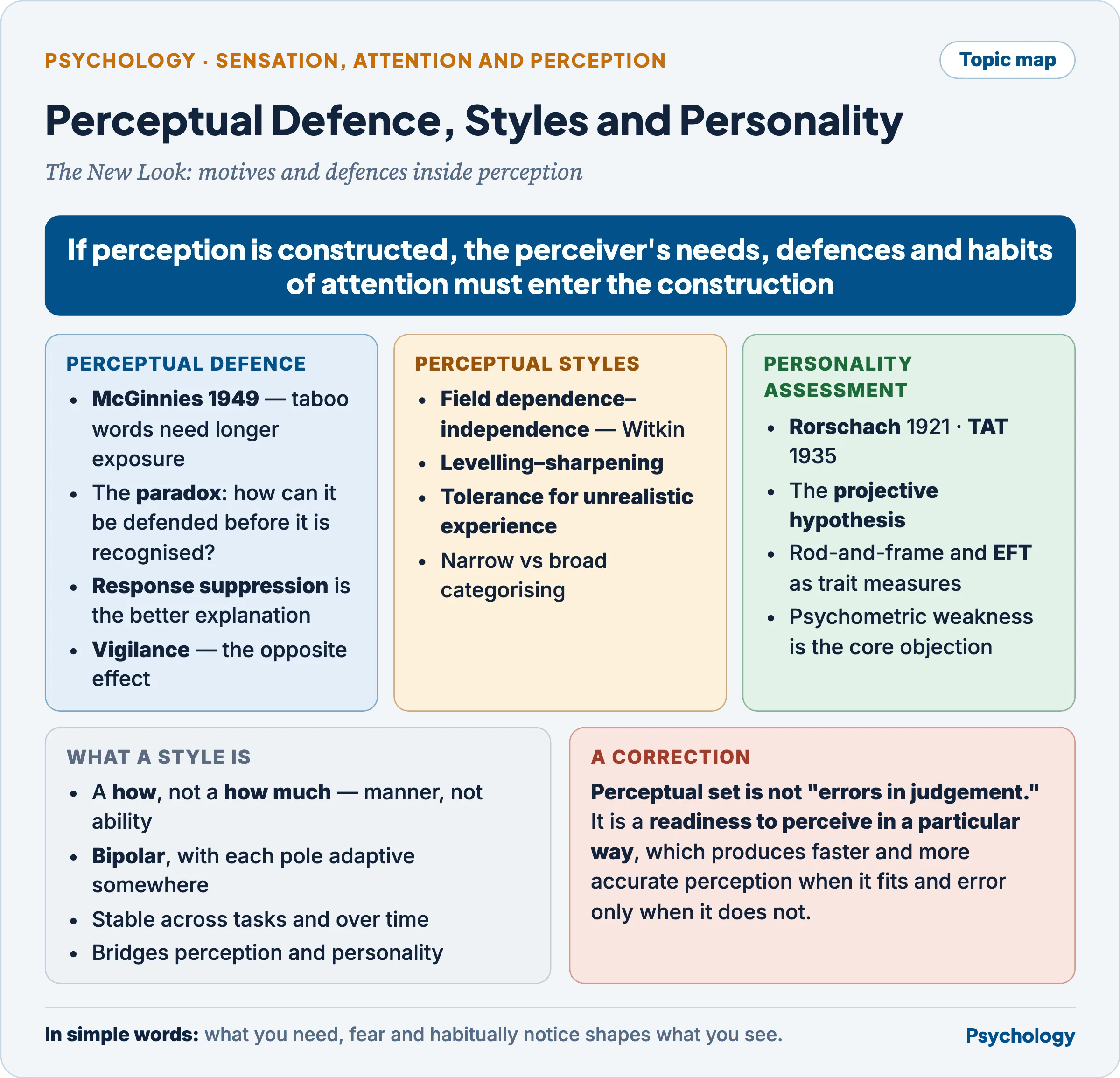
If perception is selective and set-dependent, then what a person perceives is evidence about that person. The New Look movement of the 1940s and 1950s took that inference seriously and built a research programme on it: perceptual defence, perceptual styles, and the projective test. The programme produced one of psychology’s most instructive episodes, because its central phenomenon turned out to need a very different explanation from the one it was proposed to support.
The New Look in perception
The dominant accounts of the 1930s treated perception as determined by the stimulus. The New Look asserted that it is equally determined by the perceiver’s needs, values, expectations and defences — that perception is motivated.
Its characteristic early findings were of this kind: children judged coins as larger than metal discs of the same size, and poorer children exaggerated more; hungry participants identified food words at shorter exposures than satiated ones; words associated with a person’s dominant values were recognised faster. The claim was that motivation reaches down into perception itself, not merely into what is said about it — and that claim is what the subsequent critique attacked.
Two complementary phenomena were proposed.
- Perceptual vigilance — lowered thresholds for need-relevant and emotionally significant material. We see what we are looking for.
- Perceptual defence — raised thresholds for threatening or anxiety-arousing material. We fail to see what we would rather not.
Perceptual defence: the phenomenon
Perceptual defence is the raising of the recognition threshold for stimuli that are threatening, taboo or anxiety-arousing, so that more exposure is required to identify them than neutral material of equivalent difficulty.
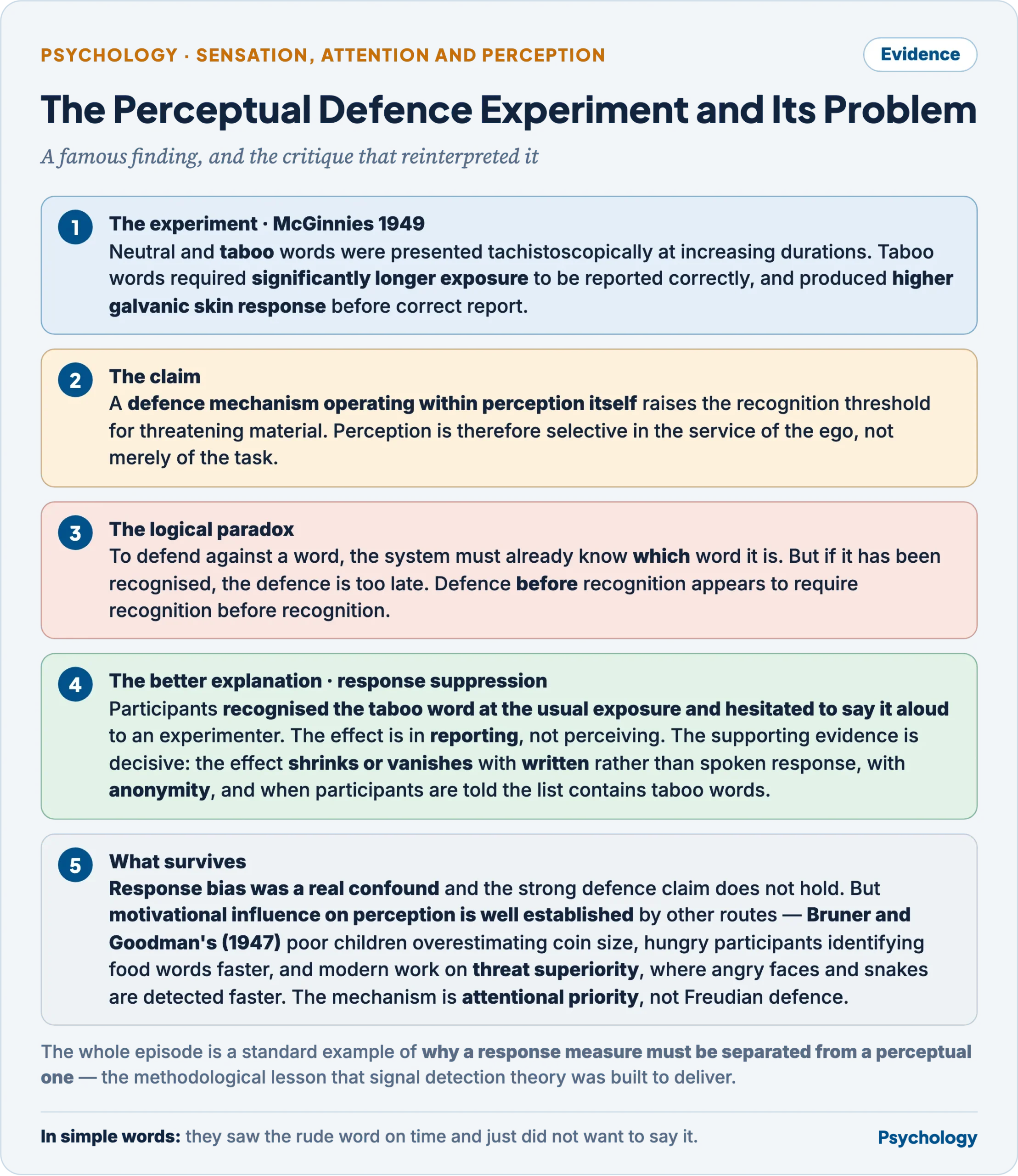
The founding study is McGinnies (1949), and its design is the model for all the experimental work on this topic.
- Apparatus. A tachistoscope, which presents a stimulus for a precisely controlled and very brief duration.
- Materials. Eleven neutral words and seven emotionally charged taboo words, presented in random order.
- Procedure. Each word was shown at a very short exposure and the duration increased in steps until the participant reported it correctly. The exposure at which correct recognition occurred is the recognition threshold.
- Simultaneous measure. The galvanic skin response (GSR) was recorded throughout, as an index of autonomic arousal, on every exposure before the one on which recognition occurred.
- Results, with sixteen observers. Recognition thresholds were significantly higher for the taboo words than the neutral words — without exception across observers. And GSR during the pre-recognition exposures was significantly greater for the taboo words.
- McGinnies’s interpretation. The participant discriminates the stimulus before consciously perceiving it, responds to it emotionally, and the resulting anxiety delays conscious recognition — a conditioned avoidance operating within perception. The pre-recognition hypotheses participants offered for taboo words were also more often nonsense or structurally unlike the target, which he read as active resistance rather than as partial recognition.
How the phenomenon can be demonstrated experimentally
The question of experimental demonstration is really a question about controls, and the design has to be stated with them.
- The tachistoscopic threshold method above is the standard, with the ascending-exposure procedure.
- Dichotic listening provides a second route: taboo material presented to the unattended ear produces autonomic response without report.
- Binocular rivalry, presenting a threatening picture to one eye and a neutral one to the other, measures which dominates awareness.
- The essential controls are what separate a demonstration from an artefact. Word frequency must be matched, since taboo words occur less often in print. Word length and structure must be matched. Response measures independent of verbal report — GSR, pupil dilation, forced-choice guessing — must be used, because the whole critique below turns on the possibility that participants perceive the word and decline to say it. Written rather than spoken report removes the embarrassment of saying a taboo word aloud to an experimenter. And participants should be blind to the purpose.
Subception, and emotion in perception
Lazarus and McCleary (1951) reported the complementary finding they named subception: participants showed elevated GSR to nonsense syllables that had been paired with shock, even on trials where they could not correctly identify the syllable. Discrimination was occurring without awareness — the autonomic system registered what consciousness did not.
The broader relationship between emotion and perception has several strands, and the question on this topic asks for them.
- Emotion lowers thresholds for emotion-relevant material. Anxious individuals detect threat words and angry faces faster, which is perceptual vigilance in its clinical form and is a maintaining mechanism in anxiety disorders.
- Emotion narrows the attended field. Under high arousal attention concentrates on the central threat at the cost of the periphery — weapon focus in eyewitness testimony, where the witness recalls the gun and not the face.
- Emotion biases the interpretation of ambiguity. The same facial expression is read differently by anxious and non-anxious perceivers.
- Emotion alters magnitude judgements. Feared objects are judged closer and larger.
- And emotion is itself perceived, through facial expression, posture and voice, with evidence for a degree of cross-cultural universality in the basic expressions.
The critique, and why it matters
Perceptual defence attracted an unusually sharp methodological critique, and the critique largely succeeded. It is the heart of any evaluation of the phenomenon.
- The response-bias objection. This is the decisive one. A participant who has recognised a taboo word may hesitate to say it to an experimenter, so the measured threshold reflects willingness to report, not perceptual sensitivity. The evidence directly supports this reading: GSR fluctuated before verbal acknowledgement, which indicates the word had been recognised at the same threshold as neutral words and the report was withheld. In signal-detection terms, the taboo words shifted the criterion, not d′ — and the classical threshold method cannot distinguish the two, which is precisely the limitation that motivated signal detection theory.
- The word-frequency objection, raised by Bruner himself and pursued by Solomon and Howes (1951) and Postman and Schneider (1951). Taboo words appear far less frequently in print, and recognition threshold is strongly determined by frequency. The apparent defence may simply be unfamiliarity. McGinnies answered that the words are common in speech and that GSR did not correlate with threshold within either word set, which is a real answer but not a complete one.
- The replication record is poor. When word frequency, length and other factors are carefully controlled, the perceptual defence effect frequently does not occur. That is the plain summary of the literature.
- The logical paradox. For the system to defend against a word’s meaning, it must first have analysed that meaning — so it must perceive the word in order not to perceive it. This is not fatal, since modern work accepts pre-conscious semantic analysis as routine, but it was a serious objection in a framework that treated perception as a single all-or-none event.
- The theoretical cost. Perceptual defence was the New Look’s strongest claim — that motivation penetrates perception itself. If the effect is response bias, then motivation is affecting report, which is far less interesting and quite compatible with a non-motivated perceptual system.
The balanced verdict: the phenomenon as originally claimed is not established; the demonstrations were confounded with frequency and response bias; and something real survives, in that pre-conscious affective processing of stimuli is now well documented by other methods. The episode’s lasting value is methodological — it showed the field that a threshold confounds sensitivity with criterion, which is one of the reasons signal detection theory was adopted so rapidly.
Perceptual styles
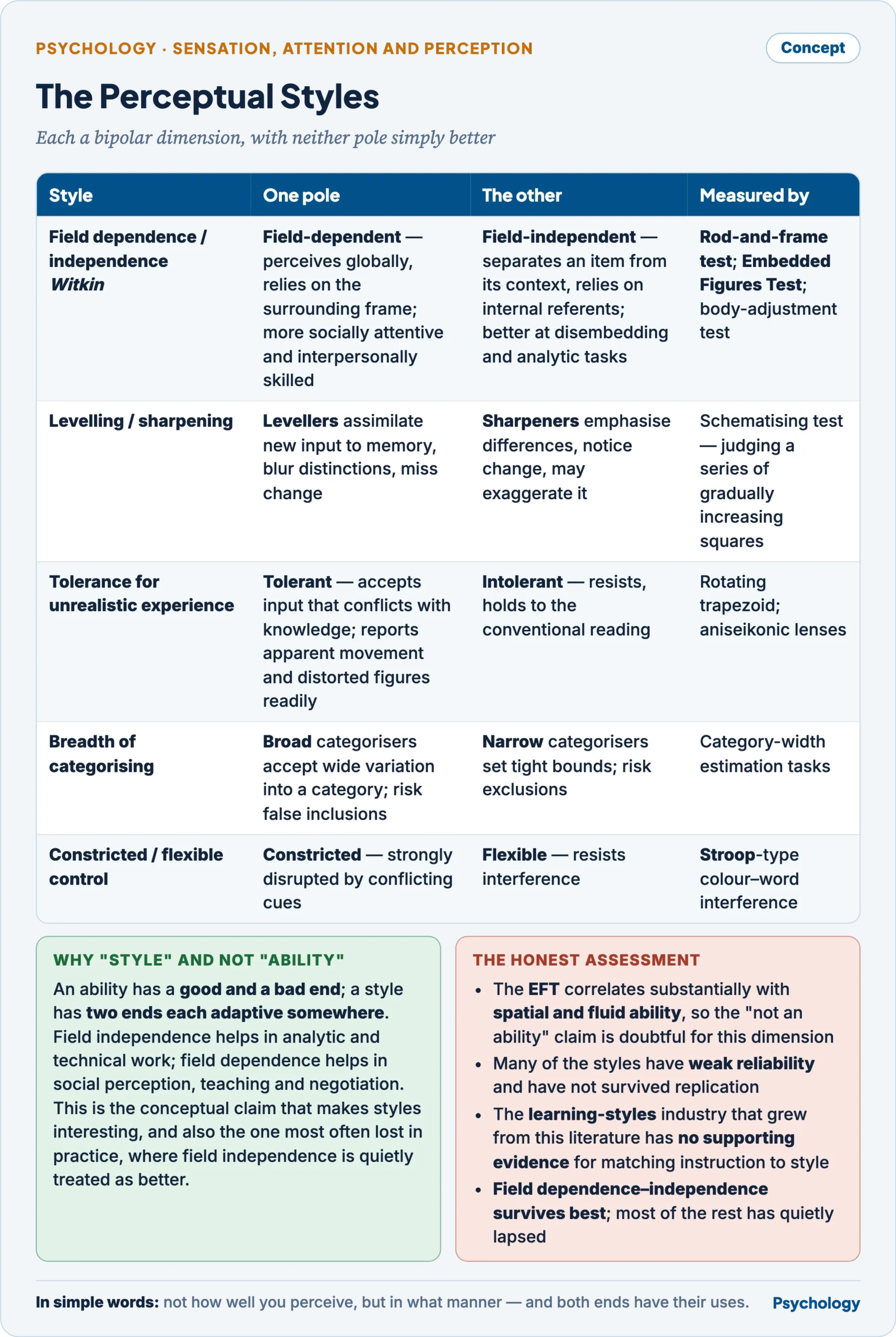
A perceptual style, or cognitive style, is a consistent individual difference in the manner of perceiving and processing information — a preferred mode rather than a level of ability. The distinction between style and ability is the whole of the controversy: a style is bipolar and value-neutral, with each pole having its own advantages, whereas an ability is unipolar, and more is better.
Field dependence–independence
Herman Witkin’s dimension is by far the most researched, and it began as a question about how people locate the upright.
- The Rod and Frame Test (RFT). In a darkened room the participant sees a luminous rod within a tilted luminous frame and must set the rod to true vertical. Field-dependent participants align the rod with the frame; field-independent participants use their bodily sense of gravity and ignore the frame.
- The Body Adjustment Test (BAT). The participant sits in a tiltable chair inside a tiltable room and must set their own body upright, again either following the room or resisting it.
- The Rotating Room Test, an elaborate centrifuge version, was abandoned on grounds of cost.
- The Embedded Figures Test (EFT). The participant must locate a simple figure concealed within a complex one. This proved the most practical measure and is what the construct is now usually assessed by.
The reconceptualisation is the theoretically important move. Witkin originally interpreted the dimension as reliance on visual versus gravitational cues. When RFT and BAT performance turned out to correlate with the EFT, he recast it more generally as disembedding ability — the capacity to separate an item from the context in which it is embedded — and then more broadly still as psychological differentiation, a dimension running through perception, personality and social behaviour.
The associated correlates, as summarised in Witkin and Goodenough (1977):
- Field-independent individuals do better at cognitive restructuring, particularly in the spatial domain; are more autonomous and internally referent; favour impersonal subjects and careers such as mathematics, engineering and the natural sciences; and are less influenced by others’ judgements.
- Field-dependent individuals show greater interpersonal competence: they attend more to social cues and faces, remember social information better, are more skilled at getting along with others, and gravitate toward people-oriented work such as teaching, nursing, counselling and sales.
That restatement is deliberate and matters. Early formulations treated field dependence as a deficit; the mature theory makes it a bipolar, value-neutral dimension in which each pole carries its own competences — which is what a cognitive style has to be if it is to be a style at all.
Other perceptual and cognitive styles
- Levelling against sharpening — whether a person assimilates new material to what is already stored, blurring distinctions, or preserves and exaggerates differences.
- Breadth of categorisation — the tendency to use wide, inclusive categories against narrow, exclusive ones.
- Scanning — the extent and systematicity of attention deployment over a field.
- Tolerance for unrealistic experience — willingness to accept percepts at variance with conventional reality, measured by susceptibility to apparent movement and similar effects.
- Constricted against flexible control — susceptibility to interference from conflicting cues, as in Stroop performance.
- Reflection against impulsivity — speed against accuracy under response uncertainty.
Evaluating styles as personality variables
The question of whether perceptual styles can properly be conceptualised as personality variables has a specific and largely negative answer.
The case in favour.
- The measures are reliable and show substantial temporal stability.
- They correlate with genuinely non-perceptual outcomes — occupational choice, social behaviour, defence preferences, response to psychotherapy — which is what a personality variable should do.
- They bridge two literatures that are otherwise disconnected, which was Witkin’s explicit ambition: to show that perception and personality are aspects of one organisation.
- They have real applied value in education, where matching instruction to style has had some success, and in occupational guidance.
The case against, which is stronger.
- Style or ability? This is the central objection. If field independence is simply spatial ability under another name, the construct adds nothing and is not bipolar. The evidence is uncomfortable: EFT and RFT scores correlate substantially with measures of spatial and fluid ability, performance improves with practice as an ability does, and the “advantages” of field dependence are inferred rather than measured by any test on which field-dependent people score higher. A genuinely bipolar dimension would have a test each pole wins.
- The measures cohere poorly. Witkin’s own early data show weak correlations between the RFT and several other supposed indicators — in one sample the correlation between RFT and resolution of auditory–visual conflict was near zero and in the wrong direction. Only the RFT and EFT survived into general use, and they are the two most similar.
- Construct drift. The dimension was redefined three times — visual–gravitational reliance, then disembedding, then psychological differentiation — each broader than the last. A construct that expands to accommodate each new correlate loses discriminant validity, and by the final version it is close to unfalsifiable.
- Confounding with intelligence and education is rarely controlled adequately, and some of the occupational correlates may be mediated entirely by general ability and schooling.
- The cognitive-styles field as a whole has not held up. Dozens of style dimensions were proposed, few replicated, and the broader “learning styles” movement that grew from it has been repeatedly found to lack evidence for its central claim that matching instruction to style improves learning.
The defensible conclusion: field dependence–independence is a robust and useful individual-difference measure whose status as a style rather than an ability is not established, and the wider attempt to found personality assessment on perceptual measures did not succeed.
Perception as a medium for studying personality
The rationale is a direct inference from the New Look. If perception is shaped by needs, values and defences, then presenting an ambiguous stimulus and recording what the person perceives should reveal those needs, values and defences — because the stimulus supplies too little structure to determine the response, so whatever structure appears must come from the perceiver. This is the projective hypothesis, and it makes perception an indirect route to material the person cannot or would not report directly.
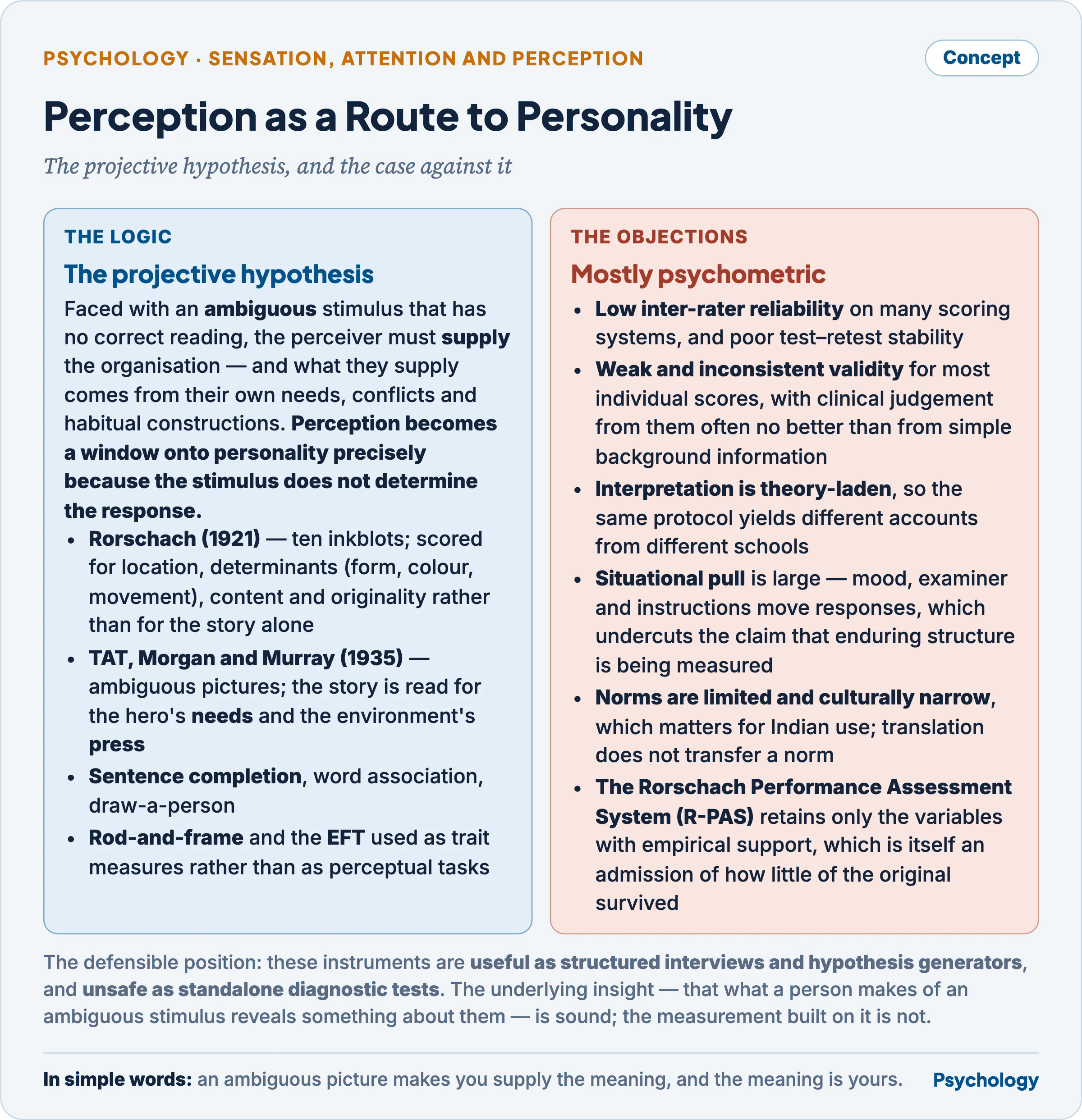
Three features give the method its appeal: it is indirect, so it bypasses deliberate self-presentation; it is unstructured, so the response is maximally determined by the respondent; and the respondent does not know what is being scored, so faking is harder than on a questionnaire.
The principal instruments.
- The Rorschach Inkblot Test (Rorschach, 1921): ten symmetrical inkblots, five achromatic and five with colour. Responses are scored not mainly on content but on determinants — whether the percept was driven by form, colour, movement or shading — on location (whole blot, large detail, small detail), and on form quality, how well the percept fits the blot’s contours. The interpretive logic is perceptual: colour-dominated responses are read as emotional reactivity, movement responses as inner life and fantasy, poor form quality as a failure of reality testing. The Rorschach is the clearest case of perception used as a personality medium, because its scoring is about how the blot was perceived rather than what was seen in it.
- The Thematic Apperception Test (Morgan and Murray, 1935): ambiguous pictures about which the respondent tells a story, scored for needs, presses and themes. More apperceptive than strictly perceptual, since the respondent constructs a narrative.
- Indian adaptations exist and matter for applied use, since the Western cards carry culturally specific content.
Major findings and their limits. The tradition produced one genuinely durable result: McClelland’s work on the need for achievement, measured by TAT-style story scoring, generated a large and productive literature on achievement motivation, including applied training programmes. Beyond that, the record is poor. The Rorschach’s reliability is weak, inter-scorer agreement varies with the system used, and validity for most of the inferences drawn from it is unsupported. The Exner Comprehensive System improved standardisation considerably, and even under it only a limited subset of indices — chiefly those bearing on thought disorder and reality testing — has acceptable validity.
The evaluation. The rationale is theoretically elegant and was a reasonable inference from the New Look; the instruments that implement it are psychometrically weak; and the parent assumption is itself in doubt, since the perceptual defence evidence suggests motivation may be affecting report rather than perception. The method’s survival in clinical practice owes more to its richness as a clinical interview aid than to its measurement properties.
Criticisms and limitations
- The New Look over-claimed and the field over-corrected. The strong motivational-penetration thesis is unsupported, but the subsequent dismissal went too far: pre-conscious affective processing is now well evidenced, and some of what the New Look claimed was right for reasons it could not have demonstrated with its methods.
- The threshold method was the root problem. Every finding in this area measured with a recognition threshold is confounded between sensitivity and criterion, which makes the entire pre-1960 literature difficult to interpret.
- Taboo-word studies are culturally and historically bound. Which words are taboo changed drastically within a generation, so the stimulus materials are not comparable across time or place and the effects should be expected to decay.
- Perceptual styles may be abilities, which would dissolve the construct.
- Projective tests have not met psychometric standards despite a century of use and repeated attempts at standardisation.
- Almost all this work is from a narrow period and place — mid-century American laboratories — and has been little replicated since, so the base of evidence is both old and thin.
Previous Year Questions
- 2018Explain and critically evaluate the phenomenon of perceptual defence.
- 2000How can the phenomenon of perceptual defence be demonstrated experimentally?
- 1999What are perceptual styles? Evaluate attempts to conceptualise them as personality variables.
- 1996Relationship between emotions and perception with special reference to perceptual defence.
- 1996Explain the rationale in using perception as a medium for studying personality. Cite major findings of research in this area.