

Factors influencing space and depth perception, size estimation.
Official Syllabus: Paper I · Unit 5 Sensation, Attention and Perception
“The problem of space perception is how we come to perceive three dimensions when the retinal image has only two.”
— George Berkeley (1709), An Essay Towards a New Theory of Vision, stating the problem the field has worked on since
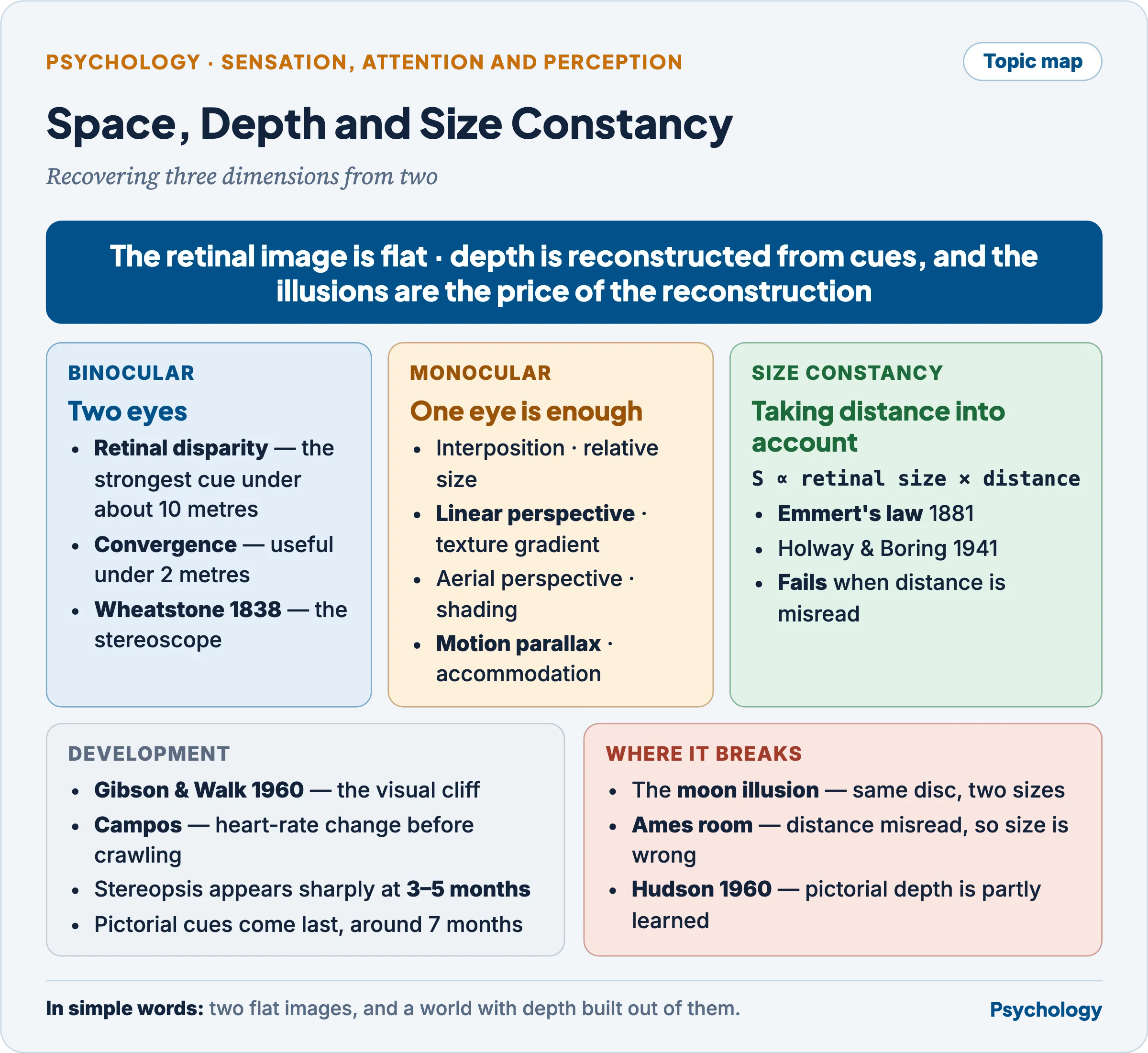
The retina is a two-dimensional surface. Distance along the line of sight is the one dimension it cannot register, because every point along a given line of sight projects to the same retinal location. Depth is therefore not sensed but inferred, from a set of regularities in the image that correlate with distance. Those regularities are the depth cues, and listing them is only the first half of the topic: the second is how they are combined, and what happens to perceived size once distance has been estimated.
The problem stated
Berkeley’s point can be put precisely. A small object near and a large object far can project exactly the same retinal image, so the image alone cannot distinguish them. The mapping from world to retina discards distance information, and the mapping cannot be inverted without additional assumptions. Everything that follows is the system’s solution to that inversion problem.
The solution has three components: monocular cues available to one eye, binocular cues requiring two, and motion-based cues requiring movement of the observer or the object. Together they are sufficient to reconstruct a stable three-dimensional layout, and the redundancy among them is why depth perception survives the loss of any one.
Monocular cues
Monocular or pictorial cues are available in a static image to a single eye, which is precisely why they are called pictorial: they are the devices a painter uses to put depth on a flat canvas.
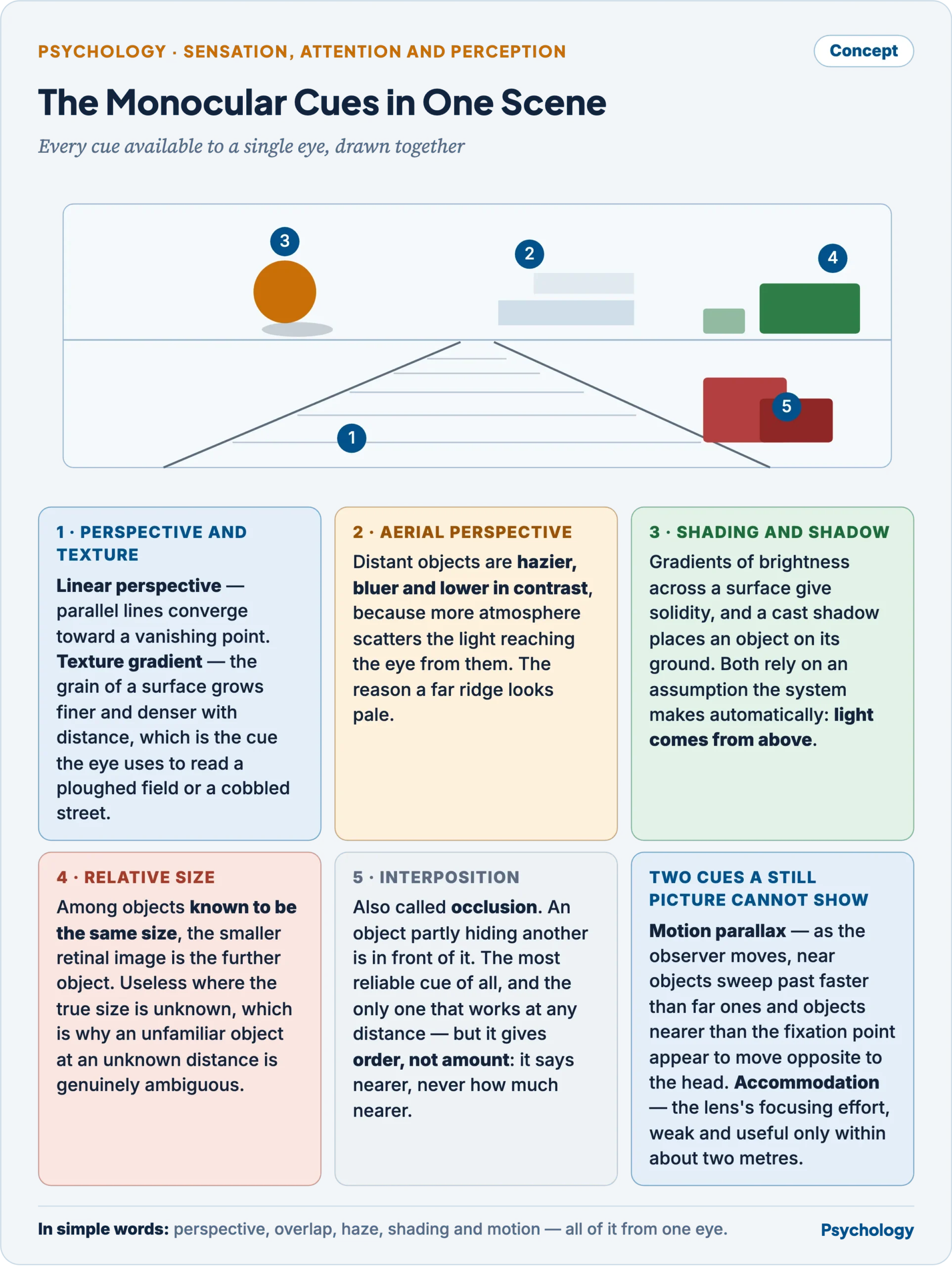
- Relative size. Where two objects are known to be of similar actual size, the one projecting the smaller image is judged further. Two people of ordinary height, one subtending half the visual angle of the other, are seen as one nearer and one further rather than as a giant and a dwarf.
- Interposition, or occlusion. An object that partly blocks another is nearer. This is the most reliable cue of all because it is almost never wrong, and it is purely ordinal — it establishes which is nearer without saying by how much.
- Linear perspective. Parallel lines converge toward a vanishing point with distance. Railway tracks and the edges of a long road are the standard illustrations.
- Texture gradient. Gibson’s contribution, and the one he regarded as fundamental. The elements of a textured surface — pebbles on a beach, tiles on a floor, a crowd in a stadium — become smaller and more densely packed with distance in a lawful way, so the gradient specifies the slant and extent of the surface continuously rather than at discrete points.
- Aerial or atmospheric perspective. Distant objects appear hazier, bluer and lower in contrast because of light scattering in the intervening air. Distant hills look blue, and on an exceptionally clear day they look closer than they are.
- Height in the visual field, or relative elevation. For objects below the horizon, those higher in the field are further; above the horizon the relation reverses. This cue is why the horizon itself is so useful a reference.
- Light and shade. Shadows and shading indicate shape and relative position, and the visual system assumes light comes from above — which is why a shaded hollow becomes a bump when the picture is inverted.
- Familiar size. Knowing an object’s actual size permits distance to be computed from its retinal size. This cue is knowledge-dependent, which makes it top-down, and it fails for unfamiliar objects.
- Accommodation. The ciliary muscles change the lens shape to focus, and the effort provides a weak distance signal. It is oculomotor rather than pictorial, and useful only within about two metres.
Motion-based cues
- Motion parallax is the most powerful monocular cue. When the observer moves, near objects sweep across the visual field faster and in the opposite direction to the movement, while far objects move slowly and in the same direction. Looking sideways from a moving train gives it in its strongest form: the fence posts rush backwards, the distant hills drift forward. Parallax yields quantitative depth over a very wide range.
- Optic flow is the whole-field pattern of motion produced by the observer’s own locomotion, radiating outward from the point being approached. Gibson identified it as the primary source of information for self-motion and heading, and it is now the basis of both animal navigation research and machine vision.
- Kinetic depth effect. A rotating three-dimensional wire figure casting a flat shadow is seen as flat when stationary and as solid immediately it rotates — motion alone creating the perception of depth.
- Motion occlusion. Textures progressively covered and uncovered at an edge as the observer moves specify which surface is nearer.
Binocular cues
- Retinal disparity, or binocular parallax, is the principal cue and the reason for having two forward-facing eyes. The eyes are about 6.3 cm apart, so each receives a slightly different view, and the difference between the two images is a precise function of distance: large for near objects, diminishing to nothing at infinity. The brain fuses the two images and computes depth from the disparity — stereopsis. The stereoscope, the 3D film and the virtual-reality headset all work by presenting each eye an appropriately disparate image, and the experience of depth from a flat screen is the demonstration that disparity alone is sufficient.
- Convergence. The two eyes rotate inward to fixate a near object and are nearly parallel for a far one, and the muscular feedback from this provides a distance signal. Like accommodation it is oculomotor and effective only at close range, within roughly ten metres and best within two.
Julesz’s random-dot stereograms settled an old question about disparity. Each eye is shown a field of random dots containing no recognisable form whatever; the two fields are identical except that a central region is shifted horizontally in one. Viewed separately each is meaningless noise; viewed stereoscopically a shape floats in depth. Since no monocular form exists to be recognised, stereopsis must operate before object recognition, not after it.
How the cues combine
The cues are not alternatives but a redundant set operating over different ranges.
- Near, within about two metres: convergence, accommodation and disparity are all strong and quantitative.
- Middle distance, to about thirty metres: disparity weakens progressively; motion parallax and the pictorial cues carry the work.
- Far, beyond thirty metres: disparity is effectively useless, and depth is carried almost wholly by the pictorial cues — which is why a landscape looks much the same with one eye closed, while threading a needle does not.
Where cues agree the percept is stable and precise. Where they conflict, the system weights them, broadly in proportion to their reliability in the circumstances, and the more reliable cue usually dominates — which is why a painting is seen as flat despite strong pictorial depth, since disparity and parallax both specify a flat surface and outvote the pictorial cues. The Ames room is the standard demonstration of what happens when a cue conflict is engineered so that the wrong cue wins.
The practical consequences are worth stating. A person with one eye retains good depth perception beyond a few metres and loses it for near manual tasks, which is why monocular vision disqualifies from some occupations and not others. And stereopsis requires both eyes to have been functional during an early critical period, which is why untreated childhood strabismus or cataract produces permanent stereoblindness even after the optics are corrected.
Size constancy and the visual angle
Size constancy is the perception of an object as unchanging in size despite large changes in the size of its retinal image. A person walking away halves their retinal image every time their distance doubles, and is not seen to shrink.
The visual angle is the angle an object subtends at the eye, and it is determined jointly by the object’s physical size and its distance: the same visual angle can be produced by a small near object or a large far one. Perceived size cannot therefore be read from visual angle alone.
The classical solution is the size–distance invariance hypothesis:
`perceived size ∝ visual angle × perceived distance`
Perceived size is the product of the retinal angle and the registered distance. Constancy follows automatically: as distance doubles the visual angle halves, the two changes cancel, and perceived size is unchanged.
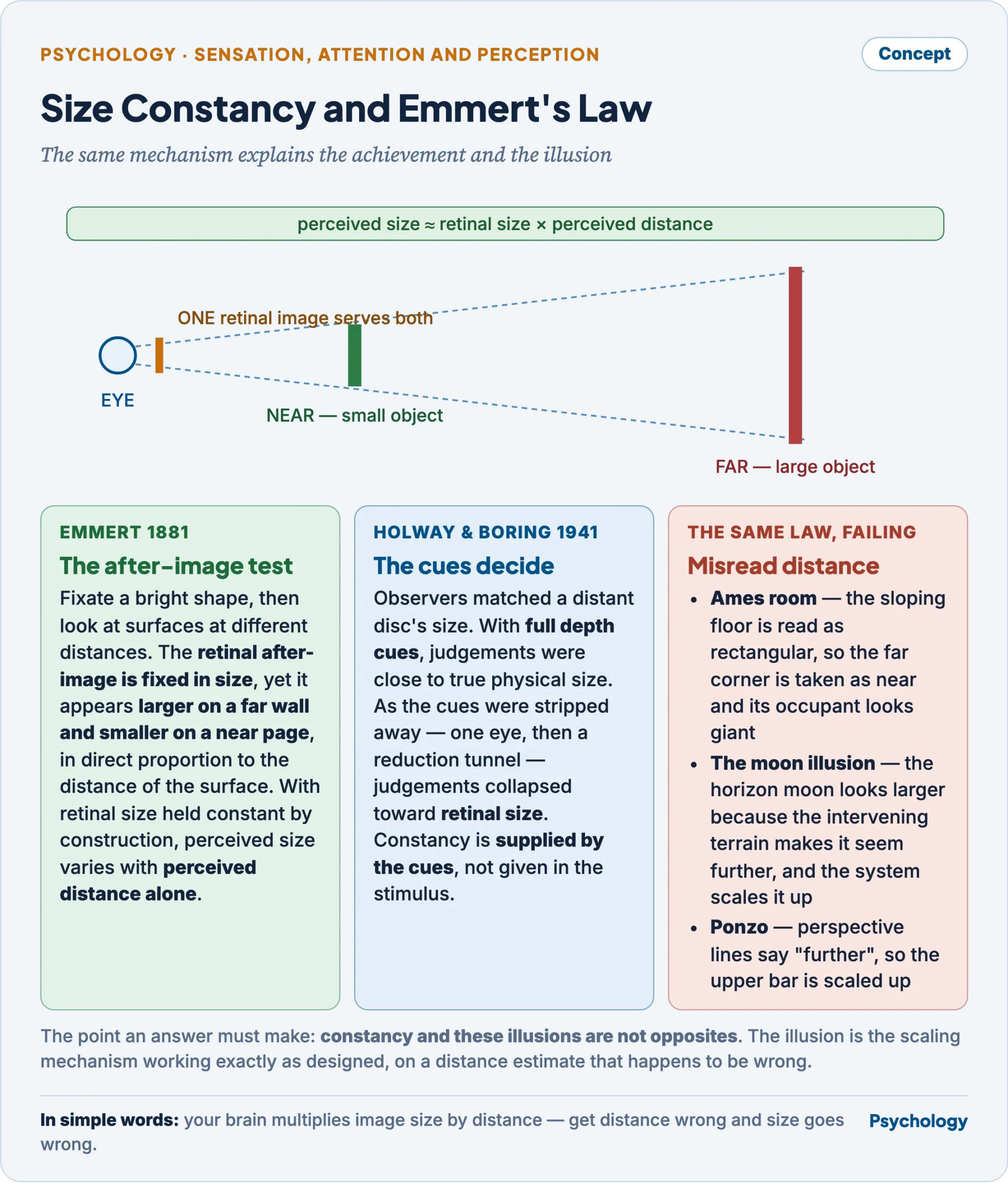
Emmert’s law is the cleanest demonstration. Stare at a bright stimulus to form an afterimage, then project it onto surfaces at different distances. The afterimage has a fixed retinal size — it is literally a patch of bleached photopigment and cannot change — yet it appears small on a near surface and large on a far wall, in direct proportion to the distance of the surface. With the retinal image held constant, perceived size varies with perceived distance alone, which is the invariance hypothesis isolated in a single observation.
Evaluating the visual-angle account
The account is necessary but not sufficient, and the evidence for that verdict is specific.
What supports it.
- Holway and Boring (1941) is the decisive experiment. Observers matched a comparison circle to test circles presented at various distances, with the test circles scaled so that every one subtended the same visual angle. Under full cue conditions the matches were close to the objects’ true physical sizes — near-perfect constancy. As cues were progressively removed — monocular viewing, then an artificial pupil to remove accommodation, then a long reduction tunnel to remove all remaining context — the matches shifted steadily toward the visual angle match. With all distance information eliminated, perceived size was governed by visual angle alone.
- That result establishes both halves of the verdict at once: visual angle is what the system has to work with, and distance information is what converts it into perceived size.
- The moon illusion and the Ponzo illusion are both explained on the same principle — identical visual angles judged against different apparent distances.
Where it is inadequate.
- It is circular as usually stated. Perceived size is explained by perceived distance, and perceived distance is in turn often inferred from perceived size via familiar size. Without an independent measure of registered distance the hypothesis cannot be tested, and in several illusions the distance said to do the explaining is not consciously perceived at all.
- Constancy is not perfect, and its error is systematic. Judgements typically fall between the true size and the visual-angle size — underconstancy — and the degree varies with instruction. Observers told to judge “actual size” show more constancy than those told to judge “apparent size”, which means a single perceptual computation is not what is being measured.
- Overconstancy occurs at large distances, where distant objects are judged larger than their physical size, which the simple product rule cannot generate.
- The Ames room directly contradicts it. The room is built with a sloping floor and a receding far corner so that both corners project the same distance cue; observers accept the false distance and perceive one person as a giant and the other as a dwarf. Perceived size follows registered distance even when registered distance is grossly wrong, which is consistent with the hypothesis — but observers continue to see the room as rectangular, so the system has chosen to sacrifice size constancy to preserve shape constancy. The hypothesis cannot say why it makes that trade.
- Relational accounts challenge it. Gibson argued that size is perceived directly from the horizon ratio and from the number of texture units an object covers, both of which are invariant with distance and require no computation of distance at all. On this account constancy needs no inference, and the laboratory conditions that produce constancy failures are precisely those in which the invariants have been removed.
- It says nothing about mechanism, being a description of the relation among three variables rather than an account of how the nervous system computes it.
The balanced conclusion: the visual-angle and size–distance framework is the correct description of the information available and of how it must be combined, is well supported by Holway and Boring and by Emmert’s law, and is incomplete — it is circular without an independent measure of registered distance, it does not predict the systematic departures from constancy, and it may be unnecessary in rich environments where relational invariants are available.
Development and evidence
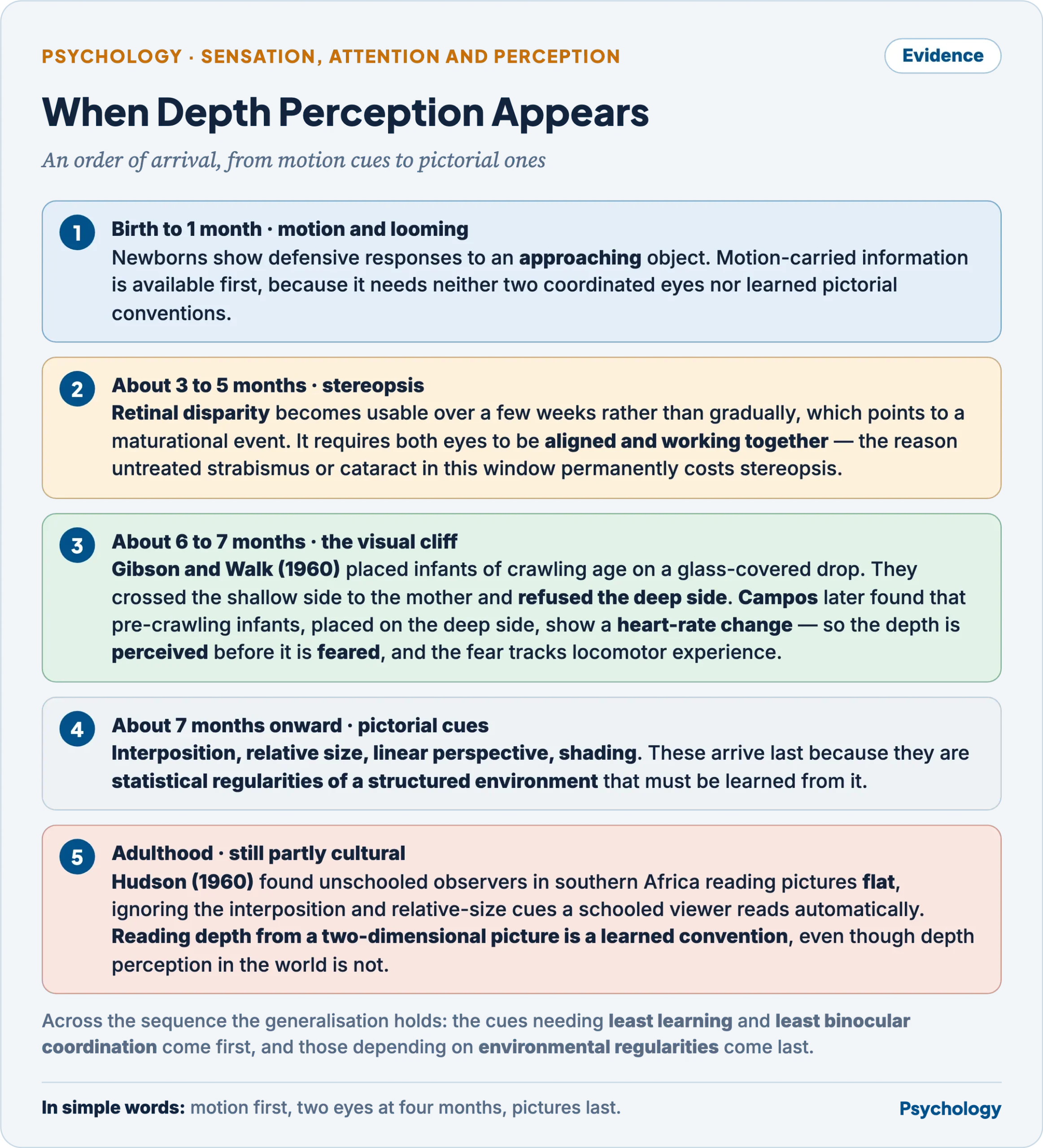
- The visual cliff of Gibson and Walk (1960) placed infants on a glass surface with an apparently deep side. Infants of crawling age refused the deep side, as did the newborn young of precocial species, indicating that depth perception is functional very early and does not require the experience of falling.
- Binocular disparity sensitivity emerges abruptly at around three to five months, rather than improving gradually, which suggests the maturation of a specific mechanism.
- Pictorial cues are used later, from about five to seven months, which fits their partly learned character.
- Cross-cultural evidence shows that reading depth in pictures is substantially learned: Hudson (1960) found that unschooled observers frequently did not interpret pictorial depth cues as intended, judging the hunter to be aiming at the distant elephant rather than the nearer antelope. Depth perception in the world is near-universal; depth perception in a flat representation of it is a learned convention.
Criticisms and limitations
- The cue list is a taxonomy, not a theory. It says which regularities correlate with distance and not how they are detected, weighted or combined, and the weighting problem is the hard part.
- Cue-combination rules are still contested. Weighted averaging by reliability fits much of the data, but cue conflicts sometimes produce a winner-take-all outcome instead, and the conditions determining which occurs are not settled.
- Almost all of the evidence is from static laboratory displays, which systematically favour the pictorial cues and underrate motion parallax and optic flow — the cues that dominate in ordinary active vision.
- The Gibson–Gregory dispute recurs here unresolved. Whether depth is computed from cues or picked up from invariants remains open, and the two accounts predict the same outcome in most ordinary conditions.
- Constancy research depends on what observers are asked. Instructions shift the results substantially, which raises the question of whether “perceived size” is a single thing at all.
- Pictorial depth is partly a cultural convention, and the Western pictorial tradition that supplies the standard stimuli encodes particular conventions of perspective that are not universal.
Previous Year Questions
- 2025What enables us to see the world in 3D despite our retinas capturing only 2D images? Explain.
- 2024How do various monocular and binocular cues help us with depth perception? Discuss with the help of examples.
- 2019How do we see the objects in three dimensions? Discuss the factors influencing the same.
- 2017How are we able to perceive the world in three dimensions when our eyes are capable of sensing only two-dimensional images?
- 2010Discuss the role of monocular and binocular cues in depth perception.
- 2009Perception of size is explained from visual angle perspective. Evaluate its adequacy.