

Perceptual organization — influence of past experiences, perceptual readiness.
Official Syllabus: Paper I · Unit 5 Sensation, Attention and Perception
“The whole is something else than the sum of its parts.”
— Kurt Koffka (1935), stating the Gestalt principle in its accurate form
The retina delivers a mosaic of independent point values. Experience delivers bounded objects standing in front of continuing backgrounds. Perceptual organisation is the name for whatever converts the first into the second, and the Gestalt psychologists’ achievement was to show that this conversion is not a minor preliminary to perception but its central problem.
The Gestalt school and what it was arguing against
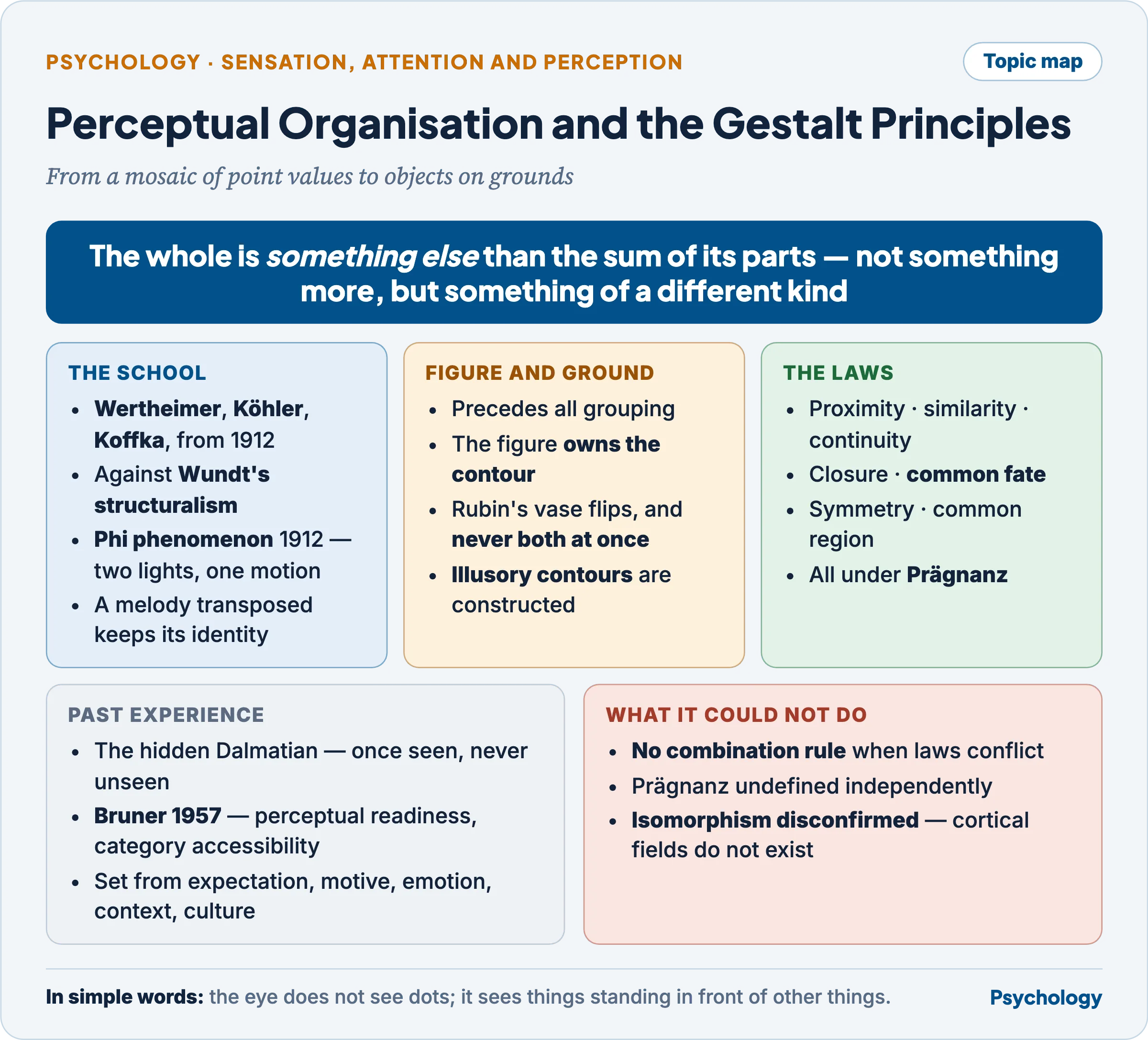
Gestalt psychology was founded by Max Wertheimer, Wolfgang Köhler and Kurt Koffka in Germany from 1912. Gestalt means form, pattern or configuration, and the school was a direct attack on Wundt’s structuralism, which sought to analyse conscious experience into elementary sensations as chemistry analyses compounds into elements.
The founding observation was Wertheimer’s (1912) study of the phi phenomenon: two lights flashed in alternation at an appropriate interval are seen as one light moving, not as two lights flashing. The motion is a property of the configuration and of nothing in the elements, since neither light moves. Structuralism could not account for it, because the experience contains something no analysis of the parts can find. Motion pictures work on the same principle.
The famous slogan is routinely misquoted. Koffka wrote that the whole is something else than the sum of its parts, not something more — the point being that the whole is of a different kind, possessing properties the parts do not have, rather than being a larger quantity of the same thing. A melody transposed into a different key retains its identity although every note has changed, which is the clearest statement of the claim.
The organising principle the school proposed is the law of Prägnanz, or the law of good figure: the perceptual field organises itself into the simplest, most regular, most stable structure the conditions permit. Every specific law below is a consequence of it.
Figure and ground
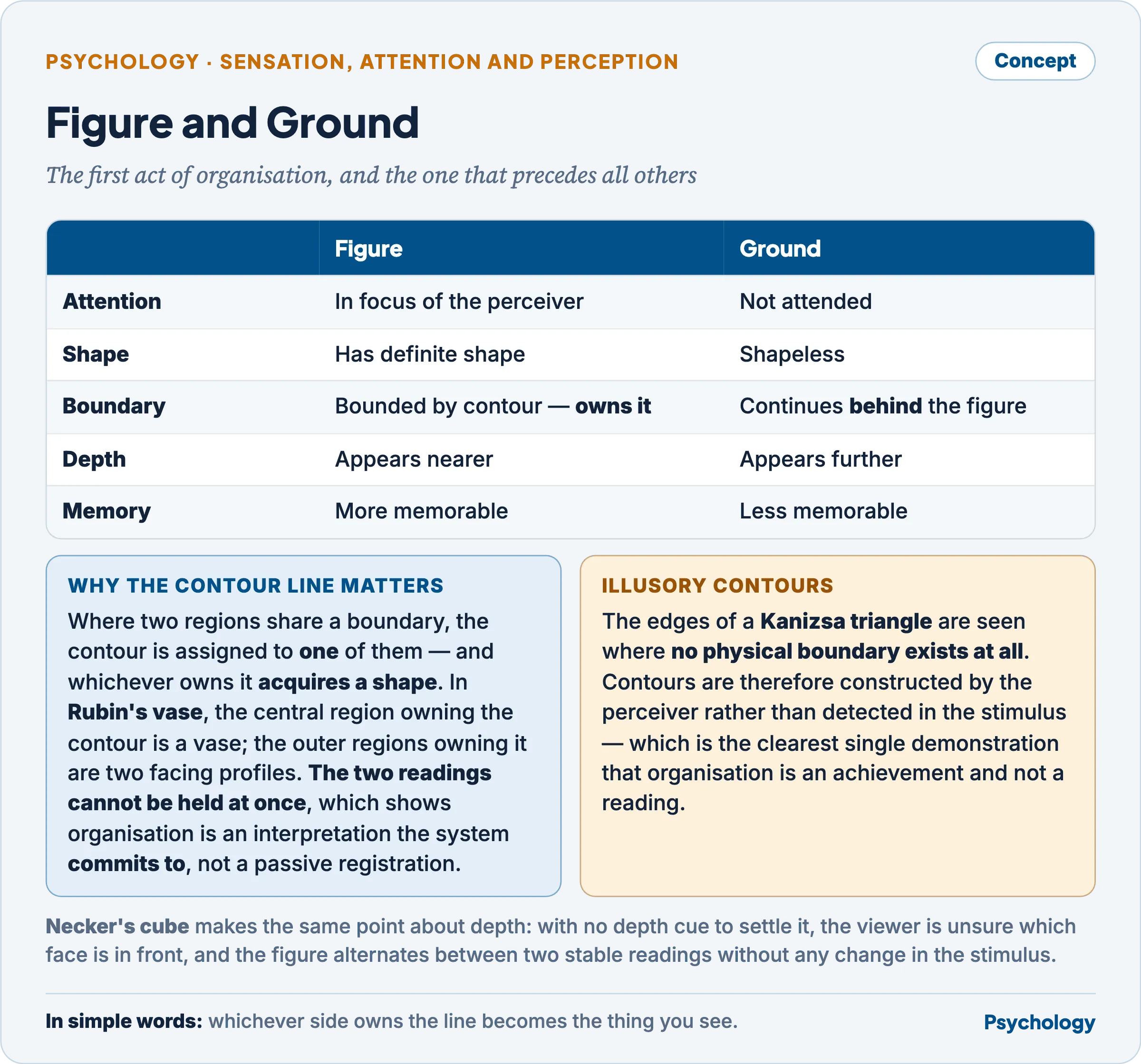
The most fundamental act of organisation is the division of the field into a figure standing out against a ground, and it precedes all the others: there is nothing to group until something has been separated from its background.
| Figure | Ground |
|---|---|
| In focus of the perceiver | Not attended |
| Has definite shape | Shapeless |
| Bounded by contour | Continues behind the figure |
| Appears nearer | Appears further |
| More memorable | Less memorable |
| Owns the contour | Does not |
The last line carries the theoretical weight. Where two regions share a boundary, the contour is assigned to one of them — and whichever region owns it acquires a shape. This is why ambiguous figures such as Rubin’s vase flip: when the central region owns the contour it is a vase, and when the outer regions own it the same contour becomes two facing profiles. The two readings cannot be held at once, which shows that organisation is an interpretation the system commits to rather than a passive registration.
Contours make the separation possible, and arise wherever there is a marked change in brightness, colour or texture. Illusory contours, such as the edges of the Kanizsa triangle, are seen where no physical boundary exists at all — a decisive demonstration that contours are constructed by the perceiver rather than detected in the stimulus.
The laws of grouping
Once figure has been separated from ground, elements are grouped, and the Gestalt laws specify how.
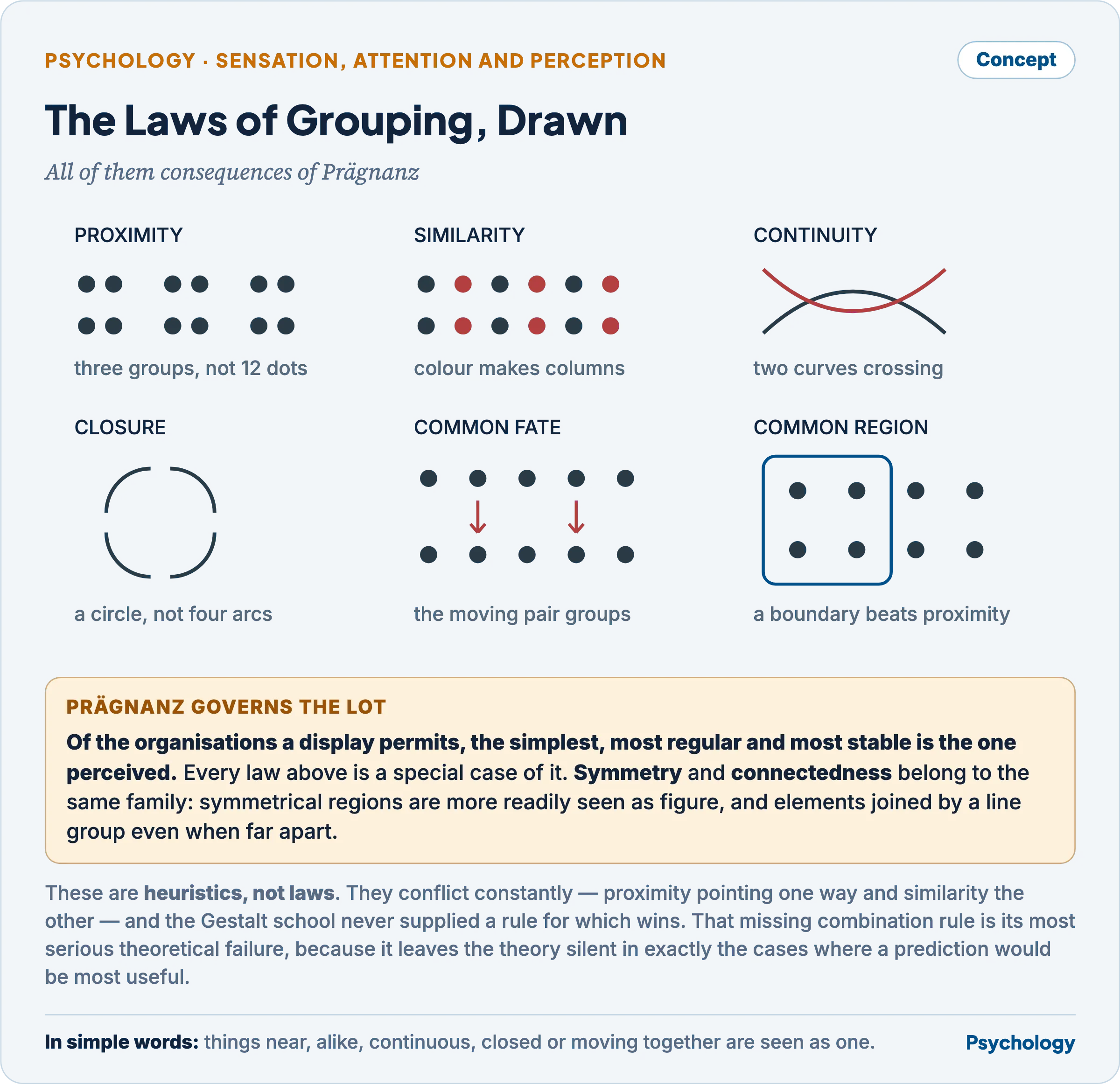
- Proximity. Elements close together are grouped. A set of dots evenly spaced is a field; the same dots with the spacing varied become rows or columns. Proximity is the strongest of the grouping factors and the easiest to use deliberately.
- Similarity. Elements alike in colour, shape, size or orientation are grouped, and similarity can overcome proximity — a grid of alternating black and white circles is seen in colour groups even though every dot is equally spaced.
- Continuity, or good continuation. Elements that fall along a smooth continuous line or curve are grouped, and the perceptual system prefers the interpretation involving the fewest abrupt changes of direction. Two crossing lines are seen as two lines passing through each other rather than as four segments meeting at a point.
- Closure. Incomplete figures are completed. A circle with gaps is seen as a circle rather than as arcs, and this is why a logo can be recognised from fragments.
- Common fate. Elements moving together in the same direction at the same rate are grouped, which is why a camouflaged animal becomes instantly visible the moment it moves. This is the most powerful of all the grouping factors.
- Symmetry. Symmetrical regions are more readily seen as figures, and symmetrical arrangements are grouped together.
- Common region and connectedness, added later, are if anything stronger than proximity: elements within a common enclosing boundary, or physically joined by a line, group together even when far apart.
- Prägnanz governs the lot: where several organisations are possible, the simplest and most regular is perceived.
A necessary qualification: these are heuristics, not laws. They describe strong regularities and they frequently conflict, and the Gestalt school never specified what happens when proximity points one way and similarity the other. That absence of a combination rule is the school’s most serious theoretical failure.
Past experience and perceptual readiness
The Gestalt school treated organisation as innate and automatic — a property of the nervous system’s self-organising dynamics, not of learning. The New Look movement of the 1940s and 1950s argued the opposite, and the truth lies between.
Past experience shapes organisation in demonstrable ways.
- Familiar configurations are easier to organise. A meaningless pattern becomes instantly organised once its identity is revealed — the classic demonstration being the high-contrast image that looks like random blotches until the hidden Dalmatian is pointed out, after which it can never be unseen. Experience has reorganised the field permanently.
- Letters, words and faces are organised as units by those with the relevant experience, and not by those without. Literacy itself changes visual organisation.
- Expertise changes what is grouped: a chess master organises a board into meaningful configurations and a novice into individual pieces, which is why the master’s recall advantage disappears for randomly arranged positions.
Perceptual readiness is Bruner’s (1957) term for the state of the perceiver prior to the stimulus. His central claim is that perception is an act of categorisation, and that the categories available to a perceiver differ in their accessibility — the ease with which they will be used. Accessibility is raised by two things: the frequency with which a category has been encountered in the past, and the current needs and expectations of the perceiver. A readied category requires less stimulus evidence to be activated, so the readied perceiver perceives faster, and also perceives wrongly more often when the readiness is misplaced.
The determinants of perceptual set are therefore:
- Expectation, which is the most powerful. Told to expect an animal, the viewer sees the ambiguous figure as a rat; told to expect a face, as a man.
- Motivation and need. Hungry participants identify food-related words faster and at shorter exposures.
- Emotion, which biases toward threat-relevant interpretation.
- Context, which is expectation supplied by the surrounding material rather than by instruction.
- Culture and past experience, which set the categories available at all.
- Instructions and suggestion, the most easily manipulated experimentally and the reason so much perceptual research requires blind procedure.
The reconciliation is that grouping is largely automatic and early; categorisation is largely learned and later. Proximity and common fate need no instruction and appear in infancy. Which object a configuration is taken to be depends entirely on what the perceiver knows.
Are the principles innate?
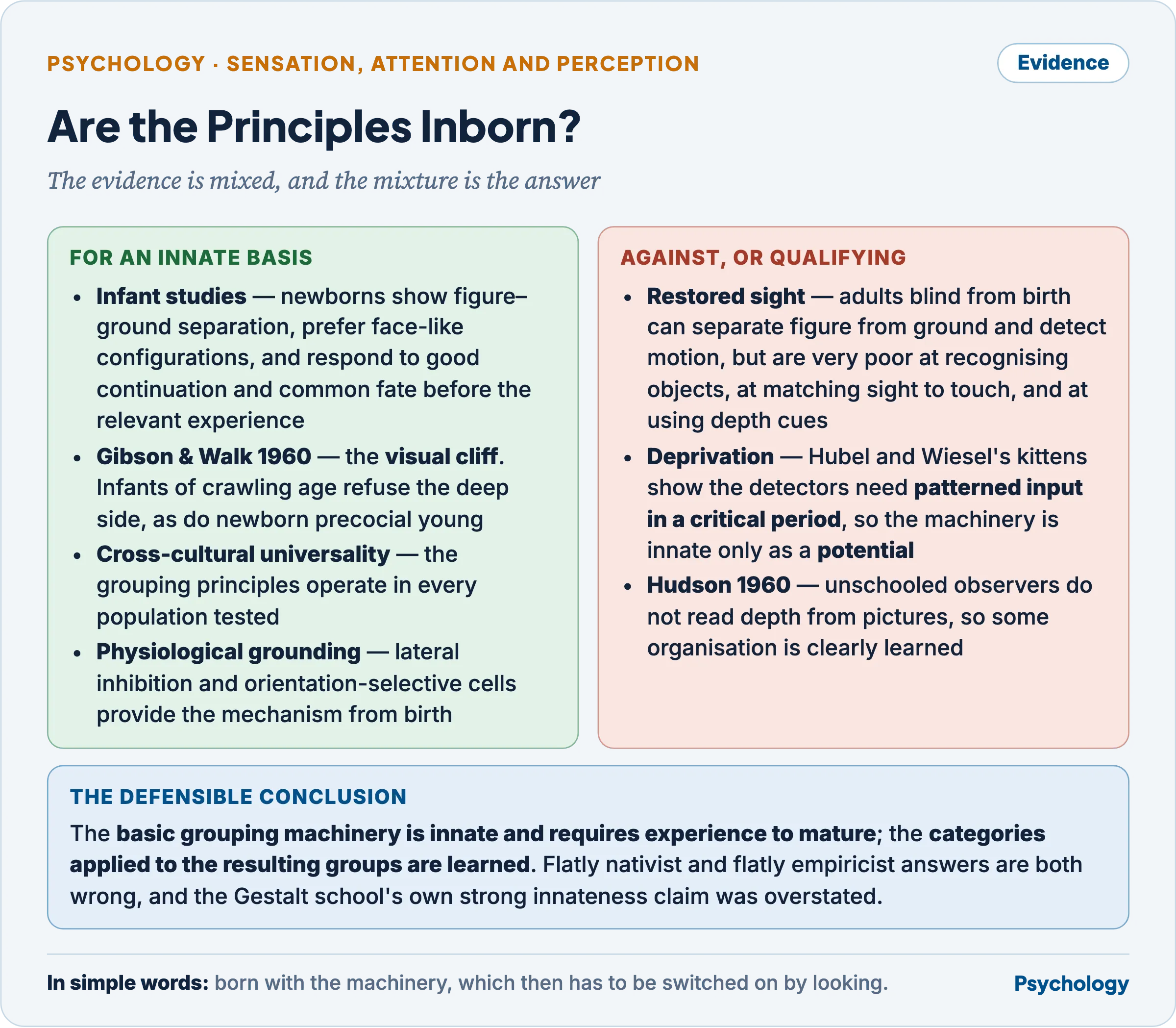
The question of whether perceptual organisation is inborn is directly examinable, and the evidence is mixed in an interesting way.
For an innate basis:
- Infant studies. Newborns and very young infants show figure–ground separation, prefer face-like configurations, and show sensitivity to good continuation and common fate well before the relevant experience could have been acquired.
- The visual cliff experiments of Gibson and Walk (1960) found that infants of crawling age, and the newborn young of precocial species, refuse to cross the apparently deep side, indicating organised depth perception at or near the start of locomotor life.
- Cross-cultural universality. The grouping principles operate in all populations tested, which would be surprising if they were learned from a particular visual environment.
- Physiological grounding. Lateral inhibition and orientation-selective cells provide a mechanism for edge extraction and grouping that is present from birth.
Against, or qualifying it:
- Restored sight cases. Adults blind from birth whose sight is surgically restored can typically distinguish figure from ground and detect motion, but are very poor at recognising objects by sight, at identifying shapes they know by touch, and at using depth cues. Something basic is given; much is not.
- Deprivation experiments. Hubel and Wiesel’s kittens show that normal development of the detectors requires patterned input during a critical period, so the machinery is innate only as a potential.
- Cross-cultural differences in pictorial depth — Hudson’s finding that unschooled observers do not read depth from pictures — show that some organisation is learned.
The defensible conclusion is that the basic grouping machinery is innate and requires experience to mature, while the categories applied to the resulting groups are learned. Flatly innate and flatly empiricist answers are both wrong.
An applied case: perceptual organisation in display design
The principles are directly usable, and air traffic control is the standard worked example because the cost of misreading a display is so high.
- Proximity groups each aircraft’s data block with its radar return, so altitude and call sign are read as belonging to that target and not to the one beside it.
- Similarity by colour and symbol codes aircraft class, altitude band or controller responsibility, allowing one category to be scanned without reading the rest.
- Common fate groups a target with its own history trail, so the direction and rate of movement are seen directly rather than computed.
- Continuity makes projected tracks and airway routes legible as paths, so a conflict between two converging aircraft is seen as a geometry rather than inferred from numbers.
- Figure–ground keeps the active targets as figure and the map, terrain and sector boundaries as a subdued ground, which is why underlying charts are rendered in low contrast.
- Closure lets a partially obscured or briefly dropped track be followed as a continuing object.
- Common region encloses the aircraft in one sector or holding stack within a boundary, grouping them regardless of screen position.
- Prägnanz, applied as a design rule, forbids visual clutter, because a crowded display will be organised by the perceptual system in ways the designer did not intend.
The general principle for any safety-critical display is that the perceptual system will group the elements whether or not the designer intends it, so the designer’s task is to ensure the groups it forms are the meaningful ones.
Criticisms and limitations
- They are descriptions, not explanations. The laws state what is grouped with what and not why. Köhler’s proposed mechanism — psychophysical isomorphism, in which electrical field forces in the brain mirror the structure of the percept — was the school’s attempt at an explanation and has been decisively disconfirmed: inserting conducting strips and insulating mica into the visual cortex of animals disrupted the supposed fields without disrupting perception.
- No combination rule. The laws conflict constantly and the theory cannot predict which wins, which makes it unfalsifiable in exactly the cases where a theory would be most useful.
- The terms are vague. “Good figure”, “simplicity” and “Prägnanz” are not independently defined, so simplicity tends to be inferred from what is perceived and then used to explain it. Later information-theoretic attempts to quantify simplicity were only partly successful.
- The evidence base was narrow. The school relied on demonstration with simple two-dimensional line drawings and on phenomenological report rather than quantitative measurement, and generalisation to natural scenes was assumed.
- The innateness claim was overstated, as the deprivation and restored-sight evidence shows.
- The school neglected what it could not accommodate. Learning, motivation and individual differences were treated as peripheral, which is precisely what the New Look movement then made central.
- Its influence nevertheless exceeds its theoretical standing, because the phenomena it identified are robust, reproducible and genuinely fundamental. Modern work on grouping, contour integration and scene segmentation is continuous with it, and interface, typographic and instrument design rest on it directly.
Previous Year Questions
- 2023Describe the factors influencing perceptual organization with reference to past experiences and perceptual readiness.
- 2022What principles of perceptual organization are useful for air traffic controllers? Also, indicate how they use each of them.
- 2019Citing examples from life situations, explain the phenomenon of perceptual organization.
- 2006Explain the concept of perceptual organization. What are the processes which influence it? Support your answer with theoretical constructs.
- 2003What is perceptual organization? Describe its various factors with the help of examples.
- 1998Do the principles of perceptual organisation point to their inborn nature? Cite experimental evidences in this context.
- 1995Evaluate critically the contribution of the Gestalt school to the development of psychology as a science with special reference to the study of perception.