

Definition and concept of perception, biological factors in perception.
Official Syllabus: Paper I · Unit 5 Sensation, Attention and Perception
“Perception is not determined simply by stimulus patterns; rather it is a dynamic searching for the best interpretation of the available data.”
— Richard Gregory (1970), stating the constructivist account of perception as hypothesis-testing
Sensation delivers a pattern of neural activity. Perception delivers a world — objects at distances, with identities and uses. The gap between them is enormous and is bridged by inference, which is why perception can be systematically wrong while sensation is functioning perfectly. Everything in this topic follows from the fact that the proximal stimulus underdetermines the distal object: infinitely many arrangements of the world could produce the same retinal image, and the system must choose one.
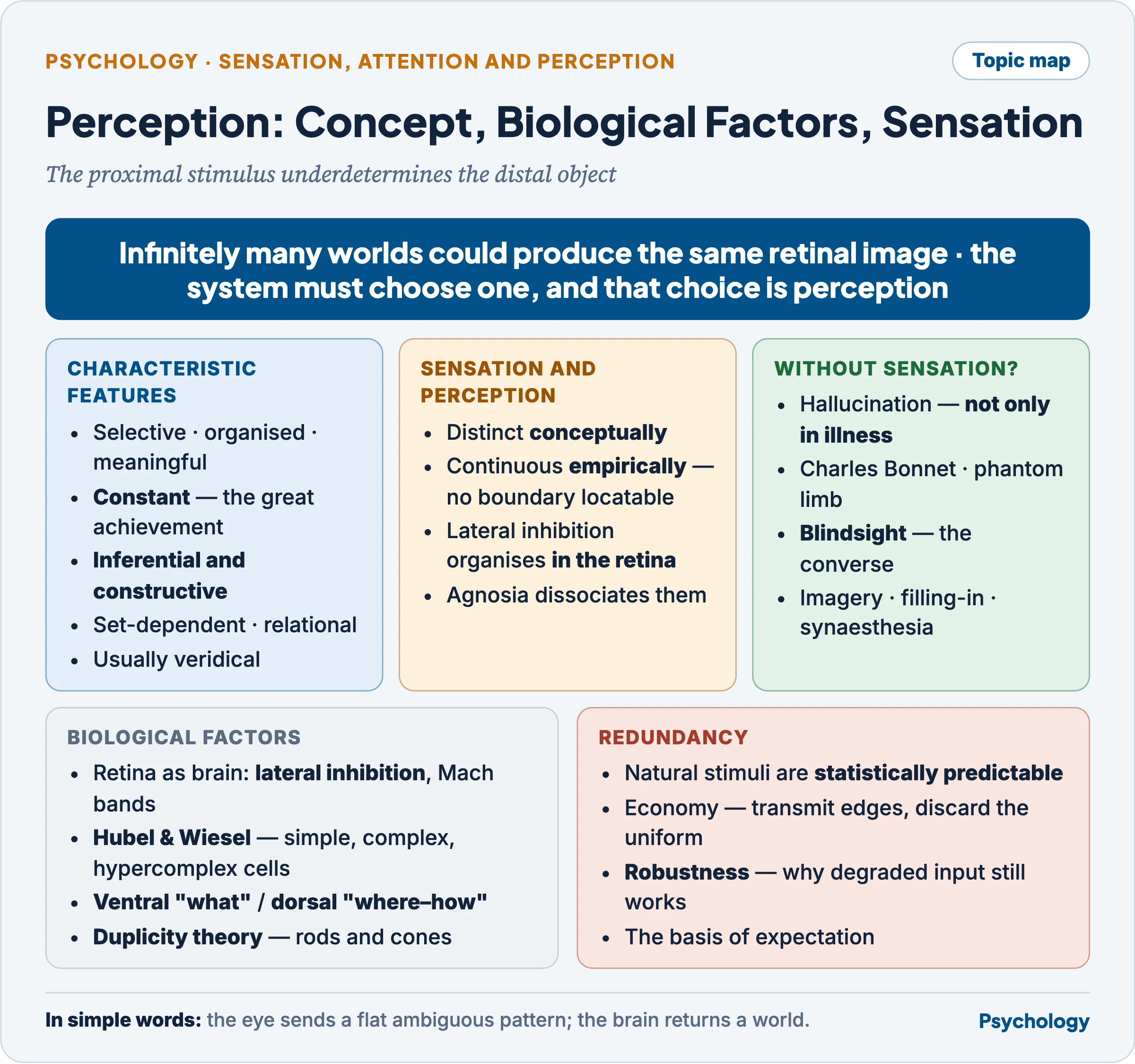
The characteristic features of perception
- It is selective. Only a fraction of available input is processed, which is attention’s contribution.
- It is organised. Input arrives as a mosaic of local values and is experienced as bounded objects on grounds, which is the Gestalt contribution.
- It is meaningful. We perceive objects and categories, not patches of light. A percept is already interpreted.
- It is constant. Objects are perceived as stable in size, shape, colour and brightness despite continuous change in the proximal stimulus. This is the achievement that makes a stable world possible.
- It is inferential and constructive. The percept goes beyond the information given, which is Gregory’s point above.
- It is set-dependent. Expectation, motive and past experience shape what is perceived, often decisively.
- It is relational. We perceive relations — figure against ground, object against frame — rather than absolute values, which is why contrast matters more than intensity throughout the senses.
- It is adaptive and usually veridical. Illusions are striking because they are exceptional; the system is right nearly all the time, and the exceptions are informative because they show the rules.
Sensation and perception: continuity or discontinuity?
The relation is genuinely contested, and the defensible answer is that the two are conceptually distinct and empirically continuous.
The case for a distinction. Sensation is the reception and transduction of physical energy by receptors; perception is the organisation and interpretation of that activity. Sensation is a bottom-up, largely passive, peripheral and modality-specific process. Perception is active, interpretive, central, and integrates across modalities and across time. Double dissociations support the distinction: in visual agnosia sensation is intact — the patient can trace an outline and match brightnesses — while recognition fails, which is perception failing with sensation preserved.
The case for continuity. No boundary can be located. Processing proceeds through many stages from receptor to association cortex with no point at which sensation ends and perception begins. Organisation starts extremely early — lateral inhibition in the retina already enhances edges, which is an organising operation performed by the sense organ itself. And top-down influences reach down to early visual areas, so even the “sensory” stages are not purely bottom-up.
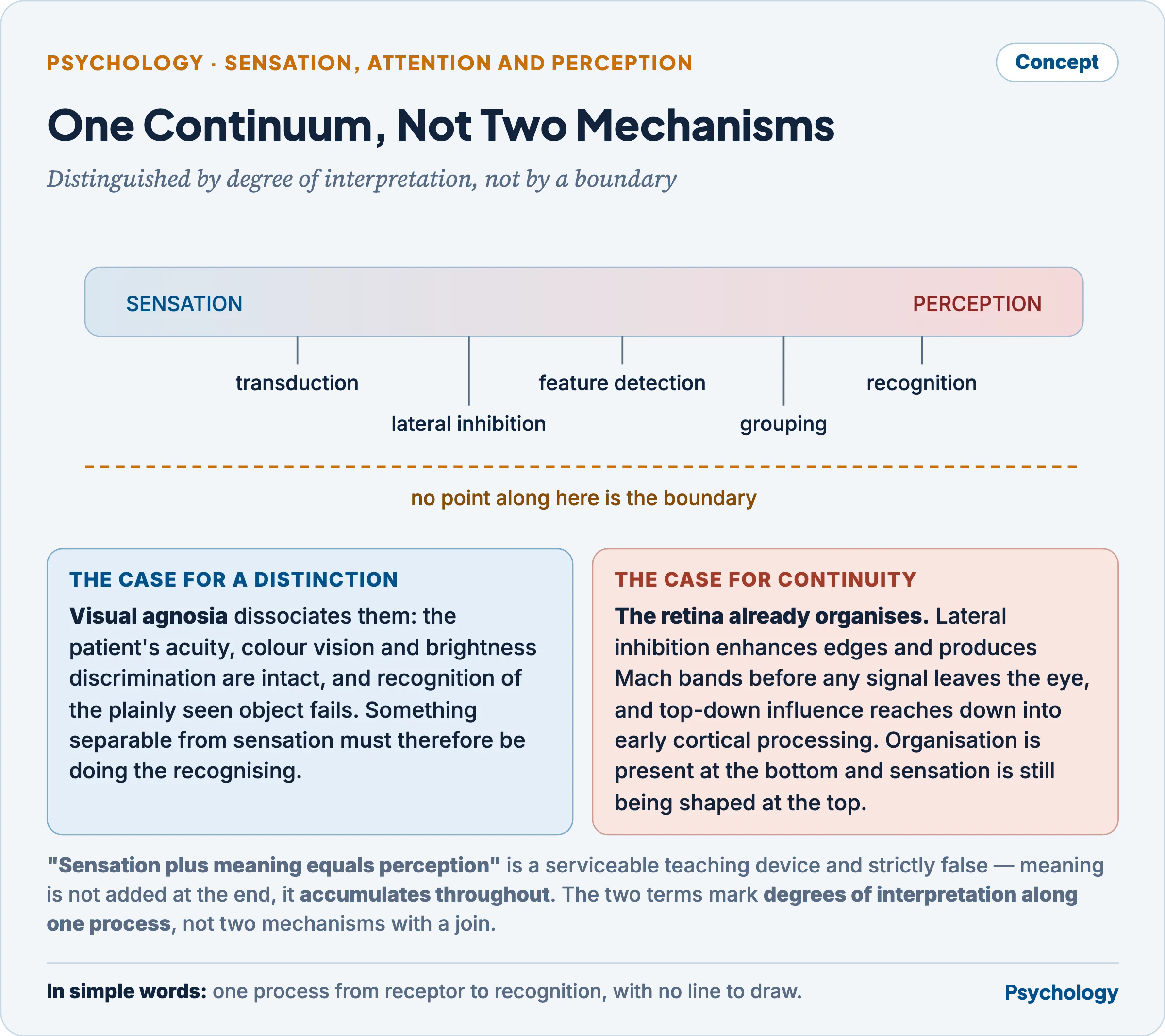
The resolution is that sensation and perception name two ends of one continuum, distinguished by degree of interpretation rather than by a boundary — useful as an analytic distinction, misleading as a claim about two separate mechanisms. The traditional formula, sensation plus meaning equals perception, is a serviceable teaching device and is strictly false, because meaning is not added at the end but accumulates throughout.
Is there perception without sensation?
Can a perceptual experience occur with no corresponding sensory input? The evidence says yes, in several forms — which is itself an argument for the constructive view.
- Hallucination is the clearest case: a full perceptual experience with no external stimulus. It occurs in psychosis, in sensory deprivation, in fever and delirium, in drug states, in bereavement, and in the hypnagogic and hypnopompic states at the edges of sleep. The important corrective is that hallucination is not confined to mental illness — healthy people in low-stimulation conditions report it reliably, which is what the deprivation experiments established.
- Charles Bonnet syndrome is the sharpest demonstration: people losing their sight experience vivid, formed visual hallucinations because input has been lost. The perceptual system, deprived of data, generates its own.
- Phantom limb is the somatosensory equivalent — a vivid and often painful experience of a limb that is not there, with no possible peripheral input from it.
- Blindsight is the converse and equally instructive: after damage to primary visual cortex, patients report seeing nothing in the blind field yet guess the location and orientation of stimuli far above chance. Here there is sensation without perception — input is processed and guides behaviour without producing conscious experience.
- Mental imagery is voluntary perception-like experience without input, and it recruits overlapping visual areas.
- Filling-in occurs constantly and unnoticed: the blind spot where the optic nerve leaves the retina receives no input at all, and the visual system supplies the missing region from its surroundings so convincingly that it is never noticed.
- Synaesthesia produces a perceptual experience in one modality from input to another — a sound reliably producing a colour.
The critical evaluation has two halves. These cases genuinely show that perceptual experience can be generated internally, which strongly supports the constructivist position that perception is the brain’s best hypothesis rather than a readout of input. But the strong claim overreaches: in every case listed the perceptual machinery was built by a lifetime of ordinary sensory input, and in several there is residual input being misinterpreted rather than none at all. The defensible conclusion is that perception requires a sensory system but not, on every occasion, a sensory stimulus.
Biological factors in perception
The pathway
Light is focused by the cornea and lens onto the retina, where photoreceptors transduce it. The retina is already a piece of brain: bipolar and ganglion cells process the signal, and horizontal and amacrine cells provide the lateral connections that produce lateral inhibition — the mechanism by which a strongly stimulated receptor suppresses its neighbours, enhancing edges and producing effects such as Mach bands. Edge enhancement, the first step of perceptual organisation, therefore happens in the eye.
Ganglion cell axons form the optic nerve, which partially crosses at the optic chiasm so that the left visual field of both eyes reaches the right hemisphere. The main route runs to the lateral geniculate nucleus of the thalamus and on to primary visual cortex (V1), with a secondary route to the superior colliculus governing orienting — and it is this second route that survives V1 damage and supports blindsight.
Feature detectors
Hubel and Wiesel, recording from single cells in cat and monkey visual cortex, found cells responding selectively to specific features rather than to light as such — simple cells responding to a bar or edge at a particular orientation and position, complex cells responding to a given orientation anywhere in their field and often to movement in a particular direction, and hypercomplex cells adding selectivity for length or corners. Their work established that the cortex analyses the image into oriented local features, and it is the physiological foundation of feature-based accounts of pattern recognition. They also demonstrated the critical period: a kitten deprived of patterned input in one eye during a specific early window permanently loses cortical representation for it, which established that the detectors require experience to develop normally.
The feature-detector framework has a known limit. Carried upward it implies cells of ever-greater specificity, ending in a single cell for each recognised object — the “grandmother cell” problem, which is implausible on combinatorial grounds. The modern view is distributed population coding: objects are represented by patterns of activity across many neurons, not by single detectors.
The two cortical streams
Beyond V1, processing divides into two broadly separable pathways, which is the single most useful organising fact about the visual brain.
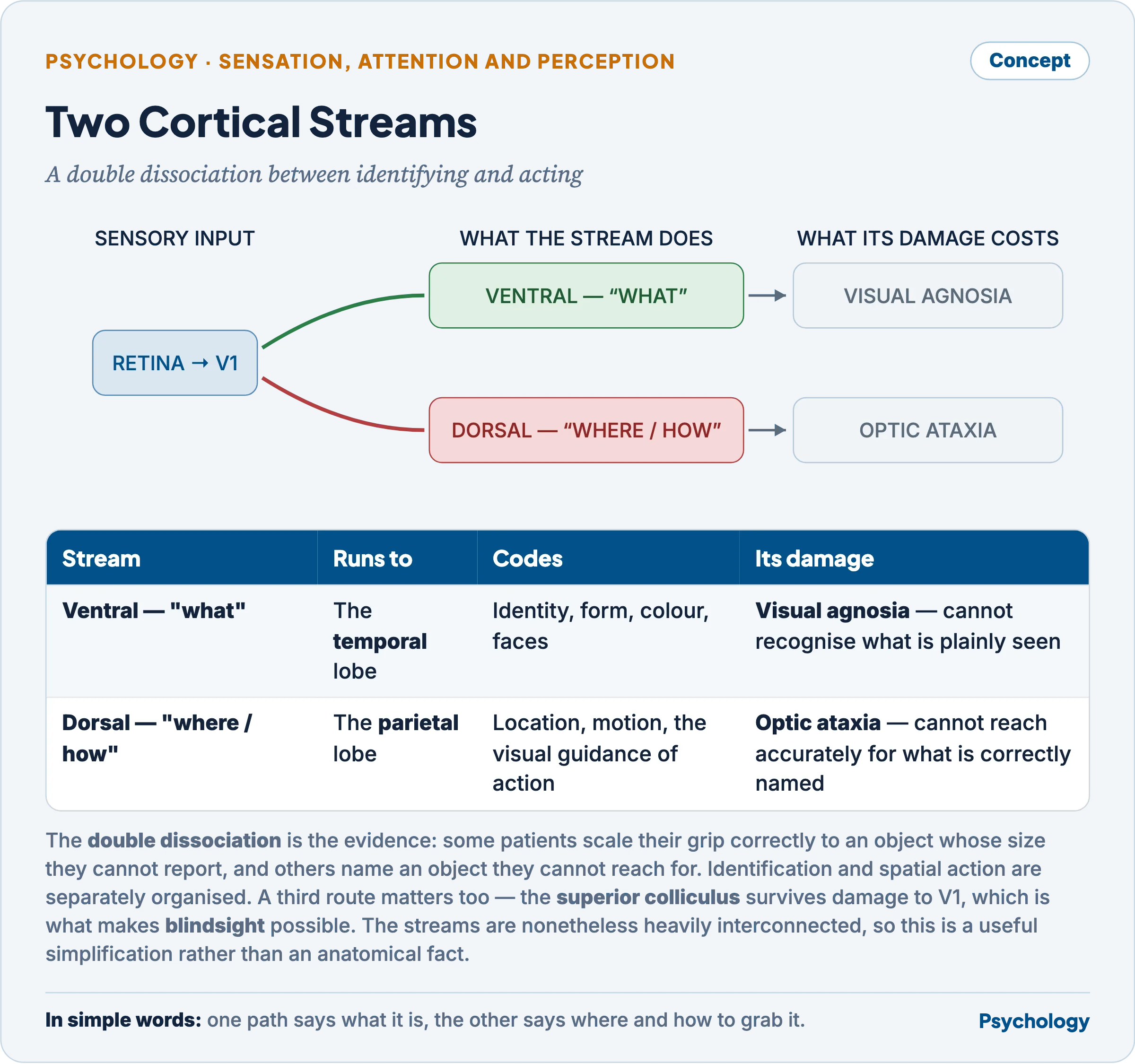
- The ventral stream, running to the temporal lobe, is the “what” pathway: object identity, form, colour, faces. Damage produces visual agnosia — failure to recognise objects that are plainly seen — and prosopagnosia, the specific failure to recognise faces.
- The dorsal stream, running to the parietal lobe, is the “where” or, in the later formulation, “how” pathway: spatial location, motion, and the visual guidance of action. Damage produces optic ataxia, failure to reach accurately for an object that is correctly recognised.
The double dissociation between these two deficits is strong evidence that identification and spatial action are separately organised, and it explains the otherwise puzzling finding that some patients can scale their grip correctly to an object whose size they cannot report.
Other biological factors
- Specialised areas exist for particular attributes: a motion-selective area whose damage produces akinetopsia, the inability to see motion as continuous, and a face-selective region in the fusiform gyrus.
- Receptor distribution shapes what can be perceived where: the fovea is dense with cones and gives high acuity in a tiny region, while the periphery is dominated by rods and gives poor acuity and good motion and dim-light sensitivity.
- Binocular structure — two forward-facing eyes with overlapping fields — is the biological precondition for stereoscopic depth.
- Neurotransmitters and drugs alter perception directly, and the perceptual distortions of hallucinogens that act at serotonergic receptors are evidence that the percept is constructed by a chemically modifiable system.
- Maturation and critical periods determine what develops: untreated congenital cataract or strabismus in early childhood produces permanent deficits even after the optics are corrected, because the cortical machinery did not develop.
The duplicity theory of vision, evaluated
Duplicity theory, proposed by von Kries (1896), holds that the retina contains two distinct receptor systems with different properties serving different conditions.
| Rods | Cones | |
|---|---|---|
| Number | about 120 million | about 6 million |
| Location | periphery; absent from the fovea | concentrated in the fovea |
| Operating range | scotopic — dim light | photopic — bright light |
| Sensitivity | very high | low |
| Colour | none — achromatic | three types, giving colour vision |
| Acuity | poor | high |
| Convergence | many rods to one ganglion cell | near one-to-one in the fovea |
| Peak sensitivity | about 500 nm | about 555 nm |
| Photopigment | rhodopsin | three cone opsins |
The experimental evidence
- The dark adaptation curve is the decisive evidence. Plotted over time in darkness, sensitivity improves in two phases separated by a distinct kink — the rod–cone break — at roughly seven to ten minutes. Cones adapt quickly and reach a modest final sensitivity; rods adapt slowly and reach a far greater one. Two curves require two systems.
- The Purkinje shift. At twilight, as vision transfers from cones to rods, the peak of spectral sensitivity moves from about 555 nm toward 500 nm, so blues and greens appear relatively brighter and reds relatively darker. A red flower and a blue flower that match in brightness at noon do not match at dusk. This follows directly from the two photopigments having different absorption spectra.
- The foveal blind spot for dim light. Because the fovea contains no rods, a very faint star disappears when looked at directly and reappears when viewed slightly to one side. Astronomers call this averted vision, and it is a direct behavioural demonstration of the anatomical claim.
- Acuity and colour vary with eccentricity exactly as the receptor distribution predicts: both are excellent at the fovea and poor in the periphery, where motion detection is correspondingly better.
- Comparative anatomy. Nocturnal animals have rod-dominated retinas and diurnal ones cone-dominated, matching the ecological prediction.
- Clinical dissociations. In rod monochromacy the patient has no functioning cones and is colour-blind, light-averse and of poor acuity; in retinitis pigmentosa rods degenerate first, producing night blindness and peripheral field loss with central vision preserved.
Evaluation
The theory is exceptionally well supported — few psychological theories have anatomical, physiological, behavioural, clinical and comparative evidence converging so completely — and it remains the correct framework. Its limitations are those of an incomplete account rather than a wrong one.
- It treats cones as one system when there are three cone types with different spectral sensitivities, so colour vision needs a further theory, which the trichromatic and opponent-process accounts supply.
- The strict dichotomy fails at mesopic levels — ordinary indoor evening light — where both systems operate together and interact, which the simple two-system statement does not accommodate.
- Rod–cone interactions occur even within the photopic range, so the systems are not as independent as the original formulation implies.
- A third photoreceptor class has since been identified: intrinsically photosensitive retinal ganglion cells containing melanopsin, which contribute little to image-forming vision but govern circadian entrainment and the pupillary reflex. Duplicity theory, being about image formation, simply does not cover them.
- It explains sensitivity and acuity well and says nothing about organisation, which is a different level of question entirely.
Redundancy and feature detectors
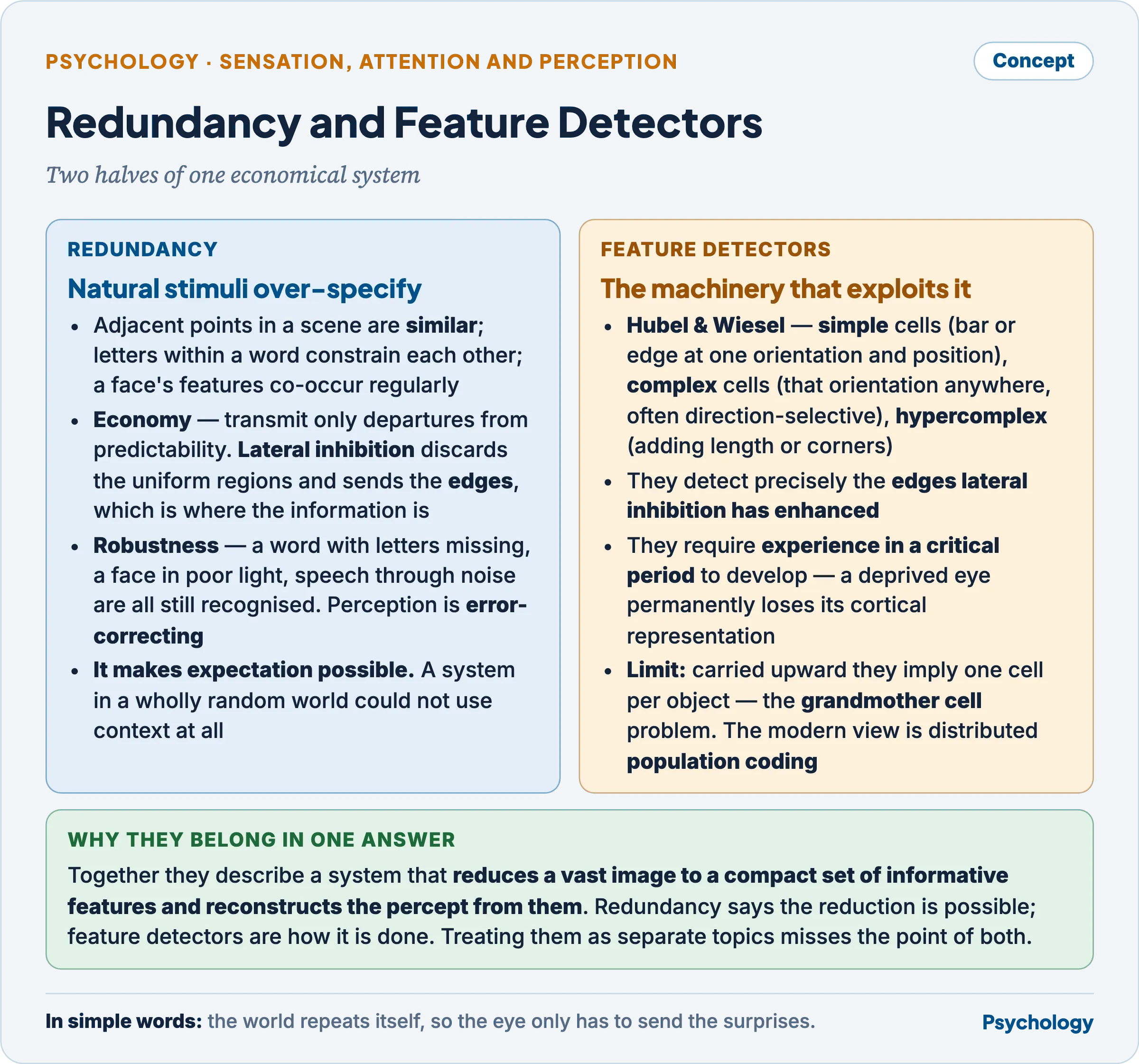
Redundancy means that natural stimuli carry far more information than is needed to identify them, because their parts are statistically predictable from one another. Adjacent points in a visual scene are similar; letters within a word constrain each other; a face’s features co-occur in regular ways.
Its significance is threefold.
- Economy. The visual system need not transmit every value, only departures from predictability. Lateral inhibition is exactly this — it discards the redundant uniform regions and transmits the edges, where the information is. This is why so much of early visual processing is edge detection.
- Robustness. Redundancy is why perception survives degraded input. A word with letters missing, a face in poor light, a sentence through noise are all still recognised, because the remaining information over-determines the answer. Perception is error-correcting, and redundancy is what makes that possible.
- It is the basis of expectation. Because the world is redundant, prediction is possible, and top-down processing has something to work with. A perceptual system in a wholly random world could not use context at all.
Feature detectors are the complementary half of the account. If redundancy means the image can be summarised by its informative features, feature detectors are the machinery that extracts them. Hubel and Wiesel’s oriented cells detect precisely the edges that lateral inhibition has enhanced. Together they describe a system that reduces a vast image to a compact set of informative features and reconstructs the percept from them — which is why both must be discussed together rather than as separate topics.
The inferential nature of perception and contextual constraints
Because the proximal stimulus underdetermines the distal object, perception must be inference — in Helmholtz’s phrase, unconscious inference. The percept is a conclusion drawn from inadequate premises, using assumptions the perceiver never consciously entertains: that light comes from above, that objects are rigid, that surfaces are continuous behind occluders.
Contextual constraints are what make the inference tractable, by narrowing the possibilities.
- Spatial context. The same grey patch appears light or dark according to its surround; the same line appears long or short according to the figure it sits in. Size constancy works by taking perceived distance into account, so context supplies the term the retinal image lacks.
- Temporal context. What preceded constrains what is perceived now, which is priming.
- Semantic context. An ambiguous shape between A and H is read as either depending on the surrounding letters, without the perceiver noticing the ambiguity.
- Expectation and set. The same drawing is seen as a rat or a man depending on what was shown before.
The force of the argument is that these constraints are not corrections applied to a percept; they are constituents of it. The perceiver has no access to an uninterpreted version, which is why illusions persist after being explained.
Person perception and object perception
Perceiving a person differs from perceiving a chair in ways that are structural, not merely a matter of complexity.
- The target has an inside. With an object, what is perceived is what there is. With a person we infer unobservable states — intentions, traits, emotions, beliefs — from behaviour, so person perception is inference about causes rather than identification of forms.
- The target is an agent who acts back. A person perceives you perceiving them and adjusts, so person perception is bidirectional and its object is partly a product of the interaction. Objects do not perform for observers.
- It is causally organised. We do not merely register behaviour; we attribute it to the person or the situation, and we do so with a well-documented bias toward the person — the fundamental attribution error.
- It is holistic and fast. Asch (1946) showed that impressions form rapidly from minimal information, that traits are integrated into a unified impression rather than listed, and that central traits such as warm or cold reorganise the meaning of everything else. Later work finds two primary dimensions, warmth and competence, underlying most impressions.
- Order matters. Asch also demonstrated the primacy effect: the same traits produce a more favourable impression presented in one order than another.
- Categories intervene. Social categories — sex, age, caste, religion — are applied automatically and bring stereotypes that fill in unobserved attributes, with no equivalent in object perception.
- It is motivated. Our goals and our relationship to the target shape what we perceive in them, in a way that perceiving a chair is not.
- Accuracy is hard to assess. For an object there is a measurable ground truth; for a person’s traits and intentions there often is none, which is why accuracy in person perception is so much harder to study.
The shared ground should also be stated: both are constructive and inferential, both use context, both show constancy — we perceive a person as the same person across moods and lighting — and both are shaped by set. Person perception is not a different faculty but the same constructive machinery applied to a target that is itself a perceiver.
Criticisms and limitations
- The constructivist account understates the richness of the input. Gibson’s direct-perception theory argues that the optic array contains far more invariant information than constructivism assumes, so that less inference is needed. The dispute is unresolved, and both sides are partly right: inference matters most for impoverished, brief or ambiguous input, and least for a moving observer in a richly textured natural scene.
- Perception-without-sensation evidence is mostly clinical and uncontrolled. Hallucination, phantom limb and Charles Bonnet syndrome are observations, not experiments, and the inference from them to normal perception is indirect.
- Blindsight is contested. Critics argue the residual performance reflects a conservative response criterion for reporting awareness rather than unconscious vision — a signal-detection objection — so the phenomenon may be degraded conscious vision rather than its absence.
- Feature-detector accounts do not scale to objects. Oriented-edge detectors are well established; how the visual system gets from them to object recognition remains unsettled, and the grandmother-cell problem shows the simple extrapolation fails.
- The two-stream account is cleaner in textbooks than in brains. The streams are heavily interconnected and both carry information of both kinds, so the what/how division is a useful simplification rather than an anatomical fact.
- Most of the evidence is visual. Perception is theorised almost entirely from vision, and the generality of its principles to hearing, touch, smell and taste is assumed far more often than tested.
Previous Year Questions
- 2022Is there perception without sensation? Evaluate critically in the light of empirical evidences.
- 2012Evaluate ‘duplicity theory’ of vision. Cite experimental evidences in support of this theory.
- 2006Is there a conceptual continuity between sensation and perception? Explain the role of contextual constraints in the inferential nature of the psychological construct of perception.
- 2005What is perception? Discuss biological factors in perception.
- 2001Discuss the characteristic features of perception and bring out the significance of redundancy and feature detectors in it.
- 2000How is perception of inanimate objects different from the person perception?