

Sensation — concepts of threshold, absolute and difference thresholds.
Official Syllabus: Paper I · Unit 5 Sensation, Attention and Perception
“The exact science of the functionally dependent relations of body and mind.”
— Gustav Fechner (1860), defining psychophysics in Elemente der Psychophysik
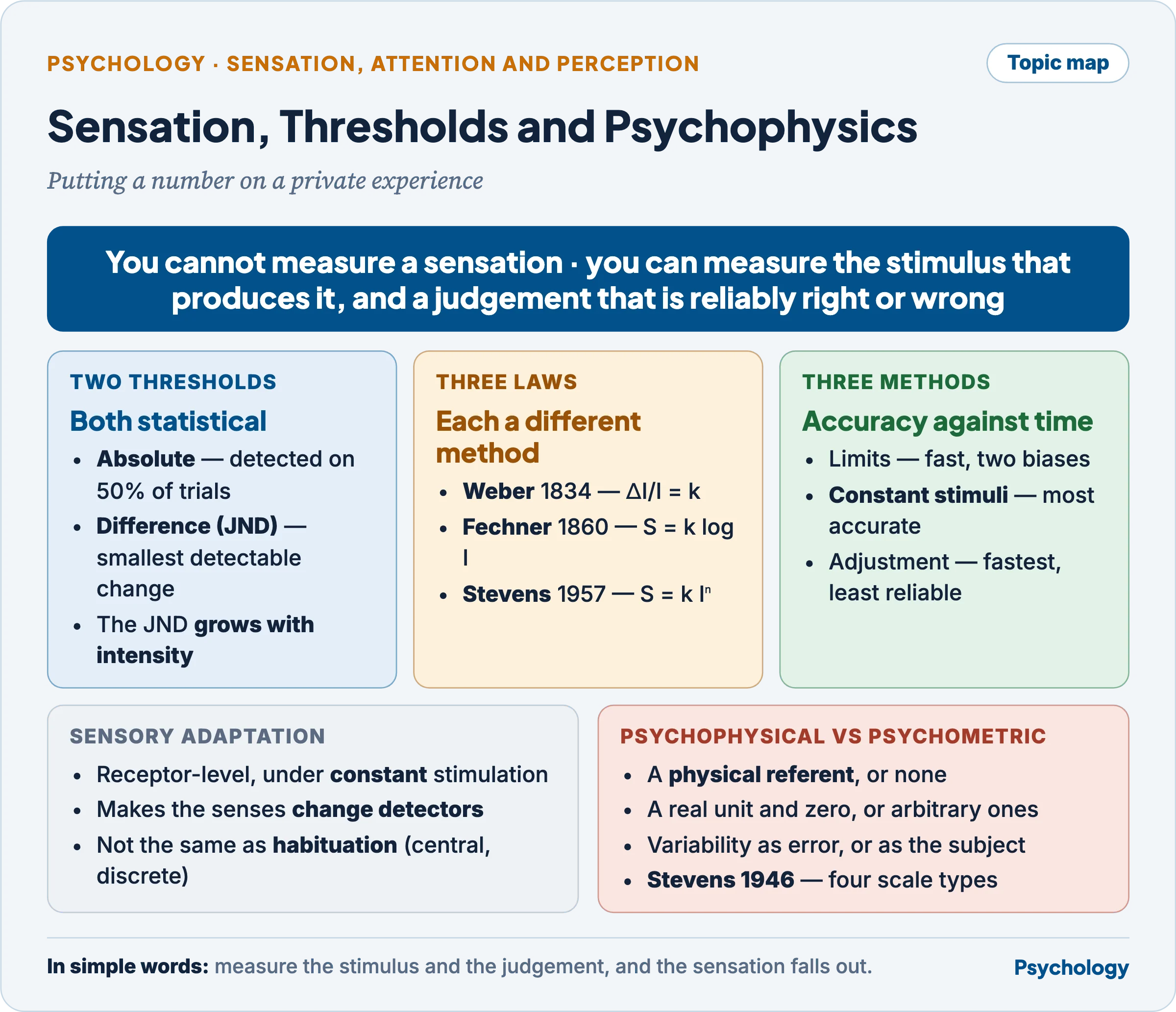
Psychophysics solved a problem that had been thought insoluble: how to put a number on a private experience. Its method is indirect and ingenious. You cannot measure a sensation, but you can measure the physical stimulus that produces it, and you can ask the observer to make a judgement that is reliably right or wrong. Relating the two gives a quantitative law without ever requiring the observer to report how strong the sensation feels in absolute terms.
Sensation, and how it becomes information
Sensation is the reception of physical energy by specialised receptors and its conversion into neural activity. Transduction is the conversion step itself, and it is what every sense organ exists to perform: the rods and cones convert light, the hair cells of the cochlea convert mechanical vibration, the receptors of the skin convert pressure and temperature.
Three properties of the resulting code matter, because every later distinction depends on them.
- Modality is coded by which pathway carries the signal, not by anything in the signal itself. This is Müller’s doctrine of specific nerve energies (1826): stimulating the optic nerve by pressure produces a flash of light, not a sensation of pressure, because the pathway determines the quality. It is the earliest demonstration that we perceive our nervous system’s activity and not the world directly.
- Intensity is coded by rate of firing and by the number of receptors recruited.
- Quality within a modality is coded by which receptor type responds — three cone types for colour, place along the basilar membrane for pitch.
Beyond the familiar five, the sensory systems include kinaesthesis (limb position from receptors in muscles and joints), the vestibular sense (balance and head orientation from the semicircular canals), and nociception (pain), which has its own receptor population rather than being an intense version of touch.
The two thresholds
Psychophysics rests on two measurements, and distinguishing them is the first thing an answer must do.
- The absolute threshold is the minimum stimulus intensity that can be detected. Because detection fluctuates from trial to trial with attention and physiological noise, it is defined statistically, by the classical convention of Fechner (1860): the intensity detected on 50 per cent of trials. The classical illustrations are a candle flame at about 30 miles on a dark clear night, the tick of a watch at 20 feet in quiet conditions, a teaspoon of sugar in two gallons of water — vivid, frequently quoted, and best presented as illustrations rather than as measurements, since they derive from idealised laboratory conditions.
- The difference threshold, or just noticeable difference (JND), is the smallest change in a stimulus that can be detected — again defined on the same Fechner (1860) convention, as the change detected on 50 per cent of trials. The stimulus you compare against is the standard; the term differential limen is the same thing.
The crucial property, and the one the laws below are built on: the difference threshold is not constant. It grows with the intensity of the standard. A candle added to one candle is obvious; a candle added to a hundred is not.
The three laws
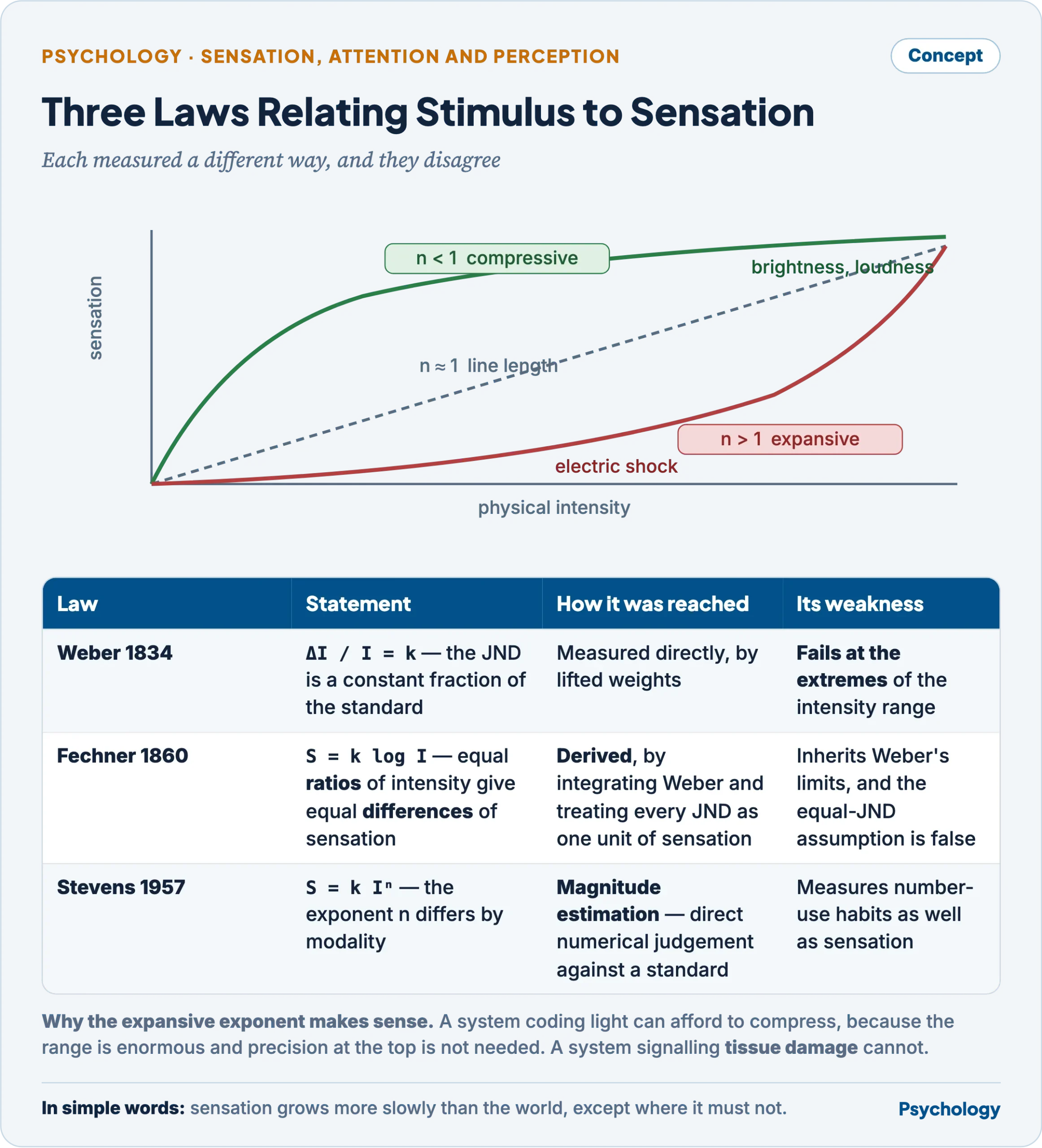
Weber’s law (1834). The just noticeable difference is a constant fraction of the standard stimulus:
`ΔI / I = k`
where ΔI is the JND, I the standard intensity, and k the Weber fraction, constant for a given sense. The fraction differs by modality — small for the senses we discriminate finely, such as pitch and brightness, and much larger for taste and smell. Ernst Weber established the law empirically by lifted weights, and the everyday consequence is immediate: a shopper notices a ten-rupee rise on a hundred-rupee item and not on a ten-thousand-rupee one, because the discriminable step scales with the base.
The law’s limit is important and examinable: it fails at the extremes of the intensity range, becoming inaccurate near threshold and near the upper limit of the receptor’s response, and holding well only across the broad middle.
Fechner’s law (1860). Fechner’s step was to treat the JND as a unit of sensation — assuming every JND is subjectively equal — and to integrate Weber’s law. The result relates sensation magnitude to stimulus intensity:
`S = k log I`
Sensation grows as the logarithm of intensity, so equal ratios of physical intensity produce equal differences of sensation. Multiplying the physical intensity tenfold adds a constant to the sensation rather than multiplying it. This is the compression that lets a sensory system handle an enormous range of physical energies — the eye operates across a billion-to-one range of light intensity — within a narrow range of neural response.
Fechner’s law is derived, not directly measured, and it inherits both of Weber’s law’s limitations and the questionable assumption that all JNDs are subjectively equal.
Stevens’s power law (1957). S. S. Stevens attacked the problem directly instead of by integration, using magnitude estimation: the observer is given a standard assigned an arbitrary number and asked to assign proportional numbers to other intensities. The relation that emerged was a power function:
`S = k I ⁿ`
The exponent n differs by modality, and its value is the law’s real content.
- n less than 1 — a compressive function. Brightness and loudness grow more slowly than physical intensity, which is why a great increase in power produces a modest increase in apparent brightness.
- n close to 1 — a roughly linear function, as for apparent length of a line.
- n greater than 1 — an expansive function. Electric shock has a high exponent, so sensation rises far faster than current. The adaptive sense of this is plain: a system that compresses light can afford to, and a system signalling tissue damage cannot.
Stevens’s law fits the data better than Fechner’s across more modalities, and the two disagree because they measure different things — Fechner builds sensation up from discrimination steps, Stevens asks for direct judgements of magnitude. Which is correct depends on whether a JND really is a constant unit of sensation, and the evidence says it is not.
The classical psychophysical methods
Three procedures measure a threshold, and each trades accuracy against time while failing in a different way.
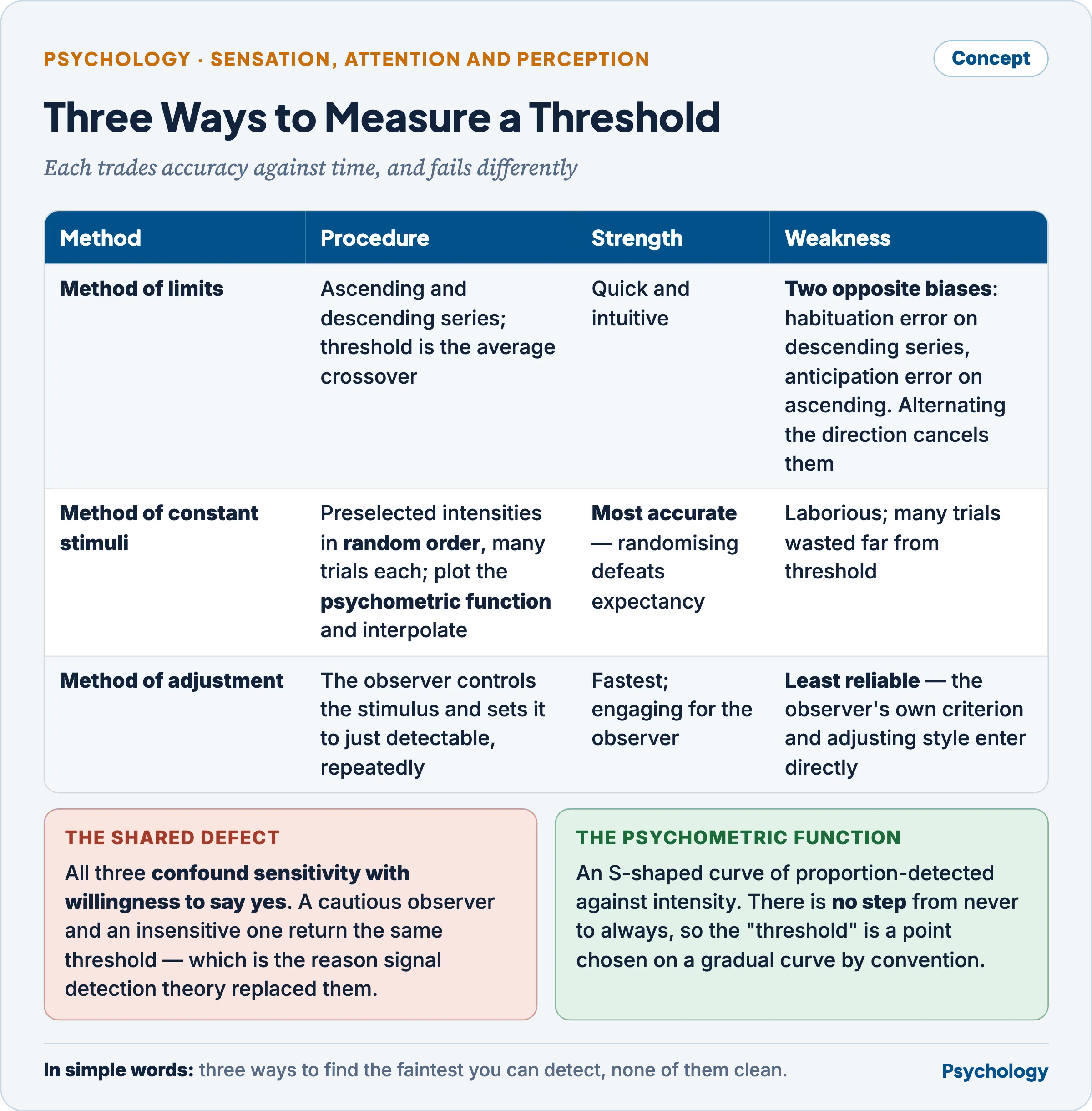
- Method of limits. The experimenter presents the stimulus in ascending and descending series, and the threshold is the average of the crossover points. It is quick and intuitive. Its weakness is two opposite biases: in a descending series the observer tends to keep saying “yes” past the real threshold (habituation error), and in an ascending series to keep saying “no” (anticipation error). Alternating the direction of the series cancels them against each other, which is why both are always run.
- Method of constant stimuli. A set of intensities chosen in advance is presented in random order, many times each, and the proportion detected is plotted against intensity to give the psychometric function — an S-shaped curve from which the threshold is read by interpolation at the Fechner (1860) 50 per cent convention. Randomising defeats the expectancy biases of the method of limits, which makes this the most accurate of the three, and also the most laborious, since many trials are wasted on intensities far from threshold.
- Method of adjustment, or average error. The observer controls the stimulus and adjusts it until it is just detectable, repeatedly; the threshold is the average setting. It is the fastest of the three and the most engaging for the observer, and the least reliable, because the observer’s own criterion and adjusting style enter directly.
The common weakness of all three is the one signal-detection theory was built to solve: each confounds sensitivity with the observer’s willingness to say yes. A cautious observer and an insensitive one produce the same threshold.
Sensory adaptation
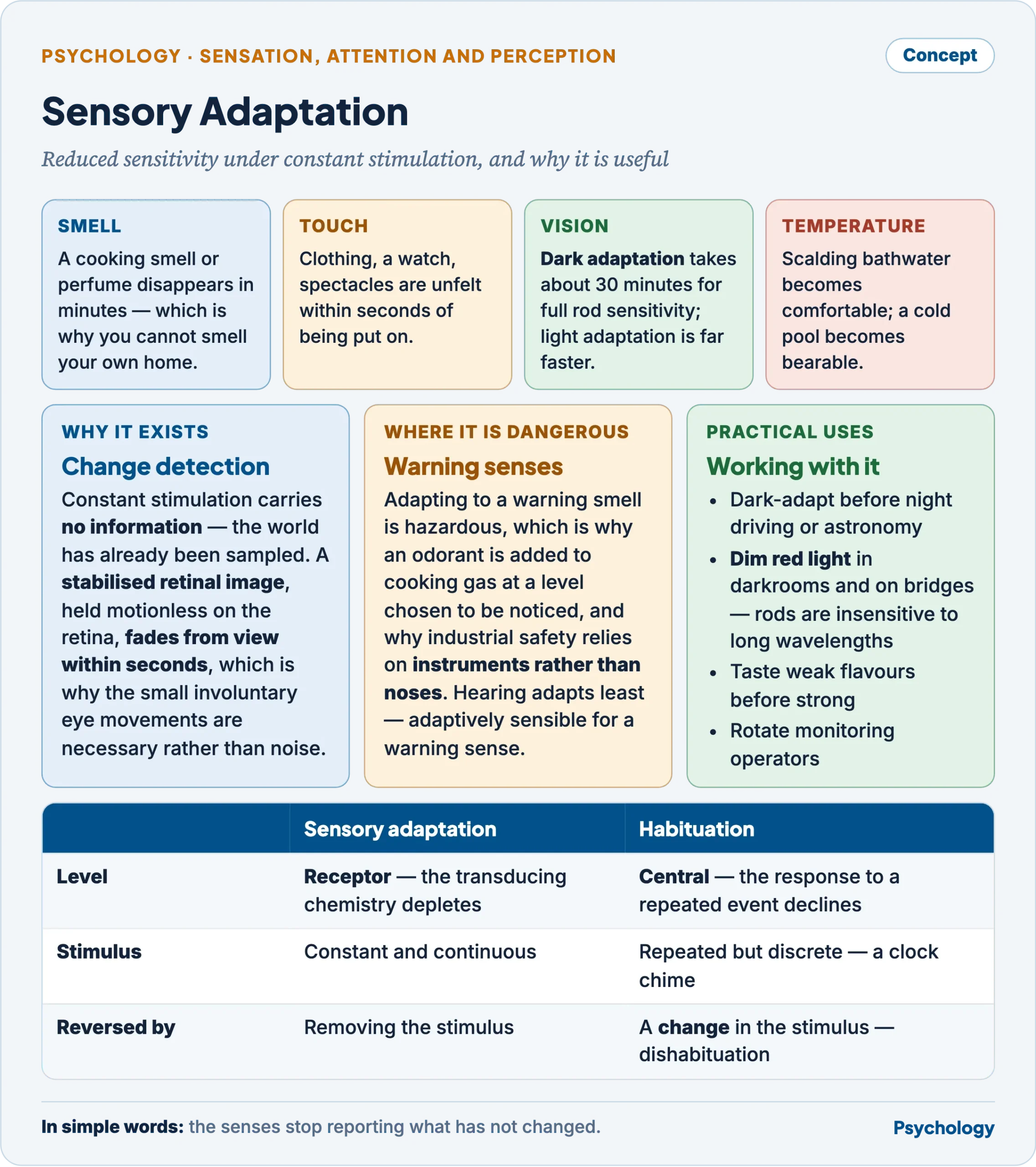
Sensory adaptation is the reduction in sensitivity of a receptor system under constant, unchanging stimulation. The mechanism is receptor-level: sustained stimulation depletes the transducing chemistry and reduces firing rate, so the response falls even though the physical stimulus has not.
The everyday instances are the content of the two questions on this topic.
- Smell. A strong cooking smell, a perfume or an unfamiliar room’s odour disappears within minutes, which is why you cannot smell your own home.
- Touch. Clothing, a wristwatch, spectacles on the nose are unfelt within seconds of being put on.
- Vision. Dark adaptation on entering a cinema takes about thirty minutes for full rod sensitivity; light adaptation on coming out is much faster. These are the most striking because the change in sensitivity is enormous.
- Temperature. Bathwater that felt scalding becomes comfortable; a cold pool becomes bearable.
- Hearing adapts least, which is adaptively sensible for a warning sense that must stay available.
Three consequences are worth stating because they turn the description into an argument.
- Change detection. Adaptation is why the sensory systems are built for it. Constant stimulation carries no information — the world has already been sampled — while change is where information lies. A perfectly non-adapting eye would be swamped by the unchanging. The stabilised retinal image experiment makes this vivid: an image held motionless on the retina by a contact-lens-mounted projector fades from view entirely within seconds, which is why the small involuntary eye movements that never stop are necessary for vision rather than noise in it.
- It frees capacity. Habituating to the constant releases attention for what has changed, which is the same economy that selective attention achieves at a higher level.
- It is not always wanted. Adaptation to a warning smell is dangerous, which is why a chemical odorant is added to cooking gas at a concentration chosen to be noticed, and why industrial safety relies on instruments rather than noses. Adaptation to a persistent noise does not protect the ear from damage, and the comfort it gives is misleading.
Practical uses follow directly: giving the eyes time to dark-adapt before night driving or astronomy; the long-standing practice of a dim red light in darkrooms and on ships’ bridges, because the rods are relatively insensitive to long wavelengths so red light preserves dark adaptation; tasting a strong flavour before a weak one; and alternating tasks to prevent a monitoring operator from habituating to the display.
Adaptation is not habituation. Adaptation is a receptor-level change in sensitivity to constant physical stimulation. Habituation is a central reduction in response to a repeated but discrete stimulus — you stop noticing a clock chime — and it is undone by a change in the stimulus (dishabituation) in a way receptor adaptation is not. Confusing the two is the commonest error on this topic.
Psychological measurement against physical measurement
The question of whether psychological attributes can be measured at all is a genuine one, and the answer distinguishes two activities that are often confused.
Physical measurement is fundamental: it rests on a concatenation operation. Two one-kilogram weights placed together balance one two-kilogram weight, so the number assigned has empirical meaning — the units are equal, the zero is absolute, and ratios are interpretable. Length, mass and time are measured this way, and other physical quantities are derived from them.
Psychological measurement has no concatenation operation. Two people with IQ 60 do not combine into one with IQ 120; two mildly anxious patients do not make one severely anxious patient. This was the substance of the Ferguson Committee, which the British Association for the Advancement of Science convened in the 1930s to ask whether sensory events could be measured at all, and which concluded that they could not, because no additive operation existed.
Stevens’s reply (1946) reframed the problem rather than solving it on the committee’s terms: measurement is the assignment of numerals to objects or events according to rule, and different rules yield different scale types with different permissible operations.
- Nominal — numerals as labels only. Jersey numbers, diagnostic categories. Permits counting and mode.
- Ordinal — rank order without equal intervals. Hardness, socioeconomic status, most rating scales. Permits median and rank correlation.
- Interval — equal intervals, arbitrary zero. Temperature in Celsius, and most psychological test scores. Permits mean and standard deviation, but not ratios: a child with IQ 140 is not twice as intelligent as one with IQ 70, because zero IQ is undefined.
- Ratio — equal intervals and an absolute zero. Length, weight, reaction time, and in psychology the magnitude-estimation scales Stevens built. Permits all operations including ratios.
Most psychological measurement is ordinal data treated as interval, which is the working compromise the field accepts and should be stated as a compromise rather than concealed.
Psychophysical and psychometric measures distinguished
Within psychology the two measurement traditions differ systematically, and the contrast is the heart of this topic.
- What is measured. Psychophysics measures a relation — between a physical stimulus and a response. Psychometrics measures an attribute of a person — intelligence, aptitude, attitude, personality.
- Is there a physical referent? This is the fundamental difference. In psychophysics the stimulus exists independently and is measurable in physical units — candelas, decibels, grams — so the independent variable is specified before any psychology is done. In psychometrics there is no physical referent at all: no instrument measures intelligence the way a photometer measures luminance, and the attribute is accessible only through the responses taken to indicate it.
- The unit. Psychophysics has a non-arbitrary unit, the JND or a ratio scale from magnitude estimation. Psychometrics has an arbitrary unit defined by the test’s own distribution — an IQ point exists because the scale was set to a mean of 100 and a standard deviation of 15.
- The zero. Psychophysics has a meaningful zero, the absence of the stimulus. Psychometrics has no true zero: a score of zero on an arithmetic test means the items were too hard, not that arithmetic ability is absent.
- Where variability is the subject. Psychophysics treats individual differences as error to be averaged away, since it seeks a general law of the sensory system. Psychometrics treats individual differences as the object of study — the whole purpose is to place people relative to one another.
- What makes a measure good. Psychophysics relies on experimental control and the physical calibration of the stimulus. Psychometrics has had to build an entire apparatus to compensate for having no physical anchor: reliability, validity, standardisation and norms. The elaborateness of psychometric theory is a direct consequence of the missing physical referent.
- The resulting scale. Psychophysical scales can reach ratio level. Psychometric scales are in practice ordinal or interval.
The honest conclusion is that both are measurement in Stevens’s sense and only one is measurement in the physicist’s sense, and that psychometrics compensates for the gap with construct validation rather than closing it. Fechner’s achievement was to find the one corner of psychology where a physical referent exists, and the subsequent history of psychometrics is the attempt to measure everywhere else without one.
Criticisms and limitations
- A convenient fiction. The classical threshold is one: There is no intensity below which detection never occurs and above which it always does; the psychometric function is a gradual curve, and the “threshold” is a point chosen on it by convention. Signal-detection theory abandons the concept entirely, replacing it with sensitivity and criterion, and does so because the classical methods cannot separate the two.
- Failure at the extremes. Weber’s law breaks down there, and Fechner’s law inherits the failure along with the unproven assumption that all JNDs are subjectively equal.
- Fechner and Stevens cannot both be right. The dispute remains unresolved because the two methods operationalise sensation differently. The power law fits more modalities; the logarithmic law has the better claim to a mechanism.
- Number use, not only sensation. Magnitude estimation measures both. Observers have habits and biases in assigning numbers, and the exponent obtained can be shifted by the range of stimuli presented and by the standard chosen.
- The famous illustrations are not measurements. The candle at thirty miles derives from ideal conditions with dark-adapted observers, and repeating it as fact overstates what was shown.
- Narrow by construction. Its rigour comes from confining itself to stimuli with a measurable physical dimension, which leaves out most of what psychology wants to know. The precision is real and so is the restriction, and treating psychophysics as the model for all psychological measurement is what the Ferguson Committee’s objection was really about.
Previous Year Questions
- 2014Explain the concept of ‘sensory adaptation’ and discuss its uses in day-to-day life.
- 2010What is sensory adaptation? Explain with examples.
- 1996How is psychological measurement different from measurement in physical sciences? Giving appropriate illustrations, distinguish clearly between psycho-physical and psychometric measures.