

Life span development — characteristics, development tasks, promoting psychological well-being across major stages of the life span.
Official Syllabus: Paper I · Unit 4 Development of Human Behaviour
“Successful aging [involves] freedom from disease and disability, high cognitive and physical functioning, and social and productive engagement.”
— Rowe and Kahn (1987), replacing the absence of illness with a positive criterion
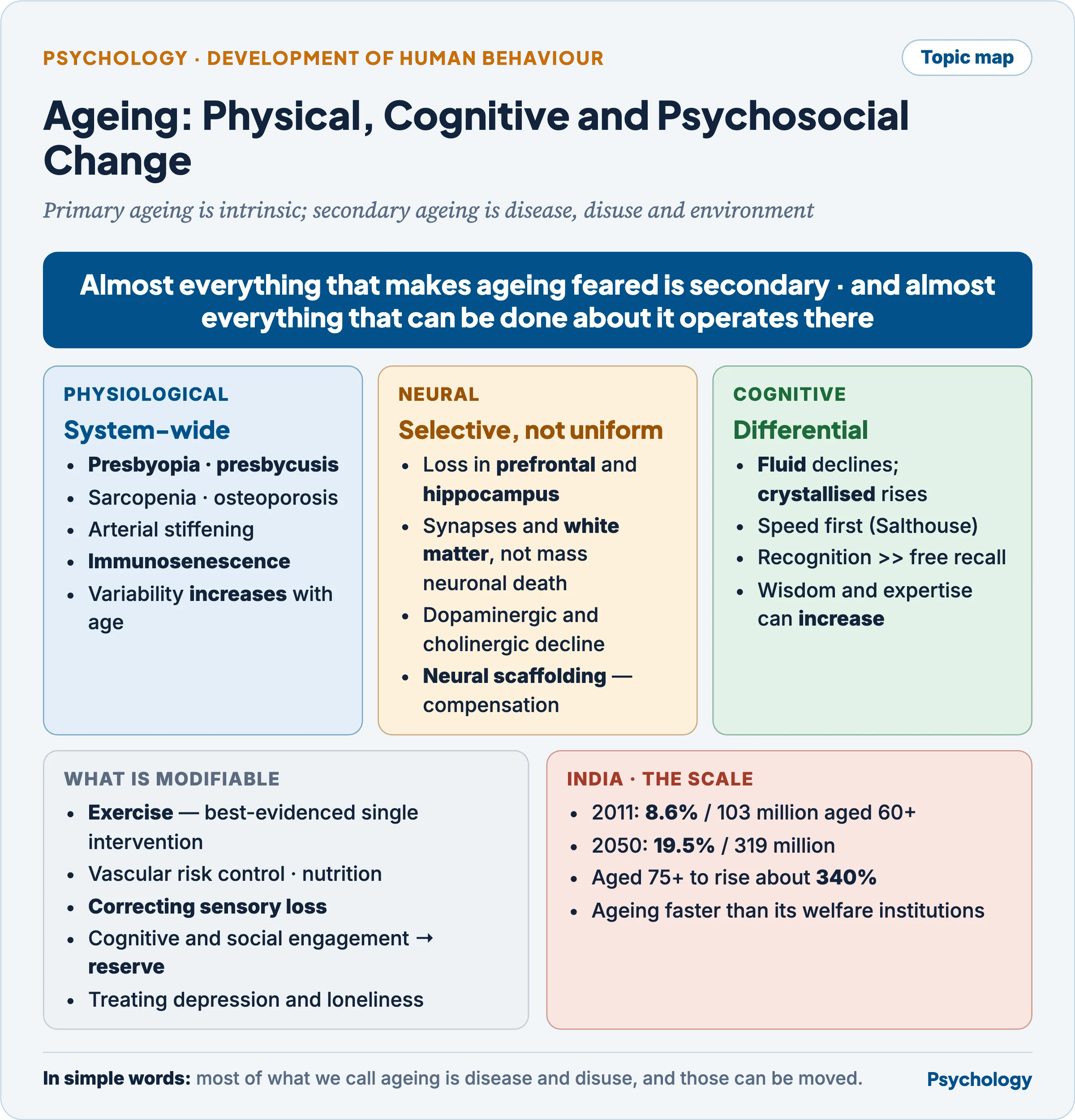
The useful distinction at the outset is between primary ageing, the intrinsic and universal biological changes that occur with time, and secondary ageing, the changes caused by disease, disuse and environment which are common but not inevitable. Almost everything that makes ageing feared is secondary, and almost everything that can be done about it operates there. Which of the two accounts for observed decline is the central empirical question of gerontology, and the answer is that the secondary component is far larger than popular understanding allows.
Physiological changes
The changes are system-wide, gradual and highly variable between individuals — variability that itself increases with age, so an average figure describes a seventy-year-old far less well than it describes a twenty-year-old.
- Sensory. Presbyopia, loss of lens accommodation, begins in the forties; the pupil narrows and the lens yellows, so more light is required and colour discrimination declines. Presbycusis, loss of sensitivity to high frequencies, impairs speech comprehension particularly in noise, and is the sensory loss with the greatest psychological consequence because it removes the person from conversation. Taste, smell, touch and proprioception all decline, the last contributing directly to falls.
- Musculoskeletal. Loss of muscle mass and strength (sarcopenia), reduced bone density with osteoporosis especially after menopause, cartilage degeneration and arthritis, loss of flexibility and height. LASI (2017-18) recorded about 19 per cent of those aged 60 and above reporting bone or joint disease, with arthritis at 11 per cent.
- Cardiovascular and respiratory. Reduced maximum heart rate and cardiac output, arterial stiffening and raised blood pressure, reduced vital capacity and gas exchange. LASI (2017-18) found more than a third of those aged 60 and above — 35 per cent — diagnosed with cardiovascular disease including hypertension, heart disease and stroke, and 8 per cent with chronic lung disease.
- Endocrine and metabolic. Declining growth hormone, oestrogen and testosterone, reduced glucose tolerance and insulin sensitivity — LASI (2017-18) found 14 per cent of the elderly with diagnosed diabetes.
- Immune. Immunosenescence reduces resistance to infection and the effectiveness of vaccination, and raises susceptibility to malignancy.
- Skin, hair and body composition. Loss of collagen and elasticity, pigmentary change, redistribution of fat from subcutaneous to visceral depots.
Neural changes
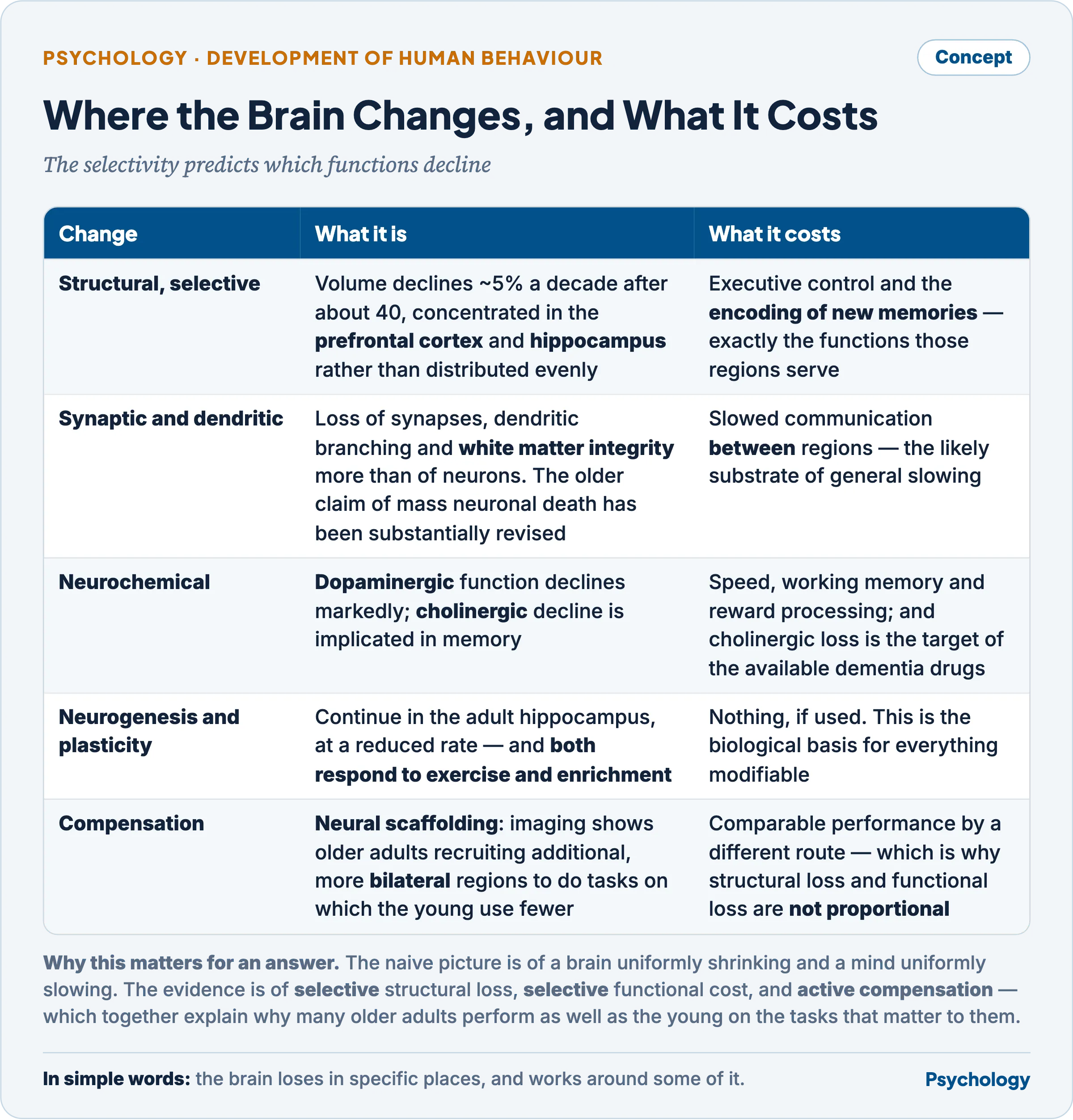
- Structural. Brain volume declines by roughly five per cent a decade after about forty, with loss concentrated in the prefrontal cortex and the hippocampus rather than distributed evenly. The selectivity matters: it predicts which functions decline, since these regions serve executive control and the encoding of new memories.
- Synaptic and dendritic. Loss is more of synapses, dendritic branching and white matter integrity than of neurons themselves — the older claim of mass neuronal death has been substantially revised. Reduced white matter integrity slows the communication between regions, which is the likely substrate of general slowing.
- Neurochemical. Dopaminergic function declines markedly, affecting speed, working memory and reward processing; cholinergic decline is implicated in memory and is the target of the available dementia drugs.
- Neurogenesis and plasticity continue in the adult hippocampus but at a reduced rate, and both respond to exercise and environmental enrichment — which is the biological basis for everything in the modification section below.
- Compensation is real and measurable. Imaging shows older adults recruiting additional, more bilateral regions to perform tasks on which younger adults use fewer, achieving comparable performance by a different route. This is neural scaffolding, and it is why structural loss and functional loss are not proportional.
Cognitive changes
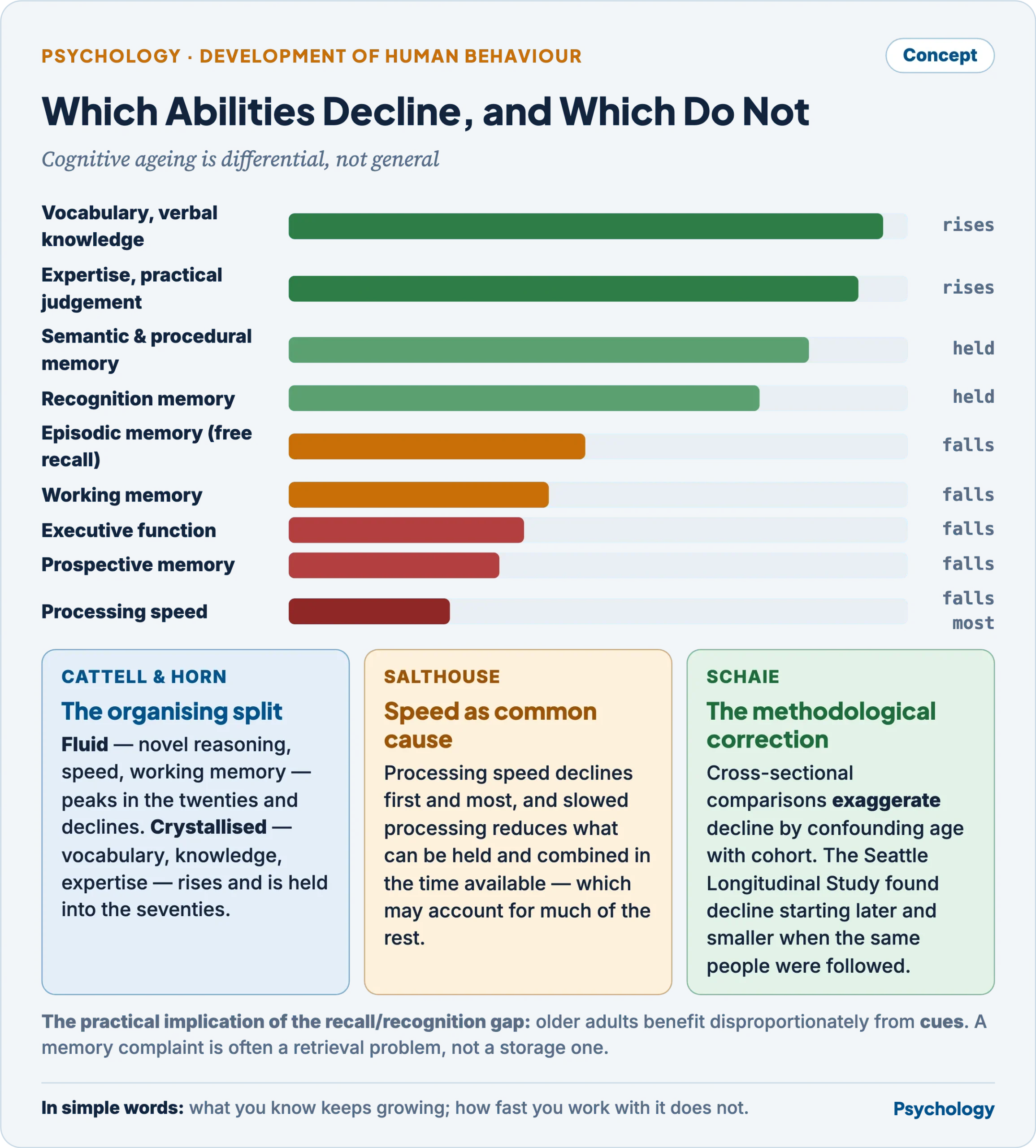
The single most important fact is that cognitive ageing is differential, not general. Some abilities decline substantially, others not at all, and some improve.
The organising distinction is Cattell and Horn’s:
- Fluid intelligence — reasoning with novel material, processing speed, working memory, mental flexibility — peaks in the twenties and declines steadily thereafter.
- Crystallised intelligence — vocabulary, verbal comprehension, accumulated knowledge and expertise — rises through adulthood and is maintained into the seventies or beyond.
The pattern of specific changes follows.
- Processing speed declines first and most, and Salthouse argued it is the common cause of much of the rest, since slowed processing reduces what can be held and combined within the time available.
- Working memory declines, particularly where information must be manipulated rather than merely held.
- Episodic memory declines, with encoding and retrieval affected more than storage, which is why recognition holds up far better than free recall — the practical implication being that older adults benefit disproportionately from cues.
- Semantic, procedural and implicit memory are largely preserved. Prospective memory for intentions declines, which is the complaint most commonly reported.
- Executive function — inhibition, set-shifting, divided attention — declines in line with prefrontal change.
- Wisdom and expertise can increase. Pragmatic knowledge about life, judgement in familiar domains and emotion regulation all show maintenance or gain, which is the principal argument against a general decline model.
What causes cognitive decline in the elderly
Separating the intrinsic from the modifiable is what makes a list of causes useful rather than merely long.
Intrinsic neurobiological factors:
- Prefrontal and hippocampal atrophy, and loss of white matter integrity.
- Dopaminergic and cholinergic decline.
- Reduced cerebral blood flow and impaired glucose metabolism.
Pathological factors — disease rather than ageing:
- Neurodegenerative disease. Alzheimer’s disease, with amyloid plaques and tau tangles; vascular dementia from infarcts and small-vessel disease; Parkinson’s, frontotemporal and Lewy body dementias. LASI (2017-18) found women reporting higher diagnosed rates of Alzheimer’s disease and dementia than men.
- Vascular risk factors — hypertension, diabetes, obesity, dyslipidaemia, smoking — which are the largest modifiable contributors and act on the brain through the vasculature. Their prevalence in the Indian elderly, documented above, makes them the dominant preventable cause.
- Delirium, acute and often reversible, from infection, dehydration or medication, and routinely misdiagnosed as dementia.
- Polypharmacy. Anticholinergics, benzodiazepines and sedatives impair cognition directly, and the elderly are the most medicated group.
- Sensory impairment. Untreated hearing loss is now an established and substantial risk factor for cognitive decline, operating through reduced input, increased cognitive load and social withdrawal — and it is correctable, which makes it the highest-value single target.
Psychosocial and behavioural factors:
- Depression, which impairs cognition directly and is massively under-treated. LASI (2017-18) found probable major depression in 8.3 per cent of those aged 60 and above against only 0.8 per cent self-reporting a diagnosis — ten times more disorder than diagnosis — with 30 per cent of the elderly screening positive for depressive symptoms. Prevalence was higher among women (9 per cent), rural residents (9 per cent), the widowed (10 per cent) and those living alone (13 per cent).
- Social isolation and loneliness, now established as independent risk factors of a magnitude comparable to the vascular ones.
- Physical inactivity, which acts through both vascular and neurotrophic pathways.
- Low cognitive engagement, consistent with the cognitive reserve hypothesis: education, occupational complexity and continued mental activity do not prevent pathology but raise the threshold of pathology at which impairment appears.
- Nutritional deficiency — B12, folate, vitamin D — which is common and correctable.
- Sleep disorder, including sleep apnoea, which impairs consolidation and clearance.
- Stereotype threat. Older adults perform measurably worse on memory tasks when ageing stereotypes are made salient, which means part of measured decline is produced by the expectation of it.
A methodological caution. Much of the apparent decline in the classic literature comes from cross-sectional comparisons, which confound ageing with cohort differences in education and nutrition. Schaie’s Seattle Longitudinal Study showed decline to begin considerably later and to be smaller when the same individuals were followed over time, and part of the cross-sectional gap was the later cohorts’ superior schooling.
How environment modifies biological ageing
The answer rests on the primary–secondary distinction: the modifiable component is large, and the mechanisms are specifiable rather than general.
- Physical exercise is the best-evidenced single intervention. Aerobic activity improves cerebral perfusion, raises BDNF and supports hippocampal volume and neurogenesis; resistance training counteracts sarcopenia and bone loss; balance training reduces falls, which are a principal cause of the loss of independence. Exercise affects both cardiovascular and cognitive trajectories, which is why it dominates every other behavioural recommendation.
- Nutrition. Adequate protein against sarcopenia, calcium and vitamin D against bone loss, B12 and folate for neural function, and caloric restriction, which extends lifespan in several species and alters the metabolic pathways associated with ageing, though the human evidence is limited to intermediate markers.
- Cognitive and social engagement builds cognitive reserve. Education, occupational complexity, continued learning and dense social networks each raise the pathology threshold at which impairment appears, and the effect is on the expression of pathology rather than on its accumulation.
- Control of the vascular risk factors — blood pressure, glucose, lipids, smoking cessation — alters both cardiovascular and cerebral ageing, and is the clearest case where treating a disease changes the appearance of ageing itself.
- Correcting sensory loss. Spectacles, cataract surgery and hearing aids restore input, reduce cognitive load and prevent the social withdrawal that accelerates decline. Cataract surgery is among the highest-return interventions available in Indian conditions.
- Avoiding toxic exposure — tobacco, excessive alcohol, air pollution, ultraviolet radiation — each of which accelerates measurable ageing in specific systems.
- Stress reduction. Chronic cortisol elevation damages the hippocampus, and the Weaver and Meaney (2004) work on epigenetic programming of the stress response establishes that early environment sets the reactivity that then operates across a lifetime. Telomere attrition, a cellular marker of ageing, is accelerated by chronic psychological stress.
- Treating depression and loneliness, both of which are reversible causes of what is otherwise read as decline.
- Expectation itself. Where ageing stereotypes are less negative, performance and even longevity differ — which makes the cultural construction of old age a determinant of its biology, not merely of its experience.
What cannot be modified should also be said: the maximum human lifespan has not been extended, cellular senescence and telomere shortening continue, and the primary changes proceed. The honest formulation is that environment substantially alters the rate and the functional consequences of ageing without abolishing it — compression of morbidity rather than elimination.
Psychosocial theories of ageing
The biological theories divide into programmed accounts, in which ageing follows a genetic schedule through telomere shortening, cellular senescence and programmed endocrine change, and damage or error accounts, in which it results from accumulated injury — free-radical and oxidative damage, cross-linking of proteins, somatic mutation and the wear and tear of use. Neither is sufficient alone, and current evidence supports a combination.
The psychosocial theories are more examinable.
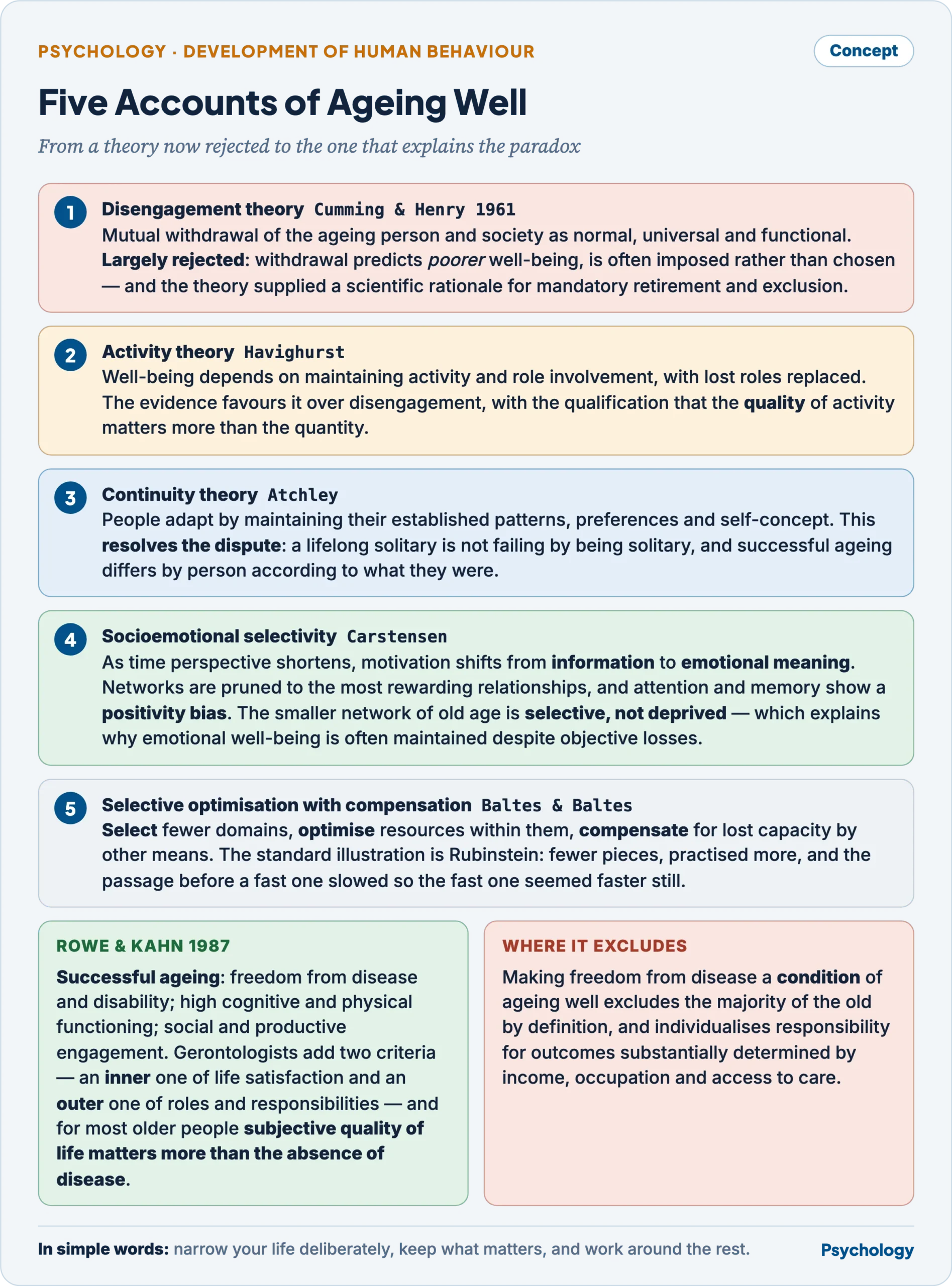
- Disengagement theory (Cumming and Henry, 1961) held that mutual withdrawal of the ageing person and society is normal, universal and functional, preparing both for death. It is now largely rejected: withdrawal is associated with poorer rather than better well-being, it is often imposed rather than chosen, and the theory supplied an intellectual justification for exclusion.
- Activity theory (Havighurst) holds the opposite: well-being depends on maintaining activity and role involvement, with lost roles replaced by new ones. The evidence favours it over disengagement, with the qualification that the quality of activity matters more than the quantity.
- Continuity theory (Atchley) holds that people adapt by maintaining their established patterns, preferences and self-concept, so what counts as successful ageing differs by person according to what they were. This resolves the disengagement–activity dispute: a lifelong solitary is not failing by being solitary.
- Socioemotional selectivity theory (Carstensen) is the most productive recent account. As time perspective shortens, motivation shifts from information acquisition to emotional meaning, so older adults deliberately prune their social networks to the most emotionally rewarding relationships and show a positivity bias in attention and memory. The important consequence is that the smaller network of old age is selective, not deprived, and this explains the otherwise paradoxical finding that emotional well-being is often maintained or improved despite objective losses.
- Selective optimisation with compensation (Baltes and Baltes) describes the adaptive strategy: select fewer domains, optimise resources within them, and compensate for lost capacity by other means. The standard illustration is the pianist Rubinstein, who played fewer pieces, practised them more, and slowed the passages before fast ones so that the fast ones seemed faster still.
- Successful ageing. Rowe and Kahn (1987) specified freedom from disease and disability, high cognitive and physical functioning, and social and productive engagement. Gerontologists generally add that there are two criteria — an inner one of life satisfaction and an outer one of social roles and responsibilities — and the evidence is that for most older people subjective quality of life matters more than the absence of disease.
- Peck’s (1968) developmental tasks of old age specify the psychological work: ego differentiation against work-role preoccupation, reappraising one’s worth in terms other than career; body transcendence against body preoccupation; and ego transcendence against ego preoccupation, coming to terms with mortality. These complete Erikson’s crisis of ego integrity against despair, whose virtue is wisdom.
- Death and dying. Kübler-Ross described five responses — denial and isolation, anger, bargaining, depression and acceptance. They are better understood as available reactions than as an invariant sequence, since the evidence does not support a fixed order or universality.
Promoting the well-being of the elderly
- Income security comes first, because without it nothing else is accessible. Pension coverage, the old-age component of the National Social Assistance Programme, and provision for the large majority who worked in the unorganised sector and have no pension at all.
- Accessible healthcare with a geriatric orientation. The National Programme for the Health Care of the Elderly and Ayushman Bharat coverage matter, but the specific need is for geriatric competence — managing multimorbidity, reviewing polypharmacy, and screening for depression and cognitive impairment rather than treating organ by organ.
- Treat depression — and look for it. The ten-to-one gap between probable major depression and diagnosed depression in LASI (2017-18) makes active screening the highest-yield psychological intervention available, and Tele-MANAS and the District Mental Health Programme are the existing instruments.
- Correct sensory loss. Cataract surgery, spectacles and hearing aids restore participation, and their effect on well-being is out of proportion to their cost.
- Prevent isolation. Living alone carried the highest depression prevalence in LASI (2017-18) at 13 per cent. Day-care centres, senior citizens’ associations, intergenerational programmes and community volunteering address the mechanism directly. Nuclearisation and the migration of adult children make this the fastest-growing risk in India.
- Enable continued engagement and contribution. Generativity does not end at retirement, and opportunities to teach, mentor and advise satisfy a need that leisure provision does not.
- Physical activity programmes, which act simultaneously on cardiovascular risk, sarcopenia, falls, mood and cognition.
- Protection from abuse and neglect, through the Maintenance and Welfare of Parents and Senior Citizens Act 2007, which creates a legal maintenance obligation on children and a tribunal to enforce it.
- Age-friendly physical environment — accessible transport, seating, lighting, pavements, toilets — since much of what disables older people is the built environment rather than their bodies.
- Change the expectation. Where ageing is construed as decline, performance and participation follow the expectation, so representation and anti-ageism are interventions and not decoration.
- Palliative and end-of-life care, which remains the least developed component of Indian provision and the one most directly determining the quality of the final stage.
The scale makes this urgent rather than optional. The elderly were 8.6 per cent of the population and 103 million people at the 2011 Census, and are projected to reach 19.5 per cent and 319 million by 2050, with the number aged 75 and above rising by about 340 per cent between 2011 and 2050. India is ageing faster than its welfare institutions are developing, and more rapidly than the societies whose models it might borrow.
Criticisms and limitations
- Cross-sectional designs exaggerate decline by confounding ageing with cohort differences in education, nutrition and test familiarity, as Schaie’s longitudinal work demonstrated.
- Longitudinal designs understate it, through selective attrition: those who drop out or die are the ones declining fastest, so the surviving sample looks better than the cohort.
- An exclusionary model. Rowe and Kahn’s criteria make freedom from disease a condition of ageing well, which by definition excludes the majority of the old and those disabled through no fault or choice of their own. It also individualises responsibility for outcomes substantially determined by income, occupation and access to care.
- Harm done by disengagement theory. It supplied a scientific rationale for mandatory retirement and social exclusion, which is a case of a weakly evidenced developmental theory shaping policy against the interests of those it described.
- Constraint mistaken for choice. Network narrowing attributed to motivational selection may partly reflect bereavement, immobility and poverty, and distinguishing the two requires evidence that is rarely available.
- Western instruments and samples. Measures of well-being, cognition and successful ageing were built elsewhere, and LASI’s first wave (2017-18) is India’s first large dataset of its kind, so most Indian claims rest on a single cross-section.
- Understated variability. Individual differences increase with age more than at any other period, so average trajectories describe the old particularly poorly, and any statement about “the elderly” is weaker than the same statement about a younger group.
- Largely observational evidence. Exercise, engagement and reserve are supported mainly by cohort studies, where the healthy and the engaged differ from others in many ways, and the randomised trials show smaller cognitive effects than the observational literature implies.
Previous Year Questions
- 2021Discuss the factors causing cognitive decline in the elderly.
- 2020How are physiological, neural and cognitive changes associated with ageing? Explain.
- 2010How can biological aging be modified with the help of environmental factors?
- 2010Briefly suggest how well-being of the elderly can be promoted.