

Values in public service; Regulatory Commissions; National Human Rights Commission; Problems of administration in coalition regimes; Citizen administration interface; Corruption and administration; Disaster management.
This article: Disaster management: concepts (hazard, exposure, vulnerability, capacity, risk, resilience; types and scales of disaster); the disaster management cycle and the paradigm shift from relief to disaster risk reduction; disasters, poverty and development; international frameworks (IDNDR, Yokohama, Hyogo, Sendai, Paris, SDGs, CDRI); India’s hazard profile in administrative terms (including Bhopal 1984, drought and COVID-19); evolution of disaster administration (relief codes to the High Powered Committee, the Odisha super cyclone, the Gujarat earthquake and the 2004 tsunami); the Disaster Management Act, 2005 and its 2025 amendment; the National Policy (2009) and National Plans (2016, 2019); the 2nd ARC Third Report; disaster finance under the 15th and 16th Finance Commissions and disaster insurance; the Collector, armed forces, NDRF and CAPFs, local bodies, communities, NGOs, media and the private sector; early warning, Odisha’s cyclone model, heat action plans, SACHET and artificial intelligence; judgments; recent disasters and their lessons; critique and theory lens.
Official Syllabus: Paper II · Unit 2-14 Significant Issues in Indian Administration
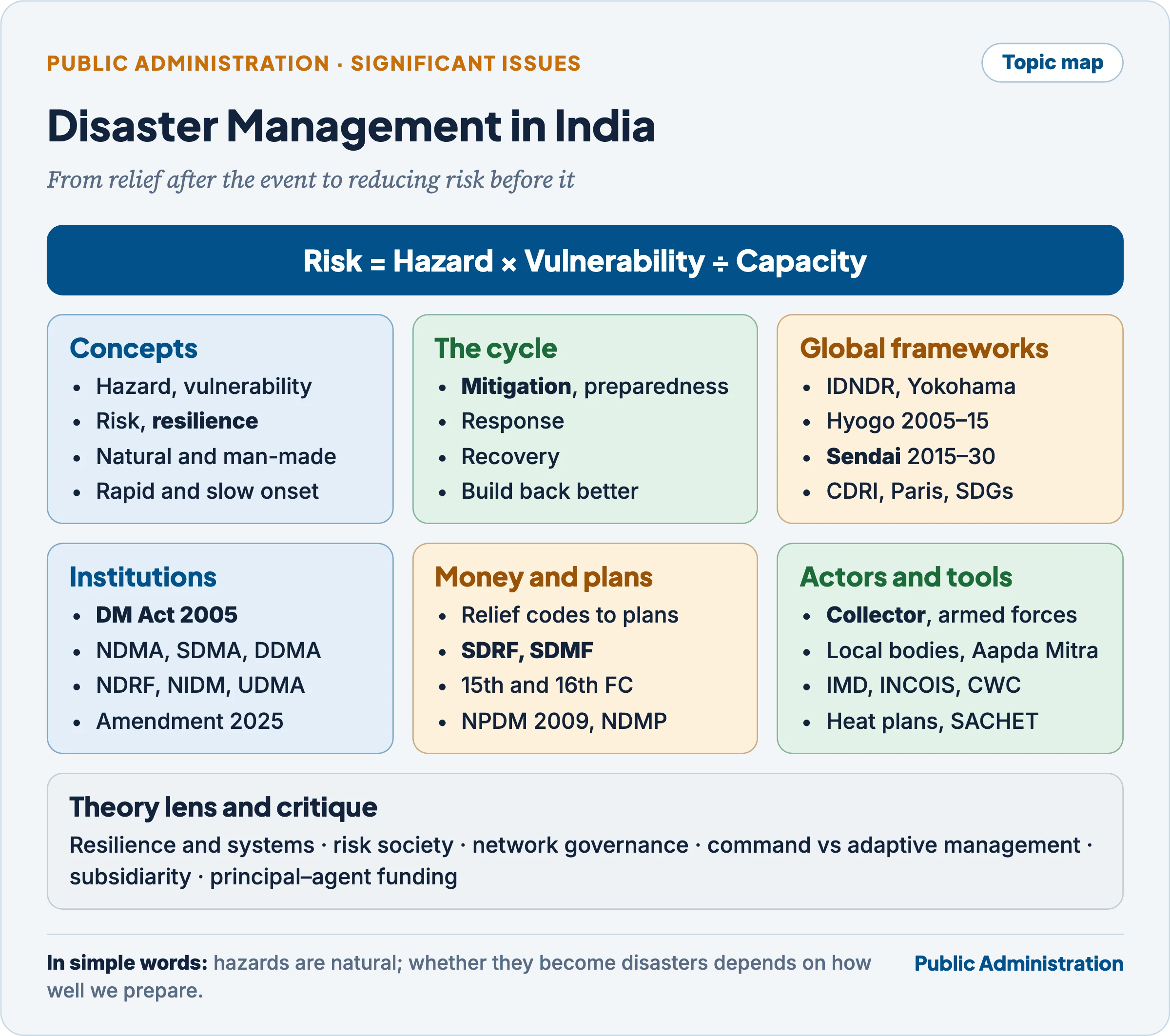
A disaster is the point at which a natural or man-made hazard overwhelms a community’s ability to cope. Earthquakes, cyclones and floods cannot be stopped, but the number of people they kill and the damage they cause depend almost entirely on administration: where houses are built, whether warnings reach people, whether shelters exist, whether the district office knows what to do, and how quickly money and help arrive.
India learnt this the hard way. The Odisha super cyclone of 1999 killed about 10,000 people; cyclones of similar strength in 2013 (Phailin) and 2019 (Fani) killed a few dozen, because the State had built warning systems, shelters, trained volunteers and a habit of evacuation. That contrast is the core of this topic: the shift from reacting to disasters with relief to reducing disaster risk before the event.
In simple words
A house fire shows the idea. One family keeps a fire extinguisher, checks the wiring and knows the exit; another only calls the fire brigade after the flames spread. Both face the same hazard (fire), but the first family has reduced its risk. Disaster management is the effort to make whole districts, cities and States behave like the first family.
1. Disaster: Concepts, Types and Scale
In simple words
A hazard is a possible threat, such as an earthquake. It becomes a disaster only when it strikes people and places that cannot cope. So disasters are not purely “natural”: poverty, weak buildings and poor planning turn hazards into disasters.
1.1 The core vocabulary
The terms below are used in the Disaster Management Act, 2005, the National Disaster Management Plan and the Sendai Framework. They are the building blocks of every later section.
- Hazard: a natural or human-induced event or process that may cause loss of life, injury, property damage or environmental harm (an earthquake, a cyclone, a toxic gas leak).
- Exposure: the people, houses, crops and infrastructure located in hazard-prone areas. An earthquake in an empty desert has a hazard but almost no exposure.
- Vulnerability: the conditions that make exposed people or assets more likely to be harmed: poor buildings, poverty, illiteracy, poor health, social exclusion, weak institutions.
- Capacity: the strengths and resources a community or institution can use to prepare for, cope with and recover from a hazard: savings, skills, early warning, shelters, trained staff, social networks.
- Risk: the probability of harmful consequences (deaths, injuries, lost livelihoods, damaged property) arising from the interaction of hazard and vulnerable conditions.
- Resilience: the ability of a system, community or society to resist, absorb, adapt to and recover from a hazard in a timely way, preserving its essential functions. Resilience is the positive goal; vulnerability is its opposite.
- Disaster (legal definition): Section 2(d) of the Disaster Management Act, 2005 defines it as a catastrophe, mishap, calamity or grave occurrence in any area, arising from natural or man-made causes, or by accident or negligence, which results in substantial loss of life, human suffering, damage to property or degradation of the environment, and is beyond the coping capacity of the community of the affected area.
- Disaster management (legal definition): Section 2(e) calls it a continuous and integrated process of planning, organising, coordinating and implementing measures for prevention, mitigation, capacity building, preparedness, prompt response, assessment of severity, evacuation, rescue, relief, rehabilitation and reconstruction.
- Mitigation (s.2(i)): measures that reduce the risk, impact or effects of a disaster; preparedness (s.2(m)): the state of readiness to deal with a threatening disaster and its effects.
1.2 The risk equation
The relationship between these terms is usually written as a simple formula. It is a way of thinking, not a precise calculation.
- Risk = Hazard × Vulnerability ÷ Capacity (often written with exposure inside vulnerability, or as Hazard × Exposure × Vulnerability).
- What it teaches:
- If any one term is zero, there is no risk: an earthquake in an uninhabited desert causes no disaster.
- Administration cannot change the hazard much, but it can reduce exposure (land-use zoning, relocation), reduce vulnerability (building codes, poverty reduction) and raise capacity (warnings, shelters, training).
- The same hazard produces very different outcomes: the Gujarat earthquake of 2001 (about magnitude 7.7) killed about 13,800 people, while earthquakes of similar size in Japan or California usually kill far fewer, because of building codes, enforcement and preparedness.
- The 16th Finance Commission used exactly this logic in 2025–26: its Disaster Risk Index for sharing funds among States treats risk as a multiplicative function of hazard, exposure and vulnerability.
Common confusion
Is a hazard the same as a disaster? No. A hazard is a potential threat; a disaster is what happens when a hazard meets an exposed, vulnerable population that cannot cope. A cyclone over the open sea is a hazard; the same cyclone striking a crowded coast with no shelters is a disaster. This is why disaster management focuses on vulnerability and capacity, not only on the hazard.
1.3 Types of disaster
Disasters are classified by cause and by speed of onset. Each classification has administrative consequences: who is the nodal ministry, which fund pays, and how early action can begin.
By cause
| Category | Examples | Administrative feature |
|---|---|---|
| Natural: hydro-meteorological | Cyclones, floods, droughts, cloudbursts, heatwaves, cold waves, lightning | Forecastable; early warning saves most lives |
| Natural: geological | Earthquakes, tsunamis, landslides, avalanches | Earthquakes cannot be predicted; building codes are the main defence |
| Biological | Epidemics, pandemics (COVID-19), pest and locust attacks, avian influenza | Health system as first responder |
| Industrial, chemical, nuclear | Bhopal gas leak (1984), fires, oil spills, radiological leaks | Regulated by safety laws; on-site and off-site emergency plans |
| Accidents and infrastructure failure | Rail and air accidents, building and bridge collapses, tunnel collapses, mine accidents | Sectoral nodal ministries |
| Hostile and crowd-related | Terrorist attacks, war, riots, stampedes | Overlap with security and public-order administration |
- The High Powered Committee (1999–2001) grouped 31 disasters into five sub-groups: water and climate related; geologically related; chemical, industrial and nuclear; accident related; and biologically related. This widened Indian thinking beyond floods and droughts to man-made disasters.
- The 2nd ARC (2006) preferred the broader term crisis, covering terrorism, communal violence and epidemics as well as natural events, and arranged them in a “crisis management matrix”.
By speed of onset
- Rapid-onset disasters (earthquakes, cyclones, flash floods, tsunamis) strike within minutes or days.
- Slow-onset disasters, also called creeping emergencies (drought, desertification, land degradation, sea erosion, climate change), build up over months or years. Their impact is not felt immediately, but societies gradually lose the ability to draw sustenance from their surroundings. Because the “event” is never sudden, governments often notice them late, and they demand development policy, not emergency response.
- Drought is called a “creeping disaster”: distress unfolds slowly through crop failure, debt and migration, which is why drought management belongs as much to agriculture and water planning as to relief.
1.4 Scale of disaster and levels of response
The level of government that responds depends on the scale of the event.
- A disaster may be local, sub-district, district, State or national in scale. The State and district are the main responders; the Union steps in for large disasters with money, forces and logistics.
- The National Disaster Management Plan (2016, revised 2019) uses L-levels:
- L0: normal times, used for preparedness and risk reduction.
- L1: a disaster the district can manage with its own resources.
- L2: a disaster needing State resources and close State supervision.
- L3: a nearly catastrophic disaster that overwhelms the State and district and needs national assistance.
- India has no legal category of “national disaster”. When Kerala sought this label for the Wayanad landslides (2024), the Union replied that the law provides only for assistance from the National Disaster Response Fund in a disaster of “severe nature”, and declared Wayanad one on 30 December 2024.
1.5 Disaster management as a special kind of public administration
Scholars of disaster management point out that it differs from routine administration in several ways. These differences explain many of the failures and successes discussed later.
- Multi-disciplinary: it needs engineers, doctors, meteorologists, police, accountants and social workers at once.
- Procedurally innovative: unprecedented situations demand improvisation and modification of normal rules (emergency procurement under section 50 of the DM Act is an example).
- Structurally temporary: it creates multi-functional, temporary organisations drawn from many departments (control rooms, task forces, relief camps).
- Public–private dichotomy fades: NGOs, companies, volunteers and government work side by side.
- Coordination is central: everyone must be brought on board, horizontally (departments) and vertically (Union, State, district, local).
- Hierarchy gives way to persuasion: in a crisis, authority works through cooperation and camaraderie as much as through orders.
- Multi-level: it involves every tier of government and often international agencies.
- A new meaning of public interest: humanitarian concern for the victim overrides routine considerations.
2. The Disaster Management Cycle and the Paradigm Shift
In simple words
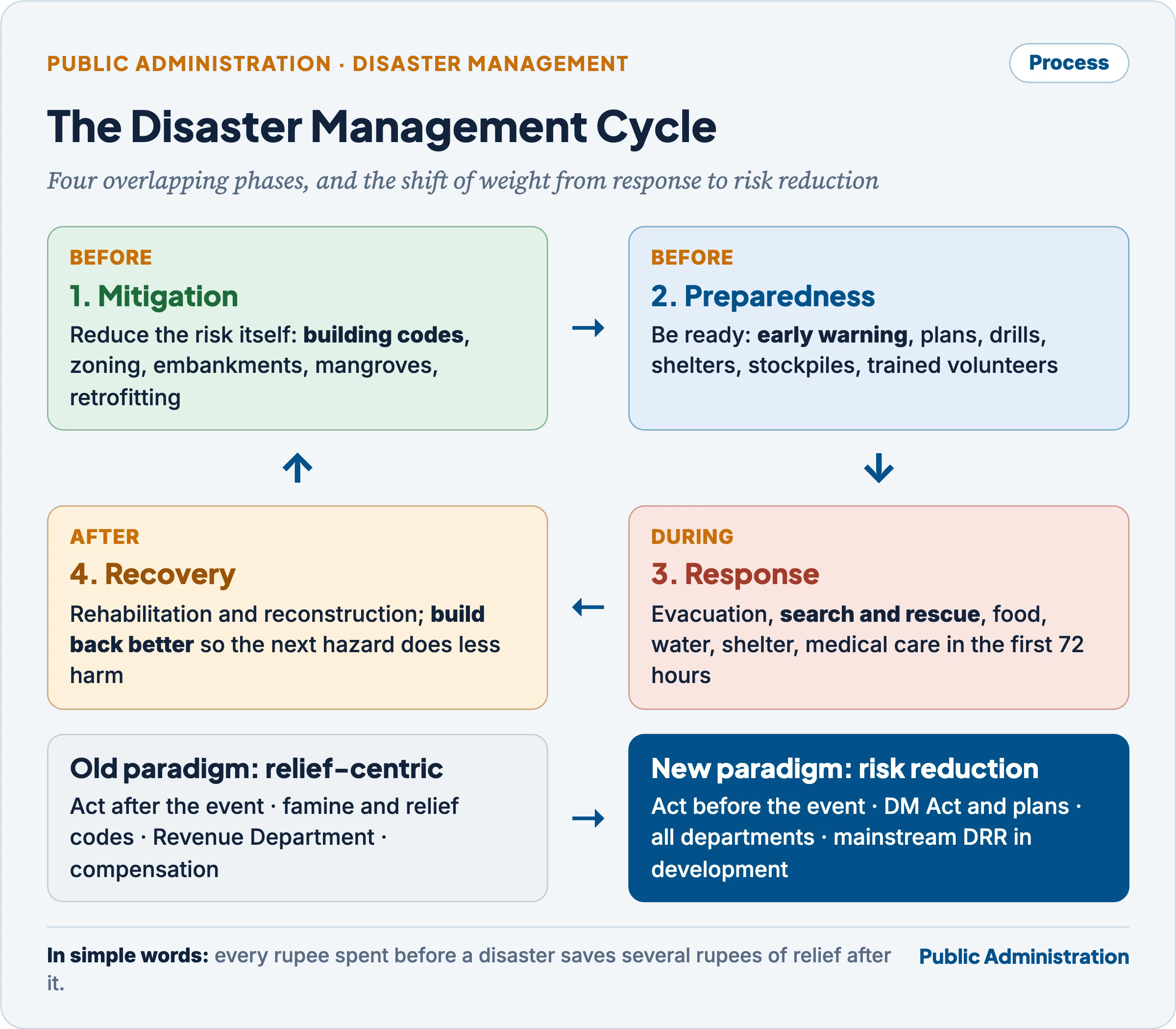
Disaster management is not a single event but a loop. We reduce risk, get ready, respond when disaster strikes, rebuild, and use the rebuilding to reduce risk further. Earlier India mostly did the “respond” part; now the stress is on the “before” parts.
2.1 The four phases
The disaster management cycle shows how governments, communities and businesses plan for disasters, react to them and recover, and how each round should leave society safer than the last.
Pre-disaster phase
- Mitigation (prevention and risk reduction) removes or reduces the risk itself.
- Structural measures use engineering: earthquake-resistant buildings, retrofitting of schools and hospitals, embankments, cyclone shelters, storm-water drains, check dams, retaining walls on slopes.
- Non-structural measures use rules, knowledge and incentives: building codes and their enforcement, land-use zoning (keeping flood plains free), seismic micro-zonation of cities, insurance, public awareness, school curricula, ecosystem protection (mangroves, wetlands, forested slopes as natural barriers).
- Mitigation is the most cost-effective phase. Studies of many countries suggest that each unit spent on mitigation saves several units of relief and rehabilitation; the 2nd ARC and the Tenth Plan both stressed this.
- Some structural measures harm the environment (embankments that worsen floods downstream), so mitigation needs environmental appraisal.
- Preparedness builds readiness to respond.
- Early warning systems and the means to carry warnings to the last village.
- Plans at every level, mock drills, evacuation routes, shelters, stockpiles of food, medicines and equipment.
- Trained volunteers (professional responders are quickly overwhelmed in mass emergencies), resource inventories, contact lists, mutual-aid arrangements.
- Casualty prediction: estimating likely deaths and injuries for a given event so that resources are in place.
During the disaster: response
- Evacuation, search and rescue, first aid, then food, water, shelter, sanitation and medical care, and restoration of communication.
- Speed matters most: most people trapped in collapsed buildings who are not reached within about 72 hours do not survive.
- Coordination systems such as the Incident Command System (adapted in India as the Incident Response System) give a single, unified command over many agencies.
- Psychosocial care: the 2nd ARC noted that about 10% of people affected by the 2004 tsunami needed professional mental-health care.
Post-disaster phase: recovery
- Rehabilitation: temporary housing, restoring public utilities and livelihoods as interim measures.
- Reconstruction: rebuilding houses, roads, schools and infrastructure.
- Build back better: using reconstruction to reduce future risk (stronger houses, safer sites, better drainage). After a disaster, people accept measures that were unpopular before, a “window of opportunity” for mitigation.
- Learning: documenting lessons, post-disaster audits, revising plans.
The phases overlap. There is no clear point at which relief turns into recovery and then into development; the length of each phase depends on the severity of the disaster, and good recovery should flow smoothly into ongoing development.
2.2 From relief to risk reduction: the paradigm shift
The most important idea in this topic is the change in philosophy. The National Policy on Disaster Management (2009) describes it as a shift from a reactive, relief-centric approach to a proactive, holistic and integrated approach of disaster risk reduction (DRR).
| Dimension | Old paradigm (till the late 1990s) | New paradigm (DM Act 2005 onwards) |
|---|---|---|
| Focus | Relief and rehabilitation after the event | Prevention, mitigation and preparedness before it |
| Legal basis | Famine codes, State relief manuals | DM Act 2005, NPDM 2009, national and State plans |
| Nodal agency | Revenue Department, Relief Commissioner | Disaster Management Department, SDMA, DDMA |
| Ministry at the Union | Agriculture (all disasters) | Home Affairs (most disasters), with sector nodal ministries |
| Scope | Natural disasters, mainly drought and flood | All hazards, natural and man-made |
| Approach | Single department, government-centred | Multi-sectoral, whole of government and whole of society |
| Money | Calamity relief after the event | Response funds plus mitigation funds; DRR in development budgets |
| Community | Passive recipient of relief | First responder and partner (Aapda Mitra, shelter committees) |
| Measure of success | Relief distributed | Lives saved, losses avoided, faster recovery |
- Why the shift happened:
- Mounting losses: reviews after the 1994 Yokohama conference found that economic losses from disasters were rising worldwide, and identified the absence of a “culture of prevention” as a main cause.
- Catastrophes at home: the Latur earthquake (1993), the Odisha super cyclone (1999), the Gujarat earthquake (2001) and the tsunami (2004) showed that relief alone could not protect lives or development gains.
- Fiscal logic: money spent on relief after each disaster could have bought far more safety if spent earlier.
- Development logic: the Tenth Five Year Plan (2002–07) was the first plan to carry a full chapter on disaster management. It noted that plans had treated disasters only as “calamity relief”, a non-plan expenditure, and argued that development must be sensitive to disaster prevention and mitigation.
- The 2nd ARC’s warning: announcing a policy, passing a law or creating an institution is easy; the challenge is implementing them so that hazards do not degenerate into disasters.
2.3 Disasters, poverty and development
Disasters and poverty feed each other. This link explains why disaster management is part of development administration, not only of emergency services.
- The poor are more exposed and more vulnerable: they live in flood plains, on unstable slopes, in kutcha houses and urban slums; they lack savings, insurance and political voice.
- Disasters push people into poverty: the World Bank’s study Unbreakable (2016) estimated that natural disasters push about 26 million people into extreme poverty every year. Losses of crops, cattle, tools and homes are a larger share of the poor’s wealth; families sell assets, take high-interest loans, pull children out of school and cut food.
- Development gains are wiped out: over 95% of disaster deaths in the last quarter of the twentieth century occurred in developing countries; a single tsunami or earthquake can set back a region’s growth for years.
- Development can create risk: unplanned urbanisation, construction in river beds, deforestation and hill roads increase exposure (the Kedarnath floods of 2013 and Joshimath’s subsidence in 2023 are examples).
- Famine theory: Amartya Sen, in Poverty and Famines (1981), showed that famines result from the collapse of entitlements (the ability to command food through work, wages or assets), not simply from lack of food. Drought becomes famine when employment and incomes fail. This is why Indian drought management relies on public works, food distribution and wage employment rather than only on food stocks.
- A comprehensive strategy therefore combines: risk-sensitive development planning, social protection that can expand during disasters (public works, food security, cash transfers), insurance for crops, houses and livelihoods, inclusive early warning, and recovery that restores livelihoods, not only buildings.
2.4 The ecosystem approach
- Healthy ecosystems are natural defences: mangroves and coastal wetlands blunt storm surges; forested slopes reduce landslides; wetlands absorb floodwater.
- Poorly planned relief and reconstruction can do more damage to ecosystems than the disaster itself (debris dumping, sand mining for rebuilding).
- Integrated approach: combine ecosystem management, development planning and risk reduction; give relief and reconstruction staff basic environmental training; protect livelihoods that depend on ecosystems.
3. International Frameworks
In simple words
Disasters cross borders and every country faces them, so the United Nations has built a shared plan for reducing disaster risk. India’s own laws and plans follow these global frameworks closely, and India has also started global initiatives of its own.
3.1 From IDNDR to Hyogo
- International Decade for Natural Disaster Reduction (IDNDR), 1990–1999: declared by the UN General Assembly in December 1989 (resolution 44/236), to reduce loss of life and property, especially in developing countries, through concerted international action.
- Yokohama, 1994: the first World Conference on Natural Disaster Reduction (May 1994, Japan) adopted the Yokohama Strategy and Plan of Action for a Safer World.
- It held that prevention, mitigation and preparedness are better than relief; that disaster prevention should be integral to development policy; that each country bears primary responsibility for protecting its people; that community participation and early warning are essential; and that vulnerability can be reduced by proper design and patterns of development aimed at target groups.
- International Strategy for Disaster Reduction (ISDR), 2000: succeeded the IDNDR with a UN secretariat in Geneva (renamed the UN Office for Disaster Risk Reduction, UNDRR, in 2019).
- Hyogo Framework for Action (HFA), 2005–2015: adopted at the second World Conference on Disaster Reduction in Kobe, Hyogo (January 2005), weeks after the Indian Ocean tsunami. Its expected outcome was the substantial reduction of disaster losses, through five priorities:
- make DRR a national and local priority with a strong institutional basis;
- identify, assess and monitor disaster risks and enhance early warning;
- use knowledge, innovation and education to build a culture of safety and resilience;
- reduce the underlying risk factors;
- strengthen preparedness for effective response.
Common confusion
Was the Yokohama conference held in 1991? Some notes date it to 1991. In fact, the World Conference on Natural Disaster Reduction met at Yokohama in May 1994, at the mid-point of the IDNDR, and adopted the Yokohama Strategy. The Hyogo conference followed in January 2005 and the Sendai conference in March 2015.
3.2 The Sendai Framework for Disaster Risk Reduction, 2015–2030
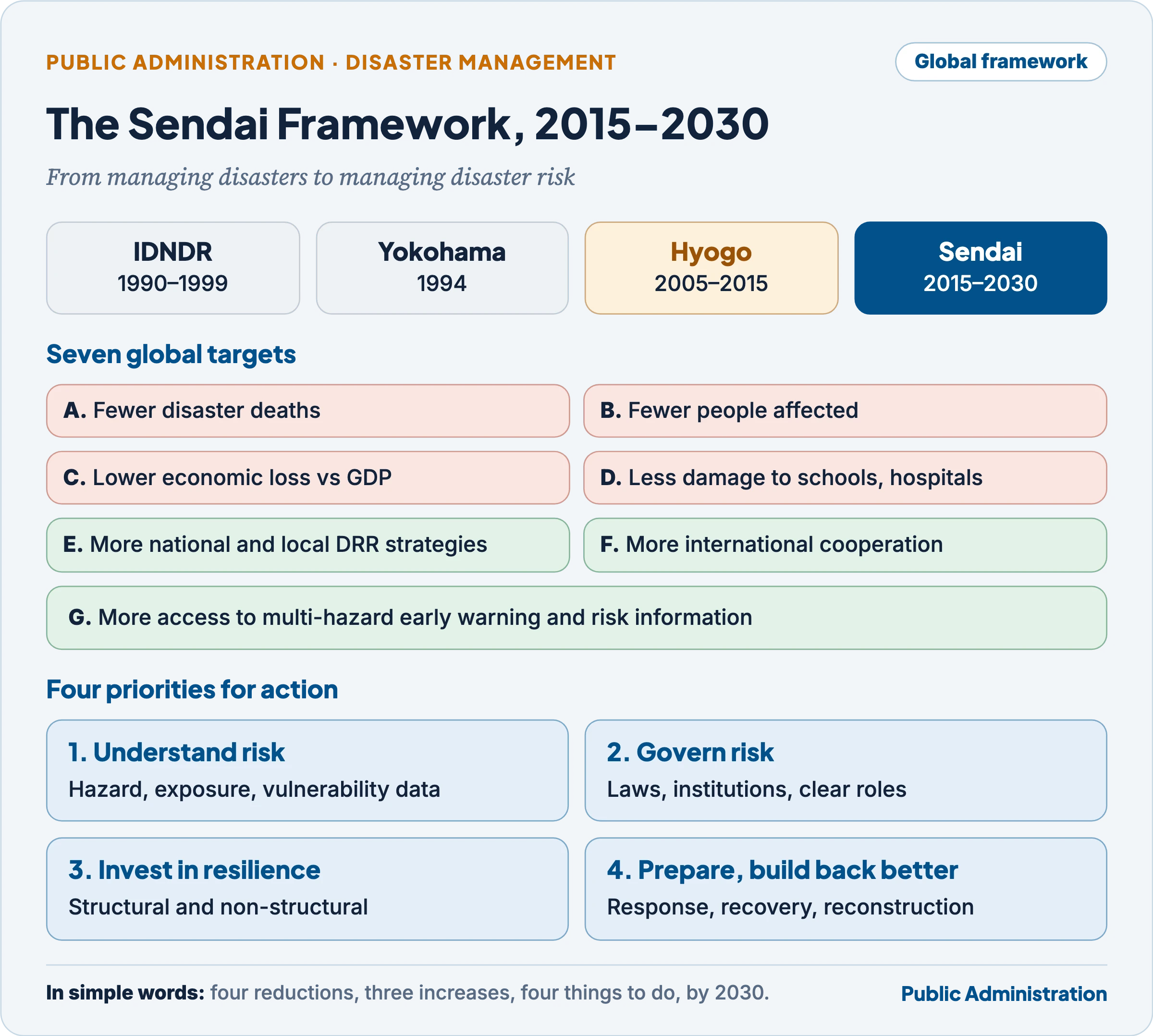
The Sendai Framework was adopted on 18 March 2015 at the Third UN World Conference on Disaster Risk Reduction in Sendai, Japan. It moves the emphasis from managing disasters to managing disaster risk, and adds health, social inclusion and the whole-of-society approach.
- Expected outcome: substantial reduction of disaster risk and losses in lives, livelihoods and health, and in the economic, physical, social, cultural and environmental assets of persons, businesses, communities and countries.
- Goal: prevent new and reduce existing disaster risk through integrated economic, structural, legal, social, health, cultural, educational, environmental, technological, political and institutional measures.
- Seven global targets (to be achieved by 2030):
- (a) substantially reduce global disaster mortality;
- (b) substantially reduce the number of affected people;
- (c) reduce direct economic loss in relation to global GDP;
- (d) substantially reduce damage to critical infrastructure and disruption of basic services, including health and educational facilities;
- (e) substantially increase the number of countries with national and local DRR strategies (by 2020);
- (f) substantially enhance international cooperation with developing countries;
- (g) substantially increase the availability of and access to multi-hazard early warning systems and disaster risk information.
- Four priorities for action:
- Understanding disaster risk (hazard, exposure, vulnerability and capacity data).
- Strengthening disaster risk governance to manage disaster risk (laws, institutions, clear roles, coordination).
- Investing in DRR for resilience (structural and non-structural, public and private).
- Enhancing disaster preparedness for effective response and to “Build Back Better” in recovery, rehabilitation and reconstruction.
- What is new compared with Hyogo: outcome targets that can be measured; focus on risk rather than loss; health and biological hazards; explicit roles for women, persons with disabilities, youth, older persons, indigenous peoples, the private sector and local governments; and the primary responsibility of States combined with shared responsibility.
- India’s alignment: India’s NDMP 2016 was described as the world’s first national plan explicitly aligned with the Sendai Framework.
3.3 Paris, the SDGs and coherence
- Three post-2015 frameworks: the Sendai Framework (March 2015), the Sustainable Development Goals (September 2015) and the Paris Agreement on climate change (December 2015). Together they treat disaster risk, development and climate change as one agenda.
- SDG links: targets on building the resilience of the poor (Goal 1), resilient cities and reduced disaster deaths (Goal 11), and strengthened resilience and adaptive capacity to climate-related hazards (Goal 13).
- Climate change increases the frequency and intensity of heatwaves, extreme rainfall and cyclones; adaptation and DRR therefore overlap. The NDMP 2019 sought coherence across all three frameworks.
3.4 India’s global initiatives
- Prime Minister’s Ten-Point Agenda on DRR, announced at the Asian Ministerial Conference on DRR, New Delhi (November 2016). Its points include: all development sectors must imbibe disaster risk management principles; risk coverage for all, from poor households to small enterprises to nations; women’s leadership in disaster risk management; investment in risk mapping; use of technology; a network of universities on disaster issues; use of social media; building on local capacity and initiative; using every disaster as an opportunity to learn; and greater cohesion in international response.
- Coalition for Disaster Resilient Infrastructure (CDRI): launched by India at the UN Climate Action Summit, New York, on 23 September 2019; headquartered in New Delhi; recognised as an international organisation in 2022. By 2025 it had about 60 member countries and over a dozen partner organisations. It promotes resilience of infrastructure (power, transport, telecom, water, health) and supports small island developing States.
- G20: under India’s presidency (2023), the G20 set up its first Working Group on Disaster Risk Reduction.
- Humanitarian assistance: NDRF teams have been sent abroad, for example to Japan (2011), Nepal (2015) and Turkey (2023), extending India’s role as a first responder in the region.
4. India’s Hazard Profile: An Administrative Reading
In simple words
India faces almost every kind of hazard: earthquakes in the Himalaya, cyclones on the coasts, floods in the plains, droughts in the interior, landslides in the hills, and heat in the cities. Each hazard needs a different administrative answer.
4.1 The broad picture
The National Disaster Management Plan summarises India’s exposure as follows.
- About 59% of the land mass is prone to earthquakes of moderate to very high intensity.
- Over 40 million hectares (about 12% of the land) is prone to floods and river erosion.
- Of about 7,500 km of coastline, close to 5,700 km is prone to cyclones and tsunamis.
- About 68% of the cultivable area is vulnerable to drought.
- Hilly areas of the Himalaya and Western Ghats face landslides and avalanches.
- Industrial, chemical, biological and nuclear hazards add to these, and urbanisation concentrates exposure in cities.
- Climate change is raising risk: a 2025 analysis by an environmental research body found extreme weather on 270 of the first 273 days of 2025 and about 4,000 deaths from such events in those nine months.
4.2 Hazard by hazard
The table summarises the administrative features of each major hazard. Detailed geography is left to other subjects; what matters here is who manages each hazard and what lessons shaped that management.
| Hazard | Key administrative features | Lessons and examples |
|---|---|---|
| Earthquake | Cannot be predicted; risk is reduced by building codes, retrofitting, micro-zonation; National Centre for Seismology monitors | Latur 1993, Gujarat 2001 (“buildings kill, not earthquakes”) |
| Cyclone | IMD forecasts days ahead; evacuation, cyclone shelters, warnings to fishermen and ports; National Cyclone Risk Mitigation Project | Odisha 1999 vs Phailin 2013 and Fani 2019 |
| Flood | CWC flood forecasting; embankments vs flood-plain zoning; Rashtriya Barh Ayog (1980) report | Bihar and Assam floods; Kosi breach 2008; Assam 2026 |
| Urban flooding | Municipal drainage, encroachment of lakes and drains, poor solid waste management | Mumbai 2005, Chennai 2015, Bengaluru 2022 |
| Drought | Slow onset; Manual for Drought Management; declaration by States; employment and food relief | Swaraj Abhiyan (2016) |
| Landslide | Micro-zonation, slope protection, regulation of hill construction; GSI studies; National Landslide Risk Mitigation Programme | Malpa 1998, Wayanad 2024 |
| Tsunami | INCOIS Indian Tsunami Early Warning Centre (Hyderabad, 2007) | 2004 tsunami |
| Heatwave | Heat action plans; notified disaster since 2026 | Ahmedabad 2010 and its 2013 plan |
| Industrial and chemical | Environment (Protection) Act 1986 rules; on-site and off-site emergency plans | Bhopal 1984 |
| Nuclear and radiological | Department of Atomic Energy nodal; off-site emergency plans in a zone of about 16 km around plants under the district administration | No major Indian accident; planning driven by global events |
| Biological | Health system; Epidemic Diseases Act 1897; DM Act used for COVID-19 | Surat plague 1994; COVID-19 2020–22 |
- Nodal ministries: the Ministry of Home Affairs handles natural disasters other than drought; Agriculture handles drought, hailstorm and pest attacks; Health handles biological disasters; Environment handles chemical disasters; Civil Aviation, Railways and Atomic Energy handle air accidents, rail accidents and nuclear emergencies. The 2025 amendment empowers the Union and States to notify hazard-wise nodal departments formally.
4.3 Industrial disasters and the Bhopal case
The Bhopal gas tragedy is India’s defining man-made disaster and a test of corporate responsibility, multi-level governance and legal liability.
- The event: on the night of 2–3 December 1984, about 40 tonnes of methyl isocyanate (MIC) gas leaked from the Union Carbide India Limited pesticide plant in Bhopal. Official figures put deaths at about 5,295 and those affected at over 5.7 lakh; survivors’ groups claim far more.
- Failures exposed:
- Corporate: poorly maintained safety systems, cost-cutting, storage of large quantities of a lethal chemical close to dense settlements.
- Local and State governance: slums allowed to grow around a hazardous plant; no off-site emergency plan; doctors not told the antidote; no warning or evacuation system.
- Union and legal: laws of the time (the Factories Act, 1948; the Explosives Act, 1884) did not deal with hazardous processes or with the safety of people living around plants; Indian tort law had no ready answer to mass injury by a multinational.
- The legal response:
- Bhopal Gas Leak Disaster (Processing of Claims) Act, 1985 made the Union the sole representative of victims (parens patriae).
- A settlement of US $470 million in 1989 ended civil claims against the parent company; a curative petition by the Union seeking about ₹7,844 crore more was dismissed by the Supreme Court in March 2023, holding that a settlement can be reopened only for fraud.
- Environment (Protection) Act, 1986 and rules under it: the Manufacture, Storage and Import of Hazardous Chemical Rules, 1989, and the Chemical Accidents (Emergency Planning, Preparedness and Response) Rules, 1996, which require on-site and off-site emergency plans and crisis groups at Union, State, district and local levels.
- A new chapter on hazardous processes in the Factories Act (1987).
- Public Liability Insurance Act, 1991: compulsory insurance for handlers of hazardous substances to pay immediate relief on a no-fault basis.
- Absolute liability: in M.C. Mehta v. Union of India (Oleum gas leak, 1987), the Supreme Court held that an enterprise carrying on a hazardous activity is absolutely liable for harm, without the exceptions of strict liability.
- Unfinished business: contaminated soil and groundwater; long delays in disposing of the plant’s toxic waste (about 337 tonnes was moved to an incinerator at Pithampur only in January 2025); inadequate health care for survivors and their children.
- Lessons: siting and land-use control near hazardous units; community right to know; enforcement of safety laws (still weak: industrial accidents continue on and off site and in transport of hazardous materials); corporate accountability that does not end with a settlement.
4.4 Drought: the long-term strategy
- Features of Indian drought: high but highly variable rainfall concentrated in about 100 days of the south-west monsoon; large rainfed agriculture; falling groundwater; abandoned traditional water-harvesting systems.
- Administrative history: Famine Codes (from the 1880s) treated drought as a relief problem; after independence came the Drought Prone Areas Programme (1973) and the Desert Development Programme (1977–78), watershed development, rural employment programmes and food security.
- Why a long-term strategy has been weak:
- Late and uneven declaration: States use different indicators and sometimes avoid declaring drought.
- Relief bias: spending peaks in drought years and drops afterwards; mitigation (water conservation, crop diversification, irrigation efficiency) gets less sustained attention.
- Fragmentation: drought falls between agriculture, water resources, rural development and revenue departments.
- Swaraj Abhiyan v. Union of India (2016): the Supreme Court directed the Union to update the Drought Management Manual with standard indicators, weights, timelines and terminology, to use modern technology for early determination, to set up the National Disaster Mitigation Fund and a regular NDRF cadre, and to frame the long-delayed National Plan. A revised Manual for Drought Management followed in December 2016.
- Long-term strategy elements: watershed and groundwater management, micro-irrigation, drought-resistant crops, crop insurance (PMFBY, 2016), employment guarantees, fodder banks and contingency crop plans, and early warning from IMD and remote sensing.
4.5 Epidemics and COVID-19 under the DM Act
COVID-19 was the first time the DM Act was used for a nationwide biological disaster, and it showed both the reach and the limits of the Act.
- Legal route:
- On 14 March 2020 the Union treated COVID-19 as a notified disaster for the State Disaster Response Fund.
- On 24 March 2020 the NDMA, under section 6(2)(i), ordered measures to contain the spread, and the National Executive Committee (Union Home Secretary) issued binding guidelines under section 10(2)(l): the nationwide lockdown.
- The Epidemic Diseases Act, 1897 (amended in 2020 to protect health workers) was used alongside.
- Strengths: a single legal basis for nationwide action; speed; overriding effect of the Act (section 72); coordinated guidelines for all States.
- Concerns:
- Centralisation: health and public order are State subjects, yet detailed guidelines came from the Union.
- Migrant workers: the sudden lockdown stranded millions without work or transport, showing poor planning for vulnerable groups.
- Health system capacity: low public health spending, shortages of beds, oxygen and staff (especially in the 2021 second wave).
- Legal fit: the DM Act was designed mainly for natural disasters; a dedicated public health emergency law was proposed in 2017 but never enacted.
- National Health Policy, 2017 in the pandemic’s light: it aimed to raise public health spending to 2.5% of GDP by 2025 and to strengthen primary care and surveillance; the pandemic showed the cost of missing these targets, the need for health emergency preparedness as part of disaster planning, and the importance of district-level surveillance and laboratories.
- Judgments: the Supreme Court held in Centre for Public Interest Litigation v. Union of India (2020) that no fresh National Plan was needed for COVID-19 and that funds of the PM CARES trust need not be transferred to the National Disaster Response Fund; in Reepak Kansal v. Union of India (2021) it held that the NDMA was bound to recommend ex gratia for COVID deaths (see Section 9).
5. Evolution of Disaster Administration in India
In simple words
For a century and more, India handled disasters through relief manuals written for famines. A series of terrible disasters between 1999 and 2004 forced the country to build a new system with laws, authorities, plans and a special response force.
5.1 The relief-centric inheritance
- Ancient roots: the Arthashastra of Kautilya devoted a section to measures against famine, flood, fire and epidemics, including storage of grain and relief works.
- Famine Commissions and Famine Codes: after repeated famines, the Famine Commission of 1880 recommended Famine Codes (from 1883 in the provinces), which laid down how scarcity was to be declared and relief works, gratuitous relief and loans organised. These evolved into State relief manuals and scarcity manuals.
- The Revenue model: relief was handled by the Revenue Department. Most States had a Relief Commissioner, often the Revenue Secretary, with a direct chain of command to the Collector and Tehsildar. This gave speed in relief but left prevention, mitigation and preparedness outside anyone’s responsibility.
- At the Union: the Department of Agriculture and Cooperation was nodal for all natural disasters, with a Central Relief Commissioner and a Crisis Management Group; the Cabinet Committee on Natural Calamities reviewed major events; a High Level Committee decided central assistance; the National Crisis Management Committee (NCMC) under the Cabinet Secretary coordinated serious crises.
- Finance: Finance Commissions provided relief money from the Second Finance Commission onwards; the Ninth Finance Commission (1990–95) created the Calamity Relief Fund (CRF) in each State; the Eleventh created the National Calamity Contingency Fund (NCCF). Both were for relief only, not mitigation or reconstruction.
- Constitutional silence: disaster management is not mentioned in any of the three lists of the Seventh Schedule. Relief came to be seen as the States’ responsibility, with the Union in a supporting role.
5.2 The catalysts: 1993 to 2004
| Year | Event | Administrative outcome |
|---|---|---|
| 1993 | Latur (Killari) earthquake, Maharashtra | First large earthquake reconstruction with international support; early interest in safe building |
| 1999 | High Powered Committee set up (August), chaired by J.C. Pant | First holistic national review; widened to man-made disasters in 2000 |
| 1999 | Odisha super cyclone (29 October), about 10,000 deaths | Orissa State Disaster Mitigation Authority set up on 29 December 1999, the first such body in India |
| 2001 | Gujarat (Bhuj) earthquake (26 January), about 13,800 deaths | Gujarat State Disaster Management Authority (February 2001); National Committee on Disaster Management under the PM; nodal role moved to the MHA (2002) |
| 2001 | HPC report (October) | Culture of preparedness; draft national and State laws; control rooms; national response plan |
| 2003 | Gujarat State Disaster Management Act | First State law on disaster management |
| 2004 | Indian Ocean tsunami (26 December), over 12,000 deaths in India | Decision to enact a national law; NDMA first set up by executive order in 2005 |
| 2005 | Disaster Management Act (assent 23 December 2005) | Statutory three-tier system, NDRF, NIDM, plans and funds |
- The High Powered Committee (J.C. Pant), 1999–2001:
- Constituted by the Ministry of Agriculture in August 1999 to suggest institutional reforms and prepare national, State and district plans; its terms were enlarged in April 2000 to cover man-made disasters.
- It identified 31 disasters in five groups, called for a “culture of preparedness”, quick response through a network of control rooms, hazard evaluation and risk assessment, human resource development, updating of manuals, involvement of NGOs and the media, and draft central and State legislation (a national calamity management law and a model State law).
- It submitted its report in October 2001, with a vision of a disaster-resilient India through preparedness, quick response, strategic thinking and prevention.
- After the Gujarat earthquake, the Union advised States to:
- convert their Relief and Rehabilitation Departments into Disaster Management Departments;
- set up State Disaster Management Authorities under Chief Ministers and district committees under Collectors;
- prepare multi-hazard plans, set up Emergency Operation Centres, and introduce disaster management in school, engineering, architecture and medical education.
- It also decided to raise a specialised response force (eight battalions) and to set up the National Institute of Disaster Management (from the National Centre for Disaster Management at the Indian Institute of Public Administration).
- The tsunami of 2004 struck while these reforms were still young and convinced the Union that only a comprehensive law could give the system a legal and institutional base.
5.3 The role of the State: Odisha and Gujarat as pioneers
- Odisha turned the 1999 trauma into a system: OSDMA, the Odisha Disaster Rapid Action Force (raised in 2001 from the State armed police), hundreds of multi-purpose cyclone shelters each with a community management and maintenance committee, village volunteers trained in warning, first aid and search and rescue, and a zero-casualty goal.
- Gujarat used reconstruction after 2001 to pass the first State law, create GSDMA, promote earthquake-resistant housing through owner-driven reconstruction, and set up an institute for disaster management.
- These States show that disaster management capacity is built at the State level; national law came after State innovation.
6. The Disaster Management Act, 2005 and the 2025 Amendment
In simple words
The Disaster Management Act is India’s main law on disasters. It created authorities at the national, State and district levels to plan for disasters, a special force to respond to them, an institute to train people, and funds to pay for response and prevention. In 2025 it was amended to give these authorities more teeth and to bring cities in.
6.1 Constitutional and legal basis
- No express entry: disaster management is not in the Seventh Schedule. Parliament enacted the DM Act on its general legislative competence, commonly traced to Entry 23 of the Concurrent List (“social security and social insurance”) and to its residuary and treaty powers; the 2nd ARC recommended a specific Concurrent List entry on management of disasters and emergencies.
- Enactment: the Disaster Management Bill was introduced in Parliament in May 2005; it received the President’s assent on 23 December 2005 (Act 53 of 2005). The Statement of Objects aimed at institutional mechanisms for drawing up and monitoring plans, ensuring prevention and mitigation by all wings of government, and a holistic, coordinated and prompt response.
- Overriding effect: under section 72, the Act prevails over inconsistent laws.
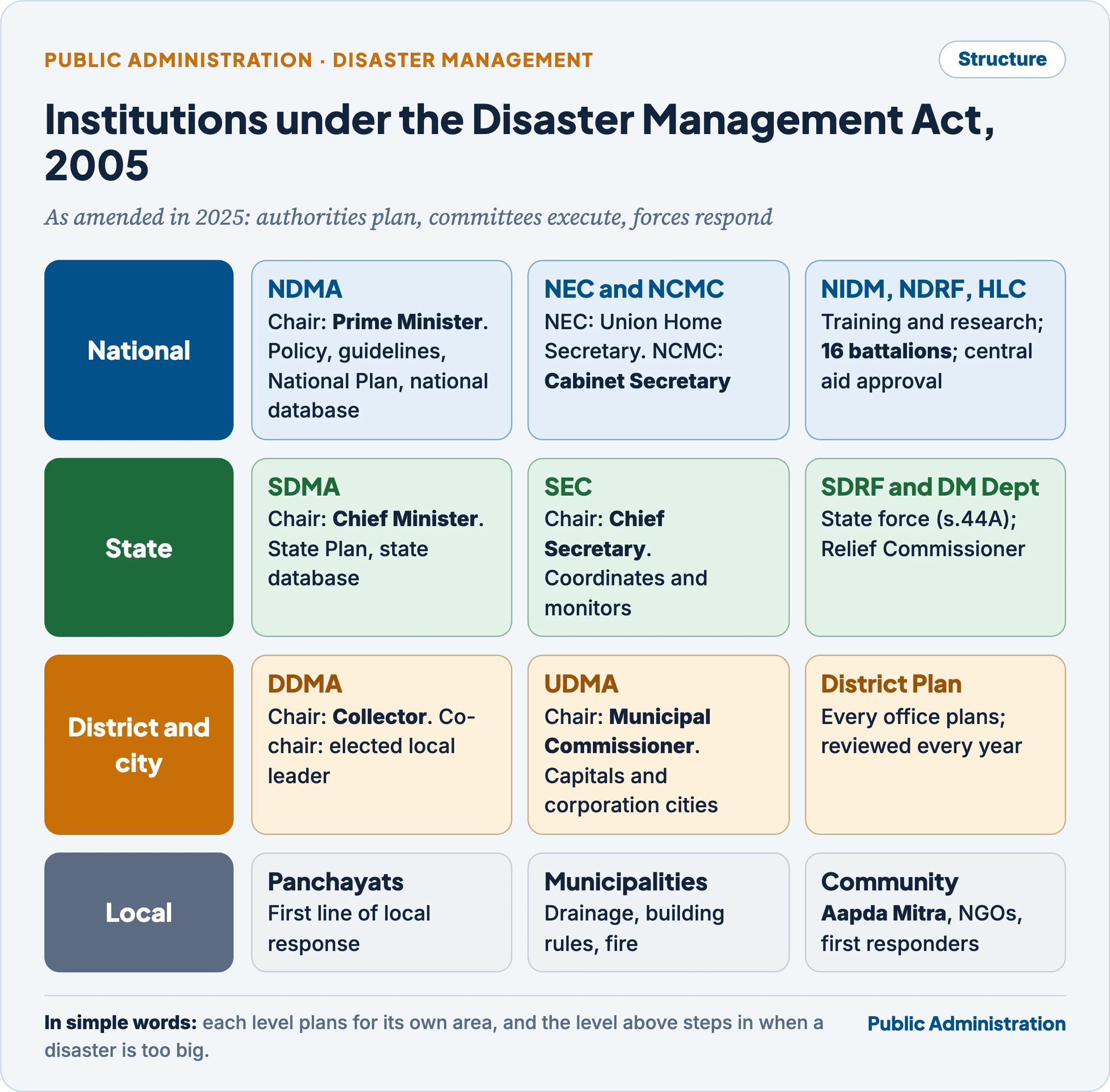
6.2 The institutional structure
National level
- National Disaster Management Authority (NDMA) (section 3): chaired ex officio by the Prime Minister, with up to nine other members, one of whom may be Vice-Chairperson. Its functions (section 6) include laying down policies, plans and guidelines, approving the National Plan and the plans of Union ministries, guiding States, recommending funds for mitigation, coordinating enforcement, and providing support to other countries.
- National Executive Committee (NEC) (section 8): chaired by the Union Home Secretary (the Secretary of the ministry in charge of disaster management), with Secretaries of the ministries concerned (agriculture, atomic energy, defence, drinking water, environment, finance, health, power, rural development, science and technology, space, telecom, urban development, water resources) and the Chief of Integrated Defence Staff. It assists the NDMA and coordinates response (section 10).
- National Advisory Committee (section 7) of experts, at the NDMA’s discretion.
- National Institute of Disaster Management (NIDM) (section 42): training, research, documentation, a national information base, and help to States in capacity building.
- National Disaster Response Force (NDRF) (section 44): a specialist force for response, under the general superintendence, direction and control of the NDMA and the command of a Director General.
- Duties of the Union (sections 35–37): every ministry must prepare a disaster management plan, integrate prevention and mitigation into its development plans and projects, and provide budget for it.
State level
- State Disaster Management Authority (SDMA) (section 14): chaired by the Chief Minister, with up to eight nominated members and the chairperson of the State Executive Committee as an ex officio member; it lays down the State policy, approves the State Plan (section 23) and departmental plans, and recommends mitigation funds.
- State Executive Committee (SEC) (section 20): chaired by the Chief Secretary, with four other Secretaries; it coordinates and monitors implementation.
- Duties of the State Government (sections 38–40): integrate disaster management into development plans, allocate funds, provide early warning, and ensure every department prepares a plan.
District and local level
- District Disaster Management Authority (DDMA) (section 25): chaired by the Collector / District Magistrate / Deputy Commissioner, with the elected representative of the local authority as co-chairperson, the Chief Executive Officer of the district authority, the Superintendent of Police, the Chief Medical Officer and up to two other district officers. It is the planning, coordinating and implementing body for the district (section 30): prepares the District Plan (section 31), identifies vulnerable areas, ensures that departments and local authorities follow plans and guidelines, organises training, sets up early warning and gives directions in an emergency.
- Local authorities (section 41): panchayats and municipalities must train their staff, maintain resources and carry out relief, rehabilitation and reconstruction in their areas.
Plans, funds and powers
- Hierarchy of plans: National Plan (section 11), State Plans (section 23), District Plans (section 31), and plans of every Union ministry, State department and district office; plans are to be reviewed and updated (district plans every year).
- Minimum standards of relief (section 12): the NDMA shall recommend guidelines on minimum standards for relief camps (shelter, food, drinking water, medical cover, sanitation), special provisions for widows and orphans, and ex gratia for loss of life, damage to houses and restoration of livelihoods. Section 13 allows relief in repayment of loans.
- Funds: National Disaster Response Fund (section 46), National Disaster Mitigation Fund (section 47), and corresponding State and district response and mitigation funds (section 48); ministries must budget for their plans (section 49); emergency procurement without normal tender procedures is allowed (section 50).
- Offences and penalties (sections 51–60): obstruction or refusal to comply with directions; false claims for relief; misappropriation of relief money or materials; false alarms or warnings causing panic (section 54); failure of officers to perform duties; contravention of requisition orders; offences by departments and companies.
- Other powers: requisition of resources, premises and vehicles with compensation (section 65); directions to media to carry warnings; no discrimination in compensation and relief on grounds of sex, caste, community, descent or religion (section 61); directions by the Union to any authority (section 62); protection for action in good faith (section 73).
6.3 Articles and Acts at a glance
| Provision | What it does |
|---|---|
| Seventh Schedule | No entry on disaster management; relief seen as a State function; Concurrent Entry 23 (social security) commonly cited |
| Concurrent List Entry 29 | Prevention of the spread of infectious diseases from one State to another |
| State List Entry 6 | Public health and sanitation |
| Article 280 | Finance Commission, which sizes disaster funds |
| DM Act s.2(d), 2(e) | Definitions of disaster and disaster management |
| s.3, 6 | NDMA and its powers |
| s.8, 10 | NEC and its powers (used for COVID-19 guidelines) |
| s.11, 23, 31 | National, State and District Plans |
| s.12 | Minimum standards of relief, including ex gratia |
| s.14, 20 | SDMA and SEC |
| s.25, 30 | DDMA and its powers |
| s.41A (2025) | Urban Disaster Management Authority |
| s.42 | NIDM |
| s.44, 44A (2025) | NDRF; State Disaster Response Force |
| s.46, 47, 48 | National and State response and mitigation funds |
| s.51–60 | Offences and penalties |
| s.61 | No discrimination in relief |
| s.72 | Overriding effect |
| Civil Defence Act, 1968 (amended 2010) | Civil defence extended to disaster management |
| Epidemic Diseases Act, 1897 (amended 2020) | Powers in epidemics; protection of health workers |
| Environment (Protection) Act, 1986 and Chemical Accidents Rules, 1996 | Chemical disaster planning |
6.4 The Disaster Management (Amendment) Act, 2025
The 2005 Act was amended after twenty years of experience, including COVID-19 and the rise of urban and climate-related disasters.
- Passage: introduced in the Lok Sabha on 1 August 2024; passed by the Lok Sabha on 12 December 2024 and the Rajya Sabha on 25 March 2025; assent on 29 March 2025; in force from 9 April 2025.
- Key changes:
- Plans: the NDMA and SDMAs themselves prepare the National and State Plans (earlier the NEC and SEC prepared them and the authorities approved them).
- New functions for the NDMA and SDMAs: periodic stock-taking of disaster risks, including emerging risks from extreme climate events; technical assistance to lower levels; recommending minimum standards of relief; and preparing national and State disaster databases covering disaster risks, fund allocation and expenditure, and preparedness and mitigation plans.
- NDMA’s oversight role: it can assess the preparedness of States and conduct post-disaster audits of preparedness and response.
- Regulations and staff: the NDMA may make regulations under the Act with the prior approval of the Union Government, and may specify the number and categories of its officers and appoint experts and consultants.
- Statutory status for the pre-existing National Crisis Management Committee (chaired by the Cabinet Secretary, nodal body for disasters with serious or national ramifications) and the High Level Committee (chaired by the Union Minister in charge of disaster management, which approves central financial assistance from the national funds).
- Urban Disaster Management Authority (UDMA) (new section 41A): States may constitute one for State capitals and all cities with a Municipal Corporation (except Delhi and Chandigarh), with the Municipal Commissioner as chairperson and the District Collector as vice-chairperson; it prepares and implements an Urban Plan approved by the SDMA.
- State Disaster Response Force (new section 44A): States may constitute one by notification.
- Nodal ministries and departments: the Union and States must notify hazard-wise nodal ministries and departments responsible for monitoring, early warning, prevention, mitigation, preparedness and capacity building.
- Funds: the national response fund is now for “different aspects of disaster management”, applied under guidelines framed by the Union in consultation with the NDMA.
- Assessment:
- Positives: clearer roles; data and accountability (databases, preparedness assessment, post-disaster audit); recognition of urban risk; legal backing for long-standing committees and for State forces; explicit attention to climate risk.
- Concerns:
- Centralisation: regulation-making by the NDMA with Union approval, preparedness assessment of States and Union-framed fund guidelines strengthen the Centre in a field the 2nd ARC said should be primarily the States’.
- Urban democracy: the UDMA is chaired by an appointed Municipal Commissioner and the Collector, not the elected Mayor, which sits uneasily with the 74th Amendment and municipal self-government.
- Multiplicity: UDMA, DDMA and municipal bodies may overlap in the same city without clear lines of command.
- Unchanged gaps: no constitutional entry; no guarantee of staff and money for DDMAs; panchayats still lack a defined role.
Common confusion
Is the “NDRF” a force or a fund? Both, which causes confusion. The National Disaster Response Force (section 44) is the specialist rescue force of 16 battalions. The National Disaster Response Fund (section 46) is the money the Union uses to supplement a State’s own fund in a disaster of severe nature. Similarly, “SDRF” can mean a State’s response force or its response fund.
7. Policy, Plans and the 2nd ARC’s Third Report
In simple words
A law creates institutions; a policy states the philosophy; plans say who does what, when. India’s 2009 policy set the goal of a disaster-resilient India, and the 2016 and 2019 national plans turned it into a matrix of responsibilities. The 2nd ARC’s report on crisis management examined the whole system and suggested reforms.
7.1 National Policy on Disaster Management, 2009
- Vision: to build a safe and disaster-resilient India by developing a holistic, proactive, multi-disaster oriented and technology-driven strategy through a culture of prevention, mitigation, preparedness and response.
- Main themes:
- Community-based disaster management, including the last mile and vulnerable groups.
- Capacity development in all related areas.
- Consolidation of past initiatives and best practices.
- Cooperation with agencies at national and international levels.
- Multi-sectoral coordination and compliance.
- Approach: mainstreaming DM into development; techno-legal regimes (building codes, zoning, land-use rules) and their enforcement; knowledge networks; sustainable recovery; and attention to women, children, the elderly and persons with disabilities.
- Primary responsibility for disaster management rests with the States; the Union supplements them. The Union has repeated this in Parliament (for example on Wayanad in 2024).
7.2 National Disaster Management Plan, 2016 and 2019
- NDMP 2016: released by the Prime Minister on 1 June 2016, the first national plan under section 11, nearly ten years after the Act and after prodding by the Supreme Court (Swaraj Abhiyan, 2016).
- Aligned with the Sendai Framework: its four priorities are applied to each hazard.
- Five thematic areas for action: understanding risk; inter-agency coordination; investing in DRR through structural measures; investing in DRR through non-structural measures; and capacity development.
- Responsibility matrices: for each hazard and each phase, the plan names the Union ministry, State department and agency responsible, reducing ambiguity about “who does what”.
- Time frames: short, medium and long term.
- Scalable and flexible: it applies across all phases of the cycle and all levels of disaster (L0 to L3).
- NDMP 2019 (revised):
- Built on the 2016 plan after consultations from 2017.
- Seeks coherence of Sendai, the SDGs and the Paris Agreement; incorporates the Prime Minister’s Ten-Point Agenda; treats social inclusion as a cross-cutting principle; stresses mainstreaming DRR and women’s leadership.
- Uses time frames ending in 2022, 2027 and 2030, co-terminus with the global frameworks.
- Adds attention to newer hazards (heat, lightning, biological, urban floods) and to recovery and build back better.
- How the NDMP serves every phase of the cycle:
- Mitigation: hazard-wise structural and non-structural measures with responsible agencies.
- Preparedness: early warning, communication, training, mock drills, stockpiles, Emergency Operation Centres.
- Response: the Incident Response System, roles of NDRF, armed forces, health and other services, L-levels for scaling up.
- Recovery: post-disaster needs assessment, build back better, livelihood restoration.
- NDMA guidelines: by 2024 the NDMA had issued 38 guidelines on specific hazards and cross-cutting themes (earthquakes, floods, cyclones, urban flooding, heatwaves, school safety, hospital safety, psychosocial care, minimum standards of relief, the Incident Response System and others).
7.3 The 2nd ARC’s Third Report: Crisis Management: From Despair to Hope (2006)
The Second Administrative Reforms Commission, chaired by M. Veerappa Moily, submitted its third report in September 2006, months after the DM Act. It looked at crises broadly (natural, man-made, security-related) and at the gaps in the new system.
Diagnosis
- Crisis administration in the States was oriented from the beginning to post-disaster relief; Relief Commissionerates were adjuncts of Revenue Departments concerned with land records and tenure, so prevention and preparedness were missing.
- Forecasting and response failures (for example, in the Mumbai floods of 26 July 2005, forecasts predicted a fraction of the 94 cm of rain that fell at Santacruz).
- The DM Act concentrated wide powers at the national level and gave the NDMA executive functions.
Main recommendations
- Constitution: insert a new entry, “Management of disasters and emergencies, natural or man-made”, in the Concurrent List.
- Primary responsibility with States: amend the DM Act so that crisis management stays primarily with State governments, with the Union in a supportive role.
- Categorise disasters by level (local, district, State, national) and intensity.
- Role of NDMA: recommend policies, lay down guidelines and standard operating procedures, conduct vulnerability studies and research, set parameters for categorising and declaring disasters, build expertise, train, coordinate early warning and deploy specialised personnel and equipment; implementation of mitigation and response should rest with States, districts and local bodies.
- Uniform apex structure: Prime Minister and Chief Minister at the political apex; Cabinet Secretary and Chief Secretary at the administrative apex; a duty on every public functionary to report an emerging crisis; stringent punishment for misuse of disaster funds.
- District: the Collector as the focal point of crisis management; local bodies to be involved in preparedness and response.
- Armed Forces: their role in rescue and relief should continue even after NDRF is raised, though civil capacity must grow.
- Mitigation and techno-legal measures: hazard and vulnerability analysis in every mitigation plan; seismic micro-zonation of vulnerable cities; enforcement of building codes and land-use regulations; mainstreaming risk reduction in development projects.
- Early warning and communication: a common platform of scientific agencies, GIS-based hazard maps, and community-level dissemination.
- Insurance: make disaster insurance attractive through policy measures and fiscal incentives.
- Community and capacity: awareness, involvement of communities, panchayats, NGOs and volunteers in plans; training; psychosocial care; an information base.
- Drought: a long-term approach combining water conservation, watershed development and livelihood support rather than repeated relief.
What happened later: States set up SDMAs and Disaster Management Departments; NDRF grew; the 2025 amendment took up databases, nodal departments and State forces. But the Concurrent List entry has not been made, and the Act has, if anything, become more centralised.
8. Financing Disaster Management
In simple words
Disasters need money fast, and prevention needs money steadily. India keeps disaster funds at the State and national levels; the Finance Commission decides how big they are and how they are shared. The hard part is making sure that money goes into prevention, not only into relief after the event.
8.1 The architecture
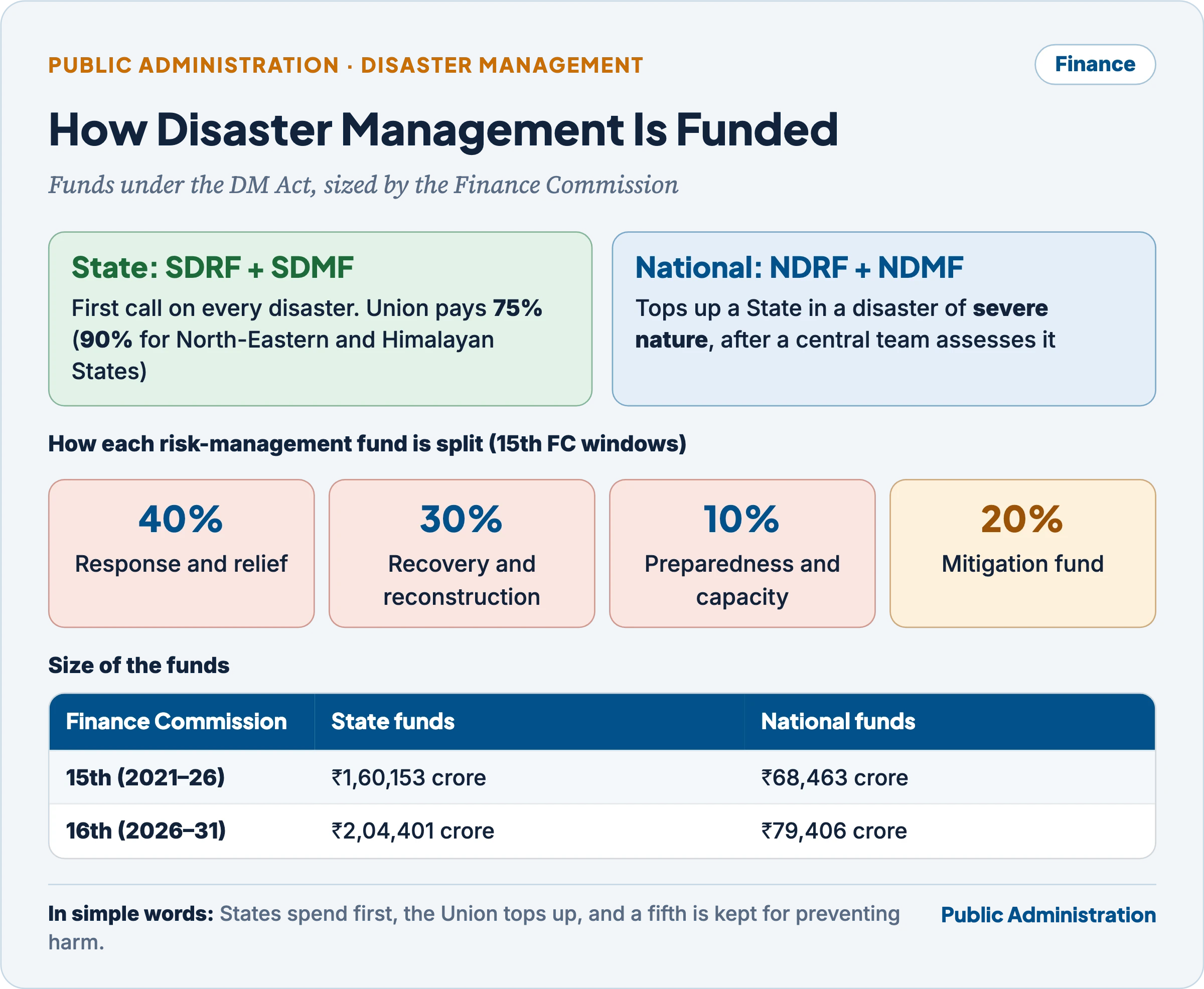
- State funds first: the State Disaster Response Fund (SDRF) is the first resort for relief in any notified disaster. The Union contributes 75% (and 90% for North-Eastern and Himalayan States); the State contributes the rest.
- National funds as a top-up: in a disaster of “severe nature”, a State seeks additional help from the National Disaster Response Fund (NDRF). An Inter-Ministerial Central Team (IMCT) assesses damage; the High Level Committee (now statutory) approves assistance, after adjusting part of the balance in the State’s own fund.
- Relief, not compensation: central assistance follows approved items and norms for relief (for example ex gratia for deaths, assistance for damaged houses and crops); it is not full compensation for loss.
- Mitigation funds: the State and National Disaster Mitigation Funds (sections 47–48) finance projects that reduce risk. They were created only after the Swaraj Abhiyan order (2016) and properly funded from the 15th Finance Commission.
8.2 The Finance Commissions
| Commission | Main contribution to disaster finance |
|---|---|
| Second to Eighth | Margin money for relief, assessed on past expenditure |
| Ninth (1990–95) | Calamity Relief Fund in each State (Union 75%) |
| Eleventh (2000–05) | National Calamity Contingency Fund at the Union level |
| Thirteenth (2010–15) | Merged into the DM Act’s SDRF and NDRF |
| Fifteenth (2021–26) | Risk management funds with mitigation windows; risk-based allocation |
| Sixteenth (2026–31) | Larger corpus, refined Disaster Risk Index, heatwave and lightning notified, data conditions |
The 15th Finance Commission (2021–26)
- Created the State Disaster Risk Management Fund (SDRMF) of ₹1,60,153 crore for 2021–26 and the National Disaster Risk Management Fund (NDRMF) of ₹68,463 crore.
- 80:20 split: 80% to the response fund and 20% to the mitigation fund.
- Three windows inside the response fund: response and relief (40%), recovery and reconstruction (30%), preparedness and capacity building (10%), with limited flexibility between them.
- Allocation among States combined past expenditure with a risk index (hazard, exposure, vulnerability), moving away from purely expenditure-based allocation that rewarded States for past spending.
- Graded cost-sharing for national assistance: the State’s share rises with the size of the assistance.
The 16th Finance Commission (2026–31)
- Corpus: ₹2,04,401 crore for State funds (about 28% more than the 15th FC), of which the Union share is about ₹1,55,916 crore; ₹79,406 crore for national funds.
- Retained cost-sharing of 75:25 (and 90:10 for North-Eastern and hilly States), declining States’ demands for 90:10 everywhere.
- Retained the 80:20 split between response and mitigation (SDRF ₹1,63,521 crore, SDMF ₹40,880 crore), with flexibility between relief and reconstruction; preparedness and capacity building moved to the mitigation funds.
- Refined Disaster Risk Index: a multiplicative function of hazard, exposure and vulnerability, with more hazards included; past expenditure still counts.
- Heatwave and lightning recommended for the list of notified disasters: the list of 12 (cyclone, drought, earthquake, fire, flood, tsunami, hailstorm, landslide, avalanche, cloudburst, pest attack, frost and cold wave) became 14, notified through MHA guidelines of 30 June 2026. Earlier, States could use only 10% of their SDRF for such “State-specific” disasters (eleven States had notified heatwave and sixteen lightning).
- Discipline and data: releases may be withheld if a State’s unspent SDRF balance exceeds three years’ allocation; from 2027–28, complete data in the National Disaster Management Information System (NDMIS) is a condition for grants.
- Weak use of mitigation money: the Commission found that utilisation of mitigation funds has been slow, that States’ capacities vary widely, and asked the NDMA to study capacity gaps; it also urged insurance and other risk-transfer instruments.
8.3 Centre–State friction over money
- “National disaster” demands: States seek the label (Kerala for Wayanad, 2024) to get more money; the Union insists the law knows only severe nature and fixed norms.
- Delays and disputes: States complain of slow IMCT visits, low norms and delays in central assistance; Karnataka went to the Supreme Court in 2024 over delayed drought assistance before funds were released.
- Underlying issue: relief money flows through an intergovernmental chain where the Union pays most but the States implement, a classic principal–agent setting (see the theory lens). For the wider fiscal picture, see the articles on the Finance Commission and on Union–State Relations.
8.4 Disaster insurance
Insurance spreads the cost of a disaster across time and across people. It is desirable but difficult, especially for the poor.
- Why it is desirable:
- Gives quick liquidity after a disaster, protecting livelihoods and reducing distress sales and debt.
- Reduces the burden on government budgets and on ad hoc relief.
- Can reward risk reduction if premiums are lower for safer buildings and practices.
- Insured households and farms are more creditworthy, encouraging investment.
- Why it is hard to implement:
- Covariant risk: a disaster hits a whole region at once, so losses are correlated and huge; insurers need reinsurance and large capital reserves.
- Risk is hard to estimate: low-probability, high-loss events need reliable data and models.
- Affordability: premiums for the poor in high-risk areas are high; administration of many small policies in remote areas is costly.
- Low awareness and trust: people do not buy insurance against rare events or distrust claim settlement.
- Moral hazard and the Samaritan’s dilemma: if governments always give relief, people and governments under-insure and under-invest in prevention.
- Claims and basis risk: in parametric insurance (payout triggered by rainfall or wind speed), the trigger may not match actual losses.
- Indian experience:
- Crop insurance (Pradhan Mantri Fasal Bima Yojana, 2016) is the largest scheme, but faces delayed claims and State withdrawals.
- Nagaland piloted parametric rainfall insurance (2021–23), learnt that its trigger thresholds were too high, and in August 2024 became the first State to sign a multi-year disaster risk transfer parametric insurance agreement covering the whole State.
- Public Liability Insurance Act, 1991 for hazardous industries.
- Ways forward: government subsidies for poor households; group and community policies through microfinance institutions and SHGs; government or donor reinsurance; reliable risk data; linking premiums to safety; and treating insurance as one part of an integrated disaster plan, not a substitute for prevention.
9. Actors in Disaster Management
In simple words
Disasters are managed by many hands: the Collector who coordinates, the soldiers and rescue forces who reach the trapped, the local councils and volunteers who know every lane, the NGOs who bring relief, and the media who carry warnings. The system works only when these hands work together.
9.1 The Collector and district administration
The district is where disaster management happens. The Collector/District Magistrate chairs the DDMA and remains the pivot of response, as the 2nd ARC observed.
- Before a disaster:
- Prepares and updates the District Disaster Management Plan; maps hazards and vulnerable areas; identifies shelters and evacuation routes.
- Runs mock drills, trains staff and volunteers, maintains resource inventories and the District Emergency Operation Centre.
- Ensures departments include mitigation in their schemes (safe school buildings, drainage, embankments).
- During a disaster:
- Acts as the Responsible Officer and often the Incident Commander under the Incident Response System; mobilises police, fire, health, public works, irrigation and revenue staff; requisitions resources; orders evacuation.
- Draws money under financial rules and the SDRF; requests the armed forces and NDRF.
- Coordinates NGOs and volunteers; keeps the public informed.
- After a disaster:
- Assesses damage, distributes relief according to norms, ensures non-discrimination (section 61), and supervises rehabilitation and reconstruction.
- Illustrations: Odisha’s district collectors leading cyclone evacuations; the Uttarkashi district administration coordinating the Silkyara tunnel rescue (November 2023), where 41 workers were brought out after 17 days through the joint work of NDRF, SDRF, central agencies, the Army and rat-hole miners; Wayanad’s collectorate managing relief camps and rehabilitation in 2024.
- Climate change and the district: rising heat, extreme rainfall and erratic monsoons require the district to be proactive, not just reactive: district heat action plans, climate-informed DDMPs, crop contingency plans with agriculture departments, local early warning for lightning and cloudbursts, water conservation, and convergence with rural employment programmes for climate-resilient assets.
- Constraints: the Collector’s many roles (revenue, elections, law and order, development) leave little time for preparedness; DDMAs often lack dedicated staff, budgets and technical experts; plans are prepared to satisfy a requirement and not updated. For the Collector’s wider role, see the article on the District Collector.
9.2 The Incident Response System
- What it is: the NDMA’s Guidelines on the Incident Response System (2010) adapted the American Incident Command System: a standard, flexible structure for managing any incident.
- Features: a single Incident Commander; functional sections for operations, planning and logistics; manageable span of control; common terminology; unified command when several agencies are involved; a Responsible Officer at the State (Chief Secretary) and district (Collector) levels who sets objectives.
- Why it matters: it answers the classic problem of confusion when many agencies arrive at once; it is a bureaucratic tool designed to be flexible, combining clear command with modular expansion.
9.3 Armed forces, CAPFs, NDRF and SDRFs
- Armed forces:
- Called in under aid to civil authority; their strengths are speed, discipline, self-contained logistics, helicopters, engineers and medical teams.
- Major roles: the 2013 Uttarakhand floods (the Air Force’s Operation Rahat evacuated tens of thousands), Kerala 2018, Wayanad 2024 (a Bailey bridge built in days).
- The 2nd ARC wanted their role to continue; but over-reliance on them diverts them from their primary task and lets civil capacity stagnate, so the aim is to use them as the last resort but fastest reinforcement.
- National Disaster Response Force:
- Raised on 19 January 2006 with eight battalions (two each from BSF, CRPF, ITBP and CISF); expanded to 16 battalions (sanctioned strength about 18,500), drawn from the Central Armed Police Forces (including SSB and Assam Rifles), with regional response centres and an NDRF Academy at Nagpur.
- NDRF Rules (2008) made it a dedicated disaster force under the DG NDRF; it specialises in collapsed-structure search and rescue, flood rescue, and chemical, biological, radiological and nuclear emergencies; it also runs community awareness and school safety programmes.
- State Disaster Response Forces: most States have raised them (Odisha’s ODRAF was a pioneer); the 2025 amendment gives them statutory backing (section 44A). Delhi began raising one in September 2026 after a building collapse at Satya Niketan killed seven.
- Other services: fire services (a municipal function under the Twelfth Schedule; a Model Fire Service Bill was revised in 2019), civil defence (the Civil Defence Act, 1968 was amended in 2010 to cover disaster management), Home Guards, police and medical services.
9.4 Local bodies
Panchayats and municipalities are closest to people and to the causes of risk (building permissions, drainage, encroachment), yet they are the weakest link.
- Constitutional basis: the Eleventh Schedule (panchayats) and Twelfth Schedule (municipalities) include items such as urban planning, regulation of land use and construction of buildings, fire services, water supply, public health and sanitation, and social forestry, all central to disaster risk.
- Why municipal governance is not ready for frequent disasters:
- Planning failures: construction on flood plains, lakes and drains; weak enforcement of building codes and zoning; unauthorised colonies and slums on vulnerable land.
- Infrastructure deficit: inadequate storm-water drainage (often designed for low rainfall intensities), clogged drains due to poor solid waste management.
- Institutional weakness: limited functions and funds devolved; few technical staff; no disaster management cell in many cities; poor coordination with State departments, development authorities and the district.
- Examples: Mumbai (26 July 2005), with about 94 cm of rain in a day, encroached Mithi river and outdated drains; Chennai (December 2015), with built-up lakes and uncoordinated reservoir releases; Bengaluru (2022), with encroached storm-water drains; building collapses in Delhi and Mumbai (2026).
- Remedies: the UDMA under the 2025 amendment; city disaster management plans and city emergency operation centres; urban flood early warning; seismic micro-zonation; risk-based land-use planning; enforcing building bye-laws; restoring lakes and drains; heat action plans; strengthening municipal finance and staff (see the article on Municipal Governance and the 74th Amendment).
- Panchayats: village disaster management plans, community volunteers, maintenance of shelters and tanks, convergence with rural employment and housing schemes; but in most States panchayats have no defined role or funds under the DM Act.
9.5 Communities and community-based disaster risk management
The community is always the first responder: before any official arrives, neighbours pull people from rubble and boats out of floods. Community-based disaster risk management (CBDRM) builds on this.
- Why CBDRM: it fills gaps in the top-down, government-centred approach:
- Last-mile gap: warnings and help reach late or not at all in remote areas.
- Knowledge gap: officials lack local knowledge of risks, vulnerable households and safe places.
- Ownership gap: plans made without people are not followed.
- Capacity gap: professional responders are few and are overwhelmed in the first hours.
- Elements: participatory risk mapping, village and ward disaster plans, task forces (warning, evacuation, first aid, search and rescue, shelter management), local early warning, community stockpiles, and traditional knowledge (in the 2004 tsunami, some island communities survived by reading the sea’s retreat; traditional wood and stone houses in the hills often withstood earthquakes better than modern concrete).
- Indian initiatives:
- Aapda Mitra: piloted by the NDMA in 2016 in 30 districts and scaled up to 350 multi-hazard districts, with about 1 lakh trained volunteers by 2024 (about 20% women as Aapda Sakhis); each gets two weeks’ training, an emergency responder kit and insurance cover.
- Yuva Aapda Mitra (2024): training of about 2.37 lakh volunteers from NCC, NSS, Nehru Yuva Kendras and Bharat Scouts and Guides in 315 districts (outlay about ₹470 crore).
- Odisha’s cyclone shelter committees with at least 50% women’s participation; Kerala’s fishermen in the 2018 floods.
- Limits: elite capture and exclusion of Dalits, women and the disabled; volunteer attrition without incentives; dependence on short-term project funding; and the risk that “community resilience” becomes an excuse for the State to withdraw.
9.6 NGOs, media and the private sector
- NGOs and humanitarian agencies: Red Cross, Ramakrishna Mission, CARE and many local groups provide relief, shelter, health, psychosocial care and reconstruction; inter-agency networks (such as Sphere India) apply minimum humanitarian standards and coordinate with government. Problems: duplication, uneven coverage, accountability for funds, and occasional conflict with administration.
- Media:
- Positive roles: carrying warnings and advisories (the Act allows authorities to direct media to do so), countering rumours, publicising needs, and holding governments accountable for failures.
- Negative roles: sensationalism, intrusion into grief, focus on dramatic rescues rather than slow recovery or prevention, and misinformation on social media (section 54 punishes false alarms).
- Private sector: business continuity planning; Corporate Social Responsibility under the Companies Act, 2013 (Schedule VII includes disaster management, relief, rehabilitation and reconstruction); resilient infrastructure through CDRI; insurance and reinsurance; technology (mobile operators carrying alerts, satellite firms).
10. Early Warning, Technology and Innovative Practices
In simple words
The best way to save lives is to warn people early and move them to safety. India’s weather and ocean agencies now forecast cyclones, floods and heat days in advance, and alerts reach mobile phones in local languages. Odisha shows what happens when good warnings meet a prepared administration and community.
10.1 Warning agencies and the alert system
- India Meteorological Department (IMD): forecasts cyclones (as the regional cyclone centre for the north Indian Ocean), heavy rainfall, heatwaves, cold waves and lightning; impact-based and colour-coded warnings.
- Indian National Centre for Ocean Information Services (INCOIS), Hyderabad: runs the Indian Tsunami Early Warning Centre (set up in 2007 after the 2004 tsunami) and ocean-state forecasts.
- Central Water Commission (CWC): flood forecasting for major rivers.
- Others: Geological Survey of India (landslides), Defence Geo-informatics Research Establishment (avalanches), Forest Survey of India (forest fires), National Centre for Seismology (earthquake reporting; earthquakes cannot be predicted).
- Common Alerting Protocol (CAP) based Integrated Alert System, “SACHET”:
- Integrates all alert-generating agencies with all SDMAs for geo-targeted alerts in regional languages via SMS, mobile app, TV, radio, railways, coastal sirens, internet and satellite receivers (GAGAN and NavIC).
- Approved for pan-India implementation (2024); more than 4,500 crore alert messages had been sent by March 2025. The NDMA is also building a cell broadcast system that sounds alerts on all phones in an area.
- Other tools: the 112 single emergency number; apps such as Damini (lightning), Mausam and Meghdoot (farmers); the Web-DCRA and decision support system for cyclone risk (used for Biparjoy and Michaung in 2023); the National Cyclone Risk Mitigation Project (shelters, warning dissemination, underground cabling in coastal States).
- Mission Mausam: approved in September 2024 (₹2,000 crore over two years, launched January 2025) for next-generation radars, satellites, supercomputers, AI/ML and decision support.
- Bharat Forecast System: launched in May 2025 by IITM Pune; a 6 km resolution global model (earlier 12 km) giving forecasts for clusters of panchayats and improving extreme-rainfall prediction.
10.2 The Odisha model: zero casualty
| Super cyclone 1999 | Phailin 2013 | Fani 2019 | |
|---|---|---|---|
| Deaths | About 10,000 | A few dozen (about 44 in most counts) | 64 |
| Evacuation | Limited, late | Nearly 1 million | About 1.2 million |
| System | Relief-centric; no shelters network | OSDMA, shelters, ODRAF, volunteers | Same, plus mass SMS and digital radio |
- Ingredients:
- Accurate forecasts from IMD days in advance, and the State’s trust in them.
- Institutions: OSDMA, the Special Relief Commissioner, ODRAF and fire services, district control rooms.
- Infrastructure: hundreds of multi-purpose cyclone shelters with community management committees, evacuation roads, underground cabling in some towns.
- Communities: trained village volunteers, women’s groups, fishermen’s associations; tailored SMS (over 20 million during Fani), sirens and loudspeakers.
- Political commitment to a zero-casualty target and regular mock drills.
- Recognition: the UN disaster risk reduction office cited Phailin’s evacuation as a global example ahead of the Sendai conference.
- Limits: deaths were averted but economic losses remained huge (power networks, housing, livelihoods, forests in Fani); recovery and build back better remain harder than evacuation; other coastal States have not uniformly copied the model.
10.3 Heat action plans
- Origin: after a heatwave in May 2010 caused about 1,300 excess deaths in Ahmedabad, the Ahmedabad Municipal Corporation with public health partners prepared South Asia’s first Heat Action Plan in 2013.
- Elements: a heat early warning system (colour-coded alerts from IMD forecasts); public awareness; training of health workers; hospital preparedness; drinking water points and cool shelters; cool roofs for slums; changes in working hours for outdoor workers; inter-agency coordination with a nodal officer.
- Spread: the NDMA issued heatwave guidelines (2016, revised 2019) and asked States, districts and cities to prepare HAPs; by 2026 about 300 cities and districts in 23 States had them.
- Notified disaster from 2026: heatwave (and lightning) became nationally notified, allowing full use of SDRF and mitigation funds.
- Weaknesses: many plans are generic, lack local vulnerability mapping, legal backing and dedicated budgets, and focus on short-term response rather than long-term cooling (urban greening, building design, labour protections); heat deaths are undercounted.
10.4 Artificial intelligence and new technology
AI and data tools are changing each phase of the cycle, though they bring their own risks.
- Forecasting and early warning: AI/ML in Mission Mausam and high-resolution models; AI-based flood forecasting developed with the CWC since 2018; nowcasting of thunderstorms and lightning.
- Risk assessment: satellite imagery and machine learning to map flood plains, landslide-prone slopes, heat islands and building vulnerability; the 16th FC’s emphasis on data-driven risk indices.
- Response: drones and thermal cameras for search and rescue (used in Wayanad 2024); geo-targeted alerts; analysis of social media and distress calls to locate victims; decision-support dashboards for resource allocation.
- Recovery: rapid satellite-based damage assessment, faster verification of claims (crop insurance, housing), monitoring reconstruction.
- Risks and limits: poor-quality or missing local data; digital divide (the poorest may lack phones or literacy); false alarms that erode trust; opaque algorithms and accountability for wrong predictions; privacy concerns; and over-confidence in technology at the expense of community knowledge. Technology works only when linked to institutions and people who act on the information.
11. Judgments on Disaster Management
In simple words
Courts have pushed governments to obey the disaster law they passed: to make plans, set up funds, raise forces, declare droughts on time and give minimum relief. Their orders show how slowly the system moved after 2005.
- Swaraj Abhiyan v. Union of India (11 May 2016):
- Context: drought in several States in 2015–16, with some States reluctant to declare drought.
- Held that drought is a disaster under section 2(d); criticised the “ostrich-like attitude” of States that ignored early warnings.
- Directed the Union to set up the National Disaster Mitigation Fund within three months, constitute a regular NDRF cadre within six months, frame the National Plan without further delay, revise the Drought Management Manual by 31 December 2016 (standard indicators, weights, timelines and terminology, use of modern technology), and consider humanitarian factors (migration, suicides, women and children).
- Gaurav Kumar Bansal v. Union of India (8 May 2017):
- Filed after the Uttarakhand floods of 2013, alleging non-implementation of the DM Act.
- The Court’s prodding (2015–17) led to the National Plan, guidelines on minimum standards of relief, SDMAs and SECs in every State, and DDMAs in every district (district plans in 615 of 684 districts by 2017).
- The Court found sufficient compliance but asked the NDMA to publish annual reports regularly, review and update plans, and make its website multilingual.
- Centre for Public Interest Litigation v. Union of India (18 August 2020):
- Held that the existing National Plan (2019) with orders under the Act sufficed for COVID-19; no fresh plan was needed.
- PM CARES Fund is a public charitable trust; there was no need to transfer its money to the National Disaster Response Fund; individuals and institutions may contribute to the NDRF.
- Reepak Kansal v. Union of India (30 June 2021) (with Gaurav Kumar Bansal’s petition):
- Held that the word “shall” in section 12 is mandatory: the NDMA has a statutory duty to recommend guidelines on minimum standards of relief, including ex gratia for loss of life.
- Found the NDMA had failed in this duty for COVID-19 deaths and issued a mandamus, leaving the amount to the NDMA; it also ordered simplified death certificates stating COVID-19 as cause.
- The NDMA then recommended ₹50,000 per death from State funds, approved by the Court in October 2021.
- Related environmental and liability cases: M.C. Mehta (Oleum gas, 1987) on absolute liability; the Bhopal curative petition (2023); the Supreme Court’s 2013–14 orders on hydropower projects in Uttarakhand after the Kedarnath floods.
12. Recent Disasters and Their Lessons
In simple words
Every major disaster since 2013 has taught the same lessons in new forms: build with nature, not against it; listen to warnings; prepare cities; and give local bodies and communities the means to act.
| Disaster | What happened | Main administrative lessons |
|---|---|---|
| Uttarakhand (Kedarnath) floods, June 2013 | Cloudburst and glacial lake breach; thousands dead, mostly pilgrims | Unregulated construction on river banks; weak early warning in the hills; poor pilgrim registration; led to the Gaurav Kumar Bansal litigation |
| Kerala floods, 2018 | Over 400 deaths; heavy rain with reservoir releases | Dam operation and coordination; community (fishermen) rescue; “Rebuild Kerala” as build back better |
| COVID-19, 2020–22 | Nationwide use of the DM Act | Centralised legal response; migrant crisis; health capacity; ex gratia litigation |
| Joshimath subsidence, January 2023 | Cracks in over 800 buildings; construction ban from 5 January 2023 | Carrying capacity of Himalayan towns; drainage; large projects in fragile zones |
| Silkyara tunnel collapse, November 2023 | 41 workers trapped for 17 days, all rescued | Multi-agency coordination; geological assessment of infrastructure projects |
| Wayanad landslides, 30 July 2024 | Mundakkai and Chooralmala destroyed; over 200 dead and many missing | “Severe nature” vs “national disaster” debate; Western Ghats land use; warnings and evacuation; Centre–State friction over money |
| Himachal Pradesh monsoons, 2023 and 2025 | Repeated cloudbursts, flash floods, landslides; over 360 lives lost in 2025 | Hill roads and construction; river-bed encroachment; need for State-specific building and planning rules |
| Dharali flash flood, Uttarkashi, 5 August 2025 | A market town buried by debris flow | Settlements on debris cones and stream beds; hazard zoning |
| Punjab floods, August–September 2025 | Worst in decades; at least 57 dead, lakhs affected | Embankment maintenance; reservoir coordination across States; crop losses and insurance |
| Assam floods, July 2026 | Described by officials as the worst in about six decades | Need to move from relief to prevention; sand mining, upstream changes |
| Satya Niketan collapse, Delhi, September 2026 | Five-storey building fell during repairs; seven dead | Urban building safety; Delhi’s move to raise its own SDRF |
Cross-cutting lessons
- Most disasters are development failures: construction in river beds, on slopes and in lakes converts heavy rain into catastrophe.
- Warnings are only as good as the last mile: forecasts improved, but warnings for cloudbursts, landslides and flash floods remain weak and do not always trigger evacuation.
- Mountains need their own rules: Himalayan and Western Ghats States need carrying-capacity studies, hazard zoning and environmental appraisal of roads, tunnels and hydropower.
- Cities are the new frontier of risk: urban floods, heat and building collapses require municipal capacity, not only district or State machinery.
- Recovery is the weakest phase: relief is quick; rehousing and livelihood restoration take years and are often incomplete.
- Federal finance shapes response: disputes over “national disaster” labels and central assistance show the need for transparent, rule-based funding.
13. Critique and the Way Forward
In simple words
India now has the laws, institutions and money for disaster management, and it has saved many lives, especially from cyclones. But the system still leans towards response, works poorly at the district and city level, and often fails to stop development that creates new risks.
13.1 Main criticisms
- Still response-centric: relief and rescue dominate attention and budgets; the 16th FC found mitigation funds poorly utilised; post-disaster rescue gets credit, prevention does not.
- Weak DDMAs and local bodies: DDMAs are often a committee of busy officers without dedicated staff, technical experts or budget; district plans are prepared on paper and seldom updated; panchayats and municipalities have no clear role or money.
- Funding problems: low relief norms; delays in central assistance; disputes over “severe nature”; few incentives for States to invest in mitigation; low insurance penetration.
- Coordination gaps: many agencies (NDMA, MHA, nodal ministries, SDMAs, departments, municipal bodies, UDMAs) with overlapping roles; weak horizontal coordination at the State level; NDMA’s dual position as advisory authority and quasi-executive body.
- Urban risk neglected: encroachment of drains and lakes, unauthorised construction, weak building code enforcement and poor drainage.
- Development that creates risk: infrastructure and tourism in fragile mountains and coasts without risk assessment.
- Data and accountability: incomplete loss data; heat and lightning deaths undercounted; until 2025 no post-disaster audit; NDMA annual reports irregular (noted by the Supreme Court in 2017).
- Exclusion: relief and recovery sometimes miss Dalits, women-headed households, the disabled and migrants, despite section 61.
- Centralisation: the 2025 amendment strengthened the Centre’s hand, while the 2nd ARC wanted States to lead.
These criticisms together are often summed up in the remark that India suffers “more disaster of management than management of disaster”: failures of planning, coordination and enforcement turn hazards into tragedies.
Criticism — Criticism: India’s disaster management remains reactive
- Relief over prevention: mitigation funds lie unused while relief spending rises each year.
- Paper institutions: DDMAs without staff, district plans copied and never tested, NDMA reports irregular.
- Development against nature: Joshimath, Wayanad and the Himalayan floods show that the State itself creates risk through roads, tunnels and unplanned towns.
- Urban unpreparedness: Mumbai, Chennai, Bengaluru and Delhi flood or collapse with each extreme event.
- Federal friction: delays and disputes over central aid, and a 2025 amendment that centralises a State subject.
- Exclusion: the poorest are the most exposed and the last to recover.
Defence — Defence: a real transformation in two decades
- Lives saved: cyclone deaths fell from about 10,000 (1999) to a few dozen (2013, 2019); India is a global example for evacuation.
- Complete architecture: law, policy, Sendai-aligned plans, authorities at every level, NDRF of 16 battalions, SDRFs, NIDM.
- Money and rules: dedicated response and mitigation funds, risk-based allocation, heatwave and lightning now notified.
- Technology: SACHET alerts in billions, 6 km forecasts, cell broadcast, decision-support tools.
- Community: about one lakh Aapda Mitras plus youth volunteers, shelter committees, heat action plans in 300 cities and districts.
- Global leadership: CDRI, the Ten-Point Agenda, NDRF missions abroad, the G20 DRR working group.
13.2 Bureaucracy and flexibility in disasters
A recurring question is whether bureaucratic agencies (established procedures, specialisation, hierarchy, clear objectives) suit disaster management.
- Where bureaucracy helps: clear authority (the Collector, the Incident Commander), standard operating procedures, trained specialist forces, rule-based relief that limits favouritism, and accountability for money.
- Where it fails: disasters are uncertain, fast-changing and novel; rigid procedures, file-based approvals, departmental silos and fear of audit slow action; hierarchy discourages initiative at the front line; specialised agencies may not cooperate.
- The needed balance: structured flexibility: clear command and pre-planned roles plus delegated authority, emergency procurement, joint training, improvisation within clear goals, and networks with communities and NGOs. The Incident Response System, emergency financial powers and mock drills are attempts at this balance.
13.3 The way forward
- Prevention first: use mitigation funds fully; make disaster and climate risk assessment mandatory for public infrastructure; enforce building codes and land-use zoning.
- Strengthen the district and the city: dedicated DM staff and budgets for DDMAs and UDMAs; tested, updated plans; a defined role and funds for panchayats and municipalities; elected representatives in UDMAs.
- Federal balance: a Concurrent List entry (2nd ARC); transparent, rule-based central assistance; consultation with States on regulations under the 2025 amendment.
- Last-mile warnings: impact-based forecasting, cell broadcast, local warning for cloudbursts, landslides and flash floods, linked to evacuation plans.
- Community and inclusion: expand Aapda Mitra with incentives; women’s leadership; plans for the disabled, elderly and migrants; enforce non-discrimination.
- Risk finance: insurance for houses and livelihoods, parametric cover for States, catastrophe bonds, and incentives for States that invest in mitigation.
- Learning and accountability: post-disaster audits, public annual reports, complete NDMIS data, independent reviews.
- Climate integration: heat action plans with budgets and legal backing; climate-resilient agriculture; ecosystem restoration.
Theory lens: disaster management through Paper I ideas
- Systems theory and resilience. Systems thinkers treat an organisation as an open system that must adapt to its environment. C.S. Holling (“Resilience and Stability of Ecological Systems”, 1973) defined resilience as a system’s ability to absorb shocks and persist; Aaron Wildavsky (Searching for Safety, 1988) contrasted anticipation (preventing known risks) with resilience (coping with the unknown). Indian disaster policy combines both: mitigation and plans for known hazards, and community capacity and flexible response for surprises. See the article on Systems and Contingency Theories.
- Beck’s risk society. Ulrich Beck (Risk Society, 1986; English 1992) argued that modern societies increasingly face manufactured risks created by industry and technology, which are unequally distributed and hard to attribute. Bhopal, the hydropower and road-driven risks of Joshimath and Uttarakhand, and urban flooding are Indian examples: development itself produces disasters, so risk governance must regulate development, not only respond to nature.
- Network and collaborative governance. R.A.W. Rhodes (Understanding Governance, 1997) described governing through networks rather than hierarchy; Chris Ansell and Alison Gash (2008) set out conditions for collaborative governance (trust, shared understanding, facilitative leadership). Disaster response, from the Silkyara rescue to Odisha’s cyclone evacuations, is a network of NDRF, the Army, departments, NGOs, companies and communities; success depends on pre-built relationships, not orders alone.
- Weberian command versus adaptive management. Max Weber’s bureaucracy (Economy and Society, 1922) offers hierarchy, rules and expertise: useful for accountability and clear command. But crisis scholars such as Karl Weick (on sense-making under uncertainty, 1993) and Arjen Boin, Paul ‘t Hart and colleagues (The Politics of Crisis Management, 2005: sense-making, decision-making, meaning-making, termination and learning) stress adaptive, improvisational leadership. The Incident Response System is a hybrid: Weberian command with modular flexibility. See the article on Weber and Bureaucracy.
- Decentralisation and subsidiarity. The principle of subsidiarity holds that tasks should be performed at the lowest level capable of doing them well. The DDMA, UDMA, Aapda Mitra and CBDRM apply it; the 2nd ARC’s call for State primacy reflects it. Yet the 2025 amendment’s regulatory and audit powers for the NDMA pull the other way, and local bodies remain under-empowered, an example of centralised decentralisation. See the article on District Administration and Democratic Decentralisation.
- Development administration and formalism. Development administration (Weidner, Riggs) treats administration as an instrument of planned change; disaster risk reduction asks that every development programme be risk-sensitive. Fred Riggs’ idea of formalism (Administration in Developing Countries, 1964), the gap between formal rules and actual behaviour, fits district plans that exist only on paper, unenforced building codes and unspent mitigation funds. See the articles on Development Administration and Riggsian Models.
- Principal–agent theory in Centre–State funding. The Union (principal) funds most disaster relief, while States (agents) implement and know local conditions better. Information asymmetry causes disputes over damage assessment (IMCT visits); moral hazard and the Samaritan’s dilemma (James Buchanan, 1975) suggest that assured bailouts reduce incentives to invest in prevention. Risk-based allocation, mitigation windows, data conditions (NDMIS) and graded cost-sharing are attempts to align incentives.
- NPM versus New Public Governance in crisis response. New Public Management (Hood, 1991) favours lean, target-driven agencies; the NDMA and NDRF as specialised agencies and “zero-casualty” targets reflect this. But COVID-19 showed the danger of lean capacity in health systems and the limits of target-driven administration. New Public Governance (Stephen Osborne, 2006) emphasises co-production with citizens and networks, which is the logic of Aapda Mitra, shelter committees and community warning. See the article on New Public Management and After.
Key Terms
| Term | Meaning in simple words |
|---|---|
| Hazard | A possible source of harm, natural or man-made |
| Exposure | People and assets located where a hazard can strike |
| Vulnerability | Conditions that make people or assets easy to harm |
| Capacity | Strengths and resources to prepare, cope and recover |
| Disaster risk | Likely losses from hazard meeting vulnerable, exposed people |
| Resilience | Ability to absorb a shock, adapt and bounce back |
| Disaster risk reduction (DRR) | Policies and actions that prevent new and reduce existing risk |
| Mitigation | Measures that reduce the risk or impact of a disaster |
| Preparedness | Readiness to respond: plans, warnings, drills, stocks |
| Build back better | Using reconstruction to reduce future risk |
| Creeping emergency | A slow-onset disaster such as drought or desertification |
| L-levels (L0–L3) | Scale of a disaster, from normal times to near-catastrophe |
| Severe nature | Status that allows a State extra help from national funds |
| Notified disaster | A disaster type for which SDRF and NDRF money can be used (14 since 2026) |
| Incident Response System | Standard command structure for managing an emergency |
| Emergency Operation Centre | Control room that coordinates response |
| Micro-zonation | Detailed mapping of hazard levels within a city |
| Techno-legal regime | Building codes and land-use laws that make construction safe |
| Parametric insurance | Insurance that pays when a measured trigger (rainfall, wind) is crossed |
| Covariant risk | Risk that hits many people at the same time |
| Aapda Mitra | Trained community volunteer for disaster response |
| CAP / SACHET | India’s integrated, geo-targeted disaster alert system |
| Heat action plan | Local plan to warn and protect people during heatwaves |
| CBDRM | Community-based disaster risk management |
| Risk society | Beck’s idea that modern society produces its own risks |
Commissions, Committees and Judgments
The bodies, laws and cases below, listed by year, shaped disaster management in India.
| Body / case | Year | Key point |
|---|---|---|
| Famine Commission | 1880 | Recommended Famine Codes; relief-centric model |
| M.C. Mehta v. Union of India (Oleum gas) | 1987 | Absolute liability for hazardous enterprises |
| UN General Assembly resolution 44/236 | 1989 | Declared the IDNDR for 1990–1999 |
| Yokohama World Conference | 1994 | Strategy for a Safer World; culture of prevention |
| High Powered Committee (J.C. Pant) | 1999–2001 | 31 disasters, culture of preparedness, draft laws, control rooms |
| Orissa State Disaster Mitigation Authority | 1999 | First State disaster body, after the super cyclone |
| Gujarat State Disaster Management Act | 2003 | First State disaster law |
| Hyogo Framework for Action | 2005 | Five priorities for 2005–2015 |
| Disaster Management Act | 2005 | NDMA, SDMA, DDMA, NEC, SEC, NIDM, NDRF, plans and funds |
| 2nd ARC Third Report (M. Veerappa Moily) | 2006 | Crisis management: State primacy, Concurrent List entry, NDMA advisory |
| National Policy on Disaster Management | 2009 | Holistic, proactive, multi-hazard DRR |
| Sendai Framework | 2015 | Seven targets and four priorities to 2030 |
| Swaraj Abhiyan v. Union of India | 2016 | Mitigation fund, NDRF cadre, National Plan, revised drought manual |
| National Disaster Management Plan | 2016, 2019 | First national plan, Sendai-aligned; revised for coherence |
| Gaurav Kumar Bansal v. Union of India | 2017 | Monitored DM Act implementation; NDMA to publish reports, update plans |
| CDRI launched | 2019 | India-led global coalition on resilient infrastructure |
| Centre for PIL v. Union of India | 2020 | No fresh national plan for COVID-19; PM CARES not to be transferred |
| 15th Finance Commission (N.K. Singh) | 2020–21 | Risk management funds with mitigation windows |
| Reepak Kansal v. Union of India | 2021 | Section 12 duty mandatory; ex gratia for COVID-19 deaths |
| Union of India v. Union Carbide (curative) | 2023 | Bhopal settlement not reopened without fraud |
| DM (Amendment) Act | 2025 | Databases, UDMA, SDRF, statutory NCMC and HLC, NDMA regulations |
| 16th Finance Commission (Arvind Panagariya) | 2025–26 | ₹2.04 lakh crore State corpus; heatwave and lightning notified |
Contemporary Developments
- 9 April 2025: DM (Amendment) Act in force. The amendment (assent 29 March 2025) gave the NDMA and SDMAs planning, database and audit functions, created Urban Disaster Management Authorities and State Disaster Response Forces, and gave statutory status to the NCMC and HLC.
- January 2025: Bhopal waste moved. About 337 tonnes of toxic waste from the Union Carbide site was moved to Pithampur for incineration, four decades after the disaster.
- May 2025: Bharat Forecast System. A 6 km resolution forecasting model was handed to the IMD, improving extreme-rainfall prediction at the level of clusters of panchayats.
- August–September 2025: Himalayan and Punjab floods. The Dharali flash flood (5 August), Himachal’s most destructive monsoon in decades and Punjab’s worst floods in decades exposed construction in river beds and weak hill-area planning.
- February 2026: 16th Finance Commission report tabled. It recommended ₹2,04,401 crore for State disaster funds and ₹79,406 crore for national funds (2026–31), kept 75:25 cost-sharing and made NDMIS data a condition for grants; the government accepted the recommendations.
- 30 June and 4 August 2026: heatwave and lightning notified. New MHA guidelines added them to the list of notified disasters, taking it to 14 and letting States use full SDRF allocations for them.
- July–August 2026: Assam floods. Officials described them as the worst in about six decades, renewing calls to shift from relief to prevention.
- September 2026: Delhi moves to raise an SDRF. After the Satya Niketan building collapse killed seven, the Delhi government began raising its own State Disaster Response Force, using the 2025 amendment’s enabling provision.
Revision Grid
| Thinker / body | Work or report (year) | Key idea |
|---|---|---|
| C.S. Holling | “Resilience and Stability of Ecological Systems” (1973) | Resilience as capacity to absorb shocks |
| James Buchanan | “The Samaritan’s Dilemma” (1975) | Assured help weakens incentives to prepare |
| Amartya Sen | Poverty and Famines (1981) | Famines as entitlement failure |
| Ulrich Beck | Risk Society (1986) | Modernity manufactures its own risks |
| Aaron Wildavsky | Searching for Safety (1988) | Anticipation versus resilience |
| Karl Weick | Mann Gulch study (1993) | Sense-making collapses in crises |
| R.A.W. Rhodes | Understanding Governance (1997) | Governing through networks |
| Boin, ‘t Hart and others | The Politics of Crisis Management (2005) | Five tasks of crisis leadership |
| Ansell and Gash | Collaborative governance (2008) | Conditions for multi-actor collaboration |
| High Powered Committee | Report (2001) | Culture of preparedness |
| 2nd ARC | Crisis Management: From Despair to Hope (2006) | State primacy; DRR; Concurrent List entry |
| UN conferences | Yokohama (1994), Hyogo (2005), Sendai (2015) | From relief to managing risk |
| NDMA | NPDM (2009), NDMP (2016, 2019) | Holistic DRR; responsibility matrices |
| World Bank | Unbreakable (2016) | Disasters push millions into poverty |
| Finance Commissions | 15th (2021–26), 16th (2026–31) | Risk-based funds with mitigation windows |
Previous Year Questions
- 2026Community based Disaster Risk Management is a response to the gaps within the existing Disaster Risk Management strategy. Evaluate.
- 2025Artificial Intelligence (AI) has emerged as an innovative tool in disaster management. Illustrate with examples.
- 2023Disasters can push the world’s poorest deeper into poverty. Do you think that a a comprehensive strategy to deal with such vulnerabilities is required?
- 2021In past two decades India’s public policy on Disaster Management has shifted its focus from rescue, relief and rehabilitation efforts to holistic management of disaster. Analyse.
- 2020Examine the National Health Policy in the context of the current pandemic situation, Identify the problems and suggest improvements.
- 2019The National Policy on Disaster Management envisages a paradigm shift from hitherto reactive post-disaster relief centric regime to more pro-active and enabling environment. Examine the responses of State Governments in this regard.
- 2018Climate change issues pose new challenges for district administration to be proactive.” Elaborate
- 2017“Disaster preparedness and management has become an important component of district administration in India.” Discuss with suitable illustrations.
- 2016Explain how the National Disaster Management Plan (NDMP) provides a framework and direction to the government agencies for all phases of disaster management cycle.
- 2015“Municipal governance in India is not sufficiently prepared to meet the challenges of frequent natural disasters.” Elucidate the statement and add your suggestions.
- 2013“Bureaucratic agencies, characterized by established procedures, specialization, leadership, clear objectives, are not ideal to handle disaster management.” Examine with reference to the need for administrative flexibility in managing disasters.
- 2011(i) Identify the different conceptual categories of disasters. (ii) Write a note on the new culture of disaster management.
- 2011“Disaster insurance is desirable but not an easy proposition to implement.” Illustrate with suitable examples.
- 2010It is argued that the Bhopal gas disaster and the response pattern to it systems of corporate social responsibility, governance at local, state and central levels, and legal safeguards and liabilities. Comment on this assessment.
- 2009“Indian has failed to devise a long-term strategy for drought management.” Comment.
- 2008‘In India, there appears to be more disaster of management than management of disaster.’ Comment.