

Values in public service; Regulatory Commissions; National Human Rights Commission; Problems of administration in coalition regimes; Citizen administration interface; Corruption and administration; Disaster management.
This article: Meaning, definitions and forms of corruption (petty and grand, coercive and collusive, political and bureaucratic, systemic, state capture, conflict of interest); theories of its causes (Nye, Klitgaard, principal–agent, public choice and rent seeking, Myrdal’s soft state, the functionalist “grease versus sand” debate, Riggs’ prismatic society, the ecological approach); causes in India; effects on administration, development and trust; history from Kautilya to the Santhanam Committee; the institutional framework (CVC, the CBI’s anti-corruption role, Lokpal, State Lokayuktas, vigilance machinery); the legal framework (Prevention of Corruption Act and its 2018 amendment, Whistle Blowers Protection Act, Benami law, PMLA, Fugitive Economic Offenders Act, Black Money Act, BNS and BNSS provisions, electoral finance); landmark judgments; the 2nd ARC’s Fourth Report; UNCAC, the Corruption Perceptions Index, OECD, G20 and FATF; technology and transparency as anti-corruption tools; ethics-based approaches; critiques of the anti-corruption industry and over-criminalisation; a theory lens.
Official Syllabus: Paper II · Unit 2-14 Significant Issues in Indian Administration
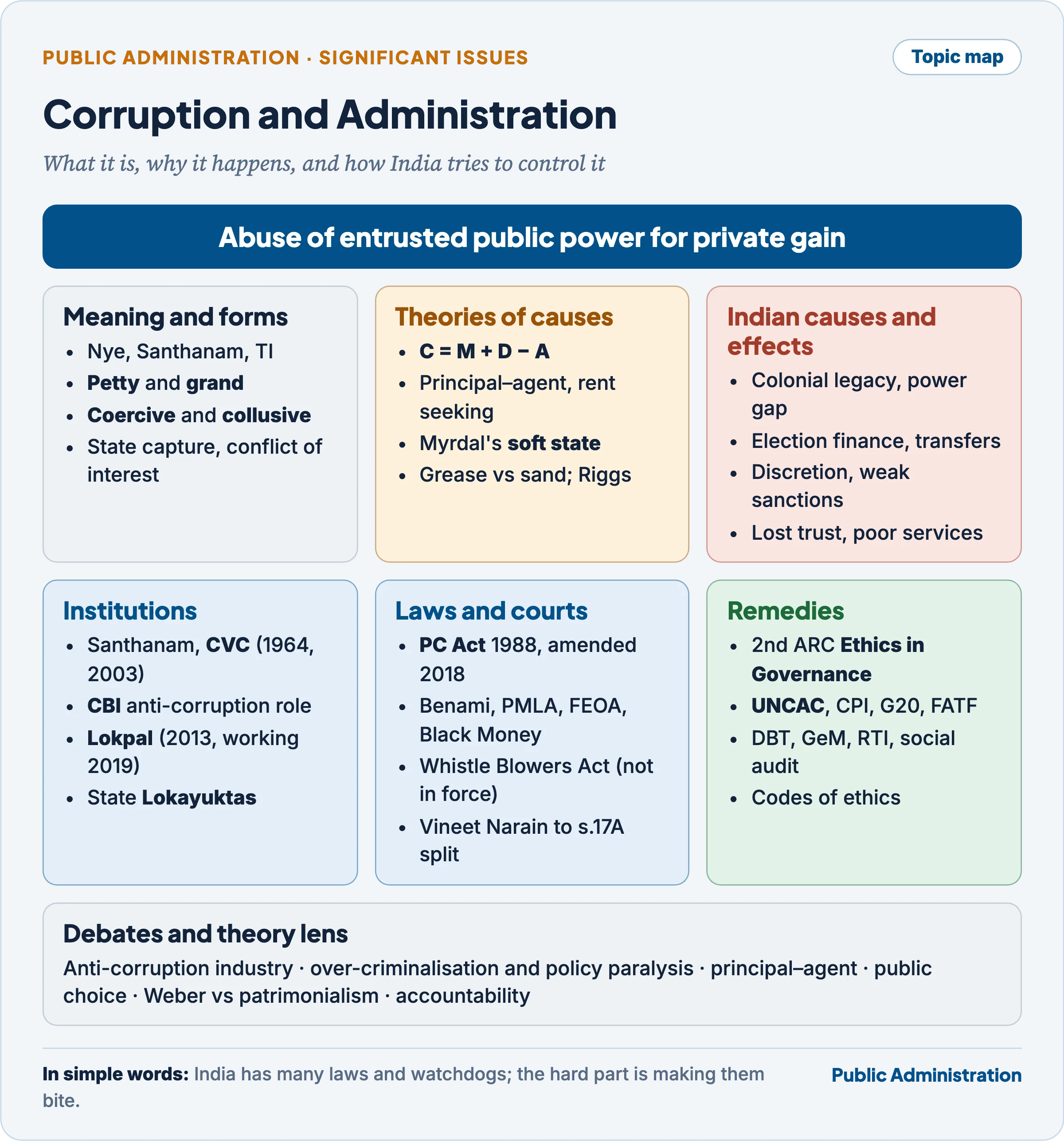
Corruption is the use of public power for private gain. It is the oldest pathology of administration: Kautilya listed forty ways in which officials embezzle the king’s revenue, and every modern Indian commission on administration, from the Santhanam Committee (1962–64) to the 2nd ARC (2007), has returned to it. For public administration, corruption is not only a crime by individuals. It is a failure of the system that is supposed to make power answerable: it bends rules, diverts resources from the poor, slows decisions and destroys the trust on which a democratic state rests.
India has built a dense web of remedies: a Central Vigilance Commission, the CBI, a Lokpal and State Lokayuktas, the Prevention of Corruption Act and half a dozen laws on black money and laundering, the RTI Act, and a digital delivery system that pays benefits straight into bank accounts. Yet India scored only 39 out of 100 on Transparency International’s Corruption Perceptions Index 2025. The gap between the strength of the laws and the persistence of the problem is the central puzzle of this topic.
In simple words
Think of a village well guarded by a watchman who also decides who may draw water. If he alone decides (monopoly), can bend the rules as he likes (discretion), and nobody checks his register (no accountability), he will soon start charging a fee. Corruption control is about breaking that monopoly, writing clear rules, and making someone check the register.
1. Meaning, Definitions and Forms of Corruption
In simple words
Corruption means using a public position to get something for yourself, your family or your friends, at the cost of the public. It can be a constable taking a hundred rupees or a minister selling a mining licence. Scholars disagree about where exactly the line is, so they define it in several ways.
1.1 The idea
- Etymology. The word comes from the Latin corruptus, from corrumpere, “to break” or “to destroy”. The 2nd ARC’s Fourth Report opens with this point: corruption is the breaking of a trust, and it is the most visible sign of a failure of ethics (from the Greek ethikos, “arising from habit”).
- Three elements appear in almost every definition:
- a public role (elected or appointed) that carries entrusted power;
- a deviation from the duties or rules of that role;
- a private-regarding gain: money, status, a job for a relative, a future favour or a party fund.
- Not only bribery. Corruption covers bribery, extortion, embezzlement, fraud, nepotism, patronage, kickbacks, misuse of government property, conflict of interest, influence-peddling, bid-rigging and the sale of favours. Some forms involve no cash at all (a post-retirement job, a gift, a transfer to a favoured post), which is why the boundary between corrupt and non-corrupt conduct can be thin.
1.2 Definitions
Different disciplines place the line in different places. The table sets out the main definitions.
| Source | Definition (in short) | Centre of gravity |
|---|---|---|
| J.S. Nye, “Corruption and Political Development: A Cost-Benefit Analysis” (1967) | Behaviour that deviates from the formal duties of a public role because of private-regarding (family, close clique) wealth or status gains, or that violates rules against private-regarding influence | Public office and its rules |
| Carl Friedrich | A power holder who, induced by money or other rewards, takes actions that favour the giver and damage the public and the organisation | Public interest |
| Market-centred writers (Jacob van Klaveren, Nathaniel Leff) | The official treats the office as a business whose income he tries to maximise; the “price” of a decision is set by supply and demand | Exchange |
| Santhanam Committee (1964) | The improper or selfish exercise of power and influence attached to a public office or to the special position one occupies in public life | Office and position |
| World Bank | The abuse of public office for private gain | Office |
| Transparency International | The abuse of entrusted power for private gain | Any entrusted power, public or private |
| Prevention of Corruption Act, 1988 (as amended 2018) | Defines offences rather than corruption: obtaining or accepting an “undue advantage” to perform a public duty improperly | Legal |
- Nye’s definition is the most cited because it is operational: one can ask what the rules of an office say and whether they were broken. Its weakness is that it depends on the rules: where the rules are themselves bad or vague, it cannot say whether an act is corrupt.
- Friedrich’s public-interest test catches conduct that is legal but harmful (a minister who writes a policy to suit a donor), but “public interest” is hard to define.
- Transparency International widened the idea from public office to “entrusted power”, so that bribery between private firms and corruption in banks or sports bodies also counts.
Common confusion
Is “corruption” defined in the Prevention of Corruption Act? No. The Act never defines corruption as a concept. It defines offences: taking an “undue advantage” (s.7), giving one (s.8), criminal misconduct by misappropriation or illicit enrichment (s.13) and so on. The Santhanam definition and the World Bank and TI definitions are analytical definitions used by commissions and scholars, not legal ones. This is why something widely seen as corrupt (a favourable policy for a donor) may still not be an offence.
1.3 Five ways of approaching the definition
Scholars have grouped the definitions into five families, each answering “who decides what is corrupt?”.
- Public-office-centred (Nye, Bayley): the rules of the office decide.
- Market-centred (van Klaveren, Leff): corruption is a price for a scarce public decision.
- Public-interest-centred (Friedrich): harm to the public decides.
- Public-opinion-centred: what the public regards as corrupt. Arnold Heidenheimer, in Political Corruption (1970), distinguished:
- black corruption: acts that both elites and the masses condemn and want punished;
- grey corruption: acts some groups condemn and others tolerate;
- white corruption: acts that most people tolerate (a small gift to a clerk, a recommendation for a relative).
- Legalistic: only what the law prohibits.
Behind these sit four schools of thought: moralists (corruption as a moral aberration), functionalists (what function it serves; Section 2.5), social censure theorists (how the state chooses to label some acts corrupt) and social constructionists (how actors’ positions and interests shape the label).
1.4 Forms of corruption
The same act can be classified along several lines. The classifications below are the ones Indian commissions and scholars use most.
| Basis | Types | Meaning and Indian example |
|---|---|---|
| Scale | Petty and grand | Petty: small sums at the cutting edge (a constable, a patwari, an octroi clerk). Grand: large decisions by high officials and politicians (telecom spectrum, coal blocks, defence deals) |
| Who initiates (2nd ARC) | Coercive (extortionary) and collusive | Coercive: the citizen is a victim forced to pay for a service he is entitled to. Collusive: giver and taker both gain at the public’s cost (contracts, tax evasion, adulteration) |
| Actor | Political and bureaucratic (administrative) | Political: elected office holders deviate from their role for private gain. Bureaucratic: civil servants abuse public resources |
| Spread (Mark Robinson) | Incidental, institutional, systemic | Incidental: one bad officer. Institutional: a whole agency riddled because controls are absent. Systemic: corruption is the norm across society |
| Organisation (Pranab Bardhan, Shleifer and Vishny) | Centralised and decentralised | Centralised: one “bribe collector” coordinates. Decentralised: many independent officials each demand a share, so the total burden rises |
| Policy-making | Administrative corruption and state capture | Administrative: bribes to bend the implementation of rules. State capture: firms or elites shape the rules themselves |
- Syed Hussein Alatas, the Malaysian sociologist, in The Sociology of Corruption (1968), gave a sevenfold typology by the nature of the transaction:
- transactive (a mutual deal between giver and taker);
- extortive (compulsion on the giver);
- defensive (what the victim of extortion does to protect himself);
- investive (a favour with no immediate return, an investment in future goodwill);
- nepotistic (appointing relatives);
- autogenic (one person acting alone, as in insider trading by an official);
- supportive (acts that protect existing corruption, such as silencing a whistleblower).
- Coercive versus collusive is the most useful distinction for India. The 2nd ARC observed that as the economy is freed from state controls, extortionary corruption declines and collusive corruption tends to rise. Liberalisation removed many licences that citizens had to bribe for, but opened large opportunities in contracts, natural resources, land and regulation.
- Systemic corruption has distinct features: corruption is the rule, not the exception; patron–client networks link lower to higher officials; posts are bought and gains shared upwards; and the line between public and private blurs. Its control needs more than the punishment of individuals.
State capture
- Joel Hellman, Geraint Jones and Daniel Kaufmann, in a World Bank study of post-communist states, “Seize the State, Seize the Day” (2000), defined state capture as the shaping of laws, rules and decrees by firms through illicit private payments to public officials.
- Captors can be oligarchs, business groups, criminal networks or public officials themselves. State capture is wider than regulatory capture (George Stigler, 1971), in which a regulator comes to serve its industry, often without any bribe (see the article on Regulatory Commissions).
- Indian illustrations: the allocation of 2G spectrum (2008) on a “first come, first served” basis, struck down by the Supreme Court in Centre for PIL v Union of India (2012), and the coal block allocations declared illegal in Manohar Lal Sharma (2014) were cases where the policy itself was bent rather than a single file.
Conflict of interest
- A conflict of interest arises when an official’s private interest could improperly influence the performance of public duties: a regulator holding shares in a regulated firm, an officer deciding a tender in which a relative bids, a retiring official joining a company he regulated (the “revolving door”).
- It is a risk of corruption, not corruption itself. The remedy is disclosure, recusal and cooling-off periods (the Central Civil Services (Conduct) Rules, 1964, asset returns, and post-retirement restrictions).
2. Why Corruption Happens: Theories of Causes
In simple words
Some people say corruption happens because officials are greedy. Others say the system makes it easy and rewarding. Most theories agree that corruption grows where officials have power that nobody else can offer, freedom to decide as they like, and little chance of being caught.
Explanations vary with the discipline. To an economist a bribe looks like rent seeking, to a prosecutor like a crime, and to a public administrator like a failure of accountability. One survey of the literature (Gjalt de Graaf, 2007) identified six families of causal theory: public choice (a rational choice), bad apple (bad character), organisational culture (the group norm), clashing moral values (social norms that permit favours), the ethos of public administration (pressure to perform overrides integrity) and correlation theories (statistical links without a causal story).
2.1 Klitgaard’s formula: C = M + D − A
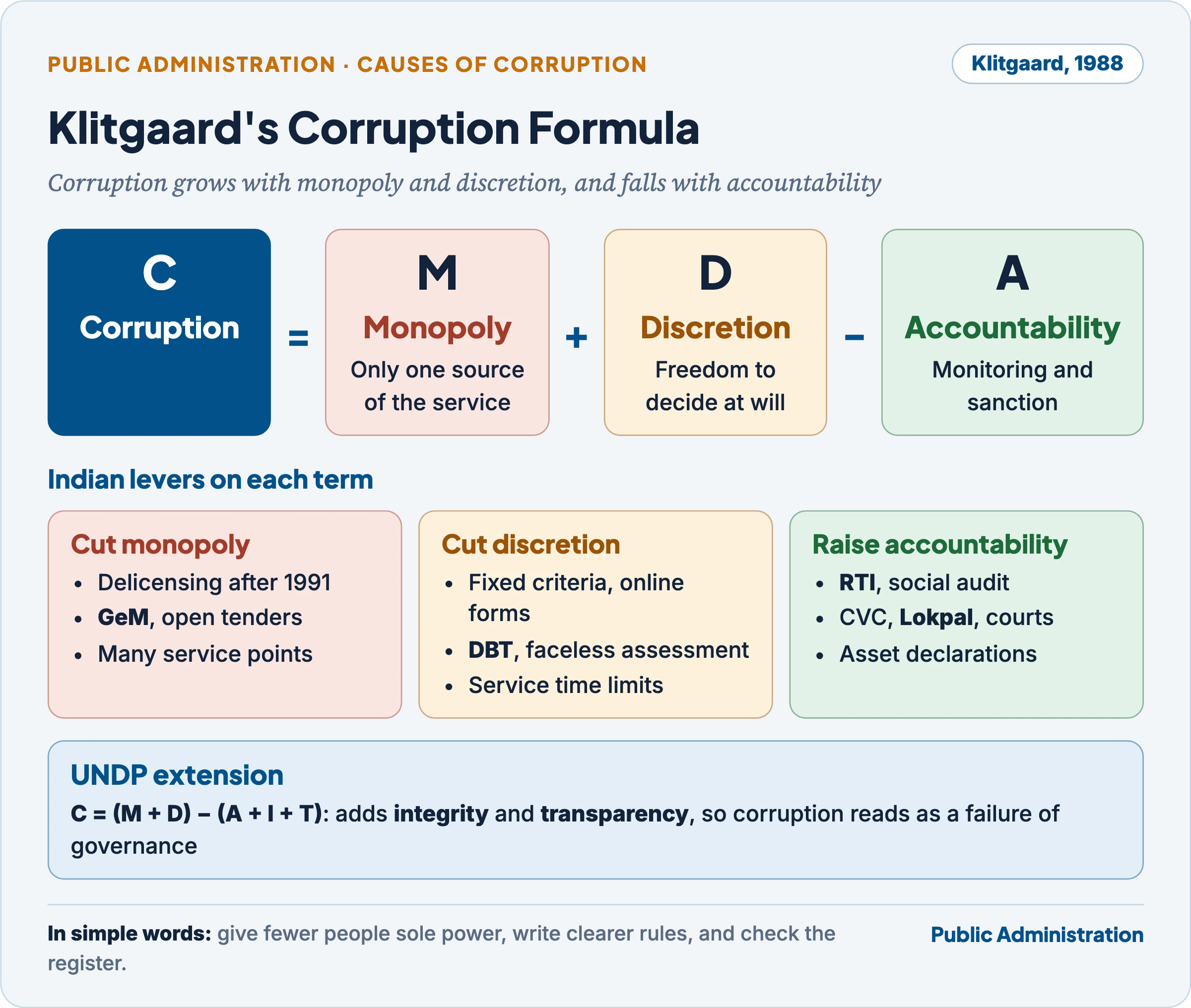
- Robert Klitgaard, an American economist, in Controlling Corruption (1988), summarised the conditions for corruption in a formula: Corruption = Monopoly + Discretion − Accountability.
- Monopoly (M): the official or agency is the only source of a licence, permit or service, so the citizen cannot go elsewhere.
- Discretion (D): the official has wide freedom to decide whether, when and how.
- Accountability (A): the extent to which the official is monitored, must explain and can be sanctioned.
- How it works. A ration-card office that alone issues cards (M), where the inspector decides eligibility with no clear criteria (D), and where nobody audits his decisions (low A), will produce bribes. Online applications with fixed criteria and time limits (lower D), multiple service points (lower M), and public dashboards and social audit (higher A) reduce them.
- Variants. A rent-based version writes C = R + D − A, where R is the economic rent available. The UNDP extended the formula to C = (M + D) − (A + I + T), adding integrity and transparency, which presents corruption primarily as a failure of governance.
- Klitgaard’s own remedies follow from it: select honest agents, change rewards and penalties, gather information to raise detection, restructure the principal–agent–client relationship (competition, less discretion), and raise the moral costs of corruption.
- Indian application. The 2nd ARC’s conclusion restates the formula: monopoly and discretion increase the propensity to corruption, while competition and transparency reduce it, as seen when telephones, cement, steel, airlines and two-wheelers became freely available after 1991 and the queues and “speed money” around them vanished.
- Critique.
- The formula is a heuristic, not a measurable equation: the terms cannot be added.
- It ignores opportunity and pay (Leslie Palmier’s three factors: low salaries, many opportunities, low risk of detection together explain corruption, and it is their balance that matters).
- It treats officials as rational calculators and leaves out culture, norms and collective expectations (see the collective-action critique in Section 2.2).
2.2 The principal–agent model
- The idea. In principal–agent theory, a principal (who wants something done) delegates to an agent (who does it). The agent has more information than the principal (information asymmetry) and interests of his own, so he may shirk or cheat. Corruption occurs when a third party (the client) pays the agent to betray the principal.
- Applied to government by Klitgaard and Susan Rose-Ackerman (Corruption: A Study in Political Economy, 1978; Corruption and Government, 1999):
- citizens are principals of legislators, who are principals of ministers, who are principals of civil servants;
- a contractor (client) bribes the engineer (agent) to certify substandard work, betraying the department and the public (principals).
- Remedies follow: monitoring (audit, vigilance, RTI), incentives (fair pay, performance-linked careers), sanctions (dismissal, prosecution), screening at entry, and reducing information asymmetry (e-governance, publication of decisions).
- The collective-action critique. Anna Persson, Bo Rothstein and Jan Teorell, in “Why Anticorruption Reforms Fail” (2013), argued that in systemic corruption there is no principal who wants honesty: ministers, auditors and police are themselves part of the network. If everyone expects everyone else to be corrupt, honesty is irrational for the individual. Principal–agent remedies (more monitors) then fail, because the monitors are also corrupt. The solution must change shared expectations: a “big push” that convinces people that honesty has become the norm.
- India illustrates both. Where a clear principal exists and wants results (a Chief Minister pushing online land records, the Union pushing DBT), principal–agent tools work. Where the political principal itself benefits (transfers, contracts, election finance), monitoring bodies are kept weak, which critics call a “policy of non-action” (Section 13).
2.3 Public choice and rent seeking
- Public choice theory applies economic reasoning to politics: politicians, bureaucrats and voters are self-interested utility maximisers. It sees corruption as post-constitutional opportunism: once rules are set, individuals and groups try to subvert them for benefits above what they would otherwise get.
- Rent seeking. A rent is income above what a resource would earn in a competitive market. When the state creates artificial scarcity (a licence, a quota, a tariff), firms spend resources to capture the rent rather than to produce.
- Gordon Tullock, “The Welfare Costs of Tariffs, Monopolies, and Theft” (1967), showed that the effort spent competing for such privileges is a pure social loss.
- Anne Krueger, “The Political Economy of the Rent-Seeking Society” (1974), estimated that rents from import licences in India were about 7.3 per cent of national income in 1964. Bribery of officials was one of the main ways such rents were captured.
- Shleifer and Vishny, “Corruption” (1993), showed that many independent agencies each controlling a permit (the “toll booths on a road”) produce more bribery and less output than a single coordinated bribe-taker.
- Policy conclusion. Since the scope of government intervention creates the rents, the cure is to reduce controls, licences and discretion (liberalisation, deregulation, privatisation) and to change incentive structures.
- India. The licence-permit-quota raj (the phrase is associated with C. Rajagopalachari in the late 1950s) is the classic case. The 1991 reforms removed much of the industrial licensing, and corruption around those permits fell.
- Critique. Public choice tends to blame the state as such. Privatisation and contracting created new rents (spectrum, mines, land, public–private partnerships), and the biggest Indian scams after 1991 were in these areas. Reducing the state is not the same as reducing corruption; regulating the market honestly is the harder task. See the article on New Public Administration and Public Choice.
2.4 Myrdal’s soft state
- Gunnar Myrdal, the Swedish Nobel economist, in Asian Drama: An Inquiry into the Poverty of Nations (1968), described South Asian states, including India, as “soft states”.
- A soft state passes progressive laws but lacks the will and capacity to enforce them or to impose social discipline on the powerful.
- Rules are flouted with impunity, and officials and politicians are reluctant to act against each other.
- The “folklore of corruption”. Myrdal described the widely shared beliefs that everyone in power is corrupt and that nothing can be done. These beliefs are partly self-fulfilling: people pay because they assume they must, and officials demand because they assume they can. Breaking the folklore is part of the cure.
- “Speed money”. Myrdal rejected the idea that bribes speed things up. Officials create delays deliberately in order to be paid to remove them, so “speed money” slows administration overall.
- Relevance. Weak enforcement of the Lokpal Act (five years before the first appointment), the unenforced Whistle Blowers Protection Act (passed 2014, never brought into force), low conviction rates and delays in prosecution sanction are all symptoms of softness. The article on Bureaucracy, Democracy and Development places the soft state in the wider Indian debate.
2.5 Is corruption functional? The “grease versus sand” debate
The most debated question in the literature is whether corruption can ever help development. The functionalists of the 1960s said yes; most later evidence says no.
| “Grease the wheels” (functionalist) | “Sand in the wheels” (dysfunctional) | |
|---|---|---|
| Thinkers | Nathaniel Leff, “Economic Development through Bureaucratic Corruption” (1964); David Bayley, “The Effects of Corruption in a Developing Nation” (1966); Samuel Huntington, Political Order in Changing Societies (1968); Nye’s cost–benefit view (1967) | Myrdal (1968); Paolo Mauro, “Corruption and Growth” (1995); Daniel Kaufmann and Shang-Jin Wei (1999); Rose-Ackerman (1999) |
| Argument | Bribes cut red tape in rigid, over-regulated states; allow efficient firms to buy scarce licences; give excluded groups (minorities, new entrepreneurs) access to the state; integrate new elites and reduce violence | Officials create delays to sell their removal; bribes go to the best briber, not the best producer; investment and growth fall; public spending shifts to projects with large kickbacks; the poor pay most |
| Famous line | Huntington: for growth, the only thing worse than a rigid, over-centralised, dishonest bureaucracy is a rigid, over-centralised, honest one | Myrdal: “speed money” slows the whole machine |
| Evidence | Mostly argument and case examples | Cross-country data: Mauro found corruption lowers investment and growth; Kaufmann and Wei found firms paying more bribes spend more, not less, time with officials |
- Why the functionalists lost ground.
- The benefits are short-term and private; the costs (distorted rules, lost trust, poor-quality works) are long-term and public.
- Corruption is not a substitute for reform but an obstacle to it, because those who profit from red tape resist its removal.
- Bribes allocate decisions by ability to pay, which is unjust and often inefficient.
- What survives of the functional view. It reminds administrators that over-regulation itself breeds corruption. The answer is to remove pointless controls, not to tolerate the bribe.
- Gibbon’s paradox. Edward Gibbon, in The Decline and Fall of the Roman Empire, called corruption “the most infallible symptom of constitutional liberty”. His point was that free, open societies expose corruption that autocracies hide; more reported scandals can mean more freedom and more scrutiny, not necessarily more corruption. India’s frequent scams and the activism of courts, media and RTI users can be read this way. The paradox does not excuse corruption: liberty reveals it, but only accountability controls it.
2.6 The ecological view: Riggs’ prismatic society
- Corruption as an environmental problem. The ecological approach holds that administration is shaped by its social, economic, political and cultural setting. Corruption then reflects the environment (kinship obligations, scarcity, a political economy of patronage) rather than merely the defects of administrative rules.
- Fred Riggs, in Administration in Developing Countries: The Theory of Prismatic Society (1964), gave the classic account.
- Formalism: a gap between formal rules and actual behaviour. Conduct rules, vigilance manuals and anti-corruption laws exist on paper, but practice follows other norms.
- Overlapping: new formal structures (a ministry, a regulator) are shaped by older loyalties of caste, clan and family (Riggs’ “clects”).
- The bazaar-canteen model and price indeterminacy: in prismatic economies there is no fixed price for a public service. The “price” depends on who you are, whom you know and how much you can pay. The government office becomes a bazaar for some and a canteen (subsidised, privileged access) for others.
- The sala: the prismatic office, where officials use official power for personal and kin ends while claiming universalistic norms.
- Four groups of environmental factors appear in cross-country studies:
- political and judicial: the level of democracy, competition, electoral rules, judicial independence;
- historical: colonial legacy and legal tradition;
- social and cultural: family values, attitudes to hierarchy, gift norms, social fragmentation;
- economic: openness to trade, natural-resource rents, size of the public sector and level of public pay (Vito Tanzi).
- The synthesis. Corruption is both environmental and administrative. The environment supplies the motive and the tolerance; administrative design supplies the opportunity. The ecological view explains persistence; the administrative view gives levers for change. A study of corruption in India therefore needs a systemic-ecological method that joins the two. See the article on Riggsian Models.
3. Causes of Corruption in India
In simple words
In India, corruption grows from many roots at once: officials who still behave like rulers, citizens who depend on them for everything, elections that need huge sums of black money, rules so complex that only an insider can follow them, and punishment so slow that it rarely deters anyone.
3.1 The 2nd ARC’s diagnosis
The 2nd ARC’s Fourth Report (Ethics in Governance, 2007) identified three factors that aggravate corruption in India, and added a fourth.
- Colonial legacy of unchallenged authority. The colonial state exercised power arbitrarily and expected obedience. In a society that worships power, officials find it easy to deviate from ethical conduct.
- Asymmetry of power. Nearly 90 per cent of workers are in the unorganised sector with precarious incomes, while most organised jobs with security are in government or PSUs. Even the lowliest public servant is better off and more powerful than most citizens, and this reduces social pressure to behave ethically.
- Policies that put the citizen at the mercy of the State. In the early decades after Independence, over-regulation, severe restrictions on economic activity, near-monopoly of the government in many sectors and an economy of scarcity created conditions for unbridled corruption. Subsidies and beneficiary-oriented schemes in a setting of power asymmetry turned the public servant into a patron and the citizen into a supplicant.
- Over-centralisation. The more remotely power is exercised from the people, the greater the distance between authority and accountability. Many layers between citizen and decision-maker diffuse responsibility.
3.2 Political causes
- Election finance. Elections cost far more than the legal limits allow, and parties rely on opaque donations and cash. Money raised through corruption funds campaigns, and donors expect returns in contracts, licences and policy. The Supreme Court’s electoral bonds judgment (2024; Section 7.7) turned on this link.
- The chain from politics to administration. N. Vittal, Central Vigilance Commissioner (1998–2002), argued that political corruption leads to bureaucratic corruption, which leads to business corruption and the criminalisation of politics, and identified the growth of black money as the root of the culture of corruption.
- The transfer and posting industry. Ministers’ control over transfers and postings of officers (especially police, revenue, engineering and tax posts) is both a source of income and a means of control; honest officers are moved, pliable ones rewarded. The 2nd ARC and the Santhanam Committee both named appointments, transfers, postings and licences as the main channels of routine political corruption.
- Criminalisation of politics. The N.N. Vohra Committee (1993) described a nexus of criminals, politicians and bureaucrats. The Association for Democratic Reforms’ analyses of candidates’ affidavits show a large share of legislators facing criminal cases. This is taught in the article on Central and State Agencies and Criminalisation of Politics.
- Tolerance by the elite. As long as the political class does not punish its own, corruption acquires legitimacy; the scandals of the 1980s–2010s (Bofors, fodder, telecom, Commonwealth Games, coal) show both the scale and the slowness of punishment.
3.3 Administrative causes
- Discretion and complex procedures. Vague rules, many approvals and long forms create points of extraction. The citizen who cannot follow the procedure pays a middleman (“agent”, “dalal”) to navigate it.
- Red tape and delay. Delay is both a cause and a product of corruption (Myrdal’s “speed money”).
- Monopoly at the cutting edge. Large powers rest with lower functionaries who deal with the public: the patwari and land records, the police station, municipal building inspectors, electricity and water officials, food and drug inspectors, sales tax and transport officials.
- Low pay and weak career incentives at the lower levels, though pay revisions after the Sixth and Seventh Pay Commissions have narrowed the gap, which shows that pay alone does not explain corruption.
- Weak sanctions.
- Article 311 procedures for dismissal are long; departmental inquiries are slow and often “soft-pedalled”.
- Prosecution sanction under s.19 of the PC Act and prior approval under s.17A delay cases.
- Conviction rates in corruption trials are low and trials take many years, so the expected cost of corruption (probability of punishment times its severity) is small.
- Lack of transparency. Before the RTI Act, 2005, the Official Secrets Act, 1923 and the culture of secrecy hid files from the public.
3.4 Economic, social and historical causes
- Economic: scarcity and controls before 1991; after 1991, large rents in natural resources, land, spectrum and public procurement; a large cash economy and black money.
- Social: gift culture, obligations to kin and caste, acceptance of “small” corruption as normal (Heidenheimer’s white corruption), and the tendency to admire wealth regardless of its source. Mahatma Gandhi listed seven social sins in Young India (1925): politics without principles, wealth without work, pleasure without conscience, knowledge without character, commerce without morality, science without humanity and worship without sacrifice. The 2nd ARC reproduced them as a moral frame for its report.
- Historical: the colonial habit of unaccountable authority, war-time scarcity, and after 1947 the expansion of planning, PSUs and controls, which multiplied the points of contact between citizen and official (Section 5).
Indian Connect — How large is the problem?
- No official estimate exists. A 2005 Transparency International India study found that more than half of respondents had first-hand experience of paying a bribe or using influence to get a job done in a public office.
- Bibek Debroy and Laveesh Bhandari, in Corruption in India: The DNA and the RNA (2012), estimated bribes taken by public officials at about Rs 92,000 crore, around 1.26 per cent of GDP, with transport, real estate and government-delivered services the worst sectors.
- The Standing Committee on Finance (2019) concluded that unaccounted income and wealth inside and outside India “do not appear amenable to credible estimation”.
- India scored 39/100 and ranked 91st of 182 in TI’s CPI 2025 (up from 38 and 96th of 180 in 2024), below the global average of 42.
4. Effects of Corruption
In simple words
Corruption is not a victimless transfer of money. It makes roads crumble, rations disappear, honest officers leave and citizens stop trusting the government. The poor suffer most because they depend most on public services.
4.1 On administration
- Goal displacement. Officials pursue personal gain instead of organisational goals; a second line of authority develops parallel to the formal one (the “real” decisions are made where money changes hands).
- Distorted decisions. Projects are chosen for kickback potential, not need; specifications are written to suit a supplier; maintenance is neglected because new construction pays better.
- Poor quality and waste. Substandard works, leakages in the Public Distribution System and inflated bills.
- Demoralisation. When corruption is pervasive, honest officers are isolated or leave, and the competent are deterred from joining, further lowering capacity. The killings of Satyendra Dubey (NHAI engineer, 2003) and S. Manjunath (Indian Oil officer, 2005) after they exposed wrongdoing showed the risks honesty can carry.
- Contagion. Corruption in one agency spreads to related agencies; the prevailing ethos becomes one of cynicism and apathy.
4.2 On development and the economy
- Lower investment and growth. Mauro’s cross-country work (1995) linked corruption with lower investment; corruption acts like a tax on investment and deters foreign investment.
- Fiscal loss. Revenue is lost through tax evasion and collusive assessment; spending is inflated through padded contracts.
- Regressive burden. The poor pay a larger share of their income in bribes and lose most when services fail. Studies of truck transport (bribes at check-posts and borders), the PDS and rural employment programmes in the 2000s documented heavy leakages.
- Distorted markets. Firms compete in access rather than productivity; black money and capital flight weaken the tax base.
4.3 On democracy and trust
- Loss of legitimacy. Corruption breaks the trusteeship relationship between officials and citizens. When people believe the state is for sale, compliance with law weakens.
- Unequal citizenship. Rights become privileges available to those who pay or know someone.
- Cynicism. The “folklore of corruption” spreads: anti-corruption drives are seen as posturing or tools against opponents, which undermines genuine reform.
- Mass mobilisation. The India Against Corruption movement (2011), led by Anna Hazare, showed how corruption can become a central issue of democratic politics and directly produce institutions (the Lokpal Act, 2013).
5. Corruption in Indian Administrative History
In simple words
Corruption in Indian administration is not new. Kautilya wrote about it more than two thousand years ago, the British faced it, and independent India set up its first anti-corruption committee in 1962.
- Kautilya’s Arthashastra. Kautilya wrote that just as one cannot help tasting honey or poison placed on the tongue, an official handling revenue cannot help tasting a little of it, and that one can no more tell when an official takes money than when a fish drinks water. He listed about forty ways of embezzlement and prescribed upadha tests of integrity, spies among accountants, rewards for informers and recovery of misappropriated sums (see the article on Kautilya’s Arthashastra).
- Colonial period. The East India Company’s servants grew rich on private trade and “presents”; the impeachment of Warren Hastings (1788–95) was partly about corruption; Cornwallis raised salaries and forbade private trade, an early use of the pay remedy.
- War and the DSPE. The Special Police Establishment (1941) was set up to investigate bribery in war supplies; the DSPE Act, 1946 gave it a statutory base and extended it to all departments of the Government of India. The Prevention of Corruption Act, 1947 created the first special anti-corruption statute.
- Early scandals after 1947. The jeep purchase case (1948) and the Mundhra affair (1957–58), investigated by the Chagla Commission, showed that corruption had reached high levels; the latter led to the resignation of Finance Minister T.T. Krishnamachari.
- The Santhanam Committee (1962–64). The first systematic review (Section 6.1) found that corruption had spread to levels where it had earlier been absent and that the public widely believed some ministers had enriched themselves. It led to the CVC (1964); the CBI was created by a resolution of 1 April 1963 with the DSPE as its core.
- From the 1960s to 2011. The 1st ARC (1966) proposed the Lokpal and Lokayuktas; Maharashtra created the first functioning Lokayukta (Act of 1971); Lokpal Bills lapsed repeatedly between 1968 and 2011; the Vohra Committee (1993), the Vineet Narain judgment (1997), the CVC Act (2003), the RTI Act (2005) and the 2nd ARC (2007) followed; the 2011 movement brought the Lokpal and Lokayuktas Act, 2013.
6. The Institutional Framework
In simple words
India fights corruption through many bodies rather than one: a watchdog for vigilance (CVC), a police agency for investigation (CBI), an ombudsman for high office (Lokpal), ombudsmen in the States (Lokayuktas), and vigilance officers inside every department. Each covers a part; the gaps and overlaps between them matter as much as their powers.
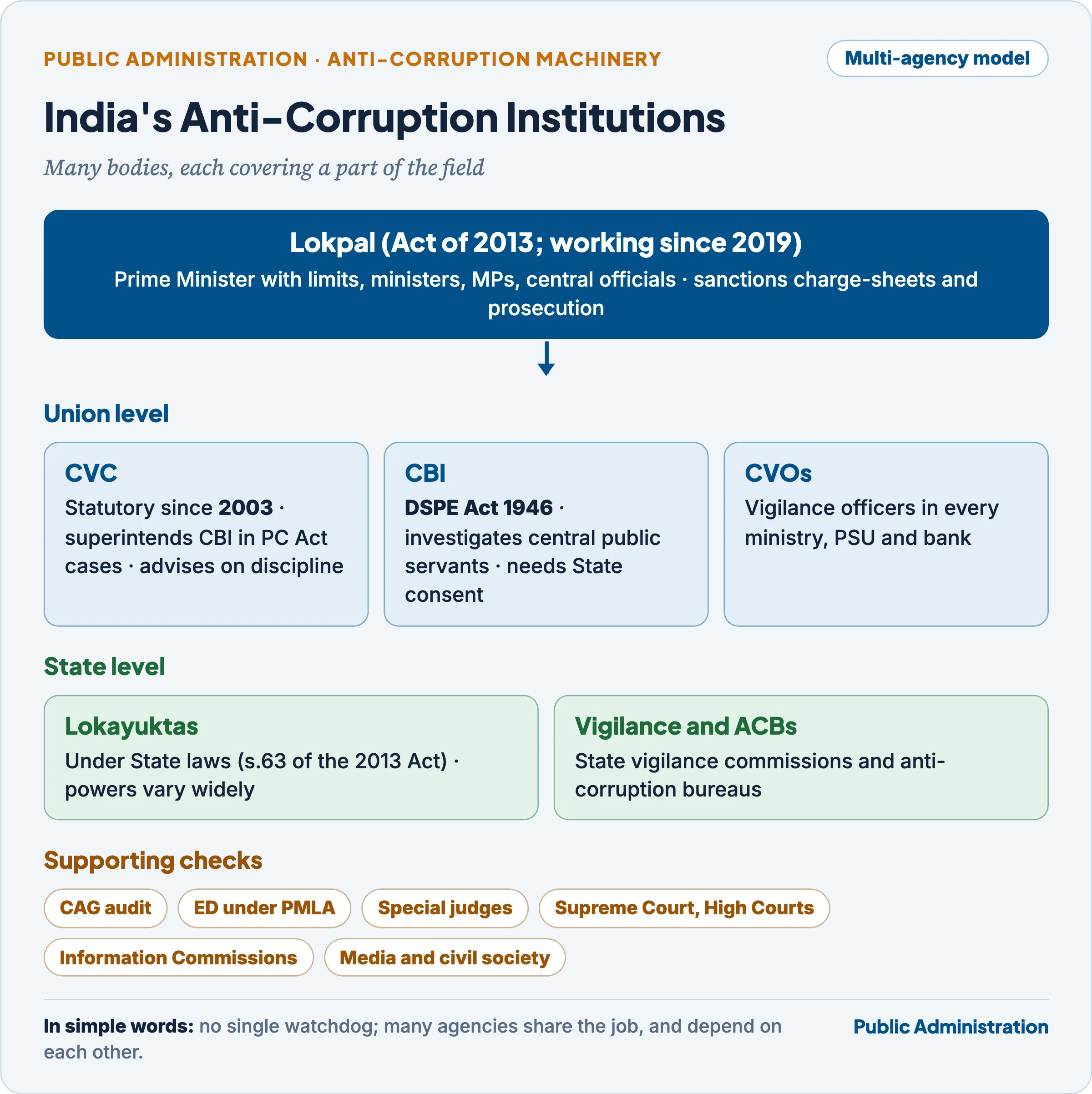
- A multi-agency model. Comparative studies distinguish single-agency models, where one powerful body leads (Singapore’s Corrupt Practices Investigation Bureau, founded 1952; Hong Kong’s Independent Commission Against Corruption, 1974) from multi-agency models (India, the USA). India’s anti-corruption work is divided among the CVC, CBI, Lokpal, State Vigilance Commissions, State anti-corruption bureaus and Lokayuktas, with the CAG, ED, courts and information commissions as supporting checks.
- Why it matters. Multi-agency systems avoid concentrating dangerous power in one body, but suffer from overlap, diffused responsibility and dependence (the Lokpal and CVC rely on the CBI to investigate; the CBI depends on the government for staff and sanction).
6.1 The Santhanam Committee (1962–64)
- Set up in 1962 by the Ministry of Home Affairs (Home Minister Lal Bahadur Shastri) as the Committee on Prevention of Corruption, chaired by K. Santhanam, a Member of Parliament. It reported in 1964.
- Findings.
- Corruption had spread “even to those levels of administration from which it was conspicuously absent in the past”.
- There was a widespread impression that some ministers had enriched themselves and secured jobs for relatives; the Committee held that absolute integrity of ministers is an indispensable condition for purity in the public services.
- Corruption flourished because of discretionary powers, cumbersome procedures, delays and the lack of an independent vigilance machinery.
- Recommendations.
- A Central Vigilance Commission, independent of the executive, with power to inquire into complaints against public servants (it kept ministers outside its scope).
- Allegations against ministers to be investigated promptly by an agency whose findings would command respect.
- A code of conduct for ministers; changes to conduct rules for civil servants on gifts, assets and private interests.
- Making possession of assets disproportionate to known sources of income an offence (inserted into the PC Act, 1947 in 1964 and now in s.13(1)(b) of the 1988 Act).
- Vigilance units in every ministry and department, and simplification of procedures to reduce discretion.
- Outcome. The CVC was set up by a government resolution of 11 February 1964, but as an advisory body without statutory status, which fell short of what the Committee had proposed. Its proposal on ministers took fifty years to be met through the Lokpal.
6.2 The Central Vigilance Commission (CVC)
- Evolution.
- 1964: created by executive resolution as an advisory apex vigilance body.
- 1997: in Vineet Narain v Union of India (the “Jain hawala” case), the Supreme Court directed that the CVC be given statutory status and superintendence over the CBI’s anti-corruption work, and struck down the “Single Directive” requiring prior permission to investigate senior officers.
- 1998: an ordinance gave the CVC statutory status.
- 2003: the Central Vigilance Commission Act, 2003 made it a multi-member statutory body.
- Composition and appointment. A Central Vigilance Commissioner and up to two Vigilance Commissioners, appointed by the President on the recommendation of a committee of the Prime Minister, the Home Minister and the Leader of the Opposition in the Lok Sabha; term of four years or age 65; removal on the lines of a constitutional functionary (after a Supreme Court inquiry for misbehaviour).
- Functions.
- Superintendence over the DSPE (CBI) in investigations under the PC Act (s.8 of the CVC Act; s.4 of the DSPE Act); review of the progress of such investigations and of applications for sanction of prosecution.
- Inquiry into complaints against central public servants of specified levels (Group A officers and equivalents in PSUs, banks and statutory bodies).
- Advice to ministries in vigilance and disciplinary cases (first-stage and second-stage advice).
- Supervision of vigilance administration: the network of Chief Vigilance Officers (CVOs) in every ministry, PSU and bank; a technical wing of engineers audits works and procurement.
- Role in selections: the CVC chairs the committee recommending the Director of Enforcement and participates in selecting senior CBI officers.
- Preventive vigilance: integrity pacts in large procurements, Vigilance Awareness Week, systemic improvement circulars; it is the designated agency for complaints under the Public Interest Disclosure and Protection of Informers (PIDPI) Resolution, 2004.
- Under the Lokpal Act, the CVC handles complaints against Group C and D employees referred by the Lokpal and reports to it.
- Institutional integrity. In Centre for PIL v Union of India (2011), the Supreme Court quashed the appointment of a Central Vigilance Commissioner because the selection committee had ignored a pending charge-sheet against him, holding that the selection must protect institutional integrity, not only personal integrity.
- Limitations.
- Its advice is recommendatory; departments may differ (though they must record reasons and the CVC reports disagreements in its annual report).
- It has no investigative machinery of its own and depends on CVOs (who are departmental officers on deputation) and the CBI.
- No jurisdiction over politicians; limited reach over State governments.
- Heavy caseload and delays in disciplinary proceedings in departments.
6.3 The CBI’s anti-corruption role (in brief)
- The CBI investigates PC Act offences by central public servants through its Anti-Corruption Division, under the superintendence of the CVC for these cases and of the Lokpal for cases referred by it.
- Its effectiveness is limited by:
- the State consent requirement under s.6 of the DSPE Act (several States have withdrawn general consent);
- executive control of staff, budget and prosecution sanction;
- the “caged parrot” remark of the Supreme Court (2013) on executive interference;
- prior approval under s.17A of the PC Act.
- The CBI’s history, legal base, consent disputes and judgments are taught in the article on British Legacy, Police Commission and Investigative Agencies.
6.4 The Lokpal
Origins
- The ombudsman idea. The ombudsman (Swedish: “representative”) began in Sweden in 1809; Finland, Denmark, Norway and New Zealand followed, and the UK created a Parliamentary Commissioner for Administration in 1967.
- The name. L.M. Singhvi, a Member of Parliament, coined “Lokpal” and “Lokayukta” in 1963.
- The 1st ARC (1966). The Administrative Reforms Commission, chaired by Morarji Desai, in its interim report on Problems of Redress of Citizens’ Grievances (1966), recommended a two-tier machinery: a Lokpal for complaints against ministers and secretaries at the Centre and in the States, and Lokayuktas for other officials.
- Forty-five years of failed bills. Lokpal Bills were introduced in 1968, 1971, 1977, 1985, 1989, 1996, 1998, 2001, 2005 and 2008; all lapsed or were withdrawn, mainly over whether the Prime Minister and MPs should be covered.
- The 2011 movement. Anna Hazare’s fasts (April and August 2011) and the civil-society Jan Lokpal draft pushed Parliament to act. The Lokpal and Lokayuktas Act, 2013 received assent on 1 January 2014 and came into force on 16 January 2014.
- The long wait. The Supreme Court in Common Cause v Union of India (2017) held that the absence of a recognised Leader of the Opposition did not justify delay. The first chairperson, Justice Pinaki Chandra Ghose, took office in March 2019; the Lokpal began functioning on 27 March 2019.
Structure and appointment
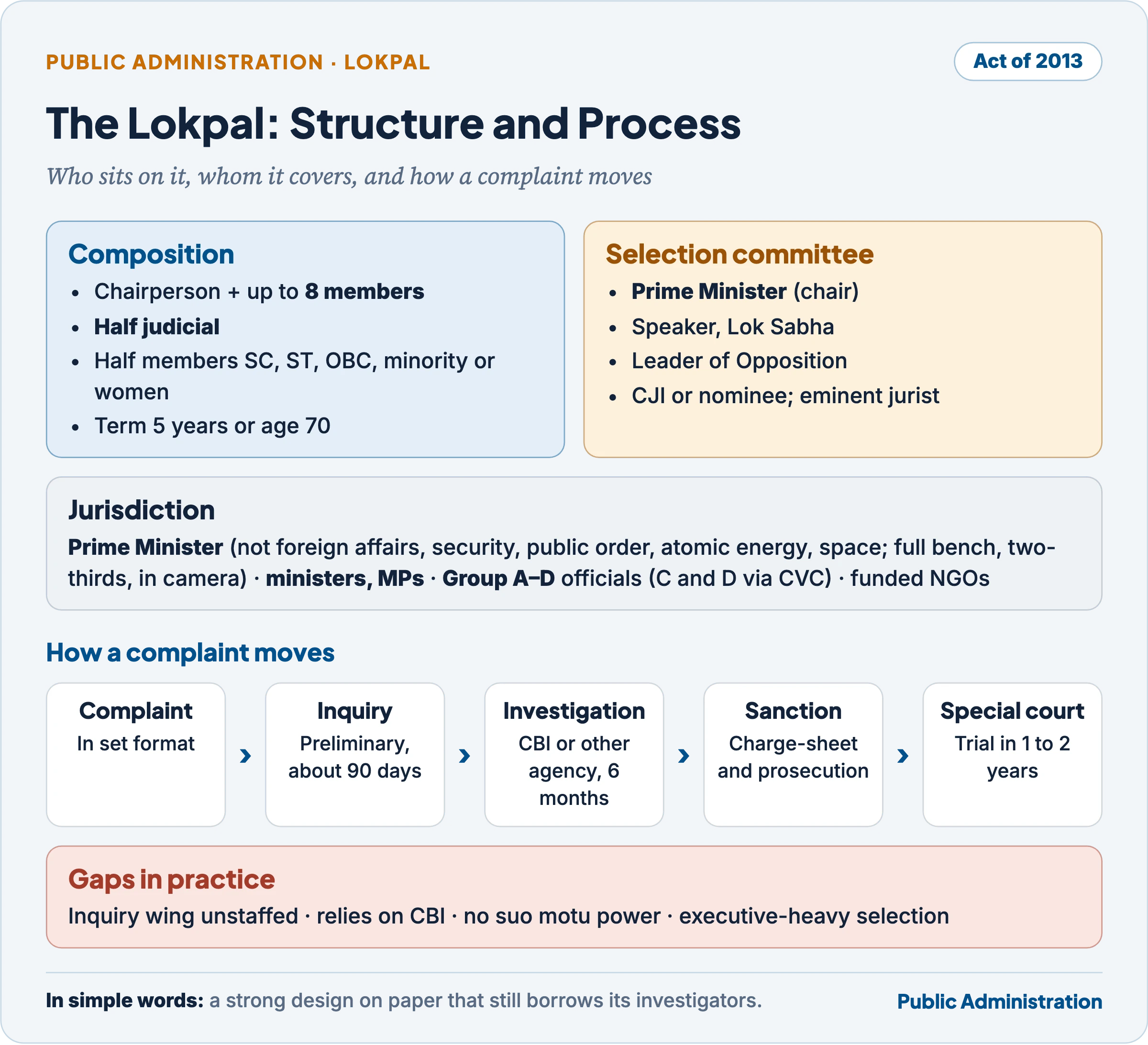
- Composition (s.3): a chairperson (a former Chief Justice or Supreme Court judge, or an eminent person with at least 25 years’ expertise in anti-corruption policy, public administration, vigilance, finance, law or management) and up to eight members, of whom half are judicial. At least half the members must be from SC, ST, OBC, minorities and women.
- Selection committee (s.4): the Prime Minister (chair), the Speaker of the Lok Sabha, the Leader of the Opposition in the Lok Sabha, the Chief Justice of India or a judge nominated by him, and an eminent jurist nominated by the President on the recommendation of the other four. A search committee prepares the panel.
- Tenure: five years or until age 70. Removal by the President after a Supreme Court inquiry, on a reference by the President or a petition signed by at least 100 MPs.
- Wings: an Inquiry Wing (s.11) under a Director of Inquiry for preliminary inquiries, and a Prosecution Wing (s.12) under a Director of Prosecution.
Jurisdiction (s.14)
- The Prime Minister, with three limits:
- excluded subjects: allegations relating to international relations, external and internal security, public order, atomic energy and space;
- an inquiry needs the full bench to consider it and at least two-thirds of members to approve;
- the inquiry is held in camera, and if the complaint is dismissed, the records are not published.
- Union ministers and Members of Parliament (but not for anything said or any vote given in Parliament, which is protected by Article 105).
- Group A, B, C and D officers and equivalent officials of central PSUs, statutory bodies and societies; complaints against Group C and D go to the CVC, which reports back.
- Societies, trusts and NGOs wholly or partly financed by government, and those receiving foreign contributions above Rs 10 lakh a year.
- The Lokpal’s own chairperson and members (through a separate procedure).
Procedure and powers
- Complaint → preliminary inquiry (by the Inquiry Wing or any agency, including the CBI; normally to be completed within 90 days) → hearing of the public servant → investigation by an agency (normally within six months, extendable by six) → the Lokpal decides whether to grant sanction to file a charge-sheet and to prosecute, or to close the case or initiate departmental action.
- Special courts (s.35) are to try cases within one year, extendable to two years.
- Powers:
- superintendence and direction over the CBI in cases it refers; CBI officers investigating such cases cannot be transferred without the Lokpal’s approval;
- civil court powers for inquiries;
- provisional attachment and confiscation of assets acquired by corruption;
- recommending transfer or suspension of a public servant to prevent tampering;
- prosecution of false and frivolous complaints.
- Asset declarations: the Lokpal and Lokayuktas (Amendment) Act, 2016 changed the format and timing of public servants’ asset declarations under s.44.
- Other changes made by the Act: it inserted s.4A into the DSPE Act (CBI Director chosen by a committee of the Prime Minister, Leader of Opposition and Chief Justice), created a Directorate of Prosecution in the CBI, and required States to set up Lokayuktas within one year (s.63).
Working since 2019
| Financial year | Complaints registered | Complaints disposed of |
|---|---|---|
| 2021–22 | 149 | 147 |
| 2022–23 | 320 | 316 |
| 2023–24 | 166 | 161 |
| 2024–25 | 292 | 260 |
| 2025–26 (till 28 February 2026) | 389 | 336 |
Source: written reply in the Lok Sabha, 25 March 2026. In 2019–20, its first year, the Lokpal received 1,427 complaints, most of them not in the prescribed format.
- The figures are small for a country of India’s size: most complaints are rejected for being outside jurisdiction, anonymous or not in the prescribed form, and few lead to investigation or prosecution.
- Leadership gaps. Justice Ghose retired in May 2022; the post was filled only when Justice A.M. Khanwilkar took oath on 10 March 2024.
- Wings still incomplete. The Lokpal constituted its Inquiry Wing in September 2024 and its Prosecution Wing on 6 June 2025, but a parliamentary committee reported in March 2026 that the Director of Inquiry was still not appointed and prosecutions were being handled through the CBI; 24 of 65 sanctioned posts were vacant, and no special court had yet been notified.
- Jurisdictional tests.
- In January 2025 the Lokpal held that it could entertain complaints against High Court judges; the Supreme Court took suo motu cognisance and stayed the order in February 2025.
- In November 2025 the Lokpal granted the CBI sanction to file a charge-sheet against an MP in the “cash-for-query” case; in December 2025 the Delhi High Court set it aside for not following the hearing procedure of s.20 and sent the matter back.
- Credibility. In October 2025 the Lokpal floated a tender for seven luxury cars; after public criticism it cancelled it in December 2025, an episode that showed how much an ombudsman’s authority rests on its own example.
Indian Connect — Lokpal, Jan Lokpal and the 2nd ARC model compared
| Feature | 2nd ARC’s Rashtriya Lokayukta (2007) | Jan Lokpal draft (2011) | Lokpal Act (2013) |
|---|---|---|---|
| Legal basis | Constitutional body | Statute | Statute |
| Prime Minister | Excluded | Included fully | Included with exclusions and safeguards |
| Bureaucracy | Not its focus (CVC and others) | All levels | Groups A–D (C and D through CVC) |
| Investigation | Own machinery | CBI’s anti-corruption wing to be merged into it | Uses CBI and others; own wings slowly built |
| Lokayuktas | Constitutional mandate for States | Model law for States | States to enact within one year |
- Assessment.
- Strengths: first statutory ombudsman covering the Prime Minister, ministers and MPs; time limits; asset attachment; superintendence over the CBI in referred cases; mandated diversity.
- Weaknesses: executive-dominated selection committee (three of five members are political or nominated); dependence on the CBI and on government for staff; no suo motu power to initiate inquiries without a complaint; the PM exclusions; strict complaint formats; slow start; and low output compared with expectations.
- Deeper limit: an ombudsman works only where political accountability is strong. In a system where minimal accountability is the norm, the Lokpal can be an ideal institution with limited effectiveness; it treats symptoms if the drivers (election finance, discretion, weak trials) remain.
Common confusion
Is the Lokpal an ombudsman like the British Parliamentary Commissioner? Only partly. The UK Parliamentary and Health Service Ombudsman (created 1967) investigates maladministration in response to complaints routed through MPs and makes recommendations; it has no power to prosecute and does not deal with crime. India’s Lokpal is primarily an anti-corruption body: it deals with offences under the PC Act, orders preliminary inquiries and investigations, grants sanction to prosecute, can attach property, and covers ministers, MPs and the Prime Minister. Most State Lokayuktas, by contrast, are closer to the classical ombudsman, handling both grievances (maladministration) and allegations (corruption), usually with recommendatory powers.
6.5 State Lokayuktas
- Origins. Odisha passed the first law (1970) but made it operational only in 1983; Maharashtra’s Lokayukta and Upa-Lokayuktas Act, 1971 created the first functioning Lokayukta (from October 1972), directly on the 1st ARC’s recommendation. Rajasthan (1973), Bihar (1974), Uttar Pradesh (1975), Madhya Pradesh (1981) and others followed.
- After 2013. Section 63 of the Lokpal Act required every State to set up a Lokayukta within one year, but left its structure to State law, so the institutions vary widely. Several States delayed until the Supreme Court pressed them in 2018–19.
- Variations.
- Coverage of the Chief Minister varies; some States exclude the CM or require special procedures.
- Powers: some Lokayuktas only recommend; some (Karnataka’s is the best known) have their own police wing.
- Investigation: many depend on the State police or vigilance department controlled by the same government.
- Karnataka. Under Justice N. Santosh Hegde, the Karnataka Lokayukta’s report on illegal mining (2011) led to the resignation of the Chief Minister. In 2016 the State created an Anti-Corruption Bureau under the government and took away the Lokayukta police’s powers; the Karnataka High Court quashed the ACB in August 2022 and restored them.
- Kerala. The Kerala Lok Ayukta (Amendment) Act, 2022, which received the President’s assent in February 2024, allowed the “competent authority” (the government, the Assembly or the Chief Minister) to accept or reject the Lokayukta’s findings instead of the official having to vacate office, diluting a strong provision.
- Evaluation.
- Uneven performance: effective where heads were activist and powers strong (Karnataka in 2006–11), weak elsewhere.
- Common weaknesses: recommendatory findings; government control of staff and budget; appointment of retired judges as a sinecure; exclusion of CMs or legislators; few convictions; and low public awareness of what the institution does.
- Judicial institutions without adequate teeth: they are headed by judges and use judicial procedure, but cannot enforce their findings.
6.6 Other parts of the machinery
- State Vigilance Commissions and Anti-Corruption Bureaus investigate State public servants; CVOs run preventive, punitive and surveillance vigilance inside organisations.
- The CAG exposes irregularities (2G, coal, Commonwealth Games audits); the ED pursues the proceeds of corruption; special judges try PC Act cases and constitutional courts monitor investigations; Information Commissions enforce the RTI Act.
7. The Legal Framework
In simple words
The laws against corruption punish four things: taking or giving bribes, hiding illegal wealth in other people’s names, washing dirty money through the financial system, and running away from the law. A fifth set of rules tries to protect the people who expose corruption.
The main statutes are summarised first; the key ones are explained after the table.
| Act | Year | Key provisions |
|---|---|---|
| Delhi Special Police Establishment Act | 1946 | Legal base of the CBI; s.6 State consent; s.4 CVC superintendence in PC Act cases |
| Prevention of Corruption Act | 1988 (amended 2018) | Bribery offences (ss.7, 7A, 8, 9, 10), criminal misconduct (s.13), prior approval (s.17A), attachment (s.18A), sanction (s.19), presumption (s.20) |
| Benami Transactions (Prohibition) Act | 1988 (amended 2016) | Benami property liable to confiscation; adjudicating authority and appellate tribunal |
| Prevention of Money Laundering Act | 2002 (in force 2005) | Laundering offence; attachment of proceeds of crime; ED; PC Act offences are scheduled offences |
| Central Vigilance Commission Act | 2003 | Statutory CVC; superintendence over CBI’s PC Act cases |
| Right to Information Act | 2005 | Proactive disclosure (s.4); information on request; Information Commissions |
| Lokpal and Lokayuktas Act | 2013 (amended 2016) | Lokpal; s.63 Lokayuktas; s.44 asset declarations |
| Whistle Blowers Protection Act | 2014 | Protection for public-interest disclosures; never brought into force |
| Black Money (Undisclosed Foreign Income and Assets) and Imposition of Tax Act | 2015 | Tax and penalty on undisclosed foreign income and assets; prosecution |
| Fugitive Economic Offenders Act | 2018 | Declaration of fugitives (offences of Rs 100 crore or more); confiscation |
| Bharatiya Nyaya Sanhita / Nagarik Suraksha Sanhita | 2023 (in force 1 July 2024) | BNS s.316(5) criminal breach of trust by a public servant; ss.170–173 electoral bribery; s.111 organised crime including economic offences; BNSS s.218 sanction for prosecution |
7.1 The Prevention of Corruption Act, 1988 and the 2018 amendment
- Background. The 1988 Act consolidated the PC Act, 1947 and the bribery sections of the IPC (ss.161–165A). It widened the definition of “public servant” to anyone performing a public duty (the Supreme Court later held in 2016 that even employees of private banks could be covered), created special judges, and kept the sanction requirement for prosecution (s.19).
- The 2018 amendment (in force 26 July 2018) rewrote the Act, partly to align it with UNCAC.
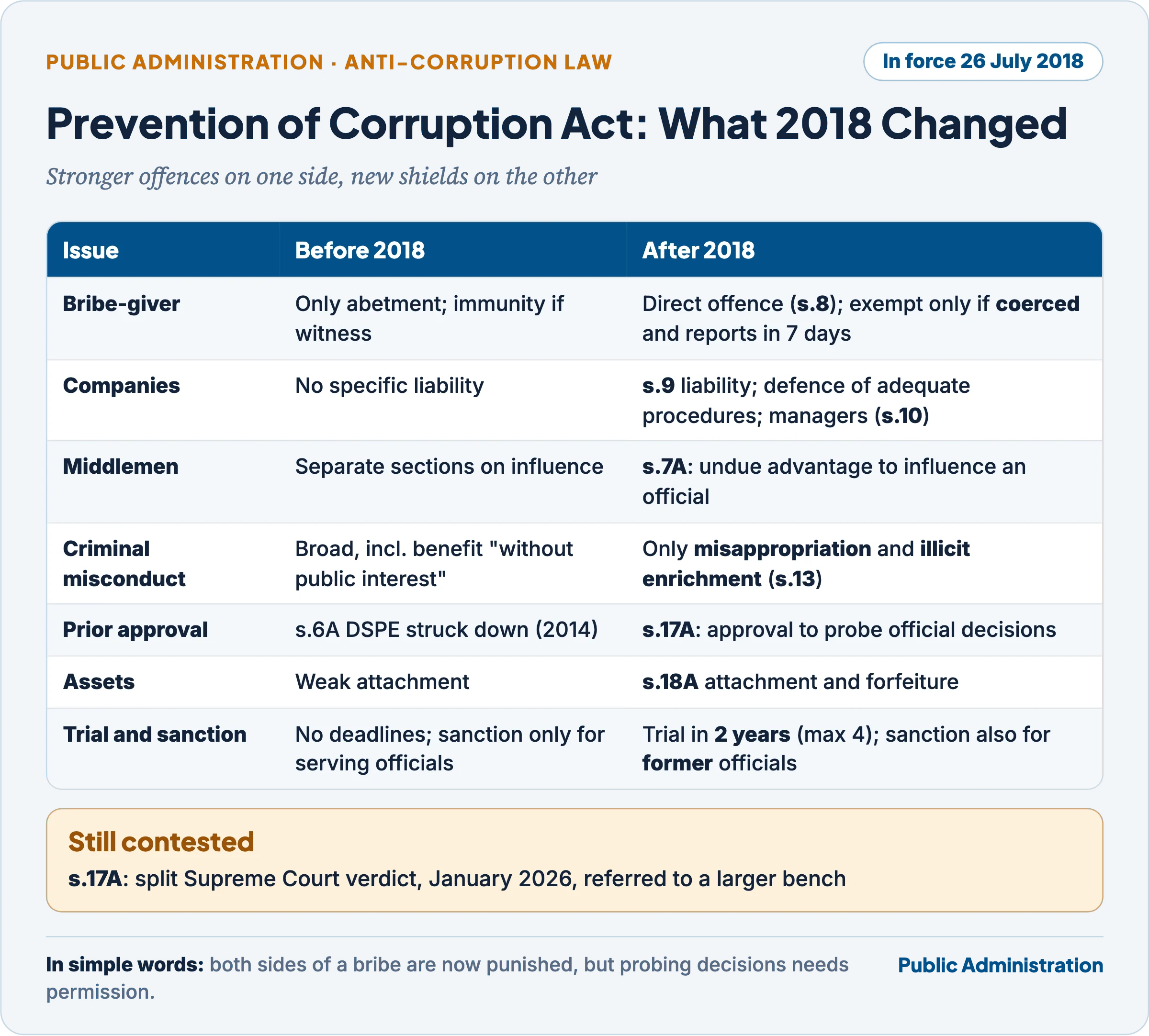
- Main changes.
- “Undue advantage” replaced “gratification”; s.7 punishes a public servant who obtains or accepts an undue advantage to perform a public duty improperly or dishonestly.
- s.7A: taking an undue advantage to influence a public servant by corrupt or illegal means or personal influence (the middleman).
- s.8: bribe-giving became a direct offence, punishable with up to seven years. A person compelled to give a bribe is exempt if he reports it within seven days.
- s.9: commercial organisations are liable if any person associated with them bribes a public servant to obtain or retain business; the defence is having “adequate procedures” to prevent bribery. s.10 makes directors and managers liable if they consented or connived.
- s.13: criminal misconduct narrowed to (a) fraudulent misappropriation of property entrusted to a public servant and (b) intentional illicit enrichment (assets disproportionate to known income). The old s.13(1)(d)(iii), which punished obtaining a benefit for anyone “without any public interest” even without a bribe, was dropped because it was seen to criminalise bona fide decisions.
- s.17A: prior approval of the government (or the authority competent to remove the officer) before any enquiry, inquiry or investigation into an offence relatable to a recommendation made or decision taken in the discharge of official functions; not needed for arrest on the spot for accepting a bribe; decision within three months (plus one).
- s.18A: attachment and forfeiture of property using the procedure of the Criminal Law Amendment Ordinance, 1944.
- s.19: sanction also needed for former public servants; decision within three months (plus one).
- s.4(4): trials to be concluded within two years (maximum four).
- Punishment for taking a bribe stays at three to seven years (raised from six months–five years by the Lokpal Act in 2014); bribe-giving carries up to seven years.
- Assessment. The amendment met long-standing demands (bribe-giver liability, corporate liability, speedy trial, attachment) recommended by the Law Commission and the 2nd ARC, but s.17A reintroduced a form of the prior-approval shield that the Supreme Court had struck down twice (Section 8). It is the clearest example of the tension between protecting honest decision-makers and shielding the corrupt.
Common confusion
Did the 2018 amendment criminalise bribe-giving for the first time? Not quite. Before 2018, a bribe-giver could be prosecuted for abetment under s.12 of the PC Act and under the IPC, and s.24 gave immunity to a giver who became a witness. What 2018 did was make bribe-giving a separate, direct offence (s.8) with its own punishment, add corporate liability (s.9), and limit protection to givers who were compelled and reported within seven days. Before this, the economist Kaushik Basu (2011) had proposed the opposite: making the giving of “harassment bribes” legal so that givers would cooperate in exposing takers; the 2018 law took a middle course.
7.2 Protection of whistleblowers
- Background. The murders of Satyendra Dubey (2003) and S. Manjunath (2005) exposed the absence of protection. The government issued the Public Interest Disclosure and Protection of Informers (PIDPI) Resolution, 2004, designating the CVC to receive such complaints and keep the informer’s identity secret.
- Whistle Blowers Protection Act, 2014 (notified 12 May 2014):
- any person may make a public interest disclosure of corruption, wilful misuse of power or discretion, or a criminal offence by a public servant to a competent authority (the CVC, State Vigilance Commissions, and others);
- the identity of the complainant is protected; victimisation is prohibited; false complaints made knowingly are punishable.
- The stalled amendment. The Whistle Blowers Protection (Amendment) Bill, 2015 (passed by the Lok Sabha on 13 May 2015) would have barred disclosures in ten categories of information modelled on the RTI Act’s exemptions (sovereignty, economic interests, Cabinet papers and others) and disallowed disclosures covered by the Official Secrets Act. Critics said this would gut the law. The Bill lapsed with the 16th Lok Sabha in 2019.
- Present position. The government told Parliament in December 2024 that the 2014 Act has not been brought into force because it needs amendments to protect sovereignty and security, and that no amendment is on the legislative agenda. Whistleblowers therefore rely on the 2004 PIDPI Resolution. This is a clear case of the gap between enactment and enforcement (Myrdal’s soft state).
7.3 Benami property
- A benami transaction is one in which property is held by one person while the consideration is paid by another (a “name-lender”), a common way of hiding corrupt wealth.
- The Benami Transactions (Prohibition) Act, 1988 was a dead letter: no rules were framed for decades.
- The Benami Transactions (Prohibition) Amendment Act, 2016 (in force from November 2016) created an Initiating Officer, Approving Authority, Adjudicating Authority and Appellate Tribunal, provided for attachment and confiscation of benami property, and punishment of up to seven years.
- Litigation. In Union of India v Ganpati Dealcom (August 2022), a three-judge bench held that the 2016 provisions could not be applied retrospectively and declared parts of the original Act unconstitutional. On 18 October 2024, a Special Bench recalled that judgment on review, because the validity of the original provisions had never been challenged in that case, and restored the appeal for fresh hearing.
7.4 Money laundering
- The Prevention of Money Laundering Act, 2002 (in force 1 July 2005) makes laundering of proceeds of crime an offence. Offences under the PC Act are scheduled offences, so the ED can attach the proceeds of corruption.
- In Vijay Madanlal Choudhary v Union of India (27 July 2022), the Supreme Court upheld the ED’s powers of arrest, attachment and search and the twin conditions for bail (s.45); a review is pending.
- Concerns: low conviction rate compared with the number of cases, use against political opponents, and “process as punishment” through long pre-trial custody.
7.5 Fugitive economic offenders
- The Fugitive Economic Offenders Act, 2018 allows a special court to declare a person who has an arrest warrant for a scheduled economic offence of Rs 100 crore or more and has left India to avoid prosecution a fugitive economic offender, and to confiscate his property in India and abroad without waiting for conviction. Such a person can be barred from pursuing civil claims in India.
- The first declarations included Vijay Mallya (January 2019) and Nirav Modi (December 2019).
- At the G20 summit in Buenos Aires (2018), India presented a nine-point agenda on action against fugitive economic offenders and asset recovery.
7.6 Black money
- Black money is income or wealth not disclosed to tax authorities, whether earned legally (but untaxed) or illegally (from crime and corruption). It funds elections and is the main store of corrupt gains.
- Measures since 2014:
- Special Investigation Team on black money (headed by Justice M.B. Shah, set up in 2014 on the Supreme Court’s direction).
- Black Money (Undisclosed Foreign Income and Assets) and Imposition of Tax Act, 2015 (in force 1 July 2015): its one-time compliance window (closed 30 September 2015) drew 648 declarations of Rs 4,164 crore.
- Income Declaration Scheme, 2016 for domestic undisclosed income at 45 per cent tax and penalty: declarations finally taken on record totalled Rs 67,382 crore by 71,726 declarants. Two very large declarations by persons of small means (about Rs 2 lakh crore and Rs 13,860 crore) were rejected as suspicious, which explains the mixed response to the scheme.
- Demonetisation (November 2016) and the Pradhan Mantri Garib Kalyan Yojana (2016) amnesty; the Benami amendment; GST (2017) and digital payments to shrink the cash economy; automatic exchange of financial account information with other countries.
- Tackling black money needs fewer cash transactions and wider digital trails, electoral finance reform (the largest demand-side driver), property-market reform (realistic circle rates, digitised land records), a wider tax base with better data analytics, effective prosecution rather than repeated amnesties (which reward evaders), and international cooperation on beneficial ownership and asset recovery.
7.7 Electoral finance and legislators
- Electoral bonds. The Electoral Bond Scheme (2018) allowed anonymous donations to parties through bonds bought from the State Bank of India, and the Finance Act, 2017 removed the cap on corporate donations. In Association for Democratic Reforms v Union of India (15 February 2024), a five-judge Constitution Bench unanimously struck down the scheme and the related amendments: voters’ right to information under Article 19(1)(a) extends to political funding, anonymity enables quid pro quo between donors and governments, and unlimited corporate funding is manifestly arbitrary. The SBI was directed to disclose the details, which were published in March 2024.
- Legislators’ bribery. In Sita Soren v Union of India (4 March 2024), a seven-judge bench overruled P.V. Narasimha Rao (1998) and held that Articles 105(2) and 194(2) give no immunity to legislators who take bribes to vote or speak; the offence is complete when the bribe is accepted.
- The BNS retains electoral bribery and undue influence as offences (ss.170–173), and the Representation of the People Act, 1951 disqualifies persons convicted of PC Act offences.
8. Courts and Corruption: Landmark Judgments
In simple words
When the executive was slow to act against corruption, the Supreme Court stepped in: it freed the CBI from prior-permission rules, monitored big investigations, cancelled corrupt allocations of public resources and clarified how bribery can be proved.
- Vineet Narain v Union of India (18 December 1997). Arising from the Jain hawala diaries, the Court used continuing mandamus to monitor investigations, struck down the Single Directive (prior permission to investigate officers of Joint Secretary rank and above), directed statutory status for the CVC with superintendence over the CBI, a minimum two-year tenure for the CBI Director and the Director of Enforcement, and an independent prosecution agency. It is the founding judgment of India’s vigilance architecture.
- Centre for PIL v Union of India (2011). The appointment of the Central Vigilance Commissioner was quashed for disregarding institutional integrity.
- Centre for PIL v Union of India (2 February 2012). 122 telecom licences issued in 2008 were cancelled; scarce natural resources must be allocated by a fair and transparent method, usually auction.
- Subramanian Swamy v Director, CBI (6 May 2014). A Constitution Bench struck down s.6A of the DSPE Act (inserted by the CVC Act, 2003), which required central approval before investigating officers of Joint Secretary rank and above. Classifying officers by status for protection from investigation violates Article 14: corruption is the same offence whoever commits it.
- Manohar Lal Sharma v Principal Secretary (2014). Coal block allocations from 1993 to 2010 held illegal and arbitrary; 214 blocks cancelled.
- Common Cause v Union of India (27 April 2017). Lokpal appointments could proceed without a Leader of the Opposition.
- Neeraj Dutta v State (GNCT of Delhi) (15 December 2022). A Constitution Bench held that demand and acceptance of a bribe must be proved, but where the complainant dies, turns hostile or is unavailable, they can be proved by other witnesses, documents or circumstantial evidence; the trial does not abate and the accused is not automatically acquitted.
- CBI v R.R. Kishore (11 September 2023). A Constitution Bench held that the 2014 declaration that s.6A was unconstitutional operates retrospectively from its insertion in 2003, since Article 20(1) does not apply to procedural protections.
- Sita Soren (2024) and ADR (electoral bonds, 2024): see Section 7.7.
- Centre for Public Interest Litigation v Union of India (13 January 2026): the split verdict on s.17A.
- Justice B.V. Nagarathna held s.17A unconstitutional: it resurrects what Vineet Narain and Subramanian Swamy struck down; the government cannot be a neutral judge of approval when its own decisions are in question; it forecloses even preliminary enquiry and “protects the corrupt”; and it discriminates in favour of officers who make recommendations or decisions.
- Justice K.V. Viswanathan upheld it, reading it down: protecting bona fide decisions from frivolous complaints is a legitimate aim (without it, officers adopt a “play it safe” attitude), but the screening must be independent, so approval must follow the recommendation of the Lokpal or Lokayukta.
- The matter was referred to the Chief Justice for a larger bench; s.17A remains in force meanwhile.
9. The 2nd ARC’s Fourth Report: Ethics in Governance (2007)
In simple words
In 2007 a commission headed by Veerappa Moily wrote the most complete plan India has for fighting corruption. Many of its ideas have since become law; others, like a constitutional ombudsman and state funding of elections, are still waiting.
- The Second Administrative Reforms Commission (constituted 31 August 2005, chaired by M. Veerappa Moily) submitted its Fourth Report, Ethics in Governance, in January 2007. It treated corruption as the most visible sign of an ethical failure and grouped its recommendations under ethics in politics, ethical frameworks, the legal and institutional framework, social infrastructure, systemic reforms and protecting honest civil servants.
| Area | Key recommendations | What happened |
|---|---|---|
| Political ethics | Partial state funding of elections; disqualify persons charged (by a court) with grave offences or corruption; audited party accounts; anti-defection decisions by President/Governor on Election Commission’s advice; collegium to select Election Commissioners | Partly addressed by courts (disclosure of antecedents; ADR 2024); state funding not adopted |
| Codes | Code of Ethics (not only conduct) for ministers, legislators, civil servants and regulators; an Ethics Commissioner for each House; a National Judicial Council | Codes remain largely codes of conduct |
| PC Act | New offences: collusive bribery (where the citizen and official both gain at public cost) with double punishment; liability of bribe-givers and companies; presumption of corruption in certain cases | 2018 amendment adopted bribe-giver and corporate liability |
| Illegal assets | A law for forfeiture of property of corrupt public servants (following the Law Commission’s proposal for a Corrupt Public Servants (Forfeiture of Property) Act); enforce the Benami law | Benami amendment 2016; s.18A PC Act (2018); FEOA 2018 |
| Sanction and Article 311 | Rationalise Article 311 so that it does not shield the corrupt; no sanction needed for public servants caught red-handed; time limit for sanction | Time limits added in 2018; s.17A moved in the opposite direction |
| Whistleblowers | A law to protect whistleblowers | 2014 Act, not in force |
| Serious economic offences | A Serious Frauds Office-type body and a definition of serious economic offences | SFIO strengthened under the Companies Act, 2013 |
| Systemic reforms | Promote competition, simplify transactions, use IT, reduce discretion, integrity pacts, proactive vigilance, risk management, social audit, citizens’ charters | E-governance, DBT, GeM, integrity pacts |
| Honest civil servants | Protect officers who take bona fide decisions from harassment | Debate continues through s.17A |
- Its central insight was that corruption control needs all four: an ethical framework (values and codes), a legal framework (laws that deter), an institutional framework (independent agencies) and systemic reform (fewer opportunities). Most Indian effort has gone into the second and third; the 2nd ARC argued that the fourth gives the largest gains.
10. The International Framework
In simple words
Corruption crosses borders: bribes are hidden in foreign banks, multinational firms bribe officials, and fugitives escape abroad. So countries have signed treaties and joined forums to share information, return stolen assets and judge each other’s progress.
10.1 UN Convention against Corruption (UNCAC)
- Adopted by the UN General Assembly on 31 October 2003 (in force December 2005); the first legally binding universal anti-corruption instrument.
- India signed it on 9 December 2005 and ratified it on 9 May 2011.
- Four pillars:
- Prevention (Chapter II): independent preventive anti-corruption bodies (Art. 6), merit-based civil service, codes of conduct, transparent public procurement and finances, measures for the judiciary and private sector, participation of society.
- Criminalisation and law enforcement (Chapter III): bribery of national and foreign public officials, embezzlement, trading in influence, abuse of functions, illicit enrichment, private-sector bribery, laundering, obstruction of justice; protection of witnesses and reporting persons (Arts. 32–33).
- International cooperation (Chapter IV): extradition, mutual legal assistance.
- Asset recovery (Chapter V): return of stolen assets as a “fundamental principle”.
- India’s framework measured against UNCAC:
| UNCAC requirement | Indian position |
|---|---|
| Bribery of national public officials, including giving (Arts. 15) | Met: PC Act ss.7, 8 (2018) |
| Trading in influence (Art. 18) | Largely met: s.7A |
| Illicit enrichment (Art. 20) | Met: s.13(1)(b) disproportionate assets |
| Liability of legal persons (Art. 26) | Met for bribing Indian officials: s.9 |
| Bribery of foreign public officials (Art. 16) | Not met: a 2011 Bill lapsed |
| Private-to-private bribery (Art. 21, optional) | Not criminalised as such |
| Protection of reporting persons (Art. 33) | Weak: 2014 Act not in force |
| Independent preventive body (Art. 6) | CVC, Lokpal; independence contested |
| Asset recovery (Chapter V) | PMLA, FEOA, Black Money Act; slow recovery from abroad |
| Transparent procurement (Art. 9) | GeM, CPPP, integrity pacts; no general public procurement law (a 2012 Bill lapsed) |
- India was reviewed in the first UNCAC review cycle (beginning 2013) and is part of the second.
10.2 Transparency International’s Corruption Perceptions Index
- The CPI ranks countries by perceived public-sector corruption on a scale of 0 (highly corrupt) to 100 (very clean), using expert and business surveys (13 sources in 2025).
- India: 39/100, rank 91 of 182 in CPI 2025 (released 10 February 2026), up one point and five places from 38, 96th of 180 in 2024; the global average fell to 42, and most Asia-Pacific democracies scored below it.
- Limits of the CPI: it measures perception, not experience; it captures elite and business views more than citizens’; small year-to-year changes are not statistically meaningful; and it says little about where corruption occurs. TI’s Global Corruption Barometer (citizens’ experience of bribery) complements it.
10.3 Other international instruments and forums
- OECD Anti-Bribery Convention (1997): criminalises bribery of foreign public officials by firms of member and adhering states. India is not a party, though it joined the ADB/OECD Anti-Corruption Initiative for Asia and the Pacific (2001).
- G20 Anti-Corruption Working Group (set up in 2010): India pushed action against fugitive economic offenders (2018) and, during its 2023 presidency, secured agreement on high-level principles on asset recovery and on strengthening the integrity and effectiveness of anti-corruption authorities.
- FATF: the June 2024 mutual evaluation placed India in “regular follow-up”, the best category, finding a high level of technical compliance but asking India to address delays in money-laundering prosecutions.
- National Integrity System. Jeremy Pope, founding managing director of Transparency International, described integrity as a building resting on pillars: political will, administrative reform, watchdog agencies, Parliament, judiciary, media, public awareness and the private sector. If one pillar weakens, the load shifts to the others; if several weaken, the structure collapses. It is a useful frame for judging India’s multi-agency system.
11. Technology, Transparency and Systemic Reform
In simple words
The surest way to stop a bribe is to remove the moment when it is asked for. When a pension goes straight into a bank account, a licence is issued online within a fixed time, and every government purchase is visible on a website, there is little left for the middleman to sell.
These tools work by changing the terms of Klitgaard’s formula: they reduce monopoly (more channels, competition), reduce discretion (rules coded into software, time limits), and raise accountability (digital trails, public data).
- E-governance. Online services (passports, railway tickets, income tax filing, land records, company registration) removed the counter clerk and the agent. The 2nd ARC noted that computerisation of railway reservations and driving licences had made them largely free of corruption. The faceless assessment scheme of the Income Tax Department (2020) removed personal contact between the assessing officer and the taxpayer.
- JAM trinity and DBT. Jan Dhan bank accounts, Aadhaar identity and mobile phones allow Direct Benefit Transfer of subsidies and payments.
- The official DBT Mission estimates cumulative savings of about Rs 5.14 lakh crore up to March 2025, mostly from deleting duplicate, fake or ineligible beneficiaries in the PDS, LPG subsidy (PAHAL) and rural employment.
- Cumulative transfers through DBT had crossed Rs 43 lakh crore by April 2025.
- Public procurement. Government e-Marketplace (GeM, 2016) made purchases open and comparable; its gross merchandise value reached about Rs 5.4 lakh crore in 2024–25. The Central Public Procurement Portal publishes tenders; e-procurement cuts collusion and the physical harassment of bidders. Integrity pacts, promoted by the CVC, bind bidders and buyers to no-bribery commitments monitored by independent external monitors.
- RTI Act, 2005. Citizens can see file notings, decisions and spending; proactive disclosure under s.4 reduces secrecy. RTI exposed scams from the Adarsh housing society to ration diversion. The RTI is taught in the article on Citizens’ Charters, RTI and Social Audit.
- Social audit. Public reading of muster rolls and bills in gram sabhas (pioneered by the Mazdoor Kisan Shakti Sangathan in Rajasthan in the 1990s; mandatory under rural employment law) lets beneficiaries check spending against reality.
- Citizens’ charters and service guarantee laws fix time limits and penalties (the Madhya Pradesh Public Services Guarantee Act, 2010 was the first); CPGRAMS tracks grievances. These belong to the citizen–administration interface (see the article on Citizen Administration Interface).
- Preventive vigilance. Job rotation in sensitive posts, CCTV and online file tracking (e-Office), random audits, and risk-based vigilance.
Limits of technology.
- Digital exclusion: authentication failures can deny rations or pensions to genuine beneficiaries, a form of exclusion error that hurts the poorest.
- Corruption moves to new points: data entry, beneficiary lists, software contracts, and the design of tenders that only one firm can meet.
- The 2nd ARC’s warning applies: e-governance without process re-engineering merely automates red tape.
- Technology cannot touch grand and collusive corruption in policy decisions, which needs political and institutional remedies.
12. Ethics-Based Approaches and Their Place
In simple words
Laws and agencies punish corruption after it happens. Ethics tries to make sure officials do not want to be corrupt in the first place, by building values, setting examples at the top and making honesty the normal way of working.
- Two approaches. The 2nd ARC described two views:
- the values approach: little can improve unless character and values are restored;
- the institutional approach: in any society a minority will pursue private gain, so rewards for honesty and punishment for deviance must be built into institutions;
- its conclusion: both are needed, since values are like guiding stars but need strong institutions to be effective.
- Compliance versus integrity. Lynn Sharp Paine, in “Managing for Organizational Integrity” (1994), contrasted compliance-based ethics (rules, monitoring, punishment) with integrity-based ethics (shared values, responsibility, leadership). Civil service regimes that equate public-sector ethics with anti-corruption stay at the compliance level: codes list prohibitions (gifts, assets, private trade) but give no guidance on fairness, impartiality, compassion or courage in decisions. The 2nd ARC therefore asked for a Code of Ethics (values) alongside the Code of Conduct (rules).
- Indian elements.
- Central Civil Services (Conduct) Rules, 1964 and All India Services (Conduct) Rules, 1968: rules on gifts, assets, private interests and political neutrality.
- The draft Public Services Bill (2006–07) listed public service values: allegiance to the Constitution, apolitical functioning, integrity, impartiality, accountability, economy in public spending.
- Mission Karmayogi (2020) and integrity modules in training; the Nolan principles (Selflessness, Integrity, Objectivity, Accountability, Openness, Honesty, Leadership) as an international benchmark.
- Leadership by example: Singapore’s success is usually attributed to political will at the top, a well-paid service, strong laws, a vigilant public and an agency that pursues the powerful.
- C.V. Narasimhan, former CBI Director, grouped anti-corruption measures as preventive (transparent, accountable procedures; electoral and administrative reform), punitive (laws, investigation, trial, discipline) and promotional (value-based politics, moral education, social ostracism of the corrupt). Ethics belongs to the third, which is the slowest but the most durable.
- Values in public service as a wider theme (Nolan, codes of ethics, the ethical framework for civil servants) is taught in the article on Values in Public Service.
13. Critiques: The Anti-Corruption Industry and Over-Criminalisation
In simple words
Fighting corruption can itself go wrong. Too many watchdogs and too much fear can make honest officers stop taking decisions, while anti-corruption campaigns can become tools to hit political opponents. Good corruption control punishes the dishonest without freezing the honest.
13.1 The “anti-corruption industry”
- Steven Sampson, in “The anti-corruption industry: from movement to institution” (2010), argued that since the 1990s anti-corruption has become a global industry of agencies, indices, donors, consultants and NGOs with its own interests. Its tools are standardised (new laws, new agencies, codes, indices) and spread regardless of local context; success is measured by outputs (laws passed, agencies created) rather than outcomes.
- Indian echoes.
- New bodies are layered on old ones (CVC, CBI, Lokpal, Lokayukta, ED, SFIO) without fixing the common bottlenecks: investigation capacity, prosecution and trial delay.
- Perception indices drive policy attention more than citizens’ experience.
- Anti-corruption rhetoric is used selectively against opponents; agencies’ conviction rates stay low while arrests and raids make headlines.
- “One-size-fits-all” fails. Comparative studies show that anti-corruption commissions succeed mainly where there is a broad domestic coalition for reform, often after a crisis (Hong Kong 1974, Singapore after 1960), and fail where they are imposed or symbolic.
13.2 Over-criminalisation and policy paralysis
- The problem. When every decision that later turns out costly can be investigated as corruption, honest officers protect themselves by not deciding: files are referred upwards, committees multiply, decisions are delayed. This is policy paralysis.
- The “four Cs”. Officers speak of fear of the CBI, CVC, CAG and Courts. After the 2G and coal cases (2010–14), several retired secretaries were prosecuted for decisions taken under ministers’ policies, and the old s.13(1)(d)(iii) (benefit to someone “without public interest”) was criticised for criminalising errors of judgment.
- Responses:
- the 2018 amendment dropped that clause and added s.17A;
- the 2nd ARC’s chapter on protecting the honest civil servant;
- CVC guidance distinguishing bona fide errors from malafide acts;
- the Supreme Court’s observation that not every wrong decision is a crime.
- The counter-critique. Protecting decision-makers must not become a shield: Justice Nagarathna’s view (2026) was that s.17A “protects the corrupt”, while Justice Viswanathan accepted the aim but required independent screening by the Lokpal. The balance lies in independent, quick screening of complaints, time-bound investigations and clear rules on what counts as misconduct.
Criticism — Criticism: India’s anti-corruption framework is a “policy of non-action”
- Laws not enforced: the Whistle Blowers Act unnotified since 2014; Lokpal appointed five years late; its inquiry wing unstaffed in 2026.
- Agencies captured or dependent: the CBI under executive control; Lokayuktas diluted (Kerala 2022) or bypassed (Karnataka ACB 2016–22).
- Shields rebuilt: Single Directive, then s.6A, then s.17A, each reviving prior approval that courts struck down.
- Low conviction and long trials make the expected cost of corruption small.
- Selective use: probes and raids timed with elections, against opponents.
- Roots untouched: opaque election finance, discretion in land and resources, and the transfer industry remain.
Defence — Defence: real if uneven progress
- Laws have deepened: bribe-giver and corporate liability, attachment, speedy trial (2018); Benami, PMLA, FEOA and Black Money laws.
- Courts and institutions act: Vineet Narain, Subramanian Swamy, Sita Soren, ADR; Lokpal now hearing hundreds of complaints a year.
- Systemic reforms work: DBT savings of over Rs 5 lakh crore; GeM; online services; faceless assessment; RTI.
- Petty corruption has fallen in many digitised services, and India’s CPI score has edged up.
- International standing: UNCAC ratification, FATF “regular follow-up” (2024).
- Democratic exposure: a free press, RTI and courts reveal scandals, which is Gibbon’s sign of liberty, not only of decay.
Theory lens: corruption through Paper I ideas
- Principal–agent theory. In the chain from citizens to legislators to ministers to civil servants, each agent has more information than its principal and interests of its own; a bribe is a client paying the agent to betray the principal. India’s remedies (RTI, audit, vigilance, DBT) are monitoring and incentive tools; their failure where principals themselves are corrupt reflects the collective-action critique of Persson, Rothstein and Teorell (2013). See the article on New Public Administration and Public Choice.
- Public choice and rent seeking. Anne Krueger (1974) estimated India’s import-licence rents at about 7.3 per cent of national income; Gordon Tullock showed the waste of competing for privileges. The licence raj fits the model; post-1991 scams in spectrum, coal and land show that new rents appear when the state allocates scarce resources without competition. See the article on New Public Administration and Public Choice.
- Klitgaard’s formula. C = M + D − A (Controlling Corruption, 1988) organises India’s reforms: GeM and online services cut monopoly, fixed criteria and service guarantees cut discretion, RTI, Lokpal and social audit raise accountability. The 2nd ARC’s conclusion that monopoly and discretion breed corruption while competition and transparency reduce it restates the formula.
- Myrdal’s soft state. Gunnar Myrdal (Asian Drama, 1968) explains why India has strong laws and weak enforcement: the unnotified Whistle Blowers Act, the delayed Lokpal and low conviction rates are signs of a state reluctant to discipline its own elite; the “folklore of corruption” sustains cynicism. See the article on Bureaucracy, Democracy and Development.
- Riggs’ prismatic society. Fred Riggs (1964) explains corruption as formalism (rules on paper, other norms in practice), overlapping (caste and kin shaping formal offices) and the bazaar-canteen economy of price indeterminacy, where the cost of a public service depends on who you are. This is the basis of the ecological view that corruption is as much environmental as administrative. See the article on Riggsian Models.
- Weber versus patrimonialism. Max Weber’s legal-rational bureaucracy rests on the separation of office from the person, salaried officials, written rules and merit; patrimonial administration treats office as the ruler’s (and the official’s) property. Corruption is the persistence of neo-patrimonial practice inside a Weberian shell: posts bought or traded through transfers, offices used for kin. Merit-based recruitment and secure careers are anti-corruption devices in Weber’s sense. See the article on Weber and Bureaucracy.
- Accountability theory. Andreas Schedler (1999) defined accountability as answerability plus enforcement; Guillermo O’Donnell (1998) distinguished vertical (elections, citizens) from horizontal (state agencies checking each other) accountability. India’s Lokpal, CVC and CAG are horizontal agencies strong on answerability but weak on enforcement (recommendatory powers, sanction requirements); RTI and social audit add a diagonal, citizen-led channel. See the article on Accountability and Control.
- NPM and good governance. The World Bank’s Governance and Development (1992) put anti-corruption at the centre of good governance; NPM reduced discretion through markets and contracts. But contracting out, PPPs and regulation created new collusive rents and regulatory capture, so NPM shifts rather than removes corruption risks. See the articles on LPG and Good Governance and New Public Management and After.
Key Terms
| Term | Meaning in simple words |
|---|---|
| Corruption | Abuse of public or entrusted power for private gain |
| Petty corruption | Small bribes at the cutting edge of service delivery |
| Grand corruption | Large-scale corruption in high-level decisions and big projects |
| Coercive (extortionary) corruption | The citizen is forced to pay for what he is entitled to |
| Collusive corruption | Giver and taker both gain at the public’s cost |
| Systemic corruption | Corruption that is the norm across institutions and society |
| State capture | Firms or elites shaping laws and rules through illicit payments |
| Conflict of interest | A private interest that could improperly influence a public decision |
| Rent seeking | Spending effort to capture government-created privileges instead of producing |
| Soft state | A state that makes laws but lacks will or capacity to enforce them (Myrdal) |
| Speed money | A bribe to hurry a decision; Myrdal argued it causes delay |
| Price indeterminacy | No fixed price for a public service; the “price” depends on who asks (Riggs) |
| Lokpal / Lokayukta | India’s anti-corruption ombudsman at the Union / in a State |
| Prior approval (s.17A) | Government permission needed before investigating decisions of public servants |
| Sanction for prosecution (s.19) | Permission needed before a court can try a public servant |
| Disproportionate assets | Assets beyond known lawful income; criminal misconduct under s.13(1)(b) |
| Benami property | Property held in one person’s name but paid for by another |
| Fugitive economic offender | A person who flees India to avoid trial for an economic offence of Rs 100 crore or more |
| Whistleblower | A person who discloses wrongdoing in the public interest |
| Integrity pact | A no-bribery agreement between a government buyer and bidders, watched by independent monitors |
| Social audit | Public verification of programme records by beneficiaries in the gram sabha |
| Policy paralysis | Officials avoiding decisions out of fear of investigation |
Commissions, Committees and Judgments
The bodies, laws and cases that built India’s anti-corruption framework are listed in order of year.
| Body / case | Year | Key point |
|---|---|---|
| Special Police Establishment; DSPE Act | 1941; 1946 | Investigation of war-time bribery; statutory base of the CBI |
| Prevention of Corruption Act | 1947 | First special anti-corruption statute |
| Committee on Prevention of Corruption (K. Santhanam) | 1962–64 | CVC; ministers’ integrity; disproportionate assets offence; vigilance units |
| Central Bureau of Investigation (MHA resolution) | 1963 | Created on 1 April 1963 with the DSPE as its core |
| Central Vigilance Commission (resolution) | 1964 | Set up on 11 February 1964 as an advisory body |
| 1st ARC (Morarji Desai), interim report on redress of grievances | 1966 | Lokpal and Lokayuktas proposed |
| Maharashtra Lokayukta and Upa-Lokayuktas Act | 1971 | First functioning Lokayukta (1972) |
| Prevention of Corruption Act | 1988 | Consolidated law; wide definition of public servant; sanction under s.19 |
| N.N. Vohra Committee | 1993 | Nexus of criminals, politicians and bureaucrats |
| Vineet Narain v Union of India | 1997 | Single Directive struck down; CVC superintendence over CBI; tenure for CBI Director |
| CVC Act | 2003 | Statutory multi-member CVC; s.6A inserted in DSPE Act |
| PIDPI Resolution | 2004 | CVC designated to receive whistleblower complaints |
| UNCAC (India ratified 2011) | 2003 | Prevention, criminalisation, cooperation, asset recovery |
| 2nd ARC (M. Veerappa Moily), Fourth Report Ethics in Governance | 2007 | Rashtriya Lokayukta (PM excluded); collusive bribery; forfeiture law; state funding; codes of ethics |
| Centre for PIL v Union of India (CVC appointment) | 2011 | Selection must respect institutional integrity |
| Centre for PIL v Union of India (2G) | 2012 | 122 licences cancelled; fair allocation of natural resources |
| Lokpal and Lokayuktas Act | 2013 | Lokpal with PM under limits; s.63 Lokayuktas; in force January 2014 |
| Whistle Blowers Protection Act | 2014 | Protection for disclosures; never brought into force |
| Subramanian Swamy v Director, CBI | 2014 | s.6A DSPE Act struck down under Article 14 |
| Manohar Lal Sharma (coal blocks) | 2014 | Allocations illegal; 214 blocks cancelled |
| Black Money Act; Benami Amendment Act | 2015; 2016 | Foreign undisclosed assets taxed; benami property confiscated |
| Common Cause v Union of India | 2017 | Lokpal appointments need not wait for a Leader of Opposition |
| PC (Amendment) Act; Fugitive Economic Offenders Act | 2018 | Bribe-giving and corporate offences, s.17A, s.18A; fugitives’ property confiscated |
| Vijay Madanlal Choudhary v Union of India | 2022 | PMLA powers of ED and bail conditions upheld |
| Neeraj Dutta v State (GNCT of Delhi) | 2022 | Demand of bribe can be proved by circumstantial evidence |
| CBI v R.R. Kishore | 2023 | Invalidity of s.6A applies from 2003 |
| Sita Soren v Union of India | 2024 | No legislative immunity for bribery; P.V. Narasimha Rao overruled |
| ADR v Union of India (electoral bonds) | 2024 | Electoral Bond Scheme struck down under Article 19(1)(a) |
| Union of India v Ganpati Dealcom (review) | 2024 | 2022 benami judgment recalled for fresh hearing |
| Centre for Public Interest Litigation v Union of India | 2026 | Split verdict on s.17A; referred to a larger bench |
Contemporary Developments
- Split verdict on prior approval (13 January 2026). In Centre for Public Interest Litigation v Union of India, Justice B.V. Nagarathna struck down s.17A of the PC Act as protecting the corrupt, while Justice K.V. Viswanathan upheld it on condition that approval follows the Lokpal’s or Lokayukta’s independent screening; a larger bench will decide.
- CPI 2025 (10 February 2026). India scored 39/100 and ranked 91st of 182, a one-point gain, against a global average that fell to 42.
- Lokpal’s capacity questioned (March 2026). The parliamentary Standing Committee on Personnel noted that the Lokpal’s Director of Inquiry was still not appointed, its Prosecution Wing (constituted June 2025) was not yet functional, 24 of 65 posts were vacant and no special court was notified; complaints rose to 389 in 2025–26 (to February).
- Lokpal and the courts (2025). The Supreme Court stayed the Lokpal’s claim of jurisdiction over High Court judges (February 2025); the Delhi High Court set aside its sanction for a charge-sheet against an MP for not following s.20 procedure (December 2025).
- Lokpal’s car tender cancelled (December 2025). A tender for seven luxury cars floated in October 2025 was withdrawn by the full bench after public criticism.
- Electoral bonds and legislators’ bribery (2024). ADR v Union of India (15 February 2024) struck down anonymous electoral bonds; Sita Soren (4 March 2024) ended legislators’ immunity for bribes.
- FATF evaluation (June 2024). India was placed in regular follow-up, with a call to speed up money-laundering prosecutions.
- Whistleblower law still stalled (December 2024). The government confirmed that the 2014 Act has not been brought into force and that no amendment is on its legislative agenda.
Revision Grid
| Thinker / body | Work or report (year) | Key idea |
|---|---|---|
| Kautilya | Arthashastra | Honey and fish similes; forty ways of embezzlement; upadha tests |
| J.S. Nye | “Corruption and Political Development” (1967) | Deviation from the duties of a public role for private gain; cost–benefit view |
| Nathaniel Leff | “Economic Development through Bureaucratic Corruption” (1964) | Corruption can grease rigid systems |
| Samuel Huntington | Political Order in Changing Societies (1968) | Corruption as a product of modernisation; can aid growth in rigid bureaucracies |
| Gunnar Myrdal | Asian Drama (1968) | Soft state; folklore of corruption; speed money causes delay |
| Syed Hussein Alatas | The Sociology of Corruption (1968) | Seven types: transactive to supportive |
| Fred Riggs | Administration in Developing Countries (1964) | Formalism, bazaar-canteen, price indeterminacy |
| Anne Krueger | “The Political Economy of the Rent-Seeking Society” (1974) | Rents from Indian import licences about 7.3 per cent of national income |
| Susan Rose-Ackerman | Corruption: A Study in Political Economy (1978) | Principal–agent and political-economy analysis |
| Robert Klitgaard | Controlling Corruption (1988) | C = M + D − A |
| Paolo Mauro | “Corruption and Growth” (1995) | Corruption lowers investment and growth |
| Persson, Rothstein, Teorell | “Why Anticorruption Reforms Fail” (2013) | Systemic corruption as a collective-action problem |
| Steven Sampson | “The anti-corruption industry” (2010) | Anti-corruption as a standardised global industry |
| Santhanam Committee | Report (1964) | CVC; integrity of ministers; vigilance machinery |
| 2nd ARC | Ethics in Governance (2007) | Coercive vs collusive corruption; Rashtriya Lokayukta; systemic reform |
Previous Year Questions
- 2026‘Zero tolerance against Corruption’, commitment of Government of India has multi-pronged approach. Critically analyse.
- 2023In 2011, India ratified the United Nations Convention Against Corruption (UNCAC). Evaluate the existing legal framework for fulfilling this commitment.
- 2022Examine the role of Lokpal in ensuring transparency and accountability in Indian administration.
- 2020“There are adequate legal mechanisms to address corruption and malpractices in administration, but they have failed to curb the menace to any noticeable degree.” In the light of this statement, discuss the efficacy of the institution of Lokayukta in Indian States.
- 2019Minimal accountability being the dominant norm in the political system, the Lokpal can only be an ideal institution with limited effectiveness. Explain.
- 2017“The ‘policy of non-action’ regarding the institutional mechanisms and legal provisions to eradicate corruption is a feature of Indian Administration.” Critically examine.
- 2016“The initiative of the Income Tax Department on disclosure of black money has had a mixed response.” Give suggestions for tackling this complex problem.
- 2015“Information Communication Technology (ICT) improves the quality to check bribery.” Comment.
- 2013“The basic ethical problem for an administrator is to determine how he/the can use discretionary power in a way that is consistent with democratic values.” Comment with reference to corruption in administration.
- 2012‘Corruption is more of an environmental than an administrative problem.’ Discuss.
- 2011“One Lok pal, howsoever strong it may be, cannot eliminate corruption in the politico-administrative system in India.” Comment.
- 2011“The performance of Lok Ayuktas in various States has been uneven.” Comment with examples.
- 2009Briefly discuss the main recommendations of any two of the following: Paul Appleby (1953 and 1956), Santhanam Committee, Hota Committee, Sixth Pay Commission
- 2006“The – Ayuktas are judicial institutions without adequate teeth”. Comment.
- 2005“The Lokayuktas in States have not succeeded in tackling mal-administration, while the Bill on Lokpal still faces stiff opposition on the floor of the Parliament.” Comment.
- 1999“Only a systematic-ecological approach to the study of corruption in India can help us understand its causes and dimensions.” Comment.
- 1999“The performance of Lok Ayuktas in Indian States do not create a very positive impression.” Comment.
- 1998“Corruption is more of an environmental than an administrative problem.” Comment.
- 1997Trace the origin of the Lokayukta plan and comment on its working.
- 1995“Between social background and administrative culture, it is the latter that has a dominating influence on integrity in administration in the Indian situation.” Review the statement in the light of research findings in this area.
- 1994“Corruption has been considered desirable and functional on various grounds.” Comment.
- 1993“The incumbents to civil service posts and political offices, who derive, their legitimacy and strength from intellectual merit and popular support respectively, cannot have identical perspectives on development. Naturally, therefore, the former has a higher & heavier responsibility to avoid conflict & preserve integrity in development administration.” Comment.
- 1991‘The institution of Lokpal is still-born while that of Lokayuktas in states are ineffective. But strengthening of these institutions is a sure way of the development of democracy with integrity.’ Comment.
- 1991‘Corruption and development are apparently not antagortic. But, speed in administration is not substitute for integrity. In Indian Administration neither speed nor integrity is showing an upward curve.’ Comment.
- 1991‘The Lokayuktas are not social reformers, nor are they persons who do little and accomplish nothing. Experience also seems to indicate that there is no comprehensive knowledge of the duties and functions of the Lokayuktas and the scope of their activities, on the part of the ordinary members of the public. Discuss.
- 1988“The institution of ‘Lokpal’ in India is likely to confront a different set of problems as compered to the set of problems experienced by the ‘Lokayuktas’ in the past.” Comment.
- 2022Most civil service regimes still equate ‘Public Sector Ethics’ with anti-corruption efforts. Discuss the insufficiency of Ethics-code in this background.
- 2019In the absence of a merit-based, fair and objective civil service a more partisan and corrupt government will emerge. Is the statement justified? Give reasons.
- 2018Edward Gibbon, the author of Decline and Fall of the Roman Empire remarked: “Corruption, the most infallible symptom of Constitutional liberty.” Critically examine this statement.
- 2012Comment on the role of Civil Society in facilitating administrative accountability with special reference to the ‘Janlokpal’ issue in India.
- 2003Account for the increasing corruption in Administration. Suggest remedies to curb administrative corruption.
- 2001In what respects, the powers of proposed institution of Lok Pal in Bill already introduced in Indian Parliament, will strengthen the institution as compared to Parliamentary Commissioner of UK?