

Values in public service; Regulatory Commissions; National Human Rights Commission; Problems of administration in coalition regimes; Citizen administration interface; Corruption and administration; Disaster management.
This article: Problems of administration in coalition regimes: meaning, types and theories of coalitions (Riker, Gamson, Axelrod, Laver–Shepsle, Lijphart); the coalition timeline at the Centre (1977–2024) and in the States; coalition dharma, Common Minimum Programmes, coordination committees, the NAC and GoMs; effects on cabinet government, collective responsibility, the Prime Minister, portfolio allocation, policy-making, the bureaucracy and ministerial stability; Article 75(1A) and the 91st Amendment, the Tenth Schedule, the Speaker, the President and the Governor in hung Houses (Bommai, Rameshwar Prasad, Sarkaria, Punchhi); federal effects; the 2024 return of coalition government. Citizen–administration interface: meaning, gaps and their causes; the 2nd ARC’s Twelfth Report, the seven-step model and Sevottam; Citizen’s Charters and the lapsed 2011 Bill; public service guarantee Acts; grievance redressal (CPGRAMS and its reforms, State portals, ombudsmen, tribunals and consumer commissions); e-governance and digital public infrastructure; RTI and social audit as interface; participation and co-production; civil society; the Good Governance Index; citizen, customer and consumer; NPM versus New Public Service; theory lens.
Official Syllabus: Paper II · Unit 2-14 Significant Issues in Indian Administration
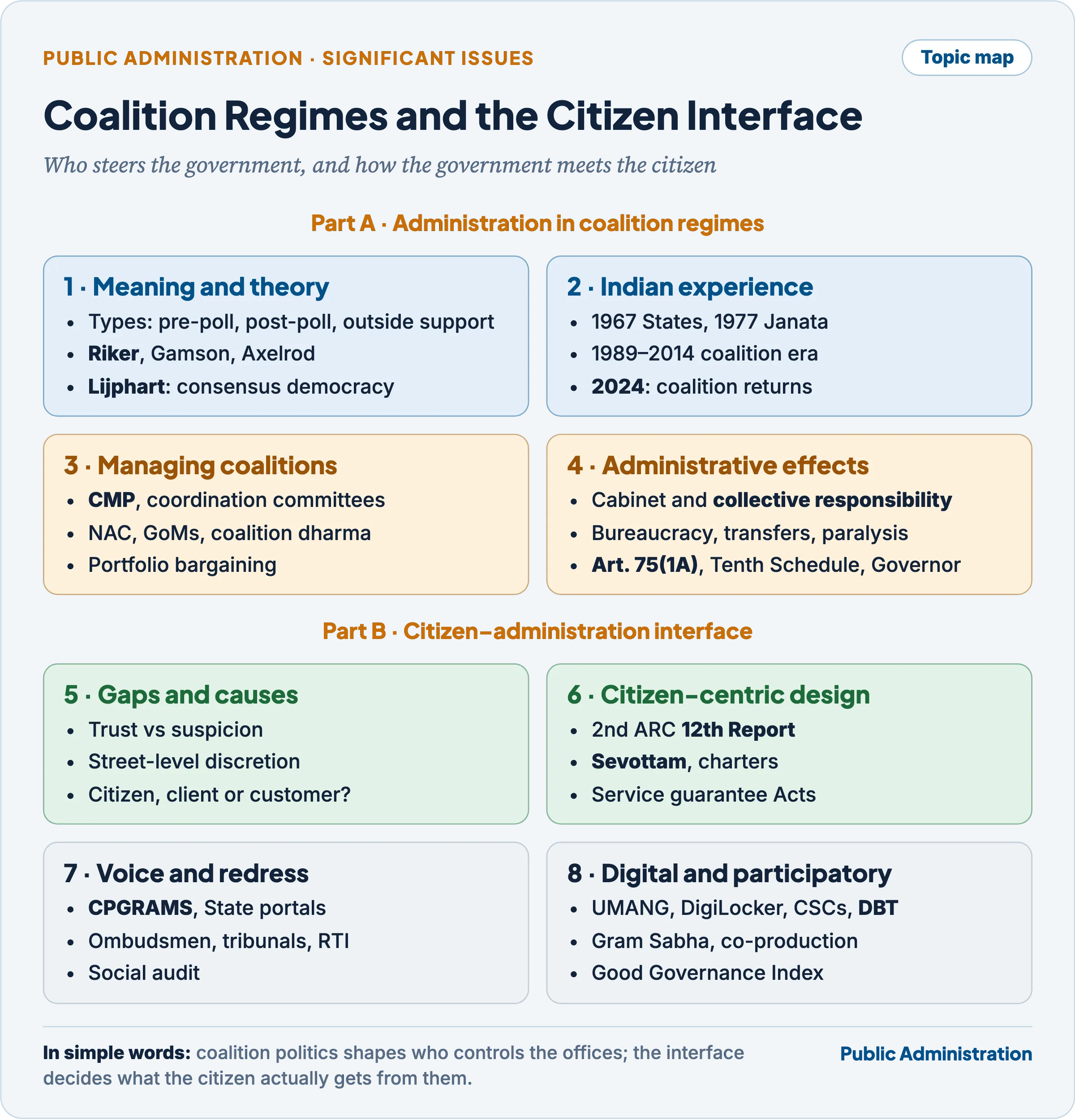
Two very different problems sit side by side in this part of the syllabus, yet they meet at one point: the quality of the state as the citizen experiences it. The first is about the top of the government. Between 1989 and 2014 no party won a Lok Sabha majority, and since June 2024 the largest party again depends on allies. When many parties share power, the Cabinet, the Prime Minister, the civil service and federal relations all behave differently.
The second is about the bottom of the government: the counter, the helpline and the portal where a citizen asks for a certificate, a pension or a ration card. This article explains both, and shows how a divided command at the top and an unresponsive interface at the bottom can each erode trust in public institutions.
In simple words
Think of a large hospital. Its board may be run by one owner or by a group of partners who must agree before anything changes (that is the coalition problem). Whatever happens in the boardroom, a patient judges the hospital by how the registration desk, the nurse and the billing counter treat her (that is the interface problem). A good hospital needs a board that can decide and a front desk that listens.
1. Coalition Government: Meaning, Types and Theory
In simple words
A coalition is a partnership of parties that cannot rule alone. Like any partnership, it needs a shared plan, a way to divide jobs, and a way to settle quarrels. Political scientists study who joins whom, why, and on what terms.
1.1 Meaning
- Origin of the word. “Coalition” comes from the Latin coalescere, “to grow together”. In politics it means an alliance or temporary union of political parties for forming and running a government.
- Coalition government. A ministry in a parliamentary system in which two or more parties share Cabinet posts because no single party commands a majority in the popular House. It is a party government, not a non-partisan one: ministers continue to represent their parties.
- Why coalitions arise.
- Fragmented party systems: many parties with regional, caste or ideological bases.
- Electoral systems: proportional representation usually yields multi-party Houses; first-past-the-post (FPTP) normally yields single-party majorities. India shows that FPTP can also produce coalitions when strong regional parties dominate their States (Duverger’s law, the French political scientist Maurice Duverger’s claim that plurality voting favours two parties, holds only at the level of each State, not nationally).
- Crisis: war or national emergency can produce an all-party national government (Britain under Churchill, 1940–45).
- A coalition is less permanent than a party and more organised than an ad hoc vote. Its glue may be positive (a shared programme) or negative (keeping a common rival out of power).
1.2 Types of coalitions
Coalitions can be classified by the level at which parties cooperate, by timing, and by how support is given.
| Basis | Type | Meaning | Indian example |
|---|---|---|---|
| Level | Electoral | Seat adjustment so that votes are not split | Pre-poll NDA and UPA seat-sharing |
| Parliamentary | A minority government survives on issue-wise or outside support | V.P. Singh (1989), Narasimha Rao (1991) | |
| Governmental | Partners share Cabinet posts | NDA (1999), UPA (2004) | |
| Timing | Pre-poll | Alliance formed before elections, with a common face | NDA in 1999, 2014, 2019, 2024 |
| Post-poll | Alliance formed after a hung verdict | United Front (1996), Karnataka (2018) | |
| Form of support | Inside | Partners join the ministry | TDP and JD(U) in the 2024 ministry |
| Outside | Parties support without joining | Left parties for UPA-I (2004–08) | |
| Purpose | National government | Most parties unite in a crisis | Britain in both World Wars |
| Power-sharing | Parties lacking a majority combine to rule | Most Indian coalitions since 1989 | |
| Prelude to fusion | Allies later merge into one party | Janata Party (1977) |
- “Jumping majorities”. A minority government may build a different majority for each Bill, borrowing votes issue by issue. Narasimha Rao’s government in its early years worked this way.
- Minority governments are a special case: they rule because the opposition is divided or does not want an early election. Kaare Strøm, the Norwegian-American political scientist, in Minority Government and Majority Rule (1990), showed that such governments are often rational and not necessarily unstable.
1.3 Theories of coalition formation
The study of coalitions borrows from game theory: parties are treated as rational players seeking office, policy or both.
| Theory | Thinker and work | Core prediction | Fit with India |
|---|---|---|---|
| Size principle (minimal winning coalition) | William H. Riker, The Theory of Political Coalitions (1962) | Players form coalitions just large enough to win and no larger, because every extra partner shares the spoils | Weak fit: Indian coalitions are often oversized as insurance against defection, or undersized minority governments with outside support |
| Proportional payoff | William Gamson, “A Theory of Coalition Formation” (1961) | Each partner expects office in proportion to the resources (seats) it brings (“Gamson’s law”) | Roughly true for Cabinet berths, but pivotal small parties often extract a premium |
| Minimal connected winning coalition | Robert Axelrod, Conflict of Interest (1970) | Parties ally with neighbours on the ideological scale, minimising policy distance | Partly true (Left Front in West Bengal and Kerala); the United Front of 1996 joined Left and regional parties mainly to keep a rival out |
| Bargaining proposition | Michael Leiserson (1966–68) | Coalitions with the fewest parties form, because bargaining is easier | Contradicted by the 1998 and 1999 coalitions of well over a dozen parties |
| Portfolio allocation | Michael Laver and Kenneth Shepsle, Making and Breaking Governments (1996) | A minister controls the policy of his portfolio, so who gets which ministry decides policy | Strong fit: allies’ ministries behave as party fiefdoms |
| Veto players | George Tsebelis, Veto Players (2002) | The more actors whose agreement is needed, the harder it is to change the status quo | Explains policy paralysis on contested reforms |
- Behavioural propositions from comparative studies. Partners in a coalition seek to maximise long-term influence; they know that office redistributes political resources and therefore compete over the spoils; their competition is limited by how far each partner tolerates the demands of others; where tolerance is high, aggressive partners are rewarded with disproportionate influence.
- Comparative experience. On the European continent coalition government is the norm; in Anglo-Saxon systems it is an exception. Coalitions in Western Europe have generally been durable, while in developing countries they have been fewer, shorter-lived and more fragile. Governments of many parties are usually less stable than two- or three-party coalitions.
- Constitutional design. Few constitutions regulate coalition-making. Germany’s constructive vote of no confidence (Article 67 of the Basic Law) lets the Bundestag remove a Chancellor only by electing a successor, so a government cannot be toppled by a negative majority. Sweden’s 1974 Instrument of Government gives the Speaker a formal role in proposing a Prime Minister. India has no comparable rules; conventions and court judgments fill the gap.
1.4 Lijphart: majoritarian and consensus democracy
- Arend Lijphart, the Dutch-American political scientist, in Democracies (1984) and Patterns of Democracy (1999), contrasted two models.
- Majoritarian (Westminster) democracy concentrates power: single-party Cabinets, a dominant executive, two-party systems, FPTP, unitary and centralised government.
- Consensus democracy disperses power: broad coalition Cabinets, executive–legislative balance, multi-party systems, proportional representation, federalism, bicameralism, rigid constitutions and judicial review.
- His empirical claim: consensus democracies perform as well as majoritarian ones on economic management and better on representation, equality and welfare (he called them “kinder and gentler”).
- India. Lijphart, in “The Puzzle of Indian Democracy: A Consociational Interpretation” (American Political Science Review, 1996), argued that India had survived as a democracy because it shared power among groups: the Congress was itself a grand coalition, and federalism, group autonomy and minority rights acted as consociational devices. The coalition era of 1989–2014 moved the Union executive towards the consensus model; the period after 2014 moved it back towards majoritarianism.
- Critique. Critics such as Steven Wilkinson questioned whether India fits the consociational model, since its elections reward majorities, not proportionality, and its power-sharing has been informal and uneven.
2. Coalition Politics in India
In simple words
For the first twenty years after 1947 one party ruled almost everywhere. Then the States began to elect coalitions, and from 1989 the Union did too. Each phase taught the system something about how to share power.
2.1 The “Congress system”, 1947–1967
- Rajni Kothari, the Indian political scientist, in “The Congress ‘System’ in India” (Asian Survey, 1964), described a one-party dominant system. The Congress was a huge internal coalition of factions, regions and castes; opposition parties acted as “parties of pressure” on its factions rather than as alternative governments.
- W.H. Morris-Jones, the British scholar of Indian politics, and Myron Weiner analysed the same pattern. Political bargaining took place inside the ruling party, so the government itself was stable.
- Administrative consequence: a homogeneous Cabinet, a strong Prime Minister (Nehru), and a civil service that faced one set of political masters.
2.2 The States after 1967
- The 1967 elections ended Congress control in eight States; defections soon toppled Congress ministries in two more. Non-Congress Samyukta Vidhayak Dal governments, combining ideologically opposite parties, took office in several States.
- Defection market. Morris-Jones called the result a “market polity”. The Haryana legislator Gaya Lal, who changed sides three times in a fortnight in 1967, gave India the phrase “Aaya Ram, Gaya Ram”. A Committee on Defections chaired by Home Minister Y.B. Chavan (1967–69) studied the problem, but legislation came only in 1985.
- Effects on administration. Ministries were enlarged to accommodate defectors; ministers, insecure in office, interfered in transfers and postings to reward supporters; officials faced frequent changes of political master; and the politician, knowing his price in the power game, became more aggressive towards the administrator.
- Stable State coalitions also emerged. The Left Front ruled West Bengal for 34 years (1977–2011); Kerala has alternated between the LDF and UDF fronts since the early 1980s; Tripura had long Left Front rule. These show that ideologically compact, disciplined coalitions can govern as steadily as single parties.
- Later State examples: the PDP–BJP government in Jammu and Kashmir (2015–18); the JD(S)–Congress government in Karnataka (2018–19); the Maha Vikas Aghadi in Maharashtra (2019–22), brought down by a split in the Shiv Sena; repeated realignments of the JD(U) in Bihar.
2.3 The Centre: from 1977 to 2024
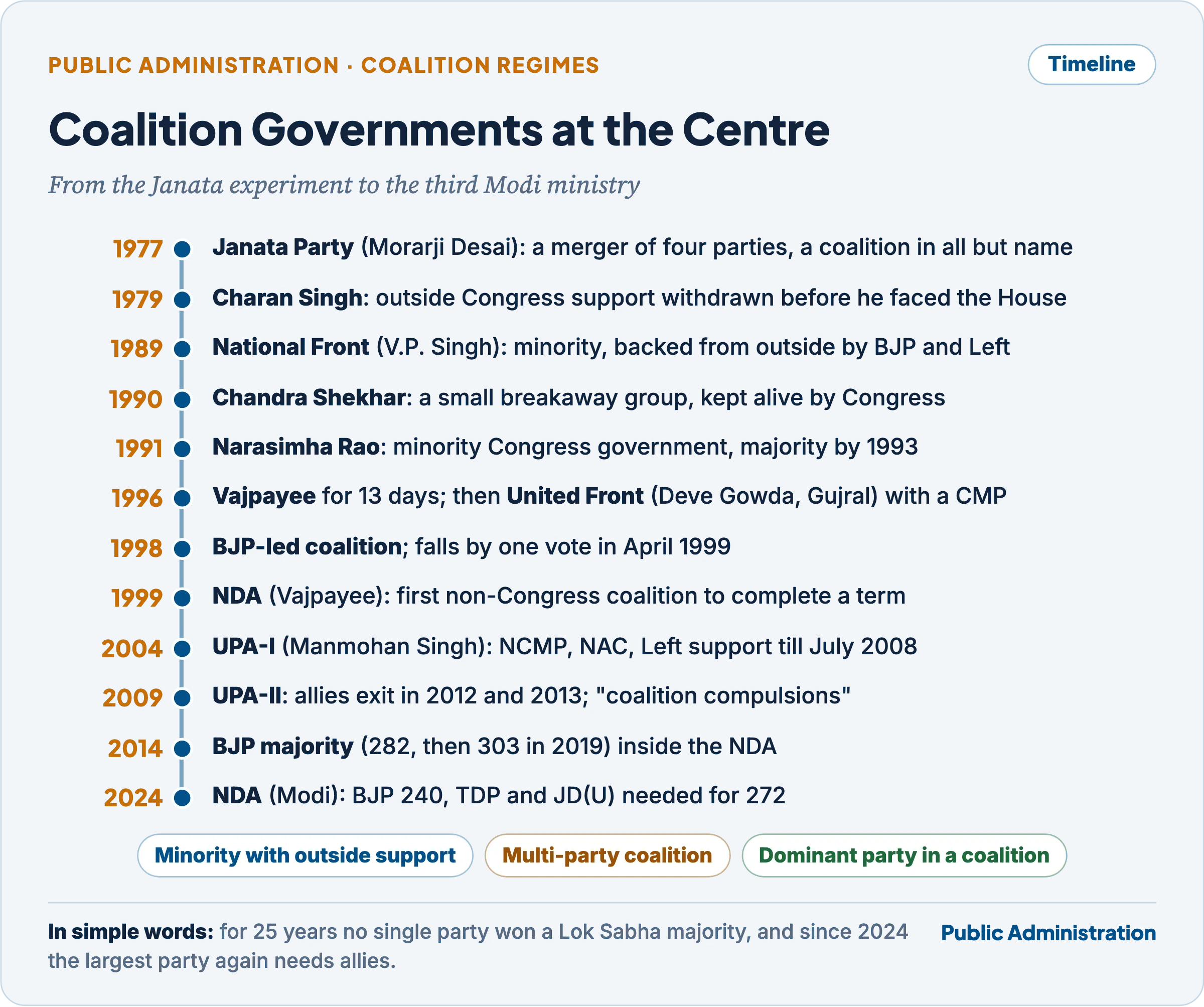
- 1977–79, Janata Party (Morarji Desai). Four parties (Congress (O), Jana Sangh, Bharatiya Lok Dal and the Socialists) merged to defeat the Emergency regime. Technically a single party, it behaved like a coalition: its constituents kept their identities and quarrelled, and the government split in 1979.
- 1979, Charan Singh. A Lok Dal–Congress (S) ministry backed from outside by the Congress, which withdrew support before he could face the Lok Sabha.
- 1989–90, National Front (V.P. Singh). The first real coalition at the Centre: a minority government supported from outside by both the BJP and the Left. It fell when the BJP withdrew over the Ayodhya issue.
- 1990–91, Chandra Shekhar. A small breakaway group of the Janata Dal ruled on Congress support, which was withdrawn within months.
- 1991–96, P.V. Narasimha Rao. A minority Congress government that launched the 1991 economic reforms and gained a majority by 1993 through by-election wins and a split in the Janata Dal. The JMM bribery case arose from its 1993 confidence vote.
- 1996, A.B. Vajpayee. Invited as leader of the largest party, he resigned after 13 days without facing a vote he could not win.
- 1996–98, United Front (H.D. Deve Gowda, then I.K. Gujral). Thirteen parties, including the Left and regional parties, governed with outside Congress support on the basis of a Common Minimum Programme. The Congress withdrew support twice.
- 1998–99, BJP-led coalition. Formed with regional allies; it fell by one vote in April 1999 when the AIADMK withdrew.
- 1999–2004, National Democratic Alliance (NDA). Over twenty parties under Vajpayee; the first non-Congress coalition to complete a full term.
- 2004–09, UPA-I (Manmohan Singh). A Congress-led coalition with the Left’s outside support (about 60 MPs), withdrawn in July 2008 over the India–US civil nuclear agreement; the government survived a confidence vote on 22 July 2008.
- 2009–14, UPA-II. The Congress, with 206 seats, depended on allies; the Trinamool Congress left in September 2012 over FDI in multi-brand retail, and the DMK in March 2013 over India’s stand on Sri Lanka.
- 2014 and 2019. The BJP won 282 and then 303 seats, a majority on its own, though it ruled as part of the NDA. Scholars described a “second dominant-party system”.
- 2024. The BJP won 240 seats; the NDA won 293. The Telugu Desam Party (16) and the JD(U) (12) became indispensable. The third Modi ministry was sworn in on 9 June 2024.
Indian Connect — The 2024 coalition: a dominant party with indispensable allies
- Portfolio pattern: the BJP kept Home, Defence, Finance and External Affairs and the Speaker’s post (Om Birla, re-elected in June 2024). Allies received ministries such as Civil Aviation (TDP), Panchayati Raj and Fisheries (JD(U)), Heavy Industries and Steel (JD(S)), Food Processing Industries (LJP (Ram Vilas)) and MSME (HAM). This is the Laver–Shepsle logic in reverse: the lead party keeps the agenda-setting portfolios.
- Signs of coalition constraint:
- the lateral-entry advertisement for 45 posts was withdrawn on 20 August 2024 after objections, including from allies, that it lacked reservation;
- the Union Budget of 23 July 2024 announced special support for Bihar and Andhra Pradesh (including about Rs 15,000 crore for the capital Amaravati), the home States of the two key allies;
- contested Bills were sent to Joint Parliamentary Committees: the Waqf (Amendment) Bill (passed as an Act in April 2025 with amendments accepted from allies) and the One Nation One Election Bills (December 2024).
- No formal Common Minimum Programme was published; coalition management runs through the Prime Minister and party leaders. The style is closer to the NDA of 1999–2004 (a dominant party with a stable core) than to the United Front of 1996–98.
2.4 Why the coalition era came and went
- Causes of the coalition era (1989–2014):
- decline of the Congress as the pole of the party system and its organisational centralisation from the 1970s;
- regionalisation: rise of State parties (TDP, DMK and AIADMK, AGP, Akali Dal, BJD, TMC);
- social mobilisation of backward castes and Dalits (Mandal politics, the BSP, SP, RJD);
- the “federalisation” of the party system: national outcomes became the sum of State contests.
- Causes of the return of single-party majorities (2014, 2019): a strong national leader, organisational expansion of the BJP, Hindi-belt consolidation and a weakened Congress.
- 2024 showed that the regional base of Indian politics had not disappeared; it had only been temporarily outweighed.
3. Instruments of Coalition Management
In simple words
A coalition needs rules of the road: a shared to-do list, a place to settle fights, and a sense that partners will not embarrass each other. India invented its own toolkit for this.
- Coalition dharma. A phrase popularised in the Vajpayee years: the moral obligation of partners to respect each other’s compulsions, consult before acting and avoid public embarrassment. It is a convention, not a rule.
- Common Minimum Programme (CMP).
- The United Front’s CMP (1996) and the UPA’s National Common Minimum Programme (May 2004); the NDA’s equivalent in 1998 was the National Agenda for Governance.
- Purpose: an agreed policy floor that partners pledge to implement, replacing separate manifestos.
- Limits: it was often vague, silent on contested reforms, and could be stalled by any partner; the UF’s CMP was never fully implemented because of the government’s short life.
- Coordination committees.
- The NDA set up a coordination committee of alliance leaders; the UPA had a UPA coordination committee and a separate UPA–Left coordination committee (2004–08) to resolve disputes with outside supporters.
- Risk: a steering committee of party bosses, outside the Cabinet and outside Parliament, becomes the real decision-maker, weakening ministerial responsibility.
- National Advisory Council (NAC).
- Set up in June 2004 under Sonia Gandhi, the UPA chairperson, to monitor the NCMP; reconstituted in 2010; it lapsed in 2014.
- It drafted or shaped rights-based laws: the Right to Information Act, 2005, the National Rural Employment Guarantee Act, 2005, the Forest Rights Act, 2006 and the draft food security law (enacted 2013).
- Critics called it a “super-Cabinet” and an extra-constitutional second centre of power; defenders saw it as a channel for civil society expertise into policy.
- Groups of Ministers (GoMs) and Empowered GoMs. UPA governments used dozens of GoMs and EGoMs to settle inter-ministerial and inter-party disputes. They spread decision-making across allies, but also delayed decisions and blurred responsibility. The government formed in 2014 abolished the standing GoMs and EGoMs.
- Portfolio bargaining and quotas. Seats in the Cabinet, the choice of ministries, Governorships and chairs of public bodies became items of negotiation. Allies typically insist on naming their own ministers.
- Enlarged ministries. To keep everyone on board, Councils of Ministers grew to unwieldy sizes, especially in the States, until the 91st Amendment (2003) imposed a ceiling (Section 4.7).
Common confusion
Does Article 75(1A) cap the Cabinet at 15 per cent of the Lok Sabha? No. It caps the whole Council of Ministers, including the Prime Minister, at 15 per cent of the total number of members of the Lok Sabha (so at most 81 in a House of 543). The Cabinet is a smaller body within it and has no separate ceiling. For the States, Article 164(1A) sets the same 15 per cent ceiling but also a minimum of 12 ministers, so small States such as Goa, Mizoram and Sikkim can have a working ministry. The National Commission to Review the Working of the Constitution (2002) had proposed 10 per cent; Parliament settled on 15.
4. Problems of Administration in Coalition Regimes
In simple words
When a household is run by several families who do not fully trust each other, every decision needs a meeting, each family guards its own room, and the servants get orders from many people. A coalition government faces the same problems on a national scale.
4.1 Articles and Acts that frame coalition government
| Provision | What it says | Relevance to coalitions |
|---|---|---|
| Article 74(1) | Council of Ministers headed by the PM to aid and advise the President | Advice comes from a multi-party ministry |
| Article 75(1) | PM appointed by the President; other ministers on the PM’s advice | President’s choice of PM in a hung House; allies name their ministers in practice |
| Article 75(1A) (91st Amendment, 2003) | Council of Ministers not to exceed 15% of Lok Sabha strength | Ends jumbo ministries used to buy support |
| Article 75(1B) | A member disqualified for defection cannot become a minister until re-elected | Removes the reward for defection |
| Article 75(3) | Council of Ministers collectively responsible to the Lok Sabha | Strained when allies dissent publicly |
| Articles 163, 164 | Governor acts on advice except where he has discretion; CM appointed by the Governor; 15% cap and minimum of 12 in States (164(1A)) | Governor’s choice in hung Assemblies |
| Article 361B | Disqualified defector barred from any remunerative political post | Closes the back door of board and corporation posts |
| Article 356 | President’s Rule on failure of constitutional machinery | Its use fell sharply after 1994 and in the coalition era |
| Tenth Schedule (52nd Amendment, 1985) | Disqualification for defection; Speaker or Chairman decides; merger exception (two-thirds) | The main legal check on floor-crossing |
| 91st Amendment, 2003 | Deleted the one-third “split” exception (paragraph 3) | Bulk defections can no longer be called splits |
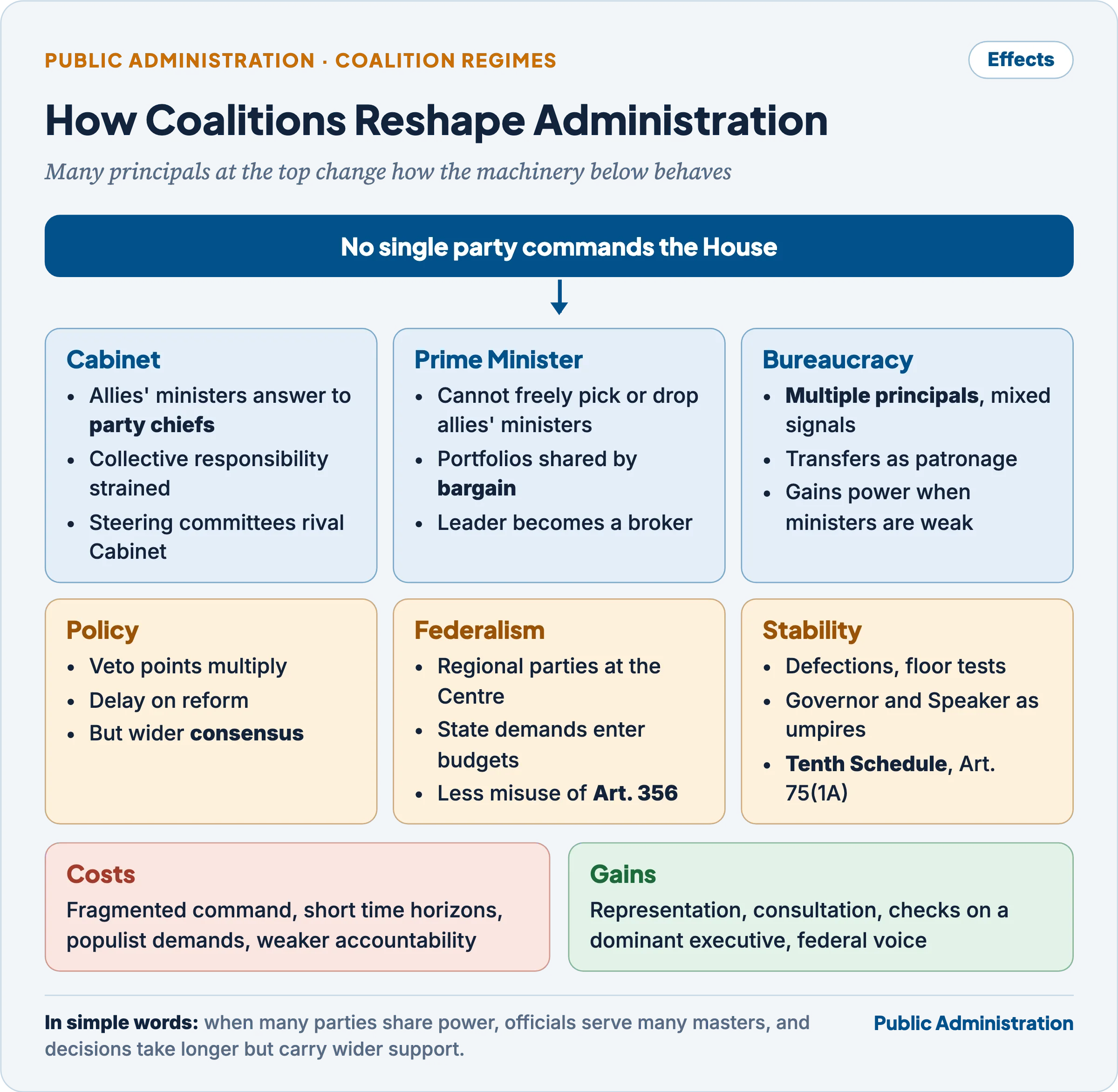
4.2 Cabinet government and collective responsibility
- The principle. Under Article 75(3) the Council of Ministers is collectively responsible to the Lok Sabha: ministers may argue in private but must defend Cabinet decisions in public, and the government stands or falls together. Cabinet government also assumes homogeneity (a common programme) and secrecy of deliberations.
- What coalitions do to it:
- Dual loyalty. An ally’s minister owes his post to his party chief, not to the Prime Minister. He may oppose Cabinet decisions in public, boycott meetings or resign on his party’s orders.
- Decisions outside the Cabinet. Real bargains are struck in coordination or steering committees, party offices and residences of alliance leaders; the Cabinet ratifies.
- Leaks and public dissent become tactics in inter-party bargaining.
- Illustrations:
- In March 2012, Railway Minister Dinesh Trivedi of the Trinamool Congress raised passenger fares in his Budget; his party chief objected, he resigned, and his successor rolled back most of the increase. A Cabinet-approved Budget proposal was reversed by an ally’s leadership.
- Allies withdrew ministers over policy disputes: the TMC over FDI in multi-brand retail (2012) and the DMK over the Sri Lanka resolution at the UN Human Rights Council (2013).
- Result. Collective responsibility survives as a legal doctrine (the ministry still falls together on a no-confidence motion) but weakens as a political practice.
4.3 The Prime Minister’s authority
- In single-party governments the PM is far more than “first among equals”: he chooses and drops ministers, allocates portfolios and controls the agenda.
- In coalitions the PM:
- cannot freely choose allies’ ministers or decide their portfolios, since partners nominate their own members;
- cannot easily dismiss an ally’s minister without risking the government;
- becomes a broker among partners, spending time on survival rather than direction.
- The UPA’s “two centres of power”. With the party president chairing both the UPA and the NAC, critics described a dual power structure in which the PM’s political authority was limited. In February 2011, faced with the 2G spectrum allocation controversy involving a minister from an ally, Prime Minister Manmohan Singh told newspaper editors that “compulsions of coalition politics” constrained him.
- Counter-examples. Vajpayee (1999–2004) and Narasimha Rao (1991–96, a minority government) both took major decisions (nuclear tests of 1998, economic reforms of 1991) despite coalition or minority constraints. The personality of the leader and the size of the lead party matter as much as the number of partners.
- The President becomes more important. In hung Houses the President chooses whom to invite, decides whether to ask for proof of support, and decides on dissolution (Section 4.8).
4.4 Portfolio allocation and ministries as fiefdoms
- Bargaining for ministries. Parties seek ministries that offer patronage (railways, telecom, fertilisers, rural development), visibility or benefits for their home State. Railways went to allied parties for long stretches.
- Fiefdom effect. Following the Laver–Shepsle logic, an ally’s minister runs his ministry as his party’s preserve: appointments, projects and transfers serve the party’s base; the PMO and the Cabinet Secretariat find it hard to intervene.
- Consequences:
- coordination failure across ministries handled by different parties;
- regional skew in project allocation;
- corruption risk: when the PM cannot discipline an ally’s minister, misuse of discretionary powers is harder to stop (the 2G spectrum case of 2008 is the usual illustration);
- ministerial instability: reshuffles follow coalition arithmetic rather than performance.
4.5 Policy-making: paralysis or consensus?
- The paralysis argument.
- Each partner becomes a veto player; the more veto players, the harder it is to change policy (Tsebelis).
- Reforms in labour law, land acquisition, pensions, disinvestment and FDI were delayed or diluted in the coalition years; the FDI in multi-brand retail decision of 2011 was suspended within days after allies objected.
- Short time horizons: partners prefer populist, visible benefits to long-gestation reforms; the threat of withdrawal makes every unpopular decision risky.
- Lowest common denominator policies: the CMP records only what all can accept.
- The consensus argument.
- Policies made by coalitions are debated more thoroughly and carry wider legitimacy, so they are less likely to be reversed.
- Major reforms did occur: the 1991 reforms by a minority government; the Fiscal Responsibility and Budget Management Act, 2003, the Electricity Act, 2003 and the national highways programme under the NDA; the RTI Act (2005), NREGA (2005), Forest Rights Act (2006), Right to Education Act (2009) and National Food Security Act (2013) under the UPA.
- The GST, enacted in 2016–17 by a majority government, still needed a consensus of the States in the GST Council; consensus-building skills learnt in the coalition era made it possible.
- Balanced view. Coalitions slow contested distributive reforms but can be productive on rights-based and consensual legislation. Single-party majorities act faster but risk badly thought-out policies with less scrutiny.
4.6 The bureaucracy in coalition regimes
Two opposite effects on the civil service are visible, and both can occur together.
- Bureaucracy gains power.
- Ministers absorbed in the power game, unsure of their tenure, have little time to direct their departments. They either sign on the dotted line, accepting the secretary’s advice, or swing to the other extreme.
- Frequent changes of ministers give permanence and expertise to the secretary; the civil service becomes the continuity in governance.
- The Cabinet Secretariat and senior officers act as brokers between ministries run by different parties.
- Bureaucracy is politicised and demoralised.
- Multiple principals: a secretary may receive conflicting signals from his minister (of an ally), the PMO (of the lead party), party bosses and coordination committees.
- Transfers as currency: each partner seeks pliable officers in “its” departments and districts; transfers increase on the eve of elections and after every change of government. Officers who loyally carried out an earlier regime’s lawful policies become victims of the next one.
- Erosion of neutrality: some officers align with particular parties to secure postings, a pattern sometimes called “committed” or “partisan” bureaucracy.
- Responses.
- T.S.R. Subramanian v. Union of India (2013): the Supreme Court asked for Civil Services Boards to regulate transfers and for minimum tenures, and for officers to record oral instructions.
- The 2nd ARC’s reports on ethics and on personnel administration recommended fixed tenures and insulation of appointments from political patronage (see the article on Civil Service Neutrality and Activism).
- The relationship between ministers and civil servants is the underlying issue. Studies of Indian politician–administrator relations found that politicians bring interests and values (“will it be acceptable?”) and civil servants bring facts and expertise (“will it work?”). The classical politics–administration dichotomy does not hold in practice: the line between policy and implementation is thin, and conflicts arise over loans, licences, postings and the handling of grievances. Coalition instability magnifies these tensions.
4.7 Ministerial instability and the legal response
- The problem. Defections, splits and frequent withdrawals of support meant short-lived governments and jumbo ministries. Between 1989 and 1999 the Lok Sabha was dissolved early three times (1991, 1997 and 1999).
- The Tenth Schedule (52nd Amendment, 1985):
- a member is disqualified if he voluntarily gives up membership of his party or votes against its whip without permission;
- the Speaker or Chairman decides (paragraph 6);
- originally, a split by one-third of a legislature party was protected (paragraph 3), and so is a merger supported by two-thirds (paragraph 4).
- Kihoto Hollohan v. Zachillhu (1992). The Supreme Court upheld the Tenth Schedule, but held that the Speaker acts as a tribunal, so his decision is subject to judicial review on grounds such as mala fides, perversity and violation of natural justice; it struck down the bar on courts (paragraph 7) as it was not ratified by the States.
- 91st Amendment, 2003. Following the Dinesh Goswami Committee (1990), the Law Commission’s 170th Report (1999) and the NCRWC (2002), it:
- deleted the split exception;
- capped the size of ministries (Articles 75(1A), 164(1A));
- barred disqualified defectors from becoming ministers or holding remunerative political posts (Articles 75(1B), 164(1B), 361B).
- Gaps that remain:
- merger by two-thirds is still allowed, so bulk defections are dressed as mergers (for example, ten of fifteen Congress legislators in Goa merged with the BJP in July 2019);
- resignation instead of defection: legislators resign to bring down a government and contest again on the other side (Karnataka and Madhya Pradesh, 2019–20);
- partisan Speakers delay or hasten decisions to suit the ruling side.
- Courts on the Speaker’s delay:
- Keisham Meghachandra Singh v. Speaker, Manipur (2020): disqualification petitions should ordinarily be decided within three months; Parliament may consider an independent tribunal in place of the Speaker.
- Padi Kaushik Reddy v. State of Telangana (31 July 2025): the Court directed the Telangana Speaker to decide petitions against ten MLAs who had moved from the BRS to the Congress within three months, and asked Parliament to consider whether entrusting this task to the Speaker serves the purpose of combating defections.
- P.V. Narasimha Rao v. State (1998) had held that MPs who took bribes to vote in the 1993 confidence motion were immune under Article 105(2); a seven-judge bench in Sita Soren v. Union of India (March 2024) overruled it, holding that bribery for a vote or speech is not protected. This closes a route by which coalition majorities could be bought without legal risk.
4.8 The Speaker, the President and the Governor in hung Houses
When the voters return no majority, three constitutional “umpires” acquire real discretion.
- The President in a hung Lok Sabha:
- 1979: President N. Sanjiva Reddy appointed Charan Singh and later accepted his advice to dissolve the House, rejecting a claim by Jagjivan Ram.
- 1989: R. Venkataraman invited the leader of the largest party (Rajiv Gandhi), who declined; the National Front was then invited.
- 1996: Shankar Dayal Sharma invited Vajpayee as leader of the largest party and asked him to prove his majority within two weeks.
- 1998: K.R. Narayanan departed from the largest-party convention by asking for letters of support before appointing Vajpayee, a test of likely majority. In 1997 and 1998 he also returned Cabinet recommendations for President’s Rule in Uttar Pradesh and Bihar, and in April 1999 asked the government to seek a confidence vote after an ally withdrew.
- Lesson: in an era of hung Parliaments, the President’s discretion expands, especially when the incumbent chooses to be assertive.
- The Governor in a hung Assembly.
- Sarkaria Commission (1988), chaired by Justice R.S. Sarkaria, set an order of preference: (1) a pre-poll alliance with a majority; (2) the largest single party claiming a majority with others’ support; (3) a post-poll coalition with all partners joining the government; (4) a post-poll alliance with some partners supporting from outside. The Governor’s task is to find the leader most likely to command a majority, not to form a government of his choice. The Punchhi Commission (2010) endorsed this and added that a pre-poll alliance should be treated as one party.
- S.R. Bommai v. Union of India (1994): majority must be tested on the floor of the House, not in Raj Bhavan by counting heads.
- Rameshwar Prasad v. Union of India (2006): the dissolution of the Bihar Assembly in May 2005, before it ever met, on the Governor’s report that a majority was being assembled through horse-trading, was unconstitutional. A Governor cannot shut out a claim on mere suspicion, and a post-poll alliance is not illegitimate merely because it is opportunistic.
- Recent cases: Goa and Manipur (2017), Karnataka (2018) and Maharashtra (2019) show different choices by Governors; in each, the Supreme Court’s remedy was an early floor test. Shivraj Singh Chouhan v. Speaker, Madhya Pradesh (2020) allowed a Governor to call a floor test on objective material; Subhash Desai v. Principal Secretary, Governor of Maharashtra (2023) held that a floor test cannot be used to settle an intra-party dispute.
- Abolition debate. Because these decisions often favoured the party ruling at the Centre, some argue that the office of Governor should be abolished or its discretion codified. Defenders reply that someone must act when the House is divided; the better solution is codified conventions and the floor test (see the article on Governor, Chief Minister and the State Council of Ministers).
- The Speaker in coalition crises. The Speaker decides disqualification, admits resignations, conducts floor tests and has a casting vote. Examples:
- Karnataka, 2019: Speaker K.R. Ramesh Kumar disqualified seventeen rebel MLAs after the coalition lost a trust vote; the Supreme Court (Shrimanth Balasaheb Patil, 2019) upheld the disqualification but set aside the bar on contesting until the end of the term.
- Madhya Pradesh, 2020: the Speaker’s acceptance of the resignations of twenty-two MLAs brought down the Kamal Nath government.
- Maharashtra, 2024: in January 2024 the Speaker held the Eknath Shinde faction to be the real Shiv Sena and disqualified no one, more than eighteen months after the split.
- Arunachal Pradesh, 2016: Nabam Rebia held that a Speaker facing a removal notice should not decide disqualification petitions (referred to a larger bench in 2023).
- Reform proposals: decisions by the President or Governor on the Election Commission’s advice (Dinesh Goswami Committee, 1990; 2nd ARC, Ethics in Governance, 2007), or by the Election Commission itself (NCRWC, 2002), or by an independent tribunal (Keisham Meghachandra Singh, 2020).
- The Chief Minister in a coalition. He is the real executive head in law, but in a coalition he cannot freely choose ministers, must share key portfolios (Deputy Chief Ministers from allies are common), and governs through coordination committees. His position resembles a chairman more than a sun around which ministers revolve.
4.9 Federalism and regional parties
- Regional parties at the Centre. From 1996, parties such as the TDP, DMK, AIADMK, BJD, Shiv Sena, TMC, JD(U), Akali Dal and NCP held Union portfolios. State interests entered the Union Cabinet directly.
- Positive effects on federalism:
- Article 356 was used far less after Bommai (1994) and because allies who ruled States opposed its misuse;
- the Inter-State Council (set up in 1990 under Article 263) and consultative forums gained importance;
- Union–State relations moved from “centralised” towards “cooperative” and “bargaining” federalism.
- Negative effects:
- regional skew in resources and projects towards allies’ States;
- foreign policy constrained by State parties (the Teesta water-sharing agreement with Bangladesh stalled in 2011 after the West Bengal Chief Minister objected; Tamil Nadu parties shaped the stand on Sri Lanka);
- demands for special category status became coalition bargaining chips (the TDP left the NDA in 2018 on this issue).
- The 2024 pattern. Allies’ States received special Budget support, but the lead party retained control of national policy, showing that federal bargaining has returned in a milder form.
4.10 Positive aspects of coalition government
- More representative: a majority of voters usually voted for the parties forming the government, so their interests are present in decision-making.
- Consensus and deliberation: policies are debated within the government before implementation.
- Checks on executive dominance: no single leader or party can push through measures without persuading others.
- Continuity: in mature coalition systems, some ministers carry experience from one government to the next, and policy shifts are gradual rather than wholesale reversals.
- Federal voice and inclusion of regions and social groups previously excluded from the Union executive.
- Learning: national parties that once rejected coalitions (the Congress until the late 1990s, the Communists, the BJP’s predecessor) learnt to share power; the experience strengthened the integration of the party system.
Criticism — Coalitions weaken administration
- Instability: governments of many parties collapse or live under constant threat; long-term planning suffers.
- Fragmented command: ministers answer to party bosses; the Cabinet becomes a federation of fiefdoms; collective responsibility erodes.
- Policy paralysis: every partner is a veto player; contested reforms stall; populism rises.
- Kingmaker blackmail: small parties with few votes extract disproportionate concessions; accountability is diffused because no party can be blamed for outcomes.
- Politicised bureaucracy: transfers become currency; officers serve many masters and lose neutrality and morale.
- Corruption risk: a Prime Minister who cannot discipline allies cannot enforce probity.
Defence — Coalitions can govern well
- Record of reform: the 1991 reforms (minority government), FRBM and Electricity Acts (NDA), rights-based laws (UPA) were all coalition achievements.
- Legitimacy: policies backed by several parties are broadly accepted and rarely reversed; consensus reduces the risk of badly thought-out measures.
- Checks and balances: coalitions restrain an overbearing executive, Article 356 and centralisation.
- Federal inclusion: regional parties give States a voice in national decisions; Lijphart’s evidence suggests consensus systems perform no worse and are more inclusive.
- Stability is possible: the NDA (1999–2004), UPA-I and long-ruling State coalitions such as the Left Front and Kerala’s fronts completed their terms.
- The problem is the design, not the coalition: rules on defection, ministry size, floor tests and disqualification can contain the costs.
The balance of evidence is that coalitions change the style of administration (slower, more negotiated, more decentralised) rather than necessarily lowering its quality. Problems become serious when coalitions are formed on a negative basis (only to keep someone out), when partners are numerous and ideologically distant, and when legal checks on defection and patronage are weak.
4.11 From coalition to one-party dominance, and back
- What changed in 2014: a single party with a majority; a dominant Prime Minister; centralisation in the PMO; GoMs abolished; faster decisions (demonetisation, GST roll-out, abrogation of Article 370’s special status, farm laws later repealed); weaker role of allies and of State parties at the Centre.
- Why it affects the governmental system:
- the Cabinet shifts from bargaining forum to leader-centred team (“presidentialisation” of the premiership);
- Parliament’s role in scrutiny weakens when the government controls the House firmly (fewer Bills referred to committees);
- federal bargaining gives way to centralised schemes and conditional transfers;
- the civil service receives a single, clear direction, which helps delivery but raises concerns about neutrality and voice.
- What 2024 restored: allies’ vetoes on some issues, referral of contested Bills to committees, and special attention to allies’ States, while the lead party retains control of core ministries and the agenda.
5. The Citizen–Administration Interface: Meaning, Gaps and Causes
In simple words
Every day millions of Indians stand at a counter to get something from the government. The interface is that meeting point: the office, the helpline, the app. When it works, citizens trust the state; when it fails, they look for a middleman.
5.1 Meaning
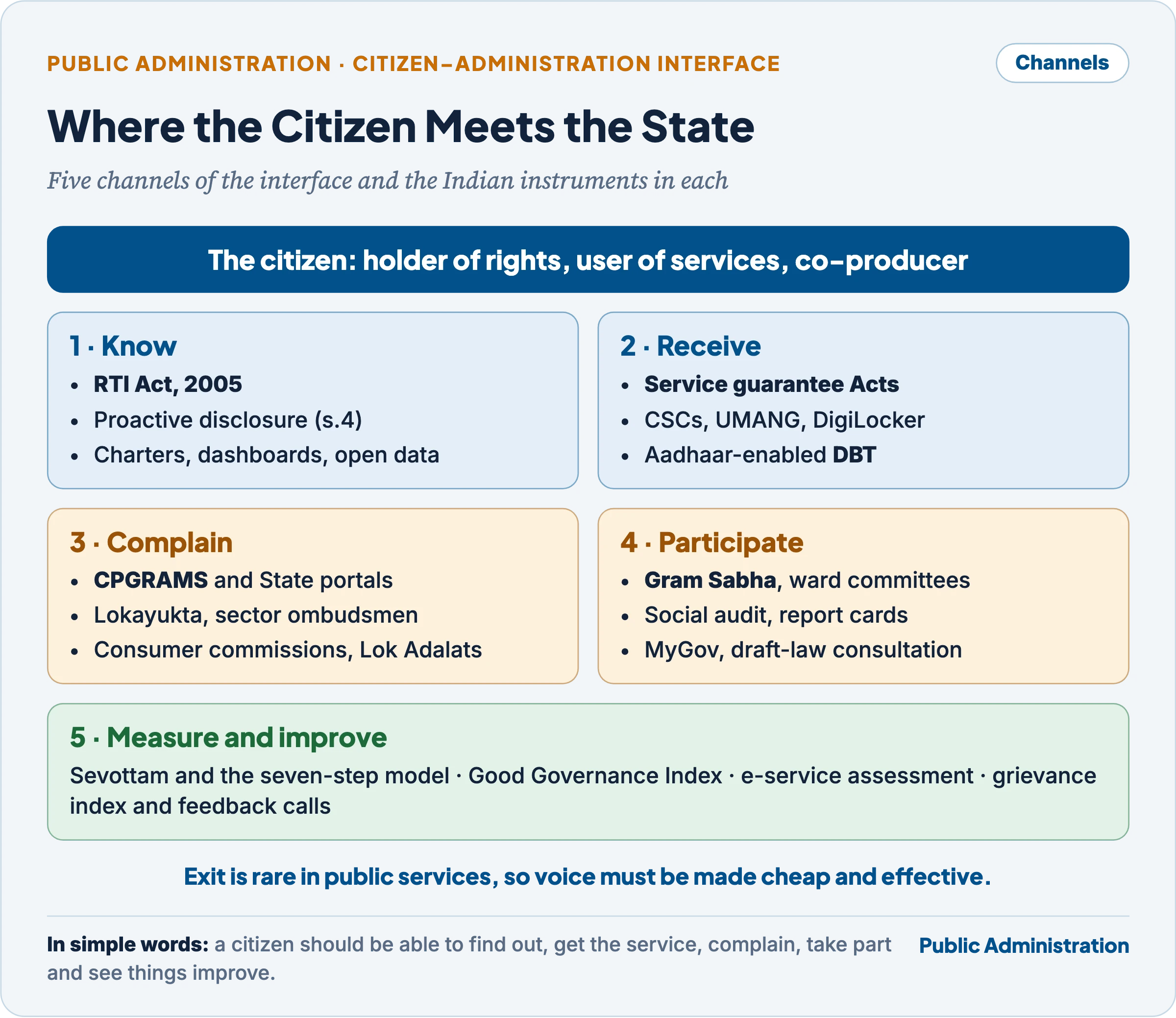
- The interface is the set of points of contact where citizens and public organisations meet: offices, counters, field visits, helplines, portals, Common Service Centres, grievance desks and public hearings.
- Why it has grown:
- the shift from a regulatory (law-and-order, revenue) state to a welfare and development state multiplied services and contact points;
- rising literacy, awareness and expectations;
- the 73rd and 74th Amendments and economic liberalisation changed who delivers services and how.
- Colonial legacy. British administration related to Indians as rulers to the ruled; citizens met the state as taxpayers or suspects, and officials disclosed only what they chose. That posture survived in procedures and attitudes.
- Responsive administration versus responsible government. Responsible government is a macro, political concept: the executive is answerable to the legislature. Responsive administration is a micro concept rooted in the delivery system: the official at the cutting edge must be sensitive and answerable to the citizen. The phrase gained currency in India through conferences of Chief Secretaries and the work of the Department of Administrative Reforms and Public Grievances (DARPG).
- Gandhi’s talisman. Gandhi asked those in doubt to recall the face of the poorest person they had seen and ask whether their action would help that person. It is often cited as the moral test of responsive administration.
5.2 The ideal and the reality
- The ideal. The relationship should rest on trust and purposefulness: the official serves, the citizen cooperates, and both pursue shared public goals.
- The reality. In practice it is often marked by suspicion, conflict, stress and strain. The citizen sees the official as arrogant, slow and corrupt; the official sees the citizen as demanding, ill-informed and ready to use influence. The relationship has changed in form more than in spirit.
- People’s perceptions of administration, as summarised by Mohit Bhattacharya, the Indian scholar of public administration:
- unhelpful attitude of officials, especially at lower levels;
- citizens’ ignorance of procedures;
- inordinate delay and waiting;
- favouritism and corruption;
- reliance on middlemen;
- rich–poor discrimination: the rich have access, the poor are avoided.
- W.A. Robson, the British scholar, listed the classic defects citizens see in bureaucracy: an excessive sense of self-importance, indifference to the citizen’s convenience, a mania for regulations and formal procedure, and failure to see that dealing with the governed is part of democracy.
- Jagannadham and Makhija’s observation: much of the administrator’s image is made or marred at the point of contact, by an air of conceit, irritation, a tactless “no” or procrastination.
- The First Administrative Reforms Commission, in its interim report on Problems of Redress of Citizens’ Grievances (1966), put the stakes clearly: the strength of a government lies in the prosperity of the people, but the security and stability of democracy lie in their contentment.
5.3 Causes of the gap
| Source | Causes | Example |
|---|---|---|
| Structure and procedure | Complex rules, multiple approvals, paper-based files, centralised powers | Several visits and affidavits for a caste certificate |
| Personnel | Colonial and hierarchical culture, low motivation, frequent transfers, vacancies at the cutting edge | Overloaded patwari or anganwadi worker |
| Discretion and corruption | Monopoly plus discretion minus accountability | “Speed money” for mutation or licences |
| Information asymmetry | Citizens do not know entitlements, time limits or the officer responsible | Touts outside RTOs and tehsils |
| Social distance | Class, caste, gender and language gap between official and citizen | Poor and illiterate applicants turned away |
| Political interference | Transfers, pressure to favour supporters, middlemen linked to politicians | Elected representatives acting as “fixers” |
| Weak accountability | Officials answer upward, not outward; no penalty for delay | Missed charter deadlines with no consequence |
| Citizen side | Low awareness, apathy, unrealistic demands, use of influence, non-compliance with rules, neglect of duties | Bribe offered to jump a queue |
- Lipsky’s street-level bureaucracy. Michael Lipsky, the American political scientist, in Street-Level Bureaucracy (1980), showed that front-line workers (teachers, constables, health workers) have wide discretion and scarce resources, so they ration services through queues, routines and stereotypes. Their coping devices become the policy the citizen actually receives. Reform at the interface must therefore improve working conditions and front-line accountability, not merely issue new rules from the top.
- Riggs’ formalism. Fred Riggs described the gap between formal rules and actual behaviour in “prismatic” societies. India’s charters and time limits on paper, ignored in practice, are a textbook case (see the article on Riggsian Models and their Critique).
- Myrdal’s “soft state”. Gunnar Myrdal, in Asian Drama (1968), described states that make laws but cannot enforce social discipline. A soft interface is one where rules are bent for those with money or influence.
5.4 Citizen, client, customer and consumer
- Subject: the colonial image; obedience without rights.
- Client: the dependent beneficiary of professional, rule-bound bureaucracy (welfare state).
- Customer: the NPM image; the user who can choose, complain and expect standards. David Osborne and Ted Gaebler, in Reinventing Government (1992), asked government to be customer-driven; the UK Citizen’s Charter (1991) of John Major’s government and India’s charters (1997) came from this thinking.
- Consumer: a legal category. Under the Consumer Protection Act, 2019, a person who hires a service for consideration is a consumer. In Lucknow Development Authority v. M.K. Gupta (1993) the Supreme Court held that housing services of a statutory development authority are “services”, and that compensation paid for official harassment and delay can be recovered from the officer responsible.
- Citizen: a rights-bearer and member of the political community, entitled to equal treatment, information, participation and redress regardless of ability to pay or to complain.
- Henry Mintzberg, the Canadian management thinker, in “Managing Government, Governing Management” (1996), warned that people relate to government simultaneously as customers, clients, citizens and subjects; calling them only customers hides the other roles.
Common confusion
Is every citizen dealing with a government office a “consumer” with a remedy before consumer commissions? No. A citizen becomes a consumer only when he hires or avails of a service for consideration (a fee, a price, an allotment payment). Paid services of public bodies, such as housing allotments, electricity, telecom, postal and railway services, are covered, and the Supreme Court (in Lucknow Development Authority v. M.K. Gupta, 1993) allowed compensation for official harassment. But sovereign functions (policing, taxation, issue of statutory certificates free of charge) are generally outside consumer law. For them the citizen relies on service guarantee Acts, grievance portals, RTI, tribunals and the writ courts. Customer and consumer are narrower ideas than citizen.
6. Citizen-Centric Administration: The 2nd ARC’s Twelfth Report
In simple words
A citizen-centric office starts by asking what the citizen needs, not what the rule book says. It publishes promises, builds the capacity to keep them, checks itself honestly and keeps improving.
- The report. The Second Administrative Reforms Commission (constituted in August 2005, chaired by M. Veerappa Moily and later V. Ramachandran) submitted its Twelfth Report, Citizen Centric Administration: The Heart of Governance, in February 2009.
- Core idea. Governance is citizen-centric when it is transparent, accountable, responsive, participative and efficient, and treats the citizen as the reason for its existence, not as a supplicant.
- Building blocks the Commission identified:
- a sound legal framework and institutional capacity;
- decentralisation and delegation, so that decisions are taken close to the citizen;
- transparency, backed by the RTI Act;
- civil service reforms that reward responsiveness;
- ethics in governance;
- process re-engineering and e-governance (single windows, fewer documents, fewer visits);
- periodic and independent evaluation of performance.
6.1 The seven-step model and Sevottam
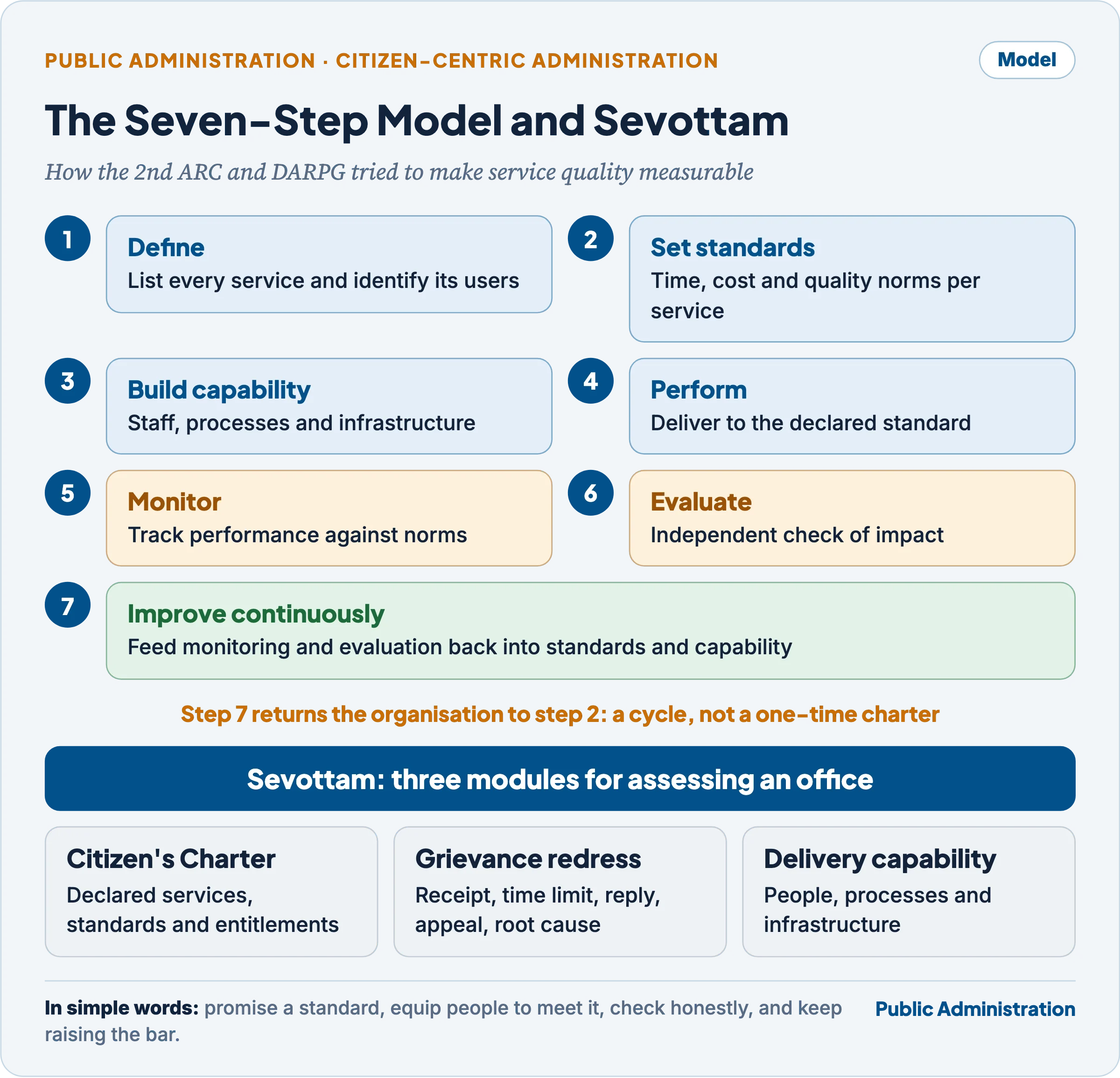
The Commission recommended that every organisation with a public interface follow seven steps:
- Define all services and identify their clients.
- Set standards and norms for each service.
- Develop the capability to meet the standards.
- Perform to achieve the standards.
- Monitor performance against the standards.
- Evaluate impact through an independent mechanism.
- Improve continuously on the basis of monitoring and evaluation.
Sevottam (from seva, service, and uttam, excellent) is DARPG’s service-delivery excellence framework of 2006, which the Commission endorsed.
- Three modules:
- Citizen’s Charter: declared services, standards and entitlements, with citizens’ inputs;
- Public grievance redress: a complaint system that leaves the citizen satisfied with how the organisation responded;
- Service delivery capability: people, processes and infrastructure, managed for continuous improvement.
- Standard. At DARPG’s request the Bureau of Indian Standards issued IS 15700:2005, a quality standard for public service organisations with citizen-centric elements (charter, grievance redress), against which offices can be certified.
- Implementation. Sevottam was piloted in central departments with large public interface (posts, railways, passports, income tax, provident fund) and in some States; Sevottam-compliant charters became an indicator in the Results-Framework Documents of 2009–14. Today the Sevottam scheme funds State Administrative Training Institutes to train officers in grievance redress.
- Why it underperformed: it remained a voluntary and largely certification-driven exercise; assessment depended on departments’ self-reporting; there was no budget for capability-building and no consequence for non-compliance; frequent transfers broke continuity; and with the end of the RFD system after 2014, the link to performance management weakened. The potential to transform service delivery was thus only partly realised.
- Other recommendations of the Twelfth Report:
- charters drawn up separately for each unit, after consulting citizens and front-line staff, with firm, measurable commitments and a stated remedy for default;
- compensation to citizens for default where feasible;
- a seven-step model for grievance redress as well: receipt, acknowledgement, time-bound disposal, communication of action taken, appeal, analysis of grievance-prone areas and systemic change;
- single-window and one-stop centres on models such as Andhra Pradesh’s e-Seva and Karnataka’s Bangalore One;
- citizens’ feedback and social audit as regular tools;
- delegation of powers to the cutting edge and simplification of internal procedures.
7. Instruments of the Interface
In simple words
The state has built many tools to make offices listen: promises in writing, laws with deadlines, complaint portals, apps, the right to ask for files and village meetings that check the accounts. Each fixes one part of the problem and leaves another.
7.1 Citizen’s Charters
- Meaning. A charter is a public declaration by an organisation of its services, standards, time limits, grievance procedures and expectations from users. Its purpose is to make the organisation accountable to the citizen in terms of service quality.
- Origin. The UK Citizen’s Charter (1991) set six principles: standards, information and openness, choice and consultation, courtesy and helpfulness, putting things right, and value for money. South Africa’s Batho Pele (“People First”) principles of 1997 added consultation, access, courtesy, information, openness, redress and value for money.
- India. The Conference of Chief Ministers (May 1997) adopted an Action Plan for Effective and Responsive Government that made charters the first item; DARPG became the nodal agency. Charters spread to railways, posts, telecom, banks, the public distribution system and State departments.
- Why charters have not made administration citizen-centric (DARPG evaluations and the 2nd ARC):
- drafted without consulting users or front-line staff, often as a formality;
- one-size-fits-all templates copied from headquarters, ignoring local conditions;
- low awareness among both staff and citizens;
- standards too lax to matter or too tight to achieve;
- no legal force and no compensation for default;
- no budget, no training, and frequent transfers of nodal officers;
- weak, irregular and internal monitoring;
- a supply-driven culture that treats services as a favour, not a right.
- The lapsed Bill. The Right of Citizens for Time Bound Delivery of Goods and Services and Redressal of their Grievances Bill, 2011 (introduced in the Lok Sabha in December 2011) would have made charters mandatory for every public authority, required grievance redress officers, set a 30-day redress limit, created Central and State Public Grievance Redressal Commissions, and allowed penalties on officials. It lapsed with the 15th Lok Sabha in 2014.
- What would make charters work: consultation in drafting; realistic, measurable standards; publicity at the counter; staff training and incentives; independent evaluation; and, above all, legal backing through service guarantee laws (see the article on Citizen’s Charters, Right to Information and Social Audit).
7.2 Public service guarantee Acts
- Madhya Pradesh’s Lok Sewaon ke Pradan ki Guarantee Adhiniyam, 2010 was the first; Bihar’s Right to Public Services Act, 2011 and similar laws in Delhi, Himachal Pradesh, Punjab, Rajasthan, Uttar Pradesh, Uttarakhand and Jammu and Kashmir followed in 2011; Karnataka’s Sakala law (2011) became a well-known model. Most States now have such laws.
- Common features:
- notified services (caste, income and domicile certificates, ration cards, mutation, licences, water and electricity connections);
- a designated officer responsible for each service and a fixed time limit;
- a first appeal and a second appeal to higher authorities;
- a penalty on the defaulting officer (often a daily fine) and, in some States, compensation to the citizen;
- in some States, an independent Right to Service Commission (for example, Maharashtra’s Act of 2015) to supervise implementation.
- Are they an extension of Citizen’s Charters?
- Yes, in substance: they take the charter’s core idea (published, time-bound service standards) and add what charters lacked: legal enforceability, named accountability, appeals and penalties. The charter’s promise becomes a guarantee.
- But they are also different in kind: charters are voluntary, NPM-inspired declarations covering any service an office chooses; guarantee Acts are statutory, rights-based entitlements covering only notified services. They treat the citizen as a rights-holder, not a customer.
- Limits: only a fraction of services is notified; penalties are rarely imposed; appellate officers belong to the same administration; awareness is low; portals record “deemed delivery” when the citizen disagrees; and the laws fix deadlines without fixing back-office capacity.
| Feature | Citizen’s Charter | Service guarantee Act |
|---|---|---|
| Nature | Voluntary declaration | Statute |
| Coverage | Services the office lists | Notified services only |
| Enforceability | Not justiciable | Appeals and penalties |
| Philosophy | Customer service (NPM) | Rights-based entitlement |
| Weakness | No teeth | Narrow coverage, weak enforcement |
7.3 Grievance redressal
A grievance is a feeling of being wronged by an administrative act or omission. Grievances arise against policies, against maladministration (delay, discourtesy, negligence) and against corruption.
Institutional devices across the world. Democracies have built several families of machinery.
| Device | Origin | How it works | Indian analogue |
|---|---|---|---|
| Ombudsman | Sweden, 1809 | Independent officer of the legislature investigates maladministration, recommends and reports; relies on publicity | Lokpal (2013 Act), State Lokayuktas (Maharashtra first, 1971) |
| Parliamentary Commissioner for Administration | United Kingdom, 1967 | Complaints reach the ombudsman through MPs (the “MP filter”) | Committee on Petitions, MPs’ letters |
| Administrative courts | France (Conseil d’État) | A separate hierarchy of courts decides citizen–administration disputes cheaply and expertly | Tribunals under Articles 323A and 323B |
| Procurator | Former USSR | A legal officer supervises the legality of official acts and can prosecute officials | No direct analogue |
India’s grievance machinery.
- Legislative channel: questions, calling-attention motions, the Committee on Petitions and the Committee on Government Assurances (since 1953). Useful for general grievances, weak for individual ones, and available only while the House sits.
- Judicial channel: writs under Articles 32 and 226, public interest litigation, damages for wrongful acts. Powerful but slow and costly.
- Quasi-judicial channel:
- administrative tribunals under Article 323A (service matters of public servants, through the Central Administrative Tribunal, 1985) and Article 323B (taxation, land reform, rent, elections and others), meant to give speedy and cheap justice; in practice many suffer from vacancies, executive control over appointments and appeals that reach High Courts anyway (L. Chandra Kumar, 1997), and the Tribunals Reforms Act, 2021 led to further litigation (see the article on Administrative Tribunals);
- consumer commissions at district, State and national levels under the Consumer Protection Act, 2019;
- Lok Adalats under the Legal Services Authorities Act, 1987, including permanent Lok Adalats for public utility services;
- sectoral ombudsmen: the RBI’s Integrated Ombudsman Scheme (2021), the insurance ombudsman, and electricity ombudsmen under the Electricity Act, 2003.
- Anti-corruption bodies: the CVC, the Lokpal and State Lokayuktas deal with corruption rather than general maladministration (see the companion article on corruption and administration in this unit).
- Executive channel:
- DARPG (so named since 1985) is the nodal agency for policy on public grievances; the Directorate of Public Grievances (1988) in the Cabinet Secretariat takes up selected unresolved cases;
- every ministry has a grievance officer, now with nodal and appellate authorities;
- the Prime Minister’s PRAGATI platform (2015) reviews grievances and projects with Secretaries and Chief Secretaries.
CPGRAMS.
- The Centralised Public Grievance Redress and Monitoring System, launched in 2007, is a 24×7 online platform connecting all Union ministries and, through role-based access, the States. It is accessible through a website, a mobile app, UMANG and Common Service Centres.
- Volume: grievances received rose from about 20 lakh in 2021 to 26.15 lakh in 2024; 22.78 lakh were received in 2025.
- The 10-step reforms (from 2022): universal coverage of ministries and their field offices, multilingual access, AI-assisted categorisation, mapping of more than one lakh grievance officers, a feedback call centre that calls complainants, an appeal mechanism with nodal and sub-appellate authorities, monthly reports and a Grievance Redressal Assessment and Index (GRAI) introduced in 2023 to rank ministries.
- Comprehensive Guidelines for Effective Redressal of Public Grievances (23 August 2024): cut the time limit from 30 to 21 days, mandated dedicated grievance cells, competent nodal and appellate officers, root-cause analysis, action on citizen feedback, integration of grievance portals and stronger escalation.
- Performance: the average disposal time in central ministries fell from 28 days in 2019 to 15 days in 2025, when about 82 per cent of grievances were disposed of within 21 days.
Common confusion
Can any complaint against government be taken to CPGRAMS? No. DARPG does not take up RTI matters, sub judice or court-related matters, religious matters, personal and family disputes, matters affecting the country’s territorial integrity or foreign relations, and suggestions. Notably, grievances of government employees about their own service matters, including disciplinary proceedings, are excluded unless the employee has already exhausted the prescribed departmental channels (under a DoPT office memorandum of 31 August 2015). Service matters belong first to departmental machinery and the Central Administrative Tribunal (see the article on Code of Conduct, Discipline, Staff Associations, Political Rights and Grievance Redressal). CPGRAMS is a channel for the citizen’s grievance about public service delivery.
Does CPGRAMS address local-level issues?
- Why not fully:
- most everyday grievances (water, roads, sanitation, ration, land records, police) concern State and local governments, which run their own portals and are only partly integrated with CPGRAMS;
- CPGRAMS forwards the complaint to the same department complained against, which often closes it with a routine reply; “disposal” is counted, not “resolution”;
- local bodies lack staff and digital capacity to respond;
- the digitally excluded, the illiterate and those without smartphones use online systems least;
- language and categorisation errors send complaints to the wrong office.
- Why it still matters: it creates a national record, makes delay visible, allows appeals, and through feedback calls and GRAI, measures quality.
- What helps: integration with State systems (CPGRAMS complaints have flowed into Madhya Pradesh’s CM Helpline 181, launched in 2014, since November 2020; Uttar Pradesh runs the IGRS “Jansunwai” portal), routing to district and block offices, assisted filing through CSCs and panchayat offices, camps such as the “Prashasan Gaon Ki Ore” campaign of December 2025, and root-cause analysis that changes procedures.
Process re-engineering: preventing grievances. Effective redress needs administrative commitment (senior officers who review grievances, act on patterns and discipline negligence). But many grievances can be prevented by redesigning the process that generates them:
- removing unnecessary documents and self-certification in place of attested copies (adopted by the Union government in 2014–15);
- automatic, suo motu delivery of entitlements (pensions started on retirement without application);
- faceless processes, such as online income-tax assessment, that remove discretion at the counter;
- digital tracking and SMS alerts that end “file not traceable”;
- analysis of grievance-prone areas, as the 2nd ARC recommended, to fix causes, not cases.
Indian Connect — The pension that starts itself
- A retiring employee once spent months chasing papers to get a pension. Digital records, pension portals and Jeevan Pramaan (digital life certificates) have shifted the burden from the pensioner to the system.
- The Union government’s Bhavishya platform tracks pension cases from two years before retirement, so the payment order is ready on the last working day.
- This is grievance prevention through process redesign: the best-handled complaint is the one that never needs to be filed.
7.4 E-governance and digital interfaces
- Evolution: State pioneers (FRIENDS in Kerala, e-Seva in Andhra Pradesh, Bhoomi land records in Karnataka) were followed by the National e-Governance Plan (2006) and Digital India (2015).
- Key platforms:
- Common Service Centres (CSCs): village-level, entrepreneur-run access points offering more than 800 services; 5.67 lakh were functional in October 2025, about 4.41 lakh of them in villages. They provide assisted digital access for those who cannot use apps themselves.
- UMANG (2017): a single mobile app with about 2,300 services in 23 languages (2025).
- DigiLocker (2015): digital documents legally equivalent to originals; about 54 crore users by mid-2025.
- Aadhaar (statutory since the Aadhaar Act, 2016) and Direct Benefit Transfer (from January 2013): benefits paid into bank accounts, cutting intermediaries and duplicate beneficiaries. The JAM trinity (Jan Dhan accounts, Aadhaar, mobile) and UPI together form India’s digital public infrastructure (DPI).
- MyGov (2014) for consultation and the Pre-Legislative Consultation Policy (2014) for publishing draft laws.
- What DPI changes:
- a direct link between state and citizen; fewer middlemen and less petty corruption;
- portability (One Nation One Ration Card) and traceability;
- data for monitoring and grievance analysis;
- a changed role for elected representatives: less a fixer for individual benefits, more a voice for those the system excludes and an overseer of policy.
- Limits and risks:
- the digital divide (connectivity, literacy, gender gaps in phone ownership);
- exclusion errors when biometric authentication or seeding fails; the Supreme Court in K.S. Puttaswamy (Aadhaar) (2018) upheld Aadhaar for welfare under Section 7 but struck down its mandatory use by private entities;
- privacy and surveillance: addressed in part by the Digital Personal Data Protection Act, 2023 and its Rules (November 2025);
- screen-level bureaucracy: discretion moves from the clerk into software, where it is harder for a citizen to argue;
- “digital-only” design that ignores the need for a human counter and human override.
- Can e-governance be participative? Yes, if it is two-way: consultations, open data, public dashboards that citizens can contest, citizen feedback built into service apps, and grievance analytics that change policy. Otherwise it remains one-way e-delivery.
- Measurement: DARPG’s National e-Governance Service Delivery Assessment (NeSDA) (2019, 2021, third edition launched in 2023) assesses State and central portals; States offered 16,487 e-services by December 2023, against 11,614 in April 2023.
7.5 RTI as an interface
The Right to Information Act, 2005 changed the interface from “need to know” to “right to know”: any citizen can demand records, and a Public Information Officer must reply within 30 days.
- How it strengthens the interface:
- it lets the citizen track his own file (the most common RTI use is checking the status of an application, pension or refund);
- it exposes arbitrariness and corruption in ration lists, admissions, contracts and appointments;
- its Section 4 obliges proactive disclosure, reducing the need to ask;
- it supports social audit and grievance redress with documents.
- Hurdles citizens face:
- delays and refusals, wide use of exemptions, and poor record-keeping;
- information commissions with vacancies and huge backlogs: about 4.14 lakh appeals and complaints were pending in 29 commissions on 30 June 2025; several State commissions were defunct for months; commissions imposed penalties in only a tiny fraction of eligible cases;
- the RTI (Amendment) Act, 2019 let the Union fix the tenure and salaries of information commissioners, which critics said weakened their independence;
- the DPDP Act, 2023, effective from November 2025, substituted Section 8(1)(j): all personal information is now exempt, and the earlier public-interest override inside the clause and the proviso giving citizens the same access as legislators were removed (Section 8(2)’s general public-interest override remains);
- threats and violence: nearly 100 RTI users had been killed by 2021, according to the Commonwealth Human Rights Initiative’s tracker, besides hundreds assaulted or harassed.
- Addressing the State’s reluctance and protecting users:
- timely appointment of commissioners (the Supreme Court in Anjali Bhardwaj v. Union of India, 2019 directed transparent and time-bound appointments);
- suo motu disclosure of the information most often sought, so that the requester need not be exposed;
- operationalising the Whistle Blowers Protection Act, 2014, which has not been brought into force (its amendment Bill of 2015 lapsed), and specific protection for RTI users, such as public disclosure of information sought by a user who is attacked, and fast-track investigation of attacks;
- penalties on officers under Section 20 and better record management.
- Status. RTI has started its journey but is far from its destination: it has made information a right and changed official behaviour, but institutional weaknesses, the privacy amendment and the risk to users limit it (see the article on Citizen’s Charters, Right to Information and Social Audit for the full treatment).
7.6 Social audit
- Meaning. Verification of a programme’s records and outcomes by its intended beneficiaries, usually in a Gram Sabha or public hearing (jan sunwai), using records obtained under RTI.
- Origin. The Mazdoor Kisan Shakti Sangathan in Rajasthan pioneered public hearings in the 1990s; Section 17 of MGNREGA (2005) made social audit mandatory, and Andhra Pradesh–Telangana built an independent social audit society. Meghalaya’s Community Participation and Public Services Social Audit Act, 2017 made it a general law.
- Current position. The Viksit Bharat–Guarantee for Rozgar and Ajeevika Mission (Gramin) Act, 2025, which replaced MGNREGA from 1 July 2026, retains social audit by the Gram Sabha, at least once every six months, with mandatory public disclosure of muster rolls, bills and geo-tagged records.
- As an interface tool, social audit turns the citizen from a recipient into an auditor; its success depends on independent audit units, protection of auditors and follow-up action.
7.7 Participation, co-production and civil society
- Forms of participation:
- constitutional forums: Gram Sabha (Article 243A), ward committees, District Planning Committees, and the PESA Act, 1996;
- Kerala’s People’s Plan Campaign (1996), the most ambitious experiment in participatory planning;
- citizen report cards, pioneered by the Public Affairs Centre, Bangalore (from the 1990s), which rate services from the user’s side;
- participatory budgeting (Pune, from the mid-2000s), Delhi’s Bhagidari scheme (2000) with resident welfare associations;
- online consultation through MyGov.
- Co-production. Elinor Ostrom, the American political economist and Nobel laureate (2009), showed that many public services are produced jointly by officials and citizens: a police force needs residents who report and cooperate; a school needs parents. Indian examples include Joint Forest Management, school management committees under the RTE Act, self-help groups under the National Rural Livelihoods Mission and village water and sanitation committees under the Jal Jeevan Mission. Risks: shifting burdens to the poor, elite capture and blurred accountability.
- Participation or grievance redress? Participation is often praised in rhetoric, but in practice it shrinks into complaint-handling: people are allowed to complain about services, not to decide what services should be. Sherry Arnstein’s ladder of citizen participation (1969) distinguishes tokenism (informing, consultation, placation) from citizen power (partnership, delegated power, citizen control). Most Indian “participation” sits on the middle rungs. Real participation requires devolution of funds, functions and functionaries, organised citizens and officials trained to facilitate rather than direct.
- Why civil servants neglect participation. Training and career incentives reward rule-compliance and targets, not consultation; participation slows decisions and shares power; and hierarchical culture treats villagers as beneficiaries. Mission Karmayogi’s emphasis on citizen-centric competencies is an attempt to change this.
- Autonomy of civil society.
- Civil society organisations (NGOs, community groups, the media, movements) aggregate voice, monitor services, carry out social audits, provide feedback and sometimes deliver services.
- They can do this only if they are autonomous from the state: an organisation dependent on government funds or fearful of regulation cannot criticise.
- Concerns: tighter foreign-contribution rules (the FCRA amendment of 2020), cancellations of registrations, and dependence on government project funding. Defenders of regulation stress accountability and transparency of NGOs themselves.
- Balance: autonomy with accountability; an effective state and a strong civil society reinforce each other (see the article on Citizen and Administration: Media, Interest Groups, Voluntary Organisations and Civil Society).
7.8 Measuring governance from the citizen’s side
- Good Governance Index (GGI). Launched by DARPG on Good Governance Day, 25 December 2019; the GGI 2021 covered ten sectors and 58 indicators, including a dedicated sector on citizen-centric governance, and ranked States in four groups (Gujarat topped the composite ranking in 2021). A District Good Governance Index has been developed for some States and UTs.
- NeSDA measures e-service delivery; GRAI ranks ministries on grievance handling; the feedback call centre surveys complainants.
- Limits: indices rely heavily on administrative data supplied by governments, focus on outputs rather than citizens’ experience, and can encourage gaming. Independent surveys, report cards and social audits are needed alongside.
7.9 Has the interface improved?
Indian administration since independence has made noticeable efforts to reach and respond to citizens. The table weighs the record.
| Dimension | Gains | Persistent gaps |
|---|---|---|
| Access | CSCs, apps, portals, single windows, doorstep delivery | Digital divide; assisted access uneven |
| Standards | Charters, guarantee Acts, Sevottam | Weak enforcement; few notified services |
| Redress | CPGRAMS (15-day average), appeals, ombudsmen | Disposal without resolution; local issues |
| Transparency | RTI, proactive disclosure, dashboards | Backlogs, DPDP exemption, attacks on users |
| Participation | Gram Sabha, social audit, MyGov | Tokenism; elite capture |
| Attitude | Training, Karmayogi, awards | Colonial and hierarchical habits persist |
Public administration today is less “public” in quantitative terms (more services are delivered through private agents, PPPs, CSCs run by entrepreneurs and outsourced call centres) but more responsive in qualitative terms (standards, deadlines, feedback and rights). Rights-based laws (RTI, guarantee Acts, food and work entitlements) have strengthened answerability; accountability in the fuller sense of sanctions for failure still lags.
8. Theory Lens
In simple words
Theories from Paper I explain why a coalition behaves as it does and why an office treats a citizen as it does. They also show what reforms are likely to work.
Theory lens: many principals at the top, voice at the bottom
- Riker’s size principle and coalition theory. William Riker‘s The Theory of Political Coalitions (1962) predicts minimal winning coalitions. Indian coalitions, often oversized for insurance or minority with outside support, show that fear of defection and the absence of a constructive no-confidence vote change the calculation; Laver and Shepsle‘s portfolio model better explains why allies’ ministries become fiefdoms (see the article on Models of Policy-Making and their Critique).
- Lijphart’s consensus democracy. Arend Lijphart argued that power-sharing systems govern as well and more inclusively than majoritarian ones. India’s coalition era moved the Union towards consensus democracy (coalition Cabinets, federal bargaining, restraint on Article 356); 2014–24 swung back to majoritarianism; 2024 sits between.
- Principal–agent theory with multiple principals. In agency theory (associated with Terry Moe and Kaare Strøm‘s chain of delegation), a bureaucrat serving several principals with conflicting goals can play them off or freeze. Coalition secretaries answering to an ally’s minister, the PMO and party bosses face exactly this common-agency problem; clearer mandates (CMPs), stable tenures and Civil Services Boards reduce agency loss.
- Cabinet government and collective responsibility. The Westminster model (Walter Bagehot‘s “efficient secret” of the fusion of executive and legislature through the Cabinet) assumes a homogeneous ministry. Coalitions keep the legal form of Article 75(3) but hollow its practice, shifting decisions to coordination committees (see the article on The Union Executive).
- Veto players. George Tsebelis shows that more veto players mean more policy stability (or paralysis); this explains both delayed reforms and the durability of consensual laws in coalition India.
- NPM versus New Public Service. NPM (Osborne and Gaebler, 1992) produced charters and the customer image; Janet and Robert Denhardt‘s New Public Service (2000, 2003) insists on serving citizens, not customers, seeking the public interest through dialogue and valuing citizenship over entrepreneurship. India’s move from charters to rights-based guarantee Acts, RTI, Gram Sabhas and social audit is a move from NPM towards NPS (see the article on New Public Management and After).
- Co-production (Ostrom). Elinor Ostrom showed that services improve when officials and citizens contribute complementary inputs; Jal Jeevan Mission committees, school management committees and SHG-based delivery apply this.
- Exit, voice and loyalty (Hirschman). Albert O. Hirschman, in Exit, Voice, and Loyalty (1970), argued that dissatisfied members either leave or speak up. Citizens cannot easily exit a tehsil or police station, so voice must be made cheap and effective (helplines, portals, appeals, social audit). Where the articulate middle class exits to private schools and hospitals, public services lose their most vocal users and decline further. In coalitions, allies use the threat of exit (withdrawal of support) as their main form of voice.
Key Terms
| Term | Meaning in simple words |
|---|---|
| Coalition government | A ministry formed by two or more parties because none has a majority alone |
| Minority government | A government without a majority that survives on outside support or a divided opposition |
| Outside support | Backing a government in votes without joining its ministry |
| Coalition dharma | The convention that partners consult and respect each other’s compulsions |
| Common Minimum Programme | An agreed policy agenda of coalition partners |
| Minimal winning coalition | Riker’s idea of a coalition just large enough to win |
| Consensus democracy | Lijphart’s model of power-sharing through coalitions, federalism and proportionality |
| Veto player | An actor whose agreement is needed to change policy |
| Collective responsibility | The rule that the whole ministry answers to the Lok Sabha and stands or falls together |
| Tenth Schedule | The anti-defection provisions of the Constitution (1985, amended 2003) |
| Hung House | A legislature in which no party or pre-poll alliance has a majority |
| Floor test | A vote in the House to prove that a government has majority support |
| Citizen–administration interface | The points of contact where citizens and public offices meet |
| Street-level bureaucrat | A front-line official with discretion over services (Lipsky) |
| Citizen-centric administration | Administration organised around citizens’ needs and rights, not office convenience |
| Sevottam | DARPG’s service-excellence framework: charter, grievance redress, delivery capability |
| Citizen’s Charter | An office’s public promise of services, standards and remedies |
| Service guarantee Act | A State law making notified services a time-bound legal right with penalties |
| CPGRAMS | The Union’s online public grievance portal (2007) |
| GRAI | DARPG’s index ranking ministries on grievance redress |
| Digital public infrastructure | Shared digital systems such as Aadhaar, UPI and DigiLocker built as public goods |
| Social audit | Verification of a programme’s records by its beneficiaries in public |
| Co-production | Joint production of a public service by officials and citizens (Ostrom) |
| Exit and voice | Hirschman’s two responses to poor service: leave or complain |
Commissions, Committees and Judgments
| Body / case | Year | Key point |
|---|---|---|
| First ARC, interim report Problems of Redress of Citizens’ Grievances (chair Morarji Desai) | 1966 | Recommended the Lokpal and Lokayuktas; linked citizens’ contentment to democratic stability |
| Committee on Defections (chair Y.B. Chavan) | 1967–69 | First study of the post-1967 defection wave |
| 52nd Amendment (Tenth Schedule) | 1985 | Disqualification for defection; Speaker decides; split and merger exceptions |
| Sarkaria Commission (chair Justice R.S. Sarkaria) | 1988 | Order of preference for inviting a government in a hung Assembly; floor test |
| Dinesh Goswami Committee on electoral reforms | 1990 | Delete the split exception; disqualification by President or Governor on Election Commission’s advice |
| Kihoto Hollohan v. Zachillhu | 1992 | Tenth Schedule valid; Speaker’s decision open to judicial review |
| Lucknow Development Authority v. M.K. Gupta | 1993 | Services of statutory authorities covered by consumer law; officer liable for harassment |
| S.R. Bommai v. Union of India | 1994 | Majority to be tested on the floor; Article 356 subject to review |
| Conference of Chief Ministers | 1997 | Action Plan for Effective and Responsive Government; Citizen’s Charters |
| P.V. Narasimha Rao v. State | 1998 | MPs bribed for votes immune under Article 105(2) (overruled in 2024) |
| Law Commission, 170th Report (chair Justice B.P. Jeevan Reddy) | 1999 | Delete the split exception; treat pre-poll alliances as parties for anti-defection |
| NCRWC (chair Justice M.N. Venkatachaliah) | 2002 | Defectors to resign and seek re-election; ministry size capped at 10%; Election Commission to decide disqualification |
| 91st Amendment | 2003 | 15% cap on ministries; split exception deleted; Article 361B |
| Rameshwar Prasad v. Union of India | 2006 | Bihar Assembly dissolution of 2005 unconstitutional; no dissolution on suspicion of horse-trading |
| 2nd ARC, 4th Report Ethics in Governance (chair M. Veerappa Moily) | 2007 | Disqualification by President or Governor on Election Commission’s advice |
| 2nd ARC, 12th Report Citizen Centric Administration | 2009 | Seven-step model; Sevottam; charters with remedies; grievance redress model |
| Punchhi Commission (chair Justice M.M. Punchhi) | 2010 | Endorsed Sarkaria’s order; pre-poll alliance as one party; floor test |
| T.S.R. Subramanian v. Union of India | 2013 | Civil Services Boards and fixed tenures to curb politicised transfers |
| Nabam Rebia v. Deputy Speaker | 2016 | Speaker facing removal notice should not decide disqualification (referred to larger bench, 2023) |
| K.S. Puttaswamy (Aadhaar) | 2018 | Aadhaar valid for welfare delivery; private mandatory use struck down |
| Anjali Bhardwaj v. Union of India | 2019 | Timely, transparent appointment of information commissioners |
| Shrimanth Balasaheb Patil v. Speaker, Karnataka | 2019 | Disqualification upheld; bar on contesting till term-end set aside |
| Keisham Meghachandra Singh v. Speaker, Manipur | 2020 | Speaker to decide within three months; independent tribunal suggested |
| Shivraj Singh Chouhan v. Speaker, Madhya Pradesh | 2020 | Governor may call a floor test on objective material |
| Subhash Desai v. Principal Secretary, Governor of Maharashtra | 2023 | Floor test not to resolve intra-party disputes |
| Sita Soren v. Union of India | 2024 | Bribery of legislators not protected by parliamentary privilege |
| Padi Kaushik Reddy v. State of Telangana | 2025 | Speaker to decide within three months; Parliament to reconsider the Speaker’s role |
Contemporary Developments
- June 2024, coalition returns at the Centre. The BJP won 240 seats and the NDA 293; the third Modi ministry (sworn in on 9 June 2024) depends on the TDP and JD(U), while the BJP keeps Home, Defence, Finance and External Affairs and the Speakership.
- 20 August 2024, lateral-entry advertisement withdrawn after objections, including from allies, over the absence of reservation: an early sign of coalition constraint on administrative reform.
- 23 August 2024, grievance guidelines. DARPG’s Comprehensive Guidelines cut the redress limit from 30 to 21 days; in 2025 central ministries averaged 15 days and disposed of about 82 per cent of grievances within the limit (Parliament reply, March 2026).
- 4 March 2024, Sita Soren judgment. A seven-judge bench ended legislators’ immunity for taking bribes to vote, overruling the 1998 judgment that arose from a minority government’s confidence vote.
- 31 July 2025, Speaker and defection. In Padi Kaushik Reddy, the Supreme Court set a three-month deadline for the Telangana Speaker and asked Parliament to reconsider leaving disqualification to Speakers.
- November 2025, DPDP Rules notified. The DPDP Act’s amendment to RTI Section 8(1)(j) took effect, exempting all personal information; information commissions had about 4.14 lakh pending cases on 30 June 2025.
- December 2025, “Prashasan Gaon Ki Ore” campaign and Good Governance Week took grievance camps to districts and villages; CPGRAMS received 22.78 lakh grievances in 2025.
- 1 July 2026, VB–G RAM G Act in force. The law that replaced MGNREGA retains Gram Sabha social audit every six months and mandatory public disclosure, keeping social audit at the centre of the rural interface.
Revision Grid
| Thinker / body | Work or report (year) | Key idea |
|---|---|---|
| William Riker | The Theory of Political Coalitions (1962) | Minimal winning coalitions (size principle) |
| William Gamson | “A Theory of Coalition Formation” (1961) | Payoffs proportional to resources |
| Robert Axelrod | Conflict of Interest (1970) | Minimal connected (ideologically adjacent) coalitions |
| Laver and Shepsle | Making and Breaking Governments (1996) | Portfolio allocation decides policy |
| George Tsebelis | Veto Players (2002) | More veto players, more policy stability |
| Arend Lijphart | Patterns of Democracy (1999); APSR article on India (1996) | Consensus democracy; India as consociational |
| Rajni Kothari | “The Congress ‘System’ in India” (1964) | One-party dominance as internal coalition |
| Kaare Strøm | Minority Government and Majority Rule (1990) | Minority governments can be rational and durable |
| Sarkaria Commission | Report (1988) | Order of preference in hung Assemblies |
| NCRWC | Report (2002) | Defection penalties; cap on ministries |
| Michael Lipsky | Street-Level Bureaucracy (1980) | Front-line discretion becomes policy |
| Albert O. Hirschman | Exit, Voice, and Loyalty (1970) | Public services need strong voice |
| Elinor Ostrom | Work on co-production (1970s–1996) | Citizens and officials jointly produce services |
| Denhardt and Denhardt | The New Public Service (2000, 2003) | Serve citizens, not customers |
| Osborne and Gaebler | Reinventing Government (1992) | Customer-driven government |
| Sherry Arnstein | “A Ladder of Citizen Participation” (1969) | Tokenism versus citizen power |
| 2nd ARC | 12th Report, Citizen Centric Administration (2009) | Seven-step model; Sevottam; charters with remedies |
| DARPG | Sevottam (2006); CPGRAMS (2007); Guidelines (2024) | Service standards and grievance redress |
Previous Year Questions
- 2025Centralized Public Grievance Redress and Monitoring System (CPGRAMS) does not effectively address local level issues. Give your opinion.
- 2024Critically examine the problems of administration in coalition regimes.
- 2023The dynamics of coalitions vary with the nature of leadership, political parties and contemporary political conditions. Analyze.
- 2023India has significantly advanced in its development goals, increased efficiency in the public sector and unlocked innovation in private sector by adopting the approach of building Digital Public Infrastructure. Elucidate.
- 2022Citizens charters in India have not succeeded in their objectives in making administrative system citizen centric. Do you agree? Give reasons.
- 2020The Speaker of the State Assembly has assumed a significant role in formations and dissolutions of governments. Examine under the circumstances of coalition governments with examples.
- 2020Ideally citizen-administration interface is supposed to be based on trustworthiness and purposefulness, in reality it is observed to be plagued by suspicion, conflicts, stresses and strains. Do you agree? Elaborate.
- 2019“The RTI has started its journey, but is far from its destination.” In the view of the statement, examine the present status of the RTI movement.
- 2019‘Sevottam Scheme’ had great potential to reform service delivery, but opportunity is frittered away. Comment.
- 2018“In the coalition era with elusive majority of a single party in the State Legislature, the role of the Governor becomes even more challenging.” Discuss.
- 2018“Effective public grievance redressal requires administrative commitment. But process reengineering can help prevent some grievances.” Discuss.
- 2018“Autonomy of civil society is crucial for responsive and effective administration.” Examine the statement
- 2017Do you think that the Public Service Guarantee Acts passed by various State Governments are an extension of the Citizen Charters? Give reasons.
- 2017“The Right to Information (RTI) has started its journey but is far from its destination.” Comment.
- 2016“The Right to Information Act is a path-breaking legislation which signals the march from darkness of secrecy to dawn of transparency.” What hurdles do the citizens face in obtaining information from the government? Explain how the reluctance of the government to part with information under R.T.I. can be addressed.
- 2015“Most Civil Servants in India are competent administrators, but they pay little attention to encourage people’s participation in decision-making.” Comment on the statement.
- 2014From coalition government to one-party dominance is a big change that is bound to affect the governmental system.” Explain why and how.
- 2013Is there a need to dispense with the Office of the Governor? Examine in the context of coalition governments.
- 2013“Public Administration today tends to be less public in quantitative terms, but more responsive to public needs than before in qualitative terms.” Examine with reference to citizen-centric administration.
- 2010“In an era of hung parliaments the power of the President expands, more so when the incumbent decides to be assertive.” Comment on the statement with reference to the situation in during the last two decades.
- 2009Do you agree with the view that Citizens’ Charters in India have not succeeded in their objective of making the administrative system citizen-centric? Analyze and give your suggestions in this regard.
- 2009“The weakest aspect of Indian administration is the grievance redressal machinery.” Discuss.
- 2008‘Right to Information Act has led to greater transparency and accountability of administration.’ Comment.
- 2007“If information is power, nothing can perhaps empower a citizen more that the secret and developmental informations held by various public authorities.” Analyse the merits and demerits of RTI Act, 2005 in the light of this statement.
- 2005“The Chief Minister symbolizes ruling power structure and is the real executive head of the State Government.” Discuss the above statement in the light of his position in a Coalition Government.
- 2003“A distinctive feature of the Indian administration, since Independence, has been the noticeable efforts undertaken to make the administrative system effectively reach and respond to citizens’ grievances.” Comment.
- 2000Do you think that our administration is sensitive to public grievances? Discuss the existing grievances redressal mechanism and give suggestions for enhancing its capabilities.
- 1997“The machinery of administrative tribunals has been provided for the purpose of speedy and cheap justice against official excesses.” Comment.
- 1992Peoples participation in administration is a democratic rhetoric, which when translated into action, tends to become mere redressal of citizen’s grievances.’ Discuss.
- 1989The Ombudsman, The Parliamentary Commissioner, The People’s Procurator General, the Consell d’etat and the Lokpal represent some of the major experiments in designing a “Machinery for Redress of Citizen’s Grievances.” Comment.
- 1988Examine the constitutional, political and operational dimensions of official & non-official relationship in Indian policy. What kind of institutional reforms are needed for bringing about a satisfactory rela-tionship between them?
- 1987What do you understand by ‘Peoples’ participation in administration’? Suggest measures to sensitise administrators to citizen’s grievances and enlist co-operation from voluntary agencies.
- 2023“Citizen Charter’s focus is on empowering citizens concerning public service delivery.” Analyze.
- 2023“The backlash against Right to information (RTI) by the State hampered the citizen’s right to know.” Examine and point out the need to amend the RTI Act to provide protection to RTI activists.
- 2021The new public service model approaches governance on the premises of an active and involved citizenship, wherein the role of public officials is to facilitate opportunities for citizens’ engagement in governance. Explain.
- 2021ICT has immense potential to transform governance and empower citizens. Examine.
- 2020New Public Service emphasizes democracy and citizenship as the basis for public administration theory and practice. Elucidate.
- 2020Thrust on the citizen centricity and right based approaches, aim to empower the citizens. In the light of the above, has the administrative accountability improved? Justify your argument
- 2019Has New Public Management failed in promoting a democratic polity? Analyse in the contexts of individual as a citizen and individual as a customer.
- 2018To what extent has e-governance made the administrative system more citizen-oriented? Can it (e-governance) be made more participative?
- 2014“The right to information is not all about citizens empowerment, it essentially redefines the concept of accountability.” Discuss.
- 2010Explain the basic principles underlying Citizen’s Charter with special reference to Its administrative philosophy. Promoting public accountability. Ensuring standards of public service.
- 2005In what ways and how can information technology play a crucial role in effective government-citizen interaction in the context of good governance?
- 2003What are the various institutional devices available for the redressal of citizen’s grievances against the excesses and malfunctioning of administration? How successful have they been?
- 2003“’Citizens’ charter’ is the most important innovation in the context of promotion of customer-orientation of administration.” Discuss.