

British legacy; National Police Commission; Investigative agencies; Role of Central and State Agencies including para military forces in maintenance of law and order and countering insurgency and terrorism; Criminalisation of politics and administration; Police-public relations; Reforms in Police.
This article: Police–public relations (meaning, the trust deficit and its causes, survey evidence from the Status of Policing in India Reports, the police and vulnerable groups); community policing (concept, Indian experiments, critique); citizen-centric policing (police stations as service centres, e-FIR and zero FIR, women help desks, SMART policing, CCTNS, ICJS, 112); police accountability to the public (judicial guidelines from D.K. Basu to Paramvir Singh Saini, NHRC guidelines, Police Complaints Authorities, custodial torture and the UN Convention against Torture); reforms in police (need, NPC to the 2nd ARC in brief, Model Police Act 2006 and State Police Acts, Prakash Singh 2006 and its compliance up to 2026, separation of investigation, commissionerates, modernisation, manpower and women, training, technology and privacy, the new criminal laws, police as a State subject and the Union’s role); theory lens.
Official Syllabus: Paper II · Unit 2-13 Law and Order Administration
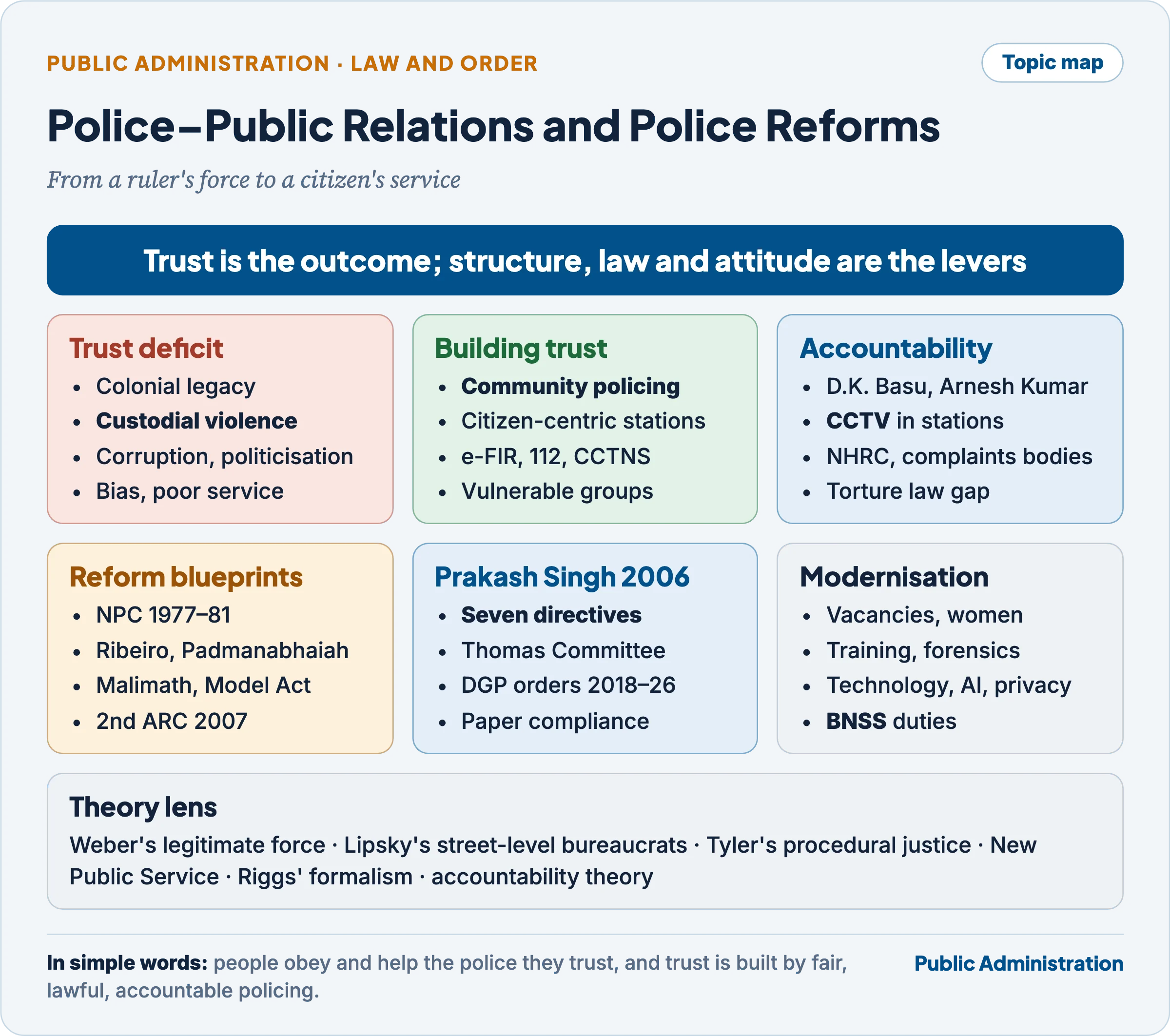
The police are the most visible face of the State. For most citizens, the constable at the crossing and the officer at the police station are the government. Whether people report crimes, give evidence, obey orders willingly and feel safe depends less on how many policemen there are than on whether people trust them.
India’s police were built in 1861 to hold down a colonised people, and the habits of that design have outlived the empire. Two questions run through this article: why the police–public relationship in India is marked by fear and distrust, and why police reform, recommended by commission after commission and ordered by the Supreme Court in 2006, has moved so slowly.
In simple words
Think of a family doctor. If patients trust her, they come early, tell her everything and follow her advice; she can treat them well. If they fear she will overcharge or insult them, they stay away until it is too late. The police work the same way: a trusted police force gets information, witnesses and cooperation; a feared one gets silence.
1. Policing in a Democracy: The Setting
In simple words
The police are the part of government allowed to use force against citizens. In a democracy that power must be used lawfully, fairly and for the people, not for whoever holds power. The relationship between police and public is the test of whether this is happening.
1.1 Why the police–public relationship matters
- The coercive arm of the State. Max Weber, the German sociologist, defined the modern State in Politics as a Vocation (1919) as the body that successfully claims a monopoly of the legitimate use of physical force in a territory. The police are the everyday instrument of that force.
- Burden of other failures. The 2nd Administrative Reforms Commission (2nd ARC), in its Fifth Report Public Order (2007), noted that force becomes necessary when other peaceful mechanisms fail, so the police stand in the front line and face public anger for the failures of other arms of governance too (land disputes, communal tension, unemployment, agitation).
- Police depend on the public. Crime is detected mostly through information from citizens; trials succeed only if witnesses come forward; order is kept mainly by voluntary compliance. A police force that has lost public trust cannot do its job however well armed it is.
- Policing by consent. The Peelian principles of the London Metropolitan Police (1829), associated with Sir Robert Peel, held that the power of the police depends on public approval and that “the police are the public and the public are the police”. This idea of policing by consent is the root of community policing.
- Legitimacy. Tom Tyler, the American psychologist, in Why People Obey the Law (1990), showed that people obey the law and cooperate with the police mainly when they see them as legitimate, and that legitimacy comes from procedural justice: being treated fairly, respectfully and with a voice, more than from outcomes or fear of punishment.
1.2 The functions of police
The functions of the police decide what “good relations” with the public must cover.
- National Police Commission (NPC, 1977–81) grouped police tasks into three kinds:
- Investigative: registering and investigating crime, which must be free from any executive interference.
- Preventive: patrolling, surveillance, crowd control and keeping order.
- Service-oriented: helping people in distress, traffic, lost persons, verification, disaster relief.
- 2nd ARC (2007) described the police role as responsive, preventive, proactive and developmental policing, and said police stations should become service centres rather than power centres.
- Model Police Act, 2006 listed a charter of duties that includes protecting life, liberty and property, preventing crime, promoting communal harmony, protecting the weaker sections, assisting victims and facilitating orderly movement and assembly.
The shift these bodies wanted is captured in one phrase of the 2nd ARC: the police must change from a “force” that enforces the writ of the State to a “service” that secures the lives, liberty and constitutional freedoms of citizens.
1.3 The inheritance in brief
- Police Act, 1861. Passed after the 1857 revolt on the recommendation of the Police Commission of 1860, it created a regime police: hierarchical, militarised, subordinate to the executive, distrustful of its own lower ranks and distant from the people. Section 4 placed the district police under the “general control and direction” of the District Magistrate, creating dual control.
- Continuity after 1947. Independence changed the political system but not the police law. Post-independence State Acts (Bombay 1951, Kerala 1960, Karnataka 1963, Delhi 1978) largely copied the 1861 model and in some cases tightened political control.
- Politicisation. David Bayley, the American police scholar, in The Police and Political Development in India (1969) and later writing, showed how Indian police became penetrated by partisan politics; the Emergency (1975–77) was the low point of misuse. The Bureau of Police Research and Development (BPR&D), in a 1979 study, warned that excessive executive control could make the police a tool for subverting the law.
The colonial design, the Police Commissions of 1860 and 1902–03 and the NPC are covered in depth in the article on Law and Order Administration: British Legacy, Police Commissions and Investigative Agencies. Central forces, insurgency and criminalisation of politics are covered in the article on Central and State Agencies, Paramilitary Forces, Insurgency, Terrorism and Criminalisation of Politics.
1.4 Articles and Acts
The constitutional and legal frame sets the limits within which both police–public relations and reforms operate.
| Provision | What it says | Why it matters here |
|---|---|---|
| List II, Entries 1 and 2 (Seventh Schedule) | Public order and police (including railway and village police) are State subjects | Reform depends on 28 States; the Union can only persuade and fund |
| List I, Entries 2A, 8, 65, 80 | Deployment of Union forces in aid of civil power; Central Bureau of Intelligence and Investigation; Union agencies for police training, research and scientific assistance in crime detection; extension of a State police’s jurisdiction | Basis of central forces, CBI, IB, BPR&D, NCRB and the police academy |
| List III, Entries 1 and 2 | Criminal law and criminal procedure | Parliament could enact the BNS, BNSS and BSA for the whole country |
| Article 21 | No deprivation of life or personal liberty except by procedure established by law | Source of custodial safeguards, compensation and the right to a fair investigation |
| Article 22 | Grounds of arrest, right to counsel, production before a magistrate within 24 hours | Core arrest safeguards |
| Article 20(3) | No person accused of an offence shall be compelled to be a witness against himself | Bars forced confessions |
| Article 14 | Equality before law and equal protection | Against caste, communal or class bias in enforcement |
| Police Act, 1861 | Still the base law in several States and UTs | Colonial structure; s.4 dual control |
| Protection of Human Rights Act, 1993 | Created NHRC and SHRCs | Oversight of custodial deaths, encounters |
| Model Police Act, 2006 | Draft law by the Soli Sorabjee Committee | Template for State Acts |
| State Police Acts, 2007 onwards | About 18 States passed new Acts or amendments after 2006 | Many dilute the Supreme Court’s directives |
| BNSS, 2023 (in force 1 July 2024) | New procedure code: zero FIR, e-FIR, videography, forensics, designated police officer | Transparency and accountability duties for the police |
| Bharatiya Sakshya Adhiniyam, 2023 | Confession to a police officer still not provable against the accused | Continues the colonial-era distrust of police confessions |
2. Police–Public Relations and the Trust Deficit
In simple words
Police–public relations means how the police and ordinary people see and treat each other. In India, many people fear the police, avoid them and turn to them only when forced to. This chapter explains what the evidence shows and why.
2.1 Meaning of police–public relations
- Two-way relationship. Police–public relations (PPR) is the sum of the attitudes, perceptions and interactions between the police and the people they serve: how the police treat citizens, and how citizens view, approach and cooperate with the police.
- Not publicity. It is not “public relations” in the advertising sense. It is built at the cutting edge: the police station counter, the beat constable, the arrest, the interrogation room and the riot.
- Elements of good PPR:
- Accessibility: people can approach the police without fear or influence.
- Responsiveness: complaints registered, help arrives on time.
- Fairness and impartiality: equal treatment regardless of caste, religion, gender, wealth or political links.
- Courtesy and respect for dignity.
- Accountability when things go wrong.
- Cooperation from the public: information, witnesses, respect for law.
Common confusion
Is police–public relations the same as a police department’s publicity or “public relations” wing? No. Publicity campaigns, social media handles and awareness programmes help, but the relationship is decided by daily conduct: whether an FIR is registered without a bribe, whether a suspect is beaten, whether a Dalit or a woman complainant is heard. The 2nd ARC warned that community policing itself must not become a mere public relations exercise.
2.2 What the evidence shows
Older commissions and newer surveys tell a consistent story.
- National Police Commission. The NPC examined police–public relations in detail and found them in a very unsatisfactory state. People named police partiality, corruption, brutality and failure to register offences as the main causes. Many people also said the police harassed even those who came forward to help. Most policemen, for their part, did not think they were at fault and blamed the system.
- State police commissions. The NPC drew on earlier State commissions: the West Bengal Police Commission (1960–61), the Bihar Police Commission (1961) and the Punjab Police Commission (1961–62). The Punjab Commission recorded public complaints of rudeness, intimidation, suppression and concoction of evidence and malicious padding of cases. The NPC observed that what the Police Commission of 1902–03 had said about corruption and oppression applied more or less to the police of its own day.
- Corruption surveys. The India Corruption Study, 2005 by Transparency International India and the Centre for Media Studies, covering eleven public services, rated the police as the most corrupt service in the public’s experience.
- Complaints to human rights bodies. Complaints against the police form a large share of the complaints received by the NHRC. In 2023–24 alone the Commission processed 436 cases of deaths in police custody and more than 269 cases of encounter deaths.
The Status of Policing in India Reports (SPIR)
Since 2018 Common Cause, a civil society organisation, and Lokniti–CSDS (Centre for the Study of Developing Societies) have published a series of research reports that combine official data with large surveys. They are the most systematic evidence on Indian policing today.
| Report | Theme and sample | Key research findings |
|---|---|---|
| SPIR 2018 | A Study of Performance and Perceptions; 15,563 citizens in 22 States | Minorities, Dalits and Adivasis fear the police most; about 64% of Muslim respondents reported high or moderate fear; marginalised groups felt most vulnerable to false implication in petty crime and terror cases |
| SPIR 2019 | Police Adequacy and Working Conditions; 11,834 police personnel in 21 States | Personnel work about 14 hours a day on average; half get no weekly off; most are not paid for overtime; about half felt Muslims are “naturally prone” to crime; 35% thought it natural for a mob to punish suspected cow-slaughter and 43% suspected rapists |
| SPIR 2020–21 | Vol. I: policing in conflict-affected areas (11 States/UTs); Vol. II: policing during Covid-19 | Most police and civilians said even dangerous militants should be caught through legal process; migrant workers faced the most force during lockdown, with about 49% of personnel reporting frequent use of force against them |
| SPIR 2023 | Surveillance and the Question of Privacy; 9,779 people in 12 States/UTs | Strong support for CCTV, but the poor, Adivasis, Dalits and Muslims trust the police least; slums are far more likely to have government CCTV than rich localities |
| SPIR 2025 | Police Torture and (Un)Accountability; 8,276 police personnel in 17 States | Many personnel justify harsh methods: 20% said it is “very important” to instil fear in the public and 35% “somewhat important”; about one in four justified mob violence in sexual assault or child-lifting cases; custodial death counts for 2020 differ widely between NCRB (76), NHRC (90) and a civil society tally (111) |
These are research findings based on samples, not census data, but their direction is consistent across five rounds: distrust is highest among the poor and marginalised, and a culture that tolerates force exists inside the police itself. The SPIR 2018 findings on institutional bias were referred to by the Delhi High Court in its October 2018 verdict on the Hashimpura killings of 1987.
2.3 Causes of the trust deficit
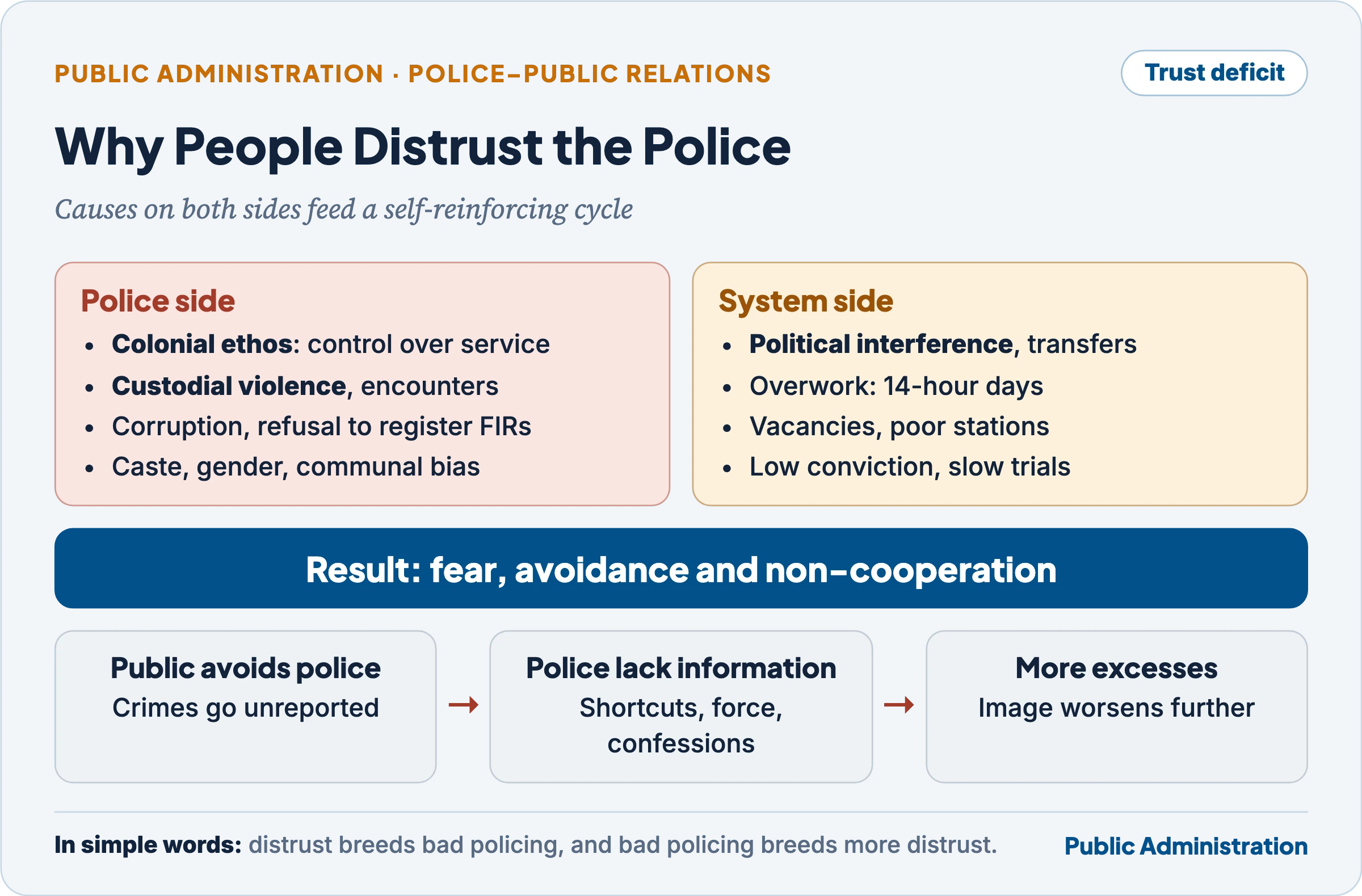
The causes lie partly in police conduct and partly in the system the police work in.
Causes in police conduct
- Colonial ethos. A force raised to control rather than to serve still carries an attitude of distance and superiority; the constable is trained to obey, not to engage. The 2nd ARC called this the persistence of “snobbery and patronage”.
- Custodial violence and torture. The third degree remains a common investigative shortcut because of the stress on confession and oral evidence over forensic proof. Deaths in police custody registered by the NHRC were 176 (2021–22), 163 (2022–23), 157 (2023–24), 140 (2024–25) and 170 (2025–26, to 15 March 2026), according to Ministry of Home Affairs replies in Parliament. Each such death, such as the Sathankulam (Tamil Nadu, 2020) father-and-son custodial deaths, damages trust far beyond the locality.
- Encounter killings. Staged “encounters”, often celebrated in popular culture and politics as quick justice, replace due process with extra-judicial punishment and corrupt the idea of law itself.
- Corruption. Bribes for registering FIRs, for “going soft” in investigation, for verification and for traffic offences; the thana (police station) is often seen as a place where nothing moves without payment.
- Non-registration of FIRs (“burking”). Officers refuse or minimise complaints to keep crime figures low, because performance is judged by the number of crimes recorded. The West Bengal Police Commission (1960) had already noted that subordinates believed credit came only from showing low crime returns.
- Rudeness and insensitivity, especially towards victims of violent crime and women, who suffer secondary victimisation.
- Bias. Differential treatment by caste, religion, class and gender: the powerful are treated with deference, the poor with contempt. The SPIR findings above show that prejudice is held by a sizeable share of personnel.
Causes in the system
- Political interference. Transfers and postings used as rewards and punishments, selective enforcement against opponents, protection of favoured criminals. Bayley observed that officers protect themselves by cultivating political allies, which further politicises the force. This is the “criminalisation of politics” problem seen from the police station (see the article on Central and State Agencies, Paramilitary Forces, Insurgency, Terrorism and Criminalisation of Politics).
- Overwork and poor working conditions. Fourteen-hour days, no weekly off, poor housing and dilapidated stations produce fatigue, cynicism and short tempers.
- Shortage of personnel. With about 22% of sanctioned posts vacant and only about 152 police per lakh people in 2022 (BPR&D data), a single station may cover a huge area; response is slow and VIP duty crowds out crime prevention.
- Poor training and equipment. Little training in soft skills, human rights and scientific investigation; few forensic resources, so force fills the gap.
- Weak criminal justice system. Conviction rates in IPC cases fell from 64.8% in 1961 to 42.4% in 2005 (2nd ARC); long trials, hostile witnesses and acquittals in high-profile cases (the 2nd ARC cited the Jessica Lal and Priyadarshini Mattoo cases and the Nithari killings) make people doubt that the police and courts can deliver justice.
- Divorce of authority from accountability. The 2nd ARC listed this among the main problems: the police exercise wide powers but rarely face consequences.
Causes on the public side
- “Every society gets the police it deserves.” Policemen come from the same society and carry its attitudes. A public that bribes for convenience, approaches the police only through influence, refuses to be a witness and applauds instant justice reinforces bad policing.
- Demand for vigilante justice. Public support for encounters and mob violence (which SPIR 2025 found many police personnel share) makes lawless policing popular.
- Apathy and non-cooperation: failing to report crime, ignoring traffic and civic laws, treating the police as adversaries.
The vicious cycle
The causes feed each other. Fearful citizens avoid the police, so crimes go unreported and the police lack information; lacking information, the police take shortcuts (force, forced confessions, fabricated evidence); these excesses confirm the public’s fear. Breaking the cycle needs action on both sides at once.
2.4 “Insincere efforts on both sides”
The view that police–public relations are a story of insincere efforts on both sides draws on this two-sided picture.
- Insincerity on the police and government side:
- Cosmetic programmes: “police weeks”, friendship meetings and photo opportunities that change nothing at the station counter.
- Personality-driven schemes that die when the officer who started them is transferred.
- Resistance to accountability: complaint bodies left without staff, CCTV cameras “not working” when needed.
- Political reluctance to give up control over the police, which keeps the police partisan.
- Insincerity on the public side:
- Using influence and money rather than lawful channels.
- Apathy about rights and duties; refusing to be witnesses.
- Demanding toughness against “others” while expecting softness for oneself.
- But not only insincerity. Some efforts, such as Kerala’s Janamaithri, Assam’s Prahari and Bhiwandi’s Mohalla Committees, have lasted and shown results. Where reform was institutionalised in law and backed by resources, it outlived its founders.
2.5 Policing a plural society
India’s diversity sharpens the problem.
- Communal riots test police impartiality most severely; inquiry commissions after riots have repeatedly found partisan conduct, delayed action or complicity.
- Under-representation of minorities, Dalits, Adivasis and women in the force weakens its legitimacy among those groups.
- Identity-based policing: profiling of particular communities, denotified tribes still treated as “criminal” (a legacy of the Criminal Tribes Act, 1871), and Adivasis in conflict areas caught between insurgents and security forces.
- The dilemma. The police must be neutral among communities while operating under governments elected by majorities and amid groups that each see the police as partisan. Representative recruitment, community liaison bodies such as the Mohalla Committees, and training in diversity are the main responses.
3. Community Policing
In simple words
Community policing means the police and local people work together to keep a locality safe. The beat constable knows the residents; residents tell the police about problems; together they solve the causes of crime, not just catch criminals after the event.
3.1 Meaning and principles
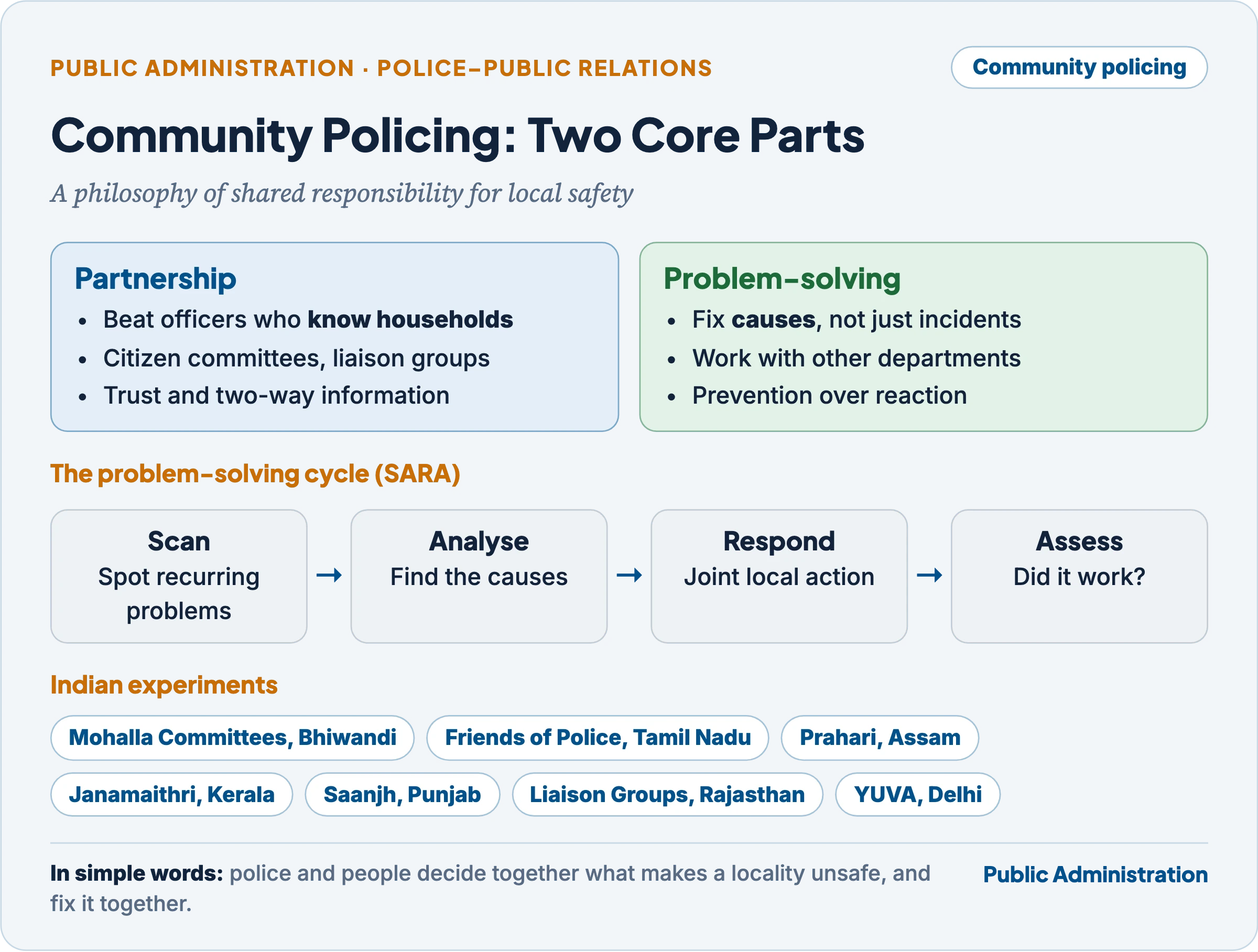
- Definition. Community policing is a philosophy (not a single programme) under which the police and the community act as partners in identifying and solving problems of crime, disorder and fear of crime. Police are no longer the sole guardians of order; residents become active allies.
- Two core components (the framework used by the United States Department of Justice in the 1990s):
- Community partnership: building trust and two-way communication through contact with residents, schools, businesses and other agencies.
- Problem-solving: studying the characteristics of local problems and applying tailored remedies.
- Problem-oriented policing. Herman Goldstein, the American scholar, argued in 1979 that police should focus on the underlying problems that generate repeated incidents rather than respond to each incident separately. The SARA model (Scanning, Analysis, Response, Assessment), set out by John Eck and William Spelman (1987), gives the steps.
- Broken windows. James Q. Wilson and George Kelling (“Broken Windows”, 1982) argued that visible disorder left unattended invites more serious crime, so attention to minor disorder and quality of life builds both safety and trust. Critics later said aggressive “order maintenance” can turn into harassment of the poor.
- Bayley’s four elements. David Bayley found that genuine community policing programmes share consultation with the community, adaptation of policing to local needs, mobilisation of community resources and problem-solving.
- Indian phrasing. A common Indian formulation states the principle simply: a policeman is a citizen in uniform and a citizen is a policeman without uniform.
3.2 Why community policing is needed in India
- Force multiplier: with a low police–population ratio, citizen cooperation multiplies police reach.
- Information and intelligence: residents know their localities; trust brings timely information on crime, radicalisation or communal tension.
- Prevention over reaction: problems such as drug abuse, juvenile delinquency or neighbourhood disputes are solved before they become crimes.
- Legitimacy: regular, respectful contact builds the procedural justice Tyler describes.
- Diversity management: joint committees of communities defuse rumours and tensions.
- Changing the police mindset: constant contact with the public softens the colonial, control-oriented culture from inside.
3.3 Indian experiments
Many States have run community policing schemes, some through individual officers and some through law.
| Initiative | State and year | Core idea |
|---|---|---|
| Mohalla Committees | Bhiwandi (Maharashtra), 1988, started by Suresh Khopde; Mumbai’s Mohalla Committee Movement Trust after the 1992–93 riots, with the backing of former police chief Julio Ribeiro | Joint Hindu–Muslim peace committees with the police; Bhiwandi stayed calm in 1992–93 |
| Delhi Police schemes | Special Police Officers (1985), Neighbourhood Watch (1989); YUVA for youth (district scheme from 2014; skill-training programme launched 29 August 2017) | Citizen volunteers; residents’ watch; keeping at-risk youth (17–25) away from crime through skills and jobs |
| Friends of Police (FOP) | Tamil Nadu, 1993, Ramanathapuram (Ramnad) district; later State-wide | Volunteers help in beats, traffic, information and crime prevention; meant to bring transparency and impartiality |
| Samarth | Coimbatore city (Tamil Nadu), after communal riots in the late 1990s | Area committees, slum adoption, student–police interface, vigilance committees |
| Maithri | Andhra Pradesh, 2000 | Courteous, responsive policing; people’s participation at a decentralised level |
| Community policing scheme | Himachal Pradesh, 2000 | Police station areas divided into sectors with People’s Policing Committees |
| Prahari | Assam, August 2001, Kokrajhar district, started by Kuladhar Saikia | Police-led village development partnership against witch-hunting and insurgency; later backed by Assam’s witch-hunting law (2015) |
| Community Liaison Groups | Rajasthan, statutory under section 55, Rajasthan Police Act, 2007 | At least one liaison group of community representatives for every panchayat, attached to police stations |
| Janamaithri Suraksha Project | Kerala, March 2008 (20 stations, 248 by 2013) | Beat officer for about 1,000 households, who must know each family; Janamaithri Suraksha Samithis; written into the Kerala Police Act, 2011 |
| Student Police Cadet | Kerala, 2010; later extended nationally | Schoolchildren trained in civic sense and law; police as mentors |
| Saanjh | Punjab, launched 17 October 2011 | Saanjh Kendras at district, sub-division and police station levels, run as registered societies by police–public committees; police services delivered at a single window under the State’s right-to-service law |
| Kolkata initiatives | West Bengal | Drug awareness, sports, blood donation (Prabaha), counselling centres; Sahayata dispute resolution in Nadia district |
Three lessons stand out from these experiments:
- Schemes that were written into law (Kerala, Rajasthan) or given institutional structures and funding (Punjab’s Saanjh) outlived their founders; those resting on one officer’s energy often faded.
- The most successful ones addressed a specific local problem (communal tension in Bhiwandi, witch-hunting in Assam), which is exactly what problem-oriented policing recommends.
- Community policing works best when service delivery (verification, copies of FIRs, NOCs) is made easy, because that is where most citizens meet the police.
3.4 Principles laid down by the 2nd ARC
The 2nd ARC (Fifth Report, 2007) set out principles for community policing:
- It is a philosophy, not just a set of programmes.
- Its success lies in citizens feeling that they have a say in the policing of their locality, making the community the first line of defence.
- Interaction should be organised through community liaison groups or citizens’ committees at different levels, which must be truly representative.
- It should be people-driven, not a mere public relations exercise.
- It should converge with the activities of other government departments.
3.5 Critique: limits and risks
Community policing is not a cure-all, and several problems recur in India.
- Elite capture. Committees are often filled by local notables, traders, retired officials and politically connected people. The poor, Dalits, women, migrants and minorities, who most need a voice, are left out; the scheme then serves the powerful and may be used against the marginalised (eviction of hawkers, slum dwellers, “outsiders”).
- Informer culture. Volunteers may become informers or enforcers, raising privacy and abuse concerns. A 1999 survey cited in a Punjab community policing guide found many residents resented being used merely as information gatherers.
- Vigilantism. Arming or empowering civilians can slide into vigilante groups. In Nandini Sundar v. State of Chhattisgarh (2011), the Supreme Court held the use of poorly trained tribal youth as armed Special Police Officers (associated with Salwa Judum) unconstitutional.
- Personality-dependence. Many schemes depend on one officer and collapse on transfer.
- Cosmetic use. Meetings and photo opportunities without changing behaviour at the station.
- Lack of statutory backing and funds in most States.
- Mismatch with the force’s culture: a hierarchical, overworked, understaffed police cannot spare time for beat contact; constables see it as extra work without reward.
- Moral policing: community groups may impose majority social norms on couples, women or minorities.
These problems do not refute the idea; they show that community policing needs representative composition, legal backing, training, resources and accountability to work.
4. Citizen-Centric Policing: Service Delivery Reforms
In simple words
Citizen-centric policing means designing police work around what the citizen needs: easy complaint registration, quick help, information about the case, and respectful treatment. Technology and clear rules now make many of these services available without even visiting a police station.
4.1 The police station as a service centre
- The thana as colonial bastion. The police station has long been the place where the colonial style survives most strongly: the station house officer (SHO) as a local power, the citizen as a supplicant, the lock-up as a threat.
- 2nd ARC’s vision. Police stations should be service centres that register complaints immediately, even on email, provide visitor rooms, help desks and information, and train staff in soft skills such as communication, counselling and team-building.
- Basic infrastructure. SPIR 2019 found police stations without telephones, wireless sets or vehicles, and many without drinking water, clean toilets or seating for visitors. The Union funds construction of police stations and facilities under its modernisation scheme.
- Citizen’s Charters. Many State police forces publish citizen’s charters listing services (FIR registration, copies, verification, NOCs), time limits and grievance channels, and several States have placed police services under their right to services laws (Punjab’s Saanjh Kendras deliver services under such a law). Charters are not, by themselves, legally enforceable; their value depends on monitoring and redress. See the article on Citizen’s Charters, Right to Information and Social Audit.
4.2 Registering the FIR
The First Information Report (FIR) is the gateway to justice, and refusal to register it is the most common grievance.
- Lalita Kumari v. Government of Uttar Pradesh (2013). A Constitution Bench held that registration of an FIR is mandatory when information discloses a cognizable offence; a preliminary inquiry is allowed only in limited categories (matrimonial, commercial, medical negligence, corruption, delayed reporting).
- BNSS, section 173 (from 1 July 2024):
- Zero FIR: information about a cognizable offence may be given irrespective of the area where it was committed, and must be recorded and transferred.
- e-FIR: information may be given by electronic communication, to be signed by the informant within three days.
- A free copy of the FIR to the informant or victim.
- A preliminary enquiry of up to 14 days, with a DSP’s permission, for offences punishable with three to seven years. Critics say this reopens the discretion that Lalita Kumari had narrowed.
- e-Zero FIR (May 2025). The Indian Cyber Crime Coordination Centre (I4C) launched a pilot in Delhi under which cyber financial frauds above ₹10 lakh reported on the national cybercrime portal or the 1930 helpline are automatically converted into zero FIRs, to be confirmed by the complainant within three days. The plan is to extend it to all States.
4.3 SMART policing
At the conference of Directors General of Police at Guwahati in November 2014, the Prime Minister outlined SMART policing:
| Letter | Meaning |
|---|---|
| S | Strict and Sensitive |
| M | Modern and Mobile |
| A | Alert and Accountable |
| R | Reliable and Responsive |
| T | Techno-savvy and Trained |
The concept combines toughness on crime with sensitivity to citizens and stresses technology and training. Its weakness is that it is a slogan, not a law; it depends on State action and funds.
4.4 Technology for citizens
| Initiative | What it does | Status |
|---|---|---|
| Crime and Criminal Tracking Network and Systems (CCTNS) | Links all police stations on common software; online complaints, FIR copies, verification, missing persons search | Started 2009 with an outlay of ₹2,000 crore; all 17,171 police stations connected by February 2025 (MHA) |
| Inter-operable Criminal Justice System (ICJS) | Connects police (CCTNS), e-Courts, e-Prisons, e-Forensics and e-Prosecution so data is entered once and shared | ICJS Phase II approved in February 2022 with ₹3,375 crore for 2022–23 to 2025–26 |
| Emergency Response Support System (ERSS) | Single emergency number 112 for police, fire and ambulance | Rolled out across States from 2018–19 under the Nirbhaya Fund |
| National Cybercrime Reporting Portal and 1930 helpline | Online reporting of cyber crime; quick freezing of defrauded money | Run by I4C, set up in 2020 |
| State citizen portals and apps | e-FIR for specified offences (theft, lost articles), tenant and servant verification, NOCs | Varies by State |
Technology reduces the need to visit the police station, which removes many occasions for harassment and bribe-seeking; it also creates records that make police action traceable. Its limits are the digital divide and the risk that it replaces rather than improves human contact.
4.5 Women help desks and gender-sensitive policing
- Women Help Desks in police stations, funded under the Nirbhaya Fund, provide a first point of contact for women complainants.
- The Ministry of Home Affairs has repeatedly advised States (in 2013, 2014, 2015, 2019, 2021, 2022 and twice in 2023) to raise women to 33% of police strength and to ensure that each police station has at least three women sub-inspectors and ten women constables, so that a women help desk can be staffed round the clock.
- All-women police stations numbered 744 in 2022, mostly urban; Tamil Nadu has the most.
5. Police and Vulnerable Groups
In simple words
Those who need the police most, such as poor people, women, Dalits, Adivasis, minorities and transgender persons, often trust them least. How the police treat these groups is the real test of fair policing.
5.1 Women
- Problems: refusal to register complaints of sexual and domestic violence, victim-blaming, insensitive questioning, delays in medical examination, harassment in custody, and few women officers.
- Representation: women were 2,63,762, about 12.3% of all police on 1 January 2023 (BPR&D). The India Justice Report 2025 found women are only about 8% of officers, about 90% of women in police are in the constabulary, and fewer than 1,000 hold IPS-level posts; no State or UT meets its own reservation quota.
- Legal and institutional responses: after the December 2012 Delhi gang rape, the Justice J.S. Verma Committee (2013) led to amendments making it an offence for a public servant to fail to record information about certain crimes against women; the BNSS lets a woman’s statement be recorded at her residence and by a woman officer; women help desks, one-stop centres, Safe City projects and fast-track courts.
5.2 Dalits and Adivasis
- Problems: reluctance to register cases under the Scheduled Castes and Scheduled Tribes (Prevention of Atrocities) Act, 1989, collusion with dominant castes, false implication of Dalits and Adivasis (SPIR 2018), custodial violence against the poor.
- Legacy of “criminal tribes”: communities notified under the colonial Criminal Tribes Act, 1871 (repealed in 1952) were “denotified” but many remain stigmatised under habitual offenders laws and police records.
- Conflict areas: Adivasis in Left-Wing Extremism areas face pressure from both insurgents and security forces.
5.3 Religious minorities
- Problems: perceptions of bias in communal riots, profiling in terror investigations, under-representation in the force.
- Evidence: SPIR 2018 found the highest fear of police among Muslims; SPIR 2019 found that about half of personnel held stereotypes about Muslims; inquiry reports after several riots have documented partisan policing.
- Responses: Mohalla Committees, peace committees, representative recruitment, training and accountability for riot conduct.
5.4 Transgender persons and other groups
- Transgender persons: the Supreme Court in NALSA v. Union of India (2014) recognised the third gender; the Transgender Persons (Protection of Rights) Act, 2019 makes abuse and harassment of transgender persons an offence. Police harassment, extortion and abuse remain common complaints; some States have recruited transgender persons into the police.
- Children: the Juvenile Justice Act requires Special Juvenile Police Units and a Child Welfare Police Officer in every station.
- Migrants and the urban poor: SPIR 2020–21 recorded frequent use of force against migrant workers during the Covid-19 lockdown.
- Elderly, persons with disabilities, victims of trafficking: specialised cells and Anti-Human Trafficking Units exist in many States.
6. Accountability of the Police to the Public
In simple words
Police accountability means the police must answer for how they use their powers. Several bodies check them: senior officers, the government, courts, human rights commissions, complaints authorities, the media and citizens. When these checks are weak, abuse continues because no one pays a price for it.
6.1 Layers of police accountability
| Layer | Mechanism | Weakness in India |
|---|---|---|
| Internal (departmental) | Superior officers, disciplinary rules, inspections | Esprit de corps; reluctance to punish colleagues |
| Political–executive | Home Minister, State government, State Security Commission | Turns into control and partisan direction rather than accountability for performance |
| Legislative | Questions, committees, debates on law and order | Episodic, focused on incidents |
| Judicial | Magistrates (remand, inquiry into custodial deaths), High Courts and Supreme Court (writs, guidelines, compensation) | Slow; guidelines poorly implemented |
| Quasi-judicial / human rights | NHRC and SHRCs under the Protection of Human Rights Act, 1993 | Recommendatory powers; limited investigative staff |
| Independent complaints bodies | Police Complaints Authorities at State and district levels | Few functional; many staffed by serving officials |
| Social | Media, civil society, RTI, CCTV and body cameras | Uneven; footage often “unavailable” |
The deeper problem, noted by the 2nd ARC, is a divorce of authority from accountability: the police are over-controlled by politicians on matters where they should be autonomous (transfers, investigation) and under-accountable to the law and the public where they should be answerable (misconduct, performance). See the article on Accountability and Control for the general theory.
6.2 Judicial guidelines on arrest, custody and encounters
The Supreme Court has filled gaps in law through a series of guidelines.
| Case | Year | What it laid down |
|---|---|---|
| Nilabati Behera v. State of Orissa | 1993 | Compensation under public law for death in police custody; the State is liable for violation of Article 21 |
| Joginder Kumar v. State of Uttar Pradesh | 1994 | Arrest must be justified, not routine; the arrested person may have a friend or relative informed |
| D.K. Basu v. State of West Bengal | 1997 (decided December 1996) | Eleven requirements on arrest and detention: visible name tags; an arrest memo attested by a witness and countersigned by the arrested person; informing a relative or friend; medical examination every 48 hours; copies to the magistrate; meeting a lawyer during interrogation (though not throughout); a police control room displaying arrest details |
| Lalita Kumari v. Government of U.P. | 2013 | Mandatory registration of FIR for cognizable offences |
| Arnesh Kumar v. State of Bihar | 2014 | No automatic arrest for offences punishable with up to seven years; police must justify arrest against a checklist and issue a notice of appearance instead; magistrates must not authorise detention mechanically |
| PUCL v. State of Maharashtra | 2014 | Sixteen-point procedure for encounter deaths: FIR, independent investigation (CID or another station), magisterial inquiry, intimation to NHRC, forensic and ballistic examination, no out-of-turn promotions or gallantry awards until the encounter is cleared |
| Shafhi Mohammad v. State of Himachal Pradesh | 2018 | Videography of crime scenes; CCTV oversight committees |
| Paramvir Singh Saini v. Baljit Singh | 2020 | CCTV cameras with night vision and audio in every police station (entry and exit, lock-ups, corridors, interrogation areas) and in offices of central agencies with arrest powers (CBI, NIA, ED, NCB and others); footage to be stored, ideally for 18 months; State and district oversight committees |
| In Re: Lack of Functional CCTVs in Police Stations (suo motu) | 2025 | Court took cognisance of 11 custodial deaths in Rajasthan in eight months of 2025 and non-functional cameras; extended the inquiry to all States and the Union and asked about a centralised dashboard to detect tampering |
Many of the D.K. Basu and Arnesh Kumar safeguards were later written into the CrPC (2008–09 amendments) and now appear in the BNSS: notice of appearance instead of arrest, a designated police officer in every district and station who displays details of arrested persons (section 37), audio-video recording of search and seizure (section 105), and recording of crime scenes in serious offences.
Common confusion
Is an “encounter” killing ever legal? Only in two narrow situations: in genuine private defence against a threat to life, and when reasonable force, extending to death, is necessary to arrest a person accused of an offence punishable with death or life imprisonment (now in the BNSS). Every such death is a possible culpable homicide until shown otherwise. That is why the NHRC (1997, revised 2003 and 2010) and the Supreme Court (PUCL, 2014) require an FIR, independent investigation and magisterial inquiry in every case. A “fake encounter” is murder.
6.3 NHRC guidelines
- Custodial deaths: since 1993, every death in police or judicial custody must be reported to the NHRC within 24 hours; post-mortems are to be video-filmed and use a model autopsy form.
- Encounter deaths (29 March 1997, revised 2 December 2003 and again in 2010): entry in the station register, investigation by an independent agency (such as the State CID) where the encounter party is from the same station, magisterial inquiry with the victim’s family involved, prosecution of officers found guilty, compensation, and no instant gallantry rewards.
- Arrest, lock-ups and polygraph tests: guidelines on lock-up visits and consent for polygraph tests.
- Limits: the NHRC’s recommendations are not binding; between April 2021 and March 2026 it recommended disciplinary action in a custodial death in only one case (Tamil Nadu), according to an MHA reply of March 2026. The commission is examined in the article on Values in Public Service, Regulatory Commissions and the NHRC.
6.4 Police Complaints Authorities
- Design (Prakash Singh, Directive Six): a State-level authority headed by a retired High Court or Supreme Court judge for complaints against officers of the rank of Superintendent of Police and above, and district-level authorities headed by a retired district judge for officers up to Deputy Superintendent. They inquire into serious misconduct: death, grievous hurt or rape in custody, and (at State level) extortion, land grabbing and serious abuse of authority. Members should include persons from civil society, retired officers and at least one woman.
- Reality: a 2023 study by the Commonwealth Human Rights Initiative (CHRI) found State authorities functional in only 14 States/UTs; nine had government or police officers as chair or members, contrary to the directive; only Delhi’s had an independent civil society member. Several States gave the function to the Lokayukta or to officials, and vacancies left some authorities without a chair for years.
- Why they matter: internal inquiries by the police into the police are distrusted. An independent, accessible and adequately staffed complaint body is the bridge between accountability and public trust.
6.5 Custodial torture and the unratified UN Convention
- UN Convention against Torture (UNCAT): adopted by the UN General Assembly in 1984; India signed it on 14 October 1997 but has not ratified it.
- Prevention of Torture Bill, 2010: passed by the Lok Sabha but lapsed after a Rajya Sabha select committee revised it.
- Law Commission’s 273rd Report (2017), under Justice B.S. Chauhan, recommended ratification and a stand-alone anti-torture law, with a draft Prevention of Torture Bill, 2017, placing the burden of proof on the State for injuries in custody and providing compensation.
- Consequences of non-ratification: no specific crime of torture in Indian law; prosecutions rely on general offences of hurt and wrongful confinement; foreign courts may refuse extradition to India citing the absence of torture safeguards (the Law Commission noted this).
- Data gaps: SPIR 2025 showed that custodial death figures from NCRB, NHRC and civil society differ widely, and that torture short of death is barely recorded.
7. Police Reforms: Need and Blueprints
In simple words
Police reform means changing the law, structure, working conditions and culture of the police so that they serve citizens under the rule of law. India has had many reports saying what to do since 1981; the trouble has been in doing it.
7.1 Why reform is needed
- Colonial law and culture: the 1861 Act and its State copies were designed for control, not service.
- Political interference in transfers, postings, investigation and recruitment, which turns the police into a tool of the ruling party and undermines the rule of law.
- Weak accountability: few independent remedies against misconduct; human rights violations go unpunished.
- Declining effectiveness: falling conviction rates, rising and more complex crime (cyber crime, organised crime, terrorism), poor investigation.
- Crime prevention pushed down the priority list: VIP security, bandobast, elections and agitations absorb manpower, so beat patrolling and preventive work decline; the NPC and the Padmanabhaiah Committee both stressed reviving the beat system.
- Neglected cutting edge: about 85–90% of the force is constabulary, poorly trained, overworked and with few promotion prospects; police stations are under-resourced.
- Changed society: a literate, rights-conscious public, a powerful media, the RTI Act and courts make the old style of policing unacceptable.
- Development and investment: public order is a precondition for growth; the 2nd ARC linked policing to the country’s economic future.
- Constitutional values: Articles 14, 21 and 22, and the Preamble’s promise of justice and dignity, demand a service police.
7.2 The main commissions and committees (in brief)
The commissions are examined in detail in the article on British Legacy, Police Commissions and Investigative Agencies; their recommendations relevant to reform are summarised here.
| Body | Year | Key recommendations |
|---|---|---|
| Indian Police Commission (Andrew Fraser) | 1902–03 | Found rampant corruption and oppression; recommended direct recruitment of officers and better pay |
| Committee on Police Training (M.S. Gore) | 1971–73 | Overhaul of training at all levels; attitudinal training; better trainers |
| National Police Commission (Dharma Vira) | 1977–81, eight reports | State Security Commission; DGP chosen from a panel prepared by a committee headed by the UPSC chairman, with a fixed four-year tenure; investigation insulated from interference; directions on preventive and service tasks to be open; judicial inquiry into custodial deaths; commissionerates in large cities; a new Police Act (draft Bill in the Eighth Report) |
| Ribeiro Committee (J.F. Ribeiro) | Set up May 1998; reports October 1998 and March 1999 | Set up by the Union on the Supreme Court’s direction to review implementation; recommended a Police Performance and Accountability Commission, a District Police Complaints Authority, DGP selection from a panel, and a new Police Act |
| Padmanabhaiah Committee (K. Padmanabhaiah) | January–August 2000 | Police for the new millennium: 10+2 minimum qualification and an entry age limit for constables, revival of the beat system, better training and technology, insulation from politicisation, federal crimes and a federal agency, commissionerates |
| Malimath Committee on Reforms of the Criminal Justice System (Justice V.S. Malimath) | 2000–03; 158 recommendations | Separate investigation wing; confessions to senior police officers made admissible (with safeguards); a central law enforcement agency for federal crimes; State Security Commission; forensic upgrading; a move towards a “quest for truth” approach |
| Police Act Drafting Committee (Soli Sorabjee) | September 2005 – October 2006 | Model Police Act, 2006 |
| 2nd ARC, Fifth Report: Public Order (M. Veerappa Moily) | June 2007 | From force to service; separate crime investigation under a Board of Investigation; State Police Board; complaint authorities; local police for local laws; officer-oriented police |
| Justice J.S. Verma Committee | 2013 | Urged full implementation of the Prakash Singh directives as part of protecting women |
Comparing Ribeiro, Padmanabhaiah and Malimath
| Point | Ribeiro (1998–99) | Padmanabhaiah (2000) | Malimath (2003) |
|---|---|---|---|
| Origin | Supreme Court’s direction in the Prakash Singh PIL | MHA initiative after the NPC stalled | MHA committee on the whole criminal justice system |
| Focus | Implementation of NPC, NHRC, Law Commission and Vohra Committee proposals | Restructuring the police organisation for new challenges | Criminal law, procedure and evidence as well as police |
| Accountability body | Police Performance and Accountability Commission (instead of the NPC’s State Security Commission) | Insulation from politics; public grievance redress | State Security Commission; investigation wing insulated |
| Distinctive idea | District complaints authority; panel-based DGP selection | Better-qualified constables, beat system, federal crimes | Admissibility of police confessions to senior officers; federal crimes in List I; an inquisitorial tilt |
| Fate | Forwarded to States; little action | Some recruitment and training ideas sent to States; structural ideas not accepted | Forwarded to States; parts echoed in later laws |
All three accepted the NPC’s core diagnosis: the police must be insulated from illegitimate political control and made accountable to the law. They differed in emphasis: Ribeiro on implementation and accountability, Padmanabhaiah on organisation and personnel, Malimath on the criminal justice system as a whole, including controversial dilutions of the accused’s rights.
7.3 The Model Police Act, 2006
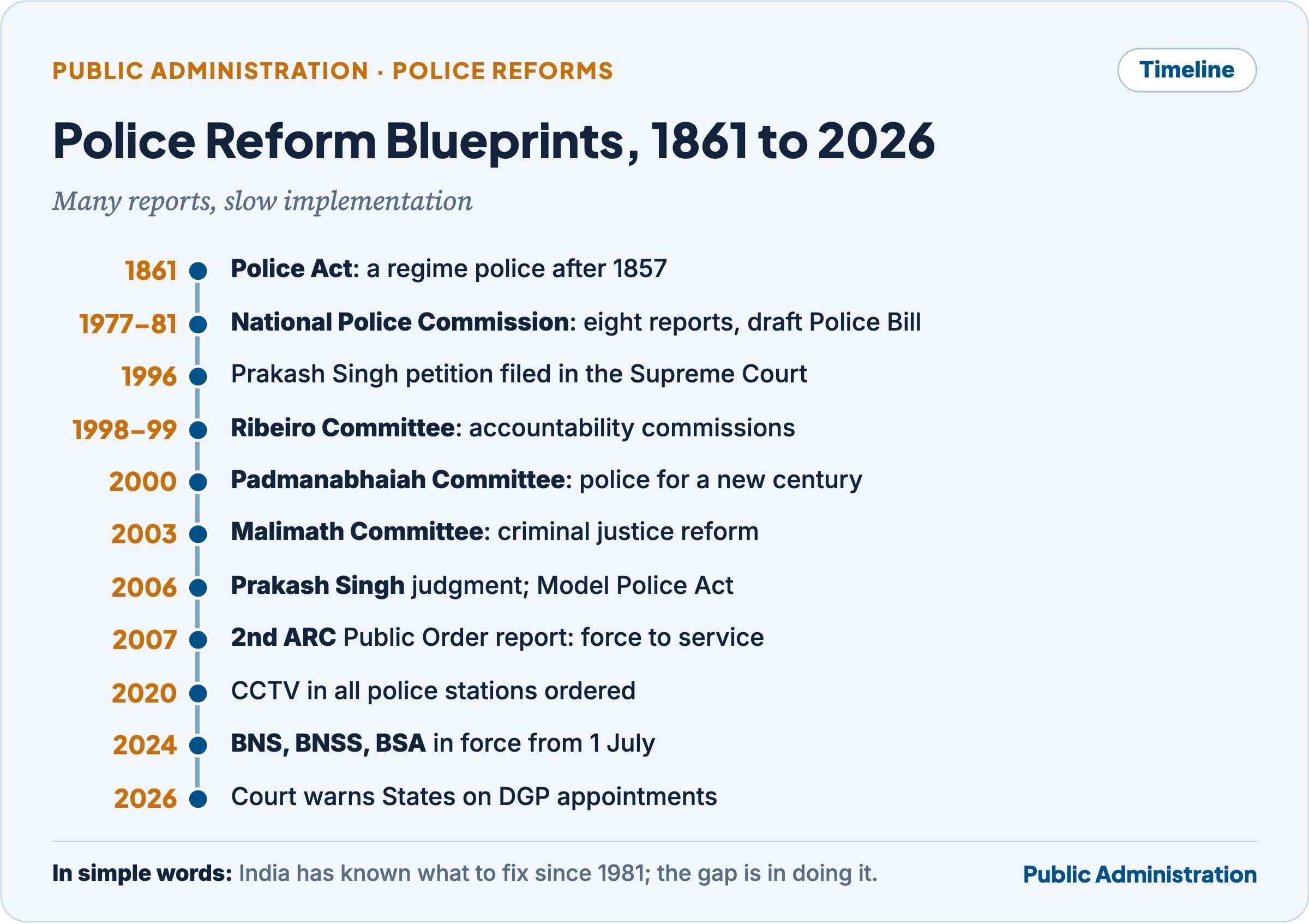
The Police Act Drafting Committee under Soli Sorabjee, former Attorney General, was set up by the Ministry of Home Affairs in September 2005 and submitted the Model Police Act on 30 October 2006, a month after the Prakash Singh judgment, which it complemented.
- Police as a service: a statutory charter of duties and social responsibilities; police to be impartial, efficient and responsive, especially to weaker sections.
- Superintendence and autonomy: the State government’s superintendence to be exercised through policies and guidelines, leaving functional autonomy to the police.
- State Police Board (a version of the State Security Commission) to frame policy, prepare panels for DGP selection and evaluate performance.
- DGP selection from the three senior-most empanelled officers; minimum two-year tenure for the DGP and key field officers.
- Separate investigation units in urban areas; a Police Establishment Committee for transfers and postings.
- Police Accountability Commission at State level and district complaints authorities.
- Community policing: village police, citizen policing committees in urban areas.
- Commissionerates for metropolitan areas with a population of ten lakh or more.
- Better service conditions: working hours, housing, welfare.
The 2nd ARC endorsed the Model Act’s broad direction but wanted a more holistic reform of the criminal justice system, pointed out that “police functions” are also performed by other departments, and suggested that departments and local bodies enforce their own regulatory laws to reduce the burden on the police.
7.4 State Police Acts after 2006
- About 18 States passed new Police Acts or major amendments after 2006, among them Assam, Bihar, Chhattisgarh, Haryana, Himachal Pradesh, Punjab, Rajasthan, Sikkim, Tripura and Uttarakhand (all 2007), Kerala, Meghalaya and Mizoram (2011), Karnataka (2012), Tamil Nadu (2013), and Andhra Pradesh, Maharashtra and Haryana (amendments, 2014). Others, such as West Bengal, Odisha, Goa, Jharkhand, Uttar Pradesh and Madhya Pradesh, have drafted or debated Bills without enacting them; several Union Territories still work under the 1861 Act.
- CHRI’s assessment is that most new Acts legalised non-compliance: State Security Commissions dominated by the government with non-binding advice; DGP selection without UPSC involvement; tenure protection riddled with exceptions; complaint authorities staffed by officials.
- Recent trend: States have also used their own laws or rules to bypass the UPSC panel for DGP selection: the Punjab Police (Amendment) Bill, 2023 (assent refused by the President, now challenged), Uttar Pradesh’s DGP selection rules (November 2024), with a committee headed by a retired High Court judge, and Jharkhand’s 2025 regulation.
7.5 The 2nd ARC’s Fifth Report: main recommendations
- Core principles: responsibility of the elected government for policy; authority, autonomy and accountability in balance; disaggregation and deconcentration; independence of crime investigation; self-esteem of policemen; professionalism and infrastructure; police as a service.
- Separate crime investigation agency in each State under an independent Board of Investigation, insulated from both politics and day-to-day law-and-order duties.
- State Police Board for policy and evaluation; a collegial system for appointments and transfers, with security of tenure.
- Independent complaint authorities at State and district levels.
- Officer-oriented civil police, with initial recruitment at the level of Assistant Sub-Inspector, to raise the quality of the cutting edge.
- Local police under municipal bodies for enforcing local laws such as traffic and nuisance; other departments to enforce their own laws.
- Police stations as service centres: immediate registration of complaints including by email, soft-skills training, community policing.
- Traditional accountability retained: annual reports of SPs written by Collectors and of DGPs by Chief Secretaries.
- Replacement of the 1861 Act by a new State law.
8. Prakash Singh v. Union of India (2006) and After
In simple words
In 1996 two retired police officers asked the Supreme Court to make governments carry out the NPC’s recommendations. In 2006 the Court did so, giving seven binding directions. Twenty years later, governments are still finding ways around them.
8.1 The case
- Petition: filed in 1996 as a public interest litigation by Prakash Singh, former DGP of Uttar Pradesh and Assam and former Director General of the BSF, and N.K. Singh, another retired officer, seeking implementation of the NPC’s recommendations.
- Interim steps: on the Court’s direction the Union set up the Ribeiro Committee (1998); in 2005 it set up the Soli Sorabjee Committee.
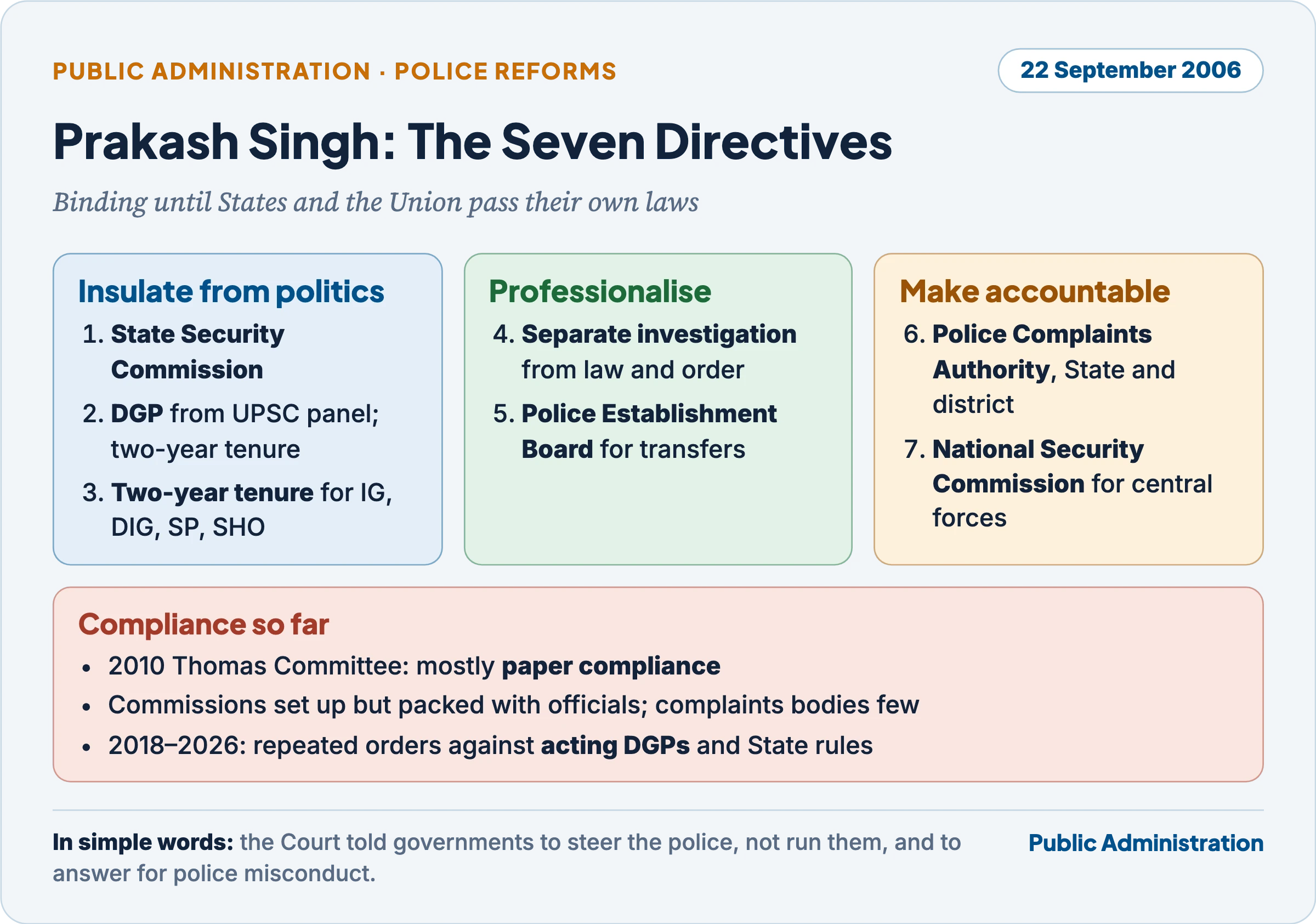
- Judgment: delivered on 22 September 2006 by a bench headed by Chief Justice Y.K. Sabharwal. Using its powers under Article 32 read with Article 142, and citing Vineet Narain (1998) as precedent for guidelines in the absence of law, the Court issued seven directives to operate until the Union and States enacted appropriate legislation.
- Two aims: functional autonomy of the police from illegitimate political control, and accountability of the police for performance and misconduct.
8.2 The seven directives
| No. | Directive | What it requires | Purpose |
|---|---|---|---|
| 1 | State Security Commission (SSC) | Headed by the Chief Minister or Home Minister, DGP as secretary, other members chosen to make it independent of government control; lays down broad policy, evaluates police performance, reports to the legislature; recommendations binding | Prevent unwarranted influence; open policy direction |
| 2 | Selection and tenure of the DGP | Chosen by the State from the three senior-most officers empanelled by the UPSC; minimum two-year tenure irrespective of superannuation; removal only for specified reasons in consultation with the SSC | End arbitrary appointment and removal |
| 3 | Minimum tenure for field officers | Two years for IG (zone), DIG (range), SP (district) and SHO (police station), subject to promotion, retirement or misconduct | Stability against punitive transfers |
| 4 | Separation of investigation from law and order | Starting in towns and urban areas with a population of ten lakh or more, with coordination between wings | Speedier, expert investigation; better rapport with people |
| 5 | Police Establishment Board (PEB) | DGP and four senior officers decide transfers, postings, promotions and service matters of officers up to DSP; recommend for SP and above; government may interfere only in exceptional cases with recorded reasons; forum of appeal | Bring service matters under police control |
| 6 | Police Complaints Authority (PCA) | State-level for SP and above, headed by a retired High Court or Supreme Court judge; district-level for up to DSP, headed by a retired district judge | Independent remedy for serious misconduct |
| 7 | National Security Commission (NSC) | At the Union level, to prepare panels for heads of Central Police Organisations with two-year tenure and review their effectiveness and service conditions | Same principles for central forces |
Common confusion
Are the Prakash Singh directives permanent law that States cannot change? Not exactly. They were issued to fill a legislative vacuum and were to operate until the Union and States passed appropriate laws. States may legislate, but in 2018 the Court held that laws or rules running counter to its directions on DGP selection would remain in abeyance, and in March 2026 it said that States with a valid Act must follow it, while others must follow the judgment, adding that a law contrary to the judgment cannot be used as a shield against contempt. The question of how far a State law may depart from the directives is still before the Court.
8.3 Compliance: the record
- Monitoring Committee: in May 2008 the Court set up a three-member committee headed by Justice K.T. Thomas. Its final report of 23 August 2010 found non-compliance, partial, marginal or “paper” compliance across States; the Court issued show-cause notices to the Chief Secretaries of Karnataka, Maharashtra, Uttar Pradesh and West Bengal.
- State Security Commissions: a 2019 CHRI study found 26 States and all UTs had constituted SSCs on paper, but not one complied with the prescribed composition: most lacked independent members, their advice was non-binding and they rarely met.
- DGP selection: the most litigated directive, because control of the police chief is what governments value most (see 8.4).
- Field tenure: transfers before two years remain common; SPIR 2019 found that between 2007 and 2016 about 18% of SSPs and DIGs were transferred in less than two years on average.
- Separation of investigation: done on paper in many cities, but investigators are routinely diverted to law and order, VIP security and elections.
- Police Establishment Boards: set up in most States, but in practice transfers of SPs and above remain with the government.
- Police Complaints Authorities: functional in fewer than half the States (see 6.4).
- National Security Commission: the Union objected to parts of the directive and created a body that, in the view of a parliamentary committee and CHRI, did not match the Court’s design.
8.4 The DGP saga: 2018 to 2026
- 3 July 2018: a bench headed by Chief Justice Dipak Misra directed States to send proposals to the UPSC at least three months before a DGP vacancy; the State must immediately appoint one of the empanelled officers; no “acting DGP”; any law or rule contrary to the directions to remain in abeyance. The Attorney General had told the Court that only five of 29 States had used the UPSC route.
- January 2019: the Court dismissed applications by five States seeking to follow their own laws.
- 13 March 2019: the Court clarified that the UPSC should empanel officers with at least six months of residual service, not two years, to avoid excluding good officers.
- 2024: the practice of acting DGPs spread (Uttar Pradesh had four successive acting DGPs after removing a UPSC-empanelled chief in 2022). In September–October 2024 the Court issued contempt notices to eight States. Uttar Pradesh then framed its own selection rules (November 2024) and Jharkhand a 2025 regulation, both providing for selection by a committee headed by a retired High Court judge without the UPSC panel.
- 5 February 2026: a bench headed by Chief Justice Surya Kant deprecated ad hoc DGPs and authorised the UPSC to send reminders and initiate contempt against defaulting States.
- 12 March 2026: the Court found six States (Punjab, Himachal Pradesh, Arunachal Pradesh, Goa, Manipur and Mizoram) prima facie in contempt for not sending proposals, closed proceedings against States that complied, and held that States with a valid Act must follow it while others must follow the judgment.
- August–October 2026: the Court took up a challenge to Odisha’s DGP selection process and, on 7 October 2026, agreed to hear urgently the Union government’s plea that Jharkhand’s 2025 regulation and the appointments under it are contrary to the Prakash Singh judgment.
8.5 Why government response has been lackadaisical
The reasons are political, federal, bureaucratic, legal and social.
- Political:
- The police are the most important instrument of power in a State: for elections, control of opposition, protection of supporters and management of agitations. Giving up control of transfers and postings (and the patronage and money around them) is costly for every party.
- Parties across the spectrum, in power in different States, have resisted equally, which shows the problem is structural, not partisan.
- Federal:
- Police is a State subject; States resent directions from the Union or the Court and see the UPSC’s role in DGP selection as central interference.
- The Union has itself been slow on the directives applying to it (UT police, the National Security Commission).
- Bureaucratic:
- Turf conflicts between the IAS and IPS: generalist control through the Home Department and the District Magistrate versus police autonomy.
- Sections of the police leadership have gained from the existing system and do not want transparent selection or independent complaints bodies.
- Legal and institutional:
- Judicial guidelines lack the legitimacy and detail of legislation; States enact laws that comply in form and defeat the substance.
- Contempt is a blunt and slow instrument; monitoring was wound up after 2010 and revived only in pieces.
- Social:
- Police reform is not an electoral issue; the beneficiaries (the poor, victims, the honest policeman) are diffuse and unorganised.
- Public opinion often applauds tough, extra-legal policing, which weakens demand for accountability.
- Design objections:
- Some argue that an SSC chaired by the Chief Minister cannot be independent, while a body with binding powers over an elected government raises democratic accountability problems.
- Autonomy without strong accountability could create a police state run by an unaccountable force.
9. Structural, Personnel and Technological Reforms
In simple words
Besides insulating the police from politics, reform must make them better at their work: specialised investigators, the right command structure in cities, enough people, decent conditions, good training and modern technology used within the law.
9.1 Separating investigation from law and order, and from prosecution
The idea that “law” and “order” are different jobs is old; it appears in the West Bengal Police Commission (1960), the NPC, Malimath, the 2nd ARC and Prakash Singh’s fourth directive.
- Merits of separating investigation from law and order:
- Specialisation and expertise in scientific investigation, cyber and economic crime.
- Investigations no longer stalled by riots, VIP duty and elections.
- Less incentive for force, more for forensic proof.
- Insulation from political pressure through a separate chain of command.
- Better conviction rates and public confidence.
- Challenges:
- Manpower shortage: separate wings need more people; in practice investigators are pulled back to law and order.
- Coordination problems: intelligence from the beat is needed for investigation, and vice versa.
- Two hierarchies may create friction and blame-shifting.
- Rural stations are too small to split.
- Separating investigation from prosecution. Prosecutors were placed under separate directorates after the CrPC of 1973 and court rulings, and the BNSS (section 20) now provides for a Directorate of Prosecution in each State with district directorates, headed by experienced advocates or judicial officers, to monitor cases and advise investigators.
- Merits: an independent prosecutor checks weak or fabricated police cases, protects the accused’s rights and improves the quality of charge-sheets.
- Challenges: loss of coordination between investigator and prosecutor (the 2nd ARC and Malimath wanted closer guidance of investigation by prosecutors), vacancies and low pay in prosecution services, and poor accountability for acquittals.
9.2 Commissionerate versus dual control
| Point | Dual control (most districts) | Commissionerate (large cities) |
|---|---|---|
| Command | SP heads the police under the “general control and direction” of the District Magistrate (s.4, Police Act 1861) | Commissioner of Police (IG rank or above) heads a unified force |
| Magisterial powers | Executive magistrate’s powers (prohibitory orders, licensing, preventive action) with the DM/SDM | Many such powers vested in the Commissioner and deputies |
| Strength | Civilian check on police; DM coordinates all departments | Quick, unified action in complex urban settings |
| Weakness | Delays and friction between DM and SP; unity of command broken | Concentration of power in police; needs strong accountability |
- The NPC recommended commissionerates for cities with a population of five lakh and above and places with special conditions; the Model Police Act, 2006 for metropolitan areas of ten lakh or more.
- By 2020 the system existed in about 63 cities in 15 States; Uttar Pradesh introduced it in Lucknow and Gautam Buddh Nagar (Noida) in January 2020 and later extended it to more cities.
- The role of the District Magistrate in law and order and the effect of commissionerates on the Collector are discussed in the article on the District Collector.
9.3 Modernisation and forensic capacity
- Umbrella scheme of Modernisation of Police Forces (MPF): approved in February 2022 for 2021–22 to 2025–26 with a central outlay of ₹26,275 crore, including:
- Assistance to States and UTs for Modernisation of Police: ₹4,846 crore for weapons, communication, IT, training equipment and police station buildings.
- Modernisation of Forensic Capacities: ₹2,080.50 crore.
- Security-related expenditure for Jammu and Kashmir, the North East and Left-Wing Extremism areas: ₹18,839 crore.
- Forensics: the BNSS requires forensic experts to visit crime scenes in offences punishable with seven years or more; yet about half the forensic posts in State laboratories were vacant in January 2023 (India Justice Report 2025). The National Forensic Sciences University and district mobile forensic units are attempts to close the gap.
- Criticism: modernisation money has often gone on vehicles and weapons rather than investigation, training and police stations; funds released are frequently under-utilised by States.
9.4 Manpower, women and working conditions
- Strength and vacancies: in January 2022 the sanctioned strength of all State police was about 26.8 lakh against an actual 20.9 lakh, leaving about 5.95 lakh posts (22%) vacant; vacancies have stayed above five lakh for a decade (BPR&D data).
- Police–population ratio: about 152 police per lakh people (actual, 2022), against a benchmark of 222 often cited in Indian policy debate; Bihar had about 75.
- Constabulary-heavy pyramid: the constabulary forms the overwhelming majority of the force, mostly with little hope of promotion. The 2nd ARC’s officer-oriented police (ASI-level entry) and Padmanabhaiah’s call for better-qualified constables address this.
- Women: about 12.3% of the force (January 2023), far short of the 33% urged by the Union since 2009; few in senior or investigative posts.
- Working conditions: average 14-hour days, half without a weekly off (SPIR 2019); poor housing (the Union funds housing only in special areas); stress and suicides. Some States have tried eight-hour shifts and weekly offs.
- Training budget: on average only about 1.25% of police budgets goes on training (India Justice Report 2025).
9.5 Training reforms
- Is police training still colonial? Largely, critics say:
- Emphasis on drill, physical training and obedience (“muscle over mind”).
- Human rights, gender, caste sensitisation, communication and scientific investigation treated as minor subjects; SPIR 2019 found almost one in three civil police personnel had never been trained in forensic technology and only about 6% of the force received in-service training each year.
- Training institutions treated as “dumping grounds” for officers out of favour; poor teaching aids and buildings (BPR&D studies from the 1990s).
- Institutions:
- Sardar Vallabhbhai Patel National Police Academy (SVPNPA), Hyderabad: trains IPS officers; began as the Central Police Training College at Mount Abu in 1948 and moved to Hyderabad in 1975.
- North Eastern Police Academy, Shillong; State police academies and training colleges; Central Detective Training Institutes under BPR&D (established 1970).
- Reform directions:
- Gore Committee (1971–73): attitude change as a training goal.
- 2nd ARC: soft skills such as communication, counselling, team-building and leadership.
- Online and continuous learning for police personnel under Mission Karmayogi (see the article on Civil Service Training and Capacity Building).
- Training on the new criminal laws, forensics and cyber crime after 2024.
- Making trainer posts attractive and linking training to promotion.
9.6 Technology, artificial intelligence and privacy
- Tools in use: CCTNS and ICJS; the National Intelligence Grid (NATGRID), conceived after the 2008 Mumbai attacks to link databases for intelligence and investigation; facial recognition technology (FRT) used by several city police forces and planned as a national automated system by NCRB; drones for crowd monitoring and surveillance; body-worn cameras; predictive policing and AI-based analytics for crime mapping and cyber fraud tracing; the Criminal Procedure (Identification) Act, 2022, which allows police to collect measurements including biometrics of arrested and convicted persons.
- Benefits: faster investigation, evidence that does not depend on confession, tracking of cyber fraud across States, transparency of police action.
- Concerns:
- Privacy: the Supreme Court in K.S. Puttaswamy v. Union of India (2017) held privacy a fundamental right; any intrusion must pass the tests of legality, legitimate aim, necessity and proportionality. FRT and mass surveillance in India operate largely without a specific law.
- Data protection exemptions: the Digital Personal Data Protection Act, 2023 lets the Union exempt State agencies in the interests of security and public order.
- Accuracy and bias: FRT and predictive tools may misidentify and may reproduce existing bias against marginalised communities whose members are over-represented in police records.
- Function creep: tools introduced for missing children or terrorism used for protests or political surveillance.
- Accountability: who audits an algorithm? SPIR 2023 found that government CCTV is concentrated in poor areas while the poor are least supportive of it.
- Balance: technology should come with legal authorisation, independent oversight, audit trails, data retention limits and grievance redress; otherwise it adds surveillance power without adding legitimacy.
9.7 The new criminal laws and policing (brief)
The Bharatiya Nyaya Sanhita (BNS), Bharatiya Nagarik Suraksha Sanhita (BNSS) and Bharatiya Sakshya Adhiniyam (BSA) replaced the IPC, CrPC and Evidence Act from 1 July 2024. For the police, the main changes are:
| Change | Provision | Implication |
|---|---|---|
| Zero FIR and e-FIR | BNSS s.173(1) | Easier access; less “jurisdiction” excuse |
| Preliminary enquiry for offences punishable with 3–7 years | BNSS s.173(3) | More police discretion; tension with Lalita Kumari |
| Designated police officer displaying arrest details | BNSS s.37 | Transparency of arrests |
| Audio-video recording of search and seizure | BNSS ss.105, 185 | Less planting of evidence |
| Forensic team visit and videography for offences of 7 years or more | BNSS s.176(3) | Shift to scientific investigation; heavy capacity demand |
| Victim informed of progress within 90 days | BNSS s.193 | Victim-centric investigation |
| Police custody of up to 15 days, taken at any time within the first 40 or 60 days | BNSS s.187 | Critics fear more pressure and custodial abuse |
| Directorate of Prosecution | BNSS s.20 | Institutional separation of prosecution |
| Confession to police still not provable | BSA | Continuing distrust of police confessions |
The laws add duties of transparency for the police, but their success depends on training, devices, forensic staff and supervision; without them, mandatory procedures may simply help the accused or be done on paper. The laws themselves are covered in the article on British Legacy, Police Commissions and Investigative Agencies.
10. Police, Federalism and the Union’s Role
In simple words
Police belong to the States, so most reform must be done by State governments. The Union can advise, fund, train, set models and run national databases, but it cannot order States to reform their police.
10.1 Police as a State subject and the Concurrent List debate
- Present position: police and public order are in the State List; criminal law and procedure in the Concurrent List; central forces, CBI, IB and police training institutions in the Union List.
- Proposals to change it: the Padmanabhaiah and Malimath committees proposed declaring some offences “federal crimes” to be investigated by a central agency; others have suggested moving police or public order to the Concurrent List so that Parliament can legislate a national framework for police reform.
| Arguments for a Concurrent List entry | Arguments against |
|---|---|
| Crime is inter-State and transnational (cyber, terror, organised crime) | Policing is local and depends on local knowledge and language |
| Parliament could pass a uniform Police Act and end non-compliance | Undermines federalism and State autonomy |
| Uniform standards of rights and accountability | The Union is itself accused of misusing central agencies |
| Better coordination of intelligence and data | States would resist; the problem is political will, not legislative competence |
- Middle path: the NIA Act (2008) shows a limited model of concurrent jurisdiction for scheduled offences; cooperative arrangements, model laws and conditional funding avoid a constitutional amendment.
10.2 The Union’s role in police reform
- Advisories: the MHA issues advisories on women in police (33%), gender sensitisation, custodial deaths, CCTV, community policing, implementation of the Prakash Singh directives and the new criminal laws.
- Funding: the MPF umbrella scheme, Nirbhaya Fund projects (ERSS-112, Safe Cities, women help desks), CCTNS and ICJS.
- Model laws and committees: the Model Police Act 2006; review committees; the NPC and its successors.
- National institutions: BPR&D (research, training standards, data on police organisations), NCRB (crime data, CCTNS), SVPNPA, the National Forensic Sciences University, I4C for cyber crime.
- The IPS as an All India Service: the Union recruits and trains the police leadership, which gives it influence over culture and standards.
- Annual conference of DGPs and IGPs: the forum where SMART policing was announced (2014); the 60th conference at Raipur (November 2025), themed “Viksit Bharat: Security Dimensions”, discussed a policing roadmap for 2047, called for changing the public perception of police especially among youth, urged use of NATGRID databases with AI, forensic reforms and awareness of the new criminal laws, and introduced Urban Policing Awards.
- Limits: the Union cannot compel States; its own record (UT police, central forces, use of central agencies) affects its credibility as a reformer.
11. The Reform Debate
In simple words
Should India first change police structures and laws, or the attitudes of police and people? The honest answer is both, because structures shape attitudes and attitudes decide whether structures work.
11.1 Structure or attitude?
- The case for structural reform first: attitudes are produced by incentives. As long as transfers are political, performance is measured by low crime figures, investigators are overworked and misconduct goes unpunished, sermons on courtesy will not change behaviour. The NPC, Prakash Singh and the 2nd ARC all treat structure (autonomy plus accountability) as the root.
- The case for attitude and cooperation first: law and order ultimately rests on voluntary compliance; the best structure fails if people do not report crimes, give evidence or respect the law, and if policemen see human rights as an obstacle. Community policing, training and public education change culture, which structures alone cannot.
- Synthesis: structural reform (insulation, accountability, resources) creates the conditions for attitudinal change; attitudinal change (inside the police and in society) creates the demand that sustains structural reform. The “radical transformation of structure and orientation” that would improve the police image therefore needs both: a new law and command structure, and a service-oriented, rights-respecting culture built by training, leadership and community partnership.
11.2 A reform agenda drawn from the commissions and courts
- Legal: replace the 1861 Act everywhere with laws faithful to Prakash Singh and the Model Police Act; enact an anti-torture law and ratify UNCAT; a law on surveillance and facial recognition.
- Autonomy: transparent DGP selection; fixed tenures; Police Establishment Boards with real powers; open, written policy directions from government.
- Accountability: independent, staffed Police Complaints Authorities; working CCTV with tamper-proof storage; magisterial inquiries into every custodial death and encounter; performance audits and public reporting.
- Effectiveness: separate, well-staffed investigation wings; forensic capacity; prosecution directorates that guide investigation.
- People: fill vacancies; 33% women; officer-oriented recruitment; eight-hour shifts, weekly offs, housing; training in soft skills, human rights and science.
- Citizens: police stations as service centres; e-FIR and online services; statutory, representative community policing; outreach to marginalised groups.
- Measurement: judge police by public satisfaction, victim experience and crime prevention, not only by recorded crime figures.
Criticism — Criticism: police reform in India has failed
- Two decades of defiance: Prakash Singh (2006) is still being enforced through contempt proceedings in 2026; most States have legalised non-compliance through their own Acts and rules.
- Paper institutions: State Security Commissions without independence, complaint bodies without members, separation of investigation without investigators.
- Colonial core intact: the 1861 Act still applies in several States and UTs; the thana culture, third degree and custodial deaths persist (170 police custody deaths registered by the NHRC in 2025–26 up to mid-March).
- Politicisation continues: acting DGPs, punitive transfers and selective use of police across parties.
- Technology without accountability: surveillance tools spread faster than safeguards; the new criminal laws extend police custody options.
- Public complicity: support for encounters and mob justice shows that demand for lawful policing is weak.
Defence — Defence: reform is real but incremental
- Judicial pressure works slowly but steadily: the 2018, 2019 and 2026 orders have narrowed the room for arbitrary DGP appointments; the UPSC now polices the process.
- New legal duties: zero FIR, e-FIR, videography, designated officers, forensic mandates and victim information are now statutory under the BNSS.
- Transparency tools: CCTNS in every police station, ICJS, CCTV orders and online services reduce discretion and create records.
- Durable community policing models: Janamaithri, Saanjh and Rajasthan’s liaison groups are in law and have outlived their founders.
- More women and better data: women’s share doubled from about 6% (2013) to over 12% (2023); research such as SPIR and the India Justice Report has made policing measurable and debatable.
- Reform as a process: no democracy reformed its police by one law; change comes through cumulative pressure from courts, civil society, technology and public expectations.
Theory lens: the police through Paper I ideas
- Weber’s legitimate force and legal-rational authority. Max Weber (Economy and Society, 1922; Politics as a Vocation, 1919) tied the State to a monopoly of legitimate force exercised through impersonal, rule-bound officials. Indian policing often has the force without the legitimacy: rules exist, but personal loyalty, caste and party shape their use. Reform aims to restore the legal-rational basis of police authority. See the article on Weber and Bureaucracy.
- Lipsky’s street-level bureaucracy. Michael Lipsky (Street-Level Bureaucracy, 1980) showed that front-line officials such as police officers, facing heavy workloads, scarce resources and vague goals, develop coping routines, ration services and stereotype clients; their discretion effectively makes policy. The Indian constable deciding whether to register an FIR, whom to arrest and how to question is the archetype; overwork (14-hour days) and bias found in SPIR studies are exactly the conditions Lipsky describes. Reform therefore has to change working conditions and discretion, not only top-level rules.
- Procedural justice and police legitimacy. Tom Tyler (Why People Obey the Law, 1990) and later work with Jason Sunshine (2003) found that people cooperate with the police mainly when they are treated fairly, respectfully and with voice. This explains why custodial violence and rudeness destroy cooperation even when crime is controlled, and why community policing, courteous service and accountability are not “soft extras” but the core of effective policing.
- Citizen–administration interface and New Public Service. Robert and Janet Denhardt’s New Public Service (2000) holds that administrators should serve citizens rather than steer them, and value citizenship and dialogue over efficiency alone. Community policing, citizen’s charters, Saanjh-type service centres and participatory committees apply this to the police. See the articles on Citizen and Administration and on New Public Management and After.
- Accountability theory. Barbara Romzek and Melvin Dubnick (1987) distinguished hierarchical, legal, professional and political accountability. Indian police are strong on hierarchical and political control but weak on legal (independent complaints bodies, courts) and professional accountability (standards, peer review). Prakash Singh tries to rebalance them. See the article on Accountability and Control.
- Principal–agent and public choice. Politicians (principals) use transfers and postings to keep police officers (agents) loyal; officers seek political patrons for career advancement. Public choice thinkers predict that rational actors will resist reforms that reduce their rents (patronage, transfer markets), which explains the cross-party resistance to Prakash Singh. Fixed tenure and independent selection are devices to realign incentives. See the article on New Public Administration and the Public Choice Approach.
- Riggs’ formalism. Fred Riggs (Administration in Developing Countries, 1964) described formalism in prismatic societies: a gap between prescribed norms and actual practice. State Security Commissions on paper, complaint authorities without members, CCTV cameras that “do not work” and Police Acts that comply in form but not substance are textbook formalism; so is the overlapping of caste and kin with formal police roles. See the article on Riggsian Models.
- NPM and its limits. New Public Management stresses performance targets and technology. SMART policing, CCTNS dashboards and crime statistics reflect it, but target-driven policing (low recorded crime, quick “solving” of cases) produces burking of complaints and forced confessions: a reminder that what is measured shapes what is done.
Key Terms
| Term | Meaning in simple words |
|---|---|
| Police–public relations | The attitudes and dealings between the police and the people they serve |
| Trust deficit | The gap between the trust the police need and the trust they actually have |
| Community policing | Police and residents working as partners to prevent crime and solve local problems |
| Problem-oriented policing | Tackling the causes of repeated incidents rather than each incident separately |
| SARA | Scanning, Analysis, Response, Assessment: the steps of problem-solving policing |
| Procedural justice | Fair, respectful treatment that makes people see authority as legitimate |
| Street-level bureaucrat | A front-line official, such as a constable, whose daily discretion shapes policy |
| Regime police | A force designed to protect those in power rather than to serve citizens |
| Burking | Refusing or minimising registration of crimes to keep figures low |
| Zero FIR | An FIR recorded at any police station regardless of where the crime happened, then transferred |
| e-FIR | Information about a crime given electronically and later signed by the informant |
| Custodial death | A death of a person while in police or judicial custody |
| Encounter killing | A killing by police claimed to be in self-defence or during arrest; fake when staged |
| Third degree | Torture or coercion to extract confessions or information |
| Dual control | District police under the SP but subject to the DM’s general control |
| Commissionerate | A city police system where the Commissioner holds unified command and magisterial powers |
| State Security Commission | A body meant to give policy direction to the police while shielding them from partisan pressure |
| Police Establishment Board | A board of senior officers that decides transfers and postings of junior officers |
| Police Complaints Authority | An independent body to hear public complaints of serious police misconduct |
| Paper compliance | Following a directive in form but not in substance |
| SMART policing | Strict and sensitive, modern and mobile, alert and accountable, reliable and responsive, techno-savvy and trained |
| CCTNS | National network linking all police stations for crime records and citizen services |
| ICJS | System linking police, courts, prisons, forensics and prosecution data |
| Elite capture | Domination of a participatory body by local elites, excluding the weak |
Commissions, Committees and Judgments
The bodies and cases below, listed by year, shape police–public relations and police reform.
| Body / case | Year | Key point |
|---|---|---|
| Police Act | 1861 | Colonial regime police; dual control under s.4 |
| Indian Police Commission (Andrew Fraser) | 1902–03 | Found widespread corruption and oppression in the police |
| West Bengal Police Commission | 1960–61 | Separate investigation in urban thanas; noted pressure to show low crime |
| Committee on Police Training (M.S. Gore) | 1971–73 | Overhaul of police training; attitudinal change |
| National Police Commission (Dharma Vira) | 1977–81 | Eight reports: SSC, DGP panel and tenure, new Police Act, three police tasks |
| Nilabati Behera v. State of Orissa | 1993 | State liable to compensate for custodial death under Article 21 |
| Joginder Kumar v. State of U.P. | 1994 | Arrest must be justified; right to inform a relative |
| D.K. Basu v. State of West Bengal | 1997 | Eleven safeguards on arrest and detention |
| NHRC encounter guidelines | 1997, 2003, 2010 | Independent investigation and magisterial inquiry in every encounter death |
| Ribeiro Committee (J.F. Ribeiro) | 1998–99 | Police Performance and Accountability Commission; complaints authority |
| Padmanabhaiah Committee (K. Padmanabhaiah) | 2000 | Recruitment, beat system, insulation from politics, federal crimes |
| Malimath Committee (Justice V.S. Malimath) | 2003 | 158 recommendations on criminal justice; federal crimes; investigation wing |
| Police Act Drafting Committee (Soli Sorabjee) | 2005–06 | Model Police Act, 2006 |
| Prakash Singh v. Union of India | 2006 | Seven binding directives for police autonomy and accountability |
| 2nd ARC Fifth Report: Public Order (M. Veerappa Moily) | 2007 | Police as a service; Board of Investigation; State Police Board |
| Thomas Committee (Justice K.T. Thomas) | 2008–10 | Found mostly paper compliance with Prakash Singh |
| Nandini Sundar v. State of Chhattisgarh | 2011 | Armed tribal SPOs (Salwa Judum) unconstitutional |
| Justice J.S. Verma Committee | 2013 | Urged implementation of police reform directives |
| Lalita Kumari v. Government of U.P. | 2013 | FIR registration mandatory for cognizable offences |
| Arnesh Kumar v. State of Bihar | 2014 | No routine arrest for offences up to seven years |
| PUCL v. State of Maharashtra | 2014 | Sixteen-point procedure for encounter deaths |
| K.S. Puttaswamy v. Union of India | 2017 | Privacy a fundamental right; tests for surveillance |
| Law Commission 273rd Report (Justice B.S. Chauhan) | 2017 | Ratify UNCAT; draft Prevention of Torture Bill |
| Prakash Singh orders on DGP selection | 2018, 2019 | UPSC panel three months ahead; no acting DGP; six months residual service |
| Paramvir Singh Saini v. Baljit Singh | 2020 | CCTV in all police stations and central agency offices |
| In Re: Lack of Functional CCTVs in Police Stations | 2025 | Suo motu national review of CCTV compliance |
| Prakash Singh contempt orders | 2026 | UPSC may initiate contempt; six States prima facie in contempt |
Contemporary Developments
- May 2025: e-Zero FIR. The Indian Cyber Crime Coordination Centre began a Delhi pilot converting cyber financial fraud complaints above ₹10 lakh on the 1930 helpline and national portal automatically into zero FIRs, to be extended nationwide.
- 2025: Status of Policing in India Report on torture. Common Cause and Lokniti–CSDS surveyed 8,276 police personnel in 17 States and found wide acceptance of harsh methods and inconsistent data on custodial deaths.
- April 2025: India Justice Report. Found women are about 12% of the police but only 8% of officers, fewer than 1,000 in IPS-level posts, and about half of forensic posts vacant.
- September–November 2025: CCTV suo motu case. After 11 custodial deaths in Rajasthan in eight months, the Supreme Court began a nation-wide review of non-functional CCTV in police stations and asked the Union about a centralised monitoring dashboard; by November only 11 States had filed compliance affidavits.
- November 2025: 60th DGsP/IGsP conference, Raipur. Themed “Viksit Bharat: Security Dimensions”; discussed a policing roadmap for 2047, public perception of police, NATGRID with AI, forensics and the new criminal laws; Urban Policing Awards introduced.
- February–March 2026: DGP appointment orders. The Supreme Court authorised the UPSC to initiate contempt against States delaying DGP proposals and found six States prima facie in contempt, while holding that States with a valid Act must follow it.
- March 2026: custodial death data. The MHA told Parliament that the NHRC registered 170 deaths in police custody in 2025–26 up to 15 March 2026, up from 140 in 2024–25.
- October 2026: Union’s plea against Jharkhand’s DGP regulation. The Supreme Court agreed to hear urgently the Centre’s application that Jharkhand’s 2025 regulation and DGP appointments under it violate the Prakash Singh judgment; a challenge to Odisha’s DGP selection was also being heard.
Revision Grid
| Thinker / body | Work or report (year) | Key idea |
|---|---|---|
| Robert Peel | Metropolitan Police principles (1829) | Policing by consent: the police are the public |
| Max Weber | Politics as a Vocation (1919) | State as monopoly of legitimate force |
| David Bayley | The Police and Political Development in India (1969) | Politicisation of Indian police; community policing elements |
| Herman Goldstein | Problem-oriented policing (1979) | Solve underlying problems, not single incidents |
| Michael Lipsky | Street-Level Bureaucracy (1980) | Front-line discretion makes policy |
| Wilson and Kelling | “Broken Windows” (1982) | Disorder invites crime |
| Eck and Spelman | SARA model (1987) | Scan, analyse, respond, assess |
| Romzek and Dubnick | Accountability types (1987) | Hierarchical, legal, professional, political accountability |
| Tom Tyler | Why People Obey the Law (1990) | Procedural justice builds legitimacy |
| Denhardt and Denhardt | New Public Service (2000) | Serve citizens rather than steer |
| National Police Commission | Eight reports (1979–81) | SSC, DGP tenure, new Police Act |
| Ribeiro / Padmanabhaiah / Malimath | 1998–99 / 2000 / 2003 | Accountability; restructuring; criminal justice reform |
| Soli Sorabjee Committee | Model Police Act (2006) | Service police with autonomy and accountability |
| Supreme Court | Prakash Singh (2006) | Seven directives |
| 2nd ARC | Fifth Report, Public Order (2007) | From force to service; Board of Investigation |
| Common Cause and Lokniti–CSDS | SPIR (2018–2025) | Evidence on trust, conditions, surveillance and torture |
Previous Year Questions
- 2026Ethical and privacy issues limit the emerging use of Artificial Intelligence (AI) by police to combat cyber crimes. Comment.
- 2026Supreme Court of India in Prakash Singh case laid the foundation for effective police reforms in India, but the states have frittered the opportunity. Discuss.
- 2025Smart Policing and Community Policing programmes have been initiated to address socio-technological challenges in law and order. Discuss.
- 2024“Police-public relations are poor in India. What measures are required to strengthen these relations?”
- 2024The separation of police, investigation, and prosecution has its own benefits and challenges. Analyse in context of recent developments.
- 2023The government response to the Supreme Court’s judgement on Police Reforms has been lackadaisical. The reasons are multiple and multidimensional. Discuss.
- 2022The effectiveness of law and order administration depends on cooperative attitudes of people towards police, than bringing reforms in the structure and procedures of law and order machinery. Do you agree? Give reasons.
- 2021Police-public relations in India need to be improved. Suggest measures to strengthen relations between police and public.
- 2020Police needs to be made accountable and freed from the grip of politics. It is a big challenge not only for law and order but also for the development of the country. Critically examine.
- 2020There has been a long-standing demand for separation of police investigation from prosecution. Analyze its merits and demerits.
- 2020At the district level, police functions under the overall supervision and control of the District Magistrate. Comment.
- 2019The police-public interface is punctuated with distrust and fear. Suggest how the police can reform its image in the eyes of the public.
- 2017“The image of Indian Police can be improved if its structure and orientations are transformed radically.” Do you agree? Elaborate.
- 2016“Police reforms in India have remained a contentious issue”. Critically analyse.
- 2016Is training of police in India still a reflection of the colonial mindset? Give reasons for your answer.
- 2015Critically examine the concept of community policing as a tool for improving public-police relations.
- 2014“Police – public relations are a story of insincere efforts made on both sides.” Elaborate.
- 2014Critically examine the statement: ‘Thana’ (police station) as the last bastion of the waning British administrative legacy in India.
- 2013“The design of the Indian Police was to subjugate the Indian People in the aftermath of 1857.” Analyse in the context of the Indian Police Act of 1861.
- 2012Compare and contrast the Padmanabhaiah, Ribeiro and Mallinath Committee Reports.
- 2011“Community policing has become a victim of elite capture.” Discuss the concept of community policing and bring out the implications of the above statement.
- 2011“The theme of Police Reforms continues to haunt the Parliament.” In the light of this statement, discuss the state of Criminal Justice System administration in India.
- 1998Do you think that the Indian police legislation, structure, technology, attitudes and behaviour are appropriate to meet the law and order problems in the country? What fundamental changes would you suggest in these realms to make the Central and the State police forces more effective in their role-performance?
- 1996“The work of crime prevention has gone down in the priority list of police activities in recent years.”
- 1995Critically review the evolving relationship between the district magistrate and the superintendent of police in the fiend of law-and-order management in a district.”
- 1992Write a critical essay on ‘The Dilemmas of Police Administration in a Plural Society.’
- 1990‘The Present culture of the Indian police system appears as continuation of what obtained under the British regime. In public estimate the police appears as an agency more to implement and enforce the objectives of the Government in power as district from enforcing law as such as an independent and impartial agency.’ Comment.
- 1988“Law and order are neither synonymous nor supplementary hence one perspective on police reforms in India can be a bifurcation of the existing Police administration into two independent entities-Judicial (or law) Police and Executive (or Order) Police.” Comment.