

Personnel Administration: Importance of human resource development; Recruitment, training, career advancement, position classification, discipline, performance appraisal, promotion, pay and service conditions; employer-employee relations, grievance redressal mechanism; Code of conduct; Administrative ethics.
This article: Ethics, morality and law; sources of ethical guidance; bureaucratic and democratic ethos; deontology, utilitarianism and virtue ethics applied to administration; Weber’s two ethics; the Finer–Friedrich debate; Appleby, Bailey, Frederickson and Hart; Cooper’s The Responsible Administrator; Waldo’s map of ethical obligations; Rohr’s regime values; Kathryn Denhardt’s definition; dirty hands, many hands, “I was only obeying orders” and whistleblowing; integrity and conflict of interest; the Nolan principles; Santhanam Committee, CVC, 2nd ARC Ethics in Governance, draft Public Services Bill, AIS Conduct Rules values, Lokpal; code of ethics versus code of conduct; building an ethical culture.
Official Syllabus: Paper I · Unit 1-09 Personnel Administration
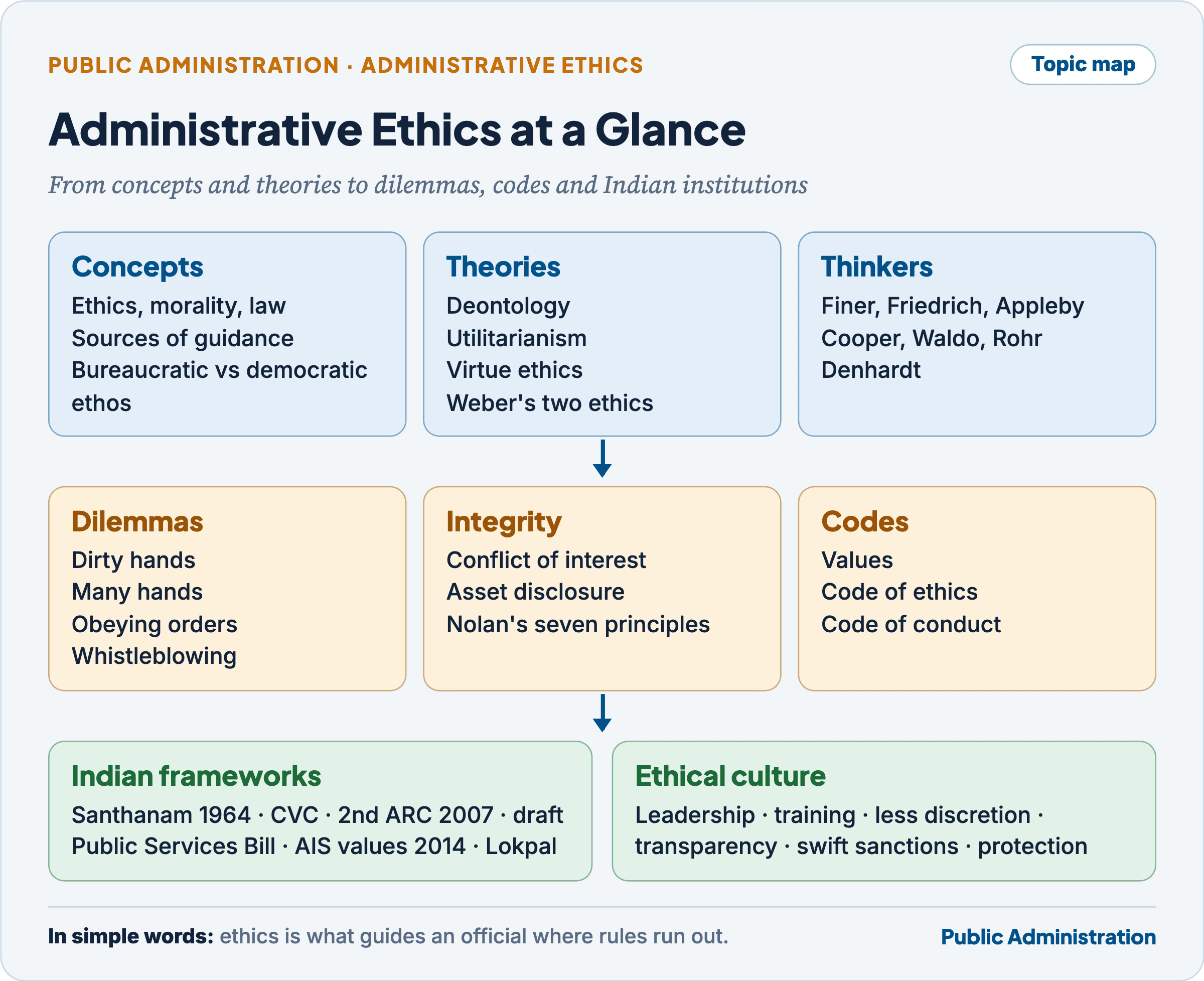
Administrative ethics is the study and practice of right conduct by public officials in the use of the power, discretion and public money entrusted to them. Laws and rules tell an official what is permitted; ethics asks what is right where the rules are silent, unclear or in conflict, and why the official should do it even when nobody is watching. Because a public servant decides for others, spends others’ money and acts with the coercive authority of the state, a lapse in ethics is never a private matter: it shows up as corruption, injustice, loss of trust and failed policy.
- Ethics is the inner control of administration, the counterpart of the external controls (legislative, executive, judicial, citizen) studied under accountability.
- The other two articles of this unit cover the personnel system (recruitment, training, promotion, pay) and discipline, appraisal, staff relations and the conduct rules as a disciplinary instrument. This article covers the values those rules rest on, the theories that justify them, the dilemmas they cannot settle, and the institutions that enforce integrity.
In simple words
A ration-shop inspector finds that a poor widow’s card was wrongly cancelled. The rules say she must reapply and wait three months. Law tells him what he may do; his conduct rules tell him not to take a bribe; ethics is what makes him phone the block office that afternoon, get the error fixed and make sure she gets her grain this month.
1. Ethics, Morality and Law
In simple words
Morality is what a society, a religion or a family teaches is right. Ethics is thinking carefully about why something is right and applying it to a role, such as a doctor’s or a civil servant’s. Law is the part of right and wrong the state has written down and will punish. The three overlap but are not the same.
1.1 Meaning of ethics
- The word ethics comes from the Greek ethikos, from ethos, meaning character or custom, that which arises from habit. Morality comes from the Latin mores, also meaning customs.
- Ethics is a set of standards a society or a profession places on itself, which guide behaviour, choices and actions. Standards alone do not ensure ethical conduct: that needs their adoption in action, sanctions against violations, competent disciplinary bodies and a culture of integrity (the 2nd Administrative Reforms Commission’s formulation in its fourth report).
- Administrative (public service) ethics applies these standards to the official role: how a public servant should use discretion, treat citizens, handle public money, deal with political superiors, and resolve conflicts between duties.
- Corruption is the most visible failure of ethics. The Latin root corruptus means to break or destroy; corruption breaks the trust between the citizen and the state.
1.2 Ethics, morality and law compared
The three are often used interchangeably, but each answers a different question. The table sets them side by side.
| Basis | Morality | Ethics | Law |
|---|---|---|---|
| Question asked | What does my society or faith say is right? | Why is it right, and what does my role require? | What does the state permit, require or punish? |
| Source | Religion, culture, family, conscience | Reasoned reflection; professional codes | Constitution, statutes, rules, judgments |
| Scope | Personal and social life | Role-based conduct (doctor, judge, civil servant) | Only what is written and enforceable |
| Sanction | Guilt, social disapproval | Professional censure, loss of standing | Penalty, dismissal, prosecution |
| Example | “Do not lie” | “Disclose any private interest in a file you handle” | Section 7 of the Prevention of Corruption Act, 1988 punishes taking a bribe |
- Law is the minimum, ethics the maximum. Every legal act is not ethical: a Collector who sits on a legal but harmful file until it expires breaks no rule but fails ethically. Not every ethical demand is legal: courtesy to a poor applicant is rarely enforced by law.
- Law can be unethical. Apartheid laws or colonial press laws were legal. This is why administrative ethics looks beyond the rulebook to constitutional and humane values.
- Ethics fills the space of discretion. Rules can never anticipate every case (Simon’s “bounded” rules; Friedrich’s point that external checks cannot catch everything). Wherever an official must choose, ethics decides how the choice is made.
- Ethics is both personal and institutional. Personal integrity matters, but so do the incentives and systems around the person: an honest officer in a rotten system may be transferred out or co-opted.
Common confusion
Is a civil servant who follows every rule automatically ethical? No. Rule-compliance is the floor, not the ceiling. An officer can obey every procedure and still be ethically wrong: by delaying a file to please a superior, by applying a rule mechanically to defeat its purpose, or by staying silent about wrongdoing he knows of. Administrative ethics, as the 2017 question puts it, includes the code of conduct but goes beyond it, into judgement, motive and courage.
1.3 Why ethics matters more in the public sector
- Monopoly and coercion. A citizen cannot choose another police station or another land-records office; the state’s monopoly gives the official power over people who cannot exit.
- Discretion. Officials decide who gets a licence, a house, a contract or a transfer. Monopoly plus discretion minus accountability is the classic recipe for corruption (Robert Klitgaard’s formula, Controlling Corruption, 1988: C = M + D − A).
- Public money and public trust. Officials are trustees of resources taken from taxpayers; misuse is a breach of trust, not only of rules.
- Asymmetry of power in India. The fourth report of the 2nd ARC notes that a colonial legacy of unchallenged authority, a huge gap in power and security between government employees and citizens (most of whom work in the unorganised sector), and decades of over-regulation and scarcity turned the official into a patron and the citizen into a supplicant. Such asymmetry reduces social pressure for ethical behaviour.
- Legitimacy. A government whose officials are seen as honest and fair gets voluntary compliance; one seen as corrupt must rely on force.
2. Sources of Ethical Guidance for a Public Servant
In simple words
When a civil servant is unsure what is right, she can look in several places: the law, the service rules, her own conscience, the code of her profession, the Constitution, and the example of respected seniors. Usually these point the same way; ethical difficulty begins when they do not.
Ethical guidance reaches an official through several channels. They range from the external and enforceable to the internal and personal.
| Source | What it provides | Indian example | Limitation |
|---|---|---|---|
| Constitution | Supreme values: justice, liberty, equality, fraternity, dignity, rule of law | Preamble; Fundamental Rights; Directive Principles; Article 311 protections | Broad; needs interpretation |
| Law | Binding duties and prohibitions | Prevention of Corruption Act, 1988; RTI Act, 2005; Lokpal and Lokayuktas Act, 2013 | Covers only what is codified; slow to change |
| Rules and conduct codes | Specific do’s and don’ts | Central Civil Services (Conduct) Rules, 1964; All India Services (Conduct) Rules, 1968 | Negative and minimal; can be gamed |
| Organisational norms and orders | What the department expects | CVC guidelines, departmental manuals, lawful orders of superiors | Can embody bad culture (“this is how it is done here”) |
| Professional norms | Standards of a profession | Medical ethics for a government doctor; audit standards for the CAG’s staff; the idea of a “civil service ethos” | May clash with organisational loyalty |
| Conscience and personal values | Inner sense of right and wrong | An officer’s refusal to falsify a muster roll | Subjective; may be mistaken or self-serving |
| Public opinion, media and civil society | External moral pressure | Social audits; RTI activism; media exposure | Can be partisan or ill-informed |
| Tradition and exemplars | Role models and inherited ideals | Kautilya’s Arthashastra on testing ministers’ integrity; Gandhi’s talisman; respected officers | Idealised; may not fit new problems |
- These sources reinforce each other most of the time. A dilemma arises when they conflict: law permits what conscience forbids, a superior’s order clashes with the Constitution, or loyalty to a colleague clashes with the public interest.
- The 2nd ARC’s key insight is that values and institutions must work together: values are the “guiding stars”, institutions are the container that gives them shape and durability. Values without institutional support soon weaken; institutions without values become empty procedure.
3. Two Ethos: Bureaucratic and Democratic
In simple words
There are two broad ideas of a “good” official. One says: be efficient, expert, loyal and obedient. The other says: serve the citizen, defend the Constitution, care about fairness. A good official needs both, but they pull in different directions.
Scholars of public service ethics (notably Darrell Pugh, writing in 1991 on the origins of ethical frameworks in public administration, and summarised by Mohit Bhattacharya) identify two frameworks of ethical standards.
| Basis | Bureaucratic ethos | Democratic ethos |
|---|---|---|
| Intellectual roots | Weber’s rational bureaucracy; Wilson’s politics–administration dichotomy; Taylor’s scientific management | Political theory; constitutionalism; New Public Administration; citizenship theory |
| Core values | Efficiency, efficacy, expertise, loyalty, accountability (to superiors) | Regime values, citizenship, public interest, social equity |
| Nature | Precise, rule-based, measurable | Open-ended, eclectic, contested |
| Image of the official | Neutral instrument, technician | Steward of democracy, guardian of values |
| Danger if alone | Amoral efficiency (“I only followed orders”) | Arbitrary activism; officials substituting their values for the people’s |
- New Public Administration (the Minnowbrook Conference, 1968) rejected value neutrality and demanded relevance, values, equity and change: the clearest shift from the bureaucratic to the democratic ethos.
- Herbert Simon showed that administration does not merely implement values given by politicians; in deciding among alternatives it sets priorities among competing values. Administration is therefore inescapably ethical.
- Contemporary balance: good administration needs bureaucratic virtues (competence, impartiality, rule-following) in the service of democratic ends (rights, equity, responsiveness).
4. Ethical Theories Applied to Administration
In simple words
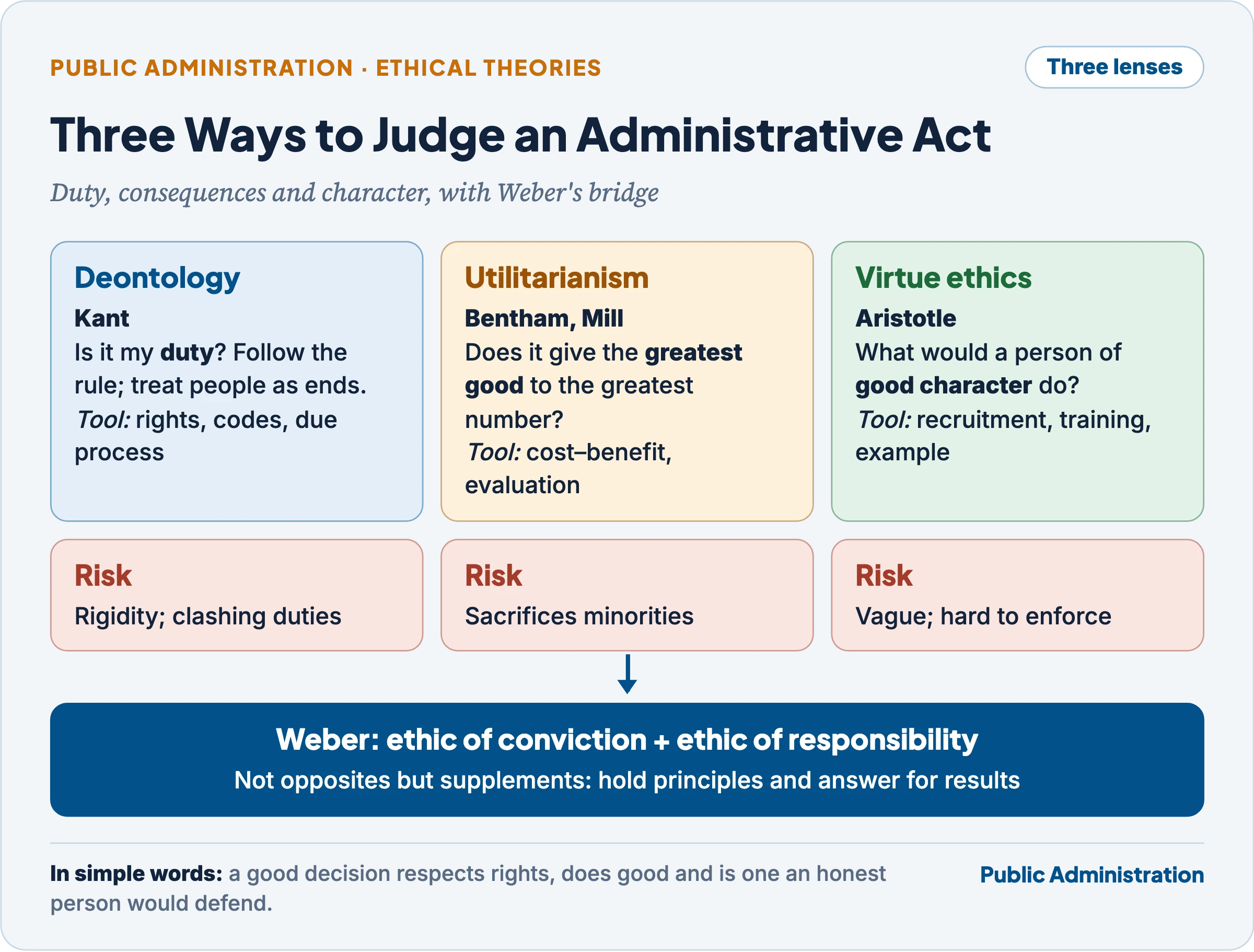
When people argue about what is right, they usually reason in one of three ways. Some ask: what is my duty? Others ask: which choice does the most good? Others ask: what would a person of good character do? Each way helps an administrator, and each can mislead if used alone.
4.1 Deontology: the ethics of duty
- Deontology (from Greek deon, duty) judges an act by whether it conforms to a duty or rule, regardless of consequences. Its classic statement is by Immanuel Kant, the eighteenth-century German philosopher, in Groundwork of the Metaphysics of Morals (1785).
- Categorical imperative: act only on a principle you could will to be a universal law; and treat humanity, in yourself and others, always as an end and never merely as a means.
- In administration:
- It grounds the rule of law, equal treatment, due process and rights: a citizen’s right to a fair hearing cannot be traded away because denying it would be faster.
- It underlies codes of conduct and fiduciary duties (do not misuse office, do not disclose secrets, do not take gifts).
- It explains why torture, falsifying records or framing an innocent person are wrong even if they would produce a “good” result.
- Critique: rigid deontology produces rule-bound rigidity (Merton’s “trained incapacity”); it gives no guidance when two duties conflict (loyalty to the minister versus duty to the public); and it can ignore disastrous consequences.
4.2 Utilitarianism: the ethics of consequences
- Utilitarianism, associated with Jeremy Bentham (An Introduction to the Principles of Morals and Legislation, 1789) and John Stuart Mill (Utilitarianism, 1863), judges an act by its consequences: the right act produces the greatest good (happiness) of the greatest number.
- In administration:
- It is the hidden logic of cost–benefit analysis, policy evaluation, budgeting and planning: choosing the project that benefits most people per rupee.
- It justifies triage in disaster relief and prioritisation in health spending.
- Bentham himself was a practical reformer (prison and poor-law design), and utilitarian reasoning shaped nineteenth-century British administrative reform.
- Critique:
- It can sacrifice minorities and individuals for aggregate gain (displacing a tribal village for a dam because the majority benefits).
- Consequences are uncertain and hard to measure; officials may rationalise self-serving choices as “for the greater good”.
- John Rawls, in A Theory of Justice (1971), objected that utilitarianism does not take seriously the distinction between persons; his difference principle (inequalities are just only if they benefit the least advantaged) gave New Public Administration and the idea of social equity a philosophical base.
4.3 Virtue ethics: the ethics of character
- Virtue ethics, going back to Aristotle’s Nicomachean Ethics, asks not “which rule?” or “which outcome?” but “what kind of person should I be?” Right action is what a person of practical wisdom (phronesis) and good character would do.
- Virtues are stable dispositions such as honesty, courage, justice, temperance, prudence, acquired by habit and example.
- In administration:
- It explains why recruitment, training, mentoring and leadership by example matter: codes cannot cover every case, so the system needs officials who can be trusted to judge well.
- Stephen Bailey (“Ethics and the Public Service”, 1964/65) named three essential moral qualities of the public servant: optimism, courage and fairness tempered by charity.
- Carl Friedrich (1940) relied on this logic: the remedy for abuse lies in recruiting the right people and socialising them into public-service values.
- Kautilya in the Arthashastra prescribed testing ministers’ character through secret trials (upadhas) of piety, wealth, lust and fear: an early virtue-based screening.
- Critique: “good character” is vague and culturally variable; virtue gives little guidance in novel or technical dilemmas; and an emphasis on character can become an excuse for not building institutions.
4.4 Weber: ethic of ultimate ends and ethic of responsibility
- Max Weber, in his lecture Politics as a Vocation (1919), distinguished an ethic of ultimate ends (conviction), in which one does what is right and “leaves the result to God”, from an ethic of responsibility, in which one must answer for the foreseeable results of one’s actions.
- Weber did not treat them as opposites: they are supplements, which only together make a person fit for public life. This corrects the common view that Weber stood for a purely “value-neutral” bureaucrat.
- For the administrator, the ethic of responsibility is a demand to consider consequences, while the ethic of conviction protects against simply obeying whatever is ordered.
4.5 The three theories compared
The table brings the three approaches together with their administrative uses.
| Basis | Deontology | Utilitarianism | Virtue ethics |
|---|---|---|---|
| Key question | What is my duty? | What produces the best outcome for most? | What would a good official do? |
| Thinkers | Kant | Bentham, Mill | Aristotle; Bailey, Frederickson in public administration |
| Administrative tool | Rules, rights, codes of conduct | Cost–benefit analysis, evaluation, planning | Recruitment, training, mentoring, leadership |
| Strength | Protects rights and equal treatment | Rational use of scarce resources | Flexible judgement in grey areas |
| Weakness | Rigidity; conflicting duties | Sacrifices minorities; uncertain outcomes | Vague; hard to enforce |
| Indian anchor | Article 14, natural justice, conduct rules | Outcome budgets, scheme evaluations by DMEO | Mission Karmayogi’s stress on attitudes and role models |
- In practice a sound administrative decision passes all three tests: it respects rights and rules, produces good consequences, and is what a person of integrity would be willing to defend publicly. Several ethical decision models (including Cooper’s, below) are, in effect, ways of running these tests together.
5. Thinkers of Administrative Ethics
In simple words
A handful of scholars shaped how public administration thinks about right conduct. One asked whether officials should be controlled from outside or trusted from inside; others listed the virtues a good official needs; others gave officials a map of their duties or a method for hard decisions.
5.1 The Finer–Friedrich debate: external control or inner responsibility
The classic debate on administrative responsibility frames the place of ethics.
| Basis | Herman Finer | Carl J. Friedrich |
|---|---|---|
| Work | “Administrative Responsibility in Democratic Government”, Public Administration Review (1941) | “Public Policy and the Nature of Administrative Responsibility”, Public Policy (1940) |
| Core argument | The only sure protection against bureaucratic power is external control: legislatures, laws and sanctions | External checks cannot catch every abuse; responsibility must be internal, built through professional standards and technical knowledge |
| Image of the official | Servant who must be watched | Professional who must be trusted and trained |
| Weakness | Cannot reach discretion; breeds defensive rule-following | Relies on officials’ self-restraint; can shelter a self-serving bureaucracy |
- The debate is the theoretical root of the distinction between objective responsibility (answerability to others) and subjective responsibility (one’s own sense of duty), later developed by Cooper.
- Modern ethics infrastructure (OECD’s term) combines both: codes and controls (Finer) with training, leadership and culture (Friedrich).
5.2 Paul Appleby: morality in a democratic government
- Paul Appleby, the American administrator-scholar who also wrote two influential reports on Indian administration (1953, 1956), argued in Morality and Administration in Democratic Government (1952) that democratic political processes themselves supply the moral framework of administration.
- He valued honesty and loyalty, but held that the higher morality of the official lies in being responsive to the public through political institutions, and in sharing power rather than hoarding it.
- His dictum, cited in a 2011 question, is that responsible government is ethical government: ethics is not a private virtue added to administration but the quality of the whole democratic system of responsibility.
- Chester Barnard, in The Functions of the Executive (1938), had earlier argued that executive positions imply a complex morality: the executive holds several moral codes at once (personal, professional, organisational) and must have a high capacity for responsibility, meaning the ability to keep to those codes under pressure, and the further capacity to create moral codes for others. Leadership, for Barnard, is ultimately the moral task of building faith in a common purpose.
5.3 Bailey, Frederickson and Hart, and Kathryn Denhardt
- Stephen K. Bailey (1964/65) argued that the public servant needs mental attitudes (recognising the moral ambiguity of all people and policies, the contextual forces that condition moral priorities, and the paradoxes of procedure) and moral qualities (optimism, courage, fairness tempered by charity).
- H. George Frederickson and David Hart, “The Public Service and the Patriotism of Benevolence” (PAR, 1985), proposed that the special ethic of public servants is the patriotism of benevolence: a combination of love of the regime’s values and love of others.
- Kathryn G. Denhardt identified honour, benevolence and justice as the moral foundations of public administration:
- Honour: adherence to the highest standards of responsibility, integrity and principle.
- Benevolence: the disposition to do good to others and promote their welfare.
- Justice: fairness and respect for the rights and dignity of every individual.
- In The Ethics of Public Service (1988), Kathryn Denhardt defined administrative ethics as a process of independently critiquing decision standards, based on core social values that can be discovered, within reasonable organisational boundaries that can be defined, subject to personal and professional accountability (the definition set for explanation in 2015). Each element matters:
- Independently critiquing decision standards: ethics is an active process of questioning the rules, not passive compliance.
- Core social values that can be discovered: the standard is not the official’s private taste but values embedded in society (in India, the Constitution).
- Reasonable organisational boundaries: the official works within an organisation and cannot act as a free agent.
- Personal and professional accountability: the official must be ready to answer for the judgement made.
- Robert and Janet Denhardt’s New Public Service (2000) later built on this: officials should serve citizens, not steer, and treat the public interest as a shared value arrived at through dialogue (see the article on NPM and after).
5.4 Terry Cooper: The Responsible Administrator
Terry L. Cooper, an American scholar of public ethics, published The Responsible Administrator: An Approach to Ethics for the Administrative Role in 1982; it has gone through several editions and is the most widely used framework of practical public-service ethics.
- Responsibility is the key ethical concept of public administration. Cooper divides it into two kinds:
- Objective responsibility: accountability to others (superiors, elected officials, citizens) and obligation to carry out the tasks the role requires, imposed by law, hierarchy and the organisation.
- Subjective responsibility: what officials feel responsible for, rooted in their values, beliefs and professional identity. It is what makes an official do right when no one checks.
- Ethical dilemmas arise from three kinds of conflict:
- Conflict of authority: two legitimate sources of authority give contrary signals (minister versus law; superior versus the public).
- Role conflict: the official’s several roles (officer, parent, union member, citizen) pull different ways.
- Conflict of interest: personal interest collides with public duty.
- Ethical decision-making model. Cooper offers a step-by-step method:
- Perceive the ethical problem and describe the facts.
- Define the ethical issue (which values or duties are in tension).
- Identify alternative courses of action.
- Project the probable consequences of each, including how they would look if made public.
- Find a fit: select the option that best balances moral rules, principles, the official’s self-image and the justifications that could be given to others.
- Maintaining responsible conduct requires both internal controls (personal values, professional ethics) and external controls (codes, laws, organisational structures), echoing the Finer–Friedrich debate and resolving it as complementary.
- Organisational design matters: Cooper stresses that organisations must protect officials who exercise conscience (participatory structures, whistleblower protection) instead of treating dissent as disloyalty.
5.5 Dwight Waldo: the map of ethical obligations
Dwight Waldo, author of The Administrative State (1948) and convener of Minnowbrook I, set out in The Enterprise of Public Administration (1980) a “map” of the ethical obligations of a public servant. His point was that the official faces not one but many competing obligations, with no fixed order of priority.
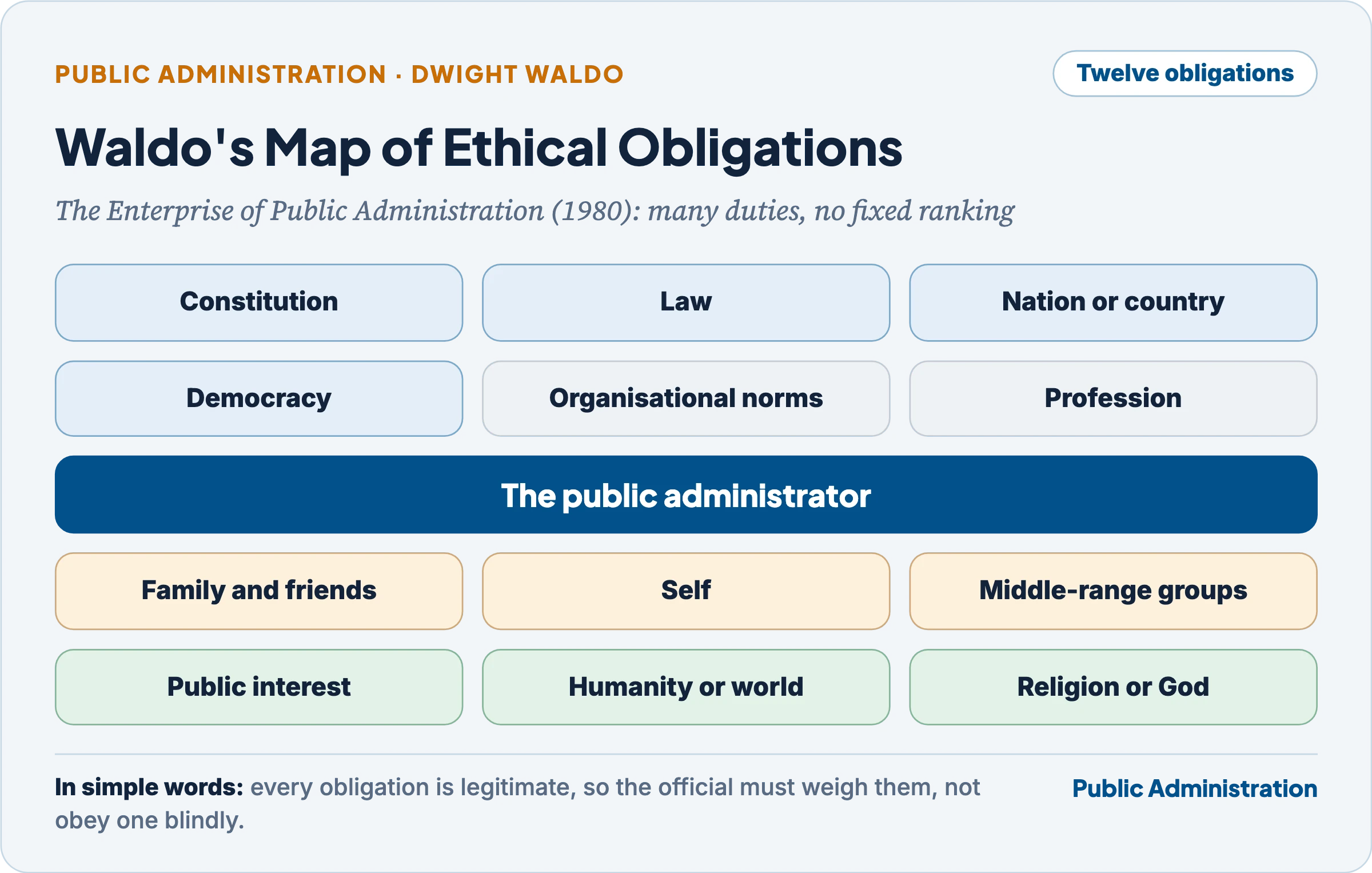
Waldo listed twelve sources of obligation:
- Constitution: the fundamental law and its values.
- Law: the statutes and rules made under it.
- Nation or country: the political community as a whole.
- Democracy: the procedures and spirit of popular government.
- Organisational–bureaucratic norms: loyalty, hierarchy, obedience to lawful orders.
- Profession and professionalism: the standards of one’s expertise.
- Family and friends: personal loyalties.
- Self: one’s own conscience, integrity and interests.
- Middle-range collectivities: class, caste, party, union, religion-based or regional groups.
- Public interest or general welfare.
- Humanity or the world: obligations beyond the nation.
- Religion or God.
- Significance:
- The map shows why administrative ethics is an unresolved tension between “what is” and “what ought to be” (the 2026 question): each obligation is legitimate, and they collide.
- There is no algorithm; the official must use judgement, weighing obligations afresh in each case.
- It warns against reductionism: neither “obey the hierarchy” nor “follow your conscience” alone is adequate.
- Indian illustration: a District Magistrate during communal tension faces obligations to the Constitution (equal protection), the law (prohibitory orders), the government (political pressure), middle-range collectivities (caste and religious groups), self (career safety) and humanity (protecting lives). The map lets the officer see the whole field before choosing.
5.6 John Rohr: regime values
John A. Rohr, the American scholar of constitutional public administration, argued in Ethics for Bureaucrats: An Essay on Law and Values (1978) that unelected officials who exercise discretion need an ethical standard that is neither their private morality nor mere obedience.
- Regime values: officials should take their values from the regime, that is, from the values of the political community expressed in its Constitution and its authoritative interpretation (for the United States, Supreme Court judgments on equality, freedom and property).
- Why regime values:
- They are public, knowable and legitimate, unlike an official’s personal views.
- Studying them through case law trains officials in reasoned moral argument.
- They give the official a basis to resist illegitimate orders without becoming a law unto himself.
- The oath to uphold the Constitution is, for Rohr, the moral foundation of the official’s discretion: it legitimises the administrative state.
- Indian application: India’s regime values are in the Preamble (justice, liberty, equality, fraternity, dignity, unity and integrity), the Fundamental Rights and Directive Principles, and the basic structure doctrine (Kesavananda Bharati, 1973). The 2014 amendment to the All India Services (Conduct) Rules now requires every member to uphold the supremacy of the Constitution and democratic values: a direct statutory expression of Rohr’s idea.
- Critique: constitutions are contested and general; regime values can legitimise unjust regimes; and case law is too remote for most front-line officials.
5.7 Three perspectives on ethical standards
Drawing these thinkers together, three perspectives can be used to set standards for public service:
| Perspective | Basis | Strength | Limit |
|---|---|---|---|
| Regime values (Rohr) | Constitution and its interpretation | Legitimate, public | General, contested |
| Situational ethics | Judgement in the particular case, since no rule covers everything | Flexible, realistic | Risk of rationalisation |
| Personal ethics (Appleby, O. Glenn Stahl) | The official’s consciously built ethical framework; Stahl urged infusing recruits with “an ethical passion for the public interest” | Inner motivation | Subjective |
- Ethics is also shaped by organisational culture (Guy Peters’ “bureaucratic culture”: a police force and a child-welfare agency have different ethical climates) and by societal culture (Riggs’ ecological approach: administrative ethics reflects the wider socio-economic culture, including caste and kinship obligations in prismatic societies).
Indian Connect — Regime values in Indian administration
- The Preamble has been treated by scholars and courts as the value charter of Indian administration: justice (social, economic, political), liberty, equality, fraternity and dignity.
- The Directive Principles (Articles 38, 39, 46) give administration a positive ethical duty towards the weaker sections, which the AIS Conduct Rules now echo (“responsiveness to the public, particularly to the weaker section”).
- Article 51A (fundamental duties) and the oath under the Third Schedule extend constitutional ethics to all citizens, a point behind the 2016 question that ethics in public life must include citizens too.
6. Ethical Dilemmas and Failures
In simple words
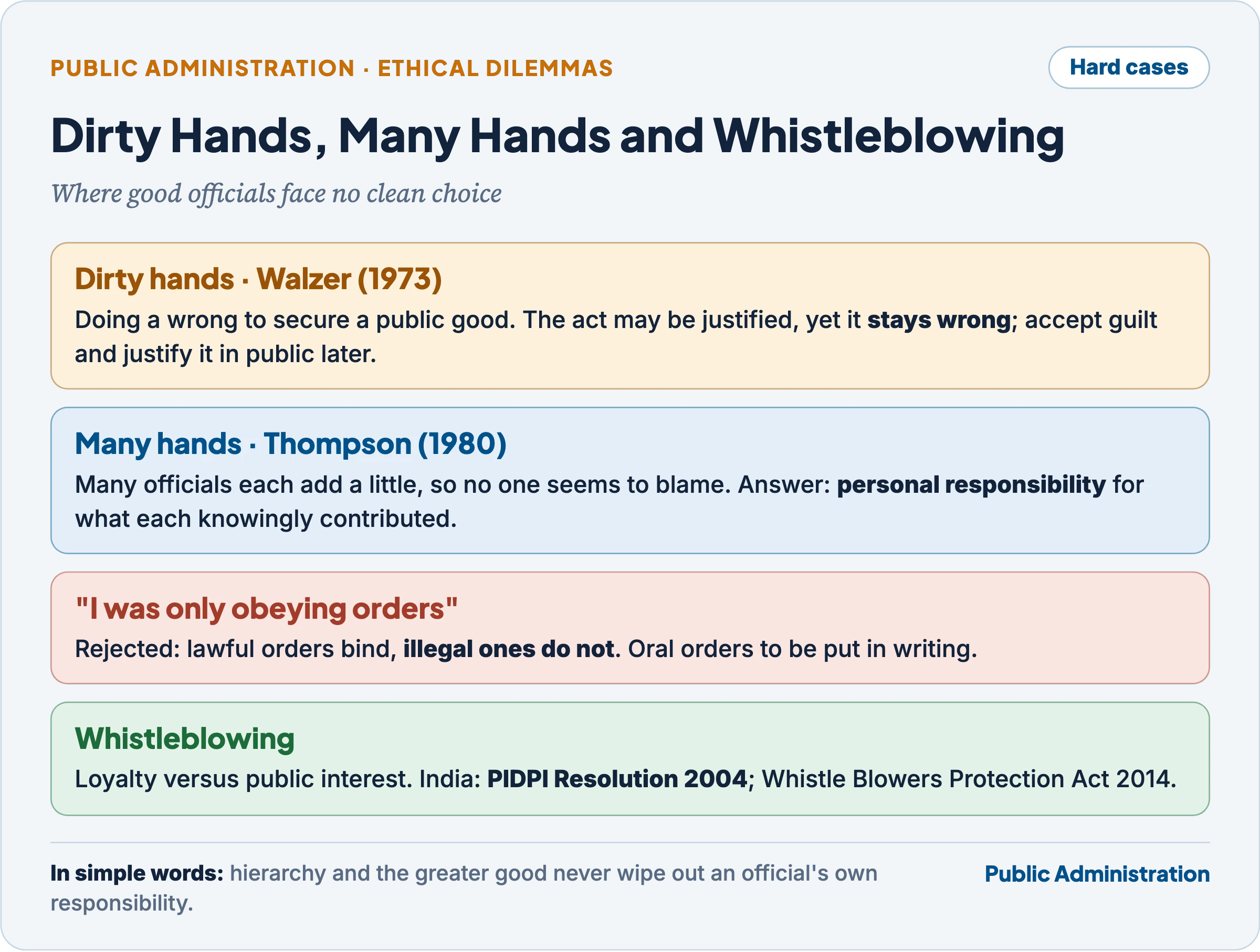
Sometimes there is no clean choice. To prevent a big harm you may have to do a small wrong; a bad decision can come out of a hundred people each doing a little bit; and the only way to stop wrongdoing may be to break ranks and speak out. These are the hardest cases in public ethics.
6.1 Dilemma, temptation and failure
- An ethical temptation is a choice between right and wrong (take the bribe or not); the right answer is clear, only the will is weak.
- An ethical dilemma is a choice between two rights or two wrongs: honesty versus confidentiality, loyalty versus justice, the rule versus the needy individual, efficiency versus equity.
- Common administrative dilemmas:
- Political direction versus professional judgement (a minister presses for a project the engineers think unsafe).
- Rule versus humanity (a deserving applicant lacks one document).
- Confidentiality versus transparency (official secrets versus the RTI Act).
- Efficiency versus equity (closing an uneconomic rural school).
- Loyalty to colleagues versus duty to the public (covering up a colleague’s error).
6.2 Dirty hands
- The problem of dirty hands, given its modern form by Michael Walzer in “Political Action: The Problem of Dirty Hands” (Philosophy and Public Affairs, 1973), is that a public official may sometimes have to do something morally wrong in order to do what is politically or socially right: deceiving, bargaining with a criminal, or using coercion to avert a greater harm. The idea goes back to Machiavelli and to Sartre’s play Dirty Hands (1948).
- Walzer’s position: the official may be right to act, yet the act remains wrong, and the official should feel and accept guilt, not pretend the act was clean. This keeps the moral cost visible and guards against making dirty acts routine.
- Administrative examples: a police officer negotiating with hostage-takers who will later go free; a disaster manager diverting relief from one village to save more lives elsewhere; officials keeping a security operation secret from Parliament.
- Dangers: the “greater good” argument is easily abused to justify torture, encounter killings or suppression of information. Hence the need for ex post accountability: dirty-hands acts must later be justified in public before courts or legislatures.
6.3 The problem of many hands
- Dennis F. Thompson, in “Moral Responsibility of Public Officials: The Problem of Many Hands” (American Political Science Review, 1980), showed that because many officials contribute in many ways to a decision, it becomes difficult to hold anyone responsible. Each official does a small part, so no one seems to have caused the harm.
- Two usual responses distort responsibility:
- Hierarchical responsibility: blame only the person at the top. But top officials often do not know the details, and juniors escape.
- Collective responsibility: blame the organisation as a whole. But then no individual is accountable.
- Thompson’s answer: personal responsibility based on causal (did your act contribute?) and volitional (did you act knowingly and freely?) criteria. Officials are responsible for what they contributed to, even if others contributed too, and their excuses (“I didn’t know”, “I couldn’t have prevented it”, “I was ordered to”) must be tested case by case.
- Indian examples: in a bridge collapse, hospital fire or hooch tragedy, the file has passed through engineers, inspectors, contractors and approving authorities, each of whom says the fault lay elsewhere. Inquiry commissions often end without fixing individual responsibility for exactly this reason.
6.4 “I was only obeying orders”
- The obedience defence, made notorious at the Nuremberg trials (1945–46) and in Adolf Eichmann’s trial (1961), which led Hannah Arendt to coin “the banality of evil” (Eichmann in Jerusalem, 1963), claims that a subordinate is not responsible for carrying out a superior’s order.
- Administrative ethics is an antidote to this argument (the 2019 question):
- Weber’s ethic of responsibility demands that one answer for foreseeable results.
- Cooper’s subjective responsibility and Thompson’s personal responsibility deny that hierarchy erases individual agency.
- Rohr’s regime values give a higher standard (the Constitution) against which orders can be tested.
- Indian law and rules:
- The AIS Conduct Rules oblige officers to implement lawful orders only; officials must refuse illegal orders.
- The rules require oral instructions from superiors to be confirmed in writing; the Supreme Court in T.S.R. Subramanian v. Union of India (2013) urged that civil servants act on written instructions and that oral orders be recorded, so that responsibility can be traced.
- The Emergency (1975–77) excesses, examined by the Shah Commission (1978), showed the cost of officials who obeyed without question; the Commission criticised officers who carried out plainly illegal orders.
6.5 Whistleblowing
- Whistleblowing is the disclosure by an insider, to authorities or the public, of wrongdoing (corruption, fraud, danger to public health or safety) within an organisation.
- Ethical tension: it pits loyalty and confidentiality against the public interest. Critics call whistleblowers disloyal; defenders see them as the last line of accountability when internal channels fail.
- Conditions for justified whistleblowing commonly cited in public ethics: the wrong is serious; the official has tried internal channels (unless futile or dangerous); the evidence is solid; and disclosure is likely to prevent harm.
- Indian framework:
- After the murder of Satyendra Dubey, an engineer with the National Highways Authority of India, in 2003 after he wrote to the Prime Minister’s Office about corruption in the Golden Quadrilateral project, the Government issued the Public Interest Disclosure and Protection of Informers (PIDPI) Resolution, 2004, designating the CVC to receive complaints and protect complainants’ identity. S. Manjunath, an Indian Oil officer killed in 2005 for exposing fuel adulteration, became another symbol.
- The Whistle Blowers Protection Act, 2014 provides a mechanism for receiving complaints against public servants and protecting complainants, but it has not been operationalised; an amendment bill of 2015, which would have diluted it on grounds of national security, lapsed with the dissolution of the sixteenth Lok Sabha in 2019.
- The 2nd ARC recommended statutory protection for whistleblowers as part of an ethics framework.
- Comparative: the United States has the Whistleblower Protection Act (1989); the United Kingdom the Public Interest Disclosure Act (1998).
7. Integrity and Conflict of Interest
In simple words
Integrity means the same person behaves the same way in public and in private, whether watched or not. A conflict of interest is when an official’s own gain could tug at an official decision, like a tender officer whose brother-in-law is a bidder. The conflict itself is not a crime; hiding it or acting on it is.
7.1 Meaning
- Integrity (from Latin integer, whole) is consistency between values, words and actions, and incorruptibility in the use of office. The CCS (Conduct) Rules, 1964 open with the duty to maintain “absolute integrity” and “devotion to duty” and to do nothing “unbecoming” of a government servant.
- Probity is adherence to the highest principles of honesty and uprightness, a term often used for financial conduct and public procurement.
- A conflict of interest arises when an official’s private interests (financial, family, social, political) could improperly influence the performance of official duties. It may be:
- Actual: the private interest already influences a decision.
- Apparent (perceived): a reasonable person would think it might.
- Potential: it could arise in future (for example, a later private job).
7.2 Forms of conflict of interest in administration
- Financial interest in a firm dealing with one’s department.
- Gifts, hospitality and favours from those affected by one’s decisions.
- Nepotism and favouritism in recruitment, postings or contracts.
- Post-retirement employment (“revolving door”) with firms one regulated; the 2nd ARC proposed a cooling-off period and screening for such appointments.
- Outside employment and private practice (for example, government doctors).
- Misuse of confidential information for private gain.
7.3 Managing conflict of interest
- Disclosure: annual declarations of assets and liabilities (AIS and CCS rules; Section 44 of the Lokpal Act requires public servants to declare assets of themselves, spouses and dependent children).
- Recusal: withdrawing from decisions where one has an interest; the 2014 AIS amendment requires officers to declare private interests relating to public duties and resolve conflicts in a way that protects the public interest.
- Restrictions: limits on gifts, investments, private trade and post-retirement jobs; permission requirements under the conduct rules.
- Integrity pacts in public procurement (promoted by the CVC and Transparency International), binding both bidders and officials to refrain from bribery.
- Ethics officers and advisory bodies that officials can consult in advance.
7.4 The Nolan Committee’s Seven Principles of Public Life (1995)
The Committee on Standards in Public Life was set up in the United Kingdom in October 1994 by Prime Minister John Major, under Lord (Michael) Nolan, a Law Lord, after the “cash for questions” scandal. Its first report (May 1995) set out the Seven Principles of Public Life, which apply to all holders of public office: ministers, MPs, civil servants, local councillors, and staff of public bodies.
| Principle | Meaning (paraphrased from the Committee’s descriptors) |
|---|---|
| Selflessness | Act solely in terms of the public interest |
| Integrity | Do not place yourself under obligations to people or organisations that might try to influence your work; do not act to gain benefits for yourself, family or friends; declare and resolve any interests |
| Objectivity | Act and take decisions impartially, fairly and on merit, on the best evidence and without discrimination or bias |
| Accountability | Be accountable to the public for decisions and actions and submit to the scrutiny necessary |
| Openness | Act and take decisions openly and transparently; withhold information only for clear and lawful reasons |
| Honesty | Be truthful |
| Leadership | Exhibit these principles in your own behaviour, actively promote them and challenge poor behaviour wherever it occurs |
- Follow-up in the UK: the Civil Service Code (1996) built on these principles (its core values are integrity, honesty, objectivity and impartiality); a Ministerial Code (1997) followed; the Committee refreshed the descriptors in 2013, and continues to review standards (for example, its 2021 report Upholding Standards in Public Life).
- Influence on India: the 2nd ARC drew on Nolan in recommending codes of ethics for ministers, legislators and civil servants; the 2014 AIS Conduct amendments reproduce Nolan’s language almost word for word (decisions “solely in public interest”, “declare any private interests”, “not place himself under any financial or other obligations”).
- Assessment: the principles are simple, universal and memorable, but critics note they are aspirational; they work in the UK because they are backed by independent standards bodies and a political culture that punishes breaches through resignation.
Common confusion
Are the Nolan principles meant only for civil servants, and did the Committee itself enforce them? Neither. The seven principles cover every holder of public office, elected or appointed. The Committee on Standards in Public Life is an advisory body: it sets and reviews standards and reports to the Prime Minister, while enforcement lies with separate bodies such as the Parliamentary Commissioner for Standards and departmental disciplinary systems. Some notes also date the Committee to 1995; it was set up in 1994 and reported in 1995.
8. Indian Frameworks for Ethics and Integrity
In simple words
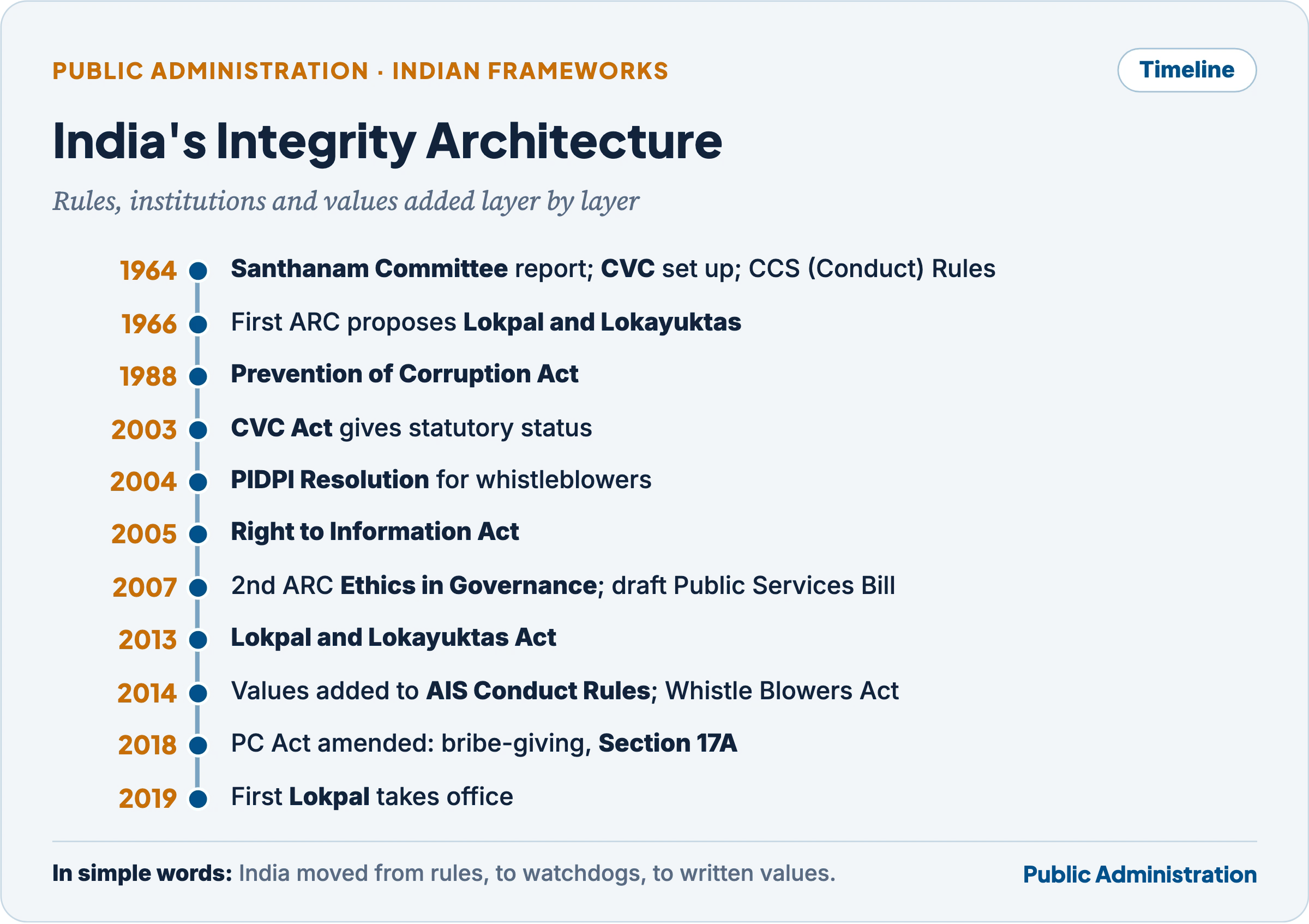
India has tried to build ethics in three ways: rules that say what officials must not do, institutions that investigate and punish corruption, and statements of values that say what officials should be. Each wave of reform, from 1964 to 2013, added a new layer.
8.1 Santhanam Committee on Prevention of Corruption (1962–64)
- Appointed in 1962 by Home Minister Lal Bahadur Shastri after members of Parliament raised the growing menace of corruption; chaired by K. Santhanam, MP; it reported in 1964.
- Key findings:
- Corruption had spread to higher levels; the Committee noted a widespread impression that some ministers had enriched themselves and that political corruption encouraged administrative corruption.
- Excessive discretion, cumbersome procedures and delays created opportunities for “speed money”.
- Key recommendations and results:
- Establishment of the Central Vigilance Commission (CVC), set up by a Government resolution of 11 February 1964; the first Central Vigilance Commissioner was Nittoor Sreenivasa Rau.
- Revision of the conduct rules, leading to the Central Civil Services (Conduct) Rules, 1964, including rules on gifts, assets and post-retirement employment.
- Strengthening of the Special Police Establishment, which became part of the Central Bureau of Investigation (CBI, 1963).
- A code of conduct for ministers and measures to create a social climate in which corruption would not flourish.
- Amendments to the law to presume corruption where assets are disproportionate to known sources of income.
8.2 The Central Vigilance Commission
- Began as an executive body (1964); given statutory status by an Ordinance in 1998 following Vineet Narain v. Union of India (1997), in which the Supreme Court directed that the CVC supervise the CBI’s anti-corruption work; the Central Vigilance Commission Act, 2003 made it a statutory multi-member body (a Central Vigilance Commissioner and up to two Vigilance Commissioners).
- Functions: superintendence over the CBI in Prevention of Corruption Act cases; advising ministries on vigilance cases; supervising Chief Vigilance Officers in every ministry, public sector undertaking and bank; designated agency under the PIDPI Resolution for whistleblower complaints.
- Preventive vigilance: CVC promotes integrity pacts, e-procurement, simplification of procedures and the annual Vigilance Awareness Week in the week of Sardar Patel’s birth anniversary (31 October).
- Limits: its advice is not binding; it has no investigative wing of its own for most matters, relying on the CBI; and its findings are sometimes ignored by ministries.
8.3 The 2nd ARC Fourth Report: Ethics in Governance (January 2007)
The Second Administrative Reforms Commission, chaired by M. Veerappa Moily, submitted its fourth report, Ethics in Governance, in January 2007. It is the most comprehensive Indian statement on public ethics.
- Diagnosis:
- Corruption is a systemic failure, aggravated by the colonial legacy, asymmetry of power, over-regulation and the quality of politics.
- Monopoly and discretion increase corruption; competition and transparency reduce it, as the effect of liberalisation on telephones, cement and two-wheelers showed, and as computerised railway reservation showed.
- Over-centralisation widens the distance between authority and accountability.
- It distinguished coercive corruption (the citizen is an unwilling victim, forced to pay for an entitlement) from collusive corruption (both bribe-giver and official gain at society’s cost, as in procurement, tax evasion and substandard works), and warned that collusive corruption grows as the economy is freed from controls.
- Recommendations on ethics:
- Ethical framework for ministers: a Code of Ethics in addition to the existing Code of Conduct for ministers, with the Prime Minister or Chief Minister responsible for enforcement.
- Legislators: an Ethics Commission in each House and a code of conduct for legislators; reforms on criminalisation of politics and partial state funding of elections.
- Civil servants: a three-level framework (see 8.4); statutory backing through a Civil Services Law.
- Anti-corruption law: a new offence of collusive bribery with stricter punishment; law for confiscation of illegally acquired property; protection for bona fide decisions; the Rashtriya Lokayukta (a constitutional national ombudsman) and constitutionally backed Lokayuktas.
- Whistleblower protection and a legal framework for public interest disclosure.
- Citizen-centric measures: RTI, citizens’ charters, social audit, e-governance and simplification to reduce discretion.
- Social measures: recognising that values and institutions must reinforce each other, and that political reform is the most important determinant of integrity.
8.4 Code of ethics versus code of conduct
The 2nd ARC proposed a three-tier framework for civil servants, which clarifies the difference between values, a code of ethics and a code of conduct.
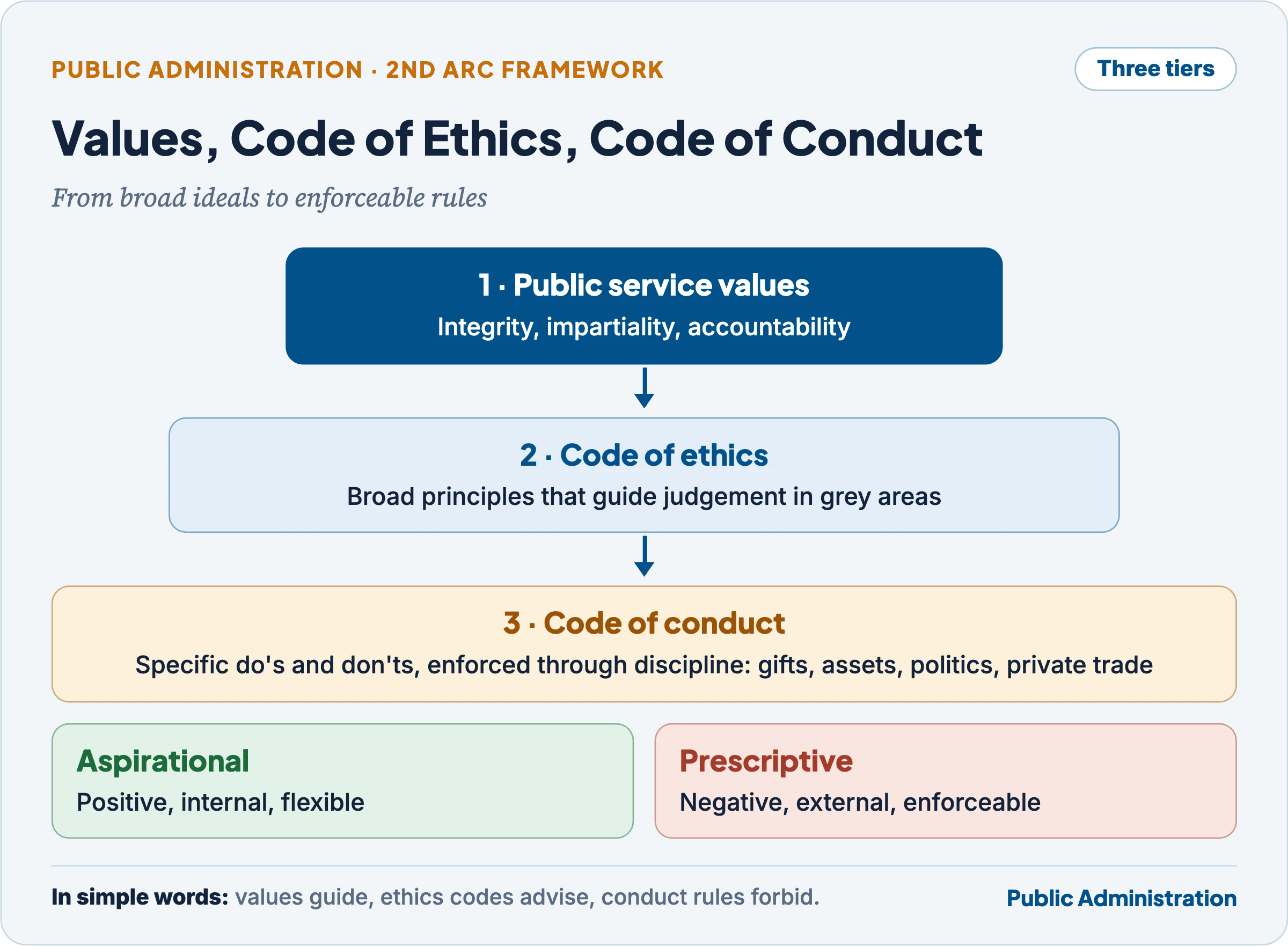
- Apex level: a clear and concise statement of public service values that all civil servants should imbibe: highest ethical standards, political impartiality, accountability and so on.
- Second level: the broad principles that should govern behaviour: the Code of Ethics.
- Third level: a specific Code of Conduct stipulating, unambiguously, acceptable and unacceptable behaviour.
- The Commission recommended that values and the code of ethics be given statutory backing in a Civil Services Law.
| Basis | Code of ethics | Code of conduct |
|---|---|---|
| Nature | Statement of values and principles | List of specific rules |
| Orientation | Aspirational, positive (“be impartial, be responsive”) | Prescriptive, mostly negative (“do not accept gifts above a limit”) |
| Guidance | Helps judgement in grey areas | Settles clear cases |
| Enforcement | Largely internal: conscience, peer pressure, leadership | External: disciplinary action under CCS (CCA) Rules, 1965 |
| Indian example | Values in the draft Public Services Bill; AIS Conduct Rules 3(1A) and 3(2B) (2014) | CCS (Conduct) Rules, 1964; AIS (Conduct) Rules, 1968 |
| Risk | Vague, ignored | Legalistic minimalism (“what is not forbidden is allowed”) |
- The conduct rules typically cover: correct behaviour towards superiors and the public; integrity; political neutrality and abstention from politics; restrictions on gifts, private trade, investments, borrowing and lending; declaration of assets; joining associations; criticism of government; contact with the press; and conduct in private and domestic life (for example, dowry and intoxication). Some of these rules go beyond the law and restrict fundamental rights of expression and association for the sake of neutrality (see the article on discipline and conduct).
- Standards complement regulation (the 2022 question): a code of conduct cannot list every situation; values and a code of ethics provide the standard against which new situations are judged, while rules give enforceable minimums. Neither replaces the other.
- The OECD’s “ethics infrastructure” (1996, and its 2017 Recommendation on Public Integrity) expresses the same balance: compliance-based tools (rules, controls, sanctions) and integrity-based tools (values, training, leadership) are both needed.
8.5 The draft Public Services Bill (2007) and the Civil Services Values
- The Department of Personnel and Training circulated a draft Public Services Bill, 2007 as the first step towards a statutory code of ethics for the civil services (Article 309 permits Parliament to regulate service conditions by law, but most rules remain executive).
- Main provisions of the draft:
- Appointment on merit through fair and open competition.
- Public Service Values to guide public servants, including allegiance to the Constitution and the law, patriotism and national pride, impartiality, objectivity, honesty, diligence, courtesy and transparency, absolute integrity, and political neutrality.
- A Public Service Code of Ethics to be notified.
- A performance management system and periodic review of pay and incentives.
- A Central Public Services Authority to oversee compliance and report annually.
- Status: the Bill was not enacted. Its values were partly carried into the All India Services (Conduct) Amendment Rules, 2014 (notified in August 2014), which inserted:
- Rule 3(1A): high ethical standards, integrity and honesty; political neutrality; merit, fairness and impartiality; accountability and transparency; responsiveness to the public, particularly the weaker section; courtesy and good behaviour.
- Rule 3(2B): upholding the supremacy of the Constitution and democratic values; decisions solely in the public interest; declaring private interests and resolving conflicts; not placing oneself under obligations; merit-based decisions; fairness to the poor and under-privileged; professionalism and dedication.
- Significance: for the first time, values (not merely prohibitions) became part of enforceable service rules; critics note that, being in rules rather than a statute, they still lack an independent ethics authority to interpret and promote them.
8.6 The Lokpal and Lokayuktas
- Background: the idea of an Indian ombudsman was proposed by the first ARC in its 1966 interim report Problems of Redress of Citizens’ Grievances (Lokpal at the Centre, Lokayuktas in the States); Lokpal Bills were introduced repeatedly from 1968 onward and lapsed. Maharashtra created the first Lokayukta (1971/72).
- The Lokpal and Lokayuktas Act, 2013 followed the India Against Corruption movement of 2011 led by Anna Hazare; it received assent on 1 January 2014.
- Composition: a Chairperson and up to eight members, half of them judicial; selected by a committee of the Prime Minister, the Speaker, the Leader of the Opposition (or leader of the largest opposition party), the Chief Justice of India or a nominated judge, and an eminent jurist.
- Jurisdiction: the Prime Minister (with safeguards on matters such as international relations, security, public order, atomic energy and space), Union ministers, MPs, and Group A to D officers of the Union, plus bodies funded by government.
- Inquiry and Prosecution Wings; power of superintendence over the CBI in cases referred by it; asset declarations under Section 44.
- States were required to set up Lokayuktas within a year.
- Working: the first Lokpal, Justice Pinaki Chandra Ghose, took office in March 2019; after his tenure ended in 2022 the post remained without a regular chair until Justice A.M. Khanwilkar was appointed in early 2024.
- Assessment:
- Strength: an independent ombudsman covering even the Prime Minister; removes the executive’s monopoly over sanction in some cases.
- Weakness: delayed operationalisation; low number of inquiries relative to complaints; dependence on the CBI and other agencies; and the fact that one institution cannot change incentives in politics and administration (the 2011 and 2019 questions).
Indian Connect — From Santhanam to Lokpal: the Indian integrity architecture
- Rules: CCS (Conduct) Rules, 1964; AIS (Conduct) Rules, 1968; CCS (CCA) Rules, 1965 for discipline.
- Laws: Prevention of Corruption Act, 1988 (amended 2018 to criminalise bribe-giving and add Section 17A, which requires prior approval before police inquire into an official’s decisions); Benami Transactions (Prohibition) Amendment Act, 2016; Fugitive Economic Offenders Act, 2018; RTI Act, 2005.
- Institutions: CVC (1964, statutory 2003); CBI (1963); Lokpal (2013 Act, working since 2019); State Lokayuktas and Anti-Corruption Bureaus; CAG.
- International: India ratified the UN Convention against Corruption (UNCAC) in 2011.
9. Building an Ethical Culture in Administration
In simple words
You cannot make officials honest just by writing rules or by preaching. You have to choose good people, train them, reward the honest ones, punish the dishonest ones quickly, take away needless discretion, let citizens see what is happening, and make sure the leaders practise what they preach.
9.1 Why codes alone are insufficient
- Most civil service regimes equate ethics with anti-corruption (the 2022 question). Ethics codes then become lists of prohibitions (gifts, assets, bribes), and ethics shrinks to not stealing. This misses:
- Ethics of omission: delay, indifference, apathy towards the poor, failure to act.
- Ethics of policy: fairness, equity and honesty in designing programmes and reporting results.
- Ethics of discretion: how officials treat citizens in the grey areas the rules do not cover.
- Compliance-based approaches foster legalistic minimalism and defensive bureaucracy (officials avoid decisions to avoid vigilance trouble, the “policy paralysis” fear that Section 17A was meant to address).
- Integrity-based approaches cultivate values, judgement and pride in public service. The best systems combine both.
9.2 Elements of an ethical culture
- Leadership by example: the “tone at the top”. The 2021 question notes that civil servants tend to absorb the values of their political executives; the 2nd ARC called the quality of politics the most important determinant of integrity. Ministerial codes, honest senior officers and swift action against high-level wrongdoing set the tone.
- Recruitment and training:
- Test ethics, integrity and aptitude at entry (UPSC’s General Studies Paper IV since 2013).
- Foundation courses, case-based ethics training and Mission Karmayogi (launched 2020) with its emphasis on attitudes, role-based competencies and a “citizen-first” ethos.
- Reducing discretion and monopoly: simplification, e-governance, direct benefit transfer, online approvals and faceless assessment (as in income tax) cut face-to-face opportunities for extortion.
- Transparency and citizen empowerment: RTI, citizens’ charters, social audits (mandatory under MGNREGA), proactive disclosure and grievance portals such as CPGRAMS.
- Swift, certain sanctions: the 2nd ARC stressed that if good behaviour is not rewarded and bad behaviour is rewarded, most people stray. Faster disciplinary procedures, compulsory retirement of officials of doubtful integrity under FR 56(j) and Rule 16(3) of the AIS (DCRB) Rules, and confiscation of illegal assets.
- Protection for honest officials: protection of bona fide decisions, fixed tenures and Civil Services Boards for transfers (T.S.R. Subramanian, 2013), and working whistleblower protection.
- Ethics infrastructure: an ethics officer or ethics advisory function in each department, an independent ethics commission (as proposed for legislators), integrity pacts and asset disclosure.
- Values in performance appraisal: integrity and attitude towards the weaker sections are assessed in the APAR; the 2nd ARC wanted appraisal to give weight to ethical conduct.
- Societal ethics: in a democracy, ethics must include citizens who offer bribes, evade taxes or demand illegal favours. Hence the CVC’s “Vigilance: Our Shared Responsibility” approach and civic education.
9.3 Innovative practices to build public trust
The 2024 question asks about innovative practices in administrative ethics. Recent practice in India and elsewhere includes:
- Behavioural ethics: “nudges” such as signing integrity declarations before submitting forms; timely reminders of conflict-of-interest duties.
- Technology for integrity: e-procurement and the Government e-Marketplace (GeM); data analytics and red-flag systems to detect collusive bidding; AI-based scrutiny (the CVC’s 2025 workshop on AI and emerging technologies for ethical governance).
- Open government data and public dashboards that make performance visible.
- Integrity testing and lifestyle audits in sensitive posts.
- Ethics counselling and safe reporting channels inside organisations.
- Global practices (the 2025 question): the OECD Recommendation on Public Integrity (2017), UNCAC, the UK’s Nolan principles, the US Office of Government Ethics (created by the Ethics in Government Act, 1978) and Singapore’s combination of high pay, meritocracy and a strong anti-corruption bureau have shaped Indian thinking on codes, asset disclosure and ombudsmen.
Indian Connect — Ethics and the Indian political–administrative interface
- The Code of Conduct for Ministers (issued by the Ministry of Home Affairs) requires ministers to disclose assets and liabilities, sever connections with businesses and avoid accepting valuable gifts; the 2nd ARC wanted a separate Code of Ethics for ministers and an independent mechanism to monitor it (the 2023 Paper II question).
- Kautilya’s Arthashastra (the 2014 and 2024 Paper II questions) treated ethics in public service as central: it famously observed that just as it is impossible not to taste honey placed on the tongue, it is impossible for an official dealing with revenue not to taste a little of it, and it prescribed espionage, rotation, audits and character tests (upadhas) to keep officials honest.
- Satyendra Dubey (2003) and S. Manjunath (2005) showed the personal cost of integrity when protection is weak; their cases drove the PIDPI resolution and the Whistle Blowers Protection Act.
Criticism — The case against codes and ethics institutions as the answer
- Codes are paper tigers: without enforcement and political will, codes are ignored; India’s conduct rules date to 1964 yet corruption persisted.
- Ethics is reduced to anti-corruption, neglecting apathy, delay and unfairness to the poor.
- Institutional overload: CVC, CBI, Lokpal, Lokayuktas and vigilance wings overlap, slow decisions and breed fear of taking decisions.
- Context dominates: in a prismatic society, caste, kinship and political patronage override formal codes (Riggs’ formalism); corruption is “more environmental than administrative”.
- Codes can be used against honest officers: vague provisions (such as “conduct unbecoming”) give superiors a weapon to punish dissent.
Defence — The case for codes, institutions and an ethics culture
- Codes set clear expectations and give officials a shield to refuse improper demands (“the rules do not permit it”).
- Institutions raise the cost of corruption: Section 17A-type safeguards, Lokpal, CVC and audit together create multiple veto points against abuse.
- Values plus institutions is the right formula: the 2nd ARC and the OECD both show that integrity-based and compliance-based tools reinforce each other.
- Evidence of change: liberalisation, e-governance, RTI and DBT have reduced petty corruption in many services, showing that design matters.
- Culture can be built: recruitment (GS Paper IV), training (Mission Karmayogi), leadership and citizen participation shape behaviour over time.
- Balanced view: administrative ethics is neither a set of rules alone nor a matter of individual saintliness. It is a system in which values (Constitution, public service values), people (recruitment, training, leadership), rules (codes, laws), institutions (CVC, Lokpal, courts, audit) and citizens (RTI, social audit) work together.
Key Terms
The table glosses the terms used in this article in simple words.
| Term | Meaning in simple words |
|---|---|
| Administrative ethics | Standards of right conduct for public officials in using power, discretion and public money |
| Morality | Society’s or religion’s shared beliefs about right and wrong |
| Deontology | Judging an act by whether it follows a duty or rule (Kant) |
| Utilitarianism | Judging an act by its consequences: the greatest good of the greatest number (Bentham, Mill) |
| Virtue ethics | Judging by character: what a person of practical wisdom would do (Aristotle) |
| Ethic of responsibility | Weber’s idea that one must answer for the foreseeable results of action |
| Bureaucratic ethos | Values of efficiency, expertise, loyalty and hierarchical accountability |
| Democratic ethos | Values of regime, citizenship, public interest and social equity |
| Objective responsibility | Cooper’s term for accountability to others imposed by law and hierarchy |
| Subjective responsibility | Cooper’s term for what officials feel responsible for, from their own values |
| Regime values | Rohr’s idea that officials take their values from the Constitution and its interpretation |
| Ethical dilemma | A choice between two rights or two wrongs |
| Dirty hands | Doing a moral wrong to achieve a public good, while accepting the guilt (Walzer) |
| Many hands | Difficulty of fixing responsibility when many officials contribute to a decision (Thompson) |
| Obedience defence | “I was only obeying orders”: rejected by administrative ethics for illegal orders |
| Whistleblowing | An insider’s disclosure of wrongdoing to authorities or the public |
| Integrity | Wholeness: consistency between values, words and actions; incorruptibility |
| Probity | Strict honesty and uprightness, especially in financial matters |
| Conflict of interest | A private interest that could improperly influence an official decision |
| Revolving door | Officials moving to private firms they used to regulate |
| Coercive corruption | Citizen forced to pay for what is his right |
| Collusive corruption | Bribe-giver and official both gain at society’s cost |
| Code of ethics | Statement of values and principles guiding judgement |
| Code of conduct | Specific enforceable rules of acceptable and unacceptable behaviour |
| Integrity pact | Agreement binding bidders and officials to refrain from bribery in procurement |
| Ethics infrastructure | The full set of values, rules, institutions and training that supports public integrity |
Commissions, Committees and Judgments
The table lists the bodies, laws and cases that shape the ethics framework.
| Body / law / case | Year | Key point |
|---|---|---|
| Santhanam Committee (K. Santhanam) | 1962–64 | Led to the CVC, CCS (Conduct) Rules 1964, stronger SPE/CBI, ministers’ code |
| Central Vigilance Commission | 1964 (statutory 2003) | Apex vigilance body; superintends CBI in corruption cases |
| First ARC interim report on grievances | 1966 | Proposed Lokpal and Lokayuktas |
| Shah Commission | 1978 | Examined Emergency excesses and officials who obeyed illegal orders |
| Nolan Committee (Lord Nolan), UK | 1994–95 | Seven Principles of Public Life |
| Vineet Narain v. Union of India | 1997 | CVC to supervise CBI; led to statutory CVC |
| PIDPI Resolution | 2004 | CVC designated to receive whistleblower complaints |
| 2nd ARC, Fourth Report (M. Veerappa Moily) | January 2007 | Ethics in Governance: three-tier values–ethics–conduct framework; collusive bribery; Rashtriya Lokayukta |
| Draft Public Services Bill | 2007 | Public service values, code of ethics, Central Public Services Authority |
| T.S.R. Subramanian v. Union of India | 2013 | Civil Services Boards; written orders; fixed tenure |
| Lokpal and Lokayuktas Act | 2013 (assent Jan 2014) | National ombudsman covering PM, ministers, MPs, officials |
| Whistle Blowers Protection Act | 2014 | Mechanism for complaints and protection; not operationalised |
| AIS (Conduct) Amendment Rules | 2014 | Values inserted as Rules 3(1A) and 3(2B) |
| PC (Amendment) Act | 2018 | Bribe-giving made an offence; Section 17A prior approval |
| CPIL v. Union of India (Section 17A) | 13 January 2026 | Split verdict on Section 17A; referred to a larger bench |
Contemporary Developments
- January 2026: split verdict on Section 17A. In Centre for Public Interest Litigation v. Union of India, Justice B.V. Nagarathna held Section 17A of the Prevention of Corruption Act (prior approval before police inquire into an official’s decisions) unconstitutional, saying it protects the corrupt; Justice K.V. Viswanathan upheld it on condition that the decision on approval rests on the recommendation of the Lokpal or Lokayukta. The matter was placed before the Chief Justice for a larger bench. The case sums up the dilemma between protecting honest decision-makers and shielding the corrupt.
- October 2025: Lokpal under scrutiny. The Lokpal’s tender for seven luxury cars for its chair and members drew public criticism; data on its website showed that out of 6,955 complaints received since 2019, it had ordered preliminary inquiries in 289 and granted prosecution sanction in seven, with complaints falling sharply after 2022–23.
- October–November 2025: Vigilance Awareness Week (27 October to 2 November) was observed on the theme “Vigilance: Our Shared Responsibility”, with a CVC workshop on AI and emerging technologies for ethical governance; the 2024 theme was “Culture of Integrity for Nation’s Prosperity”.
- May 2025: Lokpal order in the SEBI chairperson case. A full bench of the Lokpal disposed of complaints against a former SEBI chairperson, finding the allegations unsupported by verifiable material, an example of the ombudsman screening complaints before ordering inquiry.
- January 2025: first Lokpal Day. The Lokpal marked its foundation day on 16 January 2025; its chair announced recruitment of forensic accounting and cyber-investigation experts and use of IT to handle increasingly sophisticated corruption. In the same month a Lokpal order treating High Court judges as within its jurisdiction was stayed by the Supreme Court, which called the interpretation very disturbing.
- 2024: Lokpal chair appointed. Former Supreme Court judge Justice A.M. Khanwilkar became Lokpal chairperson in early 2024, ending a long gap after the first chair’s term ended in 2022.
- Continuing: Mission Karmayogi (since 2020) and the Capacity Building Commission put values, attitudes and citizen-centricity into civil service training, alongside GS Paper IV (Ethics, Integrity and Aptitude) in the civil services examination.
Revision Grid
The grid lists each thinker or body with its work and core idea.
| Thinker / body | Work or report (year) | Key idea |
|---|---|---|
| Kant | Groundwork of the Metaphysics of Morals (1785) | Duty; universal law; persons as ends |
| Bentham; J.S. Mill | Principles of Morals and Legislation (1789); Utilitarianism (1863) | Greatest good of greatest number |
| Aristotle | Nicomachean Ethics | Virtue and practical wisdom |
| Max Weber | Politics as a Vocation (1919) | Ethic of ultimate ends and ethic of responsibility as supplements |
| Carl Friedrich | “Public Policy and the Nature of Administrative Responsibility” (1940) | Inner responsibility through professionalism |
| Herman Finer | “Administrative Responsibility in Democratic Government” (1941) | External controls |
| Paul Appleby | Morality and Administration in Democratic Government (1952) | Responsible government is ethical government |
| Stephen Bailey | “Ethics and the Public Service” (1964/65) | Optimism, courage, fairness tempered by charity |
| John Rawls | A Theory of Justice (1971) | Justice as fairness; difference principle |
| Michael Walzer | “Political Action: The Problem of Dirty Hands” (1973) | Right to act, yet the act remains wrong |
| John Rohr | Ethics for Bureaucrats (1978) | Regime values from the Constitution |
| Dwight Waldo | The Enterprise of Public Administration (1980) | Map of twelve competing ethical obligations |
| Dennis Thompson | “The Problem of Many Hands” (1980) | Personal responsibility amid many contributors |
| Terry Cooper | The Responsible Administrator (1982) | Objective and subjective responsibility; decision model |
| Frederickson and Hart | “Patriotism of Benevolence” (1985) | Love of regime values and of others |
| Kathryn Denhardt | The Ethics of Public Service (1988) | Independent critique of decision standards; honour, benevolence, justice |
| Santhanam Committee | Report (1964) | CVC, conduct rules, anti-corruption machinery |
| Nolan Committee | First Report (1995) | Seven Principles of Public Life |
| 2nd ARC | Ethics in Governance (2007) | Values–ethics–conduct tiers; collusive corruption |
| Lokpal Act | 2013 | National ombudsman |
Previous Year Questions
- 2026Administrative ethics is an abstract concept, and in practice, is an unresolved dilemma between ‘what is’ and ‘what ought to be’. Comment.
- 2025Values and ethics in civil services are shaped by global practices and trends. Explain.
- 2024A trend to adopt innovative practices in administrative ethics is gaining ground for improving public trust in government. Discuss.
- 2022Most civil service regimes still equate ‘Public Sector Ethics’ with anti-corruption efforts. Discuss the insufficiency of Ethics-code in this background.
- 2022Standards are the foundation which do not replace regulations but complement them. Comment.
- 2021Civil servants generally tend to exhibit the values and ethical framework of the political executives under whom they function. Explain.
- 2020“Prevention of misconduct requires institutionalization of ethical values at the political and administrative levels.” Justify.
- 2019The imperatives of administrative ethics are necessarily an antidote to “I was only obeying the orders” argument by public officials. Explain.
- 2018“Administrative values have no value unless they are valued by all stakeholders of the governance system.” Comment.
- 2017“Administrative ethics includes the code of conduct of civil servants, but goes beyond it as well.” Discuss.
- 2017“Executive positions imply a complex morality and require a high capacity of responsibility”– (Chester Barnard). Comment.
- 2015“Administrative ethics is a process of independently critiquing decision standards, based on core social values that can be discovered, within reasonable organisational boundaries that can be defined, subject to the personal and professional accountability.” (Denhardt). Explain.
- 2013“In the globalized public administration, hierarchy creates more ethical problems than it solves ….” Comment.
- 2011Civil Servants must be social moralists in action, living up to Paul Appleby’s dictum that ‘responsible government is ethical government.’ Examine this statement in the light of good governance.
- 2010Briefly discuss the principles of ensuring ethics in public service as recommended in the Nolan Committee Report.
- 2004The administrator needs autonomy and discretion in much the same way as the politician needs control and intervention. Discuss.
- 2003Account for the increasing corruption in Administration. Suggest remedies to curb administrative corruption.
- 1991‘The Civil Servants must not forget that he is the servant, not the master of the community and that the official competence need not, and should not involve the loss of human touch.’ Examine.
- 1990‘Professional standards, ethics, philosophy, attitudes and ideology of public service are the means to promote accountability of Public Administration.’ Explain how career and no-Career Public Service is accountable to judiciary.
- 2026The political culture in India shapes bureaucratic behaviour, professional integrity and civil service conduct. Explain with suitable examples.
- 2024“Ethics in Public services has been the main concern of Kautilya’s Arthashastra.” Examine the statement.
- 2023Do you agree that code of ethics and code of conduct for ministers would help in upholding higher standards of their constitutional and ethical conduct? Explain.
- 2022In India, for the upliftment of majority of people, governmental intervention remains a central fact of life. Nevertheless, the effective implementation of policies depends on the ethical values of Public Servants. Discuss.
- 2022Examine the role of Lokpal in ensuring transparency and accountability in Indian administration.
- 2021Recent market approaches to public services present serious challenges to traditional and state-sponsored public service values. Evaluate the statement in the context of Indian administration.
- 2019Minimal accountability being the dominant norm in the political system, the Lokpal can only be an ideal institution with limited effectiveness. Explain.
- 2016“In a democratic polity, any conception of ethics and integrity in public life must encompass not only politicians and civil servants but also citizens.” Discuss.
- 2014“Ethics in public services has been the central concern of Kautilya’s Arthashatra.” Critically examine the statement.
- 2013“The basic ethical problem for an administrator is to determine how he/the can use discretionary power in a way that is consistent with democratic values.” Comment with reference to corruption in administration.
- 2011“One Lok pal, howsoever strong it may be, cannot eliminate corruption in the politico-administrative system in India.” Comment.
- 2009Briefly discuss the main recommendations of any two of the following: Paul Appleby (1953 and 1956), Santhanam Committee, Hota Committee, Sixth Pay Commission
- 2004“Values, more than techniques are the eventual determinants of the actions of the administrators.” Comment.
- 1995“Between social background and administrative culture, it is the latter that has a dominating influence on integrity in administration in the Indian situation.” Review the statement in the light of research findings in this area.