

Techniques of Administrative Improvement: Organisation and methods, Work study and work management; e-governance and information technology; Management aid tools like network analysis, MIS, PERT, CPM.
This article: Impact of information technology on administration and administrative culture; e-government, e-governance, digital governance and digital-era governance; SMART government; interaction models (G2C, G2B, G2G, G2E, C2G), Nath’s five digital governance models and Kim’s four paradigms; stage and maturity models (Gartner, Layne and Lee, UN surveys and the EGDI); India’s journey from NIC and state pilots to NeGP, Digital India, e-Kranti, digital public infrastructure, JAM and DBT, GeM, CPGRAMS, UMANG and the IndiaAI Mission; legal framework (IT Act, CERT-In, Aadhaar Act, DPDP Act and Rules, Puttaswamy); 2nd ARC’s 11th Report; benefits; failure (Heeks’s design–reality gap), digital divide, exclusion, privacy, cybersecurity, algorithmic accountability; Weber digitised and system-level bureaucracy; Estonia, Singapore, Denmark and the UK.
Official Syllabus: Paper I · Unit 1-11 Techniques of Administrative Improvement
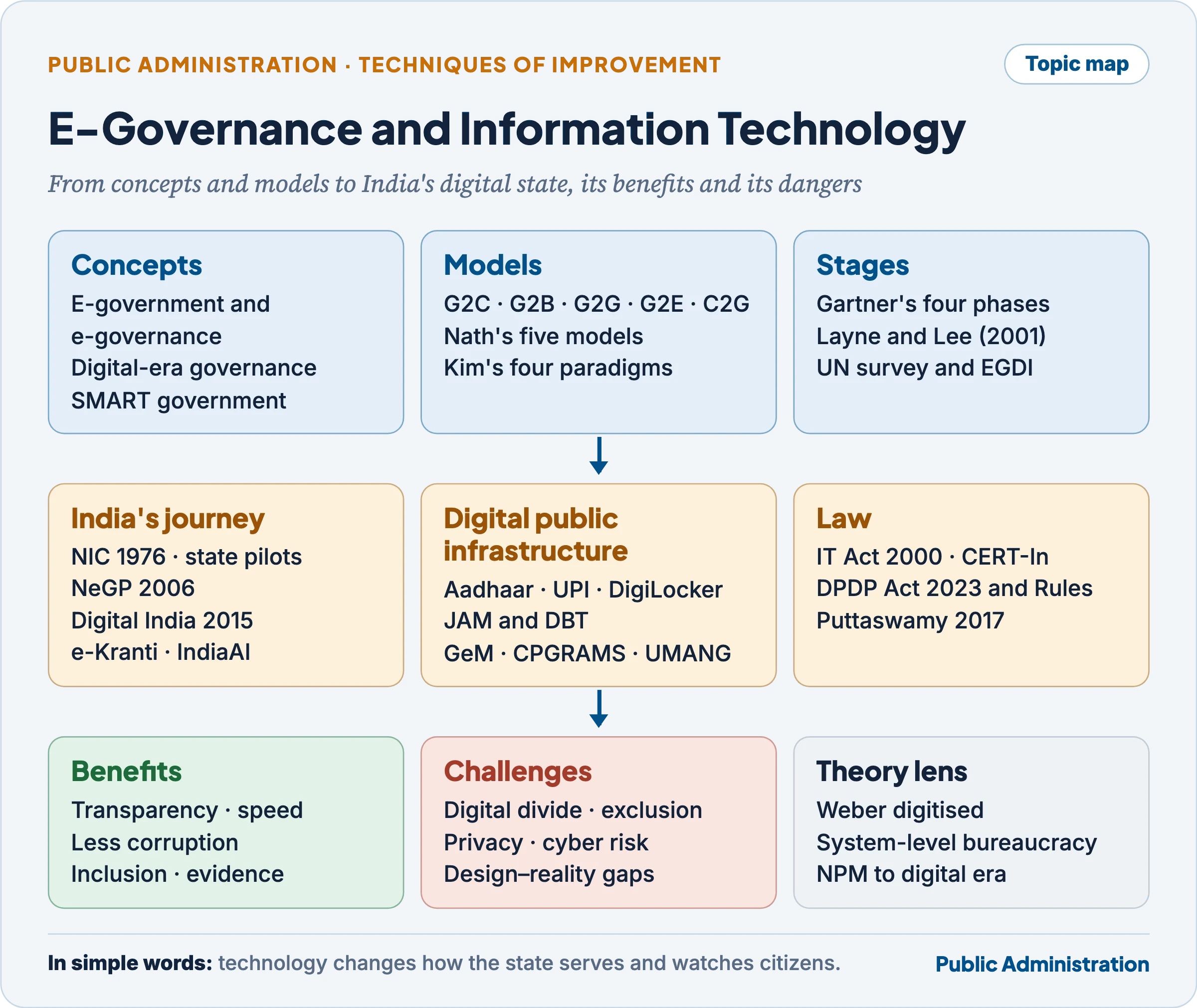
E-governance is the use of information and communication technology (ICT) to change how government works internally, how it delivers services and how citizens take part in public decisions. It is the newest and most powerful of the techniques of administrative improvement: where organisation and methods (O&M) and work study tried to simplify paper procedures, ICT can remove whole steps, join departments together and put services on a citizen’s phone.
- The subject has three layers: technique (computers, networks, portals, data), reform (re-engineered processes, new institutions, new laws) and governance (a changed relationship between state and citizen, with new questions of privacy, exclusion and accountability).
- India is now one of the world’s largest laboratories of digital government, from Aadhaar and UPI to DigiLocker and Direct Benefit Transfer (DBT), yet it ranked only 97 of 193 in the UN E-Government Survey 2024. Understanding both facts together is the core of this topic.
- The companion article on O&M, work study, MIS and network analysis (PERT and CPM) covers the older techniques; this article picks up where information systems leave the back office and reach the citizen.
In simple words
Twenty years ago, a farmer who needed a copy of his land record went to the village accountant, waited for days and often paid a bribe. Today he can print it at a kiosk or see it on his phone in minutes. The record is the same; what changed is the route between the citizen and the state. E-governance is the study of that route: how it is built, who it helps, who it leaves out and who controls it.
1. Information Technology and the Changing Nature of Administration
In simple words
Every government office is really an information factory: it collects facts (applications, records, complaints), processes them (checks, approvals) and sends out decisions (certificates, payments, orders). Anything that changes how information moves will change how government itself works.
1.1 Information as the raw material of administration
- Administration runs on information. Herbert Simon, the American theorist of decision-making, described organisations as systems of decisions; every decision rests on information gathered, stored and communicated. ICT changes the cost, speed and reach of all three.
- Three effects of ICT on any bureaucracy:
- Automation: routine tasks (calculating pay, issuing receipts) are done by machines, faster and with fewer errors.
- Informatisation: managers and citizens get information that was earlier locked in files (dashboards, online status tracking).
- Transformation: the organisation itself is redesigned because information can flow sideways and directly, not only up and down the hierarchy.
- Transaction costs fall. Visiting an office, filling the same data again and again, following up on a file: each of these is a cost to the citizen. Online services, single sign-on and status tracking reduce them sharply.
- The shift in the way of working. Writers on Indian administration in the 1990s described the move to IT as a change of style as much as of tools:
| From (paper administration) | To (IT-enabled administration) |
|---|---|
| Unwieldy files with torn covers | Computer-based files with search and audit trails |
| Hierarchical authority | Networked power |
| Power through hiding information | Empowerment through sharing information |
| Expenditure and compliance orientation | Performance and achievement orientation |
| Batch processing, delayed access and response | On-line processing, instant access, prompt response |
| Repeated manual data entry | Data entered once, exchanged electronically (EDI) |
| More time for routine, repetitive work | More time for creative work |
| Fear of the unknown, status quo | IT-savvy, continuous improvement |
The table shows why ICT was seen as a cultural shock rather than a mere purchase of equipment. A system built on secrecy, hierarchy and precedent had to learn to work on openness, networks and performance, and that change is slower than installing computers.
1.2 IT and administrative culture
- Every technology brings its own culture. The typewriter, the telephone and the photocopier each shaped office routines; the networked computer shapes them more deeply because it touches who knows what inside the organisation.
- The Indian time lag. Indian administration began to think seriously about IT only in the 1990s, after liberalisation, roughly a generation after the first use of the same technologies in the West. Officials trained in the file-and-noting system often met IT with suspicion: fear of job loss, of being watched, of losing the discretion that gave them power.
- Resistance was rational, not only cultural. Computerisation reduced discretion and therefore the rents that some officials and intermediaries drew from it. Land-record computerisation in Karnataka (Bhoomi) reduced the power of the village accountant; that is why it met resistance at first.
- Training as the bridge. Early reformers argued that IT needed professional-level training for serving officials, including long courses on IT applications in public systems; today the same idea runs through Mission Karmayogi and its online platform iGOT.
1.3 The good governance agenda and IT
Information technology became important in the 1990s because it seemed to serve almost every item on the good governance agenda promoted by the World Bank, UNDP and Indian reformers at the same time.
- Efficiency and lower cost of governance; results orientation of every department.
- Responsiveness: a citizen-friendly, citizen-caring administration.
- Accountability and transparency: records that cannot be quietly altered, decisions that can be tracked.
- Freedom of information: proactive disclosure online (later backed by the Right to Information Act, 2005).
- Integrity: fewer face-to-face contacts, therefore fewer chances for bribes.
- Demystified procedures: rules, forms and timelines published for all to see.
- Legitimacy and credibility of public institutions.
Early writers listed many areas where IT could serve these goals: online payment of taxes and utility bills, electronic filing of complaints and police reports, traffic enforcement through electronic devices, IT-based monitoring of development projects, and transparent postings and transfers through computer-generated priority lists based on weighted scores. They also noted a limit: a fully computerised transfer system leaves no room for compassion or genuine hardship cases. The trade-off between rule-bound fairness and humane discretion returns throughout this article.
1.4 From IT to ICT to digital: four waves
The vocabulary has changed as the technology has changed. Each wave added something new to administration.
| Wave | Period (approximate) | Technology | What it did to administration |
|---|---|---|---|
| Computerisation | 1970s–1980s | Mainframes, standalone PCs | Back-office automation: payroll, census, elections, railway reservations |
| Networking and the web | 1990s–2000s | LANs, WANs, the internet | Websites, online forms, kiosks, e-mail; first citizen-facing services |
| Mobile and platforms | 2010s | Smartphones, cloud, APIs | Services on phones, shared platforms (identity, payments, documents), social media |
| Data and AI | late 2010s onwards | Big data, analytics, machine learning, generative AI | Predictive targeting, automated decisions, chatbots, real-time dashboards |
- The last decade’s disruption is that technology now does not merely support decisions; it makes many of them (eligibility checks, tax-case allocation, grievance routing). This is why the questions of the 2020s are about algorithms, data protection and accountability, not just about connectivity.
2. E-Government, E-Governance and Digital Governance: The Concepts
In simple words
E-government is the government using computers and the internet to do its own work better: issuing licences online, buying goods through a portal. E-governance is bigger: it is the whole society, including citizens, businesses and civil groups, using these tools to take part in steering public affairs. One is a better counter; the other is a bigger conversation.
2.1 E-government
- World Bank definition (paraphrased): e-government is the use by government agencies of information technologies such as wide area networks, the internet and mobile computing that can transform relations with citizens, businesses and other arms of government. The intended ends are better service delivery, better interaction with business, citizen empowerment through access to information and more efficient internal management. The resulting benefits can be less corruption, more transparency, greater convenience, higher revenue and lower costs.
- In this definition technology is the means; efficiency, transparency and accountability are the expected consequences.
- Location of service changes. Traditionally citizens dealt with government in a government office. ICT allows service points to move closer to the client: an unattended kiosk in the office, a service centre in the village, or a personal computer or phone at home.
2.2 E-governance
- Governance is wider than government. The World Bank describes it as the traditions and institutions by which authority in a country is exercised: how governments are chosen, monitored and replaced; their capacity to make and carry out sound policies; and the respect of citizens and the state for the institutions that govern their interactions. It brings the private sector and civil society in as co-actors in steering society.
- E-governance, accordingly, is the use of ICT to support the guiding and steering of society and the promotion of the public interest, not only the internal work of government.
- The standard illustration:
- E-procurement, which uses ICT to support the purchasing work of a department, is e-government.
- An ICT tool that helps farmers or industrialists organise and lobby on a subsidy policy or an electricity tariff is e-governance, because it changes who takes part in the political process.
- Why the distinction matters: e-governance highlights the democratic qualities of ICT: new forms of political mobilisation, multi-stakeholder participation and two-way accountability.
| Point of difference | E-government | E-governance |
|---|---|---|
| Scope | Government’s own operations and services | Steering of society by state, market and civil society |
| Direction | Mostly one-way (state to citizen) | Two-way and many-to-many |
| Citizen seen as | User or customer of services | Participant, co-producer, voter |
| Typical tools | Portals, e-procurement, e-office, online payments | E-consultation, e-petitions, social media, open data, e-voting |
| Key value | Efficiency and service quality | Participation, accountability, legitimacy |
| Example | Filing income tax returns online | Public comments on draft laws on MyGov; citizen campaigns online |
The distinction is analytical, not watertight. A grievance portal is e-government when it routes complaints, and e-governance when aggregated complaints change policy. As e-government matures, the two tend to merge.
Common confusion
Are e-government and e-governance the same thing? No. E-government is a subset: the application of ICT inside government and in its service delivery. E-governance covers the wider process of steering society with ICT, including citizens, firms and civil society. Many writers use “e-government” loosely for both, and the 2nd ARC uses “e-governance” for all government ICT use, so the context decides. The safe position is that e-government is about better administration, e-governance about better governance, and that mature e-government shades into e-governance.
2.3 Digital governance and digital-era governance
- Digital governance is the newer umbrella term for government built on digital platforms, data and algorithms, not just websites. It stresses “digital by default” services, data as a public asset, and platforms reused across departments.
- Digital-era governance (DEG) is a specific theory by Patrick Dunleavy, Helen Margetts, Simon Bastow and Jane Tinkler, set out in “New Public Management Is Dead: Long Live Digital-Era Governance” (Journal of Public Administration Research and Theory, 2006). It claims that ICT has moved public management beyond NPM along three themes:
- Reintegration: reversing NPM’s fragmentation into agencies; bringing functions back together, shared services, joined-up government.
- Needs-based holism: organising services around the citizen’s life events and needs (birth, schooling, a job, old age) rather than around departments.
- Digitisation changes: “digital by default” processes, self-service, automated decisions, open-book government.
- DEG is treated in full in the article on New Public Management and after; here it supplies the theory behind Indian moves such as single sign-on, integrated portals and platform reuse (section 9).
2.4 SMART government
- The phrase SMART government in Indian usage means government that is Simple, Moral, Accountable, Responsive and Transparent.
- Simple: rules and procedures simplified through ICT, user-friendly.
- Moral: new ethics in administration, with technology used to support integrity and reduce corruption.
- Accountable: effective information and performance systems that make officials answerable.
- Responsive: streamlined processes that speed up delivery.
- Transparent: information in the public domain, decisions open to scrutiny.
- The Second Administrative Reforms Commission (2nd ARC) used it in the title of its 11th Report, “Promoting e-Governance: The SMART Way Forward” (December 2008) (section 11).
- Do not confuse this with smart cities (urban infrastructure) or with the management acronym SMART for goals (specific, measurable…).
2.5 The moral and developmental framing
- United Nations framing. The UN Committee of Experts on Public Administration, at its first session in July 2002, argued that public organisations must become learning organisations and that state capacity requires harnessing ICT for innovation. The UN Millennium Declaration (2000) linked good governance with inclusive participation and the public’s right to information.
- Public value. The UN World Public Sector Report 2003: E-Government at the Crossroads argued that e-government is justified only if it increases public value, that is, the quality of life citizens actually want, and that it must serve a vision of the society people wish to belong to. Technology for its own sake fails this test.
- E-inclusion. UN officials in this period stressed that ICT-led reform should broaden access to social and economic opportunity, not deepen exclusion. This links e-governance to ICT for development (ICT4D) (section 8.3).
3. Models and Relationships of E-Governance
In simple words
Government talks to different people for different reasons: to citizens about certificates, to companies about licences, to its own staff about salaries and to other governments about shared data. Each of these relationships can go online. Separately, there are different styles of using technology: just publishing information, helping citizens compare, helping them organise, or letting them transact and participate fully.
3.1 Interaction models: who talks to whom
E-government is usually mapped by the parties in each digital interaction. The scheme is descriptive, not a theory, but it organises the whole field.
| Model | Meaning | Indian examples |
|---|---|---|
| G2C (government to citizen) | Services and information delivered to citizens | DigiLocker, UMANG, Passport Seva, land records, DBT payments, CoWIN certificates |
| G2B (government to business) | Licences, taxes, procurement, compliance for firms | GST Network, MCA21 company filings, GeM, single-window clearances, e-procurement |
| G2G (government to government) | Data and workflow sharing among departments and levels | SWAN, e-Office, PFMS fund flows, PM Gati Shakti, inter-state data exchange |
| G2E (government to employee) | Services and management of public servants | e-HRMS, iGOT Karmayogi, online appraisal, pension portals, attendance systems |
| C2G (citizen to government) | Citizens’ inputs, complaints and participation | CPGRAMS grievances, MyGov consultations, RTI online, e-petitions |
- G2G is the least visible but most decisive: without data exchange behind the counter, front-end portals only digitise queues.
- C2G is where e-government becomes e-governance: the citizen is not just a recipient but a source of information, feedback and demands.
3.2 Nath’s five digital governance models
Vikas Nath, a development researcher, in “Digital Governance Models: Moving towards Good Governance in Developing Countries” (The Innovation Journal, 2003), identified five generic models built on two properties of ICT: equal access to information for anyone on the network, and the spreading of information across all its nodes rather than its concentration at the top.
| Model | How it works | Governance effect | Example |
|---|---|---|---|
| Broadcasting / wider dissemination | Information already public is spread widely online | Reduces “information failure”; citizens learn of rights and schemes | Laws, budgets, beneficiary lists and officials’ contacts on websites |
| Critical flow | Targeted information of strategic value sent to those who can act on it | Exposes corruption and abuse; supports watchdogs | Vigilance commission lists, human rights reports, audit findings online |
| Comparative analysis | Comparing data across time or places to find good and bad practice | Benchmarks governance; strengthens advocacy | Comparing state performance indices, before–after analysis of a scheme |
| E-advocacy / mobilisation and lobbying | Planned flow of information to build virtual communities that act in the real world | Gives voice to marginalised groups; widens participation in policy | Online campaigns on environmental or rights issues, public consultations on draft bills |
| Interactive service (G2C2G) | Two-way channels for services and participation | Direct participation; efficiency; transparency | Online tax filing, grievance redress, opinion polls, e-ballots |
- E-advocacy and democratised policy-making. The e-advocacy model matters because it changes who sets the agenda. Civil society groups can pool expertise across distance, frame issues, gather signatures and pressure decision-makers; marginalised voices that never reach a minister’s office can reach the public sphere. Public consultation on draft laws, petitions and citizen data campaigns make policy-making less of a closed bureaucratic exercise.
- Limits of e-advocacy: it favours the connected and articulate; online campaigns can be captured by organised lobbies, bots and misinformation; governments may treat consultation as a ritual. The model democratises voice, not necessarily influence.
- Nath’s warning: the interactive-service model is the most technology-dependent and is often copied from developed countries; without individual, secure ICT access it does not work well in poor societies. The simpler models (broadcasting, critical flow) may do more good there.
- A widespread error attributes these five models to Arie Halachmi; the 2003 paper that set them out is by Nath.
3.3 Kim’s four paradigm models
Seang-Tae Kim, a Korean scholar of e-government, in a paper at the International Congress of Administrative Sciences (Seoul, 2004), described the movement of public administration under ICT as four models:
- Bureaucracy model: ICT used inside the existing structure for internal reform and to change individual officers’ work styles.
- Information management model: a link between citizens and government through electronic public services.
- Citizen participation model: two-way interaction in which ICT promotes transparency and citizens’ participation in decisions, invigorating democracy.
- E-governance model: networked transactions among all social actors and all political and administrative activities, a near merger of e-government and e-governance.
The sequence moves from efficiency to service to participation to networked governance, which mirrors the conceptual shift from e-government to e-governance described in section 2.
3.4 E-participation
- The UN treats e-participation as three rising levels: e-information (government provides information online), e-consultation (government asks citizens for views) and e-decision-making (citizens co-shape decisions).
- India: MyGov (launched 2014) runs consultations, idea contests and surveys; draft rules are often put out for public comment online; Janbhagidari platforms, social audits with digital records under MGNREGA and the CPGRAMS feedback call centre are further channels. India’s E-Participation Index rank in 2024 was 61, far better than its overall EGDI rank of 97: participation channels exist, but infrastructure and skills lag.
4. Stages and Maturity of E-Government
In simple words
Building digital government is like building a shop. First you put up a signboard (information online). Then you open a counter (transactions). Later you connect your shop to the warehouse and suppliers (integration). Finally you redesign the whole business around the customer. Stage models describe this climb.
4.1 Gartner’s four phases (2000)
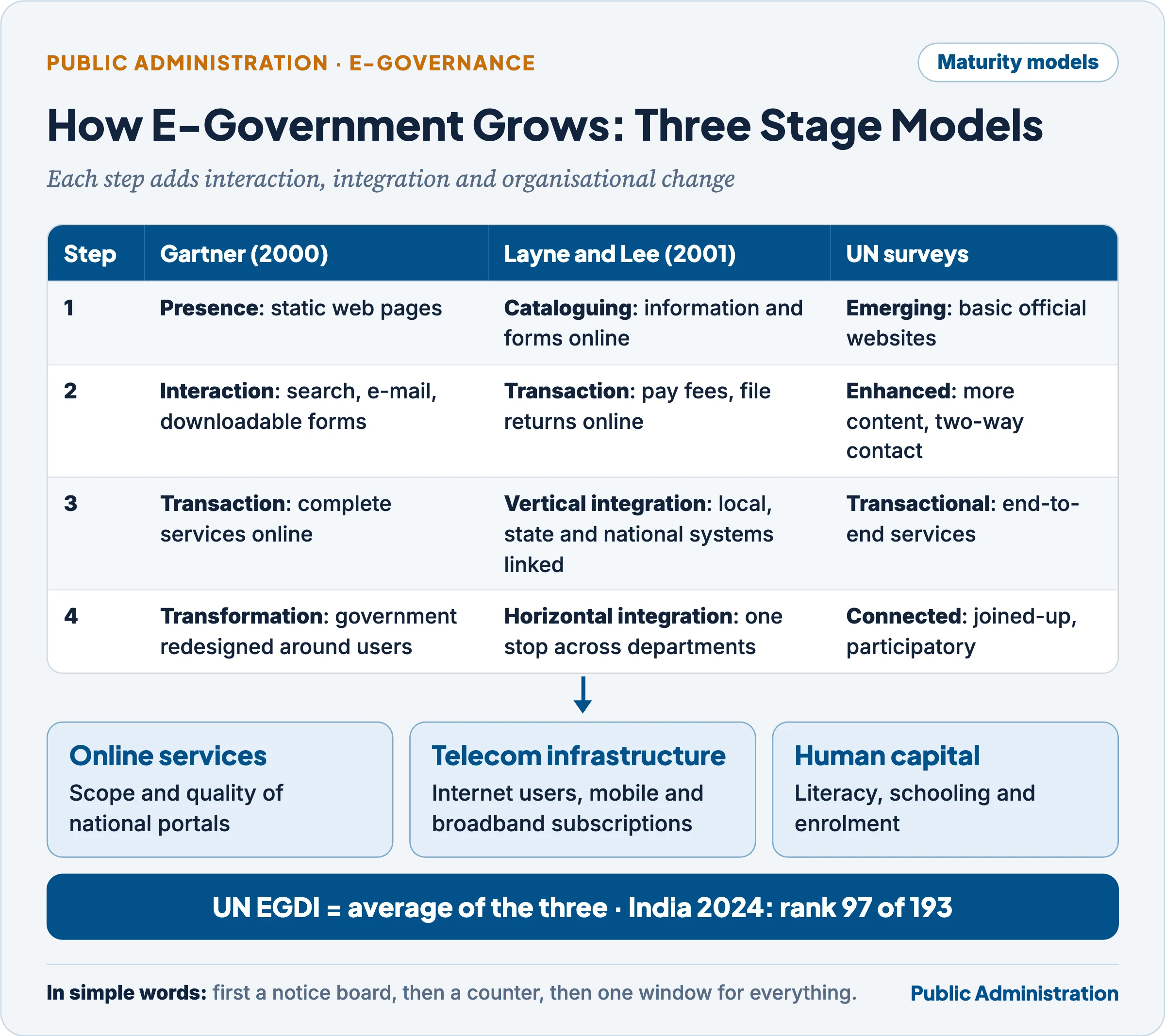
The consulting firm Gartner proposed four phases that became the common vocabulary of practitioners:
- Presence: static websites with basic information.
- Interaction: search, e-mail contact, downloadable forms.
- Transaction: complete services online (pay, apply, receive).
- Transformation: processes and organisations redesigned around users; seamless, cross-agency service.
In Indian terms these map onto computerisation (presence), networking (interaction), online transactions such as e-procurement and online fee payment (transaction) and digital transformation through shared platforms like DigiLocker and DBT (transformation).
4.2 Layne and Lee (2001)
Karen Layne and Jungwoo Lee, in “Developing Fully Functional E-government: A Four Stage Model” (Government Information Quarterly, 2001), placed stages on two axes: technological and organisational complexity, and degree of integration.
- Cataloguing: an online presence; information and forms published.
- Transaction: citizens complete transactions online; databases linked to the web interface.
- Vertical integration: systems at different levels of government doing the same function are linked (a local driving-licence office connected to the state and national databases).
- Horizontal integration: systems across different functions are linked, giving a one-stop experience (changing your address once updates tax, health and vehicle records).
- Their insight: each step needs more than technology. Integration requires common standards, data sharing rules, changes in organisational boundaries and legal authority. This is why most governments stall between stages 2 and 3.
- Indian illustration: Vahan and Sarathi (vehicle and licence databases linked from district to national level) show vertical integration; DigiLocker documents accepted across departments and MeriPehchaan single sign-on are steps towards horizontal integration.
4.3 The UN stages and the E-Government Development Index
- UN stages. The UN’s biennial surveys (from 2003) described online service maturity in stages: emerging (basic official sites), enhanced (more content, some two-way contact), transactional (end-to-end services) and connected (joined-up, participatory government).
- E-Government Development Index (EGDI). The survey ranks all 193 member states on the simple average of three normalised indices:
- Online Services Index (OSI): scope and quality of national online services.
- Telecommunications Infrastructure Index (TII): internet users, mobile and broadband subscriptions.
- Human Capital Index (HCI): adult literacy, schooling and enrolment.
- A separate E-Participation Index (EPI) measures e-information, e-consultation and e-decision-making.
Indian Connect — India in the UN E-Government Survey
- 2024 (latest edition): India ranked 97 of 193, with an EGDI of 0.6678, in the “high” group. This was up from 105 in 2022. Its E-Participation rank was 61.
- Strength and weakness: India’s online services score (about 0.82) is strong, reflecting national platforms; its telecommunications infrastructure score (about 0.57) is the weakest component, pulled down by per-capita broadband and subscription measures.
- Trajectory: India ranked 87 in 2003, fell to 125 in 2012, and has climbed since 2014 (118 in 2014, 107 in 2016, 96 in 2018).
- Top of the table (2024): Denmark, Estonia and Singapore; the United Kingdom was 7th.
- Reading the gap: India builds world-scale platforms, but per-person access, skills and literacy remain modest, so the index, which averages across the population, places it in the middle. The rank is a measure of reach, not of the size of individual platforms.
4.4 Critique of stage models
- Linear and technology-led: they assume all governments climb the same ladder towards a Western ideal, a criticism made by Richard Heeks in his work on benchmarking (2006).
- Supply-side: they count what government puts online, not what citizens actually use or the outcomes they get.
- Integration is political: moving from stage 2 to stage 4 is a matter of power over data and turf, not just engineering.
- Leapfrogging: countries like India skipped stages, going straight to mobile-first services and shared platforms without a mature desktop phase.
5. E-Governance in India: The Journey
In simple words
India’s digital government grew in layers. First, computers came into central offices for counting and record-keeping. Then a few bold states put land records and bill payments on kiosks. Then a national plan tried to scale up these islands of success. Finally, India built shared digital “rails” (identity, payments, documents) on which hundreds of services now run.
5.1 Phase one: computerisation (1970s–1990s)
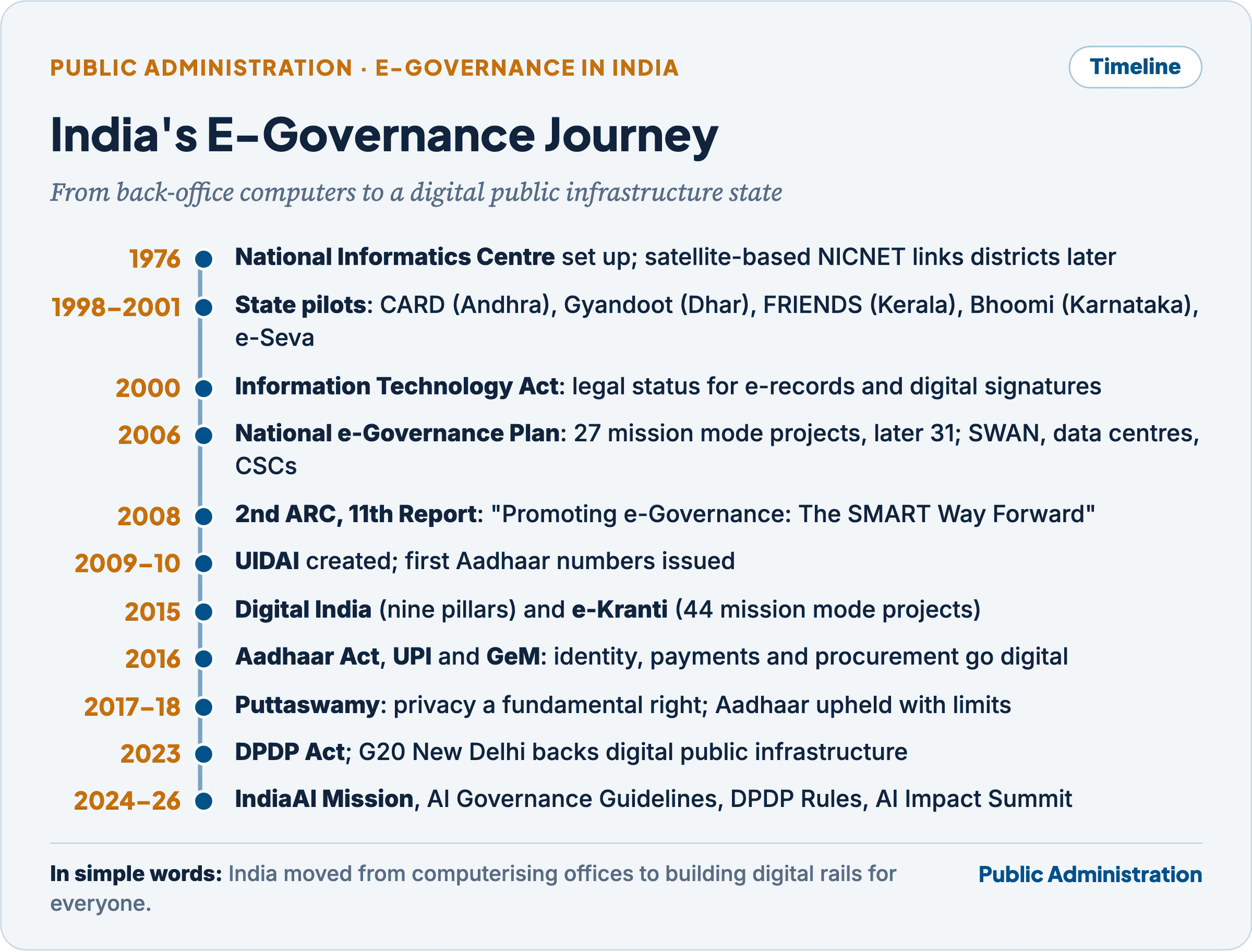
- Department of Electronics set up in 1970; the National Informatics Centre (NIC) in 1976, which became the government’s main technology arm.
- NICNET, a satellite-based network built from the late 1980s, linked the Centre with state capitals and district headquarters; the DISNIC programme sought to computerise district-level information.
- Early applications were back-office: census and election data, payroll, the railway passenger reservation system (from 1986), and economic monitoring.
- Character of this phase: inward-looking automation, with little change in procedures or in the citizen’s experience.
5.2 Phase two: state pilots and islands of success (late 1990s–2006)
Liberalisation, the IT industry boom and the good governance agenda pushed several states to experiment. These pilots showed what was possible and also why things fail.
| Project | State, year | What it did | Lesson |
|---|---|---|---|
| CARD (Computer-aided Administration of Registration Department) | Andhra Pradesh, 1998 | Computerised registration of property deeds; registration in hours instead of days | Process change plus IT cut delay and rent-seeking |
| Gyandoot | Madhya Pradesh (Dhar district), 2000 | Village kiosks (soochanalayas) run by local operators for land records, prices, grievances, beneficiary lists | Front-end kiosks without back-office reform and reliable power and telecom lose momentum |
| FRIENDS | Kerala, 2000 | Single-window centres for paying utility bills and taxes | One-stop counters save citizens’ time even before full automation |
| Bhoomi | Karnataka, first kiosk February 2001 | Digitised about 20 million land records; computerised RTCs (Records of Rights, Tenancy and Crops) at taluk kiosks; manual records made legally invalid in 2002 | Law change plus digitisation reduced the village accountant’s discretion; benefits skewed towards better-off farmers who could reach kiosks |
| e-Seva | Andhra Pradesh, 2001 | Integrated citizen service centres for bills, certificates, licences; later MeeSeva | Integration of many departments at one counter |
| Lokvani | Uttar Pradesh (Sitapur), 2004 | Public–private kiosks for grievances and land records | Low-cost PPP models can work at district level |
- Information Technology Act, 2000 gave legal recognition to electronic records and digital signatures, making online transactions possible.
- Common limitations: pilots depended on individual champions; they were not interoperable; many did not survive transfers of their leaders; back offices often stayed manual.
5.3 Phase three: the National e-Governance Plan (2006)
- Approved on 18 May 2006 with 27 Mission Mode Projects (MMPs) and 8 support components; later expanded to 31 MMPs.
- Vision: “Make all Government services accessible to the common man in his locality, through common service delivery outlets and ensure efficiency, transparency and reliability of such services at affordable costs to realise the basic needs of the common man.” The vision captures three ideas: location (near the citizen), common outlets (shared service centres) and affordability.
- Mission mode means a project with a clearly defined objective and scope, measurable outcomes and service levels, and fixed milestones and timelines, owned by a line ministry or state department.
- Three categories of MMPs:
- Central: income tax, passports, MCA21 (company affairs), central excise and customs, pensions, banking, insurance, immigration and visas, e-Office.
- State: land records, agriculture, treasuries, commercial taxes, e-District, municipalities, gram panchayats, police, road transport, employment exchanges.
- Integrated: Common Services Centres, e-Courts, e-Procurement, e-Biz, the India Portal, the National e-Governance Service Delivery Gateway (NSDG), EDI for trade.
- Core infrastructure (“the 3 pillars”):
- State Wide Area Networks (SWAN): a closed government network in each state, usually three-tier (state headquarters to district to block), with minimum 2 Mbps links, implemented either through a PPP model (a private network operator chosen by bidding) or the NIC model, and monitored by a third-party auditor.
- State Data Centres (SDCs): shared hosting of state applications and data.
- Common Services Centres (CSCs): approved in September 2006 with an initial target of one lakh rural kiosks, on a three-tier PPP structure: the Village Level Entrepreneur (VLE) who runs the centre, a Service Centre Agency for a cluster of centres, and a State Designated Agency. By June 2026 over 5.16 lakh CSCs were functional.
- Service gateways: NSDG and State Service Delivery Gateways were designed as messaging switches so that departments with different legacy systems could exchange data and track every transaction.
- Assessment: a government review before 2015 found that NeGP suffered from weak integration among applications and databases, little process re-engineering and slow use of mobile and cloud; 24 of the 31 MMPs had begun delivering full or partial services.
5.4 Phase four: Digital India and e-Kranti (2015)
- Digital India, launched on 1 July 2015, rests on three vision areas: digital infrastructure as a core utility for every citizen; governance and services on demand; and digital empowerment of citizens.
- Nine pillars:
- Broadband highways
- Universal access to mobile connectivity
- Public internet access programme
- e-Governance: reforming government through technology
- e-Kranti: electronic delivery of services
- Information for all
- Electronics manufacturing
- IT for jobs
- Early harvest programmes
- e-Kranti (NeGP 2.0), approved by the Union Cabinet on 25 March 2015, raised the portfolio to 44 MMPs (adding women and child development, social benefits, financial inclusion, urban governance and e-Bhasha among others). Its vision: “Transforming e-Governance for Transforming Governance.”
- Eleven principles of e-Kranti read like a summary of everything learned from NeGP’s weaknesses:
- Transformation, not translation (redesign, do not just digitise paper)
- Integrated services, not individual services
- Government process re-engineering mandatory in every MMP
- ICT infrastructure on demand; cloud by default; mobile first
- Fast-tracked approvals; mandated standards and protocols
- Language localisation; national GIS
- Security and electronic data preservation
Common confusion
Is Digital India the same as the National e-Governance Plan? No. NeGP (2006) was a plan of mission mode projects for electronic service delivery. Digital India (2015) is a much broader programme covering connectivity, electronics manufacturing, jobs and digital literacy, of which e-governance and e-Kranti are two of nine pillars. e-Kranti is the revised NeGP, now one component of Digital India.
5.5 Digital public infrastructure: the India Stack
In simple words
Instead of every department building its own system to check identity, take payments and store documents, India built these once, as shared public “roads”. Any scheme, public or private, can then use the same road. This is called digital public infrastructure.
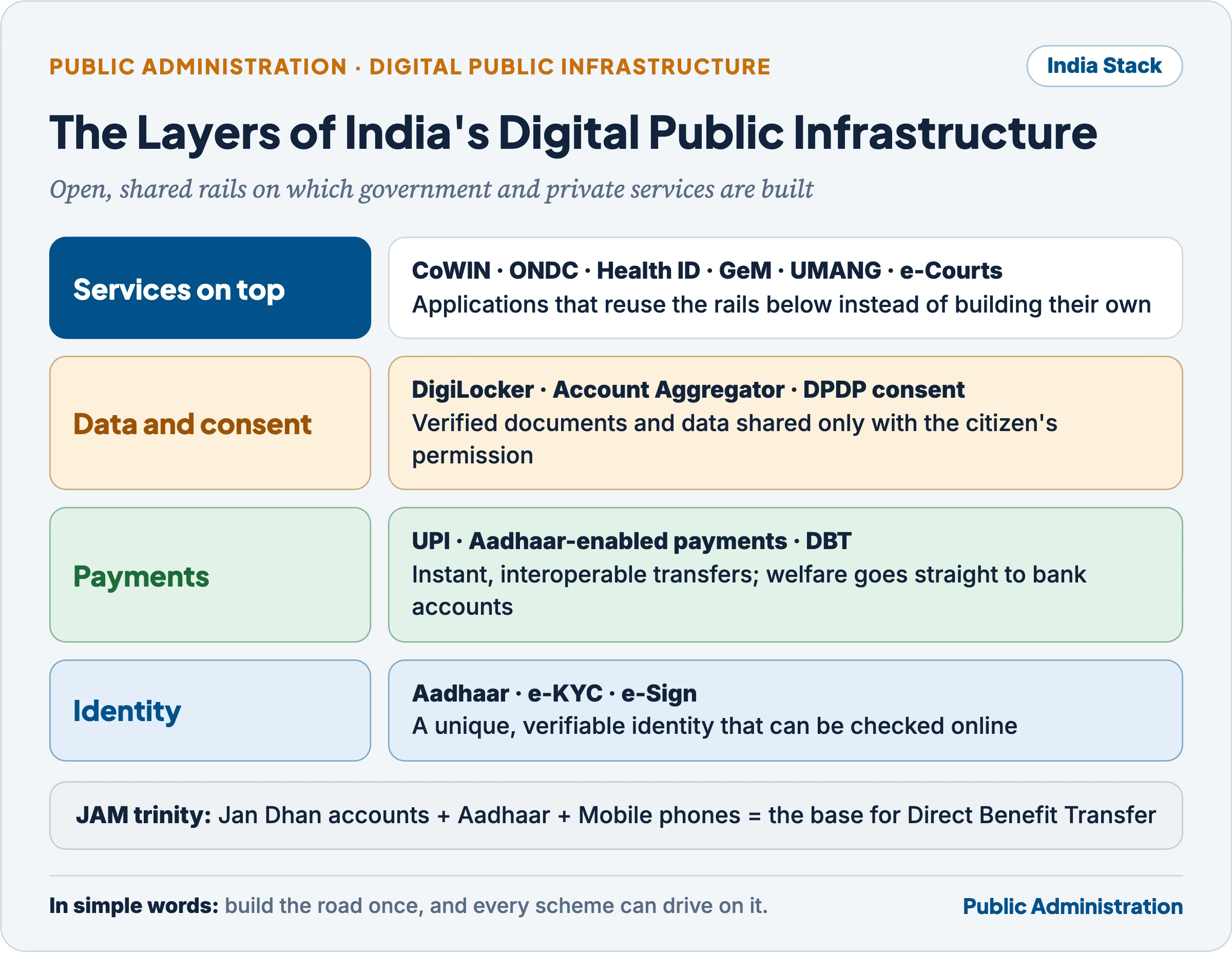
- Digital public infrastructure (DPI) means shared, interoperable digital systems (identity, payments, data exchange) built on open standards and available to the public and private sectors to build services upon. The G20 under India’s presidency (New Delhi, 2023) endorsed a framework for DPI, and India now promotes it abroad.
- Identity layer: Aadhaar.
- The Unique Identification Authority of India (UIDAI) was set up by executive notification in January 2009; the first Aadhaar numbers were issued in September 2010.
- The Aadhaar (Targeted Delivery of Financial and Other Subsidies, Benefits and Services) Act, 2016 gave it statutory backing; an amendment in 2019 allowed voluntary use for KYC.
- Over 145 crore Aadhaar numbers had been generated by July 2026; over 2,707 crore authentication transactions took place in 2024–25. e-KYC and e-Sign build on it.
- Payments layer: UPI.
- The Unified Payments Interface, built by the National Payments Corporation of India (NPCI) under RBI oversight, was launched in April 2016 and opened to the public in August 2016.
- In FY 2025–26 it processed about 24,162 crore transactions worth about ₹314 lakh crore, around 85 per cent of India’s digital payments by volume; the IMF calls it the world’s largest real-time payment system by volume.
- Aadhaar-enabled payment systems and the DBT rails carry government transfers.
- Data and consent layer.
- DigiLocker (2015): verified digital documents issued directly by departments; over 72 crore registered users by July 2026.
- Account Aggregator framework (live from 2021, RBI-regulated): consent-based sharing of financial data.
- The DPDP Act, 2023 supplies the legal basis for consent (section 6).
- Applications built on the rails: CoWIN (vaccination, 2021), the Ayushman Bharat Digital Mission (health IDs and records, 2021), ONDC (open network for digital commerce, incorporated December 2021), GeM, UMANG, e-Courts.
- Why DPI is an administrative innovation: it replaces hundreds of departmental silos with reusable components; lowers the cost of new schemes; and allows competition and private innovation on public rails (as UPI did with payment apps). This is the Indian form of “government as a platform”, a phrase popularised by the American publisher Tim O’Reilly around 2010.
JAM and Direct Benefit Transfer
- The JAM trinity (Jan Dhan bank accounts, Aadhaar, mobile phones) was named in the Economic Survey 2014–15 as the base for cash transfers.
- Direct Benefit Transfer began on 1 January 2013. By mid-2026, more than ₹52 lakh crore had been transferred through DBT under 318 schemes across 56 ministries.
- Estimated gains. The DBT Mission estimates savings or benefits of about ₹5.14 lakh crore up to March 2025, mainly from removing duplicate, fake or ineligible beneficiaries: about ₹3.13 lakh crore in the PDS (6.36 crore ration cards deleted), about ₹0.75 lakh crore each in MGNREGS and LPG subsidy (PAHAL), and about ₹22,106 crore in PM-KISAN.
- How to read these numbers: “savings” are estimates by the implementing government, built partly on assumptions about how many deleted names were ghosts. Independent studies (section 8.4) show that some deletions removed genuine beneficiaries. The gains are real, but their exact size is contested.
Indian Connect — DBT, JAM and the elected representative
- Disintermediation. When pensions, scholarships and wages go straight into bank accounts, the local intermediary (middleman, dealer, sometimes the political broker) loses his role as gatekeeper. E-governance thus creates a more direct relationship between the citizen and the state.
- Changing role of elected representatives. MLAs and MPs who once built support by “getting things done” (a ration card, a pension) must shift towards policy, oversight and problem-solving for those the system fails: people excluded by authentication errors, data mismatches or lack of access. The DISHA dashboards for MPs and district committees give them data to monitor schemes.
- Risk: representatives may also lose a feedback channel; when the system is faceless, the citizen’s only recourse is often the representative, so their grievance-escalation role grows rather than disappears.
5.6 Platforms that are changing administration
| Platform | Year | What it does | Administrative significance |
|---|---|---|---|
| MCA21 | 2006 | Online company registration and filings | Early large BPR success in G2B services |
| Passport Seva | 2010 | PPP-run passport service centres with online appointments and police verification tracking | Service levels and process redesign cut waiting times from weeks to days |
| CPGRAMS | 2007 | Online public grievance system for the Union and states | 10-step reforms (2022); 2024 guidelines cut the redress limit from 30 to 21 days; average disposal 15 days in 2025, with 22.78 lakh grievances received that year |
| PRAGATI | 2015 | Prime Minister’s video-conference review of stalled projects and grievances with Union secretaries and chief secretaries | Real-time monitoring, cross-level coordination |
| GeM (Government e-Marketplace) | 2016 | Online public procurement | ₹5.43 lakh crore of orders in FY 2024–25 and ₹5.03 lakh crore in FY 2025–26; cumulative ₹18.4 lakh crore; MSEs took 68 per cent of orders in 2025–26 |
| UMANG | 2017 | Single mobile app for Central and state services | About 2,585 services by July 2026 |
| e-Office | NeGP MMP, expanded since 2014 | Electronic files and noting in ministries | Faster file movement, audit trails, less paper |
| Faceless assessment | 2020 | Income tax cases allocated by algorithm to anonymous teams | Removes officer–taxpayer contact and territorial jurisdiction |
| PM Gati Shakti | 2021 | GIS master plan linking infrastructure ministries | G2G integration for planning |
| MeriPehchaan | 2022 | National single sign-on for government portals | Horizontal integration from the citizen’s side |
| NeSDA | 2019 onwards | DARPG’s National e-Governance Service Delivery Assessment | Rates states and ministries on accessibility, content, ease of use, security and privacy, end-service delivery, integrated delivery and status tracking |
- These platforms show the move from projects to platforms: instead of one-off computerisation, services are built on shared, reusable systems that can be measured and compared.
ICT in panchayats and the district
- e-Panchayat was one of NeGP’s state mission mode projects; its successor, eGramSwaraj (launched on National Panchayati Raj Day, 24 April 2020), records panchayat plans, works, accounts and payments online, while SVAMITVA (also launched in April 2020) uses drone surveys to give rural households property cards.
- Gains: online accounts and geo-tagged works make panchayat spending visible to citizens and auditors; payments to vendors through PFMS reduce cash handling; Gram Panchayat Development Plans can be compared across villages.
- “Mass ICT culture”: when villagers use panchayat kiosks, CSCs and apps for certificates and payments, digital habits spread beyond officials to the community.
- Limits: weak connectivity and power in many panchayats, few trained secretaries, dependence on block-level data operators, and the risk that upward digital reporting strengthens control by higher levels rather than local autonomy.
5.7 Artificial intelligence and the next phase
- IndiaAI Mission, approved by the Union Cabinet on 7 March 2024 with an outlay of ₹10,371.92 crore, funds public compute capacity (over 38,000 GPUs by early 2026), datasets, foundation models, application development, skilling, start-up finance and “safe and trusted AI”.
- Digital India Bhashini (2022) builds AI-based translation and speech tools for Indian languages, attacking the language barrier in digital services.
- India AI Governance Guidelines (released by MeitY on 5 November 2025) set out seven sutras: trust, people first, innovation over restraint, fairness and equity, accountability, understandable by design, and safety, resilience and sustainability. They favour applying existing laws (IT Act, DPDP Act, consumer and criminal law) and institutional coordination over a new AI statute.
- IT Rules amendment (10 February 2026) required platforms to label synthetically generated information (deepfakes), carry traceable metadata and remove unlawful AI content quickly.
- AI Impact Summit, New Delhi (February 2026): the New Delhi Declaration on AI Impact was endorsed by 92 countries and international organisations, stressing “AI for All”.
How AI can help execute policy “more intelligently”:
- Targeting: identifying eligible beneficiaries and detecting fraud from patterns in data.
- Prediction: forecasting disease outbreaks, crop stress, floods or dropout risk so that administration acts early.
- Automation of routine work: classifying and routing grievances, drafting replies, translating documents, answering citizen queries through chatbots.
- Monitoring: satellite and drone imagery for verifying works, land use and infrastructure progress.
Challenges specific to AI in government:
- Data quality and bias: models learn from records that reflect past discrimination and errors.
- Opacity: officials may not be able to explain an automated decision, undermining the duty to give reasons.
- Accountability: responsibility is blurred among vendor, coder, data supplier and officer.
- Capacity and dependence: government lacks in-house AI skills; reliance on a few firms risks lock-in.
- Privacy and surveillance: AI multiplies the power to profile citizens (section 8.5).
- Legal gaps: India has no general law requiring explanation of, or appeal against, automated decisions.
6. The Legal and Institutional Framework
In simple words
Digital government needs rules just as paper government does: rules that make an electronic file legally valid, that punish hacking, that protect personal data and that limit how far the state may watch its citizens. India built these rules in stages, and the courts have shaped them.
6.1 Laws
- Information Technology Act, 2000:
- Legal recognition of electronic records and digital signatures; electronic filing with government.
- Cyber offences and penalties; amended in 2008 to add data-protection compensation (section 43A, now replaced by the DPDP regime) and new offences.
- Section 69A: power to block online content (upheld in Shreya Singhal v. Union of India, 2015, which struck down section 66A on “offensive” messages as vague and violative of free speech).
- Section 70: protected systems (critical information infrastructure); section 70A created the National Critical Information Infrastructure Protection Centre (NCIIPC); section 70B made CERT-In the national agency for cyber incident response.
- IT (Intermediary Guidelines and Digital Media Ethics Code) Rules, 2021, amended several times, most recently in 2026 for AI-generated content.
- Aadhaar Act, 2016 and its 2019 amendment (section 5.5).
- Digital Personal Data Protection Act, 2023:
- Received assent in August 2023. Applies to digital personal data; based on consent, purpose limitation and data minimisation; gives data principals rights to information, correction, erasure and grievance redress.
- Creates the Data Protection Board of India (a four-member, fully digital body) with penalties of up to ₹250 crore per breach.
- Section 17 allows the Union to exempt government agencies on grounds such as sovereignty, security and public order, the most criticised feature.
- It amended RTI section 8(1)(j) to exempt all personal information from disclosure, which critics say weakens social audit.
- DPDP Rules, 2025 were notified on 13–14 November 2025 with an 18-month phased timeline: the Board first, consent managers within a year, and full obligations on data fiduciaries within eighteen months.
6.2 Institutions
| Institution | Role |
|---|---|
| MeitY (Ministry of Electronics and IT) | Nodal ministry for Digital India, IT Act, DPDP Act, IndiaAI |
| NIC | Builds and runs government applications and networks |
| National e-Governance Division (NeGD) | Programme management for Digital India; runs DigiLocker, UMANG, capacity building |
| UIDAI | Aadhaar issuance and authentication |
| CERT-In | Cyber incident response; its April 2022 directions require incidents to be reported within six hours |
| NCIIPC | Protection of critical information infrastructure |
| Indian Cyber Crime Coordination Centre (I4C) | Under the Home Ministry; coordinates action on cybercrime, runs the reporting portal and 1930 helpline |
| DARPG | Administrative reforms, CPGRAMS, NeSDA, e-governance awards |
| Data Protection Board of India | Adjudicates data breaches under the DPDP Act |
6.3 Judgments
Indian Connect — Puttaswamy and the limits of the digital state
- Justice K.S. Puttaswamy (Retd.) v. Union of India (2017): a nine-judge bench unanimously held privacy a fundamental right under Article 21 and Part III, including informational privacy. Any intrusion must meet the tests of legality, legitimate aim and proportionality.
- Puttaswamy (Aadhaar) judgment (26 September 2018): a five-judge bench, by 4:1, upheld the Aadhaar Act for welfare and subsidies under section 7, and for linking with PAN, but struck down the private-sector use of Aadhaar under section 57, ended mandatory linking with bank accounts and mobile phones, and limited retention of authentication records. Justice D.Y. Chandrachud dissented, holding the Act unconstitutional because it was passed as a Money Bill and because of its surveillance potential.
- Shreya Singhal (2015): online speech is protected; vague restrictions fail.
- Anuradha Bhasin v. Union of India (2020): internet shutdowns must be necessary and proportionate, and orders must be published and reviewed.
- Effect on administration: digital programmes must now be designed with proportionality, purpose limitation and grievance redress in mind; the 2018 ruling also required that no one be denied a welfare entitlement merely because of authentication failure.
7. Benefits: What E-Governance Delivers
In simple words
When it works, e-governance makes government faster (no queues), cheaper (fewer steps), cleaner (fewer bribes), fairer (same rules for everyone) and more open (you can see your file’s status). It also helps leaders see what is happening on the ground in real time.
7.1 Efficiency and effectiveness
- Speed and cost: fewer steps, less paper, no repeated data entry. Passport issue, company incorporation and tax refunds that once took weeks now take days or hours.
- Economies of scale: shared platforms (Aadhaar, UPI, DigiLocker, GeM) spread fixed costs across hundreds of services.
- Better procurement: GeM’s open, online bidding widens competition and creates a record of every purchase.
- Organisational efficiency: e-Office and dashboards shorten file cycles and expose bottlenecks.
7.2 Transparency and reduced corruption
- Removing discretion and contact points: where the citizen never meets the officer (faceless assessment, online licences, DBT), the opportunity for bribes shrinks.
- Audit trails: every action on a digital file is time-stamped and traceable; tampering becomes harder.
- Proactive disclosure: beneficiary lists, land records, tenders and budgets online let citizens and the media check government.
- ICT and bribery: a widely cited study by Karthik Muralidharan, Paul Niehaus and Sandip Sukhtankar (American Economic Review, 2016) of smartcard-based payments in Andhra Pradesh found that biometric payments made MGNREGA and pension payments faster, more predictable and less leaky, without reducing access. ICT works against bribery when it removes the intermediary’s control over money and information.
- Limit: corruption often moves rather than vanishes: to data entry (adding ghost names), to the last-mile agent (business correspondents, ration dealers) or to procurement of the IT system itself.
7.3 Inclusion and empowerment
- Reach: CSCs, mobile apps and DBT bring services to villages without government offices; payments reach women’s own accounts.
- Historical disabilities: ICT can help people who were long excluded by distance, caste-based gatekeeping, illiteracy or gender to deal with the state on equal terms, as anonymous digital transactions do not see caste or status. This is the hopeful side of ICT4D.
- Language: Bhashini and multilingual portals lower the English barrier.
- Participation: MyGov, online consultations and grievance portals give citizens new channels of voice.
7.4 Evidence-based governance and outcomes
- Real-time data: dashboards (PRAGATI, scheme MIS, DISHA) let managers see outputs and, increasingly, outcomes.
- Outcomes, not outputs: the deeper promise of e-governance is a shift from counting outputs of government (forms processed, money spent) to measuring governance outcomes (children immunised, grievances actually resolved, time saved by citizens). Output-based e-government may digitise activity without improving lives; e-governance should be judged by what changes for the citizen.
- Policy learning: data across districts and states allows comparison and evaluation (Nath’s comparative analysis model).
7.5 Changes inside the bureaucracy
- Generalist–specialist relationship. E-government is technical and multidisciplinary, so policy-makers (often generalists), programme administrators and technical specialists (engineers, data scientists, vendors) become interdependent. Generalists can no longer specify or supervise systems without technical knowledge; specialists cannot design them without understanding law and process. New roles have emerged: chief information security officers, programme management units, domain experts in NeGD, and lateral technical hires. The old hierarchy of generalist over specialist gives way to teams.
- Debureaucratisation? E-governance flattens some hierarchies (fewer levels needed to pass a file) and reduces bureaucratic inertia where processes are automated and timelines are tracked. But it can also centralise control (a dashboard in Delhi watching every district) and create a new technical bureaucracy of rules embedded in code. It decentralises access but may centralise power.
- Internal teamwork. New communication technology also changes how officials work together: e-Office lets several officers work on one file at once, video conferencing (as in PRAGATI) brings the Centre, states and districts into one meeting, shared dashboards give teams a common picture, and messaging tools speed coordination. Hierarchical file movement gives way to project-style collaboration, though informal chat channels raise questions of record-keeping and accountability.
- Citizen orientation. Status tracking, service-level timelines and feedback calls make administration more answerable to the citizen. Participation (shaping decisions) lags behind service (receiving decisions).
8. Challenges and Critique
In simple words
Technology does not fix a broken process; it can make it break faster. Many digital projects fail because they are designed for an imaginary office. Others leave out people without phones, skills or fingerprints that scan well. And a state that knows everything about its citizens can serve them better, but it can also watch and control them more easily.
8.1 Why e-government projects fail: Heeks’s design–reality gap
Richard Heeks, a Manchester scholar of ICT for development, in “Most eGovernment-for-Development Projects Fail: How Can Risks be Reduced?” (2003), estimated from expert polls and case analyses that in developing and transitional countries about 35 per cent of e-government projects are total failures (never implemented or abandoned), 50 per cent partial failures (major goals unmet or undesirable outcomes), and only 15 per cent successes.
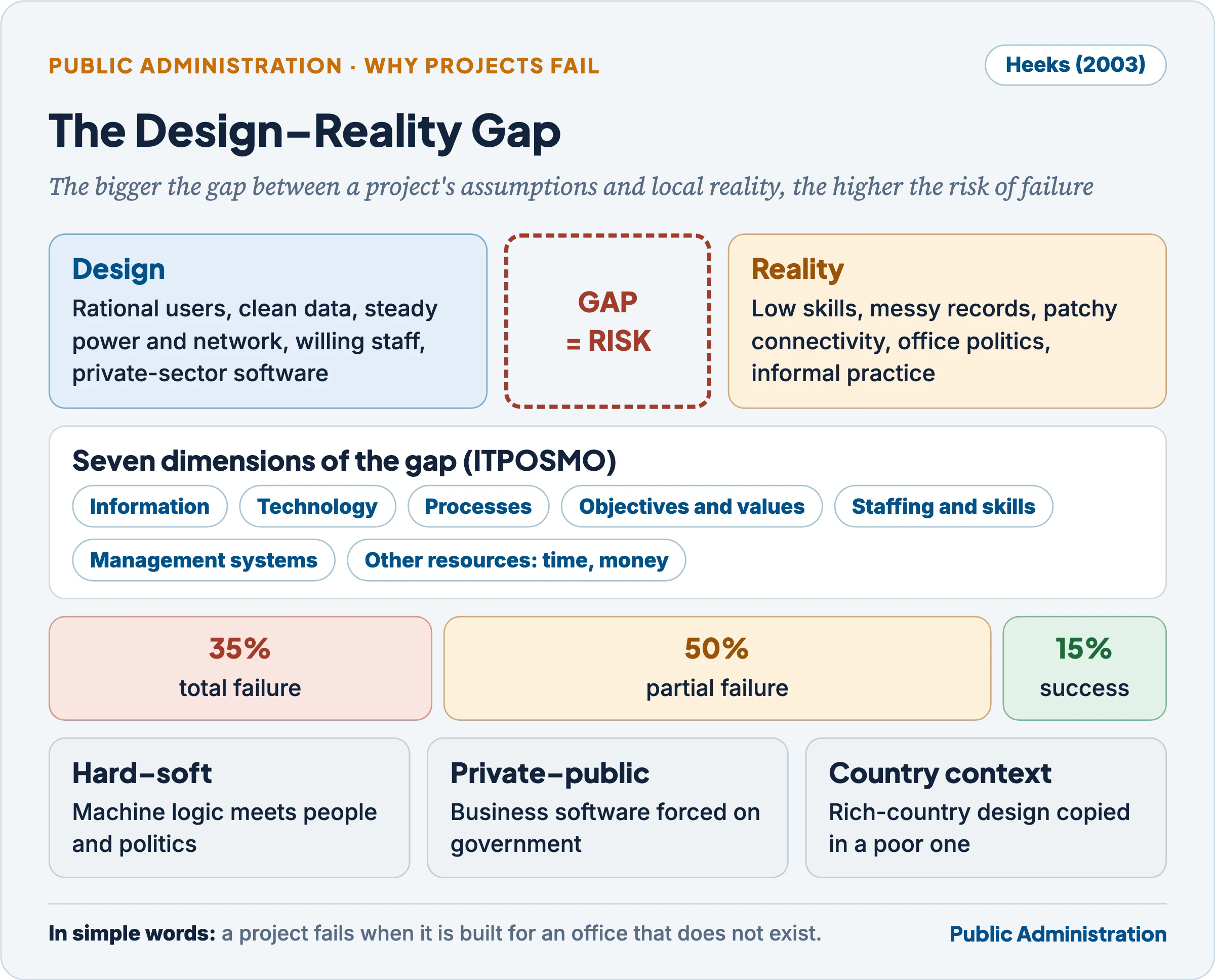
- Core idea: failure grows with the gap between the assumptions built into a project’s design and the realities where it is used.
- Seven dimensions of the gap (ITPOSMO): Information, Technology, Processes, Objectives and values, Staffing and skills, Management systems and structures, Other resources (time and money).
- Three archetypal gaps (Heeks’s typology):
- Hard–soft: systems designed on rational, mechanical assumptions meet organisations driven by people, politics and culture.
- Private–public: software built for business is forced onto government, whose goals, accountability and rules differ.
- Country context: designs from industrialised countries are copied into poorer ones (“New Delhi is not New York”).
- Costs of failure: direct and indirect money, opportunity costs, political loss of face, lost benefits for citizens, and future costs, as failure discourages the next project.
- Example of the gap: Heeks describes a strategic information system for an East African ministry that assumed rational, data-driven decisions; in reality decisions were personal and political, so the system’s output was ignored.
- Indian echo: Gyandoot’s grievance kiosks worked at the front end but complaints went into an unchanged manual back office; many NeGP MMPs digitised forms without process re-engineering.
Barriers, inhibitors, drivers and enablers. A common classification of factors in introducing ICT in public organisations:
| Type | Meaning | Examples |
|---|---|---|
| Barriers | Roadblocks that stop introduction | Lack of funds, poor infrastructure, few skilled staff, rule-following over results, narrow self-interested politics |
| Inhibitors | Factors that make induction difficult from the start | No ICT departments, mobility of ICT champions, weak legal framework, poor data maintenance, low staff motivation |
| Drivers | Forces that push ICT in | Political support, internal champions, top-management strategy, rising user expectations, technological change |
| Enablers | Conditions that ease adoption | Trained staff, access to consultants, positive attitudes, internal funds, local good-practice adaptation |
- Why public-sector ICT is harder: government mixes political will with bureaucratic professionalism; decisions are not always driven by efficiency; and public bodies face financial, legal, contractual and personnel constraints that private firms do not. ICT is often adopted as a fad, with organisations mimicking others.
- The IT productivity paradox. The economist Robert Solow remarked in 1987 that the computer age could be seen everywhere except in the productivity statistics. Governments, like firms, often invest heavily in information systems without visible returns, because benefits depend on complementary changes in processes, skills and management, not on hardware. Investment that “does not seem to make sense” usually reflects missing redesign, not useless technology.
8.2 Automating red tape: the need for re-engineering
- Michael Hammer, the American theorist of business process re-engineering, warned in 1990: “Don’t automate, obliterate”. Computerising a bad process only produces “faster red tape”.
- The 2nd ARC made government process re-engineering a precondition of e-governance; e-Kranti later made it mandatory for every MMP.
- Necessary but not sufficient: digitising land records is a necessary step towards transparent district administration, because records become searchable, tamper-evident and available at kiosks. But it is not sufficient: records digitised from outdated or disputed manual entries carry old errors forward; mutation and survey processes may stay manual; and without conclusive titling (the land titling debate), digital records still do not guarantee ownership. The Digital India Land Records Modernisation Programme and SVAMITVA property cards try to close this gap.
8.3 The digital divide and ICT for development
- Three divides. Pippa Norris, a political scientist, in Digital Divide (2001) distinguished a global divide (between countries), a social divide (within a society, between rich and poor) and a democratic divide (between those who do and do not use digital tools to participate in public life).
- Levels of the divide: later research shows the divide moves from access (first level) to skills and use (second level) and finally to outcomes (who actually benefits).
- India’s data (NSS Comprehensive Modular Survey: Telecom, January–March 2025):
- 86.3 per cent of households had internet access at home (rural 83.3, urban 91.6).
- Only 3.2 per cent of rural households had fibre connections against 14.0 per cent of urban ones: rural access is almost entirely through mobile phones.
- Among women aged 15 and above, only about 36 per cent could send or receive e-mail, a sign that skills lag far behind access.
- Among those able to use the internet but not using it, lack of know-how was the main reason given.
- What the divide means for administration: “digital by default” can become “digital only”, shifting the burden of compliance onto citizens least able to bear it: the elderly, disabled, rural women, migrants and those with poor literacy.
- Responses: assisted access through CSCs and banking correspondents; PMGDISHA for rural digital literacy; BharatNet for village broadband; multilingual and voice-based interfaces; and keeping offline alternatives.
8.4 Exclusion: when authentication fails
- The problem: biometric authentication can fail for manual labourers with worn fingerprints, the elderly, people with disabilities, and in areas with weak connectivity. Seeding errors and name mismatches can cut people off.
- Jharkhand evidence. Muralidharan, Niehaus and Sukhtankar, with the Jharkhand government, randomised the rollout of Aadhaar-based biometric authentication (ABBA) in the PDS (study published in the Review of Economics and Statistics, 2025; working paper 2020):
- ABBA by itself did not reduce leakage; it modestly raised beneficiaries’ transaction costs (by about 17 per cent of the control average).
- About 0.3 million people lost access because of ABBA, mostly those whose ration cards were not seeded with Aadhaar and who had no manual override.
- The subsequent reconciliation of grain stocks did cut leakage, but together the reforms caused 1.5–2 million people to lose benefits at some point.
- Lesson: the exclusion came mainly from how the transition was managed (no override, no clean slate), not from technology as such.
- Human cost: media and civil society reports from Jharkhand after 2017, including the widely reported death of a child in Simdega district after her family’s ration card was cancelled for not being linked to Aadhaar, made exclusion a national issue.
- Correctives: the Supreme Court’s 2018 insistence that genuine beneficiaries not be denied benefits for authentication failure; exception handling and manual override; One Nation One Ration Card portability; face authentication as an alternative; and the duty to keep human recourse in every automated system.
8.5 Privacy, surveillance and data protection
- Function creep: data collected for one purpose (welfare) is linked for others (policing, tax, profiling). Aadhaar’s linking with many databases raised this fear, which the 2018 judgment partly addressed.
- The panoptic state: the philosopher Michel Foucault used Jeremy Bentham’s prison design, the panopticon, as a metaphor for power that works through constant visibility. A state that can see every transaction can discipline citizens without force.
- Surveillance capitalism and the state: the American scholar Shoshana Zuboff (2019) described how platform firms profit from behavioural data; governments that depend on such firms or emulate their methods face similar dangers.
- Data breaches: large government databases are attractive targets; leaks of personal data from public systems have been reported repeatedly.
- India’s safeguards and their gaps: the DPDP Act creates rights and a Board, but broad government exemptions, the absence of an independent regulator in the Puttaswamy sense, and the RTI amendment draw criticism.
- AI in policing. Facial recognition, predictive policing and social media monitoring help combat cybercrime and trace offenders, but raise ethical and privacy concerns: misidentification (with higher error rates for some groups), mass surveillance of protests, no clear statutory basis, weak oversight, and the DPDP exemption for security agencies. The Puttaswamy tests of legality, necessity and proportionality, independent audits of algorithms and judicial authorisation are the standard safeguards proposed.
8.6 Cybersecurity
- The threat: as services move online, a successful attack can halt hospitals, payments or power grids.
- AIIMS, New Delhi (November 2022): a ransomware attack crippled the hospital’s servers for about two weeks, forcing manual registration and exposing the vulnerability of critical public systems.
- Low cyber awareness among officials is a key weakness:
- Human error: phishing e-mails, weak or shared passwords, use of personal devices and free e-mail for official work, pen drives moving between systems.
- Legacy systems: outdated, unpatched software in offices.
- Procurement without security: systems bought for features, not security; vendors with remote access.
- Diffused responsibility: no one in a department feels charged with security.
- Responses: CERT-In’s six-hour incident-reporting directions (2022); chief information security officers in ministries; Cyber Surakshit Bharat training for government IT officers (from 2018); NCIIPC; the I4C and cybercrime portal; regular security audits; and cyber hygiene as part of induction and in-service training.
8.7 Interoperability, vendor lock-in and capacity
- Silos: departments built separate systems with different data formats; citizens still submit the same documents repeatedly. India’s Policy on Open Standards for e-Governance (2010), its policy on adopting open-source software (2015) and API Setu for sharing data through application programming interfaces try to fix this.
- Vendor lock-in: proprietary systems, long contracts and lack of in-house skills make government dependent on single vendors for upgrades and data access.
- Capacity: most departments lack technical staff to specify, supervise and evaluate systems. Mission Karmayogi (2020) and iGOT seek to build digital competence.
- Sustainability: pilots die when champions are transferred or funding ends; maintenance budgets are often neglected.
8.8 Algorithmic governance and accountability
- Automated errors at scale: a human error affects one file; a coding error affects millions.
- Netherlands: a self-learning algorithm used to flag childcare benefit fraud wrongly targeted thousands of families, many with migrant backgrounds; the scandal led the Dutch cabinet to resign in January 2021.
- Australia’s “Robodebt” scheme (2016–2019) used automated income averaging to raise false welfare debts; a Royal Commission (2023) found it unlawful and deeply harmful to vulnerable people.
- Who is accountable? In a paper file, a named officer signs. In an algorithmic system, responsibility is spread across the policy-maker, programmer, vendor and data provider, the “problem of many hands”.
- Safeguards being discussed: algorithmic impact assessments, published source code or logic for public decisions, human review of adverse decisions, rights to an explanation and appeal, and audits for bias.
8.9 Is there a paradox between e-governance and good governance?
- The paradox: e-governance is promoted as a path to good governance, yet it can undermine it:
- It can centralise power and enhance surveillance, weakening liberty.
- It can exclude the poor, while good governance demands inclusion.
- It can replace judgment with rules, while good governance needs responsiveness to individual cases.
- It can concentrate influence in technocrats and vendors, while good governance requires democratic accountability.
- Resolution: the paradox is not inherent. E-governance supports good governance when it is embedded in rights, redress, participation and process reform; it undermines it when it is treated as a technical fix for political problems.
Criticism — The case against digital-first government
- Exclusion: “digital by default” shifts costs onto the poorest and least connected; authentication failures deny rights.
- Surveillance: linked databases build a profiling state; legal safeguards are weak and exemptions broad.
- Iron cage in code: rules become rigid software with no room for hard cases; discretion moves to unaccountable coders.
- Failure and waste: most projects in developing countries fail fully or partly; savings claims are inflated.
- Displaced corruption: rents shift to data entry, last-mile agents and IT procurement.
- Technocracy: policy is shaped by vendors and engineers, not by deliberation.
Defence — The case for digital public infrastructure
- Reach and scale: identity, payments and documents for over a billion people at low unit cost.
- Leakage cut: removal of duplicates and direct payments save large sums and reduce petty corruption.
- Inclusion: bank accounts and direct transfers reached women and rural citizens never served before.
- Transparency: audit trails, open dashboards and online records expose government to scrutiny.
- Correctable design: exclusion and privacy failures are design and management problems that override options, data protection law and grievance systems can fix.
- Platform innovation: open rails like UPI let public and private actors build services quickly.
9. Theory Lens: Bureaucracy, NPM and the Digital State
In simple words
Max Weber said modern government works like a machine of rules. Computers are the perfect rule machine. So does digital government finally complete Weber’s vision, or does it change bureaucracy into something new, in which software designers matter more than clerks?
9.1 Weber digitised: the iron cage of rationality?
- Max Weber, the German sociologist, described legal-rational bureaucracy: rules, hierarchy, written files, impersonality and expertise. He feared that rationalisation would trap modern people in an “iron cage” (stahlhartes Gehäuse), a world of calculable but dehumanised order.
- E-governance as the iron cage completed:
- Software applies rules with perfect impersonality and uniformity, Weber’s ideal.
- Files are permanent, searchable and complete; the written record principle is fulfilled.
- Discretion and favour (Weber’s “patrimonial” residues) are squeezed out.
- Surveillance and calculation extend to every transaction, the cage tightens.
- Against this reading:
- ICT also breaks hierarchy: networks, direct citizen access and open data are anti-Weberian.
- Citizens can now watch the state (RTI online, dashboards), not only the reverse.
- Platform government and participation tools move towards network governance, not pure bureaucracy.
- Balanced view: ICT intensifies Weber’s rationality in the back office while opening new channels of voice at the front. Whether the cage tightens or opens depends on design and law.
9.2 From street-level to system-level bureaucracy
Mark Bovens and Stavros Zouridis, Dutch scholars of public administration, in “From Street-Level to System-Level Bureaucracies” (Public Administration Review, 2002), studied Dutch agencies handling student grants and traffic fines and traced three types.
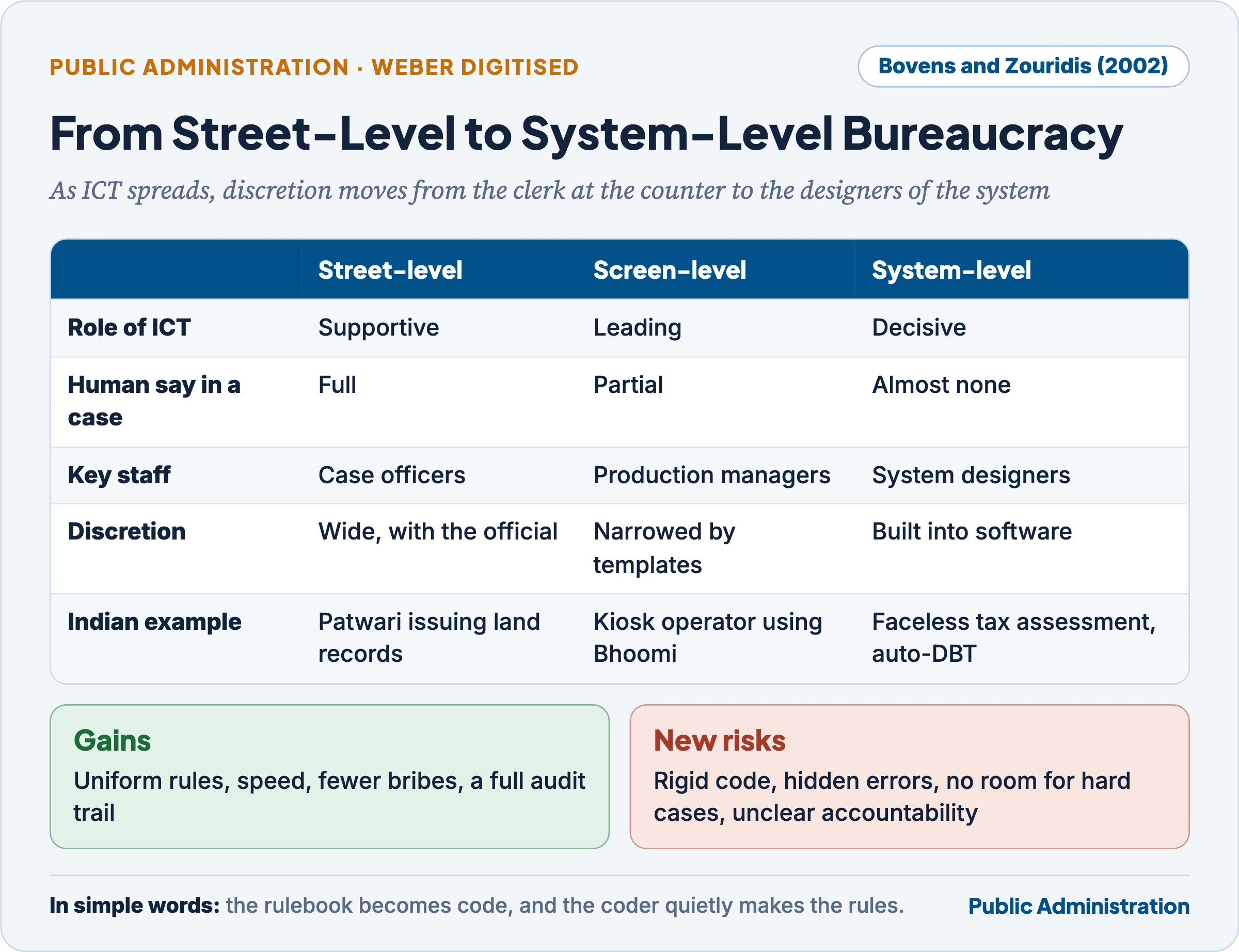
- Street-level bureaucracy (the term of Michael Lipsky, 1980): front-line officials (teachers, police, clerks) exercise wide discretion in individual cases; ICT only registers data.
- Screen-level bureaucracy: officials meet citizens through a computer screen; templates and decision trees narrow discretion; many decisions are pre-programmed.
- System-level bureaucracy: ICT is decisive: routine cases are handled without human intervention; system designers and legal-policy specialists replace case officers; boundaries between agencies become fluid as data is exchanged.
- Implications:
- Discretion does not disappear; it moves from the street-level officer to the people who write the decision rules into software.
- Classic controls (supervision of officials, judicial review of individual decisions) fit poorly; new controls are needed: transparency of code, external audit of systems, and ways for citizens to get hard cases reviewed by a human.
- India: the patwari issuing land records was a street-level bureaucrat; the Bhoomi kiosk operator is screen-level; faceless tax assessment and automatic DBT eligibility are close to system-level.
9.3 NPM, digital-era governance and public value
- NPM and e-government: in the 1990s ICT served New Public Management goals: customer orientation, outsourcing (IT vendors, PPP kiosks), agencies with performance targets, cost cutting.
- DEG’s critique: Dunleavy and colleagues argued that NPM’s fragmentation and outsourcing reduced government’s own IT competence and created silos; digital government requires reintegration and holism instead. India’s shift from scattered NeGP projects to shared DPI platforms fits this argument.
- Public value: the UN’s 2003 framing and Mark Moore’s idea of public value both judge e-government by what citizens value (fairness, trust, outcomes), not only by efficiency.
- Accountability lens: e-governance changes answerability (who must explain), transparency (what can be seen) and controllability (who can correct). It strengthens transparency of transactions but can weaken answerability for system design. Bridging this gap is the central accountability task of digital government.
9.4 The “information society” and administrative development
- Writers since the 1980s, notably the sociologist Manuel Castells in his trilogy on The Information Age (1996–1998), described a shift to a network society in which information flows are the main source of productivity and power.
- Administrative development (improving the capacity of administration itself) is accelerated by ICT when it builds skills, systems and institutions, as in DPI. It stalls when ICT is imposed without such capacity, producing the design–reality gaps of section 8.1. ICT adapts to administration as much as administration adapts to ICT.
10. Global Experiences
In simple words
Small, well-organised countries like Estonia and Singapore went digital early and deeply; large countries like the UK learned by fixing failures. India learns from both but works at a scale none of them faces.
| Country | Key features | Lessons for India |
|---|---|---|
| Estonia (EGDI rank 2, 2024) | X-Road (from 2001): a secure, decentralised data-exchange layer connecting public and private databases; universal e-ID; once-only principle (the state may ask for a piece of data only once); internet voting (since 2005); e-Residency (2014); citizens can see who accessed their data | Interoperability through a common data-exchange layer; transparency of access logs builds trust |
| Singapore (rank 3) | SingPass digital identity (2003); Smart Nation initiative (2014); GovTech agency (2016) with strong in-house engineering | Build in-house technical capacity; integrated life-event services |
| Denmark (rank 1) | Mandatory digital post for citizens (from 2014) with exemptions; strong digital identity; joint strategy across central, regional and local government | “Digital by default” works with high trust and exemptions for the excluded |
| United Kingdom (rank 7) | Government Digital Service (2011) after Martha Lane Fox’s 2010 review; the single GOV.UK portal (2012); “digital by default” service standard; open-source and agile methods | A central digital unit with authority over spending and standards can fix fragmented, vendor-dominated IT |
- Common thread: the leaders combine digital identity, data exchange, central standards, in-house skills and legal trust (privacy, access logs). India has matched or exceeded them in identity and payments; it lags in infrastructure per head, human capital and data protection institutions.
11. The 2nd ARC’s 11th Report and the Way Forward
In simple words
In 2008 a national reform commission studied why e-governance projects were not delivering and wrote a list of what must change: fix processes first, train people, build common infrastructure, protect data and give the whole effort a legal backbone. Most of its advice is still relevant.
11.1 The 2nd ARC’s 11th Report (December 2008)
The Second Administrative Reforms Commission (2005–2009), chaired by M. Veerappa Moily when this report was submitted, devoted its 11th Report, “Promoting e-Governance: The SMART Way Forward”, to the subject. It treated e-governance not as computerisation but as an integral part of governance reform.
- Core principles it laid down:
- Clarity of purpose: start from citizens’ needs, not from available technology.
- Environment building: change the mindset of politicians, officials and civil society; build political will.
- E-governance as part of governance reform, embedded in every programme, not an add-on.
- E-readiness and a step-wise approach: begin where organisations are ready; give citizens early benefits.
- Disciplined working, rigorous monitoring and independent evaluation.
- Secure, fail-safe systems with disaster recovery.
- Sustainability, horizontal replication of successful projects across states, and local-language interfaces.
- Key recommendations:
- Process re-engineering before computerisation; simplify forms, remove needless steps and documents.
- Capacity building of officials and of technology agencies, with awareness campaigns.
- Citizen-centric identification of e-governance projects, with priority to high-volume services.
- Common infrastructure: data centres, wide area networks and common service centres for rural access.
- Unique identity: earlier ARC reports had recommended a multi-purpose national identity card as a base for e-governance.
- Protection of critical information infrastructure and digital security.
- A statutory framework for e-governance: a law defining its objectives, parliamentary oversight, Union–state coordination, roles, standards and data protection, with a roadmap to move citizen–government interactions to electronic mode by 2020.
- Knowledge management as a systematic policy in Union and state governments.
- What happened next: many recommendations were absorbed into e-Kranti (mandatory process re-engineering, standards, mobile and cloud), Aadhaar, CSCs and the DPDP Act. A comprehensive electronic service delivery law, considered in 2011, was never enacted, so citizens still have no general legal right to electronic delivery of services.
11.2 Emerging trends shaping the future of e-governance
- AI-assisted government: chatbots, grievance classification, translation (Bhashini), predictive analytics and generative AI drafting.
- Platform and DPI expansion into health (ABDM), commerce (ONDC), credit and agriculture (AgriStack).
- Proactive and “invisible” services: benefits delivered automatically on life events without application.
- Data governance: consent managers under the DPDP Rules, anonymised datasets (AIKosh), and NITI Aayog’s open data platforms.
- Mobile, voice and vernacular first for the next billion users.
- Cyber resilience and sovereign cloud for government data.
- Participatory tools for co-designing policy, and open government data.
11.3 The way forward
- Rights-based digital government: a legal right to electronic services and a right to an offline or assisted alternative; human review of automated decisions.
- Inclusion by design: exception handling, assisted access, accessibility standards and local languages.
- Data protection with teeth: narrow, reviewable exemptions; an independent, adequately staffed Board.
- Outcome measurement: evaluate platforms by citizen outcomes and exclusion rates, not transaction counts.
- In-house capacity: technical cadres, cyber hygiene in all training, and reduced vendor dependence.
- Algorithmic accountability: impact assessments, audits, published logic for high-stakes public algorithms.
- Process re-engineering first, so that technology reforms the procedure, not merely speeds it.
E-governance succeeds when it changes the process and the relationship, not merely the medium.
Digital public infrastructure widens the state’s reach; law, redress and inclusion decide whether that reach serves or controls citizens.
Key Terms
| Term | Meaning in simple words |
|---|---|
| ICT | Information and communication technology: computers, networks, internet, mobile phones and software |
| E-government | Use of ICT by government agencies to improve their own working and service delivery |
| E-governance | Use of ICT to steer society, involving citizens, business and civil society, not just government |
| Digital-era governance | Dunleavy and colleagues’ theory that ICT moves public management beyond NPM through reintegration, needs-based holism and digitisation |
| SMART government | Simple, Moral, Accountable, Responsive and Transparent government |
| G2C, G2B, G2G, G2E, C2G | Digital relationships between government and citizens, businesses, other governments, employees, and from citizens to government |
| E-participation | Citizens’ involvement in decisions through digital e-information, e-consultation and e-decision-making |
| Mission Mode Project | A project with clear scope, measurable outcomes, service levels and timelines |
| SWAN | State Wide Area Network: closed government data network linking state, district and block offices |
| Common Services Centre | Village-level kiosk run by a local entrepreneur for assisted digital services |
| Digital public infrastructure | Shared, open digital systems (identity, payments, data exchange) on which many services are built |
| India Stack | India’s set of DPI layers: Aadhaar, UPI, DigiLocker, consent-based data sharing |
| JAM trinity | Jan Dhan accounts, Aadhaar and mobile phones used together for direct transfers |
| Direct Benefit Transfer | Payment of benefits straight into beneficiaries’ bank accounts |
| EGDI | UN E-Government Development Index: average of online services, telecom infrastructure and human capital |
| Design–reality gap | Heeks’s idea that projects fail when their design assumptions differ from local realities |
| ITPOSMO | Information, technology, processes, objectives and values, staffing and skills, management systems, other resources |
| Digital divide | Unequal access to, skills in and benefits from digital technology |
| Process re-engineering | Fundamental redesign of a procedure before or while automating it |
| Interoperability | Ability of different systems to exchange and use each other’s data |
| Vendor lock-in | Dependence on one supplier because systems and data cannot easily be moved |
| Street-, screen-, system-level bureaucracy | Bovens and Zouridis’s stages in which discretion moves from front-line officials to software designers |
| Function creep | Use of data or systems for purposes beyond those for which they were created |
| Algorithmic accountability | Holding automated decision systems and their makers answerable for outcomes |
| Data fiduciary | Under the DPDP Act, any entity that decides why and how personal data is processed |
| Synthetically generated information | AI-created or altered content that appears real (deepfakes), regulated by the 2026 IT Rules amendment |
Commissions, Committees and Judgments
| Body or case | Year | Key point |
|---|---|---|
| National Informatics Centre | 1976 | Government’s technology arm; built NICNET and core applications |
| National e-Governance Plan | 2006 | 27 (later 31) mission mode projects; SWAN, data centres, CSCs |
| 2nd ARC, 11th Report (chair M. Veerappa Moily) | 2008 | SMART e-governance; process re-engineering; capacity; legal framework; knowledge management |
| e-Kranti (NeGP 2.0) | 2015 | 44 MMPs; “transformation, not translation”; process re-engineering mandatory |
| Shreya Singhal v. Union of India | 2015 | Struck down IT Act section 66A; upheld section 69A blocking with safeguards |
| Justice K.S. Puttaswamy v. Union of India | 2017 | Privacy, including informational privacy, a fundamental right; proportionality test |
| Puttaswamy (Aadhaar) | 2018 | Aadhaar upheld for welfare; private use struck down; Chandrachud J. dissenting |
| Anuradha Bhasin v. Union of India | 2020 | Internet restrictions must be necessary, proportionate and published |
| Digital Personal Data Protection Act | 2023 | Consent-based data protection; Data Protection Board; government exemptions |
| DPDP Rules | 2025 | Notified November 2025; 18-month phased implementation |
| India AI Governance Guidelines | 2025 | Seven sutras; light-touch, existing-law approach |
Contemporary Developments
- August 2026: UPI completed ten years; it handled about 24,162 crore transactions worth about ₹314 lakh crore in FY 2025–26, roughly 85 per cent of India’s digital payments.
- August 2026: official figures put DigiLocker at over 72 crore users, UMANG at about 2,585 services, Aadhaar at over 145 crore numbers and DBT transfers at over ₹52 lakh crore across 318 schemes.
- April 2026: GeM reported a cumulative gross merchandise value of ₹18.4 lakh crore, with ₹5.03 lakh crore in FY 2025–26, slightly below FY 2024–25.
- February 2026: India hosted the AI Impact Summit in New Delhi; the New Delhi Declaration was endorsed by 92 countries and international organisations.
- 10 February 2026: the IT Rules were amended to require labelling and quick removal of unlawful synthetically generated content, including deepfakes.
- November 2025: the DPDP Rules were notified, starting an 18-month phased rollout and establishing the Data Protection Board; the India AI Governance Guidelines were released.
- 2025: CPGRAMS reported an average disposal time of 15 days for Union ministries, under the 2024 guidelines that cut the redress limit from 30 to 21 days.
- March 2024: the IndiaAI Mission (₹10,371.92 crore) was approved; India rose to 97th in the UN E-Government Survey 2024 (from 105th in 2022).
Revision Grid
| Thinker or body | Work or report (year) | Key idea |
|---|---|---|
| World Bank | Definitions of governance and e-government | ICT to transform relations with citizens, business and government; less corruption, more transparency |
| Dunleavy, Margetts, Bastow, Tinkler | “New Public Management Is Dead” (2006) | Digital-era governance: reintegration, needs-based holism, digitisation |
| Vikas Nath | Digital Governance Models (2003) | Broadcasting, critical flow, comparative analysis, e-advocacy, interactive service |
| Seang-Tae Kim | Paper at Seoul congress (2004) | Bureaucracy, information management, citizen participation, e-governance models |
| Gartner | Four phases (2000) | Presence, interaction, transaction, transformation |
| Layne and Lee | Government Information Quarterly (2001) | Cataloguing, transaction, vertical integration, horizontal integration |
| UN DESA | E-Government Surveys (biennial; 2024 latest) | EGDI = online services + telecom + human capital; India 97th |
| UN | World Public Sector Report (2003) | E-government justified only if it adds public value |
| Richard Heeks | “Most eGovernment-for-Development Projects Fail” (2003) | 35/50/15; design–reality gap; ITPOSMO; hard–soft, private–public, country-context gaps |
| Pippa Norris | Digital Divide (2001) | Global, social and democratic divides |
| Bovens and Zouridis | Public Administration Review (2002) | Street-, screen- and system-level bureaucracy; discretion moves to designers |
| Michael Lipsky | Street-Level Bureaucracy (1980) | Front-line discretion as policy-making |
| Max Weber | Economy and Society | Rational bureaucracy and the iron cage |
| Michael Hammer | “Reengineering Work” (1990) | Don’t automate, obliterate |
| Robert Solow | Remark (1987) | IT productivity paradox |
| Muralidharan, Niehaus, Sukhtankar | Andhra smartcards (2016); Jharkhand ABBA study | ICT can cut leakage; badly managed authentication causes exclusion |
| 2nd ARC | 11th Report (2008) | SMART e-governance, process re-engineering, legal framework |
| Government of India | NeGP (2006); Digital India and e-Kranti (2015) | Mission mode projects; nine pillars; 44 MMPs |
Previous Year Questions
- 2026New communication technology has not only enabled more robust public engagement with the government, but also serves as a new means of internal organizational teamwork. Discuss.
- 2025E-advocacy model of e-governance can facilitate democratization of public policy making. Discuss.
- 2024The future of e-governance is shaped by emerging trends for making government services efficient and accessible. Analyse.
- 2023“Information Communication Technology (ICT) can harness the power of Artificial Intelligence (AI) to execute the policies more intelligently creating an efficient and effective Government.” Examine and identify the challenges.
- 2021ICT has immense potential to transform governance and empower citizens. Examine.
- 2020“Disruptive nature of developments in Information Technology has changed the contours of e-governance in the last one decade.” Analyse.
- 2019Has e-governance led to debureaucratization and decentralization? Assess its impact on bureaucratic inertia.
- 2018To what extent has e-governance made the administrative system more citizen-oriented? Can it (e-governance) be made more participative?
- 2017“Digitalisation provides great impetus to E-governance”. Discuss.
- 2016“Information Technology brings efficiency and transparency to Public Administration. “Examine the statement with suitable examples.
- 2015“E-Governance creates a direct relationship between the Citizen and the State.” In this context, explain the changing role of the elected representatives.
- 2014“The bottom line for governance outcome rather than the outputs of government.” Analyse in context of e-government and e-governance.
- 2014“The technical and multidisciplinary nature of e-government has created an interdependent relationship within government between policymakers, program administrators and technical specialists.” Analyse in context of generalist – specialist relationship.
- 2013The success rate of e-government projects in most developing countries is stated to be rather low. Assess the reason.
- 2012‘The apparent demise of e-Government and e-Business as the main organizing principles of society has created the conditions for the rise of e-Governance from the ashes’ – In the In the context of the above statement show the distinctions between e-Government and e-Governance.
- 2011E-governance is the final arrival of Max Weber’s ‘iron cage of rationality’. Discuss.
- 2010Do you think that is a sort of paradox between e-Governance and good governance? Explain fully.
- 2010“New Public Management is dead; long live digital era of governance.” Comment.
- 2008“e-governance has the potentiality to emerge as the most effective instrument of efficiency, transparency and accountability.” Comment.
- 2006“The rise of information technology is an opportunity to overcome historical disabilities”. Explain.
- 2005In what ways and how can information technology play a crucial role in effective government-citizen interaction in the context of good governance?
- 2004What is Information Technology? Describe its impact on Public Administration.
- 2003“Organisations today seem to information systems, but their investments often do not seem to make sense.” Comment.
- 1989Do you think that sudden eruption of ‘Information society’ has adapted and accelerated administrative development?
- 2026Ethical and privacy issues limit the emerging use of Artificial Intelligence (AI) by police to combat cyber crimes. Comment.
- 2025Do you think ‘Aadhaar’ initiative has promoted inclusive governance and administrative credibility? Throw light.
- 2025Low cyber awareness among officials is causing cyber security issues in the administration. Comment.
- 2023India has significantly advanced in its development goals, increased efficiency in the public sector and unlocked innovation in private sector by adopting the approach of building Digital Public Infrastructure. Elucidate.
- 2017”Digitalization of land records is a necessary but not sufficient precondition for ensuring transparent district administration.” Explain.
- 2015“Information Communication Technology (ICT) improves the quality to check bribery.” Comment.
- 2013“Use of Information and Communication Technology (ICT) in Panchayat’s functions enhances efficiency, transparency and accountability and also induces mass ICT culture.” Examine.
- 2012Indian administration is yet to fully appreciate and adopt the benefits of Information Technology. Elucidate.
- 2003“Information technology, if properly used, can bring about sweeping changes in the nature of governance in India.” Discuss the current status and future possibilities about the use of information technology in the governance of India.
- 2001“Indian administration is yet to fully appreciate and adopt the benefits of the information technology.” Elucidate.