

Administrative Thought: Scientific Management and Scientific Management movement; Classical Theory; Weber’s bureaucratic model – its critique and post-Weberian Developments; Dynamic Administration (Mary Parker Follett); Human Relations School (Elton Mayo and others); Functions of the Executive (C.I. Barnard); Simon’s decision-making theory; Participative Management (R. Likert, C. Argyris, D. McGregor).
This article: Simon’s life and works; his attack on the principles of administration; decision-making as the heart of administration; the stages of decision; facts and values; the means–ends hierarchy; types of rationality; bounded rationality, satisficing and administrative man; programmed and non-programmed decisions; organisational influence, authority and the zone of acceptance; efficiency; computers and decisions; critique; the behavioural approach and its shifts; contribution to public administration.
Official Syllabus: Paper I · Unit 1-02 Administrative Thought
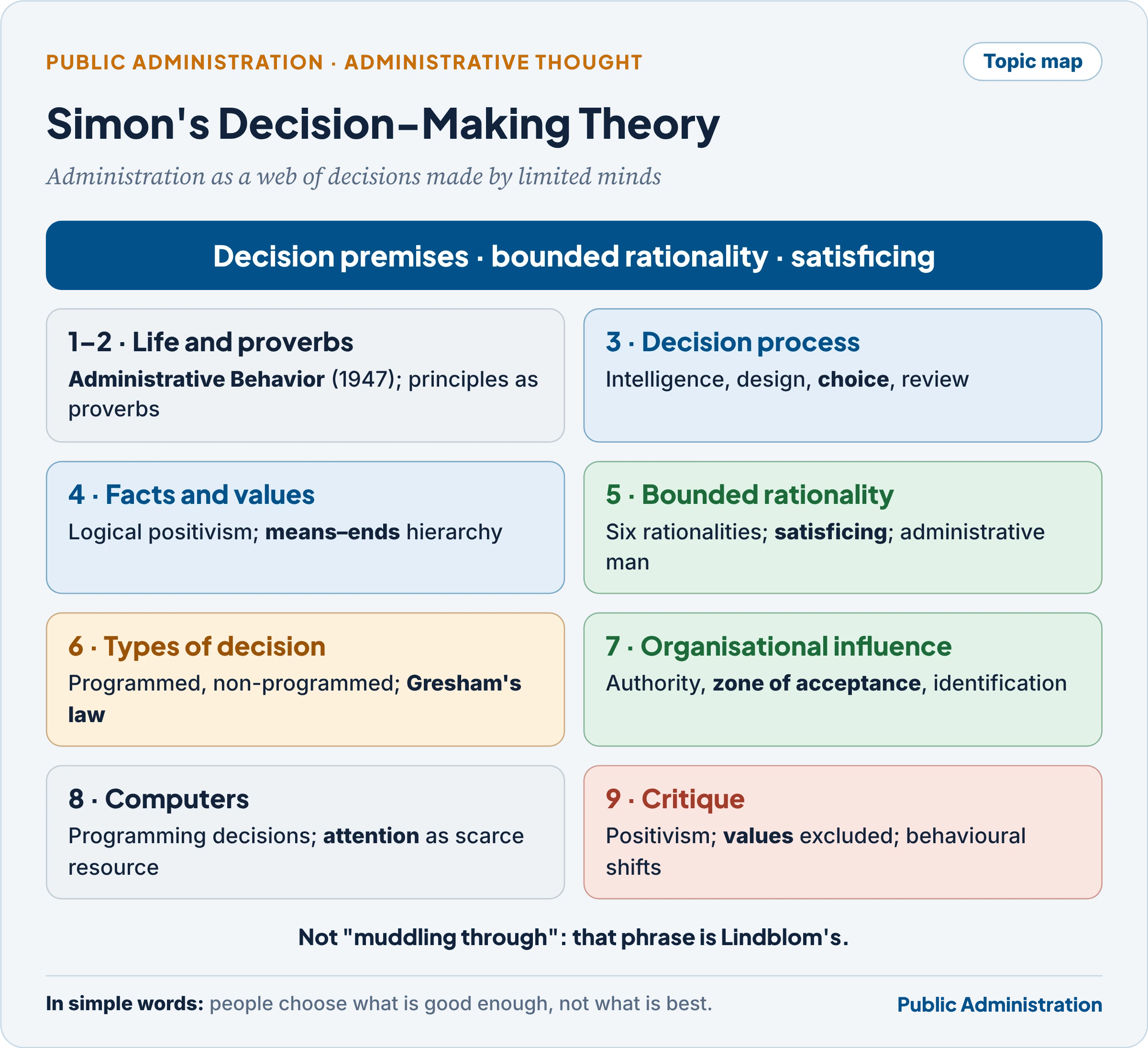
Herbert Alexander Simon (1916–2001) changed the question that administrative theory asked. The classical writers asked how to structure an organisation; Mayo asked how people feel in it. Simon asked how people in organisations decide. In Administrative Behavior (1947) he argued that decision-making is the heart of administration, that the classical principles were contradictory proverbs, and that real decision-makers are boundedly rational: they do not maximise, they satisfice.
- His method: a behavioural, empirical science of administration built on logical positivism: separate facts (testable) from values (preferences), and study the factual side scientifically.
- His standing: Nobel Prize in Economics (1978) “for his pioneering research into the decision-making process within economic organisations”; a founder of artificial intelligence, cognitive psychology and organisation theory.
In simple words
A District Magistrate learns at midnight that a river embankment may breach. She does not list every possible action and calculate every consequence; there is no time and no full information. She checks the few options she knows (evacuate three villages, call the NDRF, open a relief camp), picks the first plan that is good enough, and acts. That is bounded rationality and satisficing: Simon’s picture of real administrative decisions.
1. Life, Works and Influences
In simple words
Simon began as a student of city government and ended as a Nobel-winning economist and computer scientist. One question linked everything he did: how do human beings, with limited minds, make choices?
- Life: born on 15 June 1916 in Milwaukee; studied political science at the University of Chicago; early work on municipal government (measuring city services); spent most of his career at Carnegie Mellon University, Pittsburgh; died on 9 February 2001.
- Major works:
| Work | Year | Theme |
|---|---|---|
| “The Proverbs of Administration” (Public Administration Review) | 1946 | Attack on the classical principles |
| Administrative Behavior | 1947 | Decision-making; facts and values; rationality; organisational influence |
| Public Administration (with Smithburg and Thompson) | 1950 | A behavioural textbook of public administration |
| Models of Man | 1957 | Bounded rationality; satisficing |
| Organizations (with James March) | 1958 | Inducements–contributions; programmed behaviour; Gresham’s law of planning |
| The New Science of Management Decision | 1960 | Intelligence–design–choice; programmed and non-programmed decisions |
| The Sciences of the Artificial | 1969 | Design science; complex systems |
| Human Problem Solving (with Allen Newell) | 1972 | Information-processing theory of thinking |
- Influences: Chester Barnard above all (organisation as a system of decisions; acceptance of authority; inducements and contributions); the logical positivism of the Vienna Circle; Mayo’s human relations work; and his own studies of municipal budgeting.
- Recognition: Nobel Prize in Economic Sciences (1978); A.M. Turing Award (1975, with Allen Newell) for contributions to artificial intelligence.
2. The Attack on the Principles of Administration
In simple words
“Look before you leap” and “He who hesitates is lost” are both good advice, but they cannot both guide you at once. Simon said the classical principles of administration were like that: pairs of sayings that contradict each other.
- “Proverbs of administration” (1946): most propositions of administrative theory “share this defect of proverbs. For almost every principle one can find an equally plausible and acceptable contradictory principle.” The theory gives no guidance on which to apply.
- His examples:
- Specialisation versus unity of command: specialisation implies that a specialist should take technical orders from experts, but unity of command insists on one superior.
- Span of control versus few levels: a narrow span (so that a superior can control subordinates) multiplies hierarchical levels, contradicting the principle that “administrative efficiency is enhanced by keeping at a minimum the number of organisational levels through which a matter must pass before it is acted upon”.
- Departmentalisation by purpose, process, clientele or place: the four bases conflict, and the principles do not say which to prefer.
- Diagnosis: the principles rest on inadequate analysis of administrative situations, loosely defined terms and no empirical research; at best they are “criteria for describing and diagnosing administrative situations”.
- His remedy: build a science of administration on the study of decisions and their premises, through careful definitions and empirical research.
Common confusion
Did Simon himself say that efficiency is enhanced by keeping organisational levels to a minimum? No. That sentence is one of the classical proverbs Simon quoted in order to attack it. He showed that it conflicts with the principle of a narrow span of control. His own point was that fewer levels may speed decisions but may overload supervisors; the right balance depends on the situation and can only be found by studying how decisions actually flow. The 2000 question quoting it invites an analysis of this contradiction, not an endorsement.
(For the full debate on whether Simon was justified, see the article on Classical Theory.)
3. Decision-Making as the Heart of Administration
In simple words
Everyone in an organisation decides something: the Secretary decides policy, the clerk decides which file to open first, the constable decides whether to stop a vehicle. Simon said administration is this whole web of decisions.
3.1 Deciding and doing
- Every administrative activity involves both deciding and doing; theory had attended to doing (POSDCORB) and neglected deciding. “The task of ‘deciding’ pervades the entire administrative organisation quite as much as does the task of ‘doing’.”
- Decisions at every level: the operative employees (soldier, mechanic, fireman) do the physical work; the non-operative staff influence it by influencing the operatives’ decisions. The general, the engineer and the fire chief matter because they shape the decisions of those who act. Hence administration is best understood by analysing how the decisions and behaviour of employees are influenced within and by the organisation.
- Administration = decision-making: Simon equated administration with decision-making; hierarchical levels correspond to different kinds of decisions (broader purposes at the top, specific means lower down).
3.2 Stages of decision-making
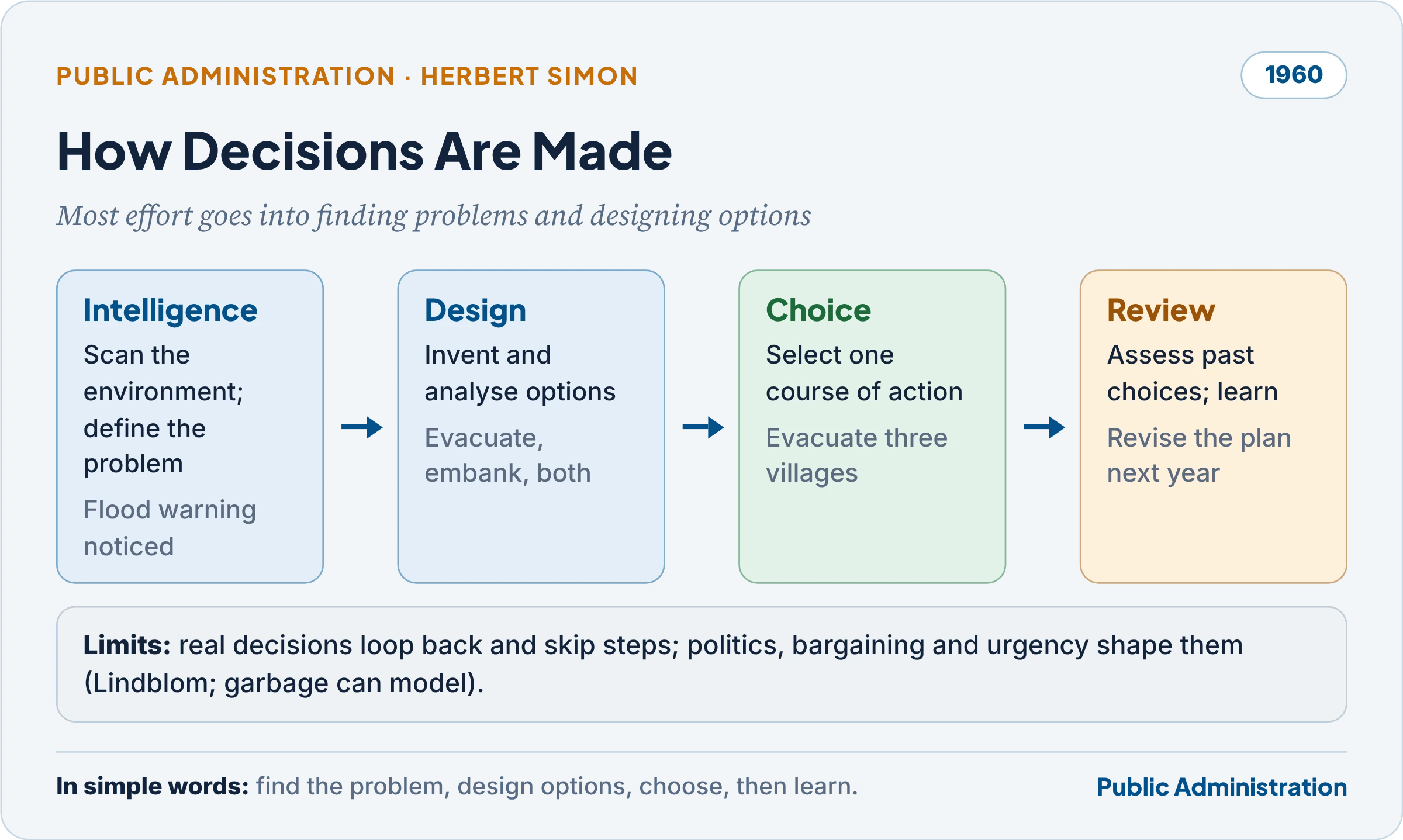
In The New Science of Management Decision (1960), Simon described three principal phases:
| Phase | Name taken from | What happens |
|---|---|---|
| Intelligence activity | Military “intelligence” | Searching the environment for conditions that call for a decision; identifying and defining the problem |
| Design activity | Design | Inventing, developing and analysing possible courses of action |
| Choice activity | Choice | Selecting a particular course of action from those available |
- A fourth phase: Simon later added review (assessing past choices), making the process cyclical.
- Time spent: executives spend most of their time on intelligence and design; choice is a small, final part of the process.
- Each phase is itself a decision process: intelligence and design involve their own sub-decisions.
- Skills required: judgement, creativity, quantitative analysis and experience.
3.3 Critical examination of the Simonian model
- Strengths: clear, general, applicable to all levels; shifts attention from structure to process; links to information systems and policy analysis; recognises that most effort lies before the choice.
- Weaknesses:
- it is a rational, linear model; real decisions loop back, skip phases and are shaped by politics, bargaining and chance (Lindblom’s incrementalism; the “garbage can” model of Cohen, March and Olsen, 1972);
- it treats problems as given to be found, while in public affairs problems are contested and framed by power;
- it under-describes implementation and feedback;
- it neglects intuition, tradition and faith (Argyris’s criticism);
- in practice, elaborate search may be impossible because decisions are urgent.
4. Facts, Values and the Means–Ends Hierarchy
In simple words
“Should the town spend more on roads or on schools?” is a question of values: it depends on what we prefer. “Which road design is cheapest for this traffic?” is a question of facts: it can be tested. Every real decision mixes both.
4.1 Fact and value premises
- Every decision has two kinds of premises:
- factual premises: statements about the observable world that can be tested as true or false (this road can carry 10,000 vehicles a day);
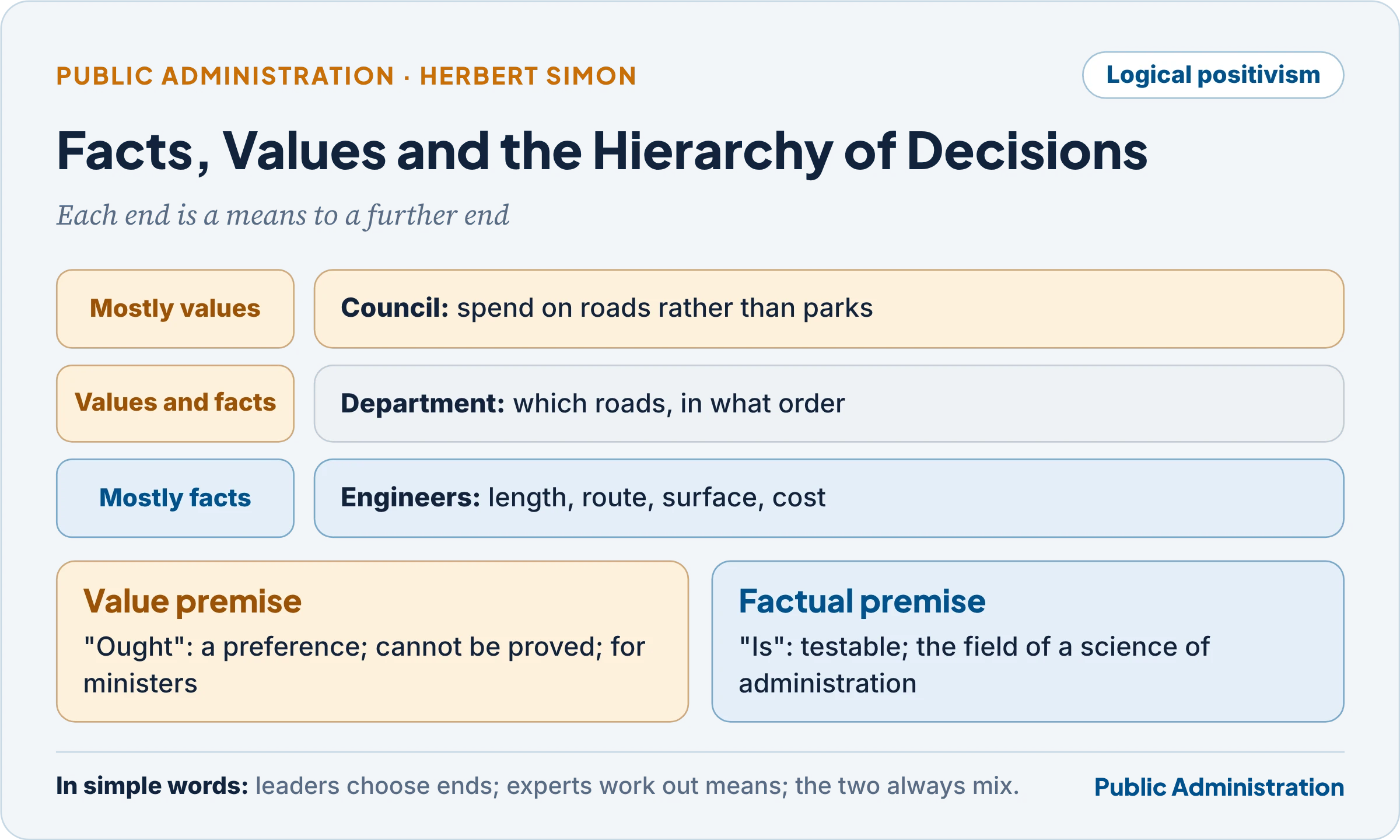
- value premises: expressions of preference (“ought” statements) that cannot be proved true or false by science (roads are more important than parks).
- Logical positivism: following the Vienna Circle, Simon held that only factual propositions are empirically meaningful; values can only be asserted. A science of administration must therefore concern itself with the factual elements of decisions.
- Facts, values, means and ends: in general, ends involve values and means involve facts; but the relation is relative, because today’s means are tomorrow’s ends.
4.2 The means–ends chain and the hierarchy of decisions
- Simon’s walker: a man contracts his leg muscles to take a step; he takes a step to proceed towards his destination; he goes to the destination (a post box) to post a letter; he posts the letter to transmit information to another person; and so on, until a relatively final aim is reached.
- Hierarchy of decisions: each decision selects a goal and the behaviour relevant to it; that goal is a means to a more distant goal. Organisational behaviour is purposive when guided by goals, and rational when it selects alternatives that lead to previously selected goals.
- Decisions leading to final goals are “value judgements“; decisions implementing goals are “factual judgements“. Higher levels deal more with values (policy); lower levels more with facts (implementation).
- Example: a municipal council’s choice between roads and parks is a value judgement; once it chooses roads, the length, route and type of road are factual judgements.
- Imperfect integration: real organisations pursue several goals at once (a recreation department seeks children’s health, good use of leisure and prevention of delinquency), so the hierarchy of goals is never perfectly integrated.
4.3 Facts and values between political and permanent executives
- Simon’s division of labour: in a democracy, legislators and ministers should decide the value premises (ends, priorities), and administrators should supply the factual premises (expert analysis of means and consequences). He saw this as a way to reconcile expertise with democratic control.
- Why separation at the operational level is the basic question: if ministers intrude into factual judgements (which contractor, which site, which officer), administration becomes politicised; if officials smuggle values into “technical” advice, democratic control is weakened.
- Why perfect separation is impossible:
- facts and values are intertwined in almost every real decision; the choice of which facts to collect reflects values;
- discretion at the field level necessarily involves value choices (who gets a house first);
- critics (Waldo, Dahl) argued that the fact–value dichotomy revives the politics–administration dichotomy in a new form.
- Indian context: the Rules of Business and Article 77 assign decisions to ministers; civil servants are expected to tender frank, evidence-based advice and record it on file. The Supreme Court in T.S.R. Subramanian (2013) stressed written orders and civil services boards to protect this division. In practice, the line is negotiated, not fixed.
5. Rationality, Bounded Rationality and Satisficing
In simple words
A shopper with unlimited time and perfect information would compare every shop in the city. A real shopper visits two or three nearby shops and buys the first item that is good enough at an acceptable price. Simon said administrators, like shoppers, satisfice.
5.1 Rationality and its types
- Definition: rationality is “concerned with the selection of preferred behaviour alternatives in terms of some system of values whereby the consequences of behaviour can be evaluated”.
- Six types (Simon distinguished them by adverbs): a decision may be
- objectively rational: correct behaviour for maximising given values in a given situation;
- subjectively rational: maximises attainment relative to the actual knowledge of the subject;
- consciously rational: adjustment of means to ends is a conscious process;
- deliberately rational: adjustment of means to ends has been deliberately brought about;
- organisationally rational: oriented to the organisation’s goals;
- personally rational: oriented to the individual’s goals.
5.2 Why complete rationality is impossible
- The classical model of rational choice requires the decision-maker to (1) list all alternatives, (2) determine all consequences of each, and (3) compare these sets of consequences. No real person or organisation can do this.
- Limits on rationality:
- knowledge of alternatives and consequences is always fragmentary;
- consequences lie in the future, so they must be imagined, and imagination is imperfect;
- only a few of all possible alternatives come to mind;
- time and resources are limited;
- the decision-maker’s habits, values, beliefs and intellectual capacity limit what he sees and how he reasons;
- organisational factors (rules, communication channels, informal norms) and external pressures constrain choice.
5.3 Bounded rationality and satisficing
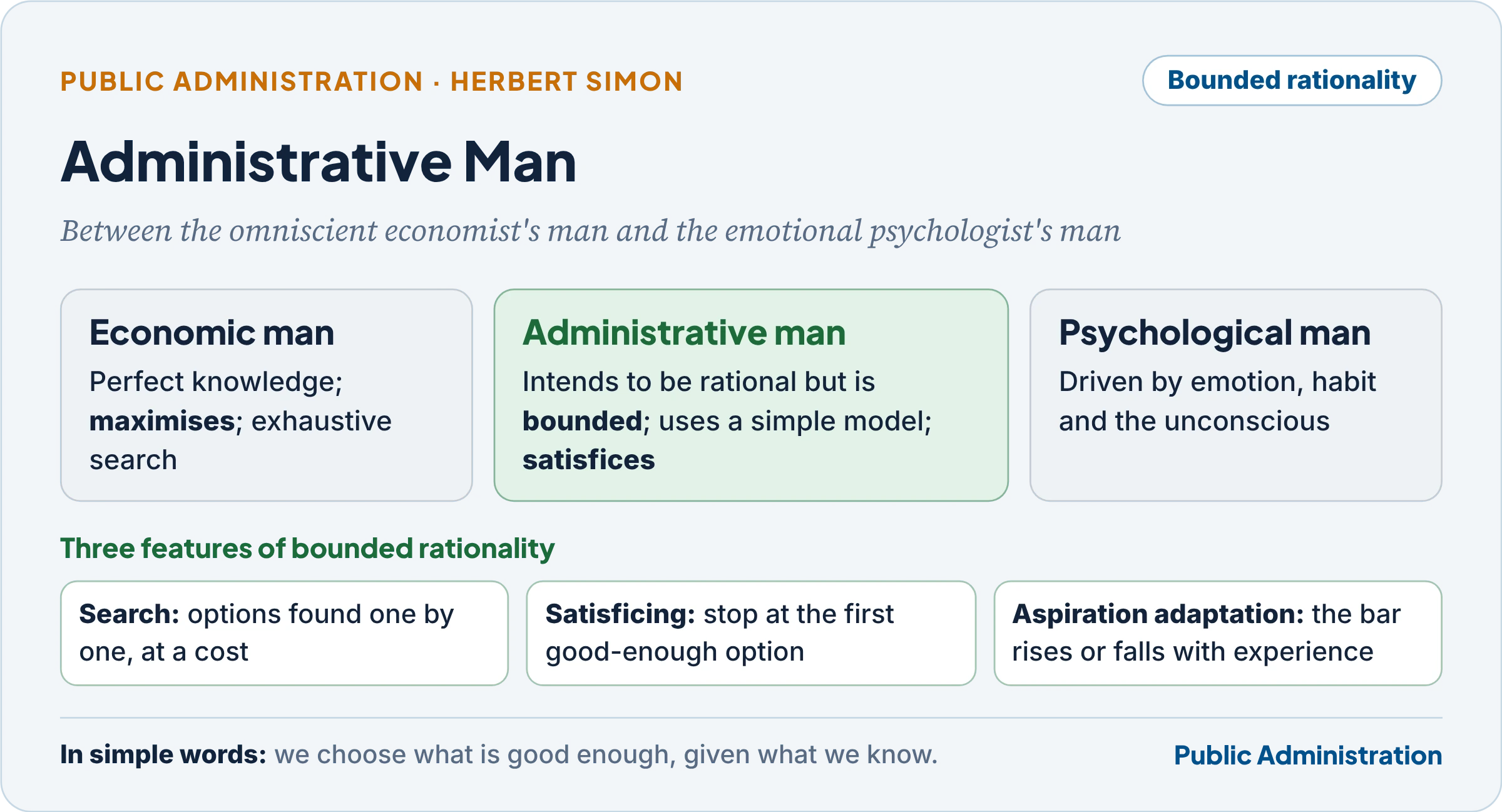
- Bounded rationality: human behaviour is “intendedly rational, but only limitedly so”. It is neither wholly rational nor wholly irrational.
- Satisficing (a blend of “satisfy” and “suffice”): instead of searching for the best alternative, the decision-maker sets an aspiration level and accepts the first alternative that meets it. Business examples of satisficing criteria are “share of the market”, “adequate profit” and “fair price”.
- Simplified models: the decision-maker isolates from the world a closed system with a limited number of variables and consequences, and uses rules of thumb that do not make impossible demands on his capacity for thought.
- Three features of the original view of bounded rationality:
- search for alternatives: alternatives are not given; they must be searched for, sequentially, at a cost;
- satisficing: search stops when an alternative meets the aspiration level;
- aspiration adaptation: the aspiration level is not fixed; it rises when satisfactory alternatives are easy to find and falls when they are hard to find. This makes satisficing a dynamic, learning process.
Common confusion
Did Simon call administrative decision-making “the science of muddling through”? No. Some notes attribute the phrase to Simon. “The Science of ‘Muddling Through'” is the title of Charles Lindblom‘s 1959 article in Public Administration Review, which argued for incrementalism: making small, successive adjustments through bargaining rather than comprehensive analysis. Simon’s terms are bounded rationality and satisficing. The two ideas are related (both reject comprehensive rationality), but Simon still saw decision-making as goal-directed search, while Lindblom stressed partisan mutual adjustment and “successive limited comparisons”.
5.4 Administrative man
| Basis | Economic man | Administrative man |
|---|---|---|
| Goal | Maximises: selects the best alternative | Satisfices: selects a good-enough alternative |
| World | Deals with the “real world” in all its complexity | Deals with a simplified model of it |
| Information | Complete knowledge of alternatives and consequences | Limited knowledge; uses rules of thumb |
| Search | Exhaustive | Sequential, stops at the first satisfactory option |
| Rationality | Omniscient | Bounded |
- Bridging psychological man and rational man: Simon complained that the social sciences suffered from “schizophrenia” in treating rationality. Economics assumed an omniscient, perfectly rational economic man; parts of psychology (especially those influenced by Freud) reduced behaviour to emotion and the unconscious (psychological man). Administrative man stands between: he intends to be rational and pursues goals, but his rationality is bounded by cognitive limits, emotions, habits and social influences. He is rational enough to be studied as a decision-maker, human enough to be studied psychologically.
- Satisficing as a bridge between rational and non-rational perspectives: satisficing keeps the goal-directed core of rational models (search, evaluation, choice) while admitting non-rational elements (habit, limited attention, aspiration levels shaped by experience and group norms). It thereby connects the economists’ and engineers’ rational models with the psychologists’ and sociologists’ accounts of behaviour.
- Difference between maximising and satisficing is relative: under some conditions satisficing approaches maximising (when search is cheap and aspirations high); under others the two are far apart.
Indian Connect — Bounded rationality in Indian policy
- Behavioural public policy: the Economic Survey 2018–19 devoted a chapter to “Policy for Homo Sapiens, Not Homo Economicus”, applying behavioural economics (nudges, defaults, social norms) to campaigns such as Swachh Bharat and Beti Bachao Beti Padhao: a policy acknowledgement that citizens, like administrators, are boundedly rational.
- Crisis decisions: during the COVID-19 lockdown (March 2020), the Union government constituted empowered groups of officers under the Disaster Management Act to take fast, good-enough decisions on supplies, health infrastructure and logistics: satisficing under extreme time pressure.
- Decision support: GIS platforms such as PM Gati Shakti and dashboards for scheme monitoring widen the information available, pushing back the bounds of rationality without removing them.
6. Programmed and Non-Programmed Decisions
In simple words
Renewing a driving licence is a routine decision that follows fixed steps. Deciding how to respond to a new pandemic is not. Simon called the first programmed and the second non-programmed, and said they need different tools.
6.1 The two types
- Programmed decisions: repetitive and routine; a definite procedure has been worked out, so each case need not be treated afresh. The term “programme” was borrowed from computers. Examples: sanctioning leave, processing a pension, awarding a tender under set rules, salary administration.
- Non-programmed decisions: novel, unstructured and consequential; there is no cut-and-dried method, because the problem has not arisen before, or its structure is elusive, or it is so important that it deserves custom treatment. Examples: launching a new mission, crisis response, restructuring a ministry.
- A continuum: decisions are not neatly one or the other; they lie along a spectrum from highly programmed to highly non-programmed.
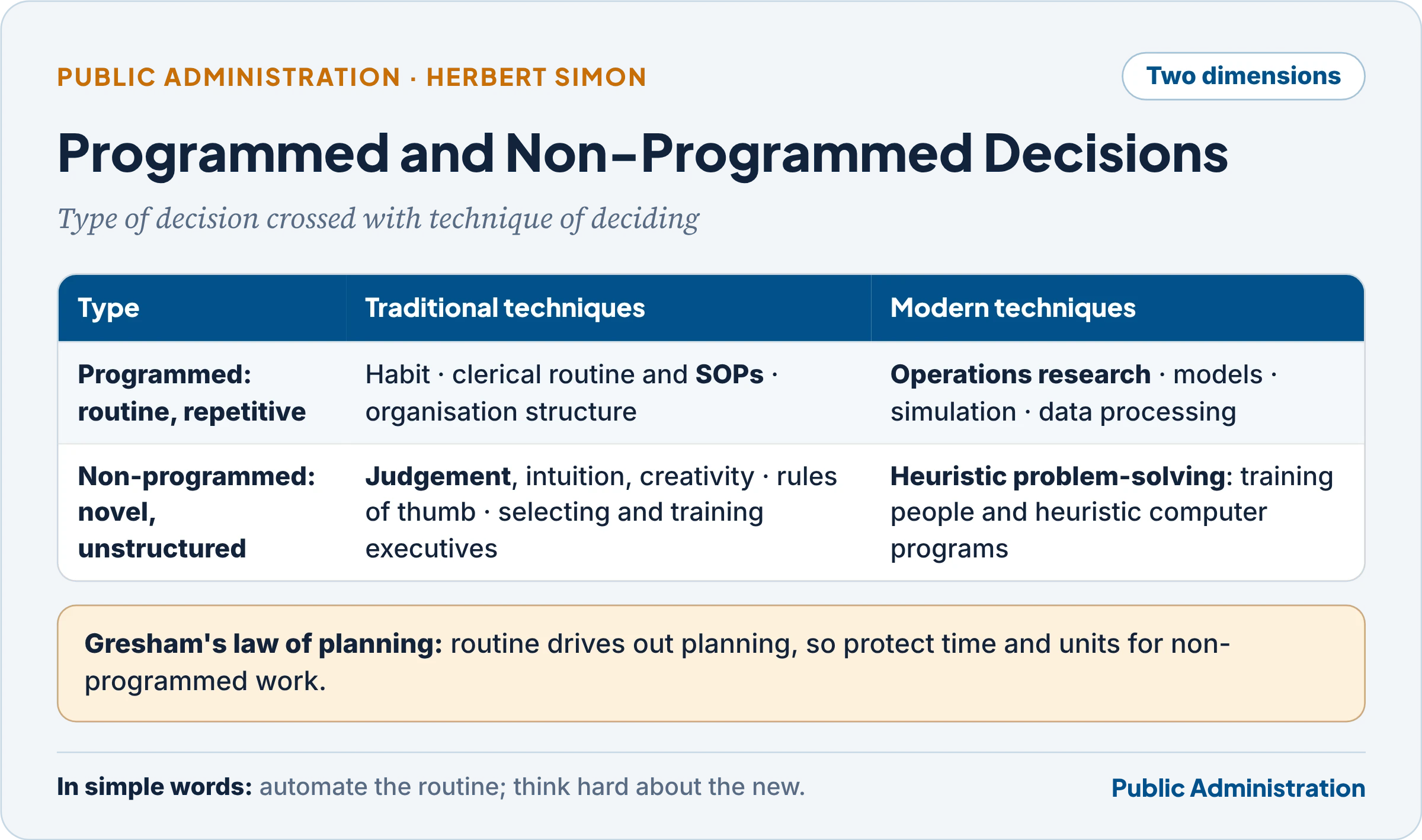
6.2 The two-dimensional taxonomy
Simon cross-classified types of decision with decision-making techniques:
| Types of decision | Traditional techniques | Modern techniques |
|---|---|---|
| Programmed (routine, repetitive; standard procedures) | Habit; clerical routine and standard operating procedures; organisation structure (common expectations, sub-goals, well-defined information channels) | Operations research (mathematical analysis, models, computer simulation); electronic data processing |
| Non-programmed (one-shot, ill-structured, novel) | Judgement, intuition and creativity; rules of thumb; selection and training of executives | Heuristic problem-solving techniques applied to (a) training human decision-makers and (b) constructing heuristic computer programs |
- Why two dimensions: the first dimension (programmed–non-programmed) describes the decision; the second (traditional–modern) describes the technique used to make it. The taxonomy showed how computers and management science were turning many once-judgemental decisions into programmed ones and, through heuristic programming, beginning to assist even non-programmed decisions.
- Gresham’s law of planning: March and Simon noted that “daily routine drives out planning“: just as bad money drives out good, programmed activity tends to drive out non-programmed activity. When a person faces both routine and highly unprogrammed tasks, the routine ones get attention first, and planning is postponed. Remedies include creating separate planning units and protecting time for strategic work.
Indian Connect — Programmed decisions and automation in India
- Faceless assessment: the Income Tax Department’s faceless assessment scheme (launched 13 August 2020) allocates cases by algorithm and standardises procedures: programmed decision-making with reduced discretion.
- Rule-based delivery: Direct Benefit Transfer, e-procurement through the Government e-Marketplace and online licensing convert many discretionary decisions into programmed ones.
- AI and governance: the India AI Governance Guidelines (5 November 2025) set principles (trust, people-centricity, accountability, understandability, safety) for AI use, including in public decisions, raising Simon’s question of which decisions should be programmed and who remains responsible.
7. Organisational Influence on the Individual
In simple words
A new officer soon “thinks like the department”: she uses its rules, trusts its data, values its goals and accepts its orders. Simon showed how the organisation shapes each person’s decisions without making them for her.
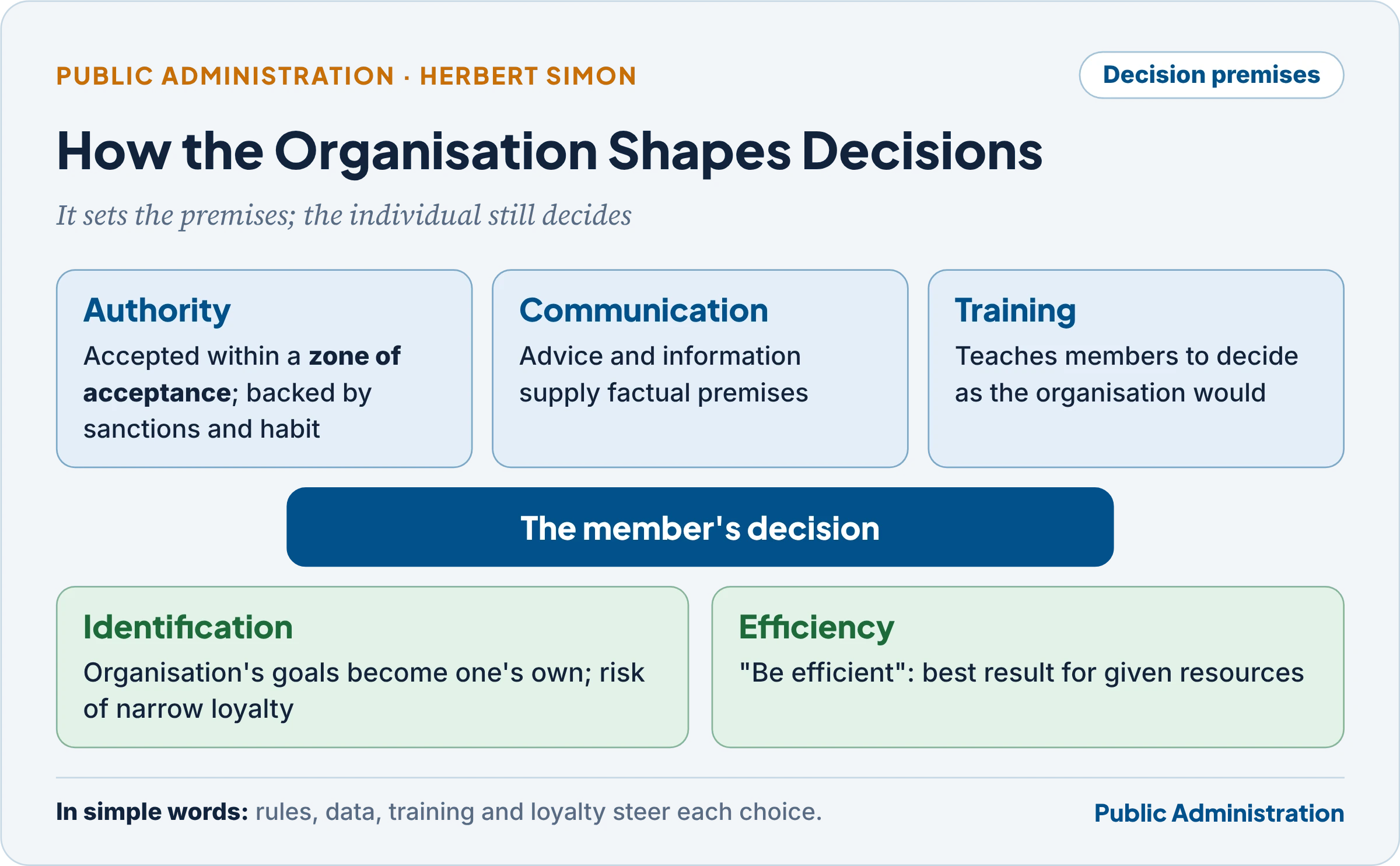
7.1 Decisions are made by individuals as members of organisations
- “Decisions are not made by ‘organisations’, but by ‘human beings’ behaving as members of organisations.” The organisation influences the premises of individual decisions; it does not replace the individual.
- Two kinds of influence:
- internal: establishing in the employee attitudes, habits and a state of mind that lead him to reach decisions advantageous to the organisation (loyalty, concern for efficiency, training);
- external: imposing on the employee decisions reached elsewhere (authority, advice and information).
7.2 Modes of organisational influence
| Mode | How it shapes decisions |
|---|---|
| Authority | The power to make decisions that guide the actions of another; accepted within a zone of acceptance |
| Communication (advice and information) | Supplies factual premises; formal and informal channels |
| Training | Equips members to decide as the organisation would, reducing the need for constant authority |
| The criterion of efficiency | “Be efficient”: choose the alternative that yields the greatest result for given resources |
| Organisational identification (loyalty) | Members take the organisation’s values as their own and decide in its interest |
7.3 Authority and the zone of acceptance
- Authority is the power to make decisions that guide the actions of another. A subordinate accepts authority when he allows his behaviour to be guided by the decision of a superior without independently examining its merits.
- Zone of acceptance: like Barnard’s zone of indifference, the range within which a subordinate accepts orders. Beyond it, disobedience follows. Its size depends on the sanctions available to authority, interpreted broadly: social sanctions (approval of the group), psychological acceptance, purpose (belief in the organisation’s goals), habit, and leadership, as well as formal sanctions of reward and punishment.
- Simon versus Barnard: both base authority on acceptance, but Simon gives more weight to sanctions, habit and institutionalised obedience; in practice, authority is liberally mixed with suggestion and persuasion. Simon recognises two levels of acceptance: of the plan of collective action, and of the authority of the manager.
- Functions of authority: it enforces responsibility (conformity to group norms), secures expertise in decisions, and permits coordination.
7.4 Specialisation and coordination
- Vertical specialisation: dividing decision-making functions among levels of a hierarchy. Simon gave three reasons:
- coordination: a common plan requires central decisions;
- expertise: decisions are allocated to those with the skills to make them;
- responsibility: operatives can be held accountable through the hierarchy to the board or legislature.
- Coordination may be procedural (specifying relationships and lines of authority: the organisation chart) or substantive (specifying the content of work: the blueprint of the engine).
7.5 Identification and the criterion of efficiency
- Identification: members identify with the organisation and judge alternatives by their consequences for it. Benefit: homogeneity and accountability. Problem: members take a narrow view of their unit’s interest and ignore the wider organisation; higher positions need a broader outlook.
- From Wilson to Simon: efficiency was the central value of the classical tradition: Wilson sought a businesslike administration; Taylor the “one best way”; Gulick called efficiency “axiom number one in the value scale of administration”; Weber’s bureaucracy was technically efficient. Simon kept efficiency as the criterion for factual decisions but redefined it as a neutral standard of the best result for given resources and placed it within bounded rationality; critics (Waldo, Dahl, New Public Administration) answered that equity and responsiveness rank with it.
- Efficiency: in the factual aspects of decisions, the administrator should choose the alternative that maximises results for given resources (“balance sheet efficiency”). The criterion is neutral as to goals. Simon later narrowed its scope, accepting that it applies mainly to lower-level decisions, where results can be measured.
7.6 Barnard and Simon on individual decisions and organisational authority
- Barnard: the individual decides whether to participate; inside the organisation he acts in an organisational capacity; authority depends on his acceptance; the executive’s task is to keep inducements above contributions and to inculcate a common purpose.
- Simon: the organisation sets the decision premises of members (through authority, communication, training, identification and efficiency); members accept authority within a zone of acceptance, supported by sanctions and habit; the individual remains the decision-maker.
- Common ground: both distinguish the decision to participate from decisions taken as a member; both see authority as consent-based; together they form the Barnard–Simon theory of organisational equilibrium.
7.7 The Barnard–Simon theory as a theory of motivation
- The theory: an organisation is a system of exchange: it offers inducements (pay, status, purpose) in return for contributions (work, money, loyalty). Each participant continues to participate only while inducements equal or exceed contributions, measured by his own values and alternatives. Contributions are the source of the inducements the organisation offers; the organisation is “solvent” only while contributions suffice to provide them.
- Why “essentially a theory of motivation”: March and Simon (1958) wrote this themselves. The theory explains why people join, stay and contribute, that is, the decision to participate and its variations (turnover, absenteeism), rather than structure or technology.
- Strengths: applies to all contributors (employees, customers, investors, citizens); explains survival; links motivation to organisational design.
- Limits: treats motivation as calculative exchange; under-explains intrinsic motivation and commitment; ignores power and constraints that prevent exit; says little about production decisions (how much effort once inside).
8. Simon, Computers and the Future of Decision-Making
In simple words
Simon helped build the first programs that could prove theorems. He predicted that computers would take over routine decisions and help managers with harder ones, which is now happening in government.
- Information as the central problem: Simon argued that the major problems of modern organisations are no longer the division of labour but the processing of information and the factorisation of decisions.
- Effects of computers:
- more decisions can be programmed, increasing organisational rationality;
- re-centralisation of decisions becomes possible, as information flows quickly to the top;
- the concept of delegating responsibility changes, and middle management may shrink;
- executives’ work becomes more satisfying as routine is automated.
- Attention as the scarce resource: in an information-rich world, “a wealth of information creates a poverty of attention”: the scarce resource is the decision-maker’s attention, not information.
- Today: data analytics, dashboards and AI systems in tax, welfare and policing realise Simon’s predictions, but also raise questions about accountability, bias and explainability that his factual, efficiency-centred model did not fully address.
9. Critique, the Behavioural Approach and Simon’s Contribution
In simple words
Simon gave public administration scientific tools, but critics said he left out what makes administration public: values, politics, justice and the citizen.
9.1 Criticism of Simon
- Positivism and the fact–value dichotomy: Dwight Waldo argued that administration is suffused with values and that a “value-free” science of administration is neither possible nor desirable; the dichotomy revives the politics–administration dichotomy. Robert Dahl stressed that normative values, individual personality and the social setting make a universal science of administration impossible.
- Exclusion of values trivialises the discipline: separating values reduces public administration to mechanical, routine and less significant matters.
- Efficiency as the master criterion: critics objected that efficiency is not the only goal; equity, responsiveness, satisfaction of interests and legality matter in public administration.
- Decision-making is not all: making decision-making the core neglects other aspects (structure, culture, power, implementation); political, social, economic and cultural factors are relegated to the background.
- Rationality over-emphasised: Chris Argyris criticised Simon for neglecting intuition, tradition and faith; others note emotion and politics.
- Satisficing as excuse: the concept may justify mediocre decisions.
- Abstract and general: the model provides a framework but not enough detail to guide organisation planners; elaborate search is often impossible in practice.
- More relevant to business than to public administration: consequences and costs of government actions are hard to measure (Golembiewski).
- Universality questioned: problems and objectives of administration differ across societies, especially in developing countries.
9.2 Identifying decision-making as the core, on a positivist base
- Logically acceptable: every administrative act involves choice; decisions link levels of the hierarchy; analysing decision premises explains how organisations work; decision-making connects public administration with economics, psychology and computer science.
- Problematic positivist underpinning:
- values cannot be banished from public decisions (equity, rights, justice are central);
- the choice of facts is value-laden;
- positivism excludes normative theory, which public administration needs (constitutional values, ethics);
- it encourages a technocratic view of administration that sidelines citizens and politics.
- Synthesis: decision-making remains a powerful lens, but it must be combined with normative and political analysis, as later policy sciences, New Public Administration and public value theory attempted.
9.3 The behavioural approach: weaknesses and shifts
- Weaknesses:
- scientism: preoccupation with method over relevance; quantification of the trivial;
- value neutrality: silence on justice, equity and the purposes of administration;
- micro focus: individual and group behaviour, neglect of the political and social environment;
- status quo bias: studying what is rather than what ought to be;
- limited utility for practitioners facing urgent, value-laden problems.
- Shifts made:
- post-behaviouralism: David Easton‘s 1969 “credo of relevance” called for relevance and action alongside rigour;
- New Public Administration (Minnowbrook, 1968): social equity, values, client focus;
- policy sciences (Lasswell, Dror): combining rational analysis with values and extra-rational processes;
- systems and contingency approaches: environment and situation;
- public choice and institutionalism: incentives and rules;
- behavioural public policy (nudges, behavioural insights): bounded rationality applied to citizens.
9.4 Administrative Behavior as a synthesis of classical and behavioural approaches
- Classical elements kept: hierarchy, authority, specialisation, coordination, efficiency as a criterion, the search for a science of administration.
- Behavioural elements added: decisions and their premises, psychology of choice, acceptance of authority, identification, informal communication, bounded rationality.
- The synthesis: Simon explained why classical structures work (they reduce complexity for boundedly rational people, set decision premises, factor decisions) and when they fail. In this sense, as later commentators said, Simon and March “somewhat unwittingly” provided the muscle and flesh to the Weberian skeleton (see the article on Weber).
9.5 Implications for the study and practice of public administration
- For the study: made public administration an empirical social science; introduced the decision as a unit of analysis; bridged public administration, business management, economics and psychology; inspired the Carnegie school (Cyert, March), Downs, Tullock, Crozier and Thompson.
- For the practice: decision analysis, management information systems, operations research and policy analysis entered government; professional training emphasised analytical skills; efficiency audits and performance measurement spread.
- For professionalism: the image of the public administrator as a professional decision-maker with expertise in factual premises, accountable to elected leaders for values.
- Caution: the same influence encouraged technocracy and neglect of values, which later movements had to correct.
9.6 Decision studies and the basic administrative processes
- The concern: decision studies have spread in many directions (game theory, operations research, behavioural economics, AI, policy analysis); specialists may lose sight of the basic processes Barnard and Simon described: how organisations secure cooperation, set decision premises, communicate, exercise authority and coordinate.
- Why this matters: technique without understanding of organisational context produces elegant models that do not change real decisions; the Barnard–Simon focus on the organisational setting of decisions keeps decision science administrative.
- “Decisional science” without integration: critics argue that decision theory studies structures, individual choices and feedback separately rather than as one integrated system. In Simon’s defence, his framework explicitly links structure (hierarchy as factored decisions), choice (bounded rationality) and feedback (review, aspiration adaptation); the fragmentation is in later specialised research more than in Simon.
Criticism — The case against Simon’s decision-making theory
- Positivist fact–value split banishes values from a value-laden field.
- Efficiency as master criterion ignores equity, legality and responsiveness.
- Too rational and linear; ignores politics, intuition and power.
- Decision-making alone cannot explain organisations.
- More suited to business than to public administration.
Defence — The case for Simon’s decision-making theory
- Realistic: bounded rationality and satisficing describe how decisions are actually made.
- Universal unit of analysis: decisions link every level of administration.
- Explains why structures, rules and training exist: to set premises for limited minds.
- Foundation of policy analysis, information systems, behavioural public policy and AI.
- Separating facts and values clarifies the roles of ministers and civil servants.
Key Terms
| Term | Meaning in simple words |
|---|---|
| Proverbs of administration | Classical principles that come in contradictory pairs |
| Decision premises | The factual and value assumptions from which a decision follows |
| Factual premise | A statement about the world that can be tested |
| Value premise | An expression of preference that cannot be proved |
| Logical positivism | Philosophy that only testable statements are scientifically meaningful |
| Means–ends chain | Each goal is a means to a further goal |
| Intelligence, design, choice | Simon’s three phases of decision-making |
| Bounded rationality | Rationality limited by knowledge, time and mental capacity |
| Satisficing | Choosing the first alternative that is good enough |
| Aspiration level | The standard a satisfactory alternative must meet; it adapts with experience |
| Administrative man | Satisficing decision-maker with bounded rationality |
| Economic man | Maximising decision-maker with perfect knowledge |
| Programmed decision | Routine decision with a set procedure |
| Non-programmed decision | Novel, unstructured decision needing judgement |
| Gresham’s law of planning | Routine work drives out planning |
| Zone of acceptance | Range within which a subordinate accepts orders |
| Organisational identification | Adopting the organisation’s goals as one’s own |
| Criterion of efficiency | Choosing the alternative with the greatest result for given resources |
| Vertical specialisation | Division of decision functions among hierarchical levels |
| Procedural and substantive coordination | Coordination of relationships and of work content |
Contemporary Developments
- 5 November 2025: MeitY released the India AI Governance Guidelines with seven guiding principles, raising questions of accountability for programmed and AI-assisted public decisions.
- 13 August 2020 onwards: faceless assessment in income tax has turned discretionary assessments into algorithmically allocated, programmed processes.
- 2018–19 onwards: behavioural insights (the Economic Survey’s “Homo Sapiens, not Homo Economicus” chapter) have entered policy design in India, applying bounded rationality to citizens.
- Continuing: data dashboards, GIS platforms and project monitoring systems widen the information available to decision-makers, pushing back but never removing the bounds of rationality.
Revision Grid
| Thinker / body | Work or report (year) | Key idea |
|---|---|---|
| Herbert Simon | “The Proverbs of Administration” (1946) | Principles are contradictory proverbs |
| Herbert Simon | Administrative Behavior (1947) | Decision premises; facts and values; bounded rationality |
| Herbert Simon | Models of Man (1957) | Satisficing |
| March and Simon | Organizations (1958) | Inducements–contributions; Gresham’s law of planning; “muscle and flesh” |
| Herbert Simon | The New Science of Management Decision (1960) | Intelligence–design–choice; programmed decisions |
| Herbert Simon | Nobel Prize (1978) | Decision-making in economic organisations |
| Dwight Waldo | Simon–Waldo debate (1952) | Values cannot be excluded |
| Robert Dahl | “The Science of Public Administration” (1947) | Values, personality, social setting |
| Charles Lindblom | “The Science of ‘Muddling Through'” (1959) | Incrementalism (not Simon’s term) |
| Cohen, March and Olsen | Garbage can model (1972) | Decisions in organised anarchies |
| David Easton | Credo of relevance (1969) | Post-behaviouralism |
| Economic Survey | 2018–19 | Behavioural economics in policy |
Previous Year Questions
- 2025Is Herbert Simon justified in criticizing some principles of administration as proverbs? Analyse.
- 2021Two-dimensional taxonomy was used by Herbert Simon to describe the degree to which decisions are programmed or non-programmed.” Explain.
- 2021Behavioural approach has been questioned on the basis of its utility in the analysis of administrative problems. Discuss the weaknesses of the approach and the shifts made therein.
- 2020Administrative man bridges the psychological man and the rational man. Explain.
- 2018“Herbert Simon’s book Administrative Behavior presents a synthesis of the classical and behavioural approaches to the study of Public Administration.” Explain.
- 2013“Decisions are not made by ‘organizations’, but by ‘human beings’ behaving as members of organizations.” How do Bernard and Simon conceptualize the relation between the decisions of the individual employee and the organizational authority?
- 2012‘Three features characterize Simon’s original view of bounded rationality: search for alternatives, satisficing, and aspiration adaptation.’ Elucidate.
- 2010“Simon’s identifying decision-making as the core field of public administration appears logically acceptable but his positivist underpinning is problematic.” Critically examine the statement.
- 2009“The Barnard – Simon Theory of Organisation is essentially a theory of motivation. “Comment.
- 2009From Woodrow to Herbert Simon most writers on administration have taken the achievement of efficiency as the central objective. Justify the statement with references to the work of major writers.
- 2006“Simon’s work has had major implications for the study of public administration and the practice of public administration professionalism.” Comment.
- 2001The ‘decision-making scheme’ and ‘satisfying model’ of Herbert A Simon is the major component of administrative theory. Comment.
- 2000“Administrative efficiency is enhanced by keeping at a minimum the number of organizational levels through which a matter must pass before it is acted upon.” –(Herbert A. Simon) Comment.
- 1999“The basic question in the relationship between political and permanent executives is the separation of facts and values at the operational level.” Comment.
- 1995“The study of decision-making is proceeding in so many directions that we can lose sight of the basic administrative processes that Barnard and Simon were trying to describe and that so many men have been trying to improve.” Elucidate.
- 1994“As March and Simon point out, there seems to exist a ‘Gresham’s Law’ of decision-making.” Explain.
- 1993“Though somewhat unwittingly, Herbert Simon and James March have provided, the muscle and the flesh to the Weberian (bureaucratic) skeleton. “Comment.
- 1992‘Simon explains that decision-making basically involves choice between alternative plans of action and choice in turn, involves facts and values.’ Comment.
- 1989Argue for and against the Simonian perspective that the “decisional science envelopes decisional structure, decisions and their feedback not in an integrated manner but anything other than that.”
- 1988Discuss the Simonian concept of ‘satisfying’ as a bridge between rational and non-rational perspectives on organizations.
- 1987‘The first stage (in administrative decision-making) is what I call “Intelligence”, the second represents “Designin” and the last stage is “Choice”. Critically examine the Simonian Model of Rational Decision-Making in administration.