

Administrative Thought: Scientific Management and Scientific Management movement; Classical Theory; Weber’s bureaucratic model – its critique and post-Weberian Developments; Dynamic Administration (Mary Parker Follett); Human Relations School (Elton Mayo and others); Functions of the Executive (C.I. Barnard); Simon’s decision-making theory; Participative Management (R. Likert, C. Argyris, D. McGregor).
This article: Barnard’s life and works; the organisation as a cooperative system; formal and informal organisation; effectiveness and efficiency; the economy of incentives and the contribution–satisfaction equilibrium; acceptance theory of authority and the zone of indifference; communication; decision-making and strategic factors; the functions of the executive; executive responsibility and morality; Barnard and the systems approach; critique and contribution.
Official Syllabus: Paper I · Unit 1-02 Administrative Thought
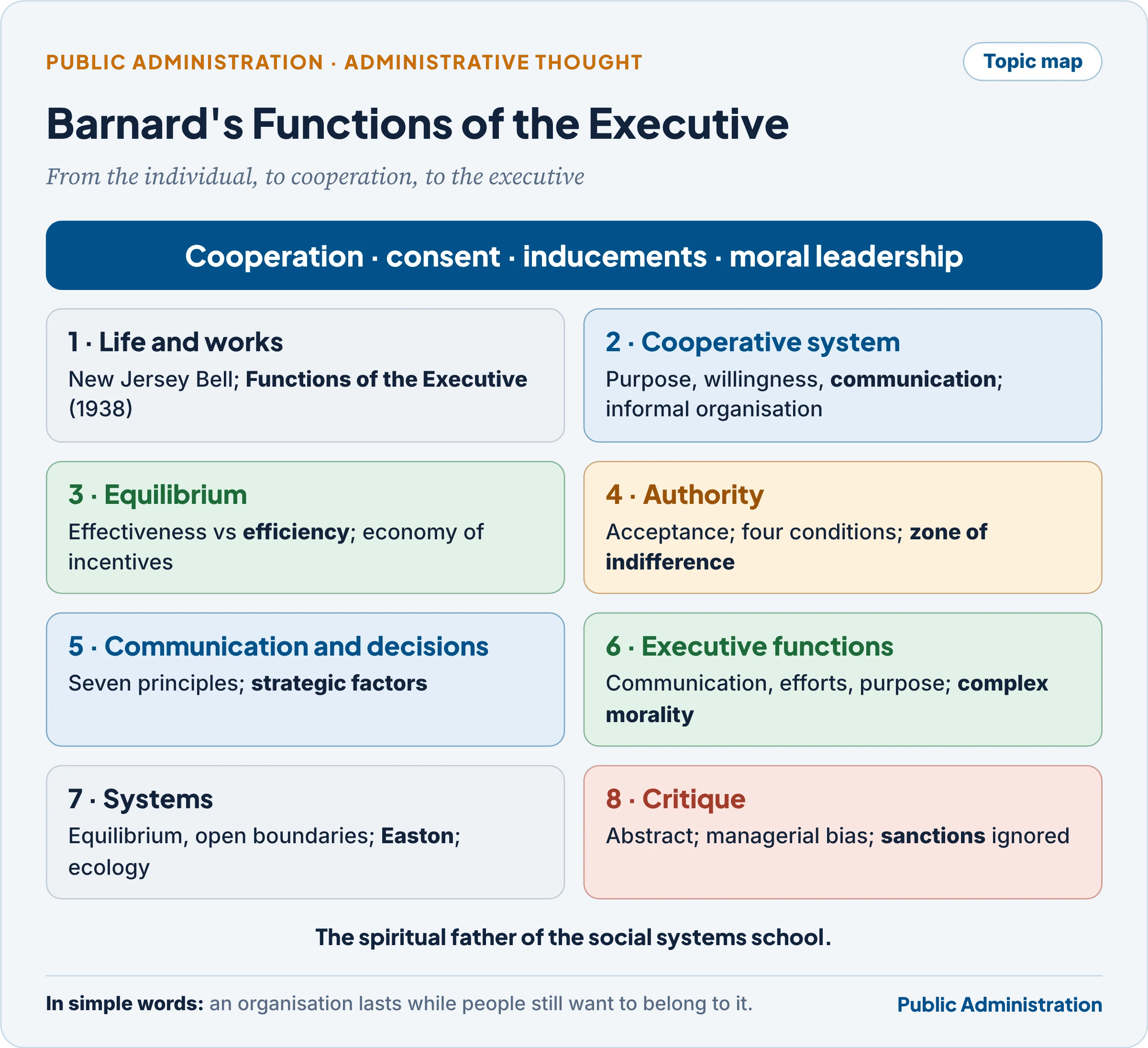
Chester Irving Barnard (1886–1961) was a telephone company president, not a professor, yet his book The Functions of the Executive (1938) became one of the most influential works in organisation theory. Where the classical writers began with the structure and Mayo with the work group, Barnard began with the individual, moved to cooperation, and ended with the executive, whose job is to keep a cooperative system alive.
- His core ideas: an organisation is a system of consciously coordinated activities; it survives only if it is both effective (achieves its purpose) and efficient (satisfies its members’ motives); authority rests on acceptance by those who receive orders; and the executive’s special work is communication, securing contributions and defining purpose, under a moral responsibility.
- His place in thought: the bridge from human relations to the behavioural and systems approaches. Herbert Simon built directly on him; he is called the spiritual father of the social systems school.
In simple words
A Gram Panchayat runs a water scheme. Households pay a user fee and help maintain pipes (contributions) because they get reliable water and a say in decisions (inducements). If the water stops or the sarpanch ignores them, they stop paying and the scheme collapses. Barnard saw every organisation like this: it lasts only while what it gives its members is worth what it asks of them.
1. Life and Works
In simple words
Barnard wrote from forty years of running a real organisation. His theory is a practitioner’s attempt to explain what executives actually do.
- Career: joined the American Telephone and Telegraph Company (AT&T) in 1909; president of the New Jersey Bell Telephone Company from 1927 until 1948; directed the New Jersey state relief system during the Depression; president of the United Service Organizations (USO), 1942–1945; president of the Rockefeller Foundation, 1948–1952; chairman of the National Science Foundation, 1952–1954.
- Intellectual circle: at Harvard he belonged to the group around L.J. Henderson that studied the Italian sociologist Vilfredo Pareto‘s idea of the social system in equilibrium; he knew Mayo’s work and absorbed many of Follett’s ideas.
- Works:
- The Functions of the Executive (1938), developed from lectures at Boston’s Lowell Institute (1937); the thirtieth-anniversary edition (1968) carries an introduction by Kenneth R. Andrews;
- Organization and Management (1948), selected papers.
- Structure of The Functions of the Executive: it moves from the individual and the limits of individual action, to cooperative systems, to formal organisation, to the elements of organisation, and finally to the functions and responsibility of the executive.
2. Organisation as a Cooperative System
In simple words
One person cannot lift a heavy log. Two can, if they agree to lift together, want to do it, and can signal “now”. Purpose, willingness and communication: Barnard found these three in every organisation.
2.1 Why cooperation arises
- Individuals have limited physical and biological capacities; to overcome these limits they cooperate. A cooperative system is a complex of physical, biological, personal and social components bound together by cooperation for at least one definite end.
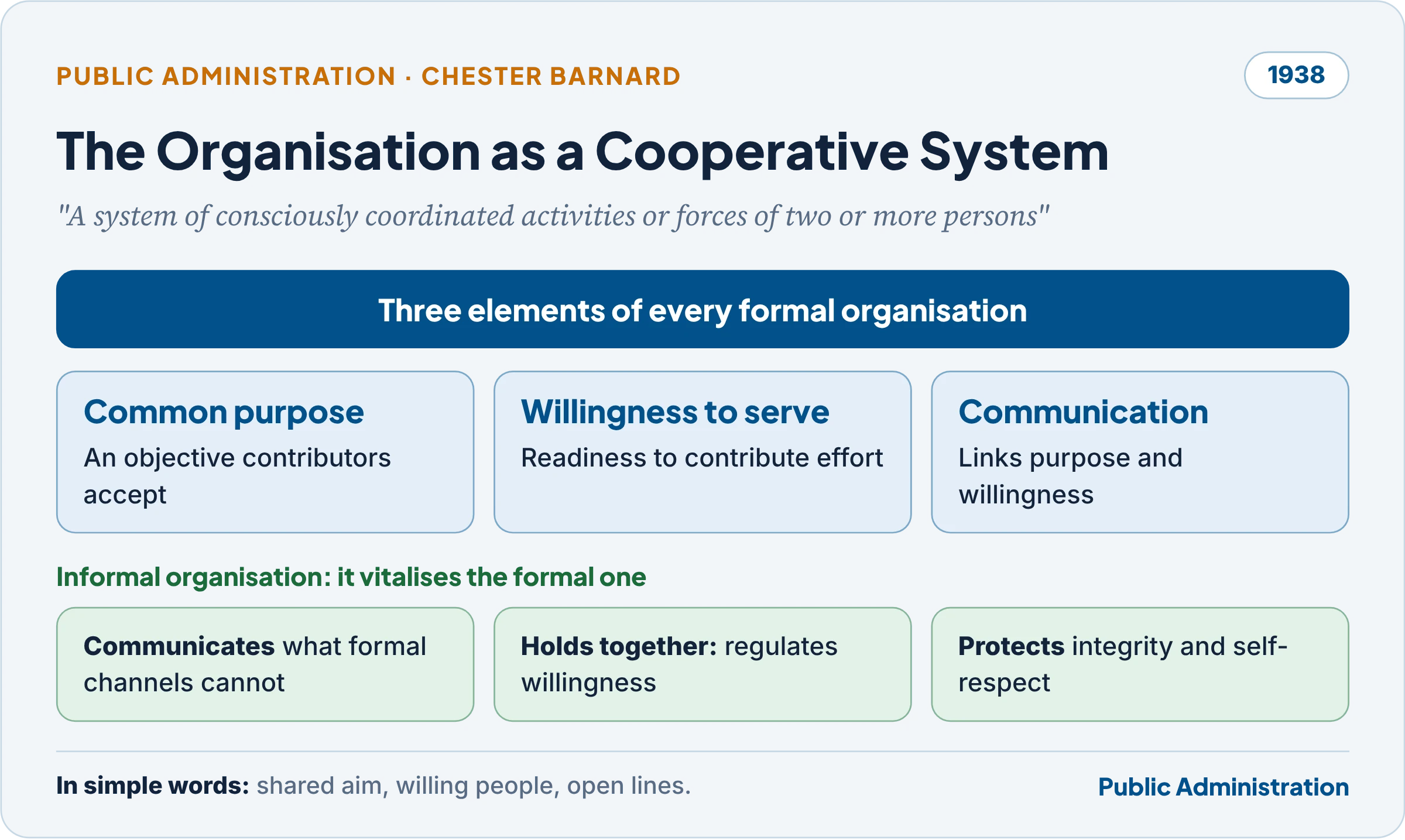
- Within every cooperative system lies a formal organisation, which Barnard defined as “a system of consciously coordinated activities or forces of two or more persons“.
2.2 The meaning of the definition
- Activities, not persons: the organisation consists of the coordinated activities of people, not the people themselves. A person contributes some activities and keeps the rest of their life outside.
- Contributors beyond employees: customers, suppliers, investors and citizens also contribute activities, so the boundary of an organisation is wider than its staff list.
- Conscious coordination: activities are deliberately coordinated towards a purpose; this distinguishes formal organisation from a crowd.
- A system: a change in one part affects the whole; the organisation is a dynamic whole in equilibrium with its environment.
2.3 Three elements of formal organisation
| Element | Meaning | Why essential |
|---|---|---|
| Willingness to serve (cooperate) | Readiness of individuals to contribute their efforts; the surrender of personal control of conduct | No organisation exists without contributors; willingness fluctuates with net satisfaction |
| Common purpose (objective) | An objective accepted by contributors as the purpose of cooperation | Without a purpose, willingness cannot be directed; the executive must inculcate belief in it |
| Communication | The process that links purpose and willingness | Translates purpose into action; “the first executive function” |
- Barnard on coordination: a fuller analysis shows that communication, authority, specialisation and purpose are all aspects of coordination. Communication links people; authority is a property of communication; specialisation is the way the work is divided and coordinated (by place, time, persons, things and methods); purpose gives coordination its direction.
2.4 Formal and informal organisation
- Informal organisation: “the aggregate of the personal contacts and interactions and the associated groupings of people”. It has no conscious joint purpose, but it produces customs, attitudes and norms.
- Informal precedes and conditions formal: informal organisation is the natural system out of which formal (artificial) organisation arises; once formal organisation exists, it creates informal organisations in turn. “There cannot be one without the other. If one fails the other disintegrates.”
- Three functions of informal organisation within formal organisation:
- communication of intangible facts, opinions, suggestions and suspicions that cannot pass through formal channels without raising issues;
- maintenance of cohesiveness by regulating the willingness to serve and the stability of objective authority;
- maintenance of the feeling of personal integrity, self-respect and independent choice: a means of preserving the personality against the disintegrating effects of formal organisation.
3. Effectiveness, Efficiency and the Contribution–Satisfaction Equilibrium
In simple words
A school may produce excellent results (effective) while its teachers are so unhappy that they all resign (inefficient, in Barnard’s sense). Both conditions must hold for the school to survive.
3.1 Two conditions of survival
- Effectiveness: the degree to which the organisation accomplishes its cooperative purpose; a system-level, impersonal criterion.
- Efficiency: in Barnard’s special sense, the degree to which the organisation satisfies the personal motives of its contributors; a personal criterion, judged by each individual.
- Why organisations are short-lived: most organisations fail because they cannot remain both effective and efficient. Barnard noted that very few last long (the Roman Catholic Church was his exception).
- The specialised definition: “the efficiency of an organisation is its capacity to offer effective inducements in sufficient quantity to maintain the equilibrium of the system“. Efficiency is thus not output per unit of input (Taylor) but the organisation’s ability to keep its contributors contributing.
3.2 Analysing the 2023 statement
- What it means: an organisation is “efficient” when the inducements it offers (pay, status, pride, belonging, purpose) are enough to call forth the contributions it needs from every class of contributor. If inducements fall short, contributors withdraw (resign, slacken, stop buying, stop investing) and the system loses equilibrium.
- Why “specialised sense”: it departs from the engineering and economic meaning of efficiency; it is subjective (each contributor decides whether he is satisfied) and relational (it concerns the exchange between the person and the organisation).
- Implications:
- the executive must manage an economy of incentives, not only a production process;
- organisational efficiency and effectiveness can conflict: squeezing contributors to meet targets may destroy willingness;
- the same logic applies to public organisations: citizens’ trust and compliance, staff morale and partners’ cooperation are all “contributions” sustained by inducements.
- Limits: it is hard to measure; it may ignore power (contributors who cannot exit stay even when dissatisfied); and it says little about the public value of the purpose.
3.3 The economy of incentives
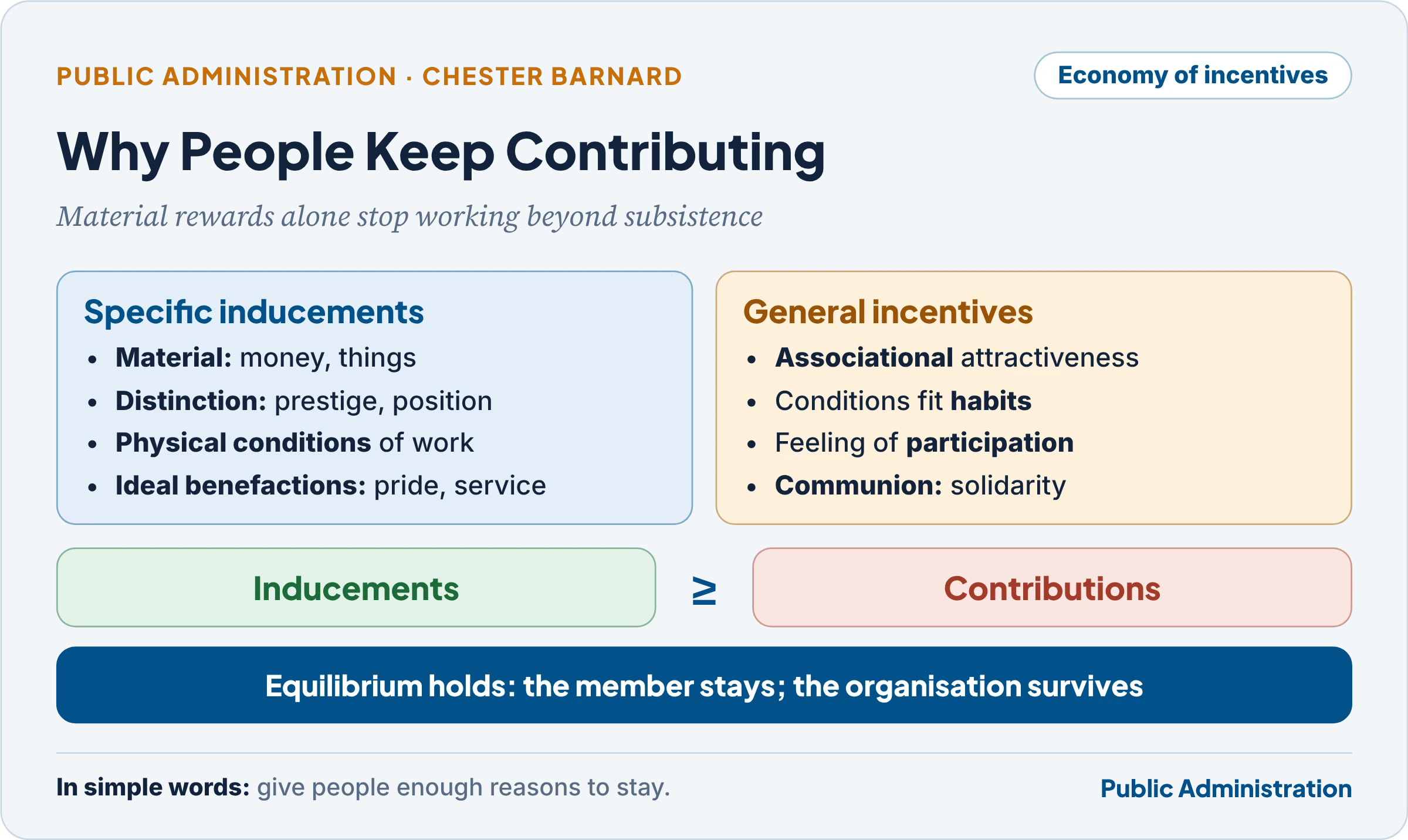
Barnard argued that the classical reliance on money is mistaken: “material rewards are ineffective beyond the subsistence level”; people need a range of incentives.
| Specific inducements (offered to particular individuals) | General incentives (inherent in the organisation) |
|---|---|
| Material inducements: money, things, physical conditions of life | Associational attractiveness: social compatibility with fellow workers |
| Personal, non-material opportunities for distinction: prestige, power, position | Adaptation of conditions to habitual methods and attitudes |
| Desirable physical conditions of work | Opportunity for the feeling of enlarged participation in the course of events |
| Ideal benefactions: pride of workmanship, loyalty, altruistic service, satisfaction of ideals | Condition of communion: comradeship, mutual support, solidarity |
- Methods of persuasion: when incentives are insufficient, the organisation can try to change people’s desires through coercion, rationalisation of opportunity (propaganda that makes the opportunity look attractive) and inculcation of motives (education, training, socialisation into values).
- The contribution–satisfaction equilibrium: each contributor continues to participate only while the inducements offered are equal to or greater (in his own valuation) than the contributions he is asked to make. The organisation survives only while this equilibrium is maintained for all its contributors.
- March and Simon (Organizations, 1958) formalised this as the inducements–contributions theory of organisational equilibrium and remarked that “the Barnard–Simon theory of organizational equilibrium is essentially a theory of motivation”: a theory of the decision to participate.
Indian Connect — Barnard’s inducements in Indian public employment
- Material inducements: the 8th Central Pay Commission, constituted on 3 November 2025 under Justice Ranjana Prakash Desai, has terms of reference that include an emolument structure “conducive to attracting talent to Government service, promoting efficiency” and a performance-linked incentive scheme: Barnard’s specific inducements in policy form.
- Non-material inducements: awards for excellence in public administration, recognition on Civil Services Day, prestige of the services and opportunities for distinction.
- Ideal benefactions: the public service motive (serving the country, helping citizens) is a powerful inducement in civil services and among frontline workers.
- Equilibrium under strain: resignations from technical posts, vacancies in specialised cadres and voluntary retirement show what happens when inducements fall below contributions.
4. The Acceptance Theory of Authority
In simple words
An order that nobody obeys has no authority, however senior the person who gave it. Barnard said authority is really decided by the person who receives the order, not the one who gives it.
4.1 Definition
- “Authority is the character of a communication (order) in a formal organisation by virtue of which it is accepted by a contributor to or ‘member’ of the organisation as governing the action he contributes.”
- Two aspects: a subjective aspect (the personal acceptance of a communication as authoritative) and an objective aspect (the character of the communication by which it is accepted).
- Implication: the decision whether an order has authority lies with the person to whom it is addressed, not with the persons of authority who issue it. This reverses the classical, top-down view of Weber and Fayol.
4.2 Four conditions of acceptance
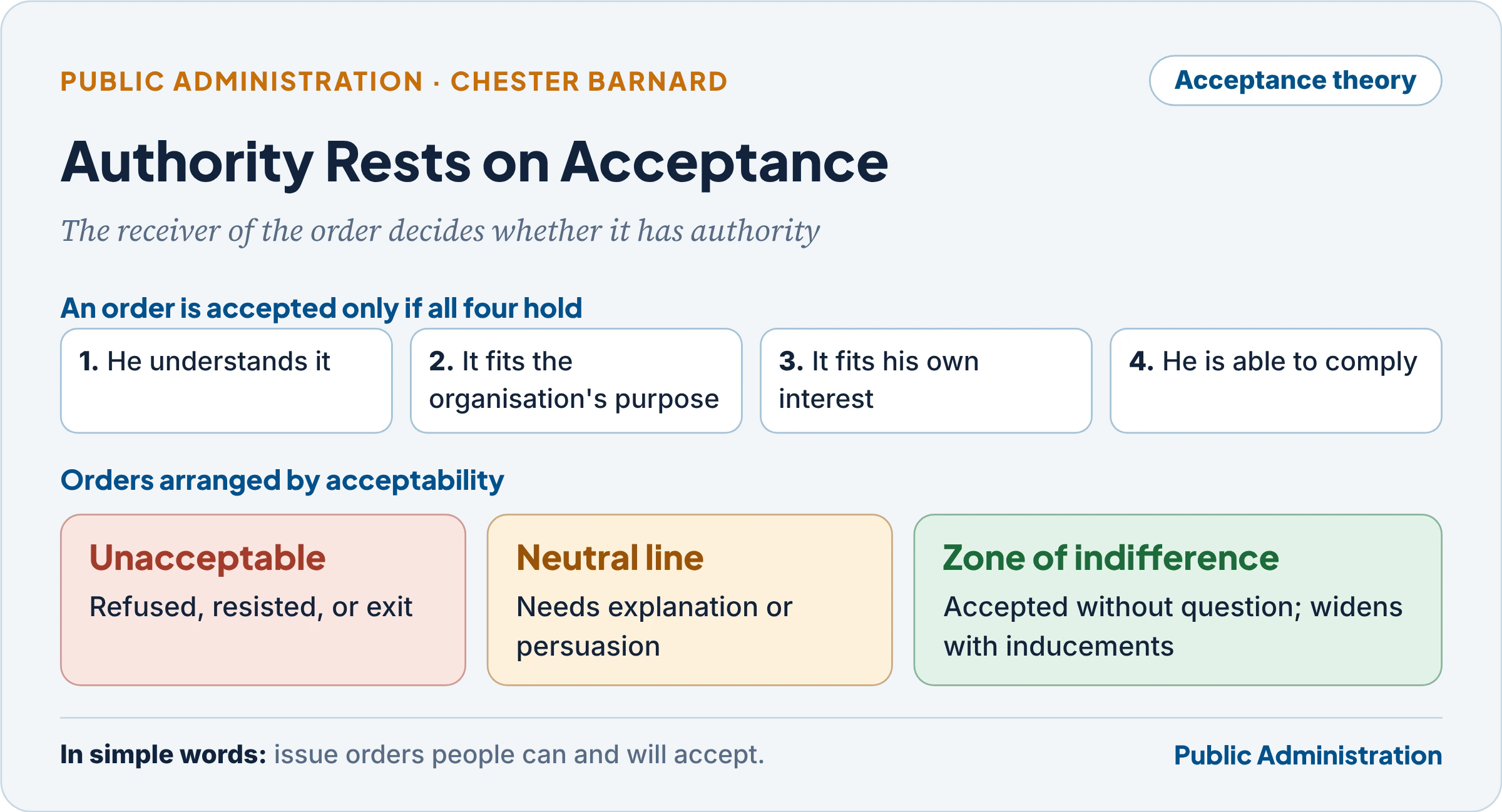
A person can and will accept a communication as authoritative only when all four conditions hold at the same time:
- he can and does understand the communication;
- at the time of decision, he believes it is not inconsistent with the purpose of the organisation;
- at the time of decision, he believes it is compatible with his personal interest as a whole;
- he is able, mentally and physically, to comply with it.
4.3 The zone of indifference
- If all orders were arranged by their acceptability, some would be clearly unacceptable, some on the neutral line (barely acceptable or barely unacceptable), and a third group unquestionably acceptable. This last group lies within each person’s zone of indifference: orders in it are accepted without conscious questioning of authority.
- Some texts describe the three ranges as zones of resistance, compliance (accepted with persuasion, often through informal leaders) and indifference.
- Width of the zone: it varies with the excess of inducements over burdens and sacrifices; the more a person values membership, the wider the zone.
- Role of the group: the informal organisation and group opinion widen the zone: people accept orders their colleagues accept.
- Executive implication: wise executives issue only orders that will be accepted, explain orders that lie near the neutral line, and widen the zone through incentives, communication and trust.
4.4 The fiction of superior authority
- Why, then, does authority appear to flow from the top? Barnard called this the fiction of superior authority. It is useful:
- it lets individuals accept orders without taking personal responsibility for every decision (they delegate upward the responsibility for the organisation’s judgement);
- it reflects the reality that the group’s interest supports authority: those who obey resent those who refuse an order that the group accepts.
- Objective authority does exist in two forms: authority of position (communications from a high position are presumed authoritative) and authority of leadership (communications from a person of superior knowledge and ability are accepted regardless of position). When both coincide, the authority is strongest.
4.5 The zone of indifference in modern organisations
- Why it animates cooperation: most day-to-day orders (attend this meeting, process these files, visit that site) fall within the zone; this routine acceptance is what makes large organisations workable without constant bargaining.
- Where it breaks down: orders that are illegal, unethical, unsafe or seen as unfair fall outside the zone and invite resistance, leaks, litigation or exit.
- Modern relevance: knowledge workers’ zones are narrower for matters within their expertise (they expect reasons); gig workers’ zones are shaped by algorithmic control and the ease of exit; public servants’ zones are bounded by law and conduct rules.
- Critique: the theory understates sanctions, dependence and unequal power: people may “accept” orders because they cannot afford to refuse. Simon later blended acceptance with sanctions in his zone of acceptance (see the article on Simon).
4.6 Weber and Barnard on authority
| Basis | Weber | Barnard |
|---|---|---|
| Source | Legitimacy of the legal order and office (top-down) | Acceptance by the subordinate (bottom-up) |
| Nature | Objective, attached to position | Subjective, a character of the communication |
| Compliance | Disciplined obedience within rules | Acceptance within the zone of indifference |
| Organisation | Formal hierarchy, impersonal rules | Cooperative system, formal and informal |
| Common ground | Both rest on consent of a kind: Weber’s legitimacy is belief by the ruled; Barnard concedes objective authority of position |
- Assessment: Weber explains why commands can claim obedience and how authority is structured; Barnard explains when commands actually work. Weber neglects the subordinate’s judgement; Barnard neglects sanctions and the legal-rational framework (see the article on Weber).
Common confusion
Does the acceptance theory mean that subordinates can ignore any order they dislike? No. Barnard was describing where authority actually comes from, not recommending disobedience. Most orders fall within the zone of indifference and are accepted routinely; the fiction of superior authority and group pressure support obedience. The theory warns executives that authority rests on consent, so orders that people cannot understand, see as against the organisation’s purpose or their own interest, or cannot carry out will fail, whatever the rank of the person who issues them.
Indian Connect — Authority and acceptance in Indian administration
- Written orders: in T.S.R. Subramanian v. Union of India (31 October 2013), the Supreme Court directed that civil servants act on written instructions and record oral instructions, protecting officers from orders outside the zone of legitimate acceptance.
- Conduct rules: the CCS (Conduct) Rules, 1964 (Rule 3) require a government servant to act on his best judgment except when acting under the direction of an official superior, and to obtain written confirmation of oral directions: a legal boundary to the zone of indifference.
- Exit and voice: service litigation before tribunals, whistle-blowing complaints under the Whistle Blowers Protection Act, 2014, and premature retirement are forms of non-acceptance when orders cross the line.
5. Communication and Decision-Making
In simple words
An organisation is a conversation that never stops. If messages do not get through, or come from the wrong person, nothing gets done.
5.1 Seven principles of communication
To establish and maintain objective authority, Barnard laid down that:
- the channels of communication should be definitely known;
- there should be a definite formal channel of communication to every member;
- the line of communication should be as direct and short as possible;
- the complete formal line should normally be used (no skipping of links);
- the persons serving as communication centres (officers, supervisors) should be competent;
- the line of communication should not be interrupted while the organisation is functioning;
- every communication should be authenticated (it must be clear that it comes from an authorised position).
5.2 Decision-making
- Organisational versus personal decisions: organisational decisions are the result of deliberation, calculation and thought, dominated by organisational purpose; personal decisions (to participate or not) are largely subconscious and responsive. Organisational decisions are therefore more logical than personal ones. Barnard was among the first to study decision-making as the core of organisation, and Simon took this up.
- Occasions for decision: decisions arise from authoritative communications from superiors, from cases referred by subordinates, and from cases originating in the initiative of the executive (the most important test of executive capacity).
- Strategic factors: in any situation, the decision-maker must identify the strategic (limiting) factor, the one whose control, in the right form, place and time, will establish a new system of conditions that meets the purpose. Analysing a situation means distinguishing relevant from irrelevant or hostile factors.
- The fine art of executive decision: “consists in not deciding questions that are not now pertinent, in not deciding prematurely, in not making decisions that cannot be made effective, and in not making decisions that others should make.”
5.3 Barnard and Simon: individual decisions and organisational authority
- Two decisions: both distinguish the individual’s decision to participate (join, stay, contribute) from the decisions made as a member, which are guided by organisational purpose.
- Barnard: organisational decisions are made by individuals acting in an organisational capacity; authority depends on their acceptance; inducements decide participation.
- Simon: the organisation sets the premises of members’ decisions through authority, communication, training, identification and the criterion of efficiency; members accept authority within a zone of acceptance, supported by sanctions as well as consent. “Decisions are not made by organisations but by human beings behaving as members of organisations.”
- Together: the individual remains the decision-maker; the organisation shapes his decisions without replacing them. Later work (Cyert and March) extended this to organisational decision-making as bargaining among coalitions (see the article on Simon).
6. The Functions of the Executive
In simple words
A manager makes sure today’s work gets done. An executive, in Barnard’s sense, keeps the whole organisation alive: people willing to work, a purpose they believe in, and messages that reach everyone.
6.1 Three essential functions
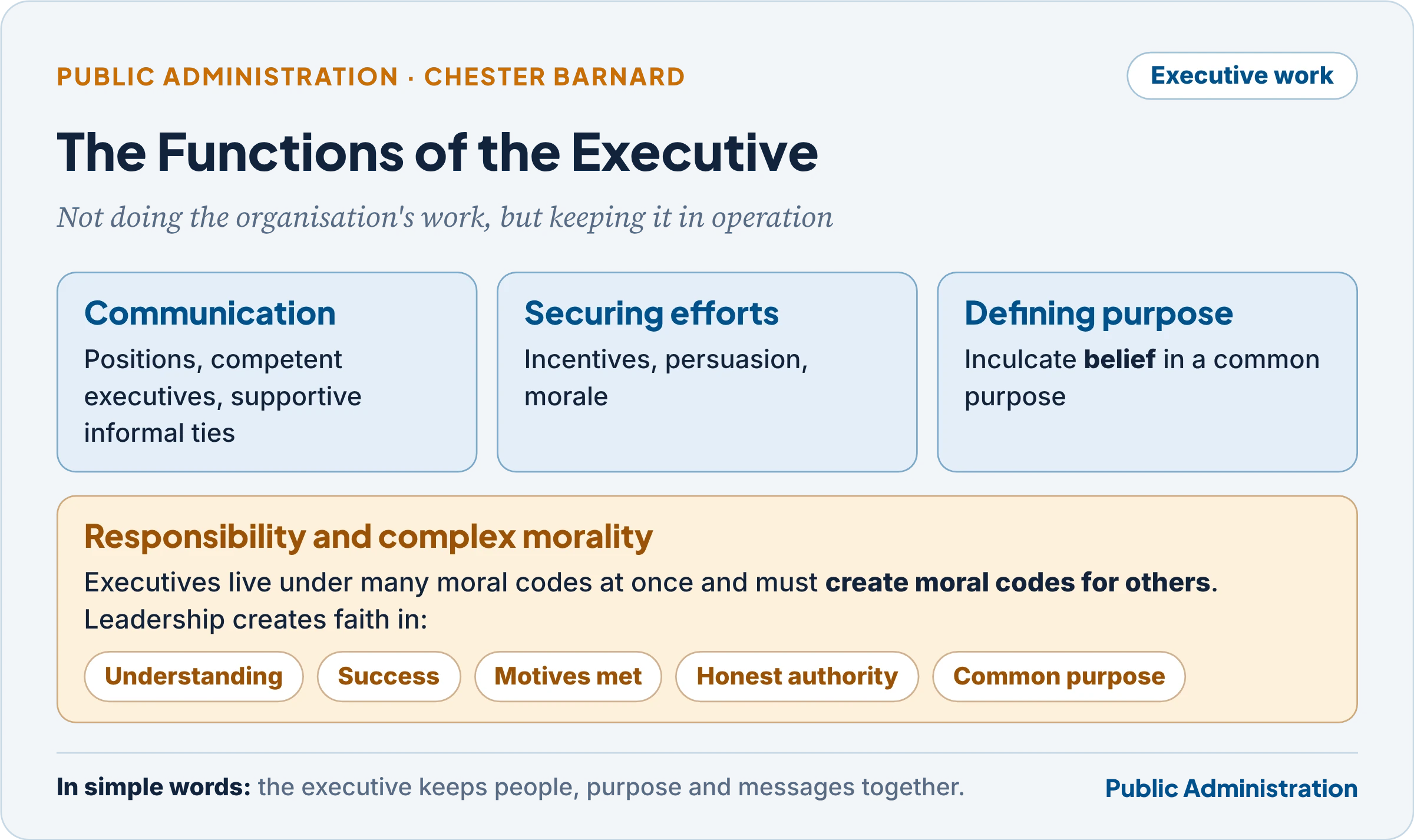
- Executive work “is not that of the organisation, but the specialised work of maintaining the organisation in operation“. Its three essential functions are:
- providing a system of communication: defining positions, selecting and developing executives (the people at communication centres), and fostering informal organisation that supports formal channels;
- promoting the securing of essential efforts: bringing people into cooperative relationships and eliciting their services through incentives, persuasion and morale;
- formulating and defining purpose: stating objectives and, crucially, inculcating belief in the real existence of a common purpose throughout the organisation; purpose is defined by the whole organisation, with the executive coordinating its translation into specific aims at every level.
- Inculcating belief in a common purpose: members have their own motives; they cooperate only if they believe a common purpose exists and is worth serving. The executive’s task is to make the purpose real and shared, through communication, example and moral leadership. Without this belief, the organisation becomes a collection of self-interested individuals and loses cohesion.
6.2 Executive responsibility and morality
- Responsibility: “the power of a particular private code of morals to control the conduct of the individual in the presence of strong contrary desires or impulses”. It gives dependability and determination to conduct.
- Complex morality: executives live under many moral codes at once: personal, professional, organisational, legal and public. “Executive positions imply a complex morality and require a high capacity of responsibility“; they also require the ability to create moral codes for others (an organisational morality) and to resolve conflicts among codes.
- The creative function: leadership is the creation of faith: in common understanding, in the probability of success, in the ultimate satisfaction of personal motives, in the integrity of objective authority, and in the superiority of common purpose. Barnard saw this moral, creative function as “the essence of leadership” and the condition of an organisation’s endurance.
- Why the executive’s role exceeds the manager’s:
- the manager administers tasks and resources; the executive maintains the cooperative system as a whole;
- the manager follows given purposes; the executive defines purpose and makes it believed;
- the manager supervises; the executive builds communication systems, informal organisation and morale;
- the manager applies rules; the executive creates moral codes and resolves conflicts among them;
- this is how Barnard “injected the social” into the study of organisation: the executive deals with social facts (cooperation, consent, belief), not only technical ones.
- Realist and idealist: the leader must be a realist (recognising the need for action in concrete conditions) and an idealist (weighing the moral factors in decisions).
Indian Connect — Barnard’s executive in Indian administration
- Defining purpose: district Collectors and secretaries translate national missions (sanitation, digital payments, nutrition) into local purposes and build belief in them among field staff and citizens.
- Communication system: e-Office, review meetings and platforms such as PRAGATI create direct channels; Barnard’s principles (definite, short, authenticated lines) apply to digital file systems as much as to paper.
- Morality and responsibility: the 2nd ARC’s fourth report, Ethics in Governance (2007), recommended a code of ethics for civil servants; executive leadership in India must balance legality, political direction, professional judgment and public interest: Barnard’s “complex morality”.
7. Barnard and the Systems Approach
In simple words
A systems view treats an organisation like a living body: parts depend on one another, and the whole keeps adjusting to its surroundings to survive. Barnard thought about organisations this way before “systems theory” became a field.
7.1 Systems elements in Barnard
- Organisation as a system: interdependent activities; a change in one element affects the whole.
- Equilibrium: internal equilibrium (contributions and satisfactions) and external equilibrium (with the environment); survival depends on maintaining both “in a continuously fluctuating environment of physical, biological and social materials, elements and forces”.
- Open boundaries: customers, suppliers and investors are contributors, so the organisation is open to its environment.
- Subsystems: formal and informal organisation; executive and non-executive work.
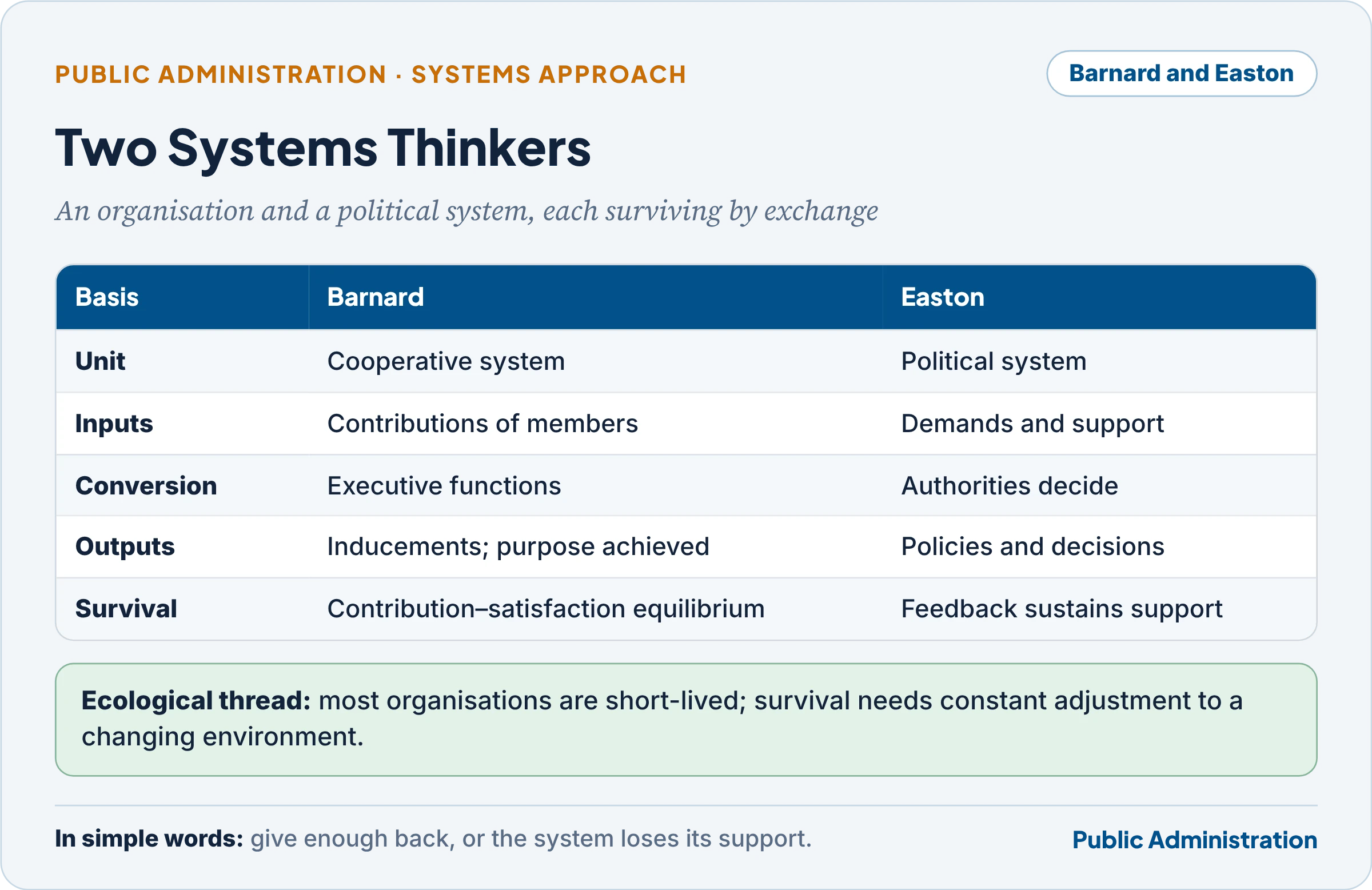
7.2 Barnard and Easton compared
| Basis | Barnard (organisation) | David Easton (political system) |
|---|---|---|
| Unit | Cooperative system of coordinated activities | Political system: authoritative allocation of values for a society |
| Inputs | Contributions of members and other contributors | Demands and support from the environment |
| Conversion | Executive functions: communication, decisions, purpose | Authorities convert demands into decisions |
| Outputs | Inducements; achievement of purpose | Decisions and policies |
| Feedback and survival | Contribution–satisfaction equilibrium decides survival | Feedback maintains support; system persists by adapting to stress |
| Key work | The Functions of the Executive (1938) | The Political System (1953); A Systems Analysis of Political Life (1965) |
- Relevance of the systems approach today: it explains interdependence (a reform in one department affects others), the need for feedback (monitoring, grievance redress), boundary management (partnerships, networks) and adaptation (crisis response). Its limits: abstraction, a conservative bias towards equilibrium and stability, and difficulty in explaining power and conflict.
7.3 Ecological elements in Barnard’s thought
- Organisational ecology (Michael Hannan and John Freeman, “The Population Ecology of Organizations”, 1977) studies how populations of organisations are born, adapt and die under environmental selection; individual managers matter less than the environment.
- Ecological elements in Barnard:
- organisations exist in a physical, biological and social environment and must adapt to survive;
- most organisations are short-lived; survival is the exception, not the rule;
- survival depends on an exchange with the environment (contributors from outside) and on external effectiveness;
- his “cooperative system” includes physical and biological components alongside social ones.
- Why contemporary theory seems closer to ecology than to Barnard: modern theory (ecology, institutional theory, resource dependence, networks) stresses environmental selection, legitimacy and inter-organisational relations, and often doubts the power of executives to shape outcomes. Barnard’s emphasis on the executive’s creative, moral leadership and on internal cooperation seems far from this.
- But the distance is smaller than it looks: Barnard’s open-system, survival-centred view anticipated ecology’s core concerns; the difference is one of emphasis (executive agency versus environmental selection), not of kind. Recent work on leadership, organisational culture and stakeholder management returns to Barnard’s themes.
8. Critique and Contribution
In simple words
Barnard’s book is famously hard to read. But almost every later theory of organisations, from Simon’s decisions to modern leadership studies, can be traced back to it.
8.1 Criticism
- Abstract and difficult style: Kenneth Andrews, in his introduction, noted the abstractness of presentation and the paucity and pedestrian quality of examples; Baker lamented the lack of practical examples.
- Purpose under-analysed: Andrews felt Barnard did not give full attention to the process of formulating purpose, which he himself called central.
- Executive leadership unclear: the expansion of cooperation and the nature of executive leadership remain vague.
- Managerial bias: the theory treats cooperation as natural and conflict as failure; it neglects unions, class and power, and can serve to legitimate management.
- Acceptance theory overstated: it understates sanctions, economic dependence and the formal powers of position; Weber’s legitimacy and Simon’s sanctions add what Barnard left out.
- Measurement problems: “efficiency” as satisfaction of motives is subjective and hard to observe.
8.2 Contribution
- Balanced treatment of administration: he combined structure and people, formal and informal, technical and moral aspects; earlier thinkers had ignored values, ethics, commitment and motivation.
- Organisation as a cooperative social system: challenged the view of organisation as a bureaucratic machine.
- Pioneer of the behavioural movement: acceptance of authority, communication, motivation and decision-making were developed by Simon, March, Likert and others.
- Informal organisation: gave it a systematic place in organisation theory.
- Decision-making: Simon’s theory was highly influenced by Barnard; Simon dedicated much of Administrative Behavior to developing Barnard’s ideas.
- Systems thinking: the spiritual father of the social systems school; anticipated open-systems and contingency approaches.
- Leadership and ethics: his view of executive responsibility influenced leadership studies and administrative ethics.
- Verdict: Claude George observed that Barnard started with the individual, moved to cooperative effort and ended with executive functions, providing “a profound understanding” of organisations; he is widely regarded as one of the outstanding theorists of modern administrative thought.
8.3 Why the behavioural approach is a continuous phenomenon
- Why continuous: organisations are made of people whose motives, values and relationships keep changing with technology, education and society. Each generation of administrative problems (motivation of knowledge workers, digital teams, ethical dilemmas, citizen engagement) calls for fresh study of behaviour. The behavioural approach is therefore a continuing research programme, not a finished doctrine.
- Barnard’s contribution to it: individual as the starting point; cooperation and consent; inducements and contributions; informal organisation; communication; decision-making; moral leadership. Simon, March, Cyert, Likert and Argyris all built on these.
Criticism — The case against Barnard
- Abstract, difficult and short of examples.
- Managerial bias: cooperation assumed, conflict and unions neglected.
- Acceptance theory ignores sanctions and unequal power.
- “Efficiency” as member satisfaction is subjective and hard to measure.
- Purpose formation and leadership left vague.
Defence — The case for Barnard
- First systematic theory of organisation as a cooperative social system.
- Explains why authority, motivation and communication depend on consent and exchange.
- Founded the behavioural and social systems schools; shaped Simon’s decision theory.
- Recognised the moral dimension of executive work long before administrative ethics became a field.
- His open-system, survival-centred view anticipated modern organisation theory.
Key Terms
| Term | Meaning in simple words |
|---|---|
| Cooperative system | People and resources combined by cooperation for a definite end |
| Formal organisation | A system of consciously coordinated activities of two or more persons |
| Informal organisation | Personal contacts, interactions and groupings without a conscious joint purpose |
| Willingness to serve | Readiness to contribute effort to the organisation |
| Common purpose | The objective that contributors accept as the reason for cooperation |
| Effectiveness | Achievement of the organisation’s purpose |
| Efficiency (Barnard) | Satisfaction of members’ motives; capacity to offer enough inducements |
| Inducements | What the organisation gives members (money, status, pride, belonging) |
| Contributions | What members give the organisation (effort, loyalty, skills) |
| Contribution–satisfaction equilibrium | Members stay only while inducements match or exceed contributions |
| Specific inducements | Material, distinction, physical conditions, ideal benefactions |
| General incentives | Associational attractiveness, habitual conditions, participation, communion |
| Acceptance theory of authority | Authority depends on acceptance by the person who receives the order |
| Zone of indifference | Range of orders accepted without question |
| Fiction of superior authority | Useful belief that authority flows from the top |
| Authority of position / leadership | Authority from rank / from knowledge and ability |
| Strategic factor | The limiting factor whose control changes the situation |
| Executive functions | Communication, securing efforts, defining purpose |
| Executive responsibility | Power of moral codes to guide conduct against contrary desires |
| Social systems school | Approach treating organisations as social systems; Barnard its spiritual father |
Contemporary Developments
- 3 November 2025: the 8th Central Pay Commission was constituted under Justice Ranjana Prakash Desai, with terms of reference covering an emolument structure to attract talent and a performance-linked incentive scheme (ToR approved by the Cabinet on 28 October 2025).
- 2020 onwards: Mission Karmayogi frames capacity building around roles, competencies and a shared national purpose, a modern version of inculcating common purpose.
- Continuing: research on employee engagement, psychological contracts and stakeholder theory restates Barnard’s inducement–contribution logic for employees, customers and partners alike.
Revision Grid
| Thinker / body | Work or report (year) | Key idea |
|---|---|---|
| Chester Barnard | The Functions of the Executive (1938) | Cooperative system; acceptance of authority; executive functions |
| Chester Barnard | Organization and Management (1948) | Selected papers |
| Vilfredo Pareto / L.J. Henderson | Social system in equilibrium | Intellectual source of Barnard’s systems view |
| Kenneth Andrews | Introduction to the 1968 edition | Abstractness; purpose under-analysed |
| Herbert Simon | Administrative Behavior (1947) | Zone of acceptance; built on Barnard |
| March and Simon | Organizations (1958) | Inducements–contributions; “essentially a theory of motivation” |
| David Easton | The Political System (1953); A Systems Analysis of Political Life (1965) | Inputs, conversion, outputs, feedback |
| Hannan and Freeman | “The Population Ecology of Organizations” (1977) | Environmental selection of organisations |
| Supreme Court | T.S.R. Subramanian v. Union of India (2013) | Written orders for civil servants |
| 8th Central Pay Commission | 2025 | Pay and performance incentives for central employees |
Previous Year Questions
- 2023Efficiency, in the specialized sense, is an organization’s capacity to offer effective inducements in sufficient quantity to maintain the equilibrium of the system. Analyze.
- 2022Barnard posits the zone of indifference as the human condition that animates authority relationships and cooperation in modern organisations. Examine.
- 2019“Chester Barnard in ‘The Functions of the Executive’ injected ‘the social’ in the study of organization. Explain in this context how the executive is expected to play a much greater role than a manager.”
- 2018“Chester Barnard’s model of ‘Contribution-Satisfaction Equilibrium’ is still considered a logical model of organisational motivation.” Do you agree? Give arguments.
- 2017“Executive positions imply a complex morality and require a high capacity of responsibility”– (Chester Barnard). Comment.
- 2015“Contemporary Organisational theory seems further afield of Chester Barnard’s Functions of the Executive than of organisational ecology.” Examine the statement in the light of ecological elements in Barnard’s thought.
- 2013“Decisions are not made by ‘organizations’, but by ‘human beings’ behaving as members of organizations.” How do Bernard and Simon conceptualize the relation between the decisions of the individual employee and the organizational authority?
- 2011The Systems Approach is relevant even today for organisational analysis. Discuss how Chester Barnard and David Easton adopted this approach in their respective areas of study.
- 2009“The Barnard – Simon Theory of Organisation is essentially a theory of motivation. “Comment.
- 2005“Organisation is a system of consciously coordinated activities or forces of two or more persons. “Comment.
- 2001Critically examine the models of Max Weber and Chester I Barnard with reference to ‘bureaucratic authority’.
- 2001‘The inculcation of belief in the real existence of a common purpose is an essential executive function; Comment.
- 2000….. “a more thorough consideration leads to the understanding that communication, authority, specialisation and purpose are all aspects compre-hended in coordination.”- (Chester I. Barnard) Comment.
- 1998Why is it that the behavioural approach to the study of organisations is a continuous phenomenon? Discuss Chester Barnard’s contributions to this approach.
- 1996Show how Barnard while analysing the multiplicity of satisfactions, clearly identifies four specific inducements.
- 1995“The study of decision-making is proceeding in so many directions that we can lose sight of the basic administrative processes that Barnard and Simon were trying to describe and that so many men have been trying to improve.” Elucidate.