

Administrative Thought: Scientific Management and Scientific Management movement; Classical Theory; Weber’s bureaucratic model – its critique and post-Weberian Developments; Dynamic Administration (Mary Parker Follett); Human Relations School (Elton Mayo and others); Functions of the Executive (C.I. Barnard); Simon’s decision-making theory; Participative Management (R. Likert, C. Argyris, D. McGregor).
This article: the rise of the human relations school; Elton Mayo and his associates; the Hawthorne studies and their findings; informal organisation; the features of human relations theory; classical versus human relations; Taylor versus Mayo; critique; the revisionists and the behavioural sciences; contribution to personnel administration; relevance today.
Official Syllabus: Paper I · Unit 1-02 Administrative Thought
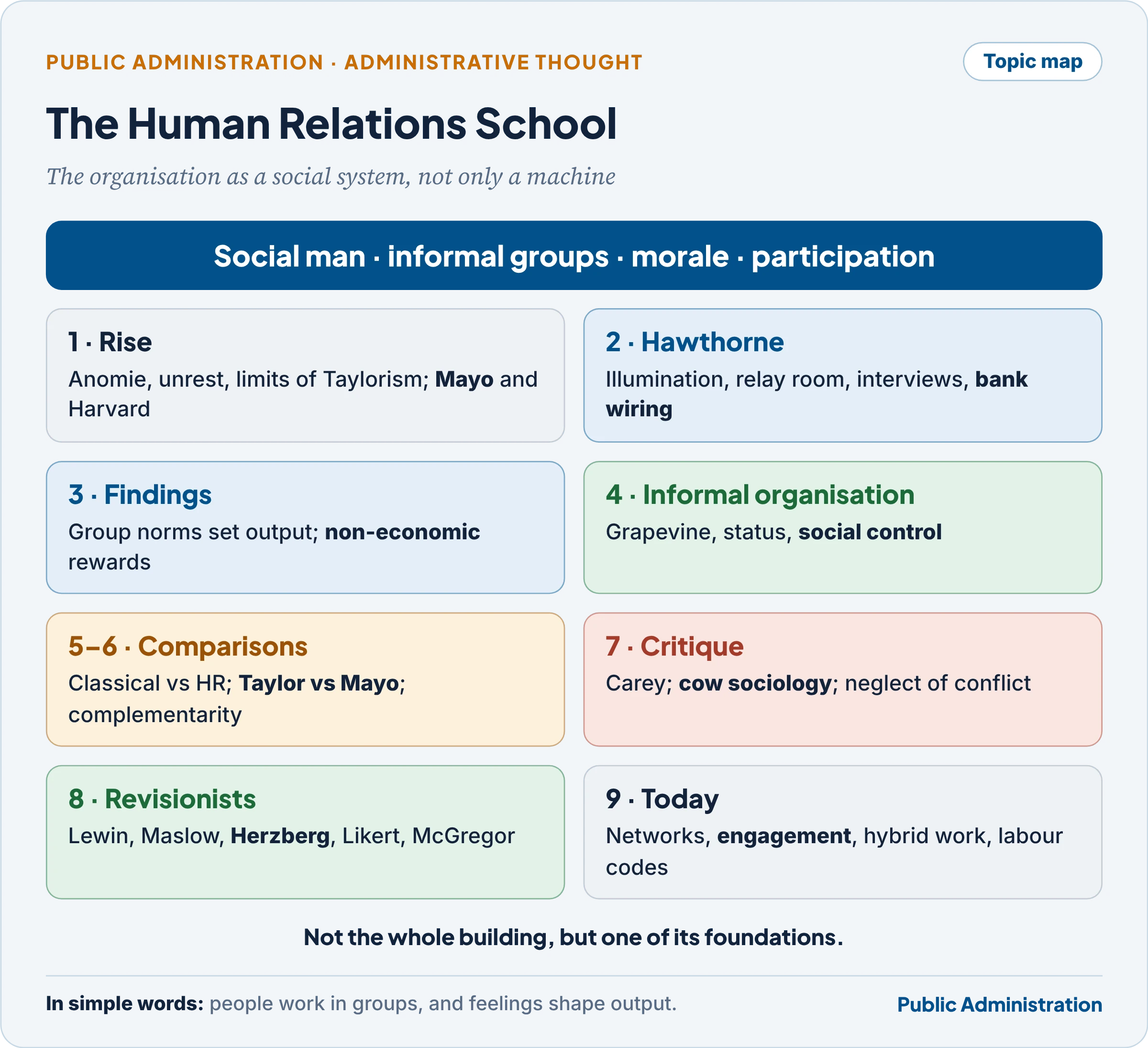
The human relations school (also called the neo-classical, socio-economic or humanistic theory) arose in the 1930s as a reaction to the classical approach. Taylor, Fayol, Gulick, Urwick and Weber had designed organisations as machines of tasks, structures and rules; the human relationists showed that an organisation is also a social system in which feelings, group membership, informal leaders and supervision shape output as much as pay and physical conditions.
- Its founding evidence: the Hawthorne studies (1924–1932) at the Western Electric Company’s Hawthorne Works near Chicago, interpreted by Elton Mayo and his Harvard colleagues.
- Its core message: the worker is a social man, not merely an economic man; productivity depends on morale, and morale depends on human relationships at work.
- Its legacy: personnel counselling, attention to supervision and communication, informal organisation, participative management, and the whole field of organisational behaviour.
In simple words
A district office gets new computers and a bigger room, yet files move as slowly as before. Then a new head starts greeting staff, asking their views and settling a long-running dispute between two sections. Work speeds up. Nothing physical changed; the human relations did. That is the Hawthorne lesson.
1. The Rise of the Human Relations Movement
In simple words
By the 1920s, factories were bigger and more efficient than ever, yet workers were unhappy, strikes were common and output disappointed managers. Something important had been left out of scientific management: people’s feelings and their need to belong.
1.1 Conditions that produced it
- Social disintegration: Mayo believed that industrialisation had uprooted people from village and craft communities in which work was part of communal life; factory workers became isolated, “normless” and maladjusted (an idea he took from Émile Durkheim‘s anomie).
- Industrial unrest: mistrust between management and labour, strikes and union conflict after the First World War.
- Limits of scientific management: time study and piece rates raised output at first, but workers resisted speed-ups, and rest pauses and incentives produced puzzling results.
- Growth of the social sciences: industrial psychology and sociology offered new tools for studying work.
1.2 Elton Mayo and his associates
- George Elton Mayo (1880–1949), an Australian-born psychologist and industrial researcher, taught at the University of Queensland, moved to the United States in 1922, worked at the University of Pennsylvania (Wharton), and joined the Harvard Business School in 1926, where he led its industrial research. He is called the father of the human relations school.
- The “First Enquiry” (1923): at a textile mill near Philadelphia with very high labour turnover in its mule-spinning department, Mayo introduced rest pauses chosen by the workers; turnover fell and output rose. He concluded that monotony and the feeling of isolation, not just physical fatigue, were the problem, and called his approach a clinical method.
- Major works: The Human Problems of an Industrial Civilization (1933), The Social Problems of an Industrial Civilization (1945), The Political Problems of an Industrial Civilization (1947).
- Others in the school:
- F.J. Roethlisberger (Harvard) and W.J. Dickson (Western Electric): Management and the Worker (1939), the full report of Hawthorne, often called the “bible” of the movement;
- T. North Whitehead (The Industrial Worker, 1938), W. Lloyd Warner (social anthropology of the bank wiring room), L.J. Henderson (the idea of the organisation as a social system);
- Western Electric managers such as George Pennock, who designed the early experiments.
2. The Hawthorne Studies (1924–1932)
In simple words
The researchers set out to find how much light workers needed. They ended up discovering that people work harder when someone takes an interest in them and when their group agrees to work hard.
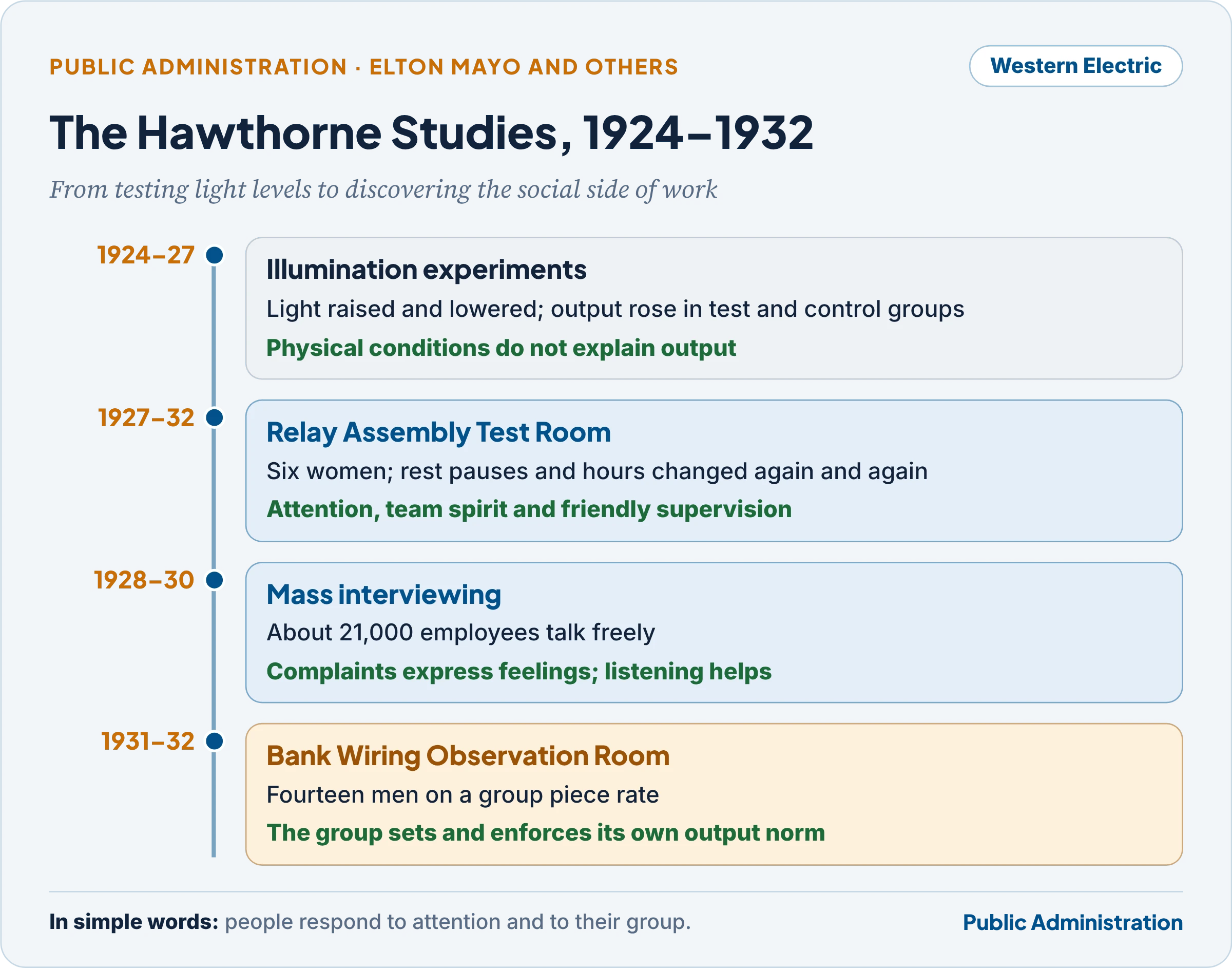
The studies were conducted at the Hawthorne Works of the Western Electric Company (the manufacturing arm of the Bell telephone system) in Cicero, near Chicago. They ran in four phases.
| Phase | Years | What was done | What was found |
|---|---|---|---|
| 1. Illumination experiments | 1924–1927 | Sponsored by the National Research Council; lighting raised and lowered for test groups, constant for control groups | Output rose in both groups, even when light fell almost to moonlight; physical conditions alone did not explain output |
| 2. Relay Assembly Test Room | 1927–1932 | Five women assemblers and a layout operator moved to a separate room; rest pauses, shorter hours, snacks introduced and withdrawn over many periods | Output rose almost steadily whatever the change; the group felt special, was consulted, had a friendly observer instead of a strict supervisor and developed team spirit |
| 3. Mass interviewing programme | 1928–1930 | About 21,000 employees interviewed; questions gave way to non-directive interviews in which workers talked freely | Complaints often expressed personal and social concerns, not objective conditions; being listened to improved attitudes; led to personnel counselling |
| 4. Bank Wiring Observation Room | 1931–1932 | Fourteen men (wiremen, soldermen, inspectors) on a group piece-rate scheme observed without changes | The group set its own output norm below what the incentive scheme could have paid, and enforced it informally |
- The Hawthorne effect: the tendency of people to change their behaviour because they know they are being studied and receiving attention. The term was coined later (by Henry Landsberger, 1958).
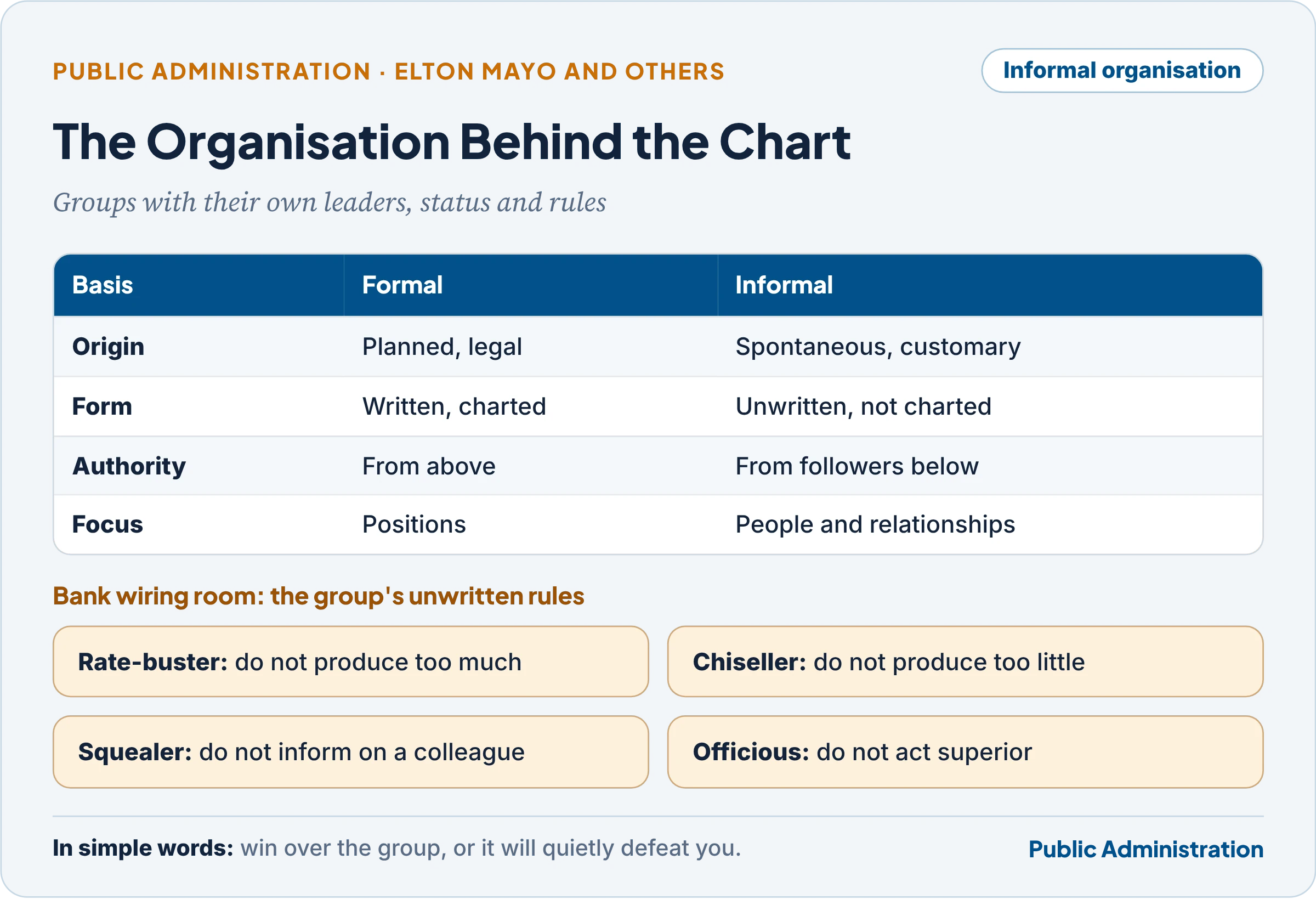
- Informal norms of the bank wiring group:
- you should not turn out too much work: if you do, you are a rate-buster;
- you should not turn out too little work: if you do, you are a chiseller;
- you should not tell a supervisor anything that will harm an associate: if you do, you are a squealer;
- you should not act officious or keep social distance: an inspector, for example, should not act like one.
- Why the group restricted output: fear that higher output would lead to rate cuts or lay-offs (the Depression had begun), and loyalty to the group’s own idea of a fair day’s work.
3. Findings and Features of Human Relations Theory
In simple words
The Hawthorne researchers concluded that a factory is not only a place where machines produce goods. It is also a small society, with friendships, leaders, rules and loyalties of its own.
3.1 Main findings
- Social and psychological factors at work, not physical conditions, are the main determinants of morale and output: the most important finding.
- Non-economic rewards and sanctions (approval, acceptance, ridicule, isolation by the group) significantly affect behaviour and limit the power of economic incentives.
- Workers act as members of groups, not as isolated individuals; the level of output is set by group norms, not by physical capacity.
- Informal organisation exists alongside the formal one, with its own leaders, status systems and codes.
- Supervision and leadership matter: a democratic, interested, communicative supervisor raises morale.
- Communication and participation: workers respond well when consulted and allowed to express their feelings.
- Specialisation is not necessarily the most efficient division of labour; work has social meaning.
- Summing up the studies, Mayo said that “man’s desire to be continuously associated in work with his fellows is a strong, if not the strongest, human characteristic”, and that many problems of worker–management cooperation arose from the emotionally based attitudes of workers rather than from objective difficulties.
3.2 Three elements of the theory
- The individual: each person brings attitudes, beliefs, sentiments and hopes to work. Roethlisberger: “each person is unique”, bringing certain skills, technical, social and logical, and certain expectations of the job.
- The informal organisation: the social groups that form spontaneously within the formal structure (see Section 4).
- Participative management: managers should consult work groups and their informal leaders before introducing change, which:
- develops a sense of participation;
- lets workers influence decisions that affect them;
- raises productivity;
- makes the working environment more pleasant;
- prevents alienation;
- eases the acceptance of organisational goals.
3.3 Mayo’s broader ideas
- Rejection of the “rabble hypothesis”: the classical economists (Mayo singled out David Ricardo) treated society as a horde of unorganised individuals each pursuing self-interest. Mayo replaced it with a “herd” or social view of man: people seek belonging and act in groups.
- Logic of sentiments versus logic of cost and efficiency: workers’ behaviour follows sentiments (feelings about fairness, belonging, recognition); management’s follows cost and efficiency. Friction between the two logics produces conflict; management must understand the former.
- Spontaneous cooperation and social skill: Mayo hoped managers with social skills could restore the community that industrialisation had destroyed, producing spontaneous cooperation instead of forced compliance.
- Roethlisberger’s summary: “too often we try to solve human problems with non-human tools and in terms of non-human data”; a human problem requires a human solution.
3.4 Features in brief
- Work is a group activity; the social world of an adult is largely built around work.
- The need for recognition, security and belonging matters more for morale and productivity than physical conditions.
- Informal groups exercise strong social control over work habits and attitudes.
- Group collaboration must be planned and developed; when achieved, it builds cohesion that resists the disruptive effects of a changing society.
- Managers should attend to socio-psychological factors rather than mechanically applying principles of organisation.
4. Informal Organisation
In simple words
The organisation chart shows who reports to whom. It does not show who eats lunch together, whose advice everyone seeks, or which rumour reached the whole office before the circular did. That hidden network is the informal organisation.
- Definition: L.D. White called it “the set of work relationships that grows out of the mutual interaction of persons working together over a long period of time”. Hicks and Gullett described “the informal shadow organisation that exists within the structure of the formal organisation”.
- Formal and informal compared:
| Basis | Formal organisation | Informal organisation |
|---|---|---|
| Origin | Planned, enacted, legal | Spontaneous, customary, social |
| Form | Written, manualised, on charts | Unwritten; cannot be charted neatly |
| Character | Rational, impersonal | Emotional, personal |
| Focus | Positions | People and relationships |
| Authority | Flows from above (position) | Flows from below (given by followers) |
- Four functions of informal groups:
- helping members attain personal objectives, which makes groups resist changes that threaten established satisfactions;
- providing social satisfaction and status, even to those with low formal rank;
- communication: the grapevine, faster than formal channels, carrying both valid information and rumour; rumours also tell an alert supervisor about anxieties;
- social control of behaviour: internal (making members conform) and external (keeping a new supervisor “in line”).
- Barnard’s view: formal organisations are “vitalised and conditioned” by informal ones; “there cannot be one without the other. If one fails the other disintegrates” (see the article on Barnard).
- Managerial implication: if management’s goals fit group norms, harmony and high productivity follow; if they conflict, management’s aims will be diminished, if not defeated, by the employees.
Indian Connect — Informal organisation in Indian administration
- Networks within the services: batch, cadre and service networks (and service associations) shape postings, information flows and resistance to reform, often more than formal rules.
- Work norms: office-level norms on file disposal speed, “work to rule” and protection of colleagues mirror the bank wiring room; reforms such as e-Office and file-tracking succeed only when they win over these informal groups.
- Participation: the Joint Consultative Machinery (1966) and departmental councils provide formal channels for staff opinion, an institutional version of the human relations idea of consultation.
- Capacity building: Mission Karmayogi (2020) adds behavioural competencies (teamwork, empathy, citizen-centricity) to functional and domain skills, a human relations theme in civil service training.
5. Classical Theory and Human Relations Compared
In simple words
The classical school asked, “How should the work be divided and supervised?” The human relations school asked, “How do the people doing the work feel, and how do they relate to one another?” Both questions matter.
5.1 Differences
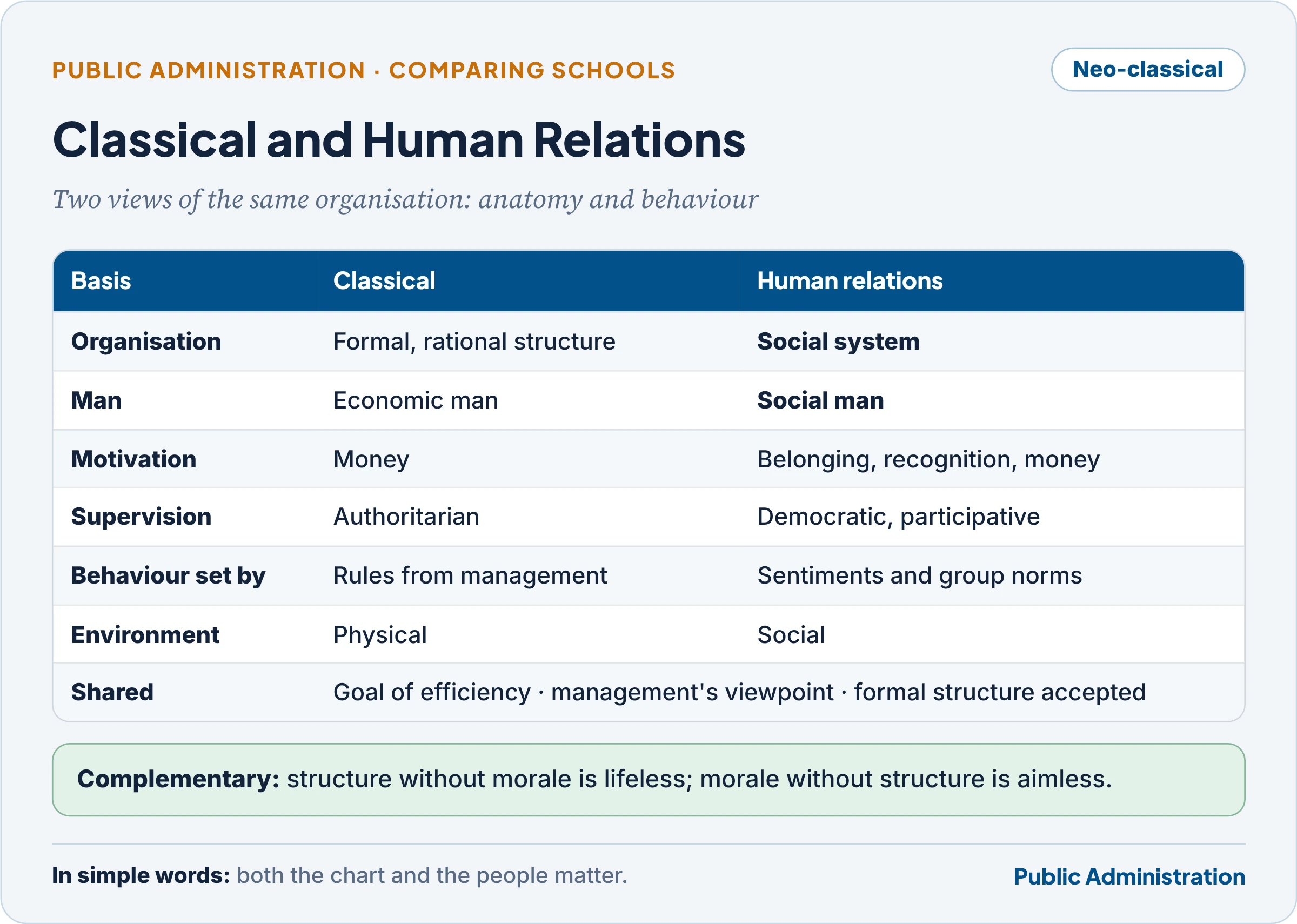
| Basis | Classical theory | Human relations theory |
|---|---|---|
| View of organisation | Formal structure; rational, impersonal system | Social system; emotional and interpersonal |
| View of man | Economic man; atomistic, rabble view | Social man; group (herd) view |
| Emphasis | Physiological and mechanical aspects | Sociological and psychological aspects |
| Behaviour explained by | Rules and regulations made by management | Attitudes, sentiments and feelings |
| People | Homogeneous | Heterogeneous |
| Supervision | Authoritarian | Democratic, participative |
| Efficiency depends on | Structure built on principles | Human relations, satisfaction and morale |
| Environment studied | Physical environment of the job | Social environment of the job |
| Motivation | Monetary, one-dimensional | Multi-dimensional: belonging, recognition, status |
| Communication | Formal orders down the hierarchy | Two-way; informal channels |
5.2 Why it is called “neo-classical”
- Same goal: both seek efficiency and productivity; human relationists accepted efficiency as a legitimate value.
- Same structure: both accept the formal organisation; human relations modified and extended classical concepts rather than abolishing them. Mohit Bhattacharya notes that they differed from the traditionalists in characterising the organisation as a social system of individuals, informal groups and inter-group relations in addition to the formal structure.
- Same viewpoint: both look at the organisation from management’s side.
- Extension, not rejection: human relations widened the theory of motivation from money to social needs; it rejected only the concept of economic man and over-reliance on formal institutionalisation.
5.3 Complementarity
- Structure and people are two sides of one organisation: classical theory supplies the anatomy (division of work, hierarchy, coordination); human relations supplies the physiology (motivation, groups, morale). Neither alone explains organisational behaviour.
- Practical combination: good organisations combine clear structure and rules with good supervision, communication and participation; human relations techniques work best within a sound formal framework, and formal structures work best when they win informal support.
- Later synthesis: Barnard’s cooperative system, Simon’s decision-making theory, systems and contingency theories, and socio-technical systems all integrate the two.
- The limit of complementarity: some tensions are real: impersonal rules versus personal treatment; hierarchy versus participation; economic incentives versus social satisfaction. These are managed, not abolished.
5.4 The anatomy and the social behaviour of organisations
- “The anatomy came first”: for Gulick, Urwick and Fayol, the design of the formal structure was the principal consideration; people were fitted into the design. The approach contributed principles of organisation, a vocabulary (POSDCORB, span of control) and the foundations of structural reform.
- “A system of inter-related social behaviours”: for the human relationists and later behaviouralists (Barnard, Simon, March), the organisation is the pattern of interactions, motives and decisions of its participants. This approach contributed the study of motivation, groups, communication, leadership and decision-making.
- Evaluation: each is partial; organisational theory progressed when they were combined in systems, contingency and socio-technical approaches.
6. Taylor and Mayo
In simple words
Taylor timed the worker with a stopwatch; Mayo sat down and listened to her. Both wanted more output, but they looked for it in very different places.
| Basis | Taylor | Mayo |
|---|---|---|
| School | Scientific management | Human relations |
| Concept of man | Economic man; isolated individual | Social man; member of a group |
| Focus | Tools, procedures, rules: physiological and mechanical | People and groups: social and emotional |
| Management style | Autocratic: planning by management | Participative |
| Organisational man | Rational and logical | Social and emotional |
| Motivation | Monistic: money | Socio-economic: belonging, recognition, money |
| Concern | Workers’ efficiency; one best way of doing tasks | Workers’ satisfaction and morale |
| Worker groups | Hostile to management (soldiering) | Not necessarily hostile; can be won over |
| Skills stressed | Technical skills | Social skills |
| Hypothesis | “Rabble hypothesis” (passive view of man) | “Herd hypothesis” |
| Method | Time and motion study | Observation, interviews, clinical method |
- From Taylorism to Mayoism: organisation theory moved from engineering the task to understanding the person and the group, from economic incentives to morale, from formal to informal organisation, and from command to participation. The quest for organisational effectiveness remained the same, but its measures widened from output alone to satisfaction, cooperation and stability.
- But the road was not straight: revisionist historians argue that Taylor recognised worker cooperation and individual differences, and that Mayo’s methods could be as manipulative as Taylor’s (see the article on Scientific Management for Taylor’s “humanistic” side).
Common confusion
Did the Hawthorne studies prove that happy workers are productive workers? No. The studies suggested that social factors influence output, and early human relationists assumed that satisfaction leads to productivity. Later research (for example reviews in the 1950s) found the link weak and sometimes reversed: high performance may produce satisfaction rather than the other way round. Herzberg showed that removing dissatisfaction does not by itself motivate. The lasting finding is narrower: group norms, supervision and participation shape output, alongside pay and job design.
7. Critique of the Human Relations School
In simple words
Critics said Mayo’s researchers studied too few people, ignored trade unions and money, and taught managers to make workers feel good without changing what really mattered: pay, power and the nature of the work.
7.1 Methodological criticism
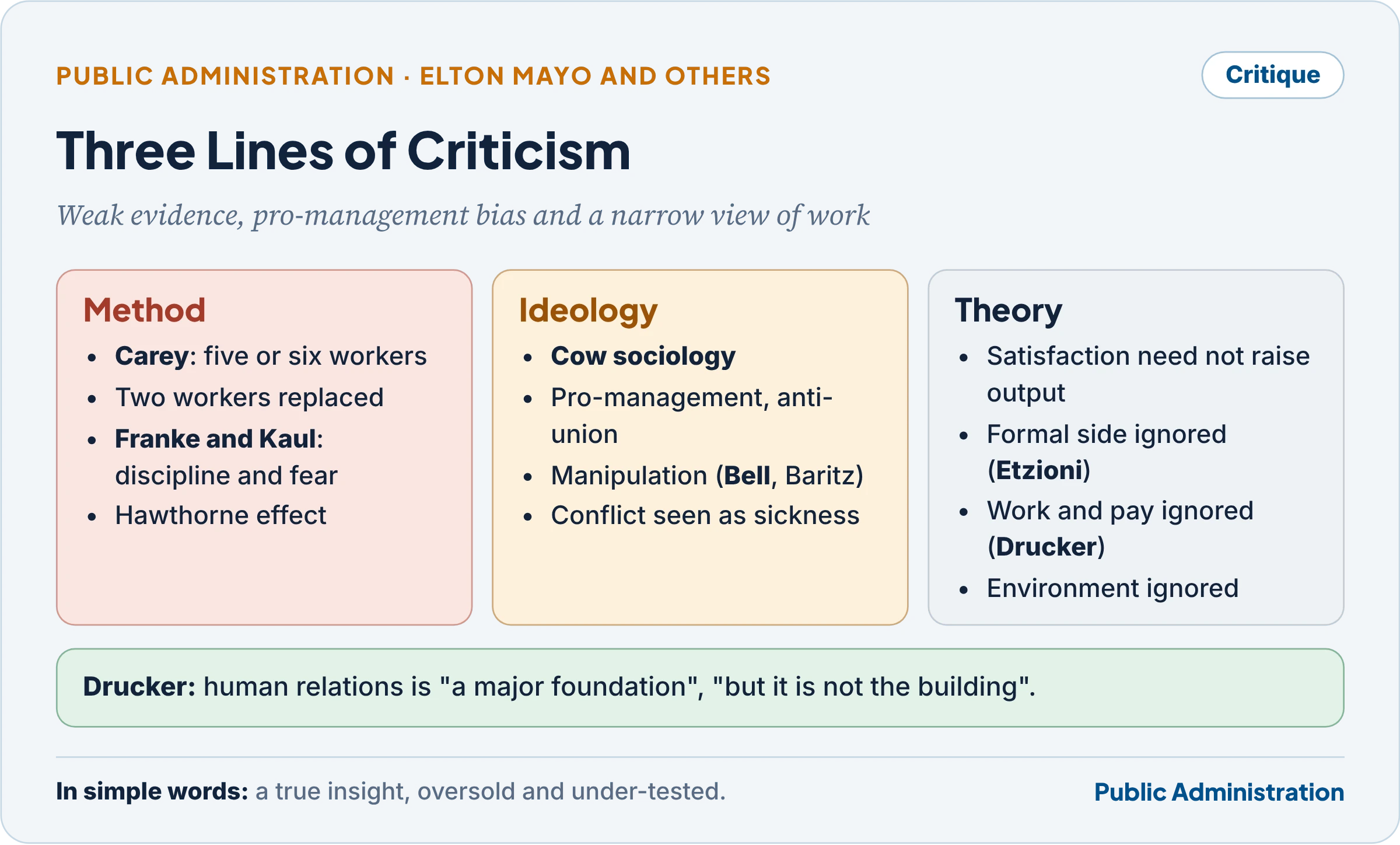
- Small, unrepresentative samples: Alex Carey (“The Hawthorne Studies: A Radical Criticism”, 1967) showed that the famous conclusions rested on five or six workers; two “uncooperative” women in the relay room were replaced; the evidence for the social explanation was weak.
- Alternative explanations: Franke and Kaul (1978) re-analysed the data and attributed most of the output increase to managerial discipline, the replacement of workers, the fear of unemployment during the Depression, and rest time, not to friendly supervision.
- The Hawthorne effect itself: the experiments were not natural: behaviour changed because of attention and publicity, so the findings cannot be generalised.
- Bias: the research was sponsored by management; the Harvard group’s interpretation fitted its prior beliefs (Daniel Bell called the methodology defective).
7.2 Ideological criticism
- Pro-management and anti-union: Loren Baritz (The Servants of Power, 1960) showed the human relationists serving management’s interests; the United Auto Workers called them “cow sociologists“: keep the cows contented and they give more milk.
- Manipulation: the theory teaches managers to manage feelings so that workers accept conditions they might otherwise contest; Daniel Bell described it as adjusting men to machines. Marxists see “Mayoism” as a subtle technique of exploitation that de-emphasises economic factors and the role of trade unions.
- Neglect of conflict: Mayo assumed that conflict between labour and management was a sign of social sickness to be cured, not a legitimate clash of interests. Reinhard Bendix and Lloyd Fisher (1949) criticised him for failing to state the ethical presuppositions of his work.
- Neglect of economic factors and the work itself: Peter Drucker argued that the human relationists neglected the nature of work and focused on interpersonal relations; they were not sufficiently aware of economic dimensions.
7.3 Theoretical and empirical criticism
- Over-emphasis on the informal: Amitai Etzioni remarked that human relations writers devoted much attention to informal relations among workers and between workers and supervisors, but little to formal relations or to the articulation of formal with informal ones.
- Unproved assumptions: that satisfied workers produce more; that democratic supervision raises productivity; that job enlargement and participation raise satisfaction or output. Each link proved weak or inconsistent; the causal order may be reversed.
- One-dimensional: it explored the social side of motivation but not its full range (achievement, growth, the work itself).
- Neglect of the environment: it studied the work group and ignored technology, markets, unions, laws and the wider society.
- Organisation without purpose: it concentrated on members’ feelings and neglected the organisation’s work and goals.
7.4 Assessment
- Lasting contribution: discovery of the informal organisation, the social nature of work, and the importance of supervision, communication, participation and morale; Mayo is rightly called “a behavioural scientist long before the term became popular” (D.S. Pugh). Laurie Mullins calls the Hawthorne experiments “probably the single most important foundation of the human relations approach to management and the development of organisational behaviour”.
- Drucker’s balanced verdict: this does not mean that we have to discard human relations; on the contrary, its insights are “a major foundation” in managing people. “But it is not the building. Indeed, it is only one of the foundations.”
- The real lesson: the human relations school is incomplete rather than wrong; later behavioural science corrected its naivety without abandoning its central insight.
Criticism — The case against the human relations school
- Weak evidence: tiny samples, replaced workers, Depression-era fear, the Hawthorne effect.
- Pro-management and manipulative: “cow sociology”; neglect of unions and real conflicts of interest.
- Over-emphasis on informal groups and feelings; neglect of formal structure, technology and environment.
- Unproved link between satisfaction and productivity.
- Neglects the nature of work, pay and economic security.
Defence — The case for the human relations school
- Discovered the informal organisation and the social nature of work, now universally accepted.
- Shifted management from coercion towards communication, consultation and good supervision.
- Founded personnel counselling, attitude surveys, supervisory training and organisational behaviour.
- Its insights were refined, not discarded, by later behavioural science (Likert, McGregor, Argyris, Herzberg).
- Its emphasis on morale and the manager’s role is confirmed by modern engagement research.
8. From Human Relations to Behavioural Science
In simple words
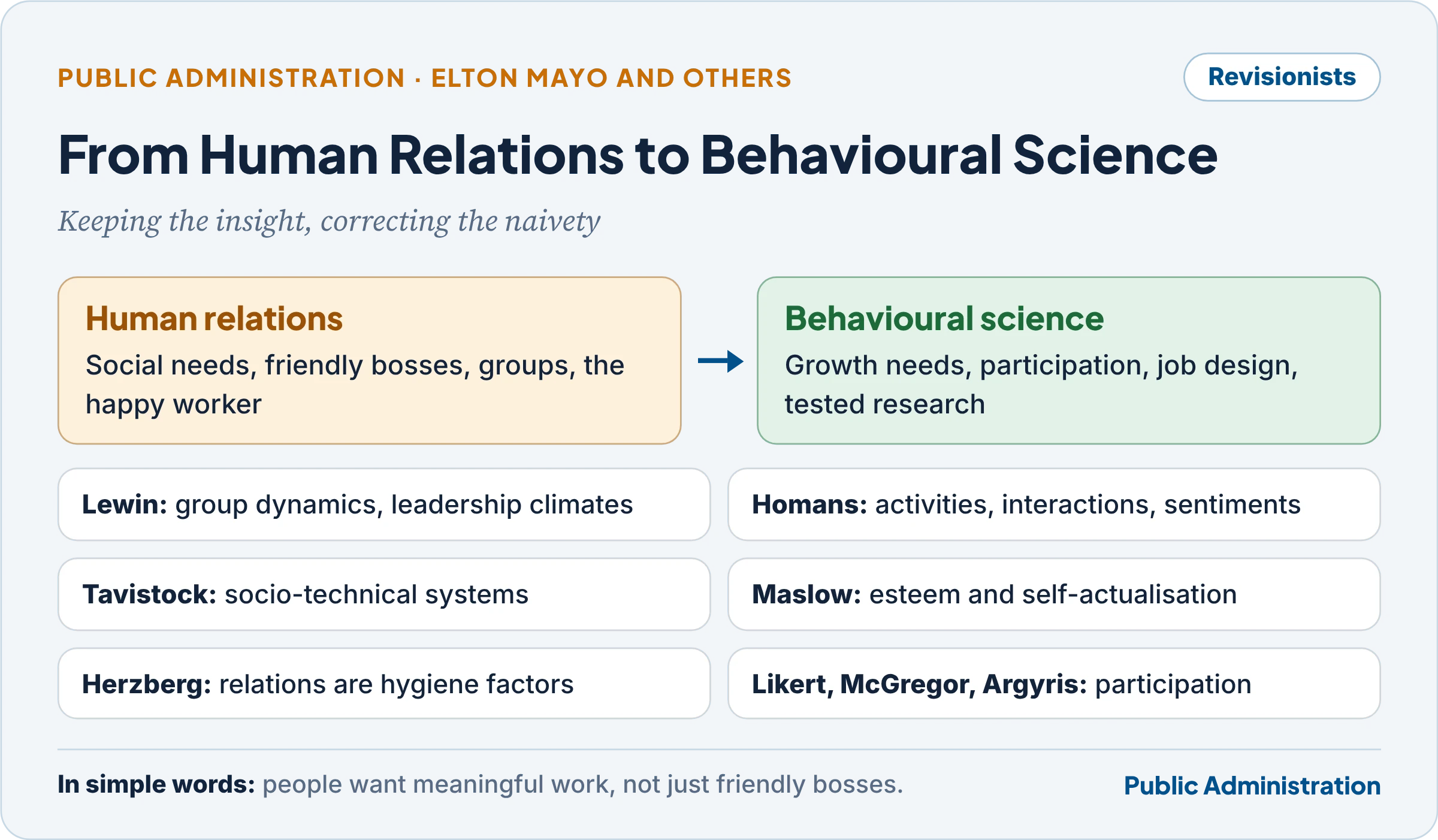
The next generation kept Mayo’s interest in people but tested his ideas more carefully. They found that people want not only friendly bosses but also meaningful work, a say in decisions and a chance to grow.
8.1 How behavioural scientists modified Mayo’s findings
| Later thinker | Modification |
|---|---|
| Kurt Lewin (1930s–40s) | Group dynamics; experiments on autocratic, democratic and laissez-faire leadership; change through group decision |
| George Homans (The Human Group, 1950) | Systematic theory of groups: activities, interactions and sentiments |
| Tavistock Institute (Trist and Bamforth, 1951) | Socio-technical systems: social and technical systems must be designed together |
| Abraham Maslow (1943, 1954) | Hierarchy of needs: social needs are one level; esteem and self-actualisation lie above |
| Frederick Herzberg (1959) | Two-factor theory: good relations and supervision are hygiene factors that prevent dissatisfaction; real motivation comes from achievement, recognition and the work itself |
| Rensis Likert (1961, 1967) | Measured management systems; participative System 4; linking pins |
| Douglas McGregor (1960) | Theory X and Theory Y: management’s assumptions shape behaviour; integration of goals |
| Chris Argyris (1957) | Conflict between formal organisation and the mature personality; job enlargement |
| Herbert Simon (1947) | Decision-making and bounded rationality: the cognitive, not just emotional, side of behaviour |
- Warren Bennis called these writers revisionists: they shared a concern to revise the naive and unsound aspects of human relations without sacrificing its radical departure from traditional theory.
- Key shifts: from social needs to higher needs (growth, achievement); from friendly supervision to participation and job design; from groups alone to groups within structures and technologies; from impressionistic case studies to survey research and experiments; from “happy worker” to “engaged and empowered worker”.
8.2 Contribution to personnel administration
- Personnel counselling: Western Electric’s counselling programme grew out of the interviewing phase.
- Attitude and morale surveys: systematic study of employee opinion.
- Supervisory and leadership training: human relations skills became part of management education.
- Communication and participation: suggestion schemes, joint consultation, quality circles, works committees.
- Grievance handling and employee welfare: recognition that grievances may express deeper concerns.
- The shift to human resource management: people as a resource to be developed, not a cost to be controlled.
- In public administration: human relations ideas shaped training, staff welfare, joint consultative machinery and leadership development in the civil services; the behavioural movement in public administration began here.
9. Relevance Today
In simple words
Offices now run on laptops and video calls, but the Hawthorne questions remain: do people feel they belong, does anyone listen to them, and does their team agree on what a fair day’s work is?
9.1 Is the human relations insight more relevant today?
- Networks over charts: in knowledge work, influence and productivity flow through informal networks (who helps whom, who shares information) more than through the formal chart. Organisational network analysis is now a management tool.
- Team climate: research on team effectiveness repeatedly finds that psychological safety (Amy Edmondson) and trust among colleagues predict performance better than individual talent.
- Remote and hybrid work: studies of remote work found that it siloes collaboration and weakens informal ties across groups, harming innovation, which confirms the importance of associations among workers.
- Engagement and the manager: Gallup’s State of the Global Workplace 2025 reported that global employee engagement fell from 23% to 21% in 2024, costing about US$438 billion in lost productivity; it attributes about 70% of variation in team engagement to the manager, a modern echo of Hawthorne’s finding on supervision.
- But also less relevant in some respects: gig and platform work is governed by algorithms, not by supervisors or stable work groups; pay, security and rights (labour codes, social security) matter as much as sentiments. The economic concerns the human relationists neglected have returned.
9.2 Are Mayo’s findings relevant in public organisations?
- Yes:
- morale, recognition and team spirit drive frontline delivery (health workers, teachers, police) where outputs are hard to measure;
- informal norms explain both dedication (ASHA workers’ community commitment) and resistance (go-slow, file-pushing);
- good supervision and listening (grievance redress, staff consultation) reduce conflict and absenteeism.
- With limits:
- public organisations are bound by law, rules and accountability; informal norms cannot override legality or equity;
- pay, promotion and security in government are rule-based, so non-economic motivators (purpose, recognition, autonomy) carry even more weight, but cannot replace fair pay and working conditions;
- “feel-good” human relations without real participation risks becoming manipulation.
Indian Connect — Human relations in Indian public services
- Recognition: the Prime Minister’s Awards for Excellence in Public Administration (instituted 2006) and civil services day recognise teams and districts, a non-economic reward of the Hawthorne kind.
- Frontline morale: ASHA workers, honorary community health volunteers, sustain high commitment largely through community standing and recognition; the WHO honoured India’s ASHAs with a Global Health Leaders Award in May 2022. Their protests over honoraria also show that recognition cannot replace fair pay.
- Consultation: the Joint Consultative Machinery and staff councils, grievance portals and welfare measures institutionalise listening to employees.
- Behavioural training: Mission Karmayogi and the Capacity Building Commission (2021) treat attitudes, teamwork and citizen orientation as trainable competencies.
9.3 Productivity and emotional response
- Mayo’s claim: productivity reflects workers’ emotional response to their work and its social setting more than physical working conditions.
- Evidence for: engagement, burnout and wellbeing research; the WHO’s recognition of burnout as an occupational phenomenon (ICD-11, 2019); the effect of managers on team engagement.
- Evidence against or qualifying: physical conditions still matter (heat stress, safety, ergonomics); the Code on Occupational Safety, Health and Working Conditions, 2020 (in force with the other labour codes from 21 November 2025) rests on the premise that conditions matter; job design and skills affect productivity; satisfaction and productivity are only loosely linked.
- Synthesis: productivity results from the interaction of conditions, job design, skills, incentives and emotional-social factors; Mayo was right to add the last, wrong to treat it as the only one.
Key Terms
| Term | Meaning in simple words |
|---|---|
| Human relations school | Approach that sees organisations as social systems where feelings and groups shape work |
| Neo-classical theory | Another name for human relations theory; it extends rather than rejects classical theory |
| Hawthorne studies | Experiments at Western Electric (1924–1932) that revealed the social side of work |
| Hawthorne effect | People change behaviour because they know they are being observed |
| Social man | View that people are motivated by belonging and recognition, not only money |
| Economic man | View that people work only for money |
| Informal organisation | Unplanned network of relationships, leaders and norms within the formal structure |
| Group norm | Unwritten rule a group enforces on its members |
| Rate-buster | Worker who produces too much, breaking the group’s output norm |
| Chiseller | Worker who produces too little |
| Squealer | Worker who informs on colleagues to the supervisor |
| Grapevine | Informal channel of communication |
| Rabble hypothesis | View of society as isolated self-interested individuals, rejected by Mayo |
| Logic of sentiments | Workers’ behaviour guided by feelings and group loyalty |
| Personnel counselling | Listening to employees’ concerns to improve attitudes and relations |
| Cow sociology | Critics’ term for keeping workers content to raise output |
| Revisionists | Later behavioural scientists who corrected the human relations school |
| Psychological safety | Team climate in which members can speak up without fear |
Contemporary Developments
- April 2025: Gallup’s State of the Global Workplace 2025 reported global engagement down from 23% to 21% in 2024, driven by falling manager engagement (30% to 27%).
- 21 November 2025: India’s four labour codes, including the Code on Occupational Safety, Health and Working Conditions, 2020 and the Code on Social Security, 2020, came into force, bringing welfare, safety and platform-worker provisions into one framework.
- 2020 onwards: Mission Karmayogi embeds behavioural competencies in civil service capacity building.
- Continuing: hybrid work, workplace wellbeing programmes and organisational network analysis have renewed attention to informal relationships at work.
Revision Grid
| Thinker / body | Work or report (year) | Key idea |
|---|---|---|
| Elton Mayo | Philadelphia textile mill “First Enquiry” (1923) | Rest pauses and morale |
| Elton Mayo | The Human Problems of an Industrial Civilization (1933) | Social man; anomie |
| Elton Mayo | The Social Problems of an Industrial Civilization (1945) | Rabble hypothesis rejected; social skill |
| Roethlisberger and Dickson | Management and the Worker (1939) | Full Hawthorne report; logic of sentiments |
| T. North Whitehead | The Industrial Worker (1938) | Relay room analysis |
| Henry Landsberger | Hawthorne Revisited (1958) | Coined “Hawthorne effect” |
| Reinhard Bendix and Lloyd Fisher | Critique (1949) | Unstated ethical presuppositions |
| Loren Baritz | The Servants of Power (1960) | Social scientists serving management |
| Alex Carey | “A Radical Criticism” (1967) | Weak evidence for the social explanation |
| Franke and Kaul | Re-analysis (1978) | Discipline and fear explain output |
| Kurt Lewin | Group dynamics (1930s–40s) | Leadership climates; group decision |
| George Homans | The Human Group (1950) | Activities, interactions, sentiments |
| Trist and Bamforth | Coal-mining study (1951) | Socio-technical systems |
| Warren Bennis | Revisionists | Correcting human relations |
Previous Year Questions
- 2024Scientific Management and Human Relations theory are two distinct approaches for improving efficiency and production. Explain.
- 2022Human relationists postulate that ‘what is important to a worker and what influences his/her productivity level may not be the organisational chart but his or her associations with other workers’. Is it more relevant today?
- 2020“Productivity is not the result of working conditions but the result of emotional response of workers to work performed.” Are Elton Mayo’s findings relevant in contemporary organizations?
- 2017“What is distinctive about the Classical and Human Relations Schools of administration is their complementarity to each other “. Analyse
- 2014“The notion of informal organisation is a residual or cafeteria concept of diverse and sprawling contents.” How does Gouldner established the need for understanding the interdigitations between the formal and informal organisation?
- 2013“The design of the physical structure, the anatomy of the organization came first, and was indeed the principal consideration.” “An organisation is a system of inter-related social behaviours of participants,” Analyse these statements and evaluate the contributions of the respective approaches to administration theory.
- 2006To what extent has the human relations movement contributed to the knowledge and practice within the field of personnel administration?
- 2002Explain the contribution of George Elton Mayo to the development of the Human Relations School. How did behavioural scientists modify his basic findings?
- 1997Examine the basic postulates of the Human Relations Theory and show how far it differs from the classical theory of organizations.
- 1994“Taylor’s Scientific Management already offered a ‘humanistic’ theory of motivation, with its democratic and participatory emphases, that was hardly improved on by Elton Mayo and others.” Comment.
- 1993“The Hawthorne researches demonstrate the need to analyse organisations as living social structures.” Comment.
- 1992Evaluate the contributions of George Elton Mayo to Administrative organization. Do you consider his contributions as great innovations of modem times?
- 1990‘Mayo was a behavioural scientist long before the term became popular.’ Comment.
- 1989“From Taylorism to Mayoism the organisation theory has travelled a long road in quest of Organisational Effectiveness.” Comment.
- 1988“Many problems of Worker-Management co-operation were the results of the emotionally based attitudes of the workers rather than objective difficulties in the situation.” (Elton Mayo). Comment.