

Administrative Law: Meaning, scope, and significance; Dicey on Administrative law; Delegated legislation; Administrative Tribunals.
This article: Meaning and definitions of administrative law (Dicey, Jennings, Wade, K.C. Davis, Griffith and Street, Garner, Jain and Jain); administrative law and constitutional law; reasons for its growth; scope (powers of the administration, control mechanisms, remedies); significance and the red, amber and green light theories; Dicey’s rule of law and his attack on droit administratif, his 1915 concession and the critiques of Jennings, Robson, Wade and Davis; the French system (Conseil d’État, Blanco); the modern rule of law (Bingham) and the rule of law in India; administrative discretion and its control (natural justice, Wednesbury, proportionality, legitimate expectation); remedies; the growth of administrative law in India.
Official Syllabus: Paper I · Unit 1-06 Administrative Law
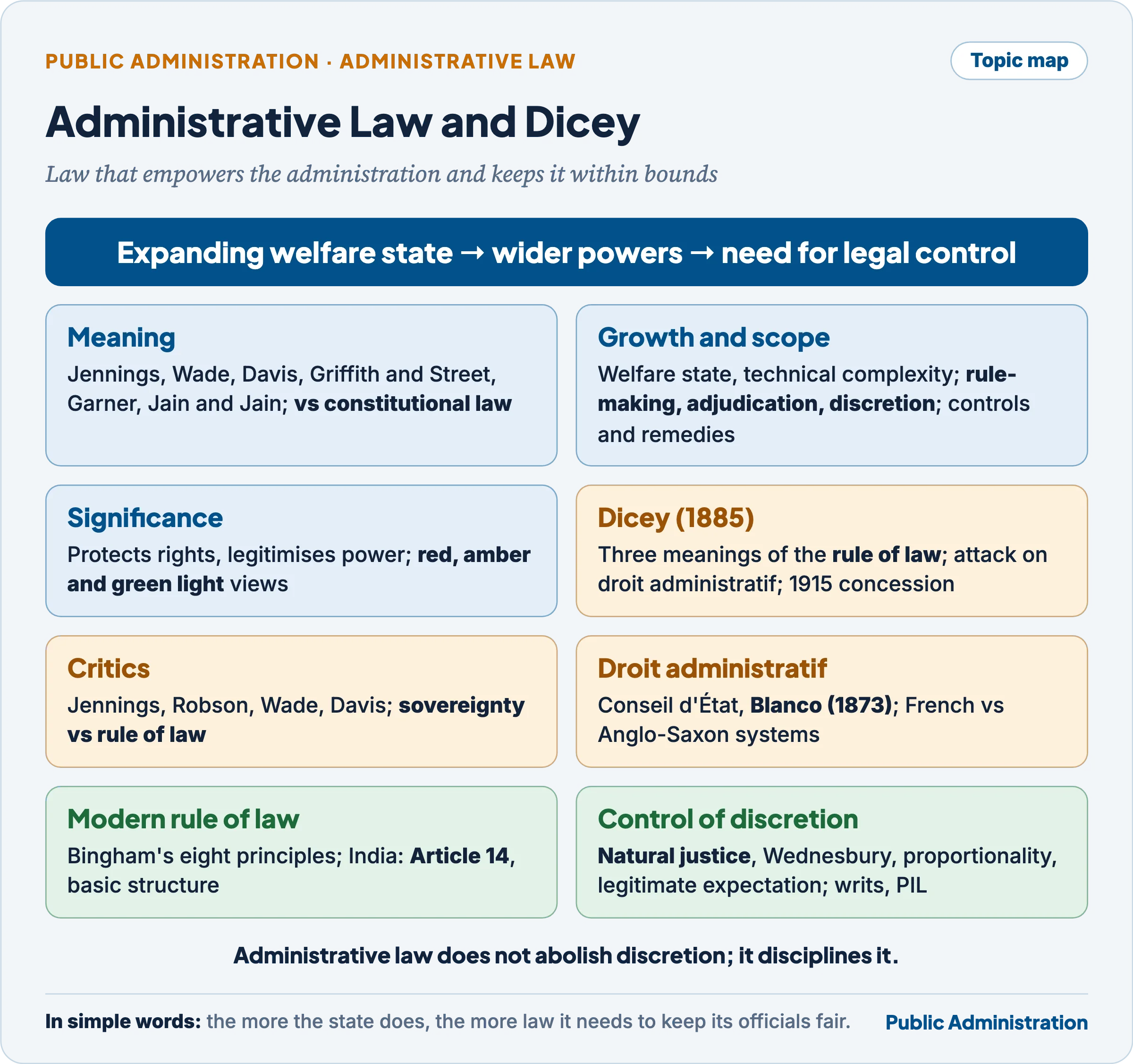
Administrative law is the body of law that creates, empowers and limits the administration. A modern government licenses businesses, fixes prices, acquires land, cancels ration cards, disciplines employees, demolishes illegal buildings and decides millions of claims every year. Each of these acts touches a citizen’s rights. Administrative law answers two questions about every such act: did the official have the power, and was the power used fairly and for the right purpose?
- The subject matters to public administration because administration is the execution of law: every official is, in effect, a law-enforcing officer whose authority comes from a statute and whose limits are fixed by law and by the courts.
- Its central problem is an old one: how to give government enough power to govern without letting that power become arbitrary. The nineteenth-century British jurist A.V. Dicey thought the answer was to deny officials any wide discretion; the twentieth century showed that discretion cannot be abolished, only structured and checked.
In simple words
A traffic policeman has the power to stop your car and fine you. Administrative law says three things about that power: it must come from a law (he cannot invent a fine), it must be used fairly (he must tell you what you did wrong and let you explain), and you must have somewhere to go if he abuses it (an appeal or a court). That, in small, is the whole subject.
1. Meaning of Administrative Law
In simple words
Private law deals with quarrels between two citizens, such as a landlord and a tenant. Administrative law deals with the relationship between a citizen and an official. Because the official holds public power, the rules have to be different: the official must always show legal authority for what he does.
1.1 A branch of public law
Administrative law is a branch of public law (law governing the state and its relations with individuals), as distinguished from private law (law governing relations between private persons). It has been called the law dealing with the pathology of public power: public institutions are repositories of power held in trust for public purposes, and power in public hands always carries the risk of misuse.
- Two faces. Administrative law both confers power (it is the legal basis for rule-making, licensing, adjudication and enforcement) and controls it (through procedure, review and remedies). One formulation sums it up as the legitimisation of due power and the de-legitimisation of undue power.
- Non-arbitrariness is its core value. In the Indian constitutional order this ties administrative law directly to Article 14 and to the rule of law, which together form the foundation of good governance.
- The term itself is a translation of the French droit administratif, which is why the French system, and Dicey’s hostility to it, sit at the heart of the topic.
1.2 Definitions
No single definition is accepted, because writers emphasise different parts of the subject. The table sets the main definitions side by side.
| Thinker and work | Definition (paraphrased) | What it stresses |
|---|---|---|
| A.V. Dicey, Law of the Constitution (1885) | The part of a nation’s legal system that fixes the legal status and liabilities of state officials, the rights and liabilities of private persons in dealing with them, and the procedure for enforcing those rights | Judicial control of officials only; modelled on the French system |
| Ivor Jennings, The Law and the Constitution (1933) | The law relating to the administration; it determines the organisation, powers and duties of administrative authorities | Structure and powers of the administration |
| H.W.R. Wade, Administrative Law (1961) | The law relating to the control of governmental power, whose primary purpose is to keep government within its legal bounds and protect the citizen against abuse | Control and protection of the citizen |
| Kenneth Culp Davis, Administrative Law Treatise (1958) | The law concerning the powers and procedures of administrative agencies, especially the law governing judicial review of administrative action | Agencies, procedure and review (the American focus) |
| J.A.G. Griffith and H. Street, Principles of Administrative Law (1952) | The law concerned with the operation and control of the powers of administrative authorities, with the emphasis on functions rather than structure | Functions and their control |
| J.F. Garner, Administrative Law | Those rules, recognised by the courts as law, which relate to and regulate the administration of government | Legal rules governing administration |
| M.P. Jain and S.N. Jain, Principles of Administrative Law | The law dealing with the structure, powers and functions of administrative organs, the limits of their powers, the procedures they follow, and the methods of control, including remedies available to persons affected | The most comprehensive working definition used in India |
The definitions fall into three broad groups, and the contrast explains why the subject has widened over time.
- Narrow, court-centred view (Dicey, Davis): administrative law is mainly about how courts control officials. It misses rule-making, internal procedures and non-judicial controls.
- Structural view (Jennings): it covers the organisation and powers of the administration. Critics say this makes administrative law almost indistinguishable from constitutional law and public administration itself.
- Functional-control view (Wade, Griffith and Street, Jain and Jain): it concentrates on powers, procedures, limits and remedies. This is the view most writers now accept, because it captures both the grant and the control of power.
1.3 The five questions of administrative law
Griffith and Street reduced the subject to five enquiries, which remain the clearest map of what administrative law studies:
- What sort of powers does the administration exercise (legislative, judicial, executive, discretionary)?
- What procedures do administrative authorities follow in exercising them?
- What are the limits on those powers?
- How is the administration kept within those limits (judicial, legislative, administrative and other controls)?
- What remedies are available to a person harmed by illegal administrative action?
1.4 Characteristics of administrative law
- It places the social interest above individual claims. Administrative law subordinates the older common-law rights of personal freedom and private property to the common good: land can be acquired for a highway, a factory licence can be suspended to protect a river.
- It works through flexible standards rather than rigid rules: “public interest”, “reasonable”, “fit and proper person”, “in the interest of public order”. Applying such standards needs judgement.
- Its technical standards are often applied by specialised bodies. Tribunals, regulators and adjudicating officers interpret them, because ordinary courts lack the expertise (see the article on Administrative Tribunals).
- It places public authorities in an advantageous position over private individuals: they act on their own motion, their orders are presumed valid and they can enforce them directly. This is why safeguards are needed.
- It is largely uncodified and dynamic. It is a law in the making, built case by case. In common-law countries, and especially in India, much of it is judge-made: the Indian jurist M.P. Jain observed that Indian administrative law is primarily the creation of the courts, since India, unlike the United States, has no general administrative procedure statute.
- It is recognised by its substance, not its form. No single code labelled “administrative law” exists in Britain or India. A rule belongs to administrative law because of what it does (it governs the exercise of public power over individuals), whether it sits in a statute, a rule, a judgment or a constitutional article.
1.5 Administrative law and constitutional law
Both are branches of public law, and the line between them is thin. A classic image, associated with the English jurist T.E. Holland, says constitutional law describes the organs of government at rest, while administrative law describes them in motion.
| Point | Constitutional law | Administrative law |
|---|---|---|
| Subject | Structure of the state, the organs of government and their relations; fundamental rights | Powers, procedures and control of administrative authorities in day-to-day action |
| Level | General principles and the framework | Detailed application of those principles |
| Source | The Constitution (written in India and the USA), conventions | Statutes, delegated legislation, judicial decisions, administrative practice |
| Supremacy | Supreme law; other law must conform | Must conform to the Constitution |
| Focus | Allocation of power | Exercise of power |
| Example | Article 311 protects civil servants against arbitrary dismissal | The departmental inquiry rules and the natural-justice standards that give Article 311 practical meaning |
Why the boundary has become porous. Several developments have blurred the distinction:
- Constitutionalisation in India. Grounds of administrative review are read into Article 14 (non-arbitrariness), Article 21 (fair, just and reasonable procedure) and Article 19 (proportionality of restrictions), and the writ jurisdiction under Articles 32 and 226 is itself part of the basic structure. Every administrative-law challenge in India can become a constitutional one.
- Administrative law does constitutional work. In many countries the most important checks on government come not from the constitutional text but from statutes and doctrines of administrative law: procedure acts, freedom-of-information laws, ombudsman laws and judge-made review. American scholars describe this as administrative constitutionalism: agencies and courts give working content to constitutional values through ordinary administrative law.
- The state–society line has blurred. Regulators, public–private partnerships, outsourced service providers and self-regulating professions exercise public functions. Indian courts extend Article 12 and writ jurisdiction to bodies performing public functions, so administrative law now reaches beyond the formal state.
- Justice and administration have merged. Tribunals, regulators and adjudicating officers decide disputes, while courts lay down policy-like guidelines (as in the demolition case of 2024). Administration has become partly judicial, and adjudication partly administrative.
In this sense administrative law can be more constitutional than the Constitution: it is where constitutional promises of equality, liberty and fairness are actually delivered or denied to citizens at the counter, the police station and the tehsil office.
Common confusion
Is administrative law the same as the law of public administration in a textbook sense, that is, all laws an administrator applies? No. An income tax officer applies tax law, but tax law is not administrative law. Administrative law is the law about how the officer may act: the source and limits of his power, the procedure he must follow, and the remedies of the taxpayer if he acts illegally. The substantive law he enforces belongs to other branches.
2. Reasons for the Growth of Administrative Law
In simple words
When the state only kept order and collected taxes, citizens rarely met officials. Today the state runs schools, hospitals, railways, ration shops and pension schemes, and regulates almost every trade. The more often citizens meet officials, the more rules are needed about how those meetings should go.
Administrative law is often called the outstanding legal development of the twentieth century. Its growth is a direct by-product of the growth of the state’s functions and powers.
- From police state to welfare state. The nineteenth-century laissez-faire state confined itself to defence, law and order and justice. The welfare state took on health, education, housing, employment, social security, planning and the regulation of business. These tasks could not be performed without conferring large powers on the executive, and large powers needed legal control.
- In India the Constitution commits the state to welfare: Article 38 directs it to secure a social order based on social, economic and political justice, and Article 39 to distribute material resources to subserve the common good. Planning, land reform, public enterprises and welfare schemes multiplied the occasions on which citizens deal with officials.
- Industrialisation and urbanisation. Factories, crowded cities, pollution, unsafe housing and disease forced the state to intervene in the interest of public health and safety, through inspection, licensing and standards.
- Scientific and technical complexity. Telecom spectrum, drug safety, emission norms, nuclear energy and financial markets require expert, detailed and quickly changing rules. Legislatures can lay down only broad policy; the details go to the executive (see the article on Delegated Legislation).
- Inadequacy of the ordinary courts. Courts are slow, costly, formal and generalist. Disputes over service matters, taxes, labour or land needed cheaper, quicker and expert adjudication, which led to administrative tribunals (see the article on Administrative Tribunals).
- Need for preventive and flexible action. Courts act after the harm; the administration can prevent it by licensing, inspection and prior approval, and can experiment and change course quickly.
- Control of discretion. Power tends to corrupt. Wider powers raised the danger of arbitrariness, favouritism and abuse, and administrative law grew as the means of disciplining discretion. This is why the legal limitation of administrative discretion is often described as the central concern of the subject.
- Rising rights consciousness. Citizens increasingly demand fair treatment, reasons and information as a matter of right, not favour; courts and legislatures responded with doctrines (natural justice, legitimate expectation) and statutes (Right to Information Act, 2005, citizens’ charters and right-to-services laws).
- Globalisation and the regulatory state. Liberalisation replaced direct state production with independent regulators (SEBI, TRAI, CERC, CCI), which make rules, adjudicate and impose penalties. Regulatory governance has become a major new field of administrative law.
Indian Connect — The Law Commission on the change in the state
- The First Law Commission under M.C. Setalvad examined the liability of the state in torts in its First Report (1956) and the whole system of justice in its Fourteenth Report, Reform of Judicial Administration (1958).
- The Commission recognised that the shift from a laissez-faire state to a public service state had concentrated considerable power in the executive, and that the safeguards of the citizen had to keep pace with that power.
- The 42nd Amendment (1976) later added Articles 323A and 323B to enable administrative and other tribunals, and Parliament enacted the Administrative Tribunals Act, 1985, showing the same logic at work: as administration expands, so does the machinery for adjudicating its disputes.
2.1 How administrative law grew in Britain, the USA and India
The growth followed similar lines in the three common-law countries, though at different speeds. The table summarises the milestones.
| Country | Milestones |
|---|---|
| Britain | Dicey denied its existence (1885) but conceded its growth (1915) · Robson, Justice and Administrative Law (1928) · Lord Hewart, The New Despotism (1929), attacking “administrative lawlessness” · Committee on Ministers’ Powers (Donoughmore, report 1932) · Crown Proceedings Act, 1947 (the Crown liable in tort) · Franks Committee on tribunals and inquiries (1957) and the Tribunals and Inquiries Act, 1958 · revival of natural justice in Ridge v Baldwin (decided 1963) · GCHQ case (1985) setting out the grounds of review |
| USA | Frank Goodnow, Comparative Administrative Law (1893), arguing that administrative law had always existed in England and America · Ernst Freund‘s casebook (1911) · Elihu Root, as president of the American Bar Association (1916), declared that a body of administrative law had become inevitable · the New Deal regulatory agencies · the Brownlow Committee (1937) called independent commissions a “headless fourth branch” · Administrative Procedure Act, 1946 · Loper Bright v Raimondo (2024) ending judicial deference to agencies’ readings of statutes |
| India | Constitution of 1950 with writ jurisdiction (Articles 32, 226) · Law Commission reports (1956, 1958) · judicial expansion of natural justice and non-arbitrariness (1960s–1980s) · 42nd Amendment (1976) and Administrative Tribunals Act, 1985 · RTI Act, 2005 · Lokpal and Lokayuktas Act, 2013 · decriminalisation through the Jan Vishwas Acts (2023, 2026) |
The table shows a common pattern: an early denial that “administrative law” exists, a period of alarm about bureaucratic power (Hewart, the Brownlow Committee), and then acceptance and regulation of administrative power through procedure statutes, tribunals and judicial review.
3. Scope of Administrative Law
In simple words
Think of administrative law as three boxes. The first holds the powers officials have. The second holds the checks on those powers. The third holds what a citizen can do when an official goes wrong. Everything in the subject fits into one of these boxes.
The scope of administrative law follows the three-part logic of powers, controls and remedies.
3.1 Powers of the administration
Modern administration exercises functions that classical theory assigned to all three organs of government.
- Rule-making (quasi-legislative) power. The executive makes rules, regulations, bye-laws, notifications and orders under parent Acts. The volume of such delegated legislation far exceeds parliamentary statutes (see the article on Delegated Legislation).
- Adjudicatory (quasi-judicial) power. Ministers, officers, tribunals and regulators decide disputes and impose penalties: the Central Administrative Tribunal on service matters, SEBI’s adjudicating officers on securities violations, revenue officers on land disputes (see the article on Administrative Tribunals).
- Discretionary (executive) power. Most administrative action involves choice: whether to grant a licence, which site to acquire, whom to promote, whether to prosecute. Administrative discretion is the heart of the subject (Section 9).
- Investigatory and inspection power. Search, seizure, inspection, summoning of documents and inquiries (for example by income tax, food safety, labour or environmental authorities).
- Ministerial functions. Routine duties with no discretion, such as issuing a certificate when the conditions are met; these are enforceable by mandamus.
Classifying an act matters, because the procedure required and the review available depend on it. Indian courts no longer treat the categories as watertight: in A.K. Kraipak v Union of India (1969) the Supreme Court held that the line between administrative and quasi-judicial power is thin and being gradually obliterated, so natural justice can apply to purely administrative action.
3.2 Control mechanisms
| Control | Instruments | Examples |
|---|---|---|
| Judicial | Writs, statutory appeals, suits for damages, public interest litigation, review on grounds of illegality, unfairness and unreasonableness | Articles 32, 136, 226, 227; L. Chandra Kumar (1997) on review of tribunals |
| Parliamentary | Laying of rules, Committees on Subordinate Legislation, questions, debates, financial committees | Laying clauses in parent Acts; Committees on Subordinate Legislation of both Houses |
| Administrative (internal) | Hierarchy, departmental appeals and revisions, inspection, vigilance, audit | Central Vigilance Commission, departmental appellate authorities |
| Ombudsman and independent bodies | Complaint-handling against maladministration and corruption | Lokpal, Lokayuktas, CAG, information commissions, human rights commissions |
| Popular and procedural | Right to information, citizens’ charters, social audit, public hearings | RTI Act, 2005; social audit under MGNREGA |
The table shows that judicial control is only one of several. Courts act after the event, case by case and at a cost; parliamentary and internal controls act on policy and in bulk; ombudsmen deal with maladministration that is not illegal (delay, rudeness, neglect). A balanced system uses all of them (see the article on Accountability and Control for the detailed treatment of legislative, executive and judicial control).
3.3 Remedies
- Writs under Article 32 (Supreme Court, for fundamental rights) and Article 226 (High Courts, for fundamental rights “and for any other purpose”):
- Habeas corpus to release a person unlawfully detained.
- Mandamus to compel a public authority to perform a public duty.
- Certiorari to quash a decision made without jurisdiction, in breach of natural justice or with an error of law on the face of the record.
- Prohibition to stop an inferior body from exceeding its jurisdiction.
- Quo warranto to oust a person from a public office he holds without legal authority.
- Public interest litigation (PIL). From S.P. Gupta v Union of India (1981) the Supreme Court relaxed the rule of standing so that any public-spirited person can approach the court on behalf of those unable to do so. PIL made courts a powerful (and sometimes overreaching) check on administrative inaction.
- Statutory appeals and revisions to higher authorities and tribunals.
- Damages and public-law compensation. Under Article 300 the state can be sued like a private person; the older immunity for “sovereign functions” (Kasturi Lal, 1965) has been eroded by public-law compensation for violation of fundamental rights (Nilabati Behera v State of Orissa, 1993, for a custodial death).
- Injunctions and declarations in ordinary civil suits.
- Ombudsman remedies. The Lokpal and Lokayuktas Act, 2013 created the Lokpal for corruption complaints against public servants, including the Prime Minister with safeguards; the first Lokpal was appointed in 2019. The ombudsman idea, Swedish in origin (1809), offers a cheap and informal remedy for maladministration that courts cannot address.
4. Significance of Administrative Law
In simple words
Without administrative law, a citizen whose pension is stopped would have to beg. With it, he can ask for reasons, demand a hearing, appeal and go to court. Administrative law turns favours into rights and gives officials a clear rulebook, which also makes their work easier.
4.1 Why it matters
- It protects rights against an expanding administration. As the state’s reach grows, administrative law is the citizen’s main shield: it ensures that liberty and property are curtailed only by law, for proper purposes and after fair procedure.
- It legitimises administrative power. Power exercised according to known rules and fair procedure commands acceptance; arbitrary power breeds resentment and litigation. Administrative law thus supports Weber’s legal-rational authority in practice.
- It reconciles efficiency with justice. It supplies a solution to the problem of reconciling the citizen’s freedom with the needs of a government charged with social and economic policy. It does not forbid discretion; it substitutes rules for discretion as far as possible and structures the rest.
- It improves the quality of decisions. Requirements to hear the affected party, consider relevant factors and give reasons produce better-informed, more consistent decisions. Administrative law is therefore not a rigid, rule-bound barrier to good management: procedural fairness, transparency and reasons are themselves management tools, and many reforms (citizens’ charters, RTI, e-governance with audit trails) use them deliberately.
- It secures accountability. It gives courts, legislatures, ombudsmen and the public the means to make officials answer for their acts.
- It gives concrete form to constitutional values. Equality, liberty and the rule of law become real only when an individual official’s order can be tested against them.
- It supports checks and balances. Judicial review of administrative action, legislative scrutiny of delegated legislation and internal controls are the everyday machinery of the separation of powers. The Indian Constitution does not adopt a rigid separation (Ram Jawaya Kapur v State of Punjab, 1955), but it relies on mutual checks: Parliament controls the executive through responsibility and finance, courts review both legislation and administration, and the executive frames rules within limits set by law. Administrative law is where this balance is maintained daily, and it is why checks and balances count among the most basic constitutional values: they stop any one organ from becoming the judge of its own powers.
4.2 The rule of law as the foundation of administration and governance
The rule of law is not only a constraint on administration; it is the base on which every model of public administration rests.
- Classical public administration rests on Weber’s legal-rational authority: officials obey impersonal rules, act within defined jurisdiction and are bound by written records. Bureaucracy without the rule of law degenerates into personal rule.
- New Public Management relies on contracts, regulators, performance agreements and property rights. Markets and contracting-out work only where contracts are enforced and regulators act predictably, so the rule of law is a precondition of NPM.
- Public governance (networks, partnerships, participation) needs clear rules on who is accountable for what. Global governance indicators treat the rule of law as a core dimension; the UN Secretary-General’s 2004 report defined it as a principle under which all persons and institutions, including the state itself, are accountable to laws that are publicly promulgated, equally enforced and independently adjudicated, and consistent with human rights.
4.3 Arbitrariness and poor governance
Arbitrary or selective enforcement of law is a major cause of poor governance, because it destroys the predictability on which citizens and investors depend.
- When laws are applied selectively (against opponents but not friends, against the poor but not the powerful), the law loses legitimacy and citizens turn to connections and bribes instead of rights.
- Over-criminalisation of minor regulatory lapses gives inspectors wide discretion to threaten prosecution, which breeds rent-seeking. The Jan Vishwas Acts (2023 and 2026) replace imprisonment for many minor and technical defaults with civil penalties partly for this reason.
- Demolitions as punishment without notice, or delay and inaction in some cases with speed in others, are classic signs of arbitrary power; the Supreme Court’s guidelines of 13 November 2024 on demolitions were a response.
- Measured rule of law. In the World Justice Project Rule of Law Index 2025, India ranked 86th of 143 countries; it ranked 62nd on constraints on government powers but 114th on civil justice, pointing to weaknesses in delivery and enforcement more than in formal law.
4.4 Red light, green light and amber light theories
Behind every theory of administrative law, the British scholars Carol Harlow and Richard Rawlings argued in Law and Administration (first edition 1984), lies a theory of the state. They grouped approaches under two traffic-light metaphors.
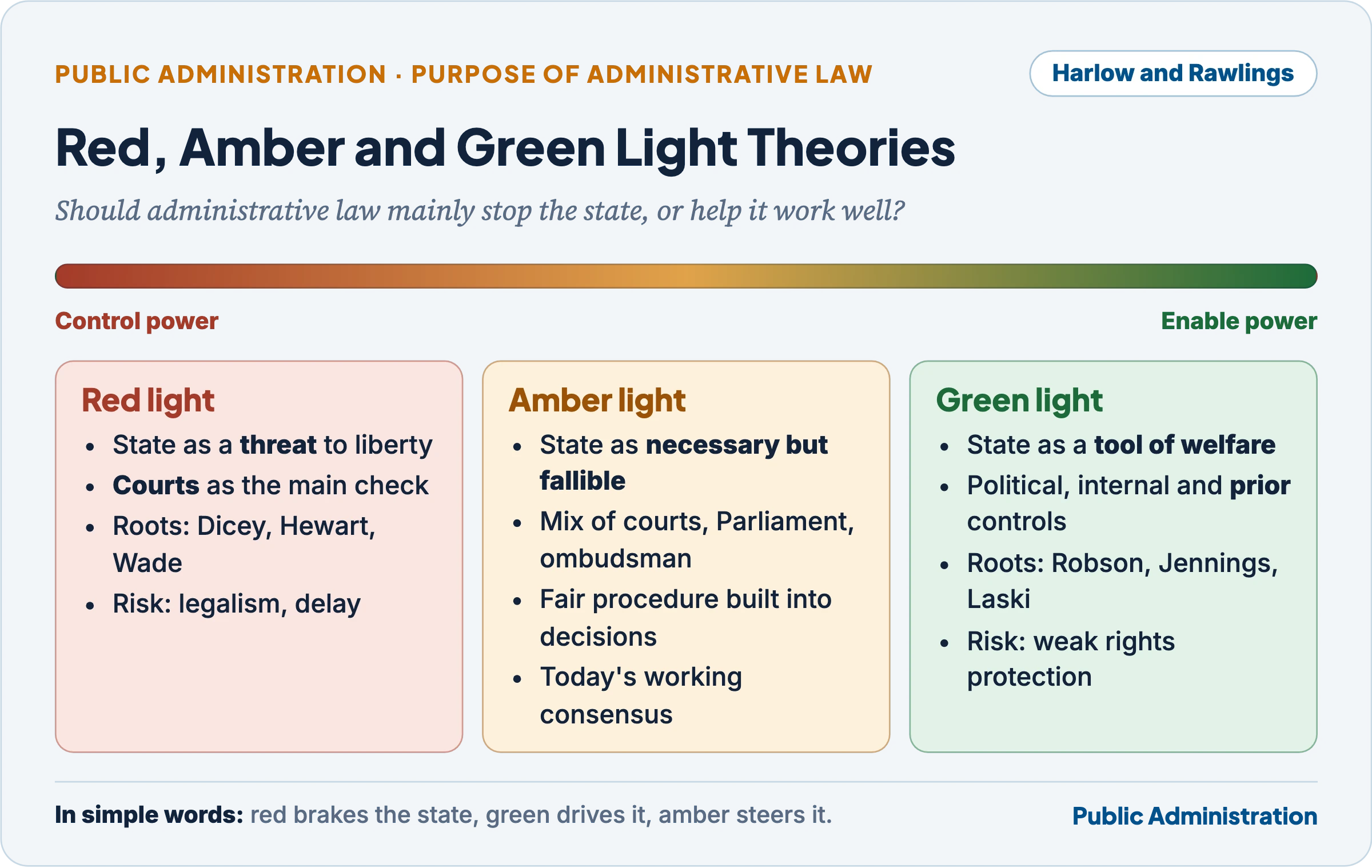
| Point | Red light theory | Green light theory |
|---|---|---|
| View of the state | A threat to individual liberty; to be kept in check | A positive instrument of collective welfare and progress |
| Purpose of administrative law | To control excesses of state power and subject it to the rule of the courts | To facilitate good administration and make public programmes work |
| Main control | Courts and judicial review, after the event | Political, internal and prior controls: Parliament, ministers, internal procedures, consultation, ombudsmen |
| Intellectual roots | Dicey, Hewart, the liberal tradition; later Wade | Robson, Jennings, Laski and the functionalist London tradition; Griffith |
| Typical tools | Ultra vires, natural justice, strict interpretation of powers | Clear statutes, good internal procedure, expert bodies, participation |
| Risk if pushed too far | Legalism, delay, judges second-guessing policy | Weak rights protection, unchecked bureaucracy |
- Red light theory grows from Dicey’s suspicion of discretion. It treats the courts as the primary weapon for protecting the citizen and assumes that most problems of administration are problems of legality.
- Green light theory grows from the experience of the welfare state. Its supporters do not favour arbitrary action; they argue that courts are not always the best controllers, since judges lack expertise and may block social reform, and that good administration is better secured by better rules, better procedures and political accountability.
- Amber light theory is the middle position Harlow and Rawlings themselves pointed towards: administration is necessary but fallible. Control should be built into decision-making (consultation, reasons, transparency) and backed by courts, legislatures and ombudsmen, each doing what it does best.
Which approach suits the objectives of administrative law? Neither extreme works alone.
- The objectives of administrative law are both to enable effective government and to protect individuals. A pure red-light approach protects rights but can paralyse welfare programmes; a pure green-light approach delivers programmes but leaves citizens exposed.
- Indian practice is amber. Courts apply red-light tools vigorously (non-arbitrariness, natural justice, proportionality, PIL), while green-light tools are expanding: RTI, citizens’ charters, social audit, Lokpal, regulatory consultation, grievance portals and decriminalisation. The trend in most democracies is towards prevention through good procedure, with courts as a backstop.
- In India’s context of weak capacity and frequent abuse at the cutting edge, the courts’ red-light role remains indispensable; but judicial overreach (policy-making through PIL, slow litigation) also shows why green-light mechanisms matter.
Criticism — Administrative law: a negation of the rule of law
- Lord Hewart, Lord Chief Justice of England, in The New Despotism (1929) attacked the growth of ministerial powers as a design to subordinate Parliament, evade the courts and make the will of the executive supreme; he called departmental adjudication administrative lawlessness.
- Administrative law gives officials a privileged position: presumption of validity, wide discretion, immunity provisions and the power to decide disputes in which the state is a party.
- Discretion can be misused for the advantage of a few and the harm of many, and there may be no effective channel of redress, especially for the poor.
- Tribunals manned by officials lack the independence of courts; critics in India have compared administrative law and its tribunals to martial law, a negation of law.
- It blurs the separation of powers, as the executive legislates and adjudicates.
Defence — Administrative law: the guarantee of the rule of law
- W.A. Robson and Ivor Jennings showed that administrative powers and tribunals were already part of English government; the choice was not between discretion and law but between controlled and uncontrolled discretion.
- The Donoughmore Committee (1932) found no evidence of a conspiracy and accepted delegated legislation and administrative adjudication as necessary, subject to safeguards.
- Natural justice, ultra vires, reasons, proportionality and legitimate expectation have made administrative action more controlled than ever; in India they rest on Articles 14 and 21.
- Specialised adjudication is cheaper, quicker and more expert, and remains subject to judicial review (L. Chandra Kumar, 1997).
- Without administrative law, the welfare state would act without rules; administrative law is how the rule of law is extended to the modern state.
5. Dicey on the Rule of Law and Administrative Law
In simple words
Dicey looked at Victorian England and said: here, nobody, not even a minister, is above the ordinary law, and nobody has arbitrary power. He looked at France and saw special courts for officials, and decided that France had a privileged class of bureaucrats. His picture of England was too rosy and his picture of France too dark, but his ideal of a government bound by law survived.
5.1 Dicey and his work
Albert Venn Dicey (1835–1922), Vinerian Professor of English Law at Oxford, published Introduction to the Study of the Law of the Constitution in 1885. The book became almost a substitute for a written constitution in Britain. It rested the English constitution on two pillars:
- Parliamentary sovereignty: Parliament can make or unmake any law, and no body can override its legislation.
- The rule of law: government must act through regular law, applied by ordinary courts.
He added a third element, conventions of the constitution (rules of political practice not enforced by courts), but he treated the rule of law as the distinctive feature of English liberty.
5.2 The three meanings of the rule of law
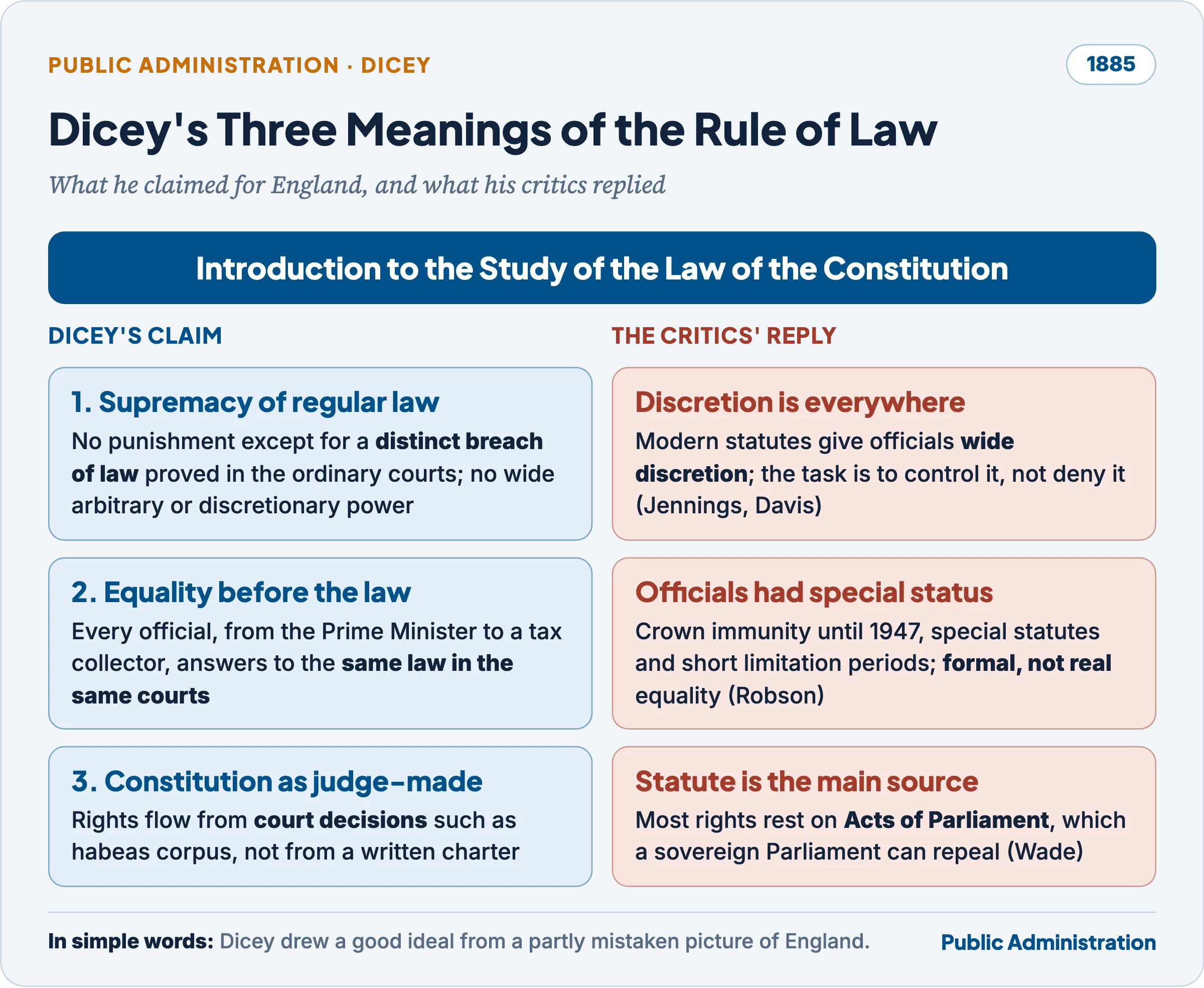
1. Supremacy of regular law (absence of arbitrary power).
- No one is punishable, or can lawfully be made to suffer in body or goods, except for a distinct breach of law established in the ordinary legal manner before the ordinary courts.
- The rule of law is opposed to government based on the exercise of wide, arbitrary or discretionary powers of constraint. Where there is discretion, Dicey believed, there is room for arbitrariness.
2. Equality before the law.
- Every person, whatever his rank or condition, is subject to the ordinary law of the realm and to the jurisdiction of the ordinary courts.
- In his own words:
> “With us every official, from the Prime Minister down to a constable or a collector of taxes, is under the same responsibility for every act done without legal justification as any other citizen.” — Dicey
- Officials enjoy no exemption from the duty of obedience to the law, and there are no special tribunals for them.
3. The constitution as the result of the ordinary law (predominance of the legal spirit).
- In England the general principles of the constitution, such as personal liberty and the right of public meeting, are the result of judicial decisions in particular cases brought before the courts.
- Rights do not flow from a written constitution; the constitution is the result of rights upheld by courts. Remedies come first: the writ of habeas corpus protected liberty better than any declaration of rights could.
What follows from the doctrine.
- Liberty is the burden of the rule of law: the individual is free to do, say or write anything that is not a breach of the law.
- Self-help is excluded: people must not take the law into their own hands; grievances go to the courts.
- Law and regulation differ: a law passed by Parliament after full debate has a legitimacy that a departmental regulation, signed by a subordinate official, lacks. This anticipates later fears about delegated legislation.
5.3 Dicey on droit administratif
Dicey contrasted the English rule of law with the French droit administratif, and concluded that administrative law was unknown in England and alien to its legal system.
- His reading of the French system. According to Dicey, droit administratif rested on two ideas foreign to English law:
- The government and every servant of the government possess, as representatives of the nation, a body of special rights, privileges or prerogatives against private citizens, determined on principles different from those governing relations between citizens.
- The government and its officials should be independent of and free from the jurisdiction of the ordinary courts.
- Three features he attributed to it:
- The rights of the state are determined by a special body of law not applicable to citizens.
- The ordinary courts have no jurisdiction where the state or its officials are parties; such cases go to administrative courts staffed by officials.
- Officials therefore enjoy special protection for wrongful acts done in the course of duty.
- His conclusion: droit administratif was a device for placing officials above the law, a relic of absolutism and Napoleonic centralisation, and opposed to the rule of law.
- Lowell’s echo. A. Lawrence Lowell, later President of Harvard, took a similar view in The Government of England (1908), and the belief that common-law countries had no “administrative law” spread to the United States.
5.4 Where Dicey went wrong about France
Later scholars, among them J.H. Morgan, W.A. Robson, Ivor Jennings and H.W.R. Wade, showed that Dicey had misread both France and England.
- He confused a part with the whole. He identified administrative law with one feature of the French system (separate courts) and, finding no such courts in England, denied that England had administrative law at all.
- French administrative courts were not tools of the executive. He assumed that courts manned by civil servants must be partial to the state. In fact the Conseil d’État acquired a reputation for independence and decided thousands of cases against the state every year; far from being a menace to liberty, it became its bulwark.
- The French citizen was often better protected. Under droit administratif the state itself paid damages for the wrongful acts of its officials done in the course of duty. In England the Crown could not be sued in tort until the Crown Proceedings Act, 1947; a citizen had to sue the official personally, and if the official was too poor to pay, the citizen got nothing. Statutes such as the Public Authorities Protection Act, 1893 also gave officials a short limitation period. As Professor Morgan put it, the effect of droit administratif was not to shield the official but to extend the state’s liability to cases where the official would be immune in England.
- The French system rests on law, not privilege. French jurist Marcel Waline summed it up in three principles: the administration may act on its own initiative and impose decisions directly; this power is exercised only within the law, which protects individual liberty against arbitrariness; and a specialised administrative jurisdiction exists to enforce that limit. Lord Hewart himself accepted that, rightly understood, droit administratif is a definite system of law administered by a tribunal using judicial methods.
5.5 Where Dicey went wrong about England
- Discretion already existed. Even in Dicey’s time, statutes gave officials wide discretion (poor law, public health, factory inspection), and the prerogative powers of the Crown in foreign affairs and defence were pure discretion. As Robson argued, English law already contained a special body of law applicable to administrative authorities.
- Equality was formal, not real. The Inland Revenue had powers no private creditor possessed; the Post Office and local authorities acted under special statutes; the Crown enjoyed immunities in contract and tort; and many officials could not be sued without restrictions. Statutory tribunals and ministerial adjudication were already growing.
- The third meaning was too narrow. Only a small part of English constitutional law came from judicial decisions; most came from statutes, conventions and custom. And judge-made rights are fragile: a sovereign Parliament can repeal them by ordinary law, while a written bill of rights entrenches them.
- Equality before the law ignores inequality of means. Radical and Marxist critics, Harold Laski among them, argued that formal equality favours the propertied: a rich man can hire the best lawyers, a poor man may not afford counsel at all. On this view Dicey’s rule of law was the legal counterpart of laissez-faire, protecting property and the existing order.
5.6 The tension between the rule of law and parliamentary sovereignty
Dicey defended both doctrines, but they pull in opposite directions.
- If Parliament is sovereign, it can confer unlimited discretion on ministers, oust the courts’ jurisdiction, create “Henry VIII clauses” allowing ministers to amend Acts by order, or legalise wartime detention without trial. The rule of law then survives only so long as Parliament chooses to respect it.
- Dicey’s own reconciliation was that Parliament’s will is expressed only through statutes, which judges interpret, and that the representative character of Parliament makes it unlikely to legislate tyranny. Critics replied that this depends on political self-restraint, not law.
- How British courts later responded: they read ouster clauses narrowly (Anisminic v Foreign Compensation Commission, 1969, held that a clause making a tribunal’s “determination” final did not protect a decision made outside jurisdiction), and some judges have suggested that the rule of law may itself limit sovereignty in extreme cases. The tension remains unresolved and often overlooked in Britain, because no court can strike down an Act of Parliament.
- India resolves it differently. Parliament is not sovereign; the Constitution is supreme. Courts can strike down laws that violate fundamental rights or exceed legislative competence, and constitutional amendments that damage the basic structure. Judicial review of administrative action under Articles 32 and 226 cannot be excluded even by amendment (L. Chandra Kumar, 1997).
5.7 Rechtsstaat and the English rule of law
The German idea of the Rechtsstaat (the “law-state”) shares the aim of a government bound by law, but it developed differently.
| Point | Continental Rechtsstaat (strong version) | English rule of law |
|---|---|---|
| Origin | Nineteenth-century German legal theory; codified public law after absolutism | Centuries of common-law evolution and the struggle between Crown and Parliament |
| Source of limits | A written constitution and codes binding all organs, including the legislature | Ordinary law and courts; Parliament itself unlimited |
| Courts | Separate administrative courts, and later constitutional courts reviewing legislation | Single system of ordinary courts; no review of Acts of Parliament |
| Substance | In its strong (post-1949) form, a substantive guarantee of rights and proportionality | Mainly formal and procedural: legality, equality before ordinary courts |
The strong Rechtsstaat never took root in England for historical reasons: England had no revolutionary break that called for a new written constitution; the common-law courts had defeated royal prerogative courts in the seventeenth century and became the trusted guardians of liberty; and the settlement of 1688 made Parliament supreme, leaving no higher law against which statutes could be measured. Only with the Human Rights Act, 1998 did British courts gain the power to declare statutes incompatible with Convention rights, and even then not to strike them down.
5.8 Dicey’s later concession (1915)
Dicey lived long enough to see the administrative state grow. In a short article, “The Development of Administrative Law in England”, in the Law Quarterly Review (1915), written as a comment on the House of Lords decision in Local Government Board v Arlidge (1915), he accepted that:
- ministers and departments were being given judicial or quasi-judicial functions, and the courts were allowing them to follow their own procedures rather than those of a court;
- this marked the growth of an English form of administrative law, a body of “official law” under which government departments decided disputes affecting individuals.
He did not abandon his preference for the ordinary courts, and he warned of the dangers, but the concession showed that his 1885 denial was no longer tenable. His new opening essay for the eighth edition of the book (1915) also lamented the declining reverence for the rule of law in England.
5.9 Critics of Dicey compared
| Critic and work | Main argument against Dicey |
|---|---|
| W.A. Robson, Justice and Administrative Law (1928) | Administrative adjudication already existed and could be as fair as courts; England needed a coherent system of administrative tribunals, even an administrative appeal court, not denial |
| Ivor Jennings, The Law and the Constitution (1933) | The rule of law is a political ideal, not a legal rule; every modern state confers wide discretion; Dicey’s view reflected Whig politics and hostility to the collectivist state |
| H.W.R. Wade, Administrative Law (1961) | Discretion cannot be abolished but must be controlled by law; restated the rule of law as legality, rules restricting discretion, independent courts, even-handedness between government and citizen, and no punishment except for defined crimes |
| Kenneth Culp Davis, Discretionary Justice (1969) | Discretion is inevitable and often desirable; the task is to confine, structure and check it |
| Harold Laski | Formal equality before the law conceals class inequality; administrative powers are needed for social reform |
| Lord Hewart, The New Despotism (1929) | A supporter of Dicey’s ideal: warned that delegated legislation and departmental adjudication were creating a “new despotism” |
5.10 The universality of administrative law and the journey beyond Dicey
The main conclusion of the debate is that administrative law is universal. Whether or not a country calls it by that name, has separate courts for it or codifies it, wherever there is public administration there is administrative law: rules about the constitution, powers, procedure and control of administrative authorities, creating a relationship between officials and citizens different from that between two citizens.
The journey of administrative law has moved far beyond Dicey in four ways:
- From denial to acceptance: administrative law is now a recognised branch of public law in every common-law country.
- From abolition of discretion to its control: the focus has shifted to grounds of review, procedural fairness and accountability for discretion.
- From formal to substantive rule of law: equality and legality are now read together with fundamental rights, proportionality and social justice.
- From courts alone to many controls: ombudsmen, information commissions, regulators, citizens’ charters and internal grievance systems complement judicial review.
Dicey’s lasting contribution is the ideal: government under law, no one above it, and independent courts to enforce it. His mistake was to equate that ideal with the absence of discretion and with one particular institutional form.
Common confusion
Did Dicey say that France had no rule of law and that England had no administrative law? He said that droit administratif was opposed to the rule of law as he understood it, and that England had no administrative law in the French sense (no separate body of law and courts for officials). He did not deny that English officials had powers. His error was to treat the French form as the only form of administrative law, and he himself partly withdrew the claim in 1915.
6. Droit Administratif: The French System
In simple words
After the Revolution, the French did not trust judges, who had blocked reforms under the old kings. So they kept disputes with the government away from the ordinary courts and gave them to a council inside the government. Over a century that council turned into an independent court that often sides with citizens against the state.
6.1 Origins and evolution
Droit administratif is the body of French public law governing the organisation and actions of the administration and its relations with citizens, applied by a separate hierarchy of administrative courts.
- 1790: separation of functions. The revolutionary laws of 16–24 August 1790 forbade the ordinary courts from interfering with the administration. Behind this lay distrust of the old royal courts (the parlements), which had obstructed reform, and a strict reading of the separation of powers: judging the administration was itself treated as an administrative act. At first, complaints went to the minister concerned (the theory of the ministre-juge, the minister as judge).
- 1799: the Conseil d’État. Napoleon Bonaparte, as First Consul, created the Conseil d’État under the Constitution of the Year VIII (December 1799). It had two roles: advising the government on bills and regulations, and resolving administrative disputes. Its decisions, however, took effect only when signed by the head of state, a system called justice retenue (retained justice).
- 1872: delegated justice. The law of 24 May 1872 made the Conseil d’État a true court deciding “in the name of the French people”, without the head of state’s signature (justice déléguée). The same reform re-established the Tribunal des conflits to decide whether a case belongs to the ordinary or the administrative courts.
- 1873: the Blanco decision. On 8 February 1873 the Tribunal des conflits decided the Blanco case: a child injured by a wagon of a state tobacco factory sued the state for damages under the Civil Code. The Tribunal held that the liability of the state for its public services cannot be governed by the Civil Code’s rules for private persons; it has its own special rules, and the administrative courts have jurisdiction. Blanco is regarded as the foundation stone of French administrative law, establishing both the autonomy of administrative law and state liability.
- 1873: Pelletier. In the same year the Tribunal des conflits distinguished personal fault of an official (for which he answers in the ordinary courts) from service fault (for which the state answers in the administrative courts).
- 1889: the Cadot decision. On 13 December 1889 the Conseil d’État held that it could hear any application to annul an administrative decision directly, ending the theory of the minister as judge.
- Twentieth century. Regional administrative tribunals (1953) became courts of first instance and administrative courts of appeal (1987) were added, leaving the Conseil d’État at the apex.
6.2 Features of the French system
- Dual jurisdiction: ordinary courts for disputes between citizens; administrative courts for disputes involving the administration; the Tribunal des conflits for disputes over jurisdiction.
- A separate body of public law, largely judge-made through the case law of the Conseil d’État rather than codified, including general principles of law binding the administration (equality before public services, the right to a hearing, continuity of public services).
- The annulment action for excess of power (recours pour excès de pouvoir): any person with an interest can ask the court to quash an illegal administrative act, cheaply and with little formality.
- State liability for service fault and, in some cases, without fault (on the basis of risk or unequal public burdens).
- Judges with administrative experience: members of the Conseil d’État are trained administrators who understand how government works, while enjoying independence in practice.
6.3 Merits of droit administratif
This is why the system is often ranked, alongside the Napoleonic Civil Code (1804), as the most notable achievement of French legal science: the Code organised private law, and droit administratif created a coherent law for the relations between state and citizen.
- Better protection of the citizen: the state, not the individual official, pays compensation; liability extends even to no-fault situations.
- Expertise: judges who know administration can assess its decisions realistically, neither naively nor with hostility.
- Cheap and accessible remedy: the annulment action is simple and inexpensive.
- Creative and coherent case law: the Conseil d’État built general principles that guided the administration and inspired other countries.
- Balance of efficiency and legality: the administration can act with vigour, while its legality is checked by a specialised court.
- Influence: the model was adopted or adapted across continental Europe, francophone Africa and beyond, and its principles (proportionality, legitimate expectation) entered European Union law.
Limitations. Disputes over which court has jurisdiction can delay justice; the closeness of the Conseil d’État to government (it also advises on bills) raises questions about appearances of independence; and the system has faced backlogs, leading to new lower courts.
6.4 French and Anglo-Saxon systems compared
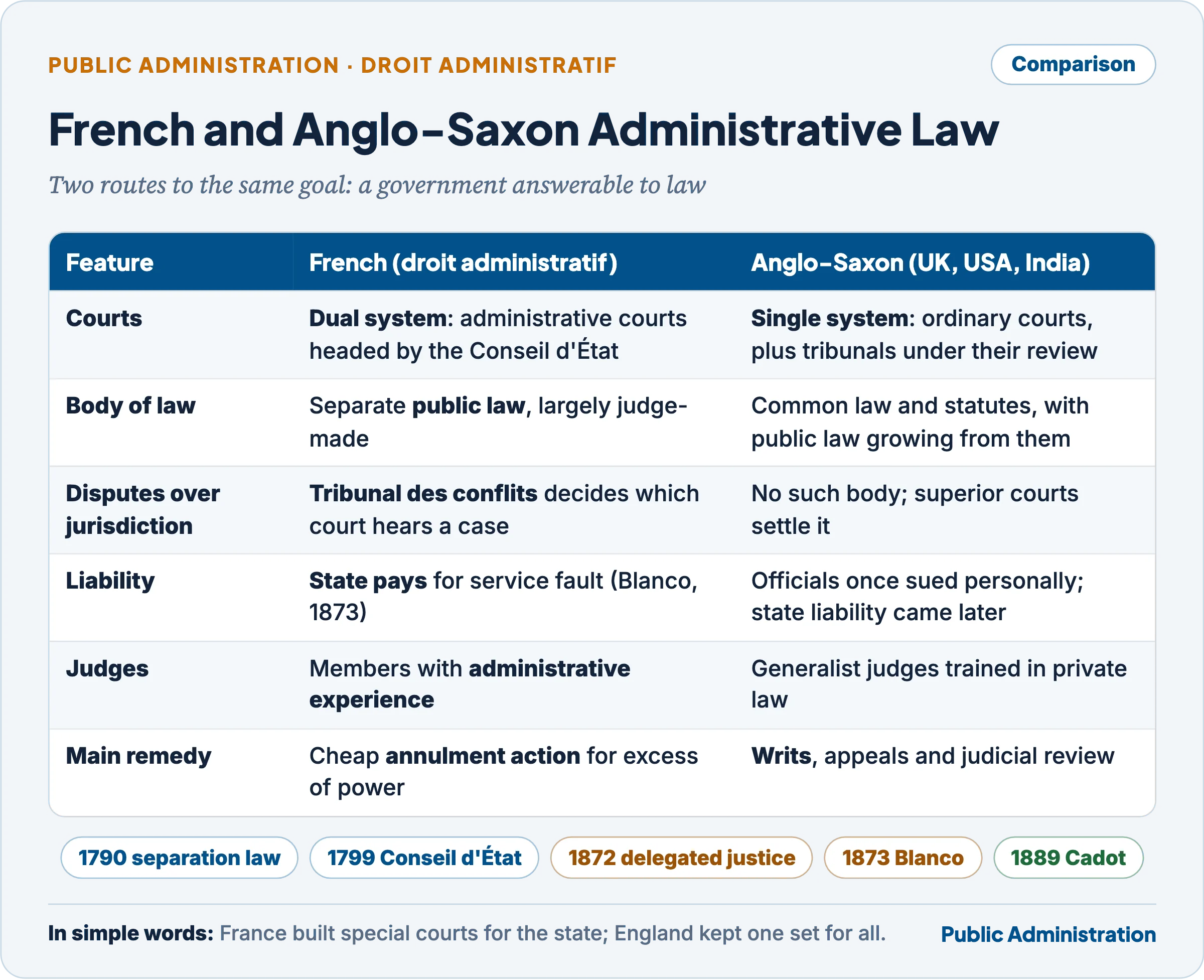
| Point | French (droit administratif) | Anglo-Saxon (UK, USA, India) |
|---|---|---|
| Court structure | Dual: administrative courts under the Conseil d’État | Single: ordinary courts; tribunals under their supervision |
| Body of law | Separate public law, judge-made, with general principles | Common law and statutes; public law grew out of private-law remedies (writs) |
| Jurisdiction conflicts | Tribunal des conflits | None; superior courts decide |
| State liability | Early and wide (Blanco, 1873) | Late: Crown Proceedings Act, 1947 (UK); Federal Tort Claims Act, 1946 (USA); Article 300 and judge-made compensation (India) |
| Judges | Trained administrators | Generalist judges |
| Main remedy | Annulment for excess of power | Writs and judicial review; statutory appeals |
| Underlying idea | Administration needs its own law and judge | Officials answer to the same law and courts as citizens (Dicey) |
India follows the Anglo-Saxon model, but with a written constitution, a Bill of Rights and judicial review, which makes Indian administrative law more constitutional than the British. Tribunals under Articles 323A and 323B introduced a partly French element (specialised adjudication), but in L. Chandra Kumar (1997) the Supreme Court kept them under the writ jurisdiction of the High Courts, so India never developed a separate administrative judiciary.
Indian Connect — What India took from each model
- From England: the common-law writs (now in Articles 32 and 226), natural justice, ultra vires and the idea that officials are personally answerable in ordinary courts (subject to statutory protections such as prior sanction for prosecuting public servants under section 218 of the Bharatiya Nagarik Suraksha Sanhita, 2023, which replaced section 197 of the CrPC).
- From the USA: a written constitution with judicial review of legislation, and the idea of due process, which entered through Maneka Gandhi v Union of India (1978) despite the framers’ choice of “procedure established by law”.
- From France (indirectly): specialised administrative adjudication through tribunals, and the European doctrines of proportionality and legitimate expectation, which reached India through English law.
7. The Modern Rule of Law
In simple words
Dicey’s rule of law said “no arbitrary power”. The modern version says more: laws must be clear, rights must be protected, courts must be affordable and fair, and the government must keep its promises, even international ones. It is a rule of law for a democracy that also wants welfare and human rights.
7.1 From a thin to a thick conception
- Thin (formal) conceptions require only that laws be general, public, prospective, clear, stable and applied by independent courts. The philosopher Joseph Raz (“The Rule of Law and its Virtue”, 1977) defended such a view: the rule of law is one virtue of a legal system, not the whole of justice. F.A. Hayek, in The Road to Serfdom (1944), defended a similar formal idea against economic planning.
- Thick (substantive) conceptions add fundamental rights, democracy and fairness. The International Commission of Jurists’ Declaration of Delhi (1959) already linked the rule of law to the conditions for human dignity, including social and economic conditions.
7.2 Bingham’s eight principles
Lord Bingham, former senior Law Lord, set out the modern rule of law in his 2006 Sir David Williams Lecture at Cambridge and in his book The Rule of Law (2010). His core idea: all persons and authorities within the state, public or private, should be bound by and entitled to the benefit of laws publicly made, taking effect in the future and publicly administered in the courts. He drew eight sub-rules from it.
| No. | Bingham’s principle | What it means for administration | Indian anchor |
|---|---|---|---|
| 1 | Law must be accessible, intelligible, clear and predictable | Rules and notifications must be published and understandable | Publication of rules; India Code portal |
| 2 | Questions of legal right should be resolved by law, not discretion | Discretion should be narrow and guided | Article 14 non-arbitrariness |
| 3 | Laws should apply equally to all, save where objective differences justify differentiation | Reasonable classification only | Article 14; Articles 15(4), 16(4) |
| 4 | Public officers must use powers in good faith, fairly, for the purpose conferred, within limits and not unreasonably | The whole of judicial review in one sentence | Grounds of review; Section 9 |
| 5 | Law must protect fundamental human rights | Administrative action tested against rights | Part III; Puttaswamy (2017) |
| 6 | Means must exist to resolve civil disputes without prohibitive cost or inordinate delay | Access to justice | Legal aid (Article 39A); tribunals; pendency problem |
| 7 | Adjudicative procedures must be fair | Natural justice, independent tribunals | Kraipak (1969); Tribunal Reforms Act case (2025) |
| 8 | The state must comply with its international law obligations | Treaties and human rights norms respected | Vishaka (1997) used international conventions |
The table shows how far Bingham’s version goes beyond Dicey: principles 1–4 restate and modernise Dicey’s first two meanings, while principles 5–8 add rights, access to justice, fair adjudication and international obligations, none of which were part of the 1885 formulation.
7.3 How Dicey’s three principles have been developed
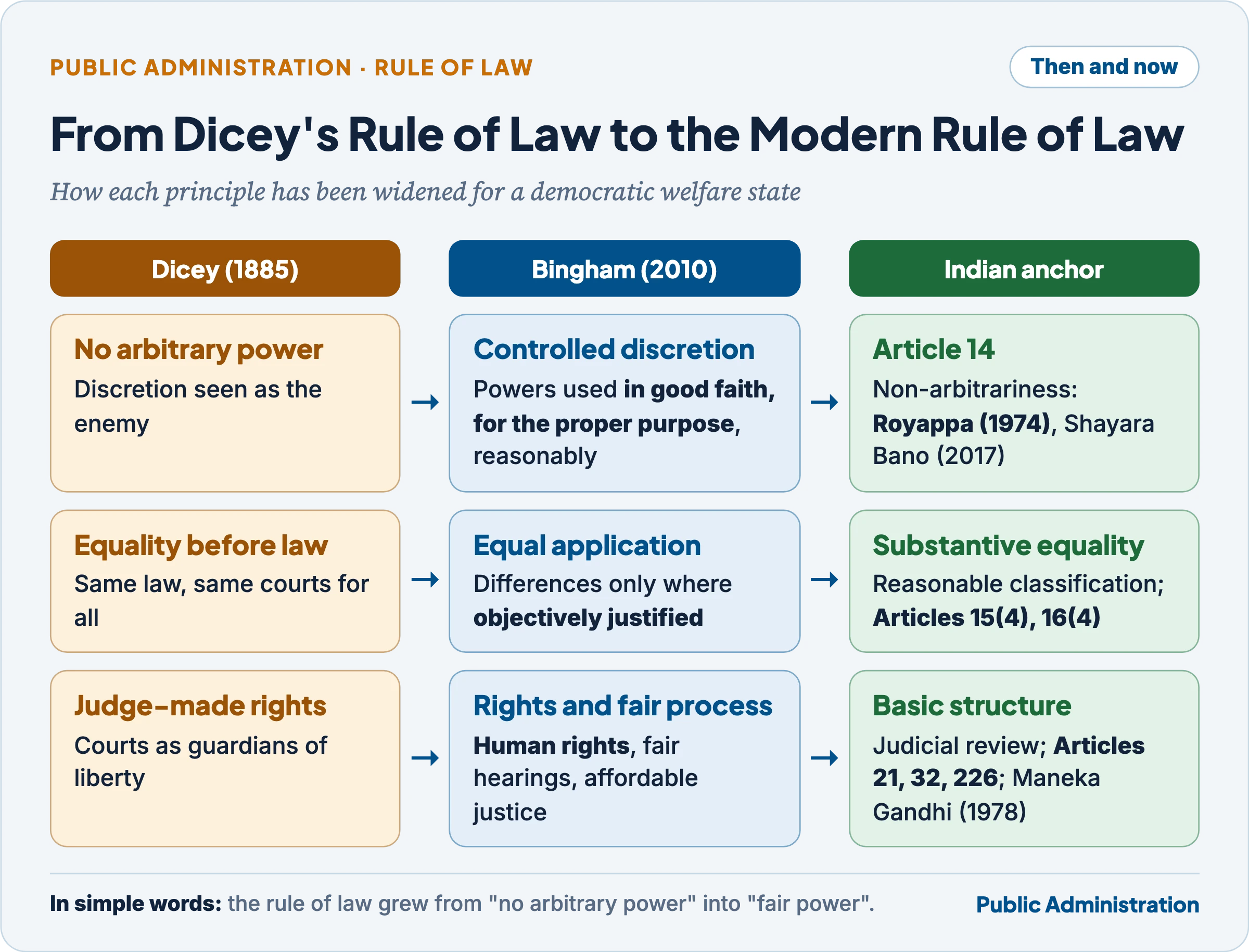
- Supremacy of law → controlled discretion. Modern democracies accept discretion but require that it be exercised within limits, for proper purposes and reasonably. The test is no longer “is there discretion?” but “is it structured and reviewable?”
- Equality before law → equal and substantive equality. Equality now permits, and sometimes requires, reasonable classification and affirmative action to remove real disadvantage. Officials remain answerable in ordinary courts, but the state’s liability for their wrongs has replaced personal liability as the main remedy.
- Judge-made constitution → written rights and judicial review. Most democracies now protect rights in written constitutions with judicial review; Britain itself adopted the Human Rights Act, 1998. The courts’ role has grown, but it now rests on entrenched texts rather than on ordinary judicial decisions alone.
- New elements: accountability institutions (ombudsmen, information commissions), transparency (RTI), access to justice (legal aid), and the rule of law as a governance indicator measured by bodies such as the World Justice Project.
8. The Rule of Law in India
In simple words
India did not need Dicey to discover the rule of law; it wrote it into the Constitution. Every official must show legal authority, every law must respect fundamental rights, and the courts can strike down any action that is arbitrary. Parliament cannot take away this protection even by amending the Constitution.
8.1 Constitutional foundations
- Preamble: justice, liberty, equality and dignity.
- Article 13: laws inconsistent with fundamental rights are void, making the Constitution supreme over ordinary law.
- Article 14: “equality before the law” (from Dicey’s English tradition) and “equal protection of the laws” (from the US Fourteenth Amendment).
- Article 21: no deprivation of life or personal liberty except according to procedure established by law, read since 1978 as a procedure that is fair, just and reasonable.
- Articles 32 and 226: writ jurisdiction to enforce rights and control administrative action.
- Article 300: the state can be sued; Article 311: protection of civil servants against arbitrary dismissal.
- Exceptions to Dicey’s equality exist in the text itself: immunity of the President and Governors from court proceedings for official acts (Article 361), parliamentary privileges (Articles 105, 194), diplomatic immunities and the requirement of prior sanction for prosecuting public servants. These are reasoned exceptions, not general privileges.
8.2 The rule of law as part of the basic structure
- In Kesavananda Bharati v State of Kerala (1973) the Supreme Court held that Parliament cannot amend the basic structure of the Constitution; the supremacy of the Constitution, judicial review and the rule of law were among the features identified by the judges.
- In Indira Nehru Gandhi v Raj Narain (1975) the Court struck down clause (4) of Article 329A, which had validated the Prime Minister’s election by declaring it valid without applying any law. Justice Khanna relied on free and fair elections as part of the basic structure; Chief Justice Ray and other judges held that validating a disputed election without applying any law offended the rule of law and equality, and that deciding a particular dispute was a judicial, not a legislative, function.
- In ADM Jabalpur v Shivkant Shukla (1976) the majority held that during the Emergency no one could approach the courts to enforce the right to life and liberty. Justice H.R. Khanna‘s dissent, which insisted that the rule of law does not vanish in an emergency, was vindicated when the nine-judge bench in K.S. Puttaswamy v Union of India (2017) declared the majority view overruled.
- Minerva Mills (1980) and L. Chandra Kumar (1997) confirmed that judicial review is part of the basic structure.
8.3 Article 14 and non-arbitrariness
Indian courts gave Dicey’s first meaning a new constitutional home: arbitrariness itself violates equality.
- E.P. Royappa v State of Tamil Nadu (1974): equality is a dynamic concept; equality and arbitrariness are sworn enemies; an arbitrary act is unequal both in political logic and constitutional law.
- Maneka Gandhi v Union of India (1978): Articles 14, 19 and 21 form an integrated whole; any procedure depriving liberty must be fair, just and reasonable, and natural justice is implicit in it.
- Ajay Hasia v Khalid Mujib (1981): state action must be free from arbitrariness, and bodies that are instrumentalities of the state are bound by Article 14.
- Shayara Bano v Union of India (2017): manifest arbitrariness (something done capriciously, irrationally or without an adequate determining principle) can invalidate even legislation.
- Association for Democratic Reforms v Union of India (15 February 2024), the electoral bonds case: the Court applied manifest arbitrariness and a proportionality analysis to strike down the scheme and related amendments.
8.4 Rule of law and social justice
Indian constitutionalism links the rule of law with social justice, not merely with protection of property, which answers the radical critique of Dicey.
- Constitutionalism means government limited by a higher law and bound to observe both limits and procedures. In India this limited government is also charged with positive duties: the Directive Principles make social and economic justice a goal of state policy.
- Substantive equality: Articles 15(4), 15(5), 16(4) and 46 permit special measures for disadvantaged groups; reasonable classification allows unequal treatment of unequals.
- Access to justice: Article 39A (equal justice and free legal aid), the Legal Services Authorities Act, 1987, and PIL (for example Bandhua Mukti Morcha v Union of India, 1984, for bonded labourers) carried the rule of law to the poor.
- Thus Indian constitutionalism uses the rule of law as an instrument of social transformation rather than as a shield for the status quo.
8.5 Gaps between principle and practice
- Judicial delay: heavy pendency in courts means rights exist on paper but remedies arrive late; civil justice is India’s weakest factor in the WJP Index.
- Selective and coercive enforcement: punitive demolitions, misuse of preventive detention and sedition-type charges, and custodial violence.
- Police and investigative autonomy: the reforms ordered in Prakash Singh v Union of India (2006) remain unevenly implemented.
- Executive law-making: re-promulgation of ordinances was held to be a fraud on the Constitution in Krishna Kumar Singh v State of Bihar (2017).
- Over-criminalisation of regulatory offences, now being reduced through the Jan Vishwas Acts.
Indian Connect — Bulldozer demolitions and the rule of law (2024)
- In In Re: Directions in the matter of demolition of structures (13 November 2024), a bench of Justices B.R. Gavai and K.V. Viswanathan held that the executive cannot demolish a person’s house merely because he is accused or even convicted of a crime; doing so would make the executive a judge, violating the separation of powers and the rule of law.
- It laid down pan-India guidelines: prior show-cause notice with time to respond, a personal hearing, a reasoned final order, time to challenge it, video recording of any demolition, and personal liability of officials who disobey, including restitution at their cost.
- A week earlier (6 November 2024), in a road-widening case from Uttar Pradesh, another bench described “bulldozer justice” as unacceptable under the rule of law and required written notice, a speaking order on objections and compensation for high-handed demolition.
- The judgments apply every element of this article: Dicey’s equality before law, natural justice, reasoned orders and public-law compensation.
9. Administrative Discretion and Its Control
In simple words
Discretion is the freedom to choose. A district magistrate deciding whether to grant an arms licence has discretion; so does a teacher deciding which student to send to a competition. The question is not whether officials should have discretion (they must) but how to stop them from using it for the wrong reasons.
9.1 Meaning and necessity
Administrative discretion is the power of an authority to choose among alternative courses of action (including inaction) on the basis of its own judgement. Kenneth Culp Davis defined it as existing whenever the effective limits on an officer’s power leave him free to choose among possible courses of action or inaction.
- Why it is needed: laws cannot foresee every situation; individual cases differ; technical and local knowledge lies with officials; emergencies require quick action; and modern statutes deliberately use broad standards (“public interest”, “fit and proper”).
- Why it is dangerous: it opens the way to arbitrariness, favouritism, corruption and inconsistency; affected persons may not know the grounds of decision; and powerful interests can capture it.
- Davis’s prescription in Discretionary Justice (1969): eliminate unnecessary discretion and then confine it (fix its boundaries by clearer rules), structure it (through published policies, reasons, precedents, open procedures) and check it (by supervision, review and appeals).
9.2 Control at the stage of delegation
Discretion can be controlled when it is conferred.
- The legislature must not delegate essential legislative functions and must lay down policy and guidelines; a law conferring unguided power can be struck down under Article 14 as arbitrary (see the article on Delegated Legislation).
- Statutes can require consultation, published criteria, reasons and appeals before discretion is used.
9.3 Control at the stage of exercise: grounds of judicial review
In the GCHQ case (Council of Civil Service Unions v Minister for the Civil Service, 1985), Lord Diplock grouped the grounds of review under three heads, and suggested that proportionality might later be added. Indian courts use the same classification.
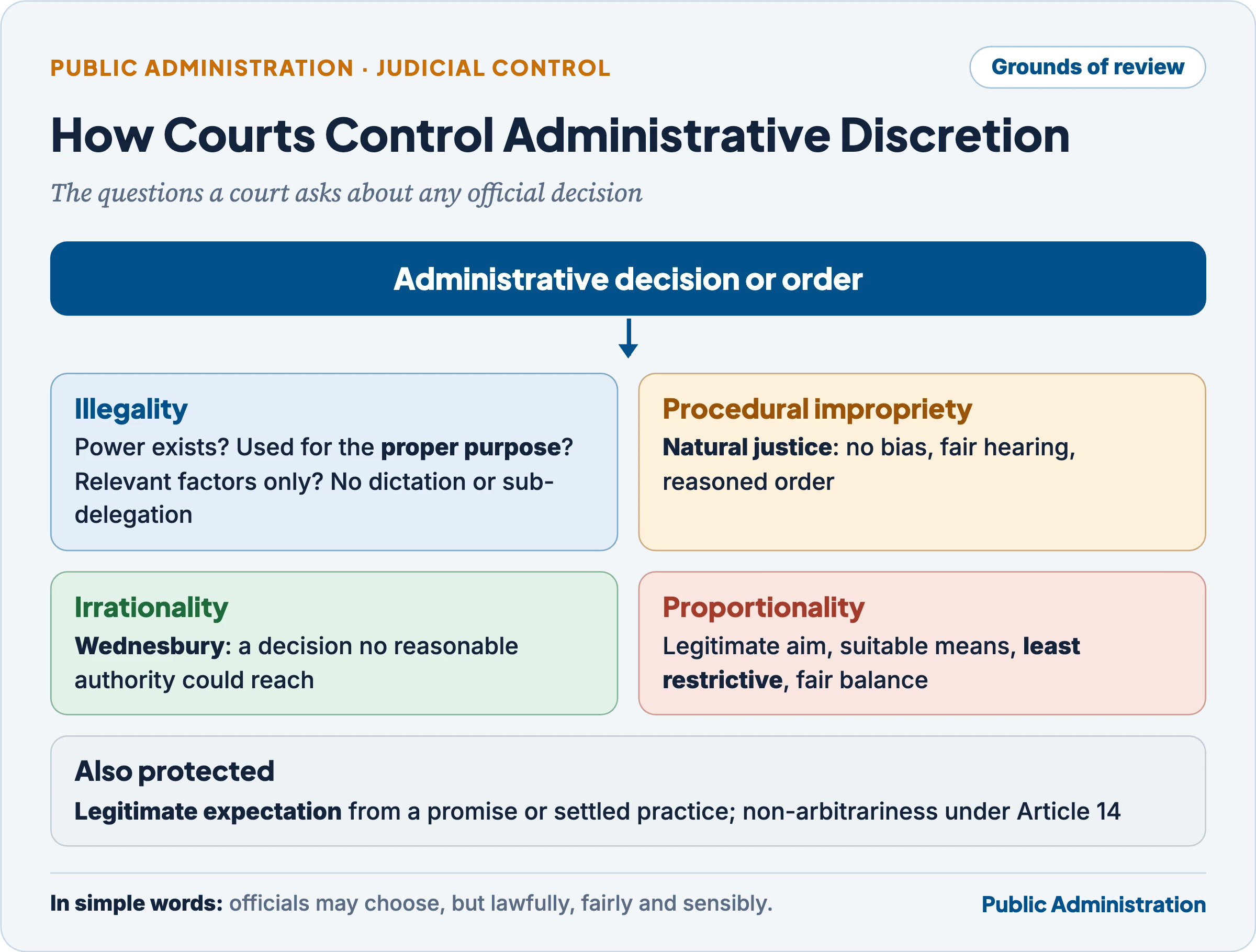
Illegality. The authority must understand correctly the law that regulates its power and give effect to it.
- Failure to exercise discretion:
- Sub-delegation without authority (a power given to the Collector exercised by his clerk).
- Acting under dictation of a superior or a minister when the statute gives the power to the officer.
- Fettering discretion by a rigid policy that admits no exceptions, so that individual cases are not considered.
- Non-application of mind to the facts of the case.
- Abuse of discretion:
- Improper purpose or mala fides (using town-planning powers to punish a political opponent).
- Irrelevant considerations taken into account or relevant ones ignored.
- Colourable exercise of power: doing indirectly what cannot be done directly.
- Exceeding jurisdiction (ultra vires).
Irrationality: Wednesbury unreasonableness. In Associated Provincial Picture Houses v Wednesbury Corporation (1948) the English Court of Appeal held that a court can interfere with a discretionary decision only if it is so unreasonable that no reasonable authority could ever have come to it. Lord Diplock later described irrationality as a decision so outrageous in its defiance of logic or accepted moral standards that no sensible person could have arrived at it. Indian courts adopted the test in Tata Cellular v Union of India (1994), which held that courts review the decision-making process, not the merits, and in Union of India v G. Ganayutham (1997).
Procedural impropriety. Failure to observe statutory procedure or the principles of natural justice (Section 10).
Proportionality. A more intensive test, of European origin, which asks whether the measure pursues a legitimate aim, whether the means are suitable to that aim, whether they are the least restrictive means available, and whether the balance between the harm to the individual and the public benefit is fair.
- In Om Kumar v Union of India (decided November 2000, reported 2001), the Supreme Court held that where administrative action restricts fundamental freedoms under Articles 19 and 21, or involves discriminatory classification under Article 14, courts act as primary reviewers and apply proportionality; where action is challenged as arbitrary under Article 14 (for example the quantum of punishment in service cases), courts act as secondary reviewers and apply Wednesbury principles.
- Modern Dental College v State of Madhya Pradesh (2016) and Puttaswamy (2017) adopted a four-step proportionality test for restrictions on rights; the electoral bonds judgment (2024) applied a double proportionality test to balance two rights.
| Point | Wednesbury unreasonableness | Proportionality |
|---|---|---|
| Question | Is the decision so unreasonable that no reasonable authority could reach it? | Is the measure suitable, necessary and balanced for a legitimate aim? |
| Intensity | Low; courts defer to the administrator | Higher; courts examine the weighing of interests |
| Role of court | Secondary reviewer | Primary reviewer where rights are restricted |
| Origin | English law (1948) | German and European law; EU and ECHR jurisprudence |
| Indian use | Service punishments, contracts, policy (Tata Cellular, Ganayutham) | Restrictions on Articles 19 and 21 (Om Kumar, Puttaswamy, electoral bonds) |
Legitimate expectation. Where a public authority has made a clear promise or followed a settled practice, an affected person may legitimately expect that it will be honoured, or at least that he will be heard before it is changed.
- Recognised in English law in the GCHQ case (1985) and in India in Navjyoti Co-operative Group Housing Society v Union of India (1992) and Food Corporation of India v Kamdhenu Cattle Feed Industries (1993), which held that giving due weight to legitimate expectations is part of non-arbitrariness under Article 14.
- Expectation is not a legal right: the authority can defeat it for an overriding public interest, but must show that interest. In Sivanandan C.T. v High Court of Kerala (12 July 2023) the Supreme Court held that substantive legitimate expectation is entrenched in Indian law: a High Court that introduced a minimum cut-off for the interview after the selection process had begun acted arbitrarily, because good administration demands consistency, transparency and predictability.
9.4 Other controls on discretion
- Legislative: clear statutory guidelines, laying of rules, committee scrutiny.
- Administrative: published policies and guidelines, internal appeals, inspection, audit, vigilance.
- Transparency: RTI disclosure of reasons and file notings; e-governance that removes discretion from routine decisions (online land records, faceless tax assessment).
- Ethical: codes of conduct and the values of the civil service; the basic ethical problem for an administrator is to use discretionary power consistently with democratic values.
10. Natural Justice
In simple words
Natural justice means two plain rules of fairness that every child understands: you cannot be the judge in your own quarrel, and you must hear both sides before you decide. Courts now add a third: say why you decided as you did.
10.1 Meaning and growth
Natural justice refers to the minimum standards of fair procedure that any authority deciding matters affecting a person’s rights or interests must observe. The principles are not codified; as A.K. Kraipak (1969) put it, they supplement the law rather than supplant it, operating in areas not covered by a valid law, with the aim of preventing a miscarriage of justice.
- English revival. For some decades English courts confined natural justice to “judicial” bodies. Ridge v Baldwin (House of Lords, decided 1963, reported 1964), in which a chief constable was dismissed without a hearing, revived the principle and applied it to administrative decisions affecting rights.
- Indian expansion. State of Orissa v Binapani Dei (1967) required a hearing before an administrative order with civil consequences (an alteration of a government servant’s date of birth); Kraipak (1969) applied natural justice to administrative selection; Maneka Gandhi (1978) made a fair hearing part of Article 21; Union of India v Tulsiram Patel (1985) held that natural justice is part of Article 14.
10.2 Rule against bias: nemo judex in causa sua
No one should be a judge in his own cause. Justice must not only be done but be seen to be done.
- Pecuniary bias: any financial interest, however small, disqualifies (in Dimes v Grand Junction Canal, 1852, a decision of the Lord Chancellor, who held shares in the company, was set aside).
- Personal bias: relationship, friendship, professional connection or hostility towards a party.
- Official or subject-matter bias: the decision-maker is involved in the subject, for example as the prosecutor, complainant or a person who has already pre-judged the issue; or departmental bias where the same department acts as prosecutor and judge.
- Test: whether there is a real likelihood or reasonable apprehension of bias in the mind of a reasonable person, not proof of actual bias (Manak Lal v Dr Prem Chand, 1957; Kraipak, 1969).
- In Kraipak, the acting Chief Conservator of Forests sat on the selection board for the Indian Forest Service while being himself a candidate; though he withdrew when his own name was considered, he took part when his rivals were assessed. The Supreme Court set aside the entire selection.
- Exception, the doctrine of necessity: if the only competent authority is disqualified and no substitute exists, it may still decide, since otherwise no decision would be possible.
10.3 Hearing rule: audi alteram partem
No one should be condemned unheard. The components depend on the context, but usually include:
- Notice stating the case to be met and the proposed action.
- Disclosure of the material relied upon against the person.
- Reasonable opportunity to present one’s case, in writing or orally.
- Cross-examination and legal representation in some contexts (for example where serious charges depend on witnesses), but not as an absolute right.
- Post-decisional hearing where an urgent decision must be taken first: Maneka Gandhi (1978) accepted that a passport could be impounded before a hearing provided a prompt hearing followed; Swadeshi Cotton Mills v Union of India (1981) applied the idea to a takeover of management.
10.4 Reasoned decisions: the third principle
- Courts increasingly require administrative and quasi-judicial authorities to give reasons (a speaking order). Reasons show that the mind was applied, discipline the decision-maker, satisfy the affected person and make judicial review possible.
- S.N. Mukherjee v Union of India (1990): administrative authorities exercising quasi-judicial functions must record reasons unless the requirement is expressly or impliedly excluded.
- Mohinder Singh Gill v Chief Election Commissioner (1978): an order must be judged by the reasons stated in it, which cannot be supplemented later by affidavits.
10.5 Exceptions to natural justice
Natural justice is flexible, and in some situations its application is excluded or reduced.
- Legislative action: making laws or rules of general application does not require individual hearings, because it affects people at large rather than particular individuals (Union of India v Cynamide India, 1987). Consultation may still be required by statute.
- Statutory exclusion: a statute may expressly or by necessary implication exclude a hearing, provided the exclusion is itself constitutional.
- Constitutional exclusion: the second proviso to Article 311(2) allows dismissal without inquiry where it is not reasonably practicable to hold one, or in the interest of the security of the state (Tulsiram Patel, 1985).
- Emergency and urgency: where prompt action is needed to protect public health or safety (sealing an unsafe building, destroying contaminated food); a post-decisional hearing may then be due.
- Public interest and national security, and confidentiality.
- Impracticability: where very large numbers are affected (cancellation of an examination due to mass copying).
- Interim, preventive or preparatory action: suspension pending inquiry, a show-cause notice, a preliminary fact-finding inquiry.
- Academic evaluation and purely administrative matters without civil consequences.
- Doctrine of necessity (for bias).
- No prejudice (“useless formality”): courts have sometimes refused relief where a hearing would have made no difference, though they apply this cautiously (State Bank of Patiala v S.K. Sharma, 1996, introduced a test of prejudice for procedural lapses).
Common confusion
Is natural justice written into the Indian Constitution? Not in so many words. No article says “nemo judex” or “audi alteram partem”. The courts have read natural justice into Article 14 (an unfair procedure is arbitrary, Tulsiram Patel, 1985) and Article 21 (procedure must be fair, just and reasonable, Maneka Gandhi, 1978). That is why a breach of natural justice in India is usually also a constitutional violation, and why it can be excluded by statute only if the exclusion itself survives Article 14.
11. Bridges: Delegated Legislation, Tribunals and the Ombudsman
In simple words
The rest of administrative law grows out of two facts: officials now make most of the rules, and officials now decide many of the disputes. Each fact has its own article; here is the link.
- Delegated legislation is the legislative face of the administrative state. Its growth (pressure on parliamentary time, technicality, flexibility, emergencies) and its dangers (executive dominance, Henry VIII clauses, inadequate scrutiny) are the reason for parliamentary controls (laying, Committees on Subordinate Legislation) and judicial controls (substantive and procedural ultra vires, excessive delegation). See the article on Delegated Legislation.
- Administrative tribunals are the judicial face. They exist because the welfare state generates disputes that ordinary courts cannot handle quickly or expertly. Their independence and their subjection to High Court review (L. Chandra Kumar, 1997; the Tribunal Reforms Act case, 2025) are the central issues. See the article on Administrative Tribunals.
- The ombudsman (Lokpal and Lokayuktas) deals with maladministration and corruption outside the reach of courts. See the articles on Accountability and Control and on Corruption.
12. Growth of Administrative Law in India
In simple words
Indian administrative law began as borrowed English law, but Indian judges turned it into something bigger by joining it to fundamental rights. Parliament then added laws on tribunals, information and ombudsmen, and is now removing jail terms for minor lapses.
12.1 Phases
| Phase | Character | Landmarks |
|---|---|---|
| Colonial (before 1950) | Administration largely law-and-order and revenue; English principles applied through ordinary courts; state liability through the East India Company precedent | P. and O. Steam Navigation Co. v Secretary of State (1861) on liability for non-sovereign functions |
| Formal phase (1950–late 1960s) | Courts cautious; natural justice confined to quasi-judicial functions; procedure established by law read literally | A.K. Gopalan (1950); Law Commission’s First (1956) and Fourteenth (1958) Reports; Kasturi Lal (1965) |
| Expansion (late 1960s–1980s) | Natural justice extended to administrative action; non-arbitrariness under Article 14; due process through Article 21; PIL | Binapani Dei (1967), Kraipak (1969), Royappa (1974), Maneka Gandhi (1978), S.P. Gupta (1981); 42nd Amendment (1976) |
| Consolidation (1985–2010) | Tribunals; Wednesbury and proportionality; legitimate expectation; compensation; RTI | Administrative Tribunals Act (1985), Tulsiram Patel (1985), Nilabati Behera (1993), Tata Cellular (1994), L. Chandra Kumar (1997), Om Kumar (2000), RTI Act (2005) |
| Contemporary (2010 onwards) | Manifest arbitrariness; four-step proportionality; substantive legitimate expectation; tribunal independence; decriminalisation and administrative penalties | Lokpal Act (2013), Shayara Bano (2017), Puttaswamy (2017), Sivanandan (2023), electoral bonds (2024), demolition guidelines (2024), Tribunal Reforms Act case (2025), Jan Vishwas Acts (2023, 2026) |
The phases show the judge-made character of Indian administrative law: each expansion came first from the courts, with legislation following later. This is why judicial interest in administrative decisions has steadily extended the frontiers of administrative law in India, and why many issues (the limits of PIL, the standard of review, the independence of tribunals) remain alive and contested after decades of litigation.
12.2 Recent legislative developments
- Jan Vishwas (Amendment of Provisions) Act, 2023, notified on 11 August 2023, decriminalised 183 provisions in 42 Central Acts administered by 19 ministries and departments, replacing imprisonment for minor and technical defaults with monetary penalties.
- Jan Vishwas (Amendment of Provisions) Act, 2026 (assent 7 April 2026): introduced in August 2025 as a Bill to amend 355 provisions in 16 Acts, it was widened by a Lok Sabha Select Committee and finally amended 784 provisions across 79 Central Acts, decriminalising 717 of them and amending 67 to ease living. It provides warnings for many first-time contraventions, graduated penalties, adjudication by designated officers, and an automatic 10 per cent increase in fines every three years.
- Significance for administrative law: decriminalisation shifts enforcement from criminal courts to administrative adjudication. This reduces harassment and court load, but it widens the discretion of adjudicating officers, so natural justice, reasoned orders and appeals become more important.
- India still has no general administrative procedure statute of the American type; procedure is fixed Act by Act and supplemented by judge-made principles.
Key Terms
| Term | Meaning in simple words |
|---|---|
| Administrative law | Law that gives the administration its powers, fixes its procedures and controls its actions, with remedies for citizens |
| Rule of law | Government according to known law, with no one above it and independent courts to enforce it |
| Droit administratif | French administrative law, applied by separate administrative courts |
| Conseil d’État | France’s highest administrative court and government adviser, created in 1799 |
| Tribunal des conflits | French body deciding whether ordinary or administrative courts hear a case |
| Parliamentary sovereignty | Parliament’s unlimited power to make or unmake any law (Britain) |
| Rechtsstaat | German idea of a state bound by law and constitution, with administrative courts |
| Administrative discretion | Freedom of an official to choose among courses of action |
| Ultra vires | Beyond the powers given by law, and therefore void |
| Natural justice | Basic rules of fair procedure: no bias, fair hearing, reasoned decision |
| Nemo judex in causa sua | No one should be a judge in his own cause |
| Audi alteram partem | Hear the other side |
| Speaking order | An order that states its reasons |
| Wednesbury unreasonableness | A decision so unreasonable that no reasonable authority could reach it |
| Proportionality | Test of whether a measure is suitable, necessary and balanced for a legitimate aim |
| Legitimate expectation | Reasonable expectation, based on a promise or practice, that an authority will act in a certain way |
| Public interest litigation | Litigation by any public-spirited person for those unable to approach the court |
| Red light theory | View of administrative law as mainly a check on state power through courts |
| Green light theory | View of administrative law as a facilitator of good administration through political and internal controls |
| Ombudsman | Independent official who investigates complaints of maladministration |
Commissions, Committees and Judgments
| Body or case | Year | Key point |
|---|---|---|
| Blanco (Tribunal des conflits) | 1873 | State liability for public services governed by special rules and decided by administrative courts |
| Committee on Ministers’ Powers (Donoughmore) | 1932 | Accepted delegated legislation and administrative adjudication as necessary, with safeguards |
| First Law Commission (M.C. Setalvad), First and Fourteenth Reports | 1956, 1958 | Liability of the state in tort; reform of judicial administration |
| Franks Committee | 1957 | Openness, fairness and impartiality for tribunals and inquiries |
| Ridge v Baldwin | 1963 | Revived natural justice for administrative decisions |
| A.K. Kraipak | 1969 | Natural justice applies to administrative action; rule against bias |
| Kesavananda Bharati | 1973 | Basic structure doctrine |
| E.P. Royappa | 1974 | Arbitrariness is the antithesis of equality |
| Indira Nehru Gandhi v Raj Narain | 1975 | Article 329A(4) struck down; rule of law, free elections, judicial function |
| Maneka Gandhi | 1978 | Fair, just and reasonable procedure; natural justice in Article 21 |
| GCHQ case | 1985 | Illegality, irrationality, procedural impropriety; legitimate expectation |
| Tulsiram Patel | 1985 | Natural justice part of Article 14; exclusion under Article 311(2) |
| S.N. Mukherjee | 1990 | Duty to give reasons |
| Kamdhenu Cattle Feed | 1993 | Legitimate expectation as part of non-arbitrariness |
| Nilabati Behera | 1993 | Public-law compensation for violation of Article 21 |
| Tata Cellular | 1994 | Review of decision-making process, not merits |
| L. Chandra Kumar | 1997 | Judicial review by High Courts is basic structure; tribunals subject to it |
| Om Kumar | 2000 (reported 2001) | Proportionality for rights; Wednesbury for arbitrariness |
| Shayara Bano | 2017 | Manifest arbitrariness |
| K.S. Puttaswamy | 2017 | Privacy; proportionality; ADM Jabalpur overruled |
| Sivanandan C.T. | 2023 | Substantive legitimate expectation |
| Electoral bonds (ADR v Union of India) | 2024 | Manifest arbitrariness and proportionality |
| Demolition of structures | 2024 | Notice, hearing, reasoned order and official liability before demolition |
| Tribunal Reforms Act case | 2025 | Provisions struck down; National Tribunals Commission directed |
Contemporary Developments
- 15 February 2024, electoral bonds judgment: a Constitution Bench applied manifest arbitrariness and a double proportionality test, showing how Indian courts now use both doctrines to review state action.
- 28 June 2024, Loper Bright Enterprises v Raimondo: the US Supreme Court overruled the Chevron doctrine of deference, holding that courts must exercise independent judgement on whether an agency acted within its statutory authority; a major shift in the balance between courts and the administrative state.
- 13 November 2024, demolition guidelines: the Supreme Court held that punitive demolitions violate the rule of law and separation of powers, and laid down notice, hearing, reasoned-order and accountability requirements for all demolitions.
- 28 October 2025, WJP Rule of Law Index 2025: India ranked 86th of 143, with its overall score falling 1.7 per cent; it ranked 43rd on open government but 114th on civil justice.
- 19 November 2025, Tribunal Reforms Act case: a bench led by Chief Justice B.R. Gavai struck down key provisions of the Tribunals Reforms Act, 2021 as a repackaging of an already invalidated ordinance, and directed the Union to set up a National Tribunals Commission within four months.
- 7 April 2026, Jan Vishwas (Amendment of Provisions) Act, 2026: amended 784 provisions in 79 Central Acts, decriminalising 717, and expanded administrative adjudication of penalties.
- 12 July 2023, Sivanandan C.T. v High Court of Kerala: recognised substantive legitimate expectation as part of Indian administrative law, grounded in consistency, transparency and predictability.
Revision Grid
| Thinker or body | Work or report (year) | Key idea |
|---|---|---|
| A.V. Dicey | Introduction to the Study of the Law of the Constitution (1885); LQR article (1915) | Three meanings of the rule of law; droit administratif alien to England; later concession |
| A.L. Lowell | The Government of England (1908) | Echoed Dicey’s denial of administrative law |
| Frank Goodnow | Comparative Administrative Law (1893) | Administrative law always existed in England and America |
| Lord Hewart | The New Despotism (1929) | “Administrative lawlessness”; executive evading Parliament and courts |
| W.A. Robson | Justice and Administrative Law (1928) | Administrative adjudication is real and can be fair |
| Ivor Jennings | The Law and the Constitution (1933) | Rule of law a political ideal; discretion inevitable |
| Griffith and Street | Principles of Administrative Law (1952) | Five questions of administrative law |
| H.W.R. Wade | Administrative Law (1961) | Law relating to the control of governmental power |
| K.C. Davis | Administrative Law Treatise (1958); Discretionary Justice (1969) | Confine, structure and check discretion |
| Harlow and Rawlings | Law and Administration (1984) | Red, green and amber light theories |
| Lord Bingham | Sir David Williams Lecture (2006); The Rule of Law (2010) | Eight principles of the modern rule of law |
| Marcel Waline | French jurist | Three principles of droit administratif |
| Donoughmore Committee | Committee on Ministers’ Powers (1932) | Delegation necessary, with safeguards |
| Franks Committee | Tribunals and Inquiries (1957) | Openness, fairness, impartiality |
| Law Commission of India | First (1956) and Fourteenth (1958) Reports, M.C. Setalvad | State liability; reform of judicial administration |
| M.P. Jain | Indian administrative law scholar | Indian administrative law is largely judge-made |
Previous Year Questions
- 2026“Dicey’s three principles of the ‘Rule of Law’ have been further developed to meet the immense needs of a democratic society.” Discuss.
- 2025Administrative Law has evolved from the need to create a system of Public Administration under law. Elucidate.
- 2025The principles of checks and balances count among the most fundamental constitutional values. Comment.
- 2025The foundations of Public Administration, New Public Management and Public Governance rest on ‘rule of law’. Discuss.
- 2025“Delegated legislation should be clear and should confine to the limits determined by the legislature.” In light of the statement explain how misuse of administrative discretion can be checked?
- 2021Judicial review, prevention of misuse or abuse of administrative power and provision of suitable remedies are the basic principles of administrative law. Justify as how various organs of the State are able to uphold these principles.
- 2020“Arbitrariness in the application of rule of law is a primary cause of poor governance.” Discuss.
- 2020“Developments in the field of Administrative Law reflect an increasingly blurred boundary between the state and society, and between justice and administration.” Has administrative law become more constitutional than the Constitution itself? Argue.
- 2019“Red light and Green light theories provide contrasting approaches to the role of administrative law.” Which of the two theories will be effective in achieving the objectives of administrative law? Justify your choice.
- 2018“The Journey of Administrative Law has moved much beyond A. V. Dicey.” Comment.
- 2017“Administrative Law is recognised by its substance rather than its form.” Discuss.
- 2016The central concern of Administrative Law has been the legal limitation of administrative discretion.” Give reasons.
- 2015“Legislative action is not subject to the rules of natural justice.” Explain the exceptions to the rule of natural justice.
- 2014“The conceptual division between administrative and constitutional law is quite porous, and that along many dimensions, administrative law can be considered more constitutional in character than the constitutions.” How would you justify the statement?
- 2012Would you agree that the strong Rechsstaat version of the rule of law found on the Continent never existed in England because of its particular history?
- 2012Why is le droit administrative regarded alongside the Napoleonic Code as the most notable achievement of French legal science?
- 2012Do you think that there is an unresolved and often overlooked tension in Dicey’s concept of rule of law, considering that the other principle of parliamentary sovereignty in English constitutional system runs counter to it?
- 2011Make a critical assessment of Dicey’s understanding of the Rule of Law and Droit Administratif.
- 2006“Today the content of administrative law is driven primarily by the scope of public administrative activity.” Explain.
- 2005“Today the content of administrative law is driven primarily by the scope of public administration activity.” Explain.
- 2002“Dicey was wrong not only in his concept of the rule of law, but he also overlooked the significance of the administrative law.” – Comment.
- 1998“Administrative Law in modern government system is inevitable.” Comment.
- 1997The central concern of administrative law has been the legal limitation of administrative ‘discretion.’ Comment.
- 1995The field of administrative law, after a century of litigation & adjudication, remains alive with simmering issues. Comment.
- 1994“Administrative law is not a rigid, rule-bound barrier to good management.” Discuss.
- 1993How has the interest of judiciary in administrative decisions grown over the years? Has it extended the frontiers of administrative law?
- 1992‘Rule of law is the base of India’s constitutional life, and administrative law seeks to ensure that this basic premise remains upheld and protected.’ Comment.
- 1990‘…… administrative law, with its creature administrative tribunals, is like martial law, the negation of law.’ Comment.
- 1989“Administrative Law has the obligation to observe the principles of natural justice and fairness.” Elaborate.
- 1987‘The Droit Administratiff violates Dicey’s basic principles of Rule of Law.’ Comment.
- 2026Constitutionalism in India paves the way for rule of law and social justice. Elaborate.