

Introduction: Meaning, scope and significance of Public Administration; Wilson’s vision of Public Administration; Evolution of the discipline and its present status; New Public Administration; Public Choice approach; Challenges of liberalization, Privatisation, Globalisation; Good Governance: concept and application; New Public Management.
This article: Challenges of liberalisation, privatisation and globalisation (LPG) for public administration; governance and good governance: concept and application.
Official Syllabus: Paper I · Unit 1-01 Introduction
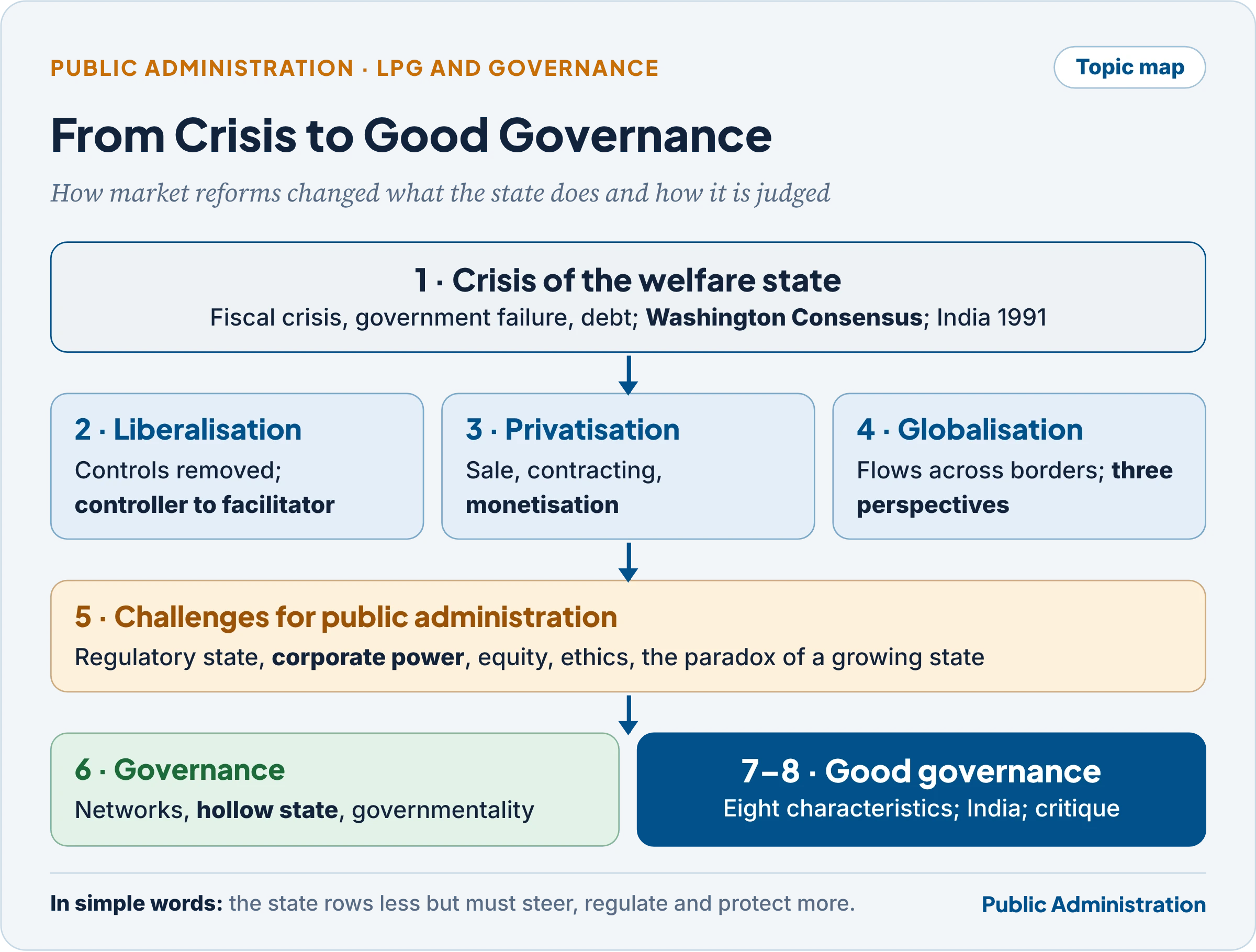
From the 1980s, a wave of change swept across the world.
- Liberalisation loosened the state’s controls over the economy.
- Privatisation moved enterprises and services from public to private hands.
- Globalisation tied national economies, cultures and problems together.
These forces did not abolish public administration, but they changed what it does (less producing, more regulating and enabling), with whom it works (markets, civil society, international bodies) and how it is judged (by results, transparency and citizen satisfaction). The answer to these challenges took the shape of a new vocabulary: governance and good governance.
In simple words
Think of the state as a family that once cooked every meal itself. Under LPG it began ordering from restaurants, letting neighbours run the kitchen and buying ingredients from abroad. It now cooks less, but it must choose good suppliers, check food safety, pay bills fairly and make sure no one in the house goes hungry. That new, harder job of coordinating and checking is “governance”.
1. The Context: Crisis of the Welfare State
In simple words
After the Second World War, governments everywhere grew big: they ran industries, planned economies and gave welfare. By the 1970s and 1980s, many ran out of money and patience. LPG was the cure many governments chose, sometimes by conviction and sometimes because lenders insisted.
1.1 Why the big state came under attack
- Fiscal crisis: the oil shocks of 1973 and 1979, stagflation (high inflation with unemployment) and rising welfare bills left governments with chronic deficits. James O’Connor called it “the fiscal crisis of the state” (1973).
- Government failure: public choice theorists (Buchanan, Tullock, Niskanen) argued that bureaucracies over-supply, waste and serve themselves (see the article on New Public Administration and Public Choice). Government came to be seen, in Ronald Reagan’s words (1981), as “not the solution to our problem; government is the problem”.
- The New Right: Margaret Thatcher (1979) and Reagan (1981) promised to “roll back the state“: cutbacks, deregulation, privatisation.
- Failure of state-led development: many public enterprises in developing countries ran losses; the debt crisis of the 1980s (from Mexico, 1982) forced countries to borrow from the IMF and World Bank on conditions.
- Collapse of command economies (1989–91) strengthened the case for markets.
- Technology and capital mobility: cheaper transport, telecommunications and later the internet let capital, goods and ideas move fast across borders.
1.2 The Washington Consensus
- The economist John Williamson (1989) summarised the reforms that the IMF, World Bank and US Treasury, all based in Washington, were urging on Latin America. He listed ten policies: fiscal discipline; reordering public spending towards health, education and infrastructure; tax reform; market-determined interest rates; competitive exchange rates; trade liberalisation; openness to foreign direct investment; privatisation; deregulation; and secure property rights.
- These became the core of structural adjustment programmes (SAPs) attached to loans: first stabilisation (cutting deficits and inflation), then structural reform (LPG).
Common confusion
Did a single country invent the “Washington Consensus”? No. The phrase was coined by John Williamson (Institute for International Economics) in 1989 to describe a common set of reforms favoured by Washington-based institutions. It was not a document drafted or “used” by any one country; it summarised prescriptions applied across Latin America, Africa, Eastern Europe and, from 1991, India.
1.3 India’s turn: 1991
- India had liberalised partly in the 1980s, but a balance of payments crisis in 1990–91 (Gulf War oil prices, falling remittances, short-term debt, political instability) left foreign exchange reserves enough for only about two weeks of imports by mid-1991. The Reserve Bank pledged gold abroad to raise funds.
- The 1991 reforms:
- devaluation of the rupee in two steps in early July 1991 (about 18–19 per cent);
- the New Industrial Policy (24 July 1991) abolished industrial licensing except for a short list of industries, opened sectors reserved for the public sector and welcomed foreign investment;
- disinvestment in public enterprises; trade and tariff reform; financial sector reform and new private banks; tax reform;
- loans from the IMF and World Bank with conditions.
- Laws rewritten in the following decade: the Foreign Exchange Regulation Act, 1973 gave way to the Foreign Exchange Management Act, 1999; the MRTP Act gave way to the Competition Act, 2002; the Electricity Act, 2003 opened power to private players; independent regulators followed (SEBI made statutory in 1992, TRAI in 1997).
2. Liberalisation
In simple words
Liberalisation means the government stops telling businesses what they may make, how much, where and at what price. It removes licences, quotas and controls, and lets markets decide more things.
2.1 Meaning
- Liberalisation is the relaxation of government restrictions on economic and social activity: removing licences, controls on prices, production, investment, imports and foreign exchange.
- More broadly, it reorganises institutional space to shift the balance of power from the state towards the market and private actors.
- Its roots in liberalism:
- Political liberalism (Locke): the individual as a rational, moral being with rights to life, liberty and property.
- Economic liberalism (Adam Smith): laissez-faire, private property, market prices and a minimal state confined to defence, law and order, justice and a few public works.
- Neo-liberalism (Hayek, Friedman): its late-twentieth-century revival.
- Liberalisation and privatisation are separable. A sector can be opened to competition while the state keeps its own firm in it (India opened airlines, telecom and insurance to private firms but kept public ones), and a state monopoly can be sold to a private monopoly without any liberalisation.
- Names for the package: New Economic Policy, Structural Adjustment Programme, economic reforms; in public administration, “reinventing government“, “government by the market“, “hollowing out” or “slimming” of the state.
2.2 What liberalisation demands of public administration
- From controller to facilitator: the licence officer becomes a regulator and promoter of investment; single-window clearances, time-bound approvals, self-certification.
- Deregulation and decriminalisation of minor offences (India’s Jan Vishwas Acts of 2023 and 2026).
- New skills: economic analysis, negotiation, contract management, regulation.
- New values: speed, transparency and predictability instead of discretion and delay.
- Regulatory capacity: without strong regulators, liberalised markets turn into private monopolies or cartels.
3. Privatisation
In simple words
Privatisation means the government hands over ownership or management of something it runs, such as an airline, a power company or garbage collection, to private companies, fully or partly. It hopes they will run it better and cheaper.
3.1 Meaning and forms
- Privatisation is the transfer of ownership, control or delivery of enterprises and services from the public to the private sector. Its antonym is nationalisation.
- It is as much a political as an economic act: it redraws the boundary between state and market.
- Forms:
| Form | What it means | Example |
|---|---|---|
| Denationalisation / strategic sale | Sale of ownership and control | Air India to the Tata group (2022) |
| Disinvestment | Sale of a minority stake, state keeps control | Initial public offering of LIC (2022) |
| Stock-market flotation | Shares sold to the public | British Telecom (1984) |
| Management or employee buy-out | Sale to managers or workers | Several UK bus companies (1980s) |
| Contracting out / outsourcing | State pays, private firm delivers | Municipal solid-waste collection |
| Leasing, franchising, concessions | Private operation of a public asset for a period | Airports leased under public–private partnership |
| Asset monetisation | Leasing brownfield assets for upfront revenue | National Monetisation Pipeline |
| Load-shedding / withdrawal | State simply stops providing a service | Ending public production of non-strategic goods |
| Deregulation of entry | Private firms allowed into a public monopoly | Telecom, aviation, insurance |
3.2 Arguments for and against
| For privatisation | Against privatisation |
|---|---|
| Efficiency and productivity improve with profit motive and competition | Private monopoly may replace public monopoly; efficiency depends on competition, not ownership (Vickers and Yarrow, 1988) |
| Frees public money and managerial attention for core functions | Equity suffers: profitable customers served, poor and remote ones neglected |
| Reduces political interference and losses | Accountability weakens: contracts replace answerability to legislature |
| Brings capital, technology and management skills | Assets may be undervalued; crony capitalism |
| Raises revenue and reduces debt | Job losses; loss of strategic control |
Common confusion
Is privatisation the same as the government “doing less”? Not necessarily. When a service is privatised, the state usually has to do more of another kind of work: writing contracts, setting tariffs, monitoring quality, settling disputes and protecting consumers. Privatisation shifts government from rowing (producing) to steering and regulating, and regulation can be harder than production.
Indian Connect — Privatisation and public enterprises in India
- From disinvestment to strategic sale: minority stake sales began in 1991–92; a Department of Disinvestment (1999) and strategic sales (Modern Foods, BALCO, VSNL, Hindustan Zinc) followed; the department became DIPAM in 2016.
- New Public Sector Enterprise Policy (2021): the state keeps a bare minimum presence in four strategic sectors (atomic energy, space and defence; transport and telecom; power, petroleum, coal and minerals; banking, insurance and financial services) and aims to privatise or close enterprises elsewhere.
- Air India was handed over to the Tata group on 27 January 2022; LIC was listed in May 2022.
- Asset monetisation: the National Monetisation Pipeline (2021) raised about ₹5.3 lakh crore against a ₹6 lakh crore target; NMP 2.0 (launched 23 February 2026) estimates potential of ₹16.72 lakh crore over 2025–30.
- The “raw deal” debate: critics point to budget support withdrawn, stakes sold to meet fiscal targets and enterprises run down before sale; defenders point to the Maharatna, Navratna and Miniratna schemes that give profitable enterprises autonomy, and to revival packages for BSNL as proof that public enterprises remain in strategic sectors.
4. Globalisation
In simple words
Globalisation means the world is shrinking. Goods, money, people, ideas, diseases and pollution cross borders faster than ever, so what happens in one country affects others, and governments can no longer solve many problems on their own.
4.1 Meaning
- Globalisation is the growing interconnectedness of the world: flows of trade, investment, finance, technology, people, information and culture across borders, and the compression of time and space.
- Different lenses see it differently:
- economists: an integrated world market;
- political scientists: a new world order with supranational bodies (WTO, IMF, World Bank, regional blocs);
- business: borderless opportunities;
- sociologists: a shared global culture. John Tomlinson wrote that “globalization lies at the heart of modern culture; cultural practices lie at the heart of globalization”.
- Dimensions: economic, political, cultural, technological, environmental, and security (terrorism, pandemics, cybercrime).
- Key works: Kenichi Ohmae, The Borderless World (1990) and The End of the Nation State (1995); Francis Fukuyama, “The End of History?” (1989); Joseph Stiglitz, Globalization and Its Discontents (2002); Dani Rodrik, The Globalization Paradox (2011), with his “trilemma“: a country cannot have deep economic integration, national sovereignty and democracy all at once; it must sacrifice one.
4.2 Three perspectives (Ali Farazmand)
| Perspective | Thinkers | View | Implication for public administration |
|---|---|---|---|
| Proponents | Fukuyama, Ohmae | A global village of free markets and consumers; nation-states fade | Shrink the state; market-friendly administration |
| Opponents | Cerny, Gill, Korten, Farazmand | A new imperialism of corporations: threatens sovereignty, culture, democracy and labour | Defend public administration as guardian of citizens against corporate power |
| Middle ground | Susan Strange, Jan Aart Scholte | Inevitable but manageable; states must adapt | Build national and local capacity, regulation and global cooperation |
4.3 The five challenges of globalisation
- Governance: problems such as financial contagion, tax avoidance and cyber threats escape national control.
- Equity: gains are unevenly shared within and between countries.
- Security: terrorism, pandemics and transnational crime.
- Ecology: climate change and biodiversity loss.
- Energy and resources: competition for oil, minerals and water.
4.4 Globalisation after 2008: slowing but not reversing
- The 2008 financial crisis, the COVID-19 pandemic and great-power rivalry exposed fragile supply chains; scholars speak of “slowbalisation“.
- Protectionism returned: in August 2025 the United States raised tariffs on many Indian goods to as high as 50 per cent; after an interim framework in February 2026 the rate was cut to 18 per cent.
- Rules are being renegotiated: the 15 per cent global minimum corporate tax (OECD/G20 Pillar Two) was modified in January 2026 by a “side-by-side” package that exempts US-headquartered groups from parts of the rules.
- New trade blocs: India signed a Comprehensive Economic and Trade Agreement with the United Kingdom (July 2025) and concluded a free trade agreement with the European Union (27 January 2026).
- The lesson: globalisation is selective and contested, and states, far from disappearing, are actively managing it.
5. Challenges of LPG for Public Administration
In simple words
LPG did not make government small and simple. It made government different: fewer factories to run, but many more markets to watch, deals to negotiate, regulators to build, poor people to protect and global problems to share.
5.1 Changes in the role and character of the state
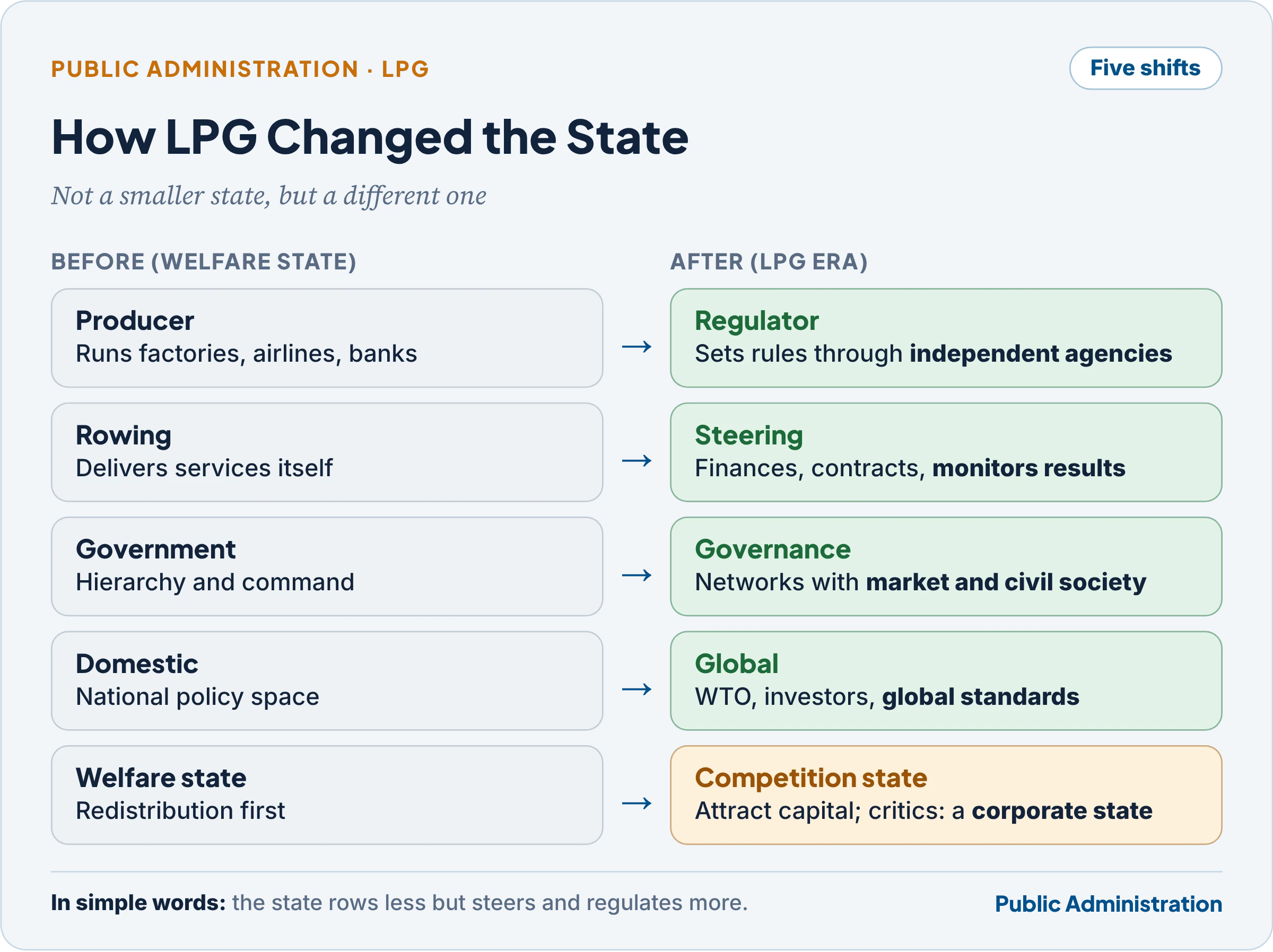
- From positive state to regulatory state: Giandomenico Majone (1994) described the rise of the “regulatory state” in Europe: the state shifts from taxing, spending and producing to rule-making through independent agencies.
- From welfare state to “corporate state” (2015 PYQ): critics such as Farazmand argue that globalisation has reshaped the state to serve capital accumulation: competing for investment through tax cuts, labour flexibility and subsidies, while welfare is trimmed. Colin Crouch called the result “post-democracy“: elections continue, but key decisions are made in partnership with corporate elites.
- From rowing to steering: policy, contracting and regulation instead of direct production.
- From government to governance: decisions shared with markets, civil society and international bodies (see section 6).
- From domestic to global: ministries negotiate with the WTO, credit-rating agencies and investors; national policy is shaped by international standards.
5.2 Specific challenges for administrators
- Regulatory capacity: designing and running independent regulators, preventing capture and overlapping jurisdictions.
- Negotiating capacity with multinational corporations and international organisations.
- Competitiveness: ease of doing business, speed, simplification and digitisation.
- Equity and inclusion: protecting those whom markets leave out: informal workers, farmers, the poor, remote areas.
- Transparency and anti-corruption: large contracts, public–private partnerships and disinvestment create new opportunities for corruption.
- Decentralisation and partnership: working with local governments, NGOs and self-help groups.
- Personnel reform: merit over seniority, specialists alongside generalists, lateral entry, continuous training.
- Ethics: reconciling business values (profit, speed, risk) with public values (equity, legality, accountability).
- New domains: disaster management, cybersecurity, data protection, climate adaptation.
- Resisting blind imitation: reforms that worked in rich countries may fail where markets, courts and regulators are weak.
5.3 Transnational corporations and public administration (2019 PYQ)
- Scale: the largest corporations earn more in a year than the GDP of most countries.
- How they affect government:
- Bargaining power: they can choose where to invest, so states compete through tax concessions, land, labour laws and subsidies (the “race to the bottom“).
- Tax base erosion: profit shifting to low-tax jurisdictions led to the OECD/G20 BEPS project and the global minimum tax.
- Investor–state dispute settlement: companies can take states to international arbitration over regulation and taxation. India’s retrospective tax amendment of 2012 led to arbitration with Vodafone and Cairn; Parliament withdrew retrospective demands through the Taxation Laws (Amendment) Act, 2021.
- Lobbying and regulatory influence: standards for data, pharmaceuticals and agriculture are shaped by corporate lobbies.
- Digital platforms handle citizens’ data and speech, forcing new laws such as India’s Digital Personal Data Protection Act, 2023 and its 2025 Rules.
- The other side: corporations bring investment, jobs, technology and global standards; they are partners in public–private partnerships and corporate social responsibility (Section 135, Companies Act, 2013).
- The administrative task is not to resist corporations but to regulate them in the public interest: competition law, tax cooperation, data protection, labour and environmental standards.
5.4 Regulation in the age of globalisation (2021, 2022 PYQs)
- Regulation is old (weights and measures, guilds, factory acts) but more necessary than ever because:
- privatised utilities need economic regulation of prices and quality;
- global markets need common rules (Basel banking norms, WTO, food safety, aviation);
- new risks (financial derivatives, data, AI, climate) need social regulation.
- Regulatory governance means rule-making, monitoring and enforcement by a mix of state agencies, international bodies, industry self-regulation and civil society standards. David Levi-Faur and John Braithwaite call the present era “regulatory capitalism“: markets grow, but so does regulation.
- Potential: stability, consumer protection, fair competition, predictable rules that attract investment, cross-border cooperation.
- Limits: capture by the regulated; overlapping jurisdictions (hence the recurring debate on a unified “super-regulator”); weak capacity in developing countries; democratic deficit when unelected regulators decide; rules made in global forums where poorer countries have little say.
Indian Connect — The Indian regulatory state
- Independent regulators: SEBI (1992), TRAI (1997), the Central Electricity Regulatory Commission (1998), IRDAI (1999), the Competition Commission of India (2003; fully functional from 2009), the Insolvency and Bankruptcy Board (2016), real estate regulators under the RERA Act (2016).
- Trust-based regulation: the Jan Vishwas Act, 2023 decriminalised 183 provisions in 42 Central Acts; the Jan Vishwas Act, 2026 (assent 7 April 2026), drawn up after a Lok Sabha Select Committee report, amends about 80 Central Acts.
- New-age regulation: the Telecommunications Act, 2023; the Digital Personal Data Protection Act, 2023 with Rules notified in November 2025.
- Problems: vacancies, retired officials appointed as regulators, overlapping mandates (for example, between telecom and competition regulators) and limited accountability to Parliament.
5.5 The paradox: LPG and NPM promised a smaller state, yet it grew (2025 PYQ)
- The promise: limit government functions and cut public expenditure.
- The reality: across OECD countries, general government spending averaged 42.6 per cent of GDP in 2023 (after a peak of 48.3 per cent in 2020), well above levels of the mid-twentieth century. Very few states shrank permanently.
- Why functions and spending rose:
- Wagner’s law: as incomes rise, demand for public services (education, health, pensions) rises faster.
- Ageing populations raise pension and health costs.
- Regulation needs administration: every privatised utility and liberalised market needs a regulator, courts and monitoring staff.
- Contracting has costs: writing, monitoring and enforcing contracts (transaction costs) often offset savings.
- Crises: the 2008 financial crisis and COVID-19 forced massive state rescue and welfare spending; states became “insurers of last resort“.
- Globalisation’s losers need compensation and safety nets (retraining, unemployment benefits, food security).
- New risks: terrorism, cybersecurity, climate change, pandemics.
- Democratic pressure: voters demand more services, not fewer.
- Infrastructure push: developing countries need large public investment.
- India: the state withdrew from many industries but expanded welfare and infrastructure: food grains free of cost for about 81 crore people under the Pradhan Mantri Garib Kalyan Anna Yojana (extended for five years from January 2024), the health insurance scheme Ayushman Bharat, record public capital expenditure, and direct benefit transfers.
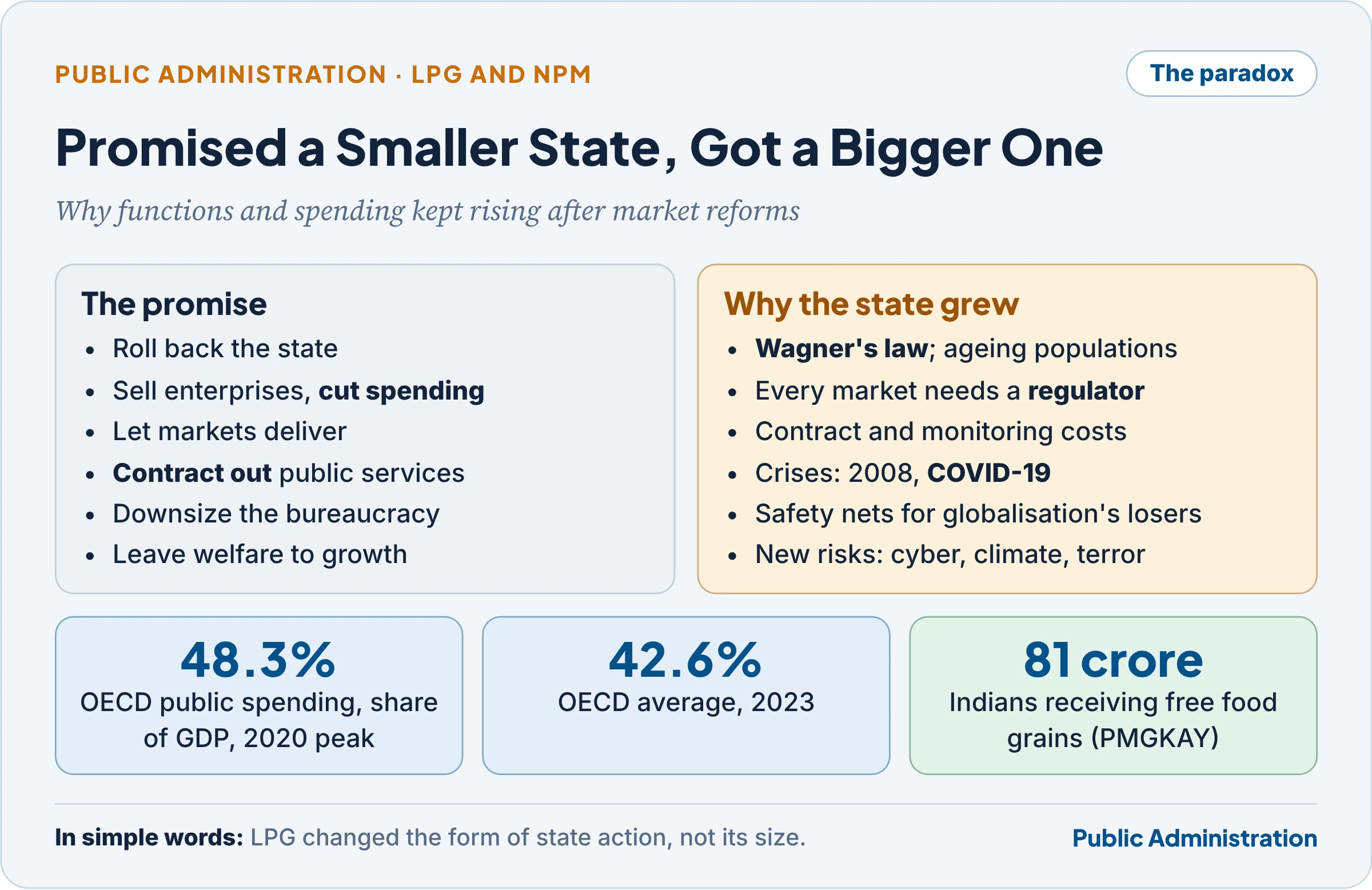
- Conclusion: LPG changed the form of state action (from producing to financing, regulating and transferring) rather than its size.
5.6 Did LPG resolve the welfare state’s crisis at the cost of equity? (2026 PYQ)
- What LPG resolved: balance-of-payments and fiscal crises; shortages and licence raj inefficiencies; it raised growth, consumer choice and foreign investment; India’s high growth after 1991 funded later welfare schemes.
- What it undermined: inequality widened in many countries; user charges and privatisation sometimes excluded the poor; labour lost bargaining power; public services were judged by efficiency rather than equity (the value New Public Administration had championed).
- The correction: “second-generation reforms“, “inclusive growth” (the Eleventh Plan, 2007–12), rights-based laws (MGNREGA 2005, Right to Education 2009, National Food Security Act 2013), and the good governance agenda that put equity, participation and accountability back alongside efficiency.
5.7 “In globalised public administration, hierarchy creates more ethical problems than it solves” (2013 PYQ)
- Problems hierarchy creates:
- Diffusion of responsibility: in long chains of command no one feels responsible; Dennis Thompson called this “the problem of many hands” (1980).
- Obedience over conscience: officials follow orders even when wrong (the Milgram experiments; Hannah Arendt’s “banality of evil“).
- Information distortion: juniors tell superiors what they want to hear (Tullock).
- Silence: whistle-blowers face retaliation.
- Rigidity: in networked, cross-border work (supply chains, joint ventures, international bodies), hierarchy cannot trace accountability across organisations.
- What hierarchy still does: it fixes responsibility and makes officials answerable through a clear chain to elected ministers; without it, network governance can become “accountability-free“.
- The answer is not to abolish hierarchy but to add ethical infrastructure: codes of conduct, conflict-of-interest rules, whistle-blower protection, transparency and a culture of personal responsibility.
6. From Government to Governance
In simple words
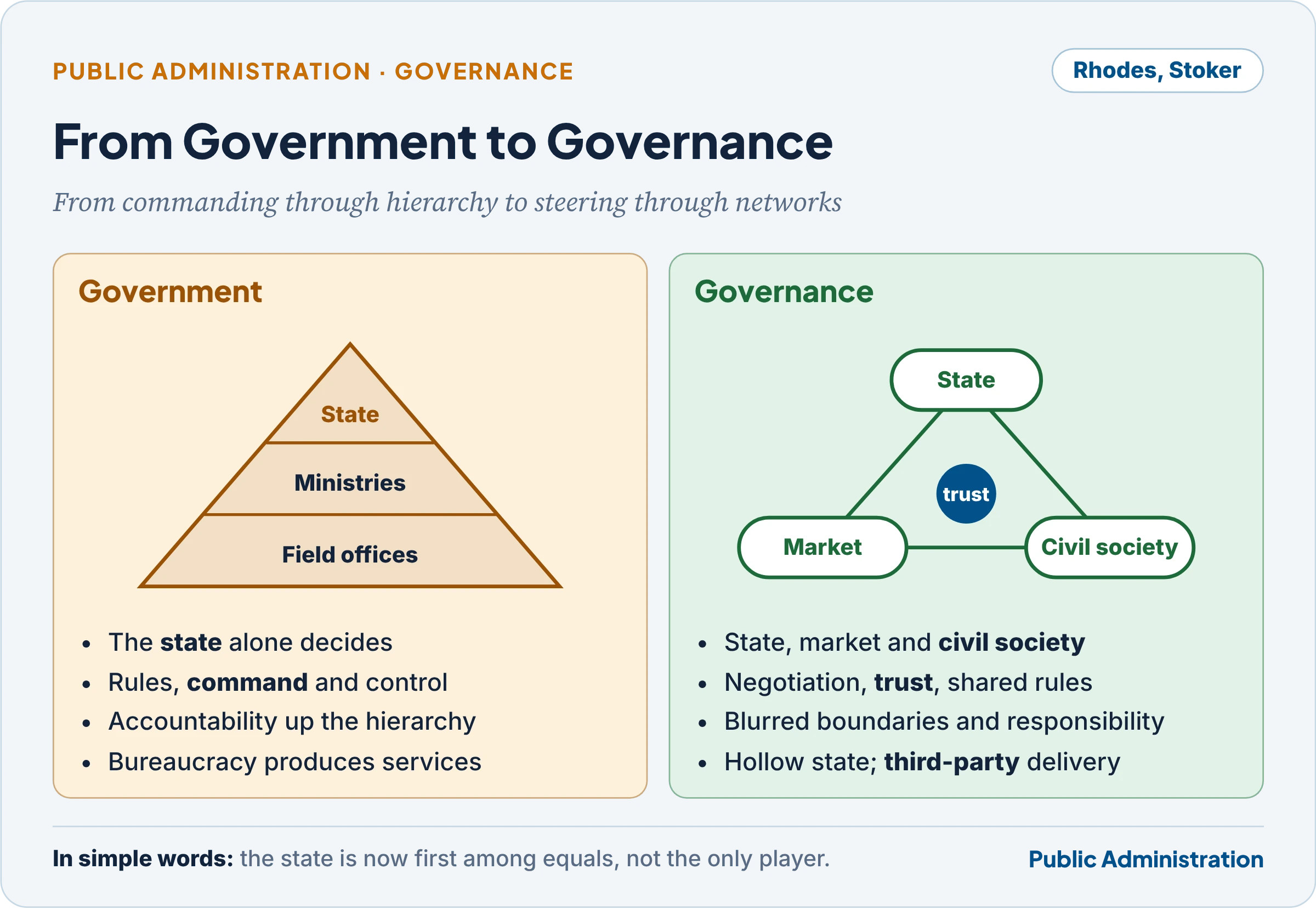
“Government” is the state giving orders. “Governance” is how a society actually gets things done, through the state, companies, voluntary groups, local communities and international bodies working together, often through networks instead of commands.
6.1 Meaning of governance
- Governance is “the process of decision-making and the process by which decisions are implemented (or not implemented)” (UNESCAP).
- World Bank (1992): “the manner in which power is exercised in the management of a country’s economic and social resources for development”.
- UNDP (1997): “the exercise of economic, political and administrative authority to manage a country’s affairs at all levels”, comprising the mechanisms, processes and institutions through which citizens and groups articulate their interests, exercise their legal rights, meet their obligations and mediate their differences.
- Kaufmann and Kraay (World Bank): “the traditions and institutions by which authority in a country is exercised”, including how governments are selected, monitored and replaced; the capacity to formulate and implement sound policies; and the respect of citizens and the state for the institutions that govern them.
- Lynn, Heinrich and Hill: “regimes of laws, rules, judicial decisions and administrative practices that constrain, prescribe and enable” public action.
- Three sets of actors (UNDP): the state, the private sector and civil society, interacting constructively.
- Actors beyond the state (UNESCAP): landlords, peasant associations, co-operatives, NGOs, research institutes, religious leaders, financial institutions, political parties, the military, media, lobbyists, donors and multinational corporations; and informal, sometimes illegitimate, actors such as land mafias and “kitchen cabinets“.
- Levels: corporate, local, national and international (global governance).
6.2 Governance as self-organising networks (2021 PYQ)
- R. A. W. Rhodes, “The New Governance: Governing without Government” (1996), listed six uses of the term: the minimal state, corporate governance, New Public Management, good governance, a socio-cybernetic system and self-organising networks. He preferred the last.
- Self-organising, interorganisational networks have four features:
- interdependence between organisations (state, private and voluntary); boundaries blur;
- continuing interactions among members, who must exchange resources and negotiate shared purposes;
- game-like interactions rooted in trust and regulated by rules agreed by participants;
- a significant degree of autonomy from the state: networks are not accountable to it and govern themselves; the state can only steer them indirectly.
- Gerry Stoker (1998) offered five propositions: governance refers to institutions and actors from and beyond government; it blurs boundaries and responsibilities; it involves power dependence; it is about autonomous self-governing networks; and it recognises that the capacity to get things done does not rest on the power of government to command.
- Jan Kooiman: governance as interactions among public and private actors to solve problems; B. Guy Peters: governing has become “a process of bargaining and mediating rather than of applying rules“.
- Managing networks needs new skills: activating the right partners, framing shared goals, mobilising resources and synthesising agreement (network management, or “meta-governance“: the governance of governance).
- Limits: networks can be closed, captured by insiders, unaccountable and slow; the state still holds law, money and legitimacy (the “shadow of hierarchy”). Bob Jessop warned of “governance failure” as real as market or state failure.
6.3 Hollow state and third-party government (2020 PYQ)
- Third-party government (Lester Salamon, 1981): government increasingly acts through other organisations (grants to states and local bodies, contracts with firms, loans, tax incentives, vouchers, funding to non-profits) rather than directly.
- Hollow state (H. Brinton Milward and Keith Provan, 1993, 2000): an extreme of this, where government becomes a funder and broker of services delivered by networks of contractors and non-profits, with the agency relying on others to jointly produce and deliver public services.
- Why governance became the organising concept: when government no longer produces most services itself, studying the bureaucracy alone misses most of public action; the field must study networks, contracts and partnerships.
- Critical view:
- The state is not hollow in the sense of powerless: it still sets rules, finances and regulates. Many scholars speak of the state “filling in” with regulatory and monitoring units even as it hollows out production.
- Hollowing can erode capacity (the state forgets how to do things) and accountability (who answers when a contractor fails?).
- In India, the core bureaucracy remains central, though partnerships (PPPs in highways, NGOs in health and education, self-help groups) have grown.
6.4 Has public administration shed its statist character? (2019 PYQ)
- Yes, in part:
- The discipline now studies civil society, markets, networks, international bodies and citizens as co-producers, not only state agencies.
- Good governance values (participation, consensus, responsiveness) are society-centred.
- The terms “governance”, “public management” and “public policy” replace “public administration” in many programmes.
- No, not entirely:
- The state remains the ultimate authority for law, coercion, taxation and legitimacy; good governance itself is largely about reforming the state (rule of law, accountability, effectiveness).
- In developing countries, the state remains the main agent of development.
- After 2008 and COVID-19, there has been a “return of the state“: industrial policy, public health, welfare.
- Balanced view: the discipline moved from a state-centric to a state-led, society-inclusive view: the state is “first among equals” in governance.
6.5 “Governance is neither a paradigm nor a panacea” (2019 PYQ)
- Not a paradigm: “governance” covers many different ideas (Rhodes listed six); it lacks a single theory, method or agreed definition, and different users (World Bank, UNDP, Rhodes, Kooiman) mean different things. It is better seen as an organising perspective or “umbrella concept“.
- Not a panacea: networks can fail; partnerships can be captured; participation can be token; accountability blurs. Some problems need hierarchy (defence, law and order) or markets (private goods).
- Useful when other methods fail: for “wicked problems” (Rittel and Webber, 1973), such as climate change, urban poverty or pandemics, which no single actor can solve, governance through networks, participation and collaboration is often the only workable approach.
- Hierarchy, market and network are three modes of coordination; good administration uses the right mix for each task.
6.6 Governance theory and governmentality (2014 PYQ)
- Governmentality is Michel Foucault’s idea (lectures of 1977–79): the “conduct of conduct“, meaning the ways power shapes how people govern themselves through knowledge, norms, statistics and techniques (censuses, audits, health campaigns, self-help), not only through law and force. Nikolas Rose, Peter Miller and Mitchell Dean developed it.
- Points of convergence:
- Both decentre the state: power and rule are spread across many actors and practices.
- Both look beyond formal institutions to networks, techniques and practices.
- Both explain the turn from command to steering at a distance (targets, contracts, incentives, audits).
- Why they run on parallel lines:
| Basis | Governance theory | Governmentality |
|---|---|---|
| Question | How are collective problems solved effectively? | How is power exercised over and through subjects? |
| Nature | Empirical and normative (often reformist) | Critical and genealogical |
| Unit | Organisations, networks, institutions | Rationalities, discourses, techniques |
| View of networks | Self-organising partners | Ways of making citizens self-governing in line with official goals |
| View of good governance | A goal to achieve | Itself a neo-liberal technique of rule (making the poor “responsible”, entrepreneurial) |
7. Good Governance: The Concept
In simple words
Governance is neutral: it can be good or bad. “Good governance” names the qualities we want: power used lawfully, openly, fairly, efficiently and answerably, with people having a say. It turns a description of governing into a yardstick for judging it.
7.1 Origins
- World Bank, 1989: Sub-Saharan Africa: From Crisis to Sustainable Growth blamed Africa’s development failure on a “crisis of governance” and first used the idea prominently; it called for an efficient public service, a reliable judicial system and an accountable administration.
- World Bank, 1992: Governance and Development defined governance and identified three aspects: (a) the form of political regime; (b) the process by which authority is exercised in managing economic and social resources; (c) the capacity of governments to design, formulate and implement policies and discharge functions. Because its Articles of Agreement bar political interference, the Bank focused on (b) and (c).
- Why it caught on in the 1990s (Arndt and Oman, OECD, 2006):
- the end of the Cold War freed aid from strategic loyalties and let donors demand reform;
- the World Bank’s 1996 campaign against the “cancer of corruption” (James Wolfensohn);
- growth of international investment in developing countries;
- the relative failure of Washington Consensus reforms showed that institutions matter;
- New Institutional Economics (Douglass North): institutions are “the rules of the game”.
- Indian roots: the ideal is ancient.
- Kautilya: “In the happiness of his subjects lies his happiness; in their welfare his welfare; whatever pleases himself he shall not consider as good, but whatever pleases his subjects he shall consider as good.”
- The Shanti Parva of the Mahabharata: Bhishma instructs Yudhishthira that the king’s duty is to protect and please the people.
- Ashoka’s edicts: the welfare (yogakshema) of all subjects.
- Rulers were bound by dharma, a higher law above the king.
7.2 Good governance adds normative and evaluative attributes (2024 PYQ)
- “Governance” describes how governing happens: who decides, through which processes and institutions.
- “Good” adds:
- a normative element: the values governing ought to serve (rule of law, accountability, participation, equity, human rights);
- an evaluative element: standards and indicators against which real governance is measured and compared (World Bank indicators, Good Governance Index).
- So good governance converts an analytical concept into a reform agenda and a report card. This is its strength (it sets clear goals) and its weakness (whose values? which yardstick?).
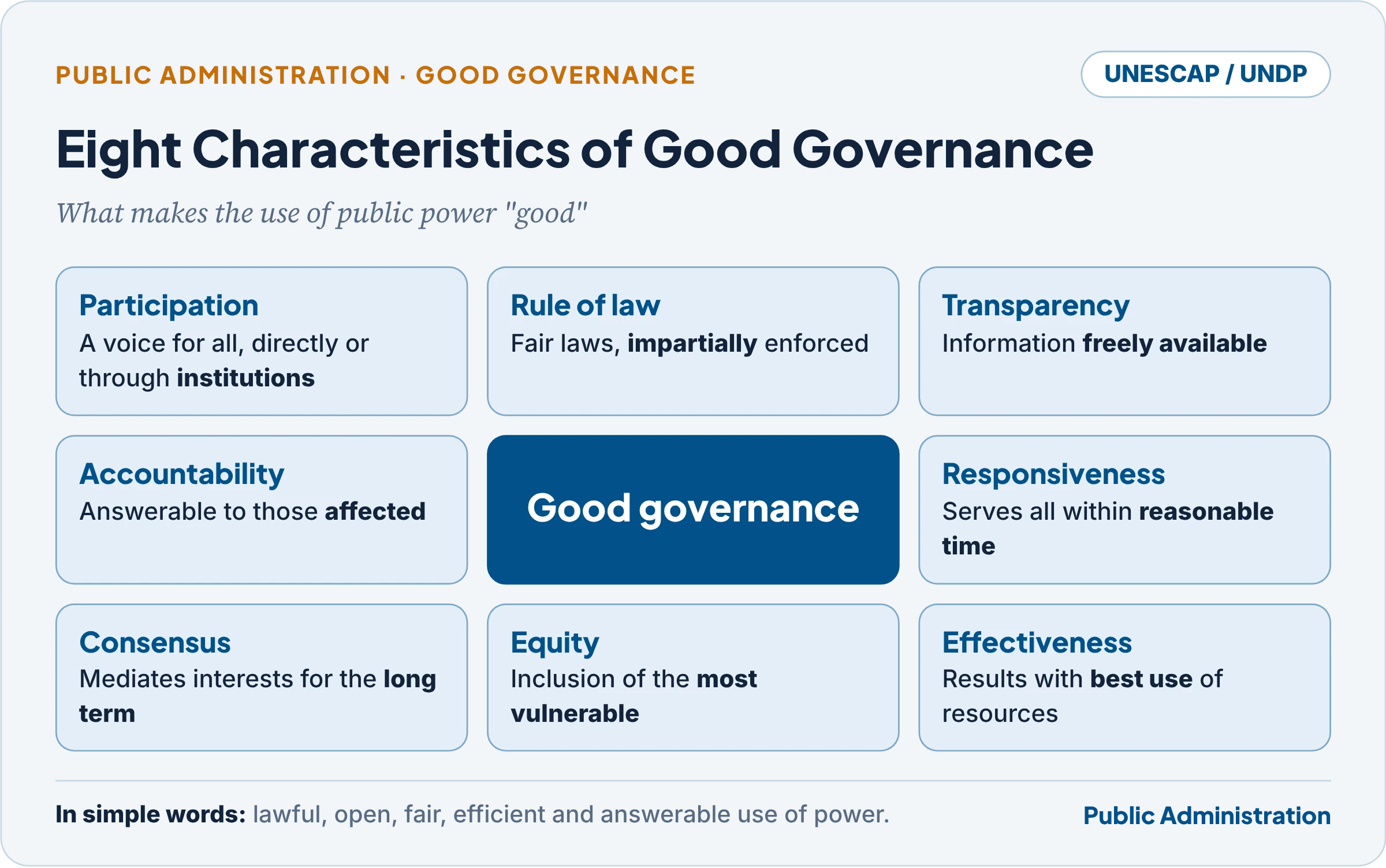
7.3 The eight characteristics (UNESCAP and UNDP)
| Characteristic | Meaning |
|---|---|
| Participation | Men and women take part directly or through legitimate institutions; requires freedom of association and expression and an organised civil society |
| Rule of law | Fair legal frameworks enforced impartially; protection of human rights, especially of minorities; independent judiciary; incorruptible police |
| Transparency | Decisions and their enforcement follow rules; information is freely available and understandable to those affected |
| Responsiveness | Institutions serve all stakeholders within a reasonable time |
| Consensus orientation | Mediating different interests to reach broad agreement on what is in the best interest of the whole community, with a long-term perspective |
| Equity and inclusiveness | All, especially the most vulnerable, feel they have a stake and opportunities to improve their well-being |
| Effectiveness and efficiency | Processes produce results that meet society’s needs while making the best use of resources, including sustainable use of nature |
| Accountability | Government, private sector and civil society are answerable to the public and to their stakeholders; impossible without transparency and rule of law |
7.4 Other formulations
- World Bank: sound public sector management, accountability, a legal framework for development, and transparency and information. Its programme of governance-related lending built capacity in civil service, budgeting, judiciary and anti-corruption.
- IMF and World Bank in the 1990s (market version): an enabling framework for the private sector, a reduced direct role for the state, devolution, anti-corruption, privatisation, removal of controls, codes of conduct and an independent judiciary.
- UK’s Department for International Development: legitimacy, accountability, competence, and respect for law and human rights.
- Kofi Annan (UN Secretary-General): “good governance is ensuring respect for human rights and the rule of law; strengthening democracy; promoting transparency and capacity in public administration.” He also called it “perhaps the single most important factor in eradicating poverty and promoting development” (1998).
- Nayef Al-Rodhan (Sustainable History and the Dignity of Man, 2009) proposed eight minimum criteria for good national governance:
- participation, equity and inclusiveness;
- rule of law;
- separation of powers;
- free, independent and responsible media;
- government legitimacy;
- accountability;
- transparency;
- limiting the distorting effect of money in politics.
- For global governance, he listed effective multilateralism, effective and representative multilateral institutions, dialogue, accountability, transparency, burden-sharing and partnerships with civil society.
- He also grounds governance in human dignity needs: reason, security, human rights, accountability, transparency, justice, opportunity, innovation and inclusiveness.
- Comparing the UN and Al-Rodhan criteria (2016 PYQ):
- Shared: participation, rule of law, transparency, accountability, equity.
- Al-Rodhan adds: separation of powers, media freedom, government legitimacy and control of money in politics. These are more political and democratic.
- The UN list stresses process qualities (responsiveness, consensus, effectiveness).
- Critique of both: they are lists of virtues without priorities or trade-offs; they assume Western liberal democracy; and they are hard to measure and operationalise in poor, divided societies.
7.5 Measuring governance
| Tool | By | What it measures |
|---|---|---|
| Worldwide Governance Indicators | World Bank (Kaufmann, Kraay and others) | Six dimensions: voice and accountability; political stability and absence of violence; government effectiveness; regulatory quality; rule of law; control of corruption |
| Corruption Perceptions Index | Transparency International (since 1995) | Perceived public-sector corruption |
| Country Policy and Institutional Assessment | World Bank staff | 16 criteria in four clusters, used for aid allocation |
| Freedom in the World | Freedom House | Political rights and civil liberties |
| International Country Risk Guide | PRS Group (since 1980) | Political, economic and financial risk for investors |
| World Governance Survey | Hydén, Court and Mease (UN University) | Six arenas (civil society, political society, government, bureaucracy, economic society, judiciary) × six principles (participation, fairness, decency, accountability, transparency, efficiency) |
| State of Democracy | International IDEA | Popular control and political equality through seven mediating values |
| Good Governance Index | India’s DARPG (2019, 2021) | Ten sectors and 58 indicators across states and UTs |
Critique of measurement:
- Most indicators are perception-based, drawn from experts and business surveys, and so biased towards investors’ concerns.
- They mix processes (elections held) with outcomes (services delivered).
- They give national averages that hide variation between states and districts (India’s states differ more than many countries).
- Donors’ mandates shape them: economic governance for the World Bank and IMF; democracy and rights for the UN, USAID and DFID.
- Ranking can reward cosmetic reforms.
- The need is for disaggregated, pro-poor, gender-sensitive and objective indicators.
8. Good Governance in Application
In simple words
Good governance is easy to list and hard to practise. In India it is written into the Constitution, pursued through laws like the Right to Information and through digital services, but it still meets corruption, delay and weak local institutions.
8.1 The Indian framework
- Constitutional base:
- the Preamble (“We, the People”; justice, liberty, equality, fraternity);
- Fundamental Rights: Article 14 against arbitrariness; Article 21, read by courts to include the rights to livelihood, privacy (Puttaswamy, 2017) and a clean environment; Articles 15–17 and 23–24 against discrimination and exploitation;
- Directive Principles: Articles 38, 39, 41, 46, 47;
- the 73rd and 74th Amendments (1992) for local self-government;
- independent institutions such as the CAG, the Election Commission and the UPSC.
- Plans and reports:
- the National Human Development Report, 2001 first applied a governance approach (institutions, delivery mechanisms and supportive legal framework);
- the Tenth Plan (2002–07) devoted a chapter to governance;
- the 2nd Administrative Reforms Commission (2005–09) wrote on ethics (Fourth Report, Ethics in Governance, 2007) and citizen-centric administration (Twelfth Report, Citizen Centric Administration: The Heart of Governance, 2009).
- Benchmarks: a Model Code of Governance discussed at the Conference of Chief Secretaries covers service delivery, weaker sections and backward areas, technology, financial management, accountability and transparency, anti-corruption, decentralisation and incentives for reform.
- Committees on civil service reform: Alagh (recruitment, 2001), Yugandhar (in-service training, 2003), Surinder Nath (performance appraisal and placement, 2003), Hota (civil service reforms, 2004).
- Good Governance Day (25 December, since 2014) and the Good Governance Index (DARPG, 2019 and 2021; ten sectors).
Indian Connect — Good governance initiatives in India
- Transparency: Right to Information Act, 2005; proactive disclosure under Section 4.
- Accountability: Lokpal and Lokayuktas Act, 2013 (Lokpal operational from 2019); Whistle Blowers Protection Act, 2014; social audits.
- Responsiveness: Citizen’s Charters (from 1997); Sevottam model (IS 15700:2005); CPGRAMS, which handled 22.78 lakh grievances in 2025 with an average disposal time of about 15 days; state Right to Public Services laws.
- Effectiveness: Direct Benefit Transfer; PRAGATI reviews; Mission Karmayogi (rules to roles) for civil service capacity.
- Ease of living and doing business: Jan Vishwas Acts (2023, 2026); single-window clearances; faceless tax assessment.
- Participation and decentralisation: gram sabhas, ward committees and the Forest Rights Act, 2006.
- Civil service stability: in T.S.R. Subramanian v. Union of India (31 October 2013) the Supreme Court directed fixed minimum tenure, civil services boards for transfers and written recording of oral instructions.
8.2 Good governance and the Millennium and Sustainable Development Goals (2010 PYQ)
- The UN Millennium Declaration (2000) committed states to “good governance within each country and at the international level” and set eight Millennium Development Goals for 2015 (poverty, education, gender, child mortality, maternal health, disease, environment, partnership).
- Why governance is the key factor: money and schemes fail without capable institutions to deliver them; corruption diverts funds; without accountability and participation the poor cannot claim services. Amartya Sen showed that no major famine has occurred in a functioning democracy with a free press, because governments are forced to respond.
- Evidence: corruption lowers growth and raises inequality and child mortality; but the link between governance and poverty reduction is complex (some countries reduced poverty with weak governance indicators).
- Sustainable Development Goals (2015–30): seventeen goals and 169 targets, with SDG 16 (“peace, justice and strong institutions”) making effective, accountable and inclusive institutions a goal in itself.
8.3 Democracy and good governance: contradiction or complement? (2004 PYQ)
Arguments that they conflict:
- Democracy can bring populism, short-termism, vote-bank politics and coalition paralysis.
- Policy is slowed by protests and litigation (land acquisition, infrastructure).
- Some authoritarian states (Singapore, China, the East Asian “developmental states”) scored well on efficiency and growth.
- Good governance indicators stress efficiency and regulatory quality, which do not need elections.
Arguments that they complement each other:
- Accountability, participation, transparency and rule of law are democratic values; good governance without them is merely efficient administration.
- Kaufmann and Kraay find better governance raises growth, and voice and accountability are part of governance.
- Democracies avoid catastrophic failures (famines, purges) and correct mistakes through elections and free media (Sen).
- India’s long-term record shows democracy and development can coexist.
Balanced view: keep “democraticness” and “good governance” analytically distinct (Dirk Berg-Schlosser). Democracy does not automatically produce good governance; it supplies the accountability that makes good governance legitimate and sustainable.
8.4 Ethics and good governance: Appleby’s dictum (2011 PYQ)
- Paul Appleby, Morality and Administration in Democratic Government (1952), held that administrative morality in a democracy lies in responsiveness to the public through political processes: the official must weigh the interests of all affected and act through responsible, accountable institutions. Hence “responsible government is ethical government“.
- Civil servants as “social moralists in action” means:
- Integrity: resisting corruption and conflicts of interest.
- Moral judgement in discretion: applying rules humanely and fairly.
- Equity: serving the weakest, in the spirit of social equity.
- Openness: accepting scrutiny.
- Courage: speaking truth to power, giving frank advice and refusing illegal orders.
- Indian anchors: the All India Services (Conduct) Rules, 1968 and the Central Civil Services (Conduct) Rules, 1964; the 2nd ARC’s call for a statutory code of ethics and Public Service Bill (Fourth Report, 2007); Mission Karmayogi’s stress on attitudes and values.
8.5 Assessing good governance
Criticism — Critics of good governance
- A donor agenda: it was used to impose market reforms and conditions on poor countries (the post-development critique of James Ferguson and Arturo Escobar).
- Depoliticisation: it treats deep political problems as technical management problems.
- Ethnocentric: its yardsticks reflect Western liberal democracy; elections are treated as proof of good governance.
- Too long a list: it asks poor countries to achieve everything at once; Merilee Grindle (2004) proposed “good enough governance“, meaning priorities suited to each country.
- Inconsistent: the international institutions preaching it are themselves criticised as opaque and unaccountable.
- Weak link to outcomes: some countries grew fast with poor governance scores.
Defence — Defenders of good governance
- It puts citizens and their rights at the centre of administration.
- It restores institutions (rule of law, accountability, transparency) after the narrow market focus of the 1980s.
- Its values have strong indigenous roots (dharma, Kautilya, Ashoka) and constitutional backing in India.
- It provides benchmarks that let citizens, courts and legislatures hold governments to account.
- It integrates efficiency with equity and participation, combining the best of NPM and New Public Administration.
- It is now part of the global development agenda through SDG 16.
- Overall: good governance is best treated as an ideal to strive for and a set of tools, not a single blueprint. Its application must be contextual, sequenced and owned by the country.
Key Terms
| Term | Meaning in simple words |
|---|---|
| Liberalisation | Removing government controls and licences so markets decide more |
| Privatisation | Transferring ownership, control or delivery from public to private hands |
| Disinvestment | Selling part of the government’s stake in a public enterprise |
| Globalisation | Growing interconnection of economies, cultures and problems across borders |
| Washington Consensus | Williamson’s (1989) list of market reforms urged by Washington-based institutions |
| Structural adjustment | Loan-linked reforms: stabilisation, then liberalisation and privatisation |
| Regulatory state | A state that governs mainly by making and enforcing rules, not by producing |
| Regulatory capture | Regulators coming to serve the industry they regulate |
| Race to the bottom | States cutting taxes and standards to compete for investment |
| Governance | The process of making and implementing decisions involving state, market and civil society |
| Self-organising network | A group of interdependent organisations that governs itself on trust and negotiated rules |
| Hollow state | Government that funds and brokers but no longer produces most services |
| Third-party government | Government acting through contractors, non-profits and other governments |
| Meta-governance | The state steering networks indirectly: the governance of governance |
| Governmentality | Foucault’s “conduct of conduct”: shaping how people govern themselves |
| Good governance | Governance meeting normative standards: participation, rule of law, transparency, accountability, equity, effectiveness |
| Good enough governance | Grindle’s idea of realistic, prioritised governance reforms suited to each country |
| Wicked problem | A problem with no clear definition or final solution, involving many actors |
Commissions, Committees and Judgments
| Body / case | Year | Key point |
|---|---|---|
| World Bank, Sub-Saharan Africa: From Crisis to Sustainable Growth | 1989 | First prominent use of “governance”; “crisis of governance” |
| World Bank, Governance and Development | 1992 | Definition and three aspects of governance |
| UNDP, Governance for Sustainable Human Development | 1997 | State, private sector and civil society; characteristics of good governance |
| National Human Development Report | 2001 | First governance approach in India |
| Alagh, Yugandhar, Surinder Nath, Hota Committees | 2001–04 | Civil service recruitment, training, appraisal and reform |
| 2nd ARC, Fourth Report (Ethics in Governance) | 2007 | Code of ethics, Public Service Bill, anti-corruption |
| 2nd ARC, Twelfth Report (Citizen Centric Administration) | 2009 | Citizen’s charters, grievance redress, Sevottam |
| T.S.R. Subramanian v. Union of India | 2013 | Fixed tenure; civil services boards; written instructions |
| Justice K.S. Puttaswamy v. Union of India | 2017 | Privacy a fundamental right; basis for data protection law |
Contemporary Developments
- August 2025: US tariffs on many Indian goods reached 50 per cent; February 2026: an interim framework cut the rate to 18 per cent.
- 24 July 2025: India and the United Kingdom signed a Comprehensive Economic and Trade Agreement; 27 January 2026: India and the European Union concluded their free trade agreement.
- 5 January 2026: the OECD/G20 Inclusive Framework agreed a “side-by-side” package on the global minimum tax.
- November 2025: the Digital Personal Data Protection Rules were notified with phased implementation.
- 23 February 2026: NMP 2.0 was launched with a monetisation potential of ₹16.72 lakh crore for 2025–30.
- 7 April 2026: the Jan Vishwas (Amendment of Provisions) Act, 2026 received assent, extending decriminalisation across about 80 Central Acts.
- December 2025: the government highlighted the Good Governance Index (ten sectors, 58 indicators) on Good Governance Day.
Revision Grid
| Thinker / body | Work or report (year) | Key idea |
|---|---|---|
| John Williamson | “What Washington Means by Policy Reform” (1989) | Washington Consensus: ten reforms |
| James O’Connor | The Fiscal Crisis of the State (1973) | Welfare state’s fiscal strain |
| Kenichi Ohmae | The Borderless World (1990); The End of the Nation State (1995) | Hyper-globalist view |
| Ali Farazmand | Writings on globalisation and PA | Three perspectives; corporate state |
| Dani Rodrik | The Globalization Paradox (2011) | Trilemma of integration, sovereignty, democracy |
| Giandomenico Majone | “The Rise of the Regulatory State in Europe” (1994) | Regulatory state |
| Levi-Faur and Braithwaite | Writings on regulatory capitalism (2005, 2008) | Markets and regulation grow together |
| Vickers and Yarrow | Privatization: An Economic Analysis (1988) | Competition matters more than ownership |
| Lester Salamon | “Rethinking Public Management” (1981) | Third-party government |
| Milward and Provan | “The Hollow State” (1993); “Governing the Hollow State” (2000) | Government through networks of contractors |
| R. A. W. Rhodes | “The New Governance: Governing without Government” (1996) | Six uses; self-organising networks |
| Gerry Stoker | “Governance as Theory: Five Propositions” (1998) | Five propositions |
| Michel Foucault | Lectures on governmentality (1977–79) | Conduct of conduct |
| World Bank | Reports of 1989 and 1992 | Origin and definition of good governance |
| UNDP / UNESCAP | 1997; “What is Good Governance?” | Eight characteristics |
| Kaufmann and Kraay | Worldwide Governance Indicators | Six dimensions |
| Nayef Al-Rodhan | Sustainable History and the Dignity of Man (2009) | Eight minimum criteria |
| Merilee Grindle | “Good Enough Governance” (2004) | Realistic, prioritised reform |
| Paul Appleby | Morality and Administration in Democratic Government (1952) | Responsible government is ethical government |
| Amartya Sen | Development as Freedom (1999) | No famines in functioning democracies |
Previous Year Questions
- 2026“Liberalization, Privatization and Globalization (LPG) successfully resolved the structural crisis of the welfare state with emphasis on market efficiency, undermining the social equity goals essential to public service.” Explain.
- 2025The objective of Liberalization, Privatization and Globalization and of New Public Management was to limit government functions and reduce public expenditure. However both functions and expenditure has increased. Account for the paradox.
- 2024Good governance adds normative and evaluative attributes to the process of governing. Comment.
- 2022Regulatory governance frameworks have become essential building blocks of world society. Discuss their potential and impact in fulfilling the hopes and demands.
- 2021Governance is about managing self-organizing networks.” Elaborate.
- 2021Regulation is an old but increasingly necessary mode of social coordination and political intervention into societal processes. Examine it in the context of globalization.
- 2020The movement towards governance as an organizing concept for public administration and management is because the focus of administration has been shifting from the bureaucratic state to the ‘hollow state’ and ‘third-party government’. Critically examine.
- 2019“Governance is neither a paradigm nor a panacea for all the ills of government. It may be a more useful approach when other methods fail in providing public service.” Critically evaluate.
- 2019With the entry of the concept of ‘good governance’ the discipline of Public Administration has shed its statist character. Explain.
- 2019“Globalization has constructed the administrative state to save and serve corporate power structure.” Discuss how transnational corporations impact government and public administration in the contemporary era.
- 2016“Good governance is ensuring respect for human rights and the rule of law, strengthening democracy, promoting transparency and capacity in Public Administration.” (Kofi Annan) In the light of the statement, critically examine the criteria of good governance as provided by United Nations and Nayef Al-Rodhan.
- 2015“Globalisation has transformed the nature and character of State from traditional administrative Welfare State to a Corporate State.” Analyse the changes in the nature of public administration in this context.
- 2014“Governance theory and the notion of governmentality have many points of convergence, but they run on parallel lines.” Comment.
- 2013“In the globalized public administration, hierarchy creates more ethical problems than it solves ….” Comment.
- 2011Civil Servants must be social moralists in action, living up to Paul Appleby’s dictum that ‘responsible government is ethical government.’ Examine this statement in the light of good governance.
- 2010“Not merely governance but good governance is the key factor in achieving the United Nations Millennium Goals.” Explain.
- 2004Democracy and good governance are contradictions in terms. Discuss with examples.
- 1999“Public Undertakings have received a raw deal in the wake of liberalism and privatization. Comment.
- 1999“Elaborate the World Bank’s concept of ‘Good Governance.”
- 2022Following the onset of globalisation, the traditional bureaucratic model appears to have lost its significance. Comment.
- 2021Recent market approaches to public services present serious challenges to traditional and state-sponsored public service values. Evaluate the statement in the context of Indian administration.
- 2021Responsibility and accountability are two major goals of Good Governance. Discuss the statement in the context of Indian administration.
- 2021Red-tapism is a major obstacle to the implementation of ‘good governance. Comment.
- 2017“The market reforms have not infringed the basic structure of the Constitution of India, but have largely compromised the realisation of the ideals of social and economic justice.” Comment.
- 2008‘The shift from the Nehruvian to the liberalisation model of development has necessitated reinventing government.’ Comment.
- 2000Do you agree that globalization, liberalization and privatization policies are going to change the very fabric of Indian Administration? What, according to you, are the major challenges before it in the 21 st century?