

Introduction: Meaning, scope and significance of Public Administration; Wilson’s vision of Public Administration; Evolution of the discipline and its present status; New Public Administration; Public Choice approach; Challenges of liberalization, Privatisation, Globalisation; Good Governance: concept and application; New Public Management.
This article: Public management; New Public Management (doctrines, reinventing government, practice across countries and in India, critique); post-NPM models: digital-era governance, joined-up government, the neo-Weberian state, public value, New Public Service and New Public Governance; modernisation of public services.
Official Syllabus: Paper I · Unit 1-01 Introduction
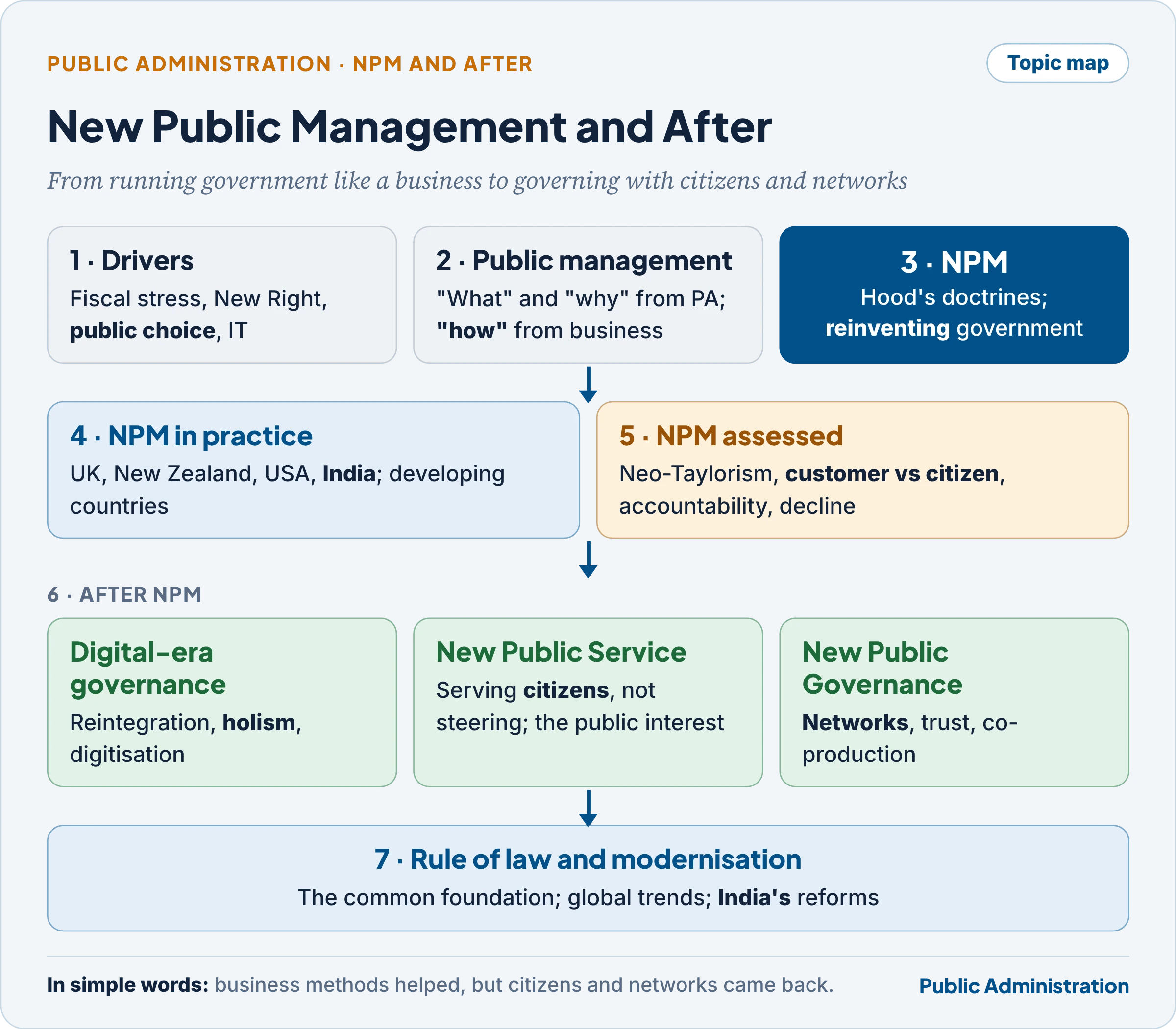
In the 1980s and 1990s, governments across the world tried to make the public sector work like a well-run business: focused on results, driven by competition, managed by empowered managers and judged by customers. This movement came to be called New Public Management (NPM). It was the biggest shake-up of public administration since Wilson and Weber. Within two decades, however, its limits became clear, and new models arose:
- Digital-era governance, which puts technology and joined-up services at the centre;
- New Public Service, which puts citizens and democracy back at the centre;
- New Public Governance, which sees public services as delivered through networks and partnerships.
In simple words
Imagine a government hospital. Traditional administration runs it by rules: fixed posts, files, seniority. NPM says: give the superintendent a budget and targets, let private firms bid for cleaning and laundry, publish waiting times and treat patients as customers. New Public Service says: patients are citizens with rights, so involve them in decisions. New Public Governance says: the hospital is one node in a network of clinics, NGOs, insurers and local bodies that must work together.
1. Why NPM Emerged
In simple words
NPM came when governments were short of money, voters were angry with bureaucracy, economists blamed self-serving officials, and computers and global competition made old, slow systems look outdated.
1.1 The drivers
- Fiscal stress: the oil shocks, stagflation and growing welfare bills of the 1970s left governments with deficits; spending had to be cut or made more productive.
- Reaction against bureaucracy: the large post-war bureaucracy was seen as rigid, wasteful, rule-bound and unresponsive. Gerald Caiden summed up the mood: all “blamed the dead hand of bureaucracy”, its poor performance, red tape, unpleasant officials and corruption.
- The New Right and neo-liberalism: Thatcher (UK, 1979), Reagan (USA, 1981) and reformers in New Zealand and Australia sought to “roll back the state“.
- Ideas from economics:
- public choice (bureaucrats maximise budgets; competition disciplines them);
- principal–agent theory (how a principal, such as a minister, can control an agent, such as an agency, through contracts and incentives);
- transaction-cost economics (when to make in-house and when to buy).
- Jonathan Boston called this cluster “new institutional economics“.
- Ideas from business management: the “managerialism” of private firms: strategic planning, performance measurement, quality management and customer service.
- Globalisation and competitiveness: governments had to support national competitiveness and meet international standards.
- Information technology: computers made performance measurement, decentralisation and new forms of service delivery possible.
- The Washington Consensus (1989) and structural adjustment carried these ideas to developing countries.
1.2 The OECD’s eight drivers of reform
In the 1990s the OECD’s Public Management Committee (PUMA) identified the common trends of reform among member countries:
- Devolving authority and providing flexibility;
- ensuring performance, control and accountability;
- developing competition and choice;
- providing responsive service;
- improving the management of human resources;
- optimising information technology;
- improving the quality of regulation;
- strengthening steering functions at the centre.
2. Public Management
In simple words
Public management is what you get when you add business-style “how to manage” skills to public administration’s “what to do and why” concerns. It keeps the public purpose but borrows the private sector’s tools.
2.1 Meaning
- The term public management came into use in the 1970s and 1980s, as disillusionment with the state grew, and drew on two sources: private-sector management techniques in the United States, and the New Right in Britain.
- James Perry and Kenneth Kraemer (1983) defined public management as “a merger of the normative orientation of traditional public administration and the instrumental orientation of general management“.
- Lewis Gunn saw it as a third way between traditional public administration and business management.
- Jan Kooiman and Martijn van Vliet saw it as collective problem-solving in which government steers society.
- Three views of public versus private management:
- they are essentially the same (generic management);
- they are fundamentally different (“alike in all unimportant respects”, Sayre);
- the middle view: they share techniques but differ in purpose, accountability and environment.
- Les Metcalfe and Sue Richards warned that “management” understood narrowly (efficiency, cost-cutting) is too narrow for the public sector, which must also manage change, networks and policy.
- Early public management studies in the United States focused on top leadership (political appointees and senior executives); critics said this ignored the lower levels where most public work is done.
2.2 “What” and “why” from public administration, “how” from business management (2022 PYQ)
| Question | Borrowed from | What it covers |
|---|---|---|
| What to do | Public administration | Public purposes defined by law and politics: welfare, justice, security, equity |
| Why do it | Public administration | Public interest, constitutional values, rule of law, accountability to citizens |
| How to do it | Business management | Strategic planning, budgeting, performance management, project management, cost-benefit analysis, marketing, quality and customer service |
- The strength: public goals pursued with modern, efficient methods.
- The tension: “how” is never value-free. Contracting, user charges and performance pay change who gets served and how, so business methods can quietly reshape public purposes. Hence the need for public managers to keep constitutional principles, rule of law and equity alongside effectiveness, efficiency and cost-benefit analysis.
Common confusion
Public administration, public management and New Public Management: are they the same? No. Public administration is the whole field and practice of carrying out public purposes, including law, politics and values. Public management is the managerial part of it: the “how” of running programmes, which can be practised in any era. New Public Management is a specific reform doctrine of the 1980s–90s that sought to make public management market-like and results-driven. Equally, New Public Management (1990s) must not be confused with New Public Administration (1968): the first is managerial and market-oriented, the second normative and equity-oriented (see the article on New Public Administration and Public Choice).
3. New Public Management: Meaning and Doctrines
In simple words
NPM says: let managers manage, judge them by results, make public bodies compete, break big departments into smaller agencies with clear jobs, and treat citizens as customers.
3.1 Meaning
- Christopher Hood coined and popularised the term in “A Public Management for All Seasons?” (Public Administration, 1991).
- R. A. W. Rhodes summarised NPM as:
- a focus on management, not policy, and on performance appraisal and efficiency;
- disaggregation of public bureaucracies into agencies that deal with each other on a user-pay basis;
- use of quasi-markets and contracting out to foster competition;
- cost-cutting;
- a style of management that emphasises output targets, limited-term contracts, monetary incentives and freedom to manage.
- Other labels: managerialism, market-based public administration, entrepreneurial government, post-bureaucratic model. Its core aim: the three Es: economy, efficiency and effectiveness.
3.2 Hood’s seven doctrines
| Doctrine | Meaning | Justification |
|---|---|---|
| Hands-on professional management | Visible managers at the top with “freedom to manage” | Accountability needs clear assignment of responsibility |
| Explicit standards and measures of performance | Goals, targets and indicators, preferably quantitative | Accountability needs clearly stated aims |
| Greater emphasis on output controls | Resources allocated by measured results | Stress on results rather than procedures |
| Disaggregation of units | Breaking up monolithic departments into units around products, with one-line budgets | Manageable units; separate provision and production |
| Greater competition | Term contracts and public tendering | Rivalry lowers costs and raises standards |
| Private-sector styles of management | Flexible hiring and rewards; public relations | Proven private tools |
| Discipline and parsimony in resource use | Cutting direct costs, resisting union demands | “Do more with less” |
3.3 Reinventing government: Osborne and Gaebler
- David Osborne and Ted Gaebler, Reinventing Government: How the Entrepreneurial Spirit Is Transforming the Public Sector (1992), argued that the bureaucratic model suited a slower age of hierarchy, manual work and mass markets, but not today’s world of fast change, knowledge workers and demand for quality and choice.
“We do not need more government; we need better government. To be more precise, we need better governance.” — Osborne and Gaebler
- Ten principles of entrepreneurial government:
| Principle | Meaning |
|---|---|
| Catalytic | Steering rather than rowing: lever all sectors to solve problems |
| Community-owned | Empowering rather than serving: push control to communities |
| Competitive | Inject competition into service delivery |
| Mission-driven | Driven by goals, not rules |
| Results-oriented | Fund outcomes, not inputs |
| Customer-driven | Meet the needs of the customer, not the bureaucracy |
| Enterprising | Earning rather than spending |
| Anticipatory | Prevention rather than cure |
| Decentralised | From hierarchy to participation and teamwork |
| Market-oriented | Leverage change through the market (for example, pollution fees) |
- Their test: “If this were my money, would I spend it this way?“
- Osborne and Peter Plastrik, Banishing Bureaucracy (1997), reduced the programme to five strategies: core (clarity of purpose), consequences (incentives for performance), customer (accountability to customers), control (empowerment) and culture (changing habits, hearts and minds).
- Assessment: the ten principles are more preferred qualities than empirically observed attributes; their market preference may not suit many developing countries.
3.4 “A crisis of credibility can be overcome only by reinventing government” (2011 PYQ)
- The crisis of credibility: by the 1990s, citizens in many countries distrusted government. Taxes were high, services were poor, bureaucracy was slow, corruption was visible, and there were large deficits.
- Reinventing government answered by promising a government that “works better and costs less“: results, customer service, competition and empowered staff. The US National Performance Review (1993) under Vice-President Al Gore was its most famous application.
- Is reinventing the only answer?
- Credibility also rests on democratic legitimacy: honesty, fairness, equity, rule of law, transparency, ethics. These are not market virtues (the New Public Service critique).
- Reinvention can raise expectations it cannot meet, worsening distrust.
- Trust is also rebuilt by participation (social audit, citizens’ charters), independent accountability institutions and visible integrity.
- In India, credibility has been pursued through a mix: reinvention-type reforms (e-governance, DBT, performance monitoring) plus rights-based laws (RTI, MGNREGA) and grievance redress.
3.5 Traditional public administration and NPM compared (2009 PYQ)
B. Guy Peters identified five assumptions of traditional administration:
- self-sufficiency of government;
- direct control through hierarchy;
- accountability upward to ministers and legislature;
- uniformity of treatment;
- a permanent civil service.
He also listed “six old chestnuts” that NPM and later reforms questioned:
- an apolitical civil service;
- hierarchical, rule-bound management;
- permanence and stability of organisations;
- an institutionalised civil service;
- internal regulation;
- equality of outcomes.
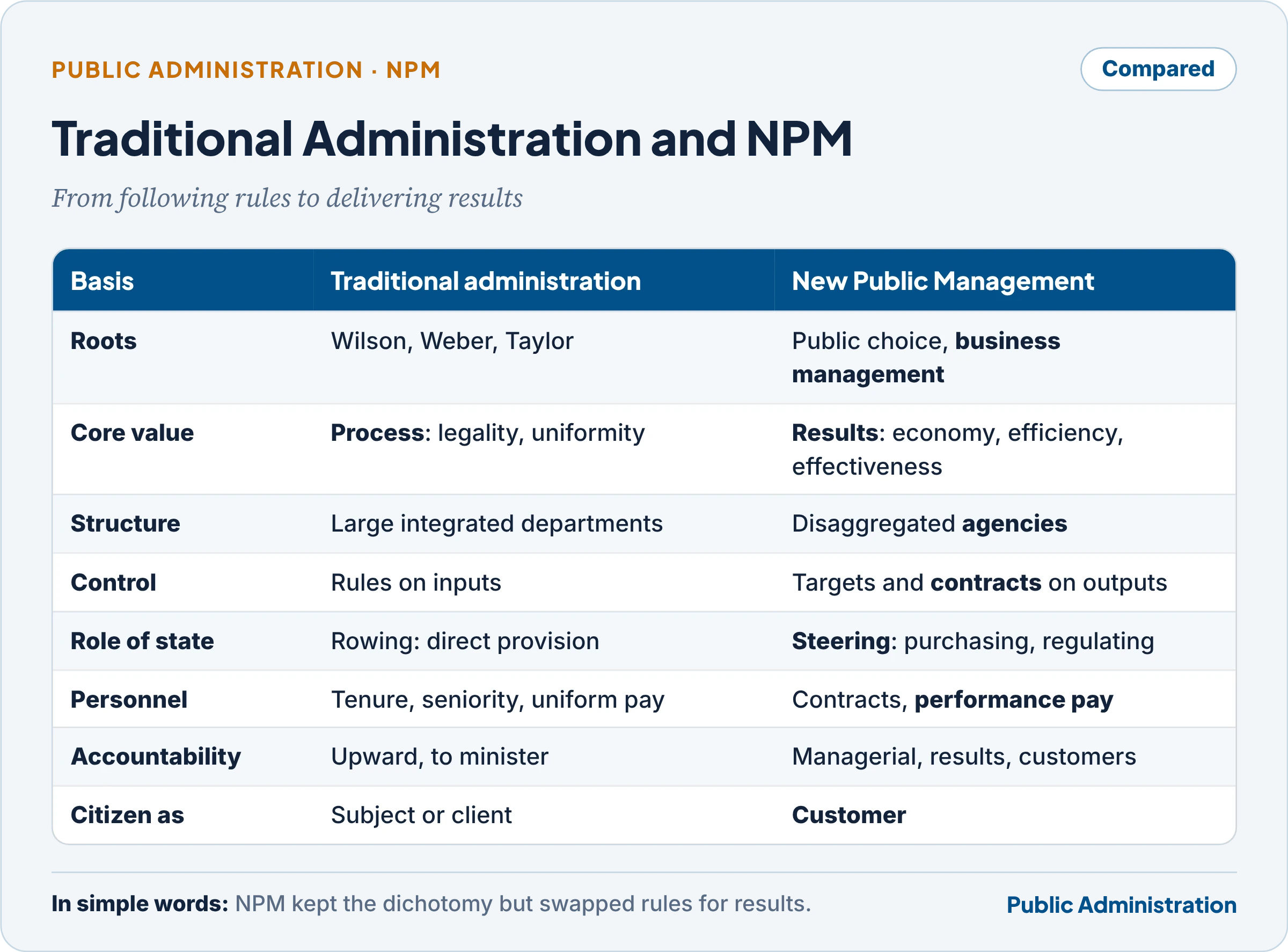
| Basis | Traditional public administration | New Public Management |
|---|---|---|
| Intellectual roots | Wilson, Weber, scientific management | Public choice, principal–agent theory, business management |
| Core value | Process: legality, uniformity, neutrality | Results: 3Es, performance |
| Structure | Large integrated departments; hierarchy | Disaggregated agencies; flat, flexible units |
| Control | Rules and procedures (inputs) | Targets and contracts (outputs, outcomes) |
| Role of state | Rowing: direct provision | Steering: purchasing, contracting, regulating |
| Personnel | Permanent tenure, seniority, uniform pay | Contracts, performance pay, lateral entry |
| Accountability | Upward, to minister and legislature; process accountability | Managerial and results accountability; to customers |
| Citizen seen as | Subject or client | Customer |
| Politics–administration | Separated in theory | Re-separated: politicians set goals, managers manage |
| Public–private | Sharp distinction | Blurred; competition and partnership |
| Budgeting | Line-item, cash accounting | Performance budgets, accrual accounting |
What NPM changed and what it retained:
- Changed:
- process accountability to results accountability;
- permanence to contracts;
- monopoly to competition;
- anonymity of officials to their personal accountability for results.
- Retained, even intensified: the politics–administration dichotomy. NPM lets ministers set goals and managers manage, reasserting “the Wilsonian separation of administration from politics with a vengeance”.
- Continuity with earlier traditions:
- Implementation research (Pressman and Wildavsky, 1973) had already shifted attention to programmes and results.
- Efficiency drives go back to the Taft Commission (1910–13) and the Brownlow Committee (1937).
- David Rosenbloom observed that NPM was “older than it knows”.
- Donald Kettl called the NPM–traditional quarrel “less an accumulation of knowledge and more a family feud“.
4. NPM in Practice
In simple words
Within twenty years, almost every country tried some NPM reforms: Britain created agencies and charters, New Zealand wrote contracts with its chief executives, the United States “reinvented government”, and India adopted citizen’s charters, outcome budgets, regulators and e-governance.
4.1 Developed countries (2008 PYQ)
| Country | Key reforms |
|---|---|
| United Kingdom | Rayner scrutinies and Efficiency Unit (1979); Financial Management Initiative (1982); Next Steps report (1988), which moved most civil servants into executive agencies; Citizen’s Charter (1991, John Major); Competing for Quality (1991) and compulsory competitive tendering in local government; Private Finance Initiative (1992) |
| New Zealand | State-Owned Enterprises Act (1986): corporatisation; State Sector Act (1988): chief executives on fixed-term performance contracts; Public Finance Act (1989): outputs and accrual accounting; Fiscal Responsibility Act (1994); purchaser–provider split |
| Australia | Financial Management Improvement Program (1984); program budgeting; competitive tendering and contracting; competency-based training; equity plans for women, Aboriginal people and others |
| United States | National Performance Review (1993, Al Gore): report From Red Tape to Results: Creating a Government that Works Better and Costs Less, with four principles: cutting red tape, putting customers first, empowering employees, cutting back to basics; Government Performance and Results Act (1993) |
| Canada | Public Service 2000 (1989); Program Review (1994–95) |
| Singapore | Service Improvement Unit in the Prime Minister’s Office; agencies with targets; early computerisation |
- The Commonwealth Association for Public Administration and Management (CAPAM), at its inaugural conference in Charlottetown, Canada (August 1994), identified five components of the new paradigm:
- delivery of high-quality services that citizens value;
- managerial autonomy, especially by reducing central agency controls;
- measuring and rewarding performance of organisations and individuals;
- providing the human and technological resources managers need;
- openness to competition and to deciding which purposes are best performed by public servants and which by the private sector.
- Mohan Kaul summed up the shifts:
- from developing plans to developing key strategic areas;
- from inward-looking systems to partnerships;
- from inputs and processes to outputs and outcomes;
- towards managing diversity within a unified public service.
4.2 Developing countries
- NPM ideas spread through structural adjustment lending, donor advice and consultants: Malaysia, Singapore, Brazil (Bresser-Pereira’s managerial reform of 1995), several African and Latin American states, and India.
- Results were modest (Nick Manning, 2001):
- NPM “has not been predominant in any developing country”; vertically integrated bureaucracies remain.
- Efficiency gains were small (Richard Batley’s review, 1999), and transaction costs often outweighed them.
- Separating purchasers from providers reduced accountability.
- Evidence was “perplexingly” thin (Charles Polidano, 1999).
- Why NPM struggled there:
- Contracts are flimsy where providers remain public and courts cannot enforce them.
- NPM assumes the “old public disciplines” (public service ethos, predictable budgets, credible policy, merit-based staffing), which many developing countries lacked. Allen Schick warned (1998) that “most developing countries should not try New Zealand’s reforms“: formal, rule-based management must come first.
- Markets, regulators and information systems are weak.
4.3 NPM as a response to liberalisation, competitiveness and technology (2003 PYQ)
- Liberalisation: opening markets meant the state had to withdraw from production, regulate private suppliers and run its own remaining enterprises commercially.
- International competitiveness: investors judge countries by speed and cost of administration, quality of regulation and infrastructure; NPM promised a lean, fast, business-friendly state.
- Technological change: information technology made it possible to measure performance, decentralise decisions with central monitoring, deliver services electronically and “flatten” hierarchies.
- So NPM is an “incarnation” of a model of public sector management shaped by these challenges, though its roots also lie in fiscal crisis, ideology and public choice theory.
Indian Connect — New Public Management in India
- Reform language: the Fifth Central Pay Commission (1997) proposed downsizing the civil service and performance-linked pay; the Conference of Chief Ministers (1997) adopted an action plan for “effective and responsive administration”, including Citizen’s Charters.
- Results orientation: Outcome Budget (from 2005); Results-Framework Documents and the Performance Monitoring and Evaluation System (2009); dashboards such as PRAGATI (2015).
- Agencies and corporatisation: NHAI (operational from 1995), autonomous regulators, and the corporatisation of the Ordnance Factory Board into seven defence public sector undertakings (1 October 2021). The 2nd ARC’s Thirteenth Report (2009) recommended executive agencies separated from policy-making ministries.
- Competition and markets: disinvestment, public–private partnerships, the Government e-Marketplace (2016) for procurement, asset monetisation.
- Customer focus: Sevottam service-quality model; CPGRAMS; the “ease of living” agenda.
- Personnel: lateral entry at joint secretary level (from 2018–19), contractual appointments, Mission Karmayogi’s competency framework.
- Limits: a powerful permanent bureaucracy, weak contract enforcement, political patronage, and the constitutional welfare mandate have produced a hybrid model, not a full NPM state.
5. NPM Assessed
In simple words
NPM made governments think about results and citizens’ convenience, and it did save money in places. But it treated citizens like shoppers, broke government into pieces that did not talk to each other, chased numbers instead of real outcomes, and weakened accountability. Its record is mixed.
5.1 Is NPM “neo-Taylorism”? (2017 PYQ)
- Christopher Pollitt, Managerialism and the Public Services (1990), called the managerialism of the Thatcher and Reagan years neo-Taylorism.
- Why the comparison holds:
- Like Taylor’s scientific management, NPM seeks efficiency through measurement, standards and control of outputs.
- It separates planning from doing: ministers and central agencies set targets, while agencies and contractors execute, much as Taylor separated management from workers.
- It relies on economic incentives (performance pay) as the main motivator.
- It treats management as a generic, technical skill applicable everywhere: “one best way”.
- Why it is incomplete:
- NPM also stresses decentralisation, empowerment and customer focus, which are not Taylorist.
- It borrows from public choice and markets (competition, contracting), which Taylor did not consider.
- Some versions (Osborne and Gaebler) draw on human relations and participation.
- Verdict: neo-Taylorism captures NPM’s control-through-measurement core (targets, indicators, league tables), but not its market and empowerment strands. NPM is better seen as a mix of managerialism (neo-Taylorism) and new institutional economics (markets and contracts), as Hood observed.
5.2 Citizen or customer? Has NPM failed democracy? (2019 PYQ)
| Basis | Individual as customer (NPM) | Individual as citizen (democracy) |
|---|---|---|
| Relationship | Buyer and seller | Members of a political community |
| Basis of claim | Payment, choice, satisfaction | Rights and duties under law |
| Voice | Exit (switch provider) | Voice (vote, participate, protest) |
| Interest | Private, individual | Public, collective |
| Who counts | Those who can pay or choose | All, including the poor and future generations |
| Accountability | To the customer through markets | To the people through elected representatives and courts |
- How NPM weakened democratic values:
- “Customer” narrows citizens to consumers of services, ignoring their role as owners and co-authors of government.
- Some “customers” are prisoners, taxpayers or regulated firms, for whom the market analogy fails.
- Agencification and contracting blurred ministerial accountability: when a contractor fails, ministers blame managers and managers blame policy.
- Equity suffered when profitable clients were served first (“cream-skimming”).
- Citizen participation in policy was replaced by satisfaction surveys.
- Where NPM helped democracy:
- Charters, published standards and grievance systems made services more responsive and gave ordinary people a right to complain.
- Transparency about performance improved information available to voters.
- Conclusion: NPM did not destroy democracy, but its customer model proved too thin. This gap gave rise to the New Public Service (section 6.5).
5.3 How accountability changed under NPM (2020, 2014 PYQs)
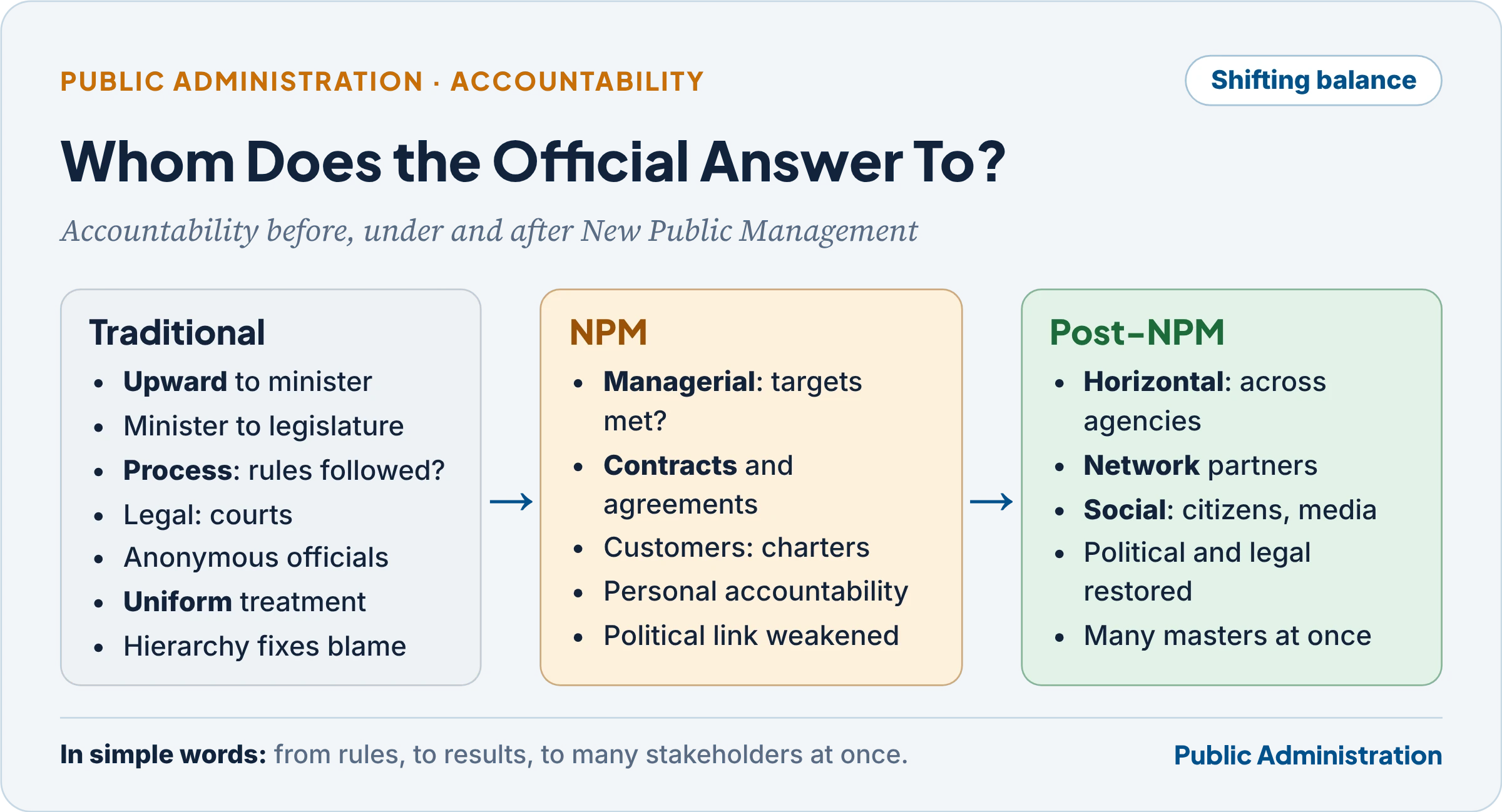
Types of accountability. Barbara Romzek and Melvin Dubnick (1987) identified four: bureaucratic (hierarchical), legal, professional and political. Others add managerial (results), market (customers) and social (civil society, media) accountability.
What NPM changed:
- From process to results: officials are judged less on following rules and more on meeting targets (“let managers manage”, and later, in Donald Kettl’s phrase, “make managers manage“).
- Contractual accountability: chief executives sign performance agreements; contractors answer through contracts.
- Personal accountability of managers replaced the anonymity of civil servants.
- Customer accountability: charters, service standards, complaint systems.
- Accounting and audit: accrual accounting, value-for-money audit, performance audit.
Why the focus remained on management: these changes were mostly managerial: they told managers how to perform, not citizens how to control government. Political accountability weakened (ministers distanced from agencies), legal accountability strained (contracts are not easily subject to administrative law), and professional autonomy (doctors, teachers) was squeezed by targets.
After NPM: the balance shifted again. Post-NPM reforms (joined-up government, NPG) added horizontal and network accountability, while NPS and good governance restored political, legal and social accountability. Today the challenge is multiple accountabilities: managers answer at once to ministers, regulators, courts, auditors, users, partners and the public.
5.4 Neither saviour nor devil (2013 PYQ)
Gains:
- a stronger focus on results and citizens’ convenience;
- cost awareness;
- some efficiency in contracted-out services (refuse collection, cleaning);
- better financial information (accrual accounting);
- transparency of performance;
- service standards and charters;
- separation of policy from operations in some areas.
Failures:
- gaming of targets and “hitting the target but missing the point”;
- fragmentation into many agencies that did not coordinate;
- loss of institutional memory and capacity;
- transaction costs;
- reduced accountability;
- inequity;
- a demoralised public service.
Evidence:
- Christopher Hood and Ruth Dixon, A Government that Worked Better and Cost Less? (2015), found that over thirty years of reform in UK central government, running costs rose substantially in real terms, while complaints and legal challenges soared: hard to reconcile with the promise of working better and costing less.
- Yet catastrophes predicted by critics also did not occur everywhere; many practices (performance information, customer service, agencies for operational tasks) survived and became normal.
- Conclusion: NPM was a useful corrective with real but context-bound benefits, not a universal cure; its tools work best inside a strong Weberian base of law, ethics and capacity.
5.5 Why NPM declined so soon (2017 PYQ)
- Fragmentation and coordination failures: agencification created “silos“; problems such as terrorism, climate change and social exclusion needed joined-up responses.
- High-profile failures: in Britain, the Hatfield rail crash (October 2000) and the collapse of privatised Railtrack (in administration, 2001; replaced by Network Rail) showed the costs of fragmenting a network industry.
- Weak evidence of savings and rising transaction costs.
- Democratic deficit: citizens are more than customers.
- Changed context: after 9/11 (2001) and the 2008 financial crisis, states needed capacity and control, not just a lean state.
- Technology: the internet allowed services to be reintegrated around citizens’ needs rather than split among agencies (digital-era governance).
- New ideas: public value, New Public Service and New Public Governance offered richer frameworks.
Criticism — Critics of New Public Management
- It treats citizens as customers, eroding citizenship, equity and the public interest.
- It is neo-Taylorism: target cultures, gaming and narrow measures.
- It fragments government and weakens coordination and ministerial accountability.
- It ignores the constitutional and legal anchorage of public administration; it is “amoral” and “throws out the baby with the bath water”.
- Its savings are unproven; transaction costs are high (Hood and Dixon).
- It suits Westminster systems with strong executives and weak administrative law, not developing countries (Schick).
Defence — Defenders of New Public Management
- It ended complacent, inward-looking bureaucracy and forced attention to results and users.
- It introduced lasting tools: performance budgets, accrual accounting, service standards, charters, agencies.
- Competition and contracting did cut costs in many routine services.
- It made public managers personally accountable and more cost-conscious.
- Its concern for the citizen as service user is laudable; there is “a kernel of truth” in its diagnosis.
- Later models (DEG, NPG) build on rather than reject many NPM practices.
6. After NPM: The New Models
In simple words
After NPM, scholars and governments tried to fix its weaknesses in different ways: use technology to put government back together (digital-era governance), work across departments (joined-up government), strengthen the state’s legal core while modernising it (neo-Weberian state), focus on the value created for the public (public value), make citizens partners rather than customers (New Public Service), and manage networks of public, private and voluntary actors (New Public Governance).
6.1 Digital-era governance (2010 PYQ)
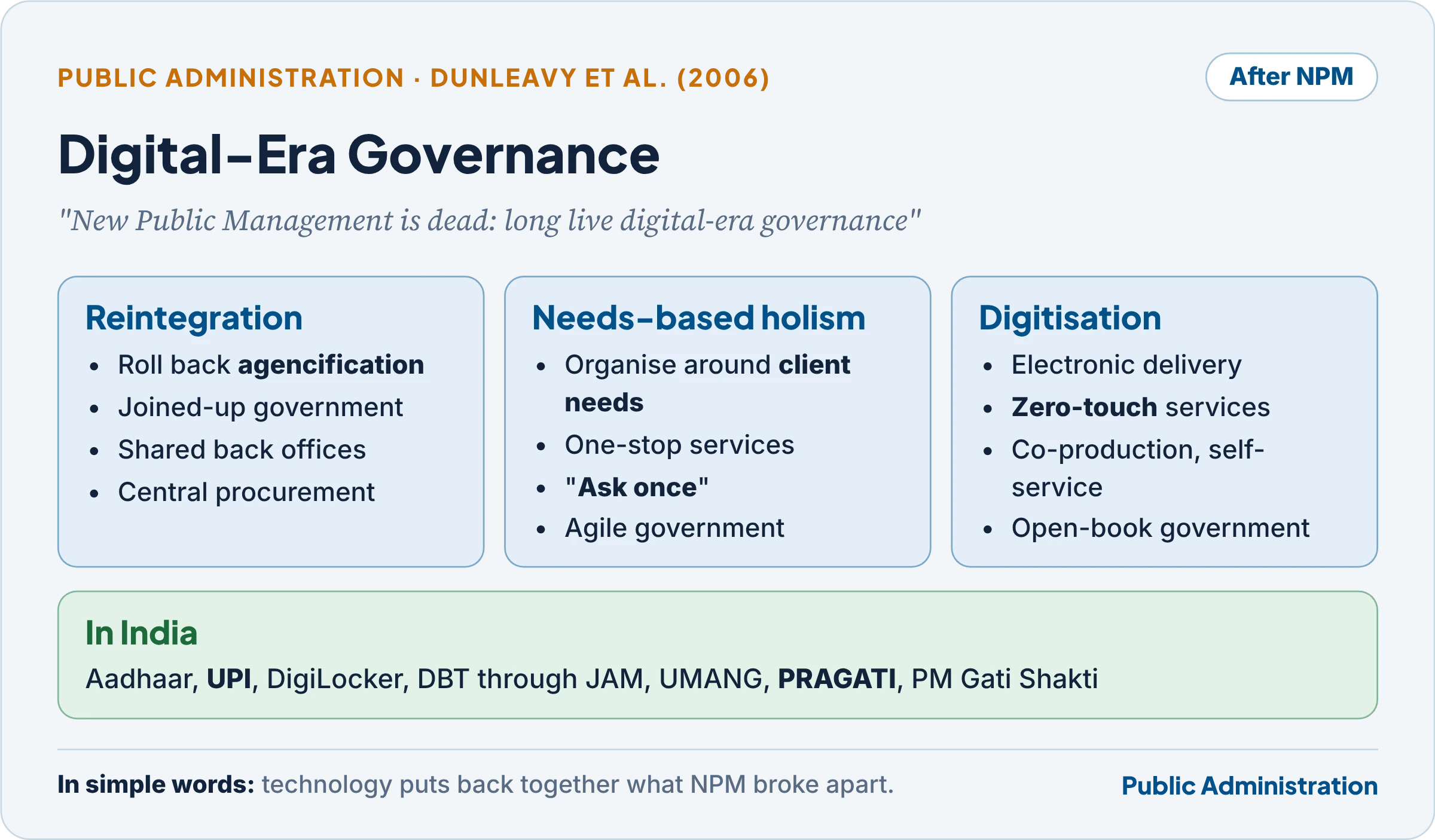
- Patrick Dunleavy, Helen Margetts, Simon Bastow and Jane Tinkler, “New Public Management Is Dead: Long Live Digital-Era Governance” (Journal of Public Administration Research and Theory, 2006), argued that NPM’s three themes, disaggregation, competition and incentivisation, had stalled or been reversed in leading countries because they increased institutional and policy complexity and reduced citizens’ ability to deal with government.
- Evidence they cited:
- Britain’s Next Steps agencies stabilised at about half the civil service;
- New Zealand, with only about 3.5 million people, had ended up with over 300 central agencies and 40 ministries, creating vertical silos;
- the OECD (2004) urged caution on agencification;
- performance-related pay was downgraded;
- the UK Treasury restricted private finance for IT projects.
- Three themes of digital-era governance:
| Theme | Components |
|---|---|
| Reintegration | Rolling back agencification; joined-up governance; re-governmentalisation; reinstating central processes; squeezing process costs; re-engineering back offices; concentrating procurement; simplifying networks |
| Needs-based holism | Reorganising around client groups; one-stop provision; “ask once” processes; data warehousing; end-to-end re-engineering; agile government |
| Digitisation changes | Electronic service delivery; zero-touch technologies; radical disintermediation; channel streaming; co-production and self-service (“isocratic” administration); open-book government |
- In digital-era governance “the agency becomes its website“: the authoritative record is electronic, not paper files.
- Possible futures they sketched: a “digital NPM“, a “policy mess” of incompatible systems, or laggard countries falling behind; with risks such as large IT failures (the UK identity card scheme) and zigzag reform cycles.
- Assessment:
- NPM is not dead: performance management, contracting and agencies persist, and “digital NPM” (outsourced IT, platform contracts) is common.
- Digital government brings new problems: surveillance, exclusion of the digitally poor, vendor lock-in, algorithmic bias and data protection.
- Still, DEG rightly captured the shift from fragmentation to integration around citizens’ needs.
Indian Connect — Digital-era and joined-up governance in India
- India Stack: Aadhaar identity, UPI payments, DigiLocker documents and consent-based data sharing; the JAM trinity (Jan Dhan, Aadhaar, Mobile) underpins Direct Benefit Transfer, with government-estimated savings of about ₹5.14 lakh crore to March 2025.
- Needs-based holism: UMANG (one app for many services), CPGRAMS, state single-window portals, “ask once” ideas in DigiLocker.
- Reintegration: PRAGATI (2015) brings the Prime Minister, Union secretaries and chief secretaries together on stalled projects; PM Gati Shakti (October 2021) provides a GIS-based national master plan linking many infrastructure ministries; the Aspirational Districts Programme coordinates schemes around outcomes in backward districts.
- New capacity: the IndiaAI Mission (approved 7 March 2024, ₹10,371.92 crore) includes a “safe and trusted AI” pillar; the Digital Personal Data Protection Act, 2023 and its 2025 Rules regulate data use.
- Risks: digital exclusion (authentication failures in welfare), data security and weak grievance redress for algorithmic decisions.
6.2 Joined-up and whole-of-government
- Joined-up government (UK, from 1997; Modernising Government white paper, 1999) and whole-of-government approaches (Australia, New Zealand) sought horizontal coordination across departments and levels to tackle cross-cutting “wicked problems”.
- Tom Christensen and Per Lægreid (2007) described these as “second-generation” or post-NPM reforms: restoring central capacity and coordination after NPM’s fragmentation, without fully abandoning NPM tools.
6.3 The neo-Weberian state
- Christopher Pollitt and Geert Bouckaert, Public Management Reform (second edition, 2004), described continental European reform (Germany, France, Nordic countries) as the neo-Weberian state (NWS).
- “Weberian” elements reaffirmed:
- the state as the main facilitator of solutions;
- representative democracy;
- administrative law and equality before the law;
- a distinct public service with its own status and ethos.
- “Neo” elements added:
- an external orientation to citizens’ needs (not internal rules);
- consultation and direct participation;
- a greater focus on results;
- professionalisation of public managers.
- It shows that modernisation need not mean marketisation.
6.4 Public value
- Mark Moore, Creating Public Value: Strategic Management in Government (1995), argued that the public manager’s task is to create public value, just as a private manager creates private (shareholder) value.
- His strategic triangle: a strategy must be
- substantively valuable (it creates public value);
- legitimate and politically sustainable (it has support from the “authorising environment”);
- operationally feasible (it has the capacity).
- Gerry Stoker (2006) called public value management “a new narrative for networked governance”: it relies on deliberation, networks and a public service ethos, not on markets or hierarchy alone.
6.5 New Public Service (2018, 2020, 2021, 2022 PYQs)
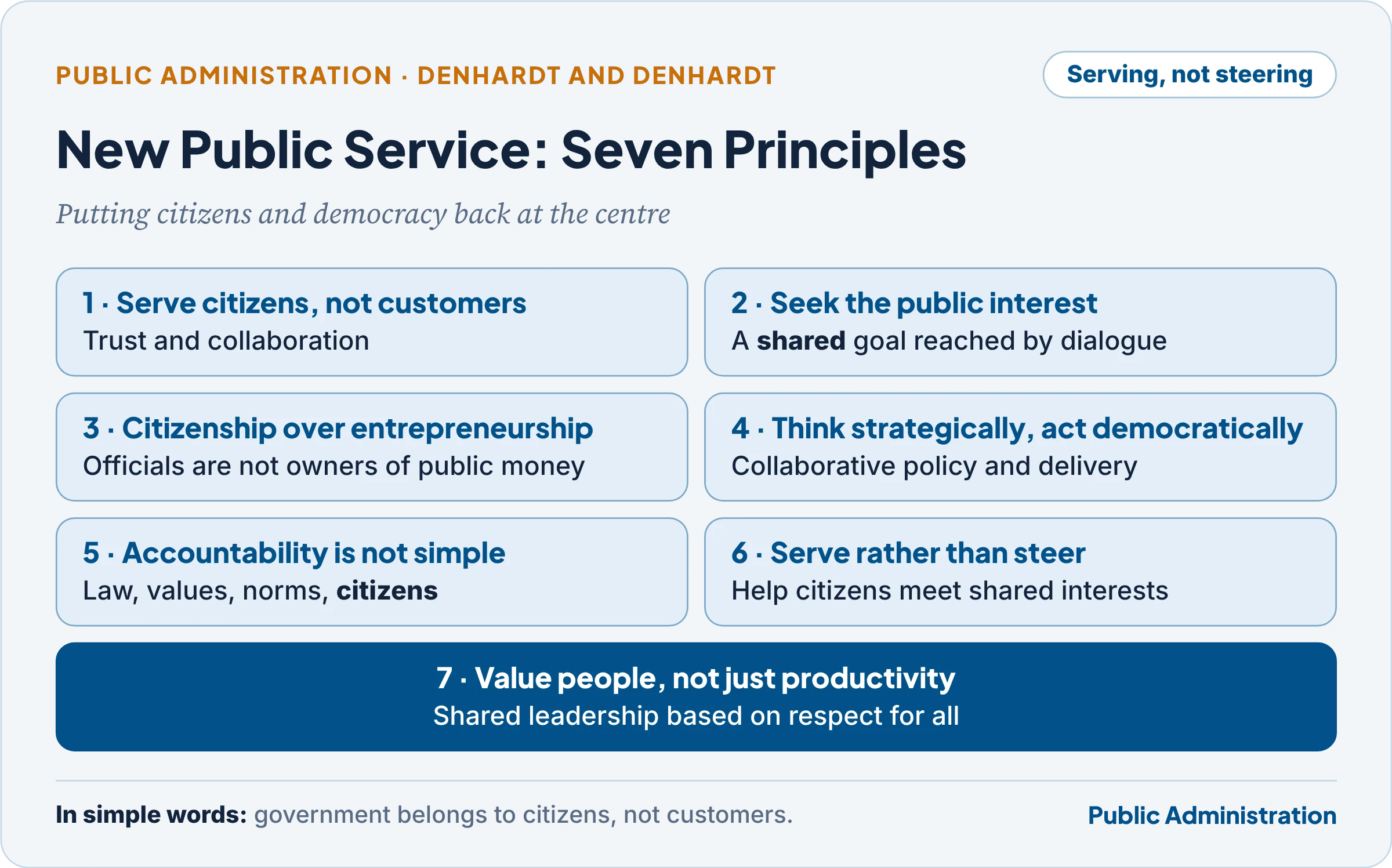
- Robert and Janet Denhardt, “The New Public Service: Serving Rather than Steering” (Public Administration Review, 2000) and The New Public Service: Serving, Not Steering (2003), rejected both old public administration (rowing) and NPM (steering) in favour of serving.
- Intellectual roots: theories of democratic citizenship; models of community and civil society; organisational humanism; and post-modern public administration (discourse theory). It draws on the Blacksburg Manifesto, New Public Administration and the idea of public service as a calling.
- Seven principles:
| Principle | Meaning |
|---|---|
| Serve citizens, not customers | Build relationships of trust and collaboration with citizens |
| Seek the public interest | The public interest is a shared goal reached through dialogue, not the sum of individual preferences |
| Value citizenship over entrepreneurship | Public servants and citizens committed to society, not managers acting as owners of public money |
| Think strategically, act democratically | Collaborative processes for policies and their implementation |
| Recognise that accountability is not simple | Officials answer to law, community values, political norms, professional standards and citizens’ interests |
| Serve rather than steer | Help citizens articulate and meet shared interests, not control society |
| Value people, not just productivity | Collaboration and shared leadership based on respect for all people |
- “Celebrates what is distinctive, important and meaningful about public service” (2022 PYQ): NPS holds that public service is not just another business. It is
- motivated by public service motivation (commitment to the public interest, compassion, self-sacrifice: James Perry);
- grounded in constitutional values;
- the place where citizens deliberate about the common good.
- It restores the dignity of public servants, demoralised by NPM’s distrust.
- Active and involved citizenship (2021 PYQ):
- Citizens are seen as co-producers and co-deciders, not passive recipients or customers.
- The official’s role is to facilitate engagement: forums, consultations, participatory budgeting, social audit, community partnerships, open data.
- Indian anchors: gram sabhas and ward committees; social audit of MGNREGA; MyGov (2014) consultations; participatory budgeting in some cities; Jan Bhagidari campaigns; public hearings under environmental clearance.
- Democracy and citizenship as the basis of theory and practice (2020 PYQ): NPS starts from who we are as a political community, not from markets. Legitimacy comes from democratic values; efficiency is valued only within them.
- Is NPS an improvement over NPM? (2018 PYQ)
- Yes: it restores citizenship, equity, ethics and the public interest; recognises complex accountability; and suits the good governance agenda and SDG 16.
- But:
- it is normative rather than an operational model, with no clear tools for efficiency or cost control;
- participation is costly and slow;
- citizens may lack time, information or interest;
- powerful groups can capture participatory forums;
- in practice NPS works alongside NPM tools, not instead of them.
6.6 New Public Governance (2024, 2025 PYQs)
- Stephen Osborne, “The New Public Governance?” (Public Management Review, 2006) and The New Public Governance? (edited, 2010), proposed NPG as a framework for a plural and pluralist state:
- plural: many interdependent actors contribute to public services;
- pluralist: many processes inform policy-making.
- Features of NPG:
- roots in institutional and network theory (not economics or management alone);
- focus on inter-organisational relationships and the governance of processes;
- emphasis on service effectiveness and outcomes;
- coordination through trust, relational contracts and networks;
- co-production with service users; Osborne later developed a “public service-dominant logic” in which value is created with users.
- NPG contrasted with NPM’s market-based approach (2024 PYQ):
| Basis | New Public Management | New Public Governance |
|---|---|---|
| Theoretical roots | Public choice, management theory | Institutional and network theory |
| Nature of state | Regulatory, disaggregated | Plural and pluralist |
| Focus | Intra-organisational management | Inter-organisational relationships |
| Emphasis | Inputs and outputs; efficiency | Processes and outcomes |
| Resource allocation | Markets, competition, classical contracts | Networks, trust, relational contracts |
| Value base | Efficacy of competition and the market | Neo-corporatist, collaborative |
| Citizen’s role | Customer | Co-producer and partner |
- NPM as a “transitory state” from traditional administration to NPG (2025 PYQ):
- The argument:
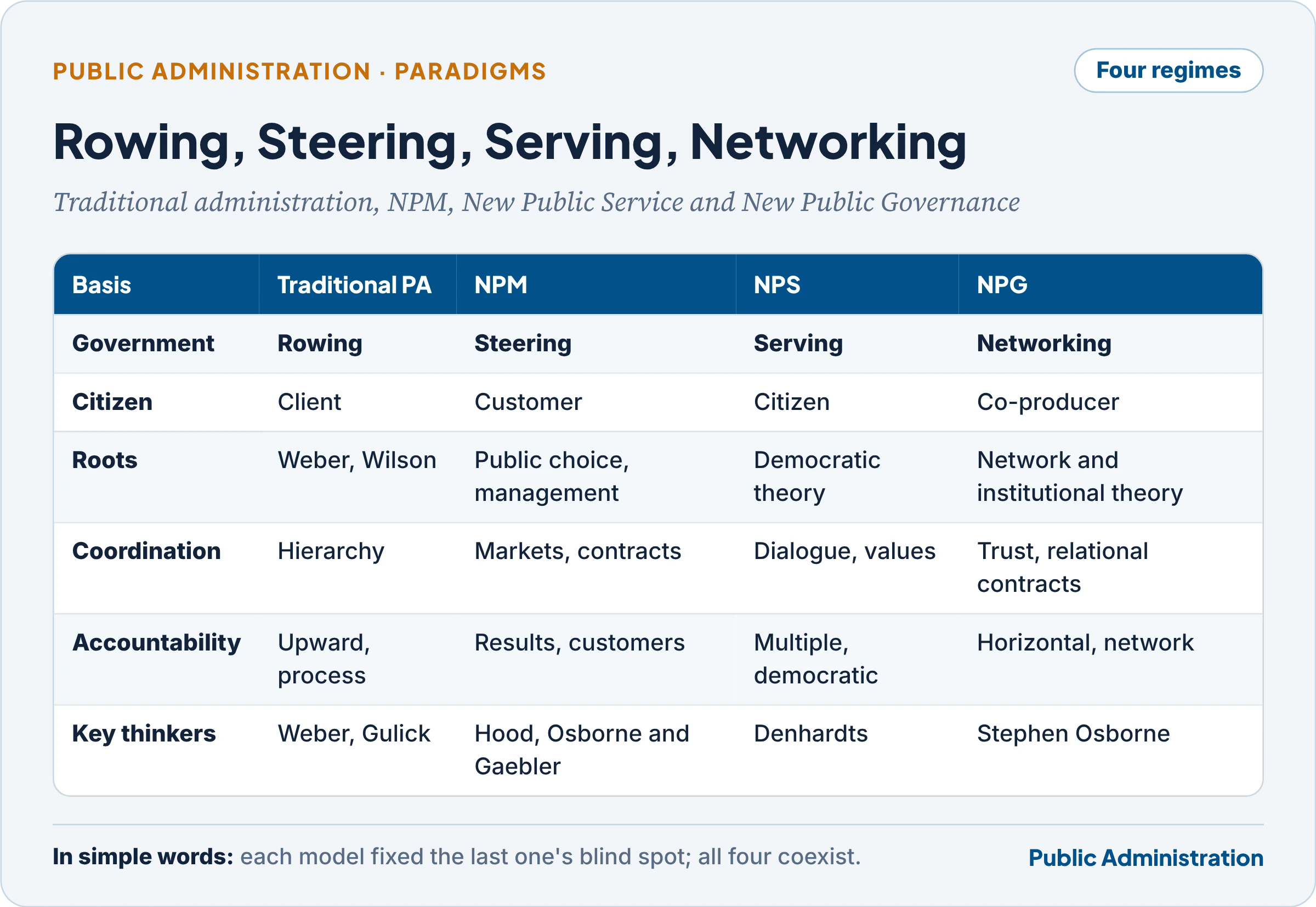
- Osborne describes three regimes: traditional public administration (until the late 1970s), NPM (1980s to early 2000s) and NPG (emerging since).
- NPM broke the monopoly of the bureaucratic state and opened the door to many providers, but its competitive, contractual logic could not manage the interdependence it created.
- NPG takes NPM’s plurality of providers and governs it through relationships and trust.
- In this sense NPM was a bridge, not a destination.
- Qualifications:
- The three regimes coexist: hierarchy remains for law and order, markets for many services, and networks for complex problems.
- NPG is still more an agenda than a fully tested model.
- NPM tools (targets, contracts) remain widespread.
- The argument:
Common confusion
New Public Service and New Public Governance: aren’t they the same? They overlap but differ in emphasis. New Public Service (Denhardts) is a normative model about the values and role of public servants: serving citizens, democracy and the public interest. New Public Governance (Osborne) is an analytical model about how services are delivered: through networks, partnerships and co-production among many organisations. NPS answers “whom and for what should public servants serve?”; NPG answers “through what arrangements are public services produced?”
6.7 Peters’ four models of governing
B. Guy Peters, The Future of Governing: Four Emerging Models (1996), described four alternatives to the traditional model. In practice they are mixed, and each has costs: “any choice of paradigms for government … is unlikely to be Pareto optimal”.
| Model | Diagnosis of what is wrong | Prescription |
|---|---|---|
| Market | Monopoly, budget-maximising bureaucracy | Competition, decentralisation, performance pay |
| Participatory state | Hierarchy stifles employees and citizens | Involve lower-level workers and clients |
| Flexible government | Permanence breeds rigidity | Temporary organisations, flexible staffing, learning organisation |
| Deregulated government | Internal rules on staffing, purchasing and budgeting choke action | Remove internal constraints; trust managers |
7. Common Foundations and Current Trends
In simple words
Whatever the model, public administration still rests on the rule of law; and today every government is modernising its services with technology, data, citizen focus and resilience, while trying not to repeat NPM’s mistakes.
7.1 Rule of law as the common foundation (2025 PYQ)
- Traditional public administration:
- Weber’s legal-rational authority: officials act within rules, offices are bound by law, decisions are recorded and reviewable;
- Dicey’s rule of law and the principle of legality (acting only under authority of law).
- New Public Management:
- markets and contracts need law: enforceable contracts, property rights, independent regulators and courts;
- competitive tendering needs transparent, rule-bound procurement;
- managerial freedom operates within a legal framework. Hood and Dixon’s study tested NPM precisely on rule-of-law indicators (complaints and judicial review).
- Public governance (NPG, good governance):
- networks and partnerships need trust, which rests on predictable rules;
- accountability across organisations depends on legal mandates, data-protection law and access to justice;
- the rule of law is the first characteristic of good governance (UN) and a target of SDG 16.
- Indian anchors:
- Article 14 against arbitrariness;
- judicial review as part of the basic structure;
- natural justice;
- the 2nd ARC’s emphasis on rule of law in citizen-centric administration;
- the Supreme Court’s insistence that even outsourced public functions remain subject to constitutional limits.
- Caution: each model can strain the rule of law. Traditional administration can become legalistic red tape, NPM can bypass process for targets, and networks can blur who is legally responsible. The common foundation must be actively protected.
7.2 Global trends in the modernisation of public services (2026 PYQ)
- Why modernisation is unavoidable:
- rising citizen expectations, shaped by private digital services;
- fiscal pressure and ageing populations;
- complex cross-cutting risks: climate, pandemics, cyber threats;
- global competition;
- declining trust in government.
- Key trends:
- Digital transformation: digital public infrastructure (identity, payments, data exchange); “digital by default”; once-only principle; proactive and life-event services.
- Data and artificial intelligence: data-driven policy, predictive analytics, generative AI in service delivery, with frameworks for safe and trusted AI.
- Citizen-centric and co-produced services: service design, user research, participation, behavioural insights.
- Whole-of-government and networks: joined-up delivery, public–private–civil society partnerships, mission-oriented government.
- Performance and evidence: outcome budgeting, evaluation, spending reviews, real-time dashboards.
- Workforce reform: skills for digital and policy work, competency frameworks, lateral entry, flexible work.
- Regulatory reform: simplification, decriminalisation, risk-based and agile regulation.
- Resilience and sustainability: disaster preparedness, green procurement, climate budgeting.
- Integrity and transparency: open government, anti-corruption, data protection.
- Efficiency drives continue: the US Department of Government Efficiency (created 20 January 2025, wound up by 4 July 2026) pursued aggressive cuts; agencies later resumed hiring, a reminder that cutting is not the same as modernising.
- India:
- Mission Karmayogi (from 2020; “rules to roles”; iGOT platform with about 1.7 crore users by August 2026);
- India Stack and DBT;
- CPGRAMS reforms;
- the IndiaAI Mission;
- Jan Vishwas decriminalisation;
- e-Office;
- PM Gati Shakti;
- the DPDP framework.
7.3 The UN view: revitalising public administration
- The UN’s Committee of Experts on Public Administration (2004–05) observed that after more than twenty years of reform “the results of public management have been mixed”: the emphasis on markets, deregulation and savings may have weakened the state’s traditional mandate, protection of the vulnerable and security.
- Its prescription: integrate the best of public administration (public interest, rule of law), public management (efficiency, economy, effectiveness) and good governance (participation, equity, transparency, accountability) to revitalise public administration.
- H. George Frederickson (“The Repositioning of American Public Administration”, 1999) noted the “disarticulation of the state“: jurisdictions no longer match problems, and public work is done by many organisations. He called for theories of institutions, networks and governance to make sense of a broader “public”.
- James Q. Wilson’s caution remains apt: public management is “a world of settled institutions designed to allow imperfect people to use flawed procedures to cope with insoluble problems”. No universal blueprint exists.
Key Terms
| Term | Meaning in simple words |
|---|---|
| Public management | The managerial “how” of public administration, blending public purposes with business methods |
| New Public Management | 1980s–90s reform doctrine: results, competition, agencies, contracts, customers |
| Managerialism | Belief that better management solves public problems; “let managers manage” |
| Neo-Taylorism | Pollitt’s label for NPM’s control through targets and measurement |
| Agencification | Breaking departments into semi-autonomous executive agencies |
| Purchaser–provider split | Separating the body that buys a service from the one that delivers it |
| Quasi-market | Market-like competition created inside the public sector |
| Entrepreneurial government | Osborne and Gaebler’s mission-driven, results-oriented, competitive government |
| Three Es | Economy, efficiency and effectiveness |
| Accrual accounting | Recording costs and revenues when incurred, not when cash moves |
| Digital-era governance | Reintegration, needs-based holism and digitisation after NPM |
| Joined-up government | Coordinating departments horizontally around shared problems |
| Neo-Weberian state | Modernised Weberian state: law and public service ethos plus citizen and results orientation |
| Public value | The value an organisation creates for the public, judged through democratic processes |
| New Public Service | Denhardts’ model: serving citizens, the public interest and democracy |
| New Public Governance | Osborne’s model: public services through networks, trust and co-production |
| Co-production | Citizens and users helping design and deliver services |
| Public service motivation | Drive to serve the public interest, beyond pay |
Commissions, Committees and Judgments
| Body / report | Year | Key point |
|---|---|---|
| Next Steps report (UK) | 1988 | Executive agencies for service delivery |
| Citizen’s Charter (UK) | 1991 | Published service standards and redress |
| National Performance Review (USA) | 1993 | “Works better and costs less”; four principles |
| CAPAM Inaugural Conference, Charlottetown | 1994 | Five components of the new paradigm |
| Fifth Central Pay Commission (India) | 1997 | Downsizing; performance-linked pay |
| Conference of Chief Ministers (India) | 1997 | Action plan for effective, responsive administration; citizen’s charters |
| 2nd ARC, Thirteenth Report | 2009 | Executive agencies; restructuring of Government of India |
| UN Committee of Experts on Public Administration | 2004–05 | Revitalising public administration |
Contemporary Developments
- 7 March 2024: the IndiaAI Mission was approved with an outlay of ₹10,371.92 crore.
- 20 January 2025 – 4 July 2026: the US Department of Government Efficiency ran its course; it was reported wound down in November 2025 and formally ended in July 2026, and agencies resumed hiring in 2026.
- November 2025: the Digital Personal Data Protection Rules were notified with phased implementation.
- August 2026: Mission Karmayogi’s iGOT platform reached about 1.7 crore users and more than 5,600 courses.
- 2025: CPGRAMS handled 22.78 lakh grievances, with average disposal time of about 15 days.
- April 2026: the Jan Vishwas Act, 2026 extended decriminalisation as part of trust-based, modernised regulation.
Revision Grid
| Thinker / body | Work or report (year) | Key idea |
|---|---|---|
| Perry and Kraemer | Public Management (1983) | Merger of PA’s normative and management’s instrumental orientation |
| Christopher Pollitt | Managerialism and the Public Services (1990) | Neo-Taylorism |
| Christopher Hood | “A Public Management for All Seasons?” (1991) | Seven doctrines of NPM |
| R. A. W. Rhodes | Writings on NPM and governance (1990s) | Five features of NPM |
| Osborne and Gaebler | Reinventing Government (1992) | Ten principles; steering not rowing |
| Osborne and Plastrik | Banishing Bureaucracy (1997) | Five Cs |
| Al Gore | National Performance Review (1993) | From red tape to results |
| Allen Schick | “Why Most Developing Countries Should Not Try New Zealand’s Reforms” (1998) | Old disciplines first |
| Nick Manning | “The Legacy of the New Public Management in Developing Countries” (2001) | Modest results |
| B. Guy Peters | The Future of Governing (1996) | Four models; six old chestnuts |
| Mark Moore | Creating Public Value (1995) | Strategic triangle |
| Robert and Janet Denhardt | “The New Public Service” (2000); book (2003) | Serving, not steering; seven principles |
| Dunleavy, Margetts, Bastow, Tinkler | “New Public Management Is Dead” (2006) | Digital-era governance |
| Pollitt and Bouckaert | Public Management Reform (2004) | Neo-Weberian state |
| Stephen Osborne | “The New Public Governance?” (2006); edited volume (2010) | Plural and pluralist state; networks |
| Gerry Stoker | “Public Value Management” (2006) | Narrative for networked governance |
| Christensen and Lægreid | “The Whole-of-Government Approach” (2007) | Post-NPM coordination |
| Romzek and Dubnick | (1987) | Four types of accountability |
| Hood and Dixon | A Government that Worked Better and Cost Less? (2015) | Costs rose; complaints soared |
Previous Year Questions
- 2026“Modernization of public services has become an unavoidable priority of governments worldwide.” Discuss the key global trends driving the modernization of public services in the light of the above statement.
- 2025New Public Management has actually been a transitory state in evolution from traditional Public Administration to what is here called New Public Governance. Examine.
- 2025The foundations of Public Administration, New Public Management and Public Governance rest on ‘rule of law’. Discuss.
- 2024New Public Governance, an emerging paradigm, is contrasted with market-based approach of New Public Management. Comment.
- 2022Public Management takes ‘what’ and ‘why’ from Public Administration and ‘how’ from Business Management. Elaborate.
- 2022New public service celebrates what is distinctive, important and meaningful about public service. Discuss.
- 2021The new public service model approaches governance on the premises of an active and involved citizenship, wherein the role of public officials is to facilitate opportunities for citizens’ engagement in governance. Explain.
- 2020New Public Service emphasizes democracy and citizenship as the basis for public administration theory and practice. Elucidate.
- 2020“Accountability under New Public Management has undergone a radical change, although the focus has continued to remain on management.” Comment
- 2019Has New Public Management failed in promoting a democratic polity? Analyse in the contexts of individual as a citizen and individual as a customer.
- 2018“New Public Service approach is an improvement over its predecessor, New Public Management.” Discuss.
- 2017New Public Management has been branded by certain scholars as ‘Neo-Taylorism’. Is it a justified comparison? What factors have led to the decline of NPM so soon after its birth?
- 2014“New public management and post new public management reforms initiatives ever affected the balance between managerial, political, administrative, legal, professional and social accountability.” Analyse.
- 2013“New Public Management may have neither been the saviour its enthusiasts promised nor the devil its critics worried it world be.” Discuss.
- 2011‘A crisis of credibility’ in the administrative system can be overcome only by ‘reinventing government’. Comment.
- 2010“New Public Management is dead; long live digital era of governance.” Comment.
- 2009It is said that “the perspective of public administration, developed over a century, with a tradition of management of public institutions and services has received a jolt from the novelty of New Public Management.” Bring out the core values, approaches and assumptions of traditional public administration and show how the New Public Management has attempted to change or retain them, and to what extent.
- 2008“In the last two decades, almost all countries of the world have experienced transformations in their administrative systems.” Explain this phenomenon with examples from the developed and the developing nations in the context of New Public Management Movement.
- 2003“The ‘New Public Management’ (NPM)is an incarnation of a new model of public sector management in response of the challenges of liberalization, international competitiveness and technological changes.” Explain.
- 2008‘The shift from the Nehruvian to the liberalisation model of development has necessitated reinventing government.’ Comment.