

Introduction: Meaning, scope and significance of Public Administration; Wilson’s vision of Public Administration; Evolution of the discipline and its present status; New Public Administration; Public Choice approach; Challenges of liberalization, Privatisation, Globalisation; Good Governance: concept and application; New Public Management.
This article: New Public Administration (with the Minnowbrook conferences I, II, III and at 50); Public Choice approach.
Official Syllabus: Paper I · Unit 1-01 Introduction
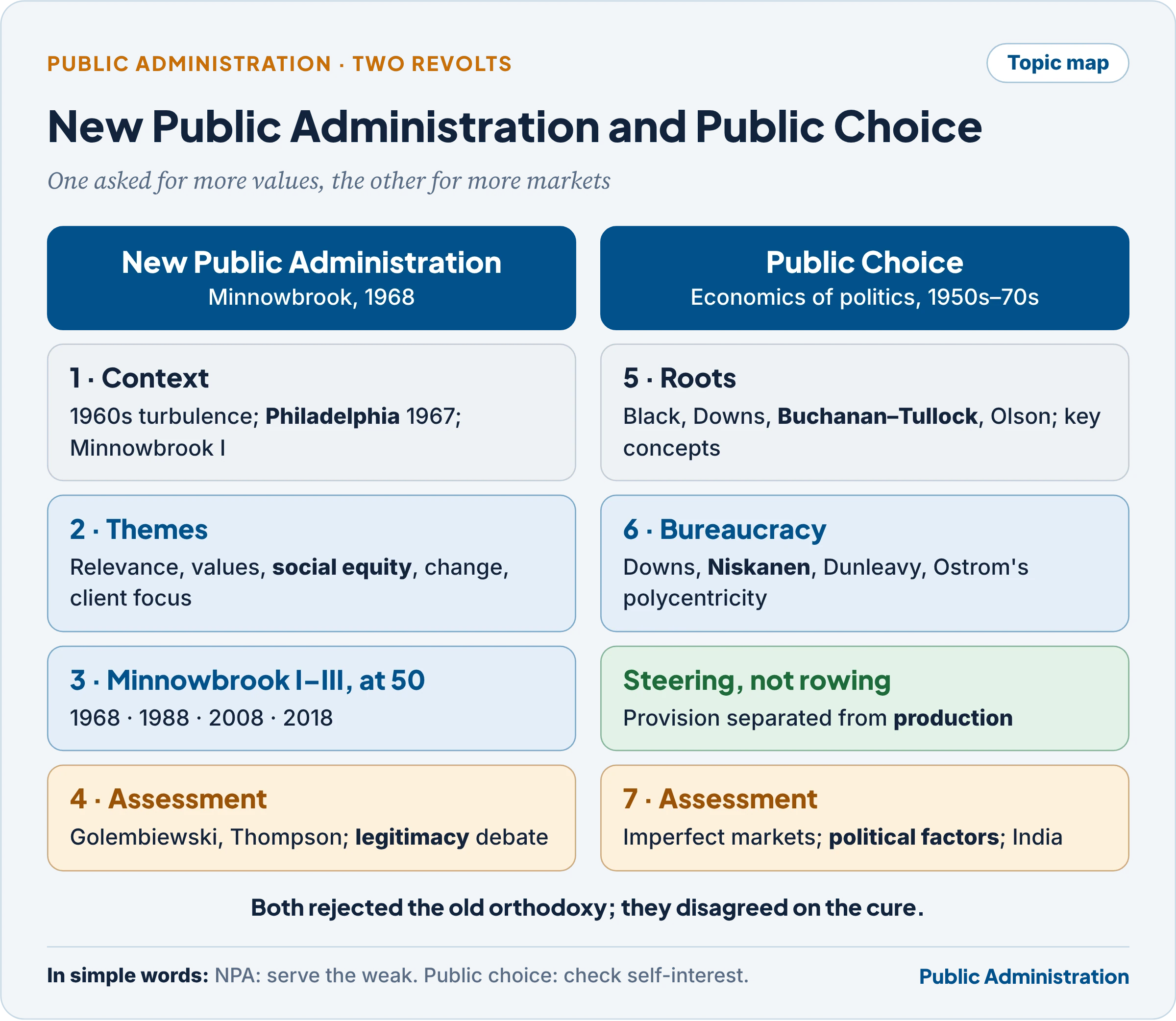
In the late 1960s and early 1970s, two very different revolts shook the comfortable world of orthodox public administration.
- New Public Administration (NPA) came from young American scholars who said the discipline had become morally blind: it cared about efficiency but not about whom government served, and it should take the side of the poor and excluded.
- The Public Choice approach came mainly from economists who said the discipline was naive in a different way: it assumed officials and politicians serve the public interest, when in fact they pursue their own interests like everyone else, so government needs competition, choice and limits.
One revolt asked for more values; the other for more markets. Both permanently changed the subject.
In simple words
Imagine a city water department. New Public Administration asks: “Why do the slums get water last? The department should fight for them.” Public Choice asks: “Why does the department keep asking for a bigger budget while the taps run dry? Let several providers compete and let residents choose.” Both are unhappy with the department, but for opposite reasons.
1. New Public Administration: The Context
In simple words
New Public Administration was born in a time of anger. America had money and power, yet its cities were burning, its poor were left behind and its young were dying in Vietnam. Young scholars felt their subject was busy counting efficiency while ignoring injustice.
1.1 The social and political setting
- The 1960s in the United States: the civil rights movement, urban riots (1965–68), the War on Poverty and Great Society programmes that promised much and delivered unevenly, the Vietnam War (fought largely by the young and the poor), assassinations (John F. Kennedy 1963; Martin Luther King Jr. and Robert Kennedy 1968) and campus unrest.
- A crisis of trust: respect for institutions (government, family, church, professions) declined; government programmes were suspected not only of failing to solve problems but of aggravating them. As one observer put it, institutions had failed “to finish what they set out to do and, worse, are now suspected of aggravating or intensifying the very problems they were designed to solve”.
- An intellectual setting: mainstream social science, including public administration, had become behavioural and value-free. David Easton’s call for a “post-behavioural revolution” in political science (1969) stressed relevance and action, the same mood that drove NPA.
1.2 The landmarks
| Year | Event | Significance |
|---|---|---|
| 1967 | Honey Report on Higher Education for Public Service (John C. Honey) | Criticised the weak state of public administration education |
| 1967 | Philadelphia Conference on the Theory and Practice of Public Administration (American Academy of Political and Social Science; proceedings edited by James Charlesworth, 1968) | Senior scholars questioned the dichotomy, hierarchy and the neglect of social problems |
| 1968 | Minnowbrook Conference I, at Syracuse University’s Minnowbrook centre in the Adirondacks, sponsored by Dwight Waldo | Young scholars launched the “New Public Administration” |
| 1971 | Frank Marini (ed.), Toward a New Public Administration: The Minnowbrook Perspective | The movement’s manifesto |
| 1971 | Dwight Waldo (ed.), Public Administration in a Time of Turbulence | Companion volume on the turbulent context |
| 1980 | H. George Frederickson, New Public Administration | Systematic statement, centred on social equity |
What the Philadelphia Conference said (1967):
- With the welfare state, government functions keep growing, so the boundaries of public administration should remain flexible.
- Administrators take part in policy-making, so the policy–administration dichotomy is meaningless.
- Too much emphasis on hierarchy and internal processes makes organisations rigid; innovation and flexibility are needed.
- The discipline should attend to urban squalor, unemployment, poverty and pollution.
- Social equity deserves attention alongside efficiency and accountability, with citizen participation built into administration.
- Training should build social sensitivity and ethics, not only techniques.
Common confusion
Is “New Public Administration” the same as “new public administration” or “New Public Management”? No. Some older writers used “new public administration” for the post-war writings of 1946–60, which shifted attention from specialised techniques to programmes, from the chief executive to real problems, from abstract principles to specific contexts, and from economy and efficiency to political values and democracy. New Public Administration (capitalised) refers to the Minnowbrook movement of 1968, centred on social equity. New Public Management (1990s) is almost its opposite: market-oriented, managerial and efficiency-driven (see the article on NPM). Also, the Watergate scandal (1972–74) came after Minnowbrook I; it deepened the distrust NPA reflected but did not cause the movement.
2. The Themes and Values of New Public Administration
In simple words
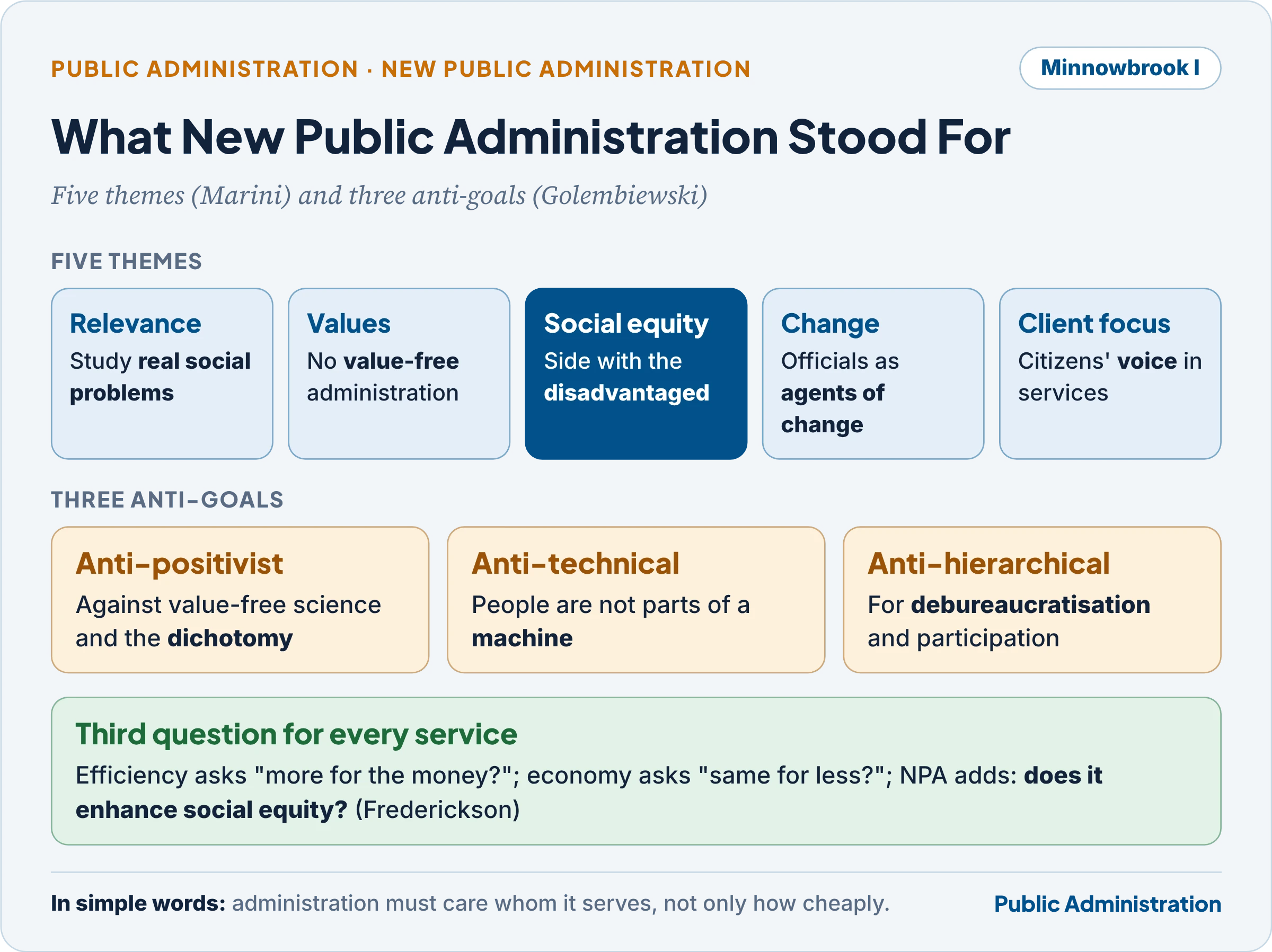
NPA’s message fits in five words: relevance, values, equity, change and clients. Study real problems; admit you have values; stand up for the disadvantaged; be ready to change institutions; and give citizens a say in the services they receive.
2.1 Marini’s five themes
| Theme | What it means | Example of what it demands |
|---|---|---|
| Relevance | The discipline had little to say about pressing problems; it must study real social issues and their political implications | Study why programmes fail in poor neighbourhoods, not only office procedures |
| Values | Value-neutral administration is impossible; be open about the values served | Reject “neutral” efficiency that hides whose interests are served |
| Social equity | Administration should reduce inequality and champion the disadvantaged; use discretion in their favour | Distribute services by need, not by political power |
| Change | Administrators should be agents of change, not defenders of the status quo or of self-perpetuating institutions | Wind up or redesign agencies that have outlived their purpose |
| Client focus | Serve clients positively and give them a voice in what, how and when services are provided | Participation of service users in decisions |
The Minnowbrook questions about knowledge (relevance):
- What standards decide which questions we study, and how?
- Who defines our questions and priorities for us?
- How aware are we of the social and moral implications of knowledge in public administration?
- Does public administration produce knowledge useful to dominant institutions and not to others?
These questions challenged the status quo: they asked whom the discipline served.
2.2 Frederickson and social equity
- H. George Frederickson made social equity the movement’s central idea. Classical public administration asked two questions: can we offer more or better services with available resources (efficiency), and can we maintain services while spending less (economy)? NPA adds a third: does the service enhance social equity?
“A Public Administration which fails to work for changes which try to redress the deprivation of minorities will likely be eventually used to repress those minorities.” — H. George Frederickson
- “Second-generation behaviouralism”: Frederickson did not reject science; he wanted research to be relevant and value-conscious. The new public administrator, he wrote, is “less generic and more public“, “less descriptive and more prescriptive“, “less institution-oriented and more client-impact oriented“, “less neutral and more normative“, and, it is hoped, “no less scientific“.
- Features of NPA, in Frederickson’s account:
- Change and responsiveness: organisations need clear criteria to judge their relevance and in-built ways to change.
- Rationality should be the citizens’ as well as the administrator’s: consult people on what ought to be done.
- Management–worker relations: morale and productivity are means; the end is citizens’ satisfaction.
- Structures: small, decentralised, flexible structures; a menu of forms instead of one standard design.
- Education: a heterogeneous, multi-approach discipline.
- Frederickson on the advocate administrator (1995 PYQ): New Public Administrationists are likely to be forthright advocates of social equity and will seek a supporting clientele: they build alliances with the groups they serve, so that equity has political backing inside and outside government.
2.3 Golembiewski’s reading: features and “anti-goals”
Robert Golembiewski summed up NPA in five positive features:
- a view of people as malleable and perfectible, always in a process of growth;
- a demand for relevance;
- social equity as the vehicle that guides administration;
- a relational rather than organisation-centred focus (citizens, groups, the community);
- an emphasis on innovation and change.
And in three anti-goals:
- Anti-positivist: it rejected (a) value-free public administration, (b) a rationalist, determinist view of human beings, and (c) any definition of public administration that kept it out of policy (as the naive dichotomy did).
- Anti-technical: it opposed sacrificing the emotional, creative human being to the logic of the machine and the system.
- Anti-bureaucratic and anti-hierarchical.
2.4 Waldo’s reading
- Dwight Waldo called NPA “some sort of movement in the direction of normative theory, philosophy, social concern and activism“; negatively, it turned away from positivism and scientism.
- He identified three perspectives NPA projected: a client-oriented bureaucracy, a representative bureaucracy (one that reflects the social composition of the people) and people’s participation in administration. Woven into practice, they would further democratise administration.
2.5 The prescriptions
- Debureaucratisation, decentralisation and democratic decision-making, so that services are delivered more effectively and humanely (Nigro and Nigro).
- Citizen participation and client involvement in decisions.
- Representative bureaucracy: recruiting the disadvantaged into the public service.
- Cutback and dismantling: “change, not growth”; creating new organisations and winding up outdated ones.
- Ethics, honesty and responsibility back in the vocabulary of public administration.
- Policy focus: the quality of schooling or the effects of law enforcement became units of analysis as important as internal management.
2.6 NPA’s method: against positivism, towards phenomenology
- Positivist explanation in mid-century social science followed the philosopher Carl Hempel’s two models:
- the deductive-nomological model (an event is explained by deducing it from general laws plus conditions, like physics);
- the inductive-probabilistic model (an event is shown to be highly probable given statistical laws).
- Some Minnowbrook writers argued that these models dominated mainstream public administration and were ill-suited to human action, which depends on meanings, intentions and values.
- Larry Kirkhart, in the Marini volume, proposed drawing on phenomenology (the philosophy of how people experience and give meaning to their world, after Alfred Schutz) and sketched a “consociated model” of organisation based on trust and shared projects. Michael Harmon later developed an “action theory” for public administration (1981).
- Did this obstruct theory-building? Critics say yes: phenomenological and normative approaches produced insight but few testable, cumulative theories, so NPA left “no coherent intellectual framework”. Defenders reply that it widened what counts as knowledge, prepared the ground for interpretive and critical public administration, and that mainstream empirical research continued alongside it.
Indian Connect — Social equity in Indian administration
- The Constitution makes social equity a duty, not an option: Articles 15(4) and 16(4) (special provisions and reservation), Article 46 (educational and economic interests of weaker sections), Article 38(2) (minimising inequalities).
- Representative bureaucracy: reservation in public employment for Scheduled Castes, Scheduled Tribes, Other Backward Classes and (since 2019) the economically weaker sections is a direct form of Waldo’s second perspective.
- Client voice and participation: social audit under Section 17 of the Mahatma Gandhi National Rural Employment Guarantee Act, 2005, the Forest Rights Act, 2006 (gram sabha decides claims), and state Right to Public Services laws.
- Equity-focused programmes: the Aspirational Districts Programme (2018) and the Aspirational Blocks Programme (launched 7 January 2023, 500 blocks) target the most backward areas; PM-JANMAN (approved 29 November 2023, outlay ₹24,104 crore) saturates Particularly Vulnerable Tribal Group habitations with basic services.
- NPA and development administration share goal- and change-orientation; NPA arose in a rich Western society, development administration in post-colonial ones.
3. The Minnowbrook Conferences: I, II, III and at 50
In simple words
Every twenty years, scholars went back to the same lakeside centre to ask, “What is public administration for, now?” The answers changed with the times: anger in 1968, caution in 1988, global networks in 2008, democracy and artificial intelligence in 2018.
3.1 Minnowbrook I (September 1968)
- Convened under Dwight Waldo’s patronage at Syracuse University’s Minnowbrook Conference Centre (Blue Mountain Lake, New York); participants were young scholars, mostly trained in political science.
- Mood: contentious, confrontational, revolutionary; decidedly anti-behavioural.
- Themes: relevance, values, social equity, change, client focus; normative and activist.
3.2 Minnowbrook II (September 1988)
- Decided at the 1987 conference of the American Society for Public Administration; held exactly twenty years later, with both the 1968 generation and newer scholars.
- Context: Reagan-era retreat of the state: cutbacks, privatisation, contracting out, voluntarism, third-party government. In Frederickson’s words, “less government and more governance”; “the era of growth” had been “replaced by the era of limits”.
- Composition: wider: law, economics, planning, policy analysis and urban studies as well as political science.
- Mood: “more civil, more practical”, less radical, more respectful to senior professionals; observers called it “constrained hopefulness“.
- New emphases: leadership, constitutional and legal perspectives, technology, policy and economic perspectives; ethics, accountability and the diversity of the workforce (including gender); a curious tension between capitalism and democracy; an adversarial attitude to business even while privatisation was accepted.
- Frederickson’s summary of the themes from Minnowbrook I that had become important aspects of the field:
- the shift from managing agencies to policy issues;
- social equity added to efficiency and economy;
- ethics, honesty and responsibility back in the lexicon;
- as needs change, government agencies often outlive their purposes;
- change, not growth, as the critical issue;
- effective administration defined by an active, participative citizenry;
- implementation, not only decision-making, as the harder challenge;
- the rational model and strict hierarchy severely challenged;
- pluralism no longer the standard for practice.
- Its focus on current and future visions (1998 PYQ): rather than radical change, it concentrated on rebuilding the field’s competence and legitimacy (personnel practices, leadership, constitutional grounding) for the near future.
3.3 Minnowbrook III (September 2008)
- Organised by Rosemary O’Leary at Syracuse University; theme: “The Future of Public Administration, Public Management and Public Service Around the World“.
- Two phases: a pre-conference workshop of about 56 emerging scholars at Minnowbrook (more diverse in race, gender and nationality than before), then a larger conference at Lake Placid with about 220 scholars and practitioners from 13 countries.
- Focal areas: academic–practitioner relations; democratic performance management; financial management; globalisation and comparative perspectives; information technology; law, politics and administration; leadership; methods and interdisciplinarity; networks; performance measurement; values and theory; social equity and justice; transparency and accountability.
- Outcomes:
- a renaissance of comparative studies, stressing that institutional and cultural context matters and must be built into research;
- a pledge (a “manifesto”) on research methods: action research to engage with practice, and methodological pluralism;
- a new definition of public administration as “a socially-embedded process of collective relationships, dialogue and action to promote human flourishing for all“;
- a call to prepare the next generation of public servants for a globalised world, with education that fits different national and regional settings;
- reflection on “public administration in dark times” (war, terrorism, climate change, financial crisis): critics felt the participants avoided the big questions in favour of routine research agendas.
- Its papers were published as The Future of Public Administration around the World: The Minnowbrook Perspective (O’Leary, Van Slyke and Kim, eds.).
3.4 Minnowbrook at 50 (August 2018)
- Convened by Tina Nabatchi at the original Minnowbrook site on the theme “Revisiting the Administrative State“, amid low trust in government and calls to “deconstruct” it.
- Small-group themes: relevance of scholarship; micro, meso and macro analysis; overcoming American-centricity; integrative public administration; automation and artificial intelligence; democracy, public administration and public values; social equity.
- Tensions: normative vs positive scholarship; whether the field should admit its role in past injustices; whether democracy is central to its identity; whether scholars should take public stands.
3.5 The four conferences compared
| Basis | Minnowbrook I (1968) | Minnowbrook II (1988) | Minnowbrook III (2008) | Minnowbrook at 50 (2018) |
|---|---|---|---|---|
| Context | Riots, Vietnam, distrust of government | Reagan era: cutbacks, privatisation | Globalisation, terrorism, financial crisis | Low trust; calls to dismantle the administrative state |
| Participants | Young, mostly political scientists | Wider disciplines; two generations | Global, diverse, emerging scholars | Scholars, practitioners, associations |
| Mood | Radical, confrontational | Civil, practical | Global, collaborative | Reflective, contested |
| Key themes | Relevance, values, equity, change, clients | Leadership, law, technology, ethics, economics | Networks, comparison, methods, equity | AI, democracy, public values, equity |
| Stance on behaviouralism | Anti-behavioural | Receptive to social sciences | Methodological pluralism | Positive and normative both |
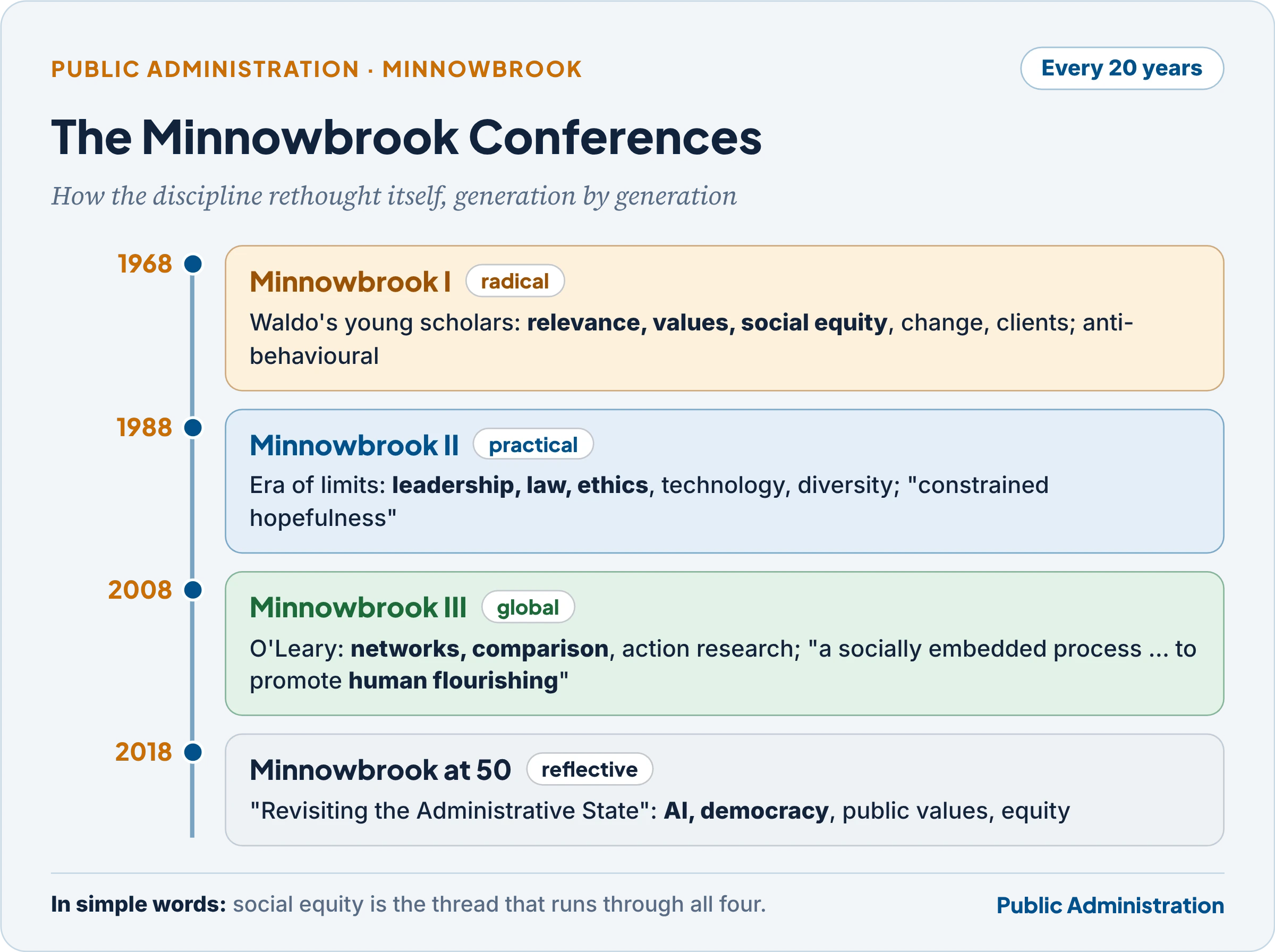
Read together, the conferences show the discipline’s changing values: from equity and activism (1968) to professional competence and legitimacy (1988), to global, networked and evidence-based public service (2008), to democracy and technology (2018). Social equity is the thread that runs through all four.
4. Assessing New Public Administration
In simple words
NPA did not build a new grand theory, and its revolutionary language outran its practical tools. But it changed what the field cares about: today no serious discussion of public administration ignores equity, ethics, participation or values.
4.1 Contributions
- Coup de grâce to the dichotomy and to the idea of value-free administration.
- Social equity became a recognised value of public administration, alongside efficiency, economy and effectiveness; later institutionalised (for example, the US National Academy of Public Administration’s standing panel on social equity).
- Policy orientation: strengthened the study of policy outcomes and implementation.
- Client orientation and participation, foreshadowing the citizen-centric reforms and New Public Service of later decades.
- Ethics and values returned to the centre of the field.
- Democratic humanism in organisations: decentralisation, participation, less hierarchy.
- Brought academics and practitioners closer and pushed the discipline towards relevance; linked it to the post-behavioural movement in political science.
- Nigro and Nigro: NPA “seriously jolted the traditional concepts and outlook of the discipline and enriched the subject by imparting a wider perspective and linking it closely to the society”; “since the New Public Administration emerged, questions of values and ethics have remained major items in public administration”.
- Its influence, rather than adding a separate layer, pervades the other approaches (political science, policy, generic management).
4.2 Criticisms
- Golembiewski: “revolution or radicalism in words, and (at best) status quo in skills or technologies”; at best a partial success, perhaps “a cruel reminder of the gap between aspiration and performance”.
- No coherent theory: it produced moods and themes rather than a framework that could command wide support (Ramesh K. Arora: anti-positivist, anti-theoretic and anti-management).
- Usurping the political role: by asking officials to champion particular groups, it arrogated to unelected administrators what belongs to elected representatives. Ingraham and Rosenbloom asked: if civil servants become open advocates of policy positions, “where then, will the liberated public service find its legitimacy?”
- Neglect of efficiency: de-emphasising efficiency and economy is unfair to the taxpayer.
- Victor Thompson, Without Sympathy or Enthusiasm: The Problem of Administrative Compassion (1975): public service should be impersonal and expert; a client is a “problem category” (a heart patient is a cardiac case), and compassion distorts professional judgement.
- Campbell: NPA differed from the old public administration mainly in responding to a different set of problems.
- Carter and Duffey: doubtful that social equity had really become an established objective alongside efficiency, effectiveness and accountability.
- Dunn and Fozouni: it produced the illusion of a paradigm shift rather than a real one.
- Waldo (sympathetically): “children’s crusades and youth movements have not on the whole written happy, brilliant pages in the history of civilisation”; he found some validity in its anti-organisational stance but much of the indictment “unfair, spurious, and above all unrealistic”.
- Context-bound: it was a product of American turbulence; its relevance to other societies depends on adaptation, although its client-oriented, equity-minded spirit suits developing countries that need debureaucratisation.
Criticism — Critics of New Public Administration
- Rhetoric outran method: radical words, conventional tools (Golembiewski).
- No coherent, testable theory; anti-theoretic and anti-management.
- Unelected officials taking sides undermines democratic legitimacy and neutrality.
- Downgrades efficiency and economy, burdening taxpayers.
- Compassion can corrupt expert, impersonal service (Thompson).
Defence — Defenders of New Public Administration
- It ended the myth of value-free administration and put social equity on the agenda permanently.
- It shifted attention to outcomes and clients, the root of later citizen-centric reforms.
- It made ethics, participation and representativeness central concerns.
- Its spirit runs through Minnowbrook II, III and at 50, New Public Service and public value.
- Its call for debureaucratisation and equity is especially relevant to developing countries.
5. The Public Choice Approach: Meaning and Roots
In simple words
Public choice says: politicians, officials and voters are ordinary people who respond to incentives. A politician wants re-election, an official wants a bigger budget or a promotion, and a voter does not bother to study every issue. If you design government assuming angels, you get disappointed; design it assuming self-interest, and you build in competition, checks and choice.
5.1 Meaning
- Definition: public choice is “the economic study of non-market decision-making, or simply the application of economics to political science” (Dennis Mueller). It is also called the economic theory of politics.
- It studies collective decisions: voting, party competition, interest groups, legislatures and bureaucracy, using the tools economists use for markets.
- In public administration, it gained currency in the 1970s, mainly through Vincent Ostrom.
5.2 Its two methodological pillars
- Methodological individualism: society, the state, a party or a bureau are nothing more than the individuals who compose them; only individuals choose. Public choice rejects the organic view of society and treats group-level explanations as misleading.
- Rational choice: individuals rank alternatives consistently and choose the one that best serves their ends within constraints. They are utility maximisers (not necessarily selfish in a narrow sense, but responsive to incentives).
- Consequences for the study of government:
- Politicians seek votes and re-election; bureaucrats seek budgets, status, power and security; voters and interest groups seek benefits.
- Politics as exchange: government arises from, and works through, bargaining and exchange among individuals, much like a market. Adam Smith’s “propensity to truck, barter and exchange” extends to politics.
- “Politics without romance” (James Buchanan): analyse real governments and officials, not idealised ones.
- Normative leaning: voluntary exchange is preferred to coercion, so public choice writers favour markets, decentralisation and constitutional limits on government.
5.3 The founders and their works
| Thinker | Work (year) | Contribution |
|---|---|---|
| Duncan Black | Papers on committees (1948) | Median voter theorem; rational analysis of group decisions |
| Kenneth Arrow | Social Choice and Individual Values (1951) | Impossibility theorem: no voting rule can turn individual preferences into a consistent social choice under reasonable conditions |
| Anthony Downs | An Economic Theory of Democracy (1957) | Parties maximise votes as firms maximise profit; rational ignorance of voters |
| William Riker | The Theory of Political Coalitions (1962) | Minimum winning coalitions |
| James Buchanan and Gordon Tullock | The Calculus of Consent (1962) | Constitutional choice; costs of collective decisions; logrolling |
| Gordon Tullock | The Politics of Bureaucracy (1965) | Self-interested officials; distortion of information in hierarchies |
| Mancur Olson | The Logic of Collective Action (1965) | Free-rider problem; small, organised groups beat large diffuse ones |
| Anthony Downs | Inside Bureaucracy (1967) | Types of officials and the “laws” of bureaucratic behaviour |
| William Niskanen | Bureaucracy and Representative Government (1971) | Budget-maximising bureaucrat |
| George Stigler | “The Theory of Economic Regulation” (1971) | Regulatory capture |
| Vincent Ostrom | The Intellectual Crisis in American Public Administration (1973) | Democratic administration; polycentricity |
| Anne Krueger | “The Political Economy of the Rent-Seeking Society” (1974) | Rent seeking; estimated rents at 7.3 per cent of India’s national income (1964) |
| Patrick Dunleavy | Democracy, Bureaucracy and Public Choice (1991) | Bureau-shaping model |
- James Buchanan received the Nobel Prize in Economics (1986) for the contractual and constitutional foundations of public choice. Elinor Ostrom (Vincent Ostrom’s colleague and wife) received it in 2009 for showing how communities govern common resources through polycentric institutions.
Common confusion
Is public choice the same as social choice or rational choice? They are related but different. Rational choice is the general assumption that individuals choose consistently to maximise their goals; it is used across the social sciences. Social choice theory (Arrow, Amartya Sen) asks whether and how individual preferences can be aggregated into a fair collective decision. Public choice applies rational choice to political and bureaucratic behaviour (voters, politicians, officials, interest groups) and draws institutional and policy conclusions from it.
5.4 Key concepts
Market failure and government failure
- Economists justify government action by market failure: public goods, externalities (pollution), natural monopolies and information asymmetry stop markets from reaching efficient outcomes.
- Pareto optimality: a situation where no one can be made better off without making someone else worse off (after the economist Vilfredo Pareto). A Pareto improvement is a change that makes at least one person better off and no one worse off. Public choice is concerned with whether collective decisions achieve such improvements, and it favours unanimity or near-unanimity rules at the constitutional stage because only voluntary agreement guarantees that everyone gains.
- Government failure: public choice insists that market failure does not automatically justify intervention, because real governments also fail: vote-seeking politicians, budget-seeking bureaucrats and organised lobbies produce over-supply, waste, cost overruns and capture. Compare real markets with real governments, not real markets with ideal governments.
Public goods
| Type | Rival in consumption? | Can people be excluded? | Example |
|---|---|---|---|
| Pure public good | No | No | Lighthouse, national defence |
| Club good | No (until crowded) | Yes | Cable television, a cinema hall, a toll road |
| Common-pool resource | Yes | No (or very costly) | Congested road, a public beach, groundwater, fisheries |
| Private good | Yes | Yes | An apple, a bus ticket |
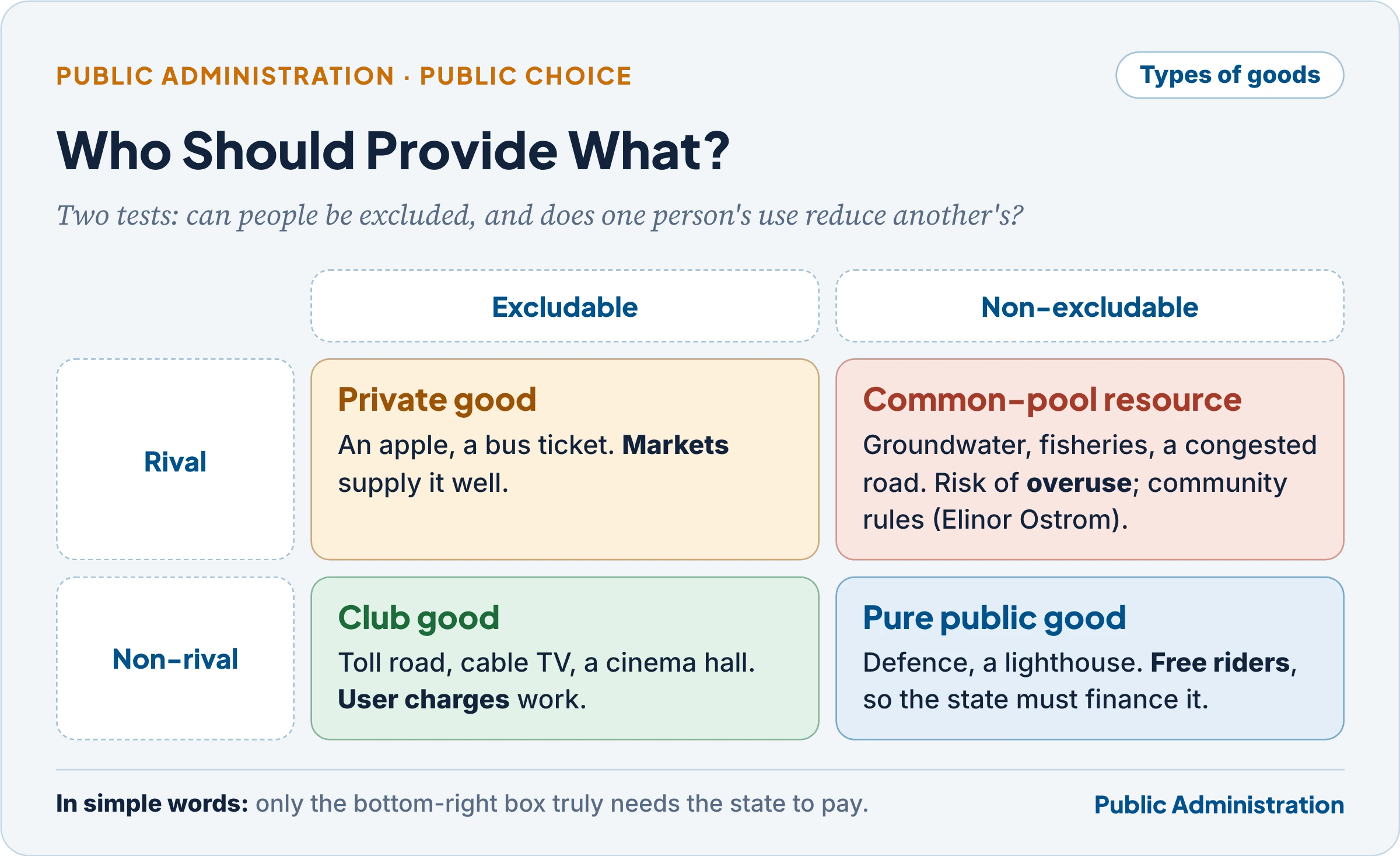
- Because people cannot be excluded from pure public goods, each person is tempted to free-ride (enjoy without paying), so markets under-supply them. Public choice accepts this, but asks which institution, at what scale, should provide each good.
Voting and interest groups
- Median voter: with single-peaked preferences, majority voting tends to choose the median voter’s preference, so parties converge on the centre.
- Rational ignorance (Downs): one vote rarely decides an election, so it is rational for voters not to spend time studying issues; this weakens their control over government.
- Logrolling: legislators trade votes (“I support your project, you support mine”), which can pass projects whose total costs exceed benefits.
- Collective action (Olson): small groups with concentrated benefits (an industry seeking protection) organise more easily than large groups with diffuse costs (consumers), so policy is biased towards special interests.
- Rent seeking: spending resources to obtain privileges created by government (licences, quotas, tariffs, monopolies) rather than creating new wealth. Jagdish Bhagwati called such activities directly unproductive profit-seeking (DUP): lobbying for tariffs, creating artificial monopolies, smuggling. Stigler’s regulatory capture: regulated industries come to control their regulators.
- Political business cycle: governments time spending and policies around elections.
6. Public Choice and Bureaucracy
In simple words
Traditional theory pictured the bureau as a loyal machine. Public choice pictures it as a group of people with their own goals: bigger budgets, more staff, easier jobs, more prestige. The cure is not more orders from the top, but more competition, more choice for citizens and smaller, overlapping units.
6.1 Tullock and Downs: officials as self-interested actors
- Gordon Tullock (The Politics of Bureaucracy, 1965): officials pursue career advancement; in tall hierarchies they filter and distort information to please superiors, so control from the top weakens as the hierarchy grows.
- Anthony Downs (Inside Bureaucracy, 1967) classified officials by their motives:
- Purely self-interested: climbers (seek power, income, prestige) and conservers (seek security and convenience).
- Mixed motives: zealots (loyal to narrow policies), advocates (loyal to their organisation’s broader functions) and statesmen (loyal to society as a whole).
- Downs also proposed “laws” of bureaucracy, such as the law of increasing conservatism (most officials become conservers over time) and the law of imperfect control (no one can fully control a large organisation).
- Downs vs Niskanen (2011 PYQ): Downs’s model rests on a theory of psychological motivation: a mix of self-interest and altruism, varying by type of official. Niskanen’s model is framed by neo-classical economics: a single maximising objective (the budget) and a formal market-like analysis of the bureau’s exchange with its sponsor.
6.2 Niskanen: the budget-maximising bureaucrat
- William Niskanen (Bureaucracy and Representative Government, 1971):
- A bureau supplies a service to a single “buyer”, its sponsor (the legislature or government), in exchange for a budget, not for a price per unit. The relationship is a bilateral monopoly: one seller, one buyer.
- The bureau head’s utility depends on salary, perquisites, public reputation, power, patronage, output, ease of making changes and ease of managing, all of which rise with the budget. So bureau heads maximise budgets.
- The bureau knows its true costs; the sponsor does not (information asymmetry). So it can obtain a budget larger than needed.
- Result: bureaux produce too much output (in his simple model, up to twice the efficient level) or produce it at too high a cost; government grows beyond what citizens want.
- In a later version (1975) Niskanen allowed bureaucrats to maximise discretionary budget (slack), which leads to waste rather than over-production.
- Remedies: competition among bureaux, contracting out, sunset rules, performance budgets, stronger legislative oversight, and private supply where possible.
6.3 Dunleavy: the bureau-shaping model
- Patrick Dunleavy (1991) argued that senior officials do not mainly want bigger budgets (most of the money goes to programmes they do not personally benefit from). They want pleasant, prestigious work: small, elite, policy-focused central agencies close to political power.
- So they shape their bureaux: hiving off routine delivery to agencies and contractors, keeping policy work at the centre.
- This explains why officials sometimes support privatisation and agencification, which Niskanen’s model cannot.
6.4 Vincent Ostrom: democratic administration
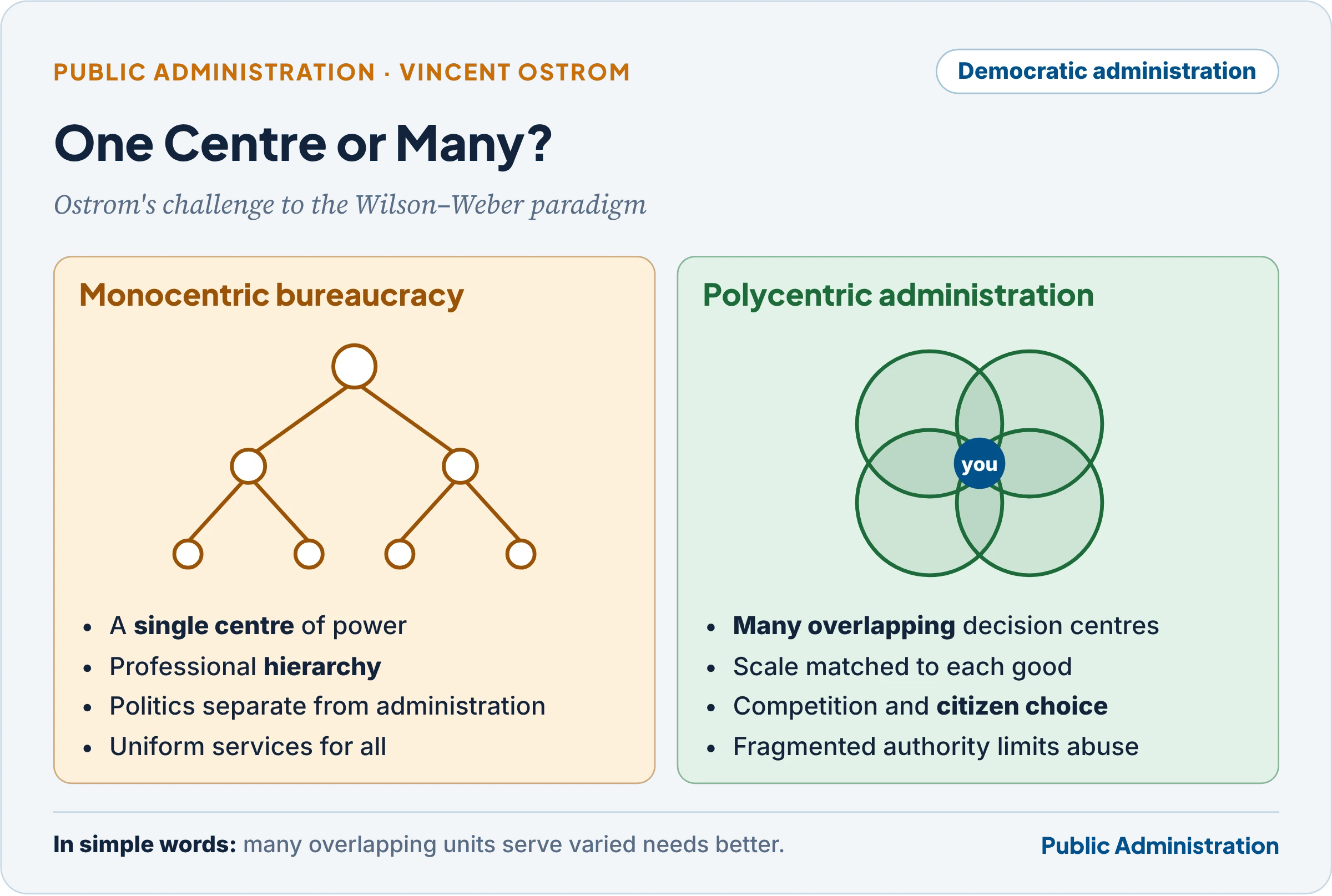
- Vincent Ostrom, The Intellectual Crisis in American Public Administration (1973; revised 1974 and 1989), argued that the discipline was in crisis because it rested on a single paradigm, inherited from Wilson and Weber: one centre of power, a professional hierarchy, and the separation of politics and administration.
- His critique:
“Perfection in the hierarchical ordering of a professionally trained public service accountable to a single center of power will reduce the capability of a larger administrative system to respond to diverse preferences among citizens for many different public goods and services and cope with diverse environmental conditions.” — Vincent Ostrom
- “Bureaucratic structures are necessary but not sufficient structures for a productive and responsive public service economy.”
- His alternative, drawing on The Federalist (Hamilton and Madison) and Tocqueville:
- “A variety of different organizational arrangements can be used to provide different public goods and services. Such organizations can be coordinated through various multi-organizational arrangements.”
- Polycentricity: many centres of decision with overlapping jurisdictions (local governments, special districts, co-operatives, private firms, community bodies), each matched to the scale of the good it provides.
- Fragmentation of authority among decision centres limits the abuse of power and allows competition, experimentation and citizen choice.
- Administration is not separate from politics: rules and procedures are “not a matter of political indifference to the users of public goods and services”.
- Democratic administration aims to maximise efficiency “measured by least cost expended in time, effort and resources”, and democratic decision-making and efficiency are compatible.
- Tiebout’s “vote with your feet” (1956): when many local governments offer different packages of services and taxes, citizens can move to the one that suits them, creating market-like pressure on governments. Ostrom, Tiebout and Warren (1961) defended “polycentric” metropolitan government against the call to merge cities into one big authority.
- Elinor Ostrom’s later work on the commons (Governing the Commons, 1990) showed that communities often manage forests, fisheries and irrigation better than either the state or the market, through locally designed rules.
6.5 From public choice to “steering, not rowing”
- Public choice separates provision (deciding what public services should be available, how much, for whom, and paying for them) from production (actually making or delivering them).
- Government should provide (decide and finance) but need not produce: production can be contracted out to competing public, private or voluntary producers, and citizens given choice (vouchers, user charges).
- This is what Osborne and Gaebler (1992) called steering rather than rowing: government as catalyst, setting direction and buying results, rather than running everything itself.
- Public choice thus promotes steering (policy, regulation, contracting, performance monitoring) and undermines rowing (monopoly in-house production by bureaucracies), because it sees monopoly rowing as the source of budget maximisation and unresponsiveness.
6.6 Policy implications
- Prefer decentralised, market-like systems: competition among agencies, contracting out, user charges and vouchers.
- Minimise public monopolies and the role of the state where markets can work; privatise or contract out services like health care and education where feasible.
- Limit the discretion of politicians and bureaucrats through constitutional rules (balanced budgets, tax limits, sunset clauses).
- Decentralise to small, democratic units; welcome overlapping jurisdictions.
- Public choice became an intellectual foundation of New Public Management and of “rolling back the state” under Thatcher and Reagan (see the article on NPM).
7. Assessing the Public Choice Approach
In simple words
Public choice was a useful cold shower: it showed that governments fail too and that incentives matter. But people in public service are not only self-seekers, many public goods cannot be sold in markets, and in countries with weak markets and weak regulators, copying market solutions can make things worse.
7.1 Contributions
- Realism: it replaced the romantic image of the selfless official with an analysis of incentives, explaining waste, delay, capture and growth of government.
- Government failure became as respectable a concept as market failure.
- Institutional design: it showed that rules and structures (voting rules, decentralisation, competition, constitutional limits) shape outcomes.
- Pluralism of institutions: polycentric, decentralised arrangements and community governance of commons.
- Regulation and rent seeking: explained licence raj-style corruption and regulatory capture.
- Political economy: it showed that economic policy cannot be discussed without politics.
- Practical influence: privatisation, contracting out, agencies, user charges, performance budgets and New Public Management drew directly on it.
7.2 Limitations: imperfect markets and political factors
Imperfect markets
- Market solutions need competitive markets, informed consumers and enforceable contracts. Many public services lack them: natural monopolies (water, power grids), information asymmetry (health care), externalities (environment) and thin markets in remote areas.
- Quasi-markets (contracting out, vouchers) often produce few bidders, collusion, cream-skimming of profitable clients and high transaction costs of writing and monitoring contracts.
- Markets ignore distribution: Pareto efficiency is silent on whether the starting distribution is fair.
Political factors
- Not all officials maximise budgets: studies (for example, André Blais and Stéphane Dion’s review, 1991) found weak evidence for Niskanen’s model; officials are also moved by public service motivation (James Perry and Lois Wise, 1990), professional norms and ideology.
- Citizens are not only consumers: public services involve rights, duties, coercion and shared values that cannot be reduced to individual preferences (the New Public Service critique).
- Collective goods and equity: defence, justice, public health and redistribution need collective decisions; exit (“vote with your feet”) favours the mobile and the rich.
- Political legitimacy: contracting out can blur accountability; ministers answer for services they no longer control.
- Ideological bias: its assumptions lead almost automatically to a smaller state; critics see it as a value-loaded case for the market presented as neutral analysis.
- Weak empirical base: many predictions are hard to test; Keith Baker argued it suits resource-rich settings better than resource-scarce ones.
- Developing countries: where markets are thin, regulators weak and the poor many, the state’s role in development cannot be shrunk without cost (see the article on development dynamics).
Indian Connect — Public choice in Indian practice
- Rent seeking under the licence raj: Anne Krueger (1974) estimated rents from import licences in India at about 7.3 per cent of national income in 1964; the 1991 reforms dismantled much of that system.
- Cutting leakage by design: Direct Benefit Transfer through JAM (Jan Dhan, Aadhaar, mobile) removed duplicate and fake beneficiaries; government estimates cumulative savings of about ₹5.14 lakh crore up to March 2025.
- Polycentricity: the 73rd and 74th Amendments (1992) created a third tier of elected governments, and co-operatives and water users’ associations manage local commons.
- Competition in procurement: the Government e-Marketplace (GeM) opened public purchasing to many sellers; independent regulators (TRAI, SEBI, CCI, electricity commissions) aim to prevent capture.
- When markets fail: Odisha’s pioneering 1999 privatisation of electricity distribution ran into losses and disputes; the regulator revoked three distribution licences in 2015 before new private operators were brought in from 2020. Privatisation works only with competition, regulation and capacity, exactly the conditions public choice assumes.
7.3 Public administration at the crossroads of four theories
Public choice is one of four theories about who really governs and why administration behaves as it does:
| Theory | Who shapes public decisions | Role of administration | Key thinkers |
|---|---|---|---|
| Public choice | Self-interested individuals: voters, politicians, bureaucrats | A set of self-interested actors to be disciplined by competition and rules | Buchanan, Tullock, Niskanen, Ostrom |
| Pluralism | Many competing groups; power is dispersed | A neutral arena or broker among groups | Robert Dahl |
| Corporatism | The state plus a few peak associations (employers, unions) that bargain and co-govern | A partner in tripartite bargaining | Philippe Schmitter |
| Elitism | A small elite (political, economic, military, bureaucratic) | Part of the ruling elite | C. Wright Mills (The Power Elite, 1956), Mosca, Pareto, Michels (“iron law of oligarchy”) |
Public administration “stands at the crossroads” of these theories because each explains part of real administrative behaviour: budget-seeking (public choice), lobbying and group bargaining (pluralism), tripartite boards and wage councils (corporatism), and the influence of a narrow, often socially privileged, administrative and political class (elitism). A full analysis of administration uses all four lenses.
Key Terms
| Term | Meaning in simple words |
|---|---|
| New Public Administration | The 1968 Minnowbrook movement demanding relevance, values, social equity, change and client focus |
| Social equity | Fair distribution of public services and the reduction of disadvantage, as a goal of administration |
| Relevance | Studying real social problems rather than internal techniques only |
| Client focus | Serving citizens positively and giving them a voice in service delivery |
| Representative bureaucracy | A public service that reflects the social composition of the population |
| Debureaucratisation | Reducing rigid hierarchy and rules to make administration flexible and humane |
| Phenomenology | A philosophy that studies how people experience and give meaning to their world |
| Deductive-nomological model | Explaining an event by deducing it from general laws, as in physics |
| Public choice | Applying economics to politics and bureaucracy: actors are rational and self-interested |
| Methodological individualism | Only individuals act and choose; groups are the sum of individuals |
| Government failure | When government intervention produces waste, over-supply or capture |
| Pareto optimality | No one can be made better off without making someone worse off |
| Free rider | Someone who enjoys a good without paying for it |
| Rational ignorance | Voters’ sensible choice not to study issues because one vote rarely matters |
| Rent seeking | Spending effort to win government-created privileges instead of creating wealth |
| Regulatory capture | Regulated industries coming to control their regulator |
| Budget maximisation | Niskanen’s claim that bureau heads seek the largest possible budget |
| Bureau-shaping | Dunleavy’s claim that senior officials reshape bureaux into small, elite policy units |
| Polycentricity | Many independent, overlapping decision centres instead of one hierarchy |
| Steering and rowing | Deciding and financing services versus producing them |
Commissions, Committees and Judgments
| Body / programme | Year | Key point |
|---|---|---|
| Philadelphia Conference on the Theory and Practice of Public Administration | 1967 | Questioned the dichotomy; called for social equity and participation |
| Minnowbrook I, II, III, at 50 | 1968, 1988, 2008, 2018 | The discipline’s periodic reconceptualisation |
| MGNREGA, Section 17 (social audit) | 2005 | Client participation and accountability in a rights-based programme |
| Forest Rights Act | 2006 | Gram sabha role in recognising forest rights: participation and equity |
| Aspirational Districts / Blocks Programmes | 2018 / 2023 | Equity-focused, outcome-monitored development of the most backward areas |
| PM-JANMAN | 2023 | Saturation of services for Particularly Vulnerable Tribal Groups |
Contemporary Developments
- August 2018: Minnowbrook at 50 placed artificial intelligence, democracy, public values and social equity on the discipline’s agenda.
- 7 January 2023: the Aspirational Blocks Programme extended the equity-focused, data-driven model to 500 blocks across 329 districts.
- 29 November 2023: PM-JANMAN was approved with an outlay of ₹24,104 crore for Particularly Vulnerable Tribal Groups.
- March 2025: cumulative Direct Benefit Transfer gains were estimated at about ₹5.14 lakh crore, the government’s main evidence that redesigning delivery reduces leakage.
- 2026: debates in the United States on making policy-influencing career posts at-will echo public choice arguments about the incentives and accountability of officials, and New Public Administration’s concern for the neutrality and legitimacy of the public service.
Revision Grid
| Thinker / body | Work or report (year) | Key idea |
|---|---|---|
| Dwight Waldo | Sponsor of Minnowbrook I (1968); Public Administration in a Time of Turbulence (1971) | NPA as normative theory, philosophy, social concern, activism; three perspectives |
| Frank Marini | Toward a New Public Administration (1971) | Relevance, values, equity, change, client focus |
| H. George Frederickson | New Public Administration (1980) | Social equity as third value; second-generation behaviouralism |
| Robert Golembiewski | Commentary on NPA | Five features, three anti-goals; “radicalism in words” |
| Larry Kirkhart / Michael Harmon | Marini volume (1971) / Action Theory (1981) | Phenomenology; consociated model; action theory |
| Victor Thompson | Without Sympathy or Enthusiasm (1975) | Impersonal expert service over compassion |
| Rosemary O’Leary | Minnowbrook III (2008) | Global, comparative, action research; human flourishing |
| Tina Nabatchi | Minnowbrook at 50 (2018) | Revisiting the administrative state |
| Duncan Black | (1948) | Median voter |
| Kenneth Arrow | Social Choice and Individual Values (1951) | Impossibility theorem |
| Anthony Downs | Economic Theory of Democracy (1957); Inside Bureaucracy (1967) | Vote maximisation; rational ignorance; types of officials |
| Buchanan and Tullock | The Calculus of Consent (1962) | Constitutional economics; politics without romance |
| Mancur Olson | The Logic of Collective Action (1965) | Free riders; special interests |
| William Niskanen | Bureaucracy and Representative Government (1971) | Budget maximisation; bilateral monopoly |
| George Stigler | “The Theory of Economic Regulation” (1971) | Regulatory capture |
| Vincent Ostrom | The Intellectual Crisis in American Public Administration (1973) | Democratic administration; polycentricity |
| Anne Krueger | “The Political Economy of the Rent-Seeking Society” (1974) | Rent seeking; India’s licence rents |
| Patrick Dunleavy | Democracy, Bureaucracy and Public Choice (1991) | Bureau-shaping |
| Elinor Ostrom | Governing the Commons (1990) | Community governance of common-pool resources |
Previous Year Questions
- 2025Imperfect market and political factors limit the application of Public Choice approach. Explain.
- 2023Minnowbrook III emphasized the importance of empirical research in generating valuable insights for public administration and recognized the need to tailor education in the field to different regional contexts. Examine.
- 2021Public administration has been viewed as a socially embedded process of collective relationship, dialogue and action. Examine the statement in light of the consensus achieved in the Third Minnowbrook Conference.
- 2018“The Phenomenological Approach advocated by the New Public Administration has obstructed the path of theory building in Public Administration.” Comment.
- 2016“The New Public Administration has seriously jolted the traditional concepts and outlook of the discipline and enriched the subject by imparting wider perspective by linking it closely to the society.” (Felix A. Nigro and Lloyd G. Nigro) Elucidate.
- 2015Discuss how the Public Choice Theory promotes the concept of ‘Steering’ and undermines the concept of ‘Rowing’ in administration.
- 2012‘On a more sophisticated plane public choice is concerned with “Pareto optimality”, or at least with “Pareto improvements”; Comment.
- 2011Whereas Downs’ model is largely dependent on a theory of psychological motivation, Niskanen’s model is framed by neo-classical thinking. In the light if the above, discuss the public choice approach to decision-making.
- 2009“New Public Administration is … a revolution or radicalism in worlds, and (at best) status-quo in skills or technologies.”
- 2001Minnowbrook Conference in USA identified four features crucial to ‘new public administration; Explain.
- 1998“The themes developed at 1988 MINNOWBROOK conference (20 years after the first conference) largely focus on the current and future visions in the field of public administration.” Elucidate.
- 1995New Public Administrationist are likely to be forthright advocates for social equity and world doubtless seek a supporting clientele. Comment.
- 1994Explicate the theoretical premises of ‘New Public Administration’ and show how far their concerns were accommodated in Public Administration.
- 1989The essence of New Public Administration is “some sort of movement in the direction of normative theory, philosophy, social concern & activism.” (Waldo). Comment.
- 1989“Public Administration today Stands at the crossroads of public choice theory, pluralism, corporatism & elitism.” Discuss.
- 1987‘Deductive – nomological and inductive- probabilistic approaches dominate new public administration.’ (Marini) Discuss.