

Introduction: Meaning, scope and significance of Public Administration; Wilson’s vision of Public Administration; Evolution of the discipline and its present status; New Public Administration; Public Choice approach; Challenges of liberalization, Privatisation, Globalisation; Good Governance: concept and application; New Public Management.
This article: Wilson’s vision of Public Administration; evolution of the discipline and its present status (with the politics–administration dichotomy, the paradigms of the discipline, and how the profession and the discipline grew together).
Official Syllabus: Paper I · Unit 1-01 Introduction
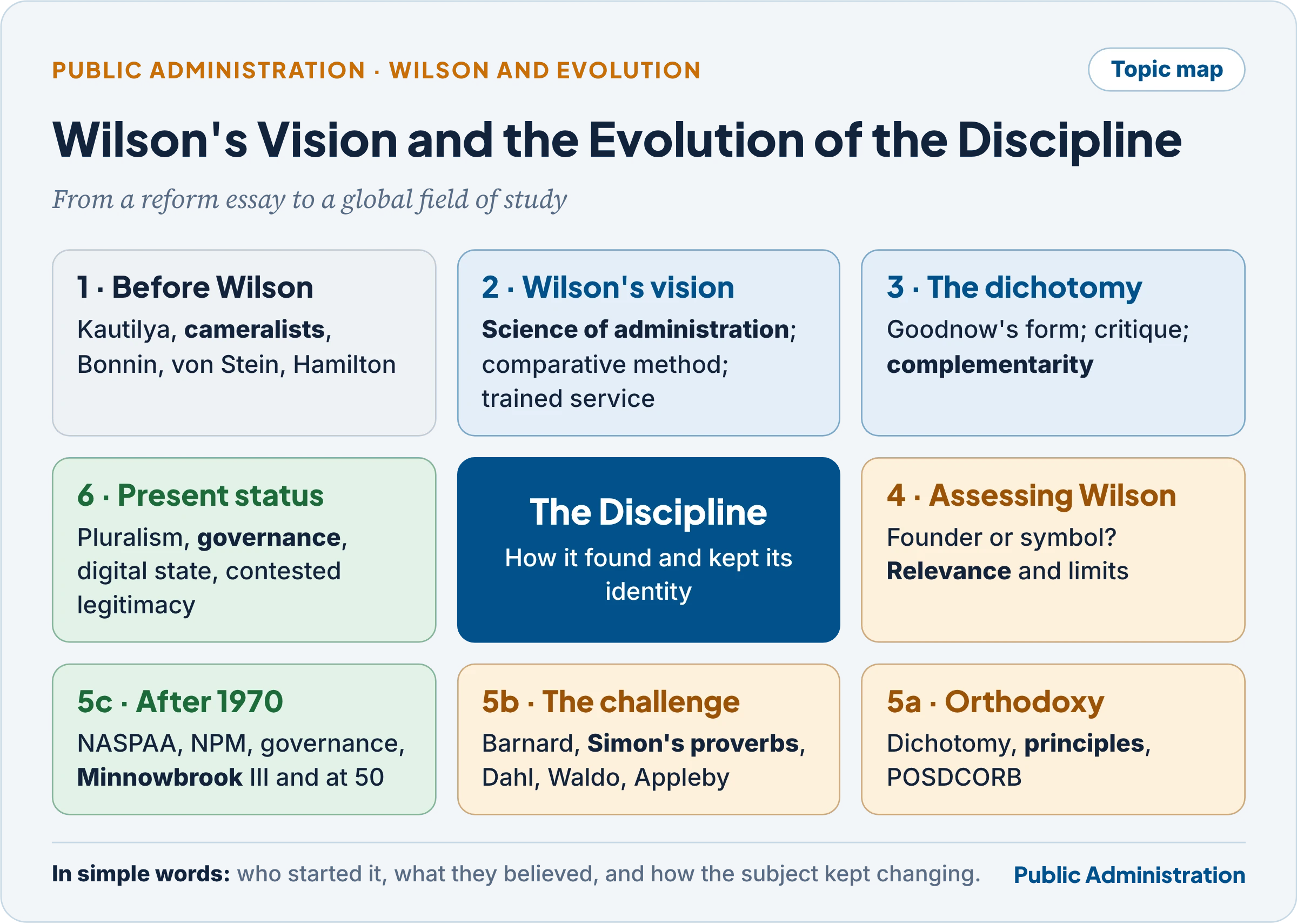
Administration is as old as government, but the study of public administration as a separate discipline is only about a century and a half old. In the United States it is usually dated to Woodrow Wilson’s essay The Study of Administration (1887), which asked how a democracy could run an increasingly complicated government honestly and well. Since then the discipline has repeatedly redefined itself: first as a neutral science of execution, then as a set of universal principles, then as a branch of political science or of management, and finally as a field in its own right that now speaks the language of governance, networks and digital platforms.
In simple words
Think of a new school subject that keeps changing its textbook. First it said “politicians decide, officials just carry out orders”. Then it said “there are fixed rules for running any office”. Then critics showed those rules contradicted each other. The subject borrowed from political science, then from business schools, and finally wrote its own textbook. Each version came from a real crisis that government faced at that time.
1. Before Wilson: Administration as Practice and Early Study
In simple words
People were running tax offices, armies and granaries thousands of years before anyone wrote a university course about it. Wilson did not invent administration; he argued that a democracy needed to study it systematically.
1.1 Ancient and classical practice
- Mesopotamia and Egypt: around 5000 BCE, Sumerian priests kept records, collected and accounted for taxes, managed temples, storehouses and standing armies; the Egyptians organised the labour, supplies and accounts needed to build the pyramids.
- China: the imperial state recruited officials through competitive written examinations, building one of the world’s first merit-based bureaucracies.
- India: Kautilya’s Arthashastra (around the 4th century BCE) is among the oldest systematic texts on administration. It describes departments headed by superintendents (adhyakshas), a council of ministers, a revenue and audit system, salary scales for officials, a network of spies, and a famous list of forty ways of embezzlement by officials. The ruler’s duty is the welfare of the subjects: “in the happiness of his subjects lies his happiness”. The Indian tradition, however, lacked continuity as a body of administrative study.
- Greek and Renaissance thought: Plato’s Republic (rule by trained guardians), Aristotle’s Politics (offices and their functions) and Machiavelli’s The Prince (advice on governing) contain administrative ideas, but they concentrated on who should rule, not on how rule should be carried out.
1.2 The first systematic study in Europe
- Cameralism (17th–18th century, German states and Austria): the Cameralists studied the management of the royal treasury (Kammer) and of state affairs in order to train civil servants. Frederick William I of Prussia created professorships in cameral science at the universities of Halle and Frankfurt an der Oder (1727). Johann Heinrich Gottlob von Justi was its best-known teacher. Their work was descriptive and practical: structures, procedures and the professional training of officials.
- France: Charles-Jean Bonnin’s Principes d’administration publique (1812) is often called the first separate treatise on public administration. French writers developed the subject through the first half of the 19th century.
- Lorenz von Stein (1815–1890), a German professor in Vienna, is regarded in Europe as a founder of the science of public administration. He argued that:
- public administration is an integrating science that draws on sociology, political science, administrative law and public finance;
- it must combine theory and practice, theory being the basis of best practice;
- it is a science because its knowledge is produced and tested by the scientific method.
- Freiherr vom Stein (a different Stein) reformed the Prussian administration in the early 1800s; Wilson admired the result.
1.3 The American setting
- Alexander Hamilton, in The Federalist No. 72 (1788), gave an early American definition: administration “in its largest sense” comprehends all the operations of the body politic, but “in its most usual, and perhaps its most precise signification, it is limited to executive details“.
- The spoils system: from the 1820s, each winning party in the United States replaced government employees with its own supporters (“to the victor belong the spoils”). Offices became rewards, not jobs requiring competence.
- The trigger for reform: in 1881 President James Garfield was shot by a disappointed office-seeker. Congress passed the Pendleton Civil Service Reform Act (1883), creating a Civil Service Commission and competitive examinations for a part of the federal service. Dorman Eaton’s study of the British civil service (1880), prepared for President Rutherford Hayes, had made the case for merit.
- A changing economy: industrialisation, railways, giant corporations and fast-growing cities created problems (monopoly, labour disputes, public health, municipal corruption) that a small, patronage-run government could not handle. The Interstate Commerce Commission, the first federal regulatory commission, was created in 1887, the same year Wilson’s essay appeared.
Common confusion
Is Woodrow Wilson really the “father” of public administration? In the American tradition, Wilson is called the founder of the self-conscious study of public administration, because his essay first argued, in America, for a separate science of administration. But calling him the father does injustice to earlier contributors: Kautilya in India, the Cameralists (Justi) in Prussia, Bonnin in France (1812) and Lorenz von Stein in Austria all studied administration systematically before him, and Hamilton wrote about it in 1788. Historians have also shown that Wilson’s essay was rarely cited by early American scholars (Paul Van Riper, 1983) and that the subject was well developed in Europe before him (Daniel Martin, 1987–88). The fairest statement: Wilson was the symbolic founder of American public administration, not the originator of the study of administration.
2. Wilson’s Vision: The Study of Administration (1887)
In simple words
Wilson’s message was simple: America had spent a century arguing about its constitution, but now the hard part was running the government it had created. Politicians should decide what to do; trained, honest officials should do it efficiently; and Americans should not be afraid to learn good methods from other countries, even monarchies.
2.1 Who Wilson was and why he wrote
- Woodrow Wilson (1856–1924): political scientist (doctorate from Johns Hopkins, author of Congressional Government, 1885), later president of Princeton University, Governor of New Jersey, and President of the United States (1913–21) during the First World War; awarded the Nobel Peace Prize for 1919.
- He wrote the essay in late 1886 and published it in the Political Science Quarterly in 1887.
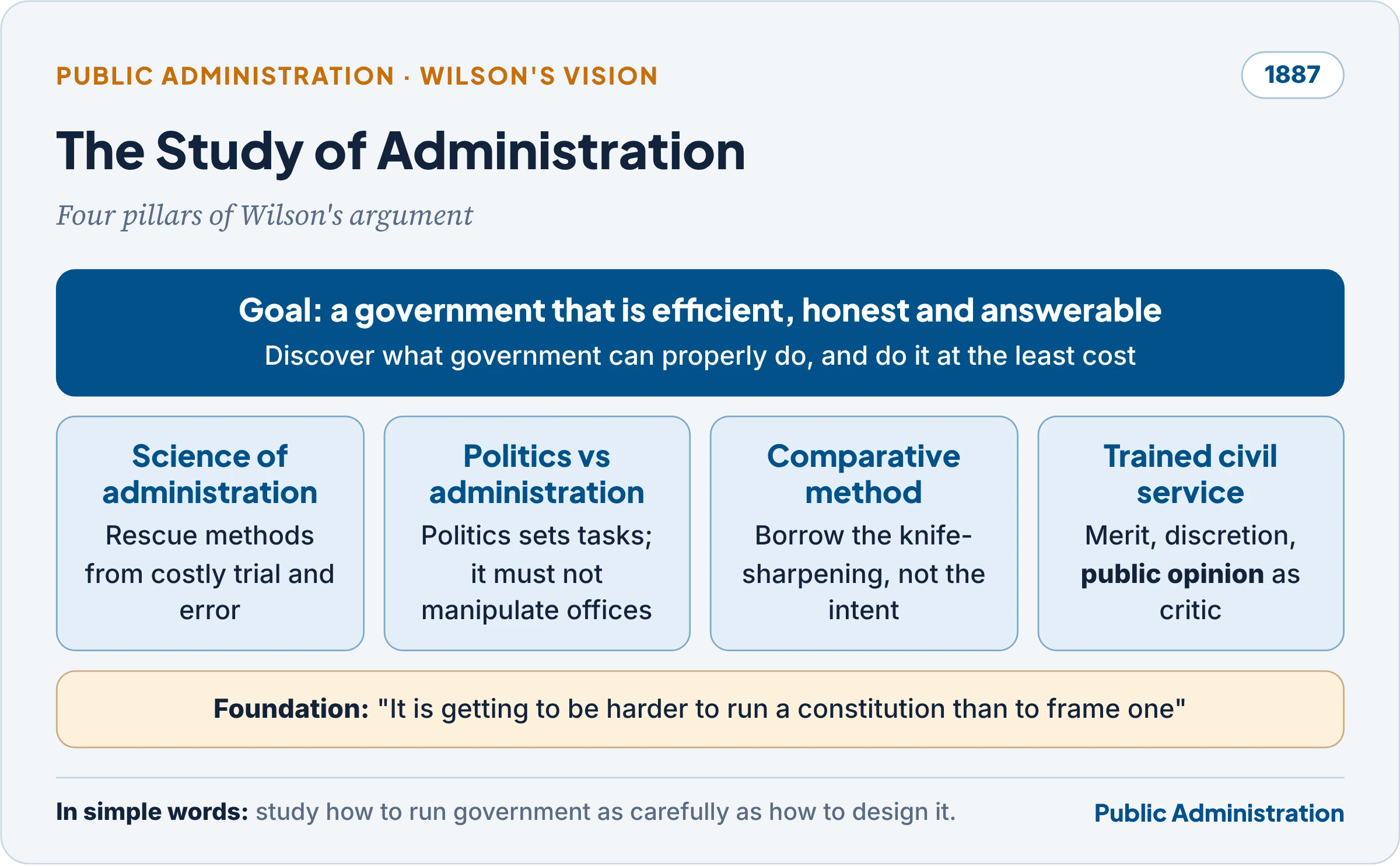
- His starting point: “It is getting to be harder to run a constitution than to frame one.” The great debates of the past had been about who should make law; the new problem was how law should be administered “with enlightenment, with equity, with speed, and without friction”.
- Why administration had become urgent: “There is scarcely a single duty of government which was once simple which is not now complex; government once had but a few masters; it now has scores of masters.” The state was taking on new tasks (regulating railways and corporations, possibly running the telegraph), and “the idea of the state is the conscience of administration.”
2.2 The object of the study
- “It is the object of administrative study to discover, first, what government can properly and successfully do, and, secondly, how it can do these proper things with the utmost possible efficiency and at the least possible cost either of money or of energy.”
- Hence his call for a science of administration “which shall seek to straighten the paths of government, to make its business less unbusinesslike, to strengthen and purify its organization, and to crown its duties with dutifulness.”
- “The object of administrative study is to rescue executive methods from the confusion and costliness of empirical experiment and set them upon foundations laid deep in stable principle.”
- He saw civil service reform (merit appointment) as only the first step, “a moral preparation” for a fuller reform of organisation and methods.
2.3 The essay’s three parts
Part I: the history of the study, and why America lagged
- The science of administration is “the latest fruit of that study of the science of politics which was begun some twenty-two hundred years ago. It is a birth of our own century, almost of our own generation.”
- It had grown up in Europe (France and Germany), in states where government was “independent of popular assent”, so there was more governing to be done and rulers wanted “the least irritating means of governing”. Prussia (under Frederick the Great and the reformer vom Stein) and Napoleonic France perfected their machinery under absolute rulers.
- England and America had concentrated on controlling government rather than energising it: their history was “not of administrative development, but of legislative oversight“.
- Three stages of government growth: (1) absolute rulers with an administration suited to absolute rule; (2) constitution-making, in which administration is neglected; (3) the sovereign people developing administration under the new constitution. America had reached the third stage unprepared.
- The main obstacle was popular sovereignty: it is harder for a democracy to organise administration, because reformers must persuade “a multitudinous monarch called public opinion” rather than a single king.
- The European science must therefore be Americanised: it “must learn our constitutions by heart; must get the bureaucratic fever out of its veins; must inhale much free American air.”
Part II: the subject matter (the distinction between politics and administration)
“The field of administration is a field of business. It is removed from the hurry and strife of politics… It is a part of political life only as the methods of the counting-house are a part of the life of society; only as machinery is part of the manufactured product.” — Woodrow Wilson
- “Administration lies outside the proper sphere of politics. Administrative questions are not political questions. Although politics sets the tasks for administration, it should not be suffered to manipulate its offices.”
- He drew on the Swiss-German jurist Johann Kaspar Bluntschli: politics is state activity “in things great and universal”, administration is “the activity of the state in individual and small things”; politics is the province of the statesman, administration of the technical official.
- Definition: “Public administration is detailed and systematic execution of public law. Every particular application of general law is an act of administration.” Collecting taxes, delivering mail and recruiting the army are administration; the general laws ordering them are not.
- The administrator is not a machine: “the administrator should have and does have a will of his own in the choice of means for accomplishing his work. He is not and ought not to be a mere passive instrument. The distinction is between general plans and special means.”
- Power and responsibility: “large powers and unhampered discretion seem to me the indispensable conditions of responsibility.” Power concentrated in the heads of the service is “easily watched and brought to book“; power divided among many is obscured and becomes irresponsible.
- Public opinion as “authoritative critic”: the fundamental problem is “What part shall public opinion take in the conduct of administration?” Wilson’s answer: it should be an authoritative critic of broad policy but must not interfere in daily details. “The problem is to make public opinion efficient without suffering it to be meddlesome.” Self-government “does not consist in having a hand in everything, any more than housekeeping consists necessarily in cooking dinner with one’s own hands. The cook must be trusted with a large discretion.”
- A trained but not arrogant civil service: America needed “a technically schooled civil service” chosen by competitive examinations, but not “an offensive official class” cut off from the people. “The ideal for us is a civil service cultured and self-sufficient enough to act with sense and vigor, and yet so intimately connected with the popular thought, by means of elections and constant public counsel, as to find arbitrariness or class spirit quite out of the question.”
Part III: the method (comparative and historical)
- “So far as administrative functions are concerned, all governments have a strong structural likeness… Monarchies and democracies, radically different as they are in other respects, have in reality much the same business to look to.”
- Because administration is separate from politics, a democracy can borrow administrative techniques from autocracies without borrowing their politics:
“If I see a murderous fellow sharpening a knife cleverly, I can borrow his way of sharpening the knife without borrowing his probable intention to commit murder with it; and so, if I see a monarchist dyed in the wool managing a public bureau well, I can learn his business methods without changing one of my republican spots.” — Woodrow Wilson
- Borrowing must be adapted: “We borrowed rice, but we do not eat it with chopsticks.” Foreign methods must be “filtered through our constitutions” and put “over a slow fire of criticism” to “distil away its foreign gases.”
- The federal question and administrative ethics: America had “governments within governments” (town, city, county, state, federal). His closing question remains central to public service ethics: “how shall our series of governments within governments be so administered that it shall always be to the interest of the public officer to serve, not his superior alone but the community also, with the best efforts of his talents and the soberest service of his conscience?”
Common confusion
Did Wilson say “if I see a monarchist engineer operating a locomotive”? No. That “locomotive” line circulates in many notes but is not in the essay. Wilson’s actual simile is about a murderous fellow sharpening a knife and a monarchist dyed in the wool managing a public bureau (quoted above). The point is the same (borrow the technique, not the politics), but quote the real words or paraphrase.
2.4 Wilson’s ideas at a glance
| Idea | What Wilson said | Why it mattered |
|---|---|---|
| Science of administration | Administration can be studied systematically and improved by principles | Founded the American discipline |
| Politics–administration distinction | Politics sets the tasks; administration executes them, free from party manipulation | Justified merit and neutral service; became the “dichotomy” |
| Business-like government | Administration is “a field of business”; make government “less unbusinesslike” | Efficiency and economy as values; anticipates later managerial reform |
| Comparative method | Learn from France and Prussia, adapt to American constitutions | Seeded comparative public administration |
| Discretion with accountability | Large powers, clear responsibility, public opinion as authoritative critic | An early answer to the strength–accountability puzzle |
| Trained civil service | Competitive examinations, technical schooling, no “offensive official class” | Professionalisation of public service |
| Ethics | Officials must serve the community, not only the superior | Public service ethics and federal co-operation |
2.5 Three orientations behind the essay
- Comparative perspective: he studied British, French and German administration and urged selective, adapted borrowing.
- Constitutional focus: his earlier work had criticised the American separation of powers as unwieldy; the essay shifts attention from constitutional design to administrative performance and to clearer distribution of authority.
- Conservative democratic philosophy: he distrusted the untutored majority (“the many, the people… are selfish, ignorant, timid, stubborn, or foolish”) and wanted public opinion to supervise, not to meddle; he believed a strong, accountable administration could save democracy from its own excesses.
3. The Politics–Administration Dichotomy
In simple words
The dichotomy says: elected leaders choose the destination; officials drive the bus. Critics reply that the driver also chooses the route, the speed and sometimes the stops, and that passengers judge the government by the ride. Today most scholars say the two roles are different but overlapping.
3.1 From distinction to dichotomy
- Wilson drew a functional distinction (politics vs administration as kinds of activity). He did not propose a wall between politicians and officials: officials had discretion over means, and public opinion supervised them.
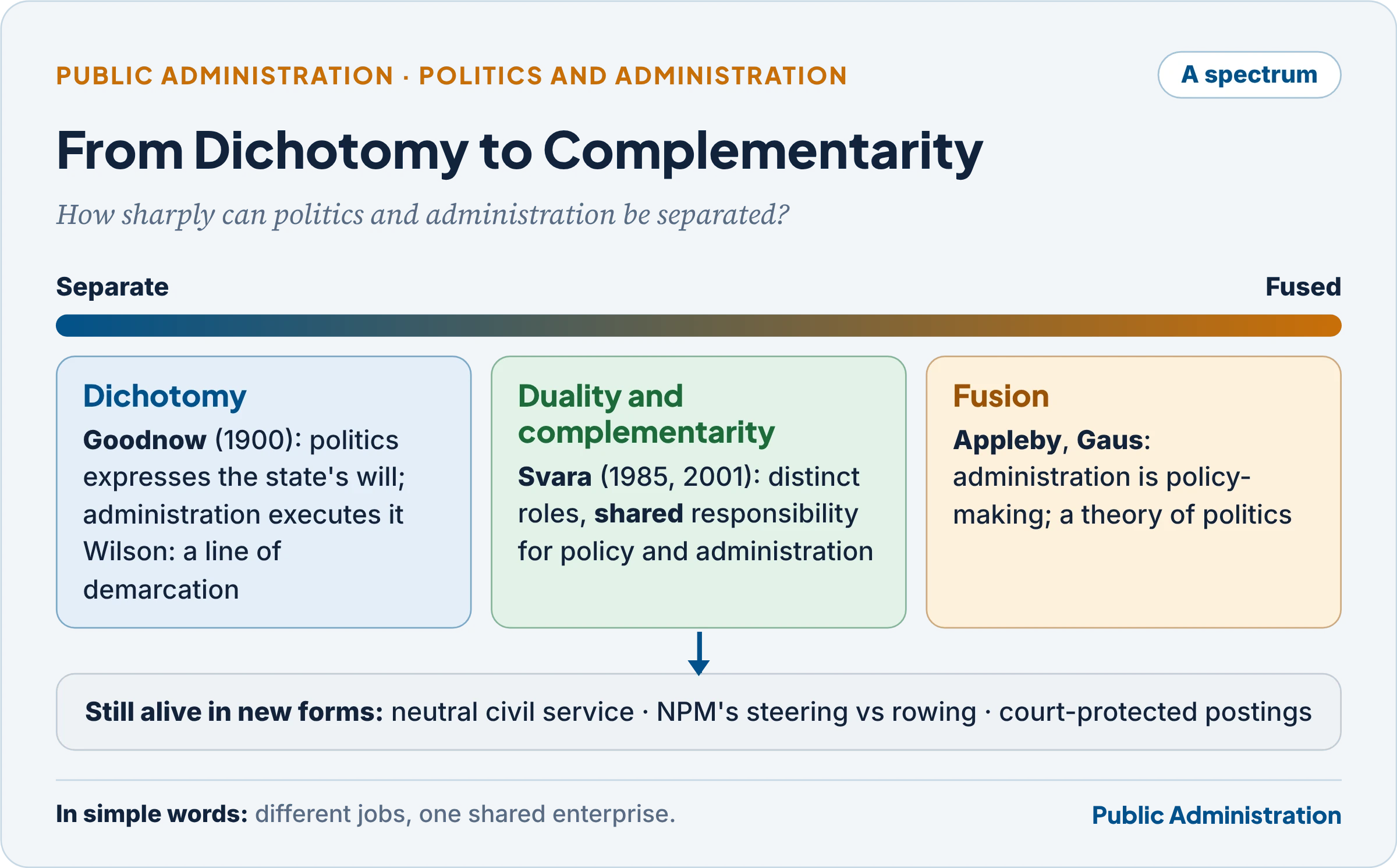
- Frank Goodnow, in Politics and Administration (1900), gave the idea its classic form: “Politics has to do with policies or expressions of the state will. Administration has to do with the execution of these policies.” Goodnow tied the two functions to institutions (the legislature expresses the will; the executive executes it), but he also accepted that some political control over administration was needed to keep the two in harmony, while technical and quasi-judicial work should be insulated.
- W.F. Willoughby went further, treating administration as a “fourth branch” of government.
- Why it was attractive:
- It was the intellectual basis of the merit system and the fight against the spoils system.
- It made a science of administration possible, by treating execution as technical and value-free.
- It protected a young profession: during the Depression, officials could claim they were neutral experts, not political spenders (Nicholas Henry’s point).
- It fitted the Weberian ideal of a neutral, rule-bound bureaucracy.
3.2 The critique
- The New Deal and the Second World War showed officials making huge policy choices; administration could not be value-free.
- Fritz Morstein Marx edited Elements of Public Administration (1946), written mostly by practitioners, which showed that apparently neutral administrative decisions were laden with political choice.
- Paul Appleby (Big Democracy, 1945; Policy and Administration, 1949): administration is policy-making; officials make policy continuously as they apply laws; political involvement is a healthy check on bureaucratic power.
- Herbert Simon (Administrative Behavior, 1947) replaced the politics/administration line with a fact/value distinction: every decision mixes factual and value premises, so administration cannot be confined to “facts”.
- Dwight Waldo (The Administrative State, 1948): public administration rests on a political theory; “efficiency” itself is a value that can conflict with democracy.
- John Gaus (1950): “A theory of public administration means in our time a theory of politics also.” With this, Henry says, the dichotomy “died” as orthodoxy.
- Fred Riggs showed that in developing countries the bureaucracy often dominates politics, so the dichotomy does not even describe reality there.
- New Public Administration (1968) wanted officials to be openly value-committed, especially to social equity.
3.3 Revisiting Wilson himself
- Wilson’s own later lectures (1891) said administration “cannot be divorced from its connections with the other branches of Public Law without being distorted and robbed of its true significance. Its foundations are those deep and permanent principles of Politics.” He also wrote that government should be business-like, “but it is not business. It is organic life.”
- Daniel Martin (“The Fading Legacy of Woodrow Wilson”, 1988) argued that Wilson’s dichotomy partly came from a translation problem with German terms, that Wilson repudiated his version within three years, and that European scholars had a different (and older) distinction.
- So the rigid “dichotomy” owes more to Goodnow and the orthodox period than to Wilson’s own nuanced essay. Many writers therefore call Wilson’s idea a line of demarcation, not a line of separation.
3.4 Middle positions: duality and complementarity
- James Svara (1985) proposed a dichotomy–duality model for city governments: four functions, mission, policy, administration and management, with elected officials dominating mission and officials dominating management, and both sharing policy and administration.
- Svara later (2001) called the relationship complementarity: politicians and administrators have distinct roles but shared responsibility; neither can do its job without the other.
- This is the closest thing to a present consensus.
3.5 Is the dichotomy still alive?
Yes, in transformed forms:
- Westminster and Indian practice keep a normative version: ministers decide and answer to the legislature; civil servants advise, implement and stay politically neutral and anonymous (Articles 74, 75 and 77; the All India Services (Conduct) Rules forbid officers from taking part in politics).
- New Public Management revived the dichotomy as a split between steering (policy, by ministers) and rowing (delivery, by managers in agencies); Britain’s Next Steps agencies (1988) institutionalised it. The US National Performance Review (1993) declared: “This performance review is not about politics.”
- Judicial and legal versions: courts insulate quasi-judicial and investigative functions from political direction.
- Current struggles are fought on the old line:
- In the United States, Loper Bright Enterprises v. Raimondo (28 June 2024) ended judicial deference to agencies’ readings of law, and the Schedule Policy/Career rule (February 2026, effective 9 March 2026) made policy-influencing career posts at-will: both redraw the boundary between political control and professional discretion.
- In India, the Supreme Court in Prakash Singh v. Union of India (2006) ordered State Security Commissions and Police Establishment Boards to separate political policy direction from operational policing and postings; in T.S.R. Subramanian v. Union of India (2013) it asked for fixed tenure, Civil Services Boards and written orders from political superiors.
- No, as a description of reality: officials draft cabinet notes, bills and rules, and implementation shapes policy outcomes; politicians intervene in transfers and operations.
Criticism — Critics of the dichotomy
- Administration is policy-making: officials exercise discretion, frame rules and shape outcomes (Appleby).
- Every administrative decision contains value premises (Simon, Waldo).
- It hides power: “neutral” officials can pursue their own or their class’s interests.
- In developing countries the bureaucracy dominates politics, so the model misleads (Riggs).
- It encouraged a narrow focus on efficiency at the cost of equity and responsiveness (New Public Administration).
Defence — Defenders of the dichotomy (or of a distinction)
- It is the basis of merit, neutrality and the end of the spoils system.
- It keeps accountability clear: elected leaders answer for policy; officials for implementation.
- It protects officials from arbitrary political pressure (Indian courts in Prakash Singh and T.S.R. Subramanian).
- Wilson meant a distinction of roles, not a wall; as a norm it still guides practice.
- Modern versions (steering vs rowing, complementarity) keep its useful core.
Indian Connect — The dichotomy in Indian administration
- Article 77(3) and the Government of India (Transaction of Business) Rules allot business among ministers; secretaries advise and implement. Article 311 protects civil servants against arbitrary dismissal; the conduct rules require political neutrality.
- The “committed bureaucracy” debate (late 1960s–1970s) asked whether civil servants should be committed to the ruling party’s programme; the accepted answer, repeated by the Second Administrative Reforms Commission, is commitment to the Constitution’s values, not to a party.
- In practice the line blurs both ways: officials shape policy through notes, drafts and delegated legislation; politicians reach into administration through transfers and postings, the problem the courts addressed in 2006 and 2013.
4. Assessing Wilson
In simple words
Wilson is like the founder of a club whose rules members later rewrote. Some say he should not be called the founder at all; others say his questions are still the right questions, even if his answers were too simple.
4.1 Why the essay still matters
- It legitimised a discipline: it made the case that administration is worth studying, which Henry calls its one unambiguous lasting thesis.
- Merit and professionalism: its defence of a trained, examined, non-partisan civil service is the foundation of modern civil services, including India’s.
- Implementation: “harder to run a constitution than to frame one” anticipates today’s concern with implementation and delivery.
- Comparative method: it founded the habit of learning from other countries with adaptation: the logic behind policy transfer, administrative reform commissions and international benchmarks.
- Efficiency and economy: it put efficiency on the agenda; the same impulse returned in New Public Management (“make government work better and cost less”).
- Discretion with accountability: its insistence that power be visible and answerable is the core of modern accountability design.
- Ethics and federalism: its closing question about serving “not his superior alone but the community also” is a live question in co-operative federalism and in public service ethics.
- The administrative state: debates in 2024–26 about the independence of expert agencies and the political control of career officials are re-runs of Wilson’s problem.
4.2 Limitations and criticisms
- A naive dichotomy: politics and administration cannot be separated in practice (Section 3).
- Business analogy: treating government as “a field of business” ignored its distinctive values of equity, legality and rights.
- Elitism and distrust of citizens: his description of the public as “selfish, ignorant, timid, stubborn” reveals an elitist view of democracy.
- Limited influence at the time: the essay was rarely cited before the 1930s and was elevated to classic status mainly after the Second World War (Van Riper).
- Not original: European scholars had developed the study much earlier (Martin).
- His own practice: as President, his administration extended racial segregation in federal offices (1913), a sharp contradiction of the equal, merit-based service the essay advocated.
- Ambiguity: the essay can be read as supporting both a neutral bureaucracy and an active, discretion-exercising one; later scholars disagree about what Wilson really meant.
Balanced judgment: Dwight Waldo called it, in effect, the most important document in the development of American public administration. Its value lies less in its answers than in its questions: what government should do, how to do it well, and how to keep a strong administration answerable to a democratic public.
5. Evolution of the Discipline
In simple words
The discipline grew in waves. Each wave came after a big event in real government: corruption scandals, the Great Depression, the world war, the civil-rights turmoil of the 1960s, the fiscal crisis of the 1970s, and the internet. Scholars changed their ideas to explain and fix what governments were going through.
5.1 Ways of dividing the history
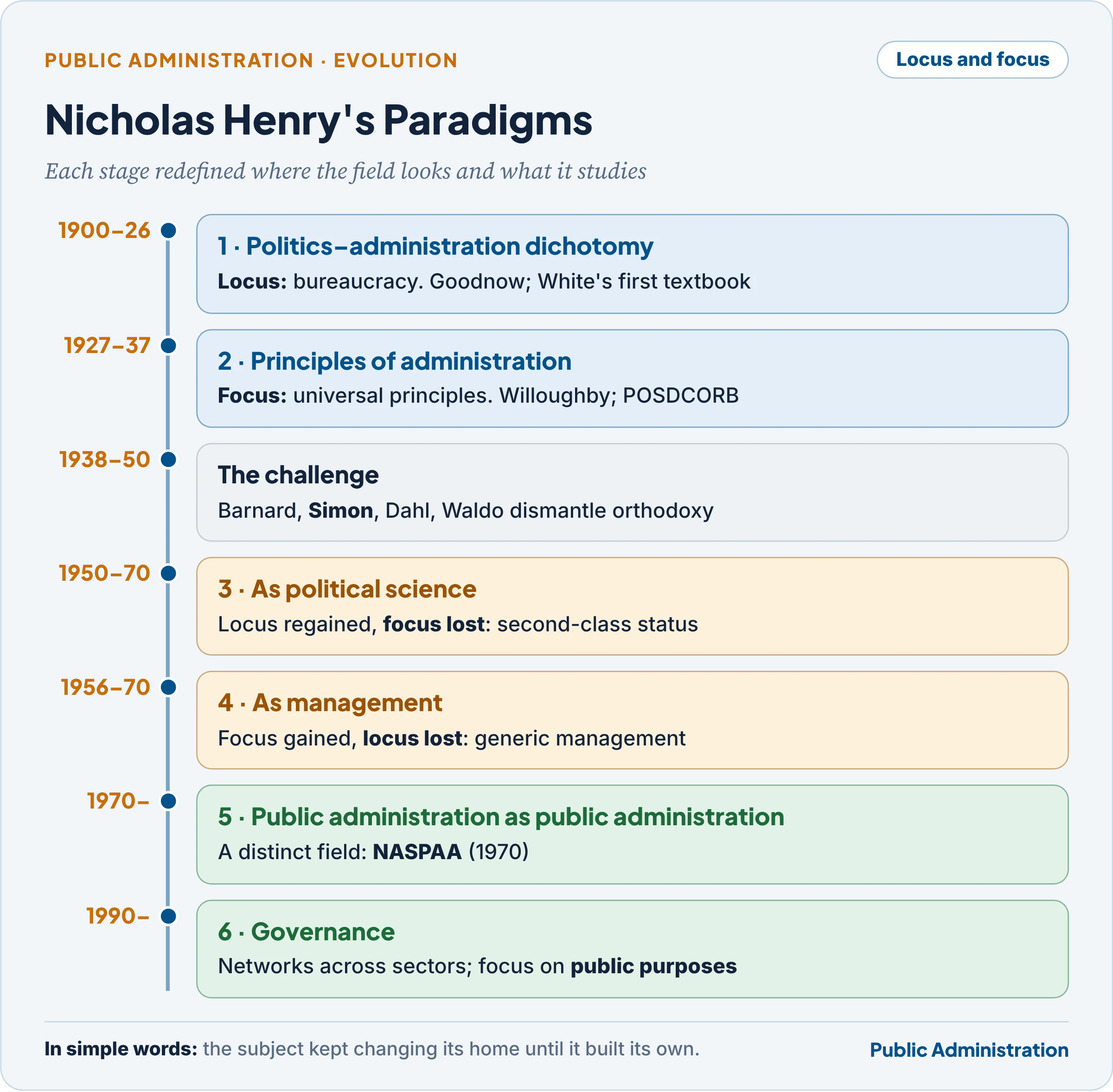
- Locus and focus. Robert Golembiewski suggested that the discipline’s history can be read through its locus (the institutional “where”: for example, the government bureaucracy) and its focus (the specialised “what”: for example, principles of administration or management techniques). When one is sharply defined, the other tends to be neglected.
- Golembiewski’s four phases: (1) analytic politics/administration distinction; (2) concrete (institutional) politics/administration distinction; (3) a science of management; (4) the public policy approach.
- Nicholas Henry’s paradigms (Public Administration and Public Affairs) are the most widely used scheme:
| Paradigm | Years | Locus | Focus | Key markers |
|---|---|---|---|---|
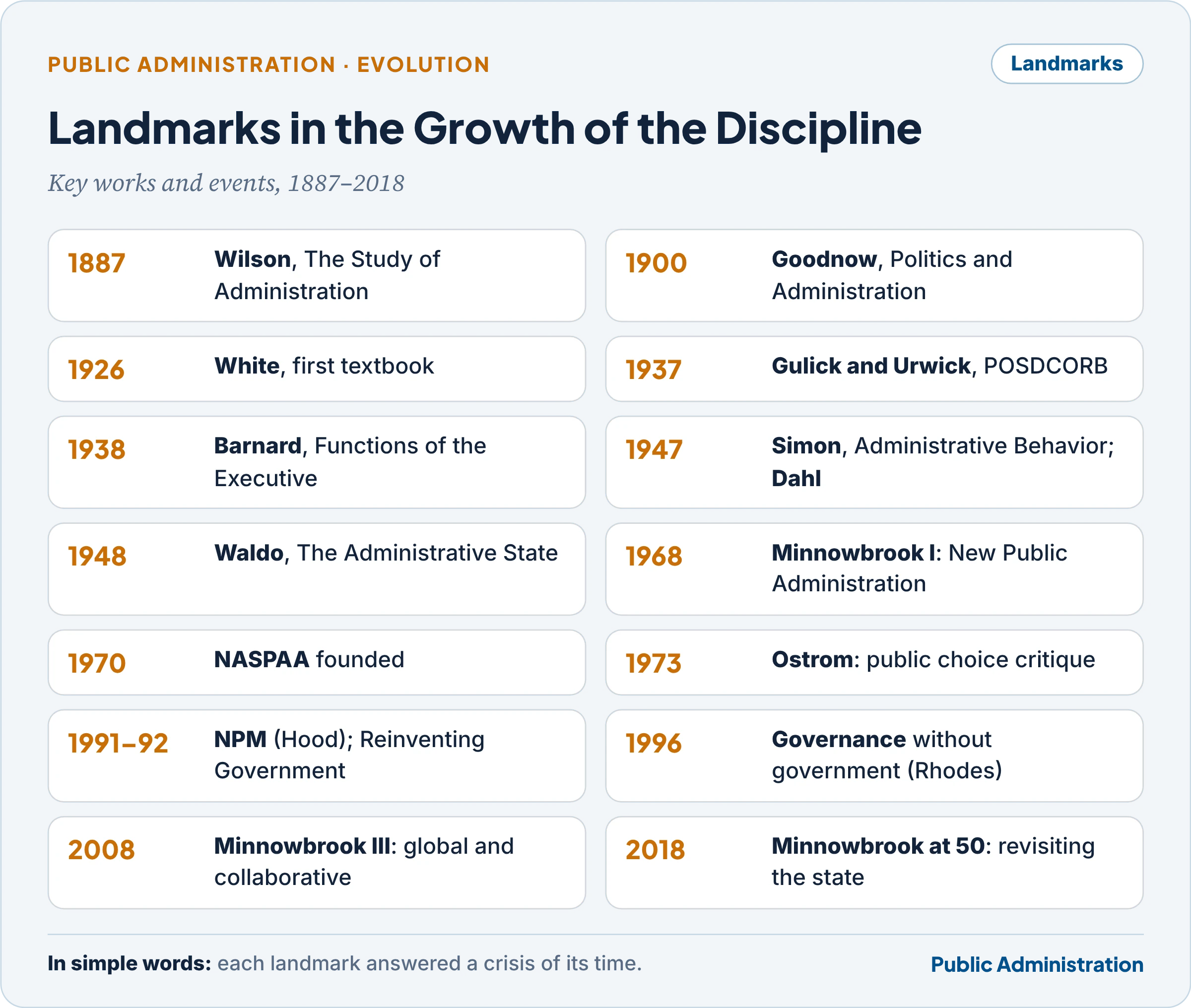
| 1. Politics/administration dichotomy | 1900–1926 | Government bureaucracy | Vague | Goodnow (1900), White’s first textbook (1926) |
| 2. Principles of administration | 1927–1937 | Anywhere | Universal principles | Willoughby (1927), Gulick and Urwick, POSDCORB (1937) |
| The challenge | 1938–1950 | — | — | Barnard (1938), Simon (1946–47), Dahl (1947), Waldo (1948) |
| 3. Public administration as political science | 1950–1970 | Bureaucracy (again) | Lost | Second-class status within political science |
| 4. Public administration as management | 1956–1970 | Lost (generic) | Management techniques | Administrative Science Quarterly (1956) |
| 5. Public administration as public administration | 1970– | Public interest and public affairs | Organisation theory, policy, management | NASPAA (1970) |
| 6. Governance | 1990– | Networks of public, private and non-profit actors | Implementing public purposes | Globalisation, redefinition, devolution |
5.2 Stage 1: the dichotomy and the reform movement (1887–1926)
- Wilson (1887) and Goodnow (1900) laid the intellectual base.
- The reform movement: the New York Bureau of Municipal Research (1906), the first “think tank” of administration, studied city government; it ran the first school for public servants, the Training School for Public Service (1911), which moved to Syracuse University in 1924 to become the Maxwell School, the first university programme in public administration. Private philanthropies (Rockefeller, Carnegie) funded much of this work.
- The President’s Commission on Economy and Efficiency (the Taft Commission, 1910–13), with Willoughby and Goodnow among its members, applied the new ideas to the federal government.
- F.W. Taylor’s Principles of Scientific Management (1911) brought “one best way” efficiency thinking from the factory into government reform.
- L.D. White’s Introduction to the Study of Public Administration (1926), the first textbook, rested on four assumptions:
- administration is a single process, the same at federal, state and local levels;
- the basis of its study is management, not law;
- it is still an art, but can and should become a science;
- administration has become “the heart of the problem of modern government“.
- Professional organisation: the American Political Science Association’s committee on practical training (1914) called for professional schools; the Society for the Promotion of Training for the Public Service (1914) was a forerunner of later associations.
5.3 Stage 2: the principles of administration (1927–1937)
- W.F. Willoughby, Principles of Public Administration (1927): administration has “certain fundamental principles of general application analogous to those characterizing any science”.
- Related works: Mary Parker Follett, Creative Experience (1924); Henri Fayol, General and Industrial Management (French 1916; English translations 1930 and 1949); James Mooney and Alan Reiley, Onward Industry! (1931), later The Principles of Organization (1939).
- Luther Gulick and Lyndall Urwick, Papers on the Science of Administration (1937), prepared for the Brownlow Committee (President’s Committee on Administrative Management, 1937): POSDCORB, unity of command, span of control, specialisation.
- This was the “high noon of orthodoxy”: principles were thought to work “irrespective of the purpose of the enterprise, the personnel comprising it, or any constitutional, political, or social theory underlying its creation” (Gulick and Urwick). University programmes multiplied, and governments sought the field’s advice.
- The American Society for Public Administration (ASPA) was founded in 1939.
- Meanwhile, the Hawthorne studies (1927–32) at Western Electric discovered the informal, social side of organisations, laying the base of the human relations approach (see the article on the human relations school).
5.4 Stage 3: the challenge (1938–1950)
- Chester Barnard, The Functions of the Executive (1938): the organisation as a co-operative system, the importance of informal organisation and of the executive’s role in securing co-operation.
- E. Pendleton Herring, Public Administration and the Public Interest (1936): officials must give concrete meaning to vague laws and reconcile group interests; they effectively define the public interest.
- The Friedrich–Finer debate (1940–41) on administrative responsibility: Carl Friedrich relied on internal controls (professional standards and conscience); Herman Finer insisted on external controls (legislative and popular).
- Herbert Simon, “The Proverbs of Administration” (1946) and Administrative Behavior (1947): the principles come in contradictory pairs, like proverbs (a narrow span of control needs a tall hierarchy, but short communication lines need a flat one); “decision-making is the heart of administration“. He proposed two streams of scholarship: a pure science of administration grounded in social psychology, and a larger group prescribing for public policy.
- Robert Dahl, “The Science of Public Administration: Three Problems” (1947): normative values, human behaviour and the social setting stand in the way of a universal science; without comparative study, a science of administration is hollow.
- Dwight Waldo, The Administrative State (1948): the orthodox doctrines were themselves a political theory reflecting American business values; the gospel of efficiency was not neutral.
- Paul Appleby, Big Democracy (1945) and Policy and Administration (1949): government is different; administration is political.
- John Gaus (1950): a theory of public administration is also a theory of politics.
- Result: by mid-century both pillars of orthodoxy (the dichotomy and the principles) had been abandoned, leaving the field “bereft of a distinct epistemological and intellectual identity” (Henry).
5.5 Stage 4: the identity crisis (1950–1970)
- Back to political science (Paradigm 3): public administration returned to political science departments but was treated as a poor relation: a 1952 article in the American Political Science Review called it political science’s “strange and unnatural child”; by 1962 the American Political Science Association’s report on the discipline omitted it as a sub-field; observers spoke of its “uncomfortable second-class citizenship“.
- To management (Paradigm 4): others turned to generic management and administrative science: Administrative Science Quarterly (1956), March and Simon’s Organizations (1958), Cyert and March’s A Behavioral Theory of the Firm (1963), James Thompson’s Organizations in Action (1967), and organisation development. This gave the field techniques but blurred the difference between public and private.
- New sub-fields grew:
- comparative public administration (the Comparative Administration Group, from 1960; Fred Riggs);
- development administration for the new nations of Asia and Africa;
- policy sciences (Harold Lasswell’s call in 1951) and later policy analysis;
- case studies (the Inter-University Case Program).
- Waldo described the situation in 1968 as a crisis of identity.
- The forces of separatism (1965–70): science, technology and public policy programmes; the New Public Administration (Minnowbrook I, 1968, with its demand for relevance, values, social equity and change); and “practitioner pride”, symbolised by the National Academy of Public Administration (1967).
5.6 Stage 5: public administration as public administration (1970–1990)
- NASPAA (the National Association of Schools of Public Affairs and Administration) was founded in 1970, marking public administration’s “secession” from political science and business administration; from 1983 it began accrediting MPA programmes. Free-standing schools of public administration and policy grew fastest.
- Public policy became a central focus: implementation studies (Pressman and Wildavsky, 1973), policy analysis and evaluation.
- Vincent Ostrom, The Intellectual Crisis in American Public Administration (1973), attacked the Wilsonian, hierarchical paradigm and offered public choice and “democratic administration” with multiple centres of decision (see the article on public choice).
- Normative revival: the Blacksburg Manifesto (1983) and Refounding Public Administration (1990) defended the public service as a legitimate constitutional actor against “bureaucrat-bashing”.
- Minnowbrook II (1988) was more practical and less radical than the first, reflecting an era of cutbacks and privatisation (see the article on New Public Administration).
5.7 Stage 6: management, governance and after (1990–present)
- New Public Management (named by Christopher Hood, 1991) and Reinventing Government (Osborne and Gaebler, 1992): markets, competition, results, customers (see the article on NPM).
- Governance: R.A.W. Rhodes described “governing without government” (1996): policy made and delivered through networks of public, private and voluntary actors. Henry’s Paradigm 6 (from 1990) captures the same shift: globalisation, redefinition (partnership instead of hierarchy) and devolution (to citizens, NGOs, markets and other governments).
- Public value (Mark Moore, Creating Public Value, 1995), New Public Service (Denhardt and Denhardt, 2000), digital-era governance (Dunleavy and colleagues, 2006) and New Public Governance (Stephen Osborne, 2006/2010) offered post-NPM alternatives.
- Minnowbrook III (2008) stressed global and comparative perspectives, networks, collaborative governance and the training of the next generation; it redefined public administration as “a socially-embedded process of collective relationships, dialogue and action to promote human flourishing for all“.
- Minnowbrook at 50 (August 2018), on the theme “Revisiting the Administrative State“, discussed automation and artificial intelligence, overcoming American-centricity, social equity, democracy and public values.
5.8 Discipline and profession grew together
Every major transformation in the practice of government produced a matching change in the study of it.
| Change in the practice of government | Response in the discipline |
|---|---|
| Spoils system, corruption, Pendleton Act (1883) | Wilson’s call for a science of administration (1887); the dichotomy |
| Progressive municipal reform | Bureaus of municipal research, first training schools (1906–11) |
| Expansion of the federal executive; the Brownlow Committee (1937) | Principles of administration, POSDCORB |
| New Deal and Second World War: officials making policy | Critique of the dichotomy (Appleby, Simon, Waldo, Gaus) |
| Decolonisation and planned development | Comparative and development administration |
| Great Society programmes, civil-rights struggle, Vietnam | Policy analysis; New Public Administration (1968) |
| Fiscal crisis, stagflation, taxpayer revolts (1970s) | Public choice; cutback management |
| Thatcher and Reagan reforms; agencies and contracting | New Public Management (1991–92) |
| Networks, partnerships, globalisation | Governance, New Public Governance |
| The internet and digital public infrastructure | Digital-era governance, data and AI governance |
| Crises of trust in expert government (2016 onward) | Public values, democratic legitimacy, “revisiting the administrative state” |
The relationship runs both ways: the discipline also shaped practice (Gulick’s papers shaped the Executive Office of the US President; NPM ideas shaped reforms worldwide; Appleby’s reports on India in 1953 and 1956 led to the Indian Institute of Public Administration, 1954, and the Organisation and Methods division).
5.9 Growth in a capitalist setting
- Public administration as a discipline grew up in the United States in the age of industrial capitalism: big corporations, big cities, mass immigration and labour conflict.
- Business provided the model: reformers wanted government run on business lines; scientific management and the “efficiency movement” moved from factories to city halls; philanthropists from industry (Rockefeller, Carnegie) financed the bureaus of municipal research.
- The state was needed to stabilise capitalism: regulation of railways and monopolies (from 1887), and later the New Deal’s economic management, required capable administration.
- Critical readings: Waldo argued that orthodox public administration mirrored the values of American business civilisation; Marxist writers see the administrative state as serving the needs of capital (see the article on Marx).
- Balance: the discipline was shaped by capitalist development, but it also produced ideas that checked business values: the public interest, social equity, accountability and New Public Service.
5.10 Efficiency as the thread from Wilson to Simon
| Writer | Place of efficiency |
|---|---|
| Wilson (1887) | Do proper things “with the utmost possible efficiency and at the least possible cost” |
| Taylor (1911) | “One best way” to maximise output |
| White (1926) | Administration as the economical use of resources; management, not law |
| Willoughby (1927) | Scientific principles to raise efficiency |
| Gulick (1937) | Efficiency is “axiom number one in the value scale of administration”; the basic “good” |
| Simon (1947) | The criterion of efficiency: choose the alternative giving the greatest result for given resources, within values set by others |
| Critics | Waldo, Dahl and the New Public Administration: efficiency for what, and for whom? Equity and democracy also count |
5.11 “Proverbs” of administration
- Simon argued that the classical principles were “proverbs“: for almost every principle there is an equally plausible contradictory principle, and the theory does not say which to apply.
- Specialisation is said to raise efficiency, but specialisation by purpose, process, clientele or place contradict one another.
- Unity of command conflicts with the need for specialised (functional) supervision.
- A narrow span of control requires many levels (a “tall” structure), but few levels are needed for undistorted communication.
- His remedy: study decision-making empirically, separate facts from values, and judge alternatives by the criterion of efficiency.
- Effect: the principles were not thrown away (they remain useful rules of thumb), but their claim to be universal scientific laws collapsed.
Common confusion
What is “administrative elitism”? It is the idea, and the practice, of government by a small, specially selected and trained group of administrators who see themselves as guardians of the public interest, set apart from both politicians and citizens. Historical forms include Plato’s guardians, China’s examination-selected mandarins, the Prussian bureaucracy, the Indian Civil Service (Lloyd George’s “steel frame“, 1922), Britain’s Oxbridge-educated generalist administrative class (criticised by the Fulton Committee, 1968, as the “cult of the amateur”) and France’s École nationale d’administration (1945; replaced in 2022 by the National Institute of Public Service). It evolves through competitive entry, closed career services, common training and esprit de corps; it is checked by representative bureaucracy, lateral entry, transparency and political control. Early American public administration had an elitist streak too: its founders hoped an educated corps of administrators would lead the people “into the light of prosperity and progress” (Henry).
6. Present Status of the Discipline
In simple words
Today public administration is like a big house with many rooms: some people study it as management, some as politics and law, some as networks, some through data and experiments. It has never settled on one definition, but it has a recognised home, its own degrees and journals, and an obvious practical purpose.
6.1 Identity: crisis or pluralism?
- The pessimistic view: the field has had a permanent identity crisis: borrowing from political science, management, economics and sociology without a core theory (Waldo’s 1968 diagnosis; Ostrom’s “intellectual crisis”, 1973).
- The optimistic view: its pluralism is a strength. Mosher called it “more a focus than a separate science”; Waldo saw it as a profession with many intellectual inputs; its unity lies in its object (public action and public purposes), not in a single method.
- Henry’s verdict: Paradigm 5 (a self-aware field) and Paradigm 6 (governance) now work in tandem: the locus is again the public sphere, broadly defined, and the focus is implementing public purposes across sectors.
6.2 Paradigms coexist, layered rather than replaced
- Traditional (Weberian) public administration, New Public Management, governance/New Public Governance, New Public Service, public value and digital-era governance all operate at the same time in most countries.
- Christopher Pollitt and Geert Bouckaert described a “neo-Weberian state” in continental Europe: modernised bureaucracy that keeps the state’s central role and rule of law while adding citizen orientation and performance management.
- Paradigms answer different questions:
- some ask how to administer (principles, management, NPM, digital governance);
- others ask why and for whom (New Public Administration, New Public Service, public value, good governance).
- None of them abolishes the core of the discipline: the public character of the work, the authority of the state, accountability to citizens, and the delivery of public purposes.
6.3 The field today
- Institutions: NASPAA was renamed the Network of Schools of Public Policy, Affairs, and Administration (2013) to reflect its global reach; it has about 215 accredited programmes in 11 countries. Leading journals include Public Administration Review (1940), Public Administration (UK) and the Journal of Public Administration Research and Theory (1991).
- Methods: behavioural public administration (experiments and insights from psychology), big data and evaluation, comparative and non-Western studies, and research on artificial intelligence in government.
- Themes: governance networks and collaboration, regulation, public value, social equity, democratic legitimacy, trust, crisis and disaster management, climate governance, and the digital state.
Indian Connect — The discipline and its present status in India
- Paul Appleby’s reports (Public Administration in India: Report of a Survey, 1953; a second report, 1956) led to the Indian Institute of Public Administration (1954) and the Organisation and Methods Division (1954); the Indian Journal of Public Administration began in 1955.
- Training institutions such as the Lal Bahadur Shastri National Academy of Administration and state administrative training institutes carry the discipline into practice; public administration is taught in universities and is an optional subject in the civil services examination.
- Reform has been guided by the Administrative Reforms Commission (1966) and the Second Administrative Reforms Commission (2005–09).
- Current debates mirror the global ones: lateral entry at joint-secretary and director level began with recruitment in 2018, but the August 2024 advertisement for lateral posts was withdrawn after controversy over reservation; capacity building moved from “rules” to “roles” under Mission Karmayogi (2020); and “minimum government, maximum governance” became the official reform slogan.
6.4 Trends shaping the 21st century
- From government to governance: partnerships, contracting, networks and multi-level co-ordination.
- Rolling back and bringing back the state: after privatisation and deregulation in the 1980s–90s, the financial crisis (2008) and the pandemic (2020) brought the state back as regulator, insurer and crisis manager. The role of public administration changed; its central place did not diminish.
- Digital government: platforms, data, artificial intelligence and data protection.
- Ethics, accountability and trust: transparency laws, social audit, grievance redress.
- Global and comparative perspectives: global public goods (climate, health), learning across countries, and moving beyond American-centred theory.
- Contested legitimacy of the administrative state: in some democracies elected leaders are reasserting control over career officials and courts are narrowing agency discretion, reopening Wilson’s question of how strong and how independent administration should be.
The discipline keeps changing its answers, but not its question: how can a strong administration remain the servant of a democratic public?
Key Terms
| Term | Meaning in simple words |
|---|---|
| Politics–administration dichotomy | The idea that deciding policy (politics) and carrying it out (administration) are separate functions done by separate people |
| Spoils system | Giving government jobs to party supporters as rewards after an election win |
| Merit system | Recruiting and promoting officials by competitive examination and ability |
| Cameralism | 17th–18th-century German and Austrian study of state finance and administration, used to train officials |
| Comparative method | Learning about administration by comparing different countries and adapting what works |
| Authoritative critic | Wilson’s role for public opinion: supervising broad policy without meddling in daily administration |
| Locus | The institutional “where” of the discipline (for example, the government bureaucracy) |
| Focus | The specialised “what” of the discipline (for example, principles or management techniques) |
| Paradigm | A dominant way of defining what a field studies and how |
| Orthodoxy | The classical period (to the late 1930s) when the dichotomy and the principles were accepted as settled truth |
| Proverbs of administration | Simon’s name for classical principles that contradict one another |
| Fact–value distinction | Simon’s separation of testable factual premises from value premises in decisions |
| Identity crisis | The loss of a distinct intellectual identity after the collapse of orthodoxy |
| Duality / complementarity | Svara’s view that politicians and administrators have distinct but overlapping and shared roles |
| Steering and rowing | NPM’s split between setting policy direction and delivering services |
| Governance | Governing through networks of public, private and voluntary actors rather than by hierarchy alone |
| Administrative elitism | Government by a specially selected and trained administrative class set apart from the public |
| Neo-Weberian state | A modernised bureaucracy that keeps the state’s central role and rule of law while adding citizen focus |
| Administrative state | A state in which much governing is done by administrative agencies exercising delegated power |
Commissions, Committees and Judgments
| Body / case | Year | Key point |
|---|---|---|
| Pendleton Civil Service Reform Act (USA) | 1883 | Merit examinations and a Civil Service Commission; the start of the end of the spoils system |
| Taft Commission on Economy and Efficiency (USA) | 1910–13 | Applied the reform movement’s ideas to the federal government |
| Brownlow Committee (USA) | 1937 | Strengthened the presidency; Gulick and Urwick’s papers; POSDCORB |
| Appleby reports on India | 1953, 1956 | Led to the Indian Institute of Public Administration and the O&M Division (1954) |
| Fulton Committee (UK) | 1968 | Criticised the “cult of the amateur” generalist administrative class |
| Administrative Reforms Commission (India) | 1966 | First comprehensive review of Indian administration |
| Second Administrative Reforms Commission | 2005–09 | Civil service commitment to constitutional values; citizen-centric administration |
| Prakash Singh v. Union of India | 2006 | State Security Commissions and Police Establishment Boards to insulate policing from political interference |
| T.S.R. Subramanian v. Union of India | 2013 | Fixed tenure, Civil Services Boards, written orders from political superiors |
| Loper Bright Enterprises v. Raimondo (USA) | 2024 | Courts, not agencies, finally interpret statutes; Chevron overruled |
Contemporary Developments
- August 2018: Minnowbrook at 50, on “Revisiting the Administrative State”, added artificial intelligence, American-centricity and social equity to the discipline’s agenda.
- 28 June 2024: the US Supreme Court’s Loper Bright decision overruled Chevron deference, narrowing the discretion of administrative agencies.
- August 2024: India’s advertisement for lateral entry to joint secretary, director and deputy secretary posts was withdrawn, reopening the debate on generalists, specialists and representation.
- February–June 2026: the US Schedule Policy/Career rule (final 6 February 2026, effective 9 March 2026) made policy-influencing career posts at-will, and an executive order of 3 June 2026 placed positions in it: the sharpest recent test of the politics–administration line.
- From reporting year 2025–26: completion of mandatory iGOT Karmayogi courses is recorded in the performance appraisal of central government employees and All India Services officers, institutionalising role-based capacity building.
- 2025–26: NASPAA’s accreditation reports cover over 220 programmes seeking or holding accreditation, reflecting the global spread of the professional degree.
Revision Grid
| Thinker / body | Work or report (year) | Key idea |
|---|---|---|
| Kautilya | Arthashastra (c. 4th century BCE) | Departments, superintendents, audit, forty ways of embezzlement |
| Von Justi | Cameral science (18th century) | Training officials for the state |
| Bonnin | Principes d’administration publique (1812) | First separate treatise on public administration |
| Lorenz von Stein | Theory of administration (1850s–60s) | Integrating science; theory and practice |
| Woodrow Wilson | The Study of Administration (1887) | Science of administration; politics–administration distinction; comparative method |
| Frank Goodnow | Politics and Administration (1900) | Politics expresses the state’s will; administration executes it |
| F.W. Taylor | Principles of Scientific Management (1911) | One best way; efficiency |
| L.D. White | Introduction to the Study of Public Administration (1926) | First textbook; management, not law |
| W.F. Willoughby | Principles of Public Administration (1927) | Universal principles; administration as a fourth branch |
| Gulick and Urwick | Papers on the Science of Administration (1937) | POSDCORB; principles; efficiency as the basic good |
| Chester Barnard | The Functions of the Executive (1938) | Co-operative systems; informal organisation |
| Pendleton Herring | Public Administration and the Public Interest (1936) | Officials reconcile group interests |
| Paul Appleby | Big Democracy (1945); Policy and Administration (1949) | Government is different; administration is political |
| Herbert Simon | “Proverbs of Administration” (1946); Administrative Behavior (1947) | Principles are proverbs; decision-making; fact–value |
| Robert Dahl | “The Science of Public Administration: Three Problems” (1947) | Values, behaviour, social setting |
| Dwight Waldo | The Administrative State (1948) | Public administration as political theory |
| John Gaus | Essay (1950) | Theory of public administration is a theory of politics |
| Nicholas Henry | Public Administration and Public Affairs | Paradigms; locus and focus |
| Vincent Ostrom | The Intellectual Crisis in American Public Administration (1973) | Critique of the Wilsonian paradigm; democratic administration |
| Paul Van Riper | Article (1983) | Wilson’s essay little cited by early scholars |
| Daniel Martin | “The Fading Legacy of Woodrow Wilson” (1988) | European antecedents; Wilson repudiated his dichotomy |
| James Svara | Articles (1985, 2001) | Dichotomy–duality; complementarity |
| R.A.W. Rhodes | “The New Governance” (1996) | Governing without government |
Previous Year Questions
- 2026Different paradigms of public administration deal with the questions of ‘How’ and ‘Why’, but do not negate the centrality of the discipline. Discuss.
- 2024“Politics-administration dichotomy debate is still alive.” Comment.
- 2017Even after 130 years of its publication, Woodrow Wilson’s essay “The Study of Administration” continues to have great relevance even today.” Comment
- 2017“With every major transformation in the applied world of Public Administration, the study of Public Administration has grown in scope and intensity.” Discuss the relationship between the evolution of the discipline and profession of Public Administration.
- 2013What is administrative elitism? How does it evolve in public administration? Elaborate your response with reference to historical examples.
- 2012How would you trace the development of Public Administration in terms of different paradigms from the politics/ administration dichotomy of 1900-1926 to the rise of Public Administration as Public Administration after the formation of the National Association of Schools of Public Affairs and Administration (NASPAA)in the USA in 1970?
- 2011In the evolution of the discipline of Public Administration. Minnowbrook Conference I, II and III reflect the discipline’s reconceptualization and its changing values. Elucidate.
- 2009“The field of Public Administration is a field of business.” (Woodrow Wilson).
- 2009From Woodrow to Herbert Simon most writers on administration have taken the achievement of efficiency as the central objective. Justify the statement with references to the work of major writers.
- 2008“Calling Woodrow Wilson, the father of Public Administration is doing injustice to equally or even more eminent contributions made prior to him.” Comment.
- 2005“Administrative questions are not political questions.” Discuss.
- 2003Give an account of major landmarks in the growth of the discipline of Public Administration in the 20 th century. What are the possible trends in its growth in first decade of 21 st century?
- 2003“The advent of the concept of “roll back of the state” since the nineteen eighties has been altering the role of Public Administration but certainly not diminishing its central place in human society.” Discuss.
- 2002Describe the evolution of the discipline of public administration with special emphasis on post-1970 developments.
- 2000“……The paradigms of public administration may be understood in terms of locus and focus.” – Golembiewski. In the light of the above statement describe the “five- paradigms” of Nicholas Henry about the evolution of the discipline of public administration.
- 1999Examine the growth to the discipline of Public Administration as a response to the developing capitalistic system in the U.S.A.
- 1994“Most of the propositions that make up the body of administrative theory today share, unfortunately, this defect of proverbs.” Comment.