

Introduction: Meaning, scope and significance of Public Administration; Wilson’s vision of Public Administration; Evolution of the discipline and its present status; New Public Administration; Public Choice approach; Challenges of liberalization, Privatisation, Globalisation; Good Governance: concept and application; New Public Management.
This article: Meaning, scope and significance of Public Administration, with its nature (integral and managerial views, art or science), the public–private distinction, its ties with politics and the other social sciences, and why its importance keeps growing.
Official Syllabus: Paper I · Unit 1-01 Introduction
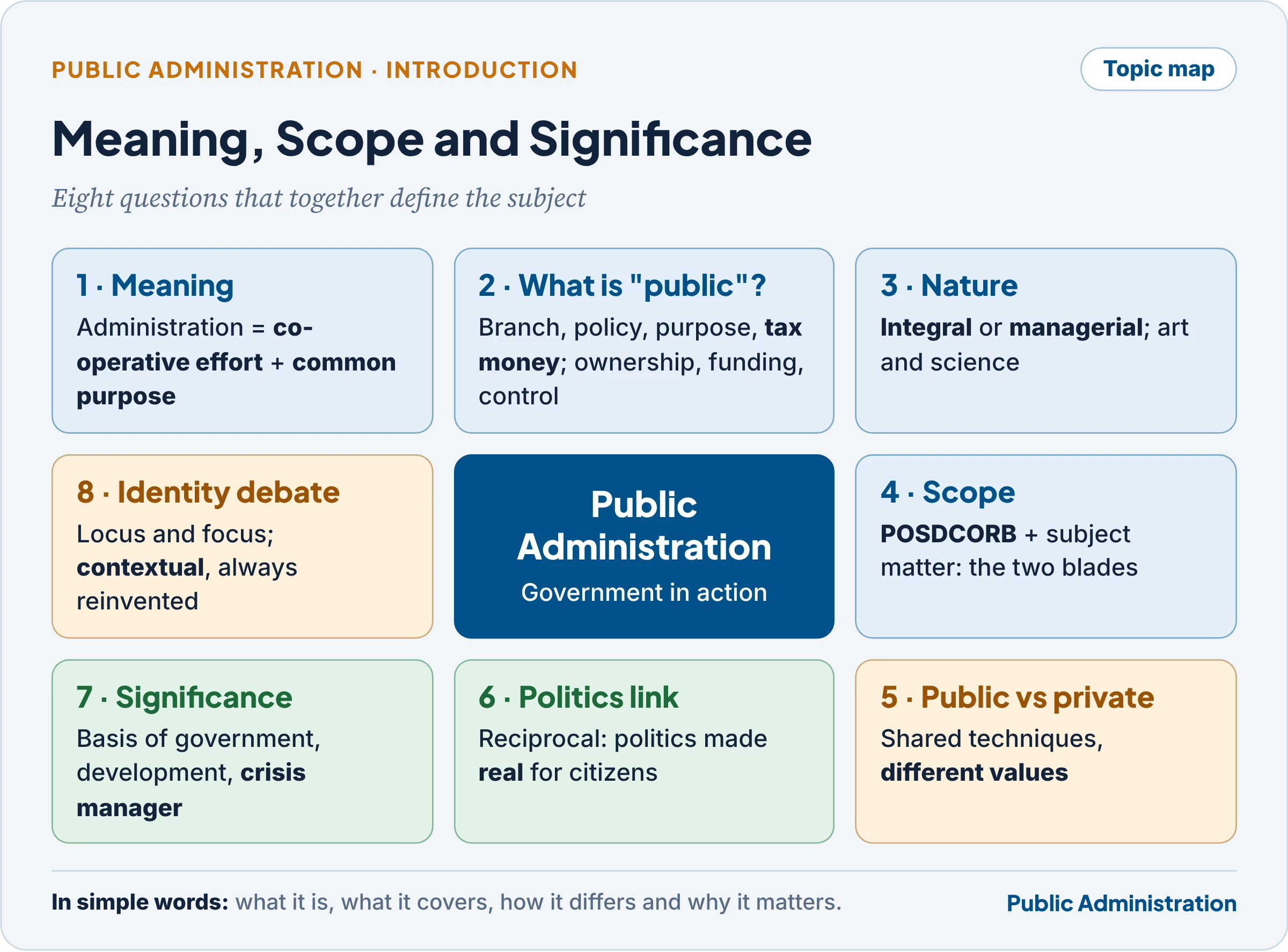
Public administration is the part of government that ordinary people actually meet: the ration shop, the police station, the passport office, the school, the vaccination camp. Laws and policies are only words until an organised body of officials turns them into services, permits, payments and protection. As a discipline, public administration studies how that machinery is organised, how it works, whom it serves and how it is held to account.
In simple words
Parliament can pass a law giving every child a free school place, but the child gets a seat only when a district officer counts the children, a department hires the teachers, a treasury releases the money and a headteacher opens the gate. All of that “making it happen” is public administration.
1. What “Administration” Means
In simple words
To administer is to look after something on someone else’s behalf and get it done. Whenever people work together towards a common goal, someone has to plan, divide the work, arrange the money and check the results. That activity is administration, whether it happens in a firm, a hospital or a ministry.
1.1 The word and the idea
- Origin of the word: administer comes from the Latin ad + ministrare, “to serve” or “to manage”. The root idea is service: managing affairs for others, not for oneself.
- E.N. Gladden, the British writer on public administration, called it “a long and slightly pompous word” with a humble meaning: to care for or look after people and to manage affairs.
- Two elements run through every definition:
- a co-operative effort (more than one person is involved), and
- a common purpose (the effort is directed at a known goal).
- Administration is universal. It is found in every organised setting: a business firm, a university, a hospital, a temple trust, a government department. This is why administration is often called the genus, with public and private administration as two species of it.
- Many meanings at once. The British scholar Andrew Dunsire, in Administration: The Word and the Science (1973), listed fifteen distinct meanings of the word in English, from “help or service” to “the government of the day” to “clerical record-keeping”. The word is slippery because it is used for an activity, a set of people, a process and an academic subject.
1.2 Classic definitions of administration
The definitions below differ in emphasis, but together they show what the activity involves.
| Thinker | Definition (core idea) | What it stresses |
|---|---|---|
| Luther Gulick | Administration “has to do with getting things done; with the accomplishment of defined objectives” | Results |
| Herbert Simon | The activities of groups co-operating to accomplish common goals | Co-operation |
| Felix A. Nigro | The organisation and use of men and materials to accomplish a purpose | Resources |
| L.D. White | The art of administration is the direction, co-ordination and control of many persons to achieve some purpose | Control of people |
| J.M. Pfiffner | The organisation and direction of human and material resources to achieve desired ends | Organising resources |
| Dwight Waldo | “A type of co-operative human effort that has a high degree of rationality“ | Rational co-operation |
| Henri Fayol | Administration is one of six activities in a firm (technical, commercial, financial, security, accounting, administrative); it must not be confused with government, which steers all six | Administration as a function |
Read together, these definitions show that administration is purposive (it serves a goal), collective (it involves many people), rational (it chooses means to fit ends) and continuous (it does not stop once a decision is made).
1.3 Administration, organisation and management
Three words are often used as if they meant the same thing. Early writers separated them carefully.
- Oliver Sheldon, the British manager-philosopher, in The Philosophy of Management (1923):
- Administration decides the policy and the broad objectives.
- Management carries out that policy within the limits administration sets.
- Organisation is the machine (the structure of people and tasks) through which management works.
- In his words, administration determines the organisation; management uses it.
- William Schulze made the same split: administration is the force that lays down the object; organisation is the combination of people, tools and space brought together for it; management leads and guides the organisation towards it.
- The medical image: organisation is anatomy (the structure) and management is physiology (how the structure works). Waldo said organisation and management are “merely convenient categories of analysis… One is static and seeks pattern; the other is dynamic and follows movement.”
Common confusion
Is “administration” higher or lower than “management”? It depends on the tradition. In the older British usage (Sheldon, Schulze), administration is the higher, policy-setting function and management executes it. In American business usage, management is often the broader word and “administration” means routine office work. In public administration, “administration” is used in the wide sense: the whole process of carrying out public policy, including its management. When a question uses the terms, define them first.
2. What Makes Administration “Public”
In simple words
A shop and a government hospital both have managers, staff and budgets. The hospital is “public” because it runs on tax money, works under laws made by elected representatives, must treat everyone equally and can be questioned in the legislature and the courts. “Public” is about who owns it, who pays for it, whose interest it serves and who can hold it to account.
2.1 Four ways of defining public administration
Scholars have defined public administration from four starting points. Each captures something real, and each has a weakness.
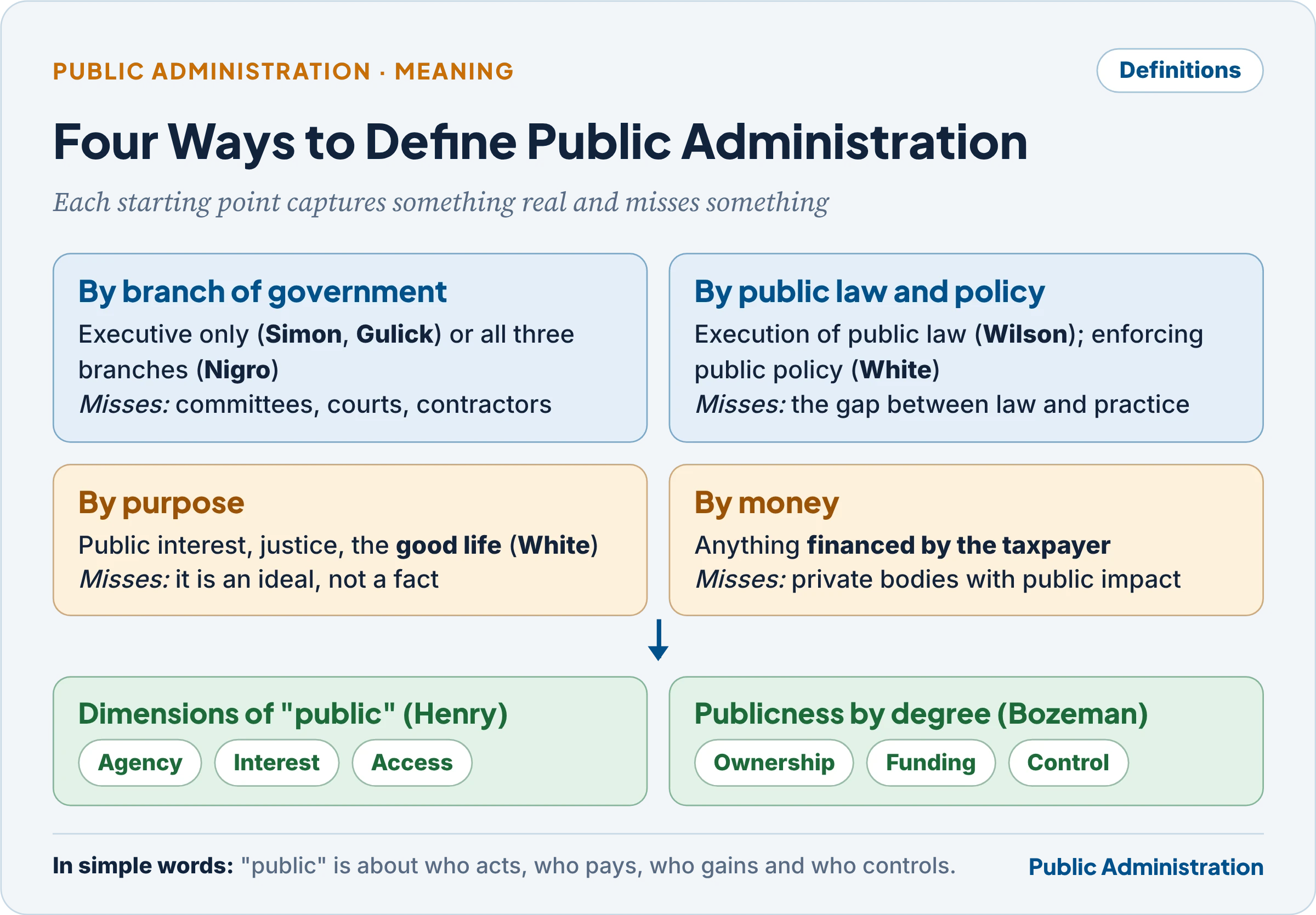
(a) By the branch of government it belongs to
- Broad view (all three branches): public administration covers the work of the legislature, executive and judiciary and their inter-relationships.
- W.F. Willoughby, the early American scholar of budgeting, gave two senses: “In its broadest sense, it denotes the work involved in the actual conduct of governmental affairs, regardless of the particular branch of government concerned… In its narrowest sense, it denotes the operations of the administrative branch only.” He himself preferred the narrow sense and even called administration a “fourth branch” of government.
- Nigro and Nigro (Modern Public Administration) take the broad view: public administration “covers all three branches”.
- Narrow view (executive only): Simon (“the activities of the executive branches of the national, state and local governments”), Gulick, Gladden, Fritz Morstein Marx and Ordway Tead limit it to the executive.
- Weakness: the branch test is formal. Parliamentary committees (the Public Accounts Committee, the Estimates Committee) and court administration are clearly administrative work, so the narrow view leaves gaps; the broad view makes the field vague.
(b) By public policy and law
- Woodrow Wilson, in The Study of Administration (1887): public administration is “detailed and systematic execution of public law. Every particular application of general law is an act of administration.” It is “government in action“, “the most obvious part of government”.
- L.D. White, in Introduction to the Study of Public Administration (1926), the first textbook of the field: public administration “consists of all those operations having for their purpose the fulfilment or enforcement of public policy.”
- John A. Vieg: it embraces every area and activity governed by public policy.
- Weakness: stated policy and real practice can differ. A law may forbid bribery while practice makes it routine; many laws on the statute book are never enforced. A definition built only on formal policy is formalistic, and especially misleading in developing societies where actual behaviour departs from the legal script. This gap is what Fred Riggs later called formalism (see the article on comparative public administration).
(c) By purpose: the public interest and the good life
- White described the ends of administration as “the maintenance of peace and order, the progressive achievement of justice, the instruction of the young, protection against disease and insecurity, the adjustment and compromise of conflicting groups and interests, in short, the attainment of the good life“.
- Fritz Morstein Marx wanted public administration to re-affirm its role as “an agency of unity and justice“.
- Weakness: this is normative (it says what administration ought to be). A dictatorship’s administration does not pursue the good life, and even in a democracy citizens sometimes experience administration as harassment.
(d) By money and control: anything financed by the taxpayer
- Public administration covers all activities financed wholly or substantially by the taxpayer, whoever carries them out.
- This brings in government companies, public corporations, aided institutions and contractors delivering public schemes.
- Weakness: it does not explain why a privately owned electricity utility, which serves the whole city and is closely regulated, also raises “public” questions. Some writers therefore include any administration with a considerable impact on the public.
Composite definitions try to combine these angles:
- Nigro and Nigro’s five features: public administration (i) is a co-operative group effort in a public setting; (ii) covers all three branches and their inter-relationships; (iii) has an important role in formulating public policy and is thus part of the political process; (iv) is different in significant ways from private administration; and (v) is closely associated with numerous private groups and individuals in providing services.
- David Rosenbloom: public administration is “the use of managerial, political and legal theories and processes to fulfil legislative, executive and judicial governmental mandates for the provision of regulatory and service functions for the society as a whole or for some segments of it.”
- Nicholas Henry: “a broad-ranging and amorphous combination of theory and practice“, whose purpose is to promote a superior understanding of government and its relationship with society, to encourage policies more responsive to social needs, and to institute managerial practices attuned to effectiveness, efficiency and the deeper human requirements of citizens.
- Donald Kettl and James Fesler, in The Politics of the Administrative Process: public administration is “the translation of politics into reality that citizens see every day“. They organise the whole field around three themes: politics (every administrative detail allocates values), performance (getting things done well and cheaply) and accountability (answerability to whom, for what).
“The immediate effect of all one-sentence or one-paragraph definitions of public administration is mental paralysis rather than enlightenment and stimulation.” — Dwight Waldo
- Frederick Mosher went further: “Perhaps it is best that it not be defined. It is more an area of interest than a discipline, more a focus than a separate science… It is necessarily cross-disciplinary.” The overlapping, vague boundaries, he argued, should be seen as a resource, not a defect.
2.2 The meaning of “public”
The word “public” itself has been unpacked in two influential ways.
Henry’s three dimensions of publicness (drawing on the political theorists Benn and Gaus):
| Dimension | Question it asks | Public end | Private end |
|---|---|---|---|
| Agency | On whose behalf does the actor act? | An official acting for the community | An individual acting for herself |
| Interest | Who gains and who loses? | Every member of the community | The owners and members only |
| Access | How open are its spaces, meetings, information and resources? | Open to all | Closed to outsiders |
Three ways of locating “public” in the history of the discipline (Henry):
- Institutional definition: “public” means government agencies on the official organisation chart. This dominated early thinking (about 70 per cent of books on public organisations took this view). Privatisation and NGOs made it inadequate.
- Philosophic (normative) definition: “public” means whatever affects the public interest. So the defence ministry’s contract with a private aircraft maker is a public administration subject. Its weakness is vagueness: one person’s public interest is not another’s.
- Organisational definition: research from the late 1970s showed the decisive difference is how strongly the outside environment (citizens, legislators, interest groups, courts, media) penetrates and shapes the organisation’s resources, processes and mission. That pressure is far greater in public organisations.
- The three definitions are mutually reinforcing, not rivals.
Barry Bozeman, in All Organizations Are Public (1987), argued that publicness is a matter of degree, measured on three dimensions: ownership, funding and control. Because political authority affects some behaviour of every organisation (through regulation, taxes, licences), all organisations are public to some extent. A government department is high on all three; a regulated private airline is low on ownership but high on control.
Whose interest is the “public interest”? Because public administration claims to serve the public interest, it needs a way to decide what that interest is in a conflict. Henry summarised four philosophical answers:
| Approach | How it decides the public interest | Weakness |
|---|---|---|
| Intuitionism | The administrator chooses what feels right in the circumstances | Gives no guideline; tends to justify the status quo |
| Perfectionism | Spend public resources so that excellence is promoted, even if the best-off gain most | Elitist and anti-egalitarian |
| Utilitarianism (Bentham, Mill) | Choose what produces the greatest net social satisfaction, even if a few lose | Can sacrifice minorities to the majority |
| Justice as fairness (John Rawls, A Theory of Justice, 1971) | Equal basic liberties for all; inequalities allowed only if they benefit everyone and offices are open to all | Demanding, but Henry saw it as the most workable guide for administrators |
The idea of “publicness” as the ultimate value of public administration rests here: in a democracy, administration is legitimate only when its decisions can be defended as serving all citizens fairly, not officials’ convenience or powerful groups.
Indian Connect — What counts as “public” in Indian law
- Article 12 of the Constitution defines “the State” for Fundamental Rights. In Ajay Hasia v. Khalid Mujib Sehravardi (1981) the Supreme Court held that a society or corporation that is an instrumentality or agency of government is “State”, using tests such as government share capital, financial assistance, deep and pervasive control and public functions.
- In Pradeep Kumar Biswas v. Indian Institute of Chemical Biology (2002) a seven-judge bench refined this into a single question: is the body financially, functionally and administratively dominated by government?
- The Right to Information Act, 2005 (Section 2(h)) covers a “public authority“, including bodies owned, controlled or substantially financed by government. In Thalappalam Service Co-operative Bank v. State of Kerala (2013) the Court held that a co-operative society is not covered merely because it is regulated; control or financing must be substantial.
- These tests are Bozeman’s dimensions (ownership, funding, control) in legal form: Indian courts decide “publicness” case by case and by degree.
3. The Nature of Public Administration
In simple words
“Nature” asks what kind of activity public administration is. Is it everyone’s work in a department, or only the bosses’ work? Is it a science with laws, an art learnt by practice, or both? Is it only about how things are done, or also about what ought to be done?
3.1 Integral view and managerial view
| Basis | Integral view | Managerial view |
|---|---|---|
| Whose work is administration? | The sum total of all activities: managerial, technical, clerical and manual, from the top officer to the peon | Only the managerial work of those who plan, organise, direct, co-ordinate and control |
| Same everywhere? | No: it differs by subject matter (administering a hospital is unlike administering a mint) | Yes: managerial techniques are common to all fields |
| Key thinkers | L.D. White, Marshall Dimock | Luther Gulick, Herbert Simon, Donald Smithburg and Victor Thompson |
| Strength | Shows that output depends on every level | Isolates the distinctive skill of administering |
| Weakness | Too broad to be studied as one skill | Ignores the subject matter and the people who do the actual work |
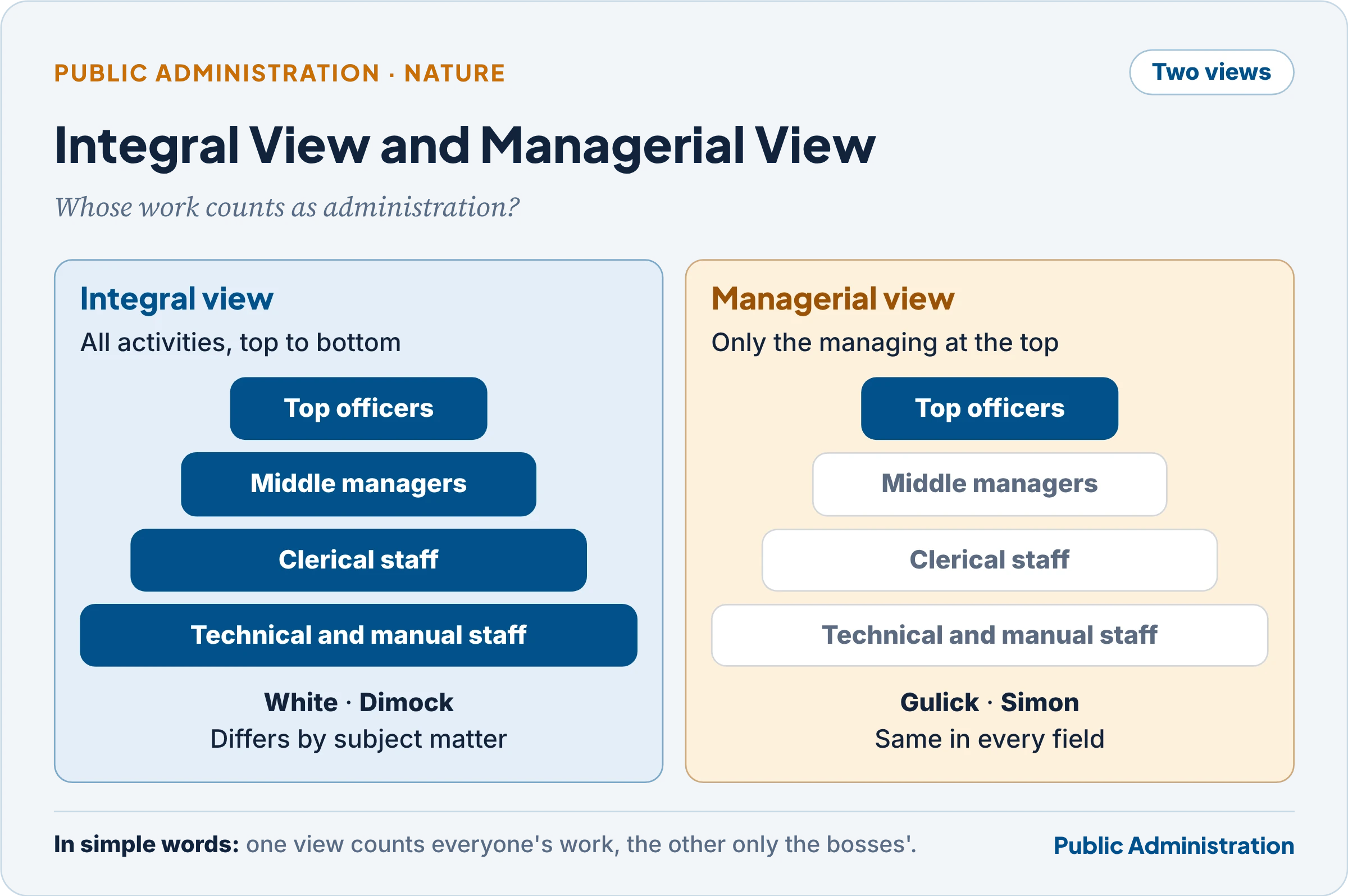
- Simon, Smithburg and Thompson stated the managerial view precisely: the term “administration” is also used in a narrower sense “to refer to those patterns of behaviour that are common to many kinds of co-operating groups and that do not depend upon either the specific goals towards which they are co-operating or the specific technological methods used to reach these goals.”
- Which view fits India? The Indian file system makes the integral view realistic. Under the Central Secretariat Manual of Office Procedure, a case usually begins with a noting by the dealing hand (the clerical level) and moves up the hierarchy; the quality of that first note shapes the final decision. The popular image of the “babu” as the real decision-maker reflects this. Today e-Office has digitised the same flow without changing its logic.
- Synthesis: the two views describe different layers of the same activity. The managerial view tells us what is distinctive about administering; the integral view tells us what produces results.
3.2 Art, science or both?
Administration as an art
- An art is a skill learnt through practice, judgement and experience, not reducible to rules.
- Ordway Tead spoke of “the art of administration”; White called it “the art of directing, co-ordinating and controlling many persons”.
- Administrators handle unique situations: a riot, a flood, a strike, a political crisis. Here judgement, tact and leadership matter more than formulas.
Administration as a science
- A science has exactness, universal validity and predictability, built through observation, hypothesis and verification. (Aristotle’s distinction: art is to do, science is to know.)
- Wilson called for a “science of administration” (1887); Gulick and Urwick titled their 1937 collection Papers on the Science of Administration; the classical writers believed in universal principles.
- Fritz Morstein Marx described what a science of administration would require: “a body of formal statements describing invariant relationships between measurable objects, units, or elements“, while noting that administrative research has produced definite precepts and hypotheses applicable to concrete situations.
- Simon wanted a pure science of administration grounded in social psychology, separating facts (testable) from values (not testable).
Why it is not a science in the strict sense
- Robert Dahl, in The Science of Public Administration: Three Problems (1947), named three obstacles:
- Values: administration cannot exclude normative questions; efficiency itself must serve some end.
- Human behaviour: administration involves the whole psychological person, not a machine.
- Social setting: principles drawn from one country cannot be universal. “As long as the study of public administration is not comparative, claims for a ‘science of public administration’ sound rather hollow.”
- Simon showed that the classical “principles” came in contradictory pairs, like proverbs (see the article on Simon).
The balanced view
- Waldo defined public administration as “the art and science of management as applied to the affairs of state” (The Study of Public Administration, 1955).
- It is best seen as an applied social science and a profession: it uses scientific methods where it can (data, evaluation, experiments, behavioural insights) and judgement where it must.
- It is both positive (describing what administration is) and normative (prescribing what it ought to be).
- Contemporary theory has tilted towards the art side in one sense: New Public Administration, New Public Service and the public value writers stress judgement, values and citizenship over universal rules.
Indian Connect — The British tradition: science joined to ethics
- Oliver Sheldon (The Philosophy of Management, 1923) argued that however scientific management becomes, its primary responsibility is social and communal: its efficiency must be judged “not only by scientific standards but also by the supreme standard of communal well-being“. He called this the doctrine of service.
- The Haldane Committee on the Machinery of Government (1918) applied the same rational spirit to government, recommending that departments be organised by function and that thinking and research be built into the machine.
- The British civil service tradition (the Northcote–Trevelyan Report, 1854, merit entry, political neutrality, anonymity) joined rational organisation to an ethic of public service. India inherited this model: the Indian civil service code of conduct and the ideal of a neutral, merit-based service are its direct descendants.
3.3 Process and substance
- The process view: administration is a set of processes (planning, organising, staffing, budgeting) that are the same whatever the field.
- The substantive view: administration is about the content of what is administered: health, police, agriculture, defence. Each has its own problems, laws and technical knowledge.
- The public policy movement (from the 1960s) obliged the discipline to study the content of policies, not only their machinery. Today public administration studies both.
- Policy-making is part of administration, not outside it:
- civil servants advise ministers, and their expertise often prevails;
- while implementing, they frame subsidiary policies at many levels;
- they make rules under delegated legislation.
- In the real world, the line separating politics and administration is thin, blurred, sometimes non-existent (see Section 6 and the article on Wilson and the evolution of the discipline).
3.4 Approaches: law or management, and the place of efficiency
Scholars have studied administration through several lenses. The main ones:
| Approach | What it studies | Examples |
|---|---|---|
| Philosophical (oldest) | What administration ought to be; its ideals and duties | Plato’s Republic, Locke, Hobbes, the Shanti Parva of the Mahabharata |
| Legal (juridical) | Constitutional and legal structure, powers and limits of public authorities | Strong in France, Germany and Belgium; Frank Goodnow in the USA |
| Historical | How institutions developed over time | White’s four volumes on US federal administration; studies of Mauryan, Mughal and British administration |
| Case method | Detailed accounts of real decisions | Inter-University Case Program (USA); case studies of the Indian Institute of Public Administration and the LBS National Academy of Administration |
| Managerial / behavioural / systems / ecological | Techniques, behaviour, the organisation as a system, administration in its environment | Gulick, Simon, Barnard, Riggs |
| Public choice | Administration through economic reasoning | Ostrom, Niskanen (see the article on public choice) |
- Law or management as the starting point? The continental European tradition treated public administration as a branch of administrative law. White (1926) broke with it: the study of administration, he argued, should start from the base of management rather than the foundation of law. His reasons: law tells officials what they may do, but not how to do it well; the urgent problem of the modern state was competence, economy and organisation. The legal approach still matters (every public act needs legal authority), but the managerial approach gave the discipline its own identity. Today the two are combined: Rosenbloom treats managerial, political and legal approaches as three equal lenses.
- Is efficiency the basic “good”? Gulick wrote that “in the science of administration, whether public or private, the basic ‘good’ is efficiency.” From Wilson to Simon, most writers took efficiency (getting the most output for the least input) as the central objective.
- Waldo objected that efficiency is not value-free: one must always ask “efficient for what?” Efficiency in a democracy can clash with participation, fairness and due process.
- Dahl said ends must be clarified before means can be called efficient.
- New Public Administration (1968) added social equity as a third goal beside efficiency and economy.
- Simon kept efficiency as a criterion of choice, but only within values set by others.
- In public administration, efficiency is therefore a necessary value but not the only one; equity, legality, responsiveness and accountability stand beside it.
3.5 An interdisciplinary field
Public administration grew out of other disciplines and still draws on them. Waldo described it as an umbrella field; Mosher saw its overlapping boundaries as a resource.
| Discipline | What it lends to public administration | Example |
|---|---|---|
| Political science (the “mother discipline”) | Theory of the state, power, democracy, accountability, policy | Ministerial responsibility, legislative control |
| Law | Constitutional limits, administrative law, rule of law, natural justice | Ultra vires, judicial review, tribunals |
| Economics | Scarcity, cost–benefit analysis, public finance, public choice | Budgeting, regulation, user charges |
| Sociology | Social structure, groups, caste and class, bureaucracy (Weber) | Representative bureaucracy, social audit |
| Psychology | Motivation, leadership, behaviour in groups | Training, morale, performance appraisal |
| Management (the “alter ego”) | Techniques of organisation, finance and personnel | O&M, project management, HR systems |
| History | How institutions evolved | Kautilya’s Arthashastra, Mughal and British legacies |
| Data science and technology | Digital platforms, evidence and algorithms | Dashboards, digital public infrastructure |
- Why silos fail: real problems cross departmental and disciplinary lines. Malnutrition is at once a health, food, water, sanitation, gender and income problem. Climate adaptation needs engineers, economists, ecologists, local institutions and social scientists. A purely managerial or purely legal lens misreads such problems.
- Current practice: governments now bring several disciplines together through behavioural insights units (applying psychology to policy design), evaluation offices, inter-ministerial missions and integrated platforms (India’s PM Gati Shakti National Master Plan, 2021, joins infrastructure ministries on one geospatial platform).
4. Scope of Public Administration
In simple words
Scope means “what does public administration cover?” One answer lists the jobs every manager does (planning, staffing, budgeting). Another says it covers whatever government does: health, roads, police, schools. The sensible answer is both: the common techniques and the special subject in which they are used.
4.1 The POSDCORB view
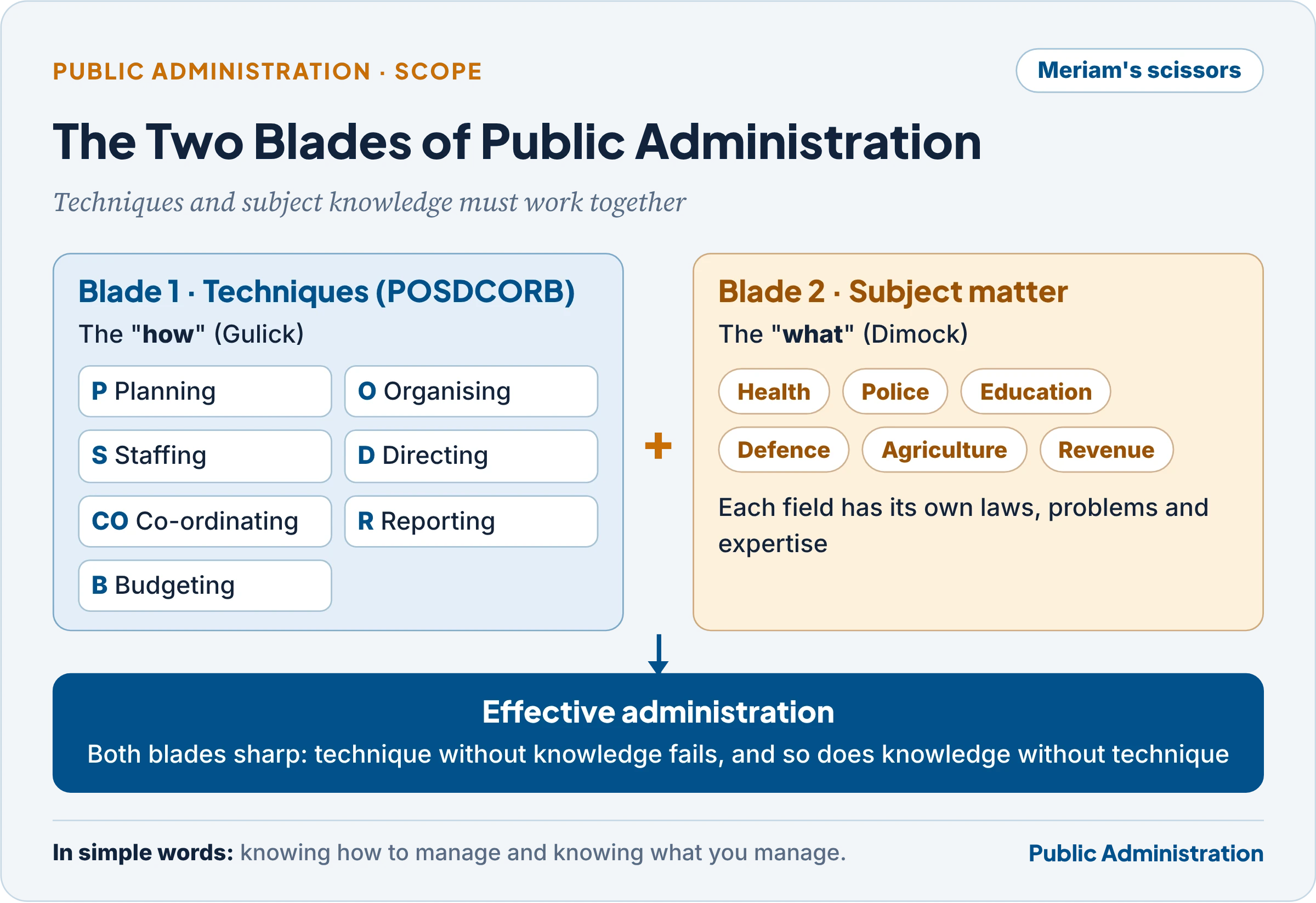
- Luther Gulick, adviser to the US President’s Committee on Administrative Management (the Brownlow Committee, 1937), summed up the work of the chief executive in the acronym POSDCORB:
- P — Planning: working out in broad outline what needs to be done and how.
- O — Organising: establishing the formal structure of authority through which work is arranged, defined and co-ordinated.
- S — Staffing: the whole personnel function of recruiting and training staff and maintaining good conditions of work.
- D — Directing: making decisions, embodying them in orders and instructions, and leading the enterprise.
- CO — Co-ordinating: inter-relating the various parts of the work.
- R — Reporting: keeping superiors and the public informed through records, research and inspection.
- B — Budgeting: fiscal planning, accounting and control.
- Strengths: it identified the common core of all administration, made the field teachable, and shaped reforms of the machinery of government.
- Criticism:
- It is technique-oriented, not subject-oriented: it ignores the substantive knowledge each agency needs.
- It treats all agencies as if they had the same problems, whatever their function.
- It covers only the top executive; it says nothing about policy, values, citizens or the environment of administration.
- It is static: it lists functions but not how decisions are actually made (Simon’s objection).
4.2 The subject-matter view and the synthesis
- The subject-matter view says the real core of administration is the services it delivers (defence, health, agriculture, education, social security), each with its own techniques that POSDCORB does not cover.
- The two are complementary, not rival:
“Public administration is an instrument with two blades like a pair of scissors. One blade may be a knowledge of the fields covered by POSDCORB, the other blade is knowledge of the subject matter in which these techniques are applied. Both blades must be good to make an effective tool.” — Lewis Meriam
- Marshall Dimock made the same point: administration is concerned with the “what” (the subject matter, the technical knowledge of a field) and the “how” (the techniques of management) of government. “Each is indispensable; together they form the synthesis called administration.”
Common confusion
Is “scope” the same as “nature”? No. Nature asks what kind of activity public administration is (integral or managerial; art or science; process or substance). Scope asks what it covers (POSDCORB functions, subject-matter fields, branches of government, non-state actors). The integral and managerial views describe its nature; POSDCORB and the subject-matter view describe its scope.
4.3 Scope as an academic discipline
As a field of study, public administration covers several recognised sub-fields:
- Organisation theory and behaviour: structures, decision-making, motivation, leadership, communication.
- Public personnel administration: recruitment, training, promotion, discipline, ethics.
- Public financial administration: budgeting, accounts, audit, public debt.
- Comparative and development administration: administrative systems across countries and their role in development.
- Public policy analysis: how policies are made, implemented and evaluated.
- Administrative law and accountability: delegated legislation, tribunals, judicial and legislative control, citizens’ rights.
- Local, urban and rural administration, e-governance, regulation and disaster management have been added more recently.
Mohit Bhattacharya groups the basic concerns of the discipline into four: structures of public organisations, processes (communication, control, decision-making), bureaucratic behaviour (interpersonal and group relationships) and organisation–environment interactions (the ecology of administration).
4.4 Scope is set by what government does
- “The scope of administration is determined by the scope of government functions, which is decided politically.” The boundaries of public administration move with the boundaries of the state.
- The historical movement has been from regulation to service and welfare, then towards an enabling and regulating role:
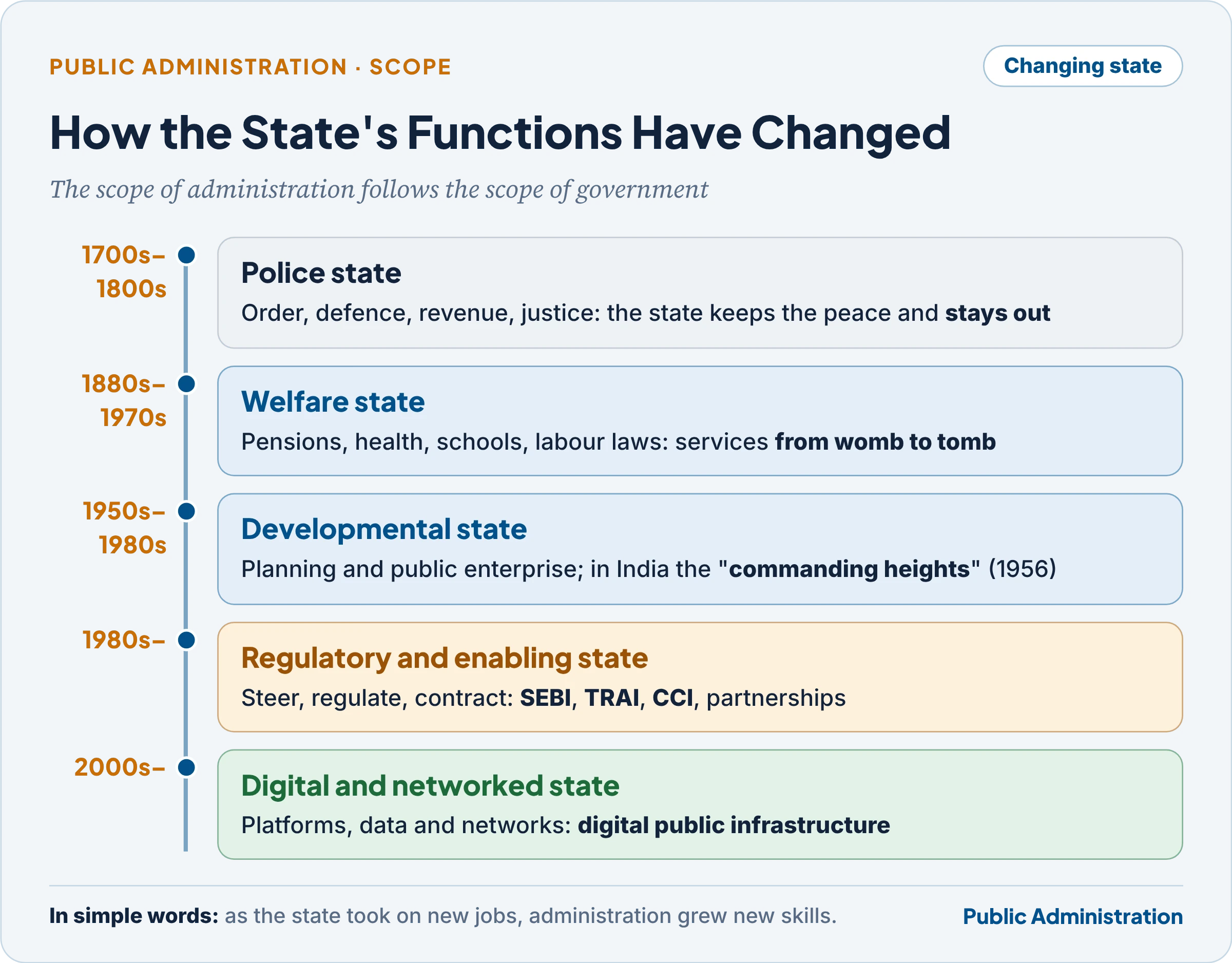
| Phase | Role of the state | What administration mainly does |
|---|---|---|
| Police state (laissez-faire, 18th–19th century) | Order, defence, revenue, justice | Collect taxes, keep peace, run courts |
| Welfare state (late 19th century onward, especially after 1945) | Social security, health, education, labour protection | Deliver services “from womb to tomb” |
| Developmental / positive state (post-colonial countries, mid-20th century) | Planning, public enterprise, land reform | Run industries, plan, build infrastructure |
| Regulatory and enabling state (from the 1980s) | Steer, regulate, partner, contract | Regulators, PPPs, contracts, standards |
| Digital and networked state (21st century) | Platforms, data, partnerships | Digital public infrastructure, network management |
- The administrative state and the bureaucratic state. When government’s main job was regulation (setting rules and enforcing them), the core of administration was rule-application: the administrative state, a term made famous by Waldo’s The Administrative State (1948). When government began operating businesses and services directly (railways, power, banks, steel), administration became large-scale bureaucratic production: the bureaucratic state. India’s Industrial Policy Resolution of 1956, which reserved the “commanding heights” for the public sector, is the clearest example of this shift. After 1991, the tide partly reversed: government withdrew from many businesses and built independent regulators (SEBI 1992, TRAI 1997, CCI 2003), moving back towards a regulatory role.
- Is the scope boundaryless? It can look so, because government touches almost everything. But it has real boundaries:
- the constitutional mandate (what the state may lawfully do; the Seventh Schedule divides it between Union and States);
- the public character of the activity (public money, public authority, public accountability);
- political choices about what the state should do, which can contract the scope (privatisation, deregulation) as well as expand it.
- The scope is therefore elastic, not boundaryless: it expands and contracts with political decisions, technology and public expectations.
The Indian Constitution sets the administrative agenda:
- Article 38 directs the State to secure a social order based on justice, social, economic and political.
- Article 39 lists goals such as adequate means of livelihood and preventing concentration of wealth; Article 46 directs special care for the educational and economic interests of the weaker sections, especially Scheduled Castes and Scheduled Tribes.
- Articles 243G and 243W (the 73rd and 74th Amendments, 1992) extend administrative tasks to panchayats and municipalities (Eleventh and Twelfth Schedules).
- Each such directive enlarges the scope of public administration: the Directive Principles are, in effect, the job description of Indian administration.
4.5 Expanding horizons
Why the scope of public administration keeps widening:
- Industrialisation and urbanisation: large-scale organisations, factories, cities and their problems.
- The welfare state replacing the police state; economic planning in developing countries.
- Population growth: slums, food, transport, health and housing needs.
- Science and technology: new fields to regulate (telecom, data, biotechnology, artificial intelligence) and new tools to govern with.
- Modern warfare and internal security: mobilising people and resources, counter-terrorism, cyber security.
- Disasters and climate change: floods, cyclones, heatwaves and pandemics demand crisis management at scale.
- Social conflict: communal, ethnic and class tensions add crisis-management tasks.
- Globalisation: trade rules, cross-border data, migration and global public goods (climate, health) bring international dimensions into domestic administration.
What a modern scope must include (concerns stressed in academic writing on the field):
- Publicness: absorbing democratic values, power-sharing and openness into everyday administration.
- Policy sensitivity: timely and innovative policy formulation in fast-changing conditions.
- Implementation capability: clear goals, step-by-step programme and project management; the legitimacy of government increasingly depends on delivery.
- Shared understanding of social reality: building decisions on the views of top officials, middle managers, front-line staff and citizens, not on an insular centre.
- Administration as learning: turning bureaucracy into a learning organisation that adapts and innovates.
Common confusion
What is “under-administration”? It is the opposite problem to “too much bureaucracy”: the state has too little administrative capacity for the tasks it has taken on. Laws and schemes exist, but there are not enough trained staff, systems or field presence to implement them, so what happens on the ground departs from what is written. Lant Pritchett (Is India a Flailing State?, 2009) described India’s version: a capable “head” (elite national institutions that design good policies) that is “no longer reliably connected via nerves and sinews to its own limbs” (the teachers, police, health workers and engineers in the field). Under-administration shows up as absenteeism, delays and gaps between de jure and de facto reality. Its remedies are capacity building, field staffing, digital monitoring and better accountability, not simply more rules.
4.6 The identity debate
- Because public administration overlaps with so many fields, its identity has been questioned repeatedly.
- Morstein Marx feared, as Waldo reported, that public administration had grown so broad that it stood “in danger of disappearing completely as a recognizable focus of study“.
- Locus and focus: Robert Golembiewski and Nicholas Henry explained the discipline’s history through its locus (the institutional “where”, such as the government bureaucracy) and its focus (the specialised “what”, such as the principles of administration). When one was sharply defined, the other was neglected (see the article on Wilson and the evolution of the discipline for Henry’s paradigms).
- “Constantly reinvented because it is contextual.” Public administration changes as its context changes: the reform era produced the dichotomy, the Depression and war produced the principles and then their critique, the 1960s unrest produced New Public Administration, fiscal crisis produced New Public Management, and the digital era is producing networked and platform governance. Its contextual nature is a source of renewal, not only of instability.
- Its distinctive strength lies in exploring the complexities and nuances of policy-making and implementation: how a decision travels from a cabinet note to a village, what bends it on the way, and how it can be made to work. No other discipline studies this full chain.
5. Public and Private Administration
In simple words
A government hospital and a private hospital both hire doctors, buy medicines and keep accounts, so they share many techniques. But the government hospital cannot turn away a poor patient, cannot charge whatever it likes, must follow rules for every purchase, and can be questioned in the assembly. Same tools, different rules of the game.
5.1 Where they are alike
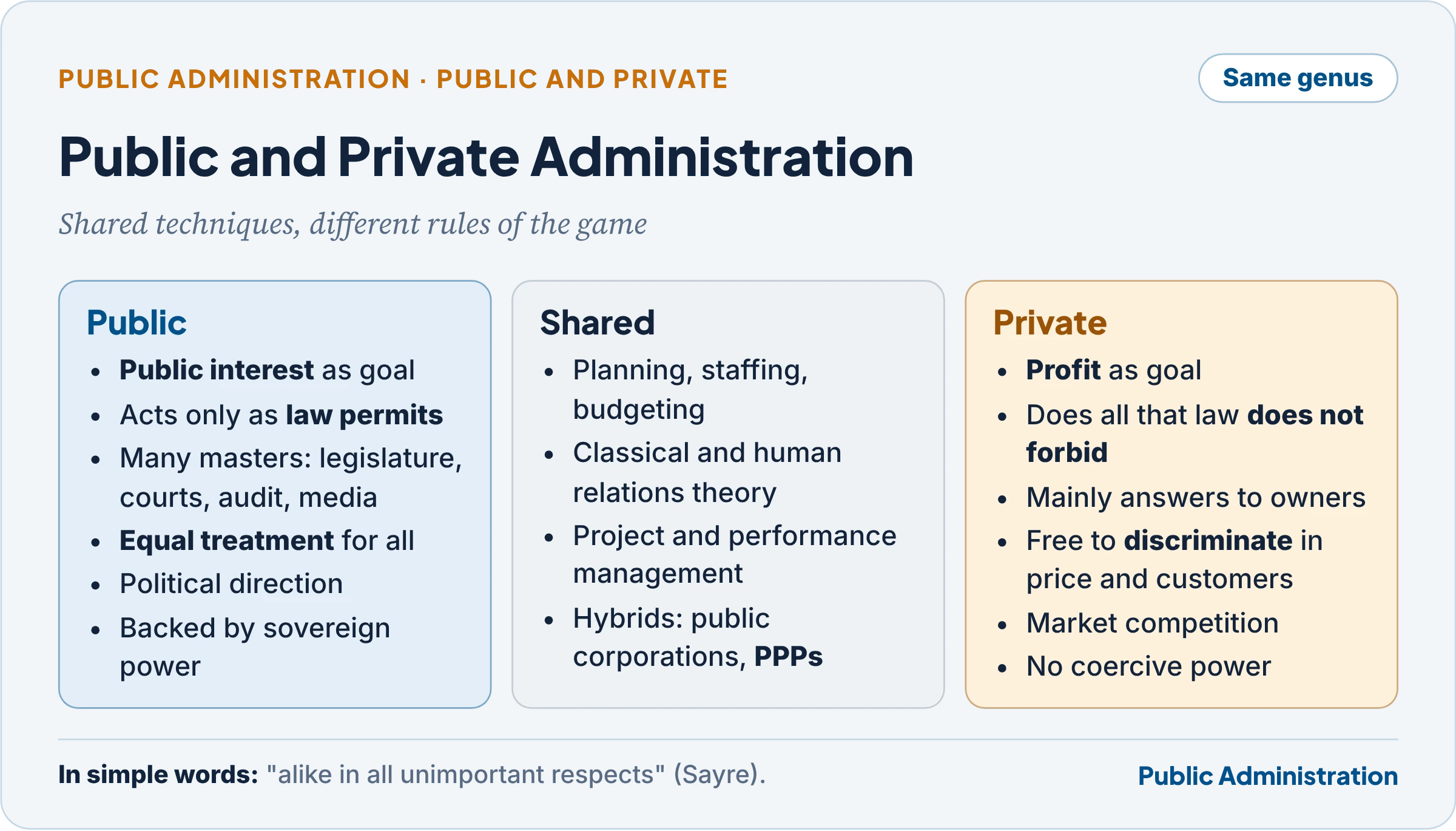
- Same genus: both are co-operative efforts to achieve goals with people, money and materials; both use POSDCORB functions.
- Shared theories: classical organisation theory (Taylor, Fayol) and the human relations approach (Mayo) were born in private industry and then applied to government.
- Movement of people and practices: managers move between sectors; performance management, project management and information systems travel both ways.
- Hybrid forms: public corporations were designed as a halfway house between a government department and a commercial company; public–private partnerships blend the two.
- Common training: the Administrative Staff College of India, Hyderabad (1956), trains managers from both government and business.
- Generic management writers (Fayol, Urwick, Gulick) argued that the principles of administration apply to all organisations.
5.2 Where they differ
| Basis | Public administration | Private administration |
|---|---|---|
| Purpose | Public interest, general welfare, citizen satisfaction | Profit for owners; survival depends on it |
| Legal basis | Can do only what law permits (an act beyond powers is ultra vires) | Can do anything the law does not forbid |
| Accountability | Many masters: legislature, courts, audit, media, citizens (external, multiple) | Mainly to owners or shareholders |
| Equity | Must treat like cases alike; partiality provokes censure | Discrimination is normal (price tiers, chosen customers) |
| Political direction | Works under elected leaders; politics is at its core | Largely insulated from party politics |
| Scope and complexity | Vast, varied, unrelated tasks; decisions involve many departments | Narrower, more single-minded |
| Measuring efficiency | No single yardstick; outcomes are hard to measure | Profit is a clear, accepted yardstick |
| Market exposure | Often a legal monopoly; prices set by budget or law | Faces competitors and prices directly |
| Coercive power | Backed by the sovereign power of the state (it can tax, license, arrest) | No coercive power of its own |
| Publicity | Works in a glass house; one mistake makes headlines | Much less exposed |
- Paul Appleby, a senior New Deal administrator and later adviser to the Government of India, in Big Democracy (1945), in a chapter titled “Government Is Different“, identified three features that set government apart:
- breadth of scope, impact and consideration: government must weigh the effect of every action on the whole society;
- public accountability: every action can be questioned publicly;
- political character: administration must respond to public sentiment, which makes it political in the best sense.
- Rosenbloom stressed law: “Every element of their being — their structure, staffing, budget and purpose — is the product of legal authority. Every action taken by a public administrator ultimately must be traceable to a legal grant of authority.”
- Equity and fairness are central values in public administration; profit, cost–benefit and speed in private administration. Public administration is therefore closer to political science and law; private administration to business management.
- Efficiency is harder to judge in government. Without a balance sheet, “public interest” is a vague substitute for profit; this can produce laxity, over-staffing and weak cost-consciousness, which is one reason reformers later borrowed business tools (see the article on New Public Management).
5.3 The debate: are they fundamentally different?
- Sayre’s law: Wallace Sayre quipped that public and private management are “fundamentally alike in all unimportant respects“.
- Graham Allison, in Public and Private Management: Are They Fundamentally Alike in All Unimportant Respects? (1980), compared the general functions of managers (setting strategy, managing internal components, managing external constituencies) and found that public managers face shorter time horizons, harder-to-measure goals, more constraints on personnel, more public processes and more media scrutiny. He concluded that the idea that business practices can simply be transferred to government is wrong.
- George Boyne (2002) tested thirteen “publicness” hypotheses against 34 empirical studies. Only three were supported by most studies: public organisations are more bureaucratic, and public managers are less materialistic and have weaker organisational commitment. The evidence for a sharp divide is thinner than theory claims.
- Bozeman: publicness is a continuum, not a dichotomy (Section 2.2).
- The lines are blurring: government is more business-like (agencies, contracts, user charges, performance pay); business is more public (regulation, corporate social responsibility under Section 135 of the Companies Act, 2013, environmental and data-protection duties). A large share of government work is contracted out: what scholars call third-party government and the hollow state.
Criticism — Critics of a separate “public” administration
- Administration is generic: planning, organising, budgeting and motivating people work the same way everywhere (Fayol, Urwick, Gulick).
- Business has developed better tools for efficiency, customer service and innovation; government should borrow them.
- Empirical studies find fewer differences than theory predicts (Boyne).
- Publicness is a matter of degree (Bozeman); many private firms do public work and many public bodies act commercially.
- Insisting on difference can become an excuse for inefficiency.
Defence — Defenders of the public difference
- Government rests on law and sovereign power; every act must be traceable to legal authority (Rosenbloom).
- Its goals are multiple, conflicting and value-laden (equity, rights, security), not a single profit number.
- It answers to many masters through political, legal and public accountability (Appleby).
- It must serve everyone equally, including those who cannot pay; markets serve those who can.
- Techniques can be borrowed, but values cannot be transplanted; treating citizens as customers can erode rights and equity (the New Public Service critique).
Indian Connect — Public and private in Indian practice
- Article 14 forbids arbitrary state action (E.P. Royappa v. State of Tamil Nadu, 1974: “equality is antithetic to arbitrariness”); a private firm faces no such constitutional duty.
- Article 311 protects civil servants from dismissal without inquiry; private employment has no equivalent constitutional guarantee.
- The Comptroller and Auditor General (Article 148), parliamentary committees, the Central Vigilance Commission and the RTI Act subject public bodies to scrutiny that private firms do not face.
- When Air India was sold to the Tata group (handed over in January 2022), it moved out of CAG audit, RTI and parliamentary questioning: ownership changes the rules of accountability, not only the balance sheet.
- Does ownership change improve performance? The evidence suggests that competition and good regulation matter at least as much as ownership (a point made in the classic economic study of privatisation by John Vickers and George Yarrow, 1988). A private monopoly can perform as badly as a public one (see the article on liberalisation, privatisation and good governance).
6. Politics and Administration: A Reciprocal Relationship
In simple words
Politicians decide what should be done; administrators decide how. But the “how” often changes the “what”, and administrators also advise on the “what”. At the same time, the kind of political system a country has (democratic or not, federal or not) shapes the kind of administration it gets. Each keeps shaping the other.
- Administration translates politics. For Kettl and Fesler, no political decision has any value except in the way it is implemented; which neighbourhood gets extra policing or which road is cleared first is a detail “richly wrapped in politics”.
- The political system creates the administrative system.
- A parliamentary system produces ministerial responsibility, a permanent and neutral civil service, and anonymity of officials (India: Articles 74, 75 and 77).
- A federal system produces two or more layers of administration and all-India services that bind them (Article 312).
- A presidential system produces political appointees at the top of departments (the United States).
- The administrative system shapes politics.
- Senior officials draft cabinet notes and bills, frame rules under delegated legislation, and offer the expertise ministers rely on.
- Implementation decides how policies are experienced, and therefore how governments are judged at elections.
- In developing countries, bureaucracy has often been the dominant institution, shaping the political agenda itself (Riggs; see the article on comparative public administration).
- John Gaus (1950): “A theory of public administration means in our time a theory of politics also.” Appleby saw administration as a political process: policy is made continuously as decisions move up and down the hierarchy, and political involvement checks arbitrary bureaucratic power.
- Appleby also saw the art of administration in the management of the flow of work upward and downward within hierarchies and between them: a matter is pushed up to the level where the right range of considerations, including political ones, can be weighed, and decisions flow back down as instructions. Hierarchy, in this view, is a device for bringing public and political judgement to bear on technical work.
- The post-war definitions of White and Pfiffner moved in the same direction: administration came to be seen as part of the policy process, not a neutral technical sequel to it.
The old puzzle: strong enough to work, not strong enough to threaten
- Traditional public administration had to “resolve a fundamentally irresolvable problem: creating an administration strong enough to be effective but not so strong as to endanger accountability” (a formulation associated with Donald Kettl).
- Its solution:
- Hierarchy: authority flows from the elected top down a chain of command, so every official is answerable to a superior and finally to a minister.
- The politics–administration dichotomy: elected leaders decide; neutral experts execute (Wilson, Goodnow).
- Rules and merit: a Weberian rule-bound bureaucracy recruited on merit and bound by procedure limits personal discretion.
- Why the solution came under strain: delegated legislation, technical complexity and the scale of the modern state gave officials real discretion; hierarchy slowed responsiveness; and contracting out moved work beyond the chain of command. Each later school (New Public Administration, New Public Management, governance) is partly a new answer to Kettl’s puzzle.
Legitimacy
- If administrators exercise discretion, on what basis is their power legitimate? Elected officials have votes; officials have only expertise and law.
- The Blacksburg Manifesto (1983; expanded in Refounding Public Administration, 1990, by Gary Wamsley, Charles Goodsell, John Rohr and others) argued that public administration is a legitimate constitutional actor in its own right, deriving authority from its oath to the constitution and its duty to the public interest. John Rohr’s To Run a Constitution (1986) made the same case.
- To play this legitimising role in a complex society, public administration needs a fuller conceptual basis than the old dichotomy: grounded in constitutional values, ethics and citizenship, not only efficiency.
Indian Connect — The interface in India
- In T.S.R. Subramanian v. Union of India (2013) the Supreme Court asked governments to give civil servants a minimum fixed tenure, set up Civil Services Boards to decide transfers and postings, and have officers record oral instructions from political superiors. It is a judicial attempt to rebalance the politics–administration relationship.
- The Second Administrative Reforms Commission (2005–09) in its report on refurbishing personnel administration called for a civil service committed to constitutional values, not to a party.
- The debate on a “committed bureaucracy” in the late 1960s and 1970s turned on the same question: committed to the ruling party’s programme, or to the Constitution’s goals?
The debate is alive elsewhere too. In the United States, the Supreme Court in Loper Bright Enterprises v. Raimondo (28 June 2024) overruled the forty-year-old Chevron doctrine, so courts no longer defer to agencies’ readings of ambiguous statutes; and the Office of Personnel Management’s final rule creating Schedule Policy/Career (February 2026, effective 9 March 2026) made policy-influencing career posts at-will. Both changes redraw the line between elected control, expert discretion and judicial review that public administration has argued about since Wilson.
7. Significance of Public Administration
In simple words
Without administration, a constitution is a document, a budget is a number and a law is a wish. Elections, vaccinations, pensions, exams, disaster relief and roads all happen because an administrative machine exists. That is why many thinkers say that civilisation itself depends on good administration.
7.1 What thinkers have said
- W.B. Donham, dean of the Harvard Business School: “If our civilisation fails, it will be mainly because of a breakdown of administration.”
- Charles A. Beard, the American historian: “There is no subject more important than this subject of administration. The future of civilised government, and even, I think, of civilisation itself, rests upon our ability to develop a science and a philosophy and a practice of administration competent to discharge the public functions of civilised society.”
- L.D. White: administration has become “the heart of the problem of modern government“. He contrasted three stages of popular expectation: once people expected nothing but oppression from the state, later only to be let alone; now they expect a wide variety of services and protection.
- Henri Fayol: the administrative process is universal, found in practically every enterprise and occupation.
- Brooks Adams, the American historian, called administration “the capacity of co-ordinating many, and often conflicting, social energies in a single organism, so adroitly that they shall operate as a unity”.
7.2 Significance as an activity
| Role | What it means | Example |
|---|---|---|
| Basis of government | Every form of government, democratic or not, needs administration | Revenue, police, courts exist under every regime |
| Instrument of law and policy | Turns laws and programmes into action | Implementing the Right to Education Act, 2009 |
| Stabilising force | Provides continuity through elections, changes of government, even coups | Services continue while governments change |
| Service provider | Delivers education, health, water, transport, social security | Public hospitals, schools, pensions |
| Instrument of development | Leads planned development where markets are weak | Irrigation, electrification, credit |
| Agent of social change | Promotes equality and protects weaker sections | Reservation, land reform, tribal welfare |
| Nation-builder | Integrates diverse regions and groups | All-India services, national programmes |
| Regulator | Sets rules for markets, environment and technology | SEBI, TRAI, CCI, pollution control boards |
| Crisis manager | Responds to disasters, epidemics and security threats | NDMA, pandemic response |
| Shaper of public opinion and policy | Informs debate, advises ministers, frames options | Expert committees, white papers |
Gerald Caiden, in The Dynamics of Public Administration (1971), listed the crucial roles of public administration in modern society: preservation of the polity, maintenance of stability and order, institutionalisation of socio-economic change, management of large-scale commercial services, ensuring growth and economic development, protection of the weaker sections, formation of public opinion, and influencing public policies and political trends.
7.3 Significance as a discipline
The academic study of public administration contributes in five ways:
- Epistemological: it builds systematic knowledge about how government actually works.
- Technical: it applies that knowledge to solve practical problems (organisation design, budgeting, evaluation).
- Ombudsmanic: by studying grievances, red tape and corruption, and publishing the findings, it informs citizens, the press and the legislature, playing a watchdog-like role.
- Liberal-educational: it spreads administrative literacy, so citizens understand how government works and can claim their rights.
- Professional: it trains civil servants and public managers through institutes and schools of public administration and policy.
7.4 Significance in developed and developing societies
| Basis | Developed societies | Developing societies |
|---|---|---|
| Main task | Regulation, service delivery, maintenance | Development: building the economy and society |
| Bureaucracy’s position | One institution among many strong ones | Often the strongest institution |
| Structure | Differentiated, specialised (Riggs: “diffracted”) | Mixture of modern forms and traditional practice (Riggs: “prismatic“) |
| Law and practice | Close fit | Gap between rules and behaviour (formalism) |
| Resources | Relatively abundant | Scarce; capacity constraints |
| Legacy | Home-grown institutions | Often colonial institutions adapted |
- In developing countries public administration has a pivotal role, because development has been government-led. This gave rise to the sub-field of development administration.
- Can it modernise traditional political culture? Partly: through education, elections, rule-based services, land reform and digital delivery, administration spreads universalistic norms. But it is itself shaped by the surrounding culture (caste, patronage, kinship), so it can also reproduce the traditional order. Modernisation succeeds when administrative reform goes together with social and political change (see the articles on comparative public administration and development dynamics).
7.5 Significance in a democracy, and under “roll-back”
- In a democracy, administration is where citizens experience the state; its performance shapes trust and legitimacy.
- The “roll-back of the state” since the 1980s changed the role of public administration (from doing to steering, regulating and partnering) but did not reduce its central place: privatised sectors need regulators, contracts need managers, partnerships need oversight, and crises (financial in 2008, the pandemic from 2020) brought the state back to the centre.
Indian Connect — The scale of Indian administration
- The 2024 Lok Sabha election was administered for about 98 crore electors at more than 10.5 lakh polling stations by the Election Commission of India: the largest administrative exercise of its kind in the world.
- India’s COVID-19 vaccination drive administered over 220 crore doses, scheduled and certified through the CoWIN digital platform.
- The Centralised Public Grievance Redress and Monitoring System (CPGRAMS) received about 22.8 lakh grievances in 2025; central ministries disposed of them in an average of 15 days, against a timeline cut from 30 to 21 days by guidelines of August 2024.
- Mission Karmayogi (2020), the national programme for civil service capacity building, has over 1.7 crore officials registered on the iGOT Karmayogi platform (August 2026). Each example shows administration as the bridge between a decision at the top and an outcome for a citizen.
Public administration is not the tail of politics but the place where politics becomes real for citizens.
Key Terms
| Term | Meaning in simple words |
|---|---|
| Administration | Co-operative effort of a group to achieve a common goal; from Latin “to serve” |
| Public administration | Administration in a governmental or public setting: carrying out public law and policy |
| Publicness | The degree to which an organisation is public: by ownership, funding and political control (Bozeman) |
| Integral view | Administration is the sum of all activities (managerial, technical, clerical, manual) in pursuit of a goal |
| Managerial view | Administration is only the managerial work of planning, organising, directing and controlling |
| POSDCORB | Gulick’s acronym for the executive’s functions: planning, organising, staffing, directing, co-ordinating, reporting, budgeting |
| Subject-matter view | The core of administration is the substantive service delivered (health, defence, education) |
| Two blades | Meriam’s image: techniques (POSDCORB) and subject knowledge together make administration effective |
| Locus and focus | The institutional “where” and the specialised “what” of the discipline |
| Administrative state | A state in which much governing is done by administrative agencies through rules and discretion |
| Third-party government | Government programmes delivered through contractors, NGOs, other governments or partnerships |
| Hollow state | A government that has contracted out so much that it mostly manages contracts rather than delivering services |
| Ultra vires | “Beyond powers”: an act a public body has no legal authority to do, and therefore void |
| Formalism | A gap between what laws and rules prescribe and what actually happens |
| Under-administration | Too little administrative capacity for the tasks the state has taken on |
| Flailing state | Pritchett’s term for a state with a capable centre but weak control over its field agents |
| Sayre’s law | Public and private management are “fundamentally alike in all unimportant respects” |
| Administrative literacy | Citizens’ knowledge of how government and administration work |
| Delegated legislation | Rules made by the executive under powers given by a law |
| Regulatory state | A state that governs mainly by setting and enforcing rules for markets and society rather than by producing goods itself |
Commissions, Committees and Judgments
| Body / case | Year | Key point |
|---|---|---|
| Northcote–Trevelyan Report (UK) | 1854 | Merit-based, permanent, neutral civil service |
| Haldane Committee on the Machinery of Government (UK) | 1918 | Departments organised by function; research and thinking built into government |
| President’s Committee on Administrative Management (Brownlow Committee) (USA) | 1937 | “The President needs help”; Gulick’s POSDCORB papers prepared for it |
| Administrative Reforms Commission (India) | 1966 | First comprehensive review of Indian administration for development |
| E.P. Royappa v. State of Tamil Nadu | 1974 | Equality is antithetic to arbitrariness: state action must be non-arbitrary |
| Ajay Hasia v. Khalid Mujib Sehravardi | 1981 | Instrumentalities and agencies of government are “State” under Article 12 |
| Pradeep Kumar Biswas v. Indian Institute of Chemical Biology | 2002 | “State” if financially, functionally and administratively dominated by government |
| Second Administrative Reforms Commission | 2005–09 | Civil service anchored in constitutional values; citizen-centric administration |
| Thalappalam Service Co-operative Bank v. State of Kerala | 2013 | A body is a “public authority” under RTI only if substantially financed or controlled by government |
| T.S.R. Subramanian v. Union of India | 2013 | Fixed tenure, Civil Services Boards, recording of oral instructions |
| Loper Bright Enterprises v. Raimondo (USA) | 2024 | Chevron deference overruled: courts, not agencies, finally interpret statutes |
Contemporary Developments
- August 2024: the Department of Administrative Reforms and Public Grievances issued comprehensive guidelines cutting the grievance redressal timeline on CPGRAMS from 30 to 21 days; in 2025 central ministries averaged 15 days, with 82.1 per cent of grievances disposed of within the timeline.
- 28 June 2024: the US Supreme Court overruled the Chevron doctrine in Loper Bright, shifting interpretive power from administrative agencies to courts and reopening debate on the “administrative state”.
- 13–14 November 2025: the Digital Personal Data Protection Rules, 2025 were notified, with an 18-month phased rollout, adding data protection to the duties of every public and private body handling personal data.
- February–June 2026: the US Schedule Policy/Career rule (final February 2026; positions designated by executive order in June 2026) made policy-influencing career posts at-will, a sharp shift in the politics–administration balance.
- From reporting year 2025–26: completion of mandatory iGOT Karmayogi courses is recorded in the Annual Performance Appraisal Reports of central government employees and All India Services officers, linking capacity building to career management; the platform crossed 1.7 crore users with over 5,600 courses (August 2026).
- December 2025: the Prashasan Gaon Ki Ore campaign (19–25 December) took grievance redressal and service delivery to districts and villages during Good Governance Week.
Revision Grid
| Thinker / body | Work or report (year) | Key idea |
|---|---|---|
| Woodrow Wilson | The Study of Administration (1887) | Detailed and systematic execution of public law; government in action |
| L.D. White | Introduction to the Study of Public Administration (1926) | Operations to fulfil or enforce public policy; heart of modern government |
| W.F. Willoughby | Principles of Public Administration (1927) | Broad and narrow senses; administration as a fourth branch |
| Oliver Sheldon | The Philosophy of Management (1923) | Administration sets policy, management executes; science joined to social ethics |
| Luther Gulick | Papers on the Science of Administration (1937, with Urwick) | POSDCORB; administration as getting things done |
| Paul Appleby | Big Democracy (1945) | “Government is different”: breadth, accountability, political character |
| Robert Dahl | The Science of Public Administration: Three Problems (1947) | Values, human behaviour and social setting block a universal science |
| Dwight Waldo | The Administrative State (1948); The Study of Public Administration (1955) | Art and science of management applied to the state; beware one-line definitions |
| John Gaus | Essay (1950) | A theory of public administration is also a theory of politics |
| Frederick Mosher | Article in Public Administration Review (1956) | Best not defined; an area of interest, not a separate science |
| Lewis Meriam | Writings on public administration | Two blades: POSDCORB and subject matter |
| Marshall Dimock | Public Administration | The “what” and the “how” of government |
| Wallace Sayre | Sayre’s law (1950s) | Alike in all unimportant respects |
| Gerald Caiden | The Dynamics of Public Administration (1971) | Eight roles of public administration in modern society |
| Graham Allison | Public and Private Management (1980) | Public and private management differ in fundamental ways |
| Barry Bozeman | All Organizations Are Public (1987) | Publicness by degree: ownership, funding, control |
| Wamsley, Goodsell, Rohr and others | Blacksburg Manifesto (1983); Refounding Public Administration (1990) | Public administration as a legitimate constitutional actor |
| Kettl and Fesler | The Politics of the Administrative Process | Translation of politics into reality citizens see; politics, performance, accountability |
| George Boyne | Review of 34 studies (2002) | Only three publicness differences well supported |
| Lant Pritchett | Is India a Flailing State? (2009) | Strong head, weak limbs: implementation gap |
Previous Year Questions
- 2026“There is an urgent need to incorporate the contribution of other disciplines into debates and analyses about governance, not the prevalence of disciplinary silos.” Comment.
- 2023Public administration horizons have been expanding to cater to the complex needs of the citizens in the globalised era. Explain.
- 2020“The strength of Public Administration is in its exploration of the complexities and nuances of public policy making and implementation.” Discuss.
- 2019“Public Administration is constantly being reinvented because it is contextual.” Elaborate.
- 2018“The scope of the discipline of Public Administration is determined by what an administrative system does.” Does it mean that the scope of this discipline is boundaryless? Explain.
- 2018“Political and administrative systems have reciprocal relationship.” Discuss.
- 2016“Public Administration is the translation of politics into reality that citizens see everyday.” (Donald F. Kettl and James W. Fesler) Explain.
- 2014“British philosophy of Administration is based on a unification of science of Administration with ethics.” Analyze.
- 2013How did traditional public administration “resolve a fundamentally irresolvable problem- creating an administration strong enough to be effective but not so strong enough to endanger accountability”?
- 2010“The study of administration should start from the base of management rather than the foundation of law.” Explain.
- 2007“Public and Private Administrations are two species of the same genus, but they also have special values and techniques of their own.” Comment.
- 2006“If public administration is to play a major legitimising role in governing our complex society, it needs to be more fully conceptualised.” Discuss.
- 2002“Though there ere certain points of similarity between public and private administration yet no private organisation can ever be exactly the same as a public one.” –Examine.
- 2001“publicness” of public Administration in an ideal democratic government remains the ultimate value in theory and practice.’ Elucidate.
- 2000“A science of administration would be a body of formal statements describing invariant relationships between measurable objects, units, or elements. Unquestionably, administrative research has produced definite precepts and hypotheses that are applicable to concrete situation.”- (Fritz Morstein Marx) Comment.
- 1999“What do you understand by the term under administration? What are the issues involved in it?”
- 1998“As long as the study of public administration is not comparative, claim for a ‘science of public administration ‘sounds rather hollow” Explain.
- 1998“The scope of administration is determined by the scope of government functions which is decided politically”. Comment.
- 1997“In the science of administration, whether public or private, the basic ‘good’ is efficiency.” Comment.
- 1996How far is it true to state that the bureaucratic state began to displace the administrative state; when the predominant function of the government changed from regulation to operation of business?
- 1996“The scope of public Administration is ever expanding.” Comment.
- 1995A theory of public administration means in our time a theory of politics also. Comment.
- 1994“The postwar formulations of White and Pfiffner reflect the new ‘public policy’ orientation-the conception of administration as a political process.” Comment.
- 1993How dose public administration differ in the developed and developing societies? How far can it modernise the traditional political culture of developing countries?
- 1993Waldo speaks of the fears of F.M. Mark that Public administration has grown so broad, and so much is involved at its periphery that it stands “In danger of disappearing completely as a recognizable focus of study.” Comment.
- 1991‘The identity and scope of public Administration both as an academic discipline and government in operation, have always been matters of continuing debate and controversy.’ Discuss.
- 1991‘Public Administration consists of all those operations having for their purpose the fulfilment or enforcement of Public Policy.’ Comment.
- 1990……the development, if not survival of civilisation depends on the science and practice of administration.’ Comment.
- 1989“Popular belief is that ownership change from public to private brings about improved performance.” Comment.
- 1989Management of the flow of work upward & downward within human hierarchies and between human hierarchies is the art of administration. (Appleby). Comment.
- 1988Do you think that contemporary Administrative Theory supports the ‘art’ of public administration and generally tends to place less emphasis on the ‘science’ of public administration?