

Anthropology Optional › Paper II › Unit 07: Scheduled Castes, Scheduled Tribes and OBCs
7.1 Problems of exploitation and deprivation of Scheduled Castes, Scheduled Tribes and Other Backward Classes. Constitutional safeguards for Scheduled Tribes and Scheduled Castes.
Official Syllabus: Paper II, Unit 7.1
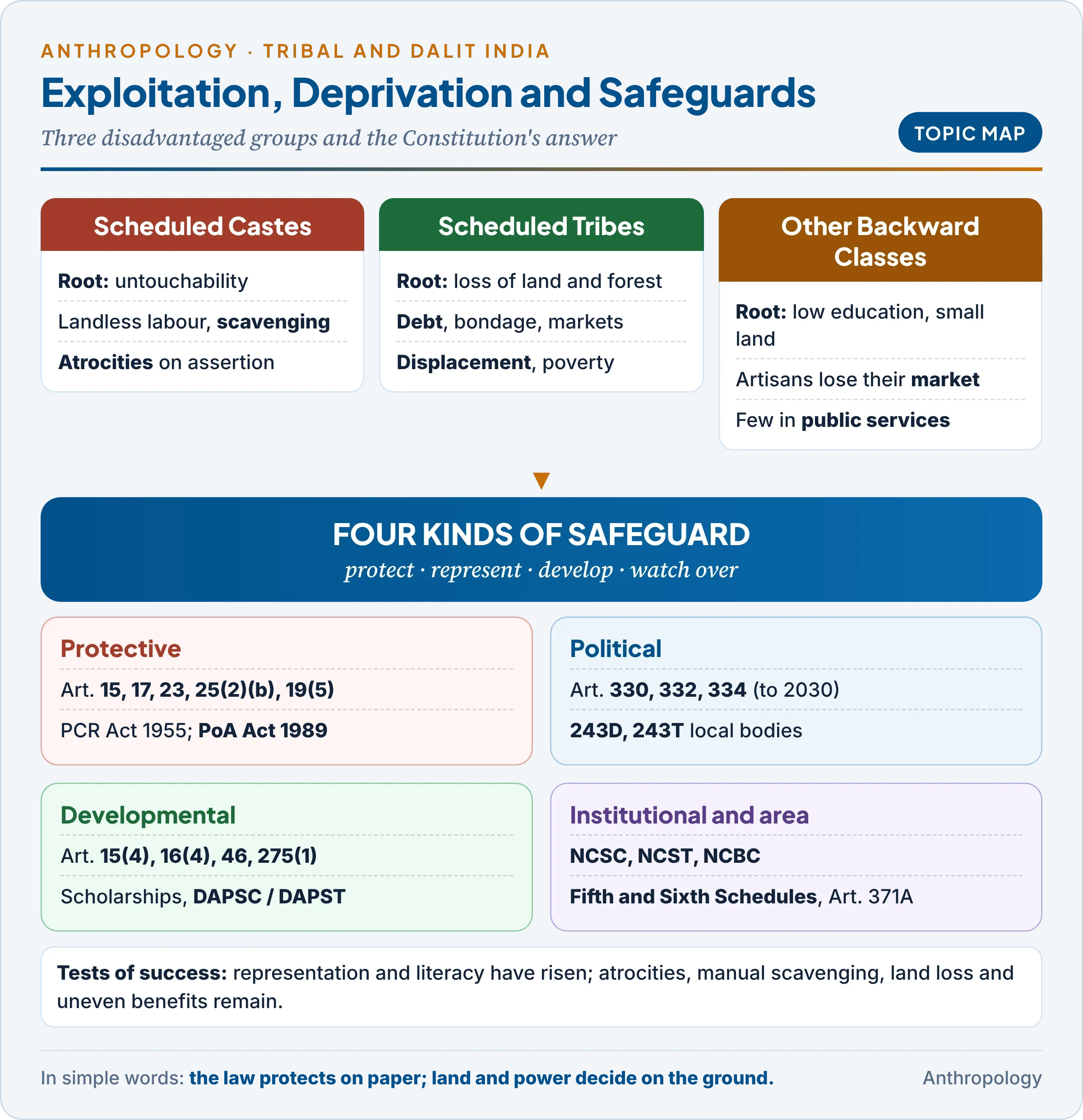
This article covers how Scheduled Castes, Scheduled Tribes and Other Backward Classes are exploited and deprived, and the safeguards the Constitution provides. Caste structure and sub-classification are in 3.2a and 3.2b; OBC identification and minorities in 5.2; PESA and Panchayati Raj in 5.3b; the tribal situation and tribal problems in 6.1 and 6.2; displacement in 6.3a; forest policy in 6.3b; and tribal plans and PVTGs in 9.1.
1. Exploitation, Deprivation and the Three Categories
In simple words
Exploitation means one group taking the labour, land or produce of another unfairly. Deprivation means a group lacks what others have: land, schooling, health, dignity or power. India’s Constitution names three groups that suffered both, Scheduled Castes, Scheduled Tribes and Other Backward Classes, and gives them special protection.
Example first: Una, 2016. On 11 July 2016, four young Dalit men skinning a dead cow, their caste work, were flogged near Una in Gujarat by self-styled cow protectors. The Dalit movement that followed vowed to give up carcass work and demanded land. The case shows three layers of the problem: a stigmatised hereditary occupation (deprivation of choice), violence to keep the group in its place (exploitation), and a political answer asking for resources and dignity.
1.1 Exploitation and deprivation distinguished
The two words are often used together, but they describe different things. The table separates them.
| Point | Exploitation | Deprivation |
|---|---|---|
| Meaning | A relationship in which one party appropriates the labour, land, produce or body of another | A condition of lacking resources, rights or capabilities that others enjoy |
| Focus | The exploiter and the mechanism (interest, wages, prices, force) | The outcome (poverty, illiteracy, ill health, exclusion) |
| Indian examples | Bonded labour; moneylenders taking tribal land; sexual violence against Dalit women; unpaid begar (forced labour) | Landlessness; low literacy; denial of temple or well; under-representation in offices |
| Remedy | Protective law: Article 23, PCR Act, PoA Act, tenancy laws | Developmental measures: reservation, scholarships, land, schemes |
Exploitation produces deprivation, and deprivation makes exploitation easier. A landless Dalit labourer who borrows for a wedding can be tied to the lender’s field; the lost freedom then keeps his children out of school.
- Relative deprivation: the British sociologist W.G. Runciman, in Relative Deprivation and Social Justice (1966), argued that people feel deprived when they compare themselves with a reference group, not by absolute need. This explains why educated Dalits and Adivasis, though better off than their parents, often protest more: they now measure themselves against the dominant groups.
- Capability deprivation: for the economist Amartya Sen, poverty is a lack of capabilities (real freedoms); untouchability deprives even a rich Dalit who cannot rent a house freely.
1.2 Does exploitation arise from a clash of self-interest?
- Interest view: exploitation follows from competition over scarce resources. In Chotanagpur the diku (outsider) moneylender and landlord gained exactly what the tribal lost: land, crops and labour.
- Ideology view: in caste society exploitation is also sustained by ideas: purity and pollution, karma (one’s birth reflects past deeds) and dharma (duty of one’s station). The French anthropologist Louis Dumont stressed this ideological hierarchy; the American anthropologist Joan Mencher, in “The Caste System Upside Down” (1974), replied from Tamil Nadu villages that lower castes saw caste as economic exploitation, not as a consensual ritual order.
- Evaluation: interest explains why land and labour are taken; ideology explains why stigma survives economic mobility.
1.3 Politics of recognition and deprivation
- Recognition: the Canadian philosopher Charles Taylor, in “The Politics of Recognition” (1992), argued that misrecognition (being seen as inferior) is itself a harm. The American philosopher Nancy Fraser answered that justice needs both redistribution (of resources) and recognition (of status).
- Indian forms: Dalit renaming and assertion (from “Harijan” to Dalit, “the broken”), statues and memorials of B.R. Ambedkar, Adivasi demands for recognition of Sarna religion and of languages in the Eighth Schedule, and communities seeking ST or SC status (the Hattee of Himachal Pradesh were added to the ST list in 2023).
- The tension: recognition can harden group boundaries; redistribution without recognition leaves stigma untouched.
1.4 Who are SCs, STs and OBCs?
- Scheduled Castes: groups once called “depressed classes” and, in the 1931 Census under J.H. Hutton, “exterior castes”. The term “Scheduled Castes” entered law through the Government of India Act, 1935 and the Scheduled Castes Order of 1936; Gandhi’s “Harijan” was rejected by many as patronising. The President notifies SCs under Article 341; under the 1950 Order an SC must profess Hinduism, Sikhism or Buddhism.
- Scheduled Tribes: notified under Article 342; the criteria and the list are discussed in 6.1.
- Other Backward Classes: the Constitution speaks of “socially and educationally backward classes” (Article 15(4)) and “backward class of citizens” (Article 16(4)). The American legal scholar Marc Galanter (Competing Equalities, 1984) showed that the term once had many local meanings.
- Size (Census 2011): SCs 20.14 crore (16.6%); STs 10.43 crore (8.6%). The Mandal Commission estimated OBCs at about 52% (1980); no census has counted them since 1931, and Census 2027 will enumerate caste.
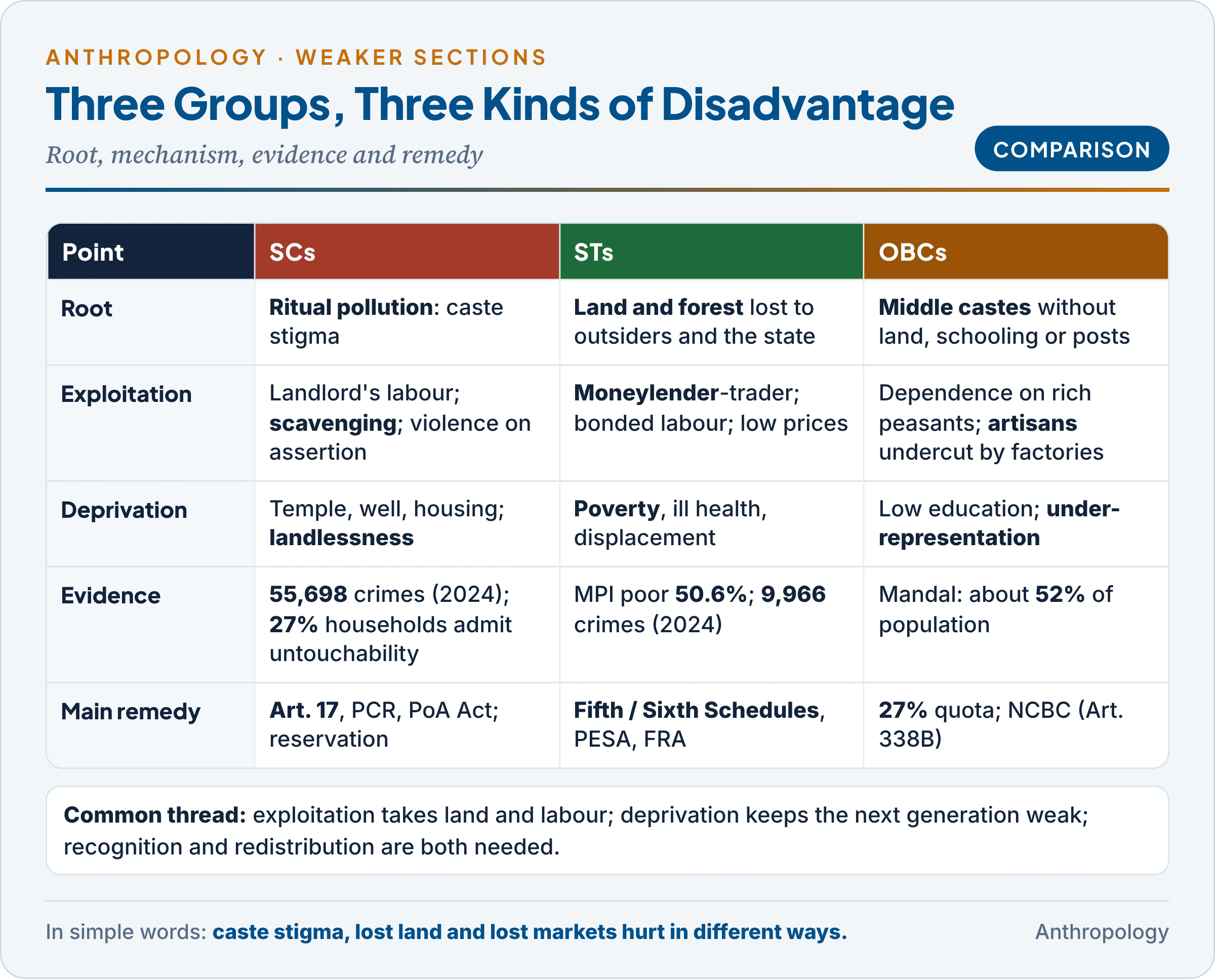
2. Scheduled Castes: Exploitation and Deprivation
In simple words
Scheduled Castes were placed at the bottom of the caste order and treated as “polluting”. This stigma kept them from land, temples, wells and schools and tied them to the dirtiest work. Laws have abolished untouchability, but it survives in quieter forms, and violence is often used when Dalits assert their rights.
2.1 Historical roots
- Vedic and Brahmanical texts: the Rig Veda‘s late Purusha Sukta first names the Shudra as the fourth varna (class); the Dharmasutras treat some groups such as the Chandala as impure and to be kept outside the village.
- Debate on origin: G.S. Ghurye linked untouchability to ritual purity; B.R. Ambedkar, in The Untouchables (1948), saw untouchables as “Broken Men” who kept Buddhism and beef-eating, not a separate race; J.H. Hutton (Caste in India, 1946) saw their position as partly racial, partly religious and partly customary (detail in 3.2a).
- Traditional disabilities: bans on wearing gold or silver ornaments, umbrellas and footwear, clothes below the knee, entering temples, using common wells and, in parts of the south, even walking on certain streets. D.N. Majumdar noted that disabilities were harsher where SCs were few.
2.2 Social disabilities today
Most old disabilities are now illegal, but they have changed form rather than vanished. The table lists the main domains.
| Domain | Disability or exploitation | Evidence or case |
|---|---|---|
| Ritual and social | Temple bars, separate cups (the “two-tumbler” system), segregated cheri or basti hamlets, refusal of rented housing | 27% of households in the India Human Development Survey (2011–12) admitted practising untouchability in some form |
| Economic | Landlessness, agricultural labour, bonded labour, hereditary scavenging and carcass work | 58,098 manual scavengers identified in the 2013 and 2018 surveys |
| Bodily risk | Entry into sewers and septic tanks without safety gear | 498 deaths from 2019 to June 2026 (National Commission for Safai Karamcharis) |
| Gender | Dalit women face caste and gender together: sexual violence, the old devadasi system of “dedicating” girls to temples | Devadasi dedication banned by state laws (Karnataka 1982, Andhra Pradesh 1988) |
| Violence | Atrocities when Dalits assert rights (land, wages, marriage, dress, horses at weddings) | 55,698 crimes against SCs registered in 2024 (NCRB) |
The pattern is that open ritual bans have declined while economic dependence and retaliatory violence remain. Economic mobility does not end stigma: a Dalit officer can still be refused a rented flat.
2.3 Factors responsible for SC exploitation
- Ideology: purity–pollution and karma made inequality look natural; untouchability was learned in the family long before the law reached the village.
- Land: SCs were kept out of ownership; without land they depended on dominant-caste landowners for work, loans and housing sites. Land reform gave them little.
- Occupation: hereditary “polluting” work (leather, scavenging, drumming at funerals) carried the stigma into the next generation; the patron–client jajmani system (exchange of services for grain) tied them to particular households.
- Political power: the dominant caste (M.N. Srinivas’s term for the numerically and economically strongest local caste) controlled the panchayat, police access and village opinion.
- State failure: slow police, low conviction (33.9% under the PoA Act in 2024), and unspent welfare funds.
- Internal division: SCs are not homogeneous; some sub-castes gained more than others, which led to the sub-classification debate (Davinder Singh, 2024, in 3.2b).
Common confusion
Is “untouchability” the same as “caste discrimination”? No. Untouchability is the specific practice of treating a group as ritually polluting, banned by Article 17 and punished under the PCR Act. Caste discrimination is wider: unequal treatment on the basis of caste even without any idea of pollution, barred by Articles 15 and 16. A landlord who pays a Dalit lower wages discriminates; one who refuses his touch practises untouchability.
3. Scheduled Tribes: Exploitation and Deprivation
In simple words
Tribal communities were exploited mainly through their land and forests. Outsiders took their land through debt and fraud, the forest department turned their forests into state property, and dams and mines displaced them. The result is poverty, debt and poor health, even though many tribal areas are rich in natural resources.
- Colonial dispossession: private property, cash revenue and courts turned clan land into saleable land; the Forest Acts (1865, 1878, 1927) made forests state property; revolts (Santal Hul 1855, Birsa Munda 1899–1900) led to laws such as the Chotanagpur Tenancy Act (1908) (detail in 6.2).
- Land alienation: by mortgage, benami (in another person’s name) purchase, fraud and state acquisition; between 2001 and 2011 the share of cultivators among ST workers fell to 34.6% and agricultural labourers rose to 44.4%.
- Debt and bondage: the moneylender is often also the buyer of produce and seller of goods; debts turn into bonded labour, as in the Dubla hali system of south Gujarat studied by the Dutch sociologist Jan Breman; the Bonded Labour System (Abolition) Act, 1976 frees bonded workers and cancels their debts.
- Markets and displacement: low prices and false weights for forest produce; displacement by dams and mines far beyond their population share (6.3a).
- Sexual and cultural exploitation: abuse of tribal women by contractors; “human safari” tourism around the Jarawa of the Andamans.
- Deprivation: rural ST poverty 45.3% (2011–12, Tendulkar method); multidimensional poverty 50.6%, the highest of any group (Global MPI 2021); literacy 59% against 73% (2011).
- Violence: 9,966 crimes against STs registered in 2024 (NCRB).
3.1 Denotified, nomadic and semi-nomadic tribes
- Criminal Tribes Act, 1871 (consolidated in 1924) branded whole communities as “born criminals”, registered them and confined them to settlements. It was repealed in 1952 (denotification on 31 August 1952, observed as Vimukta Jati Day), but states passed Habitual Offenders Acts that kept the stigma.
- Commissions: the Renke Commission (report 2008) and the Idate Commission (constituted 2014, report December 2017) identified 1,262 denotified, nomadic and semi-nomadic communities; a Development and Welfare Board followed in 2019, and the SEED scheme (economic empowerment of DNTs) was launched on 16 February 2022.
- Law: in Sukanya Shantha v. Union of India (3 October 2024) the Supreme Court struck down prison-manual rules that treated denotified tribes as “habitual” criminals and assigned work by caste, holding them violative of Articles 14, 15, 17, 21 and 23.
4. Other Backward Classes: Deprivation and Identification
In simple words
OBCs are the large middle band of castes above the Scheduled Castes: small peasants, artisans and service castes. They were not untouchable, but they lacked education, land and government jobs. Identifying them fairly has been the hardest part of India’s reservation policy.
4.1 Forms of deprivation
- Small and tenant peasants: many OBC castes cultivate small or rented holdings and depend on richer landowners; a few landed OBCs (Yadav, Kurmi in Bihar and Uttar Pradesh, Vokkaliga in Karnataka) became dominant castes.
- Artisans and service castes: potters, weavers, oil-pressers, smiths, washermen and fisherfolk lost their market to factory goods, mechanised laundries and trawlers; skills preserved for centuries now earn little.
- Representation: the Mandal Commission found OBCs heavily under-represented in central services.
- Non-Hindu OBCs: Muslim, Christian and Sikh artisan and service castes are in OBC lists (5.2).
4.2 Identifying OBCs: from Kalelkar to Mandal
| Body | Dates | Key points |
|---|---|---|
| First Backward Classes Commission (Kaka Kalelkar) | Appointed 29 Jan 1953; report 30 Mar 1955 | 2,399 backward communities, 837 “most backward”; caste as main criterion; report not accepted; Centre told states in 1961 to frame their own lists |
| Second Backward Classes Commission (B.P. Mandal) | Appointed 1979; report 31 Dec 1980 | 11 indicators: social (3 points each), educational (2), economic (1); castes scoring 11 of 22 listed; 3,743 castes, about 52% of population; 27% reservation |
| Office memorandum | 13 Aug 1990 | V.P. Singh government applies 27% in central jobs |
| Indra Sawhney v. Union of India | 16 Nov 1992 | 27% upheld; 50% ceiling; exclusion of the creamy layer; no reservation in promotions under 16(4) |
| Creamy layer | 1993 onwards | Income ceiling now ₹8 lakh a year (2017) |
| NCBC | Statutory 1993; constitutional under Article 338B (102nd Amendment, 2018) | Central list notified under Article 342A |
| 105th Amendment | 2021 | States’ power to prepare their own OBC lists restored |
| Rohini Commission | 2017–2023 | Sub-categorisation of the central OBC list; report submitted July 2023 |
The table shows a move from commission lists to constitutional bodies and judicial limits; the creamy layer shifted the focus to individuals within groups.
Common confusion
Are “Backward Classes” and “OBCs” the same? Not always. In the wide sense, backward classes include SCs, STs and OBCs (for example in Article 16(4) as interpreted by courts). In the narrow sense, used in Mandal and in Article 338B, OBCs are the backward classes other than SCs and STs. Questions on “safeguards for backward classes” usually want both layers.
5. Constitutional Safeguards: Design and Types
In simple words
The Constitution protects these groups in four ways: it forbids discrimination and exploitation, reserves seats and jobs, funds their development, and creates commissions and special areas to watch over them. Most provisions apply to both SCs and STs; land and self-rule provisions are mainly for STs.
Example first: the Poona Pact, 1932. When the British Communal Award gave the depressed classes separate electorates, Gandhi fasted in protest, and the Poona Pact (24 September 1932) instead reserved 148 seats for them in joint electorates. The Constitution kept this model in Articles 330 and 332: reserved seats elected by all voters.
5.1 Approach of the Constitution makers
- Integration, not isolation or assimilation: the Constituent Assembly chose protection with development.
- Definition by list: rather than define “caste” or “tribe”, the Constitution lets the President notify SCs and STs (Articles 341, 342) after consulting the Governor, and Parliament alone can change the lists. This made the categories administrative and open to demands for inclusion.
- Time limits: political reservation was meant for ten years, and has been extended every decade, now until 25 January 2030 (104th Amendment, 2019, which also ended nomination of Anglo-Indians).
5.2 Articles and Acts
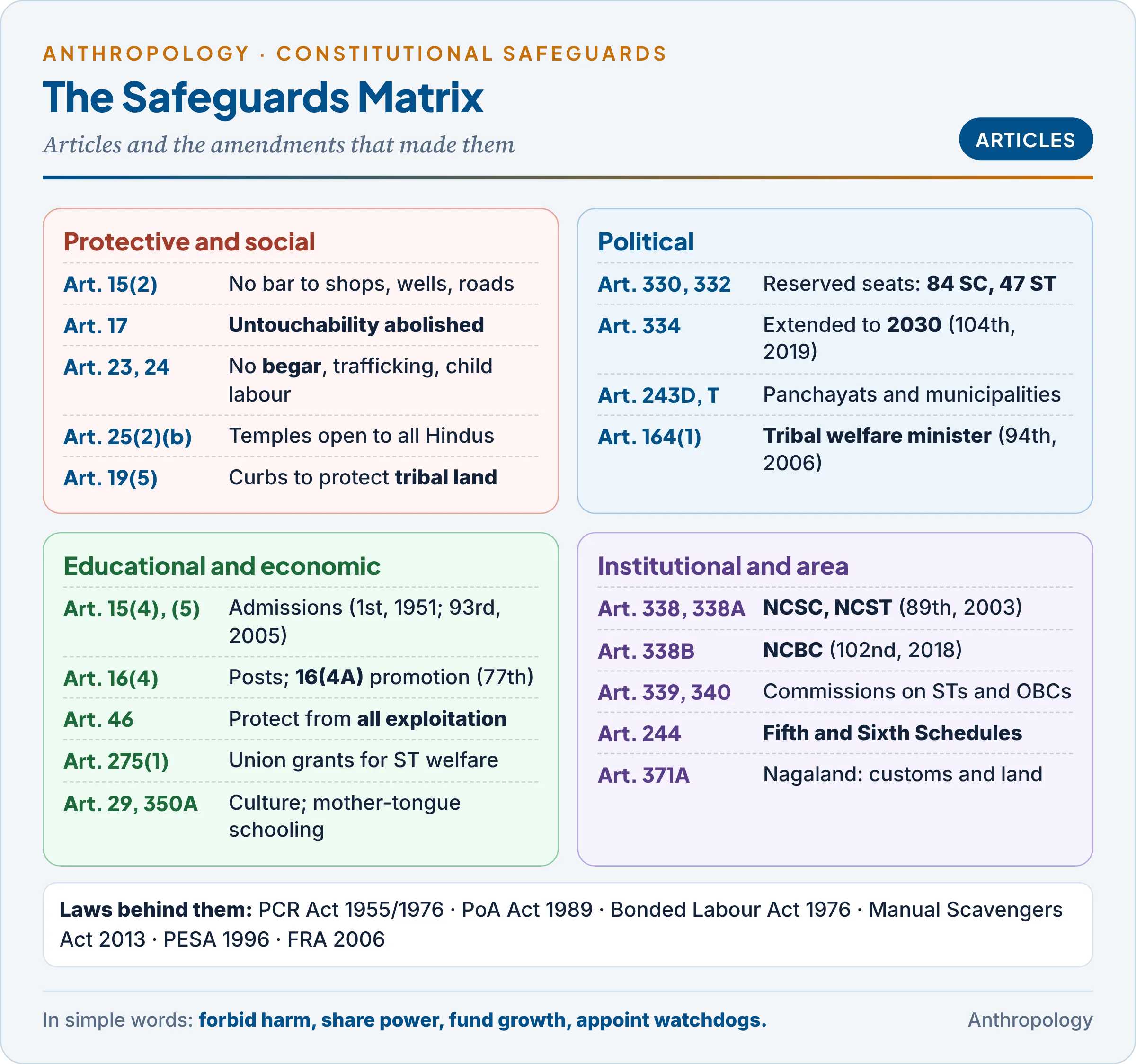
The table groups the main provisions by type. It is the core reference for this unit.
| Type | Provision | What it does |
|---|---|---|
| Equality and non-discrimination | Art. 14, 15(1), 15(2) | Bars discrimination by caste, including access to shops, wells, roads and public places |
| Abolition of untouchability | Art. 17 | Abolishes untouchability “in any form”; its enforcement is an offence |
| Against forced labour | Art. 23, 24 | Bars traffic in persons, begar and child labour in hazardous work |
| Religious access | Art. 25(2)(b) | Allows laws opening Hindu temples to all classes |
| Culture and language | Art. 29, 350A | Right to conserve a distinct language and culture; primary education in the mother tongue |
| Tribal property | Art. 19(5) | Permits restrictions on movement, residence and property to protect STs |
| Education | Art. 15(4) (1st Amendment, 1951); 15(5) (93rd, 2005) | Special provisions and reservation in admissions, including private unaided institutions |
| Public employment | Art. 16(4); 16(4A) (77th, 1995); 16(4B) (81st, 2000); 335 proviso (82nd, 2000) | Reservation in posts, in promotion, carry-forward of vacancies, relaxed standards |
| Directive | Art. 46 | State to promote educational and economic interests of SCs, STs and weaker sections and protect them from social injustice and all forms of exploitation |
| Political | Art. 330, 332, 334 | Reserved seats in Lok Sabha (84 SC, 47 ST) and assemblies, now until 2030 |
| Local bodies | Art. 243D, 243T | Reserved seats and chairpersons in panchayats and municipalities in proportion to population |
| Tribal welfare minister | Art. 164(1) proviso (94th, 2006) | Minister for tribal welfare in Chhattisgarh, Jharkhand, Madhya Pradesh, Odisha |
| Funds and directions | Art. 275(1); 339 | Union grants for ST welfare and Scheduled Areas; Commission on Scheduled Areas; Union directions to states |
| Commissions | Art. 338 (NCSC), 338A (NCST, 89th, 2003), 338B (NCBC, 102nd, 2018), 340 | Watchdog bodies; commission on backward classes |
| Lists | Art. 341, 342, 342A, 366(24), 366(25) | Notification of SCs, STs and the central OBC list |
| Areas | Art. 244, 244A; Fifth and Sixth Schedules; Art. 371A, 371B, 371C, 371G | Scheduled Areas, Tribal Areas and special provisions for the North-East |
| Statutes | PCR Act 1955; PoA Act 1989; Bonded Labour Act 1976; Manual Scavengers Act 2013; PESA 1996; FRA 2006 | Penal protection, freedom from bondage, self-rule and forest rights |
Three ideas run through the table. Protective provisions punish what others do to these groups; compensatory provisions (reservation) give a share of public goods; developmental and administrative provisions build capacity and give special areas their own rules.
5.3 Key provisions explained
- Article 15(4) was added in 1951 after the Supreme Court in State of Madras v. Champakam Dorairajan (1951) struck down caste-based admissions; it allows special provisions for advancement, not only quotas (fee waivers, hostels, relaxed marks).
- Article 16(4) allows reservation where a backward class is “not adequately represented” in services; Article 335 asks that this be consistent with efficiency of administration, a phrase courts have read as a balance, not a veto. In Jarnail Singh v. Lachhmi Narain Gupta (2018) the Court held that states need not prove the backwardness of SCs and STs for reservation in promotion, but may apply the creamy-layer test to them.
- Article 275(1) grants are meant for specific schemes approved by the Union; in practice they have often been released without such scheme-wise approval. Article 339(2) lets the Union direct states on ST welfare schemes, a power rarely used.
5.4 Laws against untouchability and atrocities
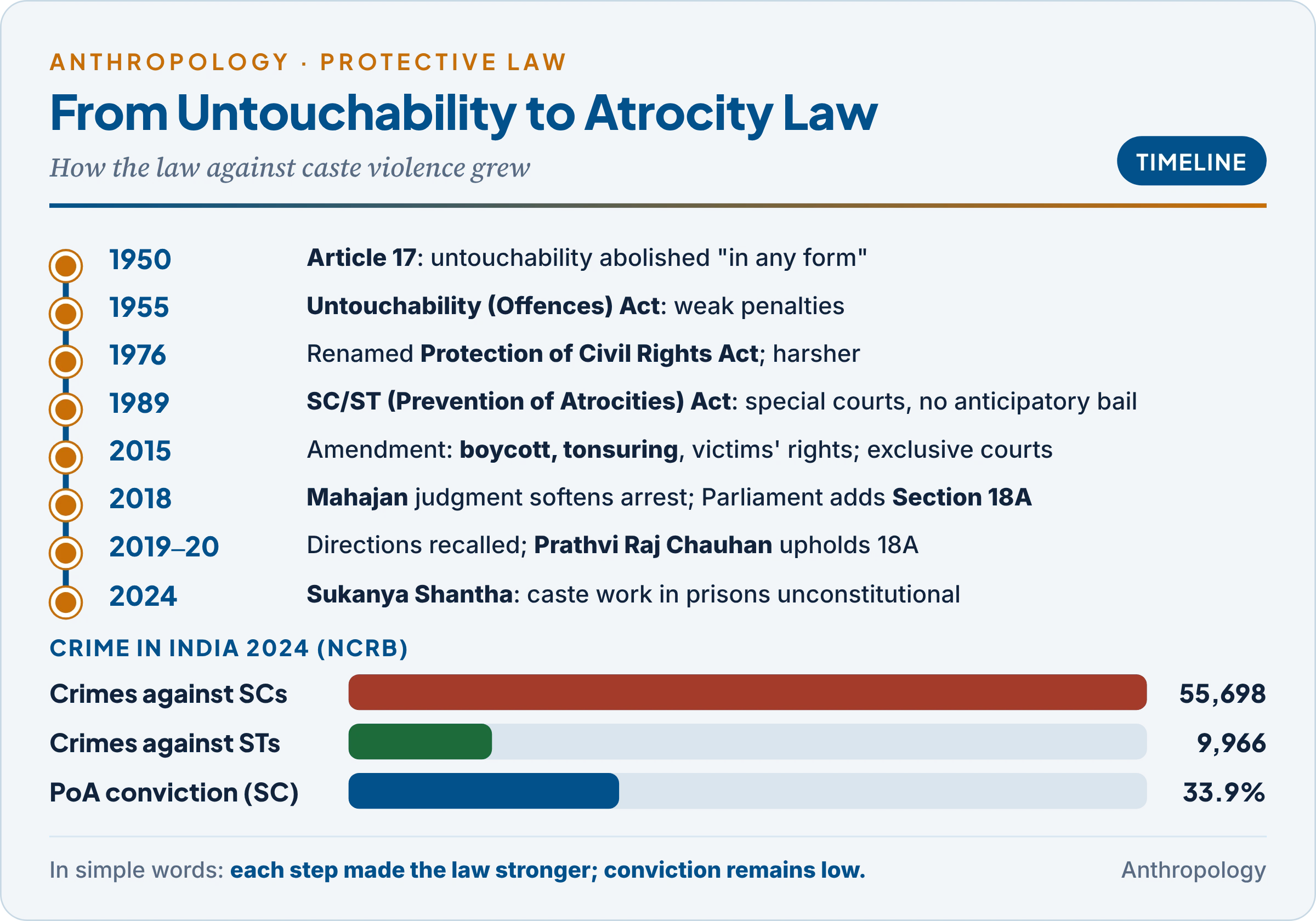
- Untouchability (Offences) Act, 1955: first law under Article 17, with weak penalties; renamed the Protection of Civil Rights (PCR) Act in 1976, with heavier penalties and special courts.
- Scheduled Castes and Scheduled Tribes (Prevention of Atrocities) Act, 1989: defines atrocities by non-SC/ST persons against SCs and STs (forcing inedible substances, parading naked, land grabbing, forced labour, sexual exploitation), sets up special courts and bars anticipatory bail (Section 18).
- 2015 amendment (in force 26 January 2016): new offences such as tonsuring, garlanding with footwear, social or economic boycott, obstructing voting, dedicating a woman as a devadasi; exclusive special courts; a chapter on the rights of victims and witnesses.
- 2018 amendment: in Subhash Kashinath Mahajan v. State of Maharashtra (20 March 2018) the Court allowed a preliminary enquiry and approval before arrest to prevent misuse. After nationwide protests, Parliament inserted Section 18A (no preliminary enquiry, no prior approval, no anticipatory bail). The Court recalled its directions on review (1 October 2019) and upheld Section 18A in Prathvi Raj Chauhan v. Union of India (10 February 2020), while allowing courts to quash plainly false cases.
- Data (NCRB, Crime in India 2024): crimes against SCs 55,698 (rate 27.7 per lakh SC population), against STs 9,966 (rate 9.5); conviction rate under the PoA Act 33.9% (SC cases) and 33.2% (ST cases). In 2023, Uttar Pradesh (15,130 cases) recorded the most crimes against SCs.
5.5 Recent judgments
- State of Punjab v. Davinder Singh (1 August 2024): states may sub-classify SCs on empirical data (detail in 3.2b).
- Chinthada Anand v. State of Andhra Pradesh (24 March 2026): SC status ends on conversion out of Hinduism, Sikhism or Buddhism, so a convert cannot invoke the PoA Act as an SC; ST status does not end by conversion alone (3.2a).
- Sukanya Shantha v. Union of India (3 October 2024): caste-based allotment of work in prisons is untouchability (Article 17) and forced labour (Article 23).
- Janhit Abhiyan v. Union of India (7 November 2022): upheld the 10% EWS quota (103rd Amendment, 2019), which excludes SCs, STs and OBCs.
5.6 Commissions as watchdogs
| Stage | Body | Basis |
|---|---|---|
| 1950 | Special Officer (Commissioner for SCs and STs) | Original Article 338 |
| 1978 | Non-statutory Commission for SCs and STs | Government resolution |
| 1990 | National Commission for SCs and STs | 65th Amendment (constituted 1992) |
| 2004 | NCSC (Art. 338) and NCST (Art. 338A) | 89th Amendment, 2003, which split the body |
| 1993 / 2018 | NCBC: statutory, then constitutional (Art. 338B) | NCBC Act 1993; 102nd Amendment |
| 1994 | National Commission for Safai Karamcharis | Statutory body for sanitation workers |
The commissions have civil-court powers in inquiries, but their advice is not binding. The 2003 split recognised that tribal issues (land, forests) differ from SC issues (untouchability, atrocities).
6. The Fifth Schedule and Scheduled Areas
In simple words
The Fifth Schedule covers tribal areas in ten states of central and western India. It makes the Governor a special guardian: he can stop unsuitable laws from applying and make rules to stop tribal land from passing to outsiders. In practice these powers have been little used.
Example first: the Governor’s veto in Jharkhand. In 2017 the Jharkhand Governor, Droupadi Murmu, later India’s first tribal President, returned the state’s bills amending the Chotanagpur and Santhal Pargana Tenancy Acts, which would have eased the use of tribal land for non-agricultural purposes, after protests that the changes would aid land alienation. It is one of the few occasions when a Governor visibly acted as the Fifth Schedule intends.
6.1 Colonial foundations
The Fifth and Sixth Schedules adapted, rather than invented, colonial devices of special administration.
- Scheduled Districts Act, 1874: special officers and selective extension of laws in “backward” districts.
- Inner Line (Bengal Eastern Frontier Regulation, 1873): permits needed to enter hill areas of the North-East, still in force in some states.
- Government of India Act, 1919: “backward tracts” kept out of the reformed legislatures.
- Government of India Act, 1935 (Sections 91–92): “Excluded Areas” (governed directly by the Governor) and “Partially Excluded Areas” (laws applied only with modifications).
- Constituent Assembly: sub-committees under Gopinath Bordoloi (North-East) and A.V. Thakkar (other areas) recommended autonomous councils and Tribes Advisory Councils.
The continuity is real (special powers, selective laws), but the purpose changed from colonial control to protection with development and, in the Sixth Schedule, self-government.
6.2 Scheduled Areas
- Declaration: by the President (para 6), after consulting the Governor; he may increase, decrease or redefine them.
- Criteria: preponderance of tribal population, compactness and reasonable size, a viable administrative unit (district, block or tehsil), and economic backwardness compared with neighbouring areas.
- Where: ten states: Andhra Pradesh, Telangana, Chhattisgarh, Gujarat, Himachal Pradesh, Jharkhand, Madhya Pradesh, Maharashtra, Odisha and Rajasthan.
6.3 The Governor’s role
- Report to the President annually or when asked (para 3); the Union may direct the state on administration of Scheduled Areas.
- Legislation by notification (para 5(1)): direct that any Act of Parliament or the state shall not apply, or apply with modifications, even retrospectively.
- Legislation by regulation (para 5(2)): for “peace and good government”, especially to prohibit or restrict land transfer by or among STs, regulate land allotment and regulate moneylending; the regulation may repeal any law, needs prior TAC consultation and the President’s assent. The Andhra Pradesh Scheduled Areas Land Transfer Regulation, 1959 is the best-known example; it underlay the Samatha judgment (1997).
- Weakness: under Article 163 the Governor acts on ministers’ advice, so the “guardian” is in practice the state government, whose own projects may threaten tribal land; reports are late and formulaic (Dhebar Commission, 1961).
6.4 Tribes Advisory Council
- Composition: up to 20 members, about three-fourths ST members of the state assembly.
- Where: all ten Scheduled Area states, and by Presidential direction in Tamil Nadu, West Bengal and Uttarakhand.
- Function: advises on matters referred by the Governor; since little is referred, most TACs meet rarely and are advisory in name only.
7. The Sixth Schedule and the North-East
In simple words
The Sixth Schedule gives tribal areas in Assam, Meghalaya, Tripura and Mizoram their own elected councils, which can make laws on land, forests, customs and marriage, run village courts and collect taxes. It is a form of tribal self-government inside a state.
Example first: Bodoland. The Bodo Accord of 2003 created the Bodoland Territorial Council under the Sixth Schedule, and the 2020 accord renamed its area the Bodoland Territorial Region with more powers: the Schedule as both autonomy and a tool for settling ethnic conflict.
7.1 Main features
- Autonomous districts and regions: each autonomous district has a District Council of up to 30 members (not more than 4 nominated, the rest elected); the Governor may create Regional Councils for different tribes within a district.
- Law-making: land and forests (except reserved forest), jhum (shifting cultivation), village administration, chiefs and headmen, inheritance, marriage and social customs; laws need the Governor’s assent.
- Justice: village councils and courts try suits between STs under customary law, subject to the High Court and Supreme Court.
- Finance: land revenue and taxes on professions, animals, vehicles, markets and tolls; a share of mineral royalties.
- Moneylending and trade: councils can license non-tribal moneylenders and traders (regulations passed by three-fourths of members).
- Councils today (10): Assam: Bodoland Territorial Council, Karbi Anglong, Dima Hasao (North Cachar Hills); Meghalaya: Khasi, Jaintia, Garo Hills; Mizoram: Lai, Mara, Chakma; Tripura: Tripura Tribal Areas ADC (under the Sixth Schedule since the 49th Amendment, 1984).
7.2 Fifth and Sixth Schedules compared
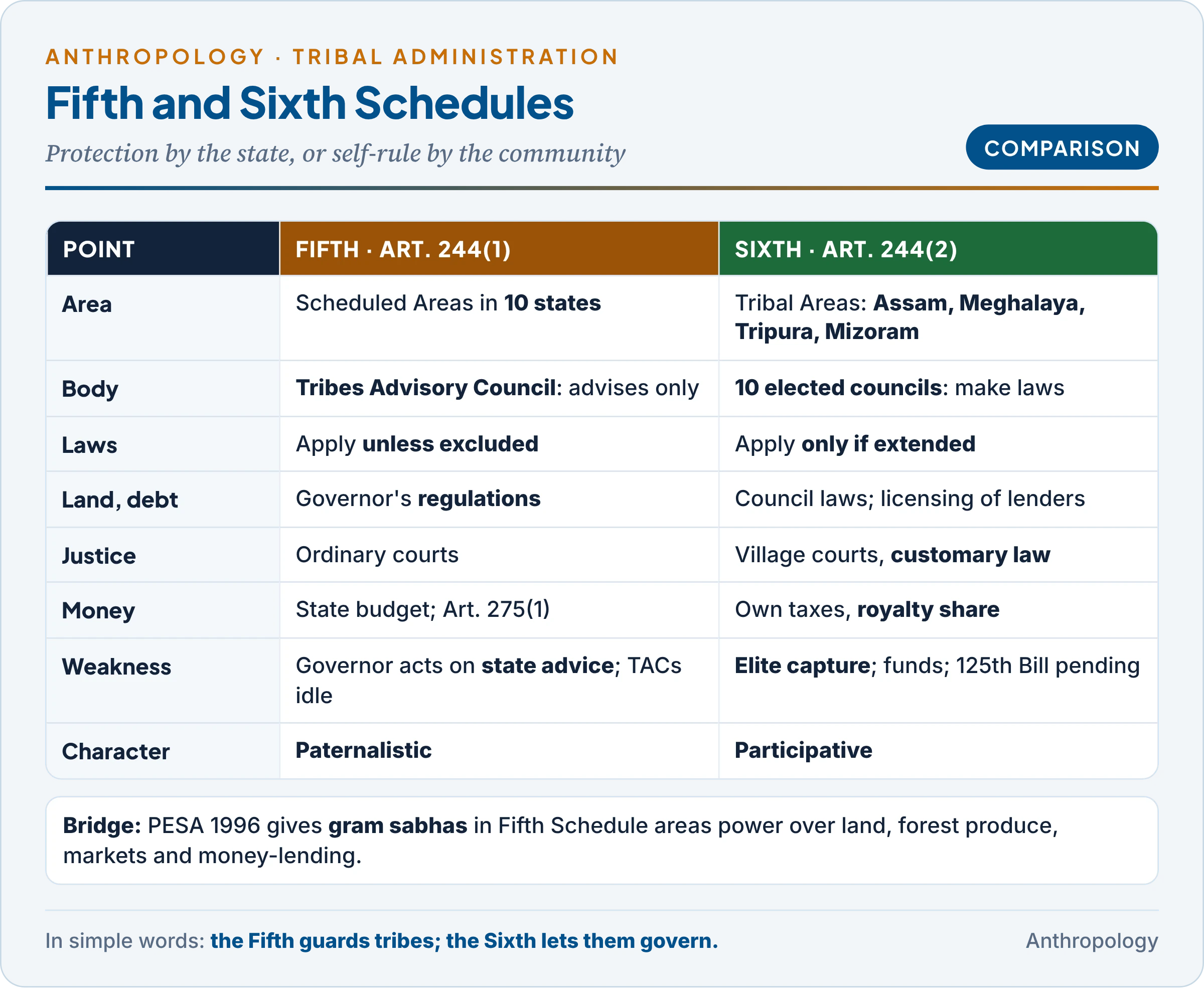
| Point | Fifth Schedule (Art. 244(1)) | Sixth Schedule (Art. 244(2)) |
|---|---|---|
| Area | Scheduled Areas in ten states | Tribal Areas in Assam, Meghalaya, Tripura, Mizoram |
| Body | Tribes Advisory Council (advisory) | District and Regional Councils (elected, legislative) |
| Laws | Apply unless excluded by the Governor | Apply only if extended by the Governor |
| Land and moneylending | Governor’s regulations | Council laws and regulations |
| Justice | Ordinary courts | Village councils and courts under customary law |
| Finance | State budget and Art. 275(1) grants | Own taxes, revenue and royalty share |
| Character | Paternalistic: protection through officials | Participative: self-government |
The contrast is between protection by the state and self-rule by the community. PESA (1996) tried to bring some of the Sixth Schedule’s spirit into Fifth Schedule areas through gram-sabha powers over land, forest produce, markets and moneylending (5.3b).
7.3 Status of Sixth Schedule areas
- Gains: customary law and land protected; tribal leadership developed; ethnic settlements channelled into councils.
- Problems: councils depend on state funds; elite and dominant-tribe capture; minority tribes and non-tribal residents feel excluded; overlapping powers with state departments; councils act only on the subjects listed in the Schedule.
- Reform pending: the Constitution (125th Amendment) Bill, 2019 (introduced 6 February 2019) proposes village and municipal councils, a state finance commission, elections by the State Election Commission, more seats and seats for women; a parliamentary committee reported in 2020, but the Bill has not been passed.
- New demands: Ladakh sought Sixth Schedule status; an in-principle agreement on a special Article 371K (22 May 2026) stalled when Ladakh bodies rejected the Centre’s draft in October 2026.
7.4 Special provisions: Article 371A and others
- Article 371A (Nagaland, 13th Amendment, 1962): no Act of Parliament on (i) religious or social practices of the Nagas, (ii) Naga customary law and procedure, (iii) civil and criminal justice under customary law, or (iv) ownership and transfer of land and its resources applies unless the Nagaland Assembly so resolves; the Governor has special responsibility for law and order, and Tuensang district had special arrangements.
- Articles 371B (Assam), 371C (Manipur, 1971) and 371G (Mizoram, 1986): Assembly committees for tribal and hill areas, and for Mizoram protection like 371A.
7.5 Roy Burman’s “buffer” and “bridge” communities
The anthropologist and administrator B.K. Roy Burman observed that the tribes of the North-East live on the fringe of three great political communities, India, China and Burma, and that historically some acted as “buffer” communities and others as “bridge” communities between them (in K.S. Singh, ed., Tribal Situation in India, 1972). Buffer communities stood between rival powers, keeping them apart; bridge communities carried trade and cultural exchange across frontiers. The idea explains why frontier tribes value autonomy and cross-border kinship, and why the Sixth Schedule and Article 371 provisions were written for them.
- ILO conventions: India ratified ILO Convention 107 (1957) in 1958, which is still in force for it, but has not ratified Convention 169 (1989), which stresses self-identification and consultation with indigenous peoples.
8. Committees and Commissions: A Chronology
The chronology shows how policy moved from listing and protection to self-rule and rights.
| Year | Body | Contribution |
|---|---|---|
| 1953–55 | Kalelkar Commission | First OBC lists |
| 1960–61 | Dhebar Commission (Scheduled Areas and STs, Art. 339) | Four layers of development among tribes; lowest layer later became PTGs |
| 1965 | Lokur Committee | Criteria for ST status (6.1) |
| 1965–69 | Elayaperumal Committee | Untouchability and the condition of SCs |
| 1969 | Shilu Ao Study Team | Tribal development programmes; tribal response to panchayats |
| 1979–80 | Mandal Commission | 11 indicators; 27% OBC reservation |
| 1995 | Bhuria Committee | Basis of PESA 1996 |
| 2002–04 | Bhuria Commission (Art. 339) | Land, forests, PESA, Tribal Sub-Plan review |
| 2014 | Xaxa Committee | Socio-economic, health and educational status of tribes |
| 2022– | K.G. Balakrishnan Commission | SC status for converts to other religions |
9. How Far Have the Safeguards Worked?
In simple words
The safeguards have created a Dalit and Adivasi presence in legislatures, offices and universities that did not exist in 1950. But atrocities, landlessness, manual scavenging and low convictions show that protection on paper has not ended exploitation on the ground, and the benefits have reached some groups far more than others.
9.1 Achievements
- Representation: 84 SC and 47 ST Lok Sabha seats; SC and ST members in every assembly and in lakhs of panchayat posts; Presidents K.R. Narayanan and Ram Nath Kovind (SC) and Droupadi Murmu (ST, from 2022).
- Education: SC literacy rose from about 10% (1961) to 66.1% (2011); ST literacy to 59%. Post-matric scholarships, hostels and reservation created the first educated generation in many families.
- Mobility: reservation produced a Dalit and Adivasi middle class of officials, teachers and professionals, a base for political assertion and for Dalit entrepreneurship (the Dalit Indian Chamber of Commerce and Industry, 2005).
9.2 Shortfalls
- Uneven benefits: the better-off sub-castes and urban families take most seats and jobs; hence sub-classification and creamy-layer debates.
- Persisting violence and impunity: conviction rates near one-third, long trials and 2.87 lakh SC atrocity cases pending trial at the end of 2024.
- Land: land reform and restoration of alienated tribal land remain weak; the Fifth Schedule’s land powers are seldom used.
- Shrinking public sector: reservation does not apply to the private sector, where most new jobs are.
- Funds: much earmarked plan money goes to general, not targeted, schemes.
- Implementation: Governors’ reports, TACs and Article 339 directions exist mainly on paper.
9.3 Merits and demerits of reservation
| Merits | Demerits |
|---|---|
| Compensates for historical exclusion and gives groups a stake in the state | Benefits concentrated in a creamy layer |
| Creates role models and a professional class | Can harden caste identity and competition for backward status |
| A study of the Indian Railways (2014) found no loss of efficiency | Ignores the private sector and quality of schooling |
9.4 Way forward
- Land and livelihood first: restore alienated land; enforce PESA and FRA.
- Quality education: mother-tongue primary schooling (Article 350A), residential schools, timely scholarships.
- Swift justice: exclusive special courts, witness protection, time-bound trials; full mechanisation of sanitation work.
- Data and social reform: caste data from Census 2027 for targeting; campaigns against untouchability, since law alone cannot change values.
Key Terms
| Term | Meaning in simple words |
|---|---|
| Exploitation | Unfairly taking another group’s labour, land, produce or body |
| Deprivation | Lacking resources, rights or dignity that others have |
| Untouchability | Treating a group as ritually polluting; banned by Article 17 |
| Atrocity | A crime by a non-SC/ST person against an SC or ST person, as listed in the 1989 Act |
| Protective discrimination | Special treatment of disadvantaged groups to achieve real equality |
| Creamy layer | The better-off section of a backward class, excluded from some benefits |
| Sub-classification | Dividing a reserved category into groups by backwardness |
| Scheduled Area | Tribal area notified under the Fifth Schedule |
| Tribal Area | Area under the Sixth Schedule with an autonomous council |
| Tribes Advisory Council | Body of mainly ST legislators advising on tribal welfare |
| Autonomous District Council | Elected tribal council that makes laws under the Sixth Schedule |
| Denotified tribes | Communities once branded “criminal” under the 1871 Act |
| Manual scavenging | Handling human excreta by hand; banned in 1993 and, more widely, in 2013 |
| Bonded labour | Work without free choice to repay a debt |
| Recognition | Being accepted as an equal and respected group |
Contemporary Developments
- Crime data: Crime in India 2024 records 55,698 crimes against SCs and 9,966 against STs, with PoA Act conviction rates of about one-third.
- Sanitation work: 498 sewer and septic-tank deaths from 2019 to June 2026; the NAMASTE scheme (July 2023) promotes mechanised cleaning.
- Judgments: Davinder Singh (2024) on sub-classification; Sukanya Shantha (2024) on caste in prisons; Chinthada Anand (2026) on conversion and SC status.
- Ladakh: an agreement in principle on a special Article 371K (May 2026) stalled in October 2026.
- Census 2027: caste will be enumerated for the first time since 1931, informing OBC and SC sub-classification.
Diagrams to Master
- Topic map: three groups → exploitation and deprivation → four kinds of safeguard → schedules and laws.
- Deprivation profile: SC, ST and OBC by root, mechanism, indicator and remedy.
- Safeguards matrix: four blocks of articles with amendment numbers.
- Fifth vs Sixth Schedule: body, laws, land, justice, finance, weaknesses; PESA as bridge.
- Anti-atrocity law timeline: 1950 → 1955 → 1976 → 1989 → 2015 → 2018 → 2020 → 2024, with NCRB data.
Revision Grid
| Scholar or body | Work (year) | Key idea |
|---|---|---|
| B.R. Ambedkar | The Untouchables (1948) | Untouchables as “Broken Men”; not a separate race |
| J.H. Hutton | Caste in India (1946) | Exterior castes: racial, religious and customary roots |
| W.G. Runciman | Relative Deprivation and Social Justice (1966) | Deprivation is felt against a reference group |
| Joan Mencher | “The Caste System Upside Down” (1974) | Lower castes see caste as economic exploitation |
| Marc Galanter | Competing Equalities (1984) | History and law of “backward classes” and reservation |
| Charles Taylor | “The Politics of Recognition” (1992) | Misrecognition as a harm |
| B.P. Mandal | Backward Classes Commission (1980) | 11 indicators; 27% |
| U.N. Dhebar | Scheduled Areas and STs Commission (1961) | Layers of tribal development |
| B.K. Roy Burman | In Tribal Situation in India (1972) | Buffer and bridge communities of the North-East |
| Supreme Court | Indra Sawhney (1992) | 50% ceiling; creamy layer |
| Supreme Court | Prathvi Raj Chauhan (2020) | Section 18A upheld |
| Supreme Court | Sukanya Shantha (2024) | Caste in prison manuals unconstitutional |
Previous Year Questions
7.1 Problems of exploitation and deprivation of Scheduled Castes, Scheduled Tribes and Other Backward Classes. Constitutional safeguards for Scheduled Tribes and Scheduled Castes.
- 2026Write notes on: Article 371A of the Indian Constitution.
- 2026What are the provisions given in the Constitution of India for the safeguard of the Scheduled Caste populations?
- 2025What are the identifying criteria for PVTGs in India? Examine their current status, nomenclature and distribution.
- 2025Trace the history and describe the methods of formulating the lists of OBCs, both at the State and National levels.
- 2024Write notes on: Status of Sixth Schedule Areas.
- 2024Write notes on: Constitutional Safeguards for Backward Classes.
- 2024Write notes on: B. K. Roy Burman’s concept of ‘Buffer Zone’
- 2024Write notes on: Describe ILO’s Convention No. 169 on Indigenous and Tribal people. Is India a signatory to it?
- 2023Write notes on: Scheduled areas.
- 2022Write notes on: Role of the Governor in the Fifth Schedule areas.
- 2022Discuss the issues and solutions related to the Scheduled Caste and the Scheduled Tribe populations in India.
- 2021Write short notes on “Politics of recognition and deprivation” in about 150 words.
- 2020Describe the provisions under 6th Schedule of Indian Constitution.
- 2020Critically evaluate the state of implementation of the constitutional safeguards for the scheduled castes.
- 2019What are the constitutional safeguards to protect the interests of the Indian tribes?
- 2018Write a note in 150 words on Tribe and scheduled tribe.
- 2018Discuss the salient features of PESA Act of 1996 and attempt a comparison with the features of the VI Schedule.
- 2017Critically discuss the constitutional safeguards for the Scheduled Castes.
- 2017Write a note in 150 words on Other Backward Class.
- 2016Examine the factors responsible for the exploitation of scheduled castes in India.
- 2016Write in detail various provisions provided by the Constitution of India for the scheduled tribes under Vth and VIth Schedules.
- 2015Write a note in 150 words on Role of Governor in Fifth Schedule Areas.
- 2014Critically examine the constitutional provisions for safeguarding the interests of Scheduled Tribes in India.
- 2013Fifth Schedule and Sixth Schedule of the Constitution are built on the foundations laid by the colonial Government. Discuss. (250 words).
- 2013Discuss how British policies dispossessed tribals of their communal properties and agricultural lands.
- 2013Discuss the Social disabilities suffered by scheduled castes.
- 2010Write a note in 150 words on The problem of bonded labour among Indian tribes.
- 2009Write a note on Fifth Schedule of the Constitution.
- 2007Write a note on Constitutional Safeguards for Scheduled Castes.
- 2004Write a note on National Commission for SCs and STs.
- 2002Critically examine the merits and demerits of reservation policy for the ‘Scheduled tribes, Scheduled castes and other Backward classes.
- 2002Do you think that exploitation emanates from clash of self interest between groups? Discuss in the context of tribals , and non-tribals.
- 1996Write a note on Constitutional safeguards for the Scheduled Castes.
- 1995Write a note on : Distinguish between exploitation and deprivation of Scheduled Castes.
- 1994Write a note on Constitutional safeguards for the scheduled tribes.
- 1993What are the major socio-economic problems faced by the Scheduled castes ? Point out the criteria for diagnosis and suggest the remedial measures.
- 1991Evaluate the extent to which existing reservations for scheduled castes and scheduled tribes have led to social mobility among them. What suggestions would you make for implementing to policy of adding an economic in extending reservation to the so-called ‘forward’ castes ?
- 1990Discuss the provisions and significance of the protective discrimination policy towards scheduled caste. Assess its impact on their social mobility.
- 1987Write a note on Constitutional safeguards for scheduled tribes.
- 1986Analyse the programmes for tribal welfare undertaken Governments in terms of relevant constitutional and statutory provisions.
- 1985Identify the main problems of the scheduled castes and discuss the measures adopted to solve them.
- 1984Write a note in 200 words: Types of subsistence economy of Indian tribes.
- 1982Write an essay on the social disabilities experienced by the scheduled castes and discuss the important efforts made to alleviate the same.
- 1981Discuss some of the important provisions in our Constitution which are meant to protect the interest of scheduled castes and scheduled tribes. What is the impact of these provisions have so far had on the weaker sections?
Related questions from other units
- 2023Unit 5.2: How are Other Backward Classes identified? Enumerating the important features, elucidate the recent changes in their social and economic life.
- 2018Unit 5.2: Write a note in 150 words on OBCs among non-Hindu communities.
- 2015Unit 8.2: Critically compare ‘Affirmative Action’ of USA and ‘Protective Discrimination for Scheduled Tribes in India.
- 2004Unit 3.4: Write a note on Buddhism, Christianity and Scheduled Castes.
- 2003Unit 9.1: Write a note on Implications of recent Presidential orders relating to Scheduled Tribes and Scheduled Castes.
- 2001Unit 6.1: Write a note on Scheduled Area.
- 2000Unit 7.3: Outline the historical background of tribal administration during the colonial period. Evaluate post-Independence administrative policies with special reference to states under either the Fifth Schedule or Sixth Schedule of the Constitution of India.
- 1990Unit 5.3: Write a note on Sanskritization as a factor of social change among the scheduled castes in India.
- 1988Unit 7.3: Assertion of ethnic identity and ethnic solidarity has been a pervasive process in India after Independence. Analyse this in relation to constitutional safeguards and emerging national integration.
- 1986Unit 6.2: Define untouchability and point out whether the problems of its removal should be treated as a matter of social reform rather than as part of administrative and legal measures.
More from Scheduled Castes, Scheduled Tribes and OBCs: all notes of this unit · every PYQ of this unit · Anthropology Optional hub