- Space and place are the two most basic concepts in geography. How geographers have defined them has shaped what kind of explanation the discipline offers.
- Space has been seen as a container, as a set of distances, and as a web of social relations.
- Place has been seen as a location, as a lived and meaningful setting, and as a meeting point of global flows.
- The socio-spatial dialectic, a term coined by Edward W. Soja (1980), holds that society and space shape each other continuously.
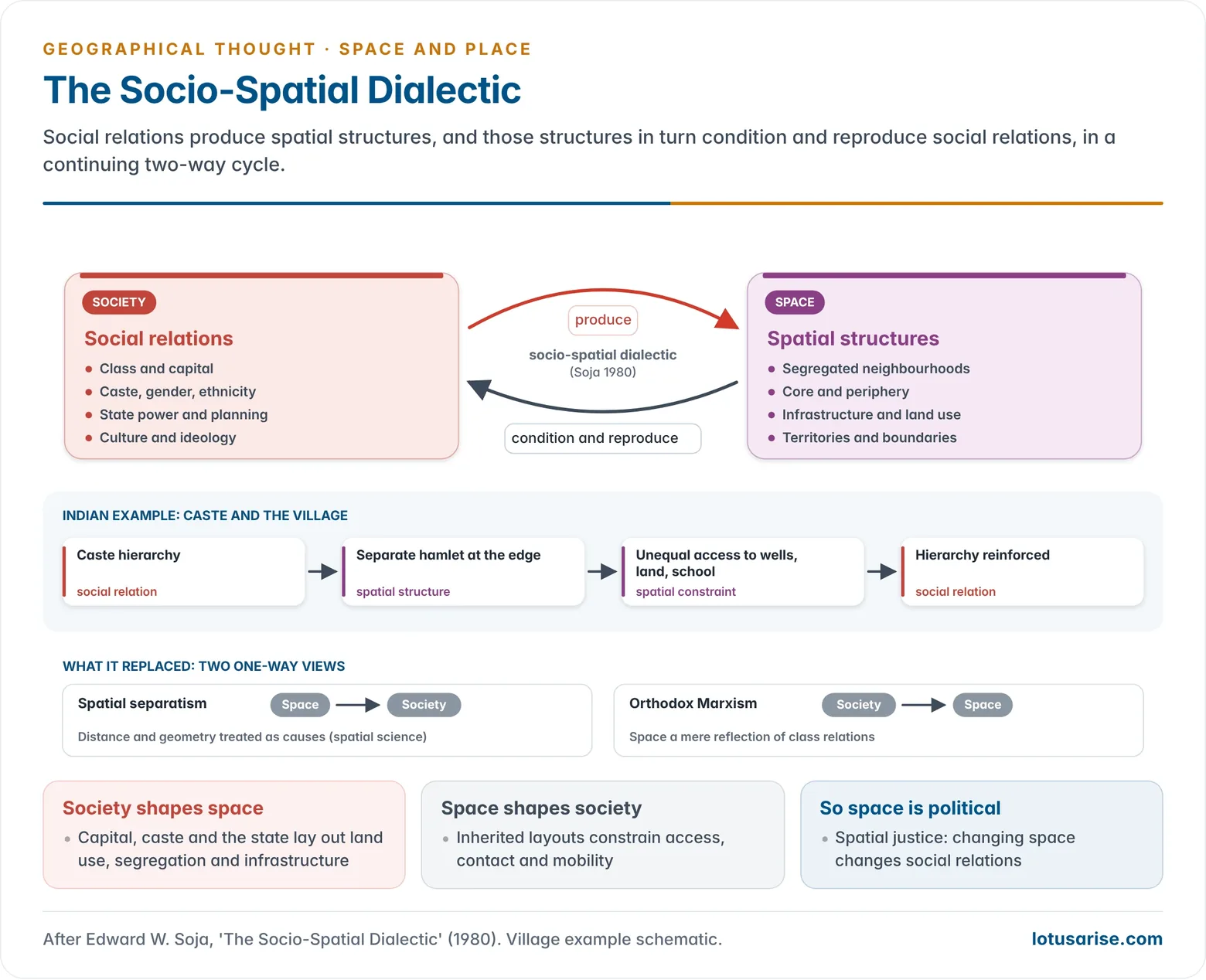
- Social relations produce spatial structures, and those spatial structures in turn condition social relations.
- The idea grew out of the radical and postmodern critiques of spatial science. Its main sources were Henri Lefebvre’s The Production of Space (1974) and David Harvey’s work on capital and space.
Concepts of Space

Space, Place and Location
- Space is the wider and more abstract idea. It covers extension, distance, direction and arrangement. James M. Blaut (1961) called it “a treacherous philosophical word”.
- Place is a portion of space that has been given identity, meaning and use by people.
- John Agnew (1987) gave place three aspects:
- Location: where a place sits in the wider economic and political order, as shaped by uneven development, state policy and segregation.
- Locale: the settings of everyday social interaction, such as homes, workplaces and streets.
- Sense of place: the subjective attachment and identity that living in a place produces.
- Robert Sack (1993) showed how space and place work at three levels:
- in or out of place: territory and power;
- spatial interaction: cause and effect across distance;
- surface and depth: appearance and meaning.
Absolute, Relative and Relational Space
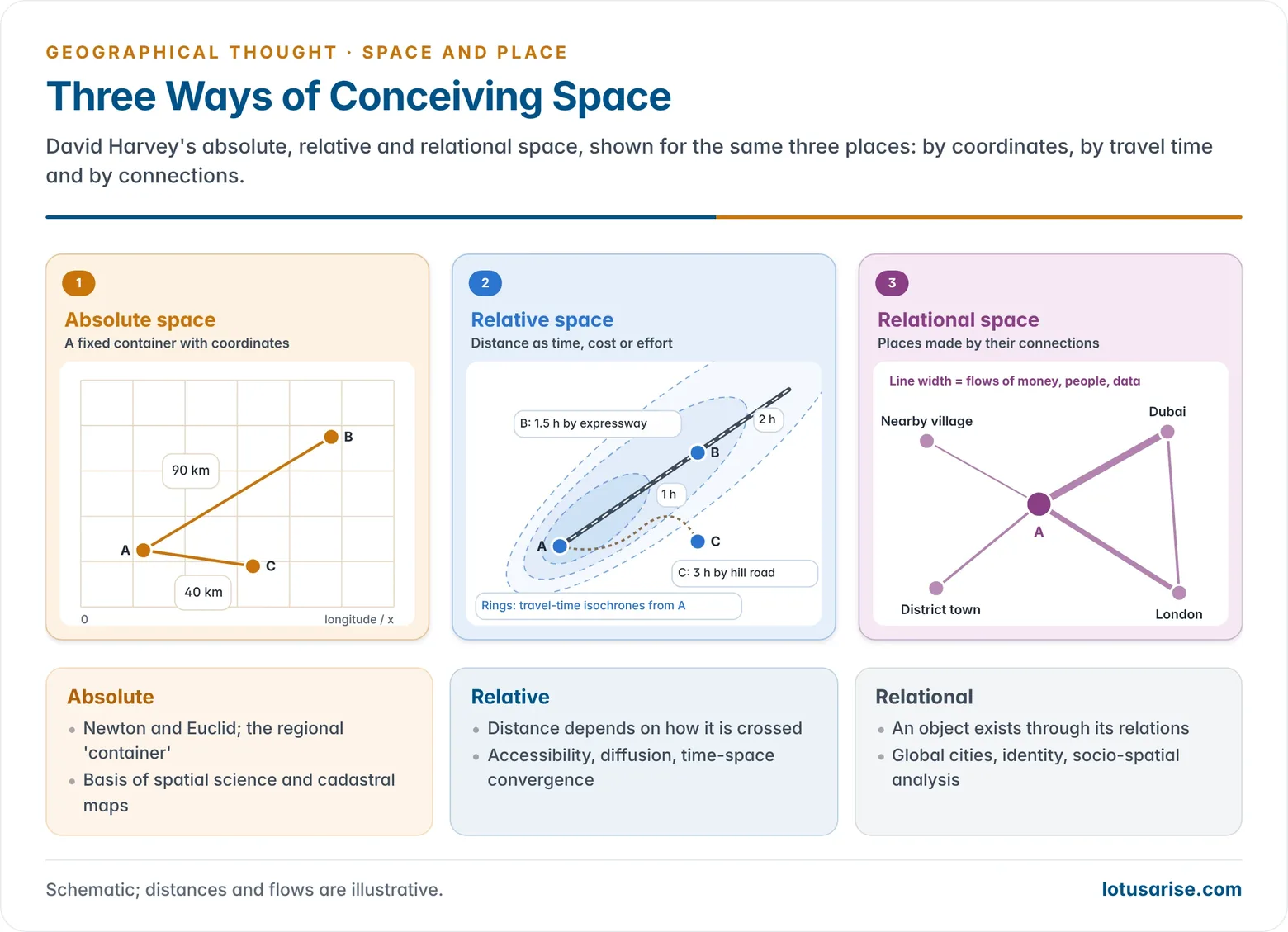
- David Harvey (Social Justice and the City, 1973) distinguished three ways of conceiving space. He argued that the question “what is space?” is answered through human practice: different practices create and use different conceptions of space.
| Concept | Meaning | Measured by | Typical use |
|---|---|---|---|
| Absolute space | A fixed, real container, independent of what fills it | Euclidean coordinates, area, straight-line distance | Surveying, cadastral maps, location on a grid |
| Relative space | Space defined by relations between objects and by movement | Travel time, cost, connectivity | Accessibility, diffusion, time-space convergence |
| Relational space | Space exists only in the relations that objects contain | Flows, networks, meanings, power | Global cities, identity, socio-spatial analysis |
- Older roots: Immanuel Kant classed geography as the science of things side by side in space, as history is of things in time. Richard Hartshorne (1939) built areal differentiation on that chorological view, which treated regions as containers of unique content.
- Absolute space goes back to Isaac Newton’s physics and Euclid’s geometry. In geography it underlies the “container” view of regions.
- Relative space reflects the post-Newtonian idea that distance depends on how it is crossed.
- Donald Janelle’s time-space convergence (1968) showed places “moving closer” as travel time fell.
- Blaut (1961) defined relative space as bound to time and process.
- Relational space holds that an object exists only through its relations to other objects. A city’s “position” lies in its links of trade, migration and information, not in its coordinates.
- In this view spatial analysis becomes social analysis, because relations of class, caste, gender and ethnicity are written into places and landscapes.
The Physical View of Space and Spatial Analysis
- The quantitative revolution adopted a physical, geometric view of space. Space was an objective, measurable surface, and distance was a friction on movement.
- William Bunge’s Theoretical Geography (1962) declared geometry the language of geography. Fred K. Schaefer (1953) sought spatial laws.
- Effects on the forms of spatial analysis:
- Models on an isotropic plain: von Thünen, Weber, Christaller and Lösch assumed uniform surfaces with movement equally easy in all directions.
- Distance-decay and gravity models: interaction falls with distance and rises with the size of places.
- Point-pattern and nearest-neighbour analysis of settlements; trend surfaces; central place hierarchies.
- Locational analysis: Peter Haggett’s movement, networks, nodes, hierarchies and surfaces (1965); geometric spatial organisation.
- Relative refinements: topology and graph-theoretic network analysis, cost and time distance, and cartograms that redraw maps by travel time or population.
- Critique of the physical view:
- Spatial fetishism: it treated space and distance as causes. Patterns that were really outcomes of social processes were explained by geometry.
- Spatial separatism: Sack (1974) criticised the attempt to explain human patterns through spatial relations alone. Space cannot be separated from what fills it.
- It ignored power, values and meaning, and the fact that different societies produce different spaces.
- Indian illustration: the planning of growth centres and the hierarchy of service centres in Indian regional planning drew on central-place geometry. Rural road planning under PMGSY targets the connectivity of habitations to the all-weather network, a relative, network-based view of space.
- Legacy: the physical view survives, refined, in GIS, remote sensing and spatial data science. These now also map relational flows such as mobile-phone data and migration networks.
Place
Place in Humanistic Geography
- Humanistic geographers of the 1970s made place a concept of experience and meaning.
- Yi-Fu Tuan (Space and Place: The Perspective of Experience, 1977): space is open and abstract. It becomes place as we come to know it and endow it with value.
- Topophilia (1974) is the affective bond between people and place.
- Edward Relph (Place and Placelessness, 1976) distinguished degrees of insideness and outsideness.
- He warned of placelessness: the spread of standardised, inauthentic landscapes such as malls, highways and chain outlets.
- Anne Buttimer studied the lifeworld and the rhythms of dwelling.
- Indian illustration: the sacred geography of tirthas such as Varanasi, Prayagraj and the Char Dham, and the attachment of communities to ancestral villages and kuladevata shrines, express a deep sense of place. Identical highway townships and malls illustrate placelessness.
Place as Process
- Allan Pred (1984) saw place as a historically contingent process: it is always being made, through daily practice, and is never a finished object.
- He drew on Anthony Giddens’s structuration theory and on time geography.
- Place is therefore central to social structuration, not a passive background. Everyday practices in particular places produce a “structure of feeling”.
- In the 1980s, Doreen Massey’s locality studies showed that global economic restructuring works out differently in different places. This helped revive new regional geography.
A Global Sense of Place
- Doreen Massey (1944–2016), in “A Global Sense of Place” (Marxism Today, 1991), rejected the idea that places have a single, fixed, bounded identity rooted in the past.
- A progressive sense of place:
- Places are meeting points of social relations that stretch across the world.
- Their identity is multiple, open and always changing.
- Her example was Kilburn High Road in London, with its Irish, Indian and Muslim connections.
- Time-space compression: the phrase comes from David Harvey’s The Condition of Postmodernity (1989). It describes how faster transport and communication shrink the world and unsettle local identities.
- Power-geometry: different groups stand in very different relations to global flows. Some control movement and some are trapped by it, so time-space compression is uneven.
- In For Space (2005) she argued that space is the product of interrelations, the sphere of multiplicity, and always under construction.
| Thinker | Work | View of place |
|---|---|---|
| Yi-Fu Tuan | Space and Place (1977) | Space endowed with value; pause in movement |
| Edward Relph | Place and Placelessness (1976) | Insideness; threat of placelessness |
| John Agnew | Place and Politics (1987) | Location, locale and sense of place |
| Allan Pred | “Place as historically contingent process” (1984) | Place as ongoing practice |
| Doreen Massey | “A Global Sense of Place” (1991) | Open, relational meeting point; power-geometry |
The Social Production of Space
Why Space Was Neglected
- From about 1880 to 1920, social theory came to give time priority over space. History became the active force and geography only the stage.
- Michel Foucault remarked that space had been treated as “the dead, the fixed, the undialectical, the immobile”, while time was richness and life.
- Marxism, too, was historicist. It explained uneven development through class struggle in time and saw geography as a minor complication.
- Geography isolated itself as well. After rejecting environmental determinism, it retreated into the description of areal differentiation and Kantian chorology.
- From the late 1960s, Western Marxism and geography began to exchange ideas. After 1980 the flow ran both ways, which produced calls for a historical-geographical materialism.
Lefebvre: The Production of Space
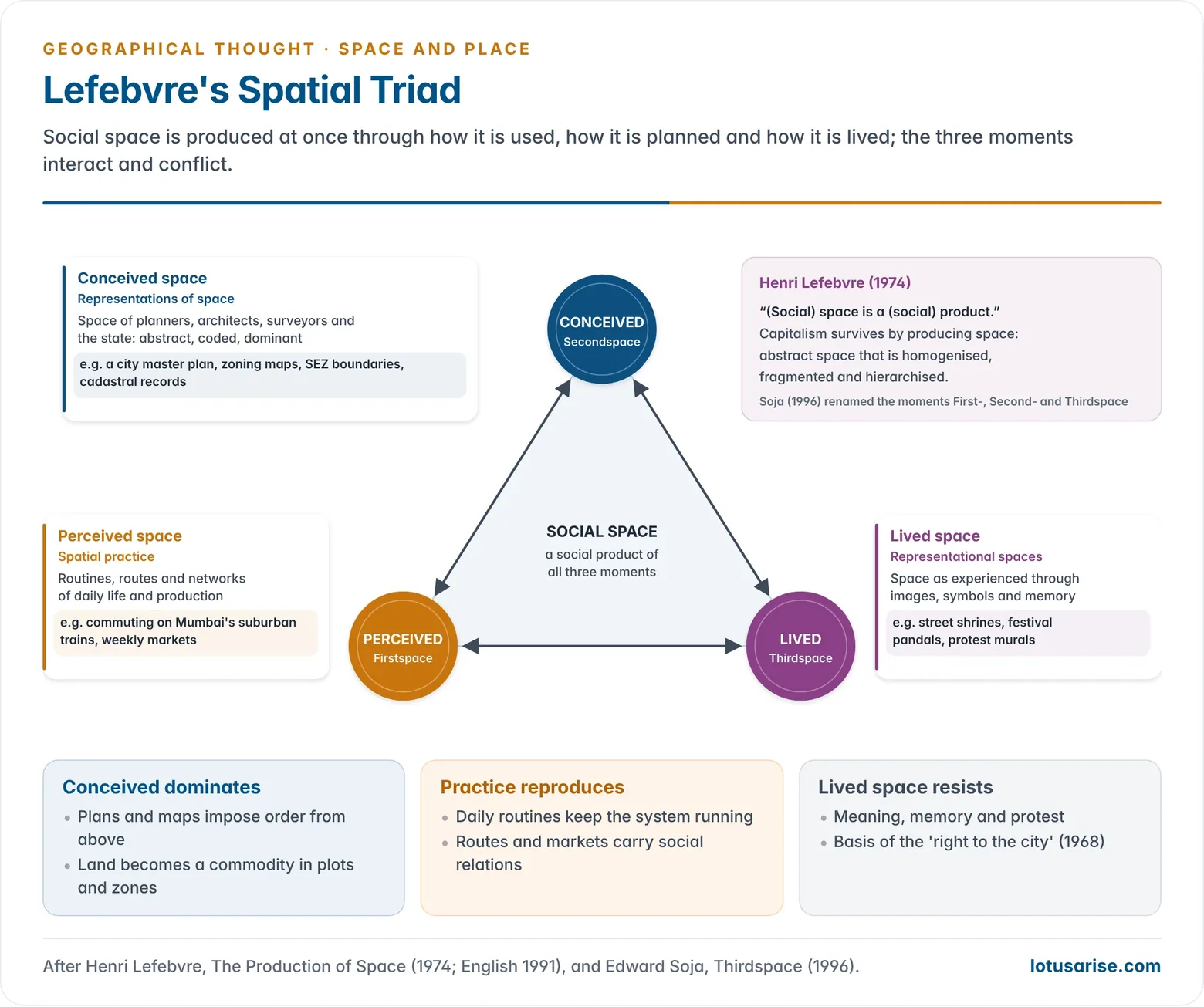
- Henri Lefebvre (1901–1991), a French Marxist philosopher, argued in La Production de l’espace (1974; English translation 1991) that “(social) space is a (social) product”.
- Space and the survival of capitalism: capitalism had survived its contradictions for a century by occupying space and producing space. Examples are urbanisation, planned new towns and the organisation of everyday life.
- Space is political: it may look neutral and purely formal, but it is shaped through political processes and is “filled with ideologies”.
- Abstract space: capitalism produces space that is homogenised, fragmented and hierarchised. It is bought and sold in plots, zoned by planners, and ranked from centre to periphery.
- The spatial triad:
- Spatial practice (perceived space): the routines, routes and networks of daily life and production.
- Representations of space (conceived space): the space of planners, architects, surveyors and the state, expressed in maps, plans and master plans.
- Representational spaces (lived space): space as experienced through images and symbols by its inhabitants. It is the space of resistance and of art.
- Differential space: Lefebvre hoped for a future space that would restore difference, use value and the body against abstract space.
- The right to the city (Le Droit à la ville, 1968): inhabitants’ claim to shape urban space against its conversion into a commodity.
Soja’s Socio-Spatial Dialectic
- Edward W. Soja (1940–2015) set out the idea in “The Socio-Spatial Dialectic” (Annals of the Association of American Geographers, 1980).
- Social relations and spatial relations are dialectically inter-reactive and interdependent. Social relations of production are both space-forming and space-contingent.
- Organised space is neither a separate structure with its own laws, as spatial separatism held, nor a mere reflection of class relations, as orthodox Marxism held.
- Spatiality: socially produced space, as distinct from physical space and mental space, is a component of society, and so it is open to political struggle.
- Manuel Castells (1983) put it bluntly: space is not a reflection of society; it is society.
- Mechanism:
- Social relations such as capital, class, caste and the state produce spatial structures like cores and peripheries, segregated neighbourhoods and infrastructure.
- Those structures then constrain and enable later social action. They become the inherited setting for new struggles, and the cycle repeats.
- Later development:
- Postmodern Geographies (1989) called for a reassertion of space in critical social theory.
- Thirdspace (1996) drew on Lefebvre for a space that is at once real and imagined.
- Seeking Spatial Justice (2010) argued that injustice has a spatial dimension that must itself be contested.
- Spatial justice in practice: Soja’s example was the Bus Riders Union in Los Angeles. Its court-approved consent decree of 1996 shifted transit investment from rail lines serving the suburbs to buses used by poor, mainly minority workers. The case showed that the geography of investment is itself a form of justice or injustice.
- Related thinkers:
- Harvey’s The Limits to Capital (1982) made the production of space a core element of Marxist theory.
- Harvey’s “spatial fix”: capital overcomes crises of over-accumulation by expanding into new territories and investing in the built environment. Later, crises are produced in the very spaces it built.
- Harvey later combined his three concepts of space with Lefebvre’s triad into a nine-cell matrix, which showed that every spatial object can be read in all these ways.
- Neil Smith’s Uneven Development (1984) traced how capital produces nature and space.
- Giddens’s structuration theory held that time–space relations are part of how societies are constituted.
- Foucault’s “heterotopias” linked space, knowledge and power.
Indian Examples
- Caste and the village: in many villages, Dalit hamlets were placed outside or at the edge of the main settlement, with separate wells and cremation grounds.
- Social hierarchy produced this layout, and the layout then reproduced the hierarchy by limiting contact, access and mobility.
- Bastis and gated enclaves: informal settlements such as Dharavi sit beside high-value districts such as the Bandra–Kurla Complex. Gated townships in Gurugram or Bengaluru’s IT corridors materialise class divides, which then shape schooling, networks and life chances.
- Special Economic Zones: SEZs under the SEZ Act (2005) create spaces with their own rules for labour, land and taxation. The land conflicts they provoked, notably Nandigram (2007), show space being produced and contested.
- Peripheral resettlement: slum clearance in Delhi and other cities has moved the poor to resettlement colonies on the urban edge. Distance from work then deepens poverty, a clear case of a spatial structure reproducing social disadvantage.
- Planning as conceived space: master plans and the Smart Cities Mission (2015) represent space from above. Street vendors and resettled communities assert lived space and their right to the city.
Critique and Evaluation
- Strengths:
- It ended the false choice between space as a cause and space as a mere outcome.
- It put geography back at the centre of social theory.
- It gave a vocabulary for spatial justice, urban struggles and identity.
- Criticisms:
- Concepts such as “spatiality” and “Thirdspace” are abstract and hard to operationalise.
- Some postmodern versions overstate the primacy of space over history and economy.
- Lefebvre’s triad is read in very different ways.
- Feminist critics noted that early accounts neglected gender, a gap that Massey and other feminist geographers filled.
- Recent directions: planetary urbanisation (Neil Brenner and Christian Schmid) treats urbanisation as a relational process that reaches far beyond city limits. Digital geographies study how platforms and data reshape everyday space.
- Evaluation: the relational, socially produced view of space is now the mainstream of human geography. Spatial science and its measurable space have been reinterpreted, not abandoned: GIS maps flows and inequalities that the socio-spatial dialectic helps to explain.