- Postmodern geography and feminist geography both grew out of the critical revolution and came to the fore in the 1980s and 1990s.
- Both distrust universal truths and grand theories. Both insist that knowledge is situated: shaped by who produces it, from where, and for whom.
- Postmodern geography questions the “Enlightenment project” of reason and progress. It stresses difference, fragmentation and plural voices, and treats space and place as social and discursive constructions.
- Feminist geography studies how gender and space shape each other. It exposes the exclusion of women from geographical knowledge and works to end gender inequality.
- Together they moved human geography from the study of spatial order to the study of identity, power and representation.
Postmodern Geography

Modernity, Modernism and Postmodernism
- Modernity is the social order that emerged in Europe from the 16th–17th centuries and spread worldwide. It rests on the Enlightenment project: faith in reason, science and progress towards truth and a just life.
- Modernisation is the process of structural change (industrialisation, urbanisation, nation-states, the world market) through which capitalism develops and survives.
- Modernism is the cultural and intellectual response to modernisation: in art, architecture, literature and science, a search for underlying order and universal truth.
- Modernity had a dark side. It was bound up with colonialism and imperial power, and with what Max Weber called the “iron cage” of bureaucracy and surveillance. Anthony Giddens named its four institutions: surveillance, industrialism, capitalism and military power.
- Postmodernism is a heterogeneous movement that began in architecture and literary criticism in the 1960s and spread to philosophy and the social sciences in the 1970s.
- Jean-François Lyotard’s The Postmodern Condition (1979) defined it as “incredulity towards metanarratives”: the grand stories of progress, emancipation or the dialectic have lost their credibility.
- Knowledge breaks into many “language games”, each with its own rules. No single standard can judge them all.
- Fredric Jameson (1984) read postmodernism as “the cultural logic of late capitalism”, marked by pastiche, surface rather than depth, and a fragmented sense of time.
| Aspect | Modern geography | Postmodern geography |
|---|---|---|
| Aim | Order, laws, universal theory | Difference, particularity, local knowledge |
| View of knowledge | Objective, value-free | Situated, partial, plural |
| View of space | Absolute, measurable container | Relational, socially and discursively constructed |
| Method | Models, statistics, totalising theory | Deconstruction, discourse, ethnography |
| Typical city | Chicago: concentric order around a centre | Los Angeles: fragmented, polycentric collage |
Postmodernism as Style, Method and Epoch
- Michael Dear (1986) separated three meanings:
- Style: in architecture and design, a mix of past styles, colour and ornament that rejects modernist uniformity. Critics called it mere “gift-wrapping”, but style shapes meaning and identity.
- Method: the rejection of meta-theory that claims to explain everything. No account can claim dominance over another. Its main tool is deconstruction. Dear thought this the most lasting strand.
- Epoch: a historical era, postmodernity, in which culture changes with a new phase of capitalism and geopolitics.
Postmodernism Enters Geography
- Gunnar Olsson was the earliest practitioner of deconstruction in geography (Birds in Egg, 1975). Michael Dear’s “The postmodern challenge: reconstructing human geography” (1988) made the case for the whole discipline.
- Derek Gregory (1989) identified three features of postmodern thought in geography:
- It is “post-paradigm”: deeply suspicious of any complete, comprehensive system, whether positivism, structuralism or humanism. Earlier geographers had used Kuhn’s paradigm idea prescriptively, to legislate proper research; postmodernism rejects that move.
- It is anti-totalising: social life does not form one coherent system driven by a single deep structure. For this reason it is often called poststructuralism. It is not another humanism either, since it rejects any “centre” around which life revolves.
- It is sensitive to difference: heterogeneity, particularity and uniqueness.
- The stress on difference produced a “return to areal differentiation, but with a difference”.
- The old regional geography of Hettner and Hartshorne described regions while ignoring everyday social life. Postmodern geography seeks to understand how places are socially constructed and lived, which links it to new regional geography.
- Edward W. Soja’s Postmodern Geographies (1989) attacked historicism: the habit of social theory, Marxism included, of privileging time and history over space.
- He drew on Henri Lefebvre’s The Production of Space (1974) and Michel Foucault’s remark that space had been treated as “the dead, the fixed, the undialectical”. Space, Soja argued, is produced and political, and history and geography must be read together. This is the root of the socio-spatial dialectic.
- Foucault’s heterotopias (cemeteries, prisons, museums, colonies, fairgrounds) are real “other spaces” that juxtapose incompatible sites and reflect, contest or invert the rest of society.
- David Harvey’s The Condition of Postmodernity (1989) explained the postmodern turn materially. The shift from Fordist mass production to flexible accumulation brought a new round of time-space compression, and postmodern culture is its expression.
- Spatial turn: by the 1990s, space and place had become central concepts across the social sciences and humanities, which drew increasingly on geographers’ work.
Deconstruction and Discourse
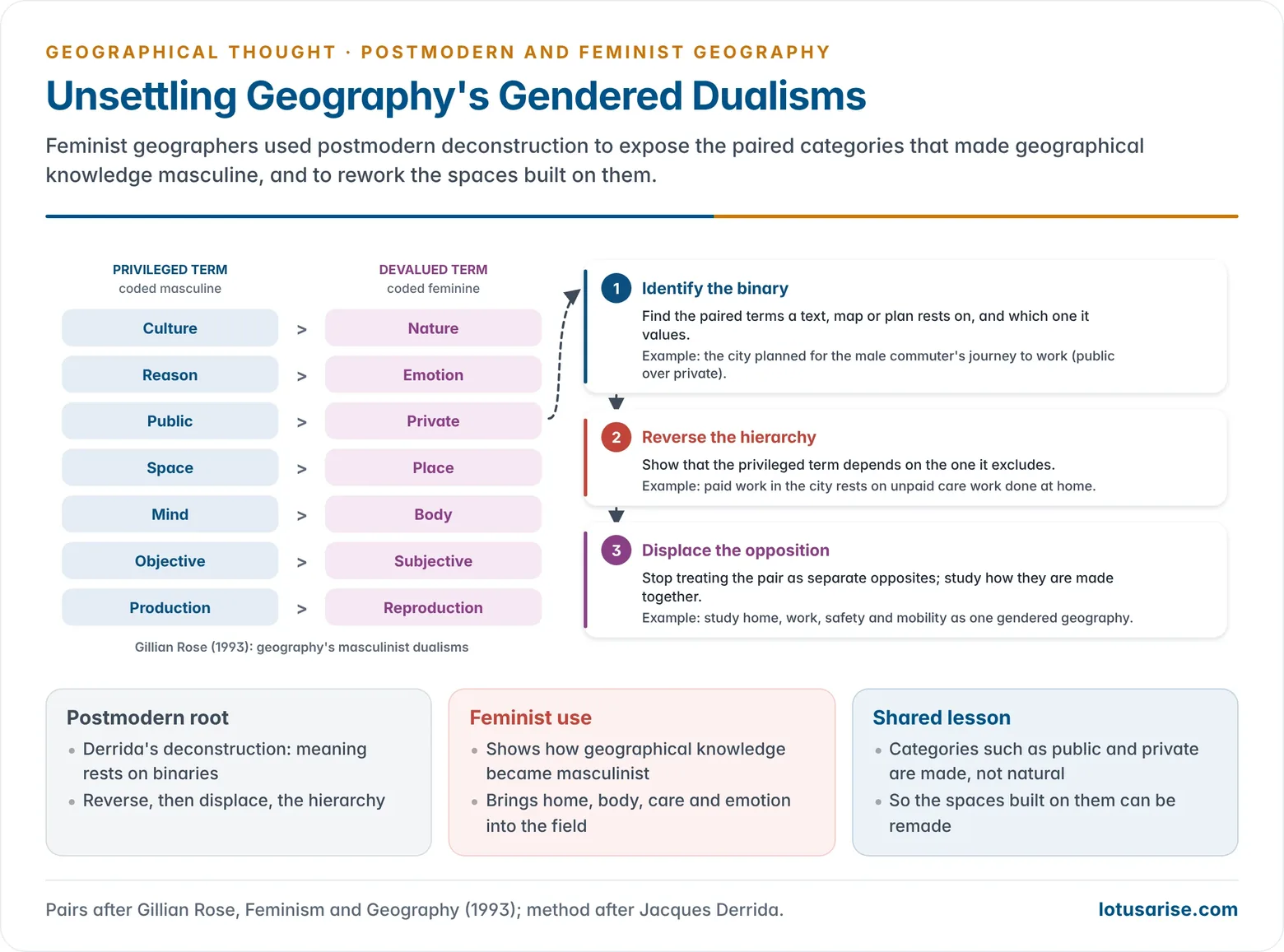
- Jacques Derrida (Of Grammatology, 1967) developed deconstruction: a close reading that shows how a text depends on binary oppositions in which one term is privileged.
- Examples: speech/writing, reason/emotion, culture/nature, public/private, centre/periphery, masculine/feminine.
- Deconstruction first reverses the hierarchy, showing that the privileged term depends on the excluded one, and then displaces the opposition itself.
- Derrida called the Western search for a fixed foundation of meaning logocentrism. His différance means that meaning always differs and is deferred, never finally fixed.
- In geography deconstruction asks how the writer’s position (culture, class, gender) shapes the text, and how maps, landscapes and regional descriptions carry power.
- J. B. Harley’s “Deconstructing the map” (1989) read maps as persuasive texts, not neutral mirrors, from colonial surveys to modern atlases.
- Foucault linked space, knowledge and power: a “history of spaces” is also a history of powers, “from the great strategies of geopolitics to the little tactics of the habitat”.
Postmodern Urbanism: The Los Angeles School
- Postmodern ideas entered geography largely through urban geographers in Los Angeles: Edward Soja, Michael Dear, Allen J. Scott and the writer Mike Davis (City of Quartz, 1990).
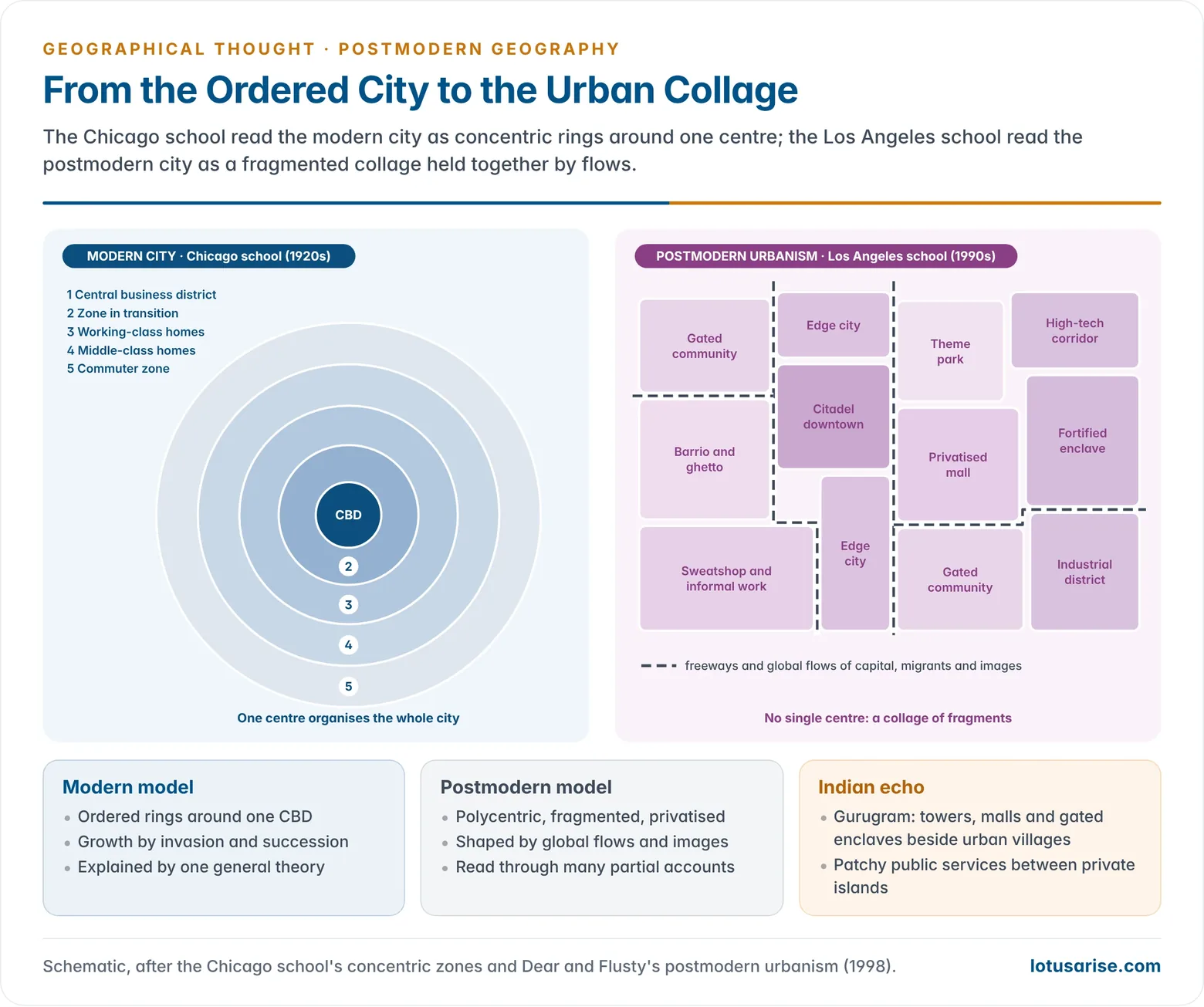
- They argued that Los Angeles, not Chicago, showed the future city:
- no single centre, but a polycentric sprawl of edge cities and corridors;
- fragmentation into gated communities, fortified enclaves, theme parks and ghettos;
- flexible, post-Fordist industry and global flows of capital and migrants;
- a city made as much by images, media and representation as by land rent.
- Michael Dear and Steven Flusty’s “Postmodern urbanism” (1998) set this model against the Chicago school’s concentric zones.
- Indian example: Gurugram’s privately built landscape of glass office towers, malls and gated enclaves, alongside urban villages and patchy public services, shows the fragmented, privatised urbanism the LA school described.
Postmodernism Across Human Geography
- Cultural geography: the “new cultural geography” read landscapes as texts and signs to be interpreted, not just as material forms, and asked whose meanings they express.
- Development geography: post-development writers such as Arturo Escobar (Encountering Development, 1995) treated “development” as a Western discourse that defined the Global South as lacking and in need of expert rescue.
- Political geography: critical geopolitics (Gearóid Ó Tuathail, Critical Geopolitics, 1996) deconstructed how statesmen and the media “write” global space into friends, enemies and frontiers.
- Economic geography: studies of post-Fordism and flexible specialisation showed new industrial districts and global production networks replacing the old Fordist regions.
- Indian echoes: the postmodern stress on discourse and difference fed into studies of how colonial maps, census categories and development plans represented India, and of plural regional and community identities.
Critique of Postmodernism
- Relativism: if no account is better than another, there is no basis for judging truth or justice. Critics called this “extreme cognitive scepticism” cut off from real-world accountability.
- Self-contradiction: the claim that we have entered a postmodern era is itself a grand narrative of historical change.
- Politically disabling: by dissolving general categories, it makes it hard to analyse domination by class, gender or race. Deconstruction can show that the world might be different, but not how.
- Explained by capitalism: Harvey saw postmodernism less as a break than as the culture of flexible accumulation. Jürgen Habermas defended modernity as an “unfinished project” against it.
- Feminist criticism: feminist geographers criticised both Harvey and Soja for writing gender out of their accounts of postmodernity: Doreen Massey in “Flexible sexism” (1991) and Rosalyn Deutsche in “Boys town” (1991).
- Legacy: postmodernism faded as a label after the 1990s, but its ideas live on in poststructural, postcolonial and non-representational geographies, in the cultural turn, and in the general view that space, place and scale are social constructs.
Feminist Geography
Meaning and Origins
- Feminist geography applies feminist politics and theory to geography. It studies how gender relations and geographies are mutually constructed, and seeks to change them.
- Sex refers to biological difference; gender to the socially created distinctions of femininity and masculinity. Feminist geography is concerned with gender.
- The Women and Geography Study Group (WGSG) of the Institute of British Geographers defined it in Geography and Gender (1984) as a geography that “explicitly takes into account the socially created gender structure of society”, committed to reducing gender inequality now and removing it through social change.
- Roots in the women’s movement:
- First wave: suffrage and legal equality, from the Seneca Falls Convention (1848) in the United States to votes for women in most Western countries by the mid-20th century.
- Second wave (1960s–70s): grew out of the civil-rights and anti-war movements, with the slogan “the personal is political”. The US National Organization for Women was founded in 1966.
- Third wave (late 1980s on): led by women of colour, lesbian and Third World women, who criticised the movement for speaking only for white, middle-class women.
- Within geography:
- Wilbur Zelinsky’s “The strange case of the missing female geographer” (1973) exposed the profession’s male bias.
- Janice Monk and Susan Hanson’s “On not excluding half of the human in human geography” (1982) showed how research ignored women.
- Geography and Gender (1984) was the first sustained feminist critique of the whole discipline. It insisted on research with women rather than on them.
- The journal Gender, Place and Culture followed in 1994.
Strands of Feminist Theory
| Strand | Cause of women’s position | Remedy | Geographical expression |
|---|---|---|---|
| Liberal | Unequal rights, sexist division of labour | Equal opportunity through law, work, education | Mapping women’s access to jobs and services |
| Radical | Patriarchy as the root oppression | Women’s autonomy, control of reproduction | Violence, fear, women’s own spaces |
| Socialist (Marxist) | Capitalism and patriarchy together | Change in both class and gender relations | Home and work, reproduction of labour, localities |
| Postmodern / poststructural | Fixed category “woman” itself | Deconstruct gender; recognise difference | Bodies, identities, intersecting differences |
- Radical feminism treats men and women almost as two classes. Shulamith Firestone’s The Dialectic of Sex (1970) made reproduction, not production, the engine of history.
- Socialist feminism links the home to capitalism: women’s unpaid work reproduces the labour force, so patriarchy and class must be analysed together.
- Postmodern feminism asks not “what about the women?” but “how is the category ‘woman’ constructed?”, and replaces a single “woman” with partial, fractured identities.
Phases of Feminist Geography
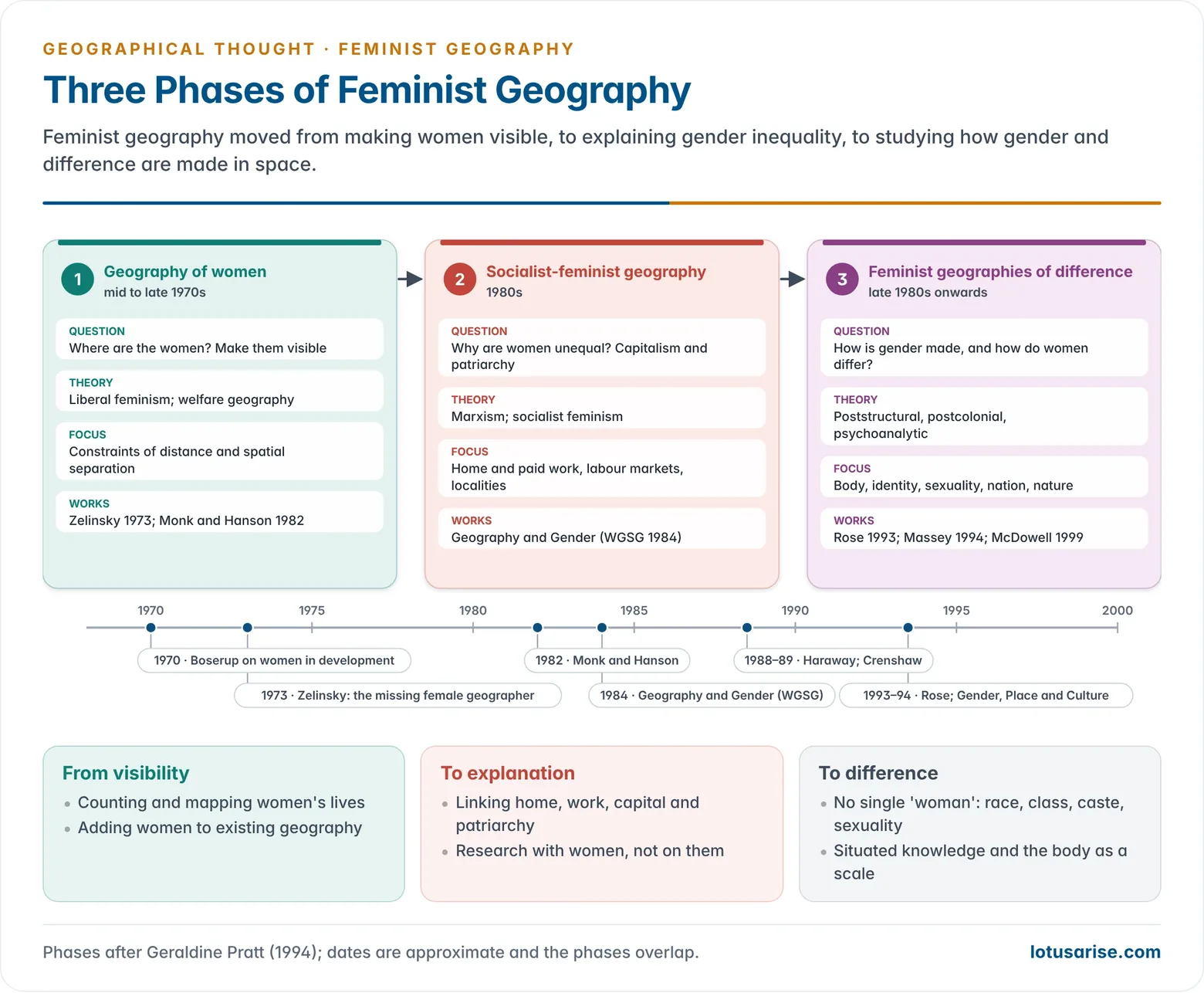
- Geraldine Pratt (1994) traced three phases:
- Geography of women (mid- to late 1970s): made women visible. It described the effects of gender inequality, especially the constraints of distance and spatial separation, drawing on welfare geography and liberal feminism.
- Socialist-feminist geography (1980s): explained inequality through the links between capitalism and patriarchy. It studied the separation of home and paid work, gendered labour markets and differences between localities.
- Feminist geographies of difference (late 1980s on): studied the construction of gender identities and differences among women, drawing on cultural, poststructural, postcolonial and psychoanalytic theory. Its scales range from the body to the nation.
Key Themes and Methods
- Public and private space: the gendered split between the “male” public world of paid work and the “female” private world of home shaped cities, transport and planning.
- Mobility and spatial entrapment: women’s journeys are shorter and more complex, chaining work, school and shopping. Susan Hanson and Geraldine Pratt’s Gender, Work and Space (1995) showed how this entraps women in local, low-paid jobs.
- Geographies of fear: Gill Valentine’s “The geography of women’s fear” (1989) showed how women avoid public places they see as dangerous, though most violence against women happens at home. The mismatch between the geography of fear and the geography of violence reproduces gendered space.
- Nature and dualisms: Gillian Rose’s Feminism and Geography (1993) argued that the discipline is masculinist. Its paired categories (culture/nature, reason/emotion, public/private, space/place) align men with the first, valued term.
- Ecofeminism embraced the women–nature link to criticise the domination of both. Other feminists rejected it as essentialist.
- Development: Ester Boserup’s Woman’s Role in Economic Development (1970) showed women’s large but invisible role in agrarian economies, and opened the field of gender and development.
- Body and identity: the body is treated as the closest geographical scale, marked by gender, sexuality, race and ability.
- Methods: qualitative interviews, participant observation, oral histories and participatory research. Donna Haraway’s “situated knowledges” (1988) replaced the detached “view from nowhere”. Researchers state their positionality. Quantitative and GIS methods have since been added back.
Key Feminist Geographers
- Doreen Massey: Space, Place and Gender (1994) argued that space and place are gendered, and that a “global sense of place” shaped by power-geometry ties localities to wider flows.
- Gillian Rose: exposed the masculinist ways of knowing of the discipline, and the absence of women from its canon.
- Linda McDowell: Gender, Identity and Place (1999) studied gender, work and the body in the city.
- Susan Hanson, Geraldine Pratt and Janice Monk: mobility, labour markets and the visibility of women in research.
- Gill Valentine: fear, sexuality and public space.
- Saraswati Raju (Jawaharlal Nehru University): leading Indian feminist geographer, who edited Gendered Geographies (2011) on gender and space in South Asia.
Intersectionality and Postcolonial Feminism
- Intersectionality, a term coined by the legal scholar Kimberlé Crenshaw (1989), holds that gender works together with race, class, caste, sexuality, religion and age. Disadvantages cannot be added up one by one.
- Postcolonial feminism challenged Western feminists for treating “Third World women” as one passive victim group. Chandra Talpade Mohanty’s “Under Western Eyes” (1984) is the classic statement.
- In India, a Dalit woman’s access to water, land or safe public space is shaped by caste and gender at once. Feminist geography in India therefore works closely with caste and class.
Feminist Geography in India
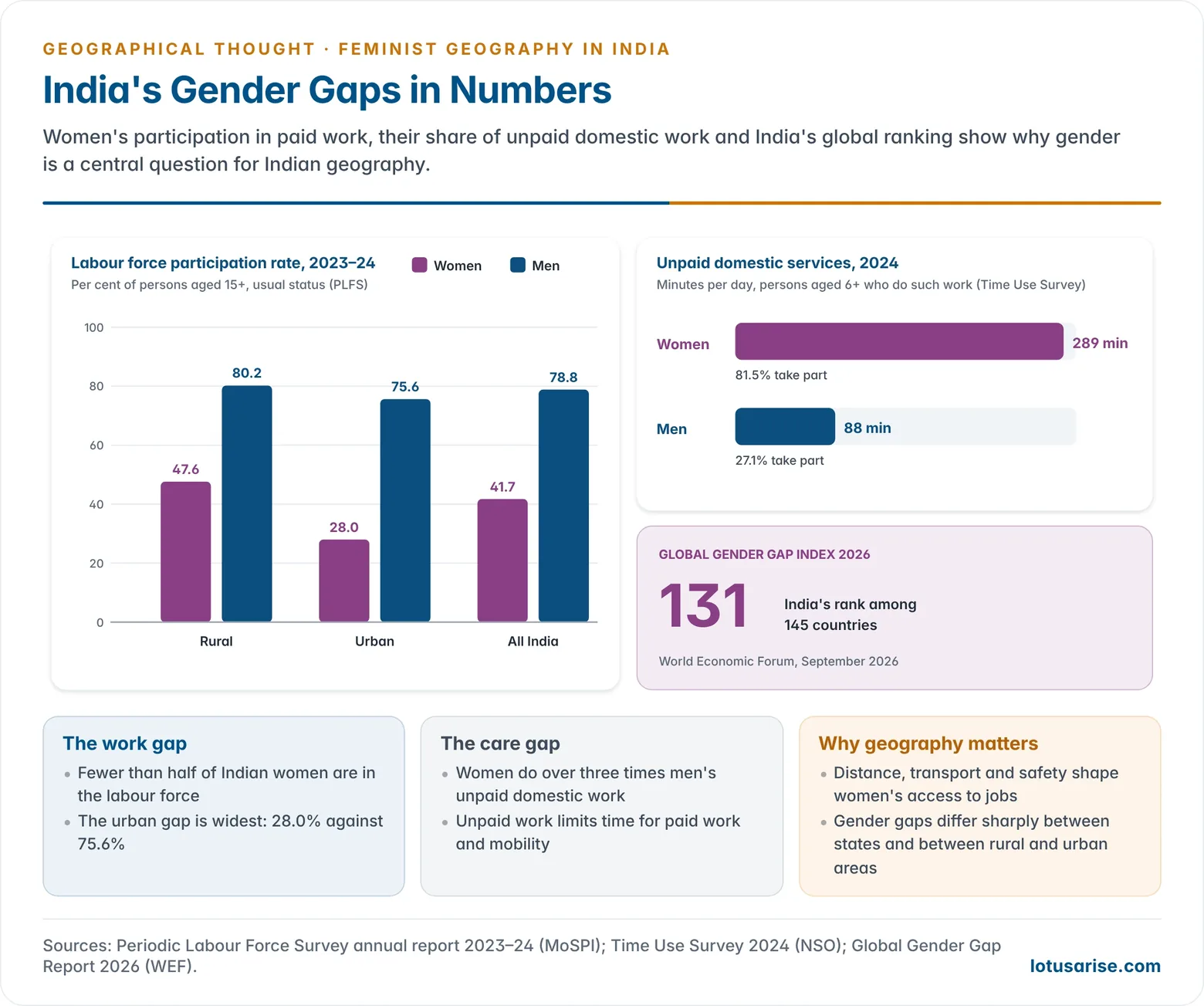
- Work: India’s female labour force participation rate (age 15+) was 41.7% in 2023–24 (rural 47.6%, urban 28.0%), against 78.8% for men (Periodic Labour Force Survey).
- Unpaid work: the Time Use Survey 2024 found women aged 6 and above who do unpaid domestic work spend about 289 minutes a day on it, against 88 minutes for men, and four of five women take part against about one in four men.
- The gap: India ranked 131st of 145 countries in the World Economic Forum’s Global Gender Gap Index 2026, the same rank as in 2025.
- Land and assets: Bina Agarwal’s A Field of One’s Own (1994) showed that women’s lack of independent land rights is central to rural gender inequality in South Asia.
- Movements and institutions: the women of Reni village in the Chipko movement (1974), the Self-Employed Women’s Association (1972), Kerala’s Kudumbashree (1998), and gender budgeting in the Union Budget since 2005–06.
- Safety and the city: women’s safety audits and mapping of unsafe spaces in Delhi and other cities apply the feminist geography of fear to planning.
Feminist Geography Across the Discipline
- Feminist political ecology (Dianne Rocheleau and colleagues, 1996) studies how gender shapes access to and control over land, water, forests and environmental knowledge.
- Feminist geopolitics shifts attention from states and armies to the everyday security of bodies and households, and to how conflict is lived.
- Geographies of sexuality, opened by David Bell and Gill Valentine’s Mapping Desire (1995), extend the questions of feminist geography to heteronormative space.
- Emotional geographies and studies of care grew from feminist attention to feeling, the body and unpaid work.
- Masculinities are now studied too: how ideas of manhood shape workplaces, violence, migration and risk-taking.
Criticism of Feminist Geography
- Essentialism: some strands (radical feminism, ecofeminism) treat “woman” as a fixed natural category, the very thing feminism set out to challenge.
- Western, white and middle-class bias: early feminist geography generalised from Anglo-American women’s lives, a criticism pressed by Black, lesbian and postcolonial feminists.
- Neglect of men and masculinities: gender relations involve men too. Geographies of masculinity developed only later.
- Fragmentation: postmodern feminism’s stress on difference can dissolve “women” as a political subject, weakening collective action.
- Data limits: women’s unpaid and informal work is poorly counted, so much research rests on small qualitative studies.
Postmodern and Feminist Geography Compared
- Common ground: both reject universal, objective knowledge and grand theory; both study power, identity and representation; both prefer qualitative, interpretive and reflexive methods.
- Tension: feminism is a political project with a clear subject, women, and a goal, gender equality. Postmodernism dissolves fixed subjects and doubts all emancipatory narratives.
- Linda Nicholson and Nancy Fraser (1988) argued that each corrects the other: postmodernism curbs feminism’s essentialism, and feminism gives postmodernism a robust social critique.
| Aspect | Postmodern geography | Feminist geography |
|---|---|---|
| Emerged | Mid-1980s | Mid-1970s, theorised in the 1980s |
| Main target | Grand narratives, totalising theory, historicism | Masculinist knowledge, gender inequality |
| Core concepts | Difference, deconstruction, heterotopia, time-space compression | Gender, patriarchy, public/private, intersectionality |
| Key works | Soja 1989, Harvey 1989, Dear 1988 | WGSG 1984, Rose 1993, Massey 1994, McDowell 1999 |
| Politics | Sceptical of emancipatory programmes | Explicitly emancipatory |
| Indian relevance | Fragmented, privatised cities | Women’s work, mobility, safety, land rights |