- New regional geography is the reformulation of the region in human geography from the 1980s. It treats the region not as a natural or given unit to be described but as a social construct: produced, reproduced and transformed by economic, political and cultural processes.
- It returns to the study of particular places that spatial science had set aside. It does so with theory, drawing on political economy, structuration theory and critical realism.
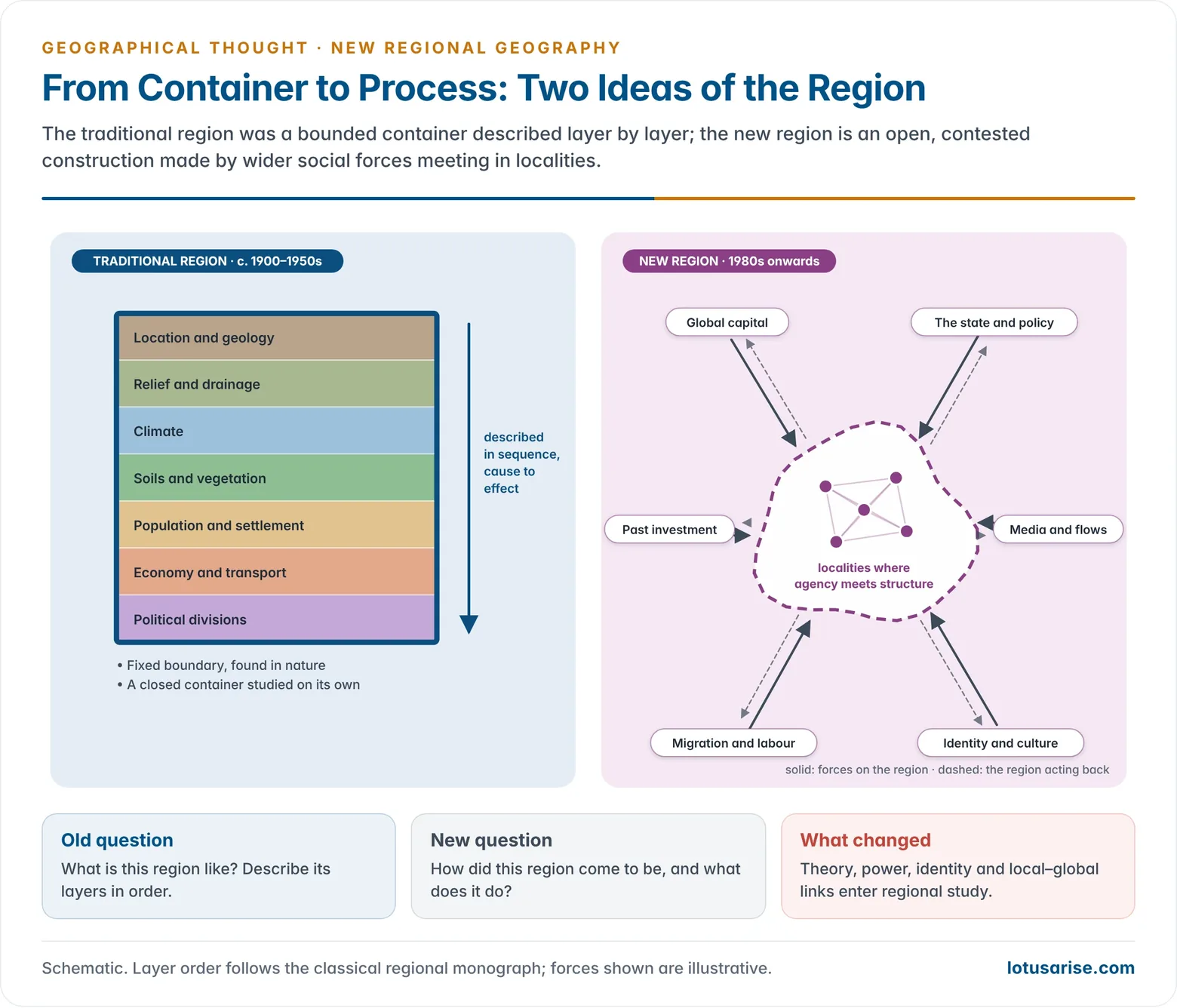
- Its central question changes from what is this region like? to how did this region come to be, and what does it do?
From Decline to Revival

Why Traditional Regional Geography Declined
- The Hettner–Hartshorne tradition treated regions as bounded, unique units, to be described through regional synthesis.
- From the 1950s, it was attacked on several fronts:
- George H. T. Kimble (1951) called the region an outdated, eighteenth-century idea.
- Fred K. Schaefer (1953) called it exceptionalist, and the quantitative revolution replaced it with spatial laws.
- Industrialisation and global markets undermined the local self-sufficiency on which the region of the pays rested.
- In spatial science, local particularity became “noise” or a “deviation” from general patterns, and regional study lost its standing.
Why the Region Returned in the 1980s
- Restructuring: deindustrialisation, plant closures and new growth areas in Britain and the United States showed that the same global changes had different local outcomes.
- Political economy: Marxist geography explained uneven development as a product of capital. Doreen Massey’s Spatial Divisions of Labour (1984) showed that each region bears layers of past investment that shape how it meets new rounds of change.
- Social theory:
- Anthony Giddens’s structuration theory (1984) held that social life is structured in time and space. Its locales are the settings of interaction.
- Space is not a stage on which society acts; it is the medium through which social relations are produced.
- Critique of functionalism and structuralism: abstract theories of capitalism could not explain why people acted differently in different places. Specificity returned to the agenda.
- Postmodern sensitivity to difference: postmodern thought gave new value to heterogeneity and particularity. This was a return to areal differentiation, but “with a difference”.
Main Strands
Three Readings of the New Region
- Anne Gilbert (“The new regional geography in English and French-speaking countries”, 1988) identified three readings:
- The region as a local response to capitalist processes: regions reflect the spatial division of labour and uneven development (Massey, Neil Smith).
- The region as a focus of identification: regions are bound by culture, identity and shared meaning, and drawn from humanistic geography.
- The region as a medium for social interaction: regions are settings where agency and structure meet, as in structuration and time-geography readings (Nigel Thrift, Allan Pred).
Structuration and Place as Process
- Nigel Thrift (1983) described the region as the meeting place of human agency and social structure. It is made of connected locales that shape how people learn, work and act.
- Allan Pred (1984) defined place as a “historically contingent process”. It is continually made through the daily paths of people and institutions, building on Torsten Hägerstrand’s time-geography.
Principles of the Reconstituted Region
- The new regional geography rests on four working principles:
- Context matters: social processes always operate in specific historical and geographical contexts, so their outcomes vary from place to place.
- Society is continually remade: human action constantly recreates society, and since action is always somewhere, that remaking differs by region.
- Regions are not isolated: local transformations are partly the outcome of wider social relations, from national policy to global markets.
- Regions are changing constructions: regions are not fixed divisions of territory. They are produced, reproduced and transformed. They are also the settings where people learn and carry on their culture, which is why Ron Johnston (A Question of Place, 1991) made uncovering them a central goal of geography.
- Local and global together: modernity and time–space compression do not erase difference. They re-sort it, producing new forms of dependence, hybridity and connection that regional accounts must map.
Locality Studies
- In Britain, the Economic and Social Research Council funded the Changing Urban and Regional System (CURS) programme of seven locality case studies, reported in Philip Cooke’s Localities (1989).
- Cooke described localities as “centres of collective consciousness”: bases from which people act on wider events, not passive containers.
- Defining a locality: statistical units such as labour-market areas were often used. The agreed view, however, was that localities must be defined by the social relations under study; Massey called them “intersections of sets of locales”.
- Critical realism (Andrew Sayer) supplied the method. General causal mechanisms produce different outcomes under different local conditions, so intensive case study is needed.
- Intensive research asks how something happens in a place. Extensive research asks how widespread it is. Realists hold that the frequency of an event says nothing about its cause.
- Massey’s “global sense of place” (1991): places are open and porous. They are unique not because they are isolated, but because each is a particular meeting point of wider social relations.
Institutionalisation of Regions
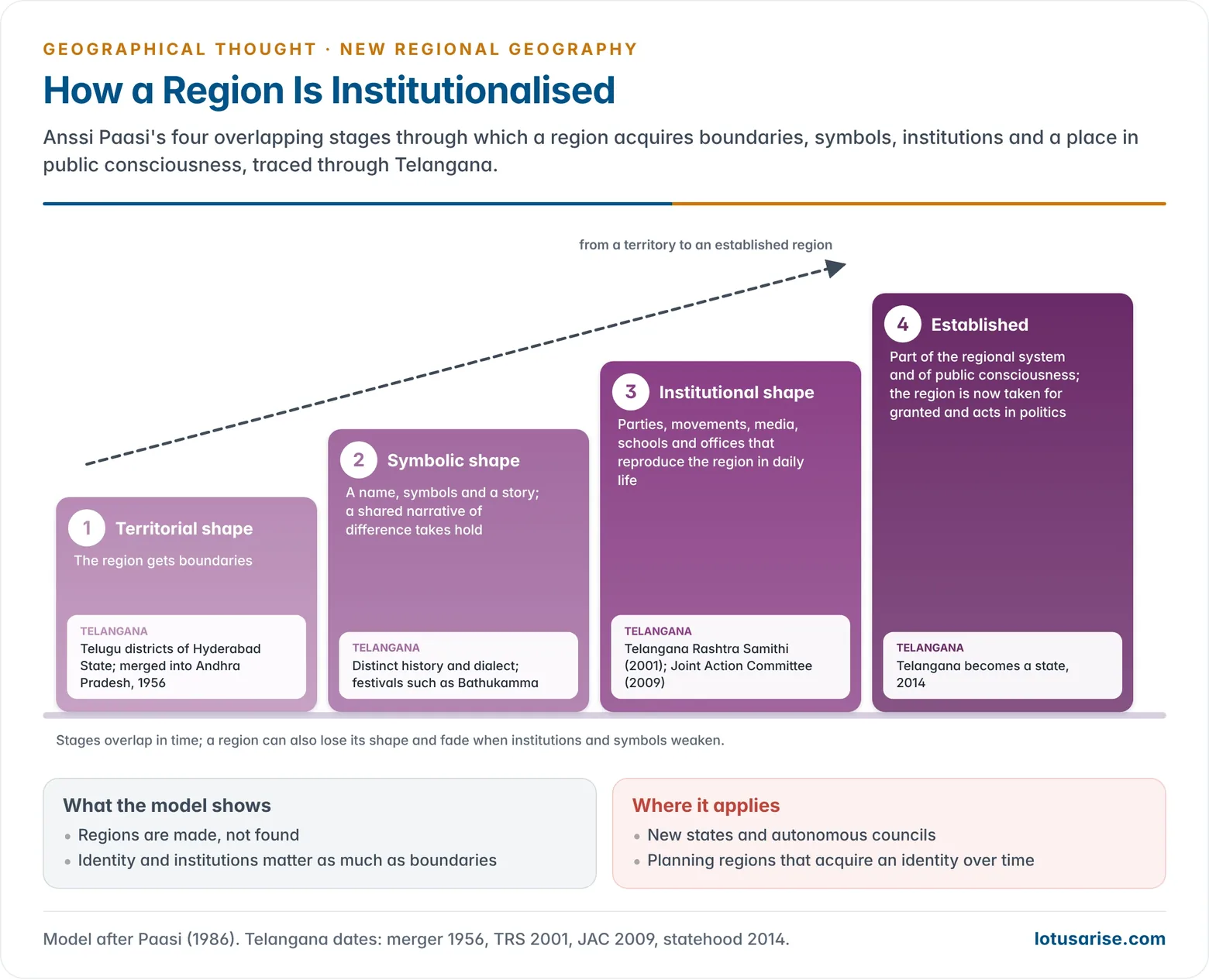
- Anssi Paasi (1986) explained how regions come into being and acquire identity through four overlapping stages:
- Territorial shape: the region acquires boundaries.
- Symbolic shape: it gains a name, symbols and a narrative.
- Institutional shape: parties, media, schools and administrative bodies form.
- Establishment: the region becomes part of the regional system and of social consciousness.
- Regions can also decline and disappear when their institutions and symbols fade.
- Telangana as a case:
- Territorial shape: the Telugu-speaking districts of the former Hyderabad State were merged into Andhra Pradesh in 1956.
- Symbolic shape: a distinct history, dialect and festivals such as Bathukamma.
- Institutional shape: the Telangana Rashtra Samithi (2001) and the Telangana Joint Action Committee (2009).
- Establishment: statehood in 2014.
Relational Regions
- From the late 1990s, John Allen, Doreen Massey and Allan Cochrane (Rethinking the Region, 1998) and Ash Amin (“Regions Unbound”, 2004) went a step further. They saw regions as relational: nodes in networks of flows, not territories with fixed edges.
- Debate continues between this view and those who stress territory, governance and boundaries, as in the “new regionalism” in regional policy.
| Basis | Traditional regional geography | New regional geography |
|---|---|---|
| Period | c. 1900–1950s | 1980s onwards |
| Nature of region | Given, natural or objective unit | Social construct, made and remade |
| Boundaries | Fixed, to be found | Open, contested, changing |
| Focus | Description, synthesis of features | Processes, power, identity |
| Theory | Weak or implicit | Political economy, structuration, realism |
| Scale | Region studied in isolation | Local–global links |
| Key names | Vidal, Hettner, Hartshorne | Massey, Thrift, Pred, Gilbert, Paasi |
Indian Examples
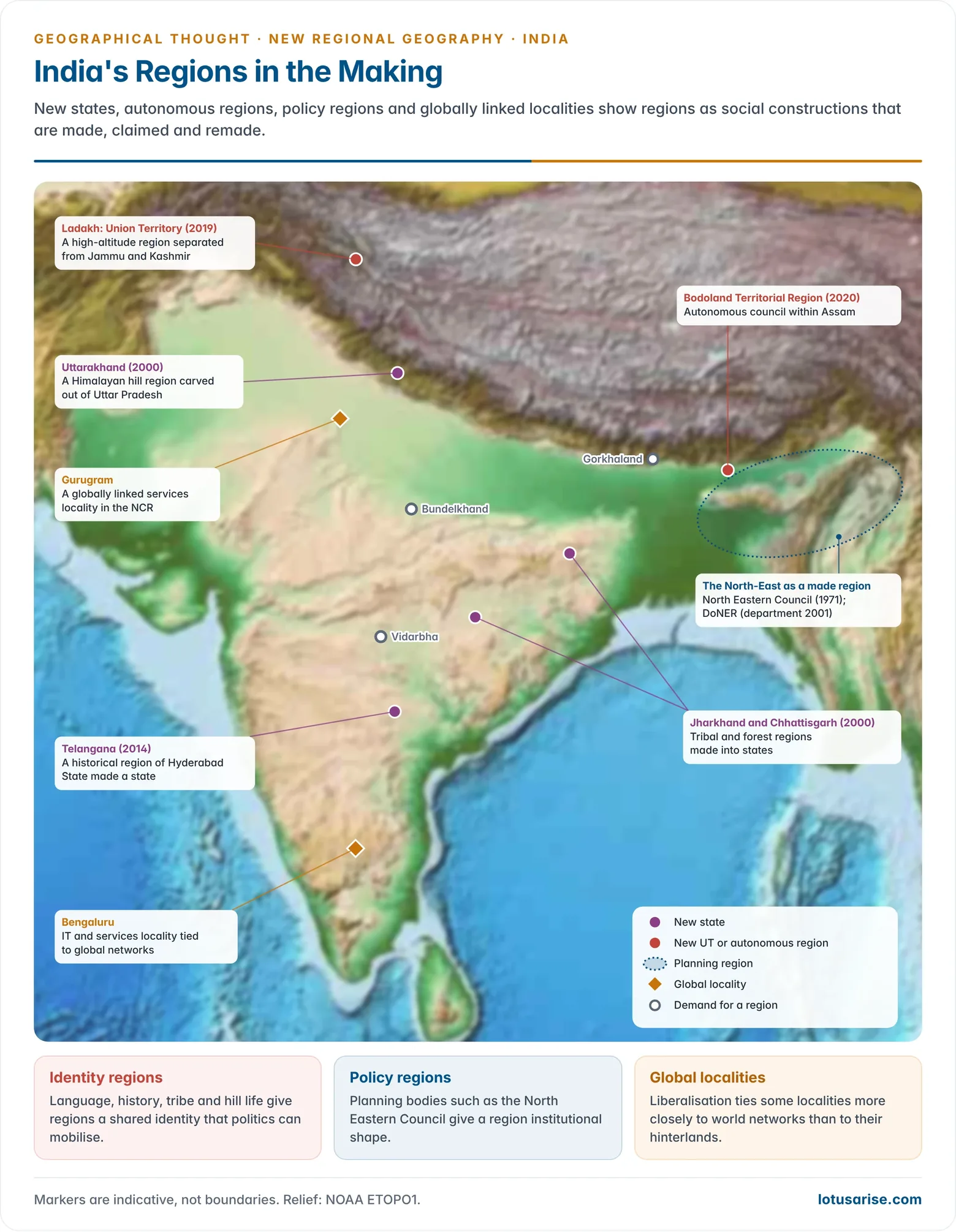
- New states: the states created in 2000 drew on long-standing regional identity, tribal and hill movements, and claims of neglect.
- Jharkhand and Chhattisgarh grew out of tribal and forest regions; Uttarakhand out of a Himalayan hill region.
- Telangana (2014) turned a historical region of the old Hyderabad State into a state after decades of agitation.
- Autonomy within states: the Bodoland Territorial Council (2003) was reorganised as the Bodoland Territorial Region under the 2020 Bodo Accord.
- Ladakh became a Union Territory in 2019. Demands for Gorkhaland, Vidarbha and Bundelkhand show regions being actively constructed and contested.
- “The North-East” as a made region: eight states with diverse histories have been grouped into one planning and policy region. The North Eastern Council (1971) and the Ministry of Development of North Eastern Region (department 2001, ministry 2004) gave that region institutional shape.
- Restructured localities: liberalisation after 1991 turned places such as Gurugram and Bengaluru into localities tied more closely to global services than to their hinterlands. Older industrial localities, such as the textile mill districts of Mumbai, declined.
- This shows the local outcomes of global restructuring.
Evaluation
- Contributions:
- It restored the region and place to the centre of human geography, bringing theory into regional study.
- It joined the local and the global, explaining why the same processes give different outcomes in different places.
- It linked regions to identity, power and politics, which helps explain regionalism, new states and regional policy.
- Criticisms:
- Empiricism: Neil Smith (1987) warned that the focus on localities risked an empiricist slide into describing the unique.
- Mixing theory and case study: Martha Pudup (1988) likened the movement between abstract concepts and empirical description to “ballet on a bed of quicksand“.
- Spatial determinism: Simon Duncan (1989) warned that locality studies might bring back the idea of autonomous space. In fact, social objects interact, not places.
- Neglect of nature: physical geography is largely missing, and the stress on identity can be overdone.
- Little shared method: there is no common method of delimiting regions, so findings are hard to compare or transfer.
- Present position: relational and territorial views now coexist. The region survives as a process, central to studies of uneven development, regionalism and socially produced space.
Previous Year Questions
- No direct PYQ has been asked on this sub-topic yet.