

4 Political organization and Social Control: Band, tribe, chiefdom, kingdom and state; concepts of power, authority and legitimacy; social control, law and justice in simple societies.
Official Syllabus: Paper I, Unit 4 (social control, law and justice in simple societies)
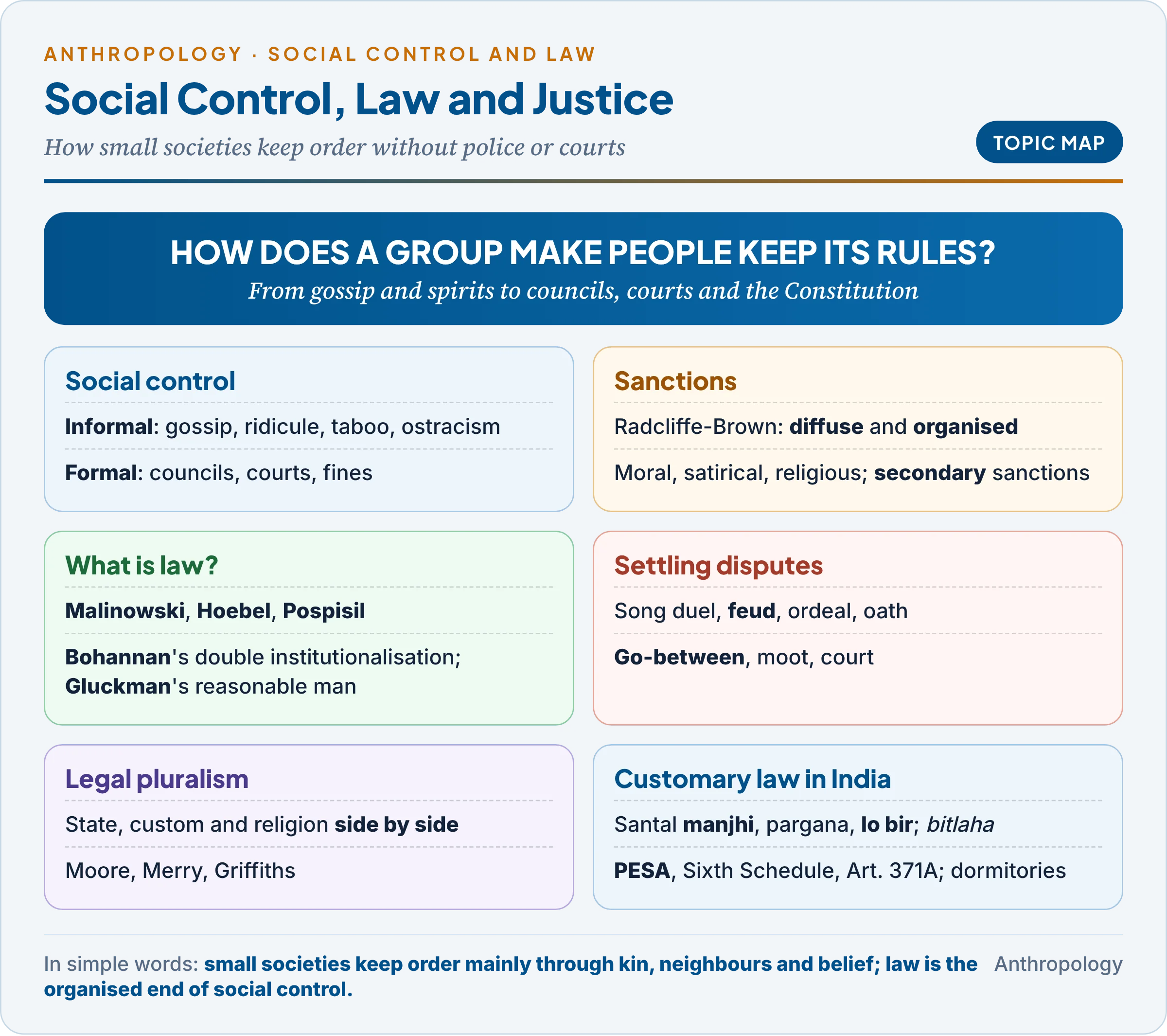
This article covers the last item of the syllabus line: social control, law and justice in simple societies. The forms of political organisation and the ideas of power, authority and legitimacy are in Unit 4a.
1. Social Control: Meaning, Means and Types
In simple words
Every group needs its members to follow its rules most of the time. Social control is the whole set of ways a group gets this done, from a raised eyebrow and village gossip to fines, councils and courts. In small communities most of this work is done by people who know each other, not by police.
Example first. In a Santal village (Jharkhand, West Bengal, Odisha), a man who neglects a guest is talked about; one who commits theft or adultery is fined by the village council under the headman (manjhi) and must give a feast; one who marries inside his own clan or outside the tribe faces bitlaha, a mass outcasting in which crowds from neighbouring villages defile his courtyard (W.G. Archer, Tribal Law and Justice, 1984). One community thus uses a ladder of controls, from gossip to expulsion, matched to the seriousness of the offence.
- Meaning. The American sociologist E.A. Ross, who first wrote at length on the subject (Social Control, 1901), meant by it the “system of devices whereby society brings its members into conformity with the accepted standards of behavior”. In anthropology, social control means all the mechanisms, internal and external, that keep behaviour within the norms (shared rules of conduct) of a group and deal with those who break them.
- Two routes.
- Internal control works through socialisation (learning a culture’s rules from childhood): rules become part of a person’s conscience, so he feels guilt or shame before anyone punishes him.
- External control works through sanctions (reactions of approval or disapproval, §2) applied by others. Socialisation does most of the work; sanctions deal with the failures.
- Why it is needed. Self-interest regularly clashes with the group’s welfare. Without control, quarrels over land, women, cattle and honour would spread through the web of kin and break up a small community, which has no police to fall back on.
1.1 Means and types of social control
The table sets out the main ways sociologists and anthropologists have classified the means of control. Each pair is a different way of looking at the same field.
| Classification | Types | Example |
|---|---|---|
| Formal and informal | Formal: rules and penalties applied by a recognised agency. Informal: arise spontaneously in the group | Village council’s fine; gossip, ridicule |
| Positive and negative (Kimball Young) | Reward for conformity; punishment for deviance | Gift of honour; fine or exile |
| Force and symbols (F.E. Lumley) | Physical force; symbolic means such as praise, persuasion, satire, threats | Beating; a mocking song |
| Unconscious and conscious (L.L. Bernard) | Custom and tradition obeyed without thought; deliberately applied controls | Food habits; a council decision |
Most control in simple societies is informal, symbolic and unconscious. The formal side grows as societies become larger and more impersonal. “Social control” is thus wider than “law”: law is only the formal, organised end of it.
- Informal means (most powerful in small, face-to-face groups):
- Folkways and mores. The American sociologist W.G. Sumner (Folkways, 1906) separated folkways, everyday habits whose breach brings mild disapproval, from mores, folkways felt to be vital to the group’s welfare, whose breach brings strong punishment. Clan exogamy belongs to the mores of the Santal.
- Custom: long-standing usage obeyed because “it has always been done”; it needs no agency to declare or enforce it.
- Public opinion, gossip and ridicule. Where everyone depends on everyone, loss of reputation is costly. The British anthropologist Max Gluckman (“Gossip and Scandal”, 1963) argued that gossip maintains the unity and values of a group, because only members have the right to gossip about each other.
- Religion, taboo and supernatural fear. A taboo (a ritual prohibition whose breach is believed to bring automatic misfortune) controls behaviour even when no one is watching, because the punishment is thought to come from the spirits, not from people.
- Witchcraft accusation. Among the Azande (South Sudan, Central African Republic, Congo), the British anthropologist E.E. Evans-Pritchard (Witchcraft, Oracles and Magic among the Azande, 1937) found that people avoided envy and quarrels because the envious and quarrelsome were the ones accused of witchcraft. Fear of being accused made people careful.
- Ostracism: refusing to eat, marry or work with an offender; the Santal bitlaha is its extreme form.
- Formal means: law, councils, courts, police, codified fines and, in modern states, education and propaganda organised by the state.
Why informal control works so well in simple societies. Gluckman described Lozi relations as multiplex: the same two people are kin, neighbours, co-workers and co-worshippers at once. A person who breaks a rule therefore risks every relationship he has, not just one, and that threat keeps most people in line.
1.2 Social control in different political systems
Control changes with political organisation (Unit 4a: a band is a small mobile group of foragers, a tribe a larger egalitarian society, a chiefdom a ranked society under a hereditary chief, a state a society with a central government). The table compares them.
| System | Main mechanisms | Example |
|---|---|---|
| Band | Gossip, ridicule, song duel, moving away, rarely killing of a habitual offender | Inuit; Hadza |
| Tribe | Kin groups’ self-help, feud, mediation, compensation, councils of elders, supernatural sanctions | Nuer; Ifugao; Santal |
| Chiefdom | Chief’s court, fines and tribute, sacred authority of the chief | Khasi syiem and dorbar; Polynesian chiefs |
| State | Courts, police, written law, prisons, alongside surviving informal controls | Ashanti; modern India |
As organisation grows, control shifts from diffuse pressure by everyone to organised enforcement by specialists, and from restoring relationships to punishing offences. Informal control never disappears; it continues inside the state, which is why customary councils still work in tribal India (§7).
2. Sanctions
In simple words
A sanction is how a group reacts when someone behaves well or badly: praise and rewards, or blame and punishment. Some sanctions come spontaneously from everyone, like laughter or gossip; others are applied through a fixed procedure, like a fine. Some are believed to come from gods or spirits.
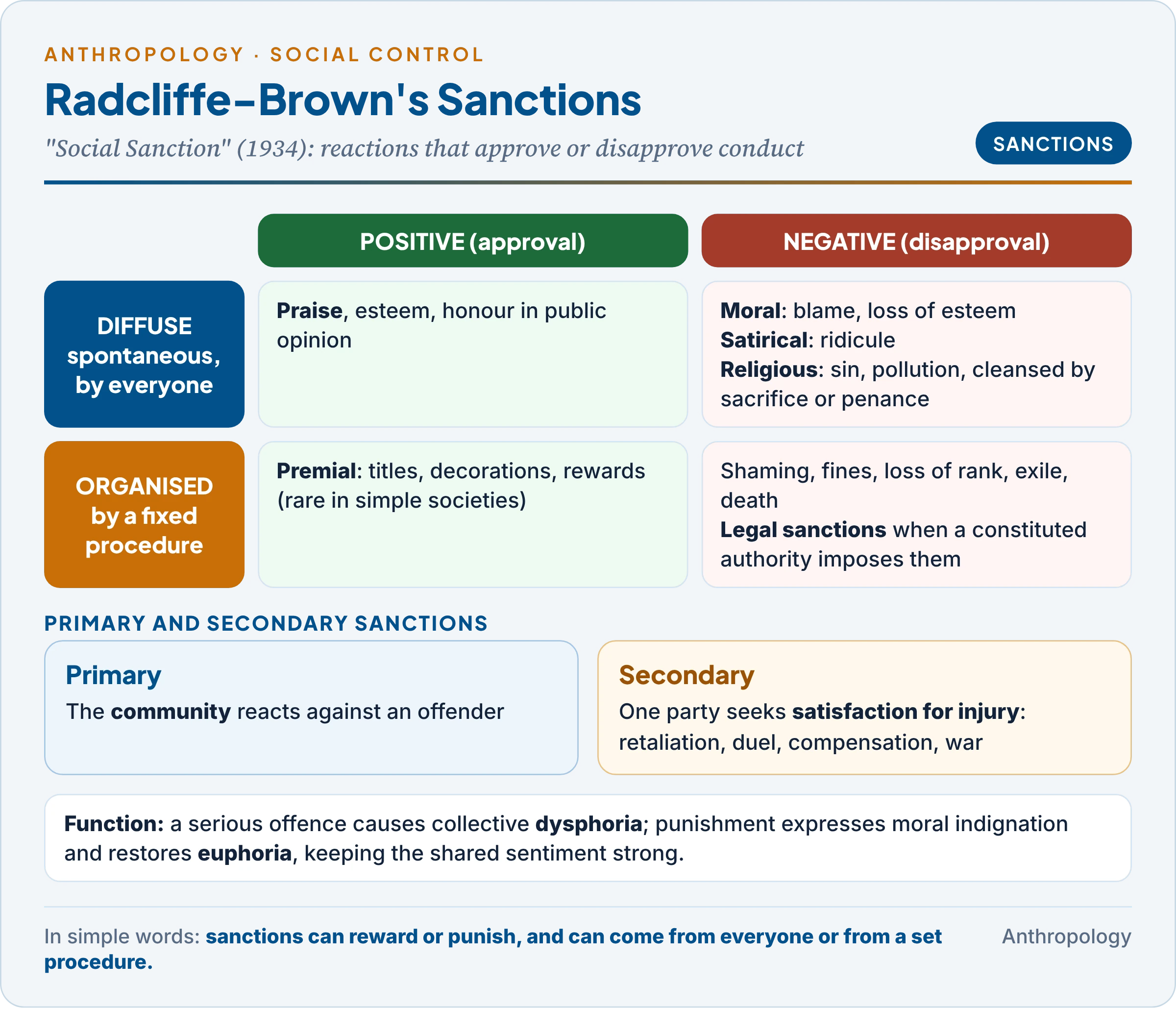
The British anthropologist A.R. Radcliffe-Brown, founder of structural-functionalism, gave the classic analysis in “Social Sanction” (Encyclopaedia of the Social Sciences, 1934). A sanction is “a reaction on the part of a society or of a considerable number of its members to a mode of behaviour which is thereby approved (positive sanctions) or disapproved (negative sanctions)”.
- Positive and negative. Positive sanctions reward (titles, praise, gifts); negative ones punish. He noted that in all societies negative sanctions are more definite than positive ones.
- Diffuse and organised.
- Diffuse sanctions are “spontaneous expressions of approval or disapproval by members of the community acting as individuals”. They include:
- the moral sanction: public opinion and loss of esteem;
- the satirical sanction: ridicule;
- the religious sanction: belief that certain acts change a person’s ritual condition for good or ill, as pollution or sin, which must be removed by sacrifice, penance or purification.
- Organised sanctions are “social actions carried out according to some traditional and recognised procedure”: public shaming, loss of rank, fines, exile, bodily punishment, death. When a constituted authority imposes them they are legal sanctions.
- Diffuse sanctions are “spontaneous expressions of approval or disapproval by members of the community acting as individuals”. They include:
- Primary and secondary.
- Primary sanctions are the community’s reaction against an offender.
- Secondary sanctions are actions by one person or group against another to obtain satisfaction for injury: retaliation (approved and limited revenge, as when an injured Australian Aboriginal man may throw a fixed number of spears at the offender), the duel, indemnification (compensation) and even war.
- Function. For Radcliffe-Brown the important effect of a sanction is not on the offender but on the community. A serious offence produces collective dysphoria (a disturbed, uneasy state); punishment expresses collective moral indignation, restores euphoria and keeps the shared sentiment strong.
Durkheim’s parallel. The French sociologist Émile Durkheim (The Division of Labour in Society, 1893) classified law by its sanction. Repressive law punishes the offender and expresses outrage; it dominates in societies held together by mechanical solidarity (likeness). Restitutive law restores things to their former state through compensation; it grows with organic solidarity (interdependence of different specialists). Ethnography later showed that simple societies rely heavily on compensation, not only on punishment, which weakens Durkheim’s contrast.
3. What Is Law? Custom, Law and the Definitional Debate
In simple words
All societies have rules, but are all rules “law”? Some anthropologists say law exists only where some recognised person or body can enforce a rule. Others say any rule that people feel bound to obey and that is backed by a real reaction is law. The answer decides whether a society without courts “has law”.
Example first. In the Trobriand Islands (Papua New Guinea), a youth called Kima’i broke the rule of clan exogamy (marrying or having sex outside one’s own clan) with his mother’s sister’s daughter. Villagers knew and gossiped but did nothing. Then the girl’s rejected suitor publicly insulted him with the charge. Kima’i climbed a coconut palm and jumped to his death. The Polish-British anthropologist Bronislaw Malinowski (Crime and Custom in Savage Society, 1926) used the case to show that a “law” may be broken quietly as long as no one makes it public, and that public accusation, not a court, set the sanction in motion.
3.1 Custom and law
The table compares custom and law as they are usually distinguished.
| Point | Custom | Law |
|---|---|---|
| Origin | Grows slowly and spontaneously | Made deliberately by an authority |
| Enforcement | Spontaneous social pressure | A special agency with recognised authority |
| Clarity | Vague, unwritten | Specific, often written |
| Change | Slow; fades without formal repeal | Enacted, amended or repealed at once |
| Scope | Everyday routine | Matters felt vital: life, property, marriage |
The two are not opposites. Custom is the main source of law in simple societies, and law without customary support is weakly obeyed, as India’s child-marriage law of 1929 (the Sarda Act) long was. Conversely, law can change custom, as with laws against untouchability or dowry.
- How custom becomes law. The American anthropologists Robert Lowie and E. Adamson Hoebel held that a custom becomes law when the community takes organised action against its breach. The folklorist E.S. Hartland‘s earlier view that simple law is the totality of customs was rejected because it made every habit a law.
- From status to contract. The English jurist Henry Maine (Ancient Law, 1861) argued that law moves “from status to contract”: in early societies rights depend on one’s position in a kin group; in modern ones on agreements between individuals.
3.2 Definitions of law: from narrow to wide
Anthropologists divide on whether law needs a specialised authority. The definitions below run from the narrowest to the widest.
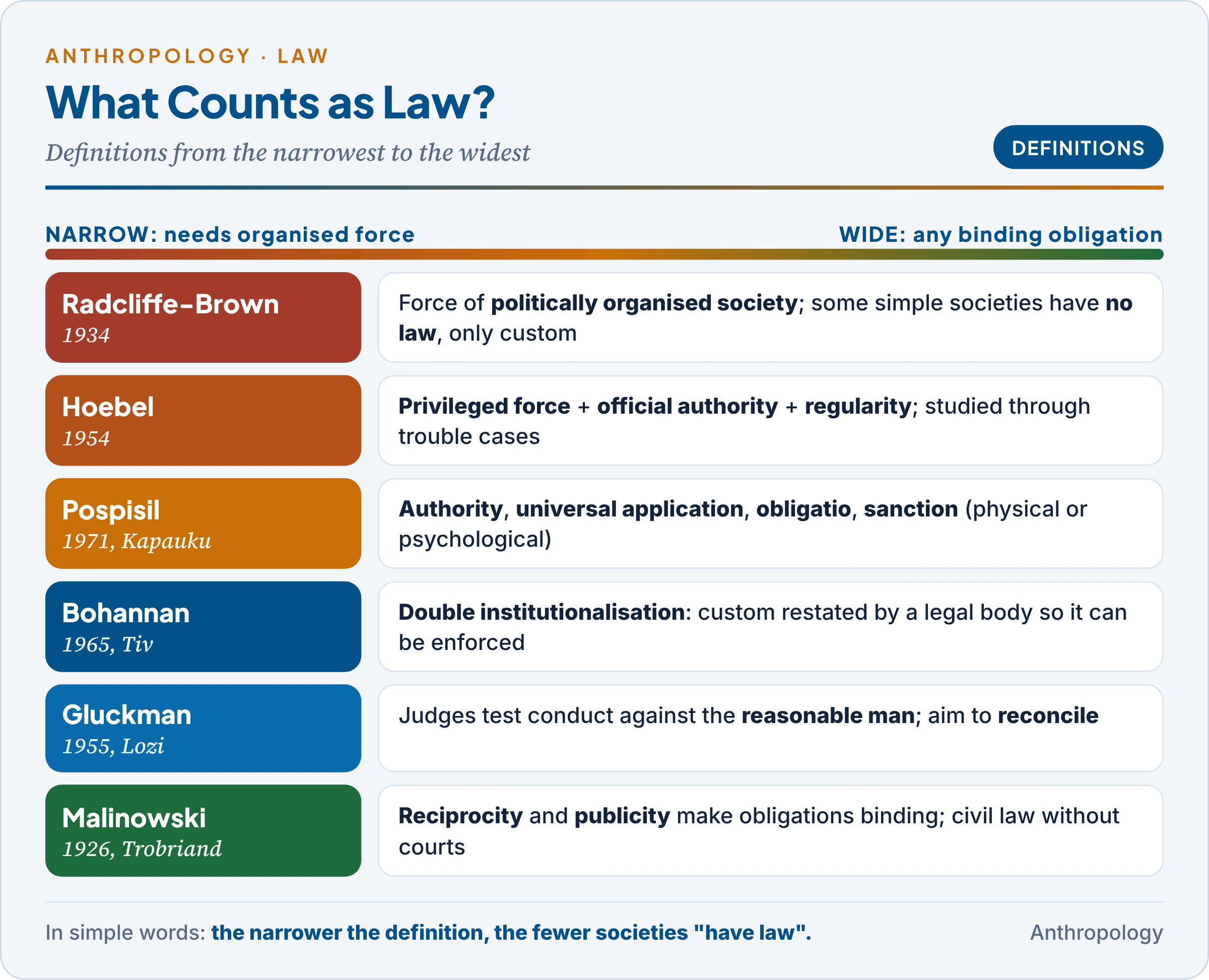
- Radcliffe-Brown (narrow). Borrowing from the American jurist Roscoe Pound, he defined law as “social control through the systematic application of the force of politically organized society”. Law therefore exists only where there are organised legal sanctions. His conclusion: “some simple societies have no law, although all have customs which are supported by sanctions”. The difficulty is that the Nuer or Inuit then “have no law”, although they plainly keep order.
- Malinowski (wide). Law consists of binding obligations felt as rights by one party and duties by another, kept not by fear of a court but by reciprocity and publicity. Trobriand coastal villages supply fish to inland villages, which repay with yams; a partner who defaults loses the return gift and his good name. Malinowski thus showed civil law (rules on property, exchange and marriage) in a society without courts. The criticism is that his definition is too wide: it makes it hard to tell law from custom or etiquette.
- E. Adamson Hoebel (middle). In The Law of Primitive Man (1954) he wrote: “A social norm is legal if its neglect or infraction is regularly met, in threat or in fact, by the application of physical force by an individual or group possessing the socially recognized privilege of so acting.”
- Three elements: privileged force, official authority (even if held only for the occasion) and regularity (like cases treated alike).
- Four functions of law: to define relationships and acceptable behaviour; to allocate the authority to use force; to settle trouble cases; to redefine relationships as conditions change.
- Method. With the jurist Karl Llewellyn, Hoebel studied actual disputes, the trouble-case method, in The Cheyenne Way (1941). Among the Cheyenne (Great Plains, USA), the soldier societies policing the communal buffalo hunt would beat a man who hunted early and destroy his gear, then sometimes help him re-equip: punishment followed by reintegration.
- Criticism: the American legal theorist Lon Fuller objected that this defines law “by an imperfection“: a system that works so well that force is never needed would not count, and many legal penalties are fines, not physical force.
- Leopold Pospisil (attributes). The Czech-American anthropologist studied the Kapauku Papuans (western New Guinea) in 1954–55. He argued that every sub-group (family, lineage, village) has its own legal level, so a society has several legal systems at once (§6). In Anthropology of Law (1971) he proposed four attributes that together mark a legal decision:
- Authority: a decision is made by a person or group whose decisions are followed, such as the Kapauku tonowi (rich man and leader);
- Intention of universal application: the decision is meant to apply to all similar cases in future, like a precedent;
- Obligatio: the decision states the rights and duties of the two living parties to the dispute;
- Sanction: some penalty, which may be physical or psychological (shame, ridicule, withdrawal of favour), not only force.
- Paul Bohannan (double institutionalisation). The American anthropologist, who studied the Tiv of Nigeria (Justice and Judgment among the Tiv, 1957), argued in “The Differing Realms of the Law” (1965) that law is custom restated by a legal institution. Customs are first institutionalised in ordinary social life; when they fail, a legal institution (a court, a moot, a council) re-institutionalises them in a form it can enforce. Law is thus custom re-created for the purpose of settling disputes, and it always lags a little behind custom.
- Max Gluckman (the reasonable man). In The Judicial Process among the Barotse of Northern Rhodesia (1955), on the Lozi of present-day Zambia, Gluckman found that judges in the king’s court (kuta) cross-examined litigants and measured their conduct against the standard of a “reasonable man” in that role: a reasonable husband, headman or son-in-law. He concluded that the logic of judging is shared by African and Western law. Because Lozi litigants stood in multiplex relationships, judges tried to reconcile them, not only to declare a winner.
The Gluckman–Bohannan debate. Bohannan replied that describing Tiv law through English legal terms (contract, tort, “reasonable man”) distorts it. Anthropologists should report the folk system, the people’s own concepts, and only then build an analytical system for comparison. Gluckman answered that refusing all comparative terms leads to “cultural solipsism“. The American anthropologist Laura Nader and others settled on a compromise: describe each system in its own terms first, then compare through a shared analytical vocabulary. The debate also moved legal anthropology from rules to processes of disputing.
Common confusion
Does a society without courts have law? It depends on the definition. By Radcliffe-Brown’s narrow definition, no: law needs organised political force. By Hoebel’s and Pospisil’s definitions, yes, if some recognised person regularly applies a sanction, as a Nuer kin group taking revenge or a Kapauku tonowi deciding a case does. By Malinowski’s wide definition, every society has law.
4. Law and Justice in Simple Societies
In simple words
In small societies the aim of settling a quarrel is usually to let the two sides live together again, not to decide who is guilty and lock him away. Kin share responsibility for what a member does, fines and compensation matter more than prison, and fear of spirits backs many rules.
The features below were drawn from early comparative work; each is a tendency, not a rule.
- Kinship base and collective responsibility. Rights and duties are held by kin groups. If a Nuer kills a man, the killer’s whole lineage is liable to revenge and to pay blood-wealth (compensation in cattle) to the victim’s lineage. Where there is no state, the kin group is the only body that can protect a member, so it must also answer for him.
- Compensation over punishment. Most offences, even homicide, end in payment to the injured group, because the aim is to restore balance between groups that must go on living together. This is restitutive justice in Durkheim’s sense.
- Closeness to morality and religion. Breaking a rule is often a sin as well as a wrong, punished by spirits through illness or bad luck. Oaths and ordeals (§5) work because people believe the supernatural will expose the guilty.
- Public opinion as enforcer. “Everybody is its policeman”: with no specialised police, the whole community applies pressure.
- Public and private wrongs. Early writers (Maine) said simple societies do not separate crimes against society from wrongs against persons. Ethnography refines this: incest, witchcraft and sacrilege are treated as wrongs against the whole community, while theft and injury are wrongs against kin groups to be settled by compensation.
- Is intention ignored? The older view was that simple law looks only at the harm done, not at intent. Gluckman’s Lozi judges, who asked how a reasonable man would have acted, show that intention is often weighed.
- Civil law exists. Malinowski’s Trobriand reciprocity, Ifugao rules on rice-field inheritance and debt, and Kapauku rules on pig loans and land sale show civil law (rules on property, contract and inheritance) in societies without states.
The table compares law in simple and complex societies, in the terms used most often.
| Point | Simple societies | Modern states |
|---|---|---|
| Basis | Kinship and custom | Territory and legislation |
| Responsibility | Collective (kin group) | Individual |
| Aim | Reconcile, compensate, restore balance | Determine guilt, punish, deter |
| Agencies | Elders, councils, mediators, kin | Police, courts, lawyers, prisons |
| Backing | Public opinion, supernatural fear | State force |
| Proof | Oath, ordeal, oracle, testimony of kin | Evidence and procedure |
The contrast is in aim more than in rules. Simple societies have rules about life, property and marriage as detailed as any state’s. What differs is that a judgment must allow people bound by multiplex ties to keep living together. This is why justice in simple societies is usually compromise justice, while state courts produce winner-takes-all decisions.
5. Methods of Dispute Settlement
In simple words
Societies without courts still have many ways of ending quarrels: insulting songs sung before an audience, tests believed to reveal the guilty, swearing before the gods, a respected go-between who carries offers back and forth, a council of elders, or simply moving away. Which method is used depends on how the society is organised.
Example first. Among the Inuit of Greenland, two men with a grievance (often over a woman) met at a festive gathering and took turns beating a drum and singing satirical songs about each other. The one who made the audience laugh more won; the loser might even leave the camp. Hoebel (The Law of Primitive Man, 1954) noted that the outcome has nothing to do with who was right: the song duel works because it releases anger in public and lets the audience, acting as judge, close the quarrel. Winner and loser were expected to be reconciled.
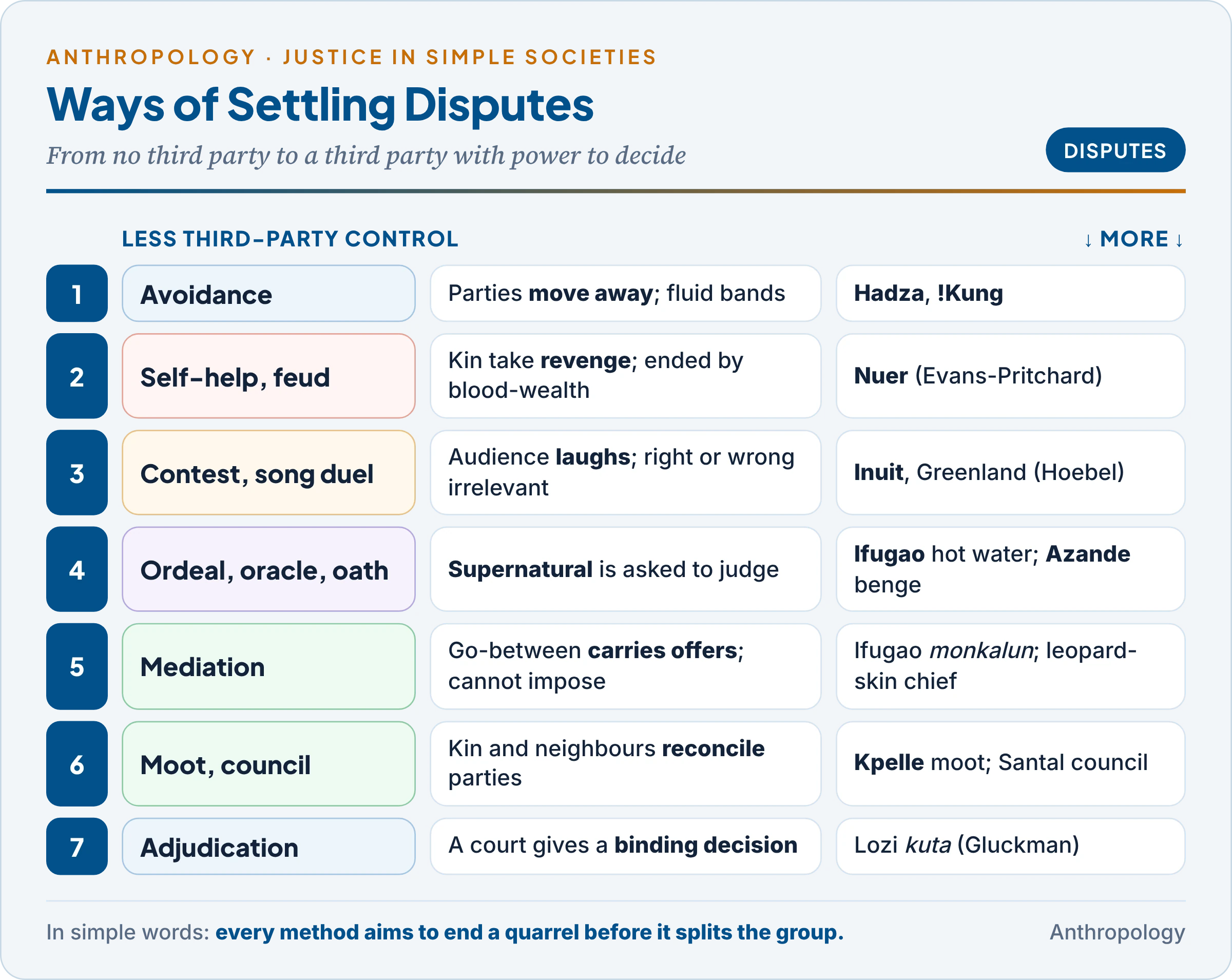
The American anthropologists Laura Nader and Harry Todd (The Disputing Process, 1978) arranged the options by how much a third party controls the outcome: lumping it (ignoring the grievance), avoidance, coercion, negotiation, mediation, arbitration and adjudication. The table gives the main forms found in simple societies.
| Method | How it works | Case (region; ethnographer) |
|---|---|---|
| Avoidance (moving away) | The weaker party or both leave; fluid bands make exit easy | Hadza (Tanzania), !Kung (Kalahari) |
| Self-help and feud | Injured kin take revenge or seize property; a feud is a chain of reprisals between groups | Nuer (South Sudan; Evans-Pritchard, 1940) |
| Contests and song duels | Public contest settles the matter regardless of rights | Inuit (Greenland; Hoebel) |
| Ordeal | Accused undergoes a dangerous test; injury shows guilt | Ifugao (Luzon, Philippines; R.F. Barton, Ifugao Law, 1919): hot-water ordeal |
| Oracle | A consulted device names the guilty party | Azande poison oracle (benge) (Evans-Pritchard, 1937) |
| Oath | Accused swears before supernatural powers; false swearing brings misfortune | Many tribal councils in India |
| Mediation (go-between) | A neutral person carries offers; no power to impose | Ifugao monkalun; Nuer leopard-skin chief |
| Moot | Informal hearing of kin and neighbours aiming at apology and reconciliation | Kpelle (Liberia; J. Gibbs, 1963); Tiv jir |
| Adjudication | A court gives a binding decision | Lozi kuta (Gluckman); Santal village and pargana councils |
The table runs from no third party to a third party with power to decide: bands rely on the top rows, tribes on the middle, chiefdoms and states on the bottom. Every method has the same basic job: to end a quarrel before it splits the group.
How the main methods work:
- Feud and the “peace in the feud”. A feud is not endless killing. Among the Nuer, a killer took refuge with the leopard-skin chief (kuaar twac), a ritual mediator without power to command, who negotiated blood-wealth of around 40 head of cattle (Unit 4a §2.1 describes his role in the segmentary system). Gluckman (Custom and Conflict in Africa, 1955) explained why feuds end: people have cross-cutting ties (a man’s mother’s kin or in-laws may be on the other side), so many people want peace and press for compensation.
- Ordeals and oaths. An ordeal asks the supernatural to judge: among the Ifugao, the accused had to pick a pebble out of boiling water, and a scalded hand showed guilt. An oath places the accused under supernatural threat if he lies. Both work because they are believed: a guilty person who fears the outcome often confesses or offers settlement first.
- Go-betweens. The Ifugao had no chiefs or courts. A respected man, usually from a wealthy family, the monkalun, carried proposals between the families, mixing persuasion with veiled threats that the other side was ready to fight, until a fine was agreed.
- Moots. The Kpelle moot met at the complainant’s house, with a kinsman as mediator; everyone could speak, the party at fault apologised and gave small gifts, and both shared drink. Gibbs called it therapeutic: like group therapy, it repaired relationships in domestic disputes that a chief’s court would only have decided.
Common confusion
Is an ordeal the same as an oracle? No. An ordeal is a test the accused undergoes in person (boiling water, poison), and the result on his body shows guilt. An oracle is a device consulted about a question; among the Azande, poison is fed to a chicken, and whether the chicken dies answers the question. Both rest on belief that hidden powers reveal the truth.
6. Legal Pluralism
In simple words
Most people live under more than one set of rules at once: the law of the state, the customs of their community, the rules of their religion. Legal pluralism is the study of how these different legal orders exist side by side, compete and borrow from each other.
Example first. A Santal land quarrel in Jharkhand may go to the manjhi’s village council, to the gram sabha under PESA, and to a civil court, and each applies different rules. The litigants choose the forum that suits them, a practice called forum shopping.
- Meaning. Legal pluralism is the coexistence of two or more legal orders in one social field.
- Classic legal pluralism. Colonial rule laid state law over indigenous and religious law, as in India’s personal laws for Hindus and Muslims and the recognition of tribal custom.
- New legal pluralism. The American anthropologist Sally Engle Merry (“Legal Pluralism”, 1988) showed that plural orders also exist in industrial societies: factories, neighbourhoods and religious communities have their own rules.
- Semi-autonomous social field. Sally Falk Moore (1973) showed that a small field, such as a workshop or a Chagga lineage (Tanzania), makes its own rules and can enforce them, yet remains open to state law. State law does not simply replace local rules; it filters through them.
- Strong and weak pluralism. John Griffiths (1986) separated weak pluralism, where the state recognises other orders (as India recognises customary law), from strong pluralism, the social fact that other orders work whether or not the state recognises them.
- Pospisil’s legal levels (§3.2) anticipated the idea: family, lineage and village each have their own law.
7. Customary Law in Tribal India
In simple words
Indian tribes have their own unwritten rules, kept by village headmen, councils of elders and larger councils of many villages. The Constitution and some laws protect these customs, especially in the north-east and in Fifth Schedule areas. At the same time, courts now insist that customs must not deny equal rights, for example to women.
Customary law is the body of rules that a community treats as binding because of long and continuous usage, enforced by its own institutions. The Constitution counts “custom or usage having in the territory of India the force of law” within “law” (Article 13(3)(a)).
7.1 Institutions and how they work
Tribal judicial institutions in India are of five broad kinds; the table gives examples.
| Institution | How it is formed | Examples |
|---|---|---|
| Council of elders | Temporary body of senior men, often clan elders | Nagas, Kamar, Saora, Konda Reddi |
| Village headman | Hereditary post, subject to village opinion | Tangkhul Naga, Munda, Santal |
| Village panchayat | Panchs under the headman | Ao Naga, Munda, Oraon, Ho, Kharia |
| Union of villages | Regional council under a regional head | Santal pargana, Munda and Oraon parha |
| Tribal chief | Hereditary supreme authority | Khasi syiem, Mizo chiefs (abolished 1954), Konyak ang |
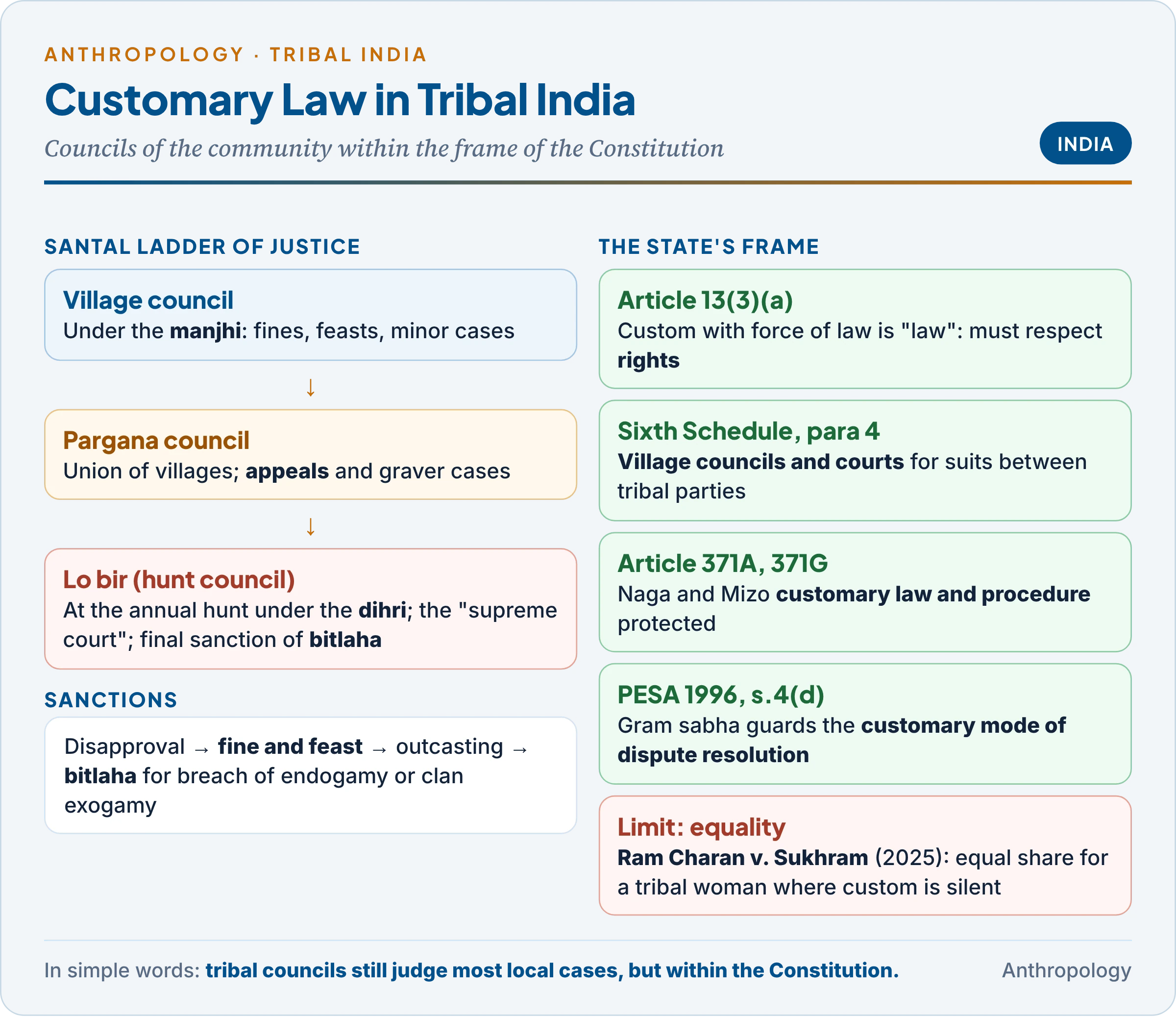
The levels act as courts of appeal for one another. Among the Santal, a case goes from the village council to the pargana council and, for the gravest matters, to the lo bir (hunt) council, which met at the annual hunt under the hunt priest (dihri) and was called the Santals’ “supreme court“; it alone could finally sanction bitlaha.
- Offences and sanctions. Among the Santal, Munda, Ho and Gond, neglect of family or guests brings disapproval; theft, adultery, refusal to repay a debt and witchcraft bring fines in cash or kind, often spent on a communal feast or an offering to the spirits; breach of tribal endogamy or clan exogamy brings outcasting. A person outcast for a minor offence is readmitted after a fine, a feast and purification: among the Oraon, the head of the tribal council (panua) drinks water from the offender’s hand, taking on his fault.
- Proof. Councils rely on witnesses, oaths and ordeals; oaths in the name of the supreme being are obeyed largely through fear of divine anger.
7.2 Sources of customary law
- Custom and usage: practices followed from ancestors.
- Myth and religion: the Santal creation story tells how the first people were destroyed for ignoring clan divisions, which gives clan exogamy its sacred charter (Unit 5a §7).
- Taboos and ritual rules about food, sex and sacred places.
- Council decisions remembered as precedents by elders.
- Borrowing from neighbouring Hindu and Christian norms (bride-price turning into dowry, for example).
- Colonial codification: the British wrote down and froze some customs, such as the Manki-Munda system of the Ho (Wilkinson’s Rules) and the Khasi and Naga customs.
- State recognition: the Sixth Schedule, Article 371A and PESA (§7.4) give some customs statutory force.
7.3 Youth dormitories as agencies of social control
Youth dormitories train the young in the rules of the community and punish breaches.
- Dhumkuria (Oraon, Jharkhand). The Indian anthropologist S.C. Roy (The Oraons of Chota Nagpur, 1915) described the boys’ house with three age grades: younger boys served older ones, and all unmarried boys had to sleep there under penalty of a fine. Members were bound to secrecy, and girls who told tales were barred from dances until forgiven. The dormitory enforced clan exogamy in courtship, since partners of the same clan were forbidden in principle.
- Ghotul (Muria Gond, Bastar, Chhattisgarh). Verrier Elwin (The Muria and Their Ghotul, 1947) showed that all unmarried boys (chelik) and girls (motiari) belonged to it, under leaders he called the sirdar (boys) and belosa (girls). Members were initiated, given graded titles and duties, and punished, usually by fines, for breaking its rules. In the more recent form of ghotul, lasting pairs were forbidden and partners had to change, a rule meant to prevent jealousy. Elwin stressed that the ghotul had “taboo” as well as “licence“: its discipline prepared the young for the strict decorum of married life.
These dormitories show socialisation and social control working together: rules are taught, practised and enforced in one institution.
7.4 Constitutional and legal recognition
The table lists the provisions that recognise or limit customary law.
| Provision | What it does |
|---|---|
| Article 13(3)(a) | Custom or usage with the force of law is “law”, so it must respect fundamental rights |
| Fifth Schedule | Governor may adapt laws for Scheduled Areas in ten states |
| Sixth Schedule, para 4 | District and regional councils in Assam, Meghalaya, Tripura and Mizoram may set up village councils or courts for suits between Scheduled Tribe parties, to the exclusion of other courts, with appeal to the district council and then the High Court |
| Article 371A (Nagaland) | No Act of Parliament on Naga religious or social practices, customary law and procedure, or civil and criminal justice under customary law applies unless the state assembly agrees; Article 371G gives Mizoram similar protection |
| PESA, 1996, s.4(a) and (d) | State laws must be in consonance with customary law; every gram sabha is “competent to safeguard and preserve the traditions and customs of the people, their cultural identity, community resources and the customary mode of dispute resolution“ |
| Hindu Marriage Act 1955 s.2(2); Hindu Succession Act 1956 s.2(2) | Do not apply to Scheduled Tribes unless the Centre notifies otherwise, so custom governs their marriage and succession |
The provisions show India choosing weak legal pluralism: the state recognises tribal law, but within the Constitution. The tension is sharpest over women’s rights: in Ram Charan v. Sukhram (17 July 2025), the Supreme Court held that where a Gond woman could not prove a custom of female inheritance but the other heirs could not prove a custom excluding her, the court must apply justice, equity and good conscience with Article 14, giving her an equal share.
7.5 Customary law and environmental conservation
Many tribal customary rules are rules about resource use, enforced by religious belief and councils.
- Sacred groves. The Munda and Oraon keep a sarna (sacred grove) where trees may not be cut; Khasi villages protect groves such as Mawphlang (Meghalaya), where taking even a twig is believed to bring misfortune. A religious sanction here does the work of a forest law.
- Niyamgiri (Odisha). The Dongria Kondh regard the Niyamgiri hills as the seat of their deity Niyam Raja. In Orissa Mining Corporation v. Ministry of Environment and Forests (18 April 2013), the Supreme Court left the decision on bauxite mining to the local gram sabhas under the Forest Rights Act, and all twelve consulted gram sabhas rejected it. Customary religious rights were thus treated as legal rights.
- Mendha-Lekha (Gadchiroli, Maharashtra). This Gond village, which decides by consensus in its gram sabha (“our government in Delhi and Mumbai, we are the government in our village”), received community forest rights in 2009 and manages its bamboo itself.
Limits of customary law:
- It can deny women land and a voice in councils.
- It can sanction witch-hunting, still a cause of killings in Jharkhand and Odisha.
- Written down by courts and officials, it can become frozen and lose the flexibility that made it customary.
Key Terms
| Term | Meaning in simple words |
|---|---|
| Social control | All the ways a group keeps members within its rules |
| Norm | A shared rule of conduct |
| Folkways / mores | Everyday habits / habits felt vital to the group’s welfare |
| Sanction | A group’s reaction approving or disapproving conduct |
| Diffuse sanction | Spontaneous reaction by people as individuals, such as gossip |
| Organised sanction | Reaction applied through a recognised procedure, such as a fine |
| Taboo | Ritual prohibition whose breach brings automatic misfortune |
| Multiplex relationship | Two people tied in several roles at once |
| Trouble case | An actual dispute studied to find the law in action |
| Obligatio | Rights and duties of the parties stated in a legal decision |
| Double institutionalisation | Custom restated by a legal body so it can be enforced |
| Reasonable man | Standard of how a person in a given role should behave |
| Feud | Chain of reprisals between groups, usually ended by compensation |
| Blood-wealth | Compensation paid by a killer’s kin to the victim’s kin |
| Ordeal | Dangerous test whose outcome is believed to show guilt |
| Moot | Informal hearing aimed at reconciliation |
| Legal pluralism | Two or more legal orders in one social field |
| Forum shopping | Choosing the court or council that suits one’s case |
| Customary law | Rules binding because of long usage, enforced by the community |
| Bitlaha | Santal mass outcasting for breach of endogamy or clan exogamy |
Contemporary Developments
- Jharkhand PESA Rules: approved by the cabinet on 23 December 2025 and notified on 2 January 2026, they make a traditional head (Santal manjhi or pargana, Ho munda or manki, Munda hatu munda or pahan) the president of the gram sabha and let it settle disputes by customary law and impose fines of up to ₹2,000; customary leaders object that district officials still control the recognition of gram sabhas.
- Ram Charan v. Sukhram (2025): equal inheritance for a tribal woman where custom is silent, through justice, equity and good conscience and Article 14.
- Uniform Civil Code, Uttarakhand (in force January 2025): exempts Scheduled Tribes, reflecting continued protection of tribal customary law.
Diagrams to Master
- Topic map of the article.
- Radcliffe-Brown’s sanctions (§2): diffuse and organised, positive and negative; moral, satirical, religious; secondary sanctions.
- Definitions of law (§3.2): narrow (Radcliffe-Brown) to wide (Malinowski), with Hoebel’s three elements and Pospisil’s four attributes.
- Dispute-settlement ladder (§5): avoidance to adjudication, with one case per rung.
- Customary law in tribal India (§7): village council, pargana, lo bir; constitutional layers.
Revision Grid
| Scholar | Work (year) | Key idea |
|---|---|---|
| Maine | Ancient Law (1861) | From status to contract |
| Durkheim | The Division of Labour in Society (1893) | Repressive and restitutive law |
| Ross | Social Control (1901) | Devices that bring conformity |
| Sumner | Folkways (1906) | Folkways and mores |
| S.C. Roy | The Oraons of Chota Nagpur (1915) | Dhumkuria discipline |
| Barton | Ifugao Law (1919) | Go-between, ordeals |
| Malinowski | Crime and Custom in Savage Society (1926) | Reciprocity and publicity; Kima’i |
| Radcliffe-Brown | “Social Sanction” (1934) | Diffuse and organised sanctions; law as organised force |
| Evans-Pritchard | Witchcraft, Oracles and Magic among the Azande (1937); The Nuer (1940) | Oracles; feud and leopard-skin chief |
| Llewellyn and Hoebel | The Cheyenne Way (1941) | Trouble-case method |
| Elwin | The Muria and Their Ghotul (1947) | Ghotul discipline |
| Hoebel | The Law of Primitive Man (1954) | Privileged force; four functions; song duel |
| Gluckman | The Judicial Process among the Barotse (1955); Custom and Conflict in Africa (1955) | Reasonable man; peace in the feud |
| Bohannan | Justice and Judgment among the Tiv (1957); “The Differing Realms of the Law” (1965) | Folk system; double institutionalisation |
| Gibbs | “The Kpelle Moot” (1963) | Therapeutic mediation |
| Pospisil | Anthropology of Law (1971) | Four attributes; legal levels |
| Moore | 1973 | Semi-autonomous social field |
| Nader and Todd | The Disputing Process (1978) | Range of disputing procedures |
| Archer | Tribal Law and Justice (1984) | Santal bitlaha |
| Griffiths | 1986 | Strong and weak legal pluralism |
| Merry | “Legal Pluralism” (1988) | New legal pluralism |
Previous Year Questions
Unit 4: Social control, law and justice
- 2026How do the concepts of power, authority, legitimacy and social control change with changing political organization? Discuss in detail giving suitable examples.
- 2023Write notes on: Customary laws and Environmental conservation.
- 2022Discuss the mechanism of social control in different kinds of political systems.
- 2018How does customary law function in the tribal society ? Discuss its different sources.
- 2016Discuss different social control mechanisms in simple societies.
- 2014Discuss the nature of Law and Justice in simple societies citing suitable examples.
- 1996Differentiate between centralized political systems and stateless political systems, and state how law and justice are administered in stateless societies.
- 1991Explain the meaning and scope of political anthropology. Describe how law and justice are maintained in simpler societies.
- 1989Explain the meaning and scope of Political Anthropology. Describe how law and order are being maintained in the so called preliterate societies.
- 1986How is law administered in primitive societies ? Give suitable examples.
- 1985What are the basic features of law and what are its functions ? Substantiate your views with illustrations.
- 1983Civil laws are present also in simpler societies.
Related questions from other units
- 2013Unit 5: How does taboo serve as a means of social control ? (250 words).
- 2007Unit 2.2: Discuss mechanisms of social control in simple societies citing suitable examples.
- 2005Unit 5: “Witchcraft accusation is the result of strained interpersonal relations.” Explain.
- 1998Unit 2.2: ‘Primitive society is governed by the traditional customary law.’ Do you agree with this statement ? Explain.
- 1993Unit 2.2: Describe the means of social control in simpler societies and compare the legal system of simple and complex societies.
- 1983Unit 13: Reciprocity and redistribution inhibit social conflict in primitive society. Discuss.