

5 Religion: Anthropological approaches to the study of religion (evolutionary, psychological and functional); monotheism and polytheism; sacred and profane; myths and rituals; forms of religion in tribal and peasant societies (animism, animatism, fetishism, naturism and totemism); religion, magic and science distinguished; magico-religious functionaries (priest, shaman, medicine man, sorcerer and witch).
Official Syllabus: Paper I, Unit 5 (approaches to religion; monotheism and polytheism; sacred and profane; myths and rituals)
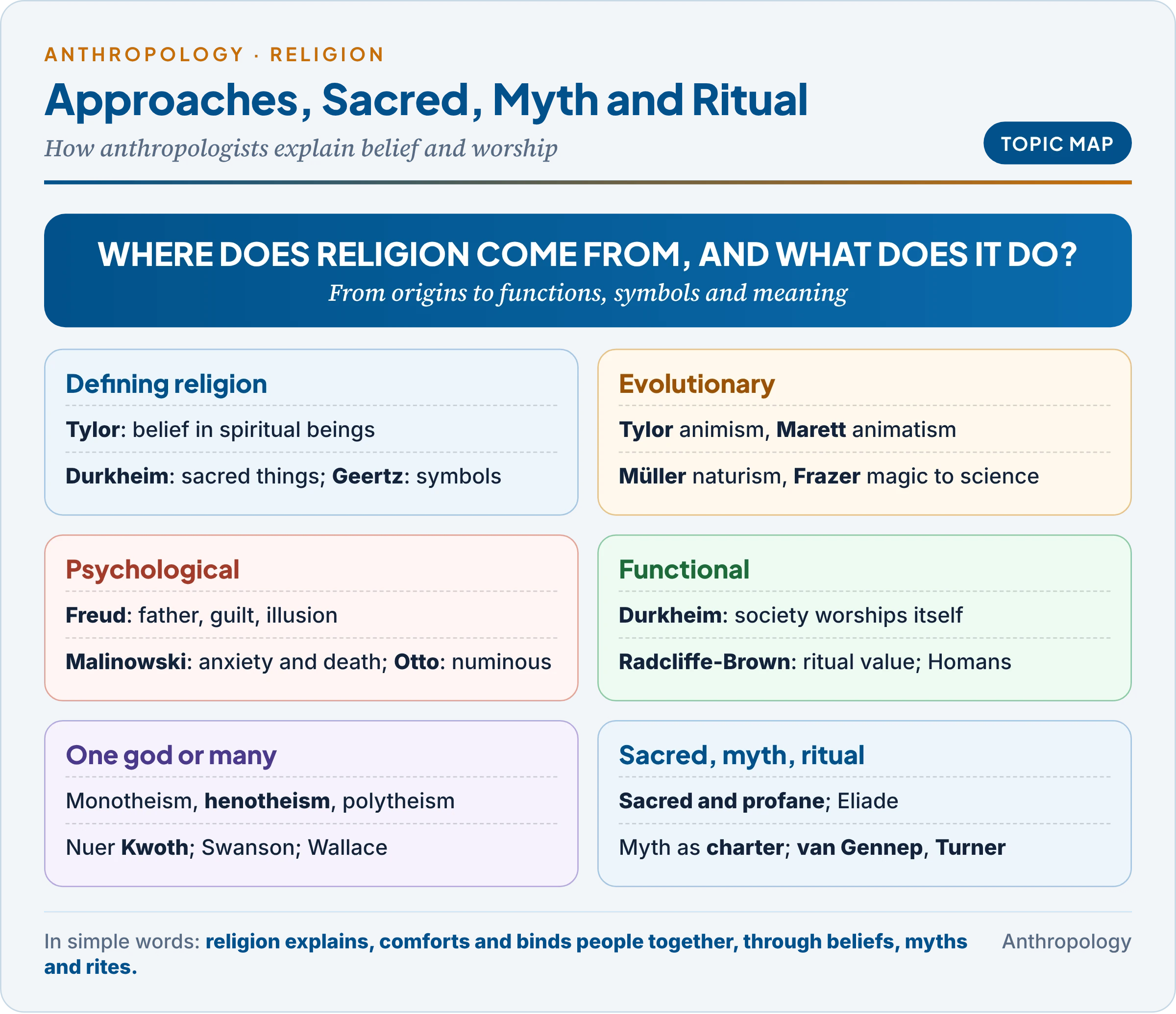
This article covers the first four items of the syllabus line: the approaches to religion, monotheism and polytheism, the sacred and profane, and myths and rituals. The forms of religion, the distinction of religion, magic and science, and magico-religious functionaries follow in Unit 5b.
1. What Is Religion?
In simple words
Religion is found in every known society. It joins beliefs about unseen powers to actions such as prayer, sacrifice and festivals, and it binds believers into a community with shared rules. Anthropologists define it in different ways depending on whether they stress the beliefs, the sacred, or what religion does for people.
Example first. At Sarhul, the spring festival of the Oraon and Munda of Jharkhand, the village priest (pahan) offers sacrifices in the sarna, the village’s sacred grove, and sal blossoms are distributed to every household. The festival has all the parts of a religion: belief in spirits of the grove, ritual (sacrifice, dance), a sacred place set apart, a specialist priest, and a community that celebrates together and renews its ties.
Definitions fall into two groups. Substantive definitions say what religion is (belief in spirits or gods); functional definitions say what it does (unites a group, gives meaning). The table sets out the classic ones.
| Scholar | Definition | Stress |
|---|---|---|
| E.B. Tylor (Primitive Culture, 1871) | “Belief in Spiritual Beings” (a “minimum definition”) | Belief, intellect |
| Émile Durkheim (The Elementary Forms of the Religious Life, 1912) | “A unified system of beliefs and practices relative to sacred things, that is to say, things set apart and forbidden, beliefs and practices which unite into one single moral community called a Church, all those who adhere to them” | Sacred, community |
| Melford Spiro (1966) | “An institution consisting of culturally patterned interaction with culturally postulated superhuman beings” | Interaction with superhuman beings |
| Clifford Geertz (“Religion as a Cultural System”, 1966) | “A system of symbols which acts to establish powerful, pervasive, and long-lasting moods and motivations in men by formulating conceptions of a general order of existence and clothing these conceptions with such an aura of factuality that the moods and motivations seem uniquely realistic” | Symbols, meaning |
Each definition answers a different question. Tylor’s is too narrow: it leaves out ritual, and Theravada Buddhism gives gods only a minor place. Durkheim’s adds community and the sacred but assumes the sacred-profane split is universal (§6). Geertz shifts the question from “what do people believe?” to “how do symbols make a world-view feel real?”: a ritual makes the believer feel that the world truly is as the religion describes it.
- Common elements in most definitions: belief in the supernatural; ritual; a sense of the sacred; a moral code; a community of believers; and an answer to the ultimate problems of death, suffering and evil.
2. Evolutionary Approaches
In simple words
Nineteenth-century scholars asked where religion came from and how it changed. They believed all societies pass through the same stages, so they arranged religions in a ladder from the “earliest” form, found among tribal peoples, to belief in one God, which they placed at the top.
Example first. A man dreams that he travels far and talks with his dead father, yet wakes in his own hut. The British anthropologist Edward Burnett Tylor reasoned that early people, puzzled by such dreams and by death, concluded that each person has a soul that can leave the body and survive death. From this idea of soul grew belief in spirits, and from spirits, the gods.
- Shared assumptions. Psychic unity of mankind (all minds work alike), unilinear evolution (one sequence for all), and the comparative method (living tribal peoples treated as evidence of humanity’s past). Practices that outlived their meaning were survivals, clues to earlier stages.
- John Lubbock (The Origin of Civilisation, 1870): atheism (absence of religious ideas), then fetishism, nature worship and totemism, shamanism, idolatry, and monotheism.
- E.B. Tylor (Primitive Culture, 1871), often called the father of anthropology, held that animism (belief in souls and spirits) was the minimum and earliest religion. He saw early man as a “savage philosopher” reasoning about dreams, trance and death: an intellectualist theory. Sequence: animism, ancestor and nature spirits, polytheism, monotheism.
- Herbert Spencer (Principles of Sociology, 1876), the English evolutionist philosopher, traced religion to ancestor worship: dead chiefs were remembered, feared and finally deified.
- Friedrich Max Müller, the German-born Oxford Sanskritist, found the origin in naturism: awe before the sun, sky and storm, expressed in the Vedic hymns. Natural forces were named by nouns with gender, and the names became persons, a process he called a “disease of language”.
- R.R. Marett, Tylor’s successor at Oxford, argued in “Pre-Animistic Religion” (1900) that before souls there was animatism: awe before an impersonal power such as Melanesian mana (described by the missionary R.H. Codrington, 1891). Religion was first felt, not reasoned: “savage religion is something not so much thought out as danced out” (The Threshold of Religion, 1909).
- James George Frazer (The Golden Bough, 1890), the Scottish classicist, proposed magic, then religion, then science. When people discovered that magic often failed, they turned to pleading with spirits and gods; later, science replaced both (the details of magic are in Unit 5b).
- Auguste Comte, the French founder of sociology, placed religion in the first of three stages of thought: theological (with sub-stages of fetishism, polytheism, monotheism), then metaphysical, then positive (scientific).
The table lines up the main schemes. Read across a row to see what each scholar thought came first and why.
| Scholar | Earliest form | Driving force | Sequence ends in |
|---|---|---|---|
| Tylor | Animism | Reasoning about dreams and death | Monotheism |
| Spencer | Ancestor worship | Memory and fear of the dead | Deified gods |
| Müller | Naturism | Awe of nature; language | Vedic gods |
| Marett | Animatism (mana) | Emotion of awe | Religion “danced out” |
| Frazer | Magic | Failure of magic | Science |
| Durkheim (§4) | Totemism | Collective life | Society worshipped |
Criticism:
- Reversal by “high gods”. The Scottish scholar Andrew Lang (The Making of Religion, 1898) found belief in a supreme creator among the simplest foragers of Australia and the Andaman Islands. The Austrian priest-ethnologist Wilhelm Schmidt (Der Ursprung der Gottesidee, 1912–55) built this into Urmonotheismus (original monotheism), later overlaid by polytheism. Since a “late” belief appears among the “earliest” peoples, the ladder collapses.
- Unverifiable. The British anthropologist E.E. Evans-Pritchard (Theories of Primitive Religion, 1965) mocked origin theories as the “if I were a horse” fallacy: scholars imagined what they would have thought in a savage’s place, with no evidence of what anyone actually thought.
- Armchair data and bias. The theories rested on travellers’ and missionaries’ reports and placed Western monotheism at the top, a ranking that reflects the theorists’ own culture.
3. Psychological Approaches
In simple words
Psychological approaches look for the roots of religion inside the human mind: in fear, awe, anxiety, guilt or the wish for a protecting father. Religion is seen as a way of coping with feelings that people cannot otherwise control.
Example first. In the Trobriand Islands, Malinowski observed that fishermen used no magic in the calm inner lagoon, where catches were safe and sure, but performed elaborate magic before fishing in the dangerous open sea. Ritual appeared exactly where danger and uncertainty were greatest, which suggested that its first job is to calm anxiety.
- Emotion as the root.
- Marett: awe before mysterious power (§2).
- Rudolf Otto, the German theologian (The Idea of the Holy, 1917), called the core religious feeling the numinous: a sense of a power that is mysterium tremendum et fascinans, a mystery that makes one tremble yet attracts.
- William James, the American psychologist (The Varieties of Religious Experience, 1902), traced religion to individual experience, not to any single emotion.
- Sigmund Freud, the Austrian founder of psychoanalysis, gave the boldest account.
- Totem and Taboo (1913): in a primal horde, a jealous father kept all the women; the sons killed and ate him, then, feeling guilt, forbade killing the totem (the father’s substitute) and marrying the women of their group. Religion and the incest taboo thus began in the Oedipal conflict (a son’s rivalry with his father).
- The Future of an Illusion (1927): God is a projection of the protecting father of childhood, and religion an illusion born of the wish for security; he called it humanity’s universal obsessional neurosis.
- Criticism: the American anthropologist A.L. Kroeber (“Totem and Taboo: An Ethnologic Psychoanalysis”, 1920) called the primal horde a “just so story” with no evidence. Freud’s lasting point is that religious symbols carry unconscious feelings about parents and authority.
- Bronislaw Malinowski (Magic, Science and Religion, 1925; book edition 1948) linked religion to life crises: birth, puberty, marriage and above all death. Death threatens to break the group and fill survivors with fear and despair; mortuary rituals and belief in immortality affirm life against death and hold the survivors together. Religion therefore meets an individual’s need for confidence in the face of what technical skill cannot control.
Criticism of psychological approaches:
- They explain religion by individual feelings, so they cannot explain why religions differ from society to society.
- Durkheim objected that a social fact must be explained by other social facts, not by individual psychology.
- Emotions such as fear may follow ritual rather than cause it (Radcliffe-Brown, §4.2).
Common confusion
Is Malinowski a psychological or a functional theorist of religion? Both. He is a functionalist because he asks what religion does, but the function he names is psychological: religion meets the individual’s need to overcome anxiety and fear of death. Radcliffe-Brown and Durkheim, in contrast, explain religion by its function for society as a whole.
4. Functional Approaches
In simple words
Functional approaches stop asking where religion came from and ask instead what it does now. Their answer is that religion holds society together: shared rituals bring people together, renew their feelings for one another and make them respect the group’s rules.
Example first. Among the Arunta of Central Australia, described by Baldwin Spencer and F.J. Gillen (1899), clan members lived scattered for most of the year. When they gathered for ceremonies, they danced, sang and handled churinga (sacred stones and boards marked with the clan’s totem, its emblematic animal or plant) in a state of intense excitement. Durkheim argued that this shared excitement made people feel a power greater than themselves, and that power was the group itself.
4.1 Émile Durkheim
- The question. Durkheim (The Elementary Forms of the Religious Life, 1912; English 1915) chose Australian totemism as the simplest religion, so that its essentials would be easiest to see.
- The argument.
- Religion divides the world into sacred and profane (§6).
- In totemism the totem is sacred, but the animal itself is ordinary; what makes it sacred is that it is the emblem of the clan.
- The totem therefore symbolises both the god and the clan, so the god is the clan personified: “the god of the clan… can be nothing else than the clan itself”.
- People feel this power at large gatherings, in a state of collective effervescence (shared, heightened emotion), and project it onto the totem.
- Beliefs and rites. Rites are of three kinds: negative cults (taboos that keep sacred and profane apart), positive cults (offerings and sacrifice, such as the Arunta intichiuma rites to increase the totem species) and piacular rites (rites of mourning and expiation).
- Functions of ritual. Rites discipline members, bring them together (cohesive), revive memories of the group’s past (revitalising) and restore well-being after loss (euphoric). By worshipping together, society worships itself.
- Criticism:
- Evans-Pritchard and others showed that Australian totemism is neither the simplest nor typical religion, and that the gatherings were of local groups, not clans.
- The American anthropologist A.A. Goldenweiser argued that “totemism” lumps together unrelated customs.
- Effervescence explains intensity of feeling, not why it is directed at gods.
- Yet Durkheim’s core insight, that religion expresses and renews social bonds, remains the basis of the functional approach.
4.2 A.R. Radcliffe-Brown
- In The Andaman Islanders (1922), the British anthropologist argued that rituals express and maintain the sentiments on which society depends. Objects and acts acquire ritual value because of their importance to social life; the Andamanese treat food and the turtle hunt with ritual care because the group’s survival depends on them.
- Rites create anxiety rather than relieve it. In “Taboo” (1939) he argued against Malinowski: a mother feels anxious because she has broken a birth taboo, not the other way round. Ritual teaches people what to feel anxious about, and so enforces social rules.
- Homans’ synthesis. The American sociologist George Homans (“Anxiety and Ritual”, 1941) reconciled the two: rites relieve primary anxiety about real dangers (Malinowski), but once established, failure to perform them creates secondary anxiety (Radcliffe-Brown).
- Ancestor worship. In “Religion and Society” (1945) he showed that rites to ancestors in lineage societies express dependence on the lineage and maintain its unity.
4.3 Beyond functionalism
Later approaches kept the question “what does religion do?” but answered it differently.
- Conflict and change. Karl Marx called religion “the opium of the people” (1844): it soothes suffering and so legitimises inequality. Max Weber (The Protestant Ethic and the Spirit of Capitalism, 1905) showed religion causing change: Calvinist ideas of a calling encouraged disciplined saving and work.
- Symbolic and interpretive. Clifford Geertz saw religion as a cultural system of symbols that is both a model of reality (describing the world) and a model for it (guiding action), uniting a people’s world-view (picture of how things are) with its ethos (moral and aesthetic style). Evans-Pritchard (Nuer Religion, 1956) studied religion through the people’s own concepts.
- Ecological. Religion can help people adapt to their environment.
- Roy Rappaport (Pigs for the Ancestors, 1968) showed that among the Tsembaga Maring of New Guinea, a ritual cycle ending in the kaiko pig festival regulated the size of pig herds, the timing of warfare and the use of land.
- Marvin Harris (“The Cultural Ecology of India’s Sacred Cattle”, 1966) argued that the Hindu ban on killing cattle preserves animals that supply ploughing, milk, dung for fuel and manure.
- The sacred groves of Indian tribes protect forests through religious taboo (Unit 4b §7.5).
Indian contributions. L.P. Vidyarthi (The Maler, 1963) described a “nature-man-spirit complex”: among the Maler of the Rajmahal hills, nature, people and spirits form one interdependent whole. M.N. Srinivas (Religion and Society among the Coorgs of South India, 1952) showed rituals of purity and pollution maintaining caste and family order.
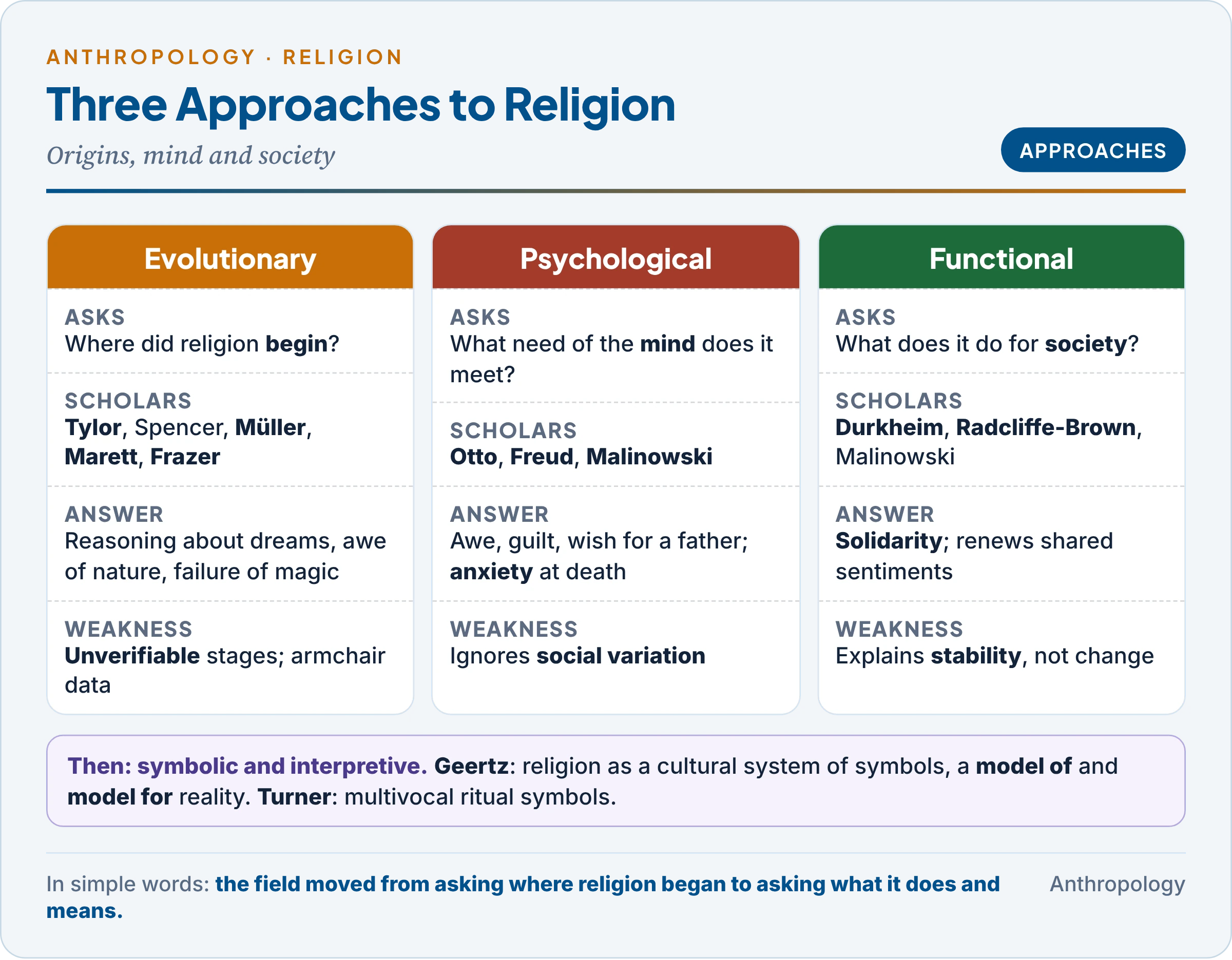
The table brings the three approaches of the syllabus together.
| Point | Evolutionary | Psychological | Functional |
|---|---|---|---|
| Question | Where did religion begin? | What need of the mind does it meet? | What does it do for society? |
| Unit | Humanity as a whole | Individual | Society or group |
| Scholars | Tylor, Spencer, Müller, Marett, Frazer | Otto, Freud, Malinowski | Durkheim, Radcliffe-Brown, Malinowski |
| Method | Armchair comparison | Psychology, psychoanalysis | Fieldwork |
| Weakness | Unverifiable stages | Ignores social variation | Explains stability, not change or conflict |
The approaches moved from origins to functions, and from individuals to groups. Each kept a valid core: religion does involve reasoning about life and death (Tylor), emotion (Malinowski, Otto) and social bonds (Durkheim). Geertz’s symbolic approach later added meaning.
5. Monotheism and Polytheism
In simple words
Monotheism is belief in one God; polytheism is belief in many gods. In practice most religions fall somewhere in between: many tribal religions have one high creator god with many lesser spirits, and some religions treat many gods as forms of a single divine power.
Example first. The Nuer of South Sudan speak of Kwoth, “Spirit”, the creator in the sky. They also address spirits of the air, totemic spirits and others by name. Evans-Pritchard (Nuer Religion, 1956) showed that these are not separate gods but refractions of the one Kwoth, as light is broken into colours. Nuer religion is neither monotheism in the biblical sense nor polytheism in the popular sense.
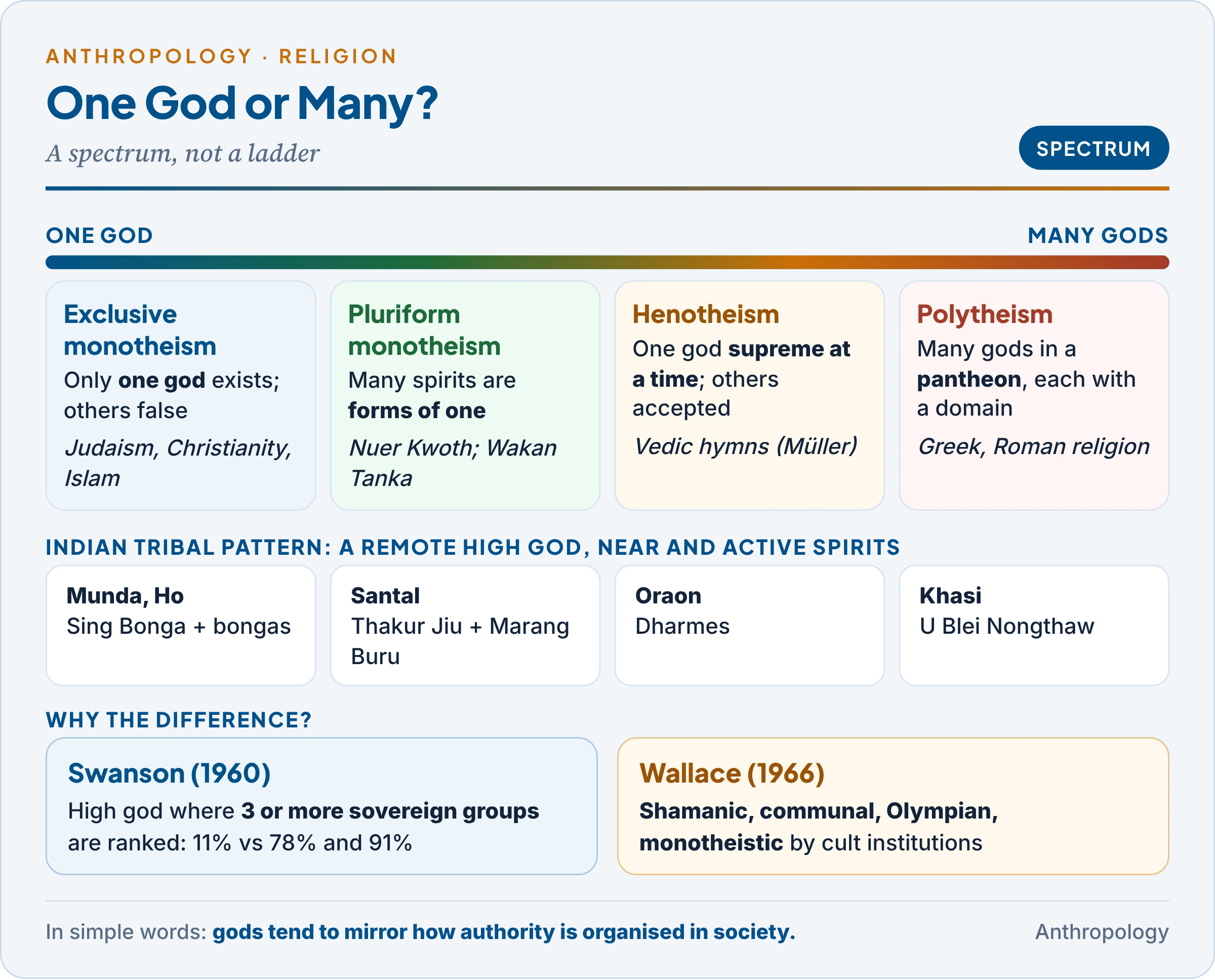
- Monotheism: belief in one god, unique, personal, creator and source of moral law (Judaism, Christianity, Islam). What matters is God’s uniqueness, not merely the number one.
- Polytheism: belief in many gods, each with its own domain, often ordered in a pantheon (an organised set of gods), as in Greek, Roman and much of popular Hindu religion.
- Intermediate forms:
- Henotheism (Müller’s term): worship of one god as supreme at a time, without denying others, as when a Vedic hymn exalts Indra or Agni as the highest; also called kathenotheism.
- Monolatry: worship of one god while accepting that others exist.
- Pluriform monotheism: many gods as forms of one divine being (Nuer Kwoth; the Oglala Sioux Wakan Tanka, the “Great Mystery”, whose many aspects are one).
- Dualism: two opposed principles, as in Zoroastrianism (Ahura Mazda and Angra Mainyu).
- Deus otiosus (idle god): a creator who has withdrawn from human affairs, so that daily worship goes to lesser spirits.
The forms are best read as a spectrum, not a ladder.
Explaining the difference:
- Evolutionary view. Tylor and Comte placed polytheism before monotheism; Schmidt reversed it (§2). Neither sequence can be proved.
- Social structure. In The Birth of the Gods (1960), the American sociologist Guy Swanson tested a Durkheimian idea on 50 societies: a high god appears where there is a hierarchy of three or more sovereign groups (groups with independent jurisdiction, such as family, clan and chiefdom). Only 11 per cent of societies with one or two such groups had a high god, against 78 per cent with three and 91 per cent with four or more. Gods, on this view, mirror the structure of authority in society.
- Organisation of worship. The American anthropologist Anthony Wallace (Religion: An Anthropological View, 1966) classified religions by their cult institutions (rituals with a common goal supported by one group): shamanic (individual and shamanic cults, foragers), communal (adds lay-run group rites, as among farming tribes), Olympian (adds full-time priests serving a pantheon) and monotheistic (a priesthood serving one supreme being).
Indian tribal religions mostly combine a high god with many spirits:
- Munda and Ho: Sing Bonga, the sun, as supreme, with village, household and forest bongas (spirits).
- Santal: Thakur Jiu as creator, with Marang Buru and other bongas.
- Oraon: Dharmes as supreme, benevolent god.
- Khasi: U Blei Nongthaw, God the creator.
Daily worship goes to the lesser spirits, who are near and can harm, while the high god is remote: a pattern close to the deus otiosus.
Common confusion
Is henotheism the same as monotheism? No. A monotheist holds that only one god exists or deserves worship. A henotheist worships one god as supreme, often one at a time, while accepting that other gods exist and may be worshipped on other occasions, as in the Vedic hymns.
6. Sacred and Profane
In simple words
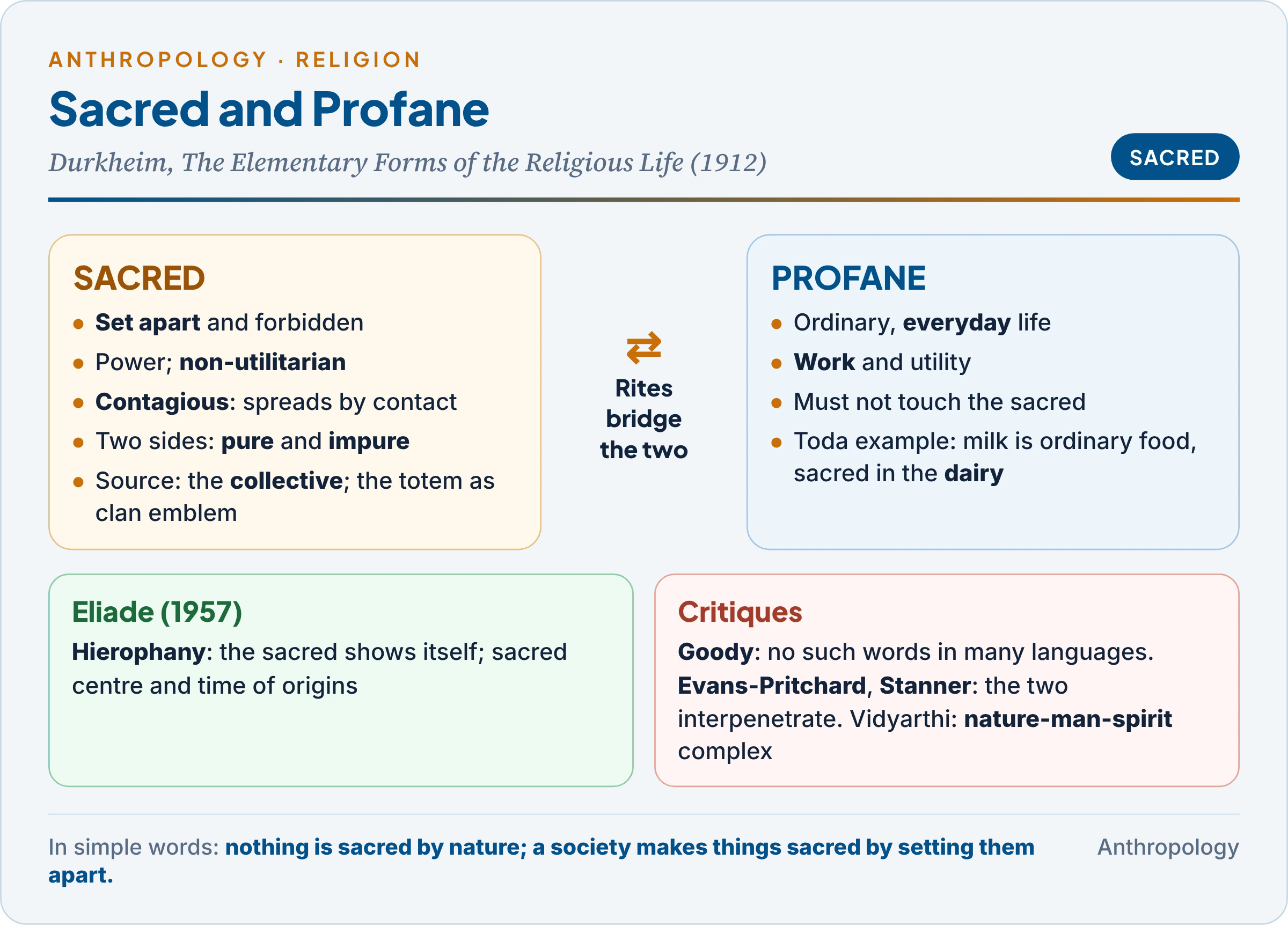
In many religions some things, places, times and people are treated as special and set apart, while everything else belongs to ordinary life. Durkheim called the first sacred and the second profane. The sacred is protected by rules because contact with the ordinary would pollute it, or because it is dangerous.
Example first. Among the Toda of the Nilgiri hills, the British anthropologist W.H.R. Rivers (The Todas, 1906) found that buffaloes and dairies were graded by sanctity. The holiest dairies were served by dairyman-priests (palol), who had to follow strict rules of purity and avoid ordinary village life. Milk, an everyday food, became sacred inside the dairy. The case shows that sacredness is not in the object but in the rules that set it apart.
Durkheim’s view:
- Absolute division. “The division of the world into two domains, the one containing all that is sacred, the other all that is profane, is the distinctive trait of religious thought.” The two are heterogeneous: passing from one to the other needs a rite, such as initiation.
- Source of sacredness. Nothing is sacred by nature. Holy water is holy not because of its chemistry or a revelation, but because the collective conscience (the shared beliefs of a society) attributes sacredness to it. Ultimately, the sacred is society itself.
- Features of the sacred:
- it involves power;
- it is non-utilitarian (work belongs to the profane);
- it is superimposed on objects, not part of them;
- it gives strength and makes a moral demand on believers;
- it is contagious: sacredness spreads by contact, which is why rites of consecration and prohibitions on touching exist.
- Sacred space and time. Religious and profane life cannot share the same place or the same time: ceremonies need set-apart places and suspend ordinary work.
- Ambiguity of the sacred. The sacred can be pure (beneficial) or impure (dangerous). In Australian funerals a corpse is first impure and feared, later a pure object of veneration. The impure is not profane: it is the sacred in its dangerous form.
- The totem link. The totem is sacred because it is the clan’s emblem: sacredness flows from the group to its symbol, which is why Durkheim used totemism to explain the sacred (§4.1).
Mircea Eliade, the Romanian historian of religions (The Sacred and the Profane, 1957), described the sacred as revealing itself in a hierophany (a manifestation of the sacred, such as a sacred tree or stone). Religious people orient their world around a sacred centre (axis mundi) and return in ritual to the sacred time of origins. Where Durkheim explained the sacred by society, Eliade treated it as a reality in its own right.
Criticism and Indian evidence:
- The British anthropologist Jack Goody (“Religion and Ritual: The Definitional Problem”, 1961) noted that many societies have no words translating “sacred” and “profane”; the dichotomy is a product of European religious thought.
- Evans-Pritchard found that for the Azande and Nuer the sacred and the everyday interpenetrate, and the Australian specialist W.E.H. Stanner (1967) found the same for Aboriginal religion.
- Vidyarthi’s nature-man-spirit complex among the Maler shows spirits present in fields, hills and homes, not in a separate sphere.
- Purity and pollution in Indian caste (Srinivas; Louis Dumont, Homo Hierarchicus, 1966) do not map onto sacred and profane: the impure can be sacred-dangerous, and the pure-impure scale ranks people, not two worlds.
7. Myths
In simple words
A myth is a sacred story, believed to be true, about how the world, people and customs came to be. Myths are not idle tales: they explain the world, justify rules and rituals, and are often recited or acted out in ceremonies.
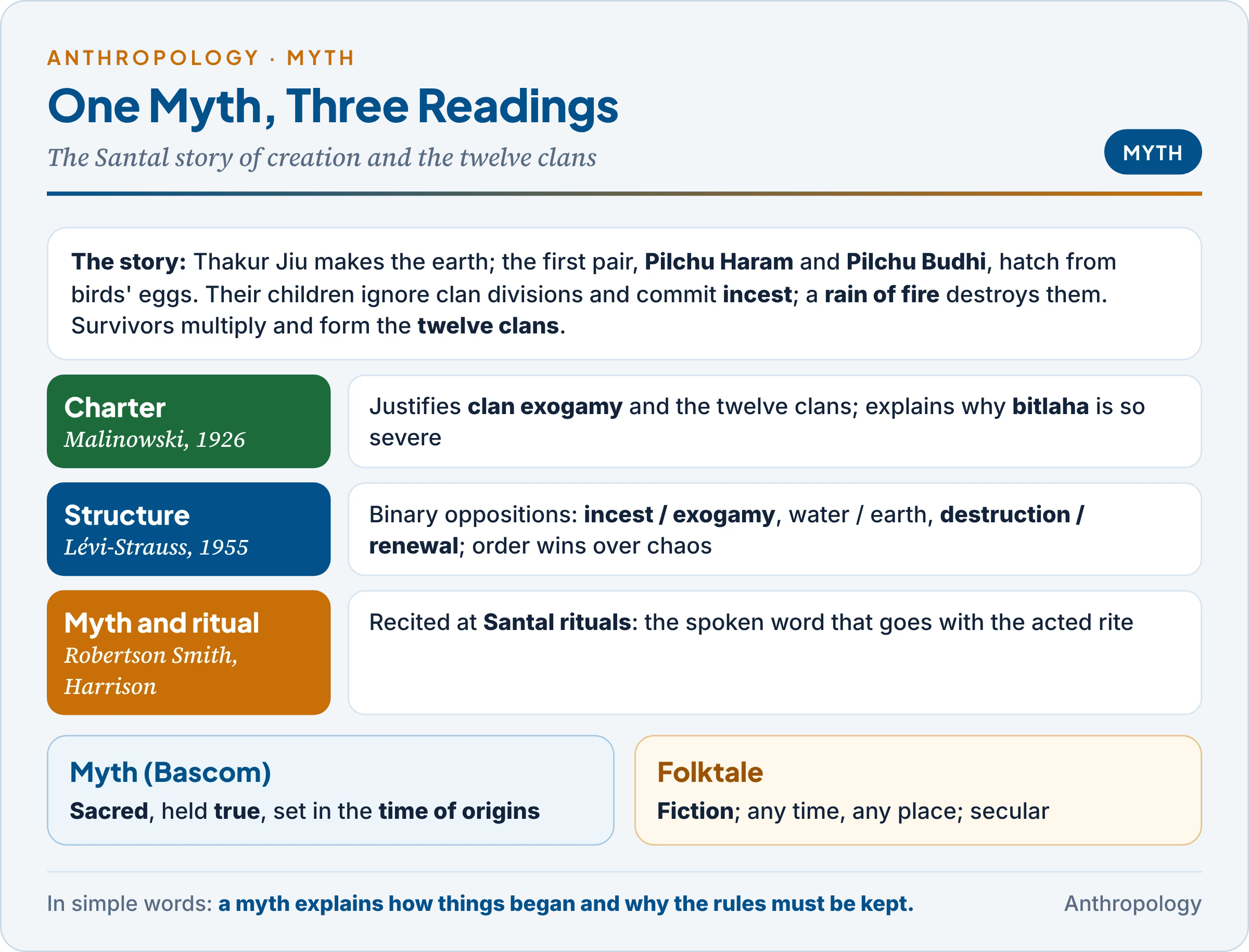
Example first. The Santal creation story, recorded from Santal elders by the missionary L.O. Skrefsrud, tells that the creator Thakur Jiu made the earth with the help of water creatures; the first human pair, Pilchu Haram and Pilchu Budhi, hatched from the eggs of two birds. Their descendants ignored clan divisions and committed incest, and Thakur Jiu destroyed them with a rain of fire; the survivors multiplied again and divided into the twelve Santal clans. The myth is recited at Santal rituals, and it gives clan exogamy its sacred authority: breaking it repeats the sin that once destroyed the world, which is why the punishment, bitlaha, is so severe (Unit 4b §1).
- Definition. A myth is a sacred narrative set in a primordial time (a time of beginnings before the present order), about gods, culture heroes or ancestors, regarded by the teller as true.
- Myth as oral literature. In non-literate societies, myths are oral literature: transmitted by memory and performance, existing in many variants, recited by specialists at set occasions, and shaped by the audience. Verrier Elwin collected thousands of tribal myths of central India (Myths of Middle India, 1949).
The American folklorist William Bascom (“The Forms of Folklore: Prose Narratives”, 1965) separated three kinds of prose narrative. The table shows how they differ.
| Point | Myth | Legend | Folktale |
|---|---|---|---|
| Belief | Fact | Fact | Fiction |
| Time | Remote past, before the present world | Recent past | Any time |
| Place | Another or earlier world | The world as it is | Any place |
| Attitude | Sacred | Sacred or secular | Secular |
| Characters | Non-human: gods, culture heroes | Human | Human or animal |
The key difference is belief and sacredness: the same plot can be a myth to one people and a folktale to another, depending on whether it is held true and sacred.
Theories of myth:
- Nature myth (Müller). Myths personify natural forces, especially the sun.
- Myth as explanation (Tylor). Myth is early science: a theory of the world.
- Myth-ritual school. The Scottish biblical scholar William Robertson Smith (Lectures on the Religion of the Semites, 1889) argued that ritual came first and myths were invented later to explain rites whose original reasons had been forgotten (the mourning for Adonis followed the yearly withering of plants). Jane Harrison called myth “the spoken correlative of the acted rite”.
- Myth as charter (Malinowski). In Myth in Primitive Psychology (1926), myth is not an explanation but “a pragmatic charter of primitive faith and moral wisdom”. In the Trobriands, each subclan’s myth of emergence from a hole in the ground justified its rights to land; the story that the dog emerged before the pig, then lost precedence, justified the high rank of the Malasi clan. Myth validates the present by appeal to the past, and it is told especially when a claim is challenged.
- Psychoanalytic. Freud read myths as disguised wishes; Carl Jung saw universal archetypes.
- Structural (Lévi-Strauss). The French anthropologist Claude Lévi-Strauss (“The Structural Study of Myth”, 1955) treated myth as a language.
- Its units are mythemes (short relations, such as “Oedipus kills his father”).
- Its meaning lies in binary oppositions (paired contrasts such as nature and culture, raw and cooked, life and death) and in mediating terms that bridge them.
- The Oedipus myth works over the contradiction between overrating blood relations (incest) and underrating them (patricide), and between belief in man’s birth from the earth and the fact of birth from two parents.
- In “The Story of Asdiwal” (1958), a Tsimshian myth of the North-West Coast of America, he related the hero’s movements between his mother’s and father’s homes to tensions between matrilocal and patrilocal residence in a matrilineal society.
- Myths thus think through contradictions a society cannot resolve, and different versions are transformations of one structure.
- Myth as sacred history (Eliade). Myth narrates what happened in illo tempore (“in that time” of origins), and ritual re-enacts it.
- Criticism of structuralism. Its oppositions are hard to test; it ignores performance and context; critics such as Edmund Leach, who applied it to the Bible (Genesis as Myth, 1969), still warned that the analyst’s ingenuity can find any pattern.
Functions of myth:
- explanation (an Abenaki myth tells how maize came from a woman’s hair);
- validation of rites and rules (the Santal myth and clan exogamy);
- description of what no one can see (creation, the end of the world);
- healing: Navajo curing chants retell creation;
- education and identity.
8. Rituals
In simple words
A ritual is a set of formal, repeated actions done in a fixed way, often at special times, that carries religious or social meaning. Some rituals move a person from one stage of life to another; others renew the whole community; others ask spirits for help.
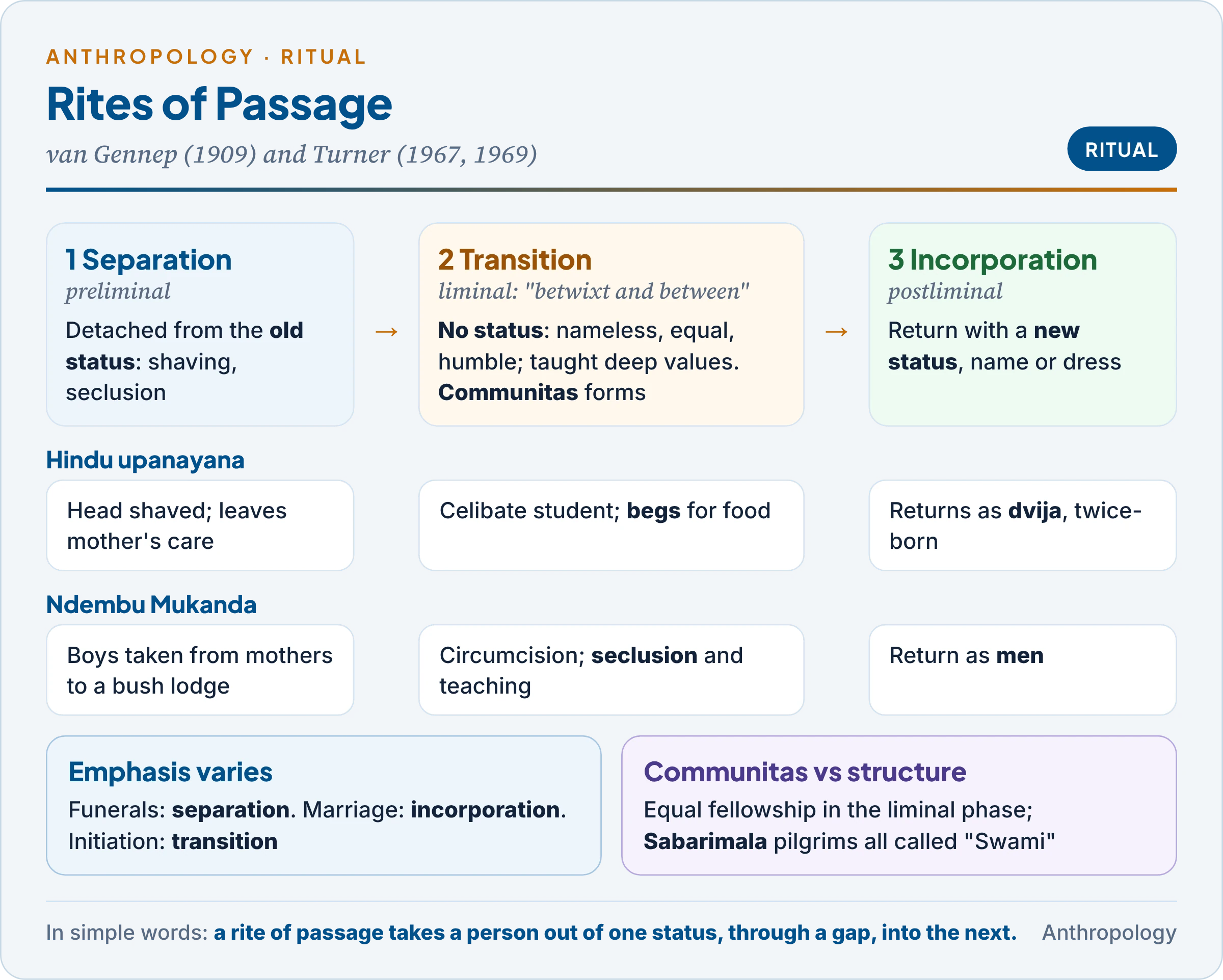
Example first. In the Hindu upanayana (sacred-thread ceremony), a boy’s head is shaved and he leaves his mother’s care (separation); as a celibate student (brahmachari) he begs for food and learns from a teacher, in a state between childhood and adulthood (transition); he returns as a dvija, “twice-born”, with new rights and duties (incorporation). The rite moves him from one social status to another.
- Definition. Victor Turner, the British anthropologist of the Ndembu of Zambia (The Forest of Symbols, 1967), defined ritual as “prescribed formal behavior for occasions not given over to technological routine, having reference to beliefs in mystical beings or powers”. Ritual is formal, repetitive, symbolic and performed.
- Ritual and myth. Ritual often re-enacts myth (imitative rites; New Year rites repeat creation). Malinowski noted that myth and ritual are not coextensive: some myths have no rite and some rites no myth.
8.1 Types of ritual
The table gives the main classifications.
| Classification | Types |
|---|---|
| By occasion (Wallace) | Calendrical (fixed by season or cycle) and non-calendrical (at crises) |
| By purpose (Chapple and Coon, 1942) | Rites of passage (changes in an individual’s status) and rites of intensification (renewing a group in crisis or at seasonal change: harvest, drought) |
| By form (Durkheim) | Negative (taboos), positive (offering, sacrifice), piacular (mourning, expiation) |
| Sacrifice (Hubert and Mauss, 1898) | Consecration through the destruction of a victim, linking the sacred and profane worlds |
| By function (Wallace) | Technological (hunting, crops), therapeutic, ideological (social control), salvation, revitalisation |
The difference that matters most is between rites of passage, which change the status of individuals, and rites of intensification, which renew the group as a whole, as Sarhul does (§1).
8.2 Rites of passage: van Gennep
The Franco-Dutch folklorist Arnold van Gennep (Les Rites de Passage, 1909) showed that rites marking birth, initiation, marriage and death share three phases, modelled on crossing a threshold (limen in Latin):
- Separation (preliminal): the person is detached from the old status: head-shaving, removal of clothes, seclusion.
- Transition or margin (liminal): the person is between statuses, neither one nor the other.
- Incorporation (postliminal): the person returns with a new status, often with feasting and new names or dress.
Different rites stress different phases: funerals stress separation, marriage stresses incorporation, and initiation and pregnancy stress transition. The rites help individuals and society through change without disorder, because each change is made public, orderly and sacred.
8.3 Liminality and communitas: Turner
- Liminality. In “Betwixt and Between” (1964, reprinted in The Forest of Symbols, 1967), Turner studied the middle phase among the Ndembu, as in the boys’ circumcision rite Mukanda. Initiands are “betwixt and between” all fixed positions: nameless, often naked or uniformly dressed, without property or rank, submissive to elders, sometimes treated as dead. Stripped of status, they can be taught the society’s deepest values.
- Communitas. In The Ritual Process (1969), Turner argued that liminal people form a bond of equality and comradeship, which he called communitas, the opposite of structure (the ordered system of ranks).
- Spontaneous (existential) communitas: the immediate experience of fellowship.
- Normative communitas: organised into a lasting social system.
- Ideological communitas: utopian models of society based on it.
Society moves between structure and anti-structure, and needs both.
- Liminoid. Turner later (1974) called modern, optional, leisure experiences that resemble liminality (theatre, carnival, festivals) liminoid.
- Symbols. Ndembu ritual symbols are multivocal (carry many meanings at once). The mudyi tree, which oozes white sap, stands for breast milk, the mother-child bond, matriliny and the unity of Ndembu society.
Indian illustrations:
- Sabarimala pilgrimage (Kerala). Pilgrims keep a 41-day vow of abstinence, wear black, and all address one another as “Swami“, whatever their caste or wealth. This is liminality and communitas in a pilgrimage, as Turner described for pilgrimages generally (Image and Pilgrimage in Christian Culture, 1978, with Edith Turner).
- Youth dormitories. Entry into the Oraon dhumkuria or the Muria ghotul is an initiation.
Rituals of rebellion. Gluckman (“Rituals of Rebellion in South-East Africa”, 1954) found that in the Swazi Incwala (national first-fruits ceremony), subjects sang songs of hostility to the king, and among the Zulu, women temporarily took on men’s roles. Such licensed reversals let tensions out in a controlled way and so strengthen the existing order.
Functions of ritual thus span the social (solidarity: Durkheim, Radcliffe-Brown), the psychological (confidence: Malinowski), the communicative (a language stating social relations: Edmund Leach) and the ecological (regulating resources: Rappaport).
Key Terms
| Term | Meaning in simple words |
|---|---|
| Animism | Belief in souls and spirits (Tylor) |
| Animatism | Belief in an impersonal supernatural power such as mana (Marett) |
| Naturism | Worship of forces of nature (Müller) |
| Survival | A practice that outlived its original purpose |
| Numinous | The awe-filled feeling of a holy power (Otto) |
| Collective effervescence | Shared heightened emotion at large gatherings (Durkheim) |
| Totem | Animal or plant that is the emblem of a clan |
| Henotheism | Worship of one god as supreme without denying others |
| Deus otiosus | A creator god who has withdrawn from human affairs |
| Sacred / profane | Set apart and forbidden / ordinary everyday life |
| Hierophany | A manifestation of the sacred (Eliade) |
| Myth | Sacred story held true, set in the time of origins |
| Charter | Myth as justification of present rules (Malinowski) |
| Mytheme | Smallest meaningful unit of a myth (Lévi-Strauss) |
| Binary opposition | A pair of contrasting ideas, such as nature and culture |
| Rite of passage | Ritual marking a change of status |
| Rite of intensification | Ritual renewing a group as a whole |
| Liminality | The in-between phase of a rite of passage |
| Communitas | Sense of equal comradeship in liminality (Turner) |
| Multivocal symbol | A symbol carrying several meanings at once |
Contemporary Developments
- Deepavali was inscribed on UNESCO’s Representative List of the Intangible Cultural Heritage on 10 December 2025 at the New Delhi session, under “social practices, rituals and festive events”, India’s sixteenth element on the lists.
- Maha Kumbh, Prayagraj (13 January to 26 February 2025): a mass pilgrimage studied as communitas on a vast scale; the Kumbh Mela has been on UNESCO’s intangible heritage list since 2017.
- Sarna religion: the Jharkhand assembly passed a resolution on 11 November 2020 seeking a separate Sarna code in the Census, asserting nature worship of sacred groves as a distinct religion.
- Sabarimala: the Supreme Court’s 2018 judgment opening the temple to women of all ages, and the reference to a larger bench in November 2019, made purity, pollution and the sacred a constitutional question.
Diagrams to Master
- Topic map of the article.
- Three approaches (§4): question, unit, scholars and weakness of each.
- Monotheism–polytheism spectrum (§5): exclusive, pluriform, henotheism, polytheism, with Indian tribal high gods.
- Sacred and profane (§6): set apart, collective source, pure and impure, rites as the bridge; Eliade; critiques.
- Myth three ways (§7): charter, structure, myth-ritual, using the Santal myth.
- Rites of passage (§8): separation, liminality with communitas, incorporation; upanayana and Mukanda.
Revision Grid
| Scholar | Work (year) | Key idea |
|---|---|---|
| Tylor | Primitive Culture (1871) | Animism; minimum definition; survivals |
| Müller | Hibbert Lectures (1878) | Naturism; disease of language; henotheism |
| Robertson Smith | Religion of the Semites (1889) | Ritual before myth |
| Frazer | The Golden Bough (1890) | Magic, religion, science |
| Lang | The Making of Religion (1898) | High gods among foragers |
| Marett | “Pre-Animistic Religion” (1900); Threshold of Religion (1909) | Animatism; “danced out” |
| van Gennep | Les Rites de Passage (1909) | Separation, transition, incorporation |
| Durkheim | Elementary Forms of the Religious Life (1912) | Sacred and profane; effervescence |
| Schmidt | Der Ursprung der Gottesidee (1912–55) | Original monotheism |
| Freud | Totem and Taboo (1913); Future of an Illusion (1927) | Primal horde; religion as illusion |
| Otto | The Idea of the Holy (1917) | Numinous |
| Radcliffe-Brown | The Andaman Islanders (1922); “Taboo” (1939) | Ritual value; rites create anxiety |
| Malinowski | Magic, Science and Religion (1925); Myth in Primitive Psychology (1926) | Anxiety and death; myth as charter |
| Gluckman | Rituals of rebellion (1954) | Licensed reversal |
| Lévi-Strauss | “Structural Study of Myth” (1955); “Asdiwal” (1958) | Mythemes, binary oppositions |
| Evans-Pritchard | Nuer Religion (1956); Theories of Primitive Religion (1965) | Kwoth’s refractions; “if I were a horse” |
| Eliade | The Sacred and the Profane (1957) | Hierophany |
| Swanson | The Birth of the Gods (1960) | High gods and sovereign groups |
| Vidyarthi | The Maler (1963) | Nature-man-spirit complex |
| Geertz | “Religion as a Cultural System” (1966) | Symbols; model of and for |
| Wallace | Religion: An Anthropological View (1966) | Cult institutions; four religion types |
| Turner | Forest of Symbols (1967); Ritual Process (1969) | Liminality, communitas, multivocality |
| Rappaport | Pigs for the Ancestors (1968) | Ritual regulates ecology |
Previous Year Questions
Unit 5: Approaches to religion; monotheism and polytheism; sacred and profane; myths and rituals
- 2026Write notes on: Myth as oral literature.
- 2026How do religious beliefs help people to devise cultural mechanisms to adapt to their environment? Discuss in detail with appropriate examples.
- 2025Critically examine James Frazer’s theory of evolutionism. Elucidate the place of religion in modernity.
- 2023How did Clifford Geertz look at religion? Differentiate between anthropological and psychological approaches to the study of religion.
- 2019Critically explain the anthropological approaches to religion.
- 2016Critically examine different Anthropological approaches to Religion.
- 2015How do you relate the concepts of ‘Sacred’ and ‘Profane’ in Durkheim’s theory of religion with a focus on the role of totem ?
- 2014What is understood by ‘Rites of Passage’ ? Describe the various phases of the ‘Rites of Passage’ and their significance.
- 2011Explain various anthropological approaches to study religion.
- 2007How anthropologists define Religion? Describe various forms of religion with suitable examples?
- 2006Discuss Anthropological approaches to the study of Religion.
- 1994Describe the role of totemism in primitive religion, according to Durkheim.
- 1993Highlight the significance of religious practices in Tribal Communities of India.
- 1991What is religion ? Discuss Taylor’s theory of origin of religion.
- 1990Describe the origin of religion. Distinguish between religion and magic.
- 1987Distinguish between religion and magic. Critically examine the different theories of religion and comment on their relevance today.
- 1986Write a note on differences between primitive religion and world religion.
- 1985How do you explain the origin and evolution of religion ? How does religion continue to function in human society ?
- 1982Discuss the theories of origins of religion. Which one appears to be most adequate?
Related questions from other units
- 2024Unit 6: How does Lévi-Strauss look at the Tsimshian myth of Asdiwal? Critically discuss Lévi-Strauss’ theory of structuralism in the light of his study of mythologies.
- 2020Unit 6: Write notes on Victor Turner and Liminality in about 150 words.
- 2014Unit 6: What is functionalism? Discuss the functional approach to the understanding of Religion.
- 2013Unit 6: Bring out the contribution of Turner and Geertz in symbolic and interpretive theories in Anthropology. (250 words).
- 2011Unit 1.1: Critically examine the contribution of Anthropologists in the interpretation of symbols.
- 1994Unit 6: Write a note on Structuralist approach to the study of myth.
- 1989Unit 6: Examine critically the concept of Model and myth in Levi-Strauss Anthropology.
- 1982Unit 6: Discuss the structural study of myth by Levi-Strauss.