

2.4 Family: Definition and universality; Family, household and domestic groups; functions of family; Types of family (from the perspectives of structure, blood relation, marriage, residence and succession); Impact of urbanization, industrialization and feminist movements on family.
Official Syllabus: Paper I, Unit 2.4
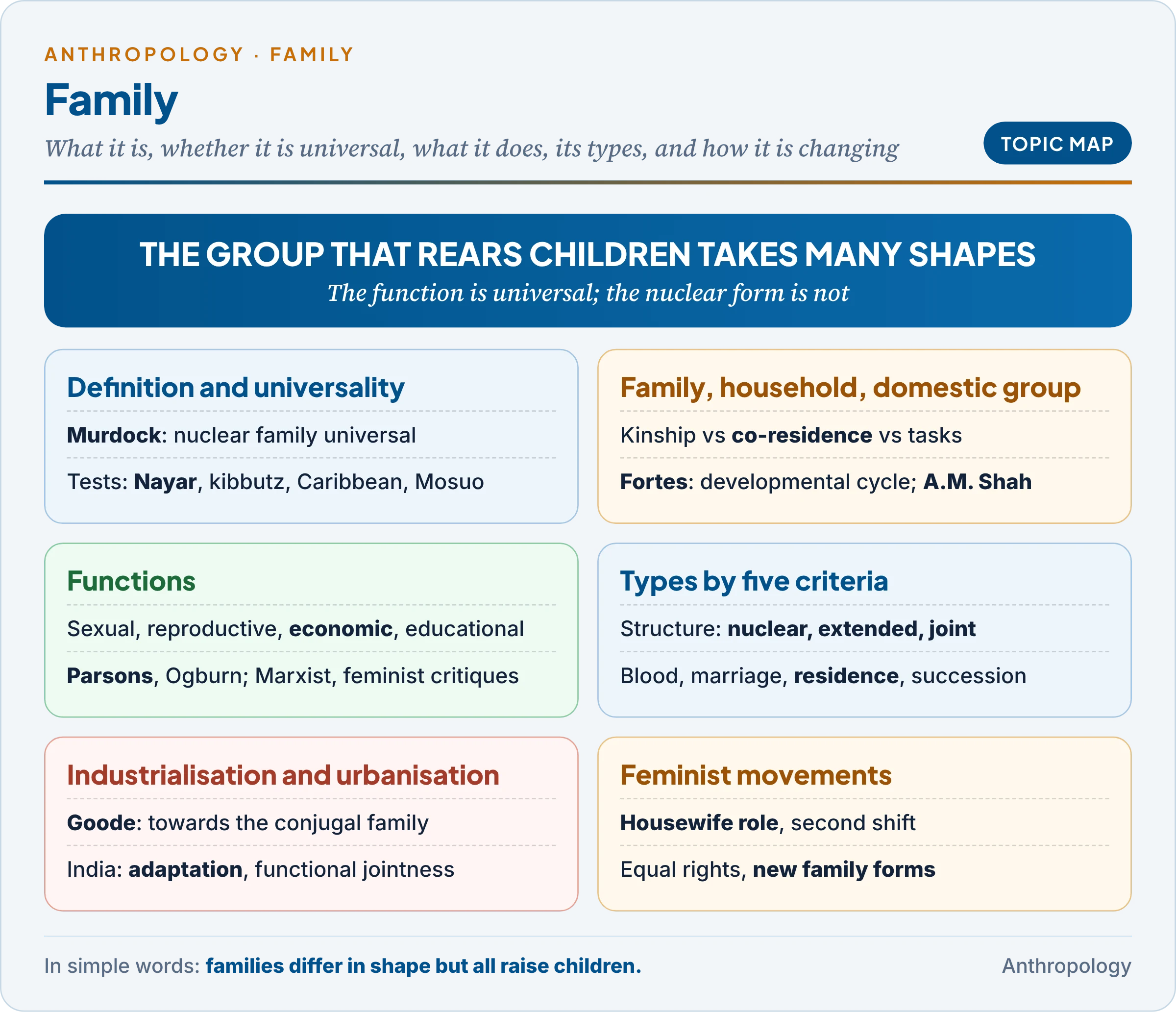
Unit 2.3 showed that marriage is a bundle of rights that makes children legitimate and links groups. Marriage creates a family of procreation; the family is the group that lives out those rights day to day. Forms of marriage (monogamy, polygyny, polyandry) are treated in Unit 2.3; here they matter only as one criterion for classifying families (§4.3).
1. Definition and Universality of the Family
In simple words
A family is the small group of people, linked by marriage, birth or adoption, who look after one another and bring up children. People everywhere live in some kind of family, but the shape of that group differs a great deal from one society to another.
Example first. Picture three homes. In a Delhi flat, a husband, wife and two children share one kitchen and one budget. In a Nayar taravad (matrilineal joint household) of old Kerala, brothers, sisters and the sisters’ children lived together, and the women’s husbands only visited at night. In an Israeli kibbutz (collective farm) of the 1950s, children slept in a children’s house and ate with their age-mates, not with their parents. All three raise children, yet only the first matches the common picture of a “family”. The question of definition and universality grows out of such cases.
1.1 Definitions
Each definition below stresses a different element. Read the last column as the test each one has to pass.
| Scholar | Definition (core) | Element stressed |
|---|---|---|
| G.P. Murdock, American cross-cultural anthropologist, Social Structure (1949) | “A social group characterised by common residence, economic cooperation and reproduction“, including adults of both sexes, at least two of whom maintain a socially approved sexual relationship, and one or more children, own or adopted | Co-residence and the nuclear core |
| William N. Stephens, The Family in Cross-Cultural Perspective (1963) | A group based on marriage and a marriage contract, with rights and duties of parenthood, common residence and reciprocal economic obligation between husband and wife | Four criteria, true of most but not all societies |
| Claude Lévi-Strauss, French structuralist, “The Family” (1956) | Originates in marriage; consists of husband, wife and children (others may join); united by legal bonds, economic and religious rights, sexual rights and prohibitions, and feelings of love and respect | The family is a product of alliance, not of nature |
| Ira Reiss, American sociologist (1965) | “A small kinship-structured group with the key function of nurturant socialisation of the newborn” | Function, not form |
The definitions move from form (who lives together) to function (what the group does for children). The reason is the same as for marriage in Unit 2.3: every formal definition was broken by some ethnographic case, so later scholars kept only the function that seemed truly universal.
Basic structure of the family. Every family rests on two kinds of bond:
- Conjugal bond (the tie between spouses) and consanguineal bond (the tie of “blood”, between parents and children and between siblings). The conjugal bond creates the consanguineal bonds of the next generation.
- Family of orientation (the family one is born into) and family of procreation (the family one founds by marrying). Each adult belongs to both: a child in the first, a spouse and parent in the second. This dual membership is what links families into a network of kin.
- Pater and mater (the socially recognised parents) are distinct from genitor and genetrix (the biological parents); the Nuer ghost marriage (Unit 2.3) shows society, not biology, deciding.
- Family as cornerstone: the family is the nucleus of wider groups; brothers’ families grow into lineages and lineages into clans (Unit 2.5).
Family as group and as institution. A group is a set of concrete persons (the Sharma family of Lucknow); an institution is the set of norms that governs such groups everywhere in a society (the rules of Hindu family life). The family is both: the same word names the people and the rules they live by. The distinction matters because a family group can dissolve through death or divorce while the institution continues unchanged.
1.2 The universality debate
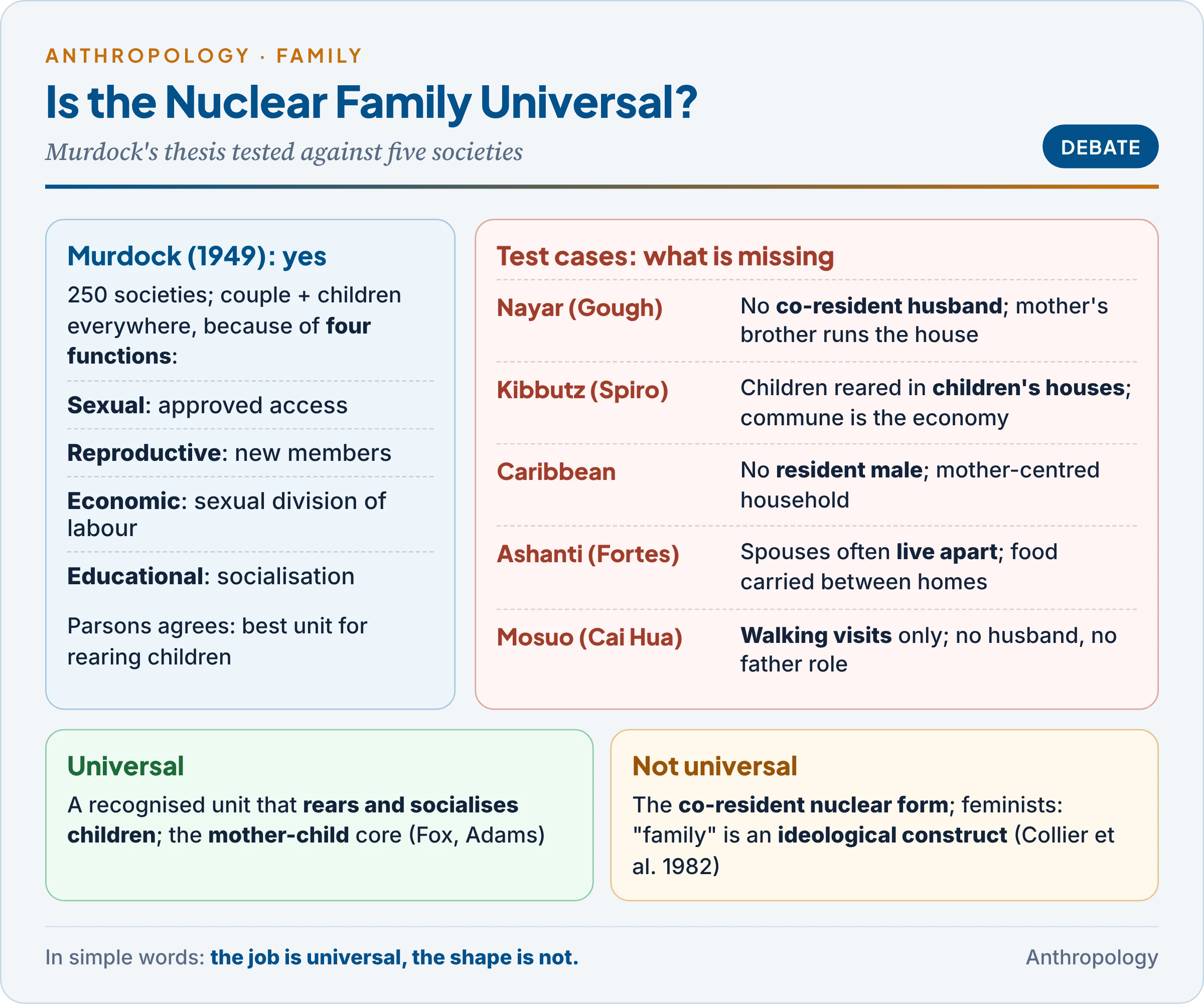
Murdock’s thesis. From a sample of 250 societies, Murdock concluded that the nuclear family (a married couple and their children) is a “universal social grouping”, present either alone or as the building block of larger polygamous and extended families. He argued it is universal because it performs four functions that no society can do without: sexual, economic, reproductive and educational (§3). Talcott Parsons, the American functionalist sociologist, added that the small conjugal family is the best setting for socialising children.
Ethnographers then tested the thesis against societies where one or more of Murdock’s elements was missing. The table gives each test case and what it proves.
| Case | Ethnographer | What was missing | What it proves |
|---|---|---|---|
| Nayar taravad (Kerala) | Kathleen Gough, British anthropologist (1959) | Co-resident husband-father; visiting sambandham husbands gave no economic support; the karanavan (senior mother’s brother) ran the house | Sex, economics and child-rearing can be split among different persons; the nuclear family is not a necessary unit |
| Israeli kibbutz | Melford Spiro, American anthropologist, “Is the Family Universal?” (1954) | Common residence and economic cooperation of the couple; children reared in children’s houses by nurses (metaplot) | A whole community can perform the “family” functions |
| Caribbean matrifocal households (Jamaica, Guyana) | R.T. Smith (1956), Nancie Gonzalez (1965) | Resident adult male; mother, grandmother and children form the stable unit | A mother-child unit can stand without a husband-father |
| Ashanti (Ghana) | Meyer Fortes, British social anthropologist | Co-residence: many spouses lived in their own matrilineal homes and food was carried between them | Marriage and family need not share a roof |
| Mosuo (Yunnan, China) | Cai Hua (2001) | Husband and father: walking visits only | Strongest case against a universal conjugal family |
The cases share one lesson: the elements Murdock bundled together (sex, residence, economy, child-rearing) can be pulled apart and given to different persons. What none of them lacks is a socially approved unit that rears children.
Responses and evaluation:
- Spiro revised himself: he later treated the kibbutz as one large family, and in Gender and Culture (1979) reported kibbutz women pressing to keep children in their own rooms at night. Some read this as a human need; others blame the kibbutz’s failure to give women equal work. Either way, removing the family proved hard, not impossible.
- Gough’s reply: even among the Nayar, the tali rite and the paternity payment gave every child a socially recognised father of proper caste. So a unit of legitimacy survived even where the co-resident nuclear family did not.
- The mother-child core: Robin Fox, British anthropologist, and R.N. Adams (1960) argued that the truly universal unit is the mother and her dependent children; the husband-father is attached to it in different ways, or not at all.
- Feminist critique: Jane Collier, Michelle Rosaldo and Sylvia Yanagisako, “Is There a Family?” (1982), argued that “the family” is an ideological construct of Western society: it assumes a natural, loving, private unit of mother, father and children. They proposed asking what activities (care, food, sex, property) are organised in which groups in each society, instead of assuming a family exists.
- Evaluation: the function of rearing and socialising the young, and a socially recognised unit for it, is universal. The form, especially the co-resident nuclear family, is not. In anthropological usage, a “universal family” means a universal function, while a “universal nuclear family” is a specific and disputed claim about structure.
Common confusion
Is “the family is universal” the same claim as “the nuclear family is universal”? No. The first says every society has some socially approved group that rears children, which almost all anthropologists accept. The second says that group is always a co-resident couple with their children, which the Nayar, kibbutz and Mosuo cases disprove.
Rethinking family and kinship. The variation in marriage forms (Unit 2.3) led anthropologists to treat family and kinship as cultural constructions of social reproduction (the way a society replaces its members and their relationships across generations), not as biological givens. David Schneider, A Critique of the Study of Kinship (1984), argued that kinship studies had projected Western ideas of “blood” onto other cultures; Kath Weston, Families We Choose (1991), and Janet Carsten‘s idea of “relatedness” (2000) showed ties made by care, feeding and living together. Amrita Pande, Wombs in Labor (2014), on commercial surrogates in Anand, Gujarat, showed that who counts as a parent is settled by law and culture.
2. Family, Household and Domestic Group
In simple words
Family is about who is related to whom. Household is about who lives and eats together. Domestic group is about who does the daily work of feeding and bringing up children. Usually these overlap, but not always, so anthropologists keep the three words apart.
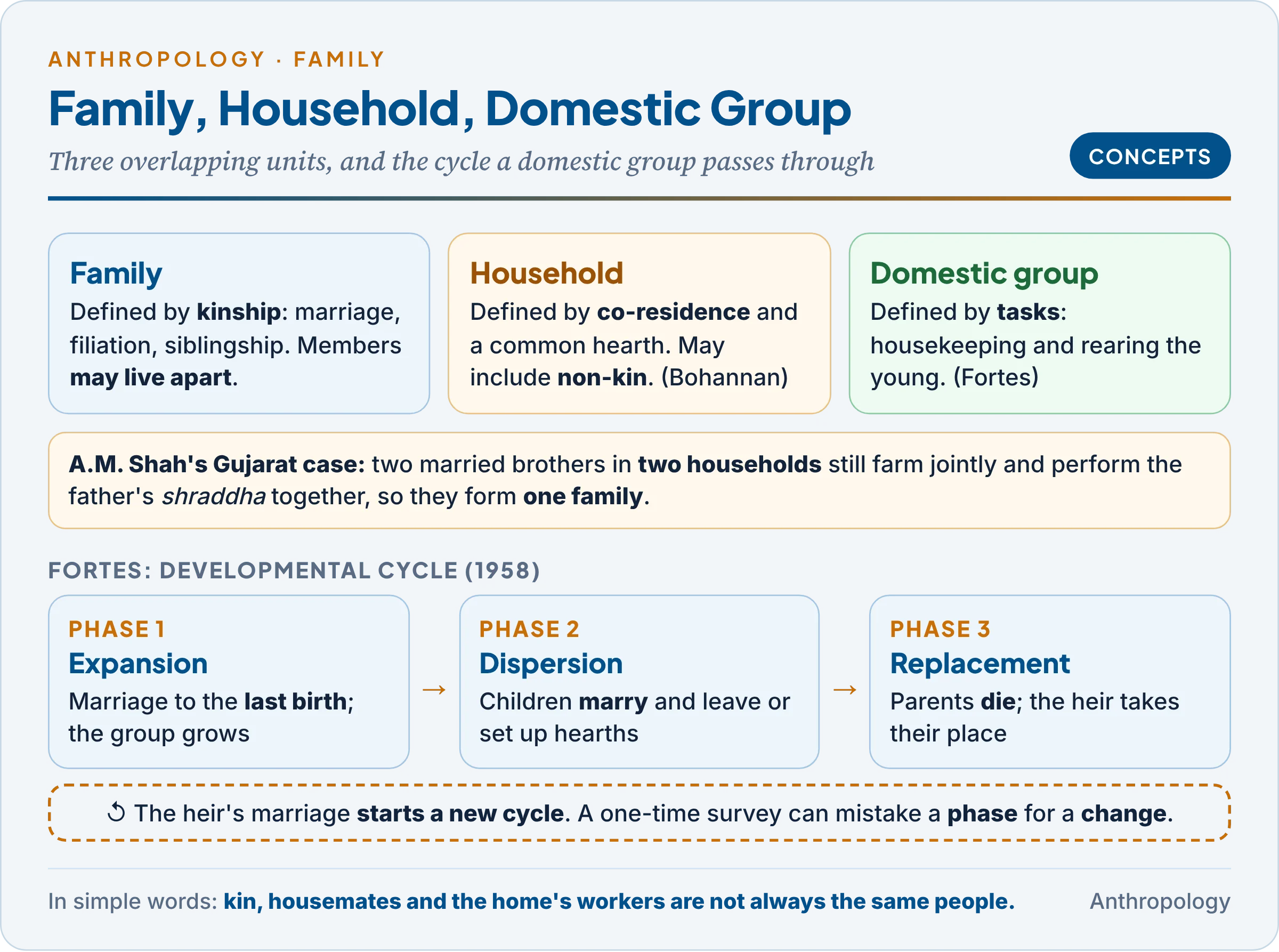
Example first. In a Gujarat village, two married brothers may live in two separate houses with separate kitchens, yet farm their land jointly, perform the father’s shraddha (death-anniversary rite) together and pool money for a sister’s wedding. The Indian sociologist A.M. Shah, The Household Dimension of the Family in India (1973), used such cases to show that two households can still form one family. A census that counts only households would wrongly record this family as “two nuclear families”.
2.1 The three concepts
- Family: a kinship group, defined by marriage, filiation (the parent-child link) and siblingship. Its members need not live together.
- Household: a residential and commensal unit (people who eat from a common hearth), defined by co-residence. Paul Bohannan, American anthropologist, put it plainly: “A family is a kinship group… A household is a local or spatial group, marked by propinquity (nearness).” A household may include servants, lodgers or adopted kin who are not family.
- Domestic group: Meyer Fortes defined it as “essentially a householding and housekeeping unit organised to provide the material and cultural resources needed to maintain and bring up its members.” It is defined by activities: shared food, production and child-rearing.
- Donald Bender (1967) separated the three along the same lines: family by kinship, household by co-residence, and domestic functions by activity. The three can occur without one another.
- Household functions: Robert Netting, Richard Wilk and Eric Arnould, Households (1984), listed five: production, distribution, transmission (of property and rights), reproduction and co-residence.
The table sets the three side by side; the key column is the second, which says what defines membership.
| Aspect | Family | Household | Domestic group |
|---|---|---|---|
| Defined by | Kinship: marriage, filiation, siblingship | Co-residence and common hearth | Shared domestic tasks |
| Can include non-kin? | No (except adoption) | Yes: servants, boarders | Yes |
| Must live together? | No; may be dispersed | Yes | Usually, or in one compound |
| Indian example | Two brothers’ separate homes forming one coparcenary (joint property group) | One chulha (hearth) | Coorg okka (Srinivas), Nayar taravad |
| Key scholar | Murdock | Bohannan, Shah | Fortes, Goody |
The distinction matters because statistics on household size are often used to claim that the Indian joint family is breaking up. Shah’s point is that separate households are not proof of separate families.
2.2 The developmental cycle of domestic groups
Meyer Fortes, in The Developmental Cycle in Domestic Groups (ed. Jack Goody, 1958), argued that a domestic group is not a fixed “type” but a unit that passes through phases over time:
- Expansion: from a couple’s marriage to the end of the wife’s childbearing; the group grows as children are born.
- Dispersion (fission): from the marriage of the first child; married children may stay for a time, then leave to found their own households.
- Replacement: the parents die and the heir (a son, or a daughter in matrilineal societies) takes their place, often starting a new cycle in the same house.
- Why it matters: a one-time survey photographs households at different phases, so a “nuclear” household may be a young joint family in expansion or parents whose sons have left. Typologies can mistake phase for change.
- Residence and inheritance shape the cycle: among the Korwa of central India, the last child left at home after the others marry stays on as heir. Under primogeniture the eldest child inherits; under ultimogeniture the youngest does (the Khasi youngest daughter, §4.5).
- Indian refinements: A.M. Shah held that household development has a pattern but is not strictly cyclical; it may progress or regress with births, marriages, deaths and partitions. I.P. Desai, Some Aspects of Family in Mahuva (1964), tracing families over generations, found a cyclical, not linear, movement between joint and nuclear forms.
Historical baseline. Shah’s analysis of the 1820s Gujarat census found an average household of about 4.5; the 1911 Census Commissioner E.A. Gait noted 4.9 persons per house, close to Britain; and Henry Orenstein (1961) found no decline in household size from 1867 to 1951. Shah added that the Sanskritised higher castes, who most followed the scriptural joint ideal, lived mainly in towns, so joint households were probably more urban than rural, the reverse of the usual belief. He also suggested that Sanskritisation of lower castes may raise the emphasis on joint living even as Westernisation of higher castes lowers it, so there is no single line of change.
3. Functions of the Family
In simple words
The family does jobs that every society needs: it controls sex, produces and brings up children, shares food and work, and gives each person a name and a place in society. Over time schools, markets and the state have taken over some of these jobs, but caring and emotional support have stayed with the family.
Murdock’s four universal functions are the starting point:
- Sexual: gives approved sexual access to spouses and so limits conflict over sex.
- Reproductive: produces new members in a socially recognised setting.
- Economic: a division of labour by sex makes spouses depend on each other.
- Educational: the first and most lasting socialisation (learning of culture) of children.
Other scholars refined the list:
- Bronisław Malinowski, Polish-British functionalist, stressed the principle of legitimacy (1930): every society insists that a child has a socially recognised father, so the family places the child in society.
- Talcott Parsons (with Bales, 1955) argued that the modern family has two “basic and irreducible” functions: primary socialisation of children and stabilisation of adult personalities (emotional support for spouses under the strain of work).
- W.F. Ogburn, American sociologist, argued that industrial society transferred the economic, protective, educational, religious and recreational functions to other agencies, leaving the affectional function with the family.
The table below joins the classic functions to their present position. Read across each row to see how the function has shifted.
| Function | How the family performs it | Indian illustration | Shift today |
|---|---|---|---|
| Regulation of sex | Approved access within marriage; incest taboo | Caste and gotra rules (Unit 2.3) | Choice marriages and live-in relationships widen choice |
| Reproduction and legitimacy | Children born into a recognised line | Shraddha and lineage continuity | Smaller families; surrogacy regulated by law |
| Economic | Production and consumption unit | Jat and Patidar joint farms; Marwari family firms | Mostly a consumption unit in cities |
| Socialisation | Language, values, gender roles | Joint family teaches respect for elders | Shared with school and media |
| Status placement | Ascribed caste, clan, name | Caste and clan by birth | Achieved status grows |
| Protection and care | Care of the sick, old and children | Sons’ duty to aged parents | State and market help, e.g. old-age homes, crèches |
| Emotional support | Affection and security | Kin network in crises | Grows in importance (Parsons) |
The pattern: functions that need large-scale organisation (production, schooling, protection) have moved out of the family, while those that need intimacy (care, emotional support, early socialisation) have stayed or grown. This is why Parsons spoke of the family as specialised, not weakened.
Critiques of the functionalist view:
- Marxist critique: Friedrich Engels, The Origin of the Family, Private Property and the State (1884), linked the monogamous patriarchal family to private property: men needed legitimate heirs. Feminists add that the “haven” hides unequal power and unpaid labour (§5.3).
- The “dark side”: the British anthropologist Edmund Leach, in his Reith Lectures (1967), said the family, “with its narrow privacy and tawdry secrets, is the source of all our discontents.” Functionalism assumes that every function benefits everyone; violence, dowry harassment and neglect of elders show it does not.
4. Types of Family
In simple words
Families can be sorted in several ways: by size and structure, by whether the marriage bond or the blood bond matters more, by how many spouses there are, by where the couple lives after marriage, and by whose line passes on name, property and authority. One family can be described on all five scales at once.
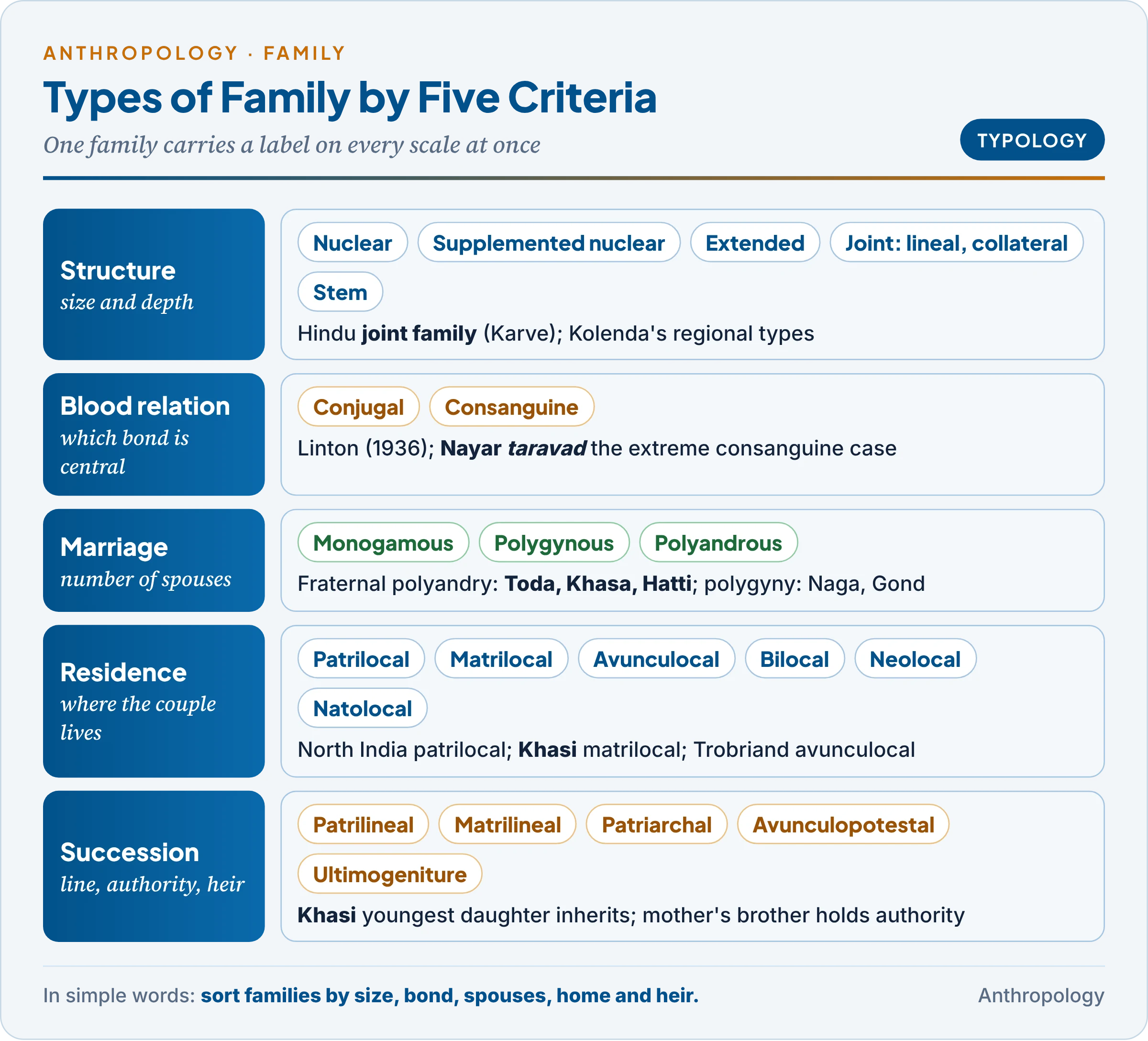
The syllabus names five criteria. Each sorts the same families in a different way, so a single family carries several labels at once: a Hindu joint family in Haryana is joint (structure), consanguine (blood relation), monogamous (marriage), patrilocal (residence) and patrilineal and patriarchal (succession).
4.1 By structure: nuclear, extended and joint
- Nuclear (elementary) family: a married couple and their unmarried children. It is the norm among hunter-gatherers (more than three-quarters of foraging societies) and in industrial societies, because both demand mobility. Even among foragers, though, the nuclear family usually camps with the kin of husband or wife, so it is less isolated than in a city.
- Variants of the nuclear family: sub-nuclear (a fragment, e.g. a widow with children); supplemented nuclear (a nuclear family plus an unmarried or widowed relative, such as the husband’s widowed mother).
- Composite family (Murdock): two or more nuclear families joined together, of two kinds:
- Polygamous family: joined by a common spouse. In a polygynous Ashanti or Tiv compound, each wife and her children occupy a separate hut, so the mother-child tie and co-wife relations shape the group.
- Extended family: joined by the parent-child tie across generations, e.g. a father and his married sons.
- Joint family: the Indian form of the extended family. Irawati Karve, Indian anthropologist, Kinship Organisation in India (1953), defined it as “a group of people who generally live under one roof, who eat food cooked at one hearth, who hold property in common, and who participate in common family worship and are related to each other as some particular type of kindred.” I.P. Desai stressed generation depth of three or more and ties of property, income and mutual obligation.
- Kinds of joint family: lineal (parents and one married son), collateral (married brothers living together after the parents’ death, also called fraternal joint) and lineal-collateral (parents, married sons and their children).
- Other extended forms: the stem family (parents and one married heir; rural Ireland, Japanese ie), the Balkan zadruga (a large fraternal household) and the Caribbean matrifocal family (mother-centred, no regular resident male).
- Pauline Kolenda’s types: the American anthropologist Pauline Kolenda, reviewing 26 Indian village and town studies (1968), used about twelve household types, from single-person and nuclear to supplemented nuclear and lineal-collateral joint. Her main finding was that most Indians, at least in villages, live in a joint or supplemented nuclear household at some point, even though nuclear households are the most numerous at any one time. She also found regional variation: more joint families on the Gangetic plain, fewer in central India. Joint families were more common among landed upper and middle castes than among Dalits.
Two contrasting extended families:
- Patrilineal: traditional China and the Rajputs of Khalapur (Uttar Pradesh). Father-son and brother-brother bonds outweigh the conjugal bond; a young wife works under her mother-in-law and gains standing with the birth of sons.
- Matrilineal: the Hopi (Arizona). A core of mother, daughters and sisters; husbands remain partly outsiders, and the mother’s brother disciplines and transmits ritual office to his sister’s son.
The extended family’s advantages are economic: many workers and undivided land where land is the main wealth, plus a respected place for the aged. Even so, Marshall Sahlins (1957) found that in Fiji an old man could lose all power once his sons took over.
4.2 By blood relation: conjugal and consanguine
The American anthropologist Ralph Linton, The Study of Man (1936), classified families by which bond is central:
- Conjugal family: built around the husband-wife bond; children leave at marriage; typical of the modern West.
- Consanguine family: built around blood ties (parent-child or brother-sister); spouses are attached at the margins. The Nayar taravad is the extreme case, where the conjugal tie was almost absent.
The contrast explains why divorce shakes the two types differently. Divorce dissolves a conjugal family, but leaves a consanguine family intact because its core members are kin by birth.
Common confusion
Is a “joint family” the same as a “joint household”? No. Under the Mitakshara school of Hindu law, a coparcenary (the joint property group of a man and his male descendants up to three generations) exists by birth, so even a father and his unmarried son form a “joint family” in law, and members may live in different houses. Under the Dayabhaga school (Bengal), sons gain property only on the father’s death, so there is no coparcenary between father and son. A sociologist’s joint household is defined by co-residence, not by property law.
4.3 By marriage
- Monogamous family: one husband, one wife.
- Polygynous family: one husband, several wives. It is sororal when the wives are sisters, as among the Crow of North America, and non-sororal otherwise. Indian examples include the Naga and Gond.
- Polyandrous family: one wife, several husbands. It is fraternal when the husbands are brothers, as among the Toda, the Khasa of Jaunsar-Bawar and the Hatti. It is non-fraternal when they are unrelated, as among the Nayar.
The full typology of marriage forms is in Unit 2.3.
4.4 By residence after marriage
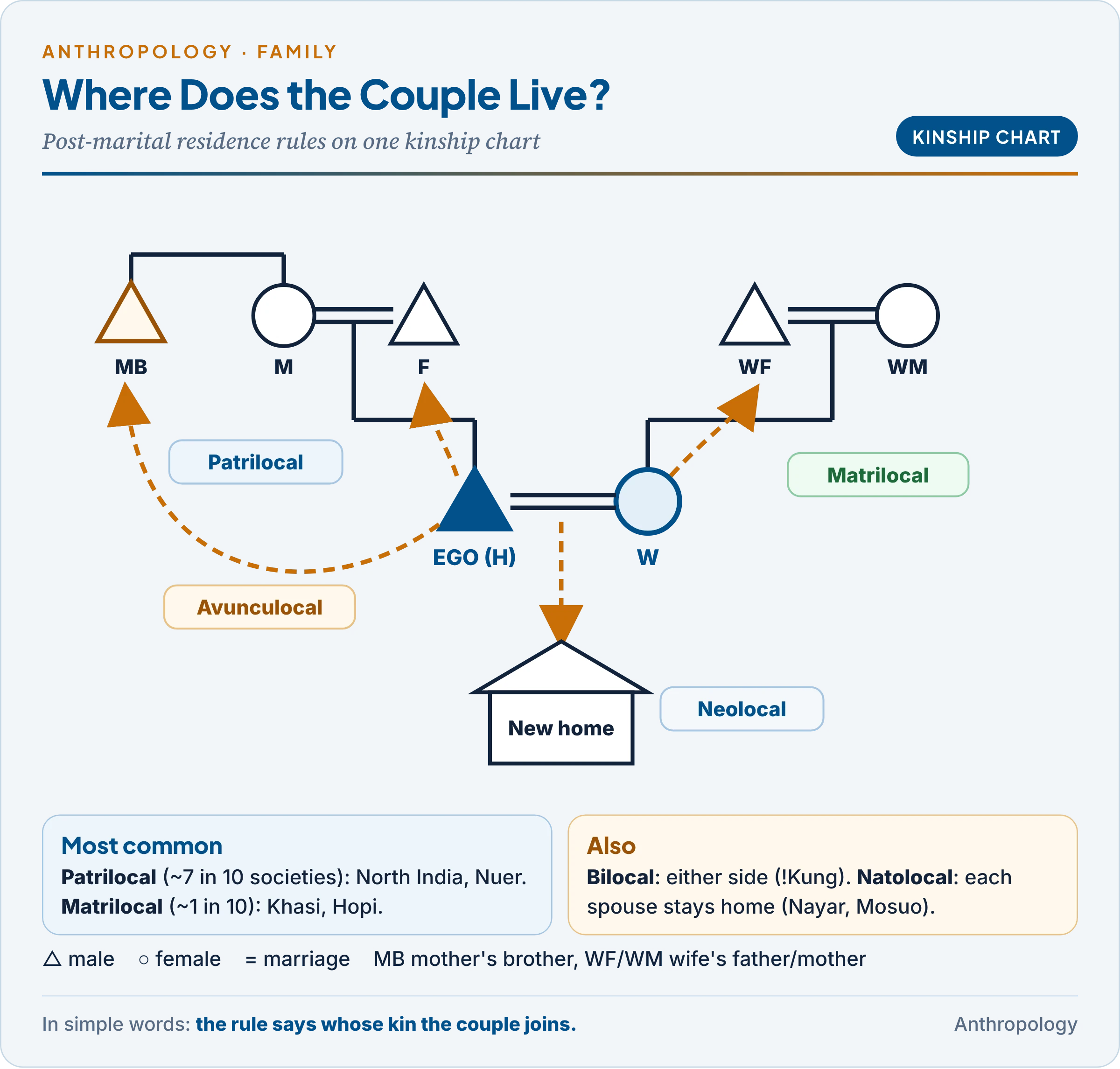
Post-marital residence (where a newly married couple lives) shapes who grows up together and who controls the household. The table lists the rules; the last column gives a case.
| Rule | Couple lives with or near | Example |
|---|---|---|
| Patrilocal (virilocal: vir, man) | Husband’s kin | Hindu North India, Santal, Nuer |
| Matrilocal (uxorilocal: uxor, wife) | Wife’s kin | Khasi, Hopi, Navaho |
| Avunculocal | Husband’s mother’s brother | Trobriand (a boy moves to his mother’s brother’s village at adolescence) |
| Bilocal (ambilocal) | Either set of parents, by choice | !Kung San, Iban |
| Neolocal | A new, separate home | Urban industrial societies |
| Natolocal (duolocal) | Each spouse stays in their own natal home | Nayar, Ashanti, Mosuo |
| Matri-patrilocal | Wife’s kin first, then husband’s | Bride-service societies (Unit 2.3) |
- Frequencies: in Murdock’s cross-cultural samples about seven in ten societies are patrilocal, about one in ten matrilocal, and neolocal and avunculocal residence are rare.
- Explaining residence: Murdock tied it to which sex contributes more to subsistence. Melvin and Carol Ember (1971) found that link weak and pointed to warfare: fighting between neighbours (internal) keeps related men together, so patrilocality; fighting distant enemies (external) takes men away, so related women stay together, hence matrilocality. Neolocality spreads with wage money, which frees couples from kin; bilocality suits small, unstable groups.
- Why residence matters for change: Murdock held that residence is the first element of social structure to respond to changes in economy, property or government. Changes in family form and kin groups follow. This is why migration for wage work is the main route by which industrialisation alters Indian families (§5).
4.5 By descent, authority and succession
- Descent: patrilineal families (name and property through males), matrilineal families (through females), bilateral families (through both) and ambilineal families (through either, by choice). The principles of descent are developed in Unit 2.5.
- Authority:
- Patriarchal: the eldest male rules, as in the Hindu joint family.
- Matriarchal: women hold formal authority. No society has been shown to give women general authority over men.
- Matripotestal or avunculopotestal: in matrilineal societies authority usually lies with men of the matriline, i.e. the mother’s brother. The Nayar karanavan and the Khasi u kni (maternal uncle) are examples.
- Egalitarian: shared between spouses, the emerging urban pattern.
- Succession and inheritance: succession is the passing of office or rank; inheritance is the passing of property. Three common patterns:
- Primogeniture: the eldest inherits, as in European aristocracy.
- Ultimogeniture: the youngest inherits. Among the Khasi the youngest daughter (ka khadduh) inherits the ancestral house and keeps the family’s rites; among the Garo an heiress (nokna) is chosen from among the daughters.
- Equal partition: Hindu law under the Mitakshara.
The matrilineal cases show why the criteria must be kept apart. A Khasi family is matrilineal in descent and matrilocal in residence, yet authority lies with the mother’s brother. A single label such as “matriarchal” therefore misdescribes it.
5. Impact of Urbanisation, Industrialisation and Feminist Movements
In simple words
Factories, cities and the women’s movement have changed family life: families have become smaller, women work outside the home, and young people choose more for themselves. But in India the joint family has not simply broken up; it has adapted, keeping its ties even when its members live apart.
Example first. In the 1960s the Canadian anthropologist Michael Ames surveyed steel workers in Jamshedpur. About 91 per cent agreed that “if possible, people should live together in a joint family”, yet only about half wanted joint residence for their own families. Ames concluded that industrial life changes where people live faster than what they value, and that its effect is filtered through education, income and caste.
5.1 Industrialisation
The convergence thesis:
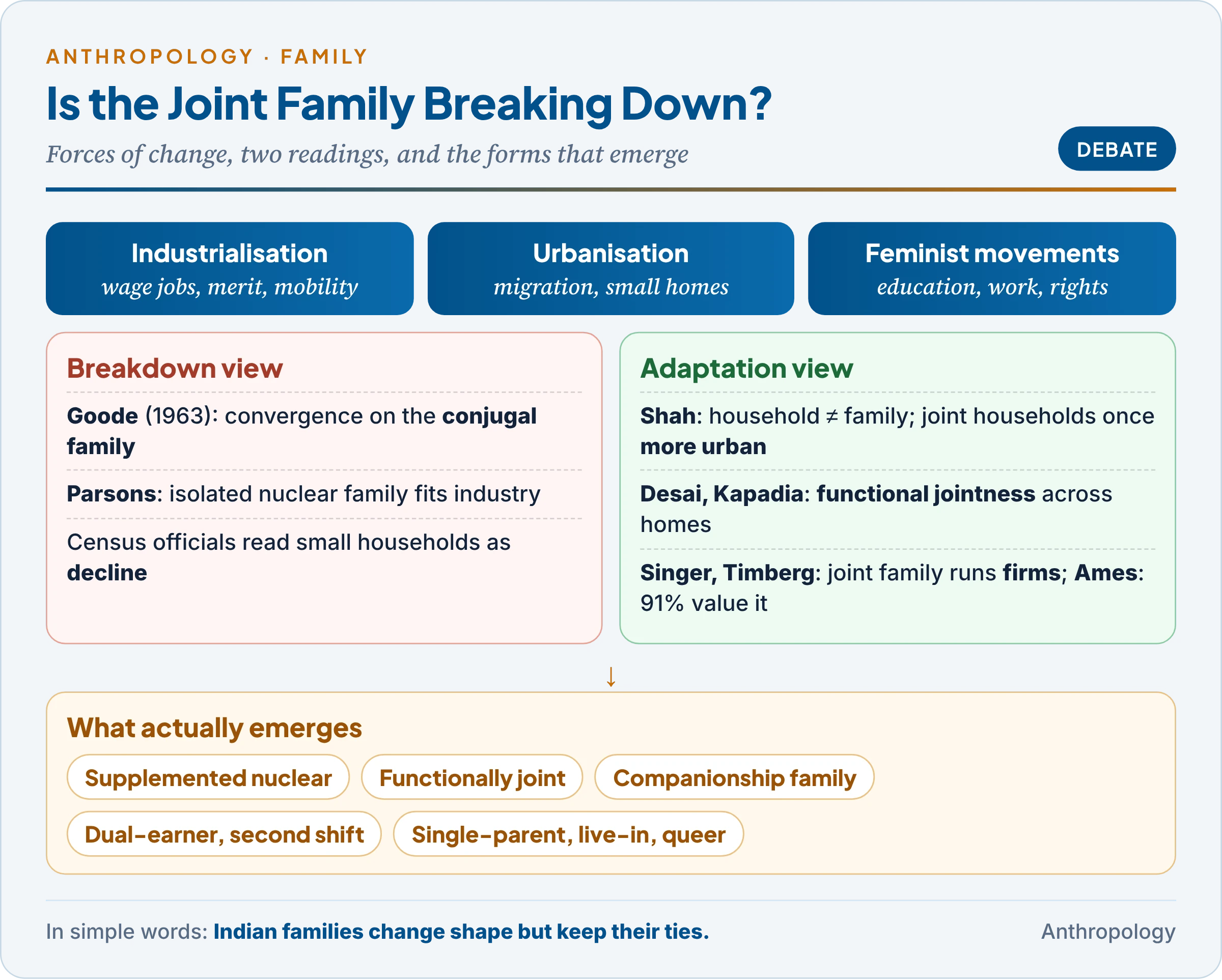
- William J. Goode, American sociologist, World Revolution and Family Patterns (1963), argued that industrialisation everywhere pushes families towards the conjugal (nuclear) system. Parsons had earlier called this the “isolated nuclear family”.
- Why industry favours the small family: wage jobs replace inherited land, so the young no longer wait on elders; merit-based hiring ignores family status; jobs demand mobility; and schools, banks and welfare agencies replace the services of lineages and clans, so elders lose control. Sons escaped this control earlier than daughters, whose wages were long set aside for their marriage.
Challenges to the thesis: the historian Peter Laslett (1972) showed that English households were already nuclear before the Industrial Revolution, so a nuclear system may have helped industry rather than resulted from it. Michael Anderson (1971) found that migrants to Lancashire cotton towns relied more on extended kin for housing and jobs.
Indian evidence: adaptation, not breakdown. The Indian studies show the joint family adapting to industry rather than dissolving:
- Milton Singer, American anthropologist (1968), found that Madras industrialists carried joint-family principles (pooled property, senior-male authority, consultation with juniors) into the management of modern firms; one “must distinguish the cultural ideal of joint family from its actual occurrence”.
- Thomas Timberg, The Marwaris (1978), argued that the joint family helped Marwari traders become industrialists. It sheltered dependants while men travelled and mobilised scarce capital. In his words, it may be the presence, not the absence, of such institutions that made trading communities succeed.
- Green Revolution peasants: landowning castes such as the Jats (Punjab, Haryana), Patidars (Gujarat) and Marathas used the joint family as a labour and capital pool for agricultural modernisation. Educated sons took over technical and credit decisions, while the elder kept authority over marriages and rituals: an adaptive change in authority.
- Class differences: landless labourers live mostly in nuclear families that can migrate whole (Bihar to Punjab). N. Krishnaji (Kerala) and Ramkrishna Mukherjee (West Bengal, 1977) found nucleation at the bottom alongside joint families at the top, where land remains the main asset.
5.2 Urbanisation
Features of the urban family in the Western literature: women’s status rises with education and jobs; mate choice becomes individual; training for work moves to schools; individualism grows; families become smaller and divorce more frequent. Ernest Burgess and Harvey Locke (1945) called this a move “from institution to companionship”: a family based on affection and equality, not custom and authority.
Indian studies qualify the picture:
- K.M. Kapadia, Marriage and Family in India (1955), and I.P. Desai (1964) distinguished residential jointness from functional jointness. Urban migrants who live in nuclear households still remit money, share property, attend life-cycle rites and consult kin on marriages. Their nuclearity is “only residential”.
- A.M. Shah’s reversal (§2.2) means that a rural migrant to a town does not necessarily move from a joint to a nuclear setting.
- Sylvia Vatuk, Kinship and Urbanization (1972), showed that migrants in Meerut rebuilt kin networks in the city.
- Supplemented nuclear households are common in cities: an aged parent, a younger brother at college, or nieces and nephews staying for schooling.
- Since the 1990s whole families of informal-sector workers have migrated together, carrying family obligations into urban slums.
- Yogendra Singh, Indian sociologist, called the overall process the “modernisation of tradition”: change happens, but within a framework that still idealises the joint family.
Costs of urban change are real too:
- Dowry demands and dowry deaths have risen within the joint family. Dowry death is now punishable under s.80 of the Bharatiya Nyaya Sanhita, 2023.
- Divorce is rising, though still low.
- The aged are more often left alone. The Maintenance and Welfare of Parents and Senior Citizens Act, 2007 makes children legally liable to maintain their parents, which shows that a function once assumed of the family now needs legal enforcement.
5.3 Feminist movements
What the movements are. Feminist movements are organised efforts to win equality for women. The first wave (late 19th to early 20th century) sought votes and legal rights; the second wave (1960s–80s) carried equality into work, sexuality and the family under the slogan “the personal is political”, after Betty Friedan‘s The Feminine Mystique (1963). In India, the report Towards Equality (Committee on the Status of Women in India, 1974) launched a movement against dowry, rape and domestic violence.
How feminists analysed the family:
- Ann Oakley, British sociologist, Housewife (1974): industrialisation’s main legacy for women was the housewife role. Women had produced alongside men at home; the factory separated men from domestic life, made women economically dependent and turned housework into unpaid “non-work”.
- Marxist feminists (Engels’ successors) saw the family as reproducing labour power free of cost. Radical feminists such as Shulamith Firestone (1970) saw biological reproduction itself as the root of women’s subordination.
- Arlie Hochschild, The Second Shift (1989), showed that employed wives return home to a second shift of housework and child care, while husbands’ share rises only slightly. Time-saving machines raised standards of cleanliness instead of reducing hours.
- Feminist anthropology: Michelle Rosaldo (1974) traced women’s subordination to the domestic/public divide. Collier, Rosaldo and Yanagisako (1982) questioned the family itself as a universal unit (§1.2). Leela Dube, Indian anthropologist, Women and Kinship (1997), showed how patrilineal kinship in South and Southeast Asia shapes daughters’ rights and sense of belonging.
Impact on the family:
- More equal conjugal roles: decisions are made jointly and power is more balanced, especially where the wife earns.
- Persisting double burden: in India’s Time Use Survey 2024, women spent 289 minutes a day on unpaid domestic work against 88 minutes for men, even as women’s labour-force participation rose to 41.7% (PLFS 2023–24).
- Children of working mothers: studies have not shown more psychological problems or delinquency; differences mostly reflect class.
- Legal reform of the family:
- The Hindu Succession (Amendment) Act, 2005 made daughters coparceners by birth, which turns the patrilineal Mitakshara family towards bilateral inheritance; Vineeta Sharma v. Rakesh Sharma (2020) applied this to daughters whatever their father’s date of death.
- The Protection of Women from Domestic Violence Act, 2005 reached violence inside the home.
- New and recognised family forms: single-parent, female-headed, blended, live-in and queer families, now recognised by the courts (see Contemporary Developments).
- The universality of marriage and family questioned: feminist analysis exposed the “natural” nuclear family as one historical form. Marriage now looks like a choice, and family like a network of care, not a fixed structure.
Evaluation: feminist movements have reshaped the family more than abolished it. Inequality inside the home has outlasted legal equality outside it, and in India the gains are class-divided: educated urban women gain most, while poor women carry both wage work and housework.
Key Terms
| Term | Meaning in simple words |
|---|---|
| Nuclear family | A married couple and their unmarried children |
| Extended family | Two or more nuclear families joined across generations by the parent-child tie |
| Joint family | The Indian extended family sharing roof, hearth, property and worship |
| Conjugal family | A family centred on the husband-wife bond |
| Consanguine family | A family centred on blood ties, with spouses at the edge |
| Family of orientation / procreation | The family one is born into / the one founded by marrying |
| Household | People who live and eat together, whether kin or not |
| Domestic group | The unit that runs the home and rears children (Fortes) |
| Developmental cycle | Expansion, dispersion and replacement phases of a domestic group |
| Coparcenary | In Hindu law, the joint property group of a man and his male descendants |
| Patrilocal / matrilocal | Living after marriage with the husband’s / wife’s kin |
| Neolocal / natolocal | Setting up a new home / each spouse staying in their own birth home |
| Ultimogeniture | Inheritance by the youngest child |
| Matrifocal family | A mother-centred family without a regular resident man |
| Functional jointness | Kin living apart but still sharing property, rites and help |
| Second shift | Housework and child care done after paid work, mostly by women |
Contemporary Developments
- Shrinking households: average household size in India fell from 4.6 (NFHS-4, 2015–16) to 4.4 (NFHS-5, 2019–21). The change in residence is real, but on the evidence of §5 it does not by itself prove the end of functional jointness.
- Atypical families recognised: in Deepika Singh v. CAT (August 2022) the Supreme Court said that single-parent, step- and queer families “are equally deserving” of legal protection and social-welfare benefits.
- Unpaid work measured: the Time Use Survey 2024 (released February 2025) recorded 289 vs 88 minutes a day of unpaid domestic work by women and men, the clearest Indian evidence of the second shift.
- Women’s work rising: female labour-force participation (age 15+, usual status) rose from 23.3% in 2017–18 to 41.7% in 2023–24 (PLFS), much of it in rural areas.
- Regulated parenthood: the Surrogacy (Regulation) Act, 2021 bans commercial surrogacy and allows only altruistic surrogacy for married couples, so law now defines who may become a parent through reproductive technology.
Diagrams to Master
- Topic map of the five themes.
- Universality debate (§1.2): Murdock’s four functions versus the five test cases. Label what each case lacks.
- Family, household, domestic group and developmental cycle (§2). Label the defining criterion of each concept and the three phases of the cycle.
- Five criteria of family types (§4). Label one Indian example under each criterion.
- Residence rules chart (§4.4) in △ ○ = notation. Label the couple’s destination for each rule.
- Breakdown versus adaptation (§5): forces of change, the two views, and the resulting forms.
Revision Grid
| Scholar | Work (year) | Key idea |
|---|---|---|
| Engels | The Origin of the Family, Private Property and the State (1884) | Monogamous patriarchal family arises with private property |
| Malinowski | 1930 | Principle of legitimacy |
| Murdock | Social Structure (1949) | Nuclear family universal; four functions; residence typology |
| Karve | Kinship Organisation in India (1953) | Definition of the joint family |
| Spiro | 1954; 1958; 1979 | Kibbutz test of universality |
| Parsons and Bales | Family, Socialization and Interaction Process (1955) | Two irreducible functions |
| Fortes / Goody | The Developmental Cycle in Domestic Groups (1958) | Expansion, dispersion, replacement |
| Gough | 1959 | Nayar taravad; legitimacy survives without a nuclear family |
| Goode | World Revolution and Family Patterns (1963) | Industrialisation leads to the conjugal family |
| I.P. Desai | Some Aspects of Family in Mahuva (1964) | Functional jointness; cyclical change |
| Kolenda | 1968 | Regional and caste variation; supplemented nuclear |
| Singer | 1968; When a Great Tradition Modernizes (1972) | Joint family in modern industry |
| A.M. Shah | The Household Dimension of the Family in India (1973) | Household ≠ family; joint households more urban than rural |
| Oakley | Housewife (1974) | The housewife role as a product of industrialisation |
| Timberg | The Marwaris (1978) | Joint family mobilises capital |
| Collier, Rosaldo, Yanagisako | “Is There a Family?” (1982) | Family as an ideological construct |
| Leela Dube | Women and Kinship (1997) | Gendered kinship in South Asia |
Previous Year Questions
Unit 2.4: Family
- 2026Write notes on: Feminist movement and family.
- 2025How the study of variation in forms of marriage led to rethinking on the concepts of social reproduction, kinship and family?
- 2024Define urbanization and discuss its impact on family in India with examples.
- 2020Explain the impact of feminist movement on universality of marriage and family structure.
- 2016Discuss the impact of urbanization and feminist movements on family in India.
- 2015Define family and critically examine the universality of family.
- 2013Discuss the impact of urbanization and feminist movement on family. (250 words).
- 2012Write a note in 150 words on : Is family a social institution ?
- 2002What do you understand by Feminist movements ? Discuss their impact on family.
- 1999Critically comment on the forces and factors that have brought about changes in the family structure in recent times.
- 1998Do you agree with the view that family is a ‘universal association’ ? Critically examine the above statement.
- 1996Examine family both as a social group and as an institution. Describe the functions of family and household, indicating therein the recent changes.
- 1993Is family a Universal Social Group ? Critically examine this with examples.
- 1991Write a note on Matrilineal society.
- 1990Give a comparative account of different types of family in the tribes of India. Illustrate your answer with suitable examples.
- 1988Write a note on Universality of family.
- 1987Give a comparative account of the different types of family in tribal and non-tribal societies of India.
- 1985What are the major functions of the family? Indicate the recent changes that have taken place in its types and functions with special reference to India.
- 1984Account for the universality of the nuclear family and describe its functions.
- 1981Is family universally the cornerstone of human society? Discuss.
Related questions from other units
- 2022Unit 2.2: Write notes on: Household and domestic group.
- 2021Unit 6: Critically evaluate Lewis Morgan’s classification of family.
- 2015Unit 6: How did Morgan explain the evolution of marriage, family and Socio-Political organization and how did other evolutionists disagree with his explanation ?
- 1983Unit 2.5: Extended family and kinship ties are incompatible with an industrial society. Critically examine the view.
- 1983Unit 2.3: Incest is universally the basis of enduring family. Comment.
- 1982Unit 2.5: The modern State has taken over many functions of the family and kin groups. Discuss.