

2.3 Marriage: Definition and Universality; Laws of marriage (endogamy, exogamy, hypergamy, hypogamy, incest taboo); Types of marriage (monogamy, polygamy, polyandry, group marriage). Functions of marriage; Marriage regulations (preferential, prescriptive and proscriptive); Marriage payments (bride wealth and dowry)
Official Syllabus: Paper I, Unit 2.3
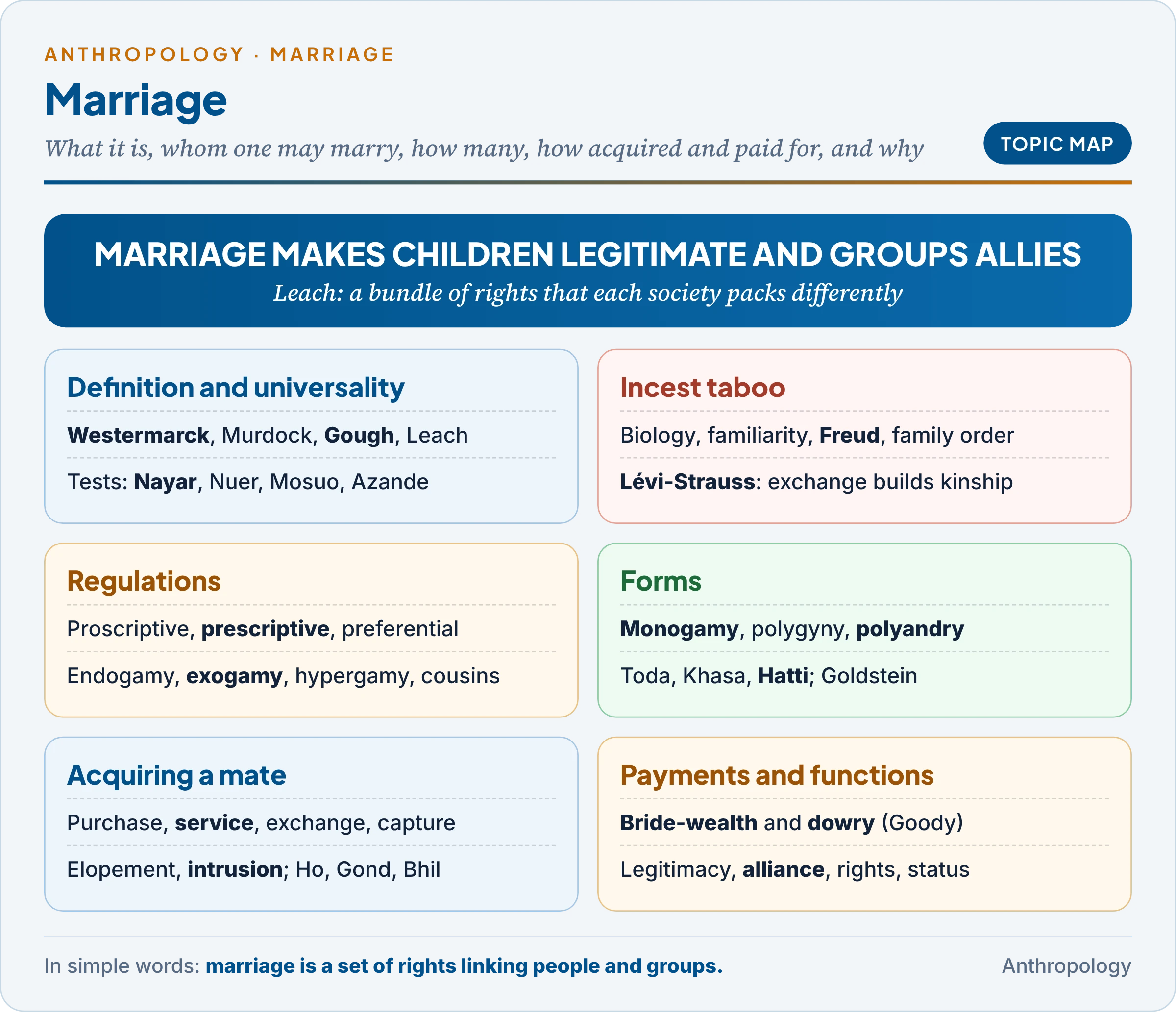
Unit 2.2 described an institution as an established set of rules for an important activity. Marriage is the institution that regulates sexual unions, the legitimacy of children and alliances between groups; the family it creates is the subject of Unit 2.4.
1. Defining Marriage: The Universality Debate
In simple words
Most people picture marriage as one man and one woman sharing a home and raising children. Anthropologists found many societies where it looks quite different, so they had to ask what all marriages have in common.
Example first. Among the Nayar of Kerala, a girl went through a ritual “marriage” before puberty with a ritual husband she might never see again, and later received several visiting husbands at night. They did not live with her or feed her, and her children belonged to her matrilineal household (descent traced through the mother). Was this marriage? The question forced anthropologists to rethink the definition.
1.1 Definitions and where each one breaks
Each definition below was proposed as universal, and each was then tested against ethnography. Read the last column as the counter-case that broke it.
| Scholar | Core of the definition | Breaks down on |
|---|---|---|
| Westermarck, The History of Human Marriage (1891) | A durable union of man and woman, socially recognised, lasting beyond procreation till after the birth of offspring | Nayar (no co-residence), Nuer woman–woman marriage |
| Murdock, Social Structure (1949) | Co-residence + economic cooperation + reproduction, forming the nuclear family | Nayar and Mosuo: no common household, no shared economy |
| Notes and Queries (Royal Anthropological Institute, 1951) | “A union between a man and a woman such that children born to the woman are recognised as legitimate offspring of both parents“ | Plural unions, same-sex unions, ghost marriage (dead husband is the father) |
| Madan and Majumdar, An Introduction to Social Anthropology (1956) | Social and economic relations arising from a sexual union of man and woman, sanctioned by religion or civil law | Adds the sanction criterion, but still heterosexual and dyadic |
| Radcliffe-Brown (1950) | Marriage is a rearrangement of social structure that gives the child a legitimate position in society | Shares Malinowski’s legitimacy core |
| Malinowski (1930) | Principle of legitimacy: every society insists that a child has a socially recognised father | Does not say what marriage is, only what it secures |
| Stephens, The Family in Cross-Cultural Perspective (1963) | Socially legitimate sexual union, begun with public announcement, undertaken with idea of permanence, with a marriage contract | Societies with no ceremony, high divorce, or extramarital sexual licence |
| Kathleen Gough, “The Nayars and the Definition of Marriage” (1959) | A relationship between a woman and one or more other persons which gives a child born to her full birth-status rights | Still centred on a woman bearing a child; excludes Azande male “boy-wives” |
| Edmund Leach (1955) | Marriage is a bundle of rights, varying by society | No single right is universal, so no single definition fits |
The table shows a retreat: early definitions named forms (a couple, a household), each failed somewhere, so later scholars defined marriage by a function, the legitimacy of children, and Leach gave up a single definition.
Gough (1959): “Marriage is a relationship established between a woman and one or more other persons, which provides that a child born to the woman under circumstances not prohibited by the rules of the relationship, is accorded full birth-status rights common to normal members of his society or social stratum.”
- Leach’s bundle of rights: the British social anthropologist Edmund Leach, writing on Sinhalese and Nayar polyandry, argued that marriage is a package of rights that a society may assemble in different ways. Marriage may allocate:
- legal fatherhood and legal motherhood
- a monopoly over the spouse’s sexuality
- rights to the spouse’s domestic and economic labour
- rights over the spouse’s property, and a joint fund of property for the children
- a socially significant relationship of affinity (relationship by marriage) between the spouses’ kin groups
- Why this helps: no society uses all of these, and no single one is found everywhere. The question “is X marriage?” therefore becomes “which rights does marriage transfer here?” The Nayar tali rite transferred only legal fatherhood, which explains why Gough could still call it marriage.
- Needham’s scepticism: the British anthropologist Rodney Needham (1971) went further: “marriage” is an “odd-job word” that covers unrelated institutions, so it cannot be a cross-cultural analytic category at all.
1.2 The ethnographic test cases
Five societies broke the universal definitions; the last column says what each proves.
| Community | Region | Ethnographer | What it shows |
|---|---|---|---|
| Nayar | Kerala | Kathleen Gough | Tali-kettu kalyanam (pre-puberty ritual with a ritual husband, enangar) is followed by sambandham visiting unions with several men. The child belongs to the matrilineal taravad under the karanavan (senior mother’s brother). Marriage is separated from co-residence and economic support. Paternity was acknowledged by paying birth expenses; a child with no acknowledged father of proper caste led to the woman’s expulsion. The system suited Nayar men’s military service, with land worked by lower-caste tenants (Mencher). |
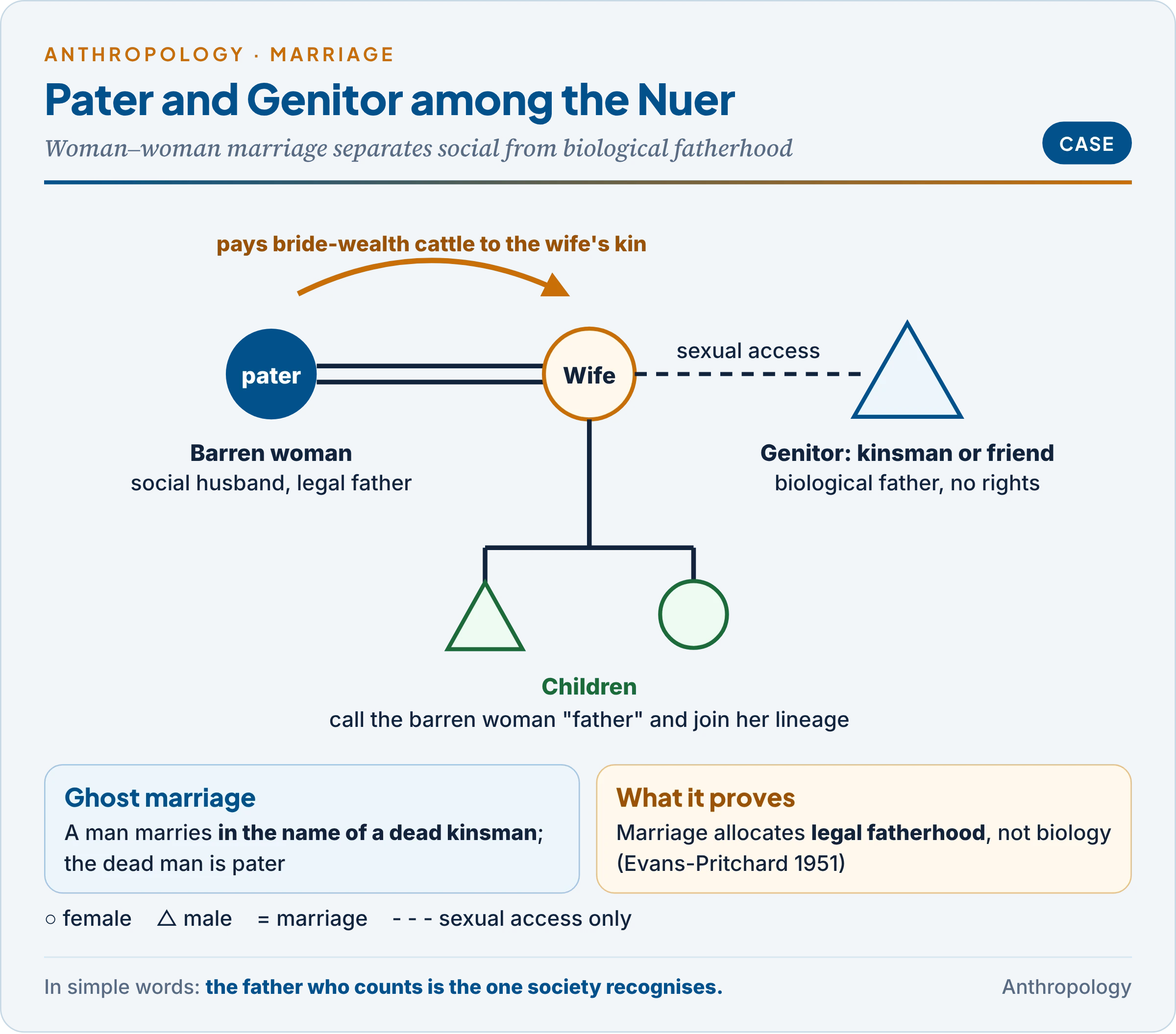
| Nuer | South Sudan | Evans-Pritchard, Kinship and Marriage among the Nuer (1951) | Ghost marriage: a man marries in the name of a dead kinsman, who becomes pater (the social and legal father). Woman–woman marriage: a barren woman pays cattle, becomes the legal “husband” and father, and a male genitor (the biological father) begets the children. Social fatherhood is distinct from biological fatherhood. |
| Mosuo (Na) | Yunnan, China | Cai Hua, A Society without Fathers or Husbands (2001) | Tisese “walking” visits: no ceremony, no co-residence, no shared property. Children stay with the mother’s lineage and are raised by mother’s brothers. This is the strongest case against universality. |
| Azande | Central Africa | Evans-Pritchard | Warriors paid bride-wealth for “boy-wives”. A union with marriage’s legal form existed between males. |
| Khasa | Jaunsar-Bawar, Uttarakhand | D.N. Majumdar, Himalayan Polyandry (1962) | Fraternal polyandry. A woman’s sexual freedom differs between her husband’s village and her natal village, so marital rights shift with residence. |
Together the cases show that the elements bundled in Western marriage can be pulled apart; what survives everywhere is a social rule placing the child in a group.
1.3 What every marriage system specifies
Every marriage system answers the same practical questions; the table gives the range of answers.
| Dimension | Range of variation |
|---|---|
| Charter (why marry) | Sexual partnership, heirs and lineage continuity, labour, alliance, adult status |
| Mate choice | Free choice (love, personal qualities) vs arranged by kin (bride-wealth or dowry size, kin-group reputation, levirate/sororate obligation) |
| Transactions | Bride-wealth, bride-service, dowry, gift or sister exchange (see §6) |
| Ceremony | From none (Mosuo) to elaborate rites; betrothal, gift exchange, magico-religious observances |
| Post-marital residence | Patrilocal / virilocal (with the husband’s people), matrilocal / uxorilocal (with the wife’s people), avunculocal (with the husband’s mother’s brother), bilocal / ambilocal (either, by choice), neolocal (a new household); detail in Unit 2.4 |
| Authority | Patripotestal (power with the husband’s side), matripotestal (with the wife’s side), avunculopotestal (with the mother’s brother, as among the Nayar) |
| Stability | Brittle unions with easy divorce in many small-scale societies vs indissoluble unions; harder-to-return bride-wealth means rarer divorce (§6) |
The dimensions are linked: where residence is patrilocal, the bride’s labour and children leave with her, so her kin usually receive bride-wealth in return.
1.4 So is marriage universal?
- The forms are not universal. Co-residence, a heterosexual pair, economic pooling and lifelong union each fail somewhere. The family (a mother–child unit with its supporters) is arguably more universal than marriage, which is why Murdock’s fusion of the two fails.
- The functions are near-universal. Every society regulates sexual access, assigns legitimate filiation (a recognised link of a child to its parents’ groups) to children, and creates affinal ties. Gough’s Nayar resolution rests here: the tali rite still made children legitimate, so even the Nayar had marriage.
- The rethinking that followed. The comparative record forced three conceptual shifts:
- Family: the household and the conjugal pair separate. Nayar and Mosuo sibling-based households are fully functioning family units without a resident husband or father.
- Kinship: the Nuer pater/genitor distinction shows that filiation is jural and social, not biological. The American anthropologist David Schneider, A Critique of the Study of Kinship (1984), argued that the biological model was a Euro-American folk theory, and the British anthropologist Janet Carsten‘s “relatedness” (2000) widened kinship to shared substance, feeding and care.
- Social reproduction: marriage reproduces property, status and labour, not just people.
- Jack Goody: dowry reproduces class position.
- Claude Meillassoux, Maidens, Meal and Money: elders control juniors through control of wives.
- Sylvia Yanagisako and Jane Collier (1987): gender and kinship are one analytical field.
- Kath Weston, Families We Choose (1991): gay and lesbian kinship is built by choice rather than blood or marriage.
Common confusion
Is the pater the same as the genitor? No. The pater is the socially recognised father, whose lineage the child joins; the genitor is the biological father. Nuer ghost and woman–woman marriage separate them, showing that marriage allocates social fatherhood.
2. The Incest Taboo
In simple words
Every society forbids sex and marriage between certain close relatives, such as parents and children or brothers and sisters. Which other relatives count as “too close” differs from society to society. Scholars disagree about why this rule exists everywhere.
Example first. In much of South India, a man may marry his mother’s brother’s daughter, and the match is often preferred. Yet marriage with his father’s brother’s daughter, who is genetically just as close, is treated as incest, because she is classed as his “sister”. The same genetic closeness carries opposite rules. The incest taboo is therefore a matter of social classification, not biology alone.
- Definition: a prohibition of sexual relations, and hence marriage, between persons classed as close kin.
- Universality:
- The nuclear-family core (parent–child, brother–sister) is prohibited in virtually every society.
- The outer boundary varies with kinship classification. Where parallel cousins are called “brother” and “sister”, they are tabooed while cross cousins may be preferred spouses.
- Exceptions are royal and ritual: Pharaonic and Ptolemaic Egypt, the Inca, and Hawaiian chiefs. Sibling marriage there kept divine blood and power concentrated. These exceptions confirm the rule, because they mark the ruler as above ordinary humanity.
2.1 Theories
Some theories look for the cause inside the family, others outward to relations between groups; the last column gives each one’s weak point.
| Theory | Proponent(s) | Argument | Weakness |
|---|---|---|---|
| Inbreeding avoidance (biological) | L.H. Morgan, Ancient Society (1877); modern population genetics | Close mating exposes deleterious recessives (homozygosity), so groups with the taboo out-reproduced those without it | Pre-scientific peoples could not know genetics. Answer: selection needs no awareness. Explains persistence better than origin. |
| Familiarity breeds aversion (Westermarck effect) | Westermarck (1891) | Children reared together from infancy develop sexual indifference, and the taboo codifies that aversion | Frazer and Freud: why forbid what no one desires? Incest does occur. |
| Psychoanalytic | Freud, Totem and Taboo (1913) | Oedipal desire is real; the taboo is a defence. The primal horde myth: sons kill the father, then renounce his women | Unfalsifiable “just-so” history. Kroeber (1920) dismantled it. |
| Family disruption | Malinowski; Brenda Seligman | Sexual rivalry would wreck family roles and authority, and with them socialisation | Explains parent–child better than siblings. Regulation, not prohibition, could have sufficed. |
| Cooperation / alliance | Tylor (1889): “marrying-out or being killed-out“; Leslie White (1948); Lévi-Strauss, The Elementary Structures of Kinship (1949) | The taboo forces exchange between groups and builds alliances | Explains the taboo’s extension and persistence, not why it exists inside the nuclear family. |
| Demographic | Mariam Slater (1959) | Short lifespans and wide birth spacing made intra-family mating rare, so out-mating became the norm | Fails once lifespans lengthen. |
- How the biological theory works: close relatives often carry the same harmful recessive genes (genes that cause disease only when inherited from both parents), so their children are more often homozygous (two copies) and ill. Groups avoiding close mating left more healthy descendants, so the rule spread without anyone knowing why.
- How the alliance theory works: the British anthropologist E.B. Tylor saw that a group marrying within itself stayed isolated, while groups exchanging spouses became allies in war and trade; the taboo pushes marriage outward and creates cooperation larger than the family.
2.2 The evidence behind the Westermarck effect
- Israeli kibbutz: Joseph Shepher (1971) found no marriages among the 2,769 he studied between peers reared together in the same children’s house from early childhood. Yonina Talmon (1964) reported similar avoidance.
- Taiwanese sim-pua (“minor”) marriage: the American anthropologist Arthur Wolf found that a girl adopted in infancy and raised with her future husband had markedly higher divorce, lower fertility and more adultery than a bride married in the usual way.
- Counter-evidence: among the Arapesh (New Guinea), Margaret Mead reported girls betrothed young and reared in the future husband’s household, yet these marriages were the norm. Familiarity therefore does not always extinguish desire, and a natural aversion would not need a strongly sanctioned taboo.
- Lebanese FBD marriage: Justine McCabe (1983) found that parallel cousins (children of two brothers) raised in close contact showed lower fertility and more divorce than other couples.
2.3 The incest taboo as the foundation of kinship (Lévi-Strauss)
- The bridge from nature to culture: for the French structuralist Claude Lévi-Strauss, the taboo is the one cultural rule that is also universal, so it marks the passage from nature to culture.
- A rule of giving, not only forbidding: the taboo is less a prohibition than a positive rule of reciprocity: renouncing one’s sister obliges another man to give his. This exchange of women creates affinity, the relationship that turns isolated descent groups into a society. This is why the taboo can be called the basis of kinship systems: without it there would be families, but no alliances linking them.
- The atom of kinship: the smallest kinship structure has four relationships: brother–sister, husband–wife, father–son and mother’s brother–sister’s son. The mother’s brother is present from the start because the brother who gave his sister is built into the elementary structure.
- Evaluation: no single theory explains both origin and persistence. The current synthesis pairs a biological aversion (Westermarck effect, inbreeding costs) with its cultural elaboration into rules that serve alliance and family order. Many primates show parallel dispersal at sexual maturity: female chimpanzees and male macaques leave their natal group (Unit 1.5a), so close inbreeding is avoided even without rules.
Common confusion
Are the incest taboo and exogamy the same rule? No. The incest taboo forbids sexual relations with close kin; exogamy requires one to marry outside a group (clan, gotra, village). Exogamy usually extends the taboo to a whole group, but the two can diverge: a society may bar marriage within the clan while tolerating affairs inside it.
3. Marriage Regulations
In simple words
Every society has rules about whom a person must not marry, whom they must marry, and whom they ideally should marry. These rules keep property, purity and alliances in order. Most marriages in the world are still arranged within such rules.
Example first. A Tamil Brahmin wedding obeys three rules at once: the couple must not share a gotra (descent from a common sage), must share a jati (caste), and may prefer a mother’s brother’s daughter. The table names these kinds of rule.
| Rule type | Tells you | Examples |
|---|---|---|
| Proscriptive | Whom you must not marry | Incest taboo, clan/gotra/sapinda exogamy |
| Prescriptive | The category you must marry into, often defined by kinship terminology | Endogamy; MBD prescription among the Kachin and Purum |
| Preferential | Whom you ideally should marry; a statistical preference | Cross-cousin, parallel-cousin, levirate, sororate |
The difference between the last two rows is one of force. A prescription defines the only acceptable category of spouse; a preference states the best choice, which most people may not actually make.
- The prescription–preference debate: Needham (Structure and Sentiment, 1962) held that true prescription is a terminological category (“MBD” means a whole class of women), whereas preference is merely what people tend to do. Lévi-Strauss later conceded the distinction mattered little for his alliance theory.
- Why regulations build solidarity: endogamy keeps a group’s boundary and property intact, while exogamy and cousin marriage tie different groups into lasting alliances renewed in each generation. Both bind members together, inside the group and between groups.
3.1 Endogamy and exogamy
- Origin of the terms: the Scottish lawyer-anthropologist J.F. McLennan, Primitive Marriage (1865), coined both.
- Endogamy means marriage within a group: jati (the defining caste rule), tribe, religious community, and among some tribes, the moiety (one of two halves of a society). It protects ritual purity (Dumont’s purity–pollution axis), property and the group boundary.
- Exogamy means marriage outside a group: clan, gotra (putative descent from a common rishi), sapinda circle, and in North India the village, where all village age-mates count as fictive siblings.
- Sapinda rule (sapinda: persons linked by descent within a set number of generations): the Dharmashastra tradition barred marriage within seven generations on the father’s side and five on the mother’s. The Hindu Marriage Act, 1955 narrowed this to five and three, and permits custom to override the prohibited degrees. This is why South Indian cross-cousin marriage stays legal.
- Indian tribal cases:
- Todas (The Todas, W.H.R. Rivers, 1906): two endogamous moieties, Tartharol and Teivaliol, each divided into exogamous clans.
- Santal, Oraon, Munda: tribal endogamy combined with totemic clan exogamy (clans named after an animal or plant, whose members count as kin).
- Why exogamy?
- Tylor: alliance.
- McLennan: female infanticide led to a shortage of women, which led to bride capture.
- Durkheim: a taboo on the totemic blood of one’s own clan.
- Lévi-Strauss: exogamy is the incest taboo writ large, a rule of exchange.
3.2 Hypergamy (anuloma) and hypogamy (pratiloma)
- Hypergamy: a woman marries up, into a higher caste or sub-caste. It was sanctioned in the Dharmashastras. Hypogamy: a woman marries down. It was condemned, and its offspring were degraded.
- Consequences in India:
- Brides compete for scarce high-status grooms, so dowry escalates.
- Top-rank families historically had a daughter surplus, which was linked to female infanticide in colonial records of some Rajput and Jat lineages.
- Kulin Brahmins of Bengal practised polygyny, with grooms marrying many wives for gifts.
- The British anthropologist Jonathan Parry, Caste and Kinship in Kangra (1979): Rajput hypergamy creates hierarchy among clans within one caste.
- Nambudiri–Nayar hypergamy (Kerala): among the Nambudiri Brahmins, only the eldest son married a Nambudiri woman. Younger sons formed sambandham unions with Nayar women. This kept Nambudiri land impartible (undivided) and is the same visiting union that defines the Nayar case in §1.2.
3.3 Preferential marriages
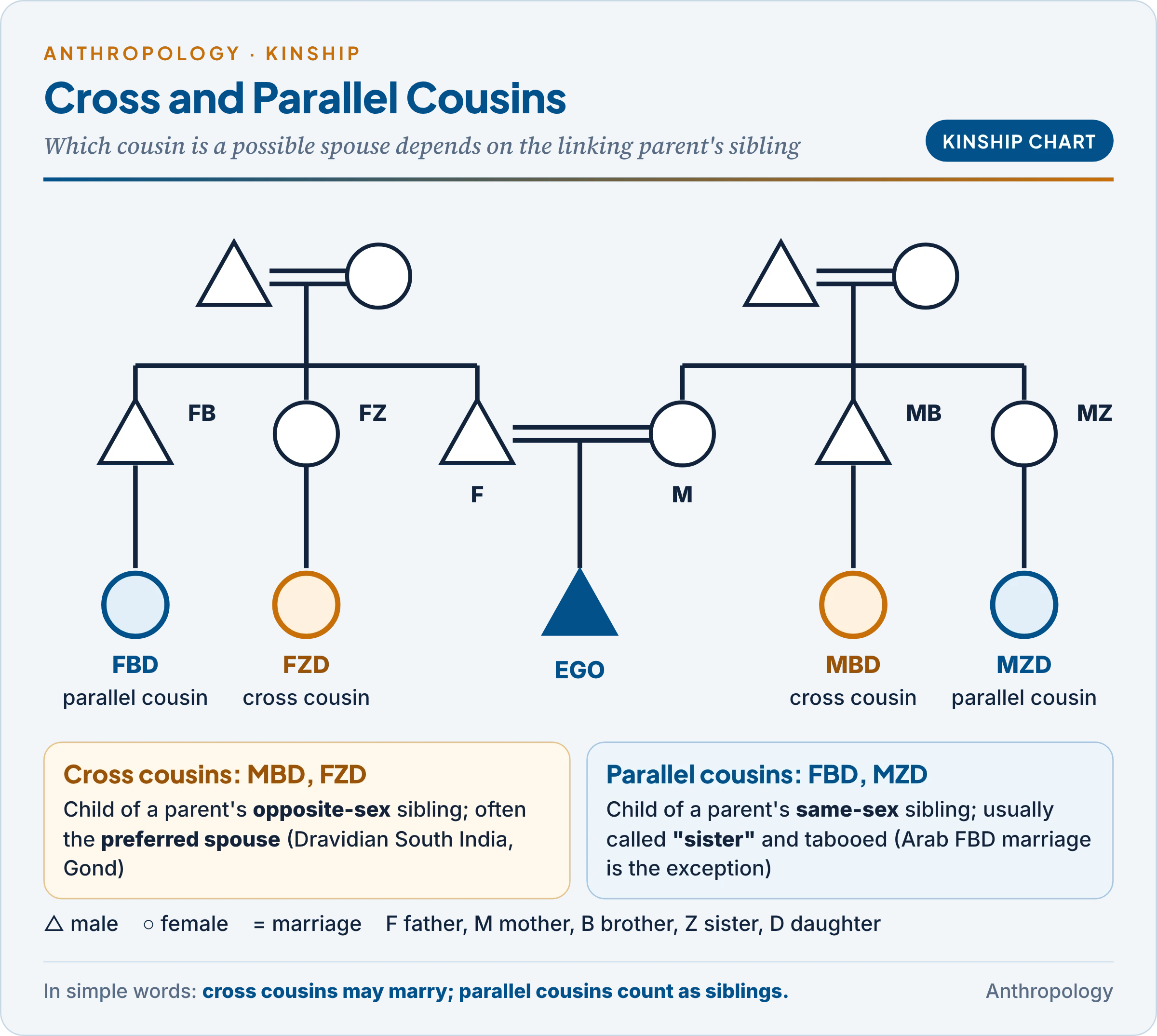
Cousin marriage is the most common preferential rule, and the key distinction is between cross and parallel cousins. A cross cousin is the child of a parent’s opposite-sex sibling (mother’s brother’s or father’s sister’s child); a parallel cousin is the child of a parent’s same-sex sibling (father’s brother’s or mother’s sister’s child). Kin codes are F father, M mother, B brother, Z sister, D daughter, so MBD is the mother’s brother’s daughter.
The structure each form creates was worked out by Lévi-Strauss. The table pairs each form with the pattern of exchange it produces.
| Form | Structure created (Lévi-Strauss) | Cases |
|---|---|---|
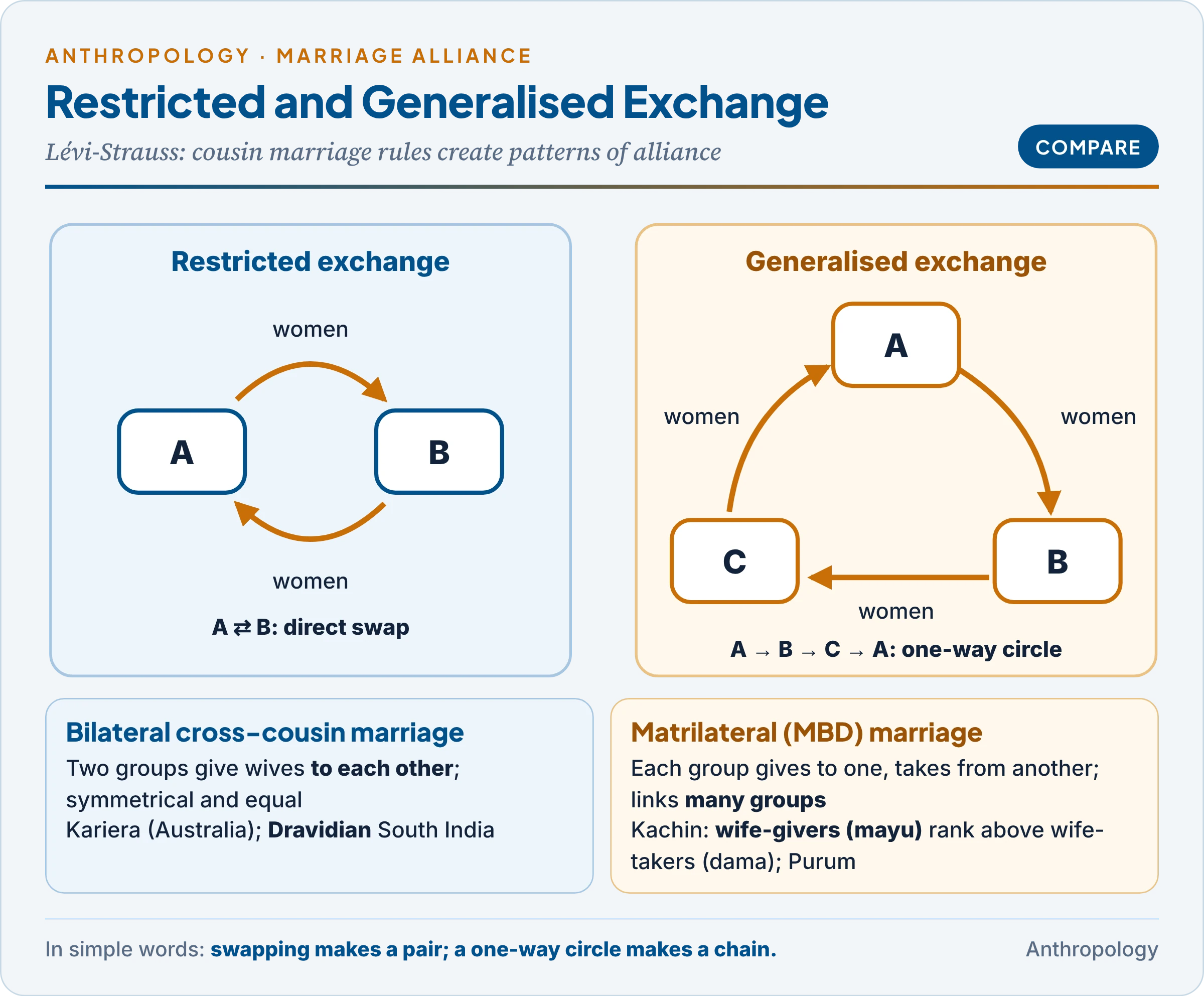
| Bilateral cross-cousin | Restricted exchange between two groups (A ⇄ B), a two-section system | Kariera of Australia (Radcliffe-Brown); much of Dravidian South India |
| Matrilateral (MBD) | Generalised exchange: women flow one way in a circle (A → B → C → A), integrating many groups and producing hierarchy | Kachin mayu–dama wife-giver/wife-taker ranking (Leach, Political Systems of Highland Burma, 1954); Purum Old Kukis of Manipur (T.C. Das‘ data, analysed by Needham) |
| Patrilateral (FZD) | Discontinuous exchange: the direction reverses each generation | Rare as a strict rule |
| Parallel cousin (FBD) | Keeps property and women inside the patrilineage, so no alliance is created | Arab and Bedouin societies, many Muslim communities including in India |
Lévi-Strauss thought MBD marriage the most powerful: in restricted exchange two groups simply swap, but in generalised exchange each group gives wives to one and takes from another, so a chain links many groups. Among the Kachin, wife-givers (mayu) rank above wife-takers (dama), so the chain also produces hierarchy.
- The sentiment counter-theory: the American anthropologists George Homans and David Schneider (1955) explained the MBD preference in patrilineal societies by affection for the mother’s side, against Lévi-Strauss’s structural reasoning.
- Indian forms:
- Dravidian kinship (Louis Dumont 1953; Thomas Trautmann 1981) builds cross-cousin marriage into its terminology: cross cousins are called by terms that mark them as marriageable. Elder-sister’s-daughter marriage (uncle–niece) is also found among some South Indian castes.
- The Gond call cross-cousin marriage dudh lautawa, “returning the milk“: a girl given in one generation is returned in the next.
- Levirate: a widow marries her deceased husband’s brother. In junior levirate it must be a younger brother. Example: karewa (chadar andazi, “throwing the sheet”) among the Jats of Haryana.
- Sororate: a widower marries his deceased wife’s sister. The term also covers a barren wife being replaced by her sister.
- Function of levirate and sororate (Radcliffe-Brown): the marriage is between groups, so the alliance, the bride-wealth and the children survive a spouse’s death. The sibling group acts as a unit, and widows and orphans keep economic support. Both customs cluster with patrilineal descent, patrilocal residence and polygyny; levirate also secures the dead man’s property for his line.
4. Forms of Marriage
In simple words
Marriage can join one man and one woman, one man and several women, one woman and several men, or several of each. One-to-one marriage is the most common in practice everywhere. The other forms usually make sense once one looks at land, labour and the number of men and women.
Example first. In July 2025, at Shillai in Sirmaur district of Himachal Pradesh, two Hatti brothers publicly married the same woman, explaining that one wife for the brothers keeps the family land undivided. This is fraternal polyandry, and its logic is economic, not exotic.
The table sets out the four forms with their sub-types and cases.
| Form | Sub-type | Cross-cultural case | Indian case |
|---|---|---|---|
| Monogamy | Lifelong; serial (divorce and remarriage) | Industrial West; Semang (Malaysia) | Khasi, Kadar, Chenchu, Juang; legally mandated for Hindus by the HMA 1955 |
| Polygyny | Sororal (wives are sisters); non-sororal | Crow and other Plains peoples (sororal); much of Africa | Naga, Gond, Baiga; Muslim personal law |
| Polyandry | Fraternal / adelphic (husbands are brothers); non-fraternal | Tibetans; Nyinba of Nepal | Toda, Khasa, Ladakhi, Kinnauri, Hatti; historically Nayar (non-fraternal) |
| Group marriage / polygynandry | Several men with several women | Marquesans (Polynesia) | Toda, Khasa: brothers sharing wives while also adding further wives |
“Polygamy” is the umbrella term for polygyny and polyandry; the Indian column shows that every form has existed in India.
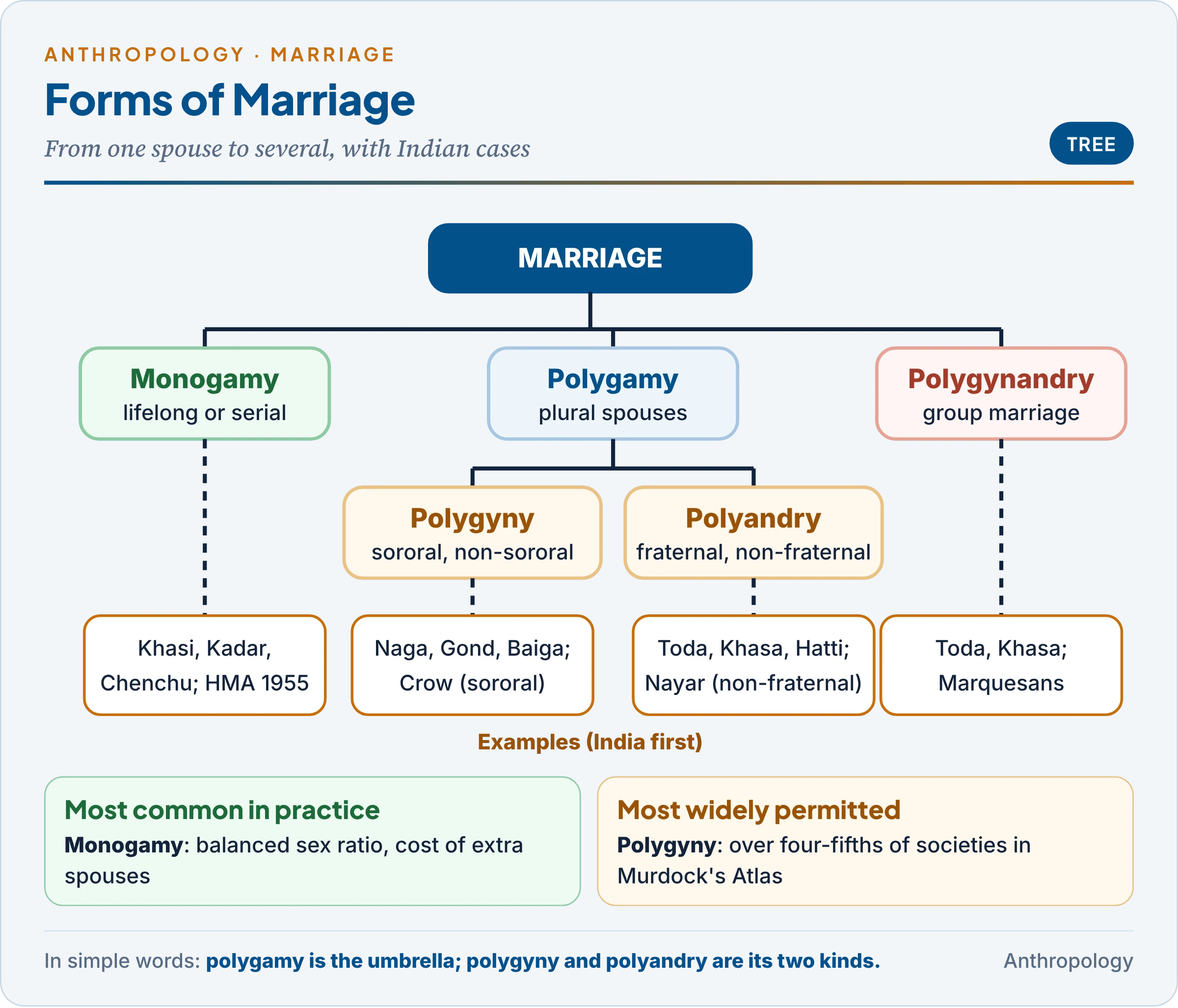
- Monogamy is the commonest practice even where plural marriage is allowed: a roughly balanced sex ratio, the cost of supporting several spouses, and simpler inheritance and child-rearing. Evolutionists (Morgan) read monogamy as a mark of civilisation; the record shows it at every level of complexity, from Andamanese foragers to industrial states.
- Polygyny is the most widely permitted form. In Murdock’s Ethnographic Atlas, over four-fifths of societies allow it, while only a handful (four) allow polyandry.
- Within polygynous societies, most men are monogamous because of the sex ratio and cost.
- Polygyny correlates with female agricultural labour (wives as producers), prestige, warfare-depleted male ratios and long post-partum sex taboos (rules against sex for a long period after childbirth).
- Polyandry:
- Toda of the Nilgiri Hills (Rivers): fraternal polyandry. Paternity is assigned through pursutpimi (presenting a toy bow and arrow in the seventh month of pregnancy). The man who performs it is the father of all children until another brother performs it. Rivers linked Toda polyandry to female infanticide.
- Khasa of Jaunsar-Bawar (Majumdar): the brothers’ joint household keeps land undivided. A later wife may join the same set of brothers.
- Ecological explanation (Melvyn Goldstein, Tibet and the Limi valley of Nepal): fraternal polyandry prevents land fragmentation, keeps a large male labour force for agro-pastoral work and trade, and depresses population growth. Local people themselves cite these motives: if each brother took his own wife, the fields would be divided among several households in the next generation.
- Familial polyandry: a father and son share a wife (reported among Tibetans). The Kota of the Nilgiris also practised polyandry alongside the Todas.
- Sex-ratio explanation (Westermarck) fails as a general cause: in Ladakh, women outnumbered men. Polyandry also lowers fertility per woman, acting as a population brake.
- Prince Peter of Greece and Denmark, A Study of Polyandry (1963): a comparative survey across India and Tibet.
- Hatti of Trans-Giri, Sirmaur (Himachal Pradesh; listed as a Scheduled Tribe in 2023): the custom is called jodidara (wedding: jajda) and is recognised in Himachal revenue law. The community explicitly gives land and joint-family reasons.
- Group marriage as an evolutionary stage (Morgan‘s “consanguine” and “punaluan” families) has no ethnographic support. Real “group” arrangements are polygynandrous extensions of polyandry or polygyny.
5. Ways of Acquiring a Mate in Tribal India
In simple words
In tribal India a spouse can be obtained in many ways: by arrangement, payment, work, exchange, capture, a test of courage, elopement or even by the girl moving in. Most of these are ways of managing the bride-price. Once the community accepts the union, it counts as a full marriage.
Example first. Among the Ho of Jharkhand, the ideal marriage (andi) is arranged with a large bride-price; a poor couple may instead elope, a youth may seize a girl, or a girl may enter a boy’s house and refuse to leave. Each route ends with the community accepting the union after a fine or feast. The table lists the main modes.
| Mode | What happens | Indian example |
|---|---|---|
| Negotiation (arranged) | Kin negotiate, often with bride-price | Ho andi |
| Purchase / bride-price | Groom’s kin pay the bride’s kin | Ho gonong (cattle and cash); widespread in central India |
| Service | A poor groom works in the bride’s household instead of paying | Gond lamsena; ghar-jamai (resident son-in-law) among Baiga and Santal |
| Exchange | Sisters or daughters are exchanged, cancelling bride-price | Common among Gond and other central Indian tribes |
| Capture | Real or mock seizure of the bride | Ho oportipi; Naga |
| Trial / probation | The groom proves courage | Bhil gol-gadhedo (seizing gur from a pole guarded by women) |
| Elopement / mutual consent | The couple decide, and society ratifies later | Ho rajikhushi; Muria ghotul (Elwin, The Muria and Their Ghotul, 1947); Oraon dhumkuria |
| Intrusion | The girl forces herself into the boy’s house and is accepted | Ho anader |
- Common logic: most “irregular” modes are ways round bride-price. Elopement, capture and intrusion are later regularised by a fine or feast, so the alliance and legitimacy functions still operate.
- Dhuku in Jharkhand: among Oraon, Munda and Ho, couples cohabit without the wedding feast they cannot afford. Their children face stigma and inheritance problems. NGO-run mass weddings have regularised thousands of such couples. This is a living Indian parallel to the live-in relationship debate (Contemporary Developments).
6. Marriage Payments
In simple words
In many societies marriage involves a transfer of wealth. Sometimes the groom’s family pays the bride’s family (bride-wealth); sometimes the bride’s family sends wealth with her (dowry). Which one a society uses depends on how it farms, how it passes on property and how unequal it is.
Example first. A Nuer groom’s kin hand over cattle to the bride’s kin in instalments, and her children then belong to the groom’s lineage. In a north Indian upper-caste wedding the flow runs the other way: the bride’s family sends dowry with her. The two payments move in opposite directions because they do different jobs.
| Payment | Direction | Rights or logic | Where |
|---|---|---|---|
| Bride-wealth | Groom’s kin → bride’s kin | Transfers rights in the woman: Laura Bohannan‘s in uxorem (sexual and domestic rights over the wife) and in genetricem (her children to the husband’s lineage). Also called “progeny price”. | Nuer cattle; Africa and Oceania; Ho, Santal, Gond |
| Bride-service | Groom’s labour → bride’s kin | Bride-wealth paid in labour | Gond lamsena; North Alaskan Inuit |
| Dowry | Bride’s kin → the bride and couple | Pre-mortem inheritance (a daughter’s share given at marriage rather than at the parents’ death): diverging devolution, where property passes to daughters as well as sons (Goody and Tambiah, Bridewealth and Dowry, 1973) | Plough agriculture, stratified Eurasian societies |
| Gift exchange | Both ways, about equal | Reciprocity, with no net transfer | Andaman Islanders |
| Woman exchange | Sister for sister | Direct reciprocity | Tiv (Nigeria), central Indian tribes |
The central contrast: bride-wealth compensates the bride’s group for losing her labour and children; dowry endows the bride and the new couple.
- Bride-wealth is the commonest marriage transaction cross-culturally (Alice Schlegel and Rohn Eloul, 1988), and is often paid in instalments that are returnable if the marriage fails or is childless.
- Goody’s contrast: the British social anthropologist Jack Goody linked each payment to a type of economy.
- Bride-wealth goes with hoe agriculture, abundant land, female labour and homogeneous devolution (property passing only within one sex line), as in Africa. Where women are the main farmers and land is plentiful, a wife’s labour is what the groom’s group gains.
- Dowry goes with plough agriculture, scarce land, stratification and diverging devolution. Where land is scarce and families are ranked, the bride’s family places her, and her share, at its own class level.
- Indirect dowry (Goody): wealth passes from the groom’s side to the bride herself, as in Islamic mahr. Parts of Africa have shifted from bride-wealth to indirect dowry as economies changed.
- What dowry does: it seals the alliance, gives the bride a security fund if widowed or deserted, sets up the conjugal household, and buys status in a hypergamous market.
- Radcliffe-Brown (African Systems of Kinship and Marriage, 1950): bride-wealth stabilises marriage, because divorce requires returning the cattle, which the bride’s kin may already have used for their own sons’ marriages. This is why marriage payments are an example of reciprocity between two groups, not a purchase.
- Brahmanical root of dowry: kanyadana (gift of a virgin) is the highest dana (religious gift), and every dana must be accompanied by dakshina (an accompanying fee), so the bride is given with varadakshina (gifts to the groom). Dowry was thus framed as religious merit, not payment, in high-caste Hindu marriage.
- The eight Hindu forms of marriage (Dharmashastras) map onto the cross-cultural modes: Brahma, Daiva, Arsha, Prajapatya (approved; the father gives the daughter, and in Arsha receives a token cow and bull), Asura (bride-price), Gandharva (mutual consent), Rakshasa (capture), Paishacha (seduction; condemned). Detail in Paper II, Unit 3.1.
- India’s shift: M.N. Srinivas (“Some Reflections on Dowry”, 1984) traced a move from bride-price to dowry among lower castes and tribes. He linked it to Sanskritisation (lower castes copying higher-caste customs), to the withdrawal of women from paid labour, and to the cash economy inflating groom-prices. Whether dowry deaths stem from the custom itself or from modern commercialisation of it remains debated (Werner Menski, 1999).
- Law: the Dowry Prohibition Act, 1961. The Bharatiya Nyaya Sanhita (in force from 1 July 2024) makes dowry death section 80 (formerly IPC 304B) and cruelty by husband or relatives section 85 (formerly IPC 498A).
7. Functions of Marriage
In simple words
Marriage decides who a child’s parents are, controls who may have sex with whom, joins two families as allies, and organises work and property. Critics add that it has also been used to control women.
The table pairs each function with the theorist who stressed it.
| Function | Theorist / anchor |
|---|---|
| Legitimacy: a socially recognised father and placement of the child | Malinowski (principle of legitimacy); Gough |
| Regulation of sexual access | Notes and Queries; incest and exogamy rules |
| Economic cooperation: pooling of a sexual division of labour | Murdock; Lévi-Strauss (“the sexual division of labour is nothing else than a device to institute a reciprocal state of dependency between the sexes”) |
| Alliance between groups | Lévi-Strauss; Leach (Kachin) |
| Transfer of rights, property and status | Leach‘s bundle of rights; Goody |
| Socialisation and enculturation of children within a stable unit | Murdock; functionalists |
| Reproduction of social hierarchy | Caste endogamy, hypergamy (Dumont, Parry) |
The functions work at two levels: legitimacy, sexual regulation, cooperation and socialisation serve the couple and child; alliance, rights and hierarchy serve the wider groups, which is why kin usually arrange marriages.
- Feminist critique: “functions” for whom? Marriage also institutionalises control over women’s sexuality, labour and fertility (Meillassoux; the American anthropologist Gayle Rubin, “The Traffic in Women”, 1975, reading Lévi-Strauss’s “exchange of women” as an origin of gender hierarchy).
Key Terms
| Term | Meaning in simple words |
|---|---|
| Bundle of rights | Leach’s idea that marriage is a set of rights that varies by society |
| Pater and genitor | The social father and the biological father |
| Incest taboo | The ban on sex and marriage between close kin |
| Endogamy | The rule of marrying within one’s own group |
| Exogamy | The rule of marrying outside one’s own group |
| Hypergamy and hypogamy | A woman marrying into a higher or a lower group |
| Cross cousin | Child of a parent’s opposite-sex sibling |
| Parallel cousin | Child of a parent’s same-sex sibling |
| Prescriptive marriage | A rule fixing the category one must marry into |
| Preferential marriage | A favoured but not compulsory choice of spouse |
| Restricted and generalised exchange | Two groups swapping spouses; spouses moving one way round a circle of groups |
| Polyandry | One woman with several husbands at once |
| Bride-wealth | Payment from the groom’s kin to the bride’s kin |
| Dowry | Wealth sent with the bride by her own family |
Contemporary Developments
- Same-sex unions: in Supriyo Chakraborty v. Union of India (17 October 2023), a five-judge Constitution Bench held there is no fundamental right to marry and left recognition of same-sex unions to Parliament. Civil unions were rejected 3:2.
- Live-in relationships:
- D. Velusamy v. D. Patchaiammal (2010) brought a “relationship in the nature of marriage” under the Domestic Violence Act, 2005.
- The Uttarakhand Uniform Civil Code (rules in force from January 2025) makes registration of live-in relationships compulsory. Scheduled Tribes are kept outside its scope, which preserves customary marriage.
- Polyandry persists where land logic persists: the Hatti jodidara wedding of July 2025.
- Inter-caste marriage remains rare: about 5% of marriages in the India Human Development Survey (2011–12), so caste endogamy remains the most resilient rule.
- Marriage squeeze: skewed sex ratios in Haryana and Punjab drive long-distance cross-region brides (Ravinder Kaur), which reverses the usual hypergamy and caste-endogamy logic.
Diagrams to Master
- Topic map of the seven themes.
- Pater–genitor split in Nuer woman–woman marriage (§1.2). Label who pays cattle and whose lineage the children join.
- Cousin chart (§3.3). Label cross versus parallel, and MBD, FZD, FBD, MZD.
- Restricted versus generalised exchange. Draw A ⇄ B beside A → B → C → A, and label wife-givers and wife-takers.
- Forms-of-marriage tree. Monogamy, then polygamy splitting into polygyny (sororal, non-sororal), polyandry (fraternal, non-fraternal) and polygynandry.
Revision Grid
| Scholar | Work (year) | Key idea |
|---|---|---|
| McLennan | Primitive Marriage (1865) | Coined endogamy/exogamy; bride capture |
| Morgan | Ancient Society (1877) | Group marriage stage; incest restricted to avoid inbreeding |
| Tylor | 1889 | “Marrying-out or being killed-out” |
| Westermarck | The History of Human Marriage (1891) | Childhood familiarity leads to aversion |
| Rivers | The Todas (1906) | Polyandry; pursutpimi; moieties |
| Freud | Totem and Taboo (1913) | Oedipal desire; primal horde |
| Malinowski | 1927, 1930 | Family disruption; principle of legitimacy |
| Lévi-Strauss | The Elementary Structures of Kinship (1949) | Incest taboo = reciprocity; restricted vs generalised exchange |
| Bohannan, Laura | 1949 | Rights in uxorem vs in genetricem |
| Evans-Pritchard | Kinship and Marriage among the Nuer (1951) | Ghost and woman–woman marriage; pater/genitor |
| Leach | 1955; Political Systems of Highland Burma (1954) | Bundle of rights; Kachin MBD hierarchy |
| Gough | 1959 | Nayar; legitimacy-based definition |
| Needham | Structure and Sentiment (1962); 1971 | Prescription vs preference; Purum; “odd-job word” |
| D.N. Majumdar | Himalayan Polyandry (1962) | Khasa of Jaunsar-Bawar |
| Goody and Tambiah | Bridewealth and Dowry (1973) | Dowry = diverging devolution |
| Srinivas | “Some Reflections on Dowry” (1984) | Bride-price to dowry shift |
| Goldstein | Tibet and Limi studies | Fraternal polyandry prevents land division |
| Cai Hua | A Society without Fathers or Husbands (2001) | Mosuo tisese |
Previous Year Questions
Unit 2.3: Marriage
- 2026Discuss ‘incest taboo’ as the basis of development of kinship systems in human societies.
- 2025How the study of variation in forms of marriage led to rethinking on the concepts of social reproduction, kinship and family?
- 2023Discuss the role of marriage regulations in traditional societies in India for strengthening social solidarity.
- 2021Write notes on: Marriage Regulations and Alliance Theory.
- 2018Write a note in 150 words on Ways of Acquiring Mate in Tribal Society.
- 2017Discuss the different forms of preferential marriage with suitable examples from tribal societies in India.
- 2015Write a note in 150 words on Incest Taboos.
- 2014Define marriage and describe the various types of marriages in human societies.
- 2013Where do you situate ‘live-in relationship’ within the institution of marriage ? (250 words).
- 2012Write a note in 150 words on Ways of acquiring a spouse in simpler societies.
- 2006Write a note on Incest Taboos.
- 1991Describe the problems of universal definition of marriage. Describe the different forms of marriage among the tribal people of India.
- 1989Define Marriage. Describe its different forms with suitable examples as prevalent among the tribal people of India. Point out the functions of marriage.
- 1983Incest is universally the basis of enduring family. Comment.
- 1983Endogamy and preferential marriage are characteristic of closed societies. Discuss.
- 1982Marriage institution is found in all societies and at all times. Discuss.
- 1981“Marriage payments are an example of reciprocity between two social groups.” Elaborate. (200 words).
Related questions from other units
- 2020Unit 2.4: Explain the impact of feminist movement on universality of marriage and family structure.
- 2020Unit 9.3: How do marriage rules impact the gene pool of populations?
- 2009Unit 2.2: Write a detailed note on polyandrous societies, citing Indian examples.
- 1988Unit 2.5: What are incest regulation? Bring out their socio-cultural functions in the context of stability in the institutions marriage, family and kinship.