

Proofs for the Existence of God and their Critique (Indian and Western).
Official Syllabus: Paper II, Section B, Unit 2
The moral argument reasons to God not from the existence of the world (the cosmological argument) or from its order (the design argument), but from the fact that we are moral beings. We feel the pull of duty, the sting of conscience, the conviction that some things — like torturing a child for fun — are really wrong, and the hope that goodness will not finally be defeated. The argument says these facts make sense only if there is a holy and just God: a Lawgiver behind the moral law, a Mind in which moral ideals exist, a Judge who will make virtue and happiness meet. Its most famous form is Kant’s argument that God is a postulate of practical reason; others come from Newman (conscience), Rashdall and Sorley (objective moral ideals), C.S. Lewis (the universal moral law) and the modern argument from objective moral values. This article explains these forms, the strong objections — the Euthyphro dilemma, Freud, evolutionary ethics, the autonomy of morals, Russell — and the Indian parallels. It then covers the other grounds offered for belief in God: the argument from religious experience, the argument from common consent, and Pascal’s wager.
In simple words
A child finds a list of house rules stuck on the fridge: “Be kind to your sister. Tell the truth. Clean up after yourself.” The child does not think the list wrote itself; it was written by someone with authority in the house who cares how the family lives. The moral argument looks at the moral law written in our conscience in the same way: a law that binds every human being, everywhere, seems to point to a Lawgiver with authority over everyone — God.
Context & Problem
How the Moral Argument Differs from the Other Proofs
- Starting point. The ontological argument starts from an idea; the cosmological and design arguments start from the physical world. The moral argument starts from moral experience: the sense of obligation, conscience, moral ideals and the demand for justice.
- Practical rather than theoretical. It is the “most palpably felt” of the arguments — rooted in the daily experience of every person, not in physics or logic. It avoids the scientific objections that trouble the cosmological and design arguments (Darwin, quantum physics).
- What it hopes to show. Not merely a First Cause or a Designer, but a personal, holy, just God — the God who matters to religion.
- Its place among the proofs. In the view that the ontological argument is the “nerve” of all the proofs (Article 1), the moral argument adds the last layer: after existence (cosmological) and order (design), it adds the moral character of reality.
The Basic Idea — Obligation Points to a Source
- Our obligation to others. The sense of obligation we feel towards fellow human beings — how we ought to treat others — assumes a reality beyond us as the source of this obligation.
- Two assumptions of the argument.
- Moral values are not mere results of desire, self-interest or need; they make a claim on us that points to a reality beyond nature.
- Those who are committed to moral values should, to be consistent, believe in the reality that is their basis — God.
- Commands imply a commander. A command does not exist without someone who commands. The moral law presents itself as a command (“Do not lie”). Its commander cannot be any contingent human being, who might command otherwise or not at all. So the source of the moral command is God.
- Ultimate command implies an ultimate commander. Morality claims ultimate authority — it overrides self-interest, custom and even the law of the state. Such authority over everything presupposes someone who has authority over everything. As people obey a government because it has the authority to command, so the moral law’s supreme authority points to a supreme Authority.
In simple words
Traffic signals are obeyed because a government stands behind them with the authority to make rules. If you found a signal in an empty desert, you would still assume someone with authority had put it there. The moral law is like a signal that every human being finds already standing in the heart — and it claims a higher authority than any government. The moral argument asks: whose authority is that?
Core Doctrine
1. Kant: God as a Postulate of Practical Reason
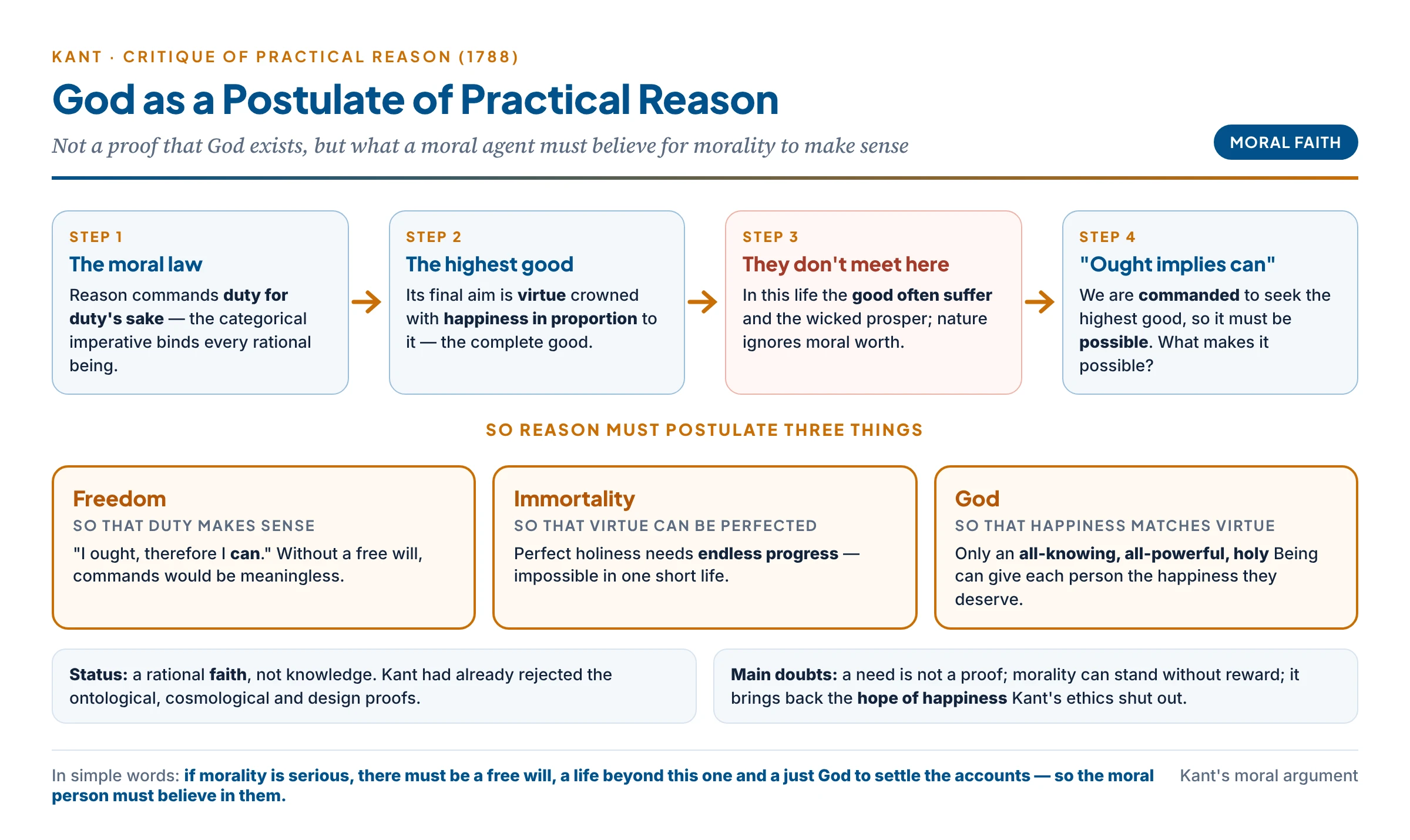
- Background. Immanuel Kant had rejected the ontological, cosmological and design proofs: theoretical (pure) reason cannot prove God, because God is not an object of possible experience (Articles 2, 4 and 5). But in the Critique of Practical Reason (1788) he argued that practical (moral) reason gives a moral certainty that replaces the failed theoretical arguments. “I have therefore found it necessary to deny knowledge, in order to make room for faith.”
- The moral law. Human reason recognises the categorical imperative — an unconditional command of duty: act only on a principle you could will as a law for everyone; treat humanity always as an end, never merely as a means. We must do our duty for duty’s sake.
- The highest good (summum bonum). Reason also sets before us the highest good as the final object of moral action. It has two elements:
- Virtue — perfect moral worth; this is the supreme good, the condition of everything else.
- Happiness in proportion to virtue — the complete good is virtue crowned with the happiness it deserves.
- The problem. In this world, virtue and happiness do not go together. Good people often lead miserable lives, while the wicked prosper. Nature pays no attention to moral worth.
- “Ought implies can.” Yet we are commanded to promote the highest good — and what we ought to do must be possible. So the conditions of its possibility must be assumed.
- The three postulates.
- Freedom of the will — without it, duty would be meaningless; I ought, therefore I can.
- Immortality of the soul — perfect virtue (holiness) cannot be reached in a short lifespan; it requires endless progress, so the soul must continue beyond death.
- The existence of God — only a Being who is all-knowing (to see our inner intentions), all-powerful (to rule nature) and holy (to will the moral law) can bring happiness into exact proportion with virtue, if not in this life then in a future one.
- The argument in four steps.
- The highest good is the state in which happiness and moral virtue coincide.
- Rational beings are bound to seek the highest good.
- The highest good is possible only if there is God (and an afterlife).
- So we must postulate that God exists.
- Kant’s three supports.
- It is plain that good people often have more miserable lives than evil people; this can be satisfactorily explained only by an afterlife under God’s justice.
- Eternal life with God is needed to reach the moral perfection that is impossible in a short life.
- The universe is rational — morally ordered at its core. This last assumption later became a bone of contention: why should the universe answer to our moral demands?
- Duties as divine commands. Kant recommends that we regard our duties as divine commands — not because God’s will makes them right, but because seeing them so strengthens our resolve. Religion, for Kant, is “the recognition of all duties as divine commands”.
- Not knowledge but faith. A postulate is not a proof. Kant does not claim to know that God exists; he claims that a moral agent must believe it, as a rational faith (Vernunftglaube). The moral argument rests ultimately on faith, not on theoretical demonstration.
“Two things fill the mind with ever new and increasing admiration and awe… the starry heavens above me and the moral law within me.” — Kant
In simple words
Imagine a game in which the rules tell you to play honestly, and also promise that honest players will win in the end. But you notice that cheats often win this round. If the rules are serious, there must be more rounds to come and a fair referee who sees everything and will settle the scores. Kant says morality is like that game: the more rounds are immortality, and the fair referee is God.
Common confusion
Is Kant’s moral argument an a priori proof of God? No, on both counts. Some notes list “Kant’s moral proof” beside the ontological argument as an a priori proof, or say that Kant proved God from morality. Kant’s argument starts from the fact of moral obligation in our practical life, and its conclusion is a postulate — something a moral agent must believe — not a piece of knowledge. Kant had already argued that no theoretical proof of God, a priori or a posteriori, can succeed. Also, the line “If God does not exist, everything is permitted” is a popular summary of a theme in Dostoevsky’s novel, not an exact sentence from it.
2. Newman: the Argument from Conscience
- John Henry Newman (An Essay in Aid of a Grammar of Assent, 1870) argued from the experience of conscience.
- What conscience is like. Conscience is not just a judgement that something is right or wrong; it is a voice that produces guilt, shame, fear of transgressing and reverence. It feels like being answerable to someone.
- The inference. We do not feel shame or fear before inanimate nature, and we cannot owe obligation merely to ourselves (we could release ourselves). Such feelings imply a Person: “If, as is the case, we feel responsibility, are ashamed, are frightened, at transgressing the voice of conscience, this implies that there is One to whom we are responsible, before whom we are ashamed, whose claims upon us we fear.”
- Conscience as an echo. Conscience is the “echo” of a divine voice; the supreme Lawgiver who speaks through it is God.
3. Rashdall, Sorley and the Moral Ideal
- Hastings Rashdall (The Theory of Good and Evil, 1907).
- There is an objective moral ideal — a standard of goodness that is not invented by us and binds all minds.
- An ideal can exist only in a mind; it is not a physical thing in space.
- It cannot exist fully in any human mind, which is limited and changeable.
- So it exists in a supreme Mind — God, “from which all Reality is derived”.
- W.R. Sorley (Moral Values and the Idea of God, 1918). Moral values are as objective and real as the facts of nature. A complete view of reality must include both; the best explanation of a world containing both natural order and objective values is a God who is the source of both. A.E. Taylor developed similar arguments.
4. C.S. Lewis: the Universal Moral Law
- C.S. Lewis (Mere Christianity, 1952, based on wartime radio talks).
- People everywhere appeal to a standard of right and wrong they expect others to know: “That’s not fair”, “You promised”. Even when they break it, they make excuses — showing they recognise it.
- This moral law is not a product of evolution or social conditioning alone; it often tells us to act against our strongest instincts.
- Just as laws imply a legislator, the moral law implies a Lawgiver behind the universe — a Mind intensely interested in right conduct.
5. The Modern Moral Argument
- William Lane Craig and others give a short version from objective moral values:
- If God does not exist, objective moral values and duties do not exist.
- Objective moral values and duties do exist — for example, the torture of innocent children for fun is evil, whatever any person or culture thinks.
- Therefore God exists.
- The intuition behind premise 1. A line popularly drawn from Dostoevsky’s novel The Brothers Karamazov expresses it: “If God does not exist, everything is permitted.” Without a transcendent foundation, morality seems to shrink to opinion, convention or feeling.
- The intuition behind premise 2. If morality were purely subjective, our moral outrage at genocide or slavery would be no more than a preference — like disliking a flavour. Most people find that impossible to accept.
Indian Connect — Indian moral arguments: karma needs a dispenser
- Nyāya’s adṛṣṭa argument is India’s closest parallel to Kant. Good and bad actions leave an unseen moral residue (adṛṣṭa — merit and demerit) that bears fruit much later, even in future lives. Adṛṣṭa is unconscious; it cannot by itself bring the right joy or sorrow to the right soul at the right time. So an all-knowing dispenser of the fruits of action (karma-phala-dātā) — God — is needed (Article 7).
- Like Kant, Nyāya argues from the demand that virtue and happiness must finally match; unlike Kant, it presents this as a proof by inference, not a postulate of faith.
- Vākyāt — Nyāya also treats the moral law of the Veda as a command that implies a commander, much as Lewis treats the moral law as implying a Lawgiver.
Critical Evaluation
Objections to Kant’s Argument
- It does not prove; it assumes. Kant shows at most that if the highest good must be possible, we must believe in God. He does not show that it is possible — the universe may simply not care about our moral demands. A need is not a proof.
- Morality can stand without reward. Many people act morally with no hope of reward or afterlife; virtue may be its own reward. Morality does not need happiness to be guaranteed.
- Inconsistent with Kant’s own ethics. Kant insists that a good act must be done for duty’s sake, as an end in itself, not for its consequences. Yet the moral argument makes happiness, distributed by God, the completion of morality — bringing back the very ends-based thinking (and heteronomy — acting from motives outside the moral law) that his ethics rejected. People may begin to act for the sake of the outcome rather than the duty.
- The rational universe is assumed. The claim that reality must be morally ordered is exactly what the sceptic doubts.
- Russell’s crate of oranges. Bertrand Russell mocked the argument that injustice in this world must be redressed in another: “Supposing you got a crate of oranges that you opened, and you found all the top layer of oranges bad, you would not argue, ‘The underneath ones must be good, so as to redress the balance.’ You would say, ‘Probably the whole lot is a bad consignment.'” If this world is unjust, that is evidence against a just God, not for one.
The Euthyphro Dilemma
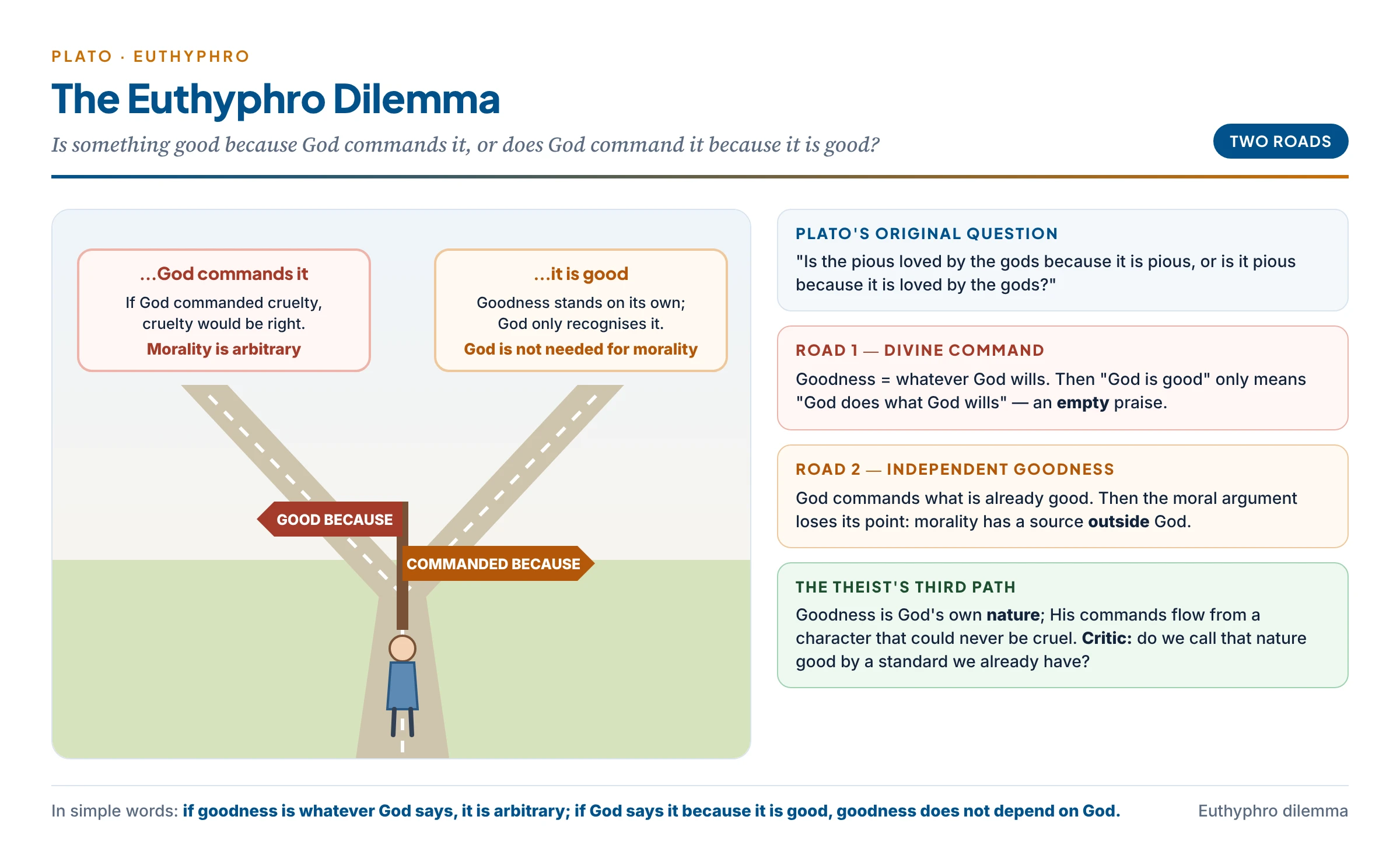
- Plato’s question in the Euthyphro: “Is the pious loved by the gods because it is pious, or is it pious because it is loved by the gods?” Put in theistic terms: is something good because God commands it, or does God command it because it is good?
- First horn — good because God commands it. Then morality is arbitrary: if God commanded cruelty, cruelty would be right. And saying “God is good” becomes empty — it only means “God does what God commands”.
- Second horn — God commands it because it is good. Then goodness is independent of God; God recognises it rather than creating it, and God is not needed as the source of morality.
- Either way, the moral argument is in trouble: either morality is arbitrary, or it does not need God.
- The theistic response. Goodness is neither above God nor made up by Him; it is rooted in God’s own nature. God commands what is good because God is goodness itself; His commands flow from His character, which could not be cruel.
- The critic’s reply. We can still ask: is God’s nature good because it is God’s, or because it has the qualities (love, justice) we already recognise as good? If the latter, our standard of goodness is again independent of God.
Psychological and Social Explanations
- Freud. In The Future of an Illusion (1927), Sigmund Freud argued that conscience is the super-ego — the internalised voice of parents and society. Guilt is not the echo of God but the echo of childhood commands. God himself is a projection of the father-figure, a wish for protection.
- Marx and Nietzsche. Marx saw morality and religion as ideologies serving class interests. Nietzsche saw Christian morality as a “slave morality” invented by the weak to restrain the strong.
- Cultural conditioning. Moral commands vary with culture and history; they may be the result of upbringing and social pressure, not divine law.
- Which set of values? Even believers disagree deeply over what God commands. If God is the source of morality, there is a large question over which moral code is God’s.
Evolutionary Ethics
- The claim. E.O. Wilson, Richard Dawkins and others argue that morality evolved because it helps survival and group cohesion.
- Kin selection — helping relatives spreads shared genes.
- Reciprocal altruism — “you scratch my back, I scratch yours” benefits both.
- Empathy, fairness and reciprocity are found in social animals — chimpanzees console one another, wolves share food — without any religion.
- The reply. Evolution explains how moral feelings developed, not why morality is binding. If morality were only a useful instinct, it would have no authority over us when breaking it is useful — yet we think cruelty is wrong even when it pays.
Secular Moral Theories and Moral Realism without God
- Morality without God.
- Utilitarianism (Bentham, Mill) — morality is about maximising happiness; it needs no God.
- Humanism — ethical values arise from reason and human dignity, not divine commands.
- Existentialism (Sartre, Nietzsche) — morality is a human creation in a godless world.
- Atheistic moral realism. Philosophers such as Sam Harris argue that there are objective moral truths — about the well-being of conscious creatures — that do not depend on God. Humanist societies agree on moral laws without invoking God.
- The theist’s reply. Without an objective foundation, morality risks becoming subjective and relative. The moral argument at least poses a sharp question: what makes moral facts real and binding in a purely physical universe?
- Mackie’s “queerness”. J.L. Mackie argued that objective values would be queer entities, utterly unlike anything else in nature — and concluded that there are no objective values. Interestingly, theists accept his premise (“objective values don’t fit a godless world”) and reverse his conclusion (“so there is a God”).
Moral Autonomy and Religion as the Source of Morality
- The conflict.
- Religion as source. Many theists hold that moral laws are God’s commands: what God allows is good, what He forbids is wrong — the divine command theory (the Ten Commandments; some Christian, Islamic and Hindu schools; thinkers such as Descartes, Locke and Paley held that God’s laws are the moral standard).
- Moral autonomy. Kant argued powerfully that morality must be autonomous — given by our own rational will. “The good will is good not because of what it achieves”, but in itself; “nothing in the world, or even beyond it, can be conceived which could be called good without qualification except a good will.” Morality is good not because God wills it; God wills it because it is good. An act done merely because it is commanded — from fear or hope of reward — lacks true moral worth (heteronomy).
- How the conflict sharpens.
- If morality depends on God’s will, a person who obeys only because God commands is not acting morally in the full sense, but obediently.
- If morality is autonomous, religion seems unnecessary for it — a point pressed by Freud, who urged that morality be made independent of religion, since religion is largely myth and myths may disappear, taking morality with them.
- The Euthyphro dilemma restates the same conflict.
- Attempts at reconciliation.
- Kant himself did not abolish religion: morality leads to religion. Having made morality autonomous, he still recommended treating duties as divine commands, as a psychological support, because the performance of duties is hard for human beings without such a “booster”. In this sense “morality without religion” may remain incomplete in practice.
- R.B. Braithwaite treated religious belief as a commitment to a way of life, with religious stories as psychological support for moral resolve.
- Natural-law theory (Aquinas) — God’s commands follow His reason, which our own reason can grasp; autonomy and theonomy coincide when reason recognises God’s law as its own.
- The upshot for the moral argument. If morality is fully autonomous, the moral argument cannot show that morality needs God as its source; at most, like Kant’s, it shows that morality points towards God as the guarantor of the highest good.
Indian Critiques — Morality and Karma without God
- Jainas and Buddhists follow strict ethical codes — non-violence to all living beings, truthfulness, non-stealing — without belief in a creator God. Morality is grounded in the law of karma, a self-operating law that needs no supervisor. The Jaina five vows (pañca-mahāvrata) shaped the ethics of all Indian religions.
- Aśvaghoṣa (Buddhist) rejected the moral argument outright: an omnipotent God could not be bound by the law of karma; and there is no need of God, because karma works autonomously through dependent origination (pratītyasamutpāda).
- Mīmāṃsā holds that ritual and moral actions produce an unseen potency (apūrva) that yields its fruit by itself; the Veda is authorless, and no God is needed to dispense results (Article 9).
Strengths and Weaknesses
| Strengths | Weaknesses |
|---|---|
| Appeals to universal moral intuitions every person shares | It does not prove God; at best it shows God is the best explanation or a postulate |
| Avoids the scientific objections that trouble the cosmological and design arguments | Atheistic moral realism and humanism offer competing foundations |
| Points to a personal, holy God — the God of religion | The Euthyphro dilemma remains unresolved for many |
| A strong counter to moral relativism | Freud, Marx and evolution offer natural explanations of conscience |
| Kant’s form preserves intellectual honesty — faith, not false proof | Kant’s form sits uneasily with his own autonomy of morals |
Critics and Defenders
Criticism — Critics
- Plato’s Euthyphro: either morality is arbitrary or it does not need God.
- Freud: conscience is the internalised voice of parents and society.
- Evolutionists: moral feelings evolved for survival; animals show them too.
- Russell: an unjust world is evidence against, not for, a just God (the bad oranges).
- Kantian autonomy, humanists and moral realists: morality is binding without God; Jaina, Buddhist and Mīmāṃsā karma works by itself.
Defence — Defenders and strengths
- Kant: the highest good must be possible, so freedom, immortality and God must be believed — a rational faith.
- Newman: shame and fear before conscience imply a Person to whom we answer.
- Rashdall and Sorley: an objective moral ideal must exist in a supreme Mind.
- Lewis and Craig: objective moral values, which we cannot honestly deny, need a transcendent foundation.
- Theists on Euthyphro: goodness is rooted in God’s own nature — neither arbitrary nor independent.
Other Arguments for God
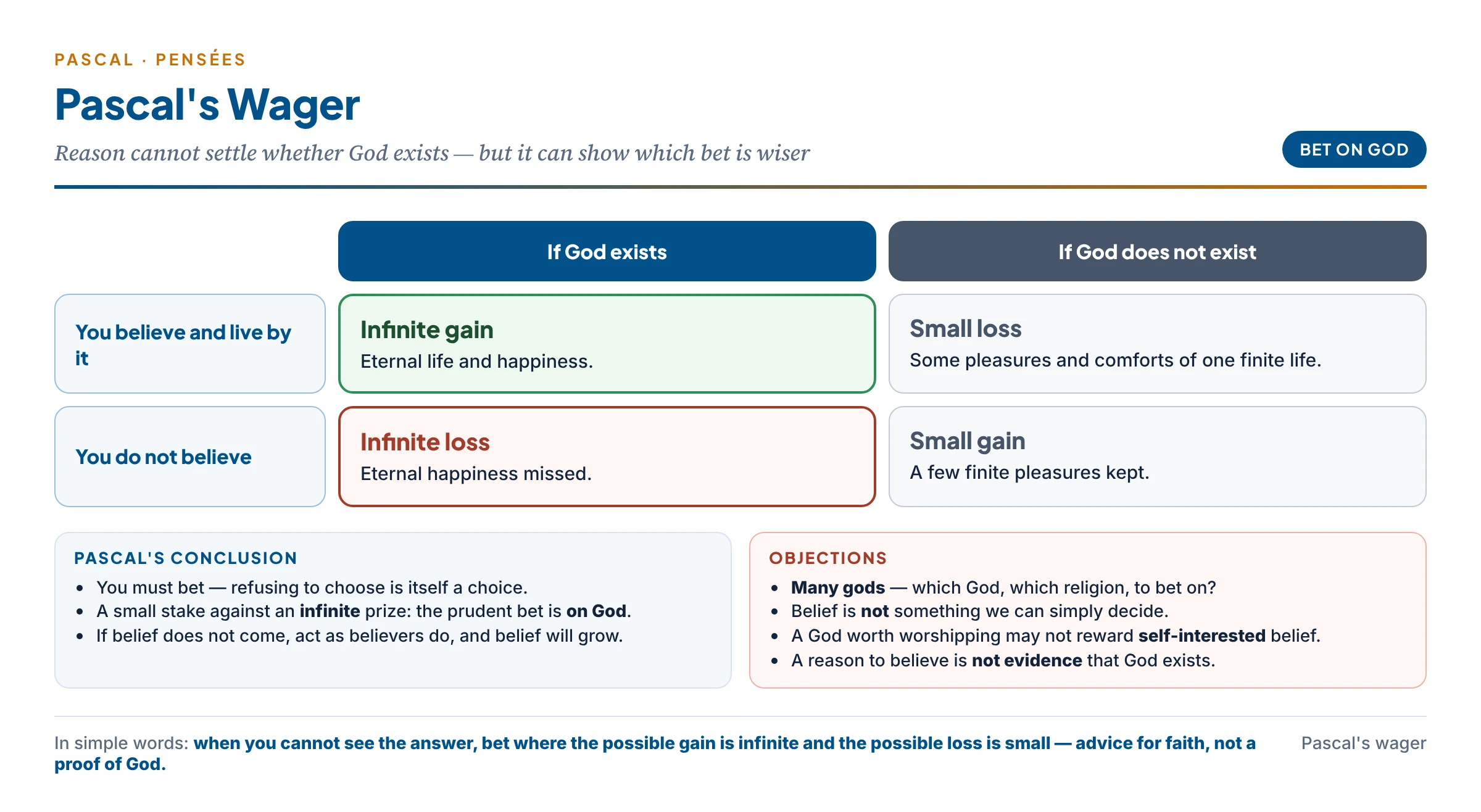
1. The Argument from Religious Experience
- The claim. Many people report direct experiences of God or the divine — and such experiences are evidence that God exists, as perceptual experience is evidence that tables and trees exist.
- Kinds of religious experience.
- Mystical — union with or absorption in the divine, beyond words (Meister Eckhart, Śaṅkara’s realisation of Brahman, Sufi saints).
- Charismatic — speaking in tongues, healing, prophecy.
- Paranormal — visions, voices, apparitions.
- Regenerative — conversion experiences that transform a person’s life and character.
- Numinous — Rudolf Otto‘s sense of the “wholly other”, a mystery that both terrifies and fascinates (mysterium tremendum et fascinans).
- Supporters.
- William James (The Varieties of Religious Experience, 1902) — mystical states are ineffable, noetic (they feel like knowledge), transient and passive; they carry authority for those who have them.
- Richard Swinburne — the principle of credulity: if it seems to me that something is present, it probably is, unless there is special reason to doubt it; and the principle of testimony: we should believe what others report, unless there is reason to doubt it.
- The lives of saints — the selfless, inspiring lives of saints and jīvanmuktas (those liberated while living) are cited as evidence that their experiences were genuine.
- Criticisms.
- Russell: “From a scientific point of view, we can make no distinction between the man who eats little and sees heaven and the man who drinks much and sees snakes.”
- Freud — experiences of God are wish-fulfilment; neuroscience links some religious experiences to brain states.
- Private and unverifiable — others cannot check them.
- Conflicting — Hindus experience Kṛṣṇa, Christians Christ, Buddhists nirvāṇa; they cannot all be experiences of the same personal God.
- Reply. A brain correlate does not show the experience is false (seeing a tree also has a brain correlate); and transformed lives are hard to explain away. Detailed treatment belongs to the syllabus unit on religious experience.
2. The Argument from Common Consent (Consensus Gentium)
- The claim. Belief in God or gods is found in almost every human society, in every age. Cicero argued that what all peoples agree on by nature must be true. A belief so universal is unlikely to be a mere error; it may be a natural awareness of the divine (Calvin’s “sense of divinity”).
- Criticisms.
- Majorities can be wrong — once almost everyone believed the sun moved round the earth.
- Not truly universal — whole traditions (Buddhism, Jainism, Sāṃkhya, Mīmāṃsā, Cārvāka, Confucianism) do not accept a creator God, and many modern people are non-believers.
- The beliefs differ — the gods of different peoples are very unlike one another; consensus on “something sacred” is not consensus on God.
- Natural explanations — fear, the wish for protection, social cohesion (Durkheim) and upbringing may explain the spread of belief.
3. Pascal’s Wager
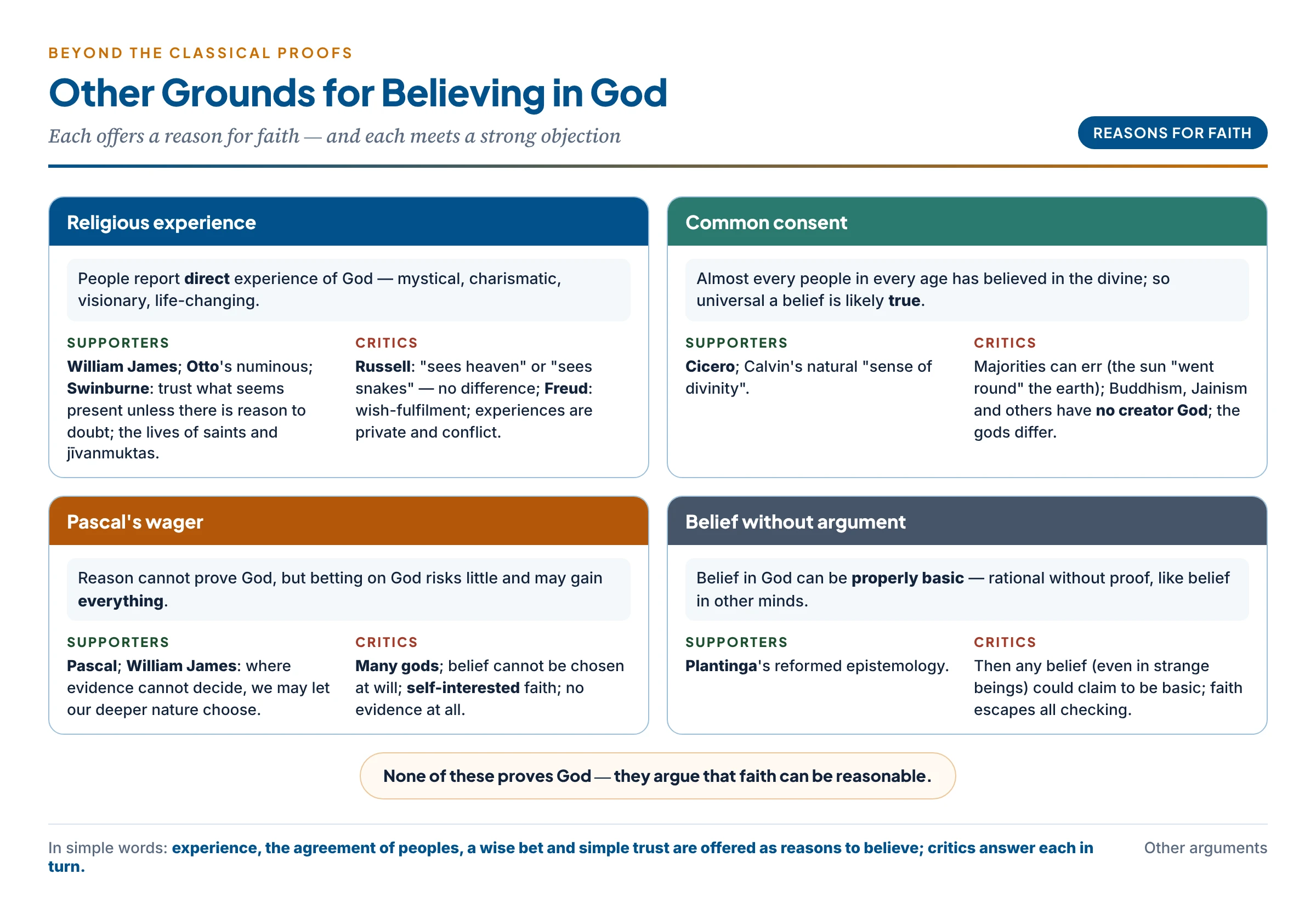
- Blaise Pascal (Pensées, published 1670) held that reason cannot prove or disprove God: “The heart has its reasons, which reason does not know.” But reason can show that it is wise to believe.
- The wager.
- Either God exists or He does not; we cannot avoid betting, because not choosing is itself a choice.
- If you believe and God exists, you gain infinite happiness — eternal life.
- If you believe and God does not exist, you lose little — some pleasures and luxuries of a finite life.
- If you do not believe and God exists, you lose infinitely; if He does not exist, you gain only a little.
- So a prudent person should bet on God — live as though God exists and seek to believe.
- Criticisms.
- The many-gods objection — which God should I bet on? Different religions demand different beliefs, and each threatens unbelievers.
- Belief is not voluntary — I cannot simply decide to believe something because it would pay.
- Mercenary belief — a God worth worshipping might not reward belief adopted out of self-interest.
- Not a proof — it gives a prudential reason to believe, not evidence that God exists.
- Pascal’s reply and James. Pascal advised acting as if one believed — attending worship, following practice — so that belief would grow. William James (The Will to Believe, 1896) argued that where a question is live, forced and momentous and evidence cannot settle it, we have the right to let our passional nature decide.
4. Belief without Arguments — Plantinga
- Alvin Plantinga argued that belief in God can be properly basic — rational to hold without evidence or argument, as belief in other minds or in the past is. A theist has the right to start from belief in God. This challenges the whole assumption that faith needs proofs (Article 1).
In simple words
A traveller lost in a forest at night comes to a fork. One path might lead home; nobody can see where either goes. Standing still is also a choice — and a cold one. Pascal says belief in God is like choosing the path that, if it is right, leads to a warm home for ever, and if it is wrong, costs only a slightly longer walk. That is not a proof that the path leads home — it is advice on how to bet when you cannot see.
Cross-Tradition Comparison
Morality, Karma and God across Traditions
| Point | Kant | Nyāya | Mīmāṃsā | Jainism and Buddhism |
|---|---|---|---|---|
| What links virtue and happiness? | God, in a future life | God as dispenser of karma’s fruits | Apūrva, the unseen potency of action | The law of karma itself |
| Is God needed? | Yes — as a postulate of faith | Yes — proved by inference (adṛṣṭa) | No | No |
| Status of the argument | Practical faith, not knowledge | Proof | Rejects the argument | Rejects the argument (Aśvaghoṣa) |
| Source of moral law | Autonomous reason | The Veda as God’s command | The authorless Veda | The teaching of the Jina or the Buddha; self-effort |
Indian Connect — Kant and the Indian karma debate
- Kant’s problem — why do the good suffer and the wicked prosper? — is answered in India by karma and rebirth: present suffering is the fruit of past deeds, and justice is worked out across lives.
- The Indian debate is then over who runs karma: Nyāya says an all-knowing God; Mīmāṃsā, Jainism and Buddhism say karma runs by itself, as gravity needs no one to push each falling stone.
- So the Indian moral argument is about the administration of moral justice, while Kant’s is about its possibility — but both start from the same demand that goodness must finally be rewarded.
Synthesis (Siddhānta)
- The moral argument moves from moral experience — duty, conscience, objective values and the demand for justice — to a holy and just God. Kant made God a postulate of practical reason: the highest good (virtue crowned with proportionate happiness) is commanded, “ought implies can”, so freedom, immortality and God must be believed. Newman argued from conscience, Rashdall and Sorley from the objective moral ideal that must exist in a supreme Mind, C.S. Lewis from the universal moral law, and the modern argument from objective moral values.
- The argument faces serious objections: the Euthyphro dilemma, Freud‘s super-ego, evolutionary explanations, cultural variety, secular and realist moral theories, Kant’s own doctrine of autonomy, Russell’s bad oranges, and the Indian systems — Jaina, Buddhist and Mīmāṃsā — in which karma works without God.
- Its lasting strength is the question it poses: what makes moral facts real and binding, and why should goodness finally prevail? It does not prove God, but it shows that belief in God gives morality a foundation and a hope. The theistic answer to Euthyphro — goodness rooted in God’s nature — and the reconciliation of autonomy with religion (reason recognising God’s law as its own) keep it philosophically alive.
- The other arguments — from religious experience, common consent and Pascal’s wager — and Plantinga’s properly basic belief share the same lesson: they offer reasons for faith, not demonstrations, and each faces strong criticism.
- Contemporary relevance.
- Debates on secular ethics, human rights and moral realism continue to ask whether morality needs a religious foundation.
- Moral education in plural societies like India must reconcile religious and autonomous sources of value.
- Neuroscience and evolutionary psychology keep testing natural explanations of conscience and religious experience.
“If, as is the case, we feel responsibility, are ashamed, are frightened, at transgressing the voice of conscience, this implies that there is One to whom we are responsible.” — John Henry Newman
Previous Year Questions
- 2026How does the issue of moral autonomy conflict with conception of religion as a source of morality? Critically discuss.
- 2021Give a critical account of moral argument to prove the existence of God.