

Caste Discrimination: Gandhi and Ambedkar.
Official Syllabus: Paper II, Section A, Unit 10
Gandhi’s response to caste cannot be understood apart from his whole philosophy. He approached untouchability as a sin to be atoned for by caste Hindus, through self-purification, suffering and change of heart rather than through hatred or coercion — because for him every social question was ultimately a question of Truth (Satya) and non-violence (Ahiṃsā), and because he held that means and ends are inseparable. This article sets out those foundations: the sources of his thought, Truth and the shift from “God is Truth” to “Truth is God”, ahiṃsā, the continuity of ends and means (against Machiavelli), satyāgraha, swaraj, his critique of modernity, sarvodaya, trusteeship, bread labour, Nai Talim, his views on religion and secularism, the state (enlightened anarchy), rights and duties and women, with comparisons with Marx and M.N. Roy and an assessment of Gandhism today.
In simple words
Two men want a village well opened to Dalits. The first gathers a mob and breaks the lock; the well is opened, but the village is split by hatred for a generation. The second sits fasting at the well, refuses to leave, invites the upper castes to talk, and waits until they themselves unlock it — slower, but the change is in their hearts, not only in the lock. Gandhi always chose the second way. To understand his approach to caste, one must understand why.
Context & Problem
Sources of Gandhian Thought
Religious sources
- Bhagavad Gītā — his “spiritual dictionary”: niṣkāma karma (action without attachment to fruits), the ideal of the sthitaprajña (person of steady wisdom), and the idea of self-rule over the senses — the root of his theory of swaraj.
- Upaniṣads — the Chāndogya‘s idea of freedom as self-governing autonomy; the Īśopaniṣad‘s “enjoy by renouncing” (basis of trusteeship).
- Tulsīdās’s Rāmcharitmānas — the ideal of Rāmrājya.
- Jainism and Buddhism — ahiṃsā (his Jain friend Raychandbhai shaped his early thought); Christianity — the Sermon on the Mount (“turn the other cheek”); the Qur’ān — brotherhood.
Western thinkers
- Henry David Thoreau — Civil Disobedience: a citizen must not obey unjust laws.
- John Ruskin — Unto This Last: the dignity of labour; the good of the individual is contained in the good of all → sarvodaya and bread labour.
- Leo Tolstoy — The Kingdom of God Is Within You: non-resistance to evil by force; the modern state is exploitative → Gandhi’s anarchism.
- Edward Carpenter — Civilisation: Its Cause and Cure — the critique of modern civilisation.
Indian political mentors
- Gopal Krishna Gokhale, his “political guru”, taught the spiritualisation of politics.
What he took from each
- From the Gītā: karma and swaraj; from Tulsīdās: Rāmrājya; from Ruskin: bread labour and sarvodaya; from Thoreau: civil disobedience; from Tolstoy: the critique of the state and “the kingdom of God within you”; from Christianity: brotherhood and self-sacrifice.
Core Doctrine
Truth (Satya) — “Truth Is God”
- The highest value: the purpose of human life is the realisation of Truth. Gandhi called his autobiography The Story of My Experiments with Truth.
- Relative and absolute truth: absolute Truth is God; human beings know only relative truths, so truth has no finality — life is a continuous search. This gives humility and tolerance: no one may impose his partial truth by force.
- Man and animal: in animals the soul is asleep and they live by appetite; in man the soul is awake, so he can know Truth. Every human being combines good and evil; life is the effort to conquer evil and move towards good — the lives of great men prove it.
The shift from “God is Truth” to “Truth is God”
- Earlier Gandhi said “God is Truth” — God has many attributes, and Truth is one of them. From about 1931 (he explained the change at Lausanne) he said “Truth is God”.
- Reasons for the shift:
- Even atheists accept truth: one can deny God, but no one can deny Truth; “Truth is God” includes the atheist and the agnostic.
- Inclusiveness: God has countless names and forms across religions; Truth is the one name all can accept.
- Truth is the most exact name: Satya comes from sat, “being” — what truly is; nothing is except Truth.
- Ethical turn: God is realised not by belief or ritual but by truthful, non-violent living.
- Religion and morality: the shift makes morality the essence of religion. For Gandhi, “true religion and true morality are inseparably bound up”; a religion that permits untouchability is not true religion. This is why he attacked untouchability as a sin against God and expected religious reform to remove it (Article 4).
- Critique: the identification makes “God” so wide that it may lose religious content; Ambedkar and rationalists objected that Gandhi’s “Truth” was in practice his inner voice, which others could not check.
Ahiṃsā (Non-Violence)
- The central thread: ahiṃsā is the foundation of Gandhism; continuity of ends and means, satyāgraha, trusteeship, the critique of modernity — all rest on it.
- Ahiṃsā as the means to Truth: Truth is the end, ahiṃsā the means; “no other means can bring man near to God”.
- Society: human beings are inter-dependent; the aim of society is the development of man, so the social order must be non-exploitative, based on love and brotherhood. Ahiṃsā is therefore a moral and social philosophy, purifying both individual and society.
- Two aspects:
- Negative — not causing injury to anyone, in thought, word and deed.
- Positive — the more important aspect: love, brotherhood and self-sacrifice — negation of self for others, which is “the characteristic of God”.
- Scope: ahiṃsā extends to animals, the non-living world and the environment.
- Not passive: ahiṃsā is an action theory — a continuous experiment; it is the ahiṃsā of the strong, not of the coward. Gandhi said that if the only choice were between cowardice and violence, he would advise violence — but ahiṃsā is superior to both.
- Soul-force: ahiṃsā is a spiritual force superior to physical force; it requires inner purity; it appeals not merely to reason but to the heart and conscience of the opponent.
- Hate the sin, not the sinner: violence aims at destroying the wrongdoer; ahiṃsā aims at purifying him.
The Continuity of Ends and Means
- The logical corollary of ahiṃsā: if the end is Truth, only truthful, non-violent means can reach it.
- Two schools of political thought:
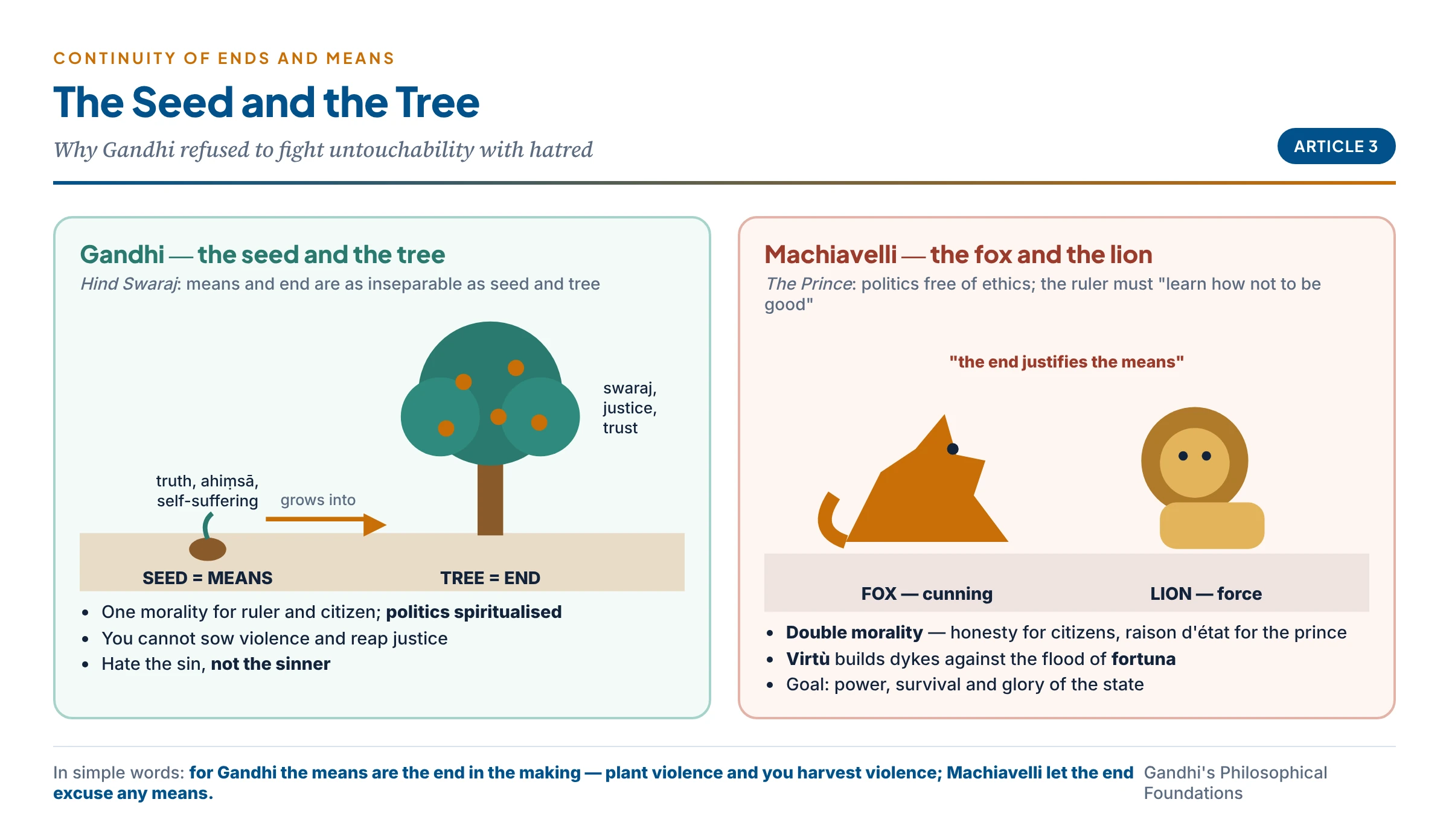
- Machiavelli — ends justify means; politics is separated from ethics and from religion.
- Plato and Aristotle — politics and ethics are inseparable; politics serves the good life. Gandhi belongs to this school.
- The seed and the tree (Hind Swaraj): “the means may be likened to a seed, the end to a tree” — there is the same inviolable connection between them as between the seed and the tree. One cannot reap justice by sowing violence or deceit; true swaraj and true democracy cannot come through unfair means.
- Politics without religion is a death-trap: religion here means morality — the political life of man is not separate from the rest of his life; if social life needs ethics, so does politics.
Machiavelli and Gandhi compared
- Machiavelli (The Prince):
- Autonomy of politics — politics has its own laws: power, survival and glory of the state.
- Double morality — citizens must be honest; the prince must “learn how not to be good” when the state demands it (raison d’état).
- The fox and the lion — the prince must be a fox to see traps and a lion to frighten wolves.
- Virtù and fortuna — the prince’s bold skill (virtù) must build dykes against the flood of fortune (fortuna).
- Gandhi inverted every point: one morality for ruler and citizen; truth instead of cunning, soul-force instead of the lion’s strength; self-suffering instead of domination.
| Point | Machiavelli | Gandhi |
|---|---|---|
| Ends and means | The end justifies the means | Means are the end in the making (seed and tree) |
| Politics and ethics | Separate | Inseparable — “spiritualised politics” |
| Morality | Double standard for ruler and ruled | One standard for all |
| Human nature | Selfish, fickle | Good and evil mixed; capable of conversion |
| Instrument | Force and cunning (lion and fox) | Truth and non-violence (satyāgraha) |
| Goal | Power and glory of the state | Swaraj, Rāmrājya, welfare of all |
In simple words
You cannot plant a neem seed and pick mangoes. If you want a society of trust, you must use trustworthy means now; if you use lies and violence to “free” people, you will grow a society of lies and violence. For Gandhi the means are the end in the making — which is why he refused to fight untouchability with hatred of the upper castes.
Satyāgraha (Truth-Force)
- Meaning: satya (truth) + āgraha (firm holding) — holding fast to truth; a continuous effort to realise truth. If the end is truth, only satyāgraha can be the means — the continuity of ends and means in action.
- Relation to ahiṃsā: satyāgraha is the behavioural component of ahiṃsā — the technique of practising ahiṃsā in conflict.
- Three components: (1) truth, (2) ahiṃsā, (3) self-suffering (tapasya) — the satyāgrahī takes suffering on himself rather than inflicting it.
- Origin: developed in South Africa (1906) against discriminatory laws; Gandhi coined the word to distinguish it from “passive resistance”.
Satyāgraha vs passive resistance
| Passive resistance | Satyāgraha |
|---|---|
| A weapon of the weak, used because one cannot use violence | A weapon of the strong; total renunciation of violence by choice |
| May harbour ill-will and the wish to harm the enemy | No hatred; aims at the conversion of the opponent |
| Violence may be used if the chance comes | Violence ruled out in thought, word and deed |
| Directed against the opponent | Directed against the evil, not the evil-doer |
| Relies on outside pressure | Relies on moral force and self-suffering |
- Characteristics: never a weapon of the weak; open, not secret; aims to convert the heart, not to humiliate.
- Techniques: fasting, hartāl, mass strikes, non-cooperation, picketing, civil disobedience — its most crystallised form being the Civil Disobedience Movement of the 1930s.
- Conditions: a last resort, after other peaceful means fail; the evil-doer must be given time to rectify his mistake.
- Scope: applicable everywhere — from the family to international relations; Gandhi even imagined resisting a foreign invasion with a human chain of satyāgrahīs.
- Critical evaluation:
- Difficult — it needs strong will and great capacity for sacrifice; the problem lies less in the concept than in those who apply it.
- Successes — used in India’s freedom struggle and inspiring Nelson Mandela and the South African struggle, Martin Luther King Jr.‘s civil-rights movement, Lech Wałęsa‘s Solidarity in Poland, Aung San Suu Kyi, and in India the Chipko and Narmada Bachao movements. Historians note it made mass participation in the national movement possible.
- Limits — hard to apply in international politics. Hannah Arendt argued that against Stalin’s Russia or Hitler’s Germany, non-violent resistance would have ended not in decolonisation but in massacre and submission — satyāgraha needs an opponent with some conscience and free press.
- Arendt’s own framework helps here: she distinguished power (people acting together) from violence (instruments of force); satyāgraha is power without violence — “action” in her sense of the highest human activity (above mere labour and work), done openly among equals.
Swaraj (Self-Rule)
- Meaning: swaraj is the Indian version of liberty — but deeper than the Western idea of freedom from interference.
- Before Gandhi: Dadabhai Naoroji, Tilak and Gokhale spoke of political swaraj; Aurobindo and Bipin Chandra Pal first rejected the purely Western notion and grounded swaraj in Vedāntic ideals, joining political and spiritual swaraj. Gandhi built on them.
- Three components:
- Rejection of the European idea of merely negative freedom — swaraj is not only independence from England and the guarantee of civil liberties.
- Civil liberty is necessary for swaraj.
- Not individualistic — it reconciles individual liberty with social liberty.
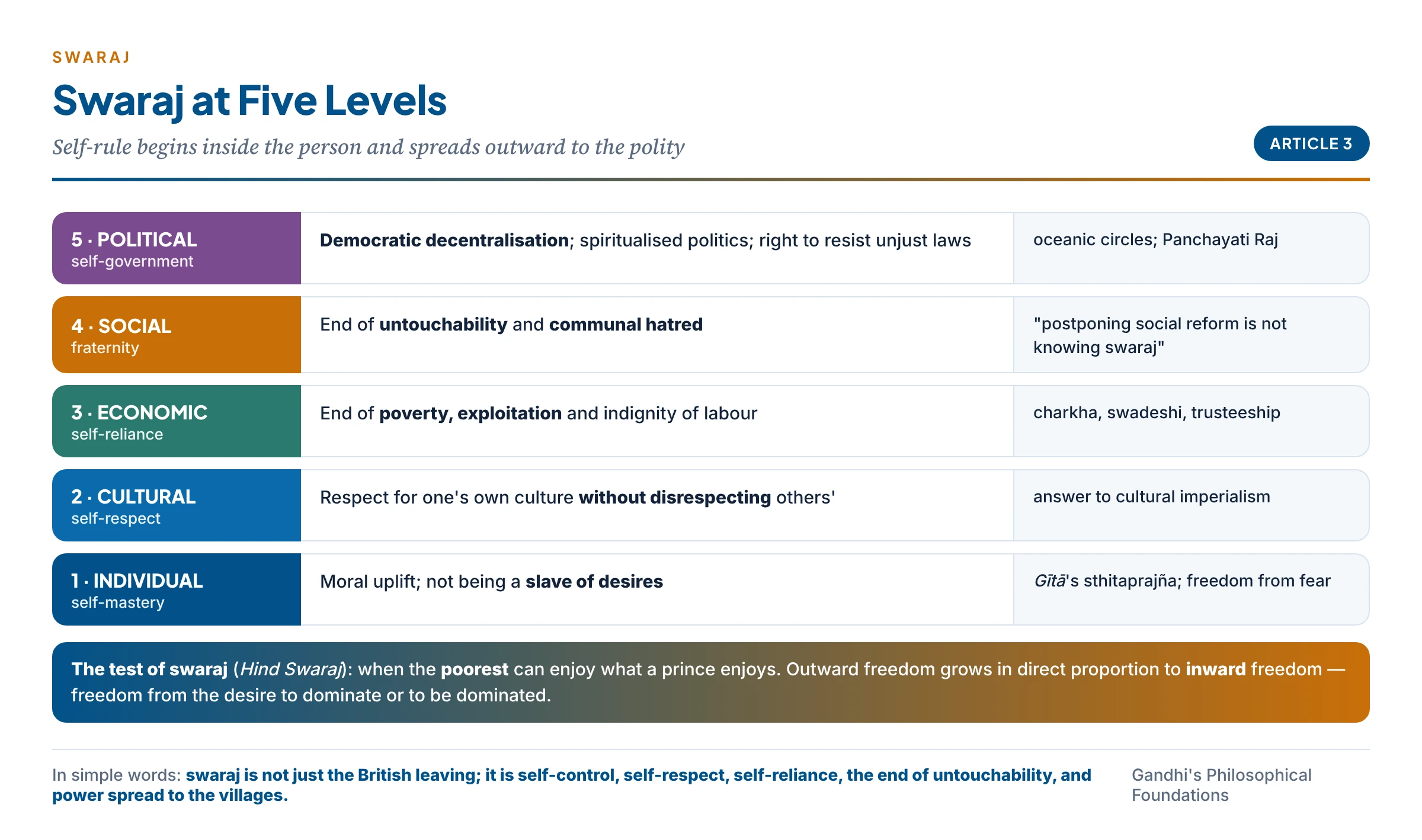
- Inner before outer: swaraj is the sum total of individual self-rule; India’s freedom begins when each person changes his own intolerance and exclusiveness. Outward freedom will be in direct proportion to inward freedom. Inner freedom liberates from fear and from the desire to dominate or to be dominated. The Gītā‘s liberated person acts without craving or possessiveness; the Chāndogya defines freedom as self-governing autonomy.
- Swaraj requires social reform: ending untouchability, ending Hindu–Muslim conflict, and sarvodaya — “to postpone social reform till swaraj is to misunderstand swaraj”. Without an army of self-sacrificing workers there is no swaraj.
- Five levels of swaraj:
- Individual — moral uplift; not being a slave of desires.
- Cultural — respect for one’s own culture without disrespecting others’.
- Economic — end of poverty, exploitation and the indignity of labour.
- Social — end of untouchability and communal hatred.
- Political — democratic decentralisation, spiritualised politics, and the citizen’s ability to resist unjust laws.
- The test: real swaraj is when the poorest can enjoy what a prince enjoys, and identifies his interest with the nation’s (Hind Swaraj).
- Moral individualism: swaraj treats the individual as an end in himself, with dignity and self-confidence, while remaining open to learning from others.
- Significance:
- Individual — a remedy for consumerism, excessive individualism and materialism; a basis of sustainable development.
- Social — the basis of a harmonious society.
- Cultural — an answer to cultural imperialism and the “clash of civilisations”.
- Political — grassroots democracy, strong civil society, rolling back the over-centralised state.
The Critique of Modernity (Hind Swaraj, 1909)
- Modernity: began in the 16th-century West — Renaissance, Reformation, Enlightenment, the industrial revolution; its features are rationalism, secularism, materialism and individualism.
- A long tradition: the critique of modernity did not begin with Gandhi — it starts with Rousseau (the arts and sciences corrupt morals) and continues in postmodern thinkers.
- Influences: Ruskin (dignity of labour), Tolstoy, Thoreau, Carpenter.
- Not anti-Western: Gandhi criticised modernity for its harmful and immoral effects, not because it came from the West; he admired the West’s civil liberties, its regard for women and its spirit of inquiry. He distinguished modernisation from westernisation.
- Features of modernity he rejected:
- The separation of ends and means.
- The autonomy of politics from ethics and religion.
- Excessive individualism leading to utilitarianism, which turns one man into a utility for another.
- Consumerism, which over-exploits nature and harms the environment.
- Industrial mass production instead of production by the masses — he linked it with the poverty of millions.
- Excessive nationalism, issuing in fascism and imperialism; power politics; racialism.
- Its institutions: railways (which spread plague and famine), lawyers (who live on quarrels), doctors (who treat symptoms and encourage indulgence) and the British Parliament (which he compared to a “sterile woman” and a “prostitute” — it produces nothing of its own and changes masters with the party whip and the newspapers).
- “Satanic” civilisation: modernity reduces man to the level of the beast; fascism and imperialism are its worst manifestations.
- True civilisation (Hind Swaraj):
- Minimisation of wants.
- Control of beastly power by moral power.
- Eradication of social evils — prostitution, theft, untouchability.
- A mode of conduct that teaches people to perform their duties.
- The future society: Rāmrājya, built on swaraj, sarvodaya, trusteeship, the charkha, democratic decentralisation and cottage industries.
- Evaluation: critics called him conservative, reactionary and pacifist, a romantic who burdened India with guilt about economic development; admirers see an alternative vision — on environment, corruption, violence and the dignity of labour — clearer and more practical than many postmodern critiques (Foucault, Derrida, Lyotard). As Bhikhu Parekh argues, Gandhi’s originality has often confused both critics and admirers, but his ideas matter greatly amid religious fundamentalism, human suffering and environmental degradation, and as an alternative theory of social change and an alternative vision of society.
Sarvodaya (Welfare of All)
- Meaning: “the uplift of all“. Gandhi coined the word as the title of his Gujarati paraphrase of Ruskin’s Unto This Last (1908).
- Ruskin’s three principles (as Gandhi read them):
- The good of the individual is contained in the good of all.
- A lawyer’s work has the same value as a barber’s — all have the same right to earn a livelihood from their work.
- The life of labour — of the tiller and the craftsman — is the life worth living.
- Principles of sarvodaya (through the Constructive Programme): dignity of labour, bread labour, equitable distribution, swaraj, self-sufficiency, uplift of the poor and abolition of untouchability, uplift of women, the charkha economy, trusteeship.
- Antyodaya: the welfare of the last person first — Gandhi’s talisman: recall the face of the poorest person you have seen and ask whether your step will be of use to him.
- After Gandhi: his followers — Vinoba Bhave (Bhoodan from 1951, Gramdān, Shramdān), Jayaprakash Narayan, Dada Dharmadhikari — turned sarvodaya into a social movement.
Common confusion
Did Gandhi start the Bhoodan movement? No. Gandhi died in January 1948. The Bhoodan (land-gift) movement was started by his disciple Vinoba Bhave in 1951 at Pochampalli in Telangana, when a landlord gifted land to landless Dalit families. It was a sarvodaya movement inspired by Gandhi’s ideas of trusteeship and voluntary sharing — but it was Vinoba’s, not Gandhi’s.
Trusteeship
- Harmony, not class war: Indian thinkers tend to think in terms of harmony and reconciliation; Marx speaks of class contradiction and the annihilation of capitalists; Gandhi speaks of harmonising class interests and the annihilation of evil, not of the evil-doer.
- Parallels: Aristotle (private property, common use) and the utopian socialists Robert Owen and Charles Fourier (appeal to the conscience of capitalists).
- Core idea: the capitalist is a trustee, not an owner, of his wealth; society is the real owner; he may keep what he needs, and must hold the rest for the welfare of society, sharing profits with workers. The Īśopaniṣad‘s “enjoy by renouncing” is its spiritual root.
- Needs vs wants: capital is not bad; its misuse — for exploitation — is bad.
- Method: persuasion; if the rich refuse, non-violent non-cooperation and satyāgraha.
- An alternative to both capitalism and communism.
- Criticism: communists called it a bourgeois idea that protects capitalism; others call it utopian — the rich rarely become trustees voluntarily.
- Relevance: corporate social responsibility (made mandatory for large companies in India in 2013) is a partial modern echo.
In simple words
A temple trust manages land and money it does not own: the trustee may draw a salary for his needs, but the rest must be spent for the devotees. Gandhi asked the rich factory owner to see himself in the same way — as the manager of wealth that belongs to society. The same logic shaped his appeal to the upper castes: their privilege was a trust to be used for the uplift of the untouchables, not a birthright.
Bread Labour and Nai Talim
Bread labour
- Every person should earn his bread by physical labour — an idea from Ruskin and Tolstoy (and the Gītā‘s ideal of yajña as work). Intellectual work is no excuse for escaping manual labour.
- Link to caste: bread labour and the equal dignity of all work are the basis of Gandhi’s reinterpretation of varṇa — the scavenger’s work is as honourable as the priest’s (Article 4).
Nai Talim (Basic Education, Wardha scheme, 1937)
- Education is the most important item of sarvodaya — more basic even than communal harmony or the removal of untouchability, because it is the silent, non-violent revolution that cures the sickness of modern civilisation.
- Five components:
- Craft at the centre — learning through productive work (spinning, agriculture, forestry, home science); education as a lifelong process.
- Community living — learning together in ashrams, like the old gurukula; a cure for excessive individualism and communalism.
- Social service — repaying one’s debt to society through sanitation, nursing, tree planting, relief work.
- Environment — “no one can educate another”; the teacher creates an environment in which students learn themselves.
- Holistic view — integration of thought and action, head, heart and hand.
- Aim: a new man and a new society; education rooted in village India, self-supporting, learning from the “book of life” — an equilibrium of body, mind and spirit.
Religion and Secularism
- Religion is personal; all religions are true, but all are imperfect because they pass through human beings; one should openly accept good ideas from every faith.
- Against fundamentalism: fundamentalists draw rigid boundaries around religion; Gandhi wanted religions open to each other.
- Against conversion: one is born into a religion for a reason; one should reform one’s own faith rather than change it — hence his opposition to Ambedkar’s plan of conversion (Article 8).
- Sarva Dharma Samabhāva — equal respect for all religions; the Indian ideal of secularism as a fellowship of religions rather than a rejection of religion.
- Secularism as a foundation of democracy:
- Religion as morality — religion supplies the ethical basis of public life (“politics without religion is a death-trap”).
- The state must not be religious — Gandhi said that if he were a dictator, religion and the State would be separate; religion is each person’s personal affair, and the state should look after secular welfare — health, communications, foreign relations, currency.
- Equal citizenship — Hindus, Muslims and others equally citizens; communal harmony as a precondition of swaraj.
(Indian secularism is treated fully in Unit 06.)
The State — Enlightened Anarchy
- Three principles behind his view: (1) non-violence, (2) swaraj, (3) oceanic circles.
- The state as concentrated violence: the state is organised, concentrated violence; it cannot practise non-violence, since it cannot exist without institutions of force. The individual has a soul; the state is a soulless machine (Tolstoy’s influence).
- The state is incompatible with swaraj: swaraj means self-rule; when people rule themselves and social evils are removed, the state is unnecessary. “That government is best which governs the least.”
- Oceanic circles: power should spread through society like ripples in the ocean — the individual at the centre, then the village, then wider circles — never a pyramid with an apex sustained by the bottom. Village republics as the base: Panchayati Raj.
- Enlightened anarchy: the ideal is a stateless society of self-regulating individuals — Rāmrājya. Gandhi thus appears an anarchist: the state is neither necessary nor moral.
- Later modification: he accepted the state as a necessary evil for the present and accommodated the constitutional state and parliamentary government; his anarchism is a philosophical ideal, not an immediate programme.
- Increasing the state’s role kills self-reliance: welfare given from above makes people dependent.
Rights and Duties
- Three views: (1) possessive individualists — possessions are man’s own creation, so rights come first; (2) idealists (Plato, Hegel) — the individual is submerged in the state, rights carry little meaning; (3) the middle way (T.H. Green, Laski) — rights and duties are complementary, rights have a social origin. Gandhi belongs to the third.
- Duties are rights in embryo: “if you focus only on rights, you chase a mirage”; rights flow from duties well performed. Influenced by the Gītā: action is duty, its fruit is right.
- Rights still matter: they are necessary for the realisation of the self; as an individual one has rights, as a member of society one has duties — the self is a part of the whole, so rights and duties go together. (See SP Unit 03 on Gandhi’s letter to Julian Huxley.)
Gandhi on Women
- Gandhi brought large numbers of women into the national movement — the Salt Satyāgraha (1930) was its high-water mark.
- Tradition, critically: “It is good to swim in the waters of tradition, but to sink in them is suicide.”
- Models: Sītā as a symbol of strength (her purity defeated Rāvaṇa) and Draupadī as a symbol of courage.
- Reforms: raise the age of marriage; abolish dowry; simple, ritual-free marriages; rehabilitation of prostitutes; widows’ right to remarry.
- Women as men’s equals: man has treated woman as a tool; she must refuse to be an object. “Woman is the incarnation of ahiṃsā” — her capacity for suffering makes her the natural leader of non-violent struggle; hence his statement that the female sex is not the weaker but the nobler of the two.
- Role in removing untouchability: every mother does sanitary service for her child; women can lead the dignity-of-labour revolution.
- Economic empowerment through the charkha and cottage industries.
- Feminist critique: he gave women mainly supportive roles (picketing liquor and foreign-cloth shops); he advised self-control rather than contraception; his ideal woman remained self-sacrificing. (Treated fully in SP Unit 09.)
In simple words
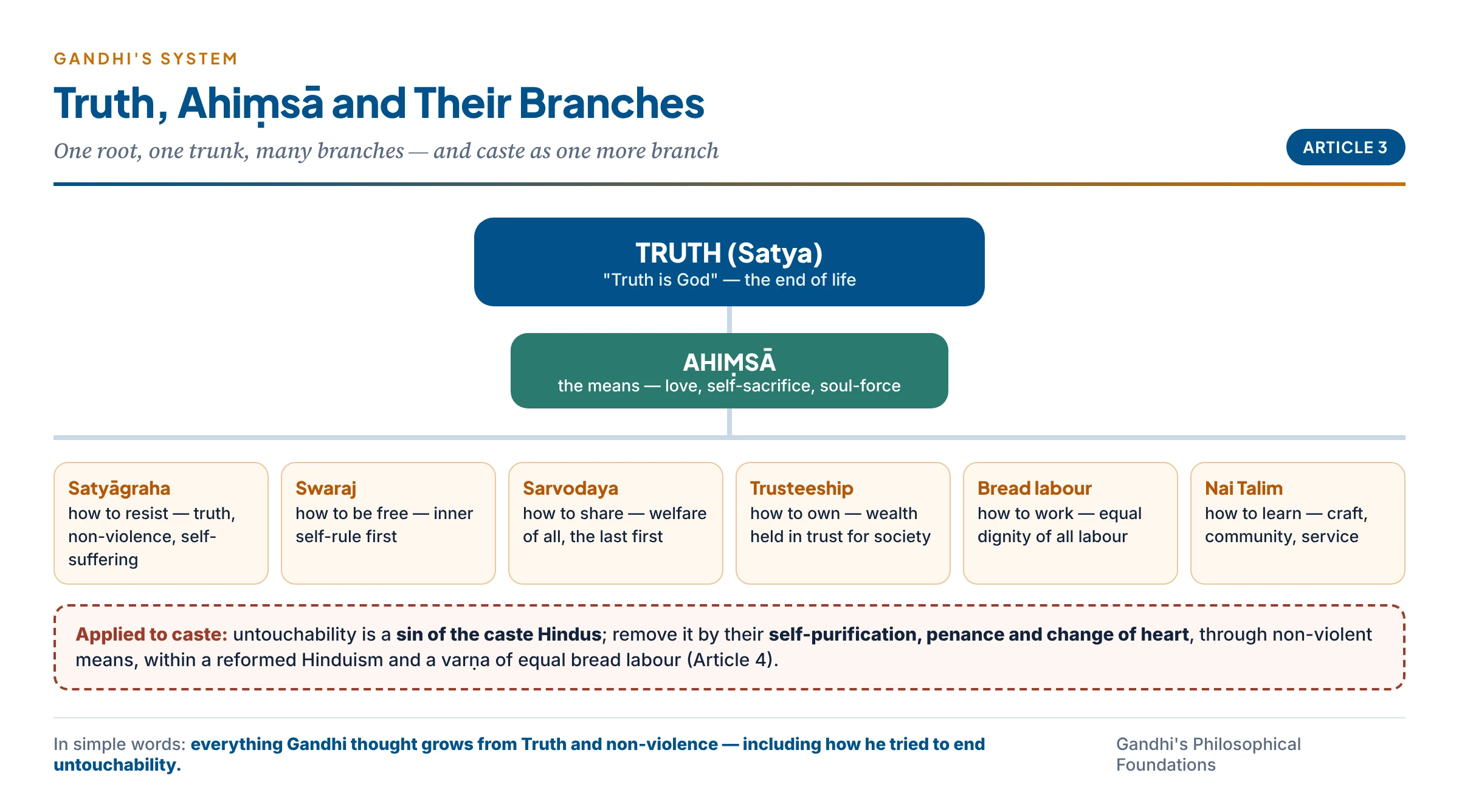
Think of Gandhi’s thought as a tree: Truth is the root, ahiṃsā the trunk, and the branches are satyāgraha (how to resist), swaraj (how to be free), sarvodaya (how to share), trusteeship (how to own), bread labour (how to work) and Nai Talim (how to learn). His approach to caste is one more branch of the same tree: remove untouchability by purifying the heart of the oppressor, through the oppressor’s own suffering and repentance.
Critical Evaluation
Gandhi Compared with Karl Marx
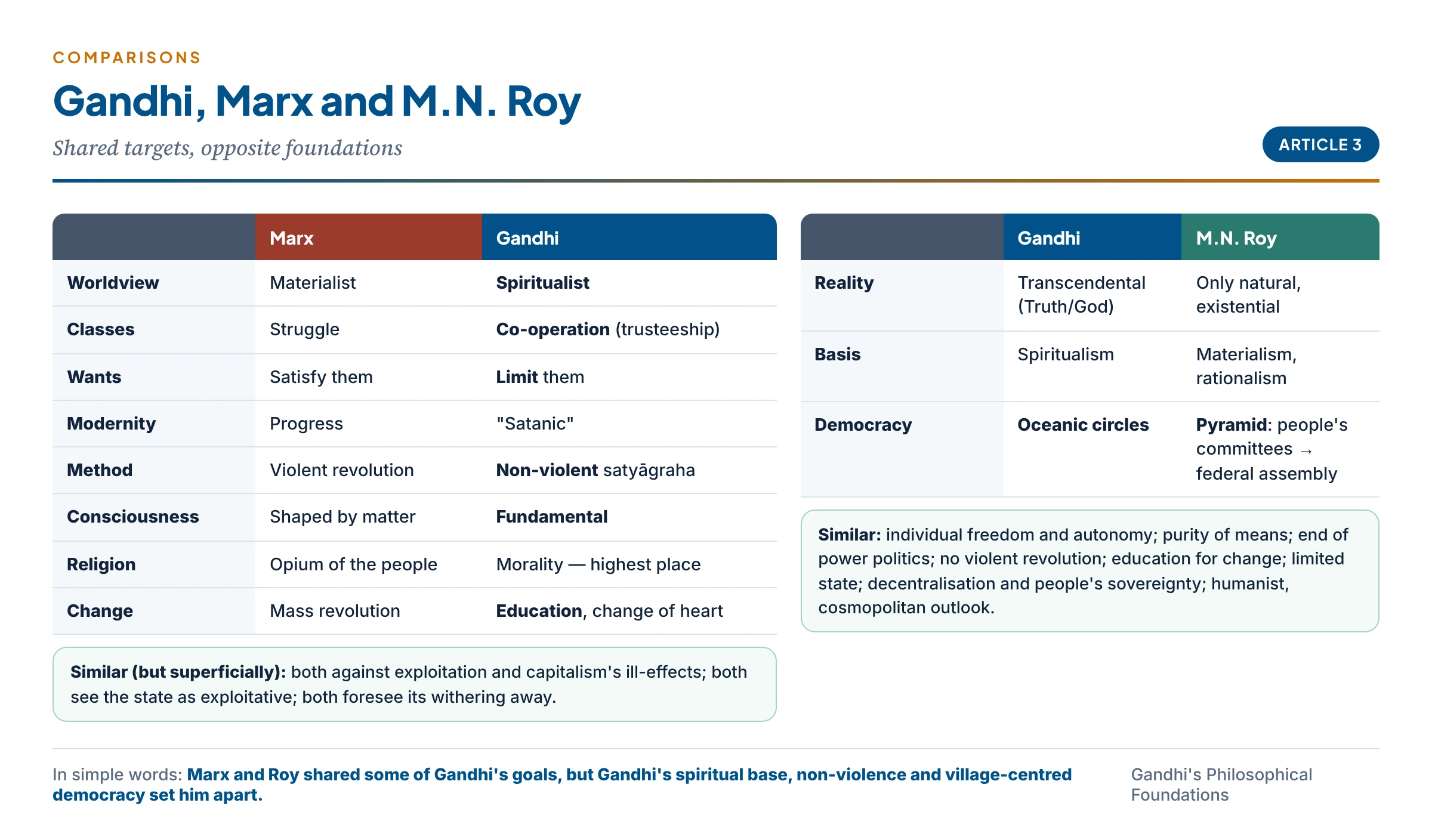
Similarities
- Both opposed exploitation.
- Both exposed the ill-effects of capitalism.
- Both taught people to fight injustice.
- Both saw the state as exploitative.
- Both imagined the withering away of the state (Marx’s communism, Gandhi’s enlightened anarchy).
Differences (the similarities are superficial, the differences fundamental)
| Point | Marx | Gandhi |
|---|---|---|
| Worldview | Materialist | Spiritualist |
| Classes | Class contradiction and struggle | Class co-operation and harmony (trusteeship) |
| Wants | Satisfaction of wants through abundance | Limitation of wants |
| Modernity | Praised industrial modernity as progress | Called modern civilisation “satanic” |
| Method | Violent revolution | Non-violent satyāgraha |
| Consciousness | Depends on material conditions | Is fundamental; changes conditions |
| Religion | “The opium of the people” | The highest place — as morality |
| Revolution | By the masses through force | Through education and change of heart |
Gandhi Compared with M.N. Roy
Similarities
- Both believed in the freedom and autonomy of the individual.
- Both insisted on purity of means.
- Both wanted to end power politics and party domination.
- Both rejected violent revolution (Roy after leaving communism).
- Both saw education as the means of social change.
- Both wanted to restrict the state.
- Both stood for decentralisation and the sovereignty of the people.
- Both had a humanist, cosmopolitan outlook.
Differences
- Spirit vs matter: Gandhi was a spiritualist; Roy a materialist and rationalist who criticised Gandhism as revivalist.
- Structure: Gandhi’s Panchayati Raj in oceanic circles; Roy’s radical democracy is pyramidical — people’s committees at the base, a federal assembly at the top.
- Reality: Gandhi believed in a transcendental reality (Truth/God); Roy only in existential, natural reality.
Is There a “Gandhism”? — Gandhism Today
- Gandhi denied it: “There is no such thing as Gandhism” — since there is no final truth, there can be no final system. He wrote no treatise of political philosophy; many of his ideas contradict established political ideas.
- Not a system-builder: Humayun Kabir said Gandhi was not a political philosopher but a great psychologist who understood the masses. He was not a philosopher like Plato or Hegel, yet he was a political thinker like Lenin or Mao.
- Gandhism exists: millions call themselves Gandhian and millions criticise Gandhism — proof of its existence.
- Why it is complex: (1) it has three interwoven dimensions — individual, social and ecological; (2) its originality sets it apart from established ideas; (3) Gandhi gave his own meaning to terms like democracy and socialism.
- Relevance today:
- Against violence, corruption, religious fundamentalism and terrorism in politics.
- Environment — minimising wants, non-violence towards nature; a foundation of sustainable development (E.F. Schumacher’s Small Is Beautiful).
- Trusteeship as corporate social responsibility.
- Satyāgraha as the basis of new social movements.
- Grassroots democracy as a mark of good governance; Panchayati Raj.
- Peace and disarmament; cosmopolitanism — indivisible humanity in an age of globalisation.
- Communal harmony, women’s empowerment, education, rural reconstruction and cottage industries against rural unemployment.
- Citizenship: neither consent nor fear but co-operation as the basis of the state.
Gandhian Socialism and Gandhian Social Development
- Gandhian socialism: not state ownership but sarvodaya — trusteeship, bread labour, decentralised village economy, swadeshi, limitation of wants, equal wages for equal work of all kinds, and non-violent change. Its distinctive features: moral rather than material, decentralised rather than centralised, co-operative rather than conflictual. Contemporary relevance: inequality, ecological crisis, jobless growth, the self-help-group and cooperative movement.
- Gandhian social development: development means moral and spiritual growth of the individual together with the material welfare of the last person — antyodaya; self-reliant villages; dignity of labour; end of untouchability; women’s equality; education through work. Development is measured not by wealth but by the quality of persons it produces (treated fully in SP Unit 08).
Critics and Defenders
Criticism — Critics of Gandhi’s philosophy
- Ambedkar: Gandhi’s moral appeals left the structure of caste intact; “change of heart” put the fate of the oppressed in the hands of the oppressor (Article 8).
- Marxists: trusteeship and class harmony protect capitalism; spiritualism hides material exploitation.
- M.N. Roy and rationalists: Gandhism is revivalist, anti-scientific, mystical.
- Arendt: non-violence works only against an opponent with a conscience and a free press.
- Modernisers: the critique of machinery and cities is romantic and economically unrealistic.
- Feminists: women given self-sacrificing, supportive roles.
Defence — Defenders of Gandhi’s philosophy
- Unity of ends and means keeps politics moral and prevents revolutions from devouring their children.
- Satyāgraha works — from India to Mandela, King, Solidarity and Chipko; it makes mass participation possible.
- Swaraj and decentralisation anticipate participatory democracy and Panchayati Raj.
- Ecological wisdom — limitation of wants and sustainable development.
- Moral individualism — dignity of every person, beginning with the last.
Cross-Tradition Comparison
| Theme | Gandhi | Western thinker |
|---|---|---|
| Ends and means | Seed and tree | Machiavelli (end justifies means); Kant (persons as ends) close to Gandhi |
| Civil disobedience | Satyāgraha | Thoreau; Rawls (civil disobedience in a nearly just society); King |
| Critique of the state | Concentrated violence; enlightened anarchy | Tolstoy; anarchists (Kropotkin) |
| Critique of modernity | Hind Swaraj | Rousseau, Ruskin, Carpenter; later Frankfurt School |
| Power | Soul-force of the many | Arendt: power is people acting together; violence destroys power |
| Dignity of labour | Bread labour | Ruskin, Tolstoy, Marx (labour as human essence) |
Indian Connect — Indian Connect — the Gītā behind Gandhi
- Niṣkāma karma → the satyāgrahī acts without attachment to victory.
- Sthitaprajña → the ideal of swaraj as self-mastery.
- Svadharma → Gandhi’s reading of varṇa as each person’s duty, not privilege — the bridge to Article 4. Ambedkar would reply that the same Gītā was the charter of caste.
Synthesis (Siddhānta)
- Gandhi’s philosophy rests on Truth (and the 1931 shift to “Truth is God”, which makes morality the essence of religion) and ahiṃsā — negative and positive, active, the force of the strong.
- From these follow the continuity of ends and means (the seed and the tree, against Machiavelli), satyāgraha (truth-force, self-suffering, conversion of the opponent), swaraj (inner self-rule at five levels, requiring social reform), the critique of modernity, sarvodaya, trusteeship, bread labour, Nai Talim, equal respect for religions, enlightened anarchy in oceanic circles, duties as embryonic rights, and a reformist view of women.
- Compared with Marx, Gandhi is spiritualist, co-operative and non-violent; compared with Roy, he shares humanism and decentralisation but not materialism.
- Why this matters for caste: Gandhi treated untouchability as a sin of the caste Hindus, to be removed by their self-purification, penance and change of heart, through non-violent means, within a reformed Hinduism and a reinterpretation of varṇa as equal bread labour — the very approach Ambedkar would challenge (Articles 4 and 8).
- Contemporary relevance: non-violent protest, ethical politics, ecological limits, decentralised democracy and the dignity of manual work remain live questions — and the debate over whether moral persuasion can defeat structural injustice remains open.
“The means may be likened to a seed, the end to a tree; and there is just the same inviolable connection between the means and the end as there is between the seed and the tree.” — M.K. Gandhi, Hind Swaraj
Previous Year Questions
- 2026Critically evaluate the shift in Gandhi’s view from ‘God is Truth’ to ‘Truth is God’, in the context of interrelation between religion and morality.
- 2024Present an exposition of Gandhi’s views on secularism as one of the foundational principles of democracy.
- 2021Discuss the distinctive features of Gandhian Socialism and its contemporary relevance.
- 2020State and examine the Gandhian concept of social development.
- 2019Evaluate Mahatma Gandhi as a political anarchist.
- 2016“To me the female sex is not the weaker sex. It is the nobler of the two.” Evaluate this statement of Gandhi.