

Caste Discrimination: Gandhi and Ambedkar.
Official Syllabus: Paper II, Section A, Unit 10
Gandhi was the first national leader to make the removal of untouchability a central part of India’s freedom struggle — he called it “a crime against God and man” and the greatest blot on Hinduism. Yet for most of his life he also defended varṇa, the fourfold order, as a law of hereditary occupation without hierarchy. This double position — war on untouchability, defence of varṇa — is the key to his approach, and to Ambedkar’s attack on it. This article explains Gandhi’s theory of varṇa and its link with bread labour, his distinction between varṇa and jāti, the evolution of his views from 1915 to 1946, his methods (self-purification of caste Hindus, the word Harijan, the Harijan Sevak Sangh, temple entry, fasts, the Constructive Programme), and a critical evaluation — including whether the traditional hold of caste groups could survive his attempt to build alternative identities.
In simple words
Imagine a joint family where the eldest son is a teacher, the second a farmer, the third a trader and the youngest cleans the house — and all eat at the same table, earn the same, and are equally respected. That was Gandhi’s picture of varṇa: four inherited callings, no ranks. What he saw around him was the opposite — the youngest made to eat outside, never touched, called “polluted”. He wanted to keep the family of four callings but throw out the cruelty. Ambedkar asked: has such a family ever existed, and can it?
Context & Problem
Why Gandhi’s View Is Distinctive
- Not a defender of caste hierarchy: Gandhi attacked untouchability more forcefully than any leader of the Congress, made it an item of the Constructive Programme, and fasted and toured India against it.
- Not an abolitionist of varṇa (until late in life): he held that varṇāśrama dharma — the order of four varṇas and four stages of life (āśramas) — was the true and healthy core of Hindu society, and that untouchability and caste arrogance were later corruptions.
- A religious reformer: his aim was to purify Hinduism from within, not to leave it. He said that if he were convinced untouchability was an essential part of Hinduism, he would cease to call himself a Hindu — but he believed it was not.
- The method follows the philosophy (Article 3): because untouchability is a sin of the caste Hindus, its removal must come from their repentance, self-purification and change of heart — through non-violent persuasion, not coercion.
Core Doctrine
Gandhi’s Theory of Varṇa
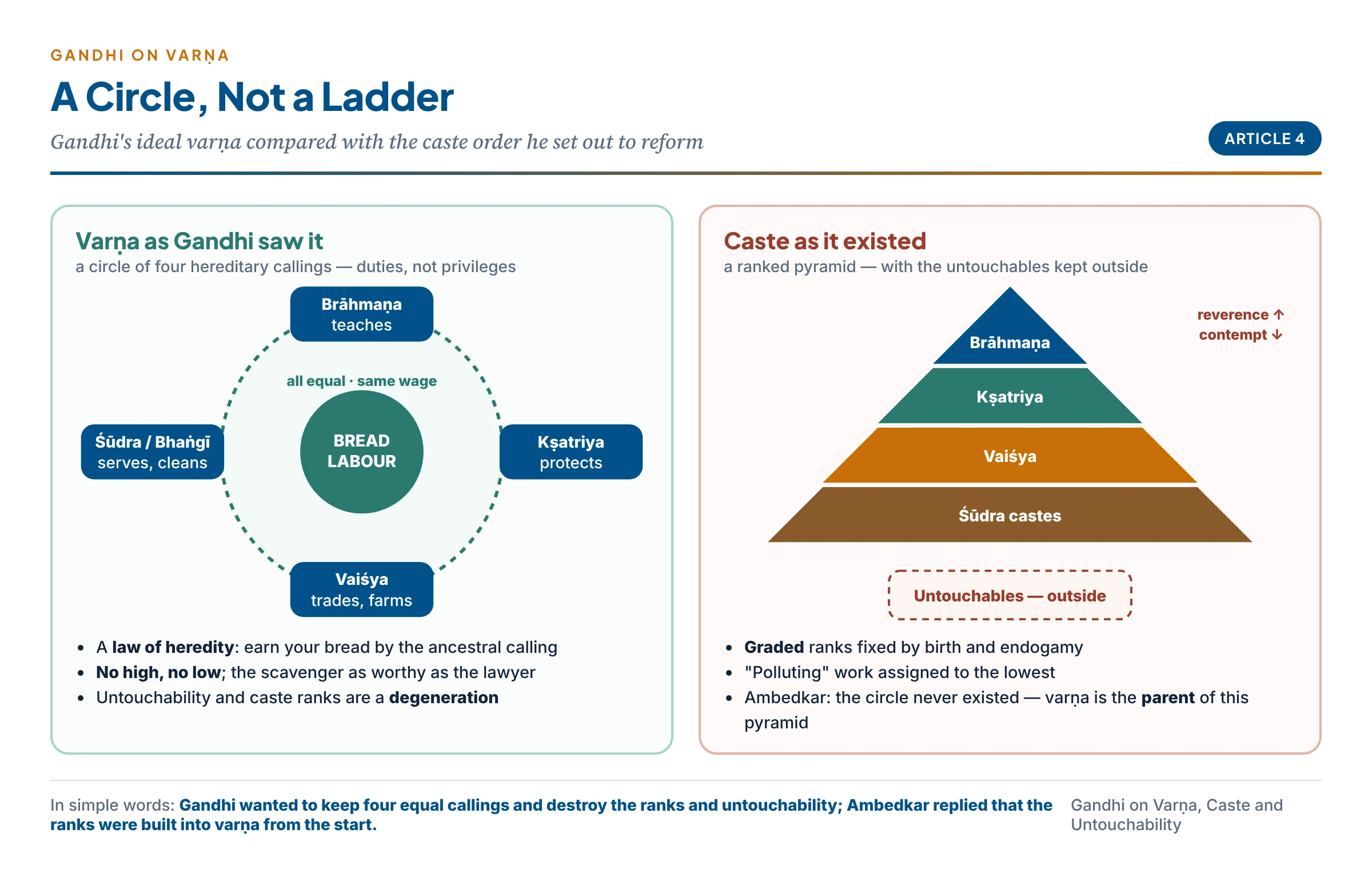
1. Varṇa as the law of heredity
- Varṇa is not a human invention but a law — like the law of gravitation, a law of heredity that each person follows the calling of his ancestors for his livelihood.
- “The law of varṇa teaches us that we have each one of us to earn our bread by following the ancestral calling.” It decides only how one earns one’s living, not what else one may do; a Śūdra may study, a Brāhmaṇa may sweep.
2. Varṇa is duty, not privilege
- The four divisions define duties; they confer no privileges. The Brāhmaṇa’s duty is learning and teaching, the Kṣatriya’s protection, the Vaiśya’s commerce and agriculture, the Śūdra’s service — and none is higher.
- Equality of varṇas: the Brāhmaṇa who teaches and the Bhaṅgī (scavenger) who cleans are equal in worth; a scavenger is as worthy of his hire as a lawyer. Ideally they should even earn the same wage.
3. Varṇa and bread labour
- Varṇa is Gandhi’s bread-labour principle applied to society: everyone must do socially useful physical work to earn bread; no work is degrading.
- Scavenging is the most honourable service; Gandhi himself cleaned latrines, made it compulsory in his ashrams, and said he would like to be reborn as a Bhaṅgī.
4. The social benefits of varṇa (as Gandhi saw them)
- Conserves energy and skills — hereditary training without the waste of competition.
- Prevents class war and competition — no one envies another’s calling.
- Leaves energy for spiritual life — one who need not struggle for status can seek mokṣa.
- Guards against materialism — earning is not the measure of worth.
5. Varṇa is not caste
- Varṇa ≠ jāti: the thousands of castes (jātis) with their rules of untouchability, inter-dining and inter-marriage restrictions and high-low ranks are a degeneration of varṇa — an excrescence, not its essence.
- “Caste has nothing to do with religion. It is a custom whose origin I do not know”; it is “harmful both to spiritual and national growth”.
- Untouchability has no sanction in the true śāstras; where the Smṛtis seem to support it, they are interpolations or must be rejected because they conflict with truth and non-violence — reason and conscience are the test of scripture.
In simple words
Gandhi drew varṇa as a circle, not a ladder: four doors into the same house, each person entering by the door of his family’s calling, all sitting in the same room. The caste system he saw was a ladder with the untouchables kept outside the house. His programme was to pull down the ladder and keep the circle. Ambedkar’s reply was that the circle had never existed: from the Puruṣa Sūkta onwards the four varṇas were drawn head to foot.
Gandhi on Untouchability
- “A crime against God and man”, “a blot on Hinduism”, “a sin” for which caste Hindus must atone.
- Untouchability is the Hindus’ sin, not the untouchables’: the burden of change lies on the oppressor; the untouchables are victims to whom a debt is owed.
- Hinduism or untouchability: Gandhi repeatedly said that he would rather Hinduism died than that untouchability lived — if untouchability survived, Hinduism itself would deserve to perish.
- Rebirth as an untouchable: in 1921 he said he did not wish to be reborn, but if he were, he should like to be born an untouchable, to share their sorrows and work for their liberation.
- Untouchability and swaraj: swaraj is impossible while a fifth of Hindus are treated as untouchable; to postpone this reform till independence is to misunderstand swaraj (Article 3).
- Not only a Hindu problem: he treated it as a national moral issue and linked it to the dignity of labour and sanitation.
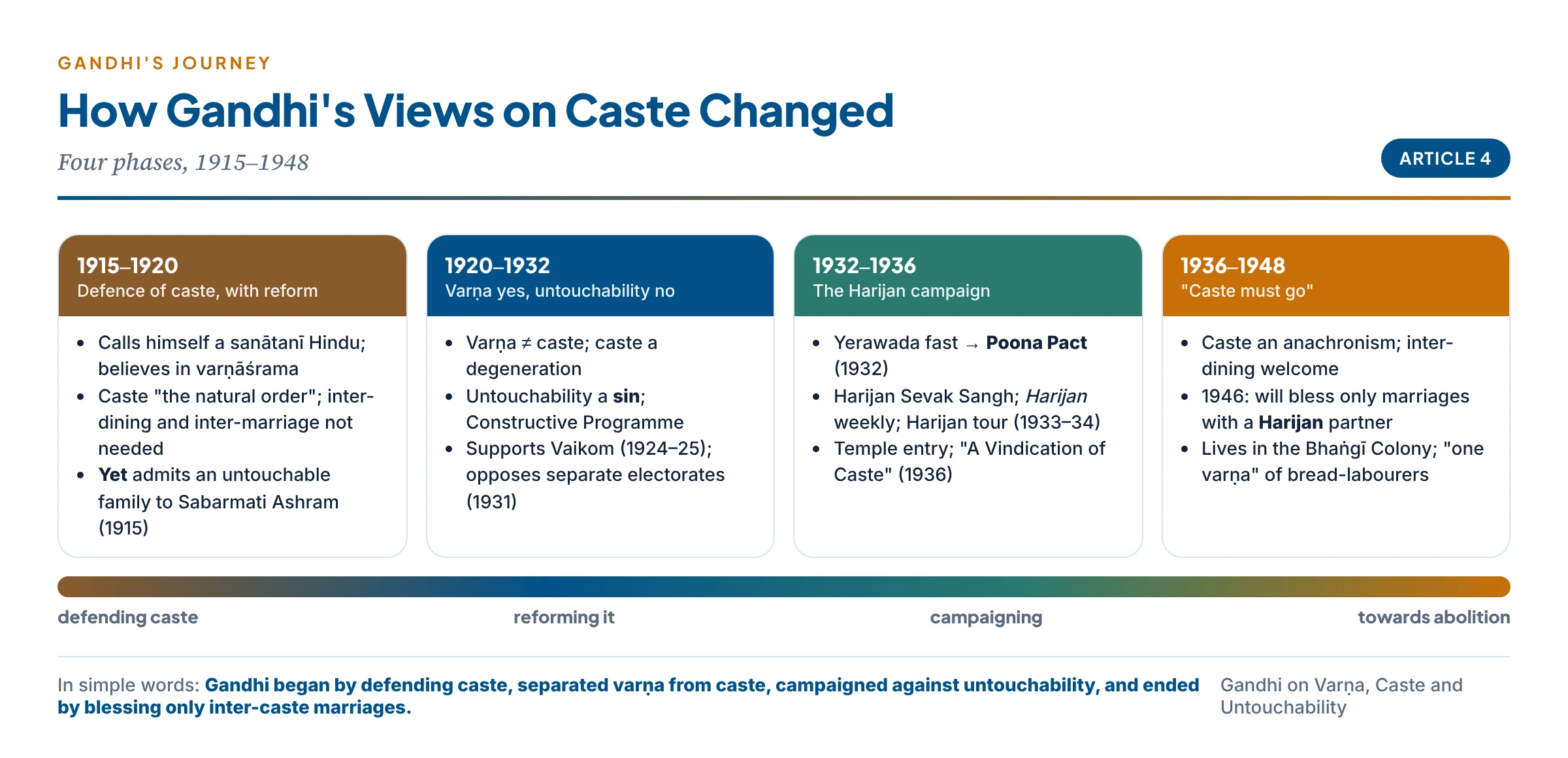
The Evolution of Gandhi’s Views (1915–1948)
Gandhi’s views changed over three decades — a fact both his admirers and critics stress.
Phase 1 — Defence of caste with reform (about 1915–1920)
- He called himself a sanātanī Hindu who believed in varṇāśrama; he defended caste as the natural order of society, said it had saved Hinduism from disintegration, and held that inter-dining and inter-marriage were not necessary for brotherhood.
- But in practice: in 1915 he admitted an untouchable family (Dudabhai, his wife Danibehn and their daughter Lakshmi, whom Gandhi later adopted) to his Sabarmati Ashram despite threats to withdraw funds and protests within his own household.
Phase 2 — Varṇa yes, caste and untouchability no (about 1920–1932)
- He separated varṇa (good) from caste (degenerate) and attacked untouchability as a sin; removal of untouchability became part of the Constructive Programme.
- He supported the Vaikom Satyagraha (1924–25) for the right of untouchables to use roads around a Travancore temple.
- He opposed separate electorates for the Depressed Classes at the Round Table Conference (1931): he would resist them “with my life” — they would divide Hindu society permanently.
Phase 3 — The Harijan campaign (1932–1936)
- The Yerawada fast (September 1932) against separate electorates ended in the Poona Pact (Article 8).
- Harijan Sevak Sangh (founded 1932, first as the Anti-Untouchability League); the weekly Harijan (from 1933); the Harijan tour (1933–34) across India to collect funds and preach against untouchability; a 21-day fast of self-purification (1933).
- Temple entry: campaigns at Guruvayur (1932); support for temple-entry legislation; he hailed the Travancore Temple Entry Proclamation (1936) as a “miracle”.
- The debate with Ambedkar on Annihilation of Caste (“A Vindication of Caste”, 1936): Gandhi defended varṇa while condemning caste and untouchability (Article 8).
Phase 4 — “Caste must go” (about 1936–1948)
- Gandhi moved closer to abolition: caste in its present form is an anachronism that must go; inter-dining and inter-marriage are desirable.
- By 1946 he declared he would bless only those marriages in which one partner was a Harijan — inter-caste marriage as a weapon against caste.
- He lived in the Bhaṅgī Colony in Delhi (1946–47) and told Hindus that the varṇa of the future would be one varṇa — all would become, as it were, Śūdras/Bhaṅgīs through bread labour.
- Varṇa reinterpreted almost out of existence: varṇa now meant only that each person serves society through honest labour, with no birth-based privilege at all.
Common confusion
Did Gandhi’s 1932 fast oppose all separate electorates “based on religion and caste”? No. The Communal Award (August 1932) gave separate electorates to Muslims, Sikhs, Christians, Europeans and others, which Gandhi and the Congress had reluctantly accepted as a fact. His fast unto death in September 1932 was against the separate electorate given only to the Depressed Classes, because he held that it would cut them off from Hindu society for ever. It ended with the Poona Pact, which gave the Depressed Classes reserved seats within joint electorates (148 instead of the Award’s 71).
Gandhi’s Methods against Untouchability
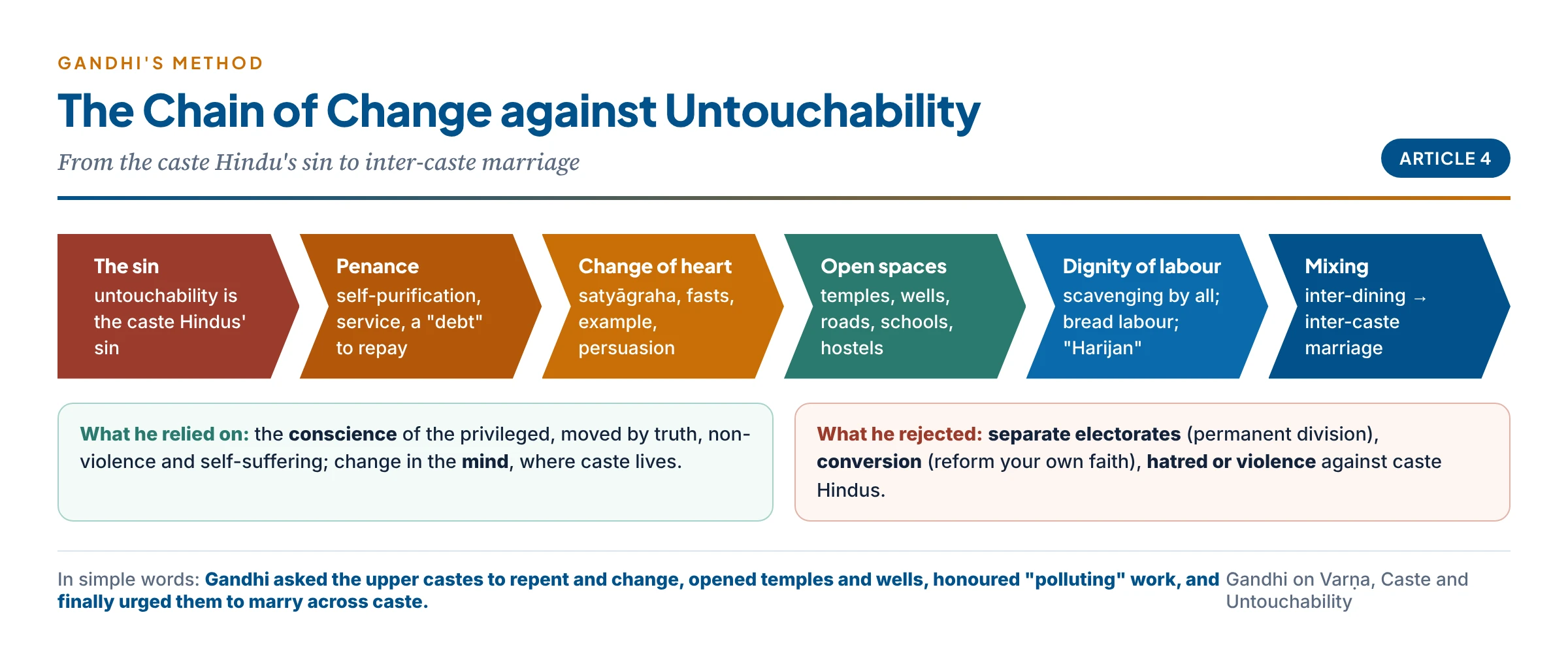
1. Self-purification and penance of caste Hindus
- Untouchability is the caste Hindus’ sin; they must atone (prāyaścitta) — by serving Harijans, opening wells, schools and temples, and changing their own conduct. The Harijan Sevak Sangh was described as a body of penitents repaying a debt — which is why its governing body was at first made up of caste Hindus.
2. Change of heart (hṛdaya-parivartana)
- Not coercion by law or force but persuasion, example and suffering — the satyāgraha principle that the opponent must be converted, not defeated (Article 3). Lasting change must be in the mind, since caste lives in the mind.
3. A new name — “Harijan”
- Harijan (“people of God”), a word from the Gujarati saint-poet Narsinh Mehta, adopted by Gandhi from about 1931–33 to replace insulting names; his weekly was called Harijan.
4. Temple entry, wells, schools and hostels
- Opening temples, public wells, roads and schools to Harijans; hostels and scholarships; Harijan funds collected on the tour.
5. Fasts
- Fasts of self-suffering to awaken the conscience of caste Hindus (1932, 1933).
6. Dignity of labour and sanitation
- Scavenging and sanitation by all in the ashrams; bread labour; the ideal of the Bhaṅgī — to remove the stigma from “polluting” work.
7. Inter-dining and, later, inter-marriage
- From ashram common kitchens to the 1946 resolve to bless only marriages with a Harijan partner.
8. Constructive Programme
- Removal of untouchability as one of its core items, alongside communal unity, khādī, village industries, basic education, women’s uplift and sanitation.
9. Self-improvement of Harijans
- He urged Harijans too to give up carrion-eating, liquor and unclean habits, so that their own self-respect would rise — a point Ambedkar also made, though for different reasons.
10. What Gandhi rejected
- Separate electorates (they would fix untouchables as a separate community), conversion (one should reform one’s own religion), and hatred or violence against caste Hindus.
Indian Connect — Indian Connect — the Gandhian legacy in law
- Article 17 of the Constitution abolished untouchability and made its practice an offence — the culmination of the movement Gandhi had made national (though drafted under Ambedkar’s leadership).
- The Untouchability (Offences) Act, 1955 (renamed the Protection of Civil Rights Act in 1976) and the SC/ST (Prevention of Atrocities) Act, 1989 turned Gandhi’s moral campaign into legal duties — the very shift from conscience to law that Ambedkar had demanded.
- The temple-entry acts of the 1930s–40s and Article 25(2)(b) (throwing open Hindu religious institutions to all classes) carry forward his temple-entry campaign.
The Traditional Hold of Caste Groups — in the Light of Gandhi
The claim: the hold of caste-based groups on Indian social behaviour has survived all attempts to build alternative identities — nation, class, a common Hindu identity, citizenship.
- Gandhi’s own attempts at alternative identity:
- Harijan — a new, dignified identity within Hinduism.
- The nation — the freedom struggle as a common identity above caste.
- Varṇa of labour — a vocational identity without rank, all equal as bread-labourers.
- Ashram community — common kitchens, common work, inter-dining.
- Why caste survived, as seen through Gandhi:
- Caste lives in the mind and in religion — Gandhi himself saw that only change of heart could end it; such change is slow and uneven.
- Gandhi did not touch endogamy until late — and endogamy is what reproduces caste in every generation.
- Retaining varṇa kept the framework of birth-based callings that castes could re-occupy.
- The village, Gandhi’s ideal unit, is caste’s stronghold (Ambedkar’s objection).
- “Harijan” was experienced by many Dalits as patronising; they preferred an identity of their own making — Dalit, Ambedkarite, Buddhist.
- Democracy itself turned caste into a basis of political mobilisation (Article 9).
- Gandhi’s lesson: caste cannot be dissolved by legislation alone or by new labels; it must be dissolved in hearts, kitchens and marriages — which is why he finally turned to inter-caste marriage. The same lesson, from the opposite direction, is Ambedkar’s: “the real remedy is inter-marriage” (Article 6).
In simple words
A city builds a grand new national stadium where everyone cheers for the same team. For two hours caste disappears. But when the match ends, people go home to caste-wise neighbourhoods, eat in caste kitchens and look for brides in caste circles. New identities — nation, class, “Harijan” — were like the stadium; caste lived on in the home. That is why the hold of caste survived, and why Gandhi finally aimed at the home itself: marriage.
Critical Evaluation
Criticisms
- Inherent conservatism: Gandhi sought the uplift of Dalits within the varṇa framework and a village-centred model, which critics call insufficient for deep-rooted inequality.
- Tolerance of varṇa: by defending a reformed varṇa he kept alive the principle of birth-based calling, which is the seed of hierarchy. A hereditary scavenger, however “honoured”, is still assigned scavenging by birth.
- Limited advocacy for political rights: he opposed separate electorates and saw the question as religious and moral; critics say he slowed political empowerment and legal reform.
- Paternalism: untouchables were treated as objects of caste-Hindu charity and penance, not as agents of their own liberation; the Harijan Sevak Sangh was run by caste Hindus; the name “Harijan” was given to them, not chosen by them.
- Change of heart leaves the oppressed waiting: if emancipation depends on the oppressor’s conscience, it may never come (Ambedkar).
- The fast as moral coercion: the 1932 fast forced Ambedkar to give up the separate electorate under the threat of Gandhi’s death and the reprisals Dalits might face (Article 8).
- Gender bias: the focus on Dalit men and on temple entry neglected the specific oppression of Dalit women.
- Unscientific religious framing: when Gandhi called the Bihar earthquake of January 1934 a divine chastisement for the sin of untouchability, Rabindranath Tagore publicly objected that linking a natural calamity to a moral failing was superstition that would weaken people’s faith in reason — even in a good cause.
- Internal contradictions: early defences of caste and later calls for inter-caste marriage sit uneasily; critics ask which Gandhi to take as authoritative.
Counter-Arguments and Defence
- Pragmatic incrementalism: in the conditions of the 1920s–30s, a frontal attack on Hinduism would have split the national movement; Gandhi’s step-by-step approach was pragmatic and paved the way for later legal changes.
- Moral regeneration: change in hearts and minds is the precondition of lasting change; laws without social acceptance stay on paper — as the persistence of untouchability after 1950 shows.
- Non-violent resistance was a strategic choice that won wider acceptance and avoided a caste war; it appealed to the conscience of the oppressor and aimed at reconciliation.
- He made untouchability a national issue: millions of caste Hindus first heard untouchability called a sin from Gandhi; temple-entry, Harijan schools and the climate that produced Article 17 owe much to him.
- Evolution: his willingness to change — from defending caste to blessing only inter-caste marriages — shows an honest experiment with truth.
- Legacy in social-justice movements: his methods inspired later struggles and helped lay the moral ground for constitutional provisions and affirmative action.
In simple words
Think of two doctors treating the same disease. Gandhi treated the symptoms in the patient’s mind — shame, guilt, compassion — hoping the body would heal itself. Ambedkar insisted on surgery — remove the organ (the sacred authority of caste) and give the patient strong medicine (law, rights, power). India’s Constitution used both: the moral climate Gandhi created and the legal surgery Ambedkar performed.
Critics and Defenders
Criticism — Critics of Gandhi’s approach to caste
- Ambedkar: varṇa is the parent of caste; Gandhi’s reform leaves the structure intact; “Harijan” is patronising; the fast was coercion.
- Dalit movement: emancipation must be self-emancipation, not caste-Hindu charity.
- Marxists: Gandhi ignored the economic base — land and labour — of caste.
- Tagore: religious explanations of calamities harm reason.
- Feminists: Dalit women’s double oppression neglected.
Defence — Defenders of Gandhi’s approach
- National awakening: made untouchability a sin and a national shame for caste Hindus.
- Method: non-violent change of heart avoids caste war and builds lasting acceptance.
- Practice: ashram life, adoption of a Dalit girl, scavenging by all, temple entry, inter-caste marriage.
- Growth: his views moved steadily towards abolition of caste.
- Complementarity: his moral campaign and Ambedkar’s legal framework together produced Article 17 and the reservation system.
Cross-Tradition Comparison
| Theme | Gandhi | Comparable Western idea |
|---|---|---|
| Varṇa as functional order | Four equal hereditary callings | Plato‘s three classes — but Plato’s classes are by aptitude, tested by education, not by birth |
| Dignity of manual work | Bread labour; the Bhaṅgī as ideal | Ruskin, Tolstoy |
| Change of heart | Penance of the privileged | Christian repentance; Martin Luther King‘s appeal to the white conscience |
| Moral persuasion vs law | Conscience first | Mill: tyranny of custom and opinion is worse than legal tyranny; King: “the law cannot make a man love me, but it can keep him from lynching me” |
| Paternalism critique | Harijan Sevak Sangh by caste Hindus | Critiques of white saviour reform; the demand for self-representation |
Indian Connect — Indian Connect — Gandhi and the Gītā’s svadharma
- Gandhi read the Gītā‘s “better one’s own duty, though imperfect” as a call to do one’s inherited work without pride or shame.
- Ambedkar read the same verse as the charter of caste — “duty” assigned by birth is bondage. The disagreement over one verse is a disagreement over whether duty can be assigned by birth at all.
Synthesis (Siddhānta)
- Gandhi’s position had two parts: war on untouchability (a sin of caste Hindus, a crime against God and man) and defence of varṇa (four equal, hereditary callings — a law of heredity and bread labour, duty without privilege), with caste (jāti) treated as a degenerate excrescence.
- His views evolved: from defending caste (1915–20), to varṇa-without-untouchability (1920–32), to the Harijan campaign (1932–36), to “caste must go” and inter-caste marriage (1936–48).
- His methods — self-purification, change of heart, the name Harijan, the Harijan Sevak Sangh, temple entry, fasts, dignity of labour, inter-dining and inter-marriage — flowed from his philosophy of truth and non-violence.
- Evaluation: he made untouchability a national moral issue and prepared the ground for Article 17, but his retention of varṇa, paternalism, opposition to separate electorates and reliance on the oppressor’s conscience left the structure of caste intact — which is why its traditional hold survived his alternative identities. The lasting lesson of his own journey is that caste ends only when it ends in marriage and the mind.
- Contemporary relevance: manual scavenging deaths, temple-entry disputes and opposition to inter-caste marriage show that both Gandhi’s demand for moral change among the privileged and Ambedkar’s demand for enforceable rights remain unfulfilled.
“Untouchability is a crime against God and mankind.” — M.K. Gandhi
Previous Year Questions
- 2022Critically evaluate Gandhi’s views on eradication of caste discrimination.
- 2018It is said that the traditional hold of caste-based groups on Indian social behaviour has survived all attempts to build alternate identities. Discuss in the light of M.K. Gandhi.
- 2012What were Gandhi’s views on varna and jāti? Critically discuss Ambedkar’s disagreement with Gandhi’s treatment of varna.