

Caste Discrimination: Gandhi and Ambedkar.
Official Syllabus: Paper II, Section A, Unit 10
For more than two thousand years caste was not only practised but defended — by sacred texts, by law-givers, by philosophers and by appeals to social order. And for just as long it was challenged — by the Buddha, by Bhakti saints, by reformers like Phule, Narayana Guru and Periyar, and finally by Ambedkar and the Dalit movement. This article sets out the main defences of caste (scriptural, karmic, functional, racial, communitarian and holistic), the replies to each, the long anti-caste tradition that formed the background to Gandhi and Ambedkar, and the much-debated statement “Caste is not a sin, but caste discrimination is” — can caste be separated from the discrimination it produces?
In simple words
A factory owner says: “I am not against my workers. I only believe that the son of a sweeper should become a sweeper, the son of a manager a manager — it keeps order, saves training costs, and everyone knows his place.” Each part of that sentence sounds practical. Put together, it means a child’s whole life is decided before he can speak. The defences of caste work the same way: each argument sounds reasonable alone; together they justify fixing people’s worth by birth.
Context & Problem
Why Ask Whether Caste Can Be Justified?
- Every lasting hierarchy needs a justification. Force alone cannot keep millions in place for centuries; people must be persuaded — or persuade themselves — that the order is right, natural or sacred.
- Two kinds of justification:
- Sacred — the order is created by God, written in scripture, rewarded by karma.
- Secular — the order is useful: it organises labour, keeps peace, preserves skills, gives identity.
- The philosophical test: a justification must show that the inequality benefits everyone, including those at the bottom, and that they could freely accept it (the idea behind Rawls’s veil of ignorance — Article 9). Caste fails this test, as the replies below show.
- The modern question: can caste as identity survive while caste as hierarchy is abolished? This is the heart of the statement “caste is not a sin, but caste discrimination is”.
Core Doctrine
The Defences of Caste
1. The scriptural (divine-order) defence
- Puruṣa Sūkta: the four varṇas came from the body of the cosmic Person — head to foot — so the order is part of creation itself.
- Manusmṛti: lays down separate duties for each varṇa; the Śūdra’s one duty is to serve the three higher varṇas “without envy”; it denies the Śūdra sacred learning and prescribes unequal punishments by caste; it also places women under lifelong male guardianship.
- Bhagavad Gītā: “the fourfold order was created by Me according to the division of qualities and actions” (guṇa-karma-vibhāgaśaḥ); and “better one’s own duty (svadharma), though imperfectly done, than another’s duty well performed”.
- The king’s duty: the Dharmaśāstras and the Arthaśāstra make it the king’s duty to make each varṇa follow its own svadharma — the state as enforcer of caste.
2. The karma–rebirth defence (theodicy of inequality)
- Birth is deserved: one is born high or low according to the deeds of past lives. The Chāndogya Upaniṣad says those of good conduct enter a “pleasant womb” (a Brāhmaṇa, Kṣatriya or Vaiśya) and those of bad conduct a “stinking womb” — a dog, a pig or a Caṇḍāla.
- Consequence: the suffering of the low-born is their own fault; obeying caste duty now is the way to a better birth later. The oppressed are taught patience, the privileged feel no guilt.
3. The functional (economic and social) defence
- Economic: caste ensures the transfer of parental skills from generation to generation — specialisation, ready-made training, no unemployment, no shortage of skilled workers.
- Social: each person’s rank and function are fixed in advance, so there is less competition and conflict; caste councils settle disputes; the caste is a mutual-aid society.
- Spiritual: people bound by clear duties live simple, disciplined lives and have time to seek the ultimate reality.
- Organic analogy: society is a body; just as the head, arms, thighs and feet have different functions and all are needed, so are the varṇas.
4. The racial (eugenic) defence
- Caste preserves purity of blood and the qualities of each “race”; mixing (varṇa-saṅkara) brings degeneration — a fear the Gītā itself voices.
5. The cultural and communitarian defence
- Caste gives identity, belonging and solidarity; it preserves crafts, cuisines, rituals and kinship networks; uprooting it leaves individuals rootless.
6. The holistic defence (hierarchy as a value)
- In the reading associated with Louis Dumont, caste expresses a holistic society in which the whole matters more than the individual; equality is a modern Western value, not a universal one.
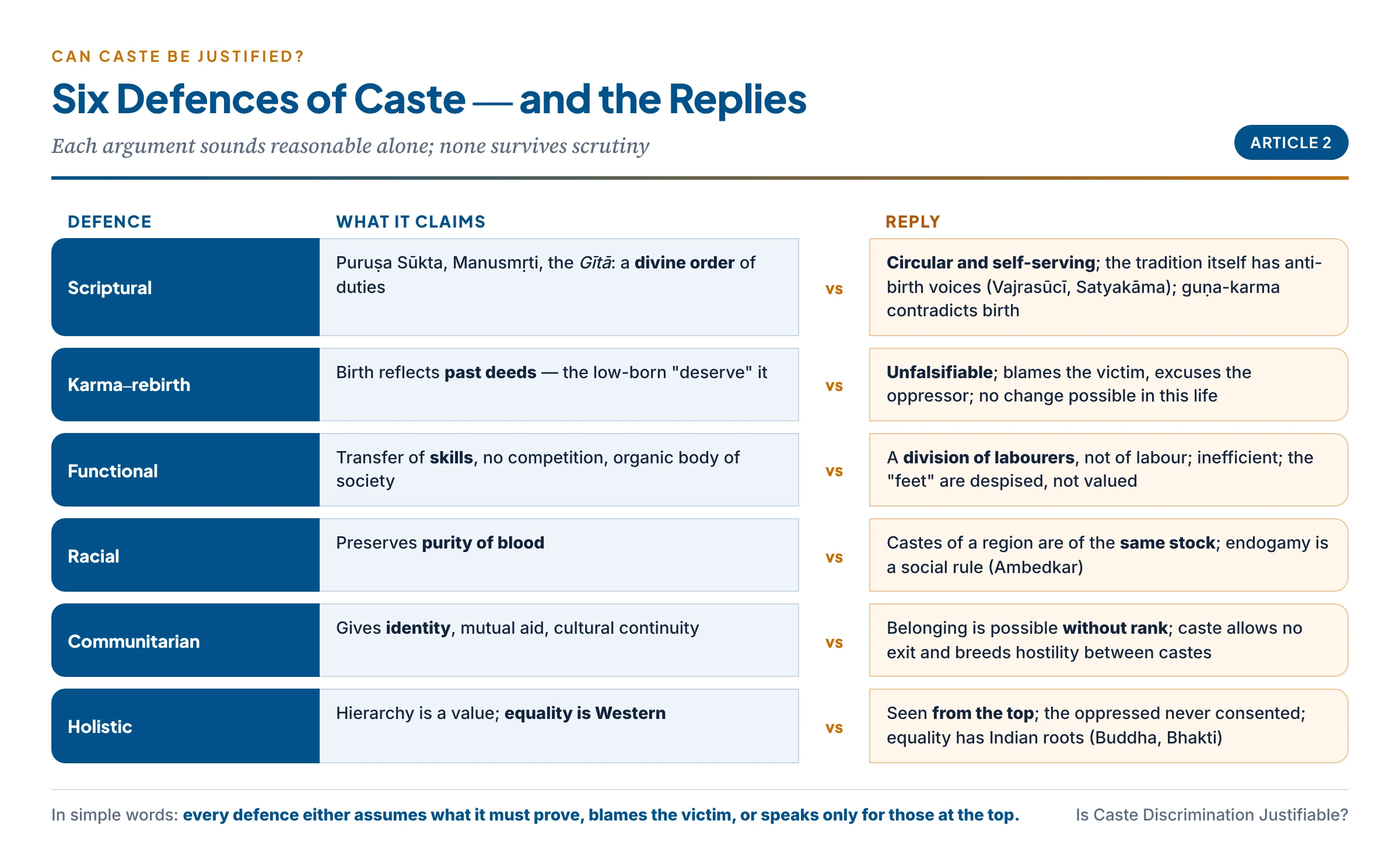
The Replies to the Defences
1. Against the scriptural defence
- Circular: it proves caste is right because texts say so — but the authority of those texts is exactly what is in question. Ambedkar: Hindus observe caste because they believe the śāstras command it; therefore one must deny the authority of the śāstras (Article 6).
- Self-serving: the texts were written by those who benefited from them.
- Internal dissent: the tradition itself contains anti-birth voices — the Vajrasūcī Upaniṣad asks “who is a Brāhmaṇa?” and answers: not by birth, body or ritual, but by realising the Self; the story of Satyakāma Jābāla in the Chāndogya Upaniṣad, accepted as a Brāhmaṇa student because he told the truth about his unknown father.
- Guṇa-karma cuts both ways: if varṇa depends on qualities and actions, it cannot depend on birth — so birth-caste contradicts the Gītā‘s own principle (Gandhi and the reformers used this point; Ambedkar replied that in practice varṇa has always been by birth).
2. Against the karma defence
- Unfalsifiable: no one can check past-life deeds; the doctrine simply renames injustice as desert.
- Morally corrosive: it blames the victim and excuses the oppressor; it turns social cruelty into cosmic justice.
- Ambedkar: the karma theory gives no scope for change in this life — those born into “defiling” work are told to wait for the next birth; hence only the annihilation of caste can help.
3. Against the functional defence
- Division of labourers: caste is not a division of labour by aptitude but a division of labourers by birth into watertight, ranked compartments (Ambedkar). No modern society that divides labour assigns it by birth.
- Economically counter-productive: people are forced into occupations for which they have no interest or talent; industry changes, but caste forbids changing occupation — causing unemployment and inefficiency.
- Not conflict-free: caste produces resentment, violence and atrocities; “order” maintained by humiliation is not peace.
- The organic analogy fails: in a body the feet are not despised, segregated or denied food — but the “feet” of caste society were.
In simple words
A hospital has doctors, nurses, cooks and cleaners — a division of labour. But no hospital says that a cleaner’s daughter may never study medicine, must eat apart from the doctors and may not touch their water. The moment work is assigned by birth and ranked by purity, it is no longer a division of labour; it is, in Ambedkar’s words, a division of labourers.
4. Against the racial defence
- Indians are of mixed stock; castes in a region are physically alike. Ambedkar: “the caste system does not demarcate racial division”; it is a social division of people of the same race. Endogamy is a social rule, not a biological necessity.
5. Against the communitarian defence
- Belonging without hierarchy is possible — through language, region, profession, faith, voluntary association.
- Solidarity inside, hostility outside: Ambedkar called the caste spirit anti-social — each caste cares only for its own members; there is no public spirit (Article 6).
- Exit: a just community must allow exit — leaving, marrying outside, changing work. Caste denies exit.
6. Against the holistic defence
- Whose holism? The view describes caste from the top; those at the bottom never consented — the long history of revolt (below) disproves the idea that hierarchy was a shared value.
- Equality is not merely Western: the Buddha, the Bhakti saints and the Upaniṣadic teaching that the same Self is in all beings are Indian sources of equality.
In simple words
Ask the defender of caste one question: “Would you accept this order if you did not know in advance which caste you would be born into?” Almost no one would gamble on being born an untouchable. An arrangement that people accept only because they already know they are on top is not a justification but a privilege.
Common confusion
Were Phule, Periyar and the Dalit Panthers “proponents of caste discrimination”? No — they were its opponents. Some notes list them under the heading “proponents” because the list is meant to be of proponents of the struggle against caste discrimination. Phule, Periyar, Narayana Guru, Ambedkar and the Dalit Panthers fought caste; the “proponents” of caste in the true sense were the authors of texts like the Manusmṛti and those who enforced their rules.
The Anti-Caste Tradition
1. Śramaṇa traditions — the Buddha and Mahāvīra (6th–5th century BCE)
- The Buddha admitted people of all castes into the Saṅgha; the barber Upāli became a leading monk. In the Vasala Sutta he taught: not by birth is one an outcaste, not by birth a Brāhmaṇa — by deeds one becomes an outcaste, by deeds a Brāhmaṇa.
- Jainism likewise opened the path of liberation to all, judging persons by conduct.
2. Upaniṣadic dissent
- The Vajrasūcī and the Satyakāma Jābāla story (above): true Brahminhood lies in knowledge and truthfulness, not birth.
3. The Bhakti and Sant movements (7th–17th century)
- Devotion is open to all; God looks at the heart, not the caste. Many saints were themselves from “low” castes:
- Nandanār (Tamil Nāyanār saint), Chokhāmeḷā (Mahar saint of Maharashtra), Ravidās (a leather-worker, who dreamt of Begampura — “the city without sorrow” where there is no caste or tax), Kabīr (a weaver: “do not ask a holy man his caste”), Nāmdev and Tukārām.
- Limits: the saints preached spiritual equality but rarely challenged caste in marriage, property and social life.
4. Basava and the Vīraśaiva movement (12th century, Karnataka)
- Basava rejected caste and ritual; his Anubhava Maṇṭapa gathered devotees of all castes; the community supported a marriage between a Brahmin’s daughter and a cobbler’s son — and was violently suppressed.
5. The Sikh Gurus
- Guru Nānak and his successors rejected caste; the langar (common kitchen) made people of all castes eat together — a direct attack on food restrictions. (Caste distinctions nevertheless survive in Sikh society.)
6. Jotirao Phule (1827–1890) and Savitribai Phule
- Opened the first school for girls (Pune, 1848) and schools for untouchables; founded the Satyashodhak Samaj (1873).
- Gulāmgirī (Slavery, 1873), dedicated to those in the United States who fought slavery, described the Śūdras and Ati-Śūdras as enslaved by Brahmanical ideology; read the Bali myth as the story of a just native king defeated by Brahmanical trickery.
- Education as the key: in Shetkaryacha Asud (The Cultivator’s Whipcord) he traced a chain — lack of education led to the loss of wisdom, then of morality, then of progress, then of wealth, and so to the ruin of the Śūdras.
7. Narayana Guru (1856–1928) and Ayyankali (1863–1941), Kerala
- Narayana Guru consecrated a Śiva image at Aruvippuram (1888) — a non-Brahmin performing a Brahmin’s ritual act — and taught “one caste, one religion, one God for humanity”.
- Ayyankali defied the ban on untouchables using public roads by riding a bullock cart (1893) and led a strike of agricultural labourers for the right of their children to attend school.
8. Periyar E.V. Ramasamy (1879–1973), Tamil Nadu
- A hero of the Vaikom Satyagraha (1924–25) for the right of untouchables to use temple roads; founded the Self-Respect Movement (1925); attacked Brahmanical hegemony, the authority of scripture, and the subordination of women; championed rationalism and social justice.
9. Ambedkar and the Ambedkarite movement
- The systematic philosopher of the anti-caste struggle — analysis (Article 5), programme of annihilation (Article 6), and remedies through education, political representation, law and conversion (Article 7).
10. After Ambedkar
- Dalit Panthers (Bombay, 1972) — young writers such as Namdeo Dhasal, Raja Dhale and J.V. Pawar, inspired by the US Black Panthers; their 1973 manifesto gave “Dalit” a broad meaning — Scheduled Castes and Tribes, neo-Buddhists, the working people, the landless, poor peasants, women — all who are exploited politically, economically or in the name of religion.
- Kanshi Ram — BAMCEF (1978) and the Bahujan Samaj Party (1984): turning the numerical majority of the oppressed (bahujan) into political power.
- Dalit literature — autobiographies and poetry that made caste experience visible: Omprakash Valmiki’s Joothan, Bama’s Karukku, Urmila Pawar’s Aaydan (The Weave of My Life), Daya Pawar’s Baluta; Arundhati Roy’s The God of Small Things (a novel that turns on an inter-caste love affair).
- Dalit feminism — Urmila Pawar, Bama and others showed that Dalit women face caste, gender and class oppression together, and that both the anti-caste movement and mainstream feminism must change.
- Wider struggle — reservation and legal reform, educational initiatives for marginalised castes, and international recognition of caste as a human-rights issue (UN bodies, Human Rights Watch).
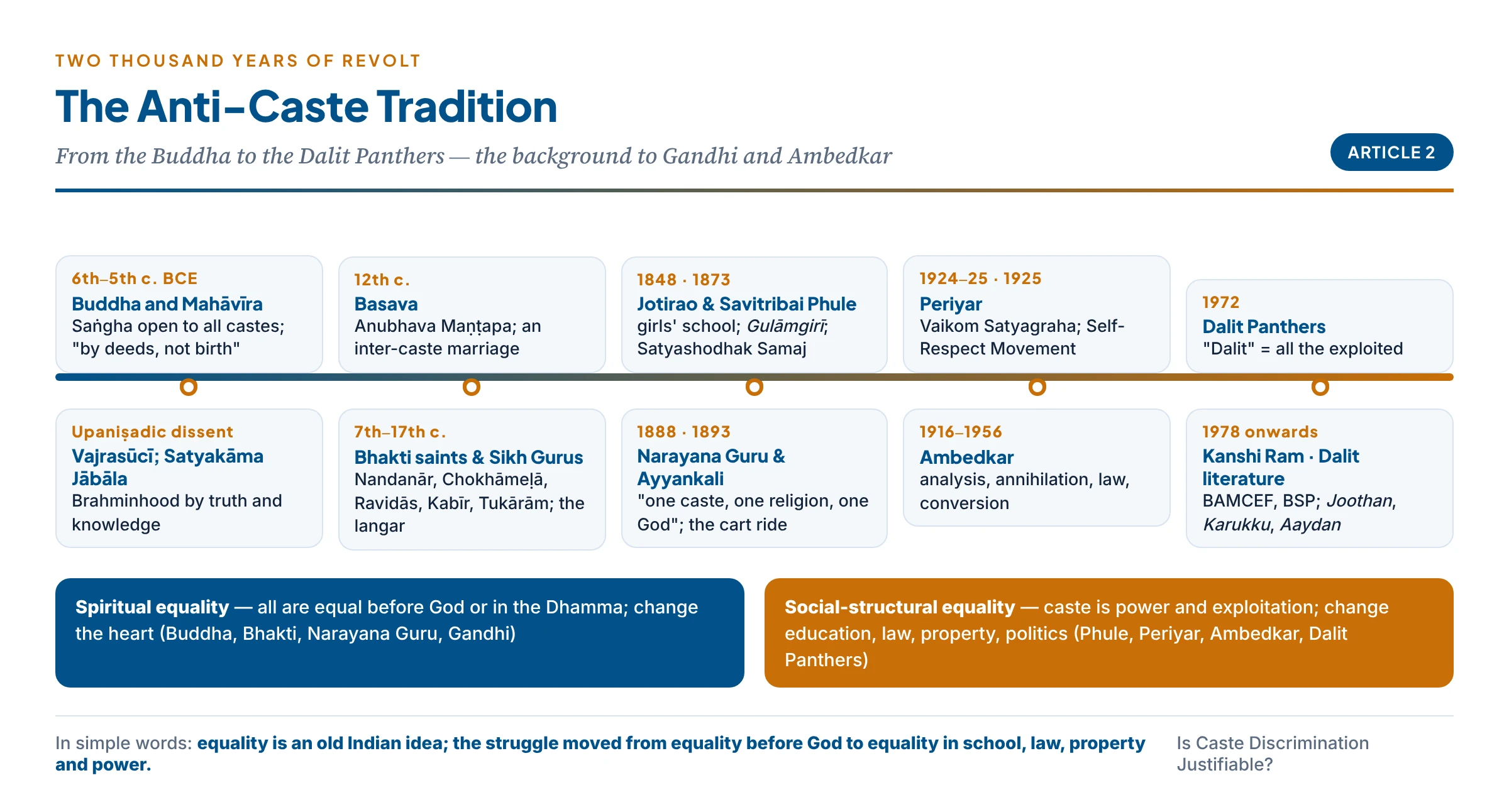
Indian Connect — Indian Connect — the tradition’s two streams
- Spiritual equality (Buddha, Bhakti, Narayana Guru, Gandhi): all are equal before God or in the Dhamma; change the heart.
- Social-structural equality (Phule, Periyar, Ambedkar, the Dalit Panthers): caste is a system of power and exploitation; change education, law, property and political power.
- Gandhi stands mainly in the first stream; Ambedkar combines the second with a new form of the first — Buddhism as a religion of equality (Article 7).
“Caste Is Not a Sin, but Caste Discrimination Is” — A Critical Assessment
What the statement means
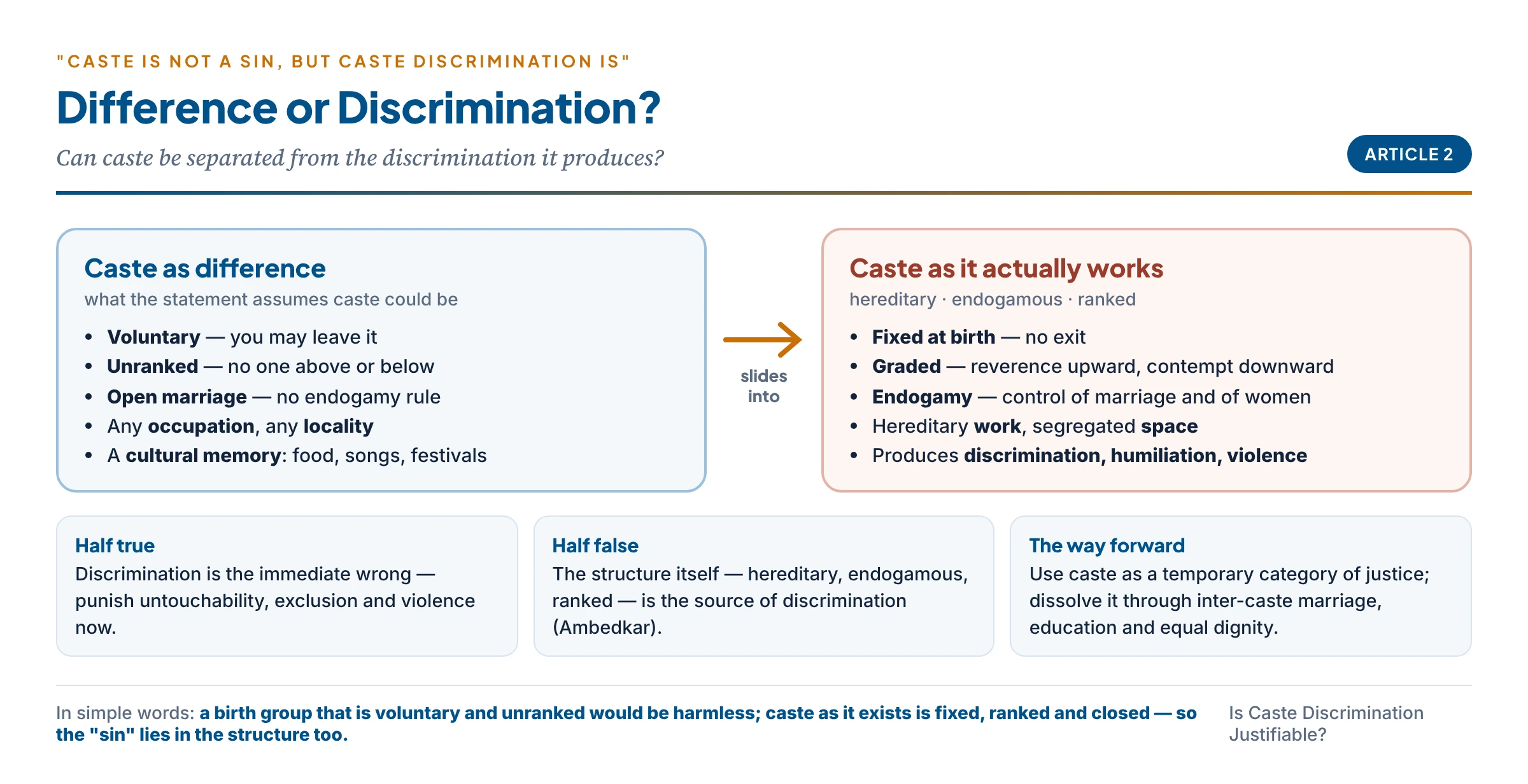
- It separates caste as difference (a group identity — family tradition, community, customs) from caste as discrimination (unequal treatment, untouchability, exclusion). The first, it claims, is morally neutral; only the second is wrong.
Arguments in support
- Pluralism: societies contain many groups — linguistic, regional, religious; difference as such is not injustice.
- The Constitution’s approach: it does not abolish caste as such; it forbids discrimination (Article 15), abolishes untouchability (Article 17) and even uses caste as a category for remedy (reservation). The law treats caste as a social fact and discrimination as the wrong.
- Gandhi’s position is close to this statement: varṇa as non-hierarchical duty is acceptable; untouchability is a sin (Article 4).
- Identity as resource: Dalit and backward-caste movements have used caste identity positively — for pride, solidarity and political mobilisation.
Arguments against
- Hierarchy is the essence of caste: sociologists (Ghurye, Bouglé, Dumont) and Ambedkar agree that caste is a ranked order; a “caste” without ranking would not be caste but a mere community. As Ambedkar put it, caste is an ascending scale of reverence and a descending scale of contempt.
- Endogamy is itself a restriction: even a “neutral” caste survives only by forbidding marriage outside it — which limits the liberty of every member, especially women.
- Birth-identity breeds discrimination: an identity fixed by birth and protected by marriage rules constantly produces inside/outside and pure/impure distinctions; difference slides into disgust.
- Ambedkar’s verdict: caste cannot be reformed into innocence — it has to be annihilated, because its root is the sacred notion of graded inequality (Article 6).
- Humiliation: the Indian political theorist Gopal Guru shows that caste works through humiliation — the denial of respect even where no law is broken; “mere difference” is often experienced by Dalits as everyday humiliation.
Assessment — as a concerned citizen
- The statement is half true. It is right that the immediate moral target is discrimination — untouchability, exclusion, violence — and that the state must punish it. It is also right that community belonging has value.
- But it is wrong if it suggests that caste as it actually exists — hereditary, endogamous and ranked — is innocent. The sin lies not only in discriminatory acts but in the structure that produces them.
- The way forward: (1) punish discrimination now; (2) use caste as a temporary category of justice (reservation, data) to undo its effects; (3) weaken the structure through inter-caste marriage, education, urban mixing and equal dignity, until caste survives, if at all, only as a voluntary, unranked cultural memory.
In simple words
A surname that tells you which region your grandparents came from is harmless — you can marry anyone, live anywhere, do any work. A surname that decides whom you may marry, which well you may use and how you are greeted is not a surname but a sentence. The statement “caste is not a sin” is true only of the first kind; caste in India has mostly been the second.
Critical Evaluation
Strengths and Limits of the Anti-Caste Tradition
- Strengths:
- It shows that equality is an Indian value with deep roots — not a colonial import.
- It moved from spiritual equality (Buddha, Bhakti) to social and political equality (Phule, Periyar, Ambedkar).
- It gave the oppressed a voice of their own — Dalit literature and politics.
- Limits:
- The Bhakti saints left marriage, property and social practice largely untouched; sects that began as anti-caste (Lingayats, Sikhs) themselves developed caste distinctions.
- Movements were often regional; caste kept adapting.
- Political mobilisation by caste can harden caste identities even while fighting caste hierarchy.
Critics and Defenders
Criticism — Critics of caste and its defences
- Ambedkar: the śāstras must lose their authority; caste is a “division of labourers”, graded inequality, anti-social.
- Phule and Periyar: caste is Brahmanical domination; education and rationalism are the weapons.
- Buddhist and Bhakti critique: worth lies in conduct and devotion, not birth.
- Liberal critique: hereditary rank denies equal dignity, liberty and opportunity; no one would choose it behind a veil of ignorance.
- Feminist critique: endogamy rests on the control of women.
Defence — What the defenders of caste (or of varṇa) argued
- Scriptural: a sacred order of duties (Manusmṛti, Gītā).
- Karma: birth reflects past deeds.
- Functional: transfer of skills, social stability, organic unity.
- Communitarian: identity, mutual aid, cultural continuity.
- Reformist (Gandhi): keep varṇa as equal duties, abolish untouchability — difference without hierarchy.
Cross-Tradition Comparison
| Theme | Indian defence or critique | Western parallel |
|---|---|---|
| Sacred hierarchy | Puruṣa Sūkta, Manusmṛti | Medieval “Great Chain of Being”; divine right of kings |
| Function and nature | Guṇa-karma, svadharma | Plato‘s three classes and the myth of the metals — but Plato allowed movement between classes by talent and kept no untouchables |
| Natural inferiority | Śūdra born to serve | Aristotle‘s “natural slave” |
| Desert by fate | Karma and rebirth | Calvinist ideas of the elect; “the poor deserve their poverty” |
| Equal dignity | Buddha’s Vasala Sutta; Advaita’s one Self in all | Kant: treat humanity always as an end, never merely as a means |
| Natural vs artificial inequality | Caste presents social rank as natural | Rousseau: social inequality is artificial, created by convention and property |
| Revolt of the oppressed | Dalit Panthers | Black Panthers; the US civil-rights movement |
Indian Connect — Indian Connect — the Buddha’s answer
- To a Brāhmaṇa who called him an “outcaste”, the Buddha replied that conduct, not birth, makes one noble or base — and listed the deeds (anger, cruelty, deceit, theft) that truly make a person an outcaste.
- Ambedkar returned to this teaching two thousand years later: his Navayāna Buddhism (Article 7) is the anti-caste tradition coming full circle.
Synthesis (Siddhānta)
- Caste was defended on scriptural (Puruṣa Sūkta, Manusmṛti, Gītā), karmic, functional, racial, communitarian and holistic grounds. Each defence fails: the scriptural one is circular and self-serving, the karmic one blames the victim, the functional one confuses a division of labour with a division of labourers, the racial one is false, the communitarian one ignores exit and hostility between castes, the holistic one speaks only from the top.
- An anti-caste tradition runs from the Buddha and Upaniṣadic dissent, through the Bhakti saints, Basava and the Sikh Gurus, to Phule, Narayana Guru, Ayyankali, Periyar, Ambedkar, the Dalit Panthers and Dalit literature — moving from spiritual to social-structural equality.
- “Caste is not a sin, but caste discrimination is” is half true: discrimination is the immediate wrong, but caste as hereditary, endogamous, ranked order is the source of discrimination; only caste reduced to voluntary, unranked cultural memory would be morally neutral.
- Contemporary relevance:
- Inter-caste marriage remains the clearest test of whether caste is mere “difference”.
- Caste pride associations and caste-based matrimonial sites show how “identity” can quietly keep endogamy alive.
- Data from the 2027 Census can help target remedies — or harden caste as a permanent political identity; how it is used will decide which.
“Not by birth does one become an outcaste; not by birth does one become a Brāhmaṇa. By deeds one becomes an outcaste, by deeds one becomes a Brāhmaṇa.” — The Buddha (Vasala Sutta)
Previous Year Questions
- 2010“Caste is not a sin, but caste-discrimination is.” As a concerned citizen, comment critically on this statement.
- 2008Discuss the impact of caste-discrimination — affirmative or otherwise — on the harmony of the society as a whole.