

Caste Discrimination: Gandhi and Ambedkar.
Official Syllabus: Paper II, Section A, Unit 10
Caste discrimination is the unfair treatment of a person because of the social group (caste) into which he or she was born. It is the oldest and most persistent form of birth-based inequality in India: it decides, even today, whom many people marry, where they live, what work they are expected to do, whom they eat with, and how they are spoken to. Philosophically it raises the deepest questions of equality, justice, dignity and human rights — can a person’s worth be fixed at birth, and can a society that ranks people by birth be just? This article explains what caste is (varṇa and jāti), the main theories of its origin, its features (Ghurye, Bouglé, Dumont), the ideology of purity and pollution and untouchability, the characteristics and types of caste discrimination, and the main factors responsible for it — the ground on which Gandhi’s and Ambedkar’s responses (Articles 3–8) stand.
In simple words
Imagine a school where every child’s seat, games partner, lunch table and future job are decided by the surname on the admission form. A brilliant child with the “wrong” surname must sit at the back, may not touch the water tap used by others, and is told that cleaning the toilets is his “duty”. No exam result can change his seat. That, in miniature, is caste: rank fixed by birth, kept by marriage rules, enforced by ideas of purity, and justified as “natural” or “sacred”.
Context & Problem
Why Caste Is a Philosophical Problem
- Equality: modern political philosophy begins from the idea that all human beings are of equal moral worth. Caste begins from the opposite idea — that people are unequal by birth.
- Justice: a just society distributes rights, opportunities and respect fairly. Caste distributes them by ancestry, not by need, effort or merit.
- Liberty: caste restricts choice of occupation, marriage, food, residence and worship.
- Fraternity: caste divides society into closed compartments and so destroys the fellow-feeling that democracy needs (Ambedkar’s point — Article 6).
- Human dignity: untouchability treats some human beings as polluting by nature — a denial of their very humanity.
Caste Discrimination Defined
- Meaning: caste discrimination is the unfair treatment and hierarchical ranking of individuals on the basis of their birth into a particular caste. It includes exclusion, segregation, humiliation, denial of opportunities and violence.
- Two sides of caste: caste (1) divides people into separate communities and (2) ranks these communities one above another. Discrimination arises from the second side — hierarchy — but the first side (closed, endogamous groups) keeps the hierarchy alive.
- Not only Hindu, not only Indian: caste-like divisions exist among Indian Muslims (Ashraf, Ajlaf, Arzal), Christians (Dalit Christians in separate churches and cemeteries in some regions), Sikhs (Mazhabi Sikhs), and in Nepalese Buddhism. Untouchability-like groups have existed in Japan (the Burakumin), Korea (the Paekchong), Tibet (the Ragyappa) and Burma (pagoda slaves).
- Global concern: the UN Committee on the Elimination of Racial Discrimination (2002) treats discrimination based on “descent” (including caste) as a human-rights violation; in 2023 the city of Seattle became the first in the United States to ban caste discrimination.
Core Doctrine
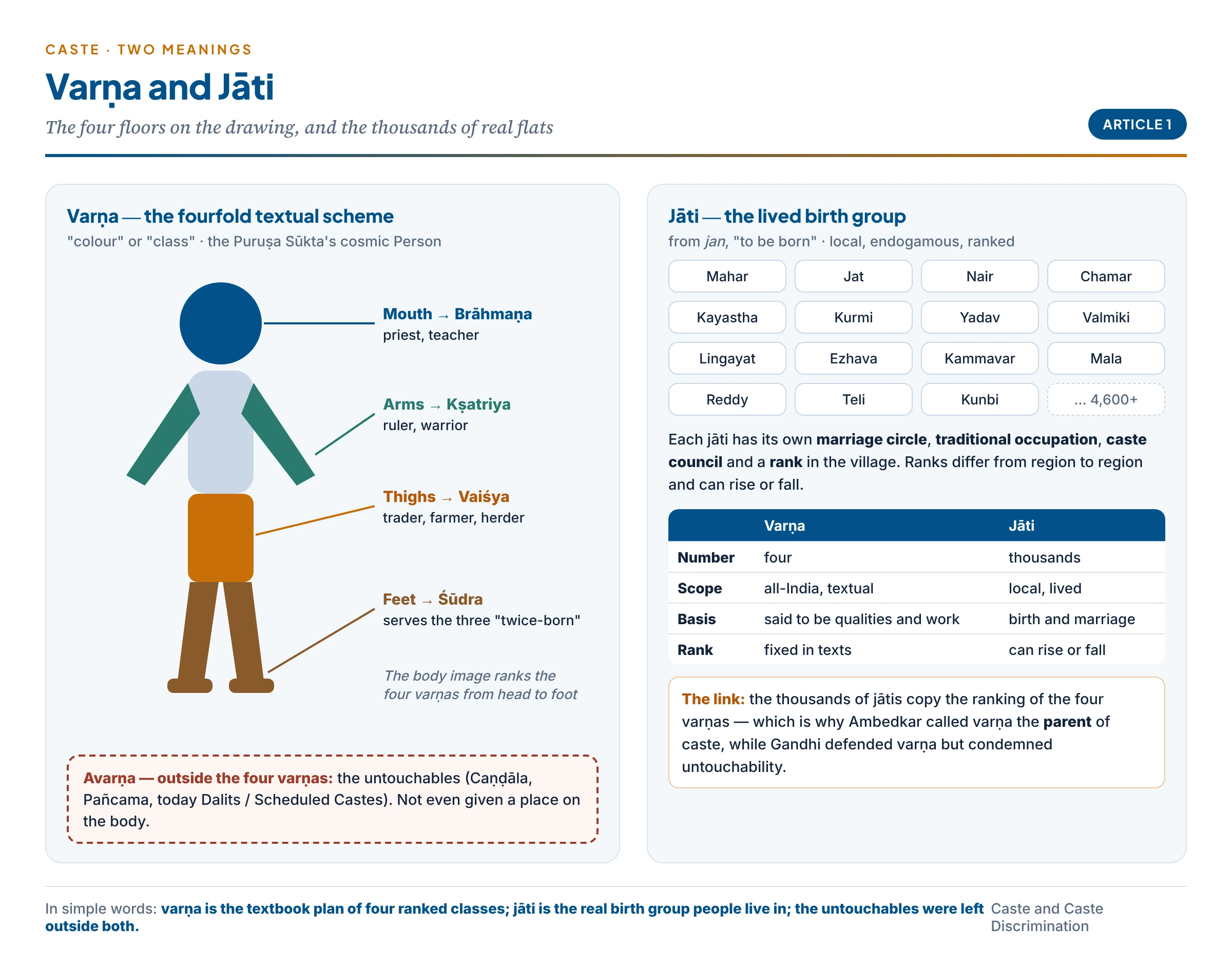
Varṇa and Jāti — Two Meanings of “Caste”
The English word “caste” (from the Portuguese casta, “pure breed”) covers two different Indian ideas.
1. Varṇa (the fourfold scheme)
- Meaning: varṇa literally means “colour” or “class”. It is the textual, all-India, fourfold division of society:
- Brāhmaṇa — priests, teachers, keepers of sacred knowledge.
- Kṣatriya — rulers and warriors.
- Vaiśya — traders, farmers, cattle-keepers.
- Śūdra — servants and labourers who serve the three “twice-born” (dvija) varṇas.
- Puruṣa Sūkta: a late hymn of the Ṛg Veda describes society as the body of the cosmic Person (Puruṣa) — the Brāhmaṇa from his mouth, the Kṣatriya from his arms, the Vaiśya from his thighs and the Śūdra from his feet. The image ranks the varṇas from head to foot.
- Avarṇa: below and outside the four varṇas stand the untouchables (called Caṇḍāla, Pañcama — “the fifth” — and, today, Dalits or Scheduled Castes). Tribal communities also stood outside the scheme.
- Twice-born: the first three varṇas may undergo the sacred-thread ceremony (upanayana) and study the Veda; the Śūdra and the untouchable were denied it.
2. Jāti (the lived reality)
- Meaning: jāti comes from jan, “to be born”. It is the local, birth-based, endogamous group — Mahar, Chamar, Jat, Nair, Kayastha, and so on.
- Number: there are thousands of jātis, varying from region to region; the national survey of the Anthropological Survey of India identified more than 4,600 communities.
- Features: each jāti has its own traditional occupation, marriage circle, customs, caste council (panchayat) and a rank relative to others in the village.
| Point | Varṇa | Jāti |
|---|---|---|
| Meaning | “Colour” / class | “Birth” |
| Number | Four (plus avarṇa outside) | Thousands |
| Scope | All-India, textual model | Local, regional, lived reality |
| Basis | Function, said to rest on qualities (guṇa) and work (karma) | Birth, endogamy, traditional occupation |
| Ranking | Fixed in texts | Negotiable; can rise or fall over time |
| Source | Vedas, Dharmaśāstras, Gītā | Custom, caste councils, local power |
In simple words
Varṇa is like the four floors shown on an architect’s drawing of a building; jāti is the thousands of actual flats in which people live. The drawing says there are four floors; in real life every flat-owner knows exactly which flats are “above” and “below” his own — and the people who live outside the building are not even counted.
Common confusion
Is caste the same as varṇa? No. Varṇa is a fourfold textual model; jāti is the real birth group of daily life. When people say “caste” they usually mean jāti. Gandhi defended varṇa while condemning untouchability and the excesses of jāti (Article 4); Ambedkar replied that varṇa is the parent of jāti — the hierarchy of the four varṇas is what the thousands of castes copy (Articles 5–6). Keeping the two ideas apart is the key to their whole debate.
Theories of the Origin of Caste
No single theory is accepted by all; each throws light on one side of the institution.
- Traditional (divine) theory
- Caste was created by God — the Puruṣa Sūkta’s body image, the Manusmṛti’s laws, and the Bhagavad Gītā‘s line that the fourfold order was created by the Lord according to qualities and actions (guṇa-karma-vibhāgaśaḥ).
- Weakness: it justifies rather than explains; it cannot account for thousands of jātis or for regional differences.
- Racial theory
- Caste arose from the meeting of fair-skinned Aryan migrants and darker indigenous peoples; varṇa (“colour”) is taken as proof. The British census commissioner Herbert Risley tried to rank castes by physical measurements.
- Weakness: castes in the same region are physically alike; there is no clear racial line between “high” and “low”. Ambedkar rejected this theory — “the caste system does not demarcate racial division”; a Punjabi Brahmin and a Punjabi Chamar are of the same stock (Article 5).
- Occupational theory
- J.C. Nesfield: caste grew out of occupations — groups doing the same work became hereditary castes; “cleaner” work gave higher rank.
- Weakness: it ignores ritual rank — the priest is above the king though the king has more power; many castes do not do their traditional work.
- Political (Brahmanical) theory
- Caste was a clever device of the Brahmins to keep their supremacy, sanctified through religious texts (the French missionary Abbé Dubois; G.S. Ghurye called caste “a Brahmanic child of the Indo-Aryan culture”).
- Weakness: one group alone could hardly impose such a vast system; but the theory rightly stresses ideology and sacred sanction.
- Religious and ritual theories
- Caste arose from family cults and rules about who may share sacred food and worship (Senart), or from hereditary ritual offices around the king (Hocart).
- Evolutionary (multiple-factor) theory
- Caste grew slowly from many factors — race, occupation, religion, guilds, conquest, the idea of purity, local customs. Most sociologists accept some version of this.
- Ambedkar’s endogamy theory
- Caste is created when endogamy is superimposed on exogamy; the Brahmins first made themselves a closed class and the others imitated them or found the door closed against them (explained fully in Article 5).
The Features of Caste
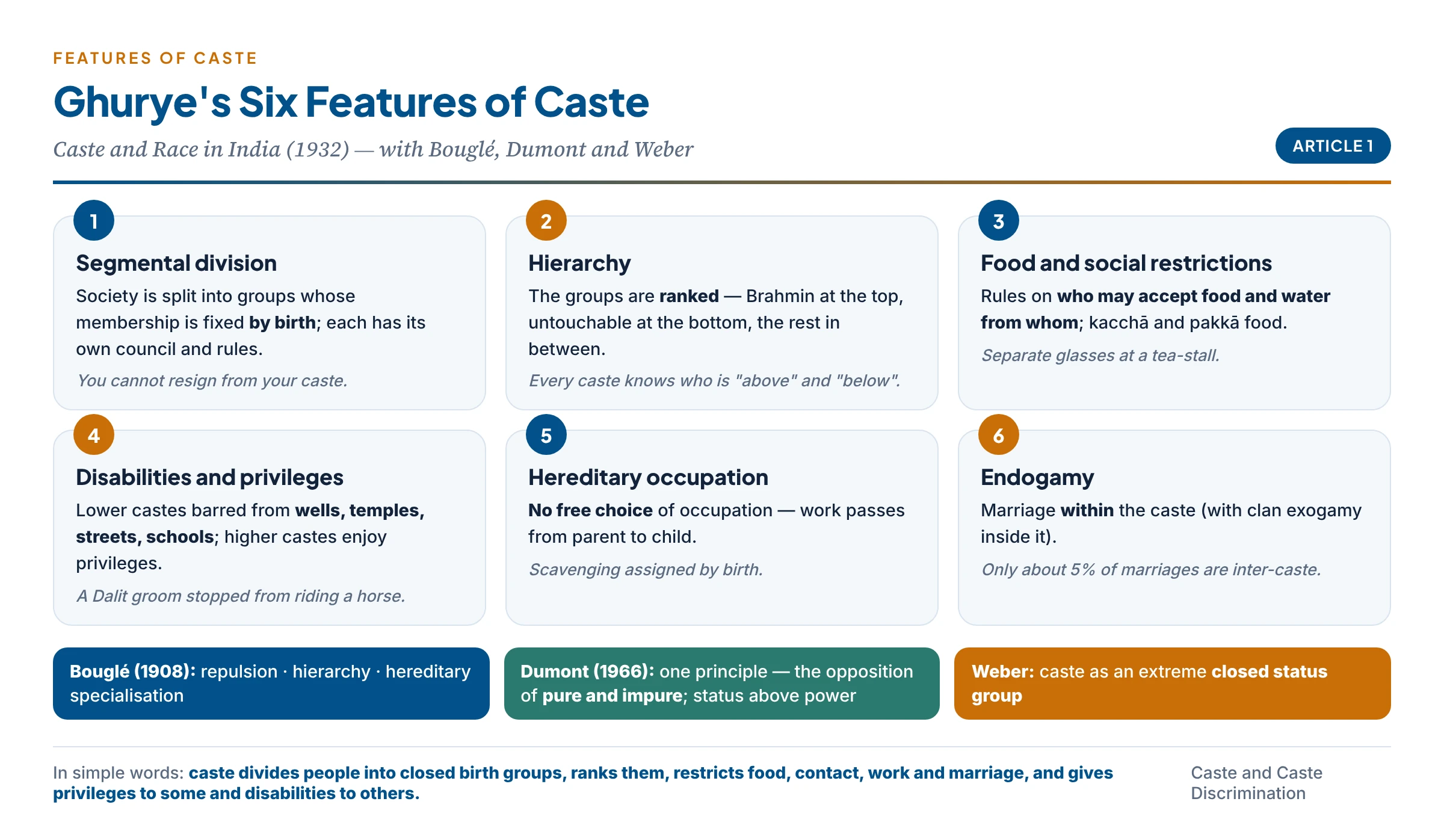
G.S. Ghurye’s six features (Caste and Race in India, 1932)
- Segmental division of society — society is divided into groups whose membership is fixed by birth; each has its own council and rules.
- Hierarchy — the groups are ranked, with the Brahmin at the top and the untouchable at the bottom.
- Restrictions on feeding and social intercourse — rules about who may accept food and water from whom (kacchā and pakkā food).
- Civil and religious disabilities and privileges — lower castes were barred from wells, temples, schools, streets; higher castes enjoyed privileges.
- Lack of unrestricted choice of occupation — occupations are hereditary.
- Restrictions on marriage (endogamy) — one must marry within one’s caste (often outside one’s gotra — clan exogamy within caste endogamy).
Célestin Bouglé’s three principles (1908)
- Repulsion — castes keep apart (no marriage, no shared food, no contact).
- Hierarchy — castes are ranked.
- Hereditary specialisation — each caste has a hereditary occupation.
Louis Dumont: purity and hierarchy (Homo Hierarchicus, 1966)
- The single principle behind caste is the opposition of the pure and the impure: the Brahmin is purest; groups dealing with death, dirt, leather and bodily waste are most impure.
- Hierarchy encompasses power: the Brahmin’s status is above the king’s power — ritual rank and political power are separated.
- Critique: Dumont took the Brahmin’s view of caste as the whole truth; Dalit and other scholars stress power, land and violence — those at the bottom never accepted the ideology as freely as Dumont suggested.
Max Weber: caste is an extreme case of a closed status group — honour and social closure carried to the point of ritual separation.
Caste and class compared
| Point | Caste | Class |
|---|---|---|
| Basis | Birth | Economic position (wealth, income, occupation) |
| Origin | The varṇa order and ritual ideas | The economic system |
| Structure | Closed — mobility theoretically impossible | Open — mobility possible |
| Marriage | Endogamous by rule | No rule |
| Sanction | Religious and customary | Mainly economic and legal |
| Spread | Mainly South Asia | Worldwide |
Purity, Pollution and Untouchability
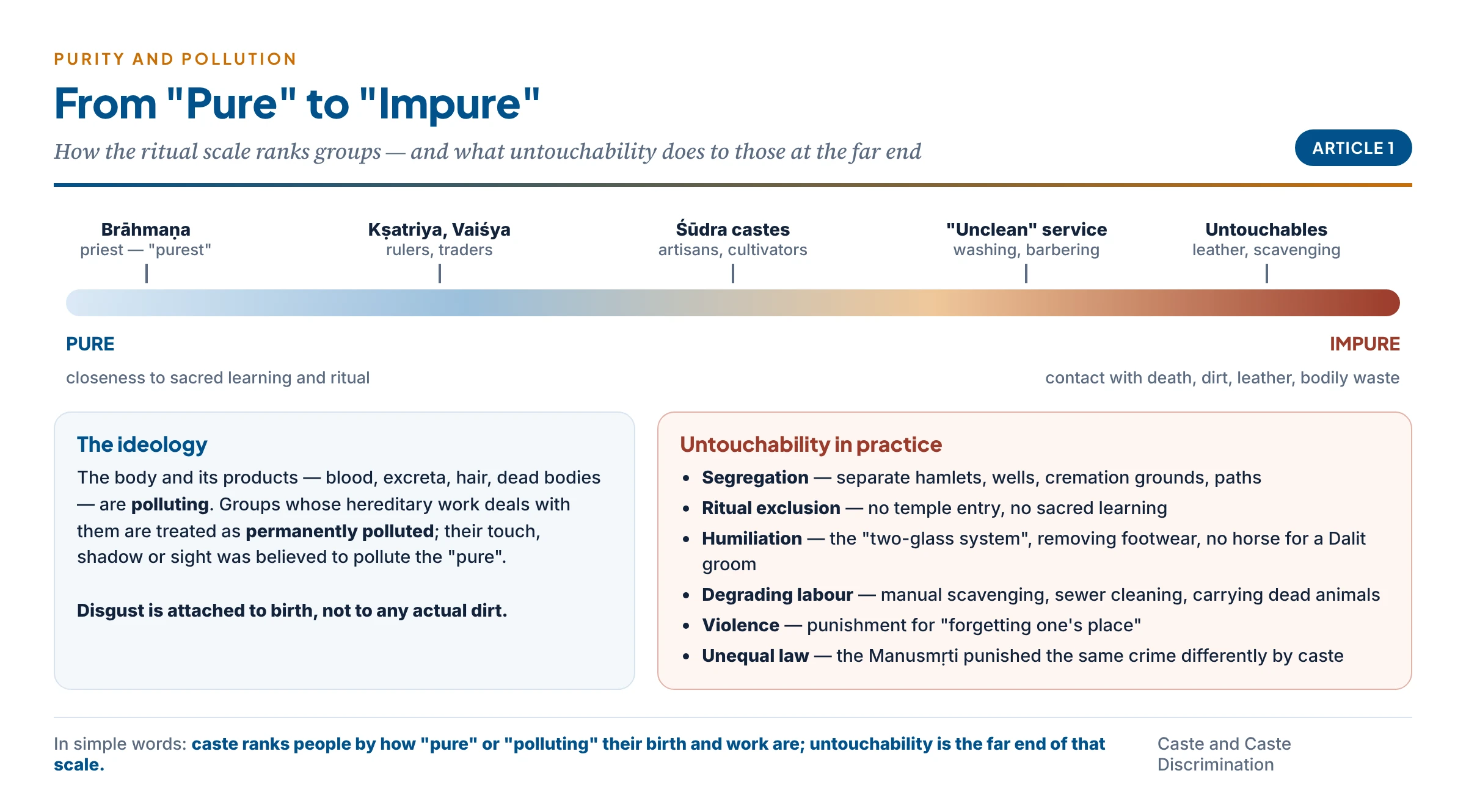
- The ideology: the body and its products (blood, saliva, excreta, hair, dead bodies) are polluting. Persons whose hereditary work deals with these — scavenging, leather work, cremation, removing dead animals — are treated as permanently polluted, and their touch, shadow or even sight was believed to pollute the “pure”.
- Untouchability: the practice of treating some castes as untouchable — the most extreme form of caste discrimination. It involves:
- Physical segregation — separate hamlets outside the village (maharwada, cheri), separate wells, cremation grounds and paths.
- Ritual exclusion — no entry into temples; no access to sacred learning.
- Social humiliation — the “two-glass system” in tea-stalls; being made to remove footwear before upper-caste houses; ban on a Dalit groom riding a horse.
- Degrading labour — manual scavenging, carrying dead animals, cleaning sewers.
- Violence — punishment of those who “forget their place”.
- The Manusmṛti’s double standard: the same crime carried a different punishment according to the caste of the offender and the victim — milder for the high-born, harsher for the Śūdra.
- Mental side: untouchability lives in the mind as much as in custom — a feeling of disgust and superiority learned in childhood. That is why Ambedkar called caste “a notion, a state of the mind” (Article 6).
In simple words
Think of how some households treat a house-help’s cup: kept on a separate shelf, washed separately, never used by the family. Nobody says the cup is dirty; it is “her” cup. Multiply that habit across a whole society, give it the authority of religion, make it hereditary, and you have untouchability — disgust attached to a person’s birth rather than to any actual dirt.
Characteristics of Caste Discrimination
- Hierarchy and social stratification — a rigid ranking fixed at birth decides status, access to resources and opportunities.
- Endogamy — marriage within the caste; resistance to inter-caste marriage keeps the boundaries.
- Occupational segregation — castes tied to hereditary work; limited economic mobility.
- Social stigma and untouchability — exclusion from social life; deep psychological harm.
- Limited access to education — historically denied learning; today, discrimination in schools and universities.
- Unequal access to resources — land, water, credit and jobs concentrated among higher castes.
- Political marginalisation — under-representation in power, weak voice in decisions.
- Discrimination in religious practices — exclusion from temples and rituals, separate places of worship.
- Stereotyping and prejudice — caste slurs, jokes, negative portrayal in media.
- Legal and constitutional injustice — laws exist, but enforcement is weak; discrimination continues in violation of constitutional principles.
- Resistance and social movements — discrimination provokes assertion (Phule, Ambedkar, Periyar, the Dalit Panthers — Article 2).
- Intersection with gender and class — Dalit women face caste, gender and class oppression together (the “triple oppression”).
- Cultural and religious justification — the practice is defended as tradition or divine order.
- Affirmative action — reservation exists to correct the disadvantage (Article 9), but its implementation faces resistance and debate.
- Inherited disadvantage — the child inherits the parents’ low status; disadvantage passes across generations.
- Dehumanisation — people are treated as less than human.
- Caste-based violence — atrocities used to assert dominance.
- Structural, not just personal — even without individual prejudice, institutions (landholding, networks, hiring through contacts) reproduce caste advantage.
- Collective identity — discrimination shapes community identities and can divide society into hostile blocs.
- Urban–rural difference — cruder in villages (wells, temples), subtler in cities (renting homes, hiring, marriage advertisements, campus discrimination).
Types of Caste Discrimination
| Type | What it involves | Why it is wrong |
|---|---|---|
| 1. Untouchability | Segregation and dehumanisation; denial of public spaces and resources | Violates dignity and equality |
| 2. Occupational | Restriction to hereditary, often “polluting” work; bias in hiring | Denies equal opportunity; blocks mobility |
| 3. Educational | Barriers to schooling; bias in classrooms and campuses | Reproduces stratification; blocks empowerment |
| 4. Social segregation | Separate localities; no inter-dining or inter-marriage | Undermines social cohesion |
| 5. Political marginalisation | Under-representation; exclusion from decision-making | Undermines democracy |
| 6. Cultural stigmatisation | Negative stereotypes, slurs, media portrayal | Dehumanises; normalises prejudice |
| 7. Inter-caste violence | Physical and psychological attacks, “honour” killings | Violates the right to live without fear |
| 8. Legal and judicial | Discriminatory laws in the past (Manusmṛti); biased policing and weak justice today | Violates rule of law and equal protection |
| 9. Religious | Exclusion from temples and rituals | Violates equal religious freedom |
| 10. Economic | Unequal land, wealth, wages, credit | Violates economic justice |
| 11. Marital | Opposition to inter-caste marriage | Violates the right to choose one’s partner |
Indian Connect — Indian Connect — how big is the problem today?
- Crimes against Scheduled Castes: 57,789 cases were registered in 2023 (National Crime Records Bureau) — a crime rate of 28.7 per lakh SC population; Uttar Pradesh recorded the most cases.
- Untouchability survives in homes: in the India Human Development Survey (2011–12), about one in four households admitted practising untouchability in some form (for example, not letting a Dalit enter the kitchen).
- Endogamy survives: only about 5% of Indian marriages are inter-caste.
- Manual scavenging and sewer deaths continue despite the 2013 law prohibiting manual scavenging.
- Campus discrimination: the deaths of Rohith Vemula (2016) and Payal Tadvi (2019) led to demands for stronger rules; the UGC’s 2026 equity regulations were kept in abeyance by the Supreme Court in January 2026 for review, with the 2012 rules continuing meanwhile.
The Main Factors Responsible for Caste Discrimination
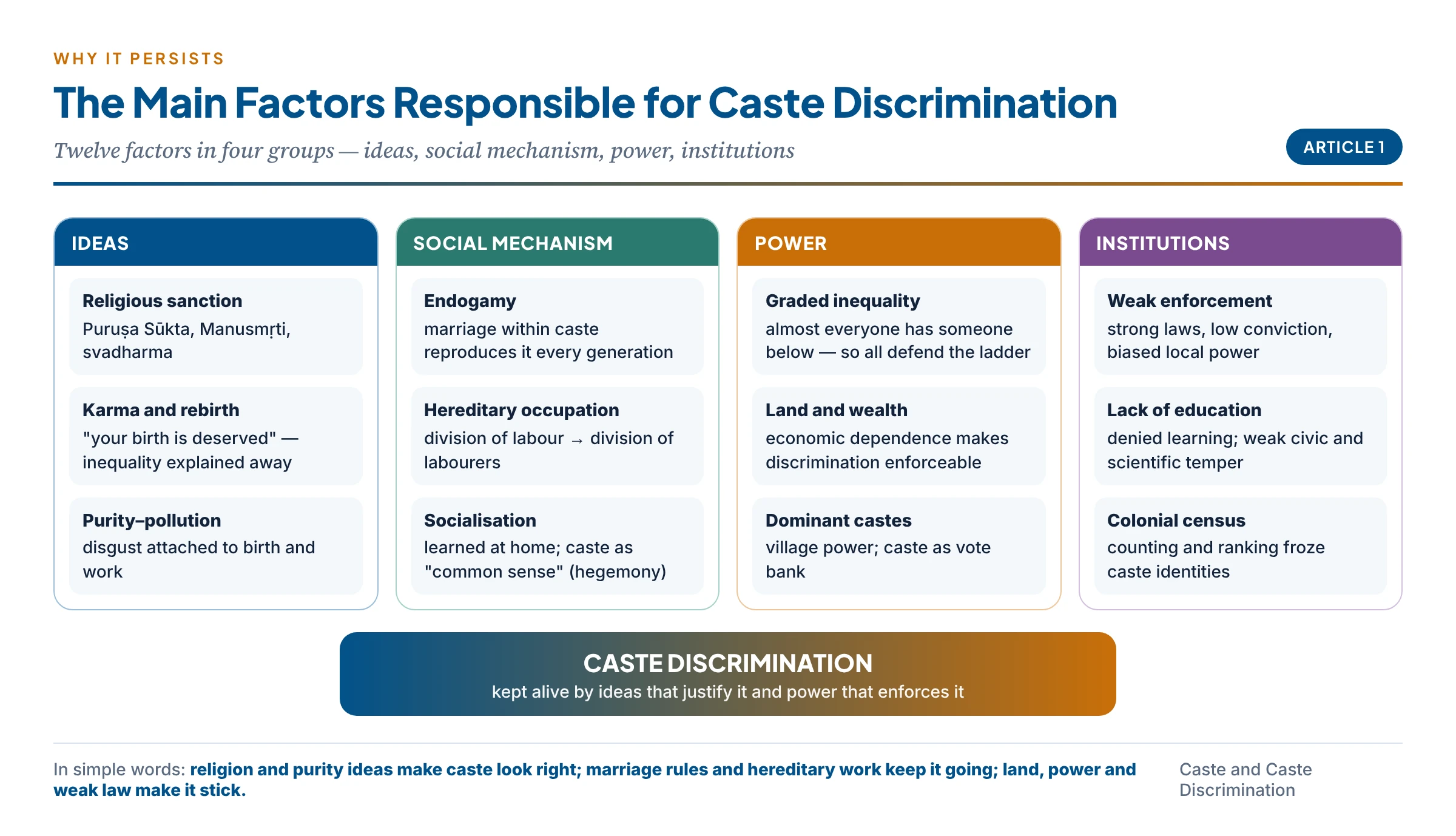
1. Religious and scriptural sanction
- The Puruṣa Sūkta, the Manusmṛti and the doctrine of svadharma gave hierarchy divine authority; disobeying caste rules became a sin.
- Karma and rebirth: one’s birth is explained as the reward or punishment of past deeds — the low-born “deserve” their lot. This theodicy of inequality made the oppressed accept their condition and freed the privileged from guilt.
2. Birth-based hereditary occupation
- Work is assigned by birth; “polluting” work is assigned to the lowest. The division of labour becomes a division of labourers (Ambedkar).
3. Endogamy
- Marriage within the caste keeps groups closed and reproduces them in every generation; it is the mechanism of caste (Article 5). Control over women’s marriage and sexuality is therefore central to caste.
4. The ideology of purity and pollution
- Disgust attached to birth and work justifies distance and exclusion.
5. Superiority complex and graded inequality
- Caste is not a simple division into “high” and “low”; it is a ladder in which almost every caste has someone below it to look down upon. Ambedkar called this “graded inequality” — an ascending scale of reverence and a descending scale of contempt. Because each caste enjoys some superiority, all have an interest in keeping the ladder — which is why the system is so stable.
In simple words
Picture a ladder of fifty rungs. The man on rung ten is pushed down by forty people above him — but he can push down the forty below him. If he joins a revolt to break the ladder, he loses his small power over those below. So almost everyone, except the person on the lowest rung, has some reason to keep the ladder standing. That is why Ambedkar said graded inequality is harder to destroy than a simple division into masters and slaves.
6. Economic structure
- Land, wealth and capital were concentrated in the hands of upper and dominant castes; landless Dalits depended on them for work. Economic dependence makes discrimination enforceable.
7. Political factors
- Dominant castes control village power; caste becomes a vote bank; discrimination is tolerated where victims are politically weak.
8. Lack of education and awareness
- Denial of education kept the lower castes from questioning the order; prejudice continues where scientific temper and civic values are weak.
9. Socialisation and cultural hegemony
- Children learn caste rules at home, in marriage arrangements and in festivals. The Italian Marxist Antonio Gramsci‘s idea of hegemony helps here: a dominant group rules best when its values become the “common sense” of all, so that even the oppressed accept them as natural. The anti-caste movements (Article 2) are a counter-hegemony — a fight over ideas as much as over resources.
10. Weak enforcement of law
- Strong laws (Article 17; the Protection of Civil Rights Act; the SC/ST (Prevention of Atrocities) Act) meet low conviction rates, social pressure on victims and bias in police and local administration.
11. Historical and colonial factors
- Invasions and insecurity made communities close ranks; the British census (especially from 1901) recorded and ranked castes, which made caste identities more rigid and gave them new political value.
12. Ordinary people and routine
- Much discrimination is done not by monsters but by ordinary, unthinking people following custom. Hannah Arendt‘s idea of the “banality of evil” — great wrongs committed through thoughtlessness and routine rather than hatred — helps explain why untouchability could be practised daily by otherwise “decent” people.
Common confusion
Did the British create caste? No. Caste and untouchability are described in the Dharmaśāstras, in Buddhist and Jaina texts, and in medieval inscriptions, long before colonial rule. What colonial rule did was count, classify and rank castes in the census and in law. That froze fluid local rankings into fixed lists and made caste a basis of political claims. So the correct statement is: caste is old; colonial rule made it more rigid and more political.
Is Caste Discrimination the Result of a Superiority Complex or of Religious Ritual?
This question links Article 1 with Ambedkar’s analysis (Article 5).
- Superiority complex: the privileged castes’ wish to keep their status, land and labour supply — a matter of power and pride.
- Religious ritual: rules of purity, pollution and sacred duty that forbid contact and mixing.
- Ambedkar’s answer: the two cannot be separated. The superiority of the Brahmins was made sacred by the śāstras; ritual gave superiority its legitimacy, and superiority gave ritual its purpose. Since ordinary Hindus observe caste because they believe the śāstras command it, the root is the religious notion — hence his call to destroy the sanctity of the śāstras (Article 6). Caste is “not a physical object like a wall”; it is a notion sustained by religion and enforced by power.
Critical Evaluation
The Case against Caste Discrimination
- Violation of equality and human rights — it assigns rights and opportunities by birth, contradicting the equal moral worth of all.
- Perpetuation of hierarchy — it fixes people as superior or inferior for life and blocks social mobility.
- Denial of individual merit — talent and effort count for less than ancestry; society loses the abilities of millions.
- Economic disparity — it keeps the lowest castes landless and poor, passing poverty across generations.
- Social stigma and untouchability — it humiliates and excludes Dalits in education, work and social life.
- Interference with individual freedom — it restricts choice of occupation, education and marriage; social pressure crushes autonomy.
- Conflict and social division — it breeds resentment and violence between communities.
- Inadequate legal protection — laws are weakly enforced; discrimination continues in new forms.
The Defences Offered — and Replies
- “Cultural and historical context”: some argue that caste traditions have cultural meaning for communities — rituals, kinship, crafts.
- Reply: culture can be valued without hierarchy; no cultural meaning can justify untouchability.
- “Identity and social cohesion”: caste gives people belonging, mutual help and community networks.
- Reply: solidarity within castes is bought at the cost of division between castes; Ambedkar: an “anti-social spirit” (Article 6).
- “Gradual change”: urbanisation, education and awareness are reducing discrimination; time will solve it.
- Reply: change has been uneven; data on violence and endogamy show deep persistence; waiting means accepting injustice now.
- “Reservation is enough”: affirmative action already corrects historical injustice.
- Reply: reservation reaches a minority and does not touch private prejudice, marriage, housing or violence; it is a remedy for discrimination, not its end (Article 9).
Critics and Defenders
Criticism — Critics of the caste order
- Ambedkar: caste is graded inequality, a “division of labourers”, sanctified by the śāstras — it must be annihilated.
- Phule, Periyar, the Dalit Panthers: caste is a system of Brahmanical domination and exploitation.
- Liberal and rights view: birth-based ranking violates equal dignity, liberty and equal opportunity.
- Marxist view: caste overlaps with class — the landless at the bottom, landowners at the top.
- Feminist view: caste is maintained by controlling women’s marriage and sexuality.
Defence — What its defenders claimed (and what remains of the claim)
- Scriptural: a divine order based on guṇa and karma — today largely abandoned even by religious leaders.
- Functional: an orderly division of labour with transfer of skills — answered by Ambedkar’s “division of labourers”.
- Gandhi’s position: keep varṇa as equal duties without hierarchy, but abolish untouchability (Article 4).
- Communitarian point: caste as a source of identity and mutual aid — a real point about belonging, but not a defence of hierarchy.
Cross-Tradition Comparison
| Theme | Caste in India | Western parallels |
|---|---|---|
| Birth-based rank | Varṇa and jāti | Feudal estates (clergy, nobility, commoners); hereditary aristocracy |
| Sacred justification | Puruṣa Sūkta, Manusmṛti, karma | The “divine right” and the “Great Chain of Being” |
| Philosophical defence | Gītā’s guṇa-karma | Plato’s myth of the metals (gold, silver, bronze souls) — but Plato allowed a child of bronze parents with a golden soul to rise; Aristotle‘s “natural slavery” |
| Untouchability | Pollution by birth and work | Racial segregation in the US South (“Jim Crow”), apartheid in South Africa; Japan’s Burakumin |
| Natural vs artificial inequality | Caste presents an artificial inequality as natural | Rousseau: natural inequality (strength, talent) vs artificial (social, conventional) inequality |
| Hegemony | Brahmanical ideas as “common sense” | Gramsci: hegemony through consent |
Indian Connect — Indian Connect — caste and race
- Ambedkar rejected the racial theory of caste, yet he saw the kinship of suffering: in 1946 he wrote to the African-American thinker W.E.B. Du Bois, comparing the position of the untouchables with that of Black Americans.
- When Martin Luther King Jr. visited India in 1959, he was introduced at a school as “a fellow untouchable from America” — and later said he realised that he was an untouchable in his own country.
- The parallel teaches that caste and race differ in their justification (purity vs colour), but share the same structure: birth-based rank, segregation, enforced by violence.
Synthesis (Siddhānta)
- Caste has two meanings: the fourfold textual varṇa and the thousands of lived jātis; outside both stand the avarṇa, the untouchables. Caste divides (segmental division, endogamy, repulsion) and ranks (hierarchy, purity–pollution); discrimination flows from the ranking and is preserved by the dividing.
- No single theory of origin suffices — divine, racial, occupational, political, ritual and evolutionary theories each catch one aspect; Ambedkar’s endogamy theory explains the mechanism that keeps caste alive.
- Untouchability — disgust attached to birth — is the extreme form; caste discrimination also works through occupation, education, segregation, politics, culture, law, religion, economy and marriage.
- The main factors behind it are religious sanction and karma theodicy, hereditary occupation, endogamy, purity–pollution, graded inequality, economic and political dominance, socialisation (hegemony), weak enforcement and colonial rigidification — a mix of ideas and power, which is why both moral persuasion (Gandhi) and structural change (Ambedkar) are needed.
- Contemporary relevance:
- Caste has moved from wells and temples to marriage sites, rental housing, hiring and campuses.
- The 2027 Census will count caste for the first time since Independence — data that can serve justice or harden identities.
- Global diaspora debates (Seattle, 2023) show caste is no longer only an Indian question.
“Caste is a notion; it is a state of the mind.” — B.R. Ambedkar
Previous Year Questions
- 2024Discuss the main factors responsible for caste discrimination.
- 2017Is caste discrimination a result of the superiority complex of a privileged class of the society or of religious rituals? Discuss with reference to the views propounded by Dr B. R. Ambedkar.
- 2008Discuss the impact of caste-discrimination — affirmative or otherwise — on the harmony of the society as a whole.