

Development and Social Progress.
Official Syllabus: Paper II, Section A, Unit 8
Development is the idea that a society can move from a worse condition to a better one, and can do so on purpose. In everyday speech it means improvement, progress, well-being and the pursuit of a better life; for a nation it describes its vision of overall betterment and the methods it uses to get there. The philosophical problem is that “better” is not self-evident. Is a country developed when its output and income grow, or when its people become healthier, freer, more equal and more secure? Who decides what counts as better, and who pays the price? This article explains the meaning and characteristics of development, its many types, the difference between growth and development, the changing paradigms of development thinking, the capitalist, socialist and mixed models, the link between development and capitalism, the Right to Development, and the main criticisms and defences of the whole development project.
In simple words
Two families earn the same salary. In the first, the money goes on a bigger car and a bigger TV while the children leave school early and the grandmother cannot see a doctor. In the second, the children study, the grandmother is treated and the family has time to rest and take part in the life of the village. Both families have grown richer by the same amount; only the second has developed. Development asks what the income is for.
Context & Problem
- The word: “development” comes from the idea of unfolding (as a seed unfolds into a plant). Applied to societies, it suggests that a society has hidden potential that can be brought out.
- The narrow meaning: development is often reduced to economic growth or modernisation (factories, cities, roads, machines). It is sometimes reduced even further, to completing projects and meeting targets (a dam built, a highway opened). Such target-chasing can leave people out and produce social inequity: a dam that lights distant cities may drown the villages of those who lived beside the river.
- The challenge since the 1960s: development thinkers began to question two assumptions:
- That development is only economic progress.
- That every country must follow a predefined path already walked by the Western countries.
- Different frames of reference give different meanings. For an economist it may mean rising income; for a feminist, women’s equality; for an environmentalist, a healthy planet; for a Gandhian, moral self-rule. A common working definition is: to move in a better direction, both quantitatively and qualitatively, in every walk of life.
- Why philosophy is involved: every development policy assumes answers to questions of justice (who gets what), equity (fair shares for the worse-off), freedom (who chooses), and the role of government and institutions. Development is therefore not only a technical but an ethical and political question.
Indian Connect — Indian Connect
- Puruṣārthas: Indian thought ranks artha (wealth) and kāma (enjoyment) as genuine aims of life, but places them within dharma (moral order) and ultimately in the service of mokṣa (liberation). Wealth is a legitimate means, never the final end, which is very close to the modern idea that growth is a means to development.
- Kauṭilya’s Arthaśāstra makes the welfare of the people the measure of good rule: “In the happiness of his subjects lies the king’s happiness; in their welfare his welfare.”
- The ancient Sanskrit prayer sarve bhavantu sukhinaḥ (“may all be happy, may all be free from illness”) states an ideal of development for all, not for a few.
Core Doctrine
Development as a Multidimensional Concept
Development has at least four dimensions, and a society may advance in one while slipping in another:
- Economic dimension: growth of GDP (gross domestic product), GNI (gross national income) and per capita income; employment; infrastructure.
- Social dimension: gender equality, reduction of inequality and discrimination, health and education.
- Political dimension: free and fair elections, accountability, transparency, rule of law and protection of rights.
- Cultural dimension: pluralism, tolerance and universal brotherhood; freedom of artistic and religious expression.
In simple words
Think of development as a table with four legs: economy, society, politics and culture. Lengthen only one leg (say, the economy) and the table does not rise; it tilts. A country with fast-growing income but rising caste violence or a silenced press is a tilted table, not a higher one.
The Characteristics of Development
Each characteristic names a quality that genuine development must have, with an everyday example:
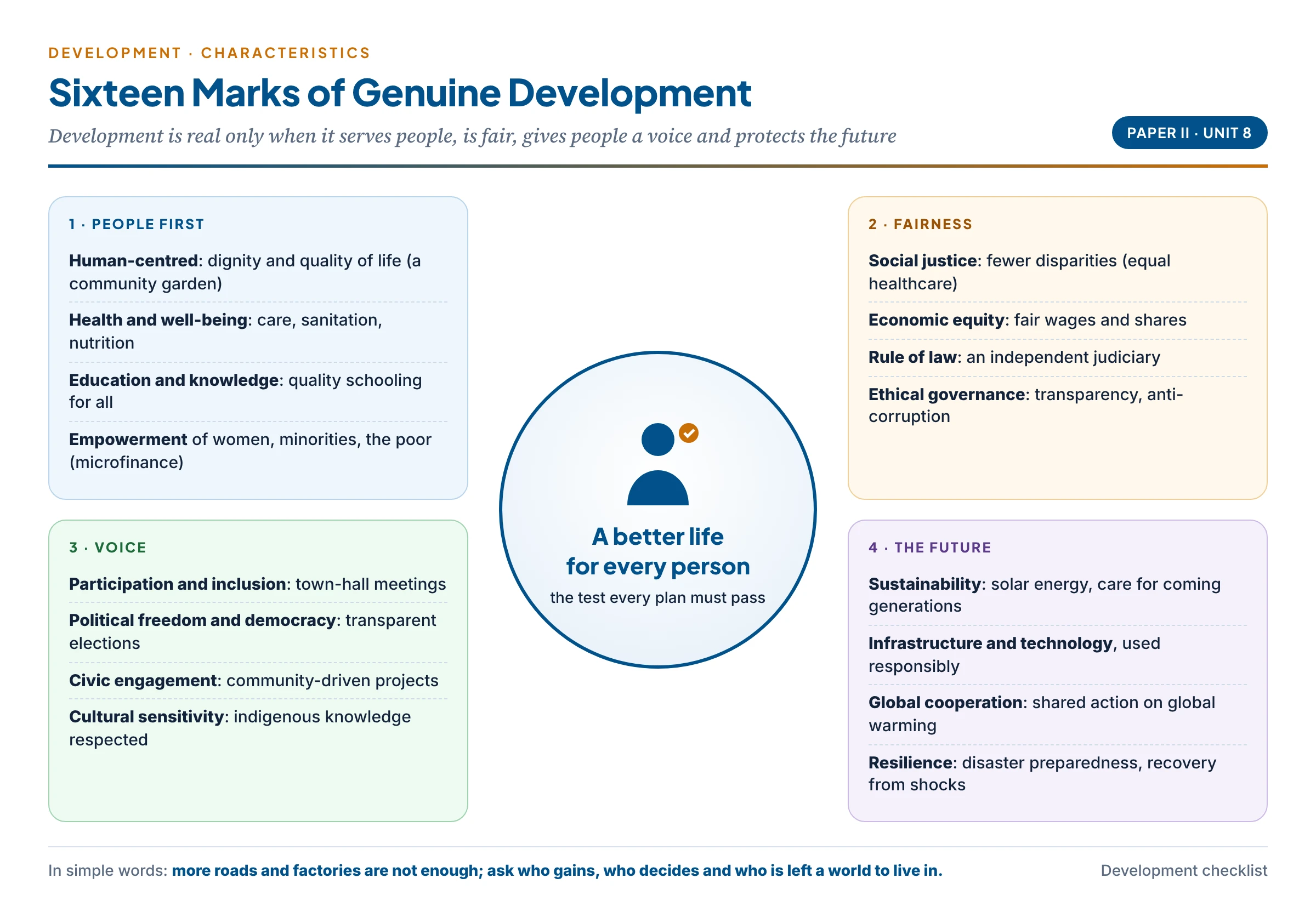
- Human-centred approach: development serves the well-being and fulfilment of human potential: quality of life, basic needs and human dignity. Example: a community garden that improves the nutrition of poor families.
- Social justice: it reduces disparities in access to resources, opportunities and benefits, aiming at a more just and equitable society. Example: equal access to healthcare for rich and poor.
- Participation and inclusion: all members of society take part in decision-making; diverse perspectives are heard, democratic values are promoted and marginalised voices count. Example: open town-hall meetings that shape local plans.
- Empowerment of marginalised groups: women, ethnic minorities and the economically disadvantaged are empowered by removing systemic barriers and creating equal opportunities. Example: microfinance that helps rural women start small businesses.
- Sustainability: present actions must not compromise the well-being of future generations; economic, social and environmental sustainability go together. Example: investment in solar energy.
- Cultural sensitivity: development respects cultural values and diversity, preserves identity and avoids cultural imperialism (one culture imposing itself on others). Example: bringing indigenous knowledge into school curricula.
- Political freedom and democracy: it builds political systems that uphold individual rights, promote accountability and allow citizens’ active participation. Example: transparent elections.
- Economic equity: fair distribution of wealth and resources, fair wages and opportunities for economic advancement for all. Example: minimum-wage and fair-wage laws.
- Access to education and knowledge: education is a key driver of individual empowerment, economic growth and social progress. Example: universal access to quality schooling.
- Health and well-being: better healthcare access, public health and attention to the social determinants of health (housing, sanitation, nutrition, income). Example: public-health campaigns such as immunisation drives.
- Rule of law and justice: institutions that ensure fairness, protect individual rights and settle disputes. Example: an independent judiciary.
- Infrastructure and technology: transport, communication and essential services, with responsible use of technology. Example: smart-city technologies that improve urban life.
- Ethical governance: transparency, accountability and ethical decision-making in political, economic and social institutions. Example: anti-corruption measures.
- Civic engagement: a sense of shared responsibility; citizens contribute to the betterment of society. Example: community-driven projects such as village water committees.
- Global cooperation: in an interdependent world, shared problems need shared solutions. Example: international collaboration against global warming.
- Crisis response and resilience: systems that can withstand shocks (economic downturns, disasters, pandemics) and recover. Example: disaster-preparedness plans that save lives in cyclones.
The Types of Development
| Type | What it means | Main features | Why it matters |
|---|---|---|---|
| Economic | Better economic well-being of a nation, measured by GDP growth and income | Infrastructure, industrialisation, wealth creation, poverty reduction | Raises living standards and creates economic opportunities |
| Human | Overall well-being and capabilities of individuals, beyond income: education, health, empowerment | Access to schooling and healthcare, gender equality, wider individual freedoms | Shows that true progress means holistic improvement in people’s lives |
| Social | Inclusive and equitable societies that tackle inequality and discrimination | Social-justice initiatives, community development, fewer social disparities | Builds fair societies with equal opportunities |
| Political | Strong political institutions, democratic governance and protection of rights | Stability, democracy, rule of law, civic participation | Creates stable and just political systems that represent citizens |
| Cultural | Preservation and enrichment of heritage, identity and creative expression | Cultural preservation, support for the arts, cultural diversity | Fosters creativity, identity and belonging |
| Environmental | Sustainable practices and protection of ecosystems | Conservation, sustainable resource management, action on climate change | Recognises that human well-being depends on a healthy environment |
| Technological | Advance of science and technology for productivity and living standards | Innovation, research and development, applying technology to social problems | Shapes how societies function; drives efficiency and progress |
| Global | Development of the interconnected world as a whole | International aid, cooperation, narrowing the gap between rich and poor nations | Expresses the shared responsibility of the international community |
| Community | Better quality of life within particular communities through local, grassroots effort | Local empowerment, community engagement, locally chosen priorities | Recognises local agency, so development fits each community’s own needs |
Growth vs Development
- Economic growth is the increase in a country’s output of goods and services over time, usually measured as the annual rise in GDP or GNP (gross national product). It is:
- Quantitative: it counts how much is produced.
- One-dimensional: it looks at one number.
- Silent about who gets the income, what it does to the environment, whether children go to school or whether people are free.
- Development is a qualitative, multidimensional and ethical process of structural change: removal of poverty, reduction of inequality, expansion of what people can do and be, and a better quality of life.
- The relation between them: growth is a potential instrument; development is the human end. Growth can pay for schools, hospitals and pensions, but only if it is shared and well used.
- Three possible combinations:
- Growth with development: income rises and is used to widen education, health and freedom (for instance, the Nordic countries; South Korea’s land reform plus mass schooling).
- Growth without development: income rises but most people gain little, the environment suffers or freedoms are curbed. This is growth with immiseration (immiseration: making people more miserable): high GDP growth while infant mortality rises, female literacy stagnates, democratic liberties are suppressed and the natural environment is destroyed.
- Development with modest growth: health and education improve through public action even when income is low (Kerala and Sri Lanka in the 1970s and 1980s are the classic examples).
Common confusion
Is economic growth the same as development? No. Growth is a rise in output; development is a rise in the quality of human lives. Many notes treat the two words as synonyms, but a nation can grow without developing (growth with immiseration) and can develop a good deal with modest growth (Kerala). Growth is best seen as one means of development, important but neither sufficient nor the goal itself.
The Changing Paradigms of Development Thinking
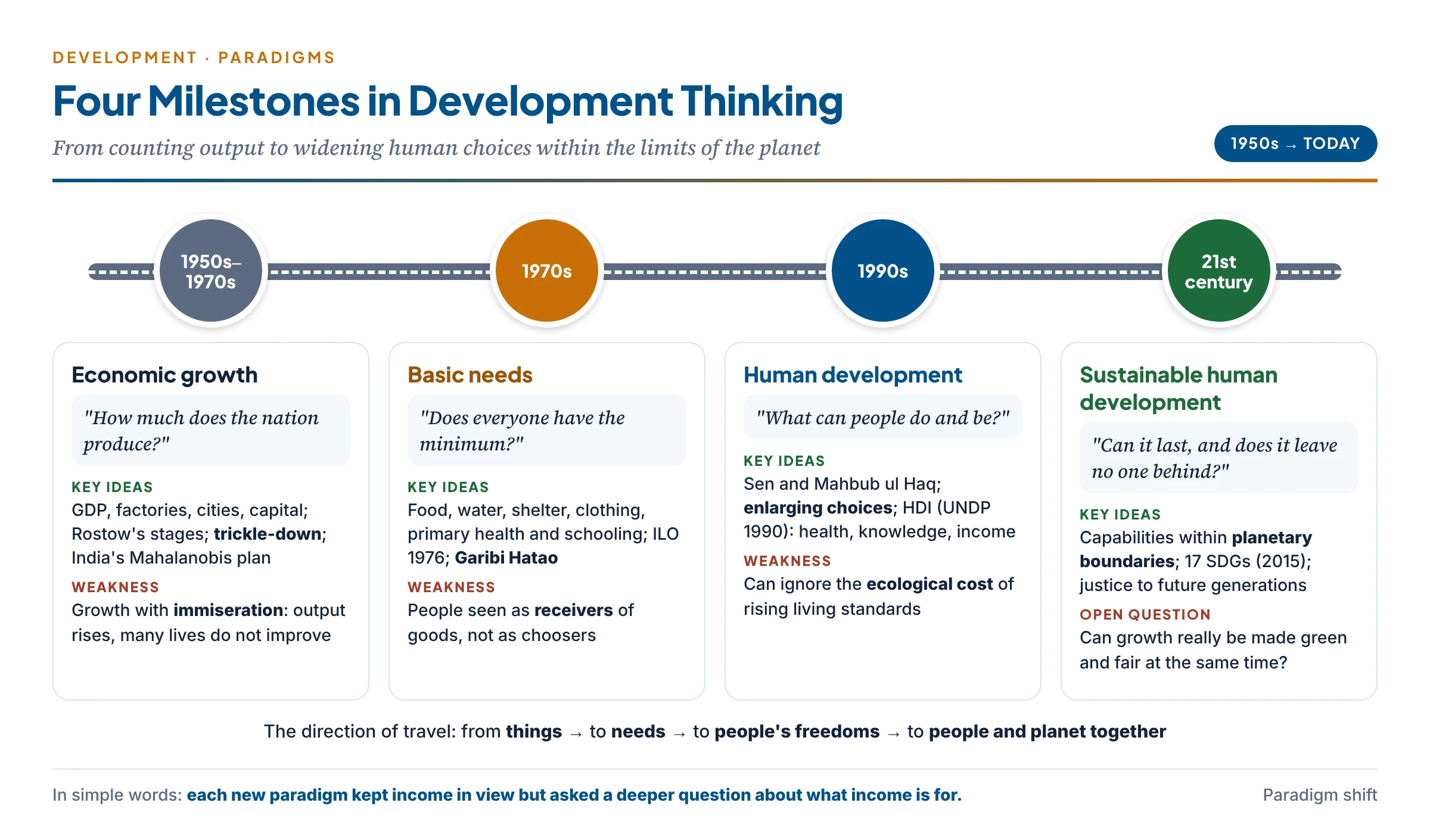
A paradigm is a shared model of what a problem is and how to solve it. Development thinking has passed through four main paradigms:
1. The economic-growth paradigm (1950s–1970s)
- Development = industrialisation, capital accumulation, urbanisation and a high annual rate of GDP growth. Poor countries were “backward” because they lacked capital and factories.
- Modernisation theory described a single ladder of stages that every society must climb. W. W. Rostow’s The Stages of Economic Growth (1960) named five: traditional society → preconditions for take-off → take-off → drive to maturity → age of high mass consumption.
- The trickle-down assumption: wealth created at the top would automatically trickle down to the poor at the base, through jobs, wages and spending.
- India’s version: the Nehru–Mahalanobis strategy of the Second Five-Year Plan (1956) gave priority to heavy industry and the public sector, the “commanding heights” of the economy. Nehru called big dams like Bhakra Nangal the “temples of modern India”.
Critiques of the growth paradigm:
- Robert F. Kennedy’s indictment (1968): in a speech at the University of Kansas he said that the gross national product “counts air pollution and cigarette advertising, and ambulances to clear our highways of carnage”, but not “the health of our children, the quality of their education or the joy of their play”. “It measures everything, in short, except that which makes life worthwhile.”
- The opulence fallacy (commodity fetishism): wealth and income are only instrumentally valuable (valuable for what they let us do), not ends in themselves. Amartya Sen’s warning: to confuse higher income with higher well-being is to mistake the tool for the craftsman.
- Growth with immiseration: as shown above, figures can rise while lives get worse.
- Trickle-down did not trickle: in many countries the benefits of growth stayed at the top, and poverty and unemployment persisted.
2. The basic-needs approach (1970s)
- The International Labour Organisation’s World Employment Conference (1976) asked that development first secure the basic needs of all: food, safe water, shelter, clothing, primary health care and primary education, plus employment.
- India’s echo: the slogan “Garibi Hatao” (remove poverty, 1971) and the Minimum Needs Programme of the Fifth Plan (1974–79).
- Limit: it treated people as receivers of goods rather than as agents who choose.
3. The human-development paradigm (1990s)
- Mahbub ul Haq and Amartya Sen shifted attention from things to people. The first Human Development Report (UNDP, 1990) declared that “people are the real wealth of a nation” and that the basic purpose of development is to enlarge people’s choices.
- The Human Development Index (HDI) combines a long and healthy life (life expectancy), knowledge (years of schooling) and a decent standard of living (income per person). In the 2025 Human Development Report, India ranked 130 of 193 countries with an HDI value of 0.685 (data for 2023), in the “medium human development” group.
- The theory behind it is Sen’s capability approach (see the next article on Development as Freedom).
4. Sustainable human development (21st century)
- Development must widen human capabilities within the limits of the planet: “planetary boundaries” such as a stable climate and biodiversity.
- The Sustainable Development Goals (SDGs, 2015): 17 goals for 2030, from ending poverty and hunger to climate action, under the pledge to “leave no one behind” (see the article on sustainable development).
Models of Development
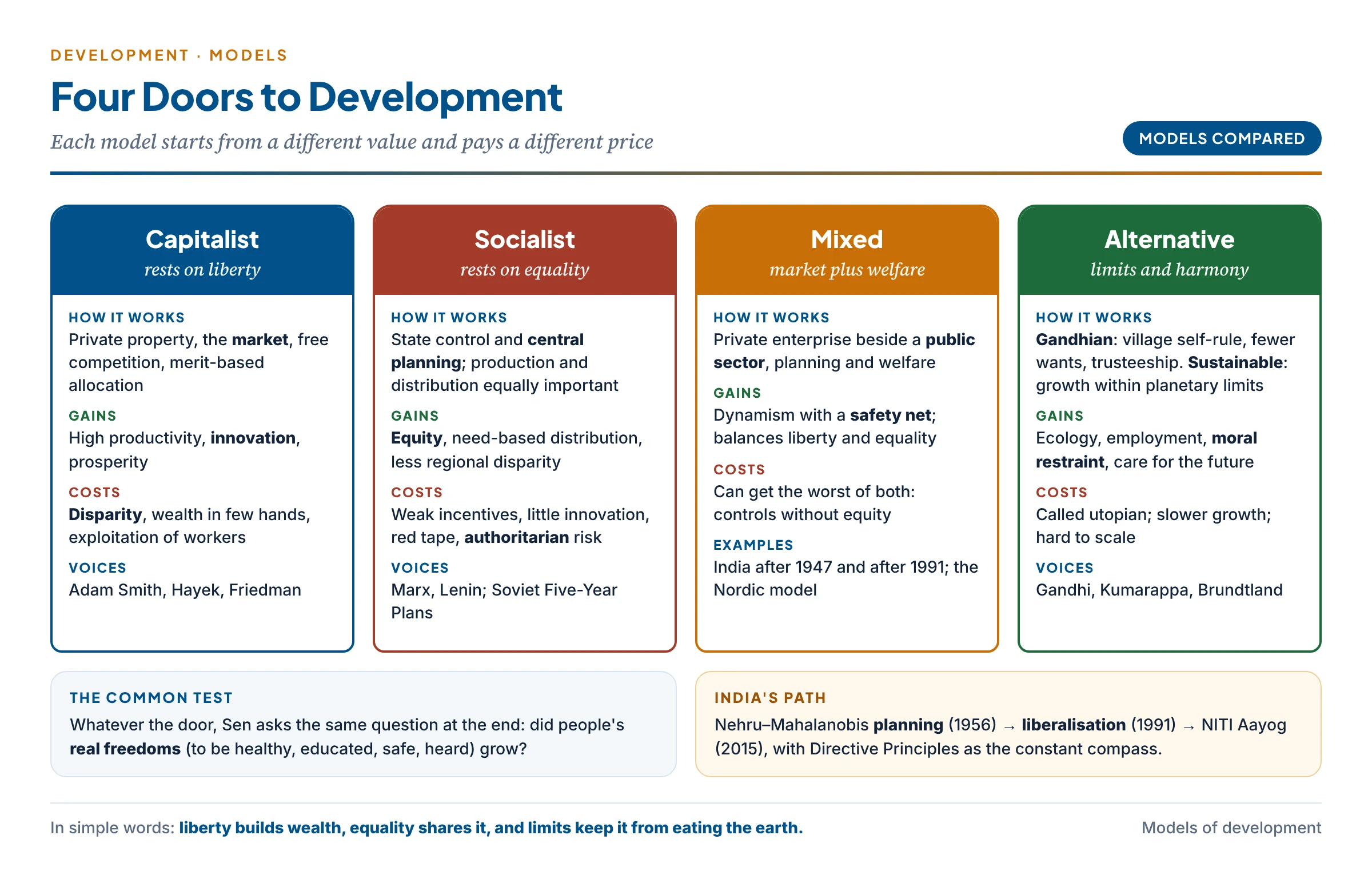
1. The capitalist model
- Based on the idea of liberty. Supports private property, the market system and free competition; resources are allocated by merit and price, with a limited role for the state.
- Thinkers: Adam Smith’s “invisible hand”; in the twentieth century Friedrich Hayek and Milton Friedman; in policy, the “Washington Consensus” of the 1980s–90s (privatisation, deregulation, open trade) promoted by the World Bank and IMF.
- Merits: a high rate of productivity; strong motivation for innovation; prosperity for society.
- Demerits: increasing economic disparity; concentration of economic resources in a few hands; exploitation of the working class; booms and busts; neglect of public goods and the environment.
2. The socialist model
- Based on the idea of equality. Believes in a state-controlled economy and central planning; gives equal importance to production and distribution.
- Examples: the Soviet Five-Year Plans; Maoist China before 1978.
- Merits: economic equity and equality; need-based distribution; reduction of regional disparity through planning; full employment and universal basic services.
- Demerits: lack of incentives; lack of motivation for innovation; red tape (red-tapism, slow rule-bound bureaucracy); and it often results in authoritarianism, because a state that controls the whole economy gathers too much power.
3. The mixed model
- Combines private enterprise with a strong public sector, planning and welfare. Most democracies today follow some version.
- India after 1947: a mixed economy with planning (Planning Commission, 1950), a large public sector and the Directive Principles as guides (Article 38: the State shall strive to promote the welfare of the people and minimise inequalities of income; Article 39(b)–(c): ownership of material resources should serve the common good and wealth should not be concentrated).
- After 1991: liberalisation, privatisation and globalisation (LPG) shifted India towards the market, with welfare programmes alongside (MGNREGA 2005, Right to Education 2009, National Food Security Act 2013). The Planning Commission was replaced by NITI Aayog in 2015.
- The Nordic model (Sweden, Norway, Denmark) joins open markets with high taxes and universal welfare.
4. Alternative models
- The Gandhian model (village-centred, limited wants, trusteeship) and the sustainable-development model are treated in separate articles. The table below places all of them side by side.
| Model | Main thinkers | What development means | Final goal |
|---|---|---|---|
| Neoliberal growth | Adam Smith, Milton Friedman, the World Bank | Continuous capital accumulation, GDP growth and free markets | Material abundance, consumer choice, maximum utility |
| Socialist planning | Marx, Lenin; Mahalanobis in India | Planned production and equal distribution under state control | Equality and the end of exploitation |
| Capability approach | Amartya Sen, Martha Nussbaum | Expansion of substantive human capabilities; removal of unfreedoms | Human dignity, agency and flourishing |
| Sustainable development | Brundtland Commission, Hans Jonas, Rawls | Balancing growth, social equity and planetary limits | Justice between generations; ecological balance |
| Gandhian Sarvodaya | Gandhi, J. C. Kumarappa | Moral self-rule, fewer wants, village self-reliance | Uplift of the last person (antyodaya); harmony of material and spiritual |
| Post-development | Arturo Escobar, Vandana Shiva, Wolfgang Sachs | Questioning the Western idea of development itself; local plurality | A “pluriverse”: many ways of living well |
Development and Capitalism: Larrain’s Thesis
Jorge Larrain, a Chilean social theorist, argued in Theories of Development (1989) that ideas of development do not appear at random: each phase of capitalism produced its own idea of what development means.
| Phase of capitalism | What was happening | Main development ideas |
|---|---|---|
| Competitive capitalism (about 1700–1860) | Small firms in competitive markets; the new industrial bourgeoisie struggled to remove the last remains of feudalism and win political power; capitalism expanded across the world in search of markets and colonies | Classical political economy (Adam Smith, Ricardo); Marx’s historical materialism |
| Imperialism (1860–1945) | Huge firms and banks; export of capital to the colonies; capitalism became the predominant mode of production; development was taken for granted | Neo-classical economics with its theory of market equilibrium; the Marxist theory of imperialism (Lenin) |
| Late capitalism (1945 onwards) | Decolonisation; new nations demand development; a phase of expansion (1945–1966) followed by slowdown and crisis (from 1966) | Modernisation theory (Rostow); the UN’s Economic Commission for Latin America (Prebisch); dependency theory; later neo-liberalism (Friedman) and world-systems theory |
The Marxist and dependency view:
- Marxists argue that the development of colonised countries is blocked as long as the colonial bond persists: the colony is made to export raw materials cheaply and import manufactured goods dearly.
- Dependency theory (Raúl Prebisch, Andre Gunder Frank, F. H. Cardoso) extends this to formally independent countries. The world is divided into a centre (rich industrial countries) and a periphery (poor raw-material exporters); trade between them is unequal exchange, so the periphery’s poverty is not an early stage of development but a product of the same world system. Frank called this “the development of underdevelopment”.
- Indian echo: Dadabhai Naoroji’s “drain theory” (Poverty and Un-British Rule in India, 1901) argued that British rule drained India’s wealth to Britain through home charges, salaries and profits.
In simple words
Imagine a village that sells raw cotton to a city mill for very little and buys back cloth made from it at a high price. Every year the village works harder and stays poor, while the city grows rich. Dependency theory says that many poor countries are this village: their poverty is made, not natural.
The Right to Development (1986)
- The Declaration on the Right to Development was adopted by the UN General Assembly in 1986 (resolution 41/128). Developing countries saw it as the foundation of a more egalitarian world order.
- Article 1: the right to development is “an inalienable human right” by which every person and all peoples are entitled to participate in, contribute to and enjoy economic, social, cultural and political development, in which all human rights and fundamental freedoms can be fully realised.
- Main ideas:
- Self-determination and sovereignty: peoples have the right to choose their own path and to sovereignty over their natural wealth and resources.
- All rights matter equally: civil, political, economic, social and cultural rights are indivisible and interdependent; none may be sacrificed for another.
- Comprehensive development: development is a comprehensive economic, social, cultural and political process aiming at the constant improvement of the well-being of the entire population and of all individuals, on the basis of their active, free and meaningful participation and the fair distribution of benefits.
- The two Covenants: it builds on the International Covenant on Economic, Social and Cultural Rights and the International Covenant on Civil and Political Rights (both 1966).
- Concern over obstacles: it expresses concern at obstacles such as colonialism, racism, foreign domination and the denial of rights, and urges equal attention to all categories of rights.
- Sen’s perspective fits this: freedom is both the end (constitutive role) and a principal means (instrumental role) of development: political freedoms, economic opportunities and social security reinforce one another.
Common confusion
Is the Right to Development a binding treaty? No. It is a declaration of the General Assembly, a statement of principles, not a treaty that states must ratify. Its force is moral and political: it has shaped later documents such as the Vienna Declaration (1993), which reaffirmed it “as a universal and inalienable right”, and the 2030 Agenda for sustainable development.
Indian Connect — Indian Connect
- The Indian Constitution builds the right to development into its Directive Principles (Articles 38, 39, 41, 46, 47) and, through the courts, into Article 21: the right to life has been read to include the right to livelihood (Olga Tellis v. Bombay Municipal Corporation, 1985), education, health and a clean environment.
- The 73rd and 74th Amendments (1992) gave panchayats and municipalities the duty to prepare plans for “economic development and social justice” (Articles 243G and 243W), making development participatory at the grassroots.
Critical Evaluation
Criticisms of Development
- Unequal distribution: the benefits of growth often go to certain groups or regions, leaving others marginalised and widening existing inequalities. In India, the World Inequality Lab estimated in 2024 that the top 1% received about 22.6% of national income and held about 40% of wealth (2022–23), among the highest shares in the world.
- Cultural homogenisation: development on Western models can make cultures uniform: local traditions, languages and practices are undermined or replaced by globalised norms, eroding cultural diversity.
- Environmental degradation: rapid industrialisation brings deforestation, pollution and resource depletion, with long-term damage to ecosystems and biodiversity.
- Dependence on external aid: development programmes in poorer countries can create dependency on foreign aid and organisations, which may compromise national sovereignty and build permanent reliance on outside help (aid often comes with conditions on policy).
- Inadequate focus on human development: traditional measures such as GDP miss improvements (or declines) in well-being; education, health and quality of life must be prioritised alongside income.
- Exploitation of labour: in the pursuit of growth, low wages, poor working conditions and denial of workers’ rights are common, especially in lightly regulated industries (the Rana Plaza garment-factory collapse in Bangladesh, 2013, killed over 1,100 workers).
- Displacement: big projects (dams, mines, industrial corridors) displace millions, often tribal people and small farmers; the Narmada dams became the symbol of this cost in India.
Inequitable Development and Social Conflict
Why unequal development breeds conflict rather than progress:
- Relative deprivation: people judge their condition by comparing themselves with others. When some groups prosper visibly while others stagnate, the gap produces frustration and anger, even if the poor are slightly better off than before.
- Loss of legitimacy: when development seems to serve only the powerful, people lose faith in the state and its laws; trust and social cohesion weaken.
- Competition for scarce resources: land, water and forests taken for projects set communities against companies and the state, and sometimes communities against each other.
- Identity and region: inequality that falls along lines of caste, tribe, religion or region turns economic grievance into identity conflict and demands for separation.
- Marx’s view: capitalist development produces class polarisation, and polarisation leads to class struggle.
- Indian examples:
- The Left-Wing Extremism (Naxalite) belt in the mineral-rich tribal areas of Chhattisgarh, Jharkhand and Odisha, where mining wealth coexisted with deep tribal poverty and displacement.
- Agitations for reservation by relatively prosperous farming castes, driven by agrarian distress and lack of jobs despite overall growth.
- Land-acquisition protests (Singur and Nandigram, West Bengal, 2006–07).
- Conclusion of the argument: development becomes progress only when it is inclusive: when its gains are shared and those who bear its costs have a voice. Otherwise growth can destroy the social peace on which further growth depends.
In simple words
A school builds a beautiful new wing, but only the children of the rich may enter it, and the playground of the others is taken to build it. The school is “bigger” but it is not “better”: the playground children are angry, the teachers are divided and learning suffers. Inequitable development works the same way in a nation.
Counterarguments and Strengths
- Poverty alleviation: development creates jobs, schools and clinics; successful programmes have lifted millions out of extreme poverty. In India, NITI Aayog estimated that about 24.82 crore people escaped multidimensional poverty between 2013–14 and 2022–23, as the share of the multidimensionally poor fell from 29.17% to 11.28%.
- Technological advancement: development brings technology that raises productivity, improves communication and the quality of life; access to technology can bridge gaps and empower communities (mobile banking, telemedicine).
- Social progress: development programmes promote gender equality, inclusion and human rights and better living standards.
- Global connectivity: trade, cultural exchange and diplomacy create interdependence, which contributes to peace and stability.
- Environmental sustainability: there is a growing emphasis on sustainable development that balances growth with conservation; green technologies are now part of development strategy.
- Empowerment of local communities: participatory models involve communities in decision-making, so projects match their needs and values (for instance, the gram sabha’s role under the Forest Rights Act, 2006).
Critics and Defenders
Criticism — Critics of the development project
- Marxists and dependency theorists: development under capitalism enriches the centre and keeps the periphery poor.
- Gandhians: it multiplies wants, destroys village life and severs economics from ethics.
- Environmentalists: it treats nature as an endless storehouse and dumping ground.
- Post-development thinkers (Escobar, Sachs): “development” is a Western story that labels other cultures “backward”.
- Feminists (Vandana Shiva): it is “maldevelopment” that ignores women’s work and knowledge.
Defence — Defenders and reformers
- Liberals: markets and growth have produced the largest fall in poverty in history.
- Sen and the human-development school: the answer is not less development but better development, judged by human capabilities.
- Sustainable-development advocates: growth can be made green and inclusive.
- Constitutional democrats: participation, rights and courts can protect those who bear development’s costs.
- The Right to Development: poor countries need development as a matter of justice; denying it would freeze global inequality.
Cross-Tradition Comparison
| Question | Mainstream Western economics | Marxist and dependency thought | Indian traditions (Kauṭilya, Gandhi, Constitution) |
|---|---|---|---|
| What is development? | Rising output and income; modernisation | Ending exploitation and class or colonial domination | Welfare of all (sarvodaya), with artha inside dharma |
| Main engine | Markets, capital, technology | Planning, social ownership, revolution or delinking | Ethical rule, village self-reliance, the welfare state |
| Main danger | State interference | Capitalist and imperial exploitation | Greed, centralisation, loss of moral restraint |
| Measure of success | GDP and per capita income | Equality, end of exploitation | The condition of the poorest (Gandhi’s talisman) |
Indian Connect — Indian Connect
- Gandhi’s talisman (1947) is a test of development in one sentence: “Recall the face of the poorest and the weakest man whom you may have seen, and ask yourself, if the step you contemplate is going to be of any use to him.”
- Ambedkar warned in the Constituent Assembly (25 November 1949) that India was entering “a life of contradictions”: equality in politics (one person, one vote) but inequality in social and economic life, and that the contradiction must be removed or those who suffer from it would “blow up the structure of political democracy”.
Synthesis (Siddhānta)
- Development is a normative idea: it always contains a picture of what a good life and a just society are. Calling growth “development” hides this picture; making it explicit is the first task of the philosophy of development.
- Growth is necessary but not sufficient. Poor societies need more income to pay for schools, hospitals and pensions. But growth becomes development only when it is shared, sustainable and chosen by people themselves, and when it widens their real freedoms.
- No single model is complete. The market brings dynamism, planning brings equity, the Gandhian model brings moral limits and ecological care, and the capability approach supplies the measure by which all of them can be judged.
- Contemporary relevance: climate change, rising inequality and automation show that the twentieth-century model of development cannot simply be repeated. India’s goal of “Viksit Bharat @2047” will be judged not only by GDP but by whether development reaches the last person and protects the planet that future generations will inherit.
“Development can be seen … as a process of expanding the real freedoms that people enjoy.” — Amartya Sen
Previous Year Questions
- 2022Do you agree that economic development does not on its own lead to human development and social progress? Give reasons and justifications for your answer.
- 2015“Inequitable development leads to social conflicts rather than social progress.” Explain.