

Individual and State: Rights; Duties and Accountability.
Official Syllabus: Paper II, Section A, Unit 3
If rights are what is due to me, duties are what is due from me. The word “duty” itself comes from the old French deu — “owed”. Every society teaches its members what they owe — to parents, teachers, neighbours, the poor, the nation, nature and, for believers, God. Western modern thought spoke mostly the language of rights; classical Indian thought spoke mostly the language of dharma. This article explains the meaning of duty, its kinds (legal and moral, positive and negative, perfect and imperfect, objective and subjective, prima facie), Kant’s theory of duty and his famous distinction between perfect and imperfect duties, the Indian ideas of dharma, svadharma, ṛṇa-traya, niṣkāma karma and lokasaṅgraha, the Buddhist ethic of reciprocal duties, and the Fundamental Duties of the Indian Constitution (Article 51A) — their history, content, significance and criticism. The relation between rights and duties is examined in the next article.
In simple words
A railway platform shows duty in miniature. The driver must stop at red signals (a legal duty). Passengers must not push the elderly (a moral duty, rarely punished). The ticket-checker must check every ticket — that is his role duty. A passenger who sees a child alone should help, though no law may force him. And everyone owes everyone else the simple duty of not harming them. One platform, many kinds of duty.
Context & Problem
Meaning of Duty
- General meaning. A duty is an obligation binding a rational agent to do or refrain from doing something, towards others, society, the state or oneself.
- Political meaning. A citizen’s obligation to obey the orders and laws made by the state is called duty.
- Philosophical meaning. Here morality, not law, is the basis of duty. Duty means performing acts that are worth doing and not performing acts that are not worth doing.
- Sanctions behind duty.
- Legal — punishment by the state.
- Social — disapproval, boycott, loss of reputation.
- Religious — divine justice, the law of karma, fear of sin.
- Conscience — the inner voice; for Kant, reason itself.
- Words for duty. Latin officium (Cicero’s De Officiis, “On Duties”); Sanskrit kartavya (that which ought to be done) and dharma (that which upholds).
Why Duties Matter
- No right without a duty — every claim-right needs someone bound to respect or provide it.
- Social order — a society runs on people doing what they ought even when no one is watching.
- Moral character — duties express what kind of persons we are trying to be.
Core Doctrine
Kinds of Duty
| Kind | Meaning | Example |
|---|---|---|
| Legal duty | Imposed by law, backed by state sanction | Paying taxes; obeying traffic rules |
| Moral duty | Imposed by morality or conscience; no legal sanction | Helping the needy; speaking the truth in daily life |
| Positive duty | To do something | Educate one’s children; vote |
| Negative duty | To refrain from something | Not to steal, harm or lie |
| Perfect duty | Strict; must always be done (for Mill: someone has a correlative right) | Keeping a promise; not killing |
| Imperfect duty | Wide; we choose when and how (no one can demand it as a right) | Charity; developing one’s talents |
| Objective duty | What the law or society holds to be one’s duty | A soldier’s duty to obey orders |
| Subjective duty | What the agent himself considers his duty | A soldier’s conscience forbidding him to fire on peaceful protesters |
| Universal duty | Owed by everyone to everyone | Non-violence, honesty |
| Special (role) duty | Arises from a role or relationship | Doctor to patient; parent to child |
- Conflict of objective and subjective duty. Sometimes they clash. A rebel may consider it his moral duty to revolt against a despot, while the state arrests him for disloyalty. Gandhi, the American abolitionists and anti-colonial fighters all faced this conflict.
- W. D. Ross’s prima facie duties (The Right and the Good, 1930) — duties of fidelity, reparation, gratitude, justice, beneficence, self-improvement and non-maleficence. Each is binding “at first sight”; when they conflict, judgement decides which is our actual duty in that situation.
Duties to Whom?
- To oneself — preserve one’s life and health, develop one’s talents, keep self-respect.
- To other persons — not to harm, deceive or exploit; to keep promises; to help in need.
- To family and community — care for parents, children and neighbours.
- To the state — obey just laws, pay taxes, defend the country, vote, serve the public.
- To humanity — respect human rights, help in disasters, oppose genocide.
- To nature and future generations — protect environment and other living beings (a duty stressed by Indian, Jaina and ecological ethics).
Kant: Duty as Respect for the Moral Law
- Duty defined. “Duty is the necessity of an action done out of respect for the moral law.” Only an action done from duty has true moral worth.
- From duty vs in accordance with duty. A shopkeeper who gives correct change only because cheating would hurt his business acts in accordance with duty, but not from duty; his act has no moral worth. The honest shopkeeper who would be honest even if cheating were profitable acts from duty.
- The good will. “Nothing … can be called good without qualification except a good will” — the will to do one’s duty for its own sake.
- Autonomy. A rational being gives the moral law to himself; acting from fear of punishment or hope of reward is heteronomy.
- Hypothetical vs categorical imperatives.
- Hypothetical — “If you want X, do Y” (if you want to pass, study). It binds only those who want X.
- Categorical — “Do Y” unconditionally. Moral duties are categorical.
- Main formulations of the categorical imperative.
- Universal law — act only on that maxim (personal rule) which you can at the same time will to become a universal law.
- Humanity — treat humanity, in yourself and in others, always as an end and never merely as a means.
- Kingdom of ends — act as a law-making member of a community of rational beings who respect each other as ends.
Kant’s Perfect and Imperfect Duties
- The test. Kant asks what happens when a maxim is made universal.
- If the maxim cannot even be thought as a universal law without contradiction (“contradiction in conception”), it violates a perfect duty.
- If it can be thought but cannot be willed as a universal law by a rational agent (“contradiction in the will”), it violates an imperfect duty.
- Perfect duties — strict and narrow: they allow no exception in favour of inclination; they mostly forbid actions.
- Imperfect duties — wide: they prescribe an end (helping others, developing oneself) but leave latitude about when, how and how much.
- Kant’s four examples (in the Groundwork):
| Duty to oneself | Duty to others | |
|---|---|---|
| Perfect | Not to commit suicide out of self-love when life brings more pain than pleasure | Not to make a false promise (borrowing money with no intention to repay) |
| Imperfect | To develop one’s talents rather than idle in pleasure | To help others in need (beneficence) |
- Why the false promise fails as a universal law. If everyone made false promises when in need, no one would believe promises; the very practice of promising would collapse, and the maxim would defeat itself — a contradiction in conception.
- Why refusing help fails. A world where no one helps anyone can be imagined without contradiction; but no rational being could will it, because every person sometimes needs help — a contradiction in the will.
- Duties of right and duties of virtue (Metaphysics of Morals). Duties of right concern external actions and can be enforced by law (do not steal); duties of virtue concern the ends we adopt and cannot be enforced (perfect yourself; promote others’ happiness). Imperfect duties belong to virtue.

In simple words
Think of a cricket team. “Never fix a match” is a perfect duty — there is no “sometimes” about it, and if every player fixed matches, cricket itself would vanish. “Practise to improve your batting” and “help a struggling team-mate” are imperfect duties — you must take them seriously, but you choose which evening to practise and how to help.
Common confusion
Is a “perfect duty” simply a duty to which someone else has a corresponding right? That is J. S. Mill’s definition, not Kant’s. Mill (Utilitarianism) says duties of perfect obligation are those in which a correlative right resides in some person — justice; duties of imperfect obligation (charity, generosity) give no one a right to demand them. Kant draws the line differently — by whether the duty allows latitude and by the contradiction test; his perfect duties include duties to oneself (not to commit suicide), where no other person holds a right. Many notes mix the two; both are useful, but they should be attributed correctly.
Criticisms of Kant’s theory of duty
- Rigorism. If lying is always forbidden, must one tell a murderer where a friend is hiding? Kant said yes — most find this unacceptable.
- Conflict of duties. Kant gives no clear method when two duties clash; Ross’s prima facie duties were a response.
- Empty formalism (Hegel) — the universal-law test, by itself, gives no content; almost any maxim can be phrased to pass.
- Coldness. Acting from duty alone, without love or compassion, seems morally poorer (Schiller’s joke about helping friends “with pleasure” and so lacking moral worth).
- Defence. Kant’s core idea — that persons must never be used merely as means, and that morality must be universalisable — remains the foundation of human dignity and human rights.
Duty in Indian Thought: Dharma
- Meaning of dharma. From the root dhṛ, “to hold, to sustain”: dharma is that which upholds the individual, society and the cosmos. It covers duty, law, virtue and right order.
- Ṛta. In the Vedas, ṛta is the cosmic order; human duty keeps life in harmony with it.
- Sāmānya dharma and viśeṣa dharma.
- Sāmānya (universal) dharma — duties of all human beings: ahiṃsā (non-violence), satya (truth), asteya (non-stealing), śauca (purity), indriya-nigraha (self-control), forgiveness and compassion.
- Viśeṣa (special) dharma — duties by varṇa (social order) and āśrama (stage of life: student, householder, forest-dweller, renunciant).
- Āpad-dharma — duty in times of distress, when normal rules may be relaxed.
- Rājadharma — the king’s duty to protect subjects, punish wrongdoers and secure their welfare; Kautilya: “In the happiness of his subjects lies the king’s happiness.”
Svadharma, Niṣkāma Karma and Lokasaṅgraha (Bhagavad Gītā)
- Svadharma — one’s own duty, fitting one’s nature and station. “Better is one’s own duty, though imperfectly done, than the duty of another well performed.”
- Niṣkāma karma — act without attachment to the fruits. “Your right is to action alone, never to its fruits.” Notice: the Gītā speaks of a right (adhikāra) to action, but not to results — duty is done for its own sake.
- Lokasaṅgraha — act for the welfare and holding-together of the world; even the wise must work, to set an example.
- Kant and the Gītā. Both value duty for its own sake, not for reward. Kant grounds it in reason; the Gītā in dharma and devotion to God, aiming at liberation.
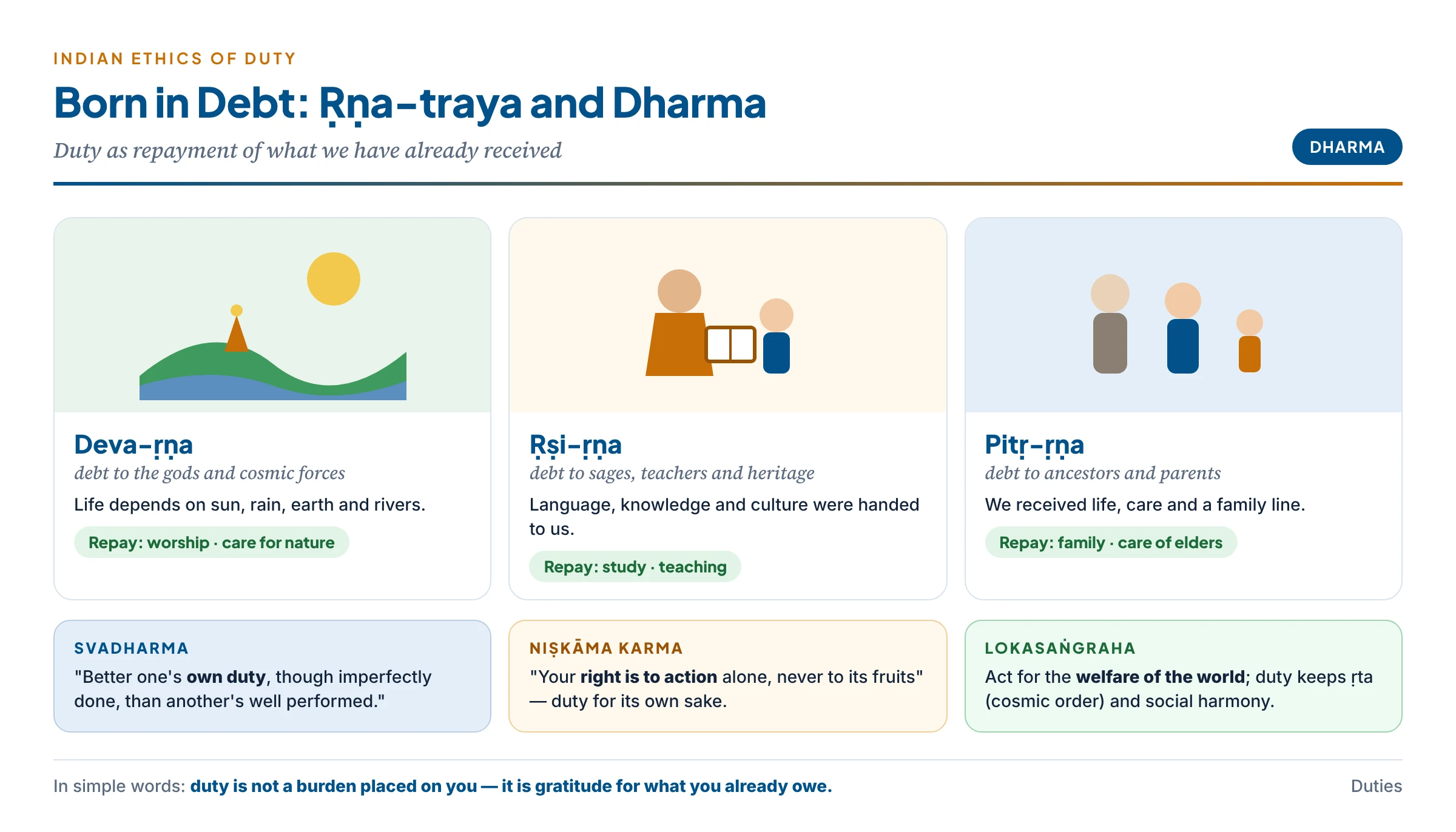
Ṛṇa-traya: The Three Debts
- Human life is born in debt; duties repay what we have already received.
- Deva-ṛṇa — debt to the gods and cosmic forces (nature) — repaid by sacrifice and worship, today read as care for nature.
- Ṛṣi-ṛṇa — debt to the sages, teachers and cultural heritage — repaid by study and teaching.
- Pitṛ-ṛṇa — debt to ancestors and parents — repaid by raising a family and continuing the line.
- Later additions — debts to fellow human beings (hospitality) and to all living beings (feeding animals), in the five great daily sacrifices (pañca mahāyajña).
- Moral point. Duty is not imposed from outside; it is gratitude for what we owe. Fulfilment of duty (kartavya-pālana) keeps cosmic balance (ṛta) and social harmony (lokasaṅgraha).
Reciprocal Duties: The Buddhist Model
- In the Sigālovāda Sutta, the Buddha teaches a young householder that duties run both ways:
- Parents and children — children support parents; parents restrain children from evil and give them education.
- Teachers and pupils — pupils serve and learn; teachers train them well.
- Husband and wife — each respects and is faithful to the other; the husband provides, the wife manages well.
- Employer and worker — the employer gives work suited to strength, fair wages, food and medical care; the worker serves diligently.
- Significance. Each person’s duty is another’s due — an Indian anticipation of the correlativity of rights and duties.
Gandhi on Duty
- Gandhi held that rights flow from duties well performed: “all rights to be deserved and preserved came from duty well done” (developed in the next article).
- Swadeshi as duty to one’s neighbour; bread labour as duty to work with one’s hands; satyagraha as the duty to resist injustice non-violently.
In simple words
A student whose fees were paid by parents, who learnt from teachers and who drinks water from a river she did not create, already owes a great deal. The idea of ṛṇa says: duty is not a burden someone else puts on you; it is the repayment of a debt you have already received.
Fundamental Duties: Article 51A
History
- The original Constitution had no chapter on duties.
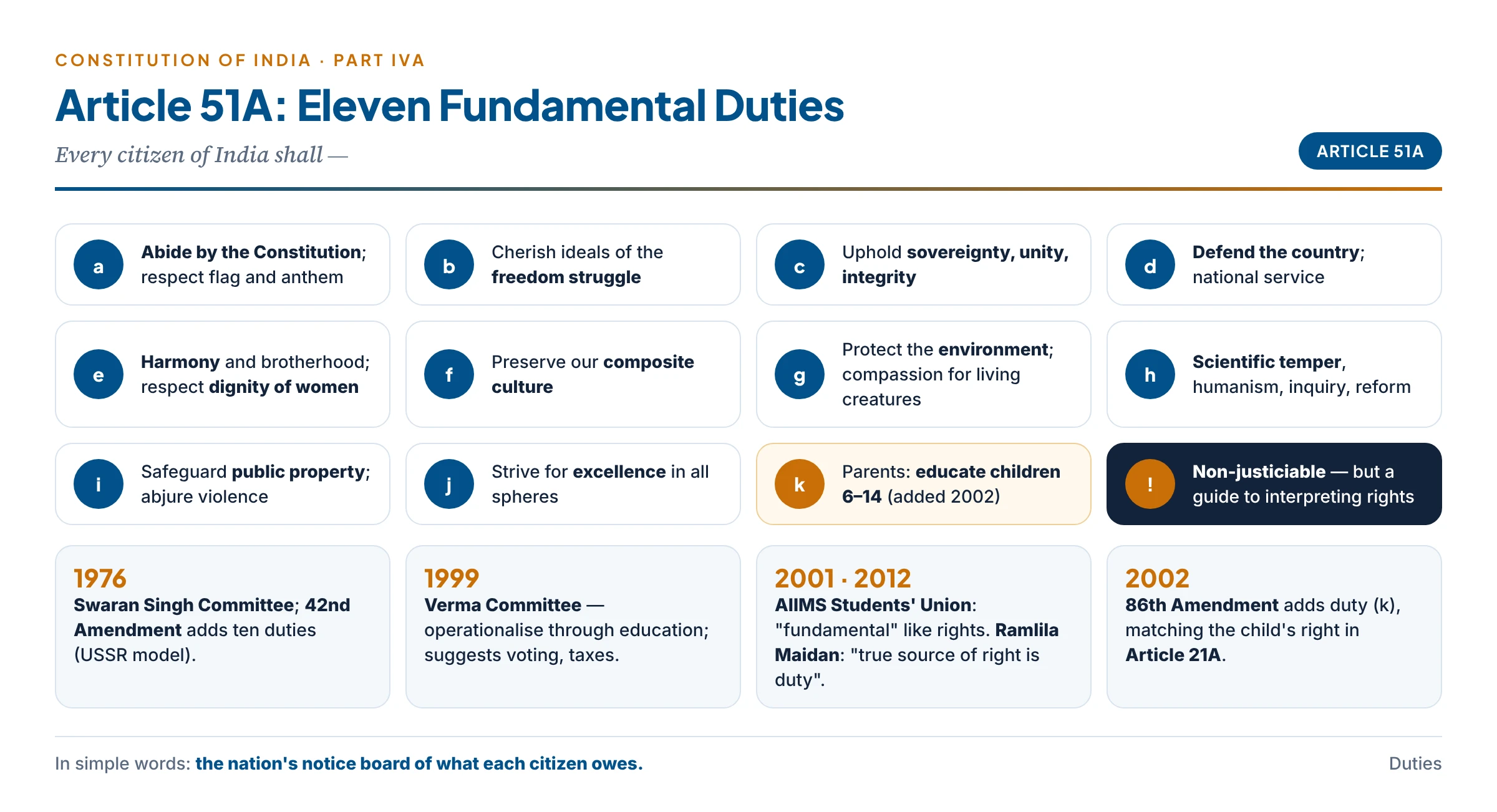
- The Swaran Singh Committee (1976) recommended them; the 42nd Amendment (1976) added Part IVA, Article 51A, with ten duties. The idea was drawn mainly from the constitution of the former USSR; Western constitutions rarely list citizens’ duties, while socialist ones stress them.
- The 86th Amendment (2002) added an eleventh duty.
In simple words
A housing society’s notice board lists residents’ rights — water, lift, parking — and also their duties — pay maintenance, don’t litter, keep noise down. No one is jailed for littering, but the notice reminds everyone that the comforts they claim depend on what they each do. Article 51A is the nation’s notice board of duties.
The eleven Fundamental Duties — every citizen shall:
- Abide by the Constitution and respect its ideals and institutions, the National Flag and the National Anthem.
- Cherish the noble ideals of the freedom struggle.
- Uphold the sovereignty, unity and integrity of India.
- Defend the country and render national service when called upon.
- Promote harmony and the spirit of common brotherhood transcending religious, linguistic, regional and sectional diversities; renounce practices derogatory to the dignity of women.
- Value and preserve the rich heritage of our composite culture.
- Protect and improve the natural environment — forests, lakes, rivers, wildlife — and have compassion for living creatures.
- Develop the scientific temper, humanism and the spirit of inquiry and reform.
- Safeguard public property and abjure violence.
- Strive towards excellence in all spheres of individual and collective activity.
- (Added in 2002) As a parent or guardian, provide opportunities for education to one’s child or ward between six and fourteen years.
Significance of including duties of citizens in the Constitution
- Reminder — citizens enjoying rights are reminded of their obligations to the country and to fellow citizens.
- Balance of rights and duties — corrects a one-sided culture of claims.
- Warning against anti-social and anti-national activities — burning the flag, destroying public property, communal violence.
- Inspiration and discipline — they promote commitment, unity and a sense of participation in national goals.
- Aid to interpretation — courts use them to interpret laws and to judge the reasonableness of restrictions on rights:
- In AIIMS Students’ Union v. AIIMS (2001) the Supreme Court said that duties carry the same prefix “fundamental” as rights and provide a valuable guide to interpreting constitutional and legal issues.
- In the Ramlila Maidan case (2012) the Court said that undue emphasis on rights without regard to duties creates imbalance, and that “the true source of right is duty“.
- Environmental cases (Rural Litigation and Entitlement Kendra; M. C. Mehta) used Article 51A(g) to remind every citizen of the duty to protect the environment.
- Link with laws — many duties are given effect through statutes: the Prevention of Insults to National Honour Act (1971), the Wildlife Protection Act (1972), the Forest (Conservation) Act (1980), provisions against promoting enmity between groups, and the Right to Education Act (2009) together with Article 21A (the duty of parents matches the right of the child).
- Indian ethos — they reflect the traditional emphasis on dharma and duty.
Implementation
- The Justice J. S. Verma Committee (1999) reported on how to operationalise Fundamental Duties through education, and suggested adding duties such as voting and paying taxes.
- In Ranganath Mishra v. Union of India (2003) the Court asked the government to implement the Verma Committee’s recommendations.
- In 2024 the Supreme Court, hearing a plea to enforce Fundamental Duties, observed that it cannot direct the legislature to enact a law for their enforcement; awareness among citizens is the main route.
Criticisms
- Non-justiciable — no court can directly enforce them; critics call them pious declarations.
- Vague terms — “composite culture”, “scientific temper”, “noble ideals” are open to many readings.
- Not exhaustive — important duties such as voting, paying taxes and family planning are missing (the Verma Committee and others suggested additions).
- Placement — put in Part IVA after the Directive Principles, they appear less important.
- Origin during the Emergency — added in 1976, they were suspected of being a device to stress obedience over rights.
- Many are already covered by ordinary law, making their separate listing redundant.
Critical Evaluation
Duty-centred and Rights-centred Ethics
- Strengths of duty ethics. It builds responsibility, community and character; it reminds people that rights require others to act.
- Dangers of duty ethics.
- Duties defined by birth (varṇa, gender) can justify hierarchy.
- Authoritarian rulers preach duty to silence protest.
- Duty without rights leaves the weak with burdens and no claims.
- Kant’s balance. Kant’s ethics is duty-based, yet it grounds human dignity — the basis of rights. Duty and rights are two sides of respect for persons.
Critics and Defenders
Criticism — Critics
- Rigorism and coldness in Kant — no lying even to a murderer; duty without compassion.
- Hegel: the categorical imperative is empty formalism.
- Ambedkar: birth-based dharma made duties a tool of caste hierarchy.
- Liberal critics of Article 51A: non-justiciable, vague, born in the Emergency.
- Libertarians: the state should not prescribe positive duties beyond not harming others.
Defence — Defenders and strengths
- Kant: duty grounded in reason protects every person’s dignity.
- Ross: prima facie duties make moral life flexible but serious.
- Gītā: niṣkāma karma frees action from selfish desire; lokasaṅgraha ties duty to the common good.
- Buddha: reciprocal duties anticipate the correlativity of rights and duties.
- Supreme Court: Fundamental Duties are a guide to interpreting rights and their limits.
Cross-Tradition Comparison
| Theme | Kant | Bhagavad Gītā / Indian ethics |
|---|---|---|
| Basis of duty | Pure practical reason; the moral law | Dharma, cosmic order (ṛta), divine will |
| Motive | Respect for the moral law, not inclination | Niṣkāma karma — action without desire for fruits |
| Universality | Universal law for all rational beings | Sāmānya dharma universal; viśeṣa dharma by station |
| Duties to self | Not to commit suicide; develop talents | Self-control (dama), study (svādhyāya) |
| Goal | A good will; the kingdom of ends | Lokasaṅgraha and liberation (mokṣa) |
| Weakness | Rigid; formal | Station-based duties can justify hierarchy |
Indian Connect — Indian Connect
- Kant and niṣkāma karma. Both reject acting for reward. The Gītā’s “your right is to action alone, never to its fruits” is close to Kant’s demand to act from duty — but the Gītā roots duty in one’s nature and station, while Kant roots it in universal reason.
- Svadharma, reinterpreted. Gandhi and Aurobindo read svadharma as one’s inner calling, not caste duty; this reading makes it compatible with equality.
- From dharma to Article 51A. The Fundamental Duties translate the old idea of dharma into a civic form — duties owed equally by every citizen, regardless of caste or creed.
Synthesis (Siddhānta)
- Duty is the other face of right. Every claim-right implies a duty; every duty well performed secures someone’s right.
- Kinds of duty differ in strictness and source — perfect and imperfect, legal and moral, objective and subjective — and moral judgement is needed when they conflict.
- Kant and the Indian tradition agree that duty should be done for its own sake, not for reward; they differ on whether duty is set by universal reason or by station and dharma.
- Fundamental Duties give India a civic dharma — not enforceable directly, but a guide to citizens, legislators and courts.
- Contemporary relevance.
- Climate change makes duties to nature and future generations urgent.
- Online behaviour — hate speech and misinformation — raises the duty of responsible expression.
- Voting and tax compliance debates echo the call to add these to Article 51A.
- Conclusion. A society of right-holders with no sense of duty cannot last; a society of duty-bearers with no rights is oppressive. The ideal is the citizen who claims his rights and performs his duties — and knows that the second secures the first.
“Duty is the necessity of an action done out of respect for the moral law.” — Immanuel Kant
Previous Year Questions
- 2013What is the significance of including duties of citizens in the Indian constitution?
- 2011Discuss Kant’s distinction between duties of perfect and imperfect obligation.
- 2008Do rights necessarily imply corresponding obligations? To whom does one primarily owe obligations – individuals or state? Discuss.