

Individual and State: Rights; Duties and Accountability.
Official Syllabus: Paper II, Section A, Unit 3
Everyone agrees that rights matter; philosophers disagree about where rights come from. Are they given by nature or God before any state exists? Are they made by law? Do they grow slowly out of custom and history? Are they whatever serves social welfare? Or are they the conditions a person needs to become a moral self? Each answer leads to a different view of the state — and of what to do when a law violates a right. This article explains the five classical theories of rights — natural, legal, historical, social-welfare and idealist — with their arguments, examples and criticisms, and then the Marxist, feminist and communitarian critiques of the whole idea of rights.
In simple words
Ask five people why a child has a right to education. One says, “Because every human being is born with it” (natural). One says, “Because the Constitution says so — Article 21A” (legal). One says, “Because our society has always valued learning” (historical). One says, “Because an educated population makes everyone better off” (social welfare). One says, “Because without education a person cannot become his best self” (idealist). Same right, five different foundations.
Context & Problem
- Why the source matters.
- If rights come from nature, the state cannot take them away — and citizens may resist a state that does.
- If rights come from law, there is no right against the law — only a demand for better law.
- If rights come from history, reform must be slow and respect tradition.
- If rights come from social welfare, they may be adjusted when welfare demands.
- If rights come from personality, the state must secure the conditions of moral growth.
- Historical setting. Natural-rights theory powered the English, American and French revolutions; legal positivism (Bentham, Austin) and conservatism (Burke) arose partly as reactions to the French Revolution’s language of absolute rights; social-welfare and idealist theories grew with industrial society and the welfare state in the nineteenth and twentieth centuries.
Core Doctrine
1. The Theory of Natural Rights
Main thinkers: Hugo Grotius, Thomas Hobbes, John Locke, Thomas Paine, Thomas Jefferson; the American (1776) and French (1789) Declarations.
Core claims
- Rights are gifts of nature or God. They belong to human beings simply because they are human — by reason or divine creation.
- Prior to the state. Rights exist in the state of nature, before any government.
- The state does not create them and so cannot limit or destroy them; its job is to protect them. This gives the idea of a limited state.
- Locke’s three natural rights: life, liberty and property (“estate”).
- Inalienable — they cannot be surrendered or taken away.
- Right of resistance — a government that violates natural rights loses its claim to obedience.
- Thomas Paine (Rights of Man, 1791), defending the French Revolution against Burke: every generation has the same natural rights; no generation can bind the next.
Merits
- Gave a moral standard above every government — the basis of constitutional limits and of revolutions against tyranny.
- Underlies the modern human-rights movement, which is often called the secular form of natural rights.
Criticisms
- “Nature” is ambiguous. Nature shows struggle and inequality as much as freedom; what “nature” grants is decided by each thinker’s assumptions.
- No state of nature ever existed in which people enjoyed rights before society.
- Rights need recognition. A right that no one recognises and no power protects is only a moral wish (Green, Laski).
- Lists differ. Locke says life, liberty and property; the French Declaration adds resistance to oppression; Jefferson says the pursuit of happiness. Which is “natural”?
- Bentham’s attack — see the legal theory below.
- Marx — “natural” rights such as property are the interests of the bourgeoisie presented as eternal truths.
2. The Legal (Positivist) Theory of Rights
Main thinkers: Jeremy Bentham, John Austin, Thomas Hobbes (in part), H. L. A. Hart (a softened version).
Core claims
- Rights are the creation of the state or law. A right exists only if the law of a sovereign recognises and protects it.
- There is no right before law, against law or outside law.
- Rights are not absolute; the state, which creates them, can modify or withdraw them.
- The state plays the central role — its courts and sanctions are what make a claim a right.
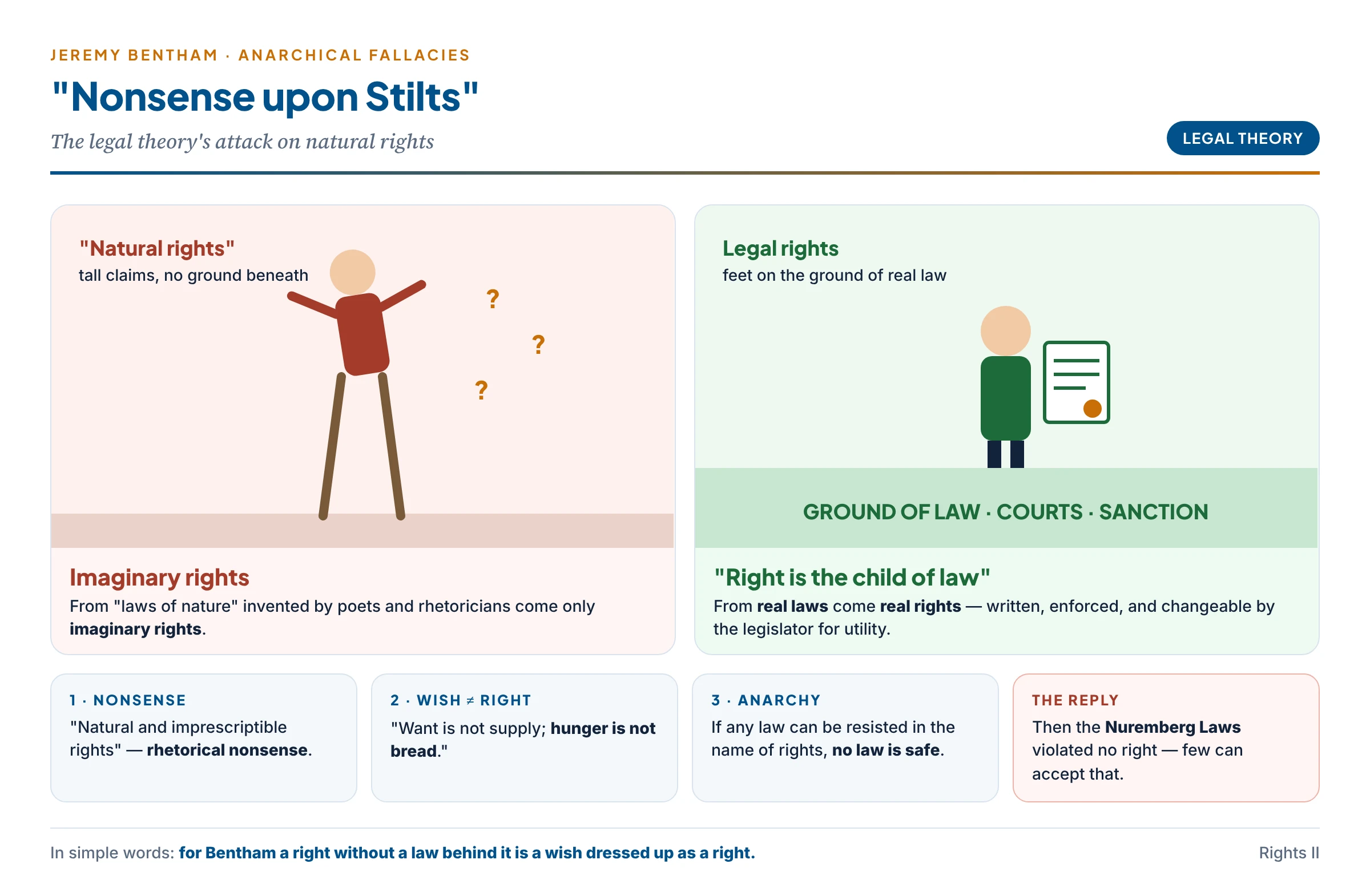
“Right, the substantive right, is the child of law: from real laws come real rights; but from imaginary laws, from laws of nature, … come imaginary rights.” — Jeremy Bentham
Bentham’s attack on natural rights (Anarchical Fallacies, written against the French Declaration):
- Conceptual nonsense. “Natural rights is simple nonsense: natural and imprescriptible rights, rhetorical nonsense — nonsense upon stilts.”
- Wishes are not rights. “Reasons for wishing there were such things as rights are not rights; want is not supply; hunger is not bread.”
- Anarchy. If every citizen may resist any law that touches his “imprescriptible” rights, every law can be disobeyed — the declaration is an invitation to insurrection.
- Utility, not nature. Rights are useful legal tools that legislators create to promote the greatest happiness of the greatest number.
Merits
- Precision — legal rights are clear, written and enforceable; one can go to court.
- Separates what the law is from what it ought to be, which helps honest criticism of law.
- Explains how rights actually work in modern states.
Criticisms
- No standard to judge bad law. If rights come only from law, the Nazi Nuremberg Laws (1935) or apartheid laws violated no rights — a conclusion almost no one accepts.
- Leaves the citizen defenceless against a tyrannical legislator; a right the state can abolish at will is a privilege.
- Law itself grows out of morality and custom. Many legal rights began as moral demands outside the law — abolition of slavery, women’s suffrage, civil rights.
- Hart’s correction. Even a positivist must accept a “minimum content of natural law” — protection of life, property and promises — without which no legal system could survive.
In simple words
A traffic police officer’s whistle is backed by law; a passer-by shouting “Stop!” is not. Bentham says rights are like the officer’s whistle — real only when the state stands behind them. His critics reply: if the officer is ordered to wave through a drunk driver who will kill a child, the child still has a right not to be killed, whatever the order says.
3. The Historical Theory of Rights
Main thinker: Edmund Burke (Reflections on the Revolution in France, 1790); also the historical school of law (Savigny, Maine).
Core claims
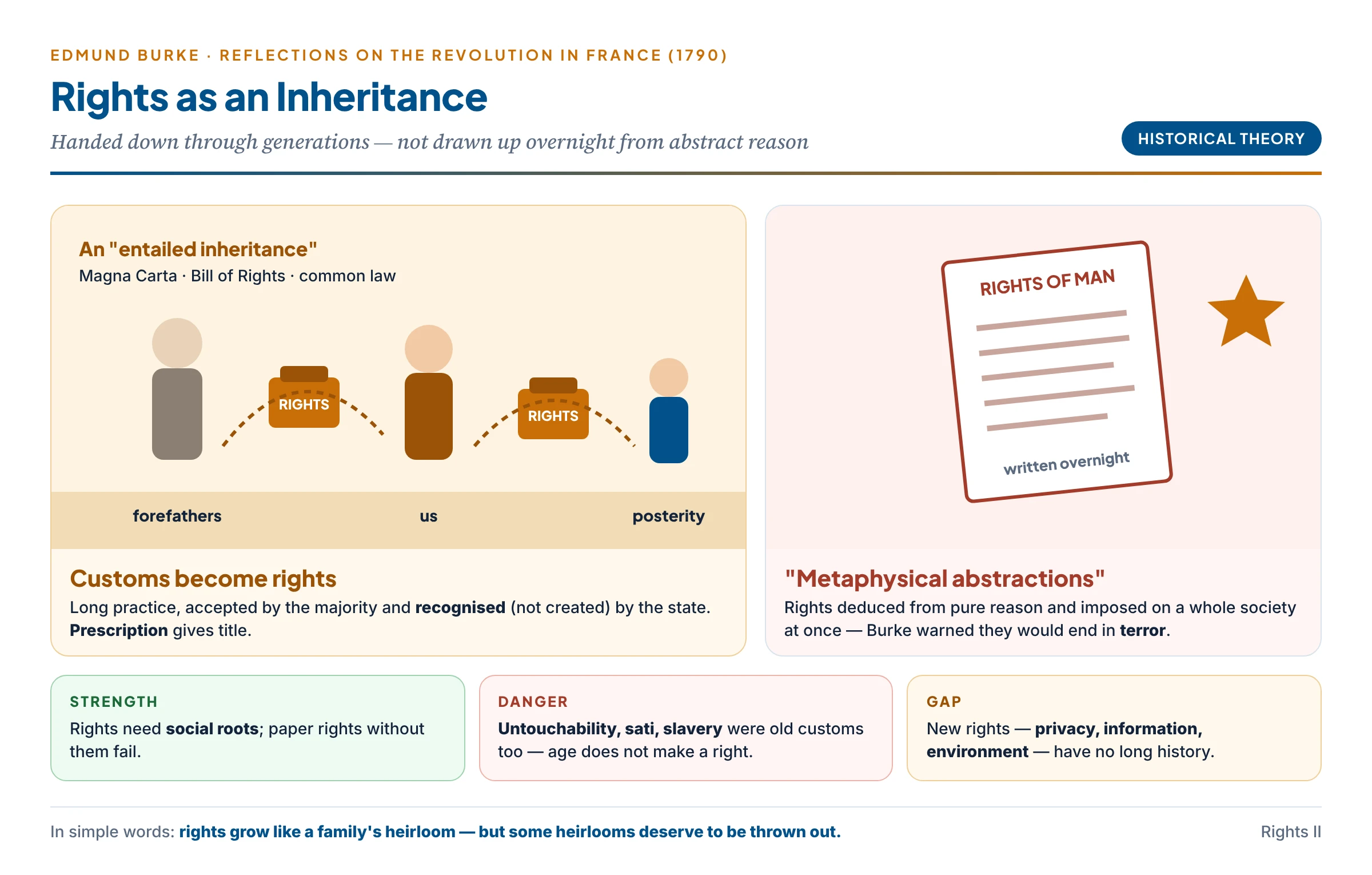
- Rights are the product of custom and history. They grow out of prevailing customs practised for a long time, recognised by the majority and accepted by the state.
- The state only recognises customary rights; it does not create them.
- Prescription — long-standing possession and usage give a right its title.
- Rights as inheritance. The English enjoy their liberties “as an entailed inheritance derived to us from our forefathers” — the rights of Englishmen (Magna Carta, the Bill of Rights), not abstract “rights of man”.
- Against abstraction. Burke attacked the French revolutionaries’ rights as metaphysical abstractions — “pretended rights” which, applied to real societies, destroy order and lead to terror.
Merits
- Shows that rights are rooted in a society’s life and institutions; paper declarations without social roots fail.
- Explains the stability of common-law rights and the value of gradual reform.
- Rightly predicted that abstract revolutionary rhetoric could justify terror.
Criticisms
- Customs can be unjust. Untouchability, sati, slavery, child marriage and denial of women’s property were long-standing customs; history alone cannot make them rights.
- Not all rights are old. The right to privacy, to information, to a clean environment or to data protection are new.
- Conservative bias. It is used to defend existing privileges and resist necessary reform.
- Customs conflict. In a plural society different communities have different customs; history does not tell us which to follow.
Common confusion
Is Burke against all rights because he attacked the “Rights of Man”? No. Burke strongly defended the rights of Englishmen — trial by jury, security of property, limited monarchy — and even supported the American colonists’ grievances. What he rejected was the claim that rights can be deduced from abstract reason and imposed on any society at once. His quarrel was about the source of rights (history, not metaphysics), not about whether rights exist.
4. The Social Welfare Theory of Rights
Main thinkers: J. S. Mill and the utilitarians, Harold Laski, Roscoe Pound, Zechariah Chafee.
Core claims
- Rights are grounded in social welfare. A claim becomes a right when its recognition promotes the general good and harmonious living.
- Acceptance by society matters more than mere recognition by the state.
- Restrictions can be imposed on rights in the larger interest of society — no right is absolute.
- Rights and duties are complementary. Each right carries a duty to use it for social good and to respect others’ rights.
- Laski: rights are “conditions of social life without which no man can seek, in general, to be himself at his best”; the state is judged by the rights it maintains.
- Roscoe Pound: law is “social engineering” — it balances competing interests (individual, public and social) so as to satisfy the maximum of wants with the minimum of friction.
In simple words
A city builds a flyover because it serves everyone’s travel; if a better metro line serves the city more, the flyover plan may change. The social-welfare theory treats rights a little like such public works — justified by the good they do for all. Its critics worry: a person is not a flyover, and some things must not be “re-planned” away even if the majority would gain.
Merits
- Explains why rights change with social needs — labour rights, the right to education, environmental rights.
- Links individual rights to the common good, avoiding selfish individualism.
- Gives a reasonable basis for reasonable restrictions (as in Article 19(2)–(6)).
Criticisms
- Who decides what welfare requires? In practice, the state or the majority — which may sacrifice minorities.
- Utilitarian erosion. If a right exists only because it is useful, it can be withdrawn when someone calculates that withdrawing it is more useful — exactly what Dworkin’s “rights as trumps” forbids.
- Vague. “Social welfare” can justify almost anything.
5. The Idealist (Personality) Theory of Rights
Main thinkers: Immanuel Kant, T. H. Green, Bernard Bosanquet, K. C. F. Krause.
Core claims
- Rights are the moral conditions needed to develop the highest personality — the capacity of each person to become a rational, self-directing moral being.
- Kant: every person is an end in himself, never merely a means; rights protect the external freedom each needs to act morally — the one innate right is freedom, so far as it is consistent with the freedom of all under a universal law.
- Green: rights are powers claimed by individuals and recognised by society as necessary for the common good; the state secures them by “hindering hindrances”.
- Rights are social, not pre-social — they exist only in a community of persons who recognise each other as moral agents.
In simple words
A seed needs soil, water and sunlight to become a tree; nobody can grow it from outside, but without these conditions it will never grow. Kant and Green see rights the same way: they are the soil, water and sunlight a person needs to grow into a free, moral self.
Merits
- Joins individual development and the common good; avoids both atomism and state-worship.
- Gives a strong ground for dignity and for positive rights (education, health) as conditions of personality.
Criticisms
- “Personality” is vague — whose idea of the best self?
- Paternalism. The state may impose its idea of the “real” good on non-conforming individuals.
- Bosanquet’s version gives too much moral authority to the state.
Theories Compared
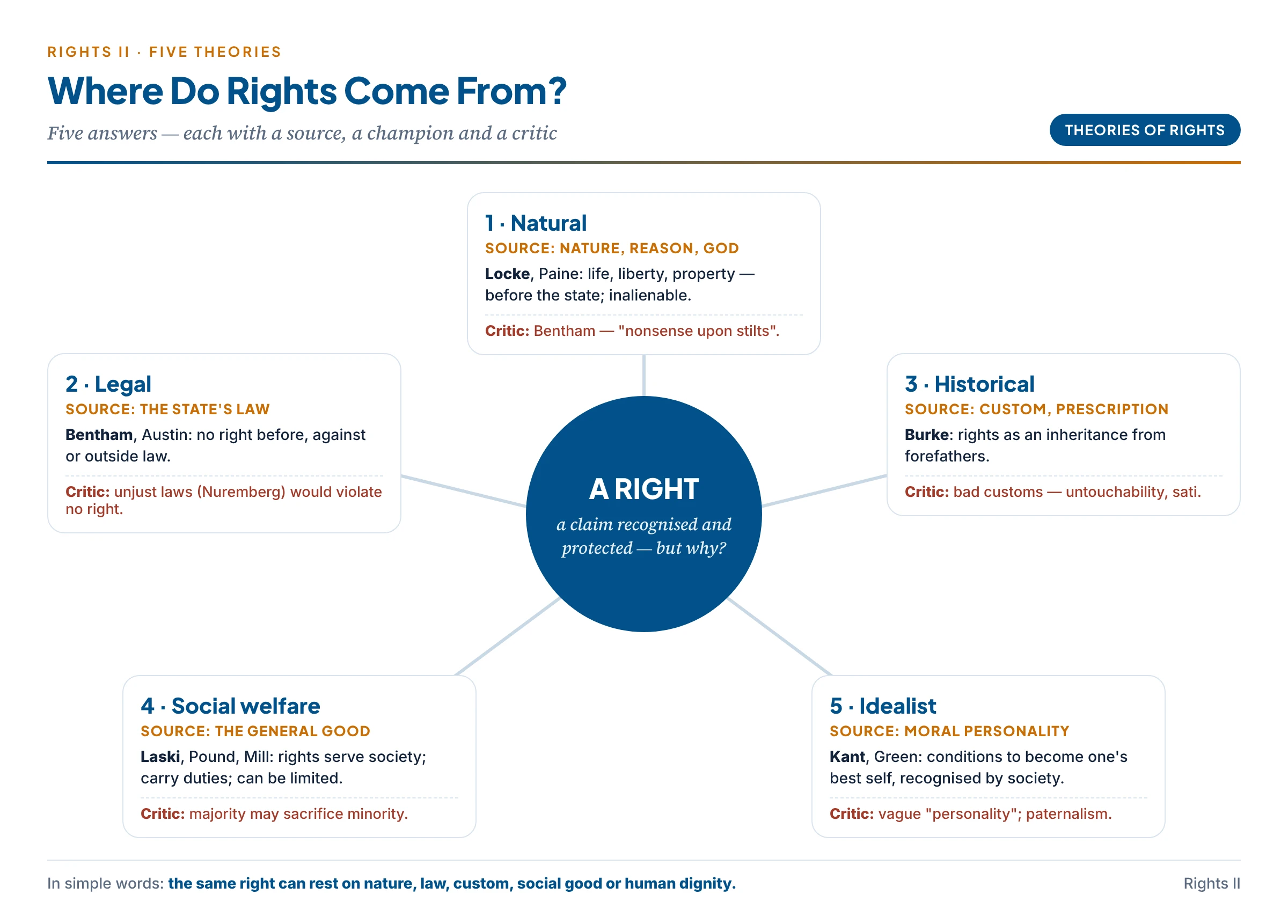
| Theory | Source of rights | Thinkers | Strength | Main criticism |
|---|---|---|---|---|
| Natural | Nature, reason, God — before the state | Locke, Paine, Grotius | Moral limit on all governments | “Nonsense upon stilts” (Bentham); vague |
| Legal | Law of the state | Bentham, Austin, Hart | Clear, enforceable | No defence against unjust law (Nuremberg Laws) |
| Historical | Custom, tradition, prescription | Burke, Savigny, Maine | Rights rooted in social life | Bad customs (untouchability, sati) |
| Social welfare | General good of society | Mill, Laski, Pound | Rights change with needs; linked to duties | Majority may sacrifice minority |
| Idealist | Conditions of moral personality | Kant, Green, Bosanquet | Dignity; positive rights | Vague; paternalism |
Critical Evaluation
The Marxist Critique of Rights
- Class character of rights. Rights in capitalist society serve the bourgeoisie: the right to property protects the owners of factories and land, not the workers who own only their labour.
- “Rights of egoistic man.” In On the Jewish Question (1843) Marx argued that the “rights of man” are the rights of man separated from other men and from the community — liberty as the right to be left alone, property as the right to enjoy one’s wealth regardless of others, security as the guarantee of egoism.
- Formal vs real rights. Equal political rights coexist with deep economic inequality; real freedom needs economic rights — to work, to a share in the product.
- Socialist rights. Socialist constitutions stressed economic and social rights and the duties of citizens.
- Reply. Where “bourgeois” civil liberties were abolished in the name of socialism, workers lost the freedoms — speech, association, strikes — they needed to defend themselves.
The Feminist Critique of Rights
- Early demands within the rights tradition. Mary Wollstonecraft (A Vindication of the Rights of Woman, 1792) and Olympe de Gouges (Declaration of the Rights of Woman and of the Female Citizen, 1791) exposed the “rights of man” as rights of men only.
- Public/private divide. Classical rights protect the private sphere from the state — but the family is where women suffered domestic violence and unpaid labour. “Non-interference” left the household unregulated.
- Male model of the person. The independent, self-owning individual of rights theory ignores dependence and care — children, the old, the sick, and those (mostly women) who care for them. Carol Gilligan contrasted an ethic of rights with an ethic of care.
- Formal equality not enough. Equal legal rights do not undo patriarchy in property, work and culture.
- Reply. Feminists have also used rights brilliantly — votes, property, reproductive rights, laws against domestic violence — showing that the problem is the narrow content of rights, not rights as such.
The Communitarian Critique
- Michael Sandel, Alasdair MacIntyre, Charles Taylor: rights-based liberalism assumes an unencumbered self, prior to its community, values and attachments.
- Neglect of duties and virtues — a society of right-holders who owe nothing to one another cannot sustain itself.
- Reply: rights protect individuals within communities from oppression by their own group (women, dissenters, lower castes).
Critics and Defenders
Criticism — Critics
- Bentham: natural rights are “nonsense upon stilts”; hunger is not bread.
- Burke: abstract rights destroy the inherited fabric of society.
- Marx: rights are the rights of egoistic, bourgeois man.
- Feminists: rights were made for men and left the family unregulated.
- Communitarians: rights-talk forgets community and duty.
Defence — Defenders and strengths
- Locke and Paine: natural rights give every person a standard above every government.
- Hart: even a legal theory must include a minimum content of natural law.
- Laski and Pound: rights grow with social needs and carry duties.
- Kant and Green: rights protect the dignity and moral growth of persons.
- Modern human-rights law blends these theories: moral foundation (natural), legal enforcement (legal), social context (historical, welfare) and dignity (idealist).
Cross-Tradition Comparison
| Western theory | Indian parallel |
|---|---|
| Natural rights from reason or God | Ṛta and sanātana dharma — an eternal moral order above kings; but it grounds duties, not individual claims |
| Legal theory — rights from the sovereign’s law | Daṇḍanīti and the king’s edicts (rājaśāsana) as a source of law in Kautilya |
| Historical theory — custom and prescription | Ācāra (custom) and sadācāra (practice of the good) recognised as sources of dharma in the Dharmaśāstras |
| Social welfare theory | Lokasaṅgraha (welfare of the world) in the Gītā; Kautilya’s yogakṣema (welfare and security of the people) |
| Idealist theory — conditions of personality | Puruṣārthas (dharma, artha, kāma, mokṣa) as aims of a full human life |
Indian Connect — Indian Connect
- Custom in Indian law. The Dharmaśāstras place custom beside scripture as a source of dharma — a close cousin of Burke’s historical theory. The Indian Constitution, however, subjects custom to Fundamental Rights (Article 13 covers “custom or usage having the force of law”), so a custom such as untouchability can be struck down. The historical theory is accepted only within limits set by rights.
- Ambedkar and the limits of law. Ambedkar agreed with the legal theory that rights need law, but warned that “rights are protected not by law but by the social and moral conscience of society” — a point close to Burke’s and Green’s insistence on social recognition.
- Gandhi and the welfare theory. Gandhi’s sarvodaya (welfare of all) makes social good the test of every right — but, unlike utilitarians, he refuses to sacrifice the last person for the many.
Synthesis (Siddhānta)
- Each theory explains one dimension of rights:
- Natural — the moral claim that exists even when the law denies it.
- Legal — the enforceable form a right needs to be effective.
- Historical — the social roots that keep rights alive.
- Social welfare — the purpose and limits of rights in a community.
- Idealist — the dignity and growth of the person that rights serve.
- An integrated view. A right is a moral claim (natural, idealist), justified by its role in human flourishing and social good (welfare), recognised by society (historical), and enforced by law (legal).
- The critiques make the theories better. Marx adds economic rights; feminists add care and the private sphere; communitarians add duties and community.
- Contemporary relevance.
- Human-rights law treats rights as universal moral claims (natural) written into treaties and constitutions (legal).
- Courts weigh rights against public interest (welfare) and strike down harmful customs (against a purely historical view).
- New rights — privacy, data, environment — show rights grow with society.
- Conclusion. Rights are not given by any single source. They are moral claims made real by recognition and law, for the sake of persons living together.
“Every state is known by the rights that it maintains.” — Harold J. Laski
Previous Year Questions
- 2022Does the idea of unconditional rights necessarily lead to anarchy? Critically examine.
- 2021Evaluate whether the social contract theory adequately addresses the different issues of human rights.
- 2016Evaluate the statement that all human beings have certain unalienable rights.