

Individual and State: Rights; Duties and Accountability.
Official Syllabus: Paper II, Section A, Unit 3
The relationship between the individual and the state is the oldest question of political philosophy and the starting point of this whole unit. Two questions sit at its heart: why should a free human being obey a power that can tax, jail and even conscript him? And what does the state owe the individual in return? Every answer depends on two prior beliefs — what human nature is like, and whether the individual or the community comes first. This article sets out the four classic views of the state, the mechanistic, organic and developmental theories of the individual–state relation, and the classical and contractarian thinkers who shaped them — Plato, Aristotle, Hobbes, Locke and Rousseau. The liberal, idealist, Marxist, anarchist and Gandhian views follow in the next article.
In simple words
Think of a housing society. Some residents say the managing committee is a nuisance and should be dissolved. Some say it is needed only to keep the gate locked and the lift running — nothing more. Some want it to run a clinic, a library and a children’s park. A few treat the committee as sacred — whatever it decides must be obeyed. These four attitudes to a small committee are the four great attitudes to the state.
Context & Problem
Individual, Citizen and State
- Individual. A human being considered on his own — with his own body, mind, interests and plans. In political philosophy the individual becomes a citizen when he is a member of a political community.
- Citizen. A full and responsible member of a political community, entitled to rights and bound by duties.
- State. A set of institutions within a society that takes public decisions, makes and enforces law, maintains justice, public order and safety. The citizen is a member of the community; the state is the power structure of that community.
- The central tension. The individual wants freedom to live his own life; the state needs authority to keep order and pursue common goals. Political philosophy keeps asking where the line between the two should fall.
Three Questions That Decide Every Theory
- What is human nature like? Selfish and fearful (Hobbes), reasonable and peaceful (Locke), naturally good but corrupted by society (Rousseau), or naturally social (Aristotle)?
- Which comes first — individual or community? If the individual is prior, the state is a tool he makes for his purposes. If the community is prior, the individual finds his very identity inside it.
- What is the state for? Only protection of life and property, or the moral and material development of every person?
- Why human nature matters. A theory of the good political order usually rests on some account of what human beings are really like. Every thinker in this article shows how a picture of human nature leads to a picture of the state.
Core Doctrine
The Four Views of the State
Political thinkers can be arranged on a line, from those who would abolish the state to those who would worship it.
| View | Proponents | Core idea | Relation with individual |
|---|---|---|---|
| 1. State as an unnecessary evil | Anarchists (Godwin, Proudhon, Bakunin, Kropotkin), Marxists | The state always works against the interests of individuals; it should disappear | Hostile — abolish the state |
| 2. State as a necessary evil | Negative liberals and libertarians (Locke, Adam Smith, Spencer, Nozick) | We need a limited, night-watchman state for security and contracts; beyond that it is a danger | Conditional — obey a limited state |
| 3. State as a positive good | Positive liberals, egalitarians, socialists (Green, Laski, Rawls) | The state can enable people — schools, hospitals, social security | Harmonious — the state serves self-development |
| 4. State as an end in itself | Idealists (Hegel, Bosanquet), fascists and Nazis | The state is the highest moral reality; the individual lives for it | Subordinate — individuals should always obey |
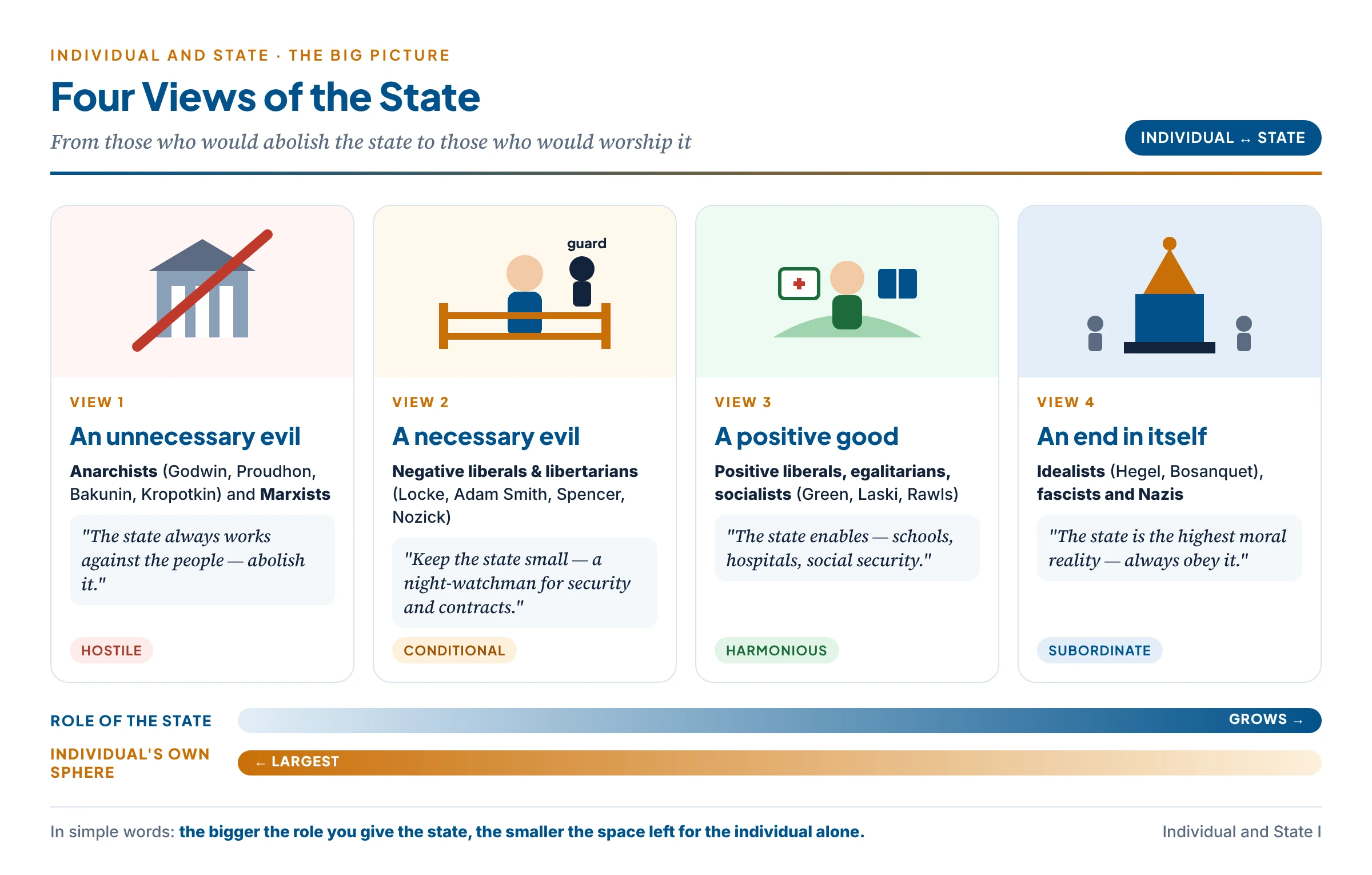
- Reading the table. Moving from left to right, the state grows and the individual’s independent sphere shrinks. Most real democracies today sit near the third view — a welfare state limited by fundamental rights.
Three Theories of the Individual–State Relation
The four views rest on three deeper pictures of how individual and state are connected.
- Mechanistic (atomistic) theory — the individual comes first.
- Thinkers: Hobbes, Locke, Bentham, Herbert Spencer, Nozick.
- The individual is a self-contained unit (“atom”) who exists, with his interests and rights, before any political society. C. B. Macpherson called this picture possessive individualism — the individual as owner of his own person and capacities, owing nothing to society for them.
- The state is an artificial machine, made by a social contract, to protect life, property and contracts.
- The individual is the end; the state is only the means. If the state oversteps its limited role, it loses its legitimacy.
- Organic (idealist) theory — the community comes first.
- Thinkers: Plato, Aristotle, Hegel, F. H. Bradley, Bosanquet.
- Society is like a living body; individuals are its organs or cells. A hand cut off from the body is a hand only in name.
- The individual finds his moral identity and freedom only inside the state.
- Danger: it can slide into the totalitarian subordination of conscience to the state, as fascist readings of Hegel showed.
- Developmental (harmonious) theory — individual and state need each other.
- Thinkers: T. H. Green, Harold Laski, Amartya Sen.
- Rejects both the lonely atom and the all-absorbing organism.
- The state is an enabling environment: it removes obstacles so that each person can develop his capacities. Green’s phrase: the state should “hinder hindrances” to the good life.
In simple words
Think of a cricket team. The mechanistic view says: eleven separate players signed a contract to play together for their own benefit. The organic view says: a player is nothing outside the team; the team’s glory is his glory. The developmental view says: the team exists so that each player can bring out his best — and good players make a good team.
Plato: The Ideal State and the Individual
- The state as the individual “writ large”. In the Republic Plato studies justice in the state because it is easier to see there in large letters than in the small letters of a single soul.
- Three classes, three parts of the soul.
- Rulers (philosopher-kings) — reason; wisdom.
- Auxiliaries (soldiers) — spirit; courage.
- Producers (farmers, artisans, traders) — appetite; temperance (self-control).
- Justice is each class doing its own work and not interfering with others — a harmony in the state that mirrors harmony in the soul.
- Communism of property and family for the guardians: no private property, no private family, so that rulers are not tempted by personal interest.
- Education and censorship. The state controls education, stories and music to form the right character.
- Individual in Plato’s state. The individual’s good is identified with performing his function for the whole. There is no idea of rights the individual can hold against the state; even marriage and children of guardians are regulated.
Is Plato’s ideal state compatible with individual rights and liberties?
- Arguments that it is not:
- No individual rights in the modern sense — a person’s place is fixed by his nature and education, not by his choice.
- Abolition of family and property for guardians removes basic private liberties.
- Censorship of poets and myths denies freedom of expression.
- Rule by experts, not by consent — citizens do not choose their rulers.
- Karl Popper (The Open Society and Its Enemies) called Plato’s state a blueprint for a closed, totalitarian society.
- Arguments in Plato’s defence:
- Plato’s aim is the good of every class, not the rulers’ gain — the guardians give up property precisely so that they cannot exploit others.
- He offers equal education to women among the guardians — radical for his time.
- Each person is placed where his talents fit, which can be read as a form of self-realisation.
- Plato’s concern is justice as harmony, a moral ideal later liberals also need (no rights survive in a society without order).
- Balanced view. Plato secures order and the common good, but at the cost of choice, privacy and dissent. Modern liberty begins exactly where Plato is weakest.
Aristotle: The Middle Course between Statism and Individualism
- “Man is by nature a political animal” (zōon politikon). Human beings fulfil their nature only in a polis (city-state).
- The state is prior to the individual — not in time, but in nature and importance, as the whole is prior to its parts.
- “Beast or god.” He who can live without the state, or needs nothing because he is self-sufficient, is either a beast or a god.
- Growth of the state. Family → village → state. The state comes into being for the sake of life and continues for the sake of the good life.
- Aristotle’s criticisms of Plato — the source of his “middle course”:
- Excessive unity. Plato wants the state to be like one person; but a state is by nature a plurality. Too much unity destroys the state.
- Common property breeds neglect — “what is common to the greatest number gets the least care”. Better: private ownership, common use (generosity).
- Abolishing the family weakens affection; it is better to have a real cousin than a diluted son shared by all.
- Rule of law is better than the rule of even the wisest man, because law is “reason without passion”.
- Polity — a mixed constitution blending oligarchy and democracy and resting on a strong middle class — is the best practicable state.
| Issue | Plato | Aristotle |
|---|---|---|
| Unity of state | Maximum unity, like one person | Unity in plurality |
| Property | Common for guardians | Private property, common use |
| Family | Abolished for guardians | Retained as natural |
| Who rules | Philosopher-king | Law and citizens taking turns |
| Best state | Ideal state | Polity — best practicable state |
| Individual | Absorbed in function | Fulfilled in the polis, with private life protected |
- Was Aristotle more successful than Plato in steering a middle course?
- Yes: he keeps the organic idea (state prior, man political) but protects property, family and the rule of law, which are the seeds of individual liberty.
- But limits remain: he defends natural slavery, excludes women, labourers and foreigners from citizenship, and still makes the polis the place where virtue is formed. His “individual” is the free male citizen, not every human being.
- Verdict: compared with Plato he moves towards individualism, but he is still within the organic tradition. The full idea of an individual with rights against the state arrives only with the modern contract theorists.
Common confusion
Does “the state is prior to the individual” mean Aristotle thought the state existed before people did? No. Aristotle knew that families and villages came first in time. “Prior” means prior in nature: just as a hand is a hand only as part of a living body, a human being becomes fully human — rational, moral, speaking — only as part of a political community. The priority is of the whole over the part, not of the earlier over the later.
Thomas Hobbes: Absolutism Built on Individualism
- A modern thinker. Hobbes (1588–1679), writing during the English Civil War, is often called the first modern political thinker. He tried to build politics like a science, borrowing the method of geometry and physics — break human beings into their simplest motions, then rebuild society from them.
- Human nature. Human beings are self-centred machines driven by desire and aversion. The strongest passions are the fear of death and the desire for power — “a perpetual and restless desire of power after power, that ceaseth only in death”. Hobbes rejects Aristotle’s view that man is naturally social; society is an artificial creation of necessity.
- Natural equality. People are roughly equal in strength and wit — even the weakest can kill the strongest by trickery. Equal ability breeds equal hope, and so competition, diffidence (distrust) and glory lead to conflict.
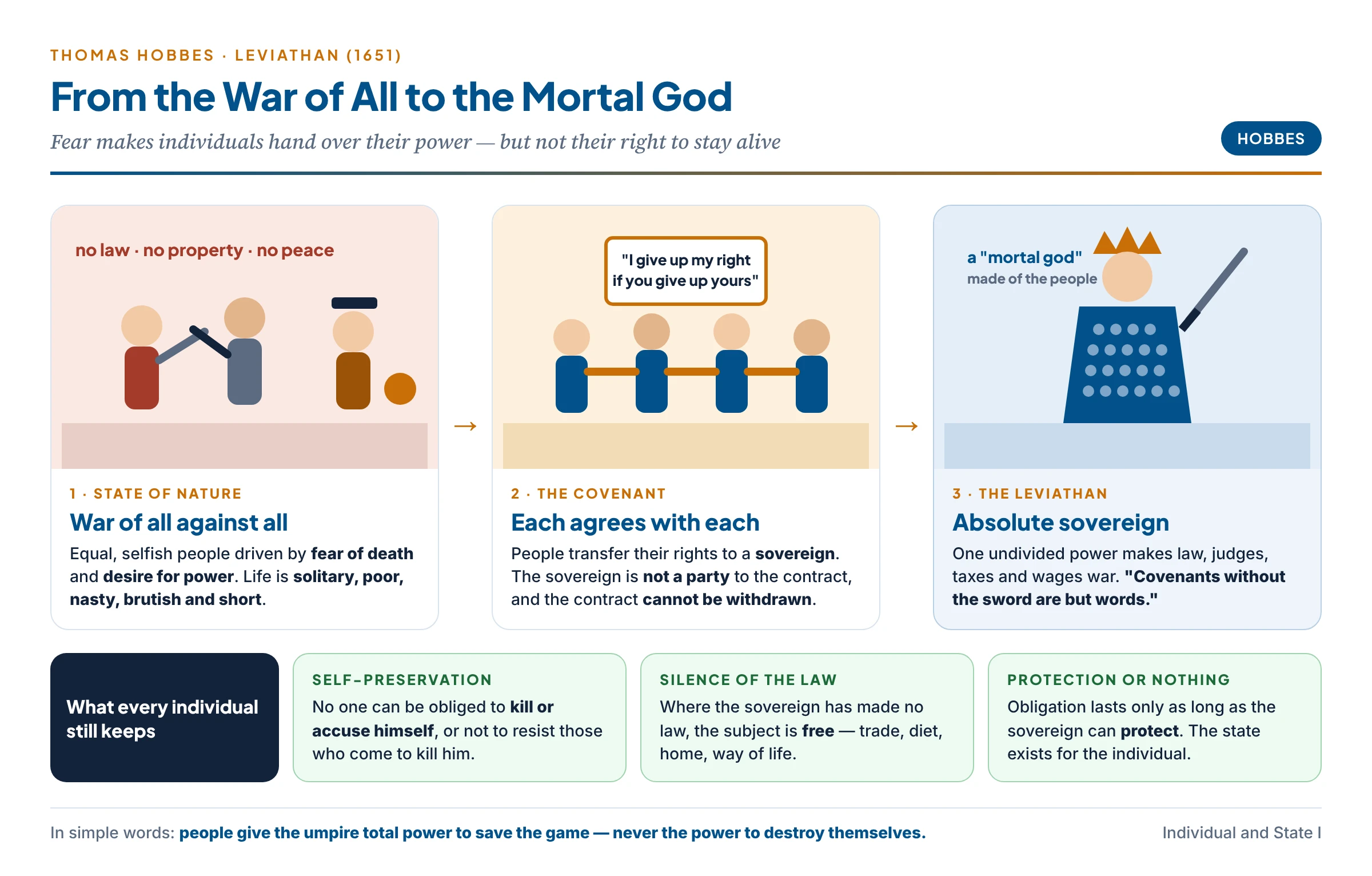
- State of nature — a war of all against all. With no common power, there is no law, no property, no justice and no industry. Life is “solitary, poor, nasty, brutish, and short.”
- Right of nature and laws of nature. Each person has a natural right to do whatever preserves his life. Reason discovers laws of nature: seek peace; give up your right to all things if others do the same; keep your covenants.
- The social contract. Each person agrees with every other to transfer his rights to a sovereign (one man or an assembly), on condition that all others do the same.
- The sovereign is not a party to the contract — the people contract among themselves; the sovereign only receives.
- The contract is irreversible. Once made, people cannot withdraw from it or punish the sovereign.
- Sovereign power is absolute and undivided — legislation, judgement, war, taxation and even control of opinion and religion.
- “Covenants, without the sword, are but words.” Only a power that can punish makes promises reliable.
- The Leviathan. The state is a great artificial man, a “mortal god”, made of the people who compose it.
Where the individual survives inside the Leviathan:
- Self-preservation cannot be surrendered. The purpose of the contract is to save life; so no one can be obliged to kill himself, confess against himself or not resist those who come to kill him. A condemned man may lawfully try to escape.
- “Liberty lies in the silence of the law.” Where the sovereign has not legislated, the subject is free to buy, sell, choose his trade, his diet and his way of life.
- Obligation lasts as long as protection. If the sovereign can no longer protect his subjects, their obligation ends.
- The state is an instrument. It exists for individuals — their peace and security — not as an end in itself.
In simple words
Imagine a cricket ground with no umpire, where every player can hit anyone and grab the ball. Nobody would play; everybody would be afraid. So the players agree to give the umpire total authority — his decision is final, no appeal. But if the umpire orders a player to jump off the stand, the player will refuse: he gave power to the umpire to save the game and himself, not to destroy himself.
- Hobbes the individualist. He starts from individuals, not from God, nature or community; their consent creates the state; its only justification is their security. For this reason many commentators call him one of the greatest individualists, even though his conclusion is absolutism.
- Hobbes the absolutist. He denies any right of resistance, divided power or a church independent of the state. He prefers monarchy because one ruler is less divided.
- First systematic theory of sovereignty. He gave the modern idea of a single, supreme, unlimited sovereign that Austin later developed.
- Hobbes against the anarchists. Even a bad coercive authority is better than chaos — the collapse of order in a country after its government falls (Iraq after Saddam Hussein’s fall is often cited) illustrates his warning.
John Locke: The Limited, Trustee State
- Human nature and the state of nature. People are reasonable and mostly peaceful. The state of nature is governed by the law of nature (reason), which teaches that no one should harm another’s life, health, liberty or possessions.
- Natural rights. Every person has rights to life, liberty and estate (property) — Locke calls them together “property”. They come from God and reason, before any government.
- Property through labour. Mixing one’s labour with nature makes a thing one’s own.
- Why leave the state of nature? Three inconveniences: there is no settled known law, no impartial judge, and no power to enforce judgements.
- Two-stage contract. People first form a civil society by agreement, then entrust power to a government. Government is a trustee (fiduciary), not a master.
- Limited government.
- Power is only to protect natural rights.
- Rule by standing, known laws, not arbitrary decrees.
- No taxation without consent.
- Separation of legislative and executive power.
- Right of revolution. If the government breaks the trust — invades life, liberty or property — power returns to the people, who may resist and set up a new government.
- Consent, express and tacit. Those who enjoy the protection of a state’s laws — even by walking on its roads — give tacit consent.
- Significance. Locke is the father of liberal constitutionalism: limited government, rule of law and rights against the state. His ideas shaped the American Declaration of Independence and the idea of fundamental rights.
“The end of law is not to abolish or restrain, but to preserve and enlarge freedom.” — John Locke
Jean-Jacques Rousseau: General Will and Popular Sovereignty
- “Man is born free, and everywhere he is in chains.” The opening line of The Social Contract (1762).
- State of nature as innocence. Natural man is a “noble savage” — simple, healthy, guided by self-love and pity, living in a state of near bliss. Inequality and misery come with private property and civilisation.
- The problem. “To find a form of association … by means of which each, uniting with all, may still obey himself alone and remain as free as before.”
- The contract. Each person gives himself totally to the whole community, not to a ruler. Since everyone gives the same, no one is worse off, and each gets back the protection of all.
- Natural liberty → civil and moral liberty. One loses the unlimited natural liberty of appetite but gains civil liberty (protected by law) and moral liberty — obedience to a law one prescribes for oneself.
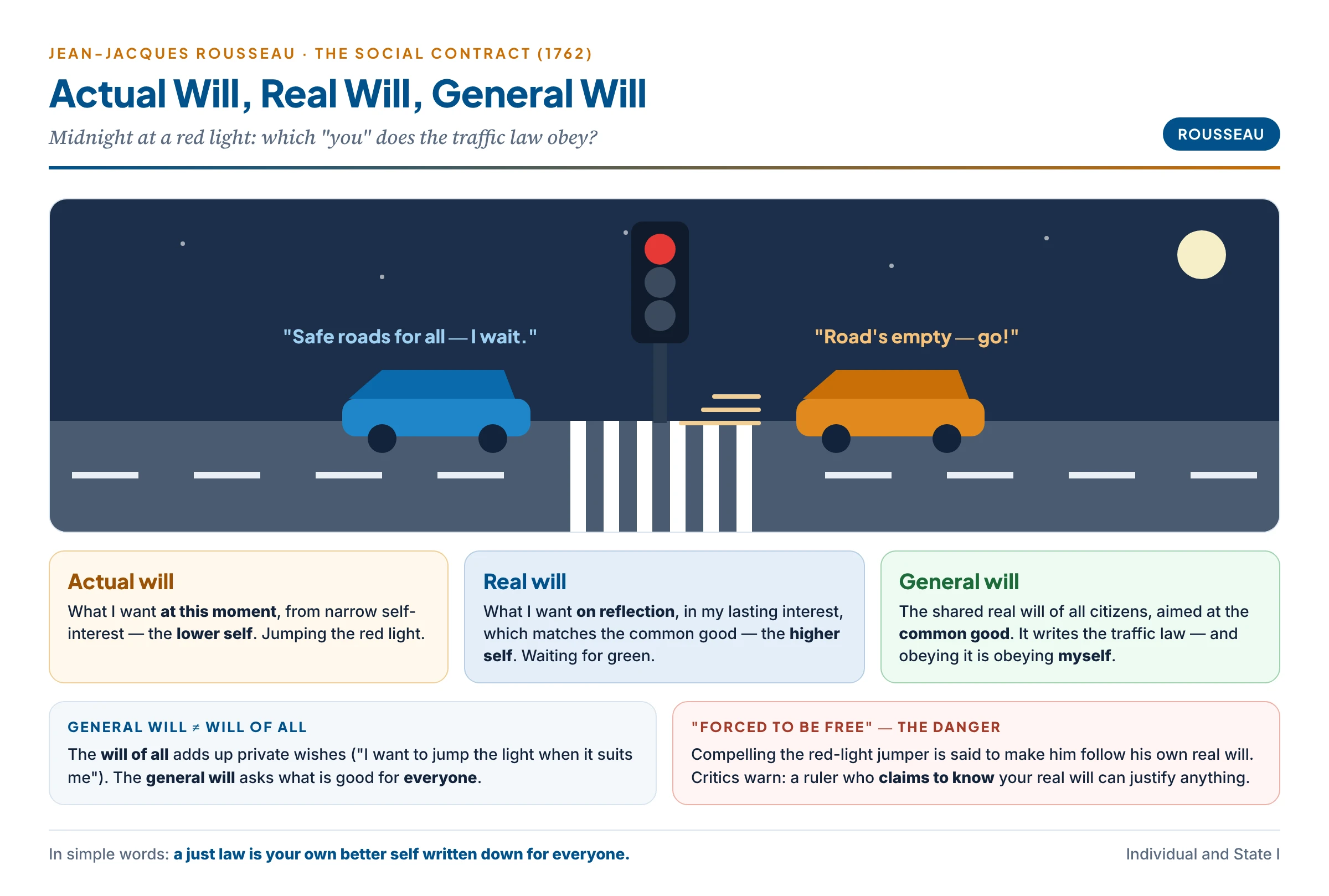
- Actual will and real will.
- Actual will — what a person wants at the moment, driven by momentary self-interest; it represents the lower self.
- Real will — what a person wants on reflection, in his long-term interest, which coincides with the common interest; it represents the higher self.
- General will — the sum of the real wills of all, always aimed at the common good. It is different from the will of all, which is only the sum of private interests.
- “Forced to be free.” Whoever refuses to obey the general will shall be compelled by the whole body — which means only that he will be forced to be free, i.e. made to follow his own real will.
In simple words
At a traffic light at midnight, part of you wants to jump the red light because the road is empty — that is your actual will. But the part of you that wants safe roads for your own family, every night, wants everyone — including you — to stop at red. That is your real will. A traffic law that makes you stop is not your enemy; it is your own better self written down. That is Rousseau’s general will.
- Popular sovereignty. Sovereignty belongs to the people as a whole and cannot be alienated, represented or divided. Rousseau praised it as a right (authority must rest on the people’s will) and as a duty (it must be exercised for the public good).
- Direct democracy. The general will cannot be represented — the English are free only at election time.
- Influence. Rousseau inspired liberals (consent and equality), democrats (popular sovereignty), socialists (critique of property and inequality) and idealists (Kant, Hegel, Green — the real will). The French Revolution drew on him.
- Criticisms.
- “Forced to be free” can justify any ruler who claims to know people’s “real will” — J. L. Talmon called Rousseau a source of totalitarian democracy.
- The general will is vague: who decides what it is?
- Direct democracy suits only a small and uniform community, like a Swiss canton or Geneva.
- Total alienation of the individual leaves no rights against the community.
Common confusion
Did Rousseau mean a dictator can force people to do anything “for their own good”? No — that is how later regimes misused him. For Rousseau the general will is the will of all citizens acting together in a public assembly for the common good, and laws must be general (apply equally to all). It is not the will of a ruler or party. The danger his critics point to is real — but it lies in claiming to know others’ real will, which Rousseau himself left to the assembled people.
The Contract Theorists Compared
| Point | Hobbes | Locke | Rousseau |
|---|---|---|---|
| Human nature | Selfish, fearful, power-seeking | Reasonable, sociable | Naturally good, corrupted by society |
| State of nature | War of all against all | Peaceful but inconvenient | Innocent bliss, then decline |
| Contract with | Each other, power to a sovereign who is not a party | Each other, then a trust with government | Each with the whole community |
| Rights kept | Only self-preservation | Life, liberty, property | Civil and moral liberty via the general will |
| Sovereign | Absolute ruler | Limited government; people ultimately | The people (general will) |
| Political obligation | Absolute (while protection lasts) | Conditional — right of revolution | To the general will; “forced to be free” |
| Legacy | Absolutism, theory of sovereignty | Liberal constitutionalism | Popular sovereignty, democracy |
Human Nature and the Good Political Order
- Every theory begins from a picture of human nature:
- Selfish and fearful man (Hobbes) → a strong, absolute state.
- Reasonable man with natural rights (Locke) → a limited, constitutional state.
- Good man corrupted by society (Rousseau) → a democratic state of the general will.
- Social and rational man (Aristotle) → the polis that educates in virtue.
- Rational soul with three parts (Plato) → rule by reason in philosopher-kings.
- Man as a bundle of class interests (Marx) → the state as class instrument, to wither away.
- Is an “objectively true” account of human nature possible?
- For: institutions that ignore real human tendencies fail — a system that assumes everyone is selfless will be exploited; one that assumes everyone is a brute will be oppressive.
- Against: human nature is partly shaped by institutions (Rousseau, Marx). Thinkers disagree on what it is, so a political order resting on one “true” account risks imposing it on everyone (Plato’s danger). Modern liberals like Rawls try to build principles that do not depend on any one contested picture of the good life.
- Balanced view: a good political order needs a realistic account of human nature — capable of both selfishness and cooperation — but should leave room for people to differ about the good life.
Critical Evaluation
Strengths and Weaknesses of Each View
- Organic view (Plato, Aristotle).
- Strength: shows that individuals are formed by community — language, morality, identity.
- Weakness: gives no protection to individuals against the community; can justify censorship, caste-like fixed roles and totalitarianism.
- Mechanistic view (Hobbes, Locke).
- Strength: gives the individual rights, makes consent the basis of authority, and limits government (Locke).
- Weakness: the “atomic” individual is a fiction — no one is born outside society; the contract never happened historically; it can ignore community, duties and the poor.
- Rousseau’s democratic view.
- Strength: ties freedom to self-government and equality.
- Weakness: vague general will; risk of majority or “real will” tyranny.
Was the Social Contract Ever Real?
- Historical critique. No state is known to have begun by a contract; states grew from kinship, conquest and religion (Hume, Maine).
- Logical critique. If people in the state of nature could keep a contract, they already had trust and morality — so the state of nature was not as lawless as claimed.
- Reply. The contract is a hypothetical test, not a history: a government is legitimate if free and reasonable people could agree to it. This is how Rawls revived the idea.
Critics and Defenders
Criticism — Critics
- Popper: Plato’s ideal state is the root of the closed, totalitarian society.
- Hume: consent theory is fiction — a poor peasant cannot really leave his country, so his staying is not consent.
- Talmon: Rousseau’s “forced to be free” leads to totalitarian democracy.
- Communitarians: the mechanistic self is an unencumbered atom that never existed.
- Marx: contract theory dresses up the interests of property-owners as universal reason.
Defence — Defenders and strengths
- Plato and Aristotle remind us that people flourish only in community and that the state has a moral, educative role.
- Hobbes shows why order is the first condition of every right — no rights survive anarchy.
- Locke gave the world limited government, rule of law and inalienable rights.
- Rousseau joined freedom with self-rule and inspired modern democracy.
- The contract, read as a test of legitimacy, still underlies modern constitutions.
Cross-Tradition Comparison
Western Views and Indian Thought
| Theme | Western view | Indian parallel |
|---|---|---|
| State of nature as chaos | Hobbes: war of all against all | Mātsya-nyāya — the “law of the fish”, the big fish eating the small, in the Mahābhārata and Arthaśāstra |
| Origin of kingship by agreement | Social contract | The people choose Manu as king and pay him a share of grain (Arthaśāstra); the Dīgha Nikāya story of Mahāsammata, “the great elect” |
| State as organism | Plato, Aristotle, Hegel | Kautilya’s saptāṅga — the state as a body of seven limbs |
| Ruler as trustee | Locke | Rājadharma: the king’s happiness lies in his subjects’ happiness |
| Function-based order | Plato’s three classes | Ideal of varṇa by aptitude (Gandhi’s reading) — and its distortion into caste |
Indian Connect — Indian Connect
- Mātsya-nyāya and Hobbes. Indian texts reached Hobbes’s conclusion — without a king wielding daṇḍa (sanction), the strong devour the weak — many centuries earlier.
- Mahāsammata and consent. The Buddhist account of the first king, chosen by the people and paid by them, is a genuine contract idea in Indian thought.
- Plato and varṇa. Both assign people to functions for the harmony of the whole; both face the same objection — fixed roles deny individual choice. Ambedkar’s critique of caste is, in this sense, a critique of the organic state.
- Rājadharma and Locke. Kautilya binds the king to the welfare of the subjects, but gives the people no right of resistance — that idea is Locke’s distinctive contribution.
Synthesis (Siddhānta)
- Each view captures a truth. The organic view sees that individuals are made in community; the mechanistic view sees that individuals have rights the community must respect; the developmental view joins them.
- The modern constitutional state combines all three: order (Hobbes), limited power and rights (Locke), popular sovereignty (Rousseau), community and education for good life (Aristotle) — and a welfare role (Green, Laski).
- Plato and Aristotle today. Their questions — who should rule, how to educate citizens, how to unite a plural society — remain alive; their answers fail where they deny individual choice.
- Contemporary relevance.
- Emergency powers and pandemics revive the Hobbesian trade-off between security and liberty.
- Constitutional limits and judicial review are Locke’s trust made into law.
- Referendums, gram sabhas and participatory budgeting echo Rousseau’s direct democracy.
- Debates on surveillance and data ask Locke’s old question: when does the trustee betray the trust?
- Conclusion. The individual and the state are not natural enemies. The state is legitimate when it protects and enables individuals; individuals are fulfilled when they take part in a just common life. The rest of this unit — rights, duties and accountability — spells out the terms of that partnership.
“If men were angels, no government would be necessary.” — James Madison
Previous Year Questions
- 2026Is Plato’s vision of an ideal state compatible with the rights and liberties of individual citizens? Discuss.
- 2024Do you agree with the view that Aristotle was more successful than Plato in steering a middle course between ‘Statism’ and ‘individualism’? Discuss with arguments.
- 2006Critically examine – “The conception of a good political order rests upon an objectively true account of human nature.”