

Yoga: Citta; Cittavṛtti; Kleśas; Samādhi; Kaivalya.
Official Syllabus: Paper I, Section B, Unit 17
Everything in Yoga turns on one word: citta, the “mind-stuff”. If citta is understood, said one teacher, “whatever things we are going to discuss — forms of citta, stages of citta, modifications of citta, kinds of kleśas — all this becomes easy.” Citta is the inner instrument made of intellect, ego and mind. It is the first and finest product of unconscious Prakṛti, so clear and luminous that the consciousness of Puruṣa shines in it like the moon in water. Because the self sees itself reflected in this moving mirror, it seems to think, feel, sleep, wake, suffer and enjoy. Bondage is this mistaken identification; yoga is the stilling of the mirror. This article explains what citta is, how Puruṣa is reflected in it, the three natures of citta, and its five levels (citta-bhūmi) — from the restless mind of daily life to the fully restrained mind of the liberated yogī.
In simple words
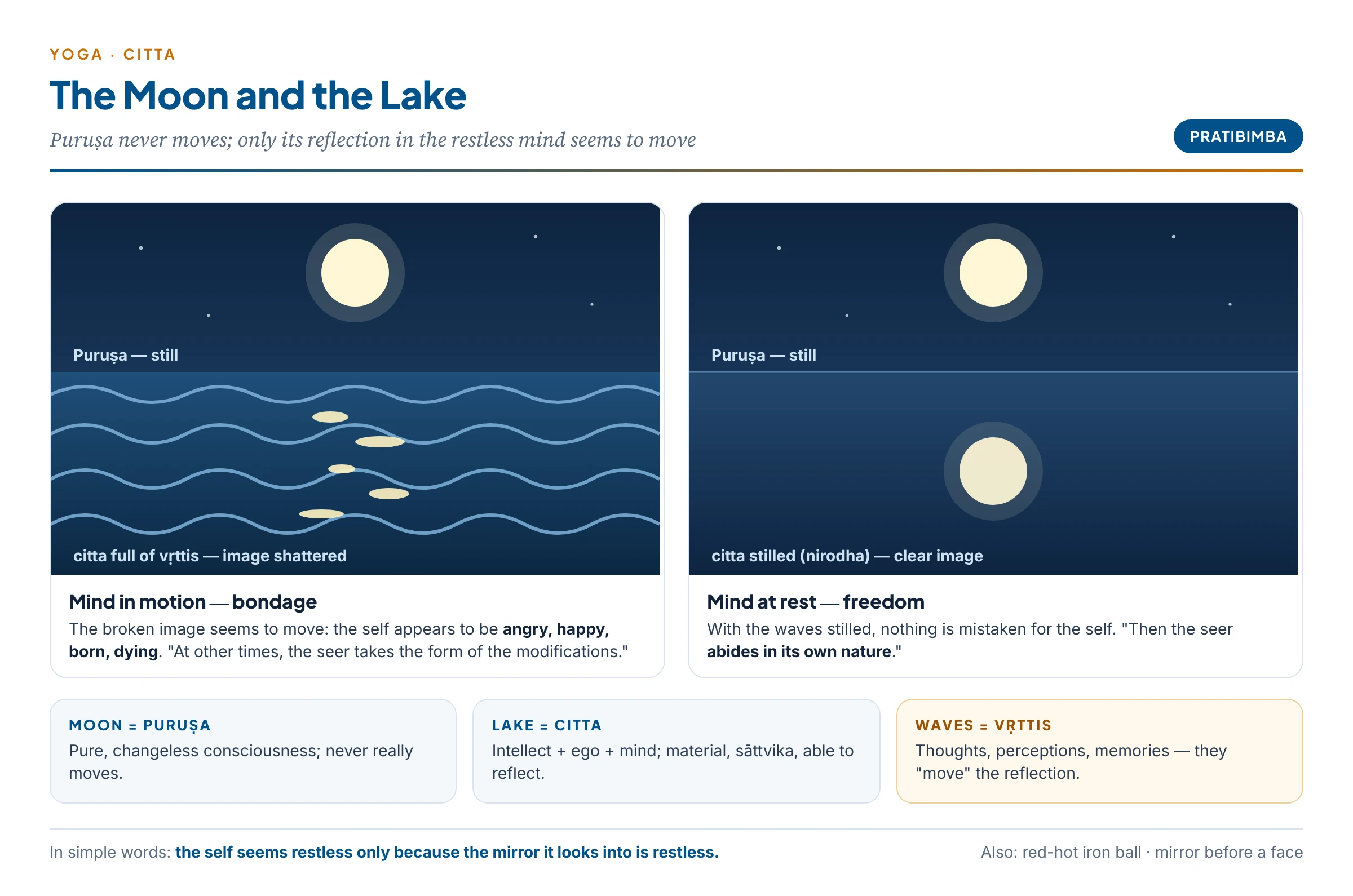
Look at the moon in a lake on a windy night. The reflection shakes, breaks and dances — yet the moon in the sky is perfectly still. Now let the wind drop: the water becomes calm and the moon’s image is clear and steady. In Yoga, Puruṣa is the moon, citta is the lake and the waves are thoughts (vṛttis). We think the self is restless because we look at its reflection in a restless mind.
Context & Problem
Why Yoga Begins with the Mind
- Where Yoga starts. “Yoga philosophy starts from where Sāṃkhya left.” Sāṃkhya explained that the evolution of Prakṛti leads to the self’s bondage; Yoga provides the practical exercise for undoing it. For this, Yoga starts with the internal organs produced by Prakṛti — intellect (buddhi, also called mahat), ego (ahaṅkāra) and mind (manas) — because they “play a very crucial role in spiritual practice”.
- The problem to be solved.
- Puruṣa is pure consciousness, “free from the limitations of the body and the fluctuations of the mind”.
- Yet in experience the self seems to be born, to grow, decay and die, to sleep and wake, to imagine and remember, to make mistakes and correct them.
- How can a changeless self appear to change? And how can an unconscious mind appear to be conscious?
- Yoga’s answer in one line. Through reflection: the self is reflected in citta, and the two are confused. The rest of the system is built on this answer.
Core Doctrine
1. What Is Citta?
- The inner organ. Citta is the same as the antaḥkaraṇa (inner instrument) of Sāṃkhya. It means the three internal organs taken together:
- Buddhi (intellect) — judges, discriminates and decides.
- Ahaṅkāra (ego) — creates the sense of “I” and “mine”, individuality and ownership.
- Manas (mind) — coordinates sense-inputs and generates options.
- One functional whole. Sāṃkhya treats these as three separate organs; Yoga “groups them together” as one citta. One lecture put it simply: put intellect, mind and ego “in a tablet form, and the tablet is known as citta”. Some texts say citta is “mahat or buddhi, which includes ahaṅkāra and manas”.
- First product of Prakṛti. Citta is “the first evolute of Prakṛti”, and in it sattva — the power of clarity and manifestation — naturally predominates over rajas and tamas.
- Unconscious in itself. Being a product of Prakṛti, citta is material (jaḍa) and “essentially unconscious“. It is subtle, not gross — like the mind, it cannot be seen, but it operates.
- Apparently conscious. “Being finest and nearest to Puruṣa, it has the power to reflect the Puruṣa and therefore appears as if it is conscious.”
- Different from manas. Citta is not the same as manas, the internal sense. Citta relates to objects through manas and the senses.
- The mediator. Citta “mediates between Puruṣa (pure consciousness) and the external world. It is not identical with the self, but rather the instrument of experience through which Puruṣa becomes aware of phenomena.”
2. How Citta Knows: Vṛtti and Jñāna
- Taking the form of objects. “When citta is related to any object through manas, it assumes the form of that object. This form is called vṛtti (modification).”
- Lit by consciousness. “The light of consciousness which comes from the Puruṣa and illuminates this form is called jñāna (knowledge).”
- How the self knows the world. “The self knows the objects of the world through the modifications of citta which correspond to the forms of the objects known.”
- Citta is the spectacle. “In reality, citta is the spectacle of which the self is, by reflection, the spectator.”
- Always known to Puruṣa. The Yoga Sūtra adds that the modifications of citta are always known to their master, Puruṣa, because Puruṣa does not change. And citta is not self-luminous: being an object that is seen, it cannot light itself up — a point aimed at the Buddhist view that consciousness illumines itself.
In simple words
Think of a projector screen. By itself the screen is blank and dark; it does not “know” anything. When the film runs, the screen takes the shapes of trees, faces and cities — these are vṛttis. But the shapes are visible only because a light shines on them — that light is Puruṣa’s consciousness. The audience, forgetting the light, thinks the pictures themselves are alive.
3. The Reflection of Puruṣa in Citta
- The double illusion. Because of Puruṣa’s reflection in citta, two mistakes happen at once:
- Puruṣa appears to change — it seems to undergo the modifications of citta.
- Citta appears conscious — it seems to be the knower and agent.
- The four classic images.
- The moon in moving waves. “Just as the moon appears as moving when seen reflected in the moving waves, and the waves appear as luminous, similarly Puruṣa appears as undergoing modifications and citta appears as conscious.”
- The red-hot iron ball. “Just as in a red-hot iron ball, formless fire appears spherical and cold iron appears hot“, Puruṣa appears changing and citta appears conscious.
- The mirror held up before a person. The self seems concerned in mental functions “because it is reflected in citta which is held up before it as a mirror before a person”.
- The moon that walks with us. At night the moon seems to walk along with us; it does not — “it is because of ignorance we think that the moon is walking with us”.
- The key sūtras.
- “At other times, the seer takes the form of the modifications” (vṛtti-sārūpyam itaratra) — in ordinary life the self seems to be identical with whatever the mind is doing.
- “Then the seer abides in its own nature” (tadā draṣṭuḥ svarūpe ‘vasthānam) — when the modifications cease.
- Citta as the physical medium of spirit. “Citta, therefore, is the physical medium for the manifestation of the spirit.”
4. The Jīva: Citta Plus Reflection
- Who is the empirical person? “It is the citta with the reflection of the Puruṣa in it, or the Puruṣa as reflected in the citta, which is the phenomenal ego or jīva.”
- What the jīva undergoes. The jīva is “subject to birth and death and transmigration, and to all painful or pleasurable experiences, and imagines itself as the agent and the enjoyer“.
- Gross and subtle body. The jīva is “the free spirit associated with the gross body and more closely related to a subtle body constituted by the senses, the manas, the ego and the intellect”.
- What really acts. “It is citta or the mind that really performs these functions of sleeping and waking, knowing and doubting, imagining and remembering.” The self only appears to do them.
In simple words
A man stands before a mirror wearing a red shirt and later a blue one. If he forgot that he is the one looking, he would say “I have become red… now I have become blue.” The jīva is like this forgetful man: Puruṣa looking into citta and taking every colour of the mirror — anger, joy, youth, old age — as its own.
5. “So Long as There Are Changes in Citta…”: The Logic of Bondage
“So long as there are changes and modifications in citta, the self is reflected therein and, in the absence of discriminative knowledge, identifies itself with them.”
- What the statement says — step by step.
- Citta keeps changing — it takes one form after another (vṛttis).
- The self is reflected in each changing state.
- Without discrimination (viveka), the self identifies with these states — “I am angry”, “I am happy”, “I am this body”.
- Consequence: “the self feels pleasure or pain out of the objects of the world, and loves or hates them accordingly. This means bondage for the self.”
- The remedy implied. “If we are to attain liberation, we must somehow restrain the activities of the body, the senses and the mind, and finally suppress all the modifications of citta.”
- The two citta-states. When “the waves of the empirical consciousness (kārya-citta, the mind as effect, in activity) die down and leave the citta in a state of perfect placidity (kāraṇa-citta, the mind as cause, at rest), the self realises itself as distinct from the mind–body complex”.
- The end of the process. “When Puruṣa realises that it is completely isolated and is only a passive spectator beyond the play of Prakṛti, it ceases to identify itself with its reflection in the citta, with the result that the light is withdrawn and the modifications of citta fall to the ground.” This cessation through meditation is yoga — “the return of Puruṣa to its original perfection”.
- Appraisal of this soteriology (theory of salvation).
- Strength — psychological depth. It locates bondage not in the world but in identification: not “having thoughts” but “being had by them”.
- Strength — consistency with Sāṃkhya. Puruṣa never really changes; only its reflection does. So liberation is not a change in the self but the end of a mistake.
- Strength — a clear method. If identification needs moving mental states, then stilling those states (nirodha) and cultivating discrimination will end it.
- Difficulty — who identifies? Puruṣa is inactive and citta is unconscious. “If Puruṣa is always free, how can bondage appear real?” The subject of the mistake is hard to locate.
- Difficulty — reflection is a metaphor. A real reflection needs contact between moon and water; but Puruṣa and citta never really touch. Critics ask how a formless, partless self can be “reflected” at all.
- Difficulty — negative goal. If liberation is the end of all modifications, is the result a positive state or a mere blank? Yoga’s reply: it is not blankness but the revelation of Puruṣa as pure, unconditioned consciousness (Article 8).
Indian Connect — The reflection model across Indian schools
- Advaita Vedānta uses the same image: the one consciousness is reflected in the inner organ (antaḥkaraṇa) of each person, producing the individual self — the “reflection theory” (pratibimba-vāda). The difference is that for Advaita the original is one Brahman, while for Yoga there are many Puruṣas.
- Buddhism keeps the flowing mind (citta) but drops the moon: there is no permanent self behind the stream.
- Nyāya makes consciousness a quality that arises in the self when the self, mind and senses come into contact — so it does not need a reflection model at all.
6. The Three Natures of Citta (Prakhyā, Pravṛtti, Sthiti)
- Citta is made of the three guṇas. Like everything in Prakṛti, citta is made of sattva, rajas and tamas, and it is “dynamic and ever-changing due to their interplay”:
- Sattva (clarity, balance) makes citta reflective and transparent.
- Rajas (activity) causes restlessness and distraction.
- Tamas (inertia) leads to dullness and ignorance.
- Three natures. Hence citta has three basic natures:
- Prakhyā — illumination (the nature of sattva): knowing, clarity.
- Pravṛtti — activity (the nature of rajas): movement, effort.
- Sthiti — inertia (the nature of tamas): stability, heaviness, sleep.
- How the mixtures show in a person. Vyāsa describes how the balance of the three colours a mind:
- Sattva mixed with rajas and tamas — the mind loves power and sense-objects.
- Pervaded by tamas — it turns to vice, ignorance, attachment and weakness.
- Tamas removed, a touch of rajas left — it turns to virtue, knowledge, detachment and mastery.
- Even the trace of rajas removed — pure sattva, resting in itself, it attains discrimination between sattva and Puruṣa and the highest meditation, called the “cloud of virtue” (dharma-megha).
- Why this matters. Because guṇa-balances differ, every mind is different — even twins “behave certainly different”. The levels of mind below are simply the stable patterns that these balances produce.
Common confusion
Are prakhyā, pravṛtti and sthiti three stages of yogic attainment? No. Some lecture notes describe them as stages in which the yogī “acquires powers”, fasts or “feels above earthly life”. In Yoga they are simply the three natures that citta has because it is made of the three guṇas: prakhyā = illumination (sattva), pravṛtti = activity (rajas), sthiti = inertia (tamas). The mixture of these natures decides whether a mind runs after power, sinks into dullness, turns to virtue or rests in discrimination.
7. Citta-bhūmi: The Five Levels of the Mind
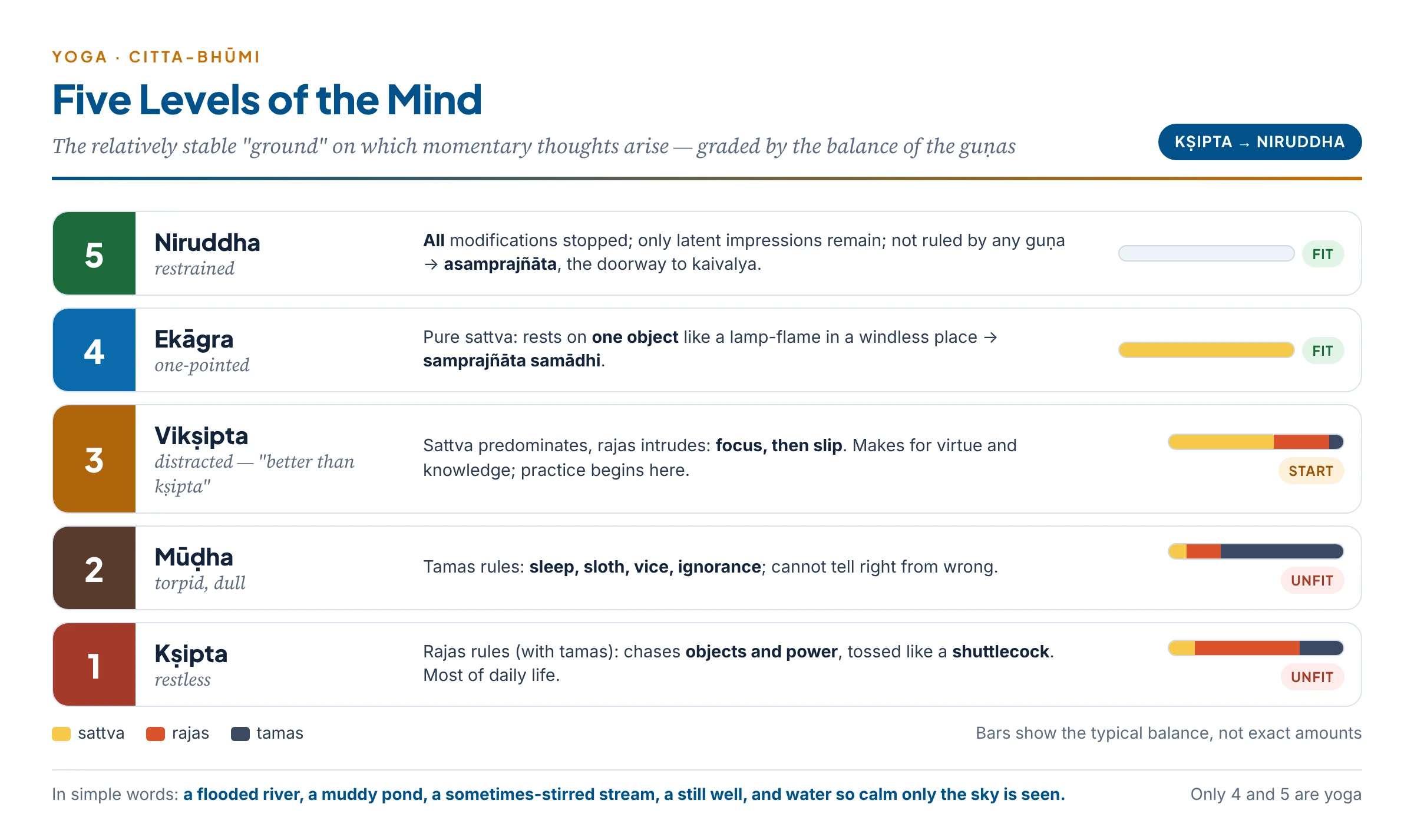
- What a citta-bhūmi is. Literally “ground” or “level” of citta. “This is different from cittavṛtti, because these are the background on which cittavṛttis happen.”
- Vṛttis are momentary; a citta-bhūmi is “relatively permanent, robust and more basic” — it grades the basic quality of a person’s mind.
- In the context of liberation, citta-bhūmis are levels of citta “from the point of view of its conduciveness” to yoga.
- Different people live at different levels; the difference is due to the different combinations of the three guṇas.
- Concentration in all levels. Vyāsa says that absorption (samādhi) is a quality of citta in all its levels — even a restless mind concentrates for a moment, and “one state of the mind excludes other states”: love and hate naturally oppose and cancel each other. But yoga proper is possible only in the last two levels.
The five levels:
- Kṣipta — restless (rajas dominant, with tamas).
- The mind is “under the sway of rajas and tamas, and is attracted by objects of sense and the means of attaining power“.
- It “flits from one thing to another without resting in any” — “tossed about like a shuttlecock between different sense-objects”.
- Example: the man who runs after money, power and pleasure, “earning more and more” and never at rest.
- For most people, daily life is governed by this state. It is the lowest level and not at all conducive to yoga.
- Mūḍha — torpid, dull (tamas dominant).
- The mind is “lethargic, confused and clouded”, with “a tendency towards vice, ignorance, sleep and the like”.
- It cannot discriminate right from wrong; it lacks both clarity and energy.
- Example: a person heavy with intoxication or sloth who acts without knowing what he is doing.
- Vikṣipta — distracted, occasionally steady (sattva predominant, rajas intruding).
- “A transitional state where the mind sometimes attains focus but quickly loses it.” There is “temporary concentration of the mind on some object, followed by distraction”.
- The mind is free from the sway of tamas, has only “a touch of rajas”, and “has the capacity of manifesting all objects and makes for virtue and knowledge“.
- The instability is due “to natural defects or accidental troubles”.
- Example: a student who studies well for ten minutes, then finds the mind has wandered to a film, and pulls it back.
- This is “the beginning of spiritual practice” — glimpses of steadiness — but it “cannot be called yoga, because it does not permanently stop the mental modifications nor destroy the afflictions”.
- Ekāgra — one-pointed (sattva fully manifest).
- “Citta is purged of the impurity of rajas and there is the perfect manifestation of sattva”; rajas and tamas are subdued.
- The mind can remain fixed on one object for a long time; this “reveals its true nature” and “prepares the way for the cessation of all mental modifications”.
- Example: the steady flame of a lamp in a windless place (an image from the Gītā).
- It is “the real starting point for higher yoga”; when permanently established it is samprajñāta samādhi (absorption with an object).
- But “even here, the mental processes are not altogether arrested” — citta still thinks of one object.
- Niruddha — restrained (beyond the guṇas’ play).
- “There is the cessation of all mental functions, including even that of concentration which marks the previous stage.”
- “The mind is left in its original, unmodified state of calmness and tranquillity”; only latent impressions remain (saṃskāra-śeṣa, “impressions as residue”).
- The citta here “is not governed by any guṇa”; it is the state of asamprajñāta samādhi (absorption without an object), the doorway to kaivalya.
- Which levels are conducive? The first three are “not at all conducive to yogic life” — kṣipta and mūḍha are unsuitable because unstable or dull; vikṣipta is better, but cannot hold absorption. Only the last two, ekāgra and niruddha, are conducive, “since both manifest the sattva element of the mind to the highest degree”.
Common confusion
Does “vikṣipta” (distracted) mean a mind even more restless than “kṣipta”? No. The name suggests “extremely restless”, but in Yoga vikṣipta means “better than kṣipta“. In kṣipta rajas rules; in vikṣipta sattva predominates and rajas only intrudes now and then. So the order of improvement is: restless (kṣipta) → dull (mūḍha) is the low pair, and distracted (vikṣipta) is the first step upward. Some notes also say that “sattva dominates” in kṣipta — this too is wrong; kṣipta is ruled by rajas (with tamas).
| Level | Ruling guṇa | Mark of the mind | Everyday image | Fit for yoga? |
|---|---|---|---|---|
| Kṣipta | Rajas (+ tamas) | Restless, chasing objects and power | Shuttlecock; money-chaser | No |
| Mūḍha | Tamas | Dull, sleepy, inclined to vice | Intoxicated person | No |
| Vikṣipta | Sattva, rajas intruding | Concentrates, then slips | Student pulling the mind back | Beginning only |
| Ekāgra | Pure sattva | One-pointed on one object | Lamp-flame in a windless place | Yes — samprajñāta |
| Niruddha | Beyond the guṇas’ play | All modifications stilled | Calm, waveless lake | Yes — asamprajñāta |
In simple words
Think of five kinds of water. Kṣipta is a river in flood, rushing everywhere. Mūḍha is a muddy pond — still, but dark. Vikṣipta is a clear stream that is sometimes stirred by passing feet. Ekāgra is a deep well whose water reflects one star perfectly. Niruddha is water so still that it no longer seems to be there — only the sky is seen.
8. Applying the Levels: Scientist, Devotee and Self-realised Yogī
How would Yoga place the minds of three very different people?
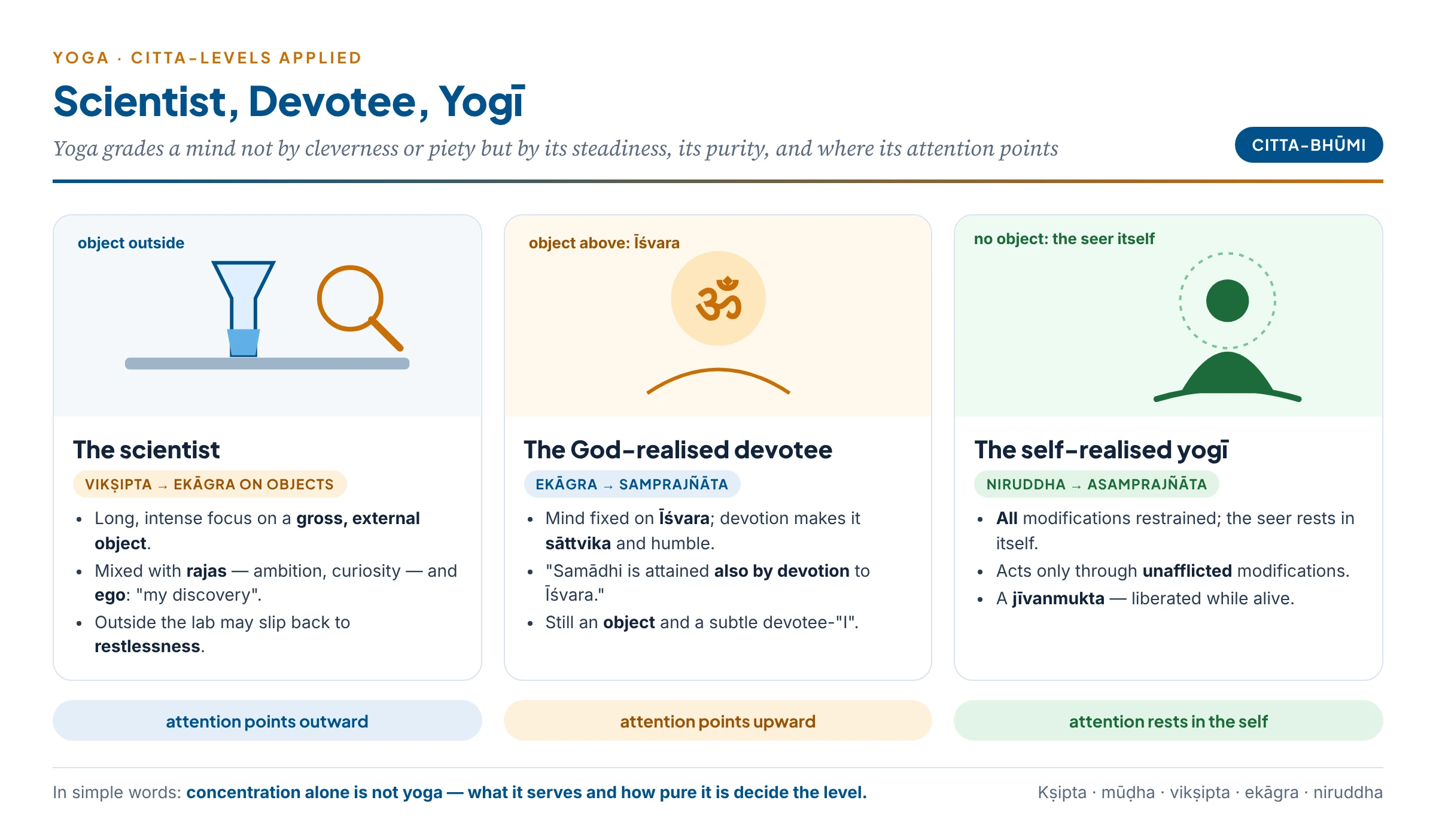
- The scientist.
- A great scientist can hold the mind on a problem for hours — a high degree of concentration, close to ekāgra with respect to an external, gross object of study.
- But the concentration serves knowledge of objects, often mixed with rajas — ambition, curiosity, desire for recognition — and ego (“my discovery”).
- Outside the laboratory the same mind may fall back to kṣipta or vikṣipta.
- Yoga would call this a powerful but object-bound, ego-coloured one-pointedness — like the lower, “reasoning” level of absorption on gross objects — not yet turned toward the self. Its typical level is vikṣipta moving toward ekāgra.
- The God-realised devotee.
- The devotee’s mind is fixed on Īśvara; devotion (Īśvara-praṇidhāna) makes it sāttvika, humble and free of selfish desire.
- Patañjali says that samādhi can be reached “also by devotion to Īśvara“. The devotee’s concentration is steady and pure — ekāgra, and through God’s help it can reach samprajñāta and move toward the highest absorption.
- But the devotee still has an object — God — and the subtle sense of a devotee “I”; for strict Yoga this is a means, not the end.
- The self-realised yogī.
- The yogī has passed through ekāgra to niruddha: all modifications are restrained and the seer abides in its own nature.
- This is asamprajñāta samādhi. Living on, the yogī acts only through unafflicted modifications (akliṣṭa vṛtti) — a jīvanmukta, liberated while alive.
- The justification. Yoga grades minds not by intelligence or piety as such, but by steadiness and purity — which guṇa rules the citta and whether its concentration points outward (objects), upward (Īśvara) or inward (Puruṣa itself).
Critical Evaluation
1. Objections to Yoga’s Theory of Citta
- How can matter know? If citta is unconscious matter, how can a “reflection” make it conscious? A mirror reflects light but does not see. Critics say Yoga simply relabels the mystery of consciousness.
- How can the formless be reflected? Reflection needs a form and a distance; Puruṣa has neither. The image is a metaphor, not an explanation.
- Contact without contact. Puruṣa and citta are said to be utterly different, yet Puruṣa’s light “comes” to citta. This repeats Sāṃkhya’s relation problem (Article 1).
- Who is bound? If Puruṣa is always free and citta is unconscious, the subject who suffers and strives is unclear.
- Is the mind really “matter”? Western dualists like Descartes make the mind conscious and the body material; Yoga’s claim that thought, ego and intellect are material while consciousness lies beyond them seems strange to common sense.
- Buddhist objection. There is a stream of citta, but no moon behind the water; the “witness” is an unnecessary addition.
2. Yoga’s Replies
- Function versus awareness. Yoga distinguishes processing (which citta does — judging, choosing, remembering) from awareness (which belongs only to Puruṣa). Modern discussions also separate the information-processing functions of the brain from the “hard problem” of why there is awareness at all. Yoga places the first in matter and the second in Puruṣa.
- Metaphors point, they do not prove. The moon, iron ball and mirror images are meant to make the idea graspable; the truth of the doctrine is claimed to be verified in samādhi, where the seer is directly known as different from the seen.
- The witness is needed. Memory, recognition and the unity of experience (“I who saw yesterday now remember”) need a permanent witness; a mere stream cannot explain why its changes are known. Hence Yoga says the modifications are “always known” to an unchanging Puruṣa.
- The relation is functional, not physical. Puruṣa and citta are related by proximity and fitness — like a magnet that moves iron without touching it — not by physical contact.
Critics and Defenders
Criticism — Critics
- Mind–consciousness puzzle: an unconscious citta cannot become conscious by mere reflection.
- The metaphor problem: a formless Puruṣa cannot be reflected like the moon.
- Relation problem: no real contact, yet real bondage?
- Buddhists: the stream of mind needs no permanent witness behind it.
- Common sense and Descartes: thought itself is conscious, not material.
Defence — Defenders and strengths
- Function vs awareness: citta processes, Puruṣa is aware — a distinction still discussed today.
- Unity of experience: memory and recognition need a permanent witness.
- Experiential test: in samādhi the seer is known as other than the seen.
- Practical power: the levels of mind give a precise map for training attention.
- Psychological insight: suffering comes from identifying with mental states.
Cross-Tradition Comparison
Citta and Western Theories of Mind
| Point | Yoga (citta) | Descartes | Hume | Freud |
|---|---|---|---|---|
| Is the mind conscious? | No — matter lit by Puruṣa | Yes — thinking substance | Perceptions are conscious | Mostly unconscious |
| What is the self? | Puruṣa, the pure witness | The mind itself | A “bundle of perceptions” | Ego between id and super-ego |
| Hidden layers | Latent impressions (saṃskāras) from many lives | None stressed | Habit and custom | The unconscious, repressed memories |
| Goal | Still the mind; seer rests in itself | Clear and distinct ideas | Live by custom and nature | Make the unconscious conscious |
- Descartes. For Descartes the mind is consciousness. For Yoga, intellect, ego and mind are instruments, as material as the body; consciousness belongs to a self beyond them.
- Hume. Hume looked within and found only a bundle of perceptions — very like the stream of vṛttis. Yoga agrees about the stream but insists on a witness to whom the stream is shown.
- Freud. Yoga’s saṃskāras — impressions that lie hidden and shape later thoughts — anticipate the idea of an unconscious mind, though Yoga carries them across lives.
- Mindfulness today. Modern attention training teaches people to observe thoughts without being carried away — a practical echo of the distinction between the mind and the one who watches it.
Indian Connect — Key takeaways
- Citta = buddhi + ahaṅkāra + manas, material, sāttvika, unconscious, but apparently conscious through Puruṣa’s reflection.
- Jīva = citta + reflection of Puruṣa; it is the jīva, not Puruṣa, that is born, dies and suffers.
- The five levels grade minds by guṇa and steadiness; only ekāgra and niruddha are fit for yoga.
Synthesis (Siddhānta)
- Citta is the inner instrument — intellect, ego and mind together — the first and finest product of Prakṛti, dominated by sattva, unconscious in itself but apparently conscious because Puruṣa is reflected in it.
- When citta takes the form of an object, the form is a vṛtti; lit by Puruṣa’s light, it becomes knowledge. The self knows the world only through these modifications.
- Through reflection, Puruṣa appears to change and citta appears to know — the moon in moving waves, the fire in the iron ball. Citta plus this reflection is the jīva, which is born, dies, transmigrates and suffers.
- Bondage is the self’s identification with the changing states of citta in the absence of discrimination; yoga is their cessation, so that the seer rests in its own nature.
- Citta has three natures — illumination, activity and inertia — and five levels: restless, dull, distracted, one-pointed and restrained. Only the last two lead to samādhi.
- A balanced view. The theory is a remarkable psychology of attention and identification; its weak point is the old Sāṃkhya puzzle of how an unconscious mind and a non-acting self can be related at all.
- Contemporary relevance.
- Attention economy. Endless notifications keep minds in a kṣipta state; the citta-bhūmi scheme gives a clear diagnosis of distraction.
- Education. The movement from vikṣipta to ekāgra — repeatedly bringing back a wandering mind — is exactly what concentration training in study involves.
- Mental health. Stepping back from thoughts (“I am having an angry thought”, not “I am anger”) reflects Yoga’s distinction between citta and its witness.
“Then the seer abides in its own nature. At other times, it takes the form of the modifications.” — Patañjali, Yoga Sūtra
Previous Year Questions
- 2024“So long as there are changes and modifications in citta, the self is reflected therein, and, in the absence of discriminative knowledge, identifies itself with them.” Present an appraisal of Yoga soteriology in the light of the above statement.
- 2023Explain Chitta and its modifications in the philosophy of Yoga. Why does Yoga philosophy prescribe cessation of modifications of Chitta? Give reasons in support of your answer.
- 2019How would Yoga philosophy comprehend the Citta-levels of a Scientist, a God-realized Devotee and a Self-realized Yogī? Justify your answer.