

Yoga: Citta; Cittavṛtti; Kleśas; Samādhi; Kaivalya.
Official Syllabus: Paper I, Section B, Unit 17
Yoga is the practical wing of Indian philosophy. Every orthodox school agrees that we suffer because we do not know who we really are — but knowing this in theory does not change a restless mind. Patañjali’s Yoga Darśana answers the question: how can a human being actually realise the self? Its answer is a complete psychology of the mind (citta) and a graded discipline that starts with ethics and ends in the highest absorption (samādhi) and freedom (kaivalya). It borrows its picture of reality almost entirely from Sāṃkhya — Puruṣa (pure consciousness) and Prakṛti (unconscious nature) — but adds two things: a detailed method, and a special Puruṣa called Īśvara (God). That is why it is called Seśvara Sāṃkhya, “Sāṃkhya with God”. This article sets out the background of the system, the structure of the Yoga Sūtra, what Yoga shares with Sāṃkhya and where it differs, and the two famous questions about it: is Yoga more praxis than theory, and is it more than a psycho-physical exercise?
In simple words
Think of a medical textbook and a hospital. The textbook explains the body, the disease and its cause; the hospital actually treats the patient. Sāṃkhya is the textbook — it explains that the self (Puruṣa) is different from body and mind and that confusing the two causes suffering. Yoga is the hospital — it gives the step-by-step treatment that makes this knowledge real in one’s own life.
Context & Problem
1. Yoga among the Indian Schools
- Orthodox and heterodox. Indian schools are divided into orthodox (āstika), which accept the authority of the Veda, and heterodox (nāstika), which reject it.
- Orthodox: Nyāya, Vaiśeṣika, Sāṃkhya, Yoga, Mīmāṃsā and Vedānta.
- Heterodox: Cārvāka, Buddhism and Jainism — called heterodox not because they deny God but because they reject the Veda.
- Theist or atheist? Among the orthodox schools, Sāṃkhya and Mīmāṃsā do not accept God, while Nyāya, Vaiśeṣika, Yoga and Vedānta do. Yoga is thus the theistic partner of an atheistic school.
- Founders. Sāṃkhya is traced to the sage Kapila; Yoga to Patañjali. Tradition pictures Kapila as a master of both reasoning and inner vision — fitting for a pair of schools that join theory and practice.
- Paired schools. The six orthodox schools are traditionally studied in three pairs: Nyāya–Vaiśeṣika, Sāṃkhya–Yoga and Mīmāṃsā–Vedānta. In each pair one school supplies what the other lacks.
- Very old roots. Yoga practices are far older than Patañjali. They are recognised in the Upaniṣads (the Kaṭha and Śvetāśvatara describe the steady control of the senses as yoga), in the Smṛtis, the Purāṇas and the Bhagavad Gītā. Patañjali did not invent Yoga; he systematised an existing tradition.
2. Patañjali and the Yoga Sūtra
- The founder. Patañjali is the traditional founder, and the system is also called Pātañjala Yoga after him. Its basic text is the Yoga Sūtra (also Pātañjala-sūtra) — about 195 short aphorisms (sūtras).
- Date. The date cannot be fixed exactly. Tradition identifies him with the grammarian Patañjali (c. 2nd century BCE); most modern scholars place the text between the 2nd and the 4th–5th century CE. All agree it is not later than the 5th century CE.
- The commentaries. A sūtra is too brief to be understood alone, so the commentaries matter.
- Vyāsa’s Yoga-bhāṣya — the first and most authoritative commentary; many now think Patañjali and “Vyāsa” together form one work, the Pātañjala-yoga-śāstra.
- Vācaspati Miśra’s Tattva-vaiśāradī — a reliable sub-commentary on Vyāsa.
- Bhoja’s Rāja-mārtaṇḍa (also called Bhoja-vṛtti) and the Yoga-maṇiprabhā — simple and popular works.
- Vijñānabhikṣu’s Yoga-vārttika and Yoga-sāra-saṅgraha — later manuals that read Yoga in a more theistic, Vedāntic light.
- Rāja Yoga. Patañjali’s system is also known as Rāja Yoga, the “royal” yoga of the mind, as distinct from Haṭha Yoga (later bodily disciplines), and from the karma, bhakti and jñāna yogas of the Gītā.
Common confusion
Was Patañjali a contemporary of the Buddha (563–483 BCE)? No. Some notes print “Yoga, 2nd century BCE (563 BCE – 483 BCE)”. The bracketed years are the Buddha’s dates and have nothing to do with Patañjali. The traditional date for Patañjali is about the 2nd century BCE, and most scholars place the Yoga Sūtra between the 2nd and the 5th century CE.
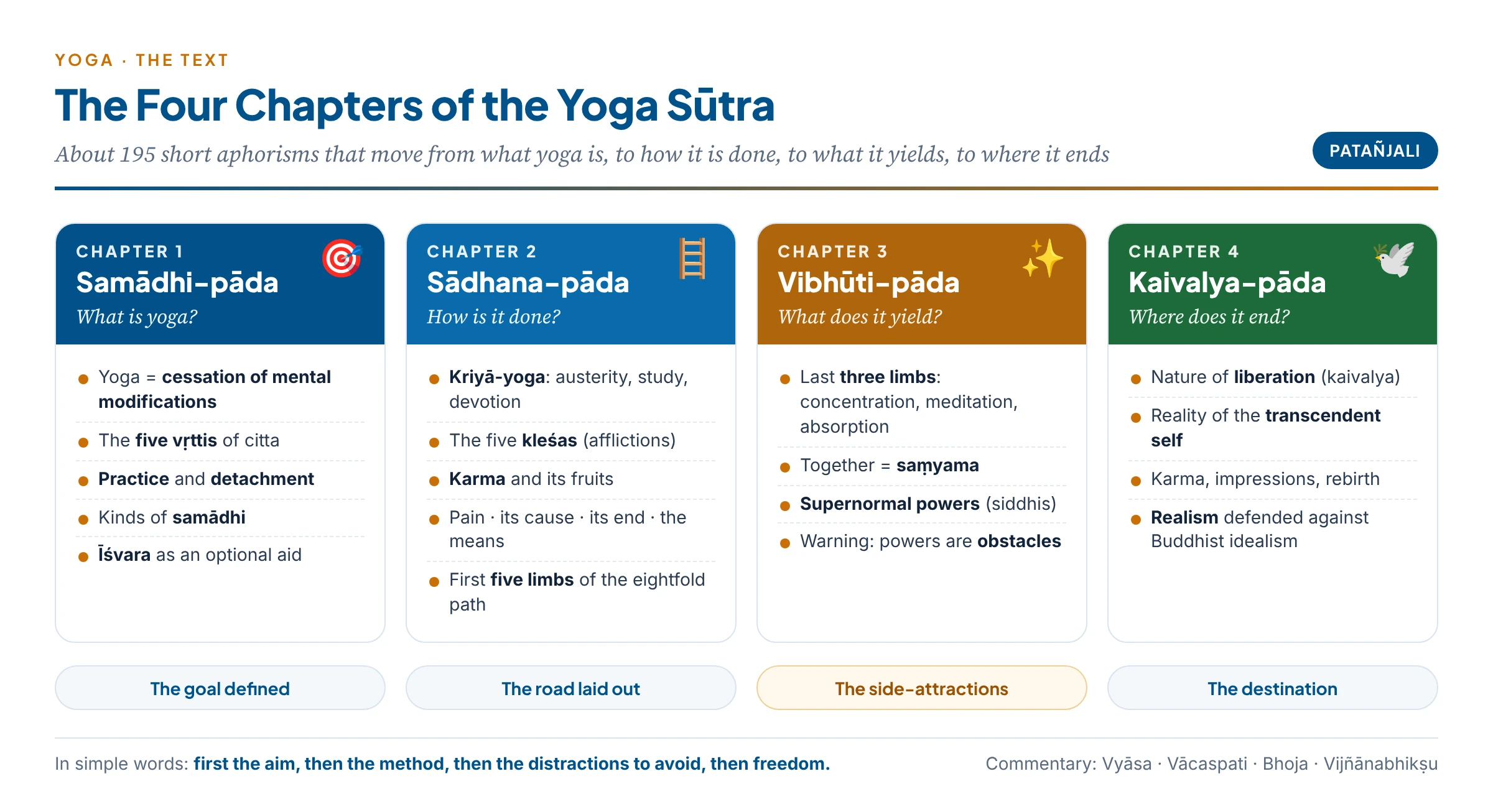
3. The Four Chapters (Pādas) of the Yoga Sūtra
- Samādhi-pāda — on absorption. The nature, aim and forms of yoga; the five modifications of the mind (vṛtti); practice and detachment; the kinds of samādhi; Īśvara as an aid.
- Sādhana-pāda — on the means. Kriyā-yoga (the yoga of action: austerity, study, devotion to God); the five kleśas (afflictions); karma and its fruits; the fourfold theme of suffering, its cause, its removal and the means of removal; the first five limbs of the eightfold path.
- Vibhūti-pāda — on powers. The three inner limbs (concentration, meditation, absorption) and their joint practice (saṃyama); the supernormal powers (siddhis) that follow — with a warning not to be trapped by them.
- Kaivalya-pāda — on liberation. The nature of liberation (kaivalya), the reality of the transcendent self, the theory of karma and impressions, and a defence of realism against Buddhist idealism.
4. The Problem Yoga Answers
- The shared diagnosis. Like Sāṃkhya, Yoga holds that the self (Puruṣa) is pure consciousness, free from body and mind, but mistakes itself for the body–mind complex. This mistake is the root of suffering.
- Sāṃkhya’s cure is discriminative knowledge (viveka-jñāna) — the direct realisation that “I am not this body, mind or ego”.
- The practical gap. But how is such knowledge to be gained by a mind that is restless, attached and clouded? “So long as the mind or the intellect of a man is impure and unsettled, he cannot properly understand anything profound and spiritual.” We need a pure heart and a tranquil mind.
- Yoga’s answer. The practice of yoga is “the best way of self-purification” — of body and intellect. Yoga therefore makes the practice of concentration “the sure means of attaining vivekajñāna“, which Sāṃkhya itself held to be the essential condition of liberation.
- In short. Yoga “gives a methodology more than a distinct metaphysics.” Its central doctrine is the doctrine of citta — the mind as an instrument that must be disciplined.
Core Doctrine
1. What Does “Yoga” Mean?
- Patañjali’s definition. The second sūtra defines yoga as yogaś citta-vṛtti-nirodhaḥ — “yoga is the cessation (nirodha) of the modifications (vṛtti) of the mind (citta)”. The next sūtra gives the result: “then the seer abides in its own nature“.
- Yoga as samādhi. Vyāsa begins his commentary with yogaḥ samādhiḥ — “yoga is samādhi (absorption)”. The cessation of mental modifications is achieved by concentration and meditation, which are also called yoga.
- Yoga as spiritual effort. For Patañjali, yoga is “spiritual effort to attain perfection through the control of the body, senses and mind, and through right discrimination between Puruṣa and Prakṛti.”
- Two roots of one word. Sanskrit has two verbs spelt yuj:
- yuj in the sense of joining (yujir yoge) — from which “yoga” means union;
- yuj in the sense of concentration (yuj samādhau) — from which “yoga” means absorption. Patañjali’s yoga comes from this second root.
- The Gītā’s sense. The Bhagavad Gītā describes yoga as that state “than which there is nothing higher worth gaining, and firmly established in which one is not shaken even by the greatest sorrow” — a state free from all pain. It also calls yoga “skill in action” and “evenness of mind”.
Common confusion
Does Patañjali’s “Yoga” mean the union of the individual soul with God? No. “Union of the individual self (jīvātman) with the Supreme Self (paramātman)” is the Vedāntic use of the word, and popular notes often repeat it. In Patañjali, yoga does not mean any contact between the self and God or the Absolute. It means the cessation of mental modifications, so that the self is separated from Prakṛti and rests alone (kaivalya). Even Īśvara is only an aid; the goal is not union with him.
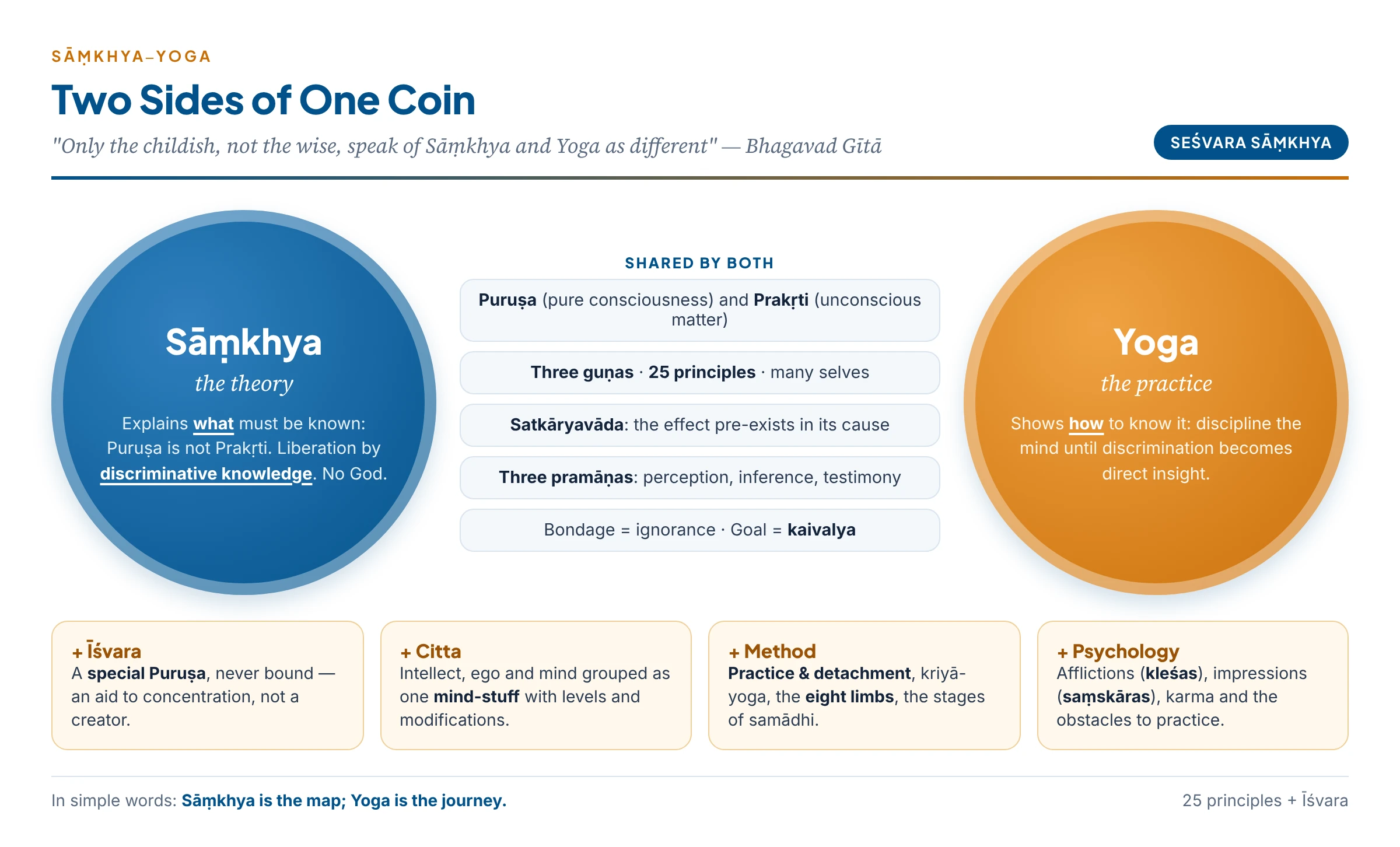
2. What Yoga Shares with Sāṃkhya
- Ontology (theory of what exists). Yoga accepts the Sāṃkhya picture almost entirely:
- Two eternal realities — Puruṣa, pure, inactive consciousness, and Prakṛti, unconscious, ever-changing matter made of three strands (guṇas: sattva, rajas, tamas).
- Many Puruṣas (bahupuruṣavāda) — each living being has its own self.
- The 25 principles (tattvas) — Puruṣa, Prakṛti and the 23 evolutes (intellect, ego, mind, ten senses, five subtle and five gross elements).
- Satkāryavāda — the effect pre-exists in its material cause, so evolution is a real transformation (pariṇāma) of Prakṛti.
- Epistemology (theory of knowledge). Yoga accepts the three pramāṇas (valid means of knowledge) of Sāṃkhya: perception, inference and verbal testimony.
- Diagnosis and goal. Both hold that bondage is due to ignorance — the self’s failure to discriminate itself from Prakṛti — and that liberation is kaivalya, the isolation of Puruṣa from Prakṛti, through discriminative knowledge.
- The tradition’s own verdict. The Gītā says that “only the childish, not the wise, speak of Sāṃkhya and Yoga as different” — they are two sides of the same coin. “Sāṃkhya is theory; Yoga is practice.”
In simple words
A student who has read every book on swimming still sinks in the river. Sāṃkhya is the book that explains why the body floats; Yoga is the coach who makes you practise in the water until floating becomes natural. Same truth, two approaches — knowing about it and becoming it.
3. Where Yoga Differs from Sāṃkhya
| Point | Sāṃkhya | Yoga |
|---|---|---|
| Main emphasis | Theory: intellectual discrimination (jñāna) | Practice: discipline, concentration, meditation (sādhana) |
| God | Nirīśvara — God unprovable and unnecessary | Seśvara — Īśvara, a special Puruṣa, accepted |
| Number of principles | 25 | 25 + Īśvara (often counted as 26) |
| The inner organ | Intellect, ego and mind treated as three separate organs | Grouped together as one citta (mind-stuff) |
| Means of liberation | Knowledge: “I am not, nothing is mine” | Cessation of mental modifications (nirodha) through practice and detachment, producing discriminative insight |
| Psychology | General account of the inner organ | Detailed psychology of citta: levels, modifications, afflictions, impressions |
- The first difference — God. Yoga adds Īśvara, though “not as creator” and mostly for practical reasons (devotion to him helps concentration). Article 7 examines whether this addition fits the system.
- The second difference — method. Sāṃkhya says what must be known; Yoga says how the mind can be made fit to know it. Sāṃkhya too “recommends study, reasoning and constant meditation”, but it does not work out a full discipline.
- The third difference — psychology. Yoga studies the mind far more closely: the five modifications (vṛtti), the five levels of mind (citta-bhūmi), the five afflictions (kleśa), latent impressions (saṃskāra) and karma.
Indian Connect — Seśvara Sāṃkhya — “Sāṃkhya made consistent”?
- Because Yoga keeps Sāṃkhya’s world-picture and adds God, it is called Seśvara Sāṃkhya (theistic Sāṃkhya) or “Neo-Sāṃkhya” — “same ontology, different method”.
- Some notes add that “Yoga is Sāṃkhya made consistent“: Sāṃkhya cannot easily explain how unconscious Prakṛti and inactive Puruṣa come together, and later Yoga brings in God to explain their association and dissociation.
- Others reply that God is “loosely attached” to Yoga and that the system works without him (Article 7).
4. Does Yoga “Broadly Accept” Sāṃkhya Ontology?
The verdict is yes, broadly — but not entirely.
- Arguments for “yes”.
- Yoga’s Puruṣa and Prakṛti, the guṇas, the 25 principles, plurality of selves and satkāryavāda are all Sāṃkhya doctrines.
- Vyāsa’s commentary calls the Yoga Sūtra an exposition of Sāṃkhya.
- Yoga’s goal is Sāṃkhya’s goal: kaivalya through discriminative knowledge.
- Points where it modifies the ontology.
- Īśvara — a Puruṣa who was never bound, omniscient and the teacher of the ancients — has no place in Sāṃkhya.
- Citta — Yoga treats intellect, ego and mind as one functional whole, a mind-stuff that holds the impressions of past lives.
- Later Yoga makes God the cause of the association and dissociation of Puruṣa and Prakṛti — something Sāṃkhya explains by Prakṛti’s own teleology.
- Realism made explicit. In its last chapter Yoga argues that objects are not dependent on any one mind, because the same object is seen differently by different minds — a direct reply to the Buddhist idealists.
- Conclusion. Yoga accepts the framework of Sāṃkhya but enriches it with a theistic element and a psychology. The change is not in the bricks but in the purpose: from explaining the world to transforming the person.
Common confusion
Does Yoga accept only one Puruṣa, unlike Sāṃkhya’s many? No. Some lecture notes say that “Yoga accepts only one Puruṣa, known as God”. This is wrong. Yoga keeps Sāṃkhya’s plurality of selves: there are innumerable Puruṣas, and Īśvara is only one special Puruṣa among them — special because he was never bound. Many selves plus one special self — that is Yoga’s position.
5. Theory and Praxis: Does the Yoga Sūtra Stress Action over Reflection?
- The claim. It is often said that the Yoga Sūtra emphasises praxis (action, practice) more than theoria (reflection, theory). There is truth in this:
- Most of the text is method. Practice and detachment, kriyā-yoga, the eight limbs, the remedies for obstacles, the stages of samādhi — the bulk of the sūtras tell the student what to do.
- It borrows its theory. Its metaphysics is taken over from Sāṃkhya almost without argument.
- Knowledge must be lived. Yoga holds that intellectual knowledge alone does not uproot deep-seated tendencies (saṃskāras); only long practice “for a long time, without break, and with devotion” makes the mind firm.
- Even its God is practical. Patañjali’s interest in Īśvara “seems to be practical” — devotion as a help to concentration.
- Why the claim is only half true. The Yoga Sūtra also contains a great deal of theory:
- Psychology — a full theory of citta, its five modifications, five levels, five afflictions and impressions.
- Epistemology — the three pramāṇas, the theory of error, verbal construction, sleep and memory.
- Metaphysics — the seer and the seen, the guṇas, the purpose of Prakṛti, the nature of time and change, and the defence of realism.
- Ethics — the vows and observances, and the theory of karma and its fruits.
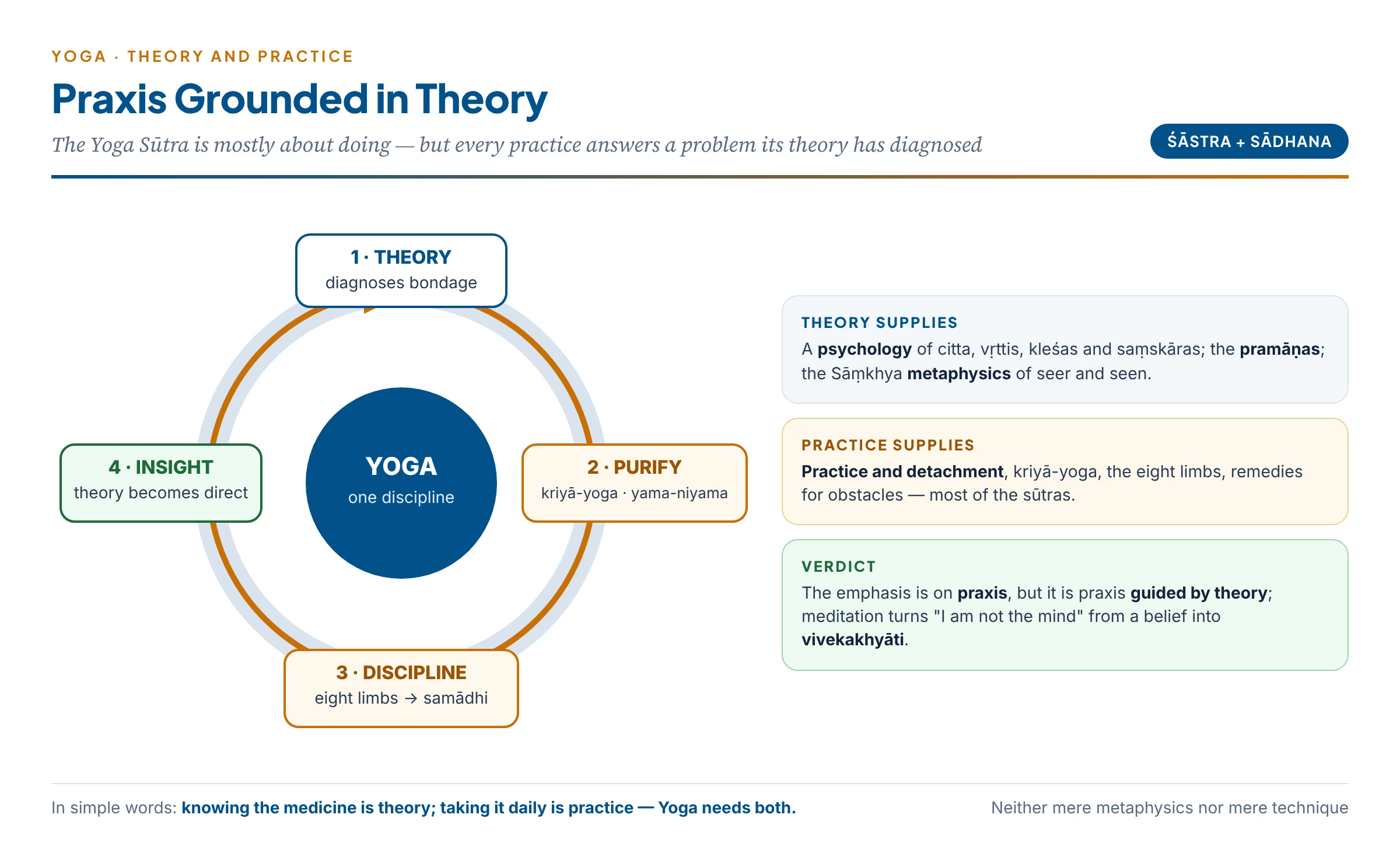
- How theory and practice work together.
- Theory explains bondage — why the mind binds (vṛttis, kleśas, saṃskāras).
- Practice removes bondage — kriyā-yoga purifies, the eight limbs discipline, samādhi uproots.
- Right knowledge guides practice — the pramāṇas give correct understanding, without which discipline is blind.
- Practice completes theory — discrimination becomes direct insight (viveka-khyāti) only through meditation.
In simple words
A cricket coach first explains why a batsman gets out to a certain ball — the theory. Then he makes him face that ball thousands of times in the nets — the practice. Most of the coach’s time goes into practice, but every drill answers a fault the theory has found. The Yoga Sūtra is like this coach.
- Verdict. The emphasis is on praxis, but praxis grounded in theory. Yoga is “neither mere metaphysics nor mere technique” but a single discipline of knowing and doing — a śāstra (systematic teaching) as well as a sādhana (practice).
6. Is Yoga More than a Psycho-physical Exercise?
- The popular picture. Today, “yoga” usually suggests postures (āsana), breathing (prāṇāyāma), flexibility and fitness. Many people see it as a health routine.
- What Patañjali actually says.
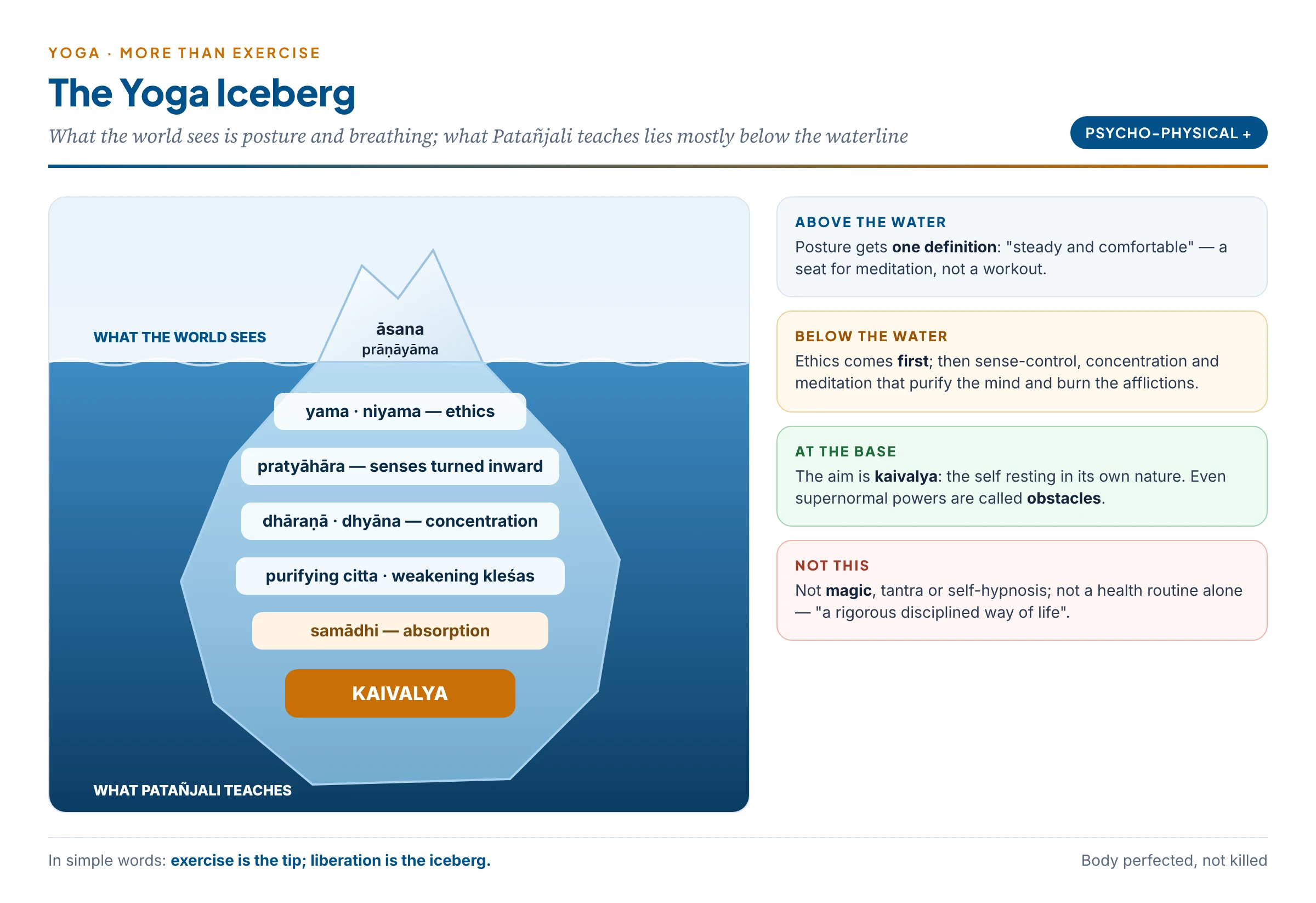
- Postures get one sūtra of definition: “posture is that which is steady and comfortable” (sthira-sukham āsanam). Its purpose is to sit still for meditation, not to perform complex exercises.
- Ethics comes first. The path begins with yama (non-violence, truth, non-stealing, continence, non-possessiveness) and niyama (purity, contentment, austerity, study, devotion to God). Without them “higher practices may collapse into egotism”.
- The aim is spiritual. The aim is not health but cessation of mental modifications, samādhi and kaivalya — the realisation of the self as pure consciousness.
- Body for the spirit. Yoga “does not want to kill the body; it recommends its perfection“, because “a sound mind needs a sound body“. The body is “the instrument for the expression of spiritual life”, not a machine to which spirit is attached from outside. So bodily practices are a means, never the end.
- Even powers are a trap. Supernormal powers (siddhis) arising from practice are called obstacles to samādhi. A system that warns against its own spectacular results is clearly not about the body.
- Why the “psycho-physical” element is still real.
- Posture, breath control and sense-withdrawal do calm the nervous system and steady the mind; they are genuine psycho-physical aids.
- Yoga recognises that mind and body influence each other: so long as the breath is unsteady, the mind too keeps fluctuating.
- Verdict. Yoga includes psycho-physical exercise but is much more: an ethical, psychological and spiritual discipline aiming at liberation — “a rigorous disciplined way of life“, “an excellent instrument of inner engineering“. It “should not be confused with magic, tantra or self-hypnotisation.” It is a system of spiritual discipline accepted by every Indian school except the Cārvāka — even Advaita Vedānta, which rejects Sāṃkhya’s dualism, accepts Yoga as conducive to spiritual life.
In simple words
An iceberg shows only a small tip above the water. Āsana and prāṇāyāma are the tip of yoga that the world sees. Below the surface lie ethics, control of the senses, concentration, meditation, the purification of the mind and, at the bottom, the realisation of the self. To call yoga “exercise” is to mistake the tip for the iceberg.
7. The Psychological Starting Point: Citta
- Why the mind matters. Yoga starts from the inner organs produced by Prakṛti — intellect (buddhi), ego (ahaṅkāra) and mind (manas) — because these “play a very crucial role in spiritual practice”.
- Citta in brief. Citta is the inner organ as a whole: the first product of Prakṛti, mainly sattva (clear, luminous), unconscious in itself but reflecting the consciousness of Puruṣa, and therefore appearing conscious. When it takes the form of an object, that form is a vṛtti (modification).
- The self as reflected. Puruṣa, reflected in the changing citta, appears to change — “as the moon appears to move when reflected in moving waves”. Citta with Puruṣa’s reflection in it is the jīva or phenomenal ego, which is born, dies, transmigrates and suffers.
- The individual self (jīva). In Sāṃkhya–Yoga the jīva is “the free spirit associated with the gross body and more closely related to a subtle body constituted by the senses, the mind, the ego and the intellect”.
- The programme. When the waves of citta die down, Puruṣa ceases to identify with them and “the seer abides in its own nature“. Articles 2 and 3 explain citta and its modifications in detail.
8. The Shape of the Whole System
- Psychology: citta, its levels and modifications (Articles 2–3).
- Diagnosis of bondage: the five afflictions (kleśa), rooted in ignorance (Article 4).
- Discipline: kriyā-yoga and the eight limbs (Article 5).
- Culmination: the stages of samādhi (Article 6).
- Aid: Īśvara and devotion to him (Article 7).
- Goal: kaivalya, the isolation of Puruṣa (Article 8).
Critical Evaluation
1. A Shared Problem with Sāṃkhya: The Advaita Critique of Prakṛti-pariṇāmavāda
Since Yoga takes over Sāṃkhya’s ontology, it also inherits Sāṃkhya’s problems. The most famous attack comes from Advaita Vedānta.
- Common ground. Both Advaita and Sāṃkhya–Yoga accept satkāryavāda — the effect pre-exists in its cause. They split on the question: is the effect a real transformation?
- Sāṃkhya–Yoga: yes — Prakṛti-pariṇāmavāda, the world is a real transformation of Prakṛti (like milk becoming curd).
- Advaita: no — Brahma-vivartavāda, the world is only an apparent transformation of Brahman (like a rope appearing as a snake).
- Śaṅkara’s objections to real transformation.
- The new form was not in the cause. If the effect is a real modification, Sāṃkhya concedes that at least the new form of the effect did not exist in the cause — which opens satkāryavāda to the Nyāya charge that something new is produced.
- The “third man” regress. If cause and effect are two separate realities, a third thing is needed to relate them, then a fourth to relate that, and so on without end.
- Has the form an independent reality? If, as Sāṃkhya insists, the form of the effect cannot be perceived as different from the cause, does it have any reality of its own? Does oil have a reality independent of the seed?
- Sāṃkhya’s defence — the five proofs of satkāryavāda.
- Asad-akaraṇāt — what does not exist cannot be produced; otherwise it would be like a hare’s horn.
- Upādāna-grahaṇāt — we take the right material to get a desired effect (oilseeds for oil).
- Sarva-sambhava-abhāvāt — not everything comes from everything; oil cannot be pressed out of sand.
- Śaktasya śakya-karaṇāt — only a cause with the right power produces the effect (seeds kept in a granary do not become plants by themselves).
- Kāraṇa-bhāvāt — cause and effect are one in essence, like threads and cloth, seeds and oil.
- Advaita’s final reply. Sāṃkhya itself tacitly accepts the logic of vivarta: it says the contact between Puruṣa and Prakṛti is only a semblance of contact (saṃyoga-ābhāsa), not a real one. If the contact is only apparent, the change it starts should be apparent too — so Sāṃkhya’s realism about change is inconsistent.
2. Other Criticisms of the Yoga System
- From strict Sāṃkhya. Bringing in Īśvara is inconsistent with strict dualism: a Puruṣa cannot act, so God cannot be causally relevant.
- From Mīmāṃsā. God is unnecessary for karma and its fruits; the moral law works by itself.
- From Buddhism. A permanent Puruṣa is unacceptable; meditation should reveal impermanence and no-self, not an eternal self.
- From modern psychology. Is the cessation of mental modifications a suppression of mental life rather than a healthy transformation of it?
- Logical difficulties.
- If Puruṣa is always free, how can bondage be real at all?
- How can unconscious Prakṛti interact with consciousness without any real contact?
- From the sceptic. To an unsympathetic critic, Yoga may look “not so much a system of philosophy as a school of mysticism and magic“: its transcendent self is far from common sense, and its supernormal powers do not fit the known laws of physics or psychology.
- From the Cārvāka. Only perception is valid; Prakṛti, Puruṣa and Īśvara are all imperceptible, so the whole system rests on unverifiable claims.
3. Replies and Defences
- Experience, not mere speculation. Yoga “relies mostly on actual experiences to carry conviction to its followers”. Its claims are to be tested in practice, not accepted on authority.
- Deeper levels of consciousness. If there is a transcendent spirit, there must be “deeper levels of consciousness than the empirical one”. Glimpses of this have been caught by seers and saints, and by philosophers such as Plato and Aristotle, Spinoza and Leibniz, Kant and Hegel; psychical research and psycho-analysis too have revealed hidden regions of the mind. As one Western writer on yoga and psychology put it, there is “a region beyond that painted drop-scene” of ordinary life, open to exploration “by those who are sufficiently determined”.
- Not magic. The powers are side-effects, and Yoga itself warns against them; the system is a method of purification and self-control.
- Better placed than Sāṃkhya. “Both from a theoretical and a practical standpoint, it occupies a better position than the Sāṃkhya in so far as it admits the existence of God and relies mostly on actual experiences.”
- Suppression or transformation? Nirodha is not violent suppression; it is “a state of mastery in which the fluctuations of citta are pacified” — as a lake becomes clear when its waves settle.
Critics and Defenders
Criticism — Critics
- Advaita (Śaṅkara): real transformation of Prakṛti leads to new forms, regress and inconsistency with “semblance of contact”.
- Strict Sāṃkhya and Mīmāṃsā: Īśvara is causally idle and unnecessary.
- Buddhists: no permanent self exists for meditation to reveal.
- Modern psychology: cessation of mental activity may be repression, not growth.
- Cārvāka and sceptics: the system rests on imperceptible entities and on claims of supernormal powers.
Defence — Defenders and strengths
- Experience-based: its claims are meant to be verified by practice.
- Complete psychology: the most exact theory of attention and mental discipline in Indian thought.
- Accepted by all: every school except the Cārvāka — including Advaita — uses Yoga as a spiritual method.
- Not suppression: nirodha is mastery and calm, like a lake becoming transparent.
- Ethics first: its practice begins with non-violence and truth, guarding against egotism and magic.
Cross-Tradition Comparison
Yoga and Other Paths of Self-Discipline
| Point | Pātañjala Yoga | Buddhism | Jainism | Advaita Vedānta |
|---|---|---|---|---|
| Root problem | Ignorance: Puruṣa confused with citta | Ignorance and craving | Karma-matter binding the soul | Ignorance of identity with Brahman |
| Discipline | Eight limbs; kriyā-yoga | Noble Eightfold Path (ethics, concentration, wisdom) | Three jewels; five great vows | Hearing, reflection, meditation |
| Role of meditation | Central — cessation of mental modifications | Central — insight into impermanence | Important — for destroying karma | Aid; knowledge alone liberates |
| Self | Many eternal Puruṣas | No permanent self | Many real souls | One Self = Brahman |
| God | Īśvara as an aid | None | None | Īśvara real only at the empirical level |
Indian Connect — Key takeaways
- The five yamas of Yoga are the five great vows of Jainism; Yoga’s friendliness, compassion, joy and equanimity match the Buddhist “divine abodes” (brahmavihāras). Yoga grew up in dialogue with these traditions.
- Every Indian school except the Cārvāka borrows Yoga’s methods, even when it rejects its metaphysics — Yoga is a shared technology of the spirit.
- Yoga’s distinctive mix is dualist metaphysics + detailed psychology + optional theism.
Western Parallels
- Plato. Philosophy as purification (katharsis) of the soul from the body’s distractions in the Phaedo — the soul must “collect itself into itself”, much as Yoga turns the senses inward.
- The Stoics. Spiritual exercises (askēsis), self-control and freedom from passions for inner peace — but without Yoga’s transcendent self.
- Plotinus. The ascent of the soul through purification to an ecstatic union with the One — mystical like Yoga’s samādhi, but ending in union, not isolation.
- Descartes. Mind and body are two substances — but for Descartes the mind is conscious, while for Yoga the mind (citta) is matter and only Puruṣa is conscious.
- Modern psychology. Attention training, mindfulness-based therapies and research on meditation show that the “psycho-physical” side of yoga has measurable effects — while leaving its metaphysical claims open.
Synthesis (Siddhānta)
- Yoga is the practical side of Sāṃkhya. It accepts Sāṃkhya’s Puruṣa and Prakṛti, the guṇas, the 25 principles, plurality of selves, satkāryavāda and the three pramāṇas — and adds Īśvara and a detailed method. Hence Seśvara Sāṃkhya.
- Its definition of yoga — cessation of the modifications of the mind — means absorption (samādhi) and separation of the self from Prakṛti, not union with God.
- The Yoga Sūtra moves from the nature of yoga (Samādhi-pāda) to its means (Sādhana-pāda), its powers (Vibhūti-pāda) and its goal (Kaivalya-pāda).
- Praxis or theory? The emphasis is on praxis, but praxis rooted in a rich theory of the mind; the two form one cycle.
- More than exercise? Yes — postures and breathing are only the visible tip of an ethical, psychological and spiritual discipline whose goal is liberation.
- Weak points are inherited from Sāṃkhya (the Puruṣa–Prakṛti relation, real transformation) and created by its addition of God; strong points are its experiential method, its psychology and its universal acceptance.
- Contemporary relevance.
- International Day of Yoga — proposed by India and adopted by the UN General Assembly in 2014, observed on 21 June — and UNESCO’s 2016 recognition of yoga as intangible cultural heritage show its global reach. Patañjali’s text reminds us that this heritage is a philosophy of the mind, not only a fitness routine.
- Mental health. Stress, anxiety and distraction are problems of an untrained mind; Yoga’s psychology of attention is directly relevant to them.
- Ethics in public life. Non-violence, truthfulness, non-stealing and non-possessiveness are as relevant to an administrator as to a monk.
- Dialogue of traditions. Yoga’s shared vocabulary with Buddhism and Jainism shows that Indian traditions grew through conversation, not isolation.
“Yoga is the cessation of the modifications of the mind. Then the seer abides in its own nature.” — Patañjali, Yoga Sūtra
Previous Year Questions
- 2011“Yoga is more than a psycho-physical exercise”. Analyse this statement and support your conclusion with arguments.
- 2012Critically evaluate the statement that “Yoga Sūtra emphasises more on praxis (action) than on theoria (reflection)”.
- 2012Give your critical comments on the assertion that the school of Yoga broadly accepts Sāṃkhya ontology.
- 2018How do the Advaita Vedāntins react to the Prakṛti-pariṇāmavāda of the Sāṃkhya philosophy? How do the Sāṃkhyas defend their own position in this regard? Discuss.