

Existentialism (Kierkegaard, Sartre, Heidegger): Existence and Essence; Choice, Responsibility and Authentic Existence; Being-in-the-world and Temporality.
Official Syllabus: Paper I, Section A, Unit 10
Martin Heidegger (1889–1976) asked a question that, he believed, Western philosophy had forgotten for two thousand years: what does it mean “to be”? We say “the tree is“, “God is“, “I am” — but what is this “is”? To answer, Heidegger begins not with God, nature or a pure thinking mind, but with the kind of being we ourselves are — Dasein (“being-there”), the being who is always already in a world, busy with things and people, and to whom its own existence matters. His Being and Time (Sein und Zeit, 1927) thus becomes a deep analysis of human existence — being-in-the-world, care, anxiety, death and time — which made him, against his own wishes, a founding figure of existentialism.
In simple words
Ask a child “What is a mango?” and she will point to one. Ask “What is is?” and she will be puzzled — and so are we. We use the word a thousand times a day and understand it well enough to live by, yet we cannot say what it means. Heidegger’s whole philosophy starts from this everyday puzzle: we understand Being, but we do not know that we understand it, or how.
Context & Problem
Heidegger’s Path
- Roots. Heidegger was raised in a Catholic family in a small town in the mountains of south-west Germany. He first trained for the priesthood, then turned to philosophy. The rural, rooted life of the Black Forest stayed with him all his life — it colours his talk of dwelling, earth and home.
- Student of Husserl. He was the student and assistant of Edmund Husserl, the founder of phenomenology, and dedicated Being and Time to him. In 1928 he succeeded Husserl to the chair of philosophy at Freiburg.
- From consciousness to existence. Husserl had asked how consciousness knows its objects (an epistemological question). Heidegger turned phenomenology into ontology — the study of Being — and replaced the pure, detached consciousness with the concrete, living human being in the world.
- An unfinished book. Being and Time was planned in two parts, each with three divisions. Only the first two divisions were published; the rest was never written. Heidegger later spoke of having reached a “dead end” in the original plan, and his thought took a turn (Kehre) towards language, poetry and the history of Being.
- The dark chapter. In 1933 Heidegger joined the Nazi party and became Rector of Freiburg University. He resigned within a year, but he never publicly apologised and kept silent about the Holocaust. This remains one of the most debated facts about any modern philosopher (see Critical Evaluation).
Is Heidegger an Existentialist?
- He refused the label. Heidegger insisted that his concern was not the human individual as such but the meaning of Being; the analysis of human existence was only the path to that question. In his Letter on Humanism (1947) he explicitly separated himself from Sartre.
- Yet he belongs to the story. The early Heidegger takes over and deepens ideas from Kierkegaard (anxiety, the crowd, the moment of decision) and Nietzsche (the death of traditional values, the call to become oneself). His themes — Angst, being-towards-death, authenticity, the “they”, ecstatic temporality — became the vocabulary of existentialism, and Sartre built Being and Nothingness on them.
- Existential phenomenology. For this reason textbooks place Heidegger, with Sartre and Merleau-Ponty, under existential phenomenology: the phenomenological method applied to human existence.
- Atheist, theist or neither? Heidegger is often listed among “atheistic existentialists” with Sartre and Nietzsche, against “theistic” Kierkegaard and Jaspers. This is only a rough grouping: Heidegger held that God’s existence has no philosophical relevance for the analysis of Dasein, but he never built a philosophy on denying God.
Common confusion
Did Heidegger proclaim himself an atheist? No. Some notes say so, but Heidegger never declared himself an atheist. He set aside the question of God as not belonging to philosophy’s task (he once said that philosophy, in its questioning, must be “atheistic in principle”), and his later thought, with its reverence before the mystery of Being, has often been compared to mysticism and even negative theology. Sartre, not Heidegger, made atheism the starting point of his existentialism.
The Forgotten Question
- Being and Time opens with a line from Plato’s Sophist:
“For manifestly you have long been aware of what you mean when you use the expression ‘being’. We, however, who used to think we understood it, have now become perplexed.” — Plato, quoted by Heidegger
- Three prejudices have kept the question asleep:
- “Being is the most universal concept” — everything that is, is; so it seems to be the emptiest, most general idea. But universality does not make it clear; it makes it the most obscure.
- “Being cannot be defined” — true, because Being is not a thing that can be placed in a class and marked off by a difference. But this does not cancel the question; it demands it.
- “Being is self-evident” — we all understand “the sky is blue” or “I am happy”. But that we live in an understanding of Being and yet its meaning is veiled in darkness shows that the question must be asked again.
- The aim. Heidegger states his task plainly: to work out the question of the meaning (sense) of Being, and to do so concretely — not by speculation about a supreme reality, but by examining the being who asks the question.
Core Doctrine
1. The Question of Being: Being and Beings
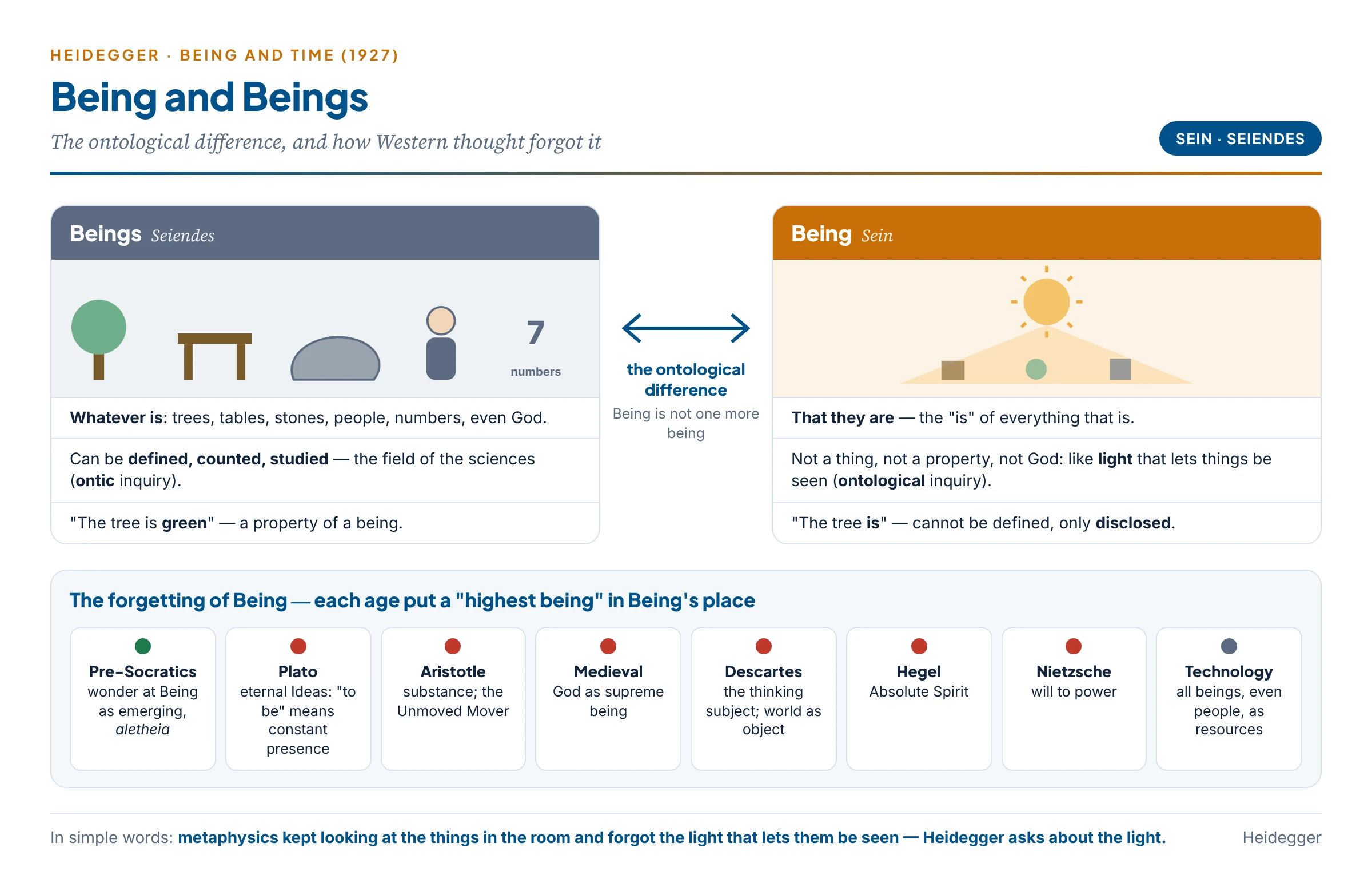
- Being is not a property. When I say “the tree is green”, greenness is a property of the tree. But when I say “the tree is“, I add no new property: Being is not one more feature like colour, size or weight. It is that by which anything shows up as something at all.
- Beings (Seiendes, entities). Trees, tables, stones, numbers, animals, people, even God — anything that is. Beings can be experienced, defined, counted, studied by the sciences.
- Being (Sein). Not another being, not the biggest or highest thing, but the “is” of all that is — the condition for entities to appear and be understood. Being cannot be defined or captured in a conceptual theory; it can only be felt, realised, disclosed.
- The ontological difference (ontologische Differenz). This distinction between Being and beings is the central idea of Heidegger’s thought. Forgetting it — treating Being as if it were just a very special being — is the error of traditional metaphysics.
- Ontic and ontological.
- An ontic inquiry studies beings: what things are there and what are their properties? Physics, biology, psychology and history are ontic sciences.
- An ontological inquiry asks about the Being of beings: what does it mean for a thing to be a living thing, a historical event, a number?
- Every science quietly depends on an ontology (biology presupposes some idea of what “life” is). So fundamental ontology must ground the regional sciences.
- Being reached only through beings. We can never meet Being “by itself”, apart from beings; it is always the Being of some being. Yet we can never grasp Being by simply looking at beings either, the way science does. Hence a special path is needed.
In simple words
Think of light in a room. You see the chair, the table and the book — but you do not see the light as one more object beside them. Yet without it, nothing would be visible. Being is like that light: not one of the things in the room, but what lets every thing show up as what it is. Metaphysics, Heidegger says, kept staring at the furniture and forgot the light.
Common confusion
Is “Being” a metaphysical entity — a supreme reality behind things? Some notes describe Heidegger’s Being as a “metaphysical entity”. This is exactly what Heidegger denies. Being is not an entity at all — not a substance, not God, not a hidden thing-in-itself, not Plato’s Forms or Spinoza’s Substance. To turn Being into a highest entity is precisely the “forgetfulness of Being” he accuses metaphysics of. Being is the event of things coming to presence and being understood.
2. The Forgetting of Being: Heidegger’s History of Metaphysics
- The early Greek wonder. The earliest Greek thinkers (the pre-Socratics, such as Heraclitus and Parmenides) were astonished that things are at all. They experienced Being as emerging, unfolding, coming out of concealment — the Greek word for truth, aletheia, literally means un-concealment (“uncoveredness”).
- Plato turns away. With Plato, the unfolding of Being was frozen into eternal Ideas (Forms) — fixed essences seen by the mind’s eye. From then on, “to be” meant “to be constantly present“. This is where the forgetfulness of Being begins.
- One long story of substitution. Each epoch replaced Being with some highest being:
| Epoch | What “to be” came to mean |
|---|---|
| Plato | the eternal Idea (Form) |
| Aristotle | substance (ousia); the Unmoved Mover |
| Medieval thought | God as the supreme being and creator |
| Descartes and modern thought | the subject, consciousness, the thinking “I” |
| Hegel | Absolute Spirit |
| Nietzsche | the will to power |
| Our technological age | resources — everything as material to be used |
- Representational thinking. Since Descartes, thinking has meant a subject standing over against objects and representing them. Nature becomes an object to be measured and mastered.
- The technological attitude. This subject–object mindset ends in the modern technological way of seeing: forests become timber, rivers become hydro-power, and even human beings become “human resources“, functional units in a vast machine. Being is reduced to usefulness.
- The neglected question. Leibniz asked the great question “Why is there something rather than nothing?” — but answered it only theologically, by pointing to God as the sufficient reason. For Heidegger, the question itself, the wonder, matters more than such an answer.
- “Destruction”, not rejection. In Being and Time Heidegger calls for a “destruction” (Destruktion) of the history of ontology. This does not mean throwing tradition away, but dismantling its hardened concepts to recover the original experiences buried beneath them. His critique of metaphysics is a transformation, not a wholesale rejection. Our language too is “encrusted” with old metaphysical assumptions, which is why Heidegger invented a new vocabulary.
- Not speculative metaphysics. Heidegger’s own inquiry is not speculative in the manner of Plato’s Ideas or Spinoza’s Substance. For him the world is not an illusion, and metaphysics is rooted in human existence itself. He also stood against the logical positivists, for whom all metaphysics was meaningless.
3. Why Begin with Dasein?
- Being is always disclosed to someone. Being is never met apart from an entity to whom it is disclosed. Stones, plants and animals are, but they do not understand that they are. Only one being asks about Being and lives in some understanding of it — we ourselves.
- Dasein. Heidegger calls this being Dasein (literally “there-being“, “being-there”). He chooses this ordinary German word deliberately, to avoid the loaded terms of tradition — subject, self, person, consciousness, mind, “rational animal” — which, he said, keep thinking a hostage of old metaphysics.
- Not a biological organism, not a consciousness. Dasein is not the human body studied by biology, nor a pure mind studied by psychology, nor Husserl’s transcendental ego. Dasein is not a synonym for consciousness. It is the way of being of the human being: open, involved, “there” in a world.
- Being is an issue for it. In Heidegger’s words, Dasein is distinguished by the fact that in its very Being, that Being is an issue for it. My existence is not just a fact about me; it is a question and a task — I have to be it, decide about it, make something of it.
- Pre-ontological understanding. Dasein already understands Being in a vague, pre-theoretical way (it uses “is” meaningfully every day). Philosophy only has to make this hidden understanding explicit.
- A methodological starting point. Dasein is the only ontic route to the ontological: the one being whose analysis opens the way to Being in general. The focus on Dasein is methodological — not because human beings are the centre of the universe, but because the question of Being can only be raised by and through the being who asks it.
- What Dasein can do that nothing else can.
- It exists with awareness of existing.
- It has curiosity, a passion towards the future, the ability to plan — capacities no other animal has.
- It is not like a chair or a table, but a being who can choose: it understands itself in terms of its possibilities — what it can be.
- It can realise its Being or ignore it. An authentic life turns towards Being; an inauthentic life loses itself among beings (see the next article).
- Ek-sistence. Heidegger plays on the Latin ex-sistere, “to stand out“. Other beings merely are; only Dasein ex-ists — stands out beyond itself into its possibilities, towards the world and towards Being. And so only Dasein has a world; stones and animals are merely in the world.
In simple words
A stone on the road does not wonder what it is; a cow grazing does not plan its career or fear its death. But you, reading this, are already asking “Who am I? What should I become?” — your own being is at stake for you. That is why Heidegger starts with you: the one being for whom being is a question is the natural door to the question of Being.
4. “The Essence of Dasein Lies in Its Existence”
- Meaning. Dasein has no fixed “what” — no given nature, like the nature of a stone or a species. Its “essence” is its existence: the way it projects itself into possibilities and takes up its being. Whatever qualities we find in Dasein are not properties of a thing but possible ways for it to be.
- Who, not what. We ask “what is a table?” but “who is Dasein?” Dasein is always mine — Heidegger calls this mineness (Jemeinigkeit). Each of us has to be his or her own being; no one can exist for me.
- Existentials, not categories. The traits of things are categories (substance, quantity, quality, place). The traits of Dasein are existentials (Existenzialien) — being-in-the-world, care, understanding, mood, being-towards-death. Using thing-categories for human beings is the root error of Descartes and of scientific psychology.
- Not a pre-given plan. Like Kierkegaard’s “existing individual”, Dasein is a becoming, not a finished product; its being is self-creation in time, between birth and death.
- Link to Sartre. Sartre turned this idea into his slogan “existence precedes essence“. But Heidegger’s “existence” means Dasein’s ecstatic standing-out into Being, not Sartre’s free self-making; he rejected Sartre’s version as still caught in old metaphysics (see section 15).
5. Phenomenology as the Method of Ontology
- Definition. Heidegger defines phenomenology through its Greek roots — phainomenon (that which shows itself) and logos (letting something be seen). Phenomenology means:
“To let that which shows itself be seen from itself in the very way in which it shows itself from itself.” — Heidegger, Being and Time
- From concealment to unconcealment. What most needs phenomenology is exactly what does not show itself at first — what lies hidden behind what is obvious. Above all, the Being of beings is hidden, covered up by everyday habits and by the tradition. Phenomenology uncovers it — truth as aletheia.
- Phenomenology becomes ontology. For Husserl, phenomenology studied the structures of consciousness. For Heidegger, “ontology is possible only as phenomenology“: the way to Being is to let the structures of Dasein’s existence show themselves.
- Hermeneutic phenomenology. Dasein always already interprets itself and its world. So the method must be hermeneutic — an art of interpretation:
- Pre-understanding. We never begin from zero; we bring a prior understanding to everything we meet. A carpenter “sees” a workshop very differently from a child.
- The hermeneutic circle. We understand the parts through the whole and the whole through the parts — we must already “know” something of what we seek, and yet not know it. Heidegger says the point is not to escape this circle but to enter it in the right way.
- Hermeneutic of facticity. The early Heidegger called his project a “hermeneutic of facticity” — interpreting human life as it is actually lived, in its concrete, thrown, historical situation, rather than as an abstract “subject”.
- Understanding as a way of being. For the older tradition of hermeneutics (Schleiermacher, Dilthey) “understanding” was a method of the human sciences for interpreting texts or cultures. Heidegger made understanding a fundamental way of being-in-the-world — something Dasein is, not merely something it does. This “rendered phenomenology hermeneutical”; Husserl refused to accept it. Gadamer later developed it into philosophical hermeneutics.
- A corrective to scientific objectification. Phenomenology lets things be seen as they are lived, before science reduces them to measurable objects. It protects the richness of lived experience from being flattened into data.
6. Breaking with Husserl: Why the World Cannot Be Bracketed
- Husserl’s epoché. Husserl asked the philosopher to perform the epoché — to “bracket” or suspend the natural belief in the existence of the world — so as to study pure phenomena in a transcendental consciousness (the transcendental ego), with the detachment of a scientist.
- Heidegger’s rejection.
- We cannot step out of the world. Dasein is always already in the world; there is no neutral, world-less standpoint from which the world can be suspended. Man cannot be a detached spectator of a world he is part of. The “natural attitude” cannot be bracketed.
- Theory is not our first relation. Bracketing makes our relation to the world theoretical, as if we first looked at things. But we first use, care for and deal with things — our primary relation is practical concern, pre-theoretical.
- Consciousness is attached to things. Husserl’s “pure consciousness” is an abstraction. Real experience is embodied, involved, attached to the things it deals with; it is care that makes the human being human.
- Being is not an essence. Husserl’s reduction aimed at the essences of things; Heidegger’s question is about their Being, their existence — which the epoché brackets away.
- Epistemology versus ontology. Husserl’s question was epistemological (how is certain knowledge possible?). Heidegger’s is ontological (what is the being of the one who knows?). Knowing itself is only one mode of being-in-the-world.
- Other existentialists agree.
- Merleau-Ponty: “the most important lesson which the reduction teaches us is the impossibility of a complete reduction” — one cannot reduce the very existing person who is doing the reducing. He spoke of the “operative intentionality” of the lived body.
- Sartre keeps Husserl’s intentionality but discards the transcendental ego, and his knowledge is “committed“, not detached.
- Sartre also found the “phenomenon of being” in nausea, which reveals the contingency of existence — a disclosure that is emotional, not cognitive.
- Even Husserl, in his later work on the lifeworld (Lebenswelt), moved towards the shared, lived world as the ground of all theory.
| Husserl | Heidegger | |
|---|---|---|
| Main question | How does consciousness know? (epistemology) | What does it mean to be? (ontology) |
| Starting point | Pure, transcendental consciousness | Dasein, the concrete being-in-the-world |
| The world | Bracketed by the epoché | Cannot be bracketed; always already there |
| Attitude | Detached spectator, theoretical gaze | Involved agent, practical concern |
| Method | Descriptive, transcendental phenomenology | Hermeneutic (interpretive) phenomenology |
| Key relation | Intentionality of consciousness | Care (Sorge) of Dasein |
7. Transcendental Ego or Concrete Self? Husserl, Heidegger and Sartre
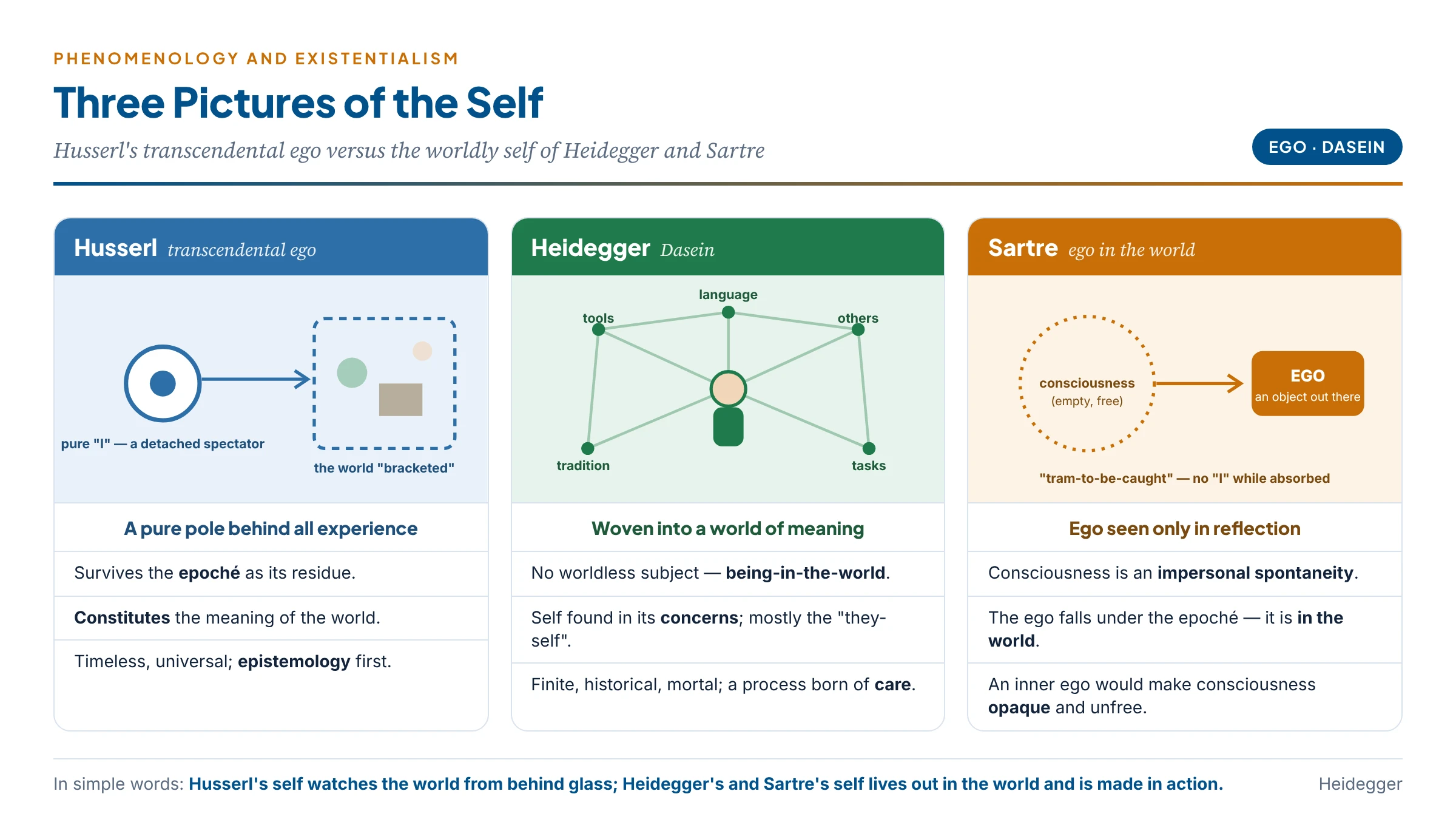
- Husserl’s transcendental ego. For Husserl, behind all experiences stands a pure “I”, the transcendental ego, which constitutes the meaning of the world and survives the epoché. It is not the empirical person with a body and a history, but a pure pole of consciousness.
- Heidegger: no worldless subject. Heidegger does not need such an ego. The “self” is not a hidden thinking thing behind experiences, but Dasein: a concrete, finite, historical being who exists in a world, among others, towards death.
- The self is found in what it does — in its tasks, roles and concerns.
- In everyday life the self is mostly the “they-self” — the anonymous “one” who does what “one” does. Only in authenticity does Dasein become its own self.
- The self is not a substance but a way of existing — a process born of care.
- Sartre: the ego is in the world. In The Transcendence of the Ego (1936) Sartre argued that the ego is not in consciousness at all, but an object out in the world, like other objects, found (and partly made) only in reflection.
- When I am absorbed in reading a novel or running to catch a tram, there is no “I” — only “tram-to-be-caught“.
- Consciousness is “a monstrous impersonal spontaneity“, free of any inner ego.
- Keeping a transcendental ego inside consciousness would make consciousness opaque and heavy, and would destroy its freedom.
- Common ground. Both Heidegger and Sartre replace the pure, timeless, world-constituting ego of Husserl with a lived, worldly, empirical self that is made in action and choice.
| Husserl | Heidegger | Sartre | |
|---|---|---|---|
| What is the self? | Transcendental ego — pure pole of consciousness | Dasein — being-in-the-world | Ego as an object in the world |
| Where is it? | Inside consciousness, behind experience | Out in the world, in its concerns | Outside consciousness; seen only in reflection |
| Role | Constitutes the meaning of the world | Discloses Being through care | Consciousness is free, impersonal, “nothing” |
| Survives the epoché? | Yes — the residue of the reduction | Epoché is impossible | The ego itself falls under the epoché |
| Character | Timeless, universal | Finite, historical, mortal | Spontaneous, free, self-making |
8. Being-in-the-World: One Unified Phenomenon
- A single structure. Heidegger writes “being-in-the-world” (In-der-Welt-sein) with hyphens to show that it is one unified phenomenon, not three pieces (a being + “in” + a world) glued together. There is no Dasein without a world, and no world without Dasein.
- Three moments that can be distinguished but not separated:
- The world. Not the sum of all objects, not a big container, but a network of significance — a whole of meaningful relations in which things show up as what they are (the “referential totality“).
- Being-in. Not spatial inclusion, like water “in” a glass or a chair “in” a room, but dwelling, familiarity, being “at home” with — as when we say someone is “in love” or “in business”. The German in is linked to “dwell”, “be accustomed to”.
- The “who”. Who is it that is in the world? Usually not “I” in any special sense, but the anonymous “they” (das Man) — see section 11 and the next article.
- Every man makes his own world. The human world is not just physical surroundings but relations, friends, acquaintances, tools and tasks — all organised by our concern (Sorge). A farmer, a poet and a soldier live on the same land but in different worlds.
- Dasein is relational. Dasein is not first an isolated mind that later reaches out to things. It is from the start social and historical — with others, among tools, inside a language and a tradition.
- Knowing is derivative. Knowing is one way of being-in-the-world, not the bridge that connects a mind to a world. We can know the world only because we already dwell in it.
In simple words
Think of the word “in” in two sentences: “the pen is in the box” and “she is in love”. The first is about position; the second is about a whole way of living. Heidegger’s “being-in-the-world” is like the second: we are not placed inside the world like pens in a box — we live it, care about it, and feel at home (or not at home) in it.
9. Worldhood: Ready-to-Hand and Present-at-Hand
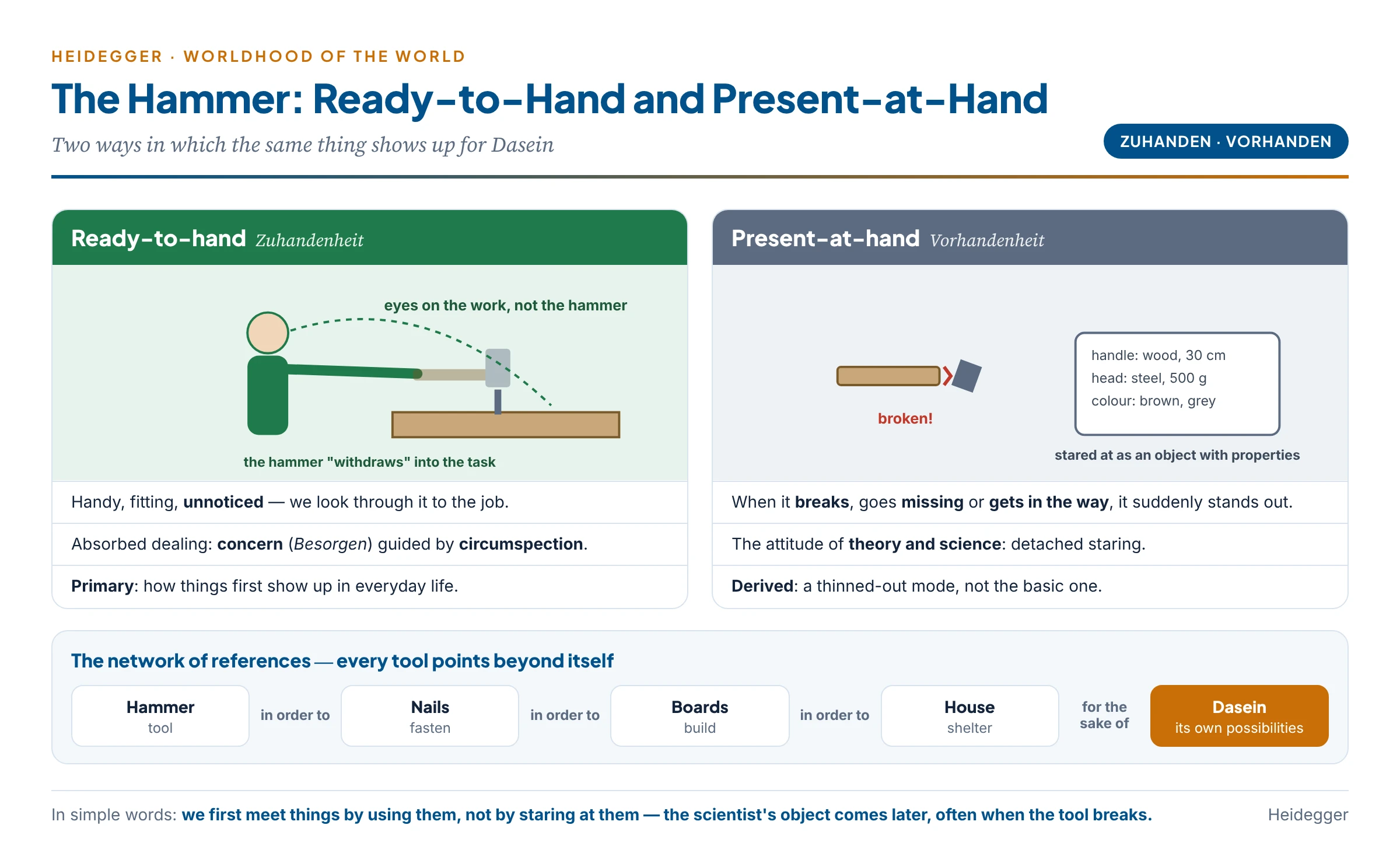
- Equipment (Zeug). The things we meet first in everyday life are not neutral “objects” but equipment — the pen, the shoe, the bus, the door. Each is “in order to” something: the hammer is for hammering nails, the nails are for fixing boards, the boards for building a house, the house for the sake of a human life (shelter). Each piece of equipment refers to others in a chain that ends in Dasein’s own possibilities.
- Ready-to-hand (Zuhandenheit). When a carpenter is hammering, the hammer is ready-to-hand: it is handy, it fits the task, and it withdraws from attention. He does not look at the hammer; he looks through it to the work. Such absorbed, skilful dealing is called concern (Besorgen), and its kind of sight is circumspection (Umsicht) — the practical “seeing” that knows its way about.
- Present-at-hand (Vorhandenheit). When we stop using a thing and stare at it as an object with properties — “a wooden handle 30 cm long, a steel head of 500 grams” — it becomes present-at-hand. This is the attitude of theory and science.
- The broken hammer. We often notice the world only when something goes wrong:
- Conspicuous — the hammer breaks; suddenly it stands out.
- Obtrusive — the hammer is missing; its absence interrupts the work.
- Obstinate — something gets in the way (a nail that will not go in).
- In such breakdowns the whole network of in-order-to relations (“what was this for?”) lights up, and the thing slides from readiness-to-hand to mere presence-at-hand.
- Primacy of the ready-to-hand. Readiness-to-hand is more original than presence-at-hand. Philosophy since Plato and Descartes has taken the detached, staring relation as basic and treated the world as a collection of present-at-hand objects. Heidegger reverses this: theory is a derived and thinned-out way of relating to things.
- Understanding through usefulness. Dasein first understands things in a context of use — as serviceable, handy, dangerous, in the way. Understanding means giving meaning to things within our projects.
- Signs. A sign (a traffic indicator, a road sign) is special equipment whose job is to make the network of references visible — it shows us our way about in the world.
Common confusion
Are “ready-to-hand” and “present-at-hand” two kinds of things — useful things and useless things? No. They are two modes of meeting the same entity. The very same hammer is ready-to-hand while I hammer with it and present-at-hand when I examine it in a laboratory or when it breaks. The distinction is about how a being shows up for Dasein, not about two separate classes of objects.
10. The Critique of Descartes and the “Scandal of Philosophy”
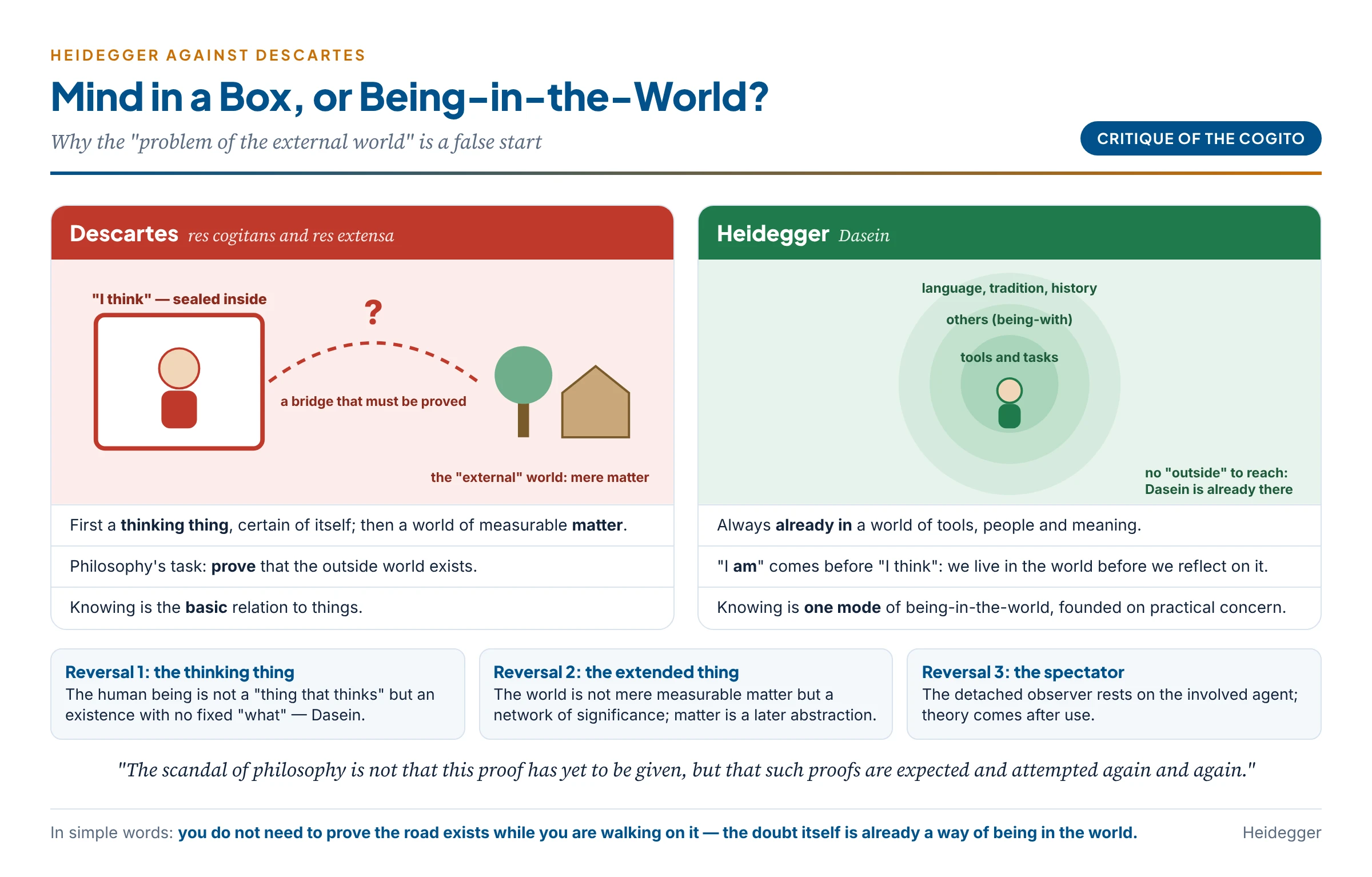
- Descartes’ picture. Descartes split reality into a thinking thing (res cogitans), certain of itself through “I think, therefore I am“, and an extended thing (res extensa), the material world, whose existence must then be proved. The mind sits inside, the world is outside, and philosophy must build a bridge.
- Heidegger’s reversal. Heidegger rejects this Cartesian dualism at its root:
- No worldless thinker. There is never first a thinking “I” and then a world. We are in the world before we think about it; existence comes before cognition. (Kierkegaard had already objected that “I must exist in order to think“.) Heidegger points out that Descartes investigated the cogito but never asked about the Being of the sum — the “I am“.
- Res cogitans has no “what”. The human being is not a “thing that thinks” but an existence with no fixed nature — Dasein.
- Res extensa is Being as constant presence. Descartes defined the world as extension — the measurable, present-at-hand stuff of physics — and so skipped the world of use and significance in which things first appear.
- The spectator rests on the agent. The theoretical, observing relation is founded on practical engagement, not the reverse.
- The “scandal of philosophy”. Kant had said it was a “scandal of philosophy” that no satisfactory proof of the existence of the external world had yet been given. Heidegger replies:
“The ‘scandal of philosophy’ is not that this proof has yet to be given, but that such proofs are expected and attempted again and again.” — Heidegger
- Why no proof is needed. The demand for proof assumes a worldless subject who must climb out of itself to reach things. But Dasein is already in the world; the sceptic’s doubt is itself an activity within the world. Heidegger does not refute the sceptic — he dislocates the problem by showing that its starting point is false.
- Objection. Critics answer that Heidegger changes the subject rather than answering the sceptic: showing that we live as if the world exists does not show that it does. Defenders reply that the sceptical question only makes sense from a picture of the mind that Heidegger has shown to be unfaithful to experience.
11. Being-with (Mitsein) and the First Glimpse of the “They”
- Others are not objects or tools. Other people are not present-at-hand things nor ready-to-hand equipment. They are Dasein too — beings who also exist and care. We meet them through the world of work: the field I walk past “belongs to someone”; the boat at the shore points to its owner; the book I read was written for readers.
- Being-with is basic. Being-with (Mitsein) is a basic structure of Dasein, not an accident. Even when I am alone, I am alone as a being-with: loneliness is a way of missing others. Heidegger thus answers the old “problem of other minds” in the same way as the problem of the external world — Dasein is never first an isolated ego.
- Thrown into a cultural world. Dasein is born into a language, culture, tradition it did not choose. This is the source of its richness — and of its danger.
- The “they” (das Man). In everyday life, the “who” of Dasein is usually the anonymous public — “one” reads what one reads, says what one says, judges as one judges. This “they” is no particular group, yet it rules everyday life. Its features — idle talk, curiosity, ambiguity, averageness — and the way out of it are explained in the next article on authenticity.
- Tradition and destiny. Through being-with, Dasein shares a heritage handed down to it and a collective destiny — not blind fate, but the shared possibilities of a community.
12. Care (Sorge): The Being of Dasein
- What unites all the structures? Heidegger’s answer is care (Sorge). The Being of Dasein is care. Care is not an emotion of worry or tenderness; it is the formal structure of a being whose existence matters to it.
- The structure of care in plain words. Dasein is always:
- Ahead of itself — reaching towards its possibilities (projection, existence; the future).
- Already in a world — thrown into a situation it did not choose (thrownness, facticity; the past).
- Alongside things — busy with the things and people around it (fallenness, absorption; the present).
- One long phrase. Heidegger compresses this into one long hyphenated phrase: “being-ahead-of-itself-already-in-(the-world)-as-being-alongside (entities encountered within the world)“.
- Moods disclose. We always find ourselves in some mood (Befindlichkeit, “state-of-mind”) — anxiety, boredom, joy, fear. Moods are not private feelings but ways the world shows itself as a whole; they disclose our thrownness.
- Understanding and discourse. Alongside mood, Dasein understands (projects possibilities) and articulates its world in discourse (Rede), the root of language.
- Concern and solicitude. Care takes the form of concern (Besorgen) towards things and solicitude (Fürsorge) towards other people. Care organises all our relations.
- Care is temporal. The three moments of care correspond to future, past and present. Heidegger’s deepest claim is that the meaning of care is temporality — the subject of the next article, together with das Man, anxiety, death and authenticity.
13. Nothing and Anxiety: “What Is Metaphysics?”
- The lecture. In his inaugural lecture at Freiburg, “What Is Metaphysics?” (1929), Heidegger argued that a single real metaphysical question, honestly asked, drags in all the others — and the questioner too.
- Science and the Nothing. The sciences study beings — “beings and nothing besides”. But what about this “nothing“? Science wants to know nothing about it — yet it defines itself by it. Metaphysics must ask about what is not.
- The Nothing (das Nichts) is not a negation. We might think “nothing” is just the result of saying “not” — a logical operation. Heidegger reverses this: the Nothing is more original than the “not” and than negation; it is the source of negation, not its product. Traditional logic cannot help here; we must abandon logic’s authority and look to experience.
- Anxiety reveals the Nothing. We meet the Nothing in a basic mood: anxiety or dread (Angst).
- Fear is always of something in the world — a dog, an exam, an illness.
- Dread is of nothing in particular: the whole of beings seems to slip away; everything becomes strangely indifferent; we “hover” with no ground.
- “Dread reveals Nothing.” In this slipping away of all beings, the Nothing shows itself — and with it, by contrast, the astonishing fact that beings are at all.
- “The Nothing itself nothings” (Das Nichts selbst nichtet). The Nothing is not an object, not “something”, and not a negation; it is active — it “nihilates“, pushing beings away and so letting them stand out as beings.
- Why is there something rather than nothing? Only because Dasein is “held out into the Nothing” can it wonder at beings and ask “why?”. The lecture ends with Leibniz’s question: “Why are there beings at all, rather than nothing?“
- Being and Nothing. Hegel had said that pure Being and pure Nothing are the same. Heidegger agrees in his own way: the Nothing belongs to the Being of beings; it is, so to speak, “on the other side” of Being — like the dusk of a summer evening, where light giving way to darkness makes us notice the light itself.
- An objection. “Nothing is just the absence of something; it cannot be experienced.” Heidegger’s reply: the mood of dread proves that nothingness is experienced; it is not inferred.
- Courage for dread. Far from a weakness, the “clear courage for essential dread” guarantees the experience of Being. There is even a “joy of dread“: to face the Nothing is to awaken to the wonder of being alive.
- Back to the ground of metaphysics. In a later introduction, “The Way Back into the Ground of Metaphysics” (1949), Heidegger said that metaphysics must be overcome: we cannot grasp Being by looking only at beings.
14. Philosophy as Therapy: The Diseases of Forgetting
Heidegger saw philosophy not only as theory but as a kind of therapy — a way to help us live a wiser, richer, more thoughtful and braver life, with the courage to face the truth. He diagnosed several “diseases of the soul“:
- We have forgotten that we are alive.
- We rush through life without noticing the mystery of Being — that anything is at all.
- Only at odd moments — late at night, when we are ill, on a walk in the countryside — does the strangeness strike us: why do things exist as they do, and why do they exist at all?
- Modern life is an “infernal machine of distraction“, stuffing us with information and killing silence.
- Angst helps here: it shows the contingency of our job, our relationships, even of being alive.
- We have forgotten that all Being is connected.
- We live by narrow interests, treating nature and other people merely as means.
- But there is a unity of Being: the ladybird, the rock, the cloud and I all share in being.
- Seeing this awakens generosity and helps overcome egoism.
- We forget to be free — we live as “they” live, in borrowed opinions. (This is the theme of authenticity, treated in the next article.)
- We treat others as objects or equipment (Zeug).
- We relate to people as tools for our purposes — the waiter as a serving machine, the colleague as a resource.
- The cure is to learn care for Being beyond ourselves. Great art helps: in The Origin of the Work of Art (1935–36) Heidegger meditates on Van Gogh’s painting of a pair of peasant shoes. A shoe in a shop is mere equipment; in the painting, the shoes reveal the whole world of the peasant woman — her toil in the fields, the damp earth, the worry about bread, the fear of death. Art lets the truth of Being happen.
In simple words
A pair of old chappals by the door is just footwear — until one day you notice them after your grandmother has passed away. Suddenly they hold her whole life: the temple walks, the market trips, the kitchen floor, her tired evenings. That is what Heidegger means when he says art (or such a moment) lets the world of a thing light up, instead of seeing it as mere equipment.
15. The Later Heidegger: Humanism, Language and the Shepherd of Being
- The turn (Kehre). After Being and Time, Heidegger moved from analysing Dasein to thinking about Being itself as an event that gives itself and withdraws in history.
- Letter on Humanism (1947). Written in reply to a French question after Sartre’s lecture Existentialism is a Humanism:
- Traditional humanism defines man as a “rational animal” or an “animal with speech” — a definition from metaphysics, which thinks of man as a special kind of animal and so misses his true dignity. This line of thought leads to the technological society, where man sees himself as master of all beings.
- Sartre merely reverses the old formula (“existence precedes essence”) and so stays within traditional metaphysics; “the reversal of a metaphysical statement remains a metaphysical statement”.
- Man is not the lord of beings but the “shepherd of Being” — the one who guards and tends the truth of Being.
- The true humanism thinks man’s dignity from his relation to Being, not from his reason or his will.
- Language is the house of Being.
“Language is the house of Being. In its home man dwells. Those who think and those who create with words are the guardians of this home.” — Heidegger, Letter on Humanism
- What it means:
- Language is not a mere tool for communicating information; it is where Being first comes to light. We are its guardians, not its prisoners.
- The poets — above all Hölderlin — are the custodians of Being; humans should “dwell poetically” on the earth.
- Since Being lies beyond what language can capture, silence too has its place.
- A reverent attitude. The later Heidegger speaks almost like a mystic:
- The sacrifice of Dasein, thinking as thanking (gratitude for the gift of Being), homecoming.
- To guard the mystery rather than try to master it; a reverential attitude before Being.
- Being is beyond language and beyond the grasp of conceptual thought.
- Technology. Bolshevism and Anglo-American materialism, Heidegger said, were “metaphysically the same” — two jaws of a “great pincers” squeezing Europe, both reducing the world to calculation and production. Like Marcel, he set meditative thinking against calculative thinking.
Critical Evaluation
Objections
- Meaningless metaphysics (logical positivists). Rudolf Carnap, in “The Elimination of Metaphysics through Logical Analysis of Language” (1932), took “The Nothing itself nothings” as his prime example of a pseudo-sentence. It turns “nothing” (a word for denial) into a noun and then into a verb, violating logical syntax; it can be neither verified nor falsified, so it is meaningless.
- Obscurity. Heidegger’s difficult German, wordplay and neologisms make his thought hard to check. Ironically, his invented vocabulary resembles the artificial syntax of the very positivists he opposed.
- Husserl’s charge. Husserl felt betrayed: Heidegger’s “fundamental ontology” was only a regional anthropology — a study of human beings — dressed up as a theory of Being. It falls back into the psychologism and “naturalism” phenomenology was meant to overcome.
- Changing the subject. The critique of Descartes and of the “scandal of philosophy” dislocates scepticism rather than refuting it.
- The question never answered. The promised answer to the meaning of Being never came; Being and Time remained unfinished, and the later writings are poetic and evocative rather than argued.
- Mysticism. “Being” comes close to God under another name; the later Heidegger drifts into mysticism and private revelation.
- Anthropocentrism. Making the human being the place where Being is disclosed is anthropocentric; ecological critics ask whether nature has meaning only when it shows up for Dasein. (Defenders note that the later Heidegger’s critique of technology is itself an early environmental voice.)
- Neglect of the social and the ethical. Despite being-with, the analysis is centred on the individual; Habermas held that Heidegger overlooked intersubjectivity and communicative reason. There is no ethics, no criterion of right and wrong.
- Politics. His Nazi involvement in 1933–34 and his silence on the Holocaust raise the question whether his thought — with its talk of destiny, rootedness and the “people” — left him open to totalitarian seduction.
Replies and Strengths
- Against the positivists. The positivist criterion of meaning is itself unverifiable; and many basic experiences (anxiety, wonder, the mystery that anything exists) are real even if they do not fit logical syntax.
- Language must stretch. New questions need new words; the encrusted language of metaphysics hid the very phenomena Heidegger wanted to show.
- Not anthropology. The analysis of Dasein is not a study of human nature but a method for reaching Being. The later Heidegger explicitly decentres man: he is the shepherd, not the lord, of Being.
- A lasting revolution. By overturning the Cartesian subject, Heidegger changed philosophy: the primacy of practice over theory, embodied and situated understanding, hermeneutics, the critique of technology, and the influence on Sartre, Merleau-Ponty, Gadamer, Levinas, Derrida and even on cognitive science and artificial intelligence research.
- Mystery is not a defect. That Being remains a mystery is not a failure of the theory; like the Upaniṣads, Heidegger holds that the deepest reality is not reached by conceptual thought. His later thought has been compared to Christian saints, Sufis and Hindu ṛṣis, and has been called humanistic even though it was charged with inhumanism.
- The political lesson. His sympathetic biographers argue that he misread the Nazi movement as an authentic collective being-with, and that his case teaches the “seducibility of the spirit by the will to power” — a lesson about philosophers and politics, not a refutation of his analyses of being-in-the-world.
Critics and Defenders
Criticism — Critics
- Carnap: “The Nothing nothings” is a pseudo-sentence that breaks logical syntax.
- Husserl: fundamental ontology is a disguised anthropology.
- Habermas: the analysis neglects intersubjectivity and communication.
- Sceptics: the critique of Descartes sidesteps rather than answers the problem of the external world.
- Ecologists: the world is meaningful only for man — anthropocentrism.
- Political critics: the Nazi episode and silence on the Holocaust.
Defence — Defenders and strengths
- Overcomes Cartesian dualism: no worldless subject, no bridge problem.
- Shows the primacy of practice: ready-to-hand before present-at-hand.
- Restores the question of Being and the wonder that anything exists.
- Makes understanding a way of being — the basis of modern hermeneutics.
- Offers an early critique of technology and of seeing people as resources.
- Treats philosophy as therapy: awakening us to life, connection and freedom.
Cross-Tradition Comparison
Being, the Nothing and the Self in Indian Thought
| Heidegger | Indian parallel | Similarity | Difference |
|---|---|---|---|
| Being is not a being; it cannot be defined, only realised | Brahman is not an object (aviṣaya); known by realisation (anubhava), not by concepts | The ultimate is beyond all things and all concepts | Brahman is eternal, unchanging consciousness; Heidegger’s Being is historical and temporal |
| “Nothing nothings”; Being approached through negation and dread | Neti neti (“not this, not this”) of the Bṛhadāraṇyaka Upaniṣad; Nāgārjuna’s śūnyatā | The real is approached by negating every determinate thing | Neti neti leads to fullness (Brahman); śūnyatā denies any own-being; Heidegger’s Nothing belongs to Being and is disclosed in anxiety |
| Forgetfulness of Being | Avidyā (ignorance) and adhyāsa (superimposition) in Advaita | Ordinary life covers the real with the familiar | Avidyā is beginningless; forgetfulness of Being is a history that began with Plato |
| Truth as aletheia (unconcealment) | Svaprakāśa — the self-luminous Self/Brahman revealed when ignorance is removed | Truth as uncovering, not as matching a statement to a fact | Advaita’s revealed reality is the Self; Heidegger’s is the event of Being in the world |
| Being-in-the-world; no isolated subject | Pratītyasamutpāda (dependent origination) in Buddhism | Nothing exists in isolation; everything is relational | Buddhism sees relationality as a mark of impermanence and suffering; Heidegger as the structure of meaning |
| Critique of the Cartesian thinking self | Kierkegaard’s and Śaṅkara‘s point: the self is the knower, never an object known | The self is not a “thing” among things | Śaṅkara’s Self is pure witness (sākṣin); Heidegger’s Dasein is finite, practical, mortal |
| Unity of Being: ladybird, rock, cloud | Īśāvāsya Upaniṣad: “all this is pervaded by the Lord”; Sarvaṃ khalvidaṃ brahma | All beings share in one reality; ethics of non-domination | Upaniṣadic unity is metaphysical identity; Heidegger’s is a shared belonging to Being |
| Shepherd of Being; against technology as mastery | Gītā’s niṣkāma karma and the Indian ideal of living in harmony with nature | Action without the urge to master and possess | The Gītā grounds this in duty and devotion to the divine; Heidegger in “letting beings be” |
Indian Connect — Key takeaways
- Heidegger’s Being, beyond all definitions and reached by negation (“the Nothing”), echoes the Upaniṣadic neti neti — reality is not grasped by concepts but realised.
- His forgetfulness of Being resembles Advaita’s avidyā: we live among names and forms (nāma-rūpa) and forget the ground of all being.
- Being-in-the-world and being-with recall Buddhist pratītyasamutpāda: nothing, not even the self, exists in isolation.
- The later Heidegger’s reverence before Being — thinking as thanking, guarding the mystery — is close in spirit to the Indian ṛṣis, to Sufis and to Christian mystics.
Synthesis (Siddhānta)
- The core achievement. Heidegger revived the question of Being and showed that it cannot be answered by looking at beings alone — we must first understand the being who asks, Dasein, whose essence lies in its existence.
- The end of the worldless subject. Against Descartes and Husserl, Heidegger showed that we are always already in the world — among tools, others, language and history. Theory is a late, derived mode; care and practical concern come first. The “scandal” is not the lack of a proof of the world, but the demand for one.
- Balanced verdict. His method is powerful but his language is obscure; his question is profound but his answer was never completed; his analyses are rich but his politics a warning. The best reading takes the phenomena he uncovered — the ready-to-hand, being-with, mood, the Nothing — as lasting contributions, whatever one makes of the “meaning of Being”.
- Contemporary relevance.
- Technology and attention. His warning that modern life is a machine of distraction, and that we see people and nature as resources, speaks directly to an age of smartphones, burnout and ecological crisis.
- Embodied and situated thinking. Research in cognitive science, robotics and artificial intelligence learned from Heidegger that intelligence is skilled coping in a world, not just calculation in a head.
- Meaning of work and life. The question “what is it all for?” — the chain of in-order-to ending in a “for-the-sake-of” — is the question every person faces about career and life.
- Indian synthesis. Heidegger’s long journey from Dasein to Being, from concepts to wonder, meets the Indian conviction that the highest truth is realised, not proved — and that self-knowledge is the gateway to the knowledge of reality.
“Man is not the lord of beings. Man is the shepherd of Being.” — Heidegger
Previous Year Questions
- 2022Provide a critical account of Heidegger’s Being-in-the-world and discuss the problem of ‘authenticity’ in the context of Dasein.
- 2018What is Epoché? How does Heidegger reject this method of phenomenological reduction? Explain Heidegger’s concept of ‘being in the world’ as opposed to the concept of a transcendental ego.
- 2015Discuss why Heidegger introduces the concept of Dasein in his metaphysics.
- 2010How is the empirical ego in Sartre and Heidegger different from the transcendental ego in Husserl?
- 2008Heidegger’s contention that the essence of “Dasein is its existence”.