

Moore, Russell and Early Wittgenstein: Defence of Commonsense; Refutation of Idealism; Logical Atomism; Logical Constructions; Incomplete Symbols; Picture Theory of Meaning; Saying and Showing.
Official Syllabus: Paper I, Section A, Unit 6
Logical construction is Russell’s method of explaining complex or doubtful entities — physical objects, space, time, matter, classes, numbers and minds — not as hidden things inferred behind our experience, but as structures built logically out of simpler things we know directly. Its guiding rule, which Russell called “the supreme maxim in scientific philosophising“, is: “Wherever possible, logical constructions are to be substituted for inferred entities.” Applied to perception, it gives the famous thesis that “the physical object is a logical construction from sense-data“: a table is not an unknowable substance behind its appearances but the whole system of its appearances — the actual and possible sense-data it presents from every point of view. In his later philosophy Russell carried the method one step further: both mind and matter are constructions from the same neutral materials — the view he called neutral monism.
In simple words
Think of the “average Indian family“, which has, say, 4.4 members. No one has ever met this family — there is no house where 0.4 of a person lives. Yet statements about it are true and useful, because they are a short way of talking about real families. Russell says many things we treat as solid entities — classes, numbers, even tables and minds — are like the “average family”: shorthand for patterns among simpler things we actually know.
Context & Problem
The Problem of Perception and Matter
- Appearance and reality. Look at a table. From one place it looks rectangular, from another like a rhombus; in sunlight it is brown and shiny, in dim light dark, and under a microscope rough and pitted. Different observers see different colours and shapes at the same moment. What we directly perceive — Russell calls it sense-data — keeps changing, while we believe the table itself stays the same.
- The question. If what we immediately know are only sense-data, how do we know that physical objects exist at all, and what are they?
- Earlier answers:
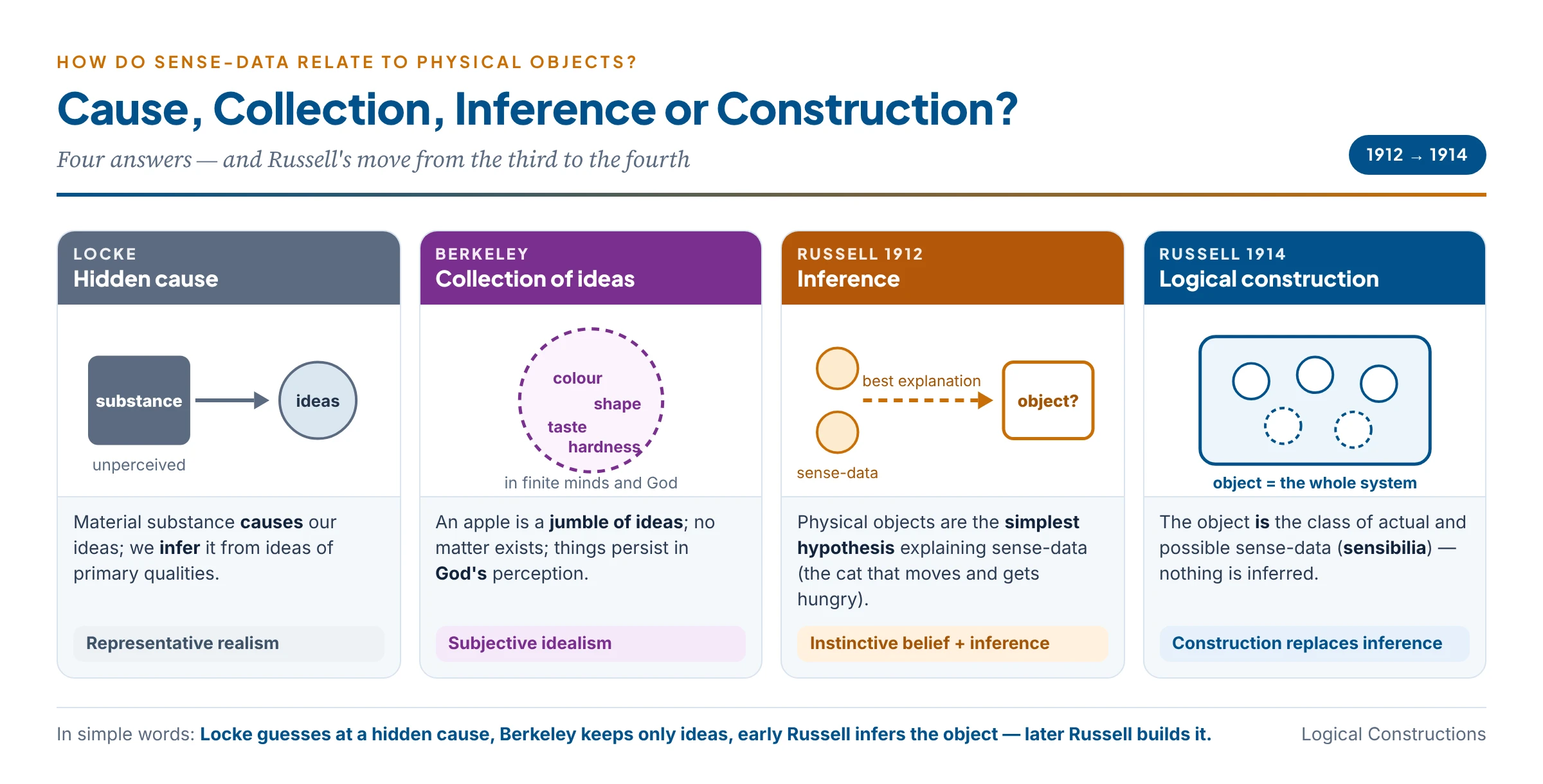
- Locke (representative realism). Physical objects are the causes of our ideas; from the ideas of primary qualities we infer the existence and nature of material substance.
- Berkeley (subjective idealism). There is no ground for material substance; an object is a collection of ideas in minds (and in God’s mind).
- Hume (scepticism). We have only impressions and ideas; belief in an independent world (and in a substantial self) cannot be rationally justified.
- Russell’s complaint. What Locke, Berkeley and Hume explained psychologically, Russell wanted to explain logically. He was unwilling to rely on doubtful inference to unknown causes, and equally unwilling to deny physical objects like Berkeley.
From Inference to Construction
- Russell’s first answer (1912). In The Problems of Philosophy Russell held that belief in physical objects is an “instinctive belief” which is the simplest hypothesis explaining our sense-data. If a cat appears at one moment in one part of the room and next in another, it is simpler to suppose it moved across the room than to suppose it vanished and reappeared; if it is hungry between meals, it is simpler to suppose it exists unobserved. Physical objects are thus inferred as the best explanation.
- The shift (1914). In Our Knowledge of the External World and “The Relation of Sense-Data to Physics” (1914), Russell moved from this inferential approach to a constructional one. Instead of inferring an unknown cause behind sense-data, he would construct physical objects directly out of sense-data. This avoided speculative inference and gave knowledge a more secure foundation.
- The model: mathematics. In Principia Mathematica, Russell and Whitehead had shown how numbers could be constructed from classes, and classes treated as incomplete symbols. Russell now applied the same method to metaphysics and epistemology.
Core Doctrine
1. What Is a Logical Construction?
- Definition. A logical construction is an entity that is not among the ultimate constituents of the world but is defined in terms of them, so that every statement about it can, in principle, be rewritten as a statement about those simpler constituents.
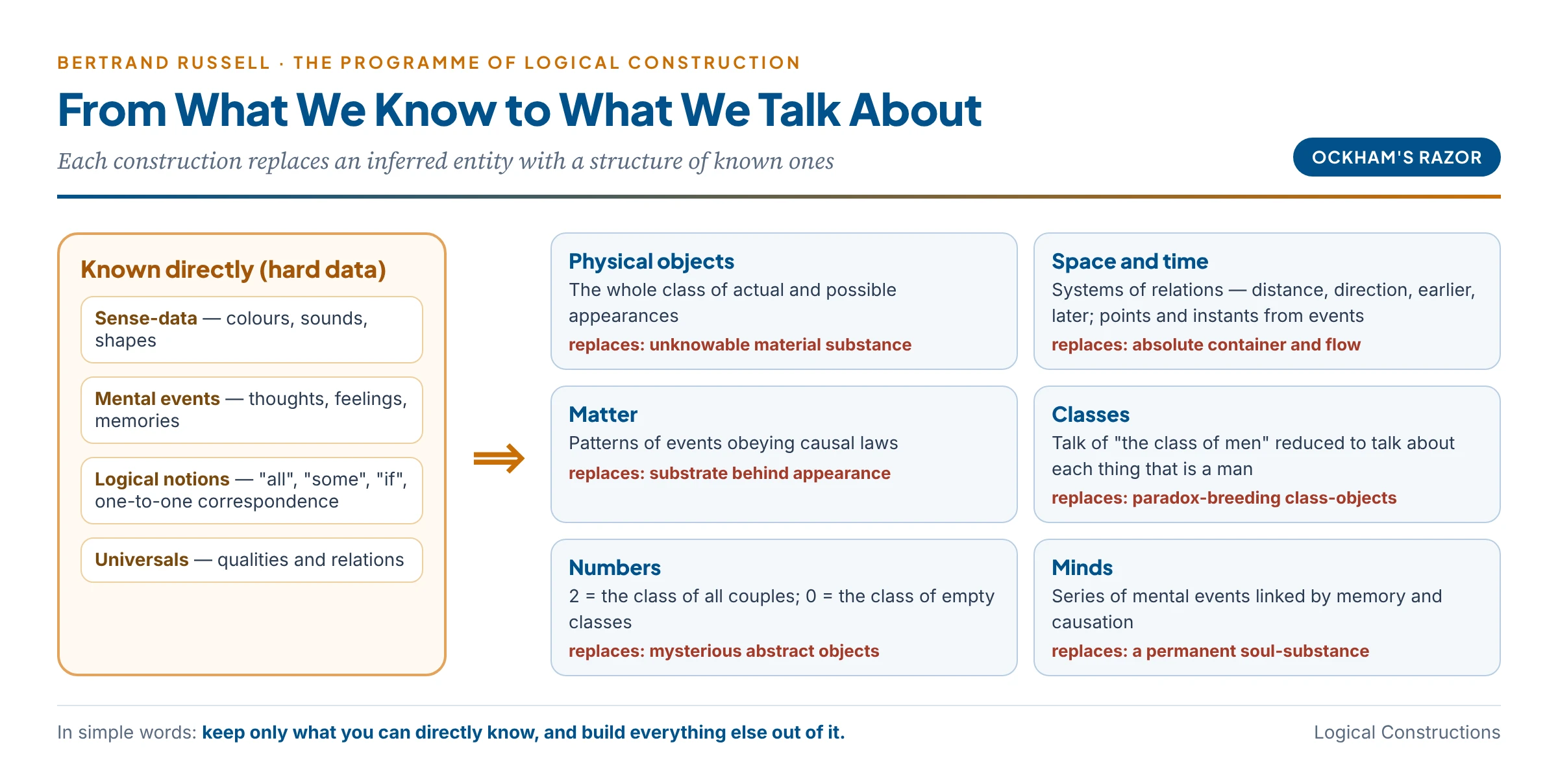
- The supreme maxim. “Wherever possible, logical constructions are to be substituted for inferred entities.” This is Russell’s version of Ockham’s razor: do not postulate an unknown entity behind experience if the work it does can be done by a structure of known entities.
- The question it answers. As with facts, the question is: what are the most fundamental objects? We start with one basic class of objects and ask whether some kind of expression requires us to posit new objects, or whether its contribution can be understood in terms of the original class. If the latter, its apparent referent is “only a logical construction” out of that class — just as conjunctive facts are nothing over and above the atomic facts they combine.
- Eliminative (reductive) method. Problematic or doubtful entities are eliminated by showing that they are not fundamental and can be explained by simpler elements.
- Incomplete symbols and “logical fictions”. Words for constructions (“the table”, “the class of men”) behave like incomplete symbols: they have no meaning in isolation, only in sentences that can be analysed away. Russell sometimes called constructions “logical fictions” — but this does not mean that tables do not exist; it means that statements about tables can be translated into statements about sense-data.
- What constructions produce. Constructions yield theoretical systems from which truths follow by logical inference. They capture the deductive relations among truths about the entity, not necessarily every feature we ordinarily associate with it.
- A somewhat vague notion. Because Russell applied it across so many fields, the exact meaning of “logical construction” was never fully fixed: some read constructions as logical functions or classes, others as something closer to descriptions or even mental constructs.
2. Two Kinds of Knowledge
- Knowledge of things and knowledge of truths. Russell distinguishes knowing things from knowing truths (propositions). Knowledge of things is of two kinds:
- Knowledge by acquaintance — direct, immediate, non-inferential awareness of an object: sense-data, data of introspection (my present thoughts and feelings), data of memory, perhaps the self, and universals. Such data are “hard data“: beyond doubt, accepted as they are even in illusions, hallucinations and dreams (the red patch I see in a dream is really seen; what is doubtful is the inference from it).
- Knowledge by description — mediate knowledge of things as “the so-and-so”, depending on previous knowledge of truths. Physical objects, other minds and historical persons are known this way. These are “soft data“, open to doubt.
- The constructional programme. All soft data are to be shown to be logical constructions of hard data. Our knowledge of objects is knowledge by description, so statements about objects can be resolved into sense-data statements.
3. Sense-Data as the Epistemic Starting Point
- What sense-data are. The colours, sounds, shapes, textures and smells immediately given in experience — seeing a red patch, hearing a whistle.
- Why start here? All knowledge must rest on what is immediately known. Physical objects, minds and scientific entities are not directly perceived; sense-data are, and so they are epistemically fundamental.
- Not necessarily mental. Russell did not claim that sense-data are private mental creations. The act of sensing is mental; the object sensed (the sense-datum) need not be — a point he shared with Moore against Berkeley. Sense-data are better thought of as neutral elements.
- Avoiding scepticism. By beginning with sense-data, philosophy builds knowledge step by step from what is certain, explaining how knowledge of the external world is possible without assuming its existence at the outset.
4. The Physical Object as a Logical Construction from Sense-Data
This is the core of the 2016 question.
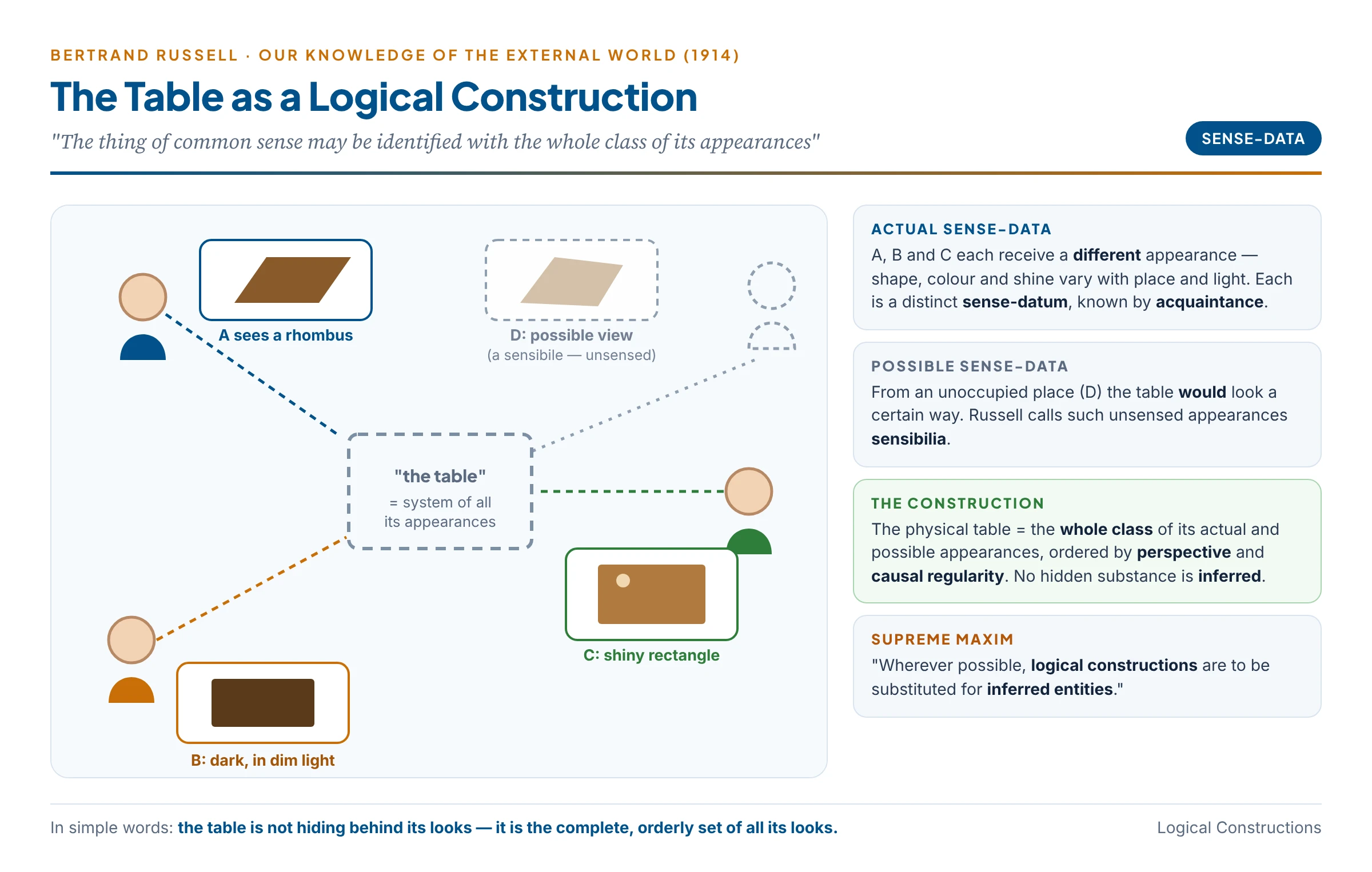
- The thesis. “The physical object is a logical construction from sense-data.” When we say that a table exists, we refer not to a mysterious substance behind appearances, but to a systematic group of sense-data occurring in regular patterns.
- Many appearances, one table. The table looks different from different angles and in different lights; each appearance is a distinct sense-datum. The physical object “table” is the whole series or system of these appearances, unified by regularity and causal order.
- Perspectives. Influenced by Leibniz’s idea that each monad mirrors the world from its own point of view, Russell imagined each observer as having a private world of perspective. Different observers looking at the same thing from different places receive different sense-data.
- Possible sense-data (“sensibilia”). Between two observers we can imagine a third standing in between; the appearance the table would present to him is a possible sense-datum, which Russell called a “sensibile” (plural sensibilia): an object of the same kind as a sense-datum, but not actually sensed.
- The full construction. A physical object is “the whole class of its appearances” — the set of all actual and possible sense-data (sensibilia) that would be correlated with it from every possible perspective, arranged in order.
- Not denied, reinterpreted. This avoids inferring a hidden material substance. The physical object is not denied (as by Berkeley); it is reinterpreted as a logical structure, not an independently existing thing beyond all experience. Russell thereby claims to keep common-sense realism while grounding it in epistemic certainty.
- Useful consequences. Puzzles about illusion, error and perception become easier: the “bent” stick in water is simply one member of the system of appearances that also includes the “straight” stick in air.
In simple words
Think of a cricket stadium filmed by thirty cameras from thirty angles. No single camera gives “the match”; each gives only one view. Yet put all the views together — including the views that cameras could have taken from other seats — and you have everything there is to show about the match. Russell says a table is like that: the complete set of its views from every possible standpoint, not a mysterious thing hiding behind the views.
5. Space, Time and Matter as Constructions
- Space. Space is not an empty container existing on its own; it is a system of spatial relations (distance, direction) among sense-data and perspectives. Russell distinguished private space (the space within each perspective) from perspective space (the arrangement of all perspectives).
- Time. Time is not an absolute, independently flowing reality. It is constructed from temporal relations — earlier, later, simultaneous, succession — among experiences. “Time” is an ordered system of relations between events.
- Points and instants. Even geometrical points and instants — which no one ever experiences — can be constructed from overlapping volumes and events, by a method Russell developed with Whitehead.
- Matter. Matter is not a substance underlying appearances; it is a logical construction from patterns of sense-data that follow causal laws. The scientific descriptions of matter are therefore highly abstract constructions, not descriptions of an ultimate stuff.
- Harmony with physics. By treating the world as a system of events and their relations, Russell aligned philosophy with the new physics of relativity, where space and time are no longer absolute.
6. Classes and Numbers as Constructions
- Classes as incomplete symbols. Treating classes as real objects leads to logical paradoxes — above all Russell’s paradox about “the class of all classes that are not members of themselves”. So Russell treated class-expressions as incomplete symbols.
- Eliminating classes. “The class of all humans” is not an entity over and above individual humans. “All students in the class passed the exam” means: “For every x, if x is a student in the class, then x passed the exam.” “All men are mortal” means: “For all x, if x is a man, x is mortal.” “The class of red things” is replaced by the propositional function “x is red”.
- Numbers. A number is the class of all classes similar to a given class — classes whose members can be put into one-to-one correspondence. Two is the class of all couples (two apples, two books, two coins); zero is the class of all empty classes. Arithmetic is thus grounded in logic, not in intuition or mysterious abstract objects.
- Universals versus classes. Russell distinguished the two:
- Universals (redness, humanity, “greater than”) are real, irreducible constituents of facts, needed to explain similarity and predication — “Socrates is a man“, “this rose is red“. They generate no paradoxes.
- Classes are not real entities but logical devices, always eliminable by paraphrase with propositional functions and quantifiers.
In simple words
How does a small child learn what “two” means? Not by meeting a mysterious object called Two, but by noticing what a pair of shoes, two eyes and two bananas have in common: their members can be matched one-to-one. Russell’s definition says exactly this — the number two is the class of all such pairs.
7. The Mind as a Logical Construction
- No mental substance. Russell does not treat the mind as a separate, mysterious substance or an inner “self” distinct from experiences.
- A series of mental events. What we directly know are mental events — sensations, perceptions, thoughts, images, feelings — known by acquaintance. The mind is a series or system of such events connected by relations of continuity, memory and causal order.
- “I have a mind.” Analysed, this refers not to a permanent inner substance but to a stream of experiences related in a special way. The unity of mind is functional and logical, not substantial.
- Dualism avoided. The mind is not a separate entity interacting mysteriously with the body, but a logical arrangement of experiences. (Compare Hume’s “bundle of perceptions” and the Buddhist analysis of the person.)
- Reduction, not denial. In general, Russell treats substance, self and matter as useful fictions — ways of summarising complex structures of facts or sense-data. Analysis clarifies reality rather than denying it; metaphysics becomes analysis, not speculation.
8. Neutral Monism
This answers the second half of the 2016 question: why Russell called his view neutral monism.
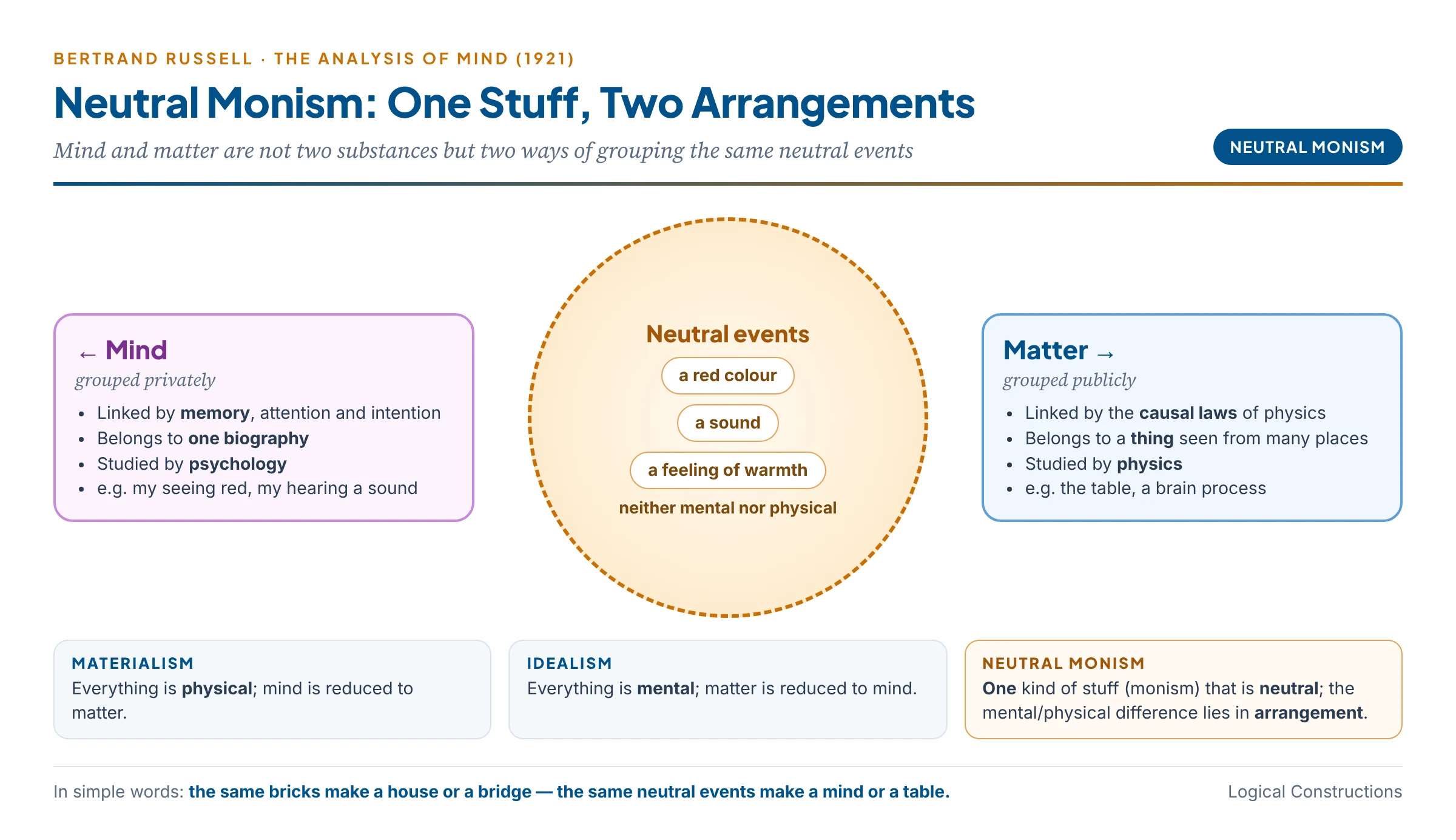
- The view. In his later philosophy (The Analysis of Mind, 1921, following William James), Russell held that the ultimate constituents of reality are neither mental nor physical, but neutral.
- Against both rivals:
- Materialism says everything is physical.
- Idealism says everything is mental.
- Neutral monism says the basic stuff is one kind (monism) and that kind is neutral — not mind, not matter.
- Two groupings of the same elements. Take neutral items such as seeing a red colour, hearing a sound, feeling warmth:
- Organised one way — privately, connected by memory, attention and intention in one biography — they constitute a mind (a thought, a perception).
- Organised another way — publicly, as members of systems governed by the causal laws of physics — they constitute a physical object.
- So: Mind = one arrangement of neutral elements; matter = another arrangement of the same elements. They are not two substances but two ways of grouping the same data. A visual experience and a brain process may be different groupings of the same neutral events.
- Why “neutral monism” fits the constructional method. If both minds and physical objects are logical constructions, and they are constructed from the same materials (sensibilia, events), then the materials are neither mental nor physical in themselves. The mind–matter difference lies in organisation and relations, not in underlying substance.
- Advantages. It overcomes the difficulties of mind–body dualism, avoids reducing mind to matter or matter to mind, is economical, and fits Russell’s emphasis on logical construction and modern science.
Common confusion
Did Russell call the 1914 construction of physical objects “neutral monism”? Not yet. In 1914 Russell still kept a subject that is acquainted with sense-data, and the act of sensing was mental. He adopted neutral monism later (around 1919–1921), when he dropped the subject and treated both minds and physical objects as constructions from neutral events. Notes often run the two together; the 2016 question asks about both, so keep the stages distinct.
In simple words
The same bricks can be arranged into a house or a bridge. A house is not made of “house-stuff” and a bridge of “bridge-stuff”; they differ only in arrangement. Neutral monism says mind and matter are like that: the same neutral “bricks” (events), arranged one way, make a mind; arranged another way, make a table.
9. Logical Construction and Logical Atomism
| Point | Logical construction | Logical atomism |
|---|---|---|
| What it is | A method of building complex notions from simpler elements | A metaphysical view of the world’s ultimate structure, plus a method of analysis |
| Direction | Upward: from known simples to complex entities | Downward: analysing complex propositions into atomic ones |
| Main products | Physical objects, space, time, matter, classes, numbers, minds as constructions | Atomic facts made of particulars and universals |
| Purpose | Replace inferred entities by structures of known ones | Show that all truths depend on a layer of atomic facts |
| Relation | Supplies the “logical fictions” that atomism does not count as ultimate | Supplies the “atoms” from which constructions are built |
- Two sides of one programme. Analysis takes us down to the atoms; construction builds us up again to tables and minds — without adding any new ultimate entities.
10. Russell’s Reaction to Berkeley
- Agreement with Moore. Russell argued, like Moore, that Berkeley’s argument confuses the act of apprehending (which is mental) with the object apprehended (which need not be). Hence Berkeley’s proof that “nothing can be known except ideas” is fallacious.
- Disagreement with Moore. Unlike Moore’s direct realism, Russell accepted that what we directly know are sense-data, not physical objects; and in the constructional phase he made physical objects systems of sense-data and sensibilia. In some ways this is closer to Berkeley’s view of things as “collections” of sensible qualities — except that Russell’s sensibilia need not be in any mind, and no God is required to sustain them.
Critical Evaluation
Does Logical Construction Give a Satisfactory Account of Knowledge?
This is the 2008 question. Strong reasons point both ways.
Reasons to say no:
- The translation never succeeds. No one has actually translated a single ordinary statement — “there is a table in the next room” — into a finite set of statements about sense-data. The translation would need endless conditional statements (“if an observer were there, he would have such-and-such sense-data”), and the conditions themselves mention observers, bodies and places — physical things.
- Circularity. Perspectives are identified by their positions in space, and observers by their bodies and sense-organs. But these are physical objects — the very things to be constructed. The construction seems to presuppose what it constructs.
- “Unsensed sense-data.” Sensibilia are supposed to be like sense-data but not sensed — which looks contradictory. If they are real unsensed entities, Russell has inferred new entities after all, against his own maxim.
- Privacy and other minds. If each person’s data are private, the construction of a public world from many perspectives requires knowledge of other people’s sense-data — which is itself not given by acquaintance.
- Explanation runs the other way. Common sense and science explain why we have the sense-data we do by appeal to physical objects and light; the constructional theory makes the explanation backwards.
- Sense-data are a myth. Ryle and Austin argued that in ordinary perception we see tables and robins, not sense-data; the starting point is a philosopher’s invention.
- Russell abandoned it. In later works Russell himself returned to inference: physical objects are known through the structure of their causal effects on us, not constructed from sense-data.
- Vagueness. The very notion of “logical construction” was never precisely defined, and neutral monism leaves it unclear what the neutral stuff actually is.
Reasons to say yes (or partly yes):
- Economy and caution. The method makes no claims beyond the evidence; it tells us exactly what our knowledge of the external world commits us to.
- It worked spectacularly in mathematics. The construction of numbers from classes and of real numbers and geometry from simpler notions remains a triumph of logic.
- It anticipated phenomenalism and logical empiricism. Carnap’s attempt to construct the world from elementary experiences and Ayer’s phenomenalism grew directly from Russell’s programme.
- It fits modern physics, which treats the world as events in space-time rather than enduring substances.
- Neutral monism lives on. In contemporary philosophy of mind, “Russellian monism” is a serious option for explaining how consciousness fits into the physical world.
Common confusion
Does “logical fiction” mean that tables do not exist? No. When Russell calls a table or a class a “logical fiction”, he means it is not an ultimate constituent of the world but a structure that can be described in terms of more basic things. The table is real in the sense that statements about it are true; it is simply not a hidden substance over and above its appearances.
Critics and Defenders
Criticism — Critics
- Phenomenalism’s critics: no statement about a table translates into sense-data statements.
- Circularity: perspectives presuppose bodies and places.
- Sensibilia: “unsensed sense-data” are inferred entities after all.
- Ryle and Austin: sense-data are a myth; we see tables.
- Realists (Moore): we know physical objects directly.
- Russell (later): returned to inference and structural knowledge of matter.
Defence — Defenders and strengths
- Ockham’s razor: no unknowable substance behind appearances.
- Mathematics: numbers and classes successfully constructed.
- Logical empiricism: inspired Carnap and Ayer.
- Physics: events in space-time instead of substances.
- Neutral monism: dissolves the mind–body divide; revived today.
- Security of knowledge: built from hard data.
Cross-Tradition Comparison
Russell and Buddhist Theories of Perception and Composite Things
| Point | Russell | Vaibhāṣika (Buddhist realists) | Sautrāntika | Yogācāra | Nyāya-Vaiśeṣika |
|---|---|---|---|---|---|
| Is the external object perceived directly? | No — sense-data are | Yes, directly perceived | No — inferred from the form in cognition | No external object at all | Yes, directly |
| Status of composite things | Logical constructions | Aggregates of real atoms | Aggregates; momentary | Mental constructions | Real wholes (avayavin) over and above parts |
| Closest Western parallel | — | Moore’s direct realism | Russell’s 1912 inference view | Berkeley | Common-sense realism |
Indian Connect — Key takeaways
- The chariot. In the Milindapañha, the monk Nāgasena tells King Milinda that “chariot” is only a name for the axle, wheels, pole and frame arranged together; there is no chariot over and above the parts. In the same way “Nāgasena” is a conventional name for a series of physical and mental elements. This is very close to Russell’s logical construction of objects and of the mind.
- Two kinds of existence. Buddhist Abhidharma distinguished things that exist as designations (prajñapti-sat: chariots, persons, forests) from things that exist substantially (dravya-sat: the ultimate momentary dharmas). Russell’s distinction between logical constructions and logical atoms is a striking parallel.
- Inferred objects. The Sautrāntika view that external objects are inferred from the forms appearing in cognition (bāhyārtha-anumeya-vāda) resembles Russell’s 1912 position; the move to treating them as constructions resembles the Buddhist view that wholes are mere designations.
- The realist opposition. The Nyāya-Vaiśeṣika defence of the whole (avayavin) as a real entity over and above its parts is the Indian counterpart of the realist objection to Russell: the table is something, not merely a system of appearances.
Synthesis (Siddhānta)
Russell’s theory of logical constructions applies one principle — “wherever possible, substitute logical constructions for inferred entities” — to the deepest questions of metaphysics and epistemology. Since what we know directly are sense-data (hard data) and what we know only by description are physical objects, minds and scientific entities (soft data), Russell tried to show that the soft can be built from the hard. The physical object becomes the system of its actual and possible appearances from all perspectives; space and time become systems of relations; classes and numbers become logical devices; and the mind becomes a series of experiences. When the same neutral events are seen to make up both minds and bodies, the result is neutral monism.
As an account of knowledge the programme fails in its strongest form: the translation of physical-object statements into sense-data statements was never carried out, the construction seems to presuppose bodies and places, and sensibilia reintroduce unobserved entities. Russell himself later returned to inference. Yet the method was a triumph in mathematics, inspired phenomenalism and logical empiricism, anticipated the event-ontology of modern physics, and gave philosophy of mind a lasting alternative to both materialism and dualism.
- Data science: “the average consumer” or “the Indian voter” are useful constructions from individual data — powerful as long as we remember what they are made of.
- Philosophy of mind: Russellian neutral monism is again debated as a way to understand consciousness.
- Buddhist philosophy shows the same insight in the chariot simile: names for wholes can be true and useful without naming extra substances.
Do not hunt for a hidden table behind its appearances — the table is the order in its appearances.
Previous Year Questions
- 2018How does Berkeley establish that Mind and its ideas alone are real? How do Moore and Russell react to Berkeley’s view in this regard? Do you find any difference between Moore’s reaction and Russell’s one? Discuss.
- 2016Explain Russell’s view that “the physical object is a logical construction from sense-data”. Why does he call his metaphysical view ‘neutral monism’?
- 2008Explain the theory of logical construction. Does it provide a satisfactory account of knowledge?
- 2001Russell’s theory of logical constructions.