

Hegel: Dialectical Method; Absolute Idealism.
Official Syllabus: Paper I, Section A, Unit 5
For Hegel, the dialectic is not confined to the categories of logic. The same movement — a one-sided form breaking down from its own contradictions and giving way to a richer one — runs through human consciousness, society and world history. History is the stage on which the World Spirit (Weltgeist) realises itself, and its meaning is the growth of freedom: “world history is the progress of the consciousness of freedom“. Self-consciousness itself is born through a struggle for recognition (the master–slave dialectic); freedom becomes real in institutions — the family, civil society and above all the state; and the passions of individuals and the deeds of “world-historical” heroes are used by the “cunning of reason” for ends they do not see. This part of Hegel’s thought inspired Marx, provoked Kierkegaard and the existentialists, and raised the sharpest moral objections to his whole system.
In simple words
Think of a cricket team over a hundred years. Players come and go, each chasing personal records, fame or money. Yet, looking back, you can see a pattern: the game moved from amateur gentlemen to professionals, from local to international, from five-day matches to many formats. No single player planned this; their private ambitions were used, so to speak, by a larger development of the game. Hegel reads world history like this — individuals pursue their own aims, but through them a deeper rational story unfolds: the story of freedom.
Context & Problem
Why History Matters to Hegel
- Reason rules the world. If “the real is rational”, then history cannot be a meaningless series of accidents. Hegel’s watchword is that “reason rules the world, and that world history has therefore been a rational process”.
- Philosophical history. Hegel distinguishes three ways of writing history:
- Original history — written by eyewitnesses of their own times (Herodotus, Thucydides).
- Reflective history — surveys of the past from a later standpoint.
- Philosophical history — history viewed as the self-realisation of Spirit, which is what Hegel offers.
- Spirit needs time. The Absolute does not stay in pure logic; as Spirit it must work itself out in time, in peoples, states and cultures. History is “Spirit externalised in time”, as nature is “the Idea externalised in space”.
- The problem. History is full of wars, cruelty and waste — the “slaughter-bench” on which the happiness of peoples has been sacrificed. How can such a history be rational? Hegel’s philosophy of history is an attempt to answer this — a theodicy, a justification of God’s ways in history.
Freedom — the Key Idea
- The essence of Spirit is freedom, as the essence of matter is gravity. Spirit is what is self-determining, depending on nothing outside itself.
- Freedom is not caprice. Doing whatever one likes is the freedom of an animal driven by impulse. True freedom is self-determination through reason — acting on laws one recognises as one’s own.
- Freedom must become objective. Hegel criticises Kant’s purely inner freedom (the good will). Freedom must be realised in the world — in laws, institutions and the state. Laws do not limit freedom; they give it rational form. Traffic rules restrict each driver’s choice, yet they make safe, free movement possible for everyone.
- Freedom and necessity. Freedom does not oppose necessity; it emerges through rational necessity. “The acceptance of necessity is true freedom” — a phrase existentialists later attacked.
Core Doctrine
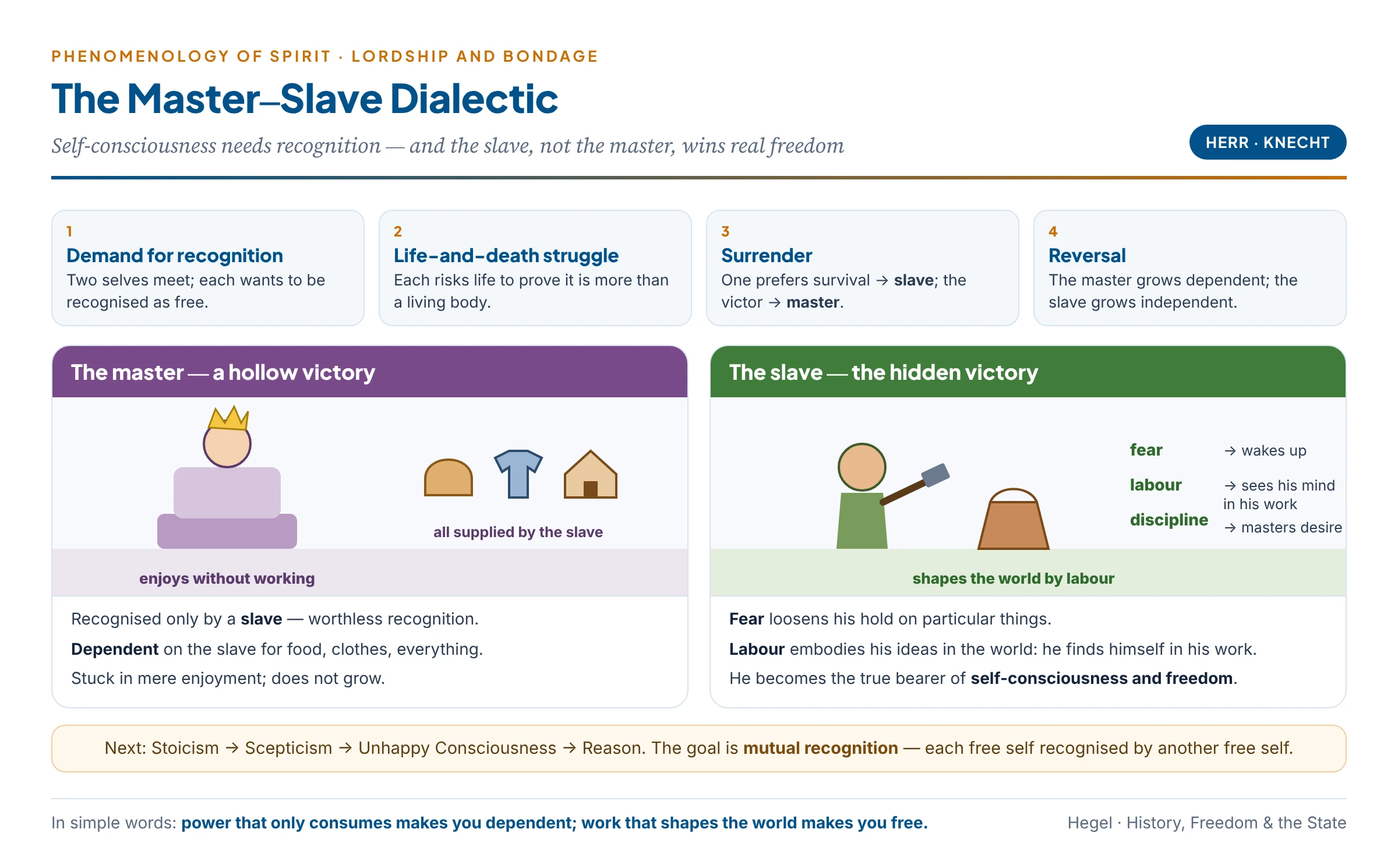
1. The Master–Slave Dialectic: How Self-Consciousness Is Born
In the Phenomenology of Spirit (1807), Hegel shows that self-consciousness is social: I become fully aware of myself only when another self-consciousness recognises me.
- The demand for recognition. Two primitive self-consciousnesses meet. Each wants the other to recognise it as an independent, free being.
- The life-and-death struggle. To prove that it is not tied to mere life, each risks its life in a struggle.
- Master and slave. One combatant values survival more than freedom and surrenders — he becomes the slave (Knecht, bondsman). The victor, who risked death, becomes the master (Herr, lord).
- The master’s hollow victory.
- The master gets recognition — but from a slave, whom he does not respect. Recognition from an unfree being is worthless.
- The master enjoys things without working on them; he becomes dependent on the slave for food, clothing and all his needs.
- The slave’s hidden advantage.
- Fear — trembling before the master (and before death) shakes the slave out of his attachment to particular things and makes him aware of his own being.
- Labour — working on material objects, the slave shapes nature according to an idea; he sees his own mind embodied in his work.
- Discipline — serving, he learns to restrain desire.
- Through labour and obedient service the slave discovers himself by himself; he rises to true self-consciousness, while the master remains stuck.
- The reversal. The master turns out to be dependent, the slave independent. Real freedom will come only when there is mutual recognition — each recognising the other as free.
- Further stages. Consciousness then passes through Stoicism (freedom in thought alone), Scepticism (doubting everything) and the Unhappy Consciousness (a soul divided between the changeable self and an unreachable God), before reaching Reason.
In simple words
Think of a rich heir and his household cook. The heir commands; the cook obeys. But over the years, the cook learns a craft, runs the kitchen, manages suppliers and can feed a hundred people. The heir cannot boil an egg and depends on the cook for everything. Who is really free and capable? Hegel says the one who works on the world comes to know himself through it — the master’s power hides his dependence.
2. Objective Spirit: Freedom Made Real in Institutions
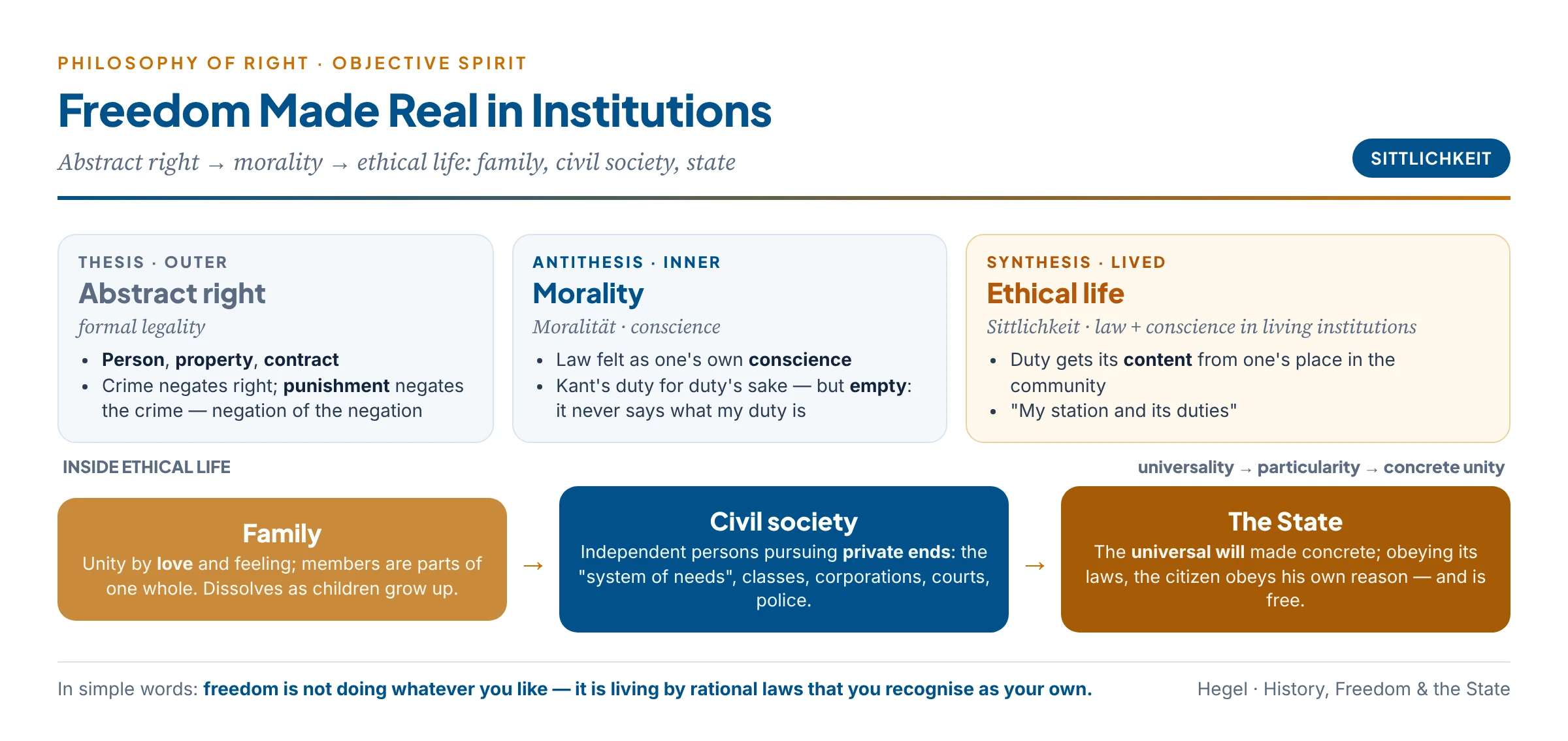
Spirit cannot remain a “cocoon-like” inner life; it must go out into the world of institutions — law, customs, morality, society and the state. Institutions are Spirit externalised and solidified, made by human beings themselves; they are not alien to man. This is Objective Spirit, which moves through a triad:
(a) Abstract Right — external, formal legality:
- Persons — self-conscious individuals who have rights to things. A slave (in law) or a table is not a person, since neither has rights.
- Property — a person rises to self-consciousness by appropriating things.
- Contract — persons recognise each other’s property through agreement, a union of wills.
- Wrong and punishment — a crime violates the contract and sets a particular will against the universal will (right). Punishment negates the wrong: crime is the negation of right, and punishment is the negation of the negation, restoring right. Punishment is the criminal’s right, since it treats him as a rational being responsible for his act.
(b) Morality (Moralität) — the inward side:
- The opposition is now inside the subject: what is versus what ought to be. The law must be felt as the law of one’s own conscience.
- This is the standpoint of Kant’s categorical imperative. But Hegel rejects Kant’s formalism: “duty for duty’s sake” is empty; it tells us that we must do our duty but not what our duty is.
- Duty comes from society. The content of duty is found only in an organised community — an idea later developed by Bradley in “My Station and Its Duties“.
(c) Ethical Life (Sittlichkeit) — the synthesis of outer law and inner conscience in living social institutions:
- The family — a unity based on love and feeling. Members are not independent individuals but parts of one whole. But feeling is not thought; when the children grow up and are educated, the family dissolves into independent persons.
- Civil society (bürgerliche Gesellschaft) — the sphere of independent individuals pursuing private ends. Each treats others as means, yet all depend on one another for their needs — a “system of needs“. It works through division of labour, economic classes and corporations, courts and police. It is the realm of the market and of particular interest.
- The state — the unity of the family’s universality and civil society’s particularity: the universal will made concrete, serving the inmost good of every individual. The state is a true organic unity.
3. Hegel’s Theory of the State
- “The march of God in the world.” Hegel’s most quoted (and most debated) phrase about the state comes from lecture notes added to the Philosophy of Right. A more exact translation is: “it is the way of God in the world that the state should exist“. He also calls the state “this actual God” and “the actuality of the ethical Idea”.
- The state as the true self of the individual.
- The individual is implicitly universal will; in the state this universal will is actualised.
- The state’s laws are the laws the individual has, so to speak, projected into the state. By obeying them, the individual obeys his own rational will — he is self-determined, and therefore free.
- Not a contract or a necessary evil. Hegel rejects the liberal view (Locke; later Nozick) that the state is a mere contract for protecting property, or a necessary evil limited to police functions. The state is not an instrument of private interests; it is the highest ethical community.
- Prior to the individual. “The universal is the prius of the particular”: as the family comes before its members, the community comes before the isolated individual, who becomes human only in it.
- Sacrifice and war. Since the state is the highest end, it may demand the sacrifice of individuals. Hegel even held that war preserves the “ethical health” of peoples by shaking them out of complacency.
- The ideal and the actual. Hegel’s ideal state is not a bureaucratic machine headed by a despot. It is a self-conscious cultural community of art, religion, morality and technology in which people freely express their deepest values — an evolving form of Plato’s Republic. Actual states fall short of it, but each national state is a rational stage in the march of the World Spirit.
Common confusion
Did Hegel teach totalitarianism and inspire Nazism? The charge is common. Hegel’s glorification of the state, his praise of war and his view of the Germanic world as the summit of history were used — along with Nietzsche’s “superman” — by later extreme nationalists, and Popper called Hegel an enemy of the “open society”. But Hegel’s state is a constitutional state with rule of law, property rights, a free civil society and representative estates; he defended the rights of the individual conscience as the great achievement of the modern world. On his own principles, a regime serving the private, megalomaniac interests of one man or one class would be a degenerate pseudo-state — something that exists but is not actual. The fairer verdict: Hegel’s language about the state was dangerously open to abuse, but he was not a theorist of totalitarian dictatorship.
4. History as the Progress of the Consciousness of Freedom
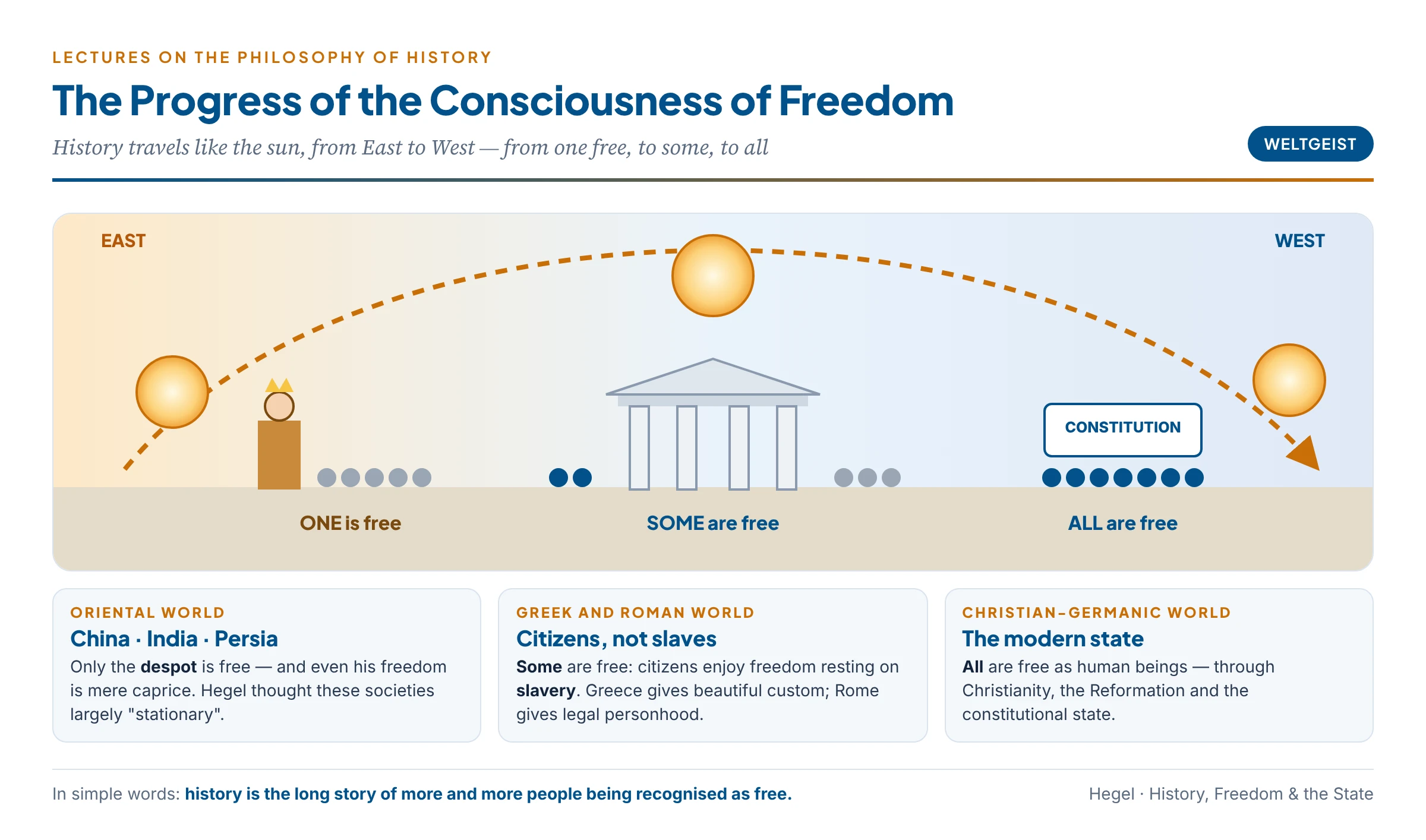
- The goal of history is freedom — that Spirit should know itself as free. Each historical period embodies a particular understanding of freedom; when it proves inadequate, internal conflict produces a new stage.
- The march from East to West. Hegel traces history like the course of the sun, from Asia to Europe:
- The Oriental world (China, India, Persia) — one is free: the despot. Everyone else is subject to his will. Even the despot’s freedom is only caprice.
- The Greek and Roman world — some are free: citizens are free, but slaves are not. The Greeks lived freedom as beautiful custom; Rome developed abstract legal personality.
- The Germanic (Christian-European) world — all are free: through Christianity and the Reformation, man as man is known to be free; the modern constitutional state embodies this.
- Revolutions as dialectic. Absolute monarchy emphasised authority but suppressed freedom; its contradiction produced revolutions demanding equality and rights. Conflicts, wars and revolutions are painful, but they express the inner contradictions of historical forms of life, through which Spirit advances.
- History is “Spirit externalised in time”. Each people embodies a national spirit (Volksgeist); it rises, has its day as the bearer of the World Spirit, and then passes on its task.
5. The Cunning of Reason and World-Historical Individuals
- Passions as fuel. “Nothing great in the world has been accomplished without passion.” Individuals act from private interests, ambitions and passions.
- The cunning of reason (List der Vernunft). Reason does not act directly; it lets the passions do the work and uses them for its own ends. The individuals and nations, seeking their limited goals, “serve at the same time as the means and tools of something higher, of which they know nothing”.
- Four kinds of individual:
- The citizen — follows the customary morality of his people without questioning it.
- The person — becomes aware of the ethos of his people and can rise above it; Hegel’s example is Socrates, who questioned the customary morality of Athens.
- The hero — the world-historical individual (Alexander, Caesar, Napoleon), whose private ambition happens to coincide with the next step of the World Spirit. Seeing Napoleon ride through Jena in 1806, Hegel wrote that he had seen “the world-soul on horseback“.
- The victim — the mass of people who seek only private success and happiness and are crushed in the clash of history.
- Even heroes are tools. Once their task is done, heroes “fall off like empty husks” — Alexander dies young, Caesar is murdered, Napoleon is exiled. In the end both hero and victim are used by the World Spirit.
- The State as the carrier. The march of history makes possible the rise of the state, which is the vehicle of the World Spirit and makes individuals aware of rational ends.
In simple words
Think of the builders of the Taj Mahal. Thousands of workers laboured for wages, the emperor for his grief and glory, merchants for profit. None of them was thinking of a world heritage that would move millions of visitors centuries later. Yet their scattered aims produced it. Hegel’s “cunning of reason” works like this: history achieves rational results through people who are pursuing quite different, often selfish, purposes.
6. The Owl of Minerva: Philosophy Comes Too Late
- Retrospective, not predictive. “When philosophy paints its grey in grey, a form of life has grown old … The owl of Minerva spreads its wings only with the falling of the dusk.“
- What this means:
- Philosophy understands a period only when it has matured and is passing away — it is backward-looking wisdom.
- It does not predict the future, and it does not preach what the world ought to be: “philosophy always comes too late” for that.
- Hegel’s dialectic of history is therefore neither empirical science nor prophecy; it is a comprehension of what has already happened.
In simple words
Think of post-match analysis. During a match, nobody can say for sure how it will turn out. After the last ball, the experts explain why the result was “bound to happen” — the pitch, the toss, a key partnership. Hegel says philosophy of history is like this expert in the studio after the game: it understands the pattern once the day is over, but it cannot bat for the team or forecast the next match.
Common confusion
Did Hegel claim that history had ended with the Prussian state? Not in so many words. Hegel held that the principle of the modern world — that all human beings are free — had been grasped, and that the modern constitutional state embodied it; in that sense the basic idea of freedom was complete. But he also said that philosophy cannot see the future and even pointed to America as “the land of the future”. The popular “end of history” thesis owes more to later interpreters than to Hegel’s own words.
7. Applying the Dialectic to Historical Development
How the dialectical method explains historical change:
- Every historical form has an inner principle — a particular idea of freedom (despotism, citizenship, individual conscience).
- The principle contains its own contradiction. Greek freedom depended on slavery; Roman legal personality coexisted with imperial despotism; feudal privilege clashed with the idea of equal rights.
- The contradiction produces crisis — conflict, decline, war or revolution.
- A new form sublates the old. It cancels the old one-sidedness, preserves its achievements (Greek art and philosophy, Roman law, Christian inwardness) and raises them to a higher level.
- The movement is directed. History has a goal — the freedom of all — and each stage is a necessary moment towards it.
- Example — the French Revolution. The Enlightenment idea of abstract freedom and equality destroyed the old order but, being purely negative, ended in the Terror. Its truth was preserved in the modern constitutional state, which combines freedom with law.
8. Hegel’s God and the Question of Colonialism
- God in history. For Hegel, God is the Absolute Spirit, not a ruler outside the world. God realises himself in the world, above all in history; world history is “the true theodicy“, the justification of God’s ways.
- Europe as the summit. Since history moves from East to West and culminates in the Christian-Germanic world, Europe appears as the place where Spirit has reached full self-consciousness.
- Hegel’s verdicts on other peoples:
- He described India as a land of “dreaming” Spirit, of a “pantheism of imagination, not of thought”, with a “religion of substance” in which the individual has no value, and as stationary, without real political history.
- He called Africa “no historical part of the world”, an “unhistorical, undeveloped spirit“.
- He wrote that “it is the necessary fate of Asiatic empires to be subjected to Europeans“, and noted that the English (the East India Company) were “the lords of the land” in India.
Did this contribute to colonial and imperial designs? Yes, in effect:
- A theory in which world history is God’s self-realisation and Europe its culmination easily became a justification of empire — the “civilising mission” of bringing “history” to peoples said to have none.
- “Whatever is real is rational” seemed to sanctify the actual triumph of the powerful — might as right.
- Denying history to Africa and Asia fed the racial and cultural hierarchies used by colonial administrators and missionaries.
No, in intention and principle:
- Hegel did not write as a colonial policymaker; his aim was to comprehend history, not to direct it (“philosophy comes too late”).
- His own principle is the freedom of all; he called slavery wrong in principle, and the logic of mutual recognition ultimately demands the recognition of every people.
- His dialectic is open: no form of life is final, so European supremacy cannot be permanent on his own terms.
Balanced view. Hegel’s Eurocentrism reflected the limited and biased sources of his age and the prejudices of his time. His system did not cause colonialism, but its picture of God’s march through history was readily used to justify it. Later thinkers — anti-colonial writers among them — turned the master–slave dialectic against empire: the colonised, like the slave, would win freedom through struggle and labour.
9. Marx’s Inversion: “Standing on Its Head”
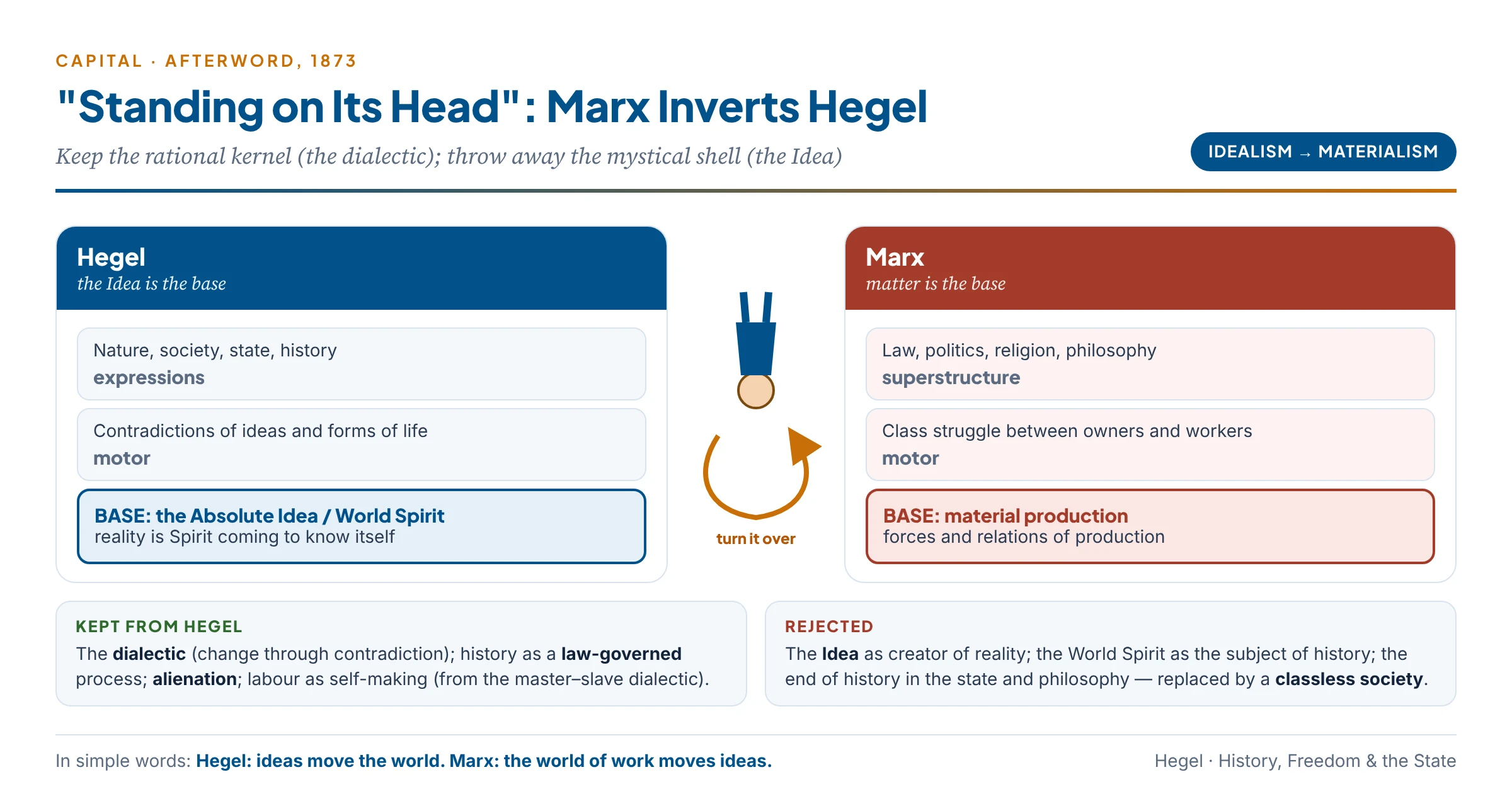
- The famous remark. In the afterword to the second edition of Capital (1873), Marx wrote that with Hegel the dialectic “is standing on its head. It must be turned right side up again, if you would discover the rational kernel within the mystical shell.”
- What Marx kept:
- The dialectical method — development through contradiction.
- History as a law-governed process with a direction.
- The idea of alienation and of labour as the way human beings make themselves (from the master–slave dialectic).
- What Marx rejected:
- Idealism — for Hegel, the Idea is the creator of reality and the material world its outward form. For Marx, the material world is primary, and ideas are its reflection in the human brain.
- The subject of history — not the World Spirit, but real human beings in their economic relations; the motor is class struggle between those who own the means of production and those who work them.
- The end of history — not the self-knowing Absolute in the Prussian state and philosophy, but a classless society.
- Right and Left Hegelians. After Hegel’s death, Right Hegelians stressed “the real is rational” and defended religion and the existing state; Left (Young) Hegelians — Feuerbach, Strauss, the young Marx — stressed “the rational will become real” and turned the dialectic into a weapon of criticism.
- Feuerbach’s role. Feuerbach argued that God is the projection of human essence; Marx went further, finding the roots of such projection in material and social conditions — dialectical and historical materialism.
Critical Evaluation
Objections to Hegel’s Philosophy of History and the State
- Kierkegaard — the forgotten individual (see the next sub-section).
- Sartre and the existentialists. If the Absolute alone matters and “the acceptance of necessity is true freedom”, the individual has no value in himself and no real freedom. Existentialists are “consistently anti-Hegelian”.
- Popper — historicism and the closed society. Belief that history has a necessary direction leads to prophecy and to sacrificing individuals for supposed historical goals; Hegel’s worship of the state paved the way for totalitarianism.
- Might becomes right. If history is rational, then what has happened — the ugly and mean as much as the glorious — is equally rational. Were the destructions of Genghis Khan and Nadir Shah, the two world wars or the gas chambers “necessary” steps of reason? Such a philosophy “paints all colours equally grey”.
- Selective history and Eurocentrism. Hegel chose facts to fit his scheme, relied on poor sources about Asia and Africa, and placed his own nation and religion at the summit.
- Marx. Hegel mystifies history: the real motors are material production and class struggle, not the self-development of an Idea.
- Individuals as means. Calling great men “tools” and ordinary people “victims” treats human beings as means, contrary to Kant’s principle that persons are ends in themselves.
Kierkegaard’s Protest: The Individual against Universal Spirit
Kierkegaard (1813–1855) is the first great critic of Hegel from the side of the existing person.
- Universal Spirit versus the single individual. For Hegel, the individual is a moment of the universal; his truth lies in the whole. For Kierkegaard, the single individual (den Enkelte) is higher than the universal: his relation to God and his own choices cannot be absorbed into any system.
- “Subjectivity is truth.” Objective, systematic knowledge suits mathematics and history; but the truths that matter for life — faith, love, death, guilt — are grasped only through passionate inward appropriation. The essence of spirit is not universal reason but inwardness.
- Either–or versus both–and. Hegel’s dialectic mediates every opposition into a synthesis. Real existence, Kierkegaard insists, faces decisions — either this or that — which no thought can mediate. The leap of faith is a choice, not a logical step.
- Existence cannot be systematised. A logical system is possible, but a system of existence is not, because existence is unfinished, temporal and lived from inside. The thinker who builds such a system forgets that he himself exists.
- The crowd and the institution. Hegel’s reverence for ethical life and the state, Kierkegaard argued, lets people hide in the crowd (“the crowd is untruth”) and in established Christendom, escaping personal responsibility.
- The palace and the shed. The system-builder is like a man who builds an enormous palace but lives in a shed beside it: his grand thought does not touch his actual life.
Evaluation. Kierkegaard rightly exposes what Hegel’s system leaves out — decision, anxiety, faith and personal responsibility. A Hegelian reply would be that the individual becomes a real self only through recognition, language and community, and that Kierkegaard’s “single individual” is itself a product of the Christian-modern world Hegel described. Both insights are needed: the self is social (Hegel) and yet irreducibly one’s own (Kierkegaard).
Replies and Defences
- Not a theorist of dictatorship. Hegel’s state includes rule of law, constitutional monarchy, civil society, property rights and freedom of conscience; it is a liberal-conservative constitutional state, not a totalitarian one.
- Retrospective, not prophetic. The “owl of Minerva” passage shows that Hegel did not claim to predict history; Popper’s charge fits later historicists better than Hegel.
- Rational is not the same as good. “Rational” means intelligible, not morally approved; recognising a necessary pattern in history is not praising every crime.
- Recognition and freedom. The master–slave dialectic and the ideal of mutual recognition have inspired movements for dignity and equality — including anti-colonial thought, feminist theory and modern ideas of human rights.
- Social nature of the self. Hegel’s insight that individuals become free only in communities and institutions corrects the abstract individualism of contract theory and is widely accepted in social science.
Critics and Defenders
Criticism — Critics
- Kierkegaard: universal Spirit swallows the existing individual; subjectivity is truth.
- Sartre and existentialists: no room for freedom and choice.
- Popper: historicism and state-worship lead to the closed society.
- Moral critics: if all history is rational, might becomes right.
- Postcolonial critics: Eurocentrism; Africa and India denied history.
- Marx: idealism mystifies the material basis of history.
Defence — Defenders and lasting value
- Constitutional state, not dictatorship; rights of conscience defended.
- Owl of Minerva: comprehension of the past, not prophecy.
- Mutual recognition: a foundation for dignity, equality and human rights.
- Social self: freedom realised in institutions, not in isolation.
- Historical consciousness: history read as meaningful development shaped modern social science.
- Marx’s debt: the dialectic of labour and alienation began here.
Cross-Tradition Comparison
Hegel and Indian Views of History, Duty and Society
| Point | Hegel | Classical Indian thought | Gandhi / Aurobindo |
|---|---|---|---|
| Shape of time | Linear and progressive: towards freedom | Cyclical: yugas and kalpas repeat | Aurobindo: evolution of consciousness towards Supermind |
| Meaning of history | Self-realisation of Spirit in the world | Liberation (mokṣa) is beyond history | Gandhi: moral struggle (truth, non-violence) within history |
| Duty | “My station and its duties” in the state | Svadharma — duty according to one’s station (Bhagavad Gītā) | Duty as service (sevā); swarāj as self-rule |
| The state | “The way of God in the world” | Rājadharma: the king protects dharma | Gandhi: the state as concentrated violence; Aurobindo: human unity beyond the nation |
| Freedom | Rational self-determination in institutions | Inner freedom from bondage (mokṣa) | Gandhi: swarāj begins with self-control |
Indian Connect — Key takeaways
- Svadharma and “My Station and Its Duties” are strikingly alike: both find the content of duty in one’s social place, not in abstract rules. The danger is the same too — both can be used to freeze existing hierarchies (caste in one case, class and state in the other).
- Gandhi stands closer to Kierkegaard than to Hegel: truth is tested in the individual conscience and its willingness to suffer, and the state is to be minimised, not worshipped.
- Sri Aurobindo shares Hegel’s vision of history as the evolution of Spirit, but places the goal beyond any nation-state — in a spiritual human unity.
- Hegel’s misreading of India as “stationary” ignored India’s long political, legal and philosophical history; Indian nationalists later answered such views directly.
Hegel, Marx and Kierkegaard
| Point | Hegel | Marx | Kierkegaard |
|---|---|---|---|
| Ultimate reality | Absolute Spirit | Matter in motion | God and the existing individual |
| Motor of history | Contradiction of ideas and forms of life | Class struggle over production | (History secondary) the leap of faith |
| Truth | The whole | Practice: changing the world | Subjectivity |
| Individual | A moment of the universal | A product of social relations | Irreducible, unique, responsible |
| Goal | Spirit knowing itself as free | Classless society | Authentic existence before God |
Synthesis (Siddhānta)
Hegel’s philosophy of history and the state applies the dialectic to the life of humankind. Self-consciousness arises through the struggle for recognition, in which the slave’s labour proves more fruitful than the master’s power; freedom becomes real only in institutions, rising from abstract right and inward morality to the ethical life of family, civil society and state; and world history, moving from the freedom of one to the freedom of some to the freedom of all, is the progress of Spirit’s consciousness of freedom, achieved through human passions by the cunning of reason. The same Absolute that unfolds in logic and nature here becomes concrete in time.
The objections are serious. Hegel’s confidence that history is rational seems to excuse its crimes; his exaltation of the state and of Europe lent itself to nationalism and colonial self-justification; and Kierkegaard rightly asked where the single individual stands in a system of world history. Yet Hegel’s central insights have proved durable: human freedom is social, needing recognition and institutions; history is not a heap of accidents but can be understood in its development; and conflict, rightly read, can be a road to fuller freedom. Marx turned the dialectic “right side up”, but kept its rational kernel — and much of modern social thought still lives inside the debate Hegel began.
- Politics of recognition: modern debates about the dignity of marginalised groups — caste, race, gender — build directly on Hegel’s idea that identity needs recognition from others.
- Constitutionalism: the idea that law and institutions make freedom possible underlies the Indian Constitution’s balance of rights with reasonable restrictions.
- Labour and dignity: the master–slave insight that work shapes the worker’s self-understanding informs modern thinking on the dignity of labour.
- Historical humility: the Eurocentrism of Hegel’s history is a lasting warning against reading one’s own civilisation as the goal of all history.
Freedom is not given to a solitary will; it is won in the eyes of others, and made real in the institutions people build together.
Previous Year Questions
- 2023“History is a process of dialectical change.” In the light of this statement discuss Hegel’s approach in understanding history.
- 2023How does Kierkegaard argue against Hegel’s idea of universal spirit in favour of the individual as the essence of spirit? Critically discuss.
- 2016What is Hegel’s view on God? Do you think that his interpretation of God was contributive to the colonial and imperial expansionist designs? Explain.
- 2012Explain Hegelian dialectical method and show how it is useful in explaining the historical development process.
- 1992“Hegel’s view stands on its head; it must be turned right side up again.” Notes.