

Kant: Possibility of Synthetic a priori Judgments; Space and Time; Categories; Ideas of Reason; Antinomies; Critique of Proofs for the Existence of God.
Official Syllabus: Paper I, Section A, Unit 4
Sensibility gives us intuitions arranged in space and time, but a heap of intuitions is not yet knowledge. To know an object we must think it — bring the manifold under concepts and unite it in a judgment. Kant’s Transcendental Analytic shows that the understanding (Verstand) does this through twelve pure concepts or categories — unity, plurality, totality, reality, negation, limitation, substance, causality, community, possibility, existence and necessity. They are not learnt from experience; they are the rules by which any experience of objects is put together. In the Transcendental Deduction, Kant argues that the categories apply necessarily to every object of experience because they are the conditions under which the manifold can be united in one self-consciousness — the “I think” or transcendental unity of apperception. Hence his bold claim: the understanding makes nature — it does not read its laws off nature but prescribes them to it. This is also Kant’s answer to Hume on causality and on the self.
In simple words
A cricket scorer watching a match sees a blur of events — a run, a shout, a ball crossing the rope. What turns the blur into a match? The scorer’s sheet has fixed columns: runs, wickets, overs, extras. Every event is entered into these columns, and only then does it count as part of a game. The columns were not learnt from today’s match; they are what make it a match at all. Kant’s categories are the mind’s scoring columns. Every sensation must be entered under them — as a thing with properties, a cause with an effect, one or many — before it becomes part of a knowable world.
Context & Problem
From Sensibility to Understanding
- Two stems of knowledge. Human knowledge springs from two sources:
- Sensibility — the receptive capacity, through which objects are given to us as intuitions.
- Understanding — the active (spontaneous) power, through which objects are thought by concepts.
- Both are needed. “Thoughts without content are empty; intuitions without concepts are blind.” Knowledge begins with the senses but does not stop there; it proceeds to understanding.
- Two functions of the understanding.
- It unites concepts in a judgment — “The table is round.”
- It synthesises the manifold of intuition into the concept of an object — combining scattered impressions of colour, shape and hardness into “a table.”
- Kant’s key idea. The same function that gives unity to concepts in a judgment also gives unity to the manifold in an intuition. So if we list the basic forms of judgment, we can discover the basic concepts of objects — the categories.
Why the Categories Must Be a priori
- “This grass is green.” Two explanations are possible for the link between grass and green:
- The link is in the objects and we merely read it off experience. Then the judgment would have no universality or necessity, because experience gives only particular, contingent cases — yet natural science contains synthetic a priori judgments (as shown earlier).
- The link is introduced a priori by the understanding — it is the result of categories (forms of thinking) that are the same for all minds. Therefore the connections appear objective to us.
- Kant chooses the second. The categories cannot be obtained from experience because they contain universality and necessity; so they are a priori forms, inbuilt in the understanding.
- Hume’s challenge. Hume had shown that concepts like cause and substance cannot be traced to impressions and concluded they are fictions of imagination. Kant agrees they are not from experience — but argues they are conditions of experience, and therefore objectively valid.
Core Doctrine
1. The Table of Judgments and the Table of Categories (Metaphysical Deduction)
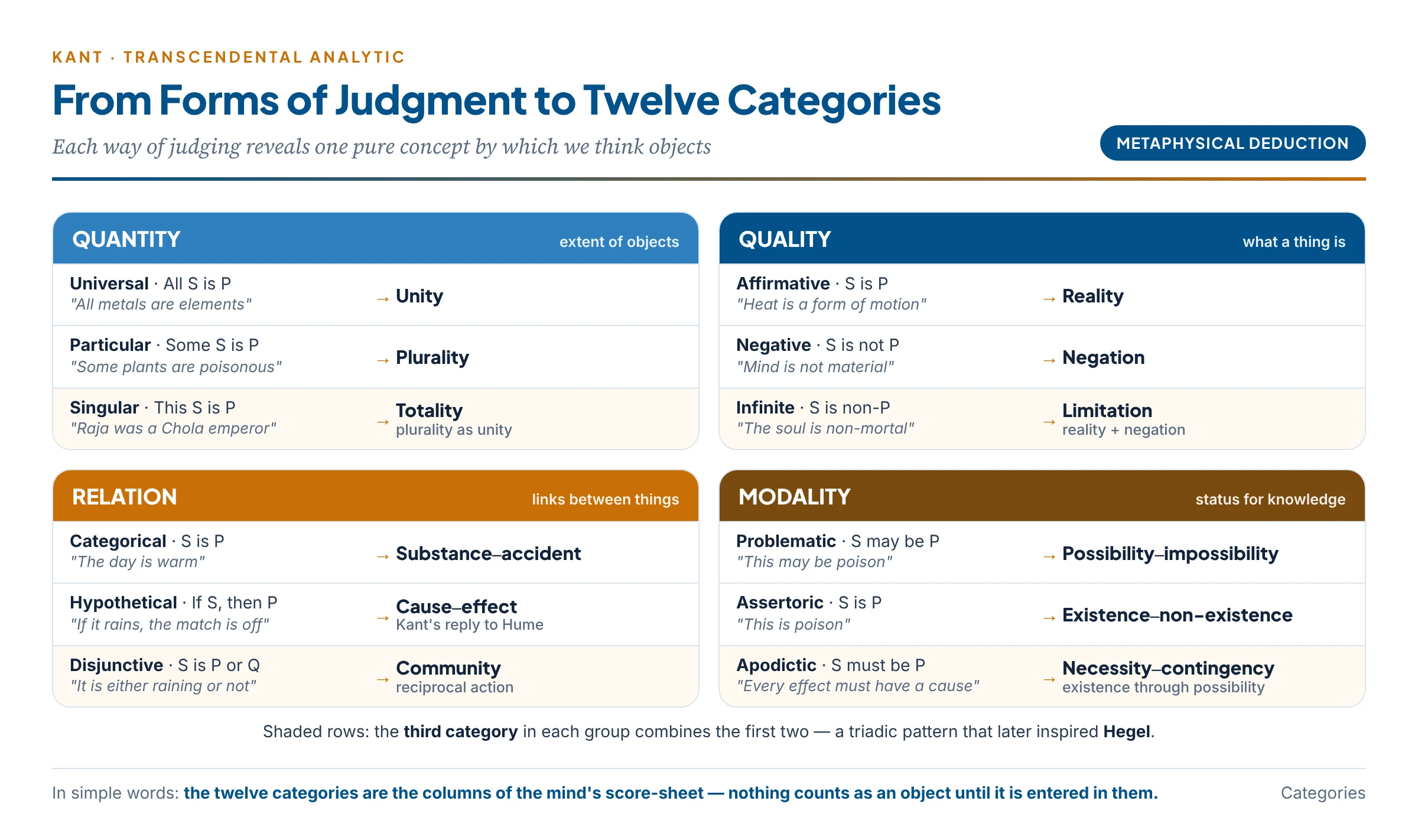
Kant groups the twelve forms of judgment under four headings — Quantity, Quality, Relation, Modality — and derives one category from each. This derivation is called the metaphysical deduction of the categories: it shows where they come from (the logical functions of judgment).
| Heading | Form of judgment | Logical form | Example judgment | Category |
|---|---|---|---|---|
| Quantity | Universal | All S is P | “All metals are elements” | Unity |
| Particular | Some S is P | “Some plants are poisonous” | Plurality | |
| Singular | This S is P | “Raja was a Chola emperor” | Totality | |
| Quality | Affirmative | S is P | “Heat is a form of motion” | Reality |
| Negative | S is not P | “Mind is not material” | Negation | |
| Infinite | S is non-P | “The soul is non-mortal” | Limitation | |
| Relation | Categorical | S is P | “The day is warm” | Substance and accident (inherence and subsistence) |
| Hypothetical | If S, then P | “If there is rain, the engagement will be cancelled” | Cause and effect (causality and dependence) | |
| Disjunctive | S is either P or Q | “It is either raining or not raining” | Community (reciprocity, action and reaction) | |
| Modality | Problematic | S may be P | “It may rain” · “This may be poison” | Possibility – impossibility |
| Assertoric | S is P | “It rains” · “This is poison” | Existence – non-existence | |
| Apodictic | S must be P | “Every effect must have a cause” | Necessity – contingency |
What each group of categories does:
- Categories of Quantity — concern the extent of objects as grasped in thought.
- Unity — “oneness”; lets the mind think an object as one determinate thing.
- Plurality — “manyness”; lets us think many objects together.
- Totality — an integrated whole; plurality considered as unity — needed to think a complete set.
- These make quantification and numerical judgments possible (the basis of applying arithmetic to things).
- Categories of Quality — concern what a thing is, its positive and negative determinations.
- Reality — posits something as existing or as a positive determination.
- Negation — the absence of reality.
- Limitation — reality combined with negation; it defines finitude (a thing is this, and not that).
- Categories of Relation — express the structural relations between objects or states of affairs, and make physics possible.
- Substance and accident — the permanent and its changing properties. Kant keeps Aristotle’s substance–attribute scheme, but as a category of thought, not a thing known in itself.
- Cause and effect — the rule that every event necessarily follows something else according to a rule. This is Kant’s reply to Hume.
- Community (reciprocity) — mutual interaction among substances; lets us conceive a world of coexisting things in systematic unity.
- Categories of Modality — concern the mode of existence of an object, its relation to our faculty of knowing.
- Possibility – impossibility — whether something agrees with the formal conditions of experience.
- Existence – non-existence — actual existence in experience (empirical reality).
- Necessity – contingency — existence that could not be otherwise versus existence that could.
- Modality adds nothing to the content of the concept; it shows the status of a judgment relative to experience.
The third category in each group arises from combining the first two: totality = plurality seen as unity; limitation = reality joined with negation; community = causality of substances reciprocally determining one another; necessity = existence given through possibility itself. This triadic pattern later inspired Hegel’s dialectic of thesis, antithesis and synthesis.
Common confusion
Did Kant simply copy the twelve judgments “as they are” from traditional logic? Not exactly. Many notes say Kant accepted the table of judgments from formal logic unchanged. In fact Kant added two forms that ordinary logic treats as special cases: singular judgments (logic treats them like universal ones) and infinite judgments (“the soul is non-mortal,” which logic treats as affirmative). He kept them because they matter for knowledge of objects (totality, limitation). His critics — Hegel above all — complained that he took the table from logic without deriving it, so the number twelve is not proved.
2. Nature of the Categories
- Pure concepts — not derived from any experience; Kant calls them “ancestral concepts” (Stammbegriffe) of the understanding.
- Form, not content. Sensibility provides the content (matter) of knowledge; the categories provide the form. They give conceptual clarity to sense data and turn it into judgments (knowledge proper).
- Constructive and constitutive. They do not merely classify given objects; they help constitute objects of experience.
- A priori and innate in the sense that they belong to the structure of the understanding — though they become active only when sensations are given to them.
- Inspired by Aristotle. Aristotle listed ten categories (substance, quantity, quality, relation, place, time…) as the most general kinds of being, gathered from language and experience. Kant criticises the list as rhapsodic (collected without a principle) and mixed with pure forms of sensibility (place, time). His categories are derived from one principle — the forms of judgment — and are forms of thought, not kinds of thing-in-itself.
- Valid only with intuitions. “Categories become active only if they get sensations to organise.” Without sensible material, a category is an empty form; with it, it yields knowledge.
3. Pure Concepts and Their Role in the Process of Knowing
- Knowing = thinking + percepts. Kant distinguishes thinking from knowing: knowing is the valid application of thought to percepts.
- Thinking is wider than knowing. The limits of knowing are not the limits of thinking. Thinking can combine pure concepts even without percepts — about God, the soul or the world as a whole — but this appears to be knowledge without being knowledge.
- The process of knowing in steps:
- Sensations are received through the forms of space and time → percepts.
- Percepts are synthesised by imagination and brought under categories → objects.
- All this happens in one consciousness (apperception) → objective judgments (“this stone is heavy because the sun warmed it”).
- Transcendental logic. Kant’s logic of the categories is not formal logic (which ignores content) but transcendental logic, which studies the a priori concepts by which we think objects. It has two parts:
- Transcendental Analytic — discovers and proves the legitimate use of the categories (knowledge of phenomena).
- Transcendental Dialectic — exposes their illegitimate use on supersensible objects (paralogisms, antinomies, the ideal of reason).
4. The Transcendental Deduction: By What Right?
- The juristic meaning of “deduction.” Lawyers distinguish the question of fact (quid facti — what happened?) from the question of right (quid juris — by what right?). A “deduction” in this legal sense is a proof of a rightful claim. Kant’s deduction is not a logical derivation but a justification.
- The problem. The categories come from the mind; objects are given through the senses. By what right do concepts that arise in the understanding apply necessarily and universally to objects that are given independently in sensibility? Without an answer, the categories would be mere subjective habits, as Hume suggested.
- The difference from space and time. Space and time did not need such a deduction: they are the forms of intuition itself, so whatever is intuited is spatial and temporal. But objects could (it seems) be given in intuition without conforming to the categories — so the right of the categories must be proved.
- Kant’s argument in steps:
- Every representation, to be mine, must be able to be accompanied by the “I think.” Otherwise something would be represented in me that could not be thought at all — it would be nothing to me.
- This unity is not given but made. A manifold becomes one consciousness only through an act of synthesis (combination). The senses provide the many; combination is never given by the senses — it is an act of the understanding.
- Synthesis follows rules, and the categories are those rules. They are the ways in which any manifold can be brought to the unity of one consciousness.
- Therefore every object of possible experience must conform to the categories. Without them, experience itself would be impossible; with them, it is objective.
- The result. The categories are conditions of the possibility of experience — “that is their sole justification.” They are not arbitrary but objectively valid.
- The limit. The deduction does not prove that categories apply to things in themselves. It applies only to phenomena — objects as experienced.
- Not psychology. Its purpose is not to describe how the mind works in time but to justify the necessity and legitimacy of the categories within possible experience.
Common confusion
What is the difference between the metaphysical deduction and the transcendental deduction?
- The metaphysical deduction answers “where do the categories come from?” — from the twelve logical forms of judgment.
- The transcendental deduction answers “by what right do they apply to objects?” — because they are the rules without which no manifold can be united in one self-consciousness, and so no experience is possible.
The first gives the list; the second gives the licence.
5. The Threefold Synthesis
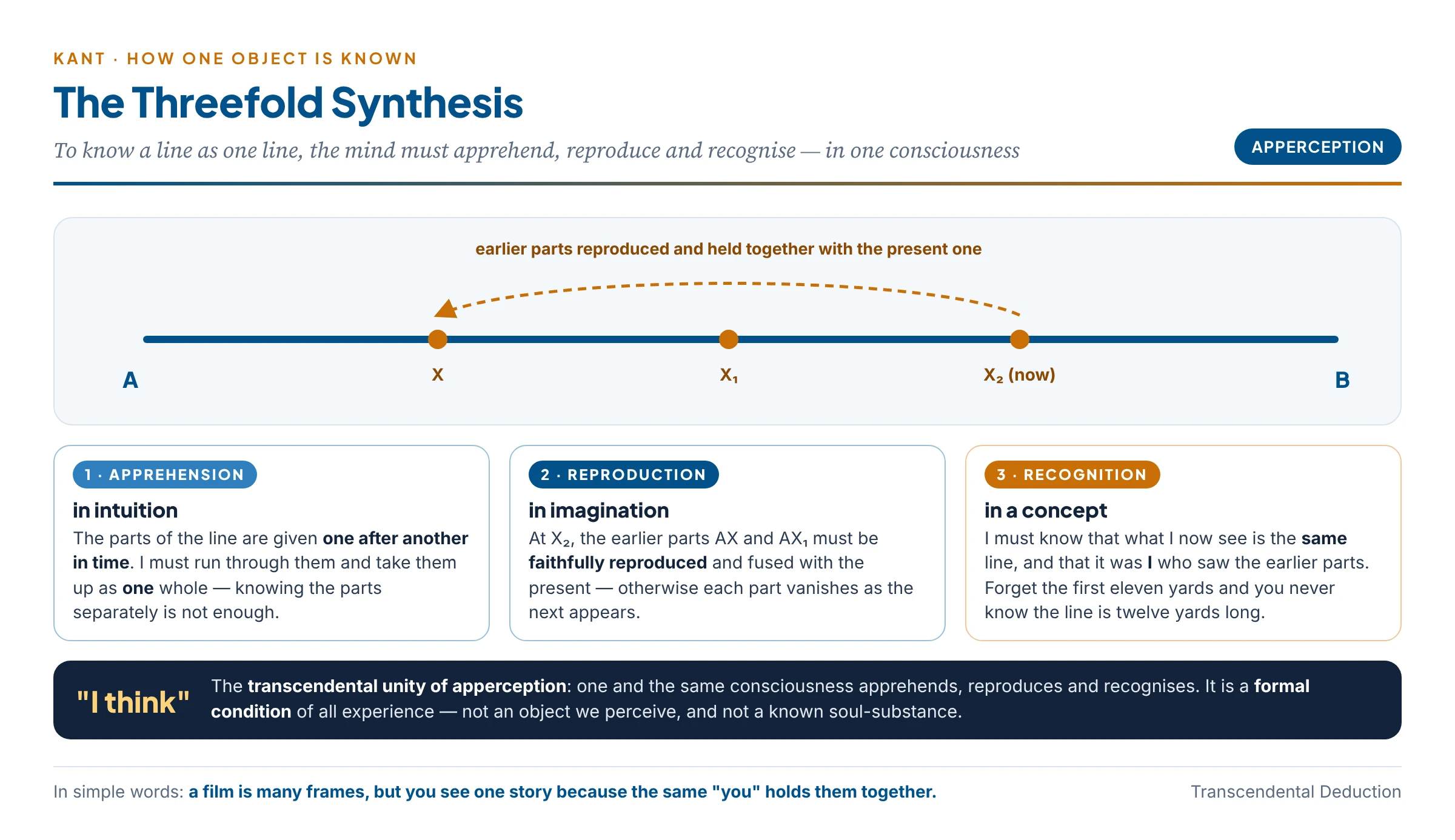
For any object to be known, the understanding must carry out a threefold synthesis (most clearly set out in the first edition of the Critique):
- Synthesis of apprehension in intuition.
- Every perception — of an outer object or an inner process — is given in time, part after part.
- Suppose I want to know a line AB. I must run through its parts and hold them together in one apprehension. Knowing the parts separately is not enough; I must perceive the line as a whole.
- Synthesis of reproduction in imagination.
- While I look along AB, I perceive successive parts AX, AX₁, AX₂…. When I am at AX₂, the images of AX and AX₁ must be faithfully reproduced and fused with it. Otherwise each part would vanish as the next appears, and I would never have the whole line.
- Synthesis of recognition in a concept.
- It is not enough to reproduce earlier parts; I must recognise that what I now perceive is the same as what I perceived a moment ago, and that it was I who perceived AX and AX₁.
- If I perceive the twelfth yard of a line and forget that I have already perceived the first eleven, I will never know that the line is twelve yards long.
- This underlying unity or sameness of self-consciousness, which apprehends the parts, reproduces the past images and finally recognises them as one, is the synthetic unity of apperception.
In simple words
A popular story makes the point. A drunkard riding home insulted a Nawab on his elephant: “How much do you want for that elephant?” The furious Nawab ordered him to appear in court the next morning. In court, sober, the man said: “Huzoor, the one who wanted to buy your elephant was Philip the drunk; I am Philip the sober.” The joke works only because we know it is the same person — one consciousness running through the night and the morning. Without such a single “I” holding experiences together, there would be no one to blame, no one to remember, and no unified experience at all.
6. The Transcendental Unity of Apperception
“The ‘I think’ must be able to accompany all my representations.” — Kant
- Apperception means self-consciousness — the awareness that all my representations belong to one and the same subject.
- Two kinds:
- Empirical apperception — the changing awareness of my mental states in inner sense (I feel cold, I am thinking of home). It is contingent, psychological, a flowing stream.
- Transcendental apperception — the original and necessary self-consciousness that must be able to accompany all my representations. It is not an experience but a formal condition of experience.
- The supreme principle of knowledge. All representations must be capable of being united in a single consciousness. Without this unity, perceptions would be a disconnected stream with no objective meaning.
- It grounds synthesis and the categories. The categories derive their validity from apperception: they are the rules for unifying representations in one consciousness. Objective knowledge is possible because the same “I think” applies identical a priori rules to all experiences — and since this unity is a priori, it is the same for all knowers.
- It does not reveal a soul. The “I” of apperception is a formal unity, not an object of knowledge. Kant rejects the rationalist claim that self-consciousness proves a simple, immortal substance (see the next article, on the paralogisms).
- Kant against Descartes. The cogito can give thinking, but not a permanent thinker known as a substance. Descartes tried “uselessly” to find a permanent self through the cogito; at most it shows that thinking goes on.
- Neither empirical nor ontological, but logical. The transcendental unity of self-consciousness is not empirical (as Hume supposed, looking for an impression of self) and not ontological (as Hegel later supposed, turning it into the Absolute Mind). For Kant it is wholly logical — a necessary condition of thinking objects.
7. “Understanding Makes Nature”
“The understanding does not derive its laws from nature, but prescribes them to nature.” — Kant
- What “nature” means here. Not things in themselves, but nature as the sum of appearances, connected according to laws.
- Why the understanding “makes” it. The lawfulness of nature — that every event has a cause, that substance persists, that things interact — comes from the categories. We cannot say anything about this world except in judgments formed through them.
- What the understanding does not make. It does not create the matter of experience (sensations are given), nor particular empirical laws (that heat expands iron must be learnt by observation). It supplies the universal form of law that any particular law must fit.
- Significance.
- It completes the Copernican Revolution: the order of nature is the order the mind brings to appearances.
- It explains how pure natural science is possible.
- It answers Hume: necessity in nature is not found in objects but legislated by the understanding.
- It also fixes the limit: the understanding legislates only for phenomena.
- Is Hegel’s Absolutism the culmination of Kant’s dualism? Kant’s dictum makes the mind the law-giver of nature but leaves an unknowable thing in itself outside it — a dualism of phenomena and noumena. Hegel removed the remainder: if mind gives nature its form, and the thing in itself is an empty abstraction, then thought and being are one, and the finite “I think” becomes Absolute Spirit. In this sense Hegel’s Absolute Idealism grows directly out of Kant’s dictum. But Kant would deny that this is a culmination: for him the understanding is finite and human, legislating only for appearances, and Hegel’s step is the dogmatic metaphysics his critique forbade.
8. Schematism: How Categories Meet Intuitions
- The problem. Categories are pure concepts; intuitions are sensible. They are heterogeneous — no one has ever seen causality. How can a category be applied to appearances?
- The answer: the schema. A schema is a “third thing” that is like the category (being a priori and general) and like the appearance (being sensible). It is produced by the imagination as a determination of time — the form common to all appearances.
- The schemata of the main categories:
| Category | Schema (time-determination) | Everyday illustration |
|---|---|---|
| Quantity | Number — successive addition of units | Counting the floors of a building |
| Reality | Filled time — sensation present in a degree | The light in a room growing brighter |
| Negation | Empty time | Silence after a bell |
| Substance | Permanence of the real in time | The ice that stays “the same water” as it melts |
| Cause | Succession according to a rule | Lightning, then thunder — always in that order |
| Community | Coexistence with mutual determination | Moon and tides acting on each other |
| Possibility | Agreement with the conditions of time at some time | “A man could live to 120” |
| Actuality | Existence in a determinate time | “He was born in 1950” |
| Necessity | Existence at all times | “The sum of a triangle’s angles is always 180°” |
In simple words
An Indian three-pin plug will not go into a European socket — the two are made differently. You need an adapter that fits both. Categories (pure concepts) and sense impressions are also “made differently”: nobody ever sees causality. The schema is the adapter. It translates each category into a pattern of time that sensations can show — “cause” becomes “one thing regularly followed by another,” “substance” becomes “what stays the same through change.” Through this adapter, concepts finally plug into experience.
9. The Principles of Pure Understanding
The categories, schematised, yield synthetic a priori principles that govern all experience:
- Axioms of intuition — all intuitions are extensive magnitudes (they can be measured). This makes the application of mathematics to nature valid.
- Anticipations of perception — in all appearances, the real that is an object of sensation has intensive magnitude — a degree (brightness, heat).
- Analogies of experience — experience is possible only through the representation of a necessary connection of perceptions:
- First analogy (substance): in all change, substance persists; its quantity in nature neither increases nor decreases.
- Second analogy (causality): all changes take place according to the law of cause and effect.
- Third analogy (community): all substances, so far as they coexist, stand in thoroughgoing interaction.
- Postulates of empirical thought — what agrees with the formal conditions of experience is possible; what is connected with sensation is actual; what is connected with the actual by universal laws of experience is necessary.
10. Kant’s View of Causality and His Answer to Hume
- Hume’s objection. The causal relation lacks logical necessity: the effect is a distinct event that cannot be found by analysing the cause, and repeated observation shows only constant conjunction. Necessity is a feeling produced by custom and projected onto objects.
- What Kant grants.
- Hume is right that causality can be proved neither by reason (it is not analytic) nor by experience (necessity is never observed).
- Causal judgments are synthetic.
- What Kant denies. That causal necessity is therefore subjective. Causality is a category of understanding; the principle of causality is a presupposition that makes experience itself possible — a transcendental argument.
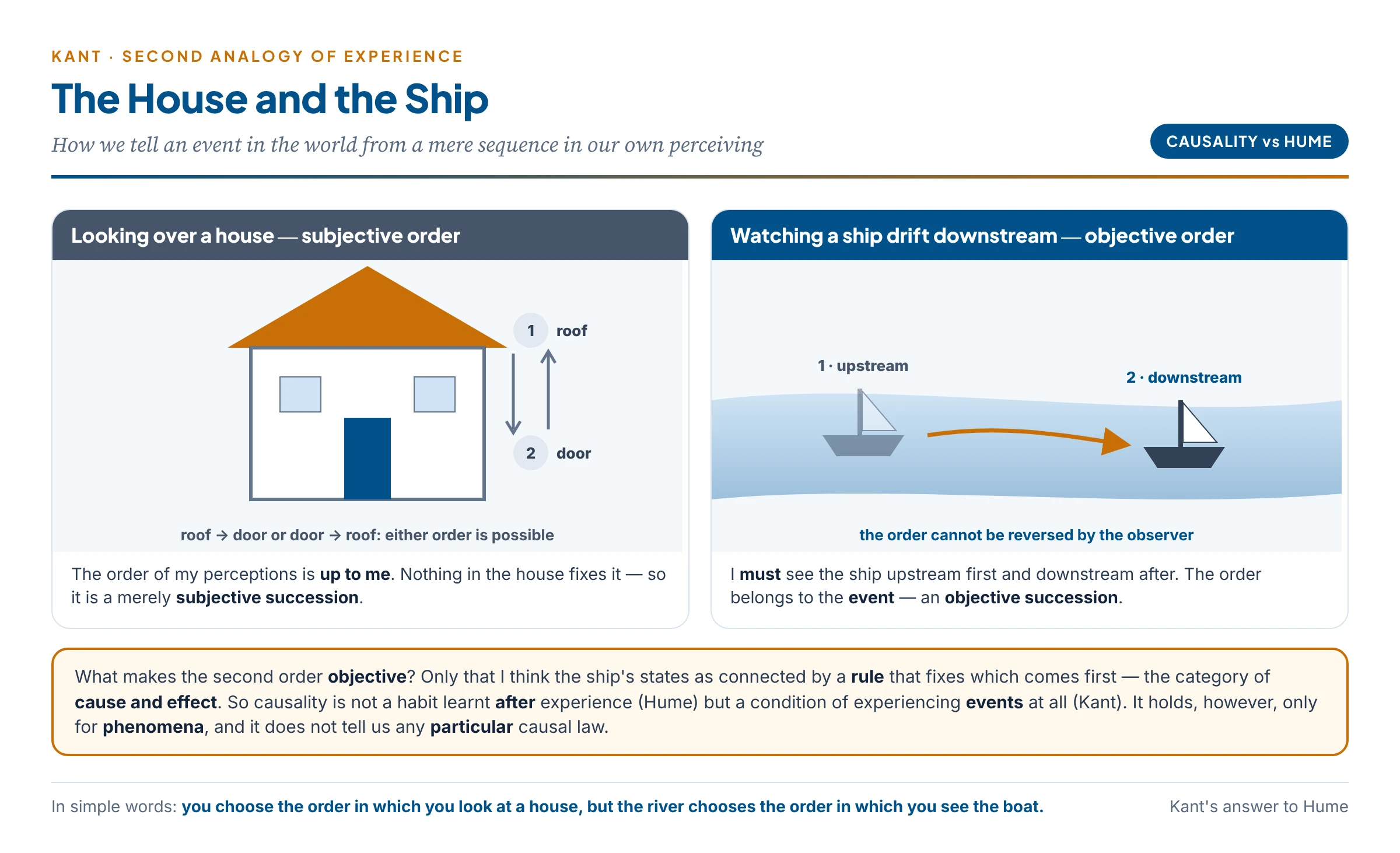
- The ship and the house (Second Analogy).
- When I look over a house, I may see the roof first and then the base, or the base first and then the roof — the order of my perceptions is up to me. This is a merely subjective succession.
- When I watch a ship drifting downstream, I must see it first upstream and then downstream; I cannot reverse the order. This is an objective succession — an event.
- What makes the difference? Only that I think the ship’s states as connected by a rule that fixes their order — i.e. by the category of cause and effect. So without causality I could not even distinguish events in the world from the play of my own perceptions.
- Kant’s conclusion. Necessity is not in things in themselves, nor is it a habit; it is a condition of objective time-order. Hume’s habit presupposes what it tries to explain: to form a habit from repeated sequences, I must already experience objective sequences.
- How far does Kant succeed?
- Success: he shows why some causal order is necessary for an objective world — Hume’s purely psychological account cannot explain the distinction between event and perception.
- Limits: Kant proves only the general principle (every event has some cause), not particular causal laws, which remain empirical and probable — here Hume is not refuted. The principle holds only for phenomena. Critics say Kant has not refuted Hume but escaped him through a transcendental argument, relocating necessity in the mind. And modern physics (quantum indeterminacy) questions strict causal determinism even within experience.
In simple words
Hume says we learn “lightning causes thunder” by habit, after seeing lightning followed by thunder many times. Kant asks: how did you know, the very first time, that the flash came before the bang in the world, rather than just in your noticing? You could look at a temple’s door before its dome or its dome before its door — that order is yours. But the flash and the bang come in a fixed order. Recognising that fixed order already uses the idea of a rule — causality. So the idea is not learnt from the repetitions; it is what lets you see the repetitions as events at all.
11. Hume, Kant and Personal Identity
“I never can catch myself at any time without a perception, and never can observe anything but the perception.” — Hume
- Hume’s problem. Looking inward, Hume finds only particular perceptions — heat, cold, love, hatred — never a self that has them. So the self is “nothing but a bundle or collection of different perceptions, which succeed each other with inconceivable rapidity.” Personal identity is a fiction of imagination, produced by memory and the associations of resemblance and causation — like the rapid succession of flames that appears as one continuous flame.
- Kant’s agreement. Hume is right that no impression of a permanent self is found in inner experience. The empirical self is a changing stream — “we never catch the permanent self at any time.”
- Kant’s answer.
- A bundle cannot bundle itself. For perceptions to form even a “bundle,” they must be combined — and combination presupposes one unifying consciousness. Hume’s laws of association (resemblance, contiguity, causation) require a mind that performs the synthesis.
- The self is the subject, not an object. Hume looked for the self among his perceptions, as if it were one more object. But the “I think” is the condition of having perceptions at all; looking for it among them is a category mistake — reducing the subject to the level of an object (sometimes called the fallacy of “transcendental dislocation“).
- Memory and recognition need a permanent knower. If the knower changed with each perception, recognition — knowing that this is what I saw before — would be impossible.
- But no knowable soul. Kant does not restore the Cartesian soul-substance. The transcendental “I” is a formal, epistemological self — a necessary condition of knowledge, not a metaphysical entity known by experience. Kant refutes speculation about a metaphysical self while supporting an epistemological self.
Hume and Kant on the self:
| Point | Hume | Kant |
|---|---|---|
| What introspection finds | Only perceptions, no self | Only the empirical self in time — agrees with Hume |
| Status of the self | Bundle of perceptions; identity a fiction | Transcendental unity of apperception — formal condition of experience |
| What unifies perceptions | Imagination and association (resemblance, causation, memory) | Synthesis by the understanding in one “I think” |
| Soul as substance | Rejected | Rejected as knowledge (paralogism); kept as a moral postulate |
| Method | Looks for an impression of self | Asks what must be true for experience to be possible |
Critical Evaluation
Criticisms
- Why twelve? The categories rest on the table of judgments, which Kant took largely from traditional logic. Hegel complained that Kant merely picked them up from formal logic without deriving them; modern logic (Frege’s quantifiers and relations) recognises different basic forms. So the specific list is arbitrary.
- The deduction proves too little. At best it shows that some rules of synthesis are necessary for unified experience; it does not show that they are exactly these twelve.
- Apperception is too thin. The “I think” is a bare, empty form; it is unclear how so thin a premise can yield content as rich as substance and causality.
- “Transcendental psychology.” Strawson argued that Kant’s talk of a synthesising faculty is dispensable imaginative psychology; the lasting argument is the analytic one: self-ascription of experience requires an objective world of enduring, causally ordered things.
- Kant’s own postulations. The a priori categories are assumed to explain knowledge, not independently proved.
- Physics has moved on. Newtonian absolute causality and conservation of substance do not fit quantum indeterminacy or mass–energy conversion; the “a priori” principles look like features of one stage of science.
- Escapism. Critics say Kant did not refute Hume; he relocated necessity in the mind by a transcendental argument, leaving the question of real necessity in nature unanswered.
- Unknowable source. If categories apply only to phenomena, Kant’s own talk of things in themselves causing sensations misuses the category of cause.
Replies and Defences
- Kant’s reply through the Analogies. The Second Analogy gives the deduction content: without causal rules, even the time-order of my own representations could not be fixed. Objectivity and self-consciousness turn out to be reciprocal.
- The core survives the list. Even if the exact twelve are disputed, the claim that experience requires some a priori concepts — of object, persistence and cause — is widely accepted.
- Strawson’s reconstruction keeps Kant’s central result in “The Bounds of Sense“: no experience without a framework of objective, re-identifiable particulars.
- Cognitive science finds that infants expect objects to persist, to move continuously and to act through contact — built-in “categories” of a sort.
- Quantum physics still relies on causal order (cause before effect) and on conservation laws in new forms; probability does not abolish lawfulness.
Critics and Defenders
Criticism — Critics
- Hegel: the table of categories is an unexamined inheritance from formal logic; why twelve?
- Strawson: the faculty-psychology of synthesis is dispensable.
- Logicians: modern logic’s basic forms differ from Kant’s twelve.
- Empiricists: the categories are Kant’s postulations; Hume is escaped, not refuted.
- Physicists: absolute causality and conservation of substance belong to Newton’s age.
Defence — Defenders and lasting value
- The Second Analogy shows why causal order is needed for any objective time-order.
- Apperception explains the unity of consciousness that Hume’s bundle cannot.
- Strawson’s “descriptive metaphysics” keeps Kant’s core: experience requires a framework of objects.
- Developmental psychology finds built-in expectations of persistence and causation.
- Kant’s distinction between empirical and transcendental self remains basic to philosophy of mind.
Cross-Tradition Comparison
Categories and the Self in Indian Thought
| Point | Kant | Vaiśeṣika | Advaita Vedānta | Buddhism |
|---|---|---|---|---|
| Categories | Twelve pure concepts of thought, valid for phenomena | Six (later seven) padārthas — dravya, guṇa, karma, sāmānya, viśeṣa, samavāya, abhāva — real kinds of being | Categories belong to the empirical (vyāvahārika) level | Categories are mental constructions (vikalpa) imposed on the flux |
| Status | Forms of the knowing mind | Objective features of reality, known by perception and inference | Superimposed (adhyāsa) on Brahman | Conventionally real only |
| The unifying self | Transcendental unity of apperception — formal “I think”, not known as an object | Ātman as a substance in which knowledge inheres as a quality | Sākṣī — the witness-consciousness, never an object, self-luminous (svaprakāśa) | No self (anātman); unity from the causal continuity of the stream (santāna) |
Indian Connect — Key takeaways
- Kant and Vaiśeṣika both offer a table of “categories,” but in opposite senses: Vaiśeṣika’s padārthas are the real kinds of things that exist; Kant’s categories are the forms of thinking through which anything can be an object for us.
- Kant’s “I think” and Advaita’s sākṣī are strikingly close: both are the subject that can never become an object, presupposed in every act of knowing. But for Advaita the witness is the real Self, pure consciousness identical with Brahman; for Kant it is a logical condition that tells us nothing about what the self is in itself.
- Buddhist anātmavāda shares Hume’s denial of an observable self; Kant’s reply — that a stream needs a unity of synthesis — echoes the Nyāya objection to Buddhists that memory and recognition (pratyabhijñā) require a lasting knower.
Synthesis (Siddhānta)
Kant’s Transcendental Analytic completes the account of knowledge that the Aesthetic began. Intuitions in space and time are blind until the understanding brings them under concepts; the most basic of these are the twelve categories, derived from the forms of judgment. The transcendental deduction gives them their licence: every representation must be able to belong to one self-consciousness, unity requires synthesis, and the categories are the rules of that synthesis — so every object of possible experience must conform to them. Through schemata (time-determinations) and principles — above all the Second Analogy — the categories make a lawful nature possible: the understanding prescribes laws to appearances. This is Kant’s answer to Hume. Causal necessity is not a habit but a condition of distinguishing events from the play of perceptions; the self is not a bundle but the “I think” that makes a bundle possible — though it is a formal unity, not a knowable soul.
Critics doubt the number twelve, the thinness of apperception and the claim to have refuted rather than escaped Hume, and modern physics has loosened Newtonian causality. Yet Kant’s central insight endures: experience of an objective world is not a passive copy but a structured achievement, and the concepts of object, persistence and cause belong to its very structure.
- Philosophy of mind: the difference between the empirical self and the subject of experience still frames debates on consciousness and personal identity.
- Cognitive science and AI: building systems that perceive objects and causes requires built-in structure — a computational echo of the categories.
- Philosophy of science: whether causality is in the world, in our models, or both remains Kant’s question.
- Ethics: the unity of the “I” that judges and acts underlies the idea of a responsible person.
Nature does not hand us its laws; the understanding brings law to nature — but only to nature as it appears to us.
Previous Year Questions
- 2025Examine Hume’s refutation of causal relation and Kant’s response to it.
- 2020“I never can catch myself at any time without a perception, and never can observe anything but the perception.” How does this statement by Hume problematize the philosophical notion of personal identity? How does Kant deal with this problem in his Critique of Pure Reason?
- 2018Explain the significance of the Kantian dictum, ‘Understanding makes Nature’. How far do you agree that Hegel’s Absolutism is the culmination of the Kantian Dualism? Discuss. Give reasons in favour of your answer.
- 2016What, according to Kant, are ‘pure concepts’? Examine their role in the process of knowing.
- 2015Explain Kant’s division of categories.
- 2013Explain Kant’s view of causality. How far is Kant able to answer Hume’s objection that causal relation lacks logical necessity?
- 1995Doctrine of transcendental deduction. Notes.