

Empiricism (Locke, Berkeley, Hume): Theory of Knowledge; Substance and Qualities; Self and God; Scepticism.
Official Syllabus: Paper I, Section A, Unit 3
Scepticism is the view that no knowledge about the world can be certain and indubitable — that all our empirical knowledge is at best probable. Hume is the most famous sceptic of modern philosophy. Taking impressions as the touchstone of knowledge, he found no impression of substance, of a self, of necessary connection, of an external world existing unperceived, or of God; he showed that induction cannot be justified by reason; and he even argued that reason, applied to itself, undermines its own conclusions. Yet Hume insisted that no one is, or could be, a total sceptic: “Nature is always too strong for principle.” His considered position is a mitigated or academic scepticism — doubt about reason’s metaphysical claims, combined with trust in natural belief, mathematics and experimental science. This article weighs whether Hume was a sceptic, how his scepticism grew out of Locke and Berkeley, and how Kant answered it — and closes with a comparison of the three empiricists.
In simple words
A good weather forecaster never says “it will rain tomorrow”; she says “there is an 80% chance of rain.” She is not a fool who knows nothing — her forecasts guide farmers, pilots and cricket matches every day. She simply refuses to claim certainty where only probability is possible. Hume is a sceptic in this sense: he did not say we know nothing; he said that beyond mathematics, all our knowledge is a well-founded forecast, never a proof.
Context & Problem
What Is Scepticism?
- Definition. Scepticism is the philosophy according to which knowledge of ultimate reality is impossible, or at least that no empirical knowledge can be declared universal and necessary. All knowledge is probable and particular. Scepticism questions claims to knowledge rather than proving them.
- Kinds of scepticism:
| Kind | Meaning | Example |
|---|---|---|
| Total (Pyrrhonian, excessive) | Doubts everything; suspends judgment on all questions | Pyrrho; ancient Pyrrhonists |
| Mitigated (academic, moderate) | Doubts reason’s metaphysical pretensions; accepts probable knowledge and common life | Hume’s considered view |
| Doctrinal | Denies or doubts knowledge for its own sake; does not seek truth | — |
| Methodological | Uses doubt as a method to reach valid, practical knowledge | Descartes’ method of doubt |
| Antecedent | Doubt before all inquiry, until our faculties are proved reliable | Descartes’ universal doubt (Hume thought it impossible to escape once begun) |
| Consequent | Doubt that follows inquiry, when the faculties are found weak or fallible | Hume’s own scepticism |
- Scepticism is self-limiting. Total scepticism is self-contradictory. If everything is doubtful, then the statement “everything is doubtful” is doubtful too; the sceptic saws off the branch on which he sits.
Scepticism and Solipsism
| Point | Scepticism | Solipsism |
|---|---|---|
| Claim | We cannot know with certainty whether there is an external world, other minds, causal necessity | Only I and my experiences exist (metaphysical) — or only my own mind can be known (epistemological) |
| Attitude | Doubt, suspension of judgment | Assertion of a positive (and extreme) thesis |
| Other minds | Their existence is uncertain | They do not exist (or are unknowable in principle) |
| Typical source | Gap between perception and reality; problem of induction | Ideas-only theory pressed to its limit (“I perceive only my ideas”) |
| Relation | A sceptic need not be a solipsist; he doubts even solipsism | A solipsist is dogmatic about the self while sceptical of everything else |
- Berkeley was charged with solipsism, which he denied by admitting other spirits and God. Hume is a sceptic, not a solipsist: having dissolved the substantial self, he has no solid “I” left to be the only thing that exists.
In simple words
Suppose you have only ever seen a famous person through photographs sent by post. Locke says the photographs are good copies of the real person. Berkeley asks: how do you know there is a person at all, since you have only photographs? — and says the photographs are the person, sent by God. Hume asks one question more: how do you know there is even a steady you looking at them, or that tomorrow’s post will bring more? Each step follows from the first assumption — that we see only photographs (ideas), never the things themselves.
From Locke to Hume: The Seed of Scepticism
- Locke: all knowledge comes from experience, there is nothing prior to experience — yet he accepts substance as the “supposed support of qualities” without any experience of it, and holds that we know only ideas, never objects directly. Here lies the seed of scepticism: if we perceive only ideas, how do we know they copy things?
- Berkeley: the existence of material substance is not verified by experience, so he rejects it; but he accepts mind as the bearer of ideas and God as their cause — again beyond experience.
- Hume carries this “half-way empiricism” to its logical limit. Accepting only what is based on experience, he refuses to accept matter, mind or God as knowable realities: they become figments of imagination. As a true empiricist, he admits the reality of impressions and ideas only.
- Two readings of this story:
- Kant (and many textbooks): scepticism is the logical outcome of empiricism. If knowledge begins and ends with impressions, then substance, causality and universal laws cannot be justified, and knowledge collapses.
- A second reading: Hume’s scepticism is not the result of empiricism but of reason: it is the Cartesian, abstract reason that falls into doubt when it demands demonstrative proof for everything. Empiricism based on a naturalistic psychology is Hume’s way out — belief rests on custom and imagination, which reason cannot overturn. Paradoxically, Hume’s great faith in the science of human nature — the psychology of his own making — is what led to his scepticism about reason.
Core Doctrine
1. The Sceptical Arguments: What Hume Doubts
- Philosophy as knowledge is impossible. Only two kinds of knowledge exist: certain but non-factual (mathematics, relations of ideas) and factual but uncertain (science, matters of fact). Metaphysics claims to give propositions that are both factual and certain — which is impossible. If “knowledge proper” means what is certain, universal and factual, there is none.
- Causation and induction. Our faith in cause and effect rests on custom, not on an invariable law. The sun has risen in the east for ages, yet we cannot say with certainty that it will rise tomorrow. No argument proves that the future will resemble the past.
- Substance and self — rational psychology impossible. There is no impression of substance; the self is a bundle of perceptions; personal identity is a fiction. We cannot know a soul, its simplicity or immortality.
- The external world — rational cosmology impossible. We can never attain satisfactory knowledge of the origin of our impressions or the ultimate constitution of the universe behind them. Belief in continued, independent bodies rests on imagination.
- God — rational theology impossible. No argument — ontological, cosmological, design or moral — proves God’s existence or attributes.
- The senses. Our senses give interrupted, variable perceptions (an oar looks bent in water; pressing an eye doubles objects); the philosophers’ “double existence” of perceptions and objects has no support.
- Scepticism with regard to reason itself. Even in demonstrative sciences, the rules are “certain and infallible,” but our application of them is fallible: we make mistakes in long calculations. So every judgment of certainty becomes a probability. Then we must judge how reliable that judgment is, adding a new doubt; and so on, until “all the rules of logic require a continual diminution, and at last a total extinction of belief and evidence.” “Having thus found in every probability, beside the original uncertainty inherent in the subject, a new uncertainty derived from the weakness of that faculty which judges … we are obliged by our reason to add a new doubt.”
- Hume’s despair. At the end of Book I of the Treatise Hume describes himself as “affrighted and confounded with that forlorn solitude in which I am placed in my philosophy,” like a man in a “leaky weather-beaten vessel” who has struck on many shoals.
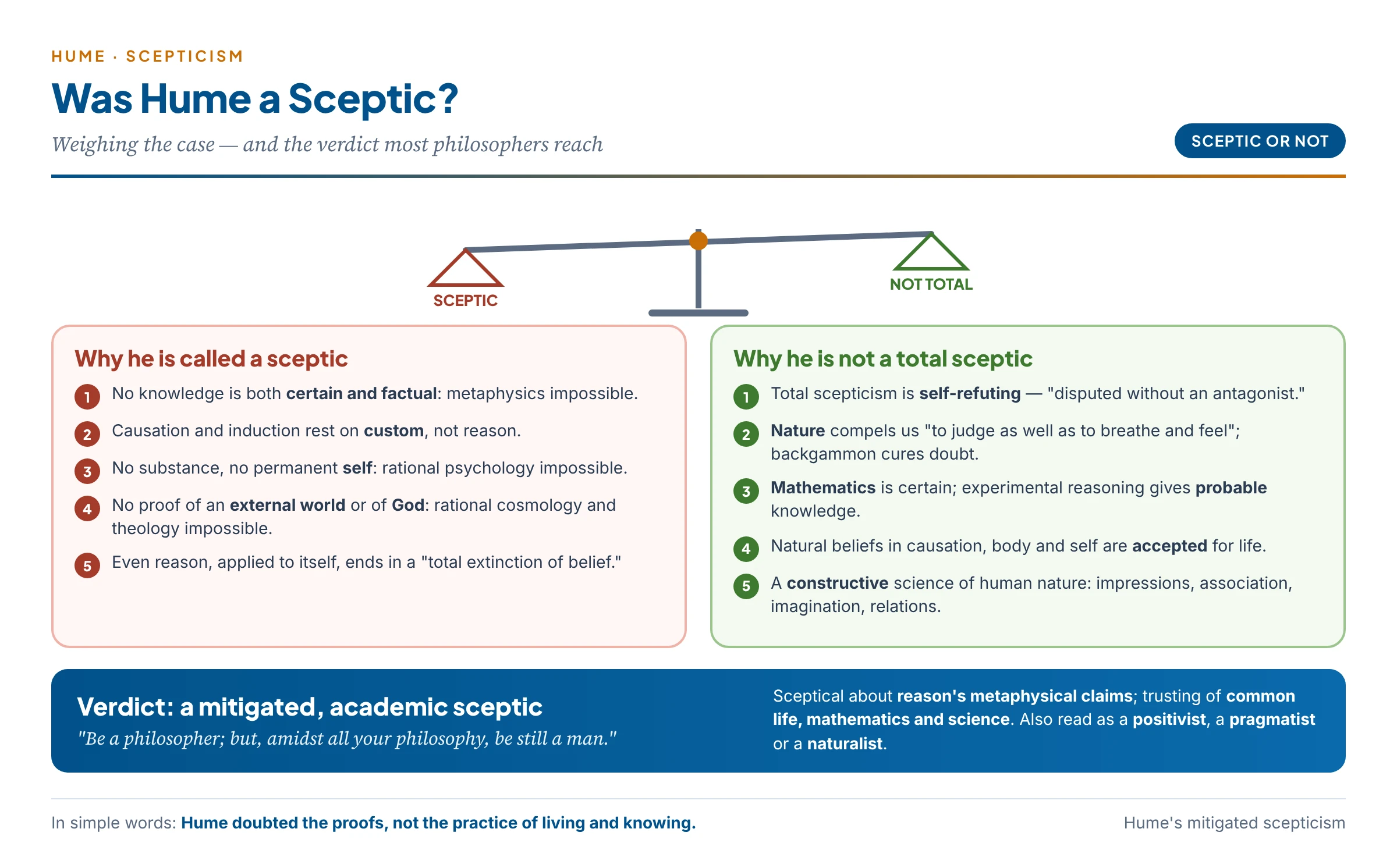
2. Why Hume Is Called a Sceptic
- He radically limits the scope of reason: reason cannot justify causal inference, induction, the external world, the self, or God.
- His empiricism allows knowledge only where impressions are present, so he rejects all metaphysical claims about substance, soul, God and necessary causation.
- He shows that causal belief rests on custom and habit, not reason, and that induction has no rational justification.
- His bundle theory denies a permanent personal identity.
- He undermines certainty in both science and metaphysics.
- He rejected the theory of causation, of substance and soul, the existing theories of personal identity, knowledge through induction, rational psychology, rational cosmology and rational theology, and all metaphysical knowledge not based on impressions and ideas. All this gives the impression that he doubts and denies certain knowledge.
- Four further reasons he has been read as a sceptic:
- The negative and critical element is so widespread in his writing that he seems merely destructive.
- He makes scepticism the background of his philosophy, using it as a convenient weapon against rationalism and dogmatism.
- From the rationalist point of view — dominant in the universities for a long time — his philosophy really is sceptical: he holds that reason cannot make our knowledge intelligible, and that “carelessness and inattention alone can afford us any remedy.” He makes reason sensitive rather than cogitative — a thesis no rationalist can accept.
- His constructive philosophy is weak and does not adequately answer the doubts he himself raised.
3. Why Hume Is Not a Total Sceptic
“Whoever has taken the pains to refute the cavils of this total scepticism, has really disputed without an antagonist.” — David Hume
- He rejects total doubt. Asked whether he is one of those sceptics “who hold that all is uncertain,” Hume replies that the question is “entirely superfluous, and that neither I, nor any other person, was ever sincerely and constantly of that opinion.”
- Total scepticism is unliveable. “The great subverter of Pyrrhonism or the excessive principles of scepticism is action, and employment, and the occupations of common life.” A Pyrrhonist cannot expect his philosophy to have any constant influence on the mind; if it did, “all discourse, all action would immediately cease.”
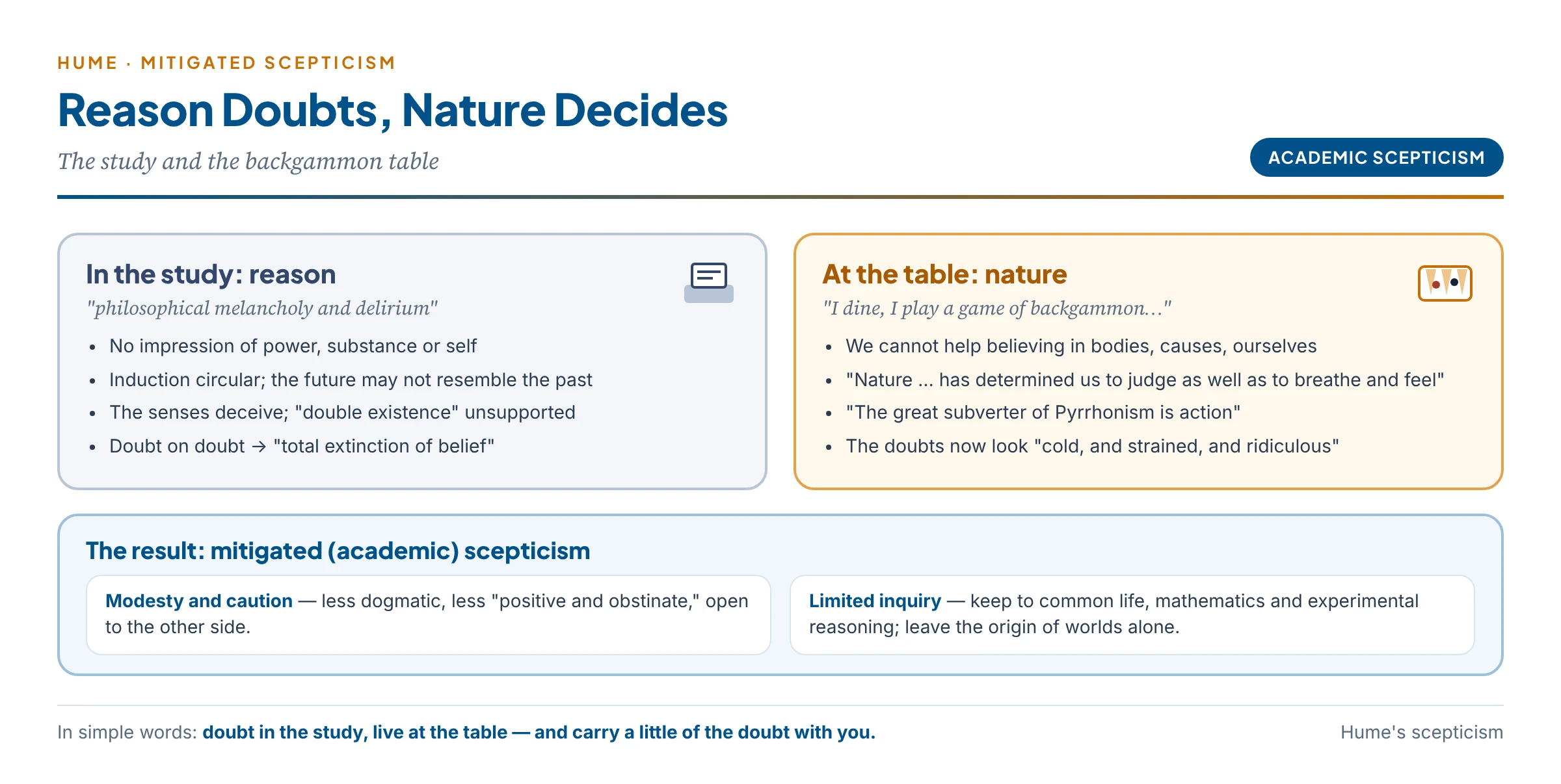
- Nature cures philosophical doubt. “Nature, by an absolute and uncontrollable necessity, has determined us to judge as well as to breathe and feel.” “Most fortunately it happens that, since reason is incapable of dispelling these clouds, nature herself suffices to that purpose, and cures me of this philosophical melancholy and delirium … I dine, I play a game of backgammon, I converse, and am merry with my friends; and when, after three or four hours’ amusement, I would return to these speculations, they appear so cold, and strained, and ridiculous, that I cannot find in my heart to enter into them any farther.”
- Natural beliefs are accepted. Hume affirms that human beings naturally and unavoidably believe in causation, the external world and personal identity, and that they are right to live by these beliefs.
- Some knowledge is certain, and much is probable. Mathematics (arithmetic and algebra) has “perfect exactness and certainty”; experimental reasoning about matters of fact gives probable knowledge sufficient for science and life. “A wise man proportions his belief to the evidence.”
- His target is dogmatism, not common sense. His scepticism is directed against dogmatic metaphysics and abstract reason, not against morality, common life or empirical inquiry. He preserves ordinary belief while denying its rational certainty.
- He is not sceptical of his own method. Hume never doubts the principles of his science of human nature; his philosophy is sceptical with regard to dogmatism and rationalism, but not with regard to scepticism itself, which he also criticises.
- Hume’s own view of the label. He would accept the name “sceptic” on two grounds only: (1) because he excludes general principles like “every event has a cause” from the class of knowledge based on relations of ideas, since only mathematics belongs there; and (2) because he denies certainty to knowledge of matters of fact. “If anyone calls me a sceptic on these grounds, I shall be proud to be called a sceptic.” He also described himself as a probabilist: it is good to doubt theories in order to produce better ones.
In simple words
Hume’s philosophy is like a brilliant mechanic who opens your car and shows you that no part is guaranteed: the brakes might fail, the engine might seize. You leave the garage a little shaken — and then you drive home anyway, because life requires it and the car has always worked. Hume does not tell you to stop driving. He tells you to drive carefully and not to boast that your car can never break down.
4. Hume’s Constructive Philosophy
Hume did not merely destroy; he offered a constructive empirical philosophy built on four principles:
- The doctrine of impressions and ideas. Impressions must be admitted even by sceptics; Hume makes them the basic touchstone of knowledge.
- The law of association. What logic cannot explain, psychology does. In causation there is no logical necessity but a psychological one; power and substance are found not in objects but in subjects. The law of association explains the mental world as the law of gravitation explains the physical world.
- Imagination. No rational ground explains the connectedness of impressions in knowledge; the real ground lies in the power of imagination to fill the gaps — in causation, the external world and personal identity.
- The theory of relations. Relations of ideas give certainty; relations of matters of fact give probability; together they map the whole field of human understanding.
- The aim. Hume hoped “to establish a system or set of opinions, which if not true (for that, perhaps, is too much to be hoped for), might at least be satisfactory to the human mind, and might stand the test of the most critical examination.” Real knowledge, for him, is habitual and sensitive, not purely cogitative.
- Contribution to philosophy:
- Limits of knowledge: a precise map of what reason can and cannot establish.
- Critique of metaphysics: the fork and the copy principle as tests of meaning.
- Problem of causation and induction: still unresolved and central to philosophy of science.
- Naturalism: a science of human nature that explains belief, emotion and morality without supernatural assumptions.
- Influence: he woke Kant, shaped utilitarian and positivist thought, and anticipated analytic philosophy and modern cognitive science.
- Intellectual humility in science, religion and politics.
5. Mitigated (Academic) Scepticism
- The Pyrrhonian excess corrected. When the excessive doubts of Pyrrhonism are “corrected by common sense and reflection,” a mitigated scepticism results — “both durable and useful.”
- Two forms of mitigated scepticism:
- Modesty and caution. Awareness of the weakness of our faculties makes us less dogmatic, less positive and obstinate, more willing to hear the other side.
- Limitation of inquiry. We should confine our inquiries “to such subjects as are best adapted to the narrow capacity of human understanding” — to common life, mathematics and experimental reasoning — and leave sublime topics (the origin of worlds, the nature of spirits) to poets and orators.
- “Be a philosopher; but, amidst all your philosophy, be still a man.”
- Methodological, not doctrinal. Hume never denied a theory simply for the sake of denial; he examined rationalist theories to find better explanations of causation, self and identity. At most he is a methodological sceptic and, in his own word, a probabilist.
- A life according to nature. For natural guidance in life, Hume’s view resembles the practical rules of the ancient sceptics:
- Accept sense-impressions as they come.
- Follow natural appetites — hunger, thirst and other drives.
- Be guided by custom and laws of one’s tradition.
- Take part in the culture of one’s age.
6. Positivist, Pragmatist or Naturalist?
- Positivist. If we stress Hume’s philosophical empiricism — impressions as the indubitable touchstone of knowledge, rejection of permanent substance, self and God, restriction of knowledge to what is measurable or experienced — he looks like a positivist. The logical positivists of the twentieth century treated him as a founder; some notes say he is now “regarded as a logical positivist.”
- Pragmatist. If we stress his naturalism — imagination, custom and associative inference, and his argument that reason cannot solve our problems — he looks like a pragmatist and an anti-intellectualist: what matters is what works in life.
- Naturalist. Later scholars emphasise that Hume subordinates reason to nature: our fundamental beliefs are determined by human nature, not by argument. Philosophy’s task is to explain belief, not to justify it from first principles.
- Critic. Some prefer to call Hume a critic rather than a sceptic: he rejected the belief that reason could solve all problems but allowed the possibility of knowledge on the basis of custom and imagination.
- History’s verdict. Hume became famous mainly for his positivism with its negative conclusions, and that is how he is still most often viewed.
7. Does Hume Deny the Possibility of Knowledge?
- It depends on what “knowledge” means.
- If knowledge means certain, universal and factual truth about reality — the knowledge rationalist metaphysics promised — then yes: Hume denies that such knowledge is possible.
- If knowledge means justified belief that guides life and science, then no: Hume accepts (a) demonstrative knowledge of relations of ideas, (b) intuitive knowledge of our present impressions, (c) proofs from uniform experience and (d) probabilities in matters of fact.
- What he denies is the rational foundation of factual knowledge, not its existence. “Our knowledge of matters of fact” is real, useful and well-founded in custom; it is never demonstrative.
- What he affirms is the reliability of mathematics, the success of experimental science, and the naturalness of our basic beliefs.
- Conclusion. Hume denies the possibility of metaphysical knowledge and of certainty about matters of fact; he does not deny the possibility of knowledge as such. His is a philosophy of limits, not of nihilism.
In simple words
A court convicts a person when guilt is proved “beyond reasonable doubt,” not with the certainty of “2 + 2 = 4.” No one says courts therefore know nothing; they know in the way human affairs allow. Hume treats all factual knowledge like a court’s verdict: firmly grounded in evidence, fit to act on — but never a mathematical proof.
8. “No Empirical Proposition Is Ever Certain”
- Hume’s support for the claim. Every empirical proposition is a matter of fact; its contrary is always conceivable; it rests on experience and causal inference, which rest on custom; so it can be probable — often overwhelmingly so — but never logically certain. Empirical laws can be overturned by new evidence, as Newton’s physics was revised.
- Supporters. Logical positivists (empirical statements are hypotheses), Popper (theories can be falsified but never verified), modern fallibilism in science.
- Objections:
- Descartes: “I think, I exist” is an empirical (existential) truth that cannot be doubted while thinking it.
- Locke: sensitive knowledge of things present to the senses is a real degree of knowledge, beyond mere probability.
- Reports of immediate experience (“I seem to see red now”) appear incorrigible; Hume himself treats present impressions as indubitable.
- Moore: “Here is one hand” is known with certainty; no philosophical argument is more certain than it.
- Wittgenstein: some empirical propositions (“the earth existed long before my birth”) are hinges — not hypotheses we doubt but the framework within which doubting makes sense.
- Evaluation. The statement is true of empirical generalisations and predictions; it is more doubtful for reports of immediate experience and for framework propositions of common sense. Hume would add that even where certainty is lacking, nature gives us all the confidence we need.
Common confusion
Is “Hume’s scepticism” the same as saying “we can know nothing”? No. That is total (Pyrrhonian) scepticism, which Hume called impossible and self-refuting. Hume accepted mathematical certainty, probable knowledge of matters of fact, and the natural beliefs of common life. What he doubted was the power of reason to prove causation, substance, the self, the external world and God, and to give factual knowledge demonstrative certainty. Many notes also write that Hume “rejected causation”; he rejected only its rational and metaphysical foundation, not the practice of causal reasoning.
9. Kant’s Response to Hume’s Scepticism
- “Hume’s problem.” In the Prolegomena Kant generalised Hume’s challenge: how can any concept that claims necessity and universality — cause, substance, community — apply to objects of experience, if it is neither got from experience nor analytically true? Kant’s answer is the critical philosophy.
- Kant agreed with Hume:
- Experience gives no necessity or strict universality; sense-impressions are passing events.
- Knowledge needs these impressions to be ordered and synthesised — and Hume showed that empiricism cannot supply the ordering concepts (substance, causality), leaving only fictions of imagination. So, says Kant, scepticism is the necessary outcome of classical empiricism.
- Kant also rejected rationalism. Innate ideas explain universality and necessity, but not why they hold of facts; rationalists fall back on God’s veracity (Descartes) or pre-established harmony (Leibniz) — unverifiable assumptions; and pure reason produces contradictory systems (Spinoza’s one substance, Leibniz’s many monads). Reason without experience builds “castles in the air.”
- Kant’s solution — the Copernican revolution:
- Both empiricism and rationalism assumed that the mind must conform to objects. Kant reverses this: objects must conform to the mind to be known at all.
- The mind contributes the forms of sensibility (space and time) and the twelve categories of the understanding (substance, causality, etc.). Like holes of different shapes on a table that catch only the pebbles that fit them, the mind lets in as objects only what fits its forms.
- Synthetic a priori judgments — in mathematics (“7 + 5 = 12”), in physics (“every event has a cause,” “in all change substance is permanent”) — are therefore possible: they hold necessarily of all possible experience.
- Against Hume’s self: the transcendental unity of apperception — the “I think” — unifies all representations.
- The price. Necessary knowledge holds only of phenomena (things as they appear), never of noumena (things-in-themselves). Kant thus limits knowledge to make room for faith: God, freedom and immortality cannot be known, but can be postulated by practical reason.
- Assessment.
- Kant saved the necessity of mathematics and the principles of natural science against Hume’s scepticism.
- But his answer concedes much to Hume: things-in-themselves are unknowable; particular laws are still empirical; and the necessity is grounded in the human mind. Critics say Kant replaced Hume’s psychological scepticism with a transcendental subjectivism.
10. Hume and Kant on Metaphysics
| Point | Hume | Kant |
|---|---|---|
| Verdict on traditional metaphysics | “Commit it to the flames” — sophistry and illusion | Metaphysics of the supersensible (soul, world, God) is impossible as knowledge |
| Why | Its propositions are neither relations of ideas nor matters of fact | Reason, going beyond experience, falls into paralogisms, antinomies and fallacious proofs |
| Is any metaphysics possible? | No — only mathematics, logic and experimental science | Yes — a metaphysics of experience: the a priori conditions of knowledge (space, time, categories) |
| Necessity | Only in relations of ideas; causal “necessity” is psychological | Synthetic a priori necessity grounded in the mind’s forms |
| Soul, world, God | Fictions or unprovable beliefs | Ideas of Reason: regulative for inquiry; postulates of practical reason |
| Method | Psychological analysis of the origin of ideas | Transcendental critique of reason’s conditions and limits |
| Outcome | Mitigated scepticism, naturalism | Critical idealism; morality as the road to the supersensible |
- Common ground. Both deny that pure reason can give knowledge of what lies beyond all possible experience; both turn philosophy from metaphysics towards epistemology. Hume ends with the limits of reason; Kant with a critique that both limits and grounds it.
The Empiricist Legacy: Locke, Berkeley and Hume Compared
The March of Empiricism
- One principle, three conclusions. All three start from “nothing in the intellect that was not first in the senses.” Each removes something the previous one kept:
- Locke keeps matter, mind and God — and representative realism.
- Berkeley removes matter, keeps spirits and God — and immaterialism.
- Hume removes mind and God as knowable substances — and ends in mitigated scepticism.
- Why each step was forced. Locke’s “something, I know not what” failed the empiricist test; Berkeley showed that the same test destroys matter; Hume showed that it equally destroys spiritual substance and causal power, on which Berkeley’s God depended.
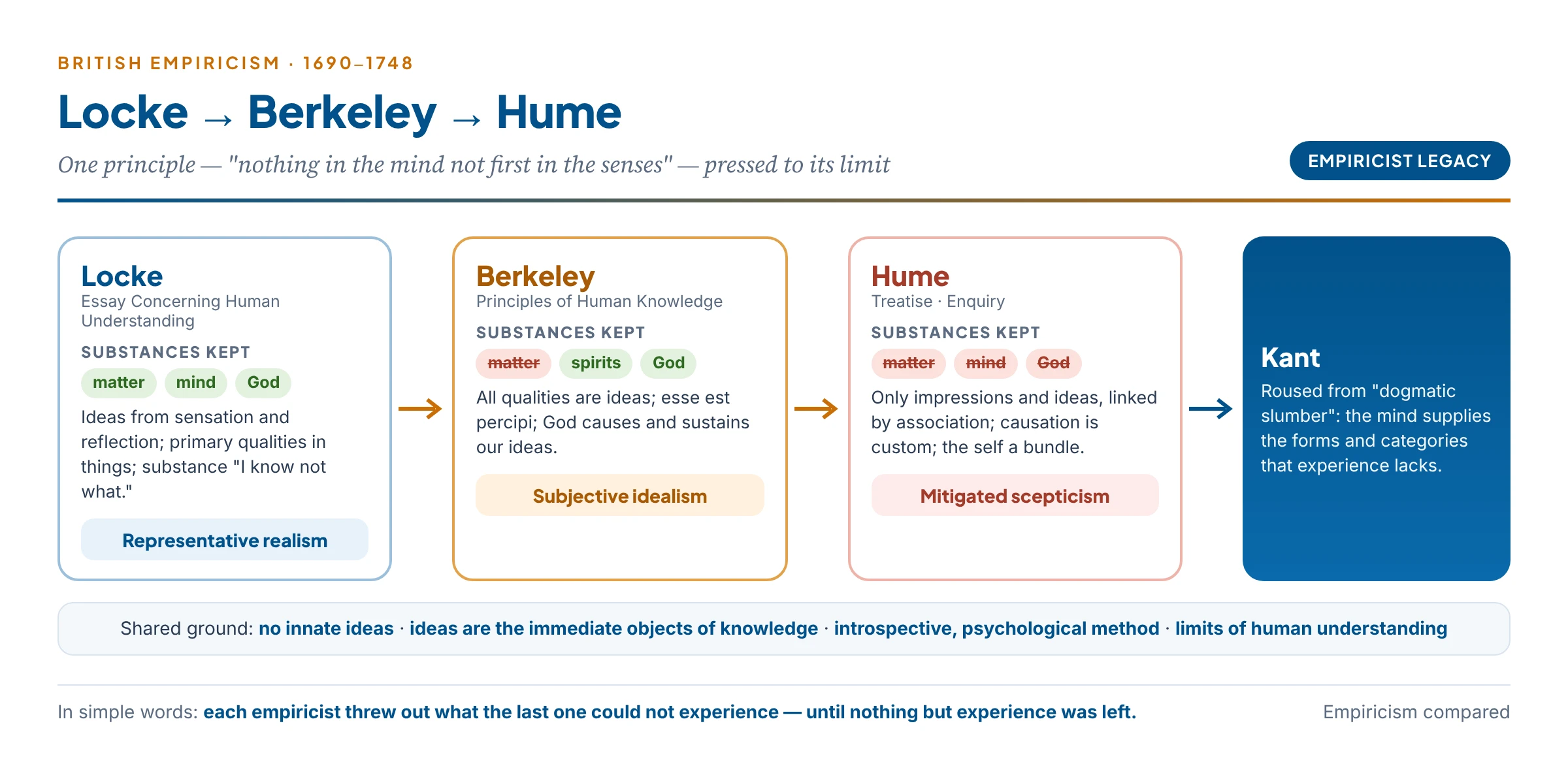
| Dimension | John Locke | George Berkeley | David Hume |
|---|---|---|---|
| School | Representative realism | Subjective idealism / immaterialism | Phenomenalism / mitigated scepticism |
| Origin of ideas | Sensation and reflection | Ideas of sense produced by God; ideas of imagination by us | Impressions (of sensation and reflection) |
| Innate ideas | Rejected (tabula rasa) | Rejected | Rejected (copy principle) |
| Abstract general ideas | Accepted (abstraction) | Rejected (nominalism) | Rejected — “one of the greatest discoveries” |
| Primary and secondary qualities | Primary objective, secondary subjective (powers) | Both mind-dependent | Qualities are impressions; distinction collapses |
| Material substance | Accepted: “something, I know not what” | Rejected as contradictory and useless | Rejected: collection of qualities |
| Spiritual substance (self) | Accepted; personal identity by consciousness / memory | Accepted: active spirit, known by notion | Rejected: bundle of perceptions |
| God | Demonstrable (cosmological, design) | Essential: cause of ideas, ground of permanence | Unprovable; agnosticism |
| Causality | Real powers in substances | Only spirits (finally God) are causes; nature = signs | Constant conjunction + custom |
| Knowledge | Intuitive, demonstrative, sensitive | Ideas known immediately; spirits by notion | Relations of ideas (certain) vs matters of fact (probable) |
| External world | Inferred cause of ideas | Collections of ideas sustained by God | Belief from constancy and coherence |
| Relation to scepticism | Seed of scepticism (veil of ideas) | Meant to refute scepticism | Culmination: mitigated scepticism |
| Indian parallel | Sautrāntika (external objects inferred from representations) | Yogācāra (consciousness only) | Buddhist anātmavāda; Cārvāka on inference; Mādhyamika critique of concepts |
Common Features of British Empiricism
- Experience is the only source of ideas; no innate ideas.
- Psychological, introspective method: examine the origin of ideas in the mind.
- Ideas (or impressions) are the immediate objects of knowledge.
- Inductive, tentative conclusions, against the rationalists’ deductive certainty.
- Critique of metaphysics: substance, abstraction and pure reason come under suspicion.
- Limits of knowledge: each thinker asks how far human understanding reaches — Locke’s “extent of our tether.”
The Legacy
- Kant: roused from “dogmatic slumber,” he combined empiricism’s insistence on experience with rationalism’s necessity.
- J. S. Mill: phenomenalism (“matter is the permanent possibility of sensation”) and inductive logic.
- Russell and Moore: sense-data, logical constructions, and the realist reaction against Berkeley.
- Logical positivism (Ayer, Carnap): Hume’s fork as the verification principle; metaphysics as nonsense.
- Popper and philosophy of science: the problem of induction and falsification.
- Analytic philosophy of mind: bundle and “no-self” views; personal identity as psychological continuity.
- Liberal political thought: Locke’s rights and toleration; Hume’s conventions and utility.
Critical Evaluation
Criticisms of Hume’s Scepticism
- Self-refutation. If reason undermines itself, so does the reasoning that shows this; a sceptical argument that destroys all reasoning destroys itself.
- Thomas Reid and common sense. Hume’s scepticism follows from the “ideal theory” — the assumption, shared by Descartes, Locke and Berkeley, that we perceive only ideas. Reject that assumption and the doubts disappear: we perceive objects directly, and the principles of common sense (that there is an external world, that I am the same person, that like causes have like effects) are first principles that need no proof.
- Kant. Hume’s error was to treat all necessity as either analytic or psychological; synthetic a priori principles ground objective experience.
- Moore. “Here is one hand, and here is another” — I know this with more certainty than any premise of a sceptical argument.
- Wittgenstein. Doubt itself needs grounds and a background of certainty; universal doubt is not a coherent practice.
- His constructive theory is too weak. Custom and imagination explain belief but do not justify it; Hume’s naturalism leaves the sceptical question unanswered.
- Psychologism. Questions of validity are answered by psychology — how beliefs arise — a confusion of origin with justification.
What Can Be Said for Hume
- Honest about limits. No philosopher has yet given a widely accepted non-circular justification of induction or proof of an external world.
- Fallibilism is scientific. Modern science treats every law as provisional — Hume’s mitigated scepticism in practice.
- Anti-dogmatism. His caution against “positive and obstinate” belief is a standing virtue in science, religion and public life.
- Nature over argument. His insight that basic beliefs are not reached by argument is shared by Reid, Wittgenstein and modern naturalised epistemology.
Critics and Defenders
Criticism — Critics
- Kant: necessity and universality are grounded a priori; scepticism follows only from a faulty empiricism.
- Reid: the “ideal theory” is the root of scepticism; common-sense principles are first principles.
- Moore and Wittgenstein: some empirical propositions are known with certainty or stand fast as hinges.
- Rationalists: reason can know necessary truths about reality.
- Critics of psychologism: custom explains belief but does not justify it.
Defence — Defenders and lasting value
- Hume’s reply: total scepticism is not his view; nature secures belief where reason cannot.
- Positivists: Hume rightly confined knowledge to logic, mathematics and experience.
- Popper: science progresses by conjecture and refutation, never by proof.
- Naturalised epistemology (Quine): study how beliefs are actually formed — Hume’s science of human nature.
- Fallibilists: certainty is the wrong goal; well-proportioned belief is the right one.
Cross-Tradition Comparison
Scepticism in Indian Philosophy
| Thinker / school | Form of doubt | Comparison with Hume |
|---|---|---|
| Sañjaya Belaṭṭhiputta (Buddha’s contemporary) | Refused to affirm or deny anything about the afterlife — “eel-wriggling” (amarāvikkhepa) | Closer to total suspension than to Hume |
| The Buddha | Left metaphysical questions unanswered (avyākata) — whether the world is eternal, whether the soul is the body | Like Hume’s limitation of inquiry to what is useful; practical, not theoretical |
| Cārvāka | Only perception is valid; inference, vyāpti and causation cannot be established; no soul, no God, no afterlife | The closest to Hume: critique of inference, causation, soul and God |
| Nāgārjuna (Mādhyamika) | Dialectic (prasaṅga) shows every concept — cause, motion, self — self-contradictory; all things empty (śūnya) | Like Hume’s critique of causation and self, but aimed at liberation |
| Śrīharṣa (Advaita) | Refutes all Nyāya definitions to show the categories of logic are indefinable | Uses scepticism to clear the way for Brahman |
| Jaina syādvāda | Every judgment true only “in some respect” (syāt) | Not scepticism: affirms partial truths; Hume doubts reason’s reach |
Indian Connect — Key takeaways
- The Cārvāka and Hume played the same historical role. Just as Hume’s scepticism woke Kant from his dogmatic slumber, the Cārvāka critique forced every Indian school to defend its pramāṇas. Nyāya had to refine its theory of vyāpti and tarka; Buddhists grounded inference in identity and causality; Vedāntins defended testimony and the self. In this sense the Cārvāka saved Indian philosophy from dogmatism.
- But Indian scepticism usually served a higher goal. Nāgārjuna and Śrīharṣa used doubt to prepare for emptiness or Brahman; the Buddha’s silence served liberation. Hume’s scepticism serves a naturalistic understanding of human beings and the modesty of science.
- Syādvāda is not scepticism. The Jaina doctrine affirms that reality is many-sided and that each standpoint gives a partial truth; it is a philosophy of non-absolutism, not of doubt.
- The Buddha and Hume both limit inquiry. Both refused to pronounce on questions beyond experience, and both pointed to the practical life as the proper field of human concern.
Synthesis (Siddhānta)
Was Hume a sceptic? Yes — about the claims of abstract reason. He showed that reason cannot prove causal necessity, the uniformity of nature, the existence of bodies, a substantial self or God; that factual knowledge is at best probable; and that reason, examined closely, even undermines its own certainty. No — about life, science and mathematics. Total scepticism, he said, is impossible and self-refuting; nature compels us to believe, to judge and to act; mathematics is certain and experimental knowledge is reliable enough to live by. Hume is best described as a mitigated or academic sceptic, a naturalist who moved the foundations of knowledge from reason to human nature, and a critic of dogmatic metaphysics.
His scepticism was the natural end of a road that began with Locke’s “ideas” and “something, I know not what,” passed through Berkeley’s immaterialism, and ended with impressions and their associations. Kant answered by making the mind the source of the order Hume could not find in experience, at the cost of leaving things-in-themselves unknown. Two and a half centuries later, Hume’s questions — about induction, causation, the self and the limits of reason — remain open, and his answer still commands respect: be a philosopher, but be still a human being.
- Science: fallibilism, probability and falsification are Hume’s mitigated scepticism made into method.
- Public reasoning: proportioning belief to evidence is the best defence against dogmatism and misinformation.
- Philosophy: the analytic tradition, positivism and naturalised epistemology all descend from Hume’s empiricism.
- Dialogue of traditions: the Cārvāka, the Buddha and Nāgārjuna show that India too knew the liberating power of doubt.
Hume took away reason’s crown but left it a lamp — enough light to walk by, if not to see the end of the road.
Previous Year Questions
- 2024How does Kant respond to Hume’s scepticism with regard to a priori judgments? Discuss.
- 2016Discuss the various stances on God taken by Rationalists and Empiricists.
- 2012Was Hume a sceptic? If not, then what is his contribution to philosophy?
- 2011What, according to Empiricists, is the concept of Substance? Discuss.
- 2010Does Hume deny the possibility of knowledge? Discuss.
- 2010Just as the skepticism of Hume helped Kant to come out of his dogmatic slumber, so also the Cārvāka philosophy saved Indian philosophy from dogmatism. Discuss.
- 2008Hume and Kant on metaphysics. Short notes.
- 2006Discuss Hume’s Scepticism.
- 2005How does Kant respond to Hume’s scepticism?
- 1996Distinction between solipsism and scepticism. Notes.
- 1990No empirical proposition is ever certain. Comment.