

Kant: Possibility of Synthetic a priori Judgments; Space and Time; Categories; Ideas of Reason; Antinomies; Critique of Proofs for the Existence of God.
Official Syllabus: Paper I, Section A, Unit 4
Immanuel Kant (1724–1804) stands at the meeting point of the two great streams of modern philosophy. Rationalism (Descartes, Spinoza, Leibniz) held that reason alone gives certain knowledge; empiricism (Locke, Berkeley, Hume) held that all knowledge comes from experience. By Kant’s time the first had ended in dogmatism — rival systems that no experience could check — and the second in scepticism — Hume’s conclusion that causality, substance and the self are habits of the imagination. Kant’s critical philosophy asks a prior question: before we claim to know God, the soul or nature, what can human reason know at all, and within what limits? His answer — the Copernican Revolution — is that objects must conform to the structure of the knowing mind. This secures science, limits metaphysics to phenomena (things as they appear), and leaves noumena (things in themselves) thinkable but unknowable.
In simple words
Think of a coin-sorting machine at a bank. Coins of every kind are poured in, but the machine accepts only those that fit its slots, and it stacks them in neat columns of ₹1, ₹2, ₹5 and ₹10. Whatever comes out of the machine is already sorted — not because the coins sorted themselves, but because the machine has a fixed shape. Kant says the human mind is like this. The world pours in sensations; the mind’s built-in “slots” — space, time and twelve basic concepts — sort them. That is why everyone’s experience has the same order, and why we can know some things about all possible experience in advance. But we never see a coin as it was before it entered the machine.
Context & Problem
Kant’s Life and the Three Phases of His Thought
- Life. Born and died in Königsberg (East Prussia); a professor there for most of his life; one of the central thinkers of the Enlightenment.
- Three phases. Kant himself moved through both rival schools before going beyond them:
- Rationalist phase — trained in the Leibniz–Wolff school, he first accepted that reason can know God, soul and world.
- Empiricist challenge — reading Hume shook that faith. “It was Hume who first interrupted my dogmatic slumber.”
- Critical phase — he rejected both one-sided views and built criticism (critical philosophy).
- Major works. Critique of Pure Reason (1781; revised 1787), Prolegomena to Any Future Metaphysics (1783), Critique of Practical Reason (1788), Critique of Judgment (1790), Religion within the Bounds of Reason Alone (1793).
- A threefold plan. Three faculties — knowing, willing, feeling — and three Critiques. Even the first Critique has three parts (Aesthetic, Analytic, Dialectic). This triadic habit later gave Hegel a hint for his dialectic.
The Four Questions of Philosophy
Kant summed up the whole field of philosophy in four questions:
- What can I know? — metaphysics and theory of knowledge (Critique of Pure Reason).
- What ought I to do? — moral philosophy (Critique of Practical Reason).
- What may I hope for? — philosophy of religion.
- What is man? — anthropology, to which the first three finally lead.
Common confusion
Is Kant’s second question “What should I know?” No. Some notes print it this way, but the second question is “What ought I to do?” — the question of morality. The first question already concerns knowing; the second turns from knowledge to action, and the third from action to hope (religion). Keep the order: know → do → hope → man.
What “Critical” Means
- Criticism is not refutation. Kant’s Critiques do not attack books or authors. A critique of pure reason is a critical examination of reason by reason itself: its sources, its scope, its valid use and its limits.
- Pure reason means reason working independently of experience. The question is how far such reason can give knowledge.
- Earlier philosophers were “dogmatic.” Both schools advanced claims without first examining the conditions and limits of knowledge — rationalists assumed reason’s unlimited power; empiricists assumed that experience alone constitutes knowledge.
- Kant’s demand. Before building a metaphysics, we must test the instrument — just as one checks a telescope before trusting what it shows.
What Counts as Knowledge for Kant
- Like Descartes and Locke, Kant held that knowledge means certain knowledge, and that such knowledge exists in mathematics and physics (Newton’s science was advancing rapidly). Philosophy must explain how this knowledge is possible, not doubt it.
- Knowledge proper has three marks:
- Universality — true in all cases, for all knowers.
- Necessity — cannot be otherwise.
- Novelty (factuality) — it tells us something new about the world.
- The rationalist gets the first two; the empiricist gets the third. Kant’s task is to show how all three can belong to one and the same judgment — the synthetic a priori (see the next article in this unit).
Core Doctrine
1. Why Rationalism Failed
- What rationalism explains well. A universal faculty of reason gives every person the same innate ideas. So cognitive propositions are the same for all (universality), and people cannot help accepting them because their reason compels them (necessity, as an inner constraint).
- The problem of facts. Innate ideas are in the mind. What guarantees that they are true of the world?
- Descartes appealed to God’s veracity to guarantee that clear and distinct ideas match reality — most obviously for our knowledge of the external world. But if clearness and distinctness cannot guarantee facts by themselves, the “magic word” God cannot work the miracle either.
- Leibniz held all ideas to be innate and appealed to pre-established harmony: God so made the monads that the order in one mirrors the order in all. My thought of a table (in the soul-monad called Ram) is matched by the table-monad. But how can Ram check the match? A windowless monad can never step outside itself. The harmony is an a priori assumption — unverifiable, a fiction as an account of knowledge.
- Rival systems from the same start. Rationalism deduces everything from self-evident definitions, especially of substance:
- Descartes defined substance as what exists in itself and is conceived through itself, yet inconsistently accepted mind and body as two (relative) substances.
- Spinoza followed the definition rigorously: there can be only one substance; all finite things, including the thinker, become modes — plurality is lost.
- Leibniz saw this and began with many monads — but could not reach a real unity among them.
- Taken singly the results are unsatisfactory; taken together they contradict one another.
- Verdict. “Reason, unaided by experience, can build only castles in the air.” Rationalism deals with airy structures that do not correspond to facts.
Kant’s six objections to rationalism:
- Pure reason is not a source of knowledge of reality. Logical consistency alone is not knowledge.
- Concepts without intuitions are empty. A concept must be filled by sensory content to determine an object.
- No intellectual intuition. Rationalists assume we can grasp essences directly by the intellect. Kant denies this: human understanding is discursive — it thinks through general concepts and must be given its objects by the senses.
- Limits of a priori metaphysics. Claims about God, soul and world as a whole go beyond all possible experience and are illegitimate as knowledge.
- Dogmatism. Rationalism assumes reason’s unlimited power without first examining its conditions.
- The critical turn. Rationalist certainty is replaced by critical inquiry into reason’s limits.
2. Why Empiricism Failed
- What empiricism gets right. The manifold of sense-data — the passing stream of sensations — is the material of all knowledge. Kant agrees with Hume that impressions are fleeting events.
- What it cannot explain. Knowledge needs more than a stream: the data must be ordered, connected and synthesised into a system, normally through concepts such as substance and causality.
- Hume’s destruction of the connecting concepts. Following Locke’s and Berkeley’s doubts about substance, Hume concluded that the idea of substance (material or spiritual) is a fiction of imagination and association, and that the necessity in causality is only a habit of the mind.
- The result. If substance and causality are fictions, there is no intelligible order among impressions; without order there is no knowledge. Scepticism is the necessary outcome of classical empiricism.
- No universality or necessity. Experience shows what has happened, never what must happen. So empiricism can never explain the universal and necessary truths of mathematics and physics; at best all knowledge becomes probable.
Kant’s six objections to empiricism:
- Experience supplies content, not structure. Not all knowledge arises from sense experience.
- Universality and necessity need a priori elements. These cannot be drawn from experience.
- Hume’s scepticism threatens science — causation, substance and necessity all dissolve.
- The mind is not passive. It is not a tabula rasa (blank slate) on which experience writes; it actively organises sense data.
- Experience is preserved. Kant does not deny experience; he limits empiricism and joins it to rational structures.
- Experience without concepts is blind. Raw sensation does not by itself give knowledge of objects.
In simple words
The rationalist is like a cook with recipes but no groceries — he can write perfect menus, but nothing reaches the table. The empiricist is like a cook with a basket of groceries but no recipe and no kitchen — the food is real, but it never becomes a meal. Kant’s knower is the cook in a kitchen: the groceries come from outside (experience), the recipes and utensils come from the cook (the mind), and only together do they make a dish (knowledge).
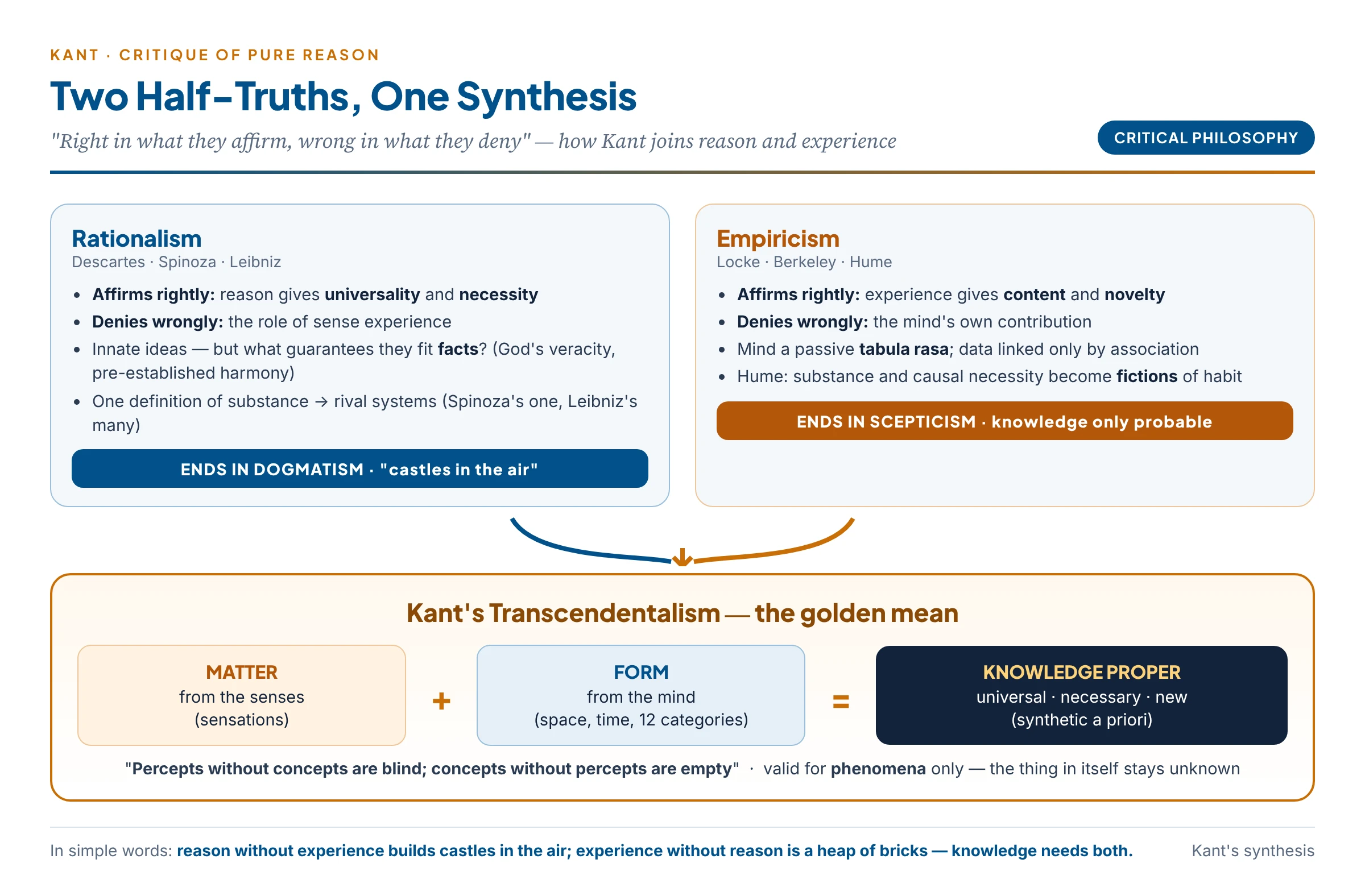
3. “Both Are Right in What They Affirm, Wrong in What They Deny”
- Rationalists are right that reason contributes to knowledge (universality and necessity), wrong to deny the role of experience.
- Empiricists are right that experience is essential (novelty, factual content), wrong to deny the role of reason.
- The real fault is over-valuation. Each school treated a necessary condition of knowledge as if it were sufficient. For Kant, sense and understanding together are the necessary and sufficient conditions.
- Method. Rationalists used deduction, empiricists induction; Kant holds that knowledge needs both the form supplied by reason and the matter supplied by sense.
- Outcome of the old debate. “The rationalism of Descartes ended in the dogmatism of Leibniz; the empiricism of Locke ended in the scepticism of Hume.” Kant’s transcendentalism is the “golden mean” between exaggerated scepticism and excessive claims to knowledge.
“Thoughts without content are empty; intuitions without concepts are blind.” — Kant
- Popular form. “Percepts without concepts are blind; concepts without percepts are empty.” A percept (sense content) with no concept is a blur; a concept with no percept is an empty form — like a mould without clay, or clay without a mould.
Common confusion
Did Kant invent the “spider, ant and bee” comparison? No. The comparison comes from Francis Bacon: the rationalist is like a spider spinning webs out of itself, the empiricist like an ant that only collects and uses, and the true philosopher like the bee, which gathers from flowers and then transforms the material by its own power into honey. Many notes attach it to Kant because it fits his synthesis so well — the bee is exactly Kant’s knower — but the image is Bacon’s.
Empiricism, rationalism and Kant’s transcendentalism compared:
| Point | Empiricism | Rationalism | Transcendentalism (Kant) |
|---|---|---|---|
| Mind at birth | Tabula rasa; knowledge begins and ends in experience | Active; knowledge made of innate ideas | Knowledge begins with experience, which stirs the mind to contribute a priori forms |
| Sense vs reason | Over-values sense; intellect works only on simple ideas (Locke); cannot create one simple idea (Hume) | Over-values reason; sense only an occasion for thinking innate ideas | Knowledge is a joint product of sense and understanding |
| Sensing vs thinking | Differ only in degree (thinking is faint perceiving) | No sharp line (Leibniz: degree only; Descartes gives clear ideas and perceptions equal status) | Sharp distinction: sensing is passive, understanding active (spontaneous) |
| Connection of data | Data discrete; linked by association — subjective, uncertain | Ideas linked by logic — but no contact with facts (“airy nothing”) | Data discrete, but the a priori connection is the same for all minds — valid for all, though only for phenomena |
| End result | Dogmatic about experience → scepticism | Dogmatic about reason → inconsistent systems of Spinoza and Leibniz | Golden mean: a priori forms + sense material; limits of knowledge fixed |
4. The Copernican Revolution
- The hidden common assumption. Both schools assumed that objects exist outside the mind and that the mind must approach them, adjusting itself to them, in order to know them.
- Why this makes knowledge impossible. If knowledge must conform to external objects, we can know them only by experience. Experience tells us that these objects are such-and-such, never that all objects must be such-and-such. So universal and necessary propositions about objects become impossible.
- Yet we do find uniformity. An orange looks orange to everyone; the geometry of a triangle holds for every triangle anyone will ever draw. Something in the knowing situation must explain this.
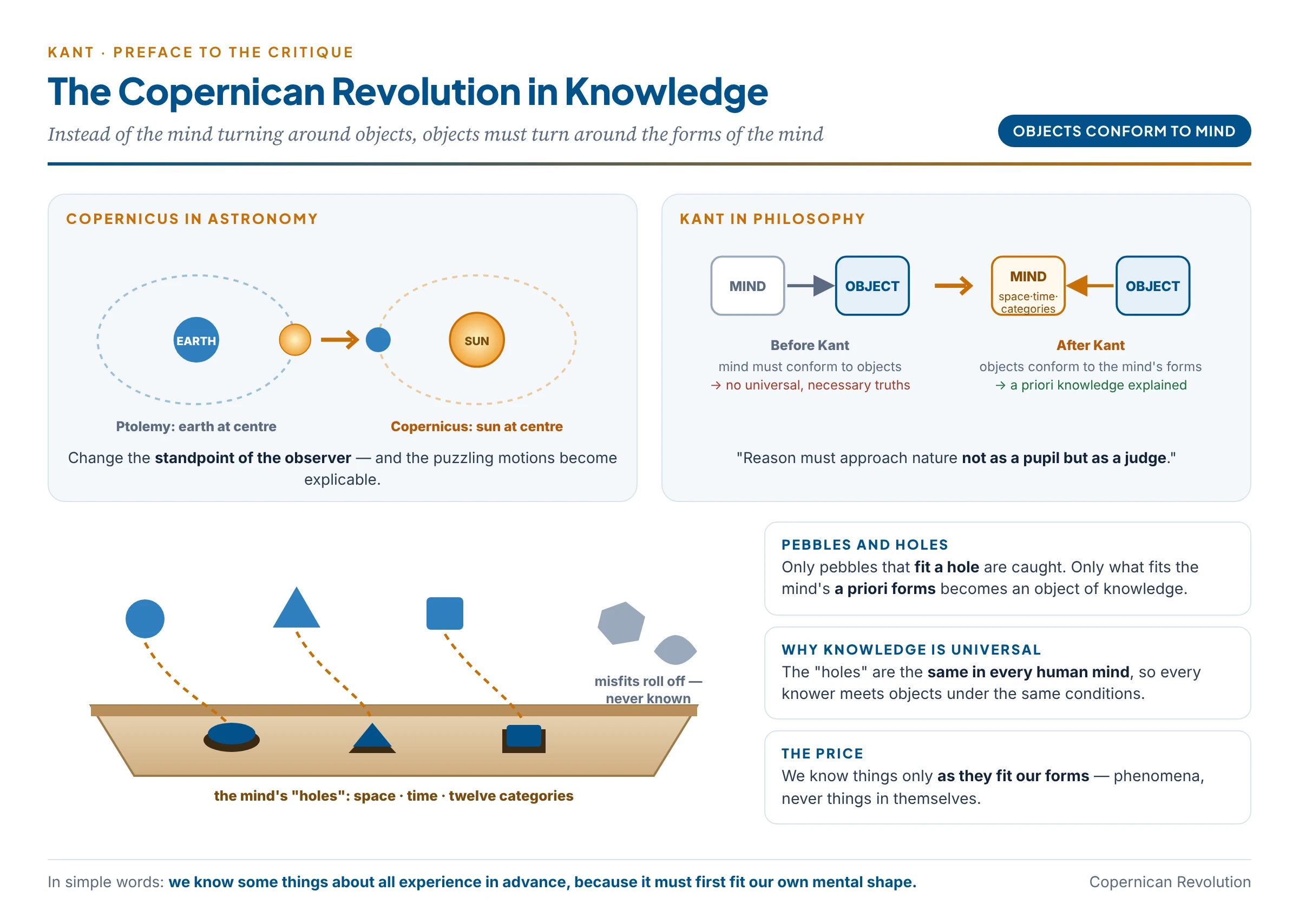
- The Copernican analogy. Copernicus found astronomy stuck under Ptolemy’s assumption that the heavens revolve around a stationary earth (the geocentric view). He reversed the standpoint — the observer moves, the sun is the centre (the heliocentric view) — and astronomy advanced “by leaps and bounds.”
- Kant’s reversal. Instead of assuming that knowledge conforms to objects, assume that objects conform to our knowledge — to the forms and concepts of the mind. “Reason must approach nature not as a pupil but as a judge,” who compels the witness to answer the questions he puts.
- The preconditions. The mind lays down conditions that anything must meet in order to become an object for us: the two forms of sensibility (space and time) and the twelve categories of understanding (substance, causality and the rest). What does not meet them is not known at all.
- Why this explains universality. These conditions are common to all human minds, so all knowers view objects under the same conditions. They are not conditions under which a mind happens to know objects, but those under which a mind as mind must know them; it cannot help seeing things according to its own constitution.
- What the revolution needs. Everything now depends on showing that there really are a priori forms that precede and shape experience. That is the work of the Aesthetic and the Analytic (articles 3 and 4 of this unit).
Pebbles and holes. Imagine a table-top with holes of various shapes and sizes, and pebbles of various shapes rolling across it. Only pebbles that fit a hole are caught; the rest roll off. The mind is the table: only what fits its pre-set “holes” (space, time, categories) is caught as an object of knowledge.
What was revolutionary about it:
- From metaphysics to epistemology. The first question is no longer “what is reality made of?” but “what can we know about reality, and how?” — a shift that still shapes philosophy.
- The mind as active. The mind is not a mirror or a passive receptor; it actively shapes our experience of reality.
- Answers in a critique of reason. The answers to metaphysical questions are sought not in speculation about the universe but in an examination of our mental faculties — which sets clear boundaries for speculation while keeping a sensible, empirical approach to the external world.
- Rescue of science. Universality and necessity in mathematics and physics are explained without appealing to God’s guarantee (as Descartes did) or giving up to habit (as Hume did).
- Limits of metaphysics. Reason’s claims about God, soul and the world as a whole lose their status as knowledge — but freedom, morality and faith gain a protected place.
Is the revolution really “Copernican”?
- The objection. Copernicus dethroned man — the earth is no longer the centre. Kant makes the mind the law-giver of nature (“mind maketh nature”), which looks like a return to a Ptolemaic, man-centred view and raises the worth of man.
- The reply. Kant borrows Copernicus’s method, not his result. Copernicus explained the observed motions by changing the standpoint of the observer; Kant explains the necessity in knowledge by changing the standpoint about the relation of knower and known. He is not trying to wound or flatter human pride — what Freud called the blow to man’s narcissism — but proposing a revolution in how we think about knowledge, expecting philosophy to advance as astronomy did.
5. How Knowledge Is Formed: Three Levels
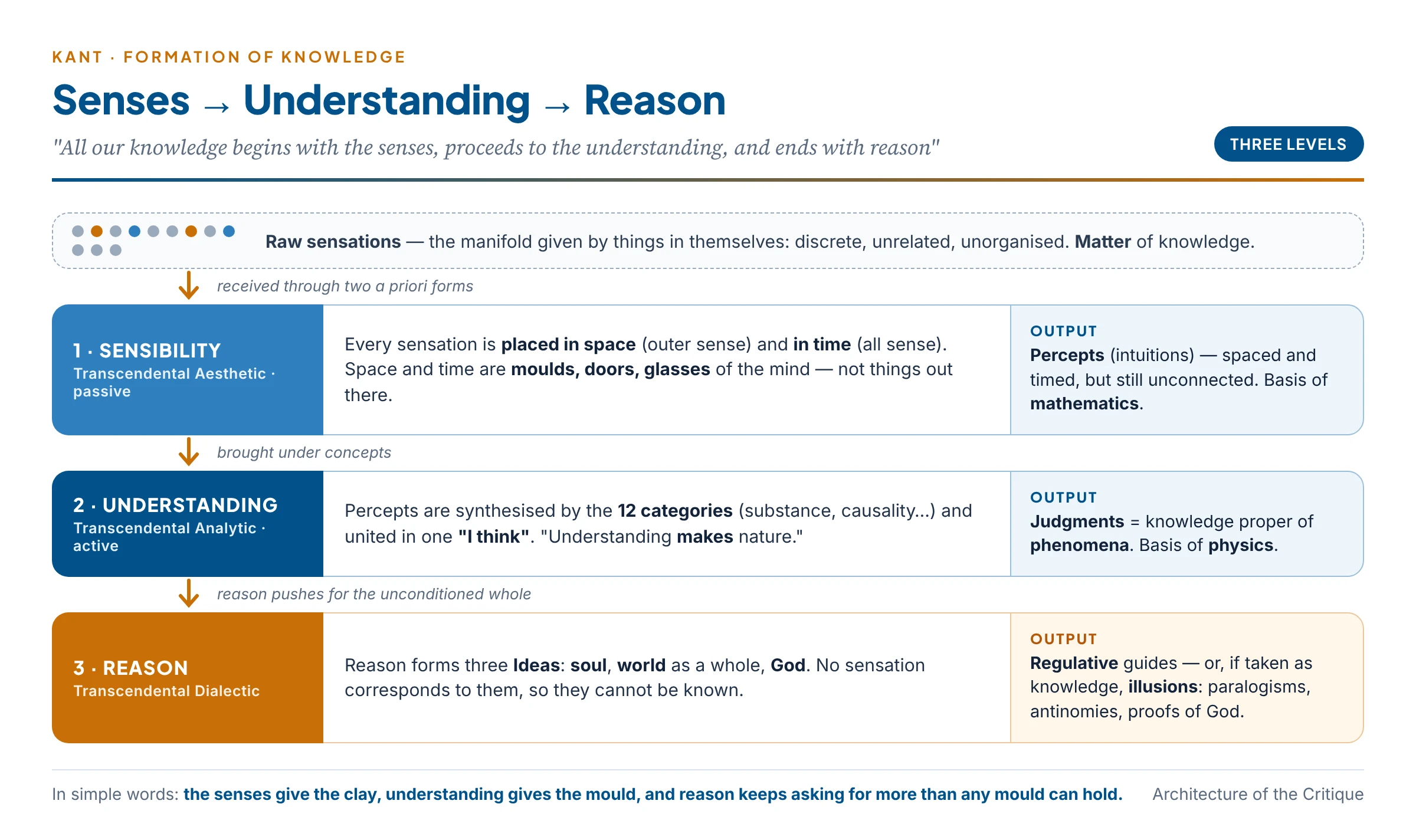
“All our knowledge begins with the senses, proceeds thence to the understanding, and ends with reason.” — Kant
- Knowledge begins with experience but does not all arise from it. As soon as the senses register impressions, the mind is stirred into its own activity and contributes its ordering forms. Matter comes from experience; form comes from the mind. Knowledge proper is a joint venture of sense and understanding.
- Level 1 — Sensibility (Transcendental Aesthetic).
- Sensibility is the mind’s receptive capacity. It receives sensations that are by themselves discrete, unrelated and unorganised — the raw material of knowledge.
- These sensations are received through two a priori forms, space and time, which act like moulds, doors or glasses.
- Sensations that have been “spaced and timed” are called percepts (intuitions). They are still unconnected, so they are not yet knowledge. Even here, both experience (the data) and reason (the forms) play a part.
- Level 2 — Understanding (Transcendental Analytic).
- Understanding is the mind’s active power. It forms judgments by bringing percepts under twelve a priori categories (pure concepts), such as substance and causality.
- The categories cannot come from experience, because they carry universality and necessity.
- Through them, scattered percepts become organised objects — knowledge proper. In this sense “understanding makes nature“: the lawful order of nature is the order that understanding gives to appearances.
- Every judgment so formed has two elements — percepts (from experience) and categories (a priori) — the living proof of the reconciliation.
- Level 3 — Reason (Transcendental Dialectic).
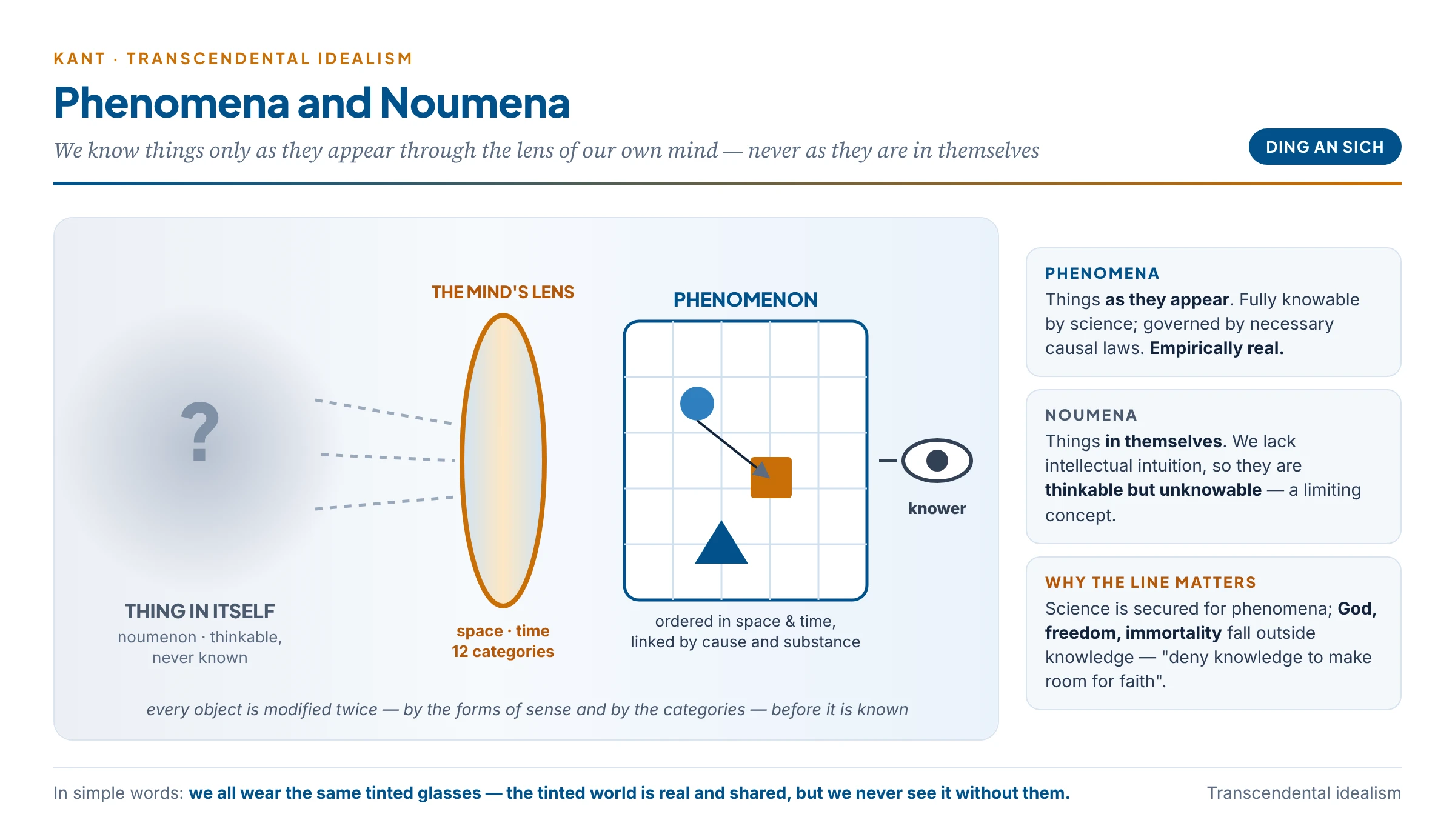
- Knowledge from the understanding is confined to phenomena. Every object is modified twice — once by space and time, once by the categories — so the thing in itself is never known as it is.
- But the mind does not rest at phenomena. Reason strives for the unconditioned — the complete whole — and forms the three Ideas of reason: soul, world and God.
- When reason treats these Ideas as objects of knowledge, it produces pseudo-knowledge — transcendental illusions (paralogisms, antinomies, the false proofs of God). The Ideas are regulative only.
- Kant’s resulting position on the supersensible is a form of agnosticism — but agnosticism only about noumena, not about phenomena, where synthetic a priori knowledge is secure.
6. Phenomena and Noumena
- Phenomena (Erscheinungen, appearances) are objects as they appear to us — given through space and time and thought through the categories.
- Everything that can be known is given in these forms, so all objects of science are phenomenal.
- The laws of nature — causality, substance, mathematical relations — apply validly and necessarily, but only within phenomena. This secures the objectivity of science while rejecting metaphysical dogmatism.
- Phenomena are governed by strict causal laws — the world of science is a world of determinism.
- Noumena (things in themselves, Dinge an sich) are things as they are independently of our sensibility and concepts.
- Since we have no intellectual intuition, noumena can never be given to us; they are unknowable.
- But they are thinkable: we must think of appearances as appearances of something.
- The concept of a noumenon is a limiting concept (Grenzbegriff): it marks the boundary of sensible knowledge and warns that the categories may not be applied beyond experience.
- Negative vs positive noumenon.
- Negative sense — a thing so far as it is not an object of our sensible intuition. This is the only sense Kant allows: it just marks the limit.
- Positive sense — an object of a non-sensible (intellectual) intuition. Humans lack such intuition, so we cannot even know whether such objects are possible.
- The domain of the noumenal. The Ideas of God, freedom and the immortal soul belong here. They cannot be known, but they can be thought — and, Kant later argues, must be postulated by moral reason.
- The purpose of the distinction. To limit knowledge in order to make room for freedom, morality and faith: “I had to deny knowledge in order to make room for faith.” Science keeps its certainty; practical reason keeps its autonomy.
In simple words
Imagine you were born wearing blue-tinted glasses that can never be removed. Everything you see is blue-tinted — trees, faces, the sky. You can study the tinted world very precisely: measure it, predict it, build bridges in it. That tinted world is Kant’s phenomenal world. But you can never see what things look like without the glasses. You know there must be something out there sending the light, yet you cannot say what it is like in itself. That “something” is the noumenon. And because everyone wears the same glasses, the tint is not private error — it is the shared, objective form of human experience.
7. Transcendental Idealism and Empirical Realism
- Transcendental idealism is Kant’s name for his position: human knowledge is limited to phenomena, not noumena.
- It is idealism because space, time and the formal structure of objects depend on the subject’s way of knowing.
- It is transcendental because it concerns not particular experiences but the a priori conditions of the possibility of experience in general.
- Empirical realism. Within experience, objects are real and objective, independent of my private will and governed by necessary laws. The table I see is not “only my idea” in Berkeley’s sense.
- Not Berkeley. Kant rejected Berkeley’s immaterialism. For Berkeley, things are only ideas in minds; for Kant, the mind-independent world exists but is unknowable in itself. In the “Refutation of Idealism” Kant argues that my consciousness of my own existence in time already requires something permanent outside me in space — against both Descartes’ doubt about the external world and Berkeley’s denial of matter.
Common confusion
“Transcendental” and “transcendent” — are they the same? No.
- Transcendent means beyond all possible experience — God, the soul as a substance, the world as a completed whole. Kant says we can have no knowledge of the transcendent.
- Transcendental means concerned with the a priori conditions that make experience possible — space, time, categories, the “I think.” Transcendental knowledge is knowledge about how experience is possible, and it stays within experience.
Kant’s philosophy is transcendental precisely in order to show that metaphysics of the transcendent is impossible.
8. Kant’s Response to Hume’s Scepticism
“It was Hume who first interrupted my dogmatic slumber and gave my investigations in the field of speculative philosophy a quite new direction.” — Kant
- The context of the “dogmatic slumber.” Kant had accepted rationalist metaphysics uncritically. Hume’s analysis of causation — that reason cannot show why, because one thing exists, another must also exist — woke him. Kant first checked whether Hume’s objection could be generalised and found that it covered all a priori concepts connecting things, not just causality.
- What Kant grants Hume.
- Causal necessity is not a logical necessity — the effect cannot be found by analysing the concept of the cause.
- Causal necessity is not observed in experience — we perceive only succession.
- What Kant denies. That the necessity is therefore a subjective habit. Causality is an a priori category of the understanding — a condition of the possibility of experience. Without it we could not even tell an objective event (a ship moving downstream) from a mere change in our perceptions.
- Hume’s fork completed. Hume allowed only two kinds of knowledge — relations of ideas (certain but empty) and matters of fact (informative but uncertain). Kant adds a third: synthetic a priori judgments, informative and necessary, as in mathematics and the principles of physics.
- The price. Kant’s answer holds only for phenomena. On metaphysics of the transcendent (God, soul, world-whole), Kant agrees with Hume: no theoretical knowledge is possible — though for different reasons and with a different outcome (practical faith instead of mere custom).
Hume and Kant on metaphysics:
| Point | Hume | Kant |
|---|---|---|
| Source of the limit | All ideas must be copied from impressions | Concepts give knowledge only when applied to intuitions |
| Causality | Habit of expectation; necessity is “in the mind” as a feeling | A priori category; necessity is a condition of experience |
| Substance, self | Fictions of imagination; self a bundle of perceptions | Substance a category for phenomena; the “I think” a formal unity, not a known soul |
| Metaphysics of God, soul, world | “Commit it to the flames” — neither relation of ideas nor matter of fact | Impossible as a science, but a natural disposition of reason; Ideas are regulative |
| Science | Probable; rests on custom | Necessary and universal — for phenomena |
| God and morality | Natural belief at most; design argument weak | God, freedom, immortality as postulates of practical reason |
9. Consequences for Traditional Metaphysics
- Metaphysics as a science is impossible. Traditional metaphysics claimed synthetic a priori knowledge of God, the soul and the world as a whole by pure reason. Without sensory intuition, its concepts are empty; its arguments produce paralogisms (false reasoning about the soul), antinomies (contradictions about the world) and invalid proofs of God.
- Metaphysics as a natural disposition remains. Reason cannot stop asking these questions; the illusions are natural and unavoidable.
- A critical metaphysics replaces dogmatic metaphysics. It sets out the a priori structure of experience (a “metaphysics of experience”) and gives the Ideas of reason a regulative role in science and a practical role in morality.
- Reconciliation of science, philosophy and religion. Science rules the phenomenal world with full necessity; philosophy as critique fixes the boundary; religion and morality are given their own ground in practical reason — freedom, immortality and God as postulates, not as objects of knowledge.
Critical Evaluation
Objections to the Critical Philosophy
- The unknowable is made known. To say that noumena exist and are unknowable is already to know something about them. Kant’s “unknown” becomes known.
- The thing in itself as cause. Kant speaks of things in themselves as the source of sensations — i.e. as causes that “affect” us. But causality is a category valid only for phenomena. So Kant uses a category beyond experience in the very act of forbidding it. (This was pressed by early critics such as Jacobi: without the thing in itself one cannot enter Kant’s system, and with it one cannot remain inside it.)
- A divided world. Kant reconciles rationalism and empiricism, but at the cost of splitting reality into phenomenal and noumenal. He cannot be called a complete reconciler.
- Psychology. Modern psychology does not find a stage of unorganised sensations later organised by concepts; perception is organised from the start.
- Physics changes. Kant took the principles of Newtonian science as fixed, but physics is dynamic and progressive; its conclusions change (relativity, quantum theory).
- How do we know the a priori forms? Kant claims to know the structure of all minds — space, time, exactly twelve categories — yet does not explain how this knowledge itself is obtained, or why it is not one more dogmatic assumption.
- Subjectivism. Critics such as Schopenhauer and Hegel read Kant’s idealism as making the world a product of the human mind — a subtler version of Berkeley.
In simple words
Objection 2 is easiest to grasp with an example. Kant says, “The thing in itself causes my sensations, but causality works only inside experience.” That is like a referee who announces, “Offside rules apply only inside the stadium,” and then gives a penalty to a player standing outside it. To explain where sensations come from, Kant seems to break his own rule.
Hegel’s Challenge to the Phenomena–Noumena Distinction
- Self-contradiction. To draw a boundary is already to be beyond it. If Kant can say that there is a noumenal world and that it is unknowable, he already claims knowledge of it. Hegel distinguishes the unknown (not yet known — like water on Mars before it was found) from the unknowable (in principle never known). Something unknown can be known later; an absolutely unknowable is a meaningless notion.
- An empty abstraction. The thing in itself, stripped of every determination we could know, is nothing but an empty abstraction — “a mere caput mortuum” (dead remainder) of thought.
- Learning to swim before entering the water. Kant wants to examine the instrument of knowledge before knowing. But examining knowledge is already knowing; one cannot learn to swim without going into the water.
- From logical to metaphysical. Kant’s transcendental unity of apperception (the “I think”) is a logical condition of knowledge. Hegel transforms it into the Absolute Mind (Spirit) — a metaphysical reality. Kant’s dualism of phenomena and noumena is overcome in Absolute Idealism, where thought and being are identical.
- Contradiction as the life of reason. Kant’s antinomies show reason falling into contradiction and stopping there. Hegel says contradiction is not a sign of error but the motor of thought and reality — the dialectic.
Kant and Hegel on reality and our thinking about reality:
| Point | Kant | Hegel |
|---|---|---|
| Relation of thought and reality | Thought conditions appearances; reality in itself lies beyond thought | Thought and reality are identical in the Absolute: “The rational is actual and the actual is rational” |
| Knowability | Only phenomena knowable; noumena unknowable | Reality is in principle wholly knowable; “the true is the whole” |
| Categories | Fixed forms of human understanding, valid only for experience | Moments of the self-development of Spirit — forms of being as well as of thought |
| Limits of reason | Reason must be disciplined; overstepping produces illusion | The limit is posited and surpassed by reason itself; finitude is overcome |
| Contradiction | Sign of reason’s illusion (antinomies) | Driving force of dialectical development |
| The self | Formal “I think” — a logical unity | Absolute Spirit — a metaphysical reality |
| Method | Critique of faculties: Aesthetic → Analytic → Dialectic | Dialectic: thesis → antithesis → synthesis |
- Is Hegel’s Absolutism the culmination of Kant’s dualism? In one sense, yes: Hegel started from Kant’s problems — the gap between phenomena and noumena, the antinomies, the active role of mind — and tried to close the gap by making mind itself absolute. In another sense, no: Kant would see Hegel’s system as exactly the dogmatic metaphysics his critique forbade.
Other Later Responses
- Logical positivists traced their elimination of metaphysics back to Hume and Kant, but rejected the synthetic a priori.
- Husserl rejected the gap between phenomena and noumena: phenomenology describes what appears, in its purest form, and there is no hidden thing behind it.
- Sartre rejected Kant’s noumenon outright: the appearance is not a mask over a hidden reality; it is absolute in its own right.
- Strawson saw in Kant a model of descriptive metaphysics — the description of the actual structure of our thought about the world — while rejecting transcendental idealism.
Critics and Defenders
Criticism — Critics
- Hegel: the unknowable thing in itself is self-contradictory; criticism of knowledge before knowing is impossible.
- Jacobi: the thing in itself “affects” us causally, against Kant’s own rule.
- Schopenhauer and others: transcendental idealism is subjectivism in disguise.
- Logical positivists: there is no synthetic a priori; metaphysics is meaningless, not merely unknowable.
- Husserl, Sartre: the phenomenon hides nothing behind it.
- Modern science: Euclidean geometry and Newtonian mechanics are not fixed a priori truths.
Defence — Defenders and lasting value
- The negative noumenon is only a limit, not a claim to knowledge — saying “here my knowledge stops” is not knowing what lies beyond.
- Kant secured both science (necessity for phenomena) and freedom (room beyond phenomena) — no earlier system did both.
- Strawson and others kept Kant’s transcendental arguments: experience of an objective world requires concepts like substance and cause.
- Cognitive science confirms the core insight: perception is shaped by the structure of the perceiver, not passively copied.
- Kant’s question — what are the limits of reason? — remains central to epistemology, philosophy of science and ethics.
Cross-Tradition Comparison
Kant, Śaṅkara and the Mādhyamika: Two Levels of Reality
| Point | Kant | Śaṅkara (Advaita Vedānta) | Mādhyamika Buddhism (Nāgārjuna) |
|---|---|---|---|
| Two levels | Phenomena / noumena | Vyāvahārika (empirical) / pāramārthika (ultimate) reality | Saṃvṛti-satya (conventional truth) / paramārtha-satya (ultimate truth) |
| What shapes the lower level | Space, time, categories of the human mind | Māyā and adhyāsa (superimposition) — name and form imposed on Brahman | Conceptual construction (prapañca), dependent origination |
| Status of empirical world | Empirically real, transcendentally ideal | Real for practical purposes, sublated by knowledge of Brahman | Valid conventionally, empty (śūnya) of own-being |
| Can the ultimate be known? | No theoretical knowledge; only thinkable; practical faith | Yes — by direct realisation (anubhava, aparokṣa-jñāna) through śruti | Not by concepts; realised in prajñā (insight) when conceptual activity ceases |
| Role of reason | Critique sets reason’s limits | Reason (tarka) is subordinate to scripture | Dialectic (prasaṅga) dissolves all views |
Indian Connect — Key takeaways
- Kant’s noumenon and Śaṅkara’s Brahman both lie beyond the categories of ordinary thought. But for Śaṅkara the ultimate is the very Self (Ātman = Brahman) and can be realised; for Kant it is never known by theoretical reason.
- Empirical reality in Kant matches vyāvahārika sattā: real for all practical concerns of life, but not absolutely real.
- Mādhyamika’s two truths resemble Kant’s two standpoints; Nāgārjuna’s dialectic, like Kant’s Dialectic, shows that reason’s views about the ultimate end in contradiction.
- Nyāya’s two stages of perception — nirvikalpaka (indeterminate, pre-conceptual) and savikalpaka (determinate, conceptual) — echo “intuitions without concepts are blind”: only conceptualised perception yields a judgment. Dignāga and Dharmakīrti similarly separate the bare particular (svalakṣaṇa), grasped by perception, from the universal (sāmānya-lakṣaṇa) constructed by thought.
Synthesis (Siddhānta)
Kant’s critical philosophy settles the old quarrel by changing the question. Rationalism and empiricism had both assumed that the mind must conform to objects; Kant’s Copernican Revolution reverses this: objects, to be known at all, must conform to the a priori forms of sensibility (space and time) and the categories of understanding. Because these forms are the same in every human mind, knowledge can be universal and necessary; because they must be filled with sensation, it is also informative. Both schools were right in what they affirmed and wrong in what they denied: “percepts without concepts are blind, concepts without percepts are empty.”
The price of this success is a boundary. We know phenomena, not noumena. Science is secure, but the old metaphysics of God, soul and world-as-a-whole collapses into transcendental illusion, and those Ideas move from the realm of knowledge to the realm of practical faith. Critics from Hegel to the phenomenologists attacked the unknowable thing in itself, and modern physics overturned Kant’s fixed geometry. Yet his central insight survives: what we experience is shaped by the structure of the experiencer, and every claim to knowledge must first ask about its own conditions and limits.
- Science and its limits: the distinction between what science can explain and what lies beyond it (values, meaning, freedom) still follows Kant’s map.
- Cognitive science: perception as active construction — the brain’s “predictive models” — is a modern echo of the Copernican Revolution.
- Human dignity: by placing freedom outside the causal order of phenomena, Kant grounded the idea that persons are ends in themselves — the root of modern human-rights thinking.
- Intellectual humility: Kant’s lesson that reason must criticise itself before it claims to know is a lasting safeguard against dogmatism of every kind.
We do not find order in nature and copy it into the mind; the mind finds in nature the order that it has itself brought to experience.
Previous Year Questions
- 2026Analyze and discuss the different ways in which Kant and Hegel conceived the relationship between reality and our thinking about reality.
- 2025How does Hegel challenge Kant’s distinction between Phenomena and Noumena? Discuss.
- 2023“Percepts without concepts are blind and concepts without percepts are empty.” In the light of this statement discuss how Kant reconciles rationalism with empiricism.
- 2018Explain the significance of the Kantian dictum, ‘Understanding makes Nature’. How far do you agree that Hegel’s Absolutism is the culmination of the Kantian Dualism? Discuss. Give reasons in favour of your answer.
- 2012Why is Kant’s philosophy known as a Copernican revolution in metaphysics? What was revolutionary about Kantian philosophy? Give reasons for your answer.
- 2011“Hume aroused me from my dogmatic slumber.” In what context has Kant made this statement? Explain.
- 2008Hume and Kant on Metaphysics. Short Notes.
- 2005How does Kant respond to Hume’s scepticism?
- 2004The significance of Kant’s distinction between phenomena and noumena. Notes.
- 2002Kant’s “Critical Philosophy” is a reconciliation between Rationalism and Empiricism. Elucidate the remark fully and bring out the consequence of such a reconciliation for the possibility of traditional metaphysics.
- 1997How does Kant reconcile rationalism with empiricism by superseding them?
- 1993“Knowledge begins with, but does not originate from experience.” Discuss this statement of Kant with special reference to his theory of knowledge.
- 1992Discuss Kant’s theory of reality. How does he attempt to reconcile the claims of science, philosophy and religion? Ascertain if he succeeds in his task.