

Empiricism (Locke, Berkeley, Hume): Theory of Knowledge; Substance and Qualities; Self and God; Scepticism.
Official Syllabus: Paper I, Section A, Unit 3
Locke kept three substances — matter, soul and God. Berkeley dropped matter but kept spirits and God. Hume turned the empiricist test on what was left and kept nothing. Substance, material or spiritual, has no impression behind it: it is a “fiction” of the imagination, a name for a collection of qualities. The external world is not proved by reason or the senses; we believe in it because the constancy and coherence of our perceptions lead the imagination to fill in the gaps. The self is not a simple, enduring soul but “a bundle or collection of different perceptions” in perpetual flux. And God cannot be proved by any argument — ontological, cosmological or from design — since all of them claim to reach beyond experience. Hume does not ask us to stop believing in bodies or in ourselves; nature will not allow it. He asks us to see that these beliefs rest on imagination and custom, not on reason.
In simple words
Think of a football team that has played for a hundred years. Every player, coach and even the stadium has changed many times — yet we say “the same team” won in 1925 and in 2025. There is no extra, unchanging “team-soul” hidden behind the players; there is only a chain of members, each linked to the next, and a name that holds the chain together in our minds. Hume says your self is like that team, and a table or a tree is like that too: a collection held together by our way of thinking, not by an invisible substance underneath.
Context & Problem
The Empiricist Test Applied to Substance
- Hume’s touchstone: an idea is genuine only if it can be traced to an impression. “From what impression is that supposed idea derived?”
- Substance in the tradition. Aristotelian and Cartesian philosophy conceived substance as an underlying subject that supports qualities and remains the same while qualities change. Descartes recognised thinking substance (res cogitans) and extended substance (res extensa), and God as infinite substance.
- Locke’s half-way position. Locke admitted we have no experience of substance — only of qualities — yet kept it as the “supposed support” of qualities, “something, I know not what.”
- Berkeley’s half-way position. Berkeley used Locke’s own empiricism to dismiss material substance: a true empiricist accepts a substance only if it can be perceived. But he kept spiritual substances, known by “notions,” and God.
- Hume completes the argument. The reasons Berkeley gave against matter apply equally to spirit. Hume asked about the self the very question Berkeley had asked about matter: “Please show me any impression from which the idea of a permanent self is derived.” In Hume, empiricism reaches its “highest reach” and its logical conclusion.
The Questions of This Article
- Do we have an idea of substance at all?
- Why do we believe in a continued and independent external world?
- What is the self, and why do we think it is one and the same through time?
- What are the passions and will, and are we free?
- Can reason prove the existence and attributes of God?
Core Doctrine
1. Substance: An “Unintelligible Chimera”
- The argument from impressions:
- If the idea of substance is real, it must come from an impression of sensation or of reflection.
- If from sensation, it must be a colour, a sound, a taste, heat or cold. But no one says substance is a colour or a taste.
- If from reflection, it must be a passion or emotion. But no one says substance is a passion.
- So the idea of a substance, as a substratum distinct from all qualities, comes from no impression at all.
- What the idea really is. “The idea of a substance … is nothing but a collection of simple ideas, that are united by the imagination, and have a particular name assigned them, by which we are able to recall, either to ourselves or others, that collection.”
- The name “gold” stands for yellowness, weight, malleability, fusibility; when we discover a new quality (solubility in aqua regia), we simply add it to the collection.
- Why we invent substance. Certain qualities are constantly conjoined and change gradually. The imagination passes smoothly along them and feigns a single, unchanging something that “has” them. Unity is not found in experience but supplied by the mind’s tendency to fake unity where there is only a collection.
- Bundle theory of objects. An object consists of its properties and nothing more. Think of an apple: redness, roundness, sweetness, crispness — remove them all and nothing remains. There is no object without properties, and none can be conceived.
- Scope. The critique applies equally to material substance (Berkeley’s conclusion, accepted by Hume) and to spiritual substance (Hume’s extension of it). Substance in the philosophers’ sense is “an unintelligible chimera,” an “idle fiction” of the imagination.
In simple words
Peel an onion looking for the “real onion” underneath the layers. Layer after layer comes off, and at the end there is nothing left — the onion was the layers all along. Hume says the same of every object: take away the colour, shape, taste and hardness of an apple, and no “apple-substance” remains to hold them. The word “apple” is a label on the bundle, not the name of a hidden core.
2. Belief in the External World
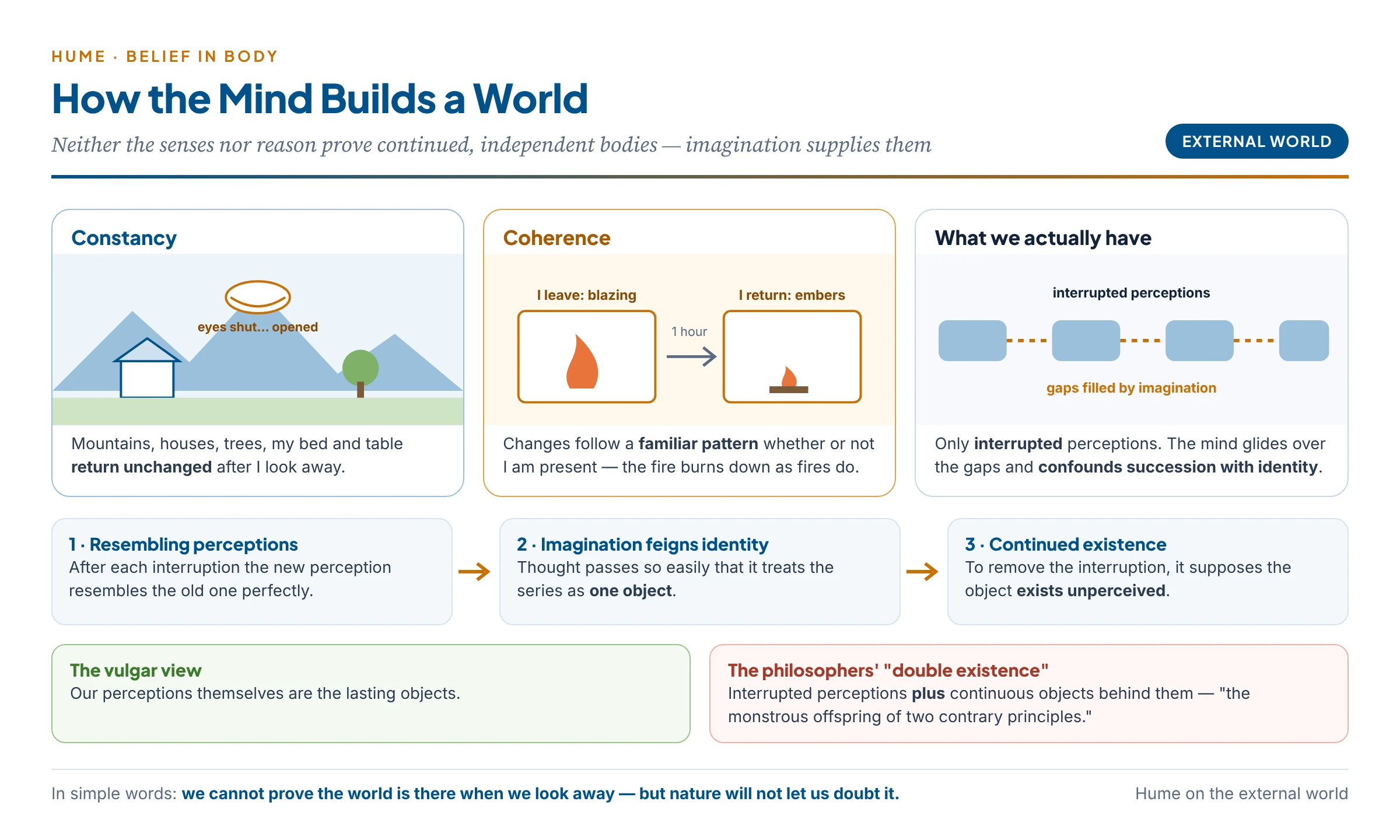
- The problem. We are confined to perceptions, which are fleeting, interrupted and dependent on us. Yet we all believe in bodies that exist continuously (even when unperceived) and independently (distinct from our perceptions). Where does this belief come from?
- Not from the senses. The senses give only present, interrupted perceptions; they cannot show existence when we do not perceive, nor something distinct from perception.
- Not from reason. No argument leads from perceptions to objects distinct from them; and ordinary people, children and peasants hold the belief without any argument. “We may well ask, What causes induce us to believe in the existence of body? but it is in vain to ask, Whether there be body or not? That is a point which we must take for granted in all our reasonings.”
- Not from involuntariness or force. Some say we attribute independent reality to impressions that are involuntary and forceful. But our pains and pleasures, passions and affections are just as involuntary and even more violent, yet no one supposes they exist outside perception.
- From the imagination, working on two features of certain impressions:
- Constancy — some perceptions return unchanged after interruption. “These mountains, and houses, and trees, which lie at present under my eye, have always appeared to me in the same order; and when I lose sight of them by shutting my eyes or turning my head, I soon after find them return upon me without the least alteration.” My bed and table, books and papers present themselves in the same uniform manner.
- Coherence — even when perceptions change, they change in a regular, predictable way. “When I return to my chamber after an hour’s absence, I find not my fire in the same situation in which I left it: but then I am accustomed in other instances to see a like alteration produced in a like time, whether I am present or absent.” A porter brings me a letter from a distant friend: I hear the door creak though I do not see it turn; I infer the stairs, the post, the journey — a coherent world beyond my present perceptions.
- How imagination completes the work.
- Once set in a train of thought, the imagination tends to continue it. Resembling perceptions after an interruption make the mind glide easily from one to the other “as if it considered only one object,” and it confounds succession with identity.
- To remove the conflict between this felt identity and the obvious interruption, the imagination feigns a continued existence that fills the gaps. “I shut my eyes, and afterwards open them; and find the new perceptions to resemble perfectly those which formerly struck my senses.”
- The supposition starts as a kind of hypothesis but grows in strength because it harmonises so many otherwise disconnected impressions.
- The vulgar view and the philosophical view.
- The vulgar (ordinary people) take their perceptions themselves to be the continuing objects.
- Philosophers see that perceptions are interrupted and dependent on us (press one eye and you see double) and so invent a double existence: interrupted perceptions in the mind, and continuous objects outside that cause them — Locke’s representative realism.
- Hume calls this philosophical system “the monstrous offspring of two principles which are contrary to each other”: it tries to satisfy reason (which says perceptions are interrupted) and imagination (which demands continuity) at once. It has no independent support in either reason or imagination.
- Hume’s verdict. Reason cannot prove the existence of an external world, and equally cannot disprove it. The belief is a natural belief: “Nature has not left this to his choice.” “Carelessness and inattention alone can afford us any remedy” for the doubts philosophy raises. Constancy and coherence generate belief, not knowledge.
3. The Self: No Impression of a Permanent Self
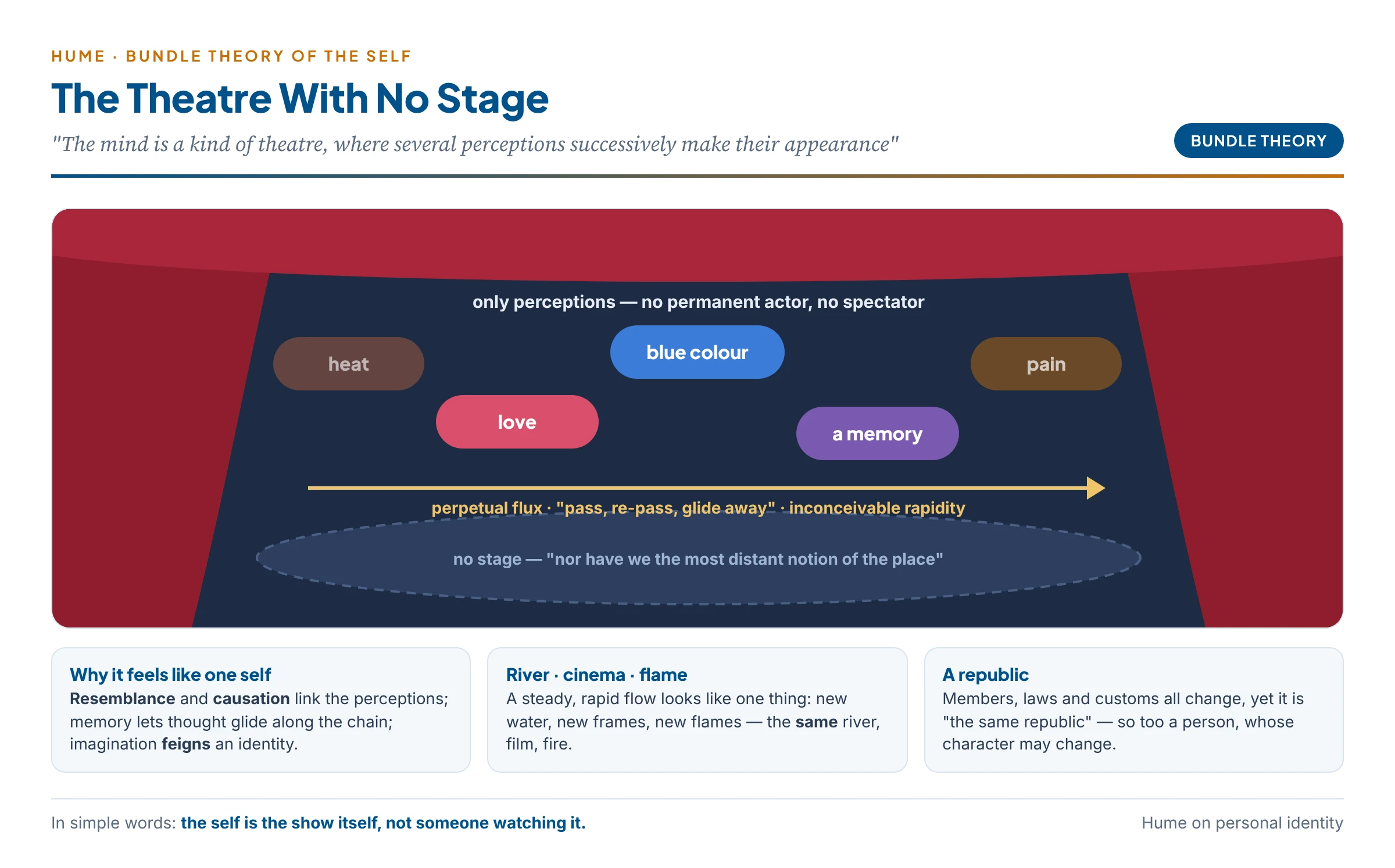
“For my part, when I enter most intimately into what I call myself, I always stumble on some particular perception or other, of heat or cold, light or shade, love or hatred, pain or pleasure. I never can catch myself at any time without a perception, and never can observe anything but the perception.” — David Hume
- The target. Some philosophers “imagine we are every moment intimately conscious of what we call our self; that we feel its existence and its continuance in existence; and are certain, beyond the evidence of a demonstration, both of its perfect identity and simplicity.” This is the Cartesian thinking substance and the immortal soul of theology.
- The argument:
- Every real idea is derived from one impression.
- If the idea of self comes from an impression, that impression must continue invariably the same through our whole life, since the self is supposed to exist that way.
- But there is no constant and invariable impression. Pain and pleasure, grief and joy, passions and sensations succeed each other and never all exist at the same time.
- So the idea of a permanent self cannot come from any impression, and “there is no such idea.”
- Sleep and death. “When my perceptions are removed for any time, as by sound sleep, so long am I insensible of myself, and may truly be said not to exist. And were all my perceptions removed by death … I should be entirely annihilated.”
- A challenge to others. “If any one, upon serious and unprejudiced reflection, thinks he has a different notion of himself, I must confess I can reason no longer with him.” Perhaps he perceives something simple and continued which he calls himself; “though I am certain there is no such principle in me.” Philosophers who claim to experience the self owe an account: is it found by perception or by meditation? Is it a feeling of pleasure or something objective? Is it absolute or subject to continuous change?
- No impression of an “I”. No matter how closely I attend to my own experience, I am never directly aware of “I“; what I experience is a succession of separate perceptions, linked by resemblance and causation. Memory may extend these relations through time, but there is no evidence of a substantial ground for their coherence. The persistent self and the immortal soul are philosophical fictions.
4. The Bundle Theory of the Self
“[The mind is] nothing but a bundle or collection of different perceptions, which succeed each other with an inconceivable rapidity, and are in a perpetual flux and movement.” — David Hume
- The self is a collection of impressions, ideas, passions and desires — a perpetual flux. As mental functions change, the “self” changes with them. Separate perceptions have no real tie; only a delusion makes us treat them as one and call them “self.”
- The theatre. “The mind is a kind of theatre, where several perceptions successively make their appearance; pass, re-pass, glide away, and mingle in an infinite variety of postures and situations.”
- Hume adds a warning: “The comparison of the theatre must not mislead us.” There is no stage and no audience: “They are the successive perceptions only, that constitute the mind; nor have we the most distant notion of the place where these scenes are represented.”
- Why the illusion of unity? It is natural to sense continuity in any rapid and uninterrupted flow. A steady flow creates the illusion of a single thing:
- A river stays “the same river” though its water is always new.
- In the cinema, still frames shown rapidly look like continuous motion.
- A rapid succession of flames gives the appearance of one steady flame.
- Three arguments against a substantial self:
- The self is not an object of perception. The elements of the mind are distinct and independent. We experience them, but we never sense an element that unites them.
- The self is not absolute. Our mind is like a stage on which thoughts and ideas pass in procession; all are transitory and momentary; only their rapidity causes the illusion of a lasting self.
- Thought experiences itself. No soul is required as an owner: “the passing thought itself is the thinker.” There is no owner of thoughts apart from the thoughts.
- Russell’s verdict on the bundle theory: it “takes away the last vestige of substance“; it is important in theology because it “abolishes all supposed knowledge of the soul” and its immortality; and in theory of knowledge it shows that the category of subject and object is not fundamental.
5. Personal Identity: Memory and Imagination
- The problem. If there is no permanent self, how do we recognise ourselves as the same person from childhood to old age? How do we recognise others after many years? Every stage of my existence differs from the earlier and later stages.
- Hume’s answer. He does not deny that we believe we are the same person; he explains how the belief arises.
- The perceptions that make up a mind are linked by resemblance and causation (contiguity plays little role).
- The imagination passes so smoothly along this chain of related perceptions that it mistakes the easy passage for the view of one unchanging object. “Our notion of personal identity proceeds entirely from the smooth and uninterrupted progress of the thought along a train of connected ideas.”
- Identity is thus a fiction: we “feign” the continued existence of a soul or self “to remove the interruption.”
- The role of memory.
- Resemblance: memory raises up images of past perceptions that resemble them; the mind passes easily between resembling perceptions and so feels them to be one.
- Causation: memory acquaints us with the causal chain of our perceptions. “The true idea of the human mind is to consider it as a system of different perceptions or different existences, which are linked together by the relation of cause and effect, and mutually produce, destroy, influence and modify each other.”
- Memory therefore discovers personal identity rather than producing it (against Locke, for whom memory makes identity). And since causation can carry us beyond memory, we extend our identity to times we have forgotten — no one thinks he did not exist on a day he cannot remember.
- The republic analogy. The soul is best compared to a republic or commonwealth, “in which the several members are united by the reciprocal ties of government and subordination, and give rise to other persons, who propagate the same republic in the incessant changes of its parts.” The members change, the laws change, yet we call it the same republic; so with a person, whose impressions and ideas, and even character and dispositions, may change.
- Identity is “verbal” in the end. All the nice and subtle questions about personal identity “can never possibly be decided, and are to be regarded rather as grammatical than as philosophical difficulties.”
- Thomas Reid objected that personal identity is so simple and immediate that it cannot be analysed like other things; we know it by memory and consciousness, and it is the foundation of all rights, obligations and responsibility.
In simple words
Look at your school photograph from Class 1. Almost every cell in that body has been replaced; your thoughts, tastes and fears are different. What makes that child “you”? Hume says: an unbroken chain — each day resembled the day before and was caused by it, and memory lets your mind slide along the chain so smoothly that it feels like one thing. There is no tiny, unchanging “you” hidden inside, watching the whole time.
6. Hume’s Own Second Thoughts
- In the Appendix to the Treatise, Hume confessed that his account of personal identity left him in a “labyrinth.” He could not explain what binds perceptions into one mind.
- His two principles could not be reconciled: “that all our distinct perceptions are distinct existences, and that the mind never perceives any real connexion among distinct existences.” If perceptions were held in something simple, or if the mind perceived real connections among them, there would be no difficulty — but Hume’s philosophy allows neither.
- Significance. The greatest critic of the substantial self admitted that the bundle theory cannot explain the unity of the bundle — the very point that Kant and later critics pressed.
7. Passions and Will
- Reason is the slave of the passions. “Reason is, and ought only to be, the slave of the passions, and can never pretend to any other office than to serve and obey them.”
- Reason informs us about facts and relations — what will cause what — but it cannot by itself move us to act. The springs of action are passions: desires, aversions, emotions.
- “‘Tis not contrary to reason to prefer the destruction of the whole world to the scratching of my finger” — reason alone cannot condemn a preference; only feeling can.
- What we call “reason” in conduct is often a calm passion — a settled, quiet desire mistaken for reason because it causes little disturbance.
- The will is “nothing but the internal impression we feel and are conscious of, when we knowingly give rise to any new motion of our body, or new perception of our mind.” It is determined by the strongest motive present, and motives arise from passions shaped by temperament, education and circumstance.
- Morality from sentiment. Moral distinctions are not derived from reason; we call actions virtuous or vicious from sentiments of approval and disapproval, rooted in sympathy and utility. Hume also noted that writers on morality pass, without justification, from “is” to “ought” — reasoning about facts cannot by itself yield a moral obligation.
- Consequence for the soul. The soul is not a rational substance governing the passions, but a dynamic centre of feelings and motives, part of the causal order of nature.
8. The Problem of Freedom: Liberty and Necessity
- Hume’s “reconciling project.” The dispute between liberty and necessity is, Hume says, largely verbal; once the terms are clarified, they are compatible. This view is called compatibilism or soft determinism.
- Necessity in human action. Necessity, as the article on causation showed, means only constant conjunction plus the inference of the mind. Human actions show exactly this: the same motives produce the same actions in similar circumstances. A prisoner reasons about his jailer’s stubbornness and the walls in the same way; we predict a friend’s honesty as we predict the weather. All human life depends on this regularity.
- Two kinds of liberty:
- Liberty of indifference — acting without any cause. Hume rejects it: an uncaused act would be chance, random and unintelligible, and no one could be held responsible for it.
- Liberty of spontaneity — “a power of acting or not acting, according to the determinations of the will“; that is, freedom from external constraint. Everyone who is not a prisoner in chains has this liberty.
- Necessity supports morality. Praise and blame make sense only if actions flow from character. If actions were not caused by a durable character, a person would be no more answerable for a crime committed yesterday than for one committed by a stranger. So necessity is essential to moral responsibility, and liberty (as spontaneity) is compatible with it.
Common confusion
Did Hume say that, since causation is only habit, our actions are undetermined and we have “true free will”? Some popular notes draw this conclusion. It is the opposite of Hume’s view. Hume applied his analysis of causation equally to physical events and human actions: both show regular conjunction and both are “necessary” in the only sense the word has. He rejected uncaused “liberty of indifference” as mere chance, and defended freedom only as acting according to one’s own will without external constraint. He was a compatibilist (soft determinist), not a libertarian.
9. God: Can Reason Prove His Existence?
- The consistent empiricist on God. Of the three empiricists, Hume alone fully accepted the premise that knowledge cannot go beyond experience. He showed that the existence of God cannot be proved on the basis of experience, and refuted every argument offered for it.
- Reason’s limits. “When the reason cannot indicate whence the smallest things in the universe have come, can it possibly make any acceptable guesses concerning the origin and purposes of the world?” Our mind fails even to explain the nature and composition of stones. The origin of the world is lost in the infinite past and its future is beyond our reach; we know only the present and the immediate past.
- Three rational sciences impossible. Just as we cannot prove the continued existence of the external world (rational cosmology) or a soul substance (rational psychology), we cannot prove anything about the nature, attributes or purposes of God (rational theology). Rational religion is “no less impossible.”
- Hume’s main works on religion:
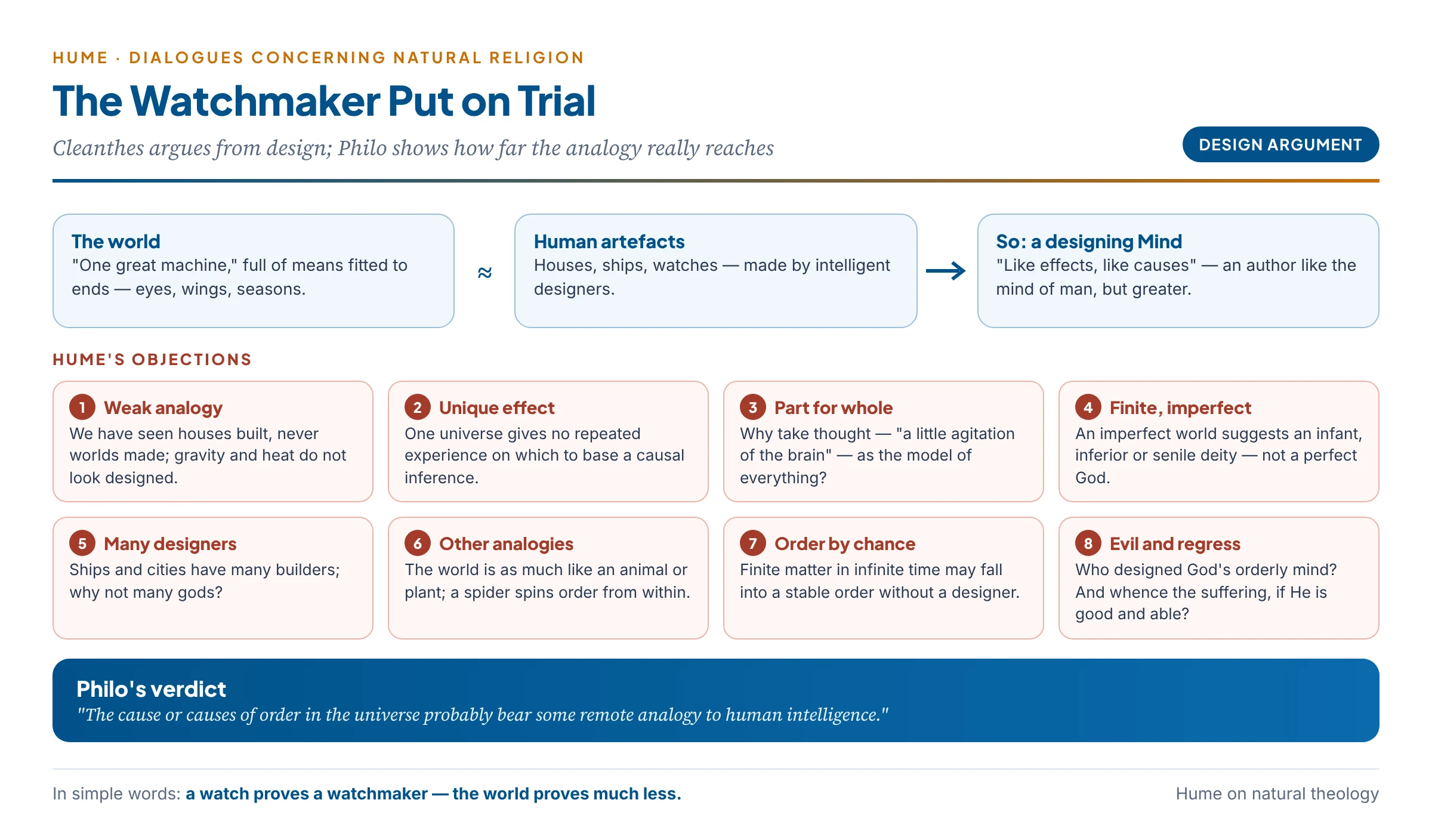
- Dialogues Concerning Natural Religion — a conversation between Cleanthes, who defends the design argument; Demea, who defends a priori proofs and religious mystery; and Philo, a sceptic who usually voices Hume’s criticisms.
- The essay on miracles in the first Enquiry.
- The Natural History of Religion — on the psychological and historical origins of belief.
- The essay “Of the Immortality of the Soul.”
10. Hume’s Refutation of the Arguments for God
(a) The ontological argument
- The argument. God is the most perfect being; existence is a perfection; a perfect God who did not exist would be a contradiction; so God exists.
- Hume’s reply:
- Existence is not a separate idea or quality. To think of a thing and to think of it as existing are the same; adding “exists” adds nothing to the concept. So existence cannot be deduced from the idea of a perfect being.
- Whatever we conceive as existent, we can also conceive as non-existent. The non-existence of any being implies no contradiction.
- We do not know God’s nature; how can we argue from that nature to His existence? Practice, not reason, is the basis of religion.
(b) The cosmological argument and “necessary being”
- The argument (Demea’s). Whatever exists must have a cause; the chain of causes cannot go back infinitely; so there is a first cause, a necessarily existent being who carries the reason of His existence in Himself.
- Hume’s replies:
- Causation is known only from experience — from observing many cases of one kind of thing following another. We have no experience of universes being caused; the world is a unique object, so the causal principle cannot be applied to it as a whole.
- “Necessary being” has no meaning. Necessity belongs only to relations of ideas; “there is no being whose non-existence implies a contradiction,” so no being’s existence is demonstrable.
- Why not the material universe? If something must be necessary, why may not matter itself, or the universe, be the necessarily existent being? We do not know all its qualities.
- An infinite regress is not impossible. Reason cannot disprove an infinite chain of causes. In an eternal succession, each member is caused by the one before it; that is a sufficient explanation.
- The whole needs no extra cause. “Did I show you the particular causes of each individual in a collection of twenty particles of matter, I should think it very unreasonable, should you afterwards ask me, what was the cause of the whole twenty.” The whole is only the parts united by the mind.
(c) The argument from design (teleological argument)
- The argument (Cleanthes’). “Look round the world: you will find it to be nothing but one great machine, subdivided into an infinite number of lesser machines.” The adaptation of means to ends throughout nature resembles, though it far exceeds, the products of human design — houses, ships, watches. “Since the effects resemble each other, we are led to infer, by all the rules of analogy, that the causes also resemble“; so the author of nature is somewhat like the mind of man, though of much larger faculties.
- Hume’s objections:
- The analogy is weak. The universe does not much resemble a house, ship or piece of furniture. When we see a house, we infer an architect with certainty because we have seen houses built; but we have never seen worlds made. Some natural processes resemble the workings of reason, but many others — heat, cold, gravitation, attraction and repulsion — do not.
- A part cannot decide the whole. Thought, design and intelligence are only one small part of nature — “a little agitation of the brain which we call thought.” Why make this tiny part the model of the whole universe?
- The universe is unique. Causal inference needs repeated experience of species of objects; the universe is a single case, so no inference about its cause has experiential support.
- Anthropomorphism. The argument makes God like a human mind. But the human mind is changeable, a stream of passing thoughts — a perfect God cannot be subject to every passing whim. If God is like us, He is not the perfect God of theism; if He is not like us, the analogy fails.
- Proportion the cause to the effect. From a finite effect we may infer only a finite cause. The world gives no ground for ascribing infinity, perfection or unity to its maker.
- The world is imperfect. It shows failure, waste, disorder, suffering and a very slow, clumsy development. On the design hypothesis, the world might be “the first rude essay of some infant deity” who abandoned it; or the work of a “dependent, inferior deity“; or the production of “old age and dotage in some superannuated deity.”
- Many designers. Even if design is granted, it does not prove one God. A great ship or a city is built by many workmen; why not a world by many gods? The argument cannot establish monotheism.
- Other analogies fit as well or better. The world resembles an animal or a vegetable more than a machine — it has a constant circulation of matter, and order in it arises from generation and vegetation rather than from reason. On this view God might be the soul of the world; Hume adds that the comparison with a living body is better than that with a machine. But our experience is too limited to prove such a thing. A spider spins an orderly web from its own belly; order may come from a principle within nature rather than from an external mind.
- Order may arise naturally (the Epicurean hypothesis). Given a finite number of particles and infinite time, every possible arrangement may occur; a stable, ordered world could arise by chance or natural necessity without a designer. Matter may contain the source of its own order.
- Who designed the designer? A divine mind is itself an orderly arrangement of ideas; if order needs a designer, so does the order in God’s mind — an infinite regress. If God’s mind can be orderly by its own nature, so can matter.
- Purposes are projected, not observed. We see only sequences of events; final causes are read into nature from human intentions.
(d) The moral argument and the problem of evil
- No moral proof. Some say God is the source and guarantor of morality. Hume replies that experience does not show a God with moral qualities like ours; morality is grounded in human sentiments of sympathy and utility, so God is not needed to explain it.
- Nature aims at preservation, not happiness. The purpose of nature in all cases is the preservation and propagation of species, not the happiness of individuals. There is more pain than pleasure in the world.
- Epicurus’ old questions. “Is he willing to prevent evil, but not able? then is he impotent. Is he able, but not willing? then is he malevolent. Is he both able and willing? whence then is evil?“
- Four hypotheses about the first causes. They may be perfectly good, perfectly malicious, a mixture of good and evil, or neither good nor evil. The mixture of happiness and misery in the world rules out the first two; the steadiness of nature’s laws rules out the third. The most probable is the fourth: the original source of all things is indifferent to good and evil, like heat and cold.
(e) Miracles
- A miracle is a violation of the laws of nature. But those laws are established by firm and unalterable experience — the strongest evidence we have.
- “No testimony is sufficient to establish a miracle, unless the testimony be of such a kind, that its falsehood would be more miraculous than the fact which it endeavours to establish.“
- In practice no such testimony exists: witnesses are few, the love of wonder is strong, miracles abound among “ignorant and barbarous nations,” and rival religions’ miracles cancel each other. So miracles cannot be the foundation of a system of religion.
In simple words
Suppose a friend tells you he saw a man walk on the surface of a lake. Hume would have you weigh two things: on one side, the whole of human experience that people sink in water; on the other, the chance that your friend was mistaken, fooled or exaggerating. Which is more likely? Unless the friend’s being wrong would itself be a bigger miracle than the walking, the wise man believes he is wrong.
(f) Immortality of the soul
- Without an idea of soul substance, metaphysical proofs of immortality collapse.
- The analogy of nature points the other way: mind and body grow, weaken and decline together; what is incapable of existing before the body is unlikely to exist after it.
11. The Natural History of Religion
- A genetic, not a rational, study. Since religion cannot be founded on reason, Hume asks how it actually arose in human nature and history.
- Origins in passion. Religion arose not from contemplation of nature’s order but from the hopes and fears of ordinary life — fear of pain and death, desire for happiness, anxiety about an uncertain future, and ignorance of the real causes of events. People invented invisible powers to explain and influence the events that affected them.
- Polytheism first. For this reason polytheism (and idol worship) is the oldest religion of mankind; monotheism came later, as worshippers flattered one deity with ever greater attributes until he became infinite.
- Flux and reflux. Religion swings between polytheism (many limited gods, more tolerant) and theism (one infinite God, more abstract and sometimes more intolerant), as the human mind seeks both closeness and grandeur in its gods.
- Religion evolves. Like other spheres of human life, religion shows development; it should be studied historically and psychologically, not proved from first principles.
12. Hume’s Own Position on God
- Not a dogmatic atheist. Hume never asserts that God does not exist; he argues that neither reason nor experience can establish God’s existence or attributes. The most rational position is suspension of judgment — philosophical agnosticism.
- A minimal concession. Philo concludes that “the cause or causes of order in the universe probably bear some remote analogy to human intelligence” — a proposition too vague to support any religious practice or doctrine.
- Belief from need, not proof. Belief in God arises from human physical and psychological needs: man finds something lacking in life and hopes some agent will remove it. We feel that there is purpose in nature, but there is no need — and no way — to justify this feeling rationally.
- No contradiction. Some readers find Hume inconsistent, seeming to accept God at one moment and demolish every proof the next. His purpose is consistent: to show that the idea of God rests not on reason or experience but on the requirements of human life; so it is futile to try to prove it.
Critical Evaluation
Criticisms of the Bundle Theory
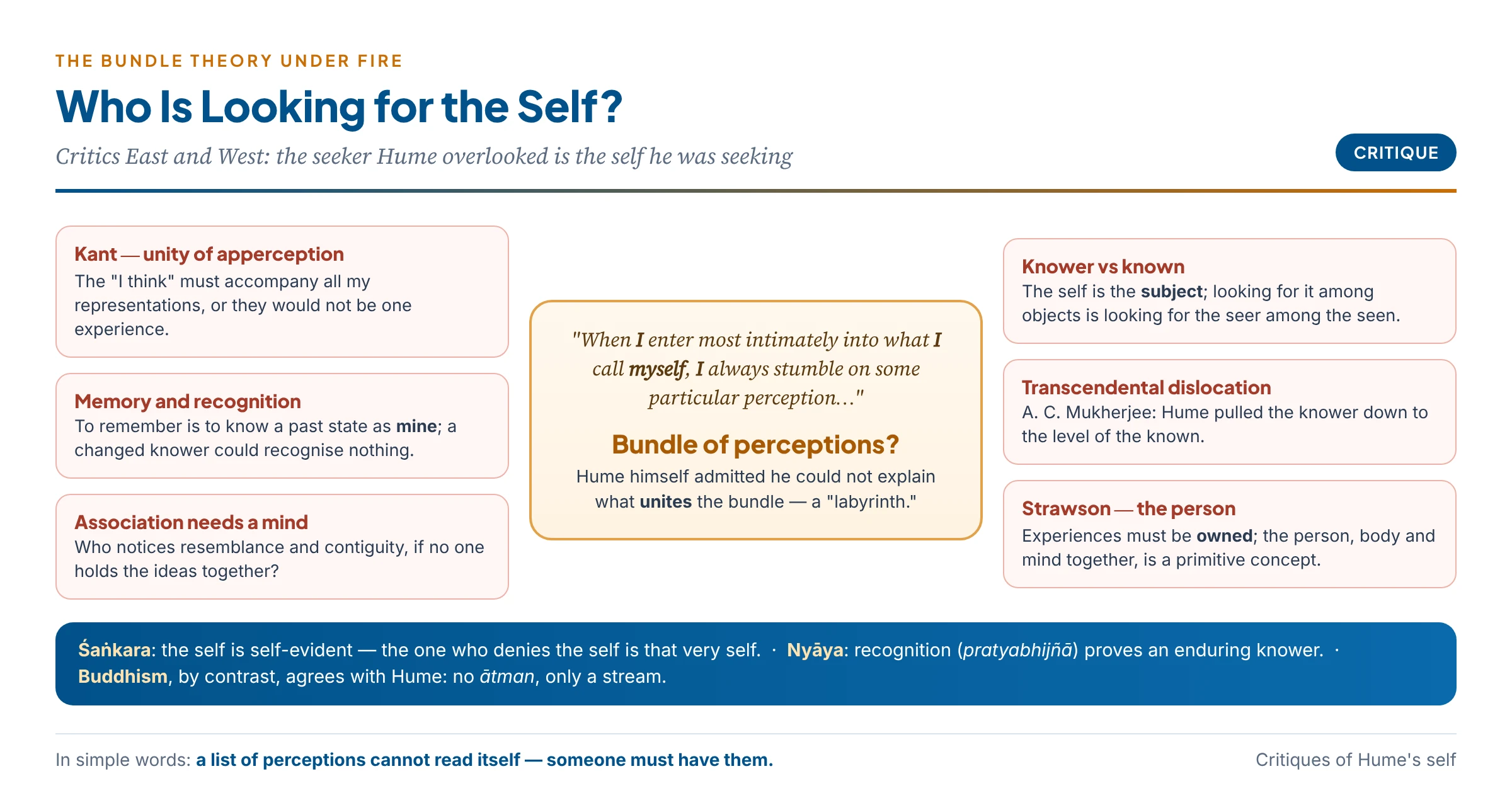
- Kant: the unity of apperception. A mere bundle of experiences cannot constitute a self. The “I think” must be able to accompany all my representations; otherwise they would not be mine, and could not be combined into one experience. Without a transcendental unity of consciousness, there could be no experience, no memory, no recognition. Kant rejects the speculative metaphysical soul but defends an epistemological self as the condition of knowledge.
- Association needs a mind. The laws of resemblance, contiguity and causation require one consciousness in which ideas are compared and connected. If there is no soul, who or what notices the proximity, similarity or contrast that produces association?
- Memory presupposes a permanent self. To remember is to recognise a past experience as mine. If the knower himself had changed, how could he recognise anything? Memory is everyday proof of the self’s continuity.
- Confusion of knower and known. Knowledge has two aspects: it reveals what is known and it establishes the knower. Hume looked for the self as an object among perceptions and, not finding it, denied it. But the self is the subject; it cannot be found as one more object. The very one who looks into himself and finds perceptions coming and going is the self.
- The “fallacy of transcendental dislocation.” A. C. Mukherjee argued that Hume reduced the knower (the transcendental self) to the level of the known — dislocating it from its proper place as the presupposition of all knowledge.
- The word “I” gives him away. “When I enter most intimately into what I call myself, I always stumble …” — who enters, who stumbles? Hume’s own sentence presupposes the self it denies.
- Experience needs consciousness. Pleasure, pain, love and hate have no existence except as experienced, and experience cannot occur without consciousness — and that consciousness is what is meant by the self.
- Homogeneity and continuity of experience. The felt consistency and uniformity of a life’s experience cannot depend on the body, which constantly changes; something permanent must account for it.
- The process of knowing. Knowing involves acceptance, classification, synthesis, discrimination and assimilation of sensations — activities that need a permanent capacity to perform them.
- Hume’s own labyrinth. By his own admission, he could not explain what unites the bundle.
Strawson’s Concept of a Person: A Refutation of Hume?
- Strawson’s thesis. In Individuals, P. F. Strawson argues that the concept of a person is primitive: a person is a single entity to which we ascribe both M-predicates (material: “weighs 60 kg,” “is in the room”) and P-predicates (personal: “is thinking,” “is in pain”). It cannot be analysed into a body plus a soul (Descartes) or into a bundle of experiences.
- The ascription argument. We can ascribe states of consciousness to ourselves only if we can ascribe them to others; and we can identify others only as embodied persons. So experiences must be ascribed to persons, not to bundles, and the concept of a person is logically prior to that of an individual consciousness.
- Against the “no-ownership” view. Strawson criticised the doctrine that experiences are not really “owned” by anything, but only causally dependent on a body. To state that view, its defender must speak of “my experiences” — so it presupposes the ownership it denies. The bundle theory has the same weakness.
- Is it a refutation of Hume?
- Yes, in part. Strawson shows that the bundle cannot be the basic subject of experiences, and that the unity of a mind is not a mere fiction of imagination but is grounded in the person as a basic particular of our conceptual scheme.
- No, in part. Strawson’s person is not the Cartesian soul or a simple, unchanging substance that Hume denied; it is an embodied being. And Strawson does descriptive metaphysics — he describes the structure of our concepts — while Hume asks whether we have an impression of a self. Hume could accept that we must think in terms of persons while denying that we perceive a substantial self.
- Verdict. Strawson refutes the bundle theory as an account of who has experiences, but not Hume’s negative thesis that introspection reveals no simple, permanent soul.
Descartes’ Cogito, Hume and Kant
- Descartes: “I think, therefore I am” — the self is known with certainty as a thinking substance.
- Hume: introspection finds thoughts, not a thinker; the cogito at most shows “there is thinking,” not that there is a substance that thinks.
- Kant: the “I think” is a formal condition of all experience (transcendental unity of apperception), not an object known through intuition; the inference from it to a substantial, simple, immortal soul is a paralogism. Kant thus agrees with Hume against Descartes’ metaphysical self, and with Descartes against Hume that the unity of the self is necessary for knowledge.
Leibniz and Hume on Substance
| Point | Leibniz | Hume |
|---|---|---|
| Method | Rationalist: substance known by reason; we find the idea of substance by reflecting on ourselves | Empiricist: substance must be traced to an impression — and cannot be |
| What substance is | Monads: simple, indivisible, unextended centres of active force | A collection of qualities united by imagination under a name |
| How many | Infinitely many substances | None knowable |
| Activity | Every monad is active, unfolding its states from within | Perceptions are passive and loose; no power is perceived |
| Unity | True unity belongs only to simple substances | Unity is feigned by the mind |
| The self | A rational soul — a dominant monad with apperception | A bundle of perceptions |
| Relations | Monads are windowless; harmony is pre-established by God | Relations are made by the mind’s comparison and association |
| God | The supreme monad; necessary being, sufficient reason of the world | Existence and attributes unprovable |
| Key principle | Identity of indiscernibles, sufficient reason | “Whatever is distinguishable is separable” |
- Common ground. Both deny Locke’s inert, unknowable substratum; both make perceptions central. Leibniz turns substance into active perceiving units; Hume dissolves it into perceptions without a perceiver.
Rationalists and Empiricists on God
| Thinker | Stance on God | Main ground |
|---|---|---|
| Descartes | God exists; His veracity guarantees clear and distinct ideas | Ontological argument; the idea of the infinite (trademark) argument |
| Spinoza | God is the one infinite substance = Nature (Deus sive Natura) | Definition of substance; geometric demonstration |
| Leibniz | God is the necessary being and author of the best possible world | Principle of sufficient reason; pre-established harmony |
| Locke | God’s existence is demonstrable | Cosmological argument (“something has existed from eternity”) and design |
| Berkeley | God is the infinite spirit who causes and sustains our ideas | Ideas need a cause; order of nature; permanence of things |
| Hume | Existence and attributes cannot be proved; agnosticism | Critique of ontological, cosmological, design and moral arguments; natural history of religion |
- The pattern. Rationalists prove God a priori and make Him the foundation of knowledge. Locke and Berkeley prove God a posteriori and keep Him as the ground of the world. Hume, as the consistent empiricist, shows that experience cannot reach God at all.
What Can Be Said for Hume
- Honest introspection. Many people, when they look inward, find exactly what Hume found: a stream of thoughts, feelings and sensations, not a separate, unchanging observer.
- Modern science of mind. Psychology and neuroscience describe the self as a constructed process — integrated by memory and narrative — with no single “centre” in the brain where everything comes together. Philosophers like Derek Parfit argued that personal identity is not what matters; continuity of psychological connections is.
- Design after Darwin. Natural selection supplied exactly the kind of non-intelligent ordering principle Hume said was possible, explaining adaptation without a designer. Hume’s objections remain central in the debate over “intelligent design” and the “fine-tuning” argument.
- Evil remains unanswered by proof. The problem of evil, in Hume’s sharp form, is still the leading objection to classical theism.
- Natural beliefs. Hume’s distinction between what reason can prove and what human nature must believe anticipates much later work on common sense and on the limits of justification.
Critics and Defenders
Criticism — Critics
- Kant: the transcendental unity of apperception is a necessary condition of all experience; a bundle cannot know itself as a bundle.
- Reid: personal identity is simple and known immediately; the external world is perceived directly; Hume’s “ideal theory” leads to absurdity.
- Strawson: the person is a primitive concept; experiences must be owned.
- Indian critics (Nyāya, Advaita): memory, recognition and the witnessing self prove an enduring subject.
- Theists (Paley, Swinburne): the cumulative evidence of order and fine-tuning still makes design probable; Hume’s objections show only that God is not like a human craftsman in every respect.
Defence — Defenders and lasting value
- Hume’s reply: he denies only that we know a substantial self, matter or God, not that we naturally believe in self and world.
- Buddhist philosophy: anātman reaches the same conclusion by analysis and meditation.
- Russell and Ayer: the self is a logical construction from experiences; substance is a grammatical illusion.
- Parfit and modern neuroscience: identity consists in psychological continuity; there is no further fact.
- Darwin and modern biology: adaptation is explained by natural selection, as Hume suggested order might be.
Cross-Tradition Comparison
Hume and Indian Views of the Self
| Point | Hume | Buddhism (anātmavāda) | Nyāya-Vaiśeṣika | Advaita Vedānta |
|---|---|---|---|---|
| Permanent self | Denied: no impression of it | Denied: no ātman; five aggregates (skandhas) | Affirmed: eternal substance (ātman) with qualities | Affirmed: pure consciousness (Ātman = Brahman) |
| What we call “self” | Bundle of perceptions | Stream (santāna) of momentary skandhas | Substrate of cognition, desire, aversion, volition, pleasure, pain | The witness (sākṣī) of all states |
| Unity explained by | Resemblance, causation, imagination | Causal continuity of moments (pratītyasamutpāda) | One self knows and remembers | The self-luminous (svayaṃprakāśa) subject |
| Memory and recognition | Discover the causal chain; identity is a fiction | Explained by causal continuity of the stream | Proof of an enduring self (pratyabhijñā) | Presuppose the unchanging witness |
| Analogy | Theatre, river, republic | Chariot (Nāgasena), flame, river | — | Light that illumines everything |
| Purpose | Naturalistic science of mind | Liberation from craving (nirvāṇa) | Liberation by right knowledge of the self | Liberation by knowing the self as Brahman |
Indian Connect — Key takeaways
- Hume’s bundle theory is the closest Western counterpart of Buddhist anātmavāda. When King Milinda asks Nāgasena who he is, Nāgasena replies that “Nāgasena” is only a name, like “chariot” — which is neither the pole, the wheels nor the axle, but a convenient designation for the parts in a certain arrangement. This is Hume’s account of both objects and selves.
- But the purposes differ. For Buddhism, seeing through the self is the path to ending suffering and craving; there is karma and rebirth without a self, carried by the causal stream. Hume has no ethical or soteriological goal: his bundle theory belongs to a science of human nature, and he leaves practical life to natural belief.
- The Indian critics anticipated Kant. Nyāya argued that memory and recognition (pratyabhijñā: “this is the same person I saw yesterday”) require one enduring knower; desire for something once enjoyed proves the same self experienced and now desires.
- Śaṅkara’s reply is the classic answer to Hume. The self is the subject that can never become an object; it is self-evident — whoever denies the self is himself that self. To seek the self among objects of experience, as Hume did, is to look for the seer among the things seen.
Indian Connect — God and design in Indian debate
Nyāya argued for Īśvara much as Cleanthes did: the earth and other things are effects (kāryatvāt), because they are made of parts, and every effect has an intelligent maker, as a pot has a potter. Its critics anticipated Hume. Mīmāṃsakas said we have never seen worlds made and so cannot infer a world-maker from pots. Buddhists and Jainas asked why one maker rather than many (an anthill is built by many ants), why a perfect and compassionate God would create a world of suffering, and who made the maker. The Cārvāka rejected God altogether, attributing order to the nature (svabhāva) of things — close to Hume’s suggestion that order may arise from within matter.
Synthesis (Siddhānta)
Hume takes Berkeley’s weapon against matter and turns it on everything that claims to lie beneath or beyond our perceptions. Substance is a collection of qualities with a name; the external world is a natural belief bred by the constancy and coherence of impressions and completed by imagination; the self is a bundle of perceptions, its identity a smooth passage of thought along chains of resemblance and causation; and God lies beyond the reach of every argument from experience, while religion itself has a natural history in human hope and fear. Throughout, Hume separates two questions: what reason can prove, and what human nature cannot help believing. The first answer is almost always “nothing”; the second is “a great deal.”
The bundle theory faces a deep objection, which Hume himself felt: a bundle cannot explain its own unity, nor the knowing subject for whom the perceptions are a bundle at all. Kant’s unity of apperception, Strawson’s person and the Indian doctrines of the witness-self all press this point. Yet Hume’s negative findings remain powerful: introspection reveals no simple, unchanging soul; we have no idea of a substratum apart from qualities; and the classical proofs of God do not reach the infinite, perfect, good Creator of theism. Hume’s lasting lesson is a disciplined modesty: to live by our natural beliefs while refusing to dress them up as demonstrations.
- Philosophy of mind: the “no-self” and “narrative self” views in psychology and neuroscience continue Hume’s bundle theory.
- Personal identity and ethics: Parfit’s view that continuity, not identity, matters has consequences for responsibility, prudence and concern for the future.
- Philosophy of religion: the design argument, the problem of evil and the credibility of miracles are still debated in Hume’s terms.
- Comparative philosophy: Hume and the Buddha offer two routes — scientific and soteriological — to the same denial of a substantial self.
When Hume looked within for a self, he found only the play — never the actor, the stage or the audience.
Previous Year Questions
- 2025Present an account of Design argument to prove the existence of God along with its criticism by David Hume.
- 2020“I never can catch myself at any time without perception, and never can observe anything but the perception.” How does this statement by Hume problematize the philosophical notion of personal identity? How does Kant deal with this problem in his Critique of Pure Reason?
- 2017Show how Hume’s analysis of experience leaves no ground for belief in permanent reality either physical or mental.
- 2016Discuss the various stances on God taken by Rationalists and Empiricists.
- 2016“The natural world is as complexly and manifestly designed as a watch.” Evaluate.
- 2013Give a critical account of Hume’s theory of self.
- 2013Critically evaluate three main objections against the argument from design for the existence of God.
- 2012How does Descartes’ ‘Cogito Ergo Sum’ affect Hume and Kant’s transcendental philosophy? Explain.
- 2011What, according to Empiricists, is the concept of Substance? Discuss.
- 2010Is Strawson’s concept of a person a refutation of Hume’s concept of self? Discuss.
- 2010Human mind is such that it naturally observes order in nature. Given this, can one use arguments from design for the existence of God? Discuss.
- 2009Compare the views of Leibnitz and Hume on the concept of substance.
- 2001Hume’s analysis of personal identity.
- 1999Evaluate Hume’s theory of personal identity.