

Empiricism (Locke, Berkeley, Hume): Theory of Knowledge; Substance and Qualities; Self and God; Scepticism.
Official Syllabus: Paper I, Section A, Unit 3
Causation is the hinge of Hume’s whole philosophy. Every inference that carries us beyond what we now see and remember — that the fire will burn, the bread will nourish, the sun will rise — rests on the relation of cause and effect. Philosophers before Hume held that a cause contains a power to produce its effect and that the effect follows with necessity, as a conclusion follows from premises. Hume applied his test — “from what impression is the idea derived?” — and found that we observe only that one event is contiguous with another, precedes it, and is constantly conjoined with it. The necessary connection we believe in is never observed in the objects; it is a feeling of expectation produced in the mind by custom. “Necessity is something that exists in the mind, not in objects.” This analysis shook the foundations of science and metaphysics and roused Kant to build his critical philosophy.
In simple words
Every morning the rooster crows and then the sun rises. A child who has heard this a hundred times may come to feel that the crowing makes the sun come up. We laugh at the child — yet Hume asks: what do we see when we say a switch “makes” a bulb light, or a ball “makes” another ball move? We see one thing, then another, again and again. The “making” — the push of power from one to the other — is never seen. Our sense that it must happen is the same kind of habit the child has; we have simply had better luck in the pairs we have watched.
Context & Problem
Why Causation Matters So Much
- All reasoning about matters of fact depends on it. Beyond the present testimony of the senses and memory, every factual inference is causal: the watch on a desert island tells of a man, the letter tells of a friend in France.
- It carries us beyond experience. Through causation we pass from an immediate impression to something not present to the senses — the unseen fire behind the smoke.
- It turns impressions into laws. By the causal principle we bind passing impressions into universal laws of nature. If the principle is valid, science has rational justification; if not, its claim to certain knowledge falls.
- So causation is the decisive test case for empiricism: can experience give us the idea of a necessary connection between distinct events?
The Background Hume Attacked
- Before Hume, scientists and philosophers alike accepted causation as a universal law — “every effect has a cause” — and inferred effects from causes as if by deduction. The whole of physics seemed to work on this basis.
- Rationalists made causal necessity a logical necessity: the effect is somehow contained in the cause and can be deduced from it, as the properties of a triangle follow from its definition. “From a given determinate cause the effect follows necessarily,” says Spinoza.
- Locke spoke of powers in objects and left the cause of our sensations as an unknown material “something, I know not what.” Berkeley made God the cause of our sensations and denied all causal power to ideas. Both relied on causation to reach what lies beyond experience.
- Hume’s move. Instead of attacking matter or God directly, Hume examined the causal principle itself, on which every such inference depends.
What Hume Was — and Was Not — Against
- Hume did not deny that we use causal reasoning, or that it is indispensable. He denied two theories about it:
- That causal necessity is logical necessity — that the effect can be known from the cause by reason alone.
- That there is a power in the cause, which we perceive, by which it produces the effect.
- His question is about origin and justification: from what impression do we get the idea of necessary connection, and what entitles us to infer the unobserved from the observed?
Core Doctrine
1. In Search of the Impression of Causation
- No common quality. Things called causes are endlessly various — fire, a blow, a word, a thought. There is no single quality in objects in virtue of which a thing is a cause. So the idea of causation must come from some relation among objects.
- Three elements of the causal relation:
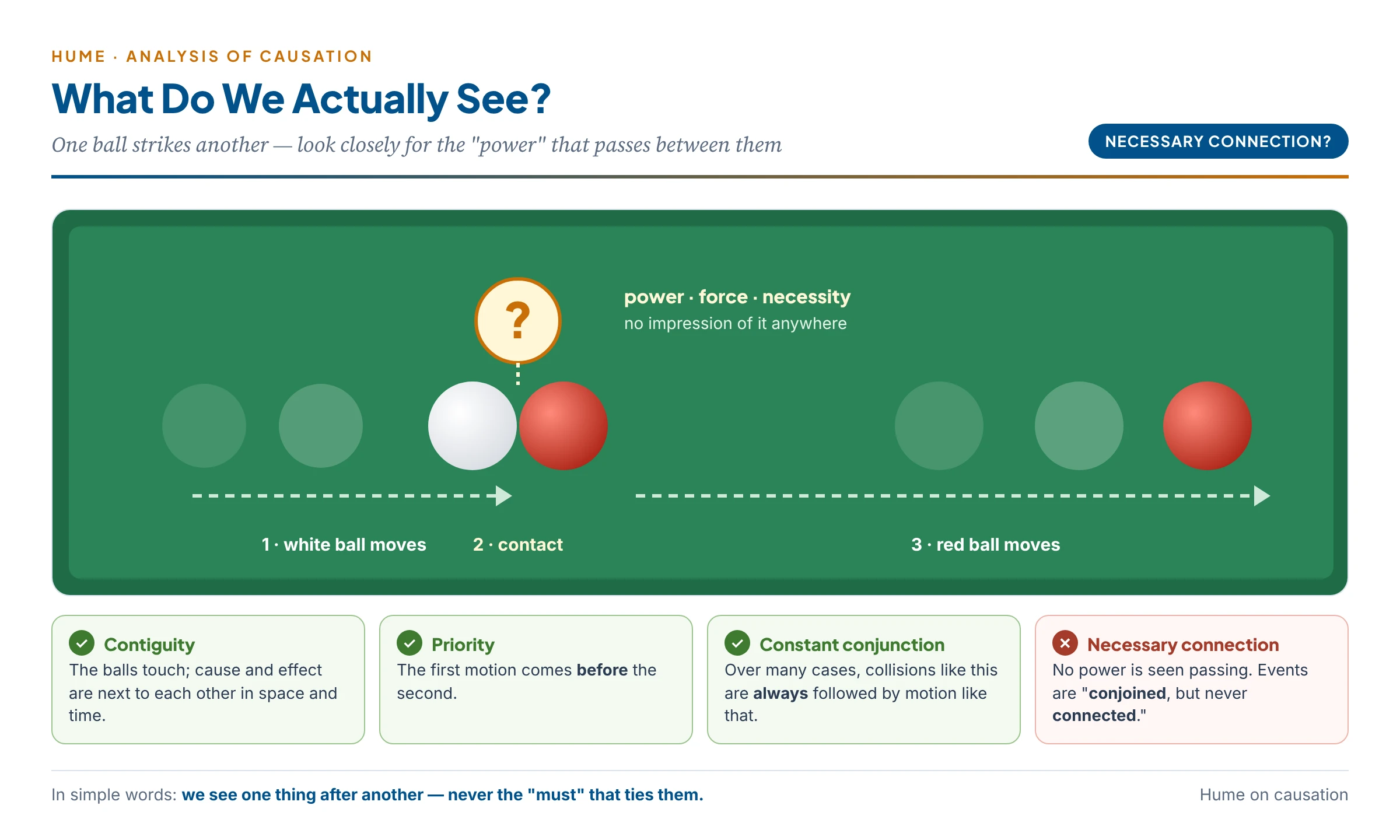
- Contiguity — cause and effect are next to each other in space and time (or linked by a chain of contiguous things). Flame and heat, food and nourishment.
- Priority in time — the cause comes before the effect.
- Necessary connection — the cause produces the effect; the effect must follow. “Of much greater importance” than the other two.
- The first two are observed. The third is not. One billiard ball rolls, strikes a second, and the second moves. We see motion, contact, then motion. “We never perceive any power in one passing to the other.” There is no extra impression of force, energy or necessity in the scene.
2. Reason Cannot Discover Causes
- No a priori knowledge of effects. “Adam, though his rational faculties be supposed entirely perfect, could not have inferred from the fluidity and transparency of water that it would suffocate him, or from the light and warmth of fire that it would consume him.” Shown an object for the first time, no one can say what effect it will produce.
- The effect is a distinct event. Examine the cause as closely as you like — the moving billiard ball — and you will not find the second ball’s motion contained in it. The effect is totally different from the cause and can never be discovered in it. So every causal judgment is synthetic: the effect is not part of the concept of the cause.
- Causal claims cannot be demonstrated. The contrary of any causal claim is conceivable. That food nourishes is no truth of reason: there is no contradiction in supposing that this food, or bad food, will not nourish. Invariable relations of the logical kind are found only in mathematics; the law of non-contradiction rules there and nowhere else.
- No amount of argument can establish the relation between fire and its capacity to burn; only experience teaches it.
3. “Whatever Begins to Exist Must Have a Cause” — Is It Certain?
Hume asks two separate questions:
- Why do we think it necessary that everything that begins to exist must have a cause?
- Why do we conclude that particular causes must have particular effects?
- On the first question, Hume argues the general causal maxim is neither intuitively nor demonstratively certain:
- The ideas of cause and effect are distinct, and whatever is distinct is separable. “It will be easy for us to conceive any object to be non-existent this moment and existent the next, without conjoining to it the distinct idea of a cause.” What can be conceived without contradiction cannot be demonstrated false.
- The supposed proofs of the maxim given by Hobbes, Clarke and Locke are fallacious: each one presupposes what it sets out to prove.
- Hobbes: all points of time and place are alike, so something must determine when and where a thing begins — but this assumes that a beginning needs a determiner.
- Clarke: without a cause, a thing would have to produce itself, which is absurd — but to deny a cause is not to make the thing its own cause.
- Locke: without a cause, nothing would be its cause, and nothing cannot produce anything — but this again treats “no cause” as if it were a strange kind of cause.
- Conclusion. Our confidence that every event has a cause comes not from reason but from experience and habit — the same source as our particular causal beliefs.
4. Experience Cannot Show Necessary Connection
- External experience. In bodies we see only succession: antecedent and consequent. No sensation of power accompanies the impact of one ball upon another.
- Internal experience — the will. Perhaps we feel power in ourselves, when we will to raise an arm and it rises?
- Hume grants that volition is followed by motion; he does not deny that the will moves the body.
- But we are aware only of the act of willing and then the movement. How the mind moves the body is “the most mysterious” thing; we do not perceive any force passing between them.
- If we felt the power, we would know why we can move the tongue and fingers but not the heart or liver; and why a man suddenly paralysed finds that his will no longer moves his limb. We learn all this only by experience.
- Even our command over our own ideas is learnt from experience, varies with health and time of day, and reveals no power.
- Introspection in general. When I look into my so-called self, I find ideas that arrive, associate and separate — but no invariability and no felt necessity among them.
- Result. Neither outer nor inner experience gives an impression of necessary connection. “All events seem entirely loose and separate. One event follows another; but we never can observe any tie between them. They seem conjoined, but never connected.”
5. Constant Conjunction and Custom
“We remember to have seen that species of object we call flame, and to have felt that species of sensation we call heat. We likewise call to mind their constant conjunction in all past instances. Without any farther ceremony, we call the one cause and the other effect, and infer the existence of the one from that of the other.” — David Hume
- The answer to the second question. We learn particular causes from experience of constant conjunction: in many past cases, objects of one kind (flame, smoke, food) have been regularly followed by objects of another kind (heat, fire, nourishment), contiguous and in the same order.
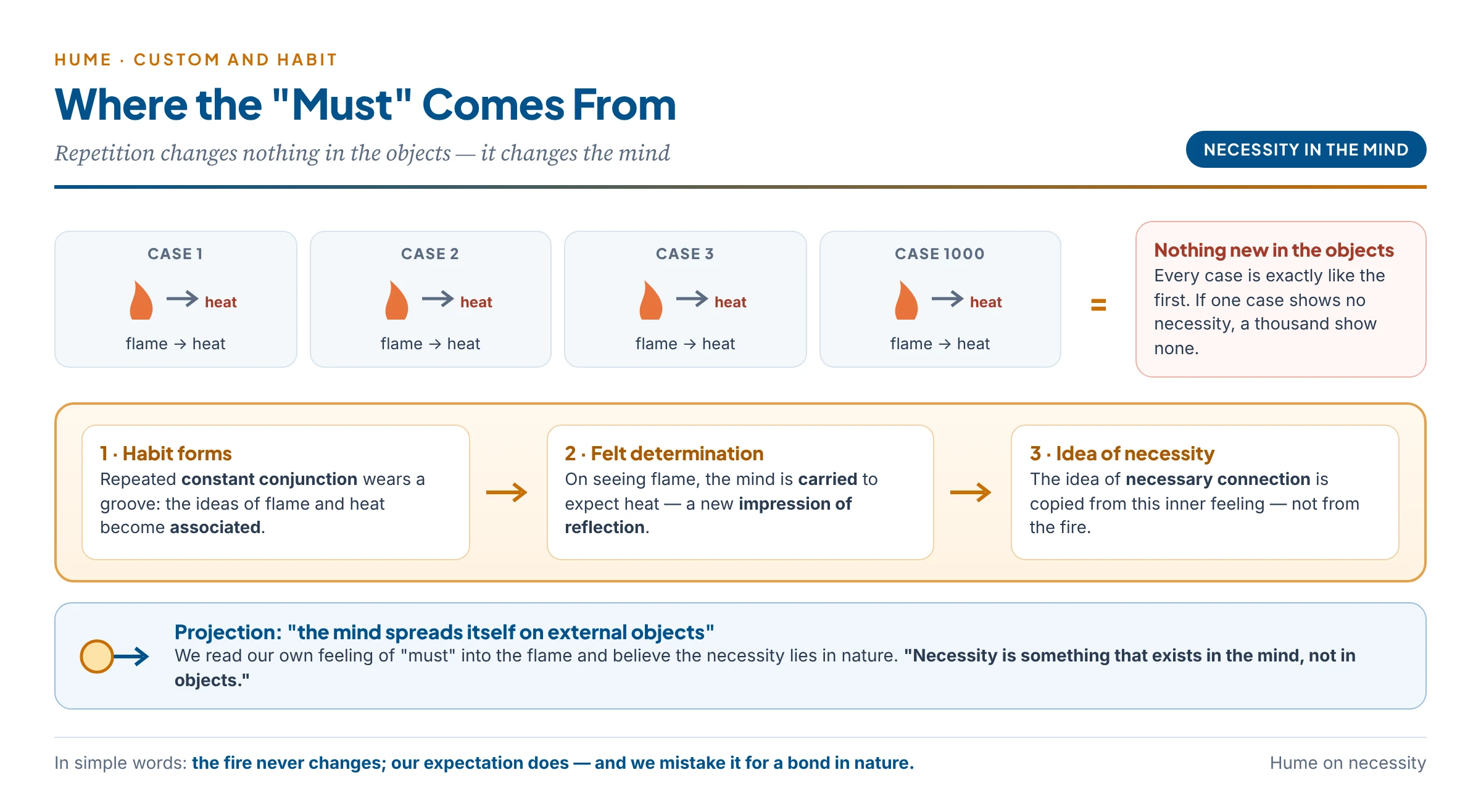
- But repetition adds nothing to the objects. One instance of a billiard collision shows no necessary connection; a thousand instances, each exactly like the first, show none either. What, then, changes?
- The change is in the mind. “After a repetition of similar instances, the mind is carried by habit, upon the appearance of one event, to expect its usual attendant, and to believe that it will exist.” This felt transition — a determination of the thought from one object to its usual attendant — is a genuine impression of reflection.
- Here is the impression we were looking for. The idea of necessary connection is copied from this internal feeling, not from anything in the objects. “Necessity is something that exists in the mind, not in objects.”
- Projection. The mind has “a great propensity to spread itself on external objects.” We read our own feeling of determination into the fire and the billiard balls and suppose that the necessity lies in them — just as we suppose that colours and sounds lie in things.
- Transition by imagination, not reason. If reason made the step from cause to effect, it would need the premise that the future resembles the past — which cannot be proved (the problem of induction). So the step is made by custom and imagination through the principle of association, not by inference.
- Belief. The present impression (flame) gives vivacity to the associated idea (heat): we do not merely imagine heat but believe it will follow.
In simple words
Learning a new ringtone shows custom at work. The first time your phone plays a strange tune, you do not reach for it. After a week, the first two notes make your hand move before you have thought anything. Nothing about the sound has changed; you have changed. Hume says causal necessity is like that: not a new property of the tune, but a groove worn in the mind by repetition — which we then imagine as a bond between the things themselves.
6. Hume’s Two Definitions of Cause
Hume gives two definitions on the same page of the Treatise (and again in the Enquiry):
- Philosophical (regularity) definition — “An object precedent and contiguous to another, and where all the objects resembling the former are placed in like relations of precedency and contiguity to those objects that resemble the latter.” In the Enquiry he adds: “where, if the first object had not been, the second never had existed.”
- Natural (psychological) definition — “An object precedent and contiguous to another, and so united with it that the idea of the one determines the mind to form the idea of the other, and the impression of the one to form a more lively idea of the other.”
- The first describes the relation as found in the objects (regular succession); the second describes it as felt in the mind (determination of thought). Together they give the full Humean analysis.
- Four conditions for “A causes B,” combining both definitions:
- A is prior to and contiguous with B.
- Events resembling A are prior to and contiguous with events resembling B (constant conjunction).
- Because of this constant conjunction, the idea of A is associated with the idea of B.
- A mental habit of expectation is formed, so that the impression of A is followed by a lively idea of B.
- Psychology and philosophy interwoven. Hume’s analysis is partly genetic (how the belief arises) and partly epistemological (what the belief can claim). For Hume the genetic story is relevant to analysis, though it is not a justification of causal inference.
- The correct form of a causal statement. “A causes B” is wrongly analysed as “B necessarily follows A.” The correct analysis is “A is regularly followed by B, and the mind, on seeing A, expects B” — a relation of succession, not of logical necessity.
Common confusion
Did Hume say that “a causes b” means “b is followed by a”? Or that cause and effect are reversible? Some notes print the analysis back to front. The cause precedes the effect: “A causes B” means A is followed by B (regularly, and with a felt expectation of B on seeing A). Priority in time is one of Hume’s three elements of causation. What Hume denies is only the word “necessarily” in “B necessarily follows A,” understood as a necessity found in the objects.
7. Causation as a Natural and as a Philosophical Relation
- As a natural relation, causation is one of the three principles of association (with resemblance and contiguity). It operates automatically on the imagination: seeing dark clouds, we expect rain without any reasoning. The transition is immediate, involuntary and inevitable.
- It is prior to philosophy: animals and children rely on causal expectation without reflection. Causal belief is the product not of argument but of instinctive association — “nature has determined us” to think causally.
- This explains why we cannot help believing in causal connections, even though reason cannot justify them.
- As a philosophical relation, causation is a relation we reflect on and use deliberately in science and judgment, comparing objects and judging them causally related.
- Careful reflection establishes priority and contiguity but cannot demonstrate why one event must follow another. The more we analyse causation, the more its lack of rational foundation appears.
- Hume does not throw philosophical causation away; he reinterprets it as a systematisation of natural habits. He even lays down rules by which to judge of causes and effects — for example, “the same cause always produces the same effect,” and differences in effects point to differences in causes — which became the ancestors of Mill’s methods of experimental inquiry.
8. The Conclusions of Hume’s Analysis
- Sensory experience does not establish an invariable connection; it shows only antecedent and consequent.
- Inner experience does not establish it either; volition is followed by movement, but no force is perceived.
- The basis of causality is habit and custom: the mind expects one event on the appearance of another. Belief in causal relation is a psychological necessity.
- The causal relation is one of succession, not of necessity.
- The causal relation is factual, not logical: it can be denied without contradiction.
- It is therefore contingent, not necessary.
- All causal judgments are synthetic: the effect is not contained in the cause and cannot be deduced from it.
- The relation is explained by association: frequent observation of succession joins the ideas of cause and effect in the mind.
- “Necessity exists in our mind and not in nature.”
- Consequence for theology: the argument that the world needs a First Cause assumes a causal principle that can be applied only within experience. We have no experience of worlds being caused, so the inference to God as First Cause has no basis.
9. Is There Any Element of Necessity in Causal Relations?
- No objective necessity. There is no necessity in the objects — no power, energy or tie that we perceive or can infer.
- No logical necessity. The denial of any causal statement is conceivable; necessity of the logical kind belongs only to relations of ideas.
- Yes — psychological necessity. There is a real determination of the mind: after constant conjunction we cannot help expecting the effect. This is the only necessity there is, and it is the source of our idea of necessary connection.
- Yes — “natural” necessity in practice. Hume insists that causal regularity governs nature and human action alike. In the debate on free will he applies the same analysis: human actions show regular conjunction with motives and character, so they are as “necessary” as physical events — and this necessity is what makes moral responsibility possible (the article on substance, self and God discusses Hume’s compatibilism).
- Does Hume deny real causes? Hume often speaks of the “secret powers” or “ultimate springs” of nature on which effects depend but which are wholly unknown to us. Some readers therefore take him to doubt only our knowledge of necessity, not its existence; most take him to hold that we have no meaningful idea of a necessity beyond regularity plus expectation. Either way, Hume’s claim is that we cannot know or justify any necessity in things.
Indian Connect — Causation in Indian thought: an early “Humean” voice
The Cārvāka materialists also refused to treat causal laws as known necessities. Since vyāpti (universal concomitance) between smoke and fire cannot be perceived in all cases, inference from one to the other is only probable; things simply behave according to their own nature (svabhāvavāda), and some even ascribed events to chance (yadṛcchāvāda). Like Hume, they made perception the only firm source of knowledge and found the step from observed to unobserved unjustified.
Critical Evaluation
Criticisms of Hume’s Theory of Causation
- The mental habit is itself a causal law. Hume explains belief in causation by saying that repetition causes a habit, which causes expectation. But this uses causation to explain causation. If fire and heat are only conjoined, why should repetition and habit be more than conjoined? Hume quietly treats the law of habit as a universal and necessary law.
- The future of habits is also uncertain. If we have no guarantee that the future will resemble the past for fire and heat, we have none that the mind’s habits will work tomorrow as they did yesterday, or the same way for all people.
- Constant conjunction is not sufficient. Thomas Reid: day and night have been constantly conjoined throughout history, yet no one thinks day causes night. Regular succession can result from a common cause (the earth’s rotation).
- Constant conjunction is not necessary. A child who touches a flame once knows that fire burns; scientists often establish a causal law from one well-designed experiment. Causal knowledge does not always wait for repetition.
- Contiguity and succession are not explained. Hume does not show how successive ideas can be experienced as co-existent or contiguous at all — the comparison itself needs a unifying mind.
- Genesis is not justification. Hume explains how causal beliefs arise but slides from this to conclusions about their validity. That a belief has a psychological origin does not show it is unwarranted (critics call this a genetic fallacy).
- Laws support counterfactuals. “If this match had been struck, it would have lit” says more than “matches struck have lit.” Mere regularity cannot explain why causal laws, unlike accidental generalisations (“all coins in my pocket are silver”), tell us what would happen.
- We do experience causal agency. Critics argue that in effort and resistance — pushing a door, being pushed — we have a direct experience of force. Whitehead held that Hume overlooked the more primitive experience of causal efficacy, in which the past is felt as conforming the present; Hume looked only at clear, separate sense-impressions.
- It undermines science. If causality is only habit, science loses its objective necessity. Critics feared Hume left natural science with no rational foundation — the charge Kant took up.
In simple words
Reid’s day-and-night objection is easy to picture. Your alarm clock rings at 6:00 every morning and the milkman knocks at 6:01. After a year, you would expect the knock whenever the alarm rings — Hume’s “custom” is fully formed. Yet the alarm does not cause the milkman to come. Something more than regular succession must separate real causes from mere companions.
What Can Be Said for Hume
- Science works with regularities. Modern physics states functional laws — equations relating quantities — and speaks little of “powers.” Russell went so far as to say that the word “cause” is a relic that could be dropped from advanced science.
- Probability, not certainty. Hume’s view that causal knowledge is probable matches scientific practice: laws are accepted provisionally and revised on new evidence.
- Experimental method. Hume’s rules for judging causes anticipate Mill’s methods and controlled experiment: look for what varies with the effect and what is always present when it occurs.
- Quantum theory shows that strict causal necessity may fail at the microscopic level; Hume never claimed it was guaranteed.
- Honesty about power. No one has given a widely accepted account of what a necessary connection between distinct events would be, or how it could be observed.
Kant’s Response: “Dogmatic Slumber”
“I openly confess that the remembrance of David Hume was the very thing that many years ago first interrupted my dogmatic slumber and gave a completely different direction to my researches in the field of speculative philosophy.” — Immanuel Kant
- Context of the statement. Kant wrote this in the Prolegomena (1783). Trained as a Wolffian rationalist, Kant had assumed that reason could know the necessary structure of reality. Hume’s analysis of causation showed him that the concept of cause — which claims necessity — cannot be got either from reason (it is not analytic) or from experience (which shows only succession). Kant then generalised Hume’s problem: the same difficulty applies to all concepts that claim necessity and universality — substance, community and the rest.
- What Kant accepted from Hume:
- Causality cannot be proved by pure reason: “the cause of A is B” is synthetic, not analytic.
- Causality cannot be derived from experience: experience gives no necessity or strict universality.
- Causal necessity therefore has its source in the subject, not in things as they are in themselves.
- What Kant rejected:
- Hume’s psychological account. Habit can give only subjective necessity — an expectation that might fail. Science needs objective necessity.
- Hume’s fork. Kant held that “every event has a cause” is a synthetic a priori judgment — informative and yet necessary.
- Kant’s solution — causality as a category:
- Causality is one of the twelve categories of the understanding, a pure concept that the mind brings to experience. Whatever is experienced as an objective event must pass through the category of cause.
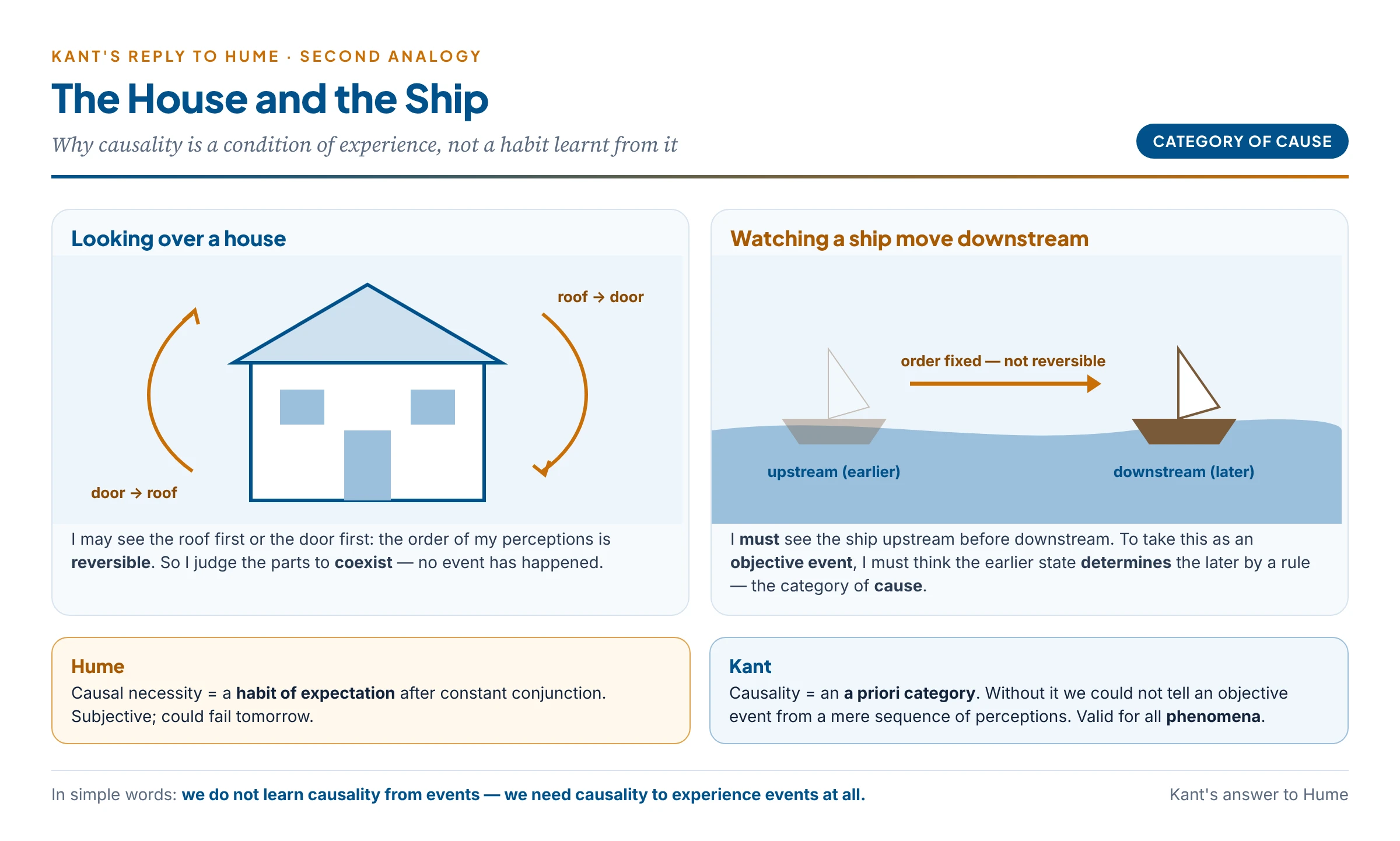
- Transcendental argument. Without the principle of causality, we could not distinguish an objective sequence of events from a mere subjective sequence of perceptions. So the principle is a condition of the possibility of experience, not a generalisation from it.
- The house and the ship. When I look over a house, I can see the roof first and the door later, or the other way round — the order of my perceptions is arbitrary, and I take the house’s parts to be simultaneous. When I watch a ship moving downstream, I must see it upstream first and downstream later; the order is fixed. To experience this as an objective event, I must think of it as following a rule — the earlier state determining the later. That rule is the category of causality.
- Thus, against Hume, causality is objectively valid for every possible object of experience — every phenomenon.
- “Empiricists only show their limits.” If the empiricist sees nothing but antecedent and consequent, Kant says, this exposes the limits of empiricism: categories are not objects of experience but the basis of experience. Looking for an impression of causality is like looking through spectacles for the spectacles.
In simple words
Imagine a person who has worn blue-tinted glasses since birth and can never take them off. Everything he sees is blue, and blue is guaranteed in every future sight — not because the world is blue, but because his glasses are. Kant says causality is like those glasses: it is certain for everything we experience because the mind supplies it. Hume looked for blueness in the objects and, finding none, called it a habit; Kant found it in the lenses.
How Far Does Kant Answer Hume?
- Gains:
- Kant restores necessity and universality to the general causal principle for all phenomena, securing the framework of Newtonian science.
- He shows that Hume’s project of tracing every concept to an impression overlooks the mind’s active synthesis: experience itself needs concepts.
- Limits:
- Kant proves at most that every event has some cause; he does not show which particular causes produce which effects. That fire burns and bread nourishes must still be learnt from experience, so Hume’s problem of induction about particular laws remains.
- Kant’s necessity holds only for phenomena; about things-in-themselves we know nothing. Critics say Kant secured certainty by shrinking its domain — a sceptical result in its own way.
- The transcendental argument shows only that we must think causally, not that the world is causally ordered — a more sophisticated subjectivism. Some critics call the transcendental move a form of escapism that changes the question rather than answering Hume.
- The categories are themselves a fixed list derived from the forms of logical judgment; critics doubt that this list is necessary.
| Point | Hume | Kant |
|---|---|---|
| Source of the idea of necessary connection | Custom: felt determination of the mind after repetition | Category of the understanding, a priori |
| Kind of necessity | Psychological, subjective | Transcendental, objective (for phenomena) |
| “Every event has a cause” | Not demonstrable; a belief from experience and habit | Synthetic a priori principle |
| Particular causal laws | Learnt from experience; never certain | Also learnt from experience (but within the a priori framework) |
| Status of science | Probable; practically reliable | Necessary in its principles; universal for phenomena |
| Things in themselves | “Secret powers” unknown | Things-in-themselves unknowable |
| Result | Mitigated scepticism | Critical idealism |
Critics and Defenders
Criticism — Critics
- Kant: habit gives only subjective necessity; causality is an a priori category that makes objective experience possible.
- Reid: constant conjunction is not causation — day and night are always conjoined; we know ourselves as active causes.
- Whitehead: Hume ignored the primitive experience of causal efficacy.
- Rationalists and realists: the theory uses causal laws (habit) to explain away causal laws, and cannot distinguish laws from accidental regularities.
- Common sense: one experience can teach a cause; we feel force in effort and resistance.
Defence — Defenders and lasting value
- Hume’s reply: the belief in causation is natural and unavoidable; what cannot be had is its rational proof.
- Regularity theorists and positivists (Mill, Russell, the Vienna Circle): causal laws are functional regularities; “power” adds nothing observable.
- Scientists: laws are provisional and probabilistic, exactly as Hume’s analysis predicts.
- Popper: no law is ever proved; Hume’s point grounds the method of conjecture and refutation.
- Modern philosophy of causation: counterfactual and probabilistic theories begin from Hume’s second definition (“if the first had not been, the second never had existed”).
Cross-Tradition Comparison
Hume and Indian Theories of Causation
| Point | Hume | Nyāya-Vaiśeṣika | Sāṅkhya | Buddhism | Cārvāka |
|---|---|---|---|---|---|
| Theory | Regularity + custom | Asatkāryavāda: effect is a new creation, not pre-existent in cause | Satkāryavāda: effect pre-exists in the material cause | Pratītyasamutpāda: dependent origination of momentary events | Svabhāvavāda (things act by their nature) or chance |
| Definition of cause | Prior, contiguous, constantly conjoined; mind determined to expect effect | Invariable (niyata) and unconditional antecedent (ananyathāsiddha pūrvavṛtti) | Material ground that already contains the effect | “This being, that arises; this ceasing, that ceases” | No knowable universal causal law |
| Necessity | In the mind, not in objects | Real in nature | Real — effect is manifestation of cause | Real regularity without substance or agent | Denied as unknowable |
| Effect and cause | Distinct events; effect not in cause | Distinct (new beginning) | Identical in essence | Distinct momentary events | — |
Indian Connect — Key takeaways
- Buddhist dependent origination is the closest Indian parallel to Hume. “When this is, that comes to be” describes causation as conditioned succession without any enduring substance or hidden power passing from cause to effect — very like Hume’s regularity view. But for the Buddha this regularity is a real law of the world (dharmatā), not a projection of the mind’s habit.
- Nyāya’s definition parallels Hume’s first definition — a cause is an invariable antecedent — but adds “unconditional” (ananyathāsiddha) to exclude mere accompaniments like the potter’s donkey or the colour of the stick. This is exactly the distinction Reid demanded between true causes and constant companions (day and night).
- Sāṅkhya’s satkāryavāda is what Hume rejects most sharply. For Sāṅkhya the effect is contained in the cause (oil in the sesame seed) and can in principle be read out of it; for Hume “the effect is totally different from the cause, and can never be discovered in it.”
- Nāgārjuna’s critique of causation (things arise neither from themselves, nor from another, nor from both, nor without a cause) is, like Hume’s, a dialectical attack on our concept of causation — though aimed at showing emptiness (śūnyatā), not at founding a psychology of belief.
- The Cārvāka critique of vyāpti reaches Hume’s conclusion that no universal causal rule is rationally established.
Synthesis (Siddhānta)
Hume’s analysis of causation proceeds with a single question — from what impression? — and arrives at a single answer: the idea of necessary connection is copied from an internal feeling of determination produced by constant conjunction, and then projected onto things. In the objects we find contiguity, priority and regular succession; the “must” belongs to us. This does not abolish causal reasoning — Hume calls custom “the great guide of human life” and even lays down rules for judging causes — but it removes its claim to rational certainty. Causal knowledge is probable, synthetic and contingent; the general maxim that everything has a cause is a natural belief, not a demonstrated truth; and the theologian’s First Cause is left without support.
The critics expose real gaps: habit is itself treated as a causal law; regularity cannot tell causes from constant companions or support counterfactuals; and the mind is more active than Hume allows. Kant turned these gaps into a new philosophy, making causality an a priori category that constitutes the very order of experience — but only for phenomena, and without proving particular laws. Between them, Hume and Kant set the terms of every later debate: is causal order found in the world, imposed by the mind, or merely expected by creatures of habit?
- Philosophy of science: regularity, counterfactual, probabilistic and interventionist theories of causation all begin from Hume.
- Statistics and medicine: “correlation is not causation” is Reid’s day-and-night objection in modern form; randomised trials are Hume’s rules made rigorous.
- Physics: functional laws and quantum indeterminacy fit Hume’s refusal to see necessity in nature.
- Law and ethics: responsibility for consequences depends on judging causes — and on Hume’s compatibilist view that regular causation of action does not destroy freedom.
We never see the bond between fire and heat; we feel it — and that feeling, Hume showed, is the hidden author of all our science.
Previous Year Questions
- 2025Examine Hume’s refutation of causal relation and Kant’s response to it.
- 2023Critically analyse Hume’s argument that causality is a matter of habit/custom involving the psychological principle of association.
- 2021“The relation between cause and effect is one of constant conjunction.” Examine Hume’s criticism of causation in the light of the above statement.
- 2019Is there any element of necessity in causal relations according to Hume? Discuss.
- 2016Critically examine Hume’s views on the relation of cause and effect.
- 2014Evaluate critically Hume’s criticism of theory of causation.
- 2013Explain Kant’s view of causality. How far is Kant able to answer Hume’s objection that causal relation lacks logical necessity?
- 2011“Hume aroused me from my dogmatic slumber.” In what context has Kant made this statement? Explain.
- 1993Hume’s doctrine of causality. Notes.