

Empiricism (Locke, Berkeley, Hume): Theory of Knowledge; Substance and Qualities; Self and God; Scepticism.
Official Syllabus: Paper I, Section A, Unit 3
“Esse est percipi” — “to be is to be perceived” — is the most famous phrase in British philosophy. With it George Berkeley claimed that the existence of a sensible thing consists in its being perceived: a table, a tree or a mountain is a collection of ideas, and an idea cannot exist except in a mind. There is no matter — no unthinking substance existing outside all minds. What exists are only spirits, whose being is to perceive (esse est percipere), and their ideas. Yet the world does not flicker in and out of existence when we shut our eyes: things are perceived by other minds and, always, by God, the infinite spirit who produces the orderly ideas we call nature. Berkeley’s immaterialism (later called subjective idealism) was meant to destroy materialism, atheism and scepticism at one stroke.
In simple words
Think of a film playing in a cinema. Everything you see — the hero, the train, the rain — is only light on a screen; there is no train behind the screen. But the film is not random: a projectionist runs it in a fixed order, the same for everyone in the hall, and it goes on even when you blink. For Berkeley, the world is like that film: what we see and touch is the whole of the “thing,” and God is the projectionist who keeps it orderly and running.
Context & Problem
From Locke to Berkeley
- Two steps to esse est percipi:
- Objects are nothing but qualities. Take away colour, shape, size, taste, hardness from an apple and nothing is left.
- Qualities are nothing but perceptions. Berkeley showed that all qualities, primary as well as secondary, are ideas in the mind (see the previous article).
- Therefore, objects are nothing but perceptions — to be is to be perceived.
- Locke’s leftover. Locke had kept matter as the “something, I know not what” supporting qualities. Berkeley’s whole effort is to show that this leftover is unperceived, uninferable, useless and contradictory.
- The religious motive. Berkeley lived when Newtonian mechanism seemed to explain everything by matter in motion. If self-existing matter is the source of all things, intelligence, freedom and design are excluded from the universe; God becomes idle. Berkeley wrote to overthrow “sceptics, atheists and free-thinkers.” “Berkeley’s whole aim was religious.”
Core Doctrine
1. Esse Est Percipi: The Principle
“All the choir of heaven and furniture of the earth, in a word all those bodies which compose the mighty frame of the world, have not any subsistence without a mind … their being is to be perceived or known.” — George Berkeley
- Meaning. When we say a sensible thing exists, we mean that it is perceived — seen, touched, heard — or could be perceived. “The table I write on I say exists; that is, I see and feel it; and if I were out of my study I should say it existed, meaning thereby that if I was in my study I might perceive it, or that some other spirit actually does perceive it.”
- Unperceived existence is a contradiction. To say a sound exists that no one can hear, or a colour no one can see, is meaningless. “It is plainly repugnant that any one of these, or any combination of them, should exist unperceived.”
- Applies to sensible things only. Spirits are not perceived; they perceive. Their being is percipere (to perceive) and to act. So reality has two parts: ideas (passive) and spirits (active).
- A logical form:
- If anything (sensible) exists, it is perceived.
- This thing is not perceived by any mind at all.
- Therefore, it does not exist.
Elements of the doctrine:
- Ideas, feelings and images have no existence apart from a mind.
- Nothing exists independently of every knower. An object cannot exist outside all knowledge of it; there is no gap between a thing and the knowledge of it.
- Perception is not personal. Percipi does not mean “perceived by me.” A thing exists if it is perceived by any mind — mine, yours or God’s. This is why Berkeley denies being a solipsist.
- Perception is not limited to the present. A thing not perceived now may have been perceived in the past or may be in the future.
- Ultimate perception is God’s. What no human perceives is perceived by God.
- Things are known through notions and ideas. Ideas give the sensible world; notions give spirits — the self and God.
Berkeley’s challenge. “Show me anything that exists and is not an idea.” The moment you mention or think of an example — a treasure buried in a field that no one has seen — you are conceiving it, so it is in your mind as an idea. Berkeley thought the challenge could not be met.
Common sense on Berkeley’s side? Berkeley claimed that his strange-sounding theory, and only his, agreed both with philosophers (who said we perceive only ideas) and with the plain man (who says the things he sees and touches are the real things). Put together: the real things are what we perceive — which are ideas. “I am not for changing things into ideas, but rather ideas into things.”
In simple words
Ask yourself: what is a song, apart from the sounds heard? What is a rainbow, apart from the colours seen? For a song or a rainbow, being and being perceived seem to go together. Berkeley says that if we think honestly, every sensible thing is like this — a table apart from all that is seen, touched and could be seen and touched is nothing at all.
2. The Systematic Refutation of Matter
Berkeley tries to show that matter (an unthinking substance existing outside minds) has no claim on us whatever it is taken to be.
(a) Matter is not perceived.
- If matter were perceived, it would be perceived by some sense: by the eye it would be a colour, by the nose a smell. But matter is supposed to be not a quality but the support of qualities — Locke’s “I know not what.”
- Our perceptions are variable; matter is supposed to be permanent and stable. So no perception is matter.
- Whatever is perceived is an idea, and ideas are mental. A perceived “matter” would be mental — which is no longer matter.
(b) Matter is not inferred.
- Not as a likeness of ideas. “An idea can be like nothing but an idea.” Insensible matter can no more resemble a colour than something invisible can be like a colour.
- Not as a cause of ideas. Matter is defined as inert, passive, unthinking; how can the inactive be the active cause of ideas in a mind? Unthinking matter could produce only an unthinking effect.
- Not as an instrument of God. An instrument is needed only by a being whose will cannot produce its effect directly; God’s will needs no tool.
- Not as an “occasion” on which God produces ideas. An inert, senseless something, without qualities, that neither causes nor accompanies anything perceptible, is indistinguishable from nothing.
(c) Matter is useless — and harmful.
- An empty name. Driven to the last ditch, the materialist calls matter “an unknown somewhat” — neither extended nor in any place. But an unknown somewhat is scarcely different from nothing.
- The wildest abstraction. Pure existence apart from all perception is the most vicious abstract idea of all.
- Infinite regress. If qualities need an unknown substratum to support them, that substratum would need another support, and so on.
- Philosophically mischievous. Matter creates the insoluble mind–body problem and leads straight to scepticism: if matter exists unperceived, we can never know its nature or even that it exists.
- Religiously dangerous. A self-existing, eternal matter would limit God and is “the main pillar and support of scepticism, … of atheism and irreligion.”
3. Objections Berkeley Answered
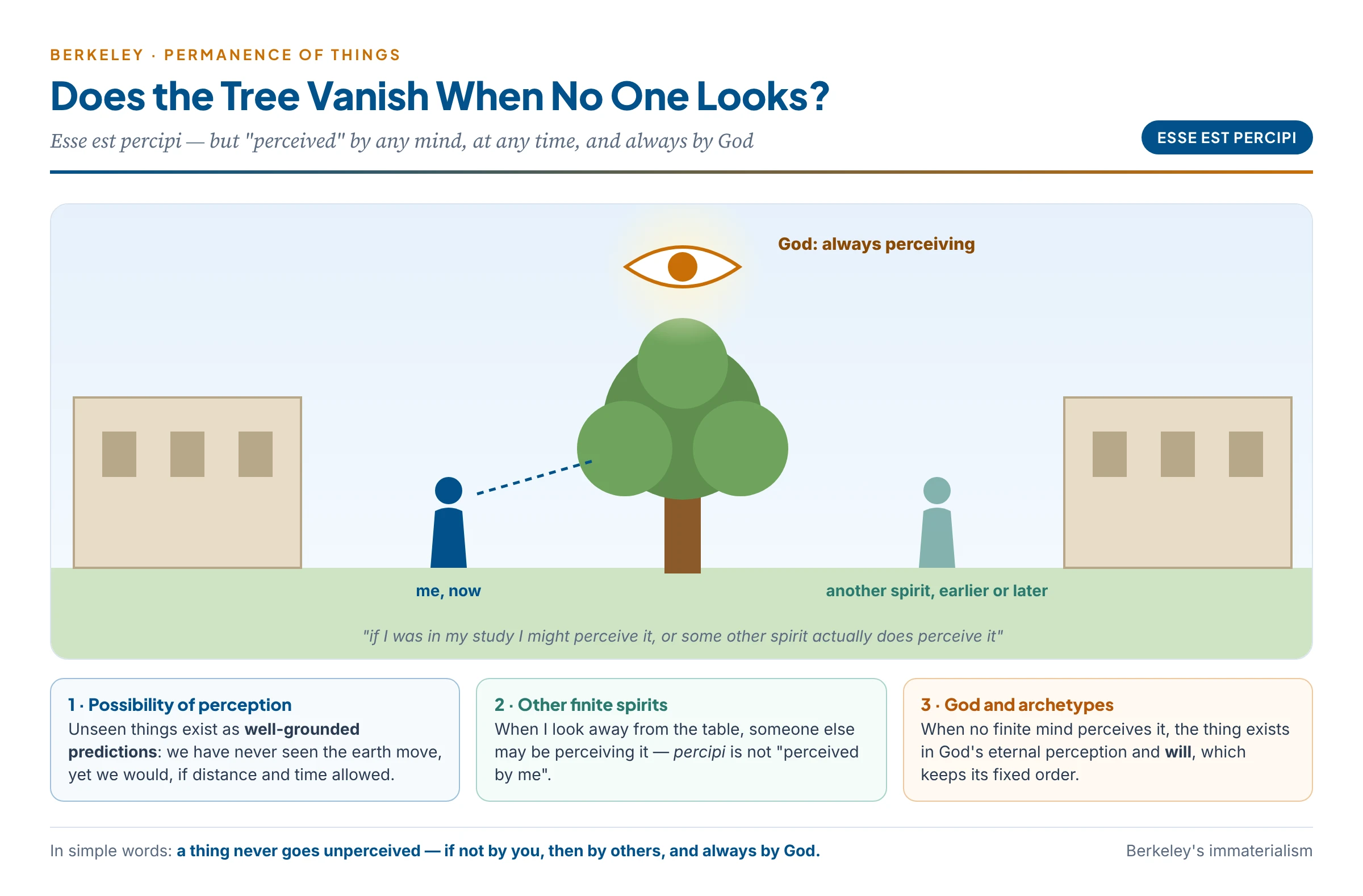
- “Then things vanish when no one looks.” No — what I do not perceive may be perceived by other spirits, and is always perceived by God.
- “What is the difference between real things and imaginary ones?” Real things (ideas of sense) are strong, lively, orderly and independent of my will — produced by God; imaginary ones are faint, arbitrary and made by me.
- “Do we eat and drink ideas and clothe ourselves with ideas?” In Berkeley’s sense, yes — the bread we eat is what we see, taste and digest; nothing is lost but the philosopher’s “matter.” The difficulty is only one of usage: “we ought to think with the learned, and speak with the vulgar.”
- “We see things at a distance, outside us — so they are not in the mind.” In dreams too we see things at a distance, yet dream objects are in the mind. Seen distance is itself a learned sign (New Theory of Vision).
- “Does the mind create ideas?” We create only imaginary ideas; ideas of sense, which we cannot control, are caused by God.
4. Externality of Things
If everything sensible is an idea “in” the mind, are there no things external to us? Berkeley answers by clarifying “in the mind.”
- “In the mind” is not “inside the head.” It means that a thing has entered into the knowledge relation with a subject — the relation is so universal that nothing escapes it.
- Things are external in five senses:
- They are objects for human perceivers — “not changing things into ideas, but ideas into things.”
- They are independent of the will of the individual perceiver: when I open my eyes, it is not up to me whether I see red or green.
- They are caused by God, a spirit external to all finite spirits.
- They copy archetypes — original ideas in God’s mind — which our ideas (ectypes) reproduce.
- Their reality is not exhausted by my perception: what is not in my mind may be in other finite minds.
5. Permanence of Things
If things are ideas, will they not be fleeting like ideas?
- Permanent possibility of perception. Things exist even when not now perceived, as well-grounded predictions of perception. We have never seen the motion of the earth, yet it exists as something we would perceive if the obstacles of time and distance were removed. (J. S. Mill later defined matter as “a permanent possibility of sensation.”)
- Other finite spirits. When I am not looking at the table, someone else may be perceiving it.
- God. When no finite spirit perceives it, the thing still exists because it is constantly perceived by God.
- Divine will and order. Things are not only perceived but willed by God in a fixed and uniform order; this gives them their self-standing character. From the human viewpoint things change constantly; in the eternal divine mind they are permanent.
Indian Connect — The tree in the quad, and the dream that ends
A famous limerick asked whether a tree in a college quadrangle ceases to exist when no one is about; the reply was that God is always about in the quad, so the tree goes on being. Indian philosophy met the same question in the debate with the Yogācāra idealists, for whom the world is “consciousness only” (vijñaptimātratā). The objectors (Nyāya, Mīmāṃsā, Advaita) asked: if objects are only in consciousness, why do they appear at fixed places and times, why do many people see the same thing, and why do they have real effects? Vasubandhu replied with the analogy of dreams, which also have place, time and effects — much as Berkeley used dreams to answer the “distance” objection. Śaṅkara, though himself an idealist about the ultimate, rejected Yogācāra: the waking world is not like a dream, because dreams are contradicted on waking while the waking world is not (vaidharmyāc ca na svapnādivat), and an external object is perceived as external (nābhāva upalabdheḥ).
6. Is Berkeley a Solipsist?
Solipsism is the view that only I exist (metaphysical solipsism), or that I can know nothing except myself and my own states (epistemological solipsism).
Why the charge arises:
- If a thing’s being is to be perceived and ideas exist only in minds, then all I can be sure of are my perceptions. There seems no proof of other minds or of a world beyond my ideas.
- Knowledge becomes soul-centred.
Berkeley’s replies:
- Ideas vs spirits. Ideas are passive; the regularity, resistance and order of sense-ideas show that they are not produced by me.
- God. The infinite spirit perceives all things and causes them by fixed laws; the world does not depend on any single finite mind.
- A public, shared world. Different people experience the same orderly world; this agreement is explained by God, not by private fancy.
- Other minds. We know other finite spirits through their effects — language, actions, purposeful behaviour — by analogy with our own.
- More than we know. “Many things, for aught I know, may exist, whereof neither I nor any other man hath or can have any idea or notion whatsoever.”
Verdict. Berkeley is not a solipsist in intention: he admits many finite spirits and God. Critics reply that his own principles give him no right to these: the “effects” by which I infer other minds are only my ideas, and a dreamer also meets many people who are only his own ideas.
Common confusion
Did Berkeley deny that the world is real, or say that things are illusions? Many notes say Berkeley “reduced the world to mental illusion” or that, for him, things “vanish when unperceived.” Both are wrong. Berkeley denied only matter — an unthinking substance existing outside all minds. He insisted that trees, houses and stones are real: they are vivid, orderly, independent of our will, shared by many perceivers and sustained by God. The difference between reality and illusion is, for him, the difference between ideas of sense (caused by God, orderly) and ideas of imagination (made by us, arbitrary). Things never “vanish,” because they are never wholly unperceived.
7. Spirits: The Only Substances
For Berkeley, spirits are the only true substances — active, perceiving, willing beings.
- Why spirits must be admitted. If spirits were only ideas, everything would dissolve into a mere succession of ideas, with no permanence and no one to perceive — complete scepticism. Ideas need a perceiver.
- Essence of spirit. Activity — the power to perceive ideas and to produce motion and change. “A spirit is one simple, undivided, active being — as it perceives ideas it is called the understanding, and as it produces or otherwise operates about them it is called the will.”
- Three kinds of spirits: (i) myself, (ii) other finite spirits like me, (iii) the infinite spirit, God.
How each is known:
- Myself — intuitively. I am immediately aware of myself (a) in perceiving ideas as mine, and (b) in calling up images and moving my body at will. This gives a notion, not an idea, of my self.
- Other finite spirits — by analogy. I know that I produce changes in things; when I see similar changes (a table made, words spoken), I infer beings like myself who made them.
- God — by His works. Treated next.
In simple words
When a message arrives on your phone saying “Running late, see you at 6,” you never see your friend — only letters on a screen. Yet you are sure a person sent it, because the words show purpose and meaning, like the words you send. Berkeley says this is exactly how we know other minds: we see only ideas (sounds, movements, a table made), but their order and purpose show an active spirit behind them, as in ourselves.
Arguments for finite spirits:
- Activity — ideas are passive and need an active perceiver.
- Self-awareness — I have a notion of myself in every act.
- Volition — I can produce ideas of imagination at will; willing presupposes an agent.
- Causation — ideas cannot cause ideas; only spirits act.
- Communication — meaningful speech and purposeful action show other minds behind them.
8. God: The Infinite Spirit
Berkeley’s immaterialism is built to make God necessary. His arguments:
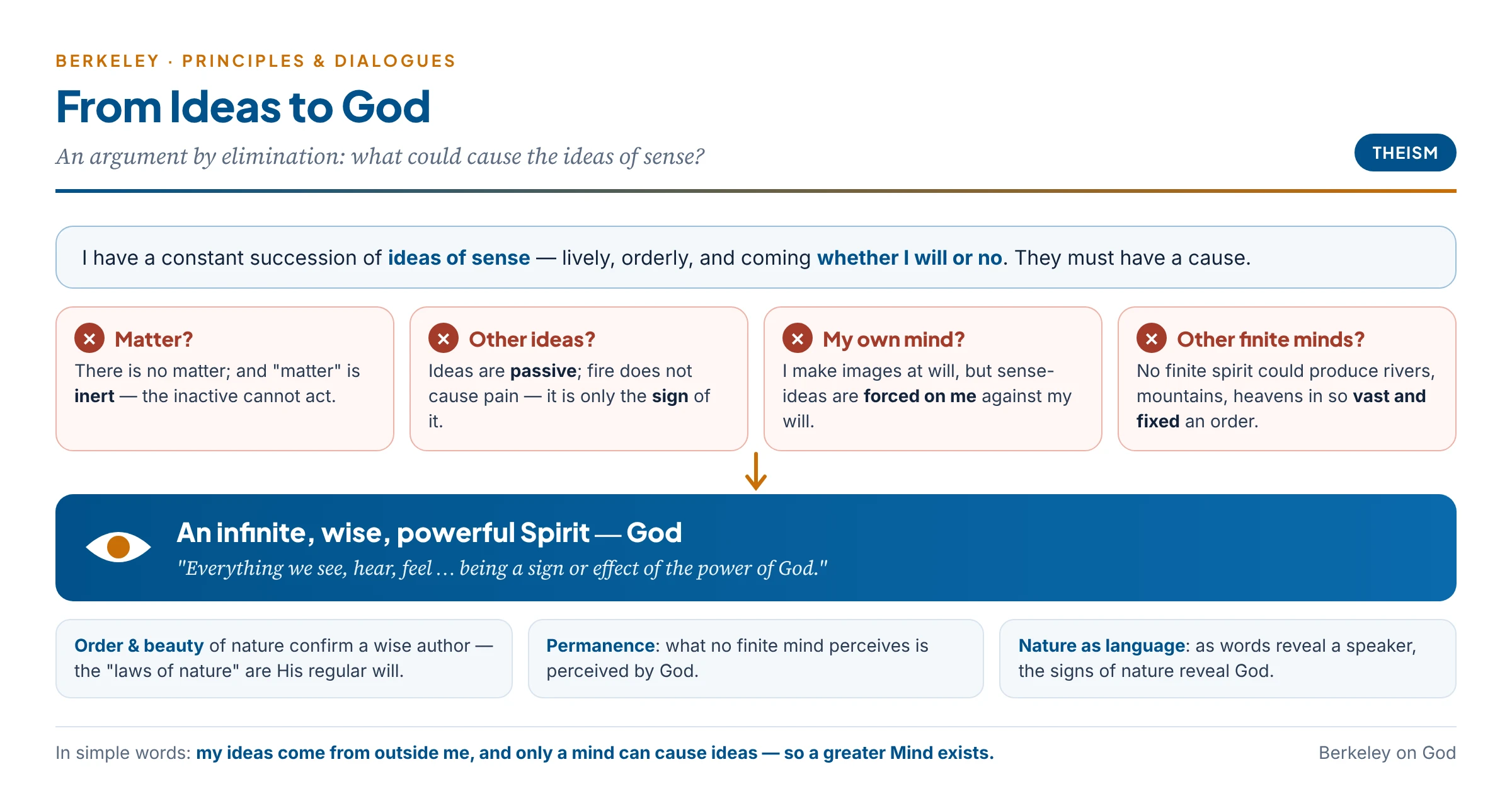
- The causal (cosmological) argument from passive ideas.
- I am aware of a succession of ideas of sense.
- They must have a cause: either matter, or other ideas, or a spirit.
- Matter does not exist and is inert; ideas are passive and cause nothing.
- So the cause is a spirit. But it cannot be my spirit: these ideas come whether I will or no.
- It cannot be any finite spirit: no finite mind could produce ideas in such a vast, fixed order — rivers, mountains, the heavens — independent of all human wills.
- Therefore an infinite, wise and powerful Spirit — God — causes them.
- Order and regularity (teleological argument). The fixed, uniform order of nature — the “laws of nature” — and its beauty and perfection reveal an intelligent, good author.
- Continuity of things. Things perceived by no finite spirit continue to exist; so they are perceived by an eternal mind.
- Involuntariness. Ideas of sense are forced on us; they come from a will other than ours.
- Nature as a divine language. As we know other men by the signs they give us, so nature is the language of God: everything we see, hear or feel is “a sign or effect of the power of God.” Our knowledge of God is in this sense clearer than our knowledge of other finite spirits. (This is sometimes called his mystical argument.)
“Everything we see, hear, feel, or any wise perceive by sense, being a sign or effect of the power of God.” — George Berkeley
Consequences:
- No causes in nature. One idea does not cause another; it is a sign of it. “The fire which I see is not the cause of the pain I suffer upon approaching it, but the mark that forewarns me of it.” Ideas are conjoined, not connected — a view Hume would generalise.
- Laws of nature = God’s regular will. God could have made fire cold or the sun dark; He keeps a fixed order for our benefit, so that we can predict and plan. Miracles are rare departures from this order.
- Science reads signs. Natural science discovers the grammar of God’s language, not hidden material powers.
9. Refutation of Dualism, Atheism and Scepticism
Berkeley claimed that by removing matter he had removed many “obscure and abstruse questions” at once.
- Dualism and scepticism. The split between objects in the mind and objects outside it was the root of scepticism: how can we know that what we perceive matches what we do not? Remove matter, and the senses are trusted again.
- Atheism and materialism. If a self-existent, unthinking matter is the origin of all things, freedom, intelligence and design are shut out of the universe. Without matter, the whole structure of atheism collapses.
- Idolatry. If the objects of sense are only clusters of sensations, it would be absurd to worship them.
- The resurrection. Objections to bodily resurrection based on the identity of material particles vanish once a body is understood as a collection of ideas God can produce again.
- Mind–body problem. With no matter, there is no puzzle of how mind and body interact.
10. Metaphysical Implications of Esse Est Percipi
- Immaterialism — material substance does not exist; sensible things are collections of ideas.
- Spiritualism — only spirits and ideas are real; spirits are the only substances.
- Theism — God is the cause of the order of ideas and the guarantor of the world’s permanence and objectivity.
- Anti-scepticism — appearance and reality coincide; what we perceive is what exists.
- No natural causation — ideas are signs of one another; God is the only true cause (close to occasionalism).
- Instrumentalism in science — scientific laws describe regularities among ideas; “forces” and “absolute space” are not hidden realities.
- Phenomenalism — the later view (Mill, Ayer) that material objects are logical constructions out of actual and possible sense-experiences grows from Berkeley’s analysis — though without his God.
- Idealism — the idea that mind is prior to matter, developed (in very different forms) by Kant and Hegel.
Critical Evaluation
Criticisms of Esse Est Percipi
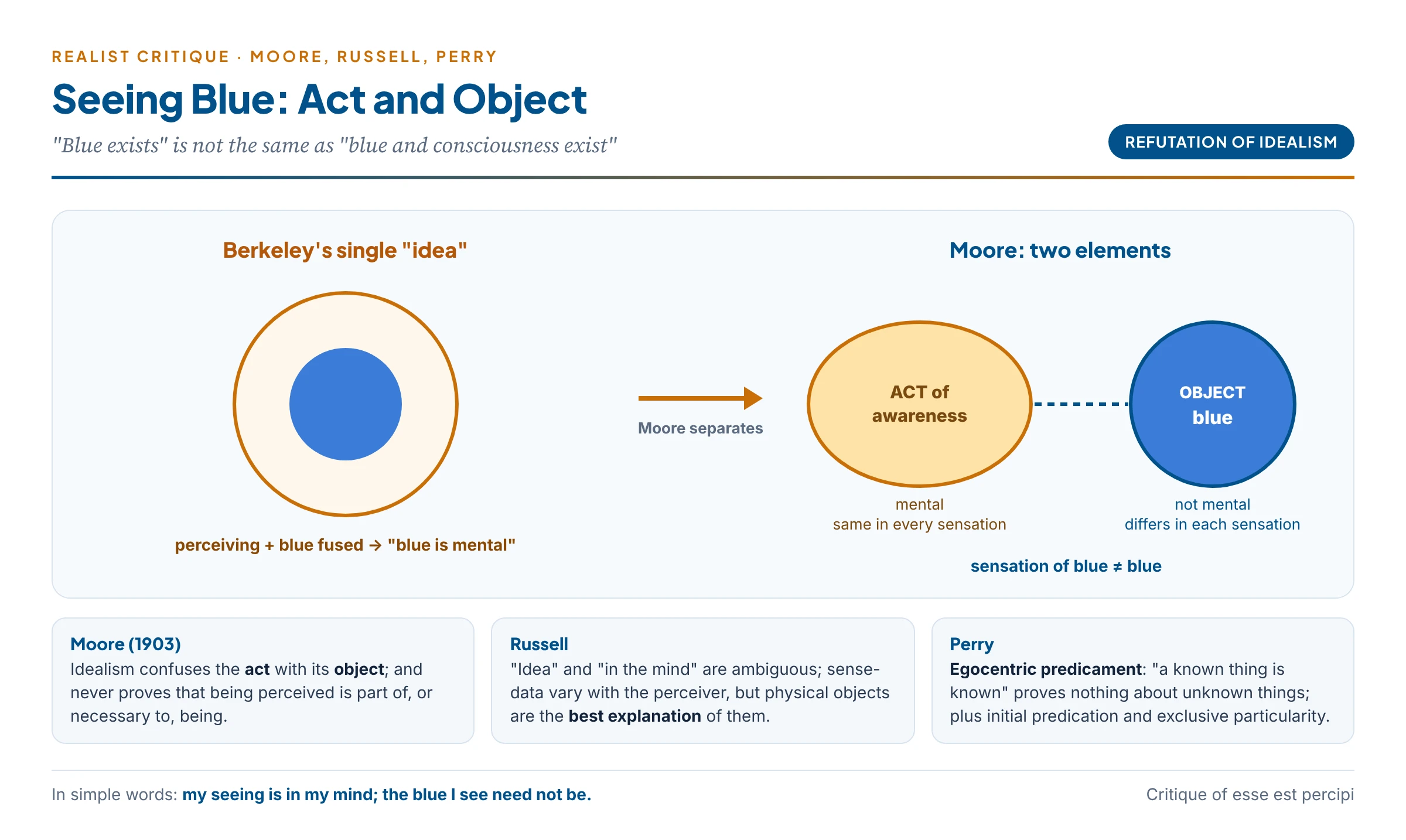
- Moore: act and object confused. In “The Refutation of Idealism” (1903), G. E. Moore argued that every sensation has two elements: the act of awareness (consciousness), which is common to all sensations, and the object (blue, green), which differs. The sensing of blue is mental; blue is not. Berkeley’s “idea” runs the two together and concludes that what is perceived is mental. “If anyone tells us that to say ‘Blue exists‘ is the same thing as to say that ‘Both blue and consciousness exist‘, he makes a mistake and a self-contradictory mistake.” Moore also noted that “esse is percipi” can mean (a) identity, (b) that being perceived is part of what being means, or (c) that being and being perceived are necessarily connected; idealists never proved any of these.
- Russell: “idea” and “in the mind” are ambiguous. In The Problems of Philosophy, Bertrand Russell granted that sense-data (the immediate colours and shapes) depend on the perceiver — they vary with position and with the body. But he argued that Berkeley confused the act of apprehending with the thing apprehended: to be “in the mind” means only to be before the mind. Nothing shows that what we are acquainted with is mental. And physical objects may well exist as the simplest explanation of our sense-data — the cat that appears in different places at different times must have existed in between.
- Perry: three fallacies. The American realist R. B. Perry found three errors:
- The egocentric predicament — any thing I mention is known by me; from this tautology (“a known thing is known”) nothing follows about whether things exist unknown. Berkeley’s challenge exploits a predicament, not a fact.
- Definition by initial predication — defining a thing by one of its accidental features. A cloth may be white, but whiteness is not what makes it cloth; being perceived may be an accident of a thing, not its essence.
- Exclusive particularity — assuming a thing can stand in only one relation. Rāma is husband of Sītā, son of Daśaratha and slayer of Rāvaṇa at once; a table is an idea in relation to a mind and a thing among things in relation to a chair.
- Inductive at best. If esse est percipi is a generalisation from experience, it rests on the weakest method — agreement without any possible negative instance — and could be only probable. Berkeley held it dogmatically.
- Common sense and science. Ordinary people believe that things exist unperceived; science explains phenomena by unobservables (atoms, electrons) and by events before any minds existed (the formation of the earth). Berkeley needs God to perceive them all.
- From knowing to being. Berkeley moves from “we know things only through perception” to “things exist only as perceived” — confusing epistemology with ontology.
- Private ideas, public world. No two people’s perceptions are the same; if things are perceptions, there are as many worlds as minds — Protagoras’s “man is the measure.” A shared world is secured only by bringing in God.
- Dr Johnson’s refutation. Told that Berkeley’s doctrine could not be refuted, Samuel Johnson kicked a large stone and said, “I refute it thus.” Philosophers note that this misses the point — Berkeley never denied that stones feel hard — but it captures the common-sense protest.
In simple words
Can you ever check whether the fridge light stays on when the door is closed? Every time you open the door to look, it is on. This does not prove the light is always on — only that it is on whenever you look. Perry’s “egocentric predicament” is the same point: every time we think of a thing, it is “perceived” by us; that tells us nothing about whether things exist when no one is thinking of them.
Criticisms of Berkeley’s God and Spirits
- Equivocation on “perception.” God “perceives nothing by sense as we do.” Divine “perception” is eternal and creative; human perception is temporal and passive. If God’s knowing is not perception, the world’s continued existence no longer rests on percipi in Berkeley’s own sense. Three outcomes are possible: if God’s perception is unknown to us — scepticism; if it is just like ours — subjectivism; if it is fuller but of the same kind — objective idealism. Berkeley never decided.
- Circularity. God is proved from our ideas, and the reality and permanence of our ideas are guaranteed by God.
- Spirits are assumed. Berkeley rejects matter because it is not perceived — but spirits are not perceived either. Hylas presses the point in the Dialogues: “you are only a system of floating ideas, without any substance to support them.” Hume drew exactly this conclusion.
- Other minds from passive ideas. The effects from which I infer other spirits are my passive ideas; how can they reveal active beings? The argument against matter can be turned against other minds.
- Kant. Any attempt to know the self as a substance produces the paralogisms of reason.
- Pain in God? If God perceives all ideas, does God perceive our pains? Berkeley says God knows pain without suffering it — but then God’s “perceiving” is again not perceiving.
- Mystical argument is not logical. “Nature is God’s language” is an inspiring picture, not a proof.
Is Berkeley’s Idealism Subjective?
Yes — it is subjective:
- Dependence on perception — sensible things exist only as perceived.
- Ideas exist only in minds — reality is mind-dependent.
- No mind-independent matter.
- Reality accessible only in consciousness — what we know directly are ideas.
- God’s will is arbitrary. The order of nature rests on God’s free choice, which could have been otherwise — not on a rational, necessary structure shared by all minds, as in objective idealism.
- A personal perceiving God. Berkeley’s reality depends on an actual personal mind, not on impersonal thought-categories valid in themselves.
No — it is not merely subjective:
- Not solipsism — many finite minds exist.
- God perceives all — things exist when no human perceives them.
- Objective order — the regularity of nature comes from God, not human minds.
- Independent of human will — sense-ideas are forced on us.
Conclusion. Berkeley’s idealism is subjective in denying any reality independent of some mind, but objective in grounding the world’s order in God rather than in individual human minds. It is often best described as theistic idealism or “theocentric phenomenalism.” Compared with Hegel, however, it remains subjective, as the next section shows.
Berkeley’s Subjective Idealism vs Hegel’s Absolute Idealism
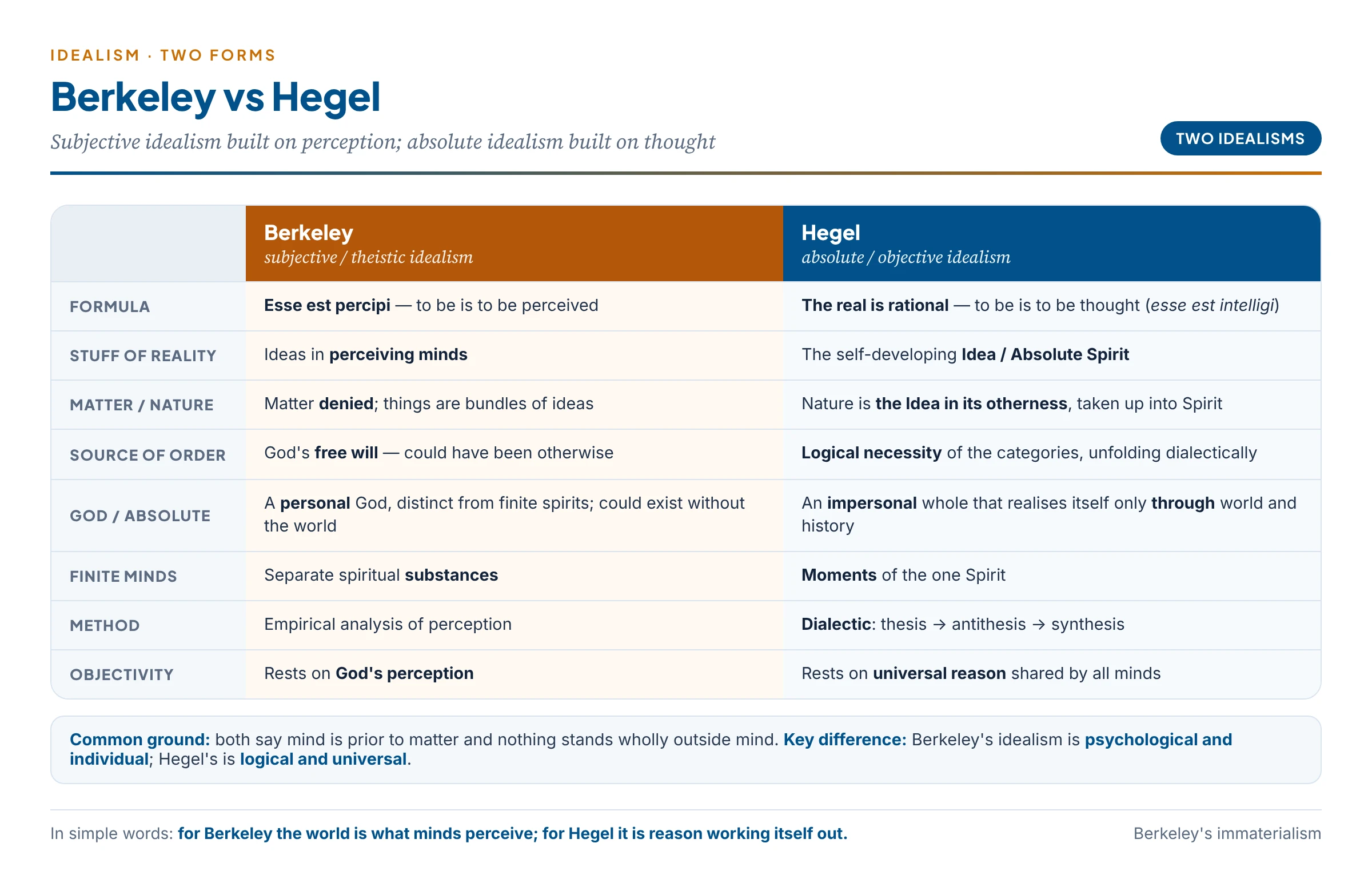
| Point | Berkeley — subjective (theistic) idealism | Hegel — absolute (objective) idealism |
|---|---|---|
| Formula | Esse est percipi — to be is to be perceived | Esse est intelligi — to be is to be thought; “the real is rational“ |
| Basis | Perception: sensible things are ideas in minds | Thought: reality is the self-unfolding of the Idea / Absolute Spirit |
| What is real | Finite spirits, their ideas, and God | The Absolute, which includes nature and finite minds as its moments |
| Status of nature | Collections of ideas; matter denied outright | Nature is real as the Idea in its otherness — matter is not denied but taken up (aufgehoben) into Spirit |
| Order of the world | God’s free will — could have been otherwise | Logical necessity of the categories, developing dialectically |
| Method | Empirical analysis of perception | Dialectic: thesis → antithesis → synthesis |
| God / Absolute | A personal God, an infinite subject, distinct from finite spirits | An impersonal, all-inclusive whole that realises itself through history and finite minds |
| God and world | God could exist without the world | Absolute and world are inseparable; the Absolute exists only through its self-manifestation |
| Individual minds | Separate substances | Partial expressions of one Spirit |
| Objectivity | Rests on God’s perception | Rests on universal reason shared by all minds |
| Starting point | British empiricism (Locke) | Kant’s critical philosophy |
- Common ground. Both are idealists: mind or spirit is prior to matter, and nothing is wholly outside mind.
- The key difference. Berkeley’s idealism is psychological and individual — tied to acts of perceiving by particular minds. Hegel’s idealism is logical and universal — reality is a rational system of concepts that is the same for all minds. Later idealists such as T. H. Green and F. H. Bradley kept Berkeley’s central claim — that thinking and perceiving are constitutive of things — but replaced percipi with intelligi.
- Kant between them. Kant attacked Berkeley’s “dogmatic idealism” in his “Refutation of Idealism,” arguing that inner experience itself requires something permanent outside me; his own transcendental idealism treats the world of appearances as real and empirically external, while things-in-themselves remain unknown.
Moore and Russell on Berkeley: How Do They Differ?
| Point | G. E. Moore | Bertrand Russell |
|---|---|---|
| Main target | The premise esse est percipi itself | The inference from “we know sense-data” to “only minds and ideas exist” |
| Key move | Act–object distinction: blue is not the sensation of blue | Ambiguity of “idea” and “in the mind”; act of apprehension vs thing apprehended |
| Status of what we perceive | The object of sensation exists independently of the act — it is not mental | Sense-data are private and depend on the perceiver’s body and position, yet are not mental acts |
| Physical objects | Known with common-sense certainty (“here is one hand”) | Not known directly but inferred as the simplest hypothesis explaining sense-data (the cat example) |
| Kind of realism | Direct, common-sense realism | Critical (representative) realism, later logical construction and neutral monism |
| Attitude to Berkeley’s relativity arguments | Rejects their idealist conclusion outright | Accepts that sense-data vary with the observer, but denies that this makes the physical world mental |
- Shared verdict. Both hold that Berkeley’s argument rests on a confusion between the mental act of perceiving and the object perceived, and both reject idealism.
- The difference. Moore attacks Berkeley head-on, denying that anything perceived is mental and defending common-sense knowledge of material things. Russell gives Berkeley more: he agrees that the immediate data of sense are relative to the perceiver, and so treats physical objects as inferred, not directly known.
What Can Be Said for Berkeley
- A valid point against Locke. If we know only ideas, the “matter” behind them is idle. Berkeley’s critique of representative realism has never been fully answered.
- Phenomenalism and positivism. Analysing material-object statements into statements about actual and possible experience inspired Mill, the logical positivists and Ayer — who regarded Berkeley more as an analyst of the concept of a material thing than a metaphysician.
- Physics and the observer. Quantum theory’s debates about the role of measurement, and the relativity of motion, give Berkeley’s emphasis on the observer a surprising afterlife (though no physicist needs his God).
- A grand vision. Even critics grant that idealism’s appeal lies in its vision of a world that is intelligible through and through, as the expression of mind.
Critics and Defenders
Criticism — Critics
- Moore: “blue” is not the sensation of blue; the act of awareness and its object are different.
- Russell: “idea” and “in the mind” are ambiguous; physical objects are the best explanation of sense-data.
- Perry: egocentric predicament, definition by initial predication, exclusive particularity.
- Hume: the arguments against material substance apply equally to spiritual substance and to God.
- Kant: inner experience presupposes something permanent outside me; Berkeley’s “dogmatic idealism” makes space and bodies imaginary.
- Dr Johnson and common sense: the stone is there whether or not I look at it.
Defence — Defenders and lasting value
- Berkeley’s reply: he denies only philosophers’ “matter,” not the reality of what we see and touch; stones are as hard as ever.
- Against representative realism: no one has shown how to check ideas against unperceived matter.
- Phenomenalists (Mill, Ayer): material things are permanent possibilities of sensation — Berkeley’s analysis without his God.
- Theists: God as the ground of a lawful, intelligible world answers materialism.
- Philosophy of physics: the role of observation and the relativity of motion echo Berkeley’s insights.
Cross-Tradition Comparison
Berkeley and Indian Idealism and Realism
| Point | Berkeley | Yogācāra (Vasubandhu, Dharmakīrti) | Advaita (Śaṅkara) | Nyāya |
|---|---|---|---|---|
| External matter | Denied | Denied — “consciousness only” (vijñaptimātra) | Empirically real (vyāvahārika); ultimately appearance (māyā) | Real and independent |
| What is real | Spirits and ideas | Momentary consciousness and its forms | One pure consciousness (Brahman) | Many substances, minds and atoms |
| Argument | Ideas cannot exist unperceived; matter is inert and useless | Blue and the cognition of blue are always perceived together, so not different (sahopalambha-niyama); atoms are incoherent | The world is not a private dream; it is public, but sublated by knowledge of Brahman | External objects are perceived as external |
| Why the world is orderly and shared | God produces ideas in a fixed order | Shared karmic seeds (vāsanā) in similar streams | Īśvara and māyā give a common world | Real objects cause similar perceptions |
| Self | Spirits are substances | No permanent self | Self = pure witness-consciousness | Eternal self |
| Answer to the dream objection | Dreams too show distance | Dreams too show place, time and effects | Dreams are contradicted on waking; waking is not | Dream objects are memory traces |
Indian Connect — Key takeaways
- Yogācāra is Berkeley’s closest Indian parallel. Both deny external matter and explain the world as consciousness. Dharmakīrti’s rule that the blue and the cognition of blue are always perceived together (sahopalambha-niyama) is a precise Indian form of esse est percipi.
- But the differences are deep. Yogācāra has no permanent self and no creator God; it explains the shared world through karmic impressions. Berkeley keeps substantial spirits and a personal God.
- Śaṅkara’s critique of Yogācāra mirrors the realist critique of Berkeley. The object is perceived as external; waking experience is not contradicted like a dream; so the world is not merely mental at the empirical level.
- Advaita is not subjective idealism. For Śaṅkara the world is public and objectively given at the practical level and unreal only from the standpoint of Brahman — closer to an absolute idealism than to Berkeley’s.
Synthesis (Siddhānta)
Esse est percipi is the meeting point of everything Berkeley argued. The critique of abstract ideas showed that “existence unperceived” is an empty abstraction; the collapse of primary into secondary qualities showed that every quality is an idea; the systematic refutation of matter showed that an unperceived substance can be neither perceived, inferred nor useful. What remains is a world of ideas perceived by spirits, held in order and permanence by God, whose regular will we call the laws of nature. In Berkeley’s own eyes this was not a denial of the world but its rescue — from scepticism, which doubts the senses, and from materialism, which makes God idle.
The doctrine’s weakness lies in its key word. “Perception” means both the act and its object; the realists Moore, Russell and Perry showed that from the mentality of perceiving nothing follows about the mentality of the perceived. And Berkeley’s God perceives in a sense so unlike ours that percipi loses its meaning just where it is needed most. Hume would press Berkeley’s own logic further — no impression of spiritual substance, no necessary connection, no proof of God — while Hegel and the absolute idealists would replace perception by thought as the stuff of reality.
- Philosophy of perception: the debate between direct realism, representative realism and idealism still begins from Locke and Berkeley.
- Science: whether theories describe hidden realities or only predict observations is Berkeley’s question in modern dress.
- Technology: simulated and virtual worlds make vivid the idea of a world whose “being is to be perceived.”
- Religion and nature: Berkeley’s vision of nature as the language of God still shapes theistic views of science.
For Berkeley the world is not a machine that God made and left alone, but a conversation God is having with us, one perception at a time.
Previous Year Questions
- 2024Is rejection of Locke’s notion of primary qualities instrumental in Berkeley’s leaning towards idealism? In this context, also discuss how Berkeley’s subjective idealism is different from the absolute idealism proposed by Hegel.
- 2020Critically discuss the following statement by Moore: “If anyone tells us that to say ‘Blue exists’ is the same thing as to say that ‘Both blue and consciousness exist’, he makes a mistake and a self-contradictory mistake.”
- 2018How does Berkeley establish that Mind and its ideas alone are real? How do Moore and Russell react to Berkeley’s view in this regard? Do you find any difference between Moore’s reaction and Russell’s one? Discuss.
- 2016Discuss the various stances on God taken by Rationalists and Empiricists.
- 2015Short note on “esse est percipi.”
- 2012If ‘to be is to be perceived’ then how does Berkeley explain the permanence of things?
- 2011What according to Empiricists is the concept of Substance? Discuss.
- 2010What metaphysical implications can be derived from Berkeley’s statement “Esse Est Percipi”?
- 2009“To be is to be perceived”. Discuss.
- 2003To be is to be perceived. Short notes.
- 2000“Esse est percipi”. Notes.