

A state that held a sixth of the earth’s land surface, thirty thousand nuclear warheads and a bloc of client regimes dissolved in twenty-two months without a foreign invasion, a civil war or a battle between its constituent parts. The Soviet Union ceased to exist on 25 December 1991 because its own republics decided it should. Explaining that, rather than narrating it, remains the sharpest test in modern international relations of whether structures or choices decide the fate of great powers.
The Puzzle: A Superpower Nobody Saw Falling

- The most striking feature of the collapse was its suddenness, and the second was that the profession that studied the Soviet Union failed almost entirely to anticipate it.
- Through the 1970s and early 1980s the literature was overwhelmingly about Soviet stability — how a single-party state managed succession, co-opted elites and absorbed dissent. The question asked was why the system endured, not whether it would end.
- This is a problem for social science and not merely for Sovietology. Disciplines built to explain regularities are poorly equipped to anticipate discontinuity — the conversion of accumulated quiet stress into a cascade.
- Regimes that suppress the expression of discontent also suppress the evidence of it, so the observer sees calm and mistakes it for consent.
- Preference falsification compounds this: where citizens conceal their views from each other as well as from the state, nobody knows how many dissenters there are, so opposition appears negligible until it appears overwhelming.
- Alexis de Tocqueville supplied the frame two centuries in advance, writing of the French monarchy in a sentence that describes the Soviet 1980s exactly.
“The most dangerous moment for a bad government is generally that in which it sets about reform.” — Alexis de Tocqueville
- The Tocquevillian mechanism has three steps, each visible in the Soviet case.
- Reform is an admission of failure — the ruler concedes that the system’s previous claims were false, weakening the justification for obedience.
- Reform raises expectations faster than it can satisfy them, so grievances tolerable under stagnation become intolerable under improvement.
- Reform relaxes coercion, and a system that substituted fear for legitimacy has nothing to fall back on.
- Two questions must therefore be separated. What made the system vulnerable is about long-run structure; what made it collapse in 1991 is about sequencing, choice and accident. Structure explains susceptibility, not timing or speed.
The Economic Foundations: A System That Stopped Growing
The command economy did not fail suddenly. It delivered rapid industrialisation, a war-winning military-industrial base and genuine gains in literacy, health and urbanisation, and then it ran out of the thing it was good at. From the mid-1970s Soviet growth decelerated continuously, and by the early 1980s the system was consuming resources faster than it could generate them.
The defects were structural, not managerial
- The chief long-term problem was economic though it had political roots: economic practice was dictated by ideology, so the defects could not be corrected without touching the doctrine that justified the regime.
- Inflexible central planning could push a few goods towards a few priorities but could not manage complexity: by the 1970s the apparatus was setting targets for millions of product lines, a computational problem no bureaucracy could solve.
- Gross output targets rewarded quantity, not productivity. A plant judged by tonnage made heavy goods, one judged by rouble value made expensive ones. Nothing rewarded a better product from fewer inputs.
- Innovation was actively disincentivised. Retooling risked this year’s target for a gain the plan would capture anyway, and success brought a ratchet effect — next year’s target raised to match — so the rational strategy was to conceal capacity.
- The soft budget constraint, in János Kornai’s term, removed the discipline failure imposes elsewhere: a loss-making enterprise was subsidised, not liquidated, so nothing died and nothing had to improve.
- Its mirror image was the shortage economy — with no penalty for hoarding inputs and no reward for satisfying customers, demand permanently exceeded supply at controlled prices, making queues and consumer scarcity structural rather than temporary.
- The second economy — private plots, moonlighting, black-market goods, bribery and diverted state property — filled the gap the plan left. It made the system liveable and so prolonged it, while normalising illegality and creating the class of operators who would be the first beneficiaries of privatisation.
- The political weaknesses were the economic ones in another register. Communist regimes were structurally unresponsive to popular pressure: without competitive elections, independent associations or a free media, a single-party state had no mechanism for articulating discontent or opening a dialogue between rulers and ruled.
The transition the system could not make
- The Soviet economy failed precisely at the point where the world economy became information-intensive. It had been designed to move steel, coal and men in bulk; it could not be redesigned to move ideas.
- The third industrial revolution ran on technologies of copying and communicating — the photocopier, the personal computer, the fax, the modem — and a state whose security rested on controlling reproduction and circulation could not diffuse them.
- Photocopiers were registered and guarded and computers concentrated in defence institutes. The instruments of productivity growth were, in Soviet conditions, instruments of subversion.
- Exclusion from world markets deepened the gap. As trade and investment internationalised from the 1970s, Western development was pulled forward by competition and the global division of labour, while the Soviet bloc, trading largely with itself through COMECON, was insulated from both the pressure and the opportunity.
- Cultural globalisation completed the damage. Radio and television carried images of a freer and visibly more prosperous West into communist societies, especially in Eastern Europe. Discontent in 1989–91 was in large measure a demand for Western living standards — economic backwardness expressed as a political claim.
Oil, grain and guns
- Hydrocarbon revenue had become the system’s shock absorber and it collapsed. The Siberian oil discoveries and the price spikes of 1973 and 1979 gave Moscow two decades of hard currency that paid for grain imports, consumer goods and the postponement of reform.
- The direction reversed in the mid-1980s. Saudi Arabia abandoned its swing-producer restraint in late 1985 and raised output sharply, and the world price fell from roughly $30 a barrel to about $10 in 1986.
- Soviet hard-currency earnings fell by billions of dollars in a single year, and a state that had used oil rents to avoid painful choices had to make them with less money than before.
- Yegor Gaidar, later the architect of Russia’s own market transition, made this the centre of his account: the Soviet Union had become a petro-state dependent on high prices to buy the grain that fed its cities, and the empire fell when it could no longer pay for bread.
- Agriculture was the system’s oldest failure. Collectivisation destroyed the incentive to produce, and the private plots occupying a small fraction of arable land yielded a disproportionate share of vegetables, meat and milk — a visible refutation of the collective principle.
- Poor harvests from the late 1970s turned inefficiency into dependency, and the world’s largest country by land area became one of the world’s largest grain importers.
- The defence burden was extraordinary and its precise size is genuinely unknown. Western intelligence estimates converged on something like 15–17% of Soviet GNP; later Russian and Western reassessments put it considerably higher, up to a quarter of output.
- The imprecision is part of the story. Soviet statistics were unreliable at the source — administered prices carried no scarcity information, managers inflated output for bonuses, defence spending was hidden in civilian budget lines, and the headline aggregate was net material product, which excludes most services and is not comparable with GNP.
- The comparative point is safe: the United States sustained a defence effort of roughly 6% of a far larger economy, so rough military parity was bought out of an economy perhaps half the size, with the best engineers, plant and materials.
- The military-industrial complex was the one sector that worked, and its priority claim starved the civilian economy of exactly what might have modernised it.
The Soviet Union did not lose the arms race. It won it, and the price of winning was the economy that was supposed to justify the victory.
Imperial Overstretch: The Cost of Being a Superpower
- Superpower status was an expense the economy could not carry, and by the 1980s the periphery consumed rather than generated resources — the pattern Paul Kennedy identified, in which strategic commitments outrun the base that funds them.
- Afghanistan was the most visible drain and its damage was moral as much as material. The war itself belongs to the Cold War’s chronology; what concerns the collapse is what it did to the Soviet system.
- Roughly fifteen thousand Soviet dead, many times that number wounded and over half a million personnel rotated through the theatre in nine years produced a veteran generation — the Afgantsy — whose experience contradicted every official account of the war.
- It broke the myth of an invincible Red Army, whose prestige had been foundational to the regime’s claim on loyalty since 1945, and it opened a rift between Party and military.
- It created new forms of political participation — veterans’ associations, soldiers’ mothers’ committees — that were organised, aggrieved and outside Party control. The withdrawal completed in February 1989 removed the expenditure without removing the delegitimation.
- The external empire was subsidised, not exploited. This is the inversion that makes the Soviet case unusual among empires.
- Eastern Europe received oil and gas below world prices and sold manufactures back at prices no world buyer would have paid; the bloc was a net transfer from Moscow.
- Cuba received a subsidy estimated at around a quarter of its national income, chiefly through sugar bought above the world price and oil sold below it. Vietnam, Mongolia, Ethiopia, Angola and North Korea drew comparable support in arms, project aid and concessional trade.
- The Strategic Defense Initiative of 1983 mattered chiefly through uncertainty. Announced as a space-based missile shield, it was technologically implausible then and remained so.
- The Soviet leadership could not be sure it was a bluff. If it worked even partially it would degrade the retaliatory capability on which Soviet security rested, so the prudent response was to fund countermeasures against a system that might never exist.
- It threatened to move the competition onto exactly the terrain — microelectronics, computing, sensors, software — where the Soviet lag was widest, and signalled that the United States could contemplate a leap the Soviet Union could not follow.
- SDI’s effect was on Soviet calculations of the future rather than on the present balance, which is why it strengthened the reformers’ argument that the arms race had to be ended rather than continued.
Reform and Its Sequencing: Gorbachev from March 1985
The prelude
- The leadership knew it was in trouble before Gorbachev arrived. The late Brezhnev years — the zastoi, or stagnation — combined gerontocracy at the top with visible decay below, and the succession crisis of 1982–85 advertised the problem.
- Yuri Andropov, General Secretary from November 1982 to February 1984, came from the KGB with the fullest picture of the economy’s condition and attempted discipline rather than reform — anti-corruption drives, labour discipline campaigns. He also promoted the younger officials, Gorbachev among them, who would attempt something larger.
- Konstantin Chernenko, from February 1984 to March 1985, was a restoration of the old guard and a year of drift; his death made generational change unanswerable.
- Mikhail Gorbachev became General Secretary on 11 March 1985, at fifty-four, the first Soviet leader with a university legal education and the first born after the revolution. He intended to save the system, not to end it — a point on which almost all scholarship now agrees and which is essential to judging him.
Four programmes, in the wrong order
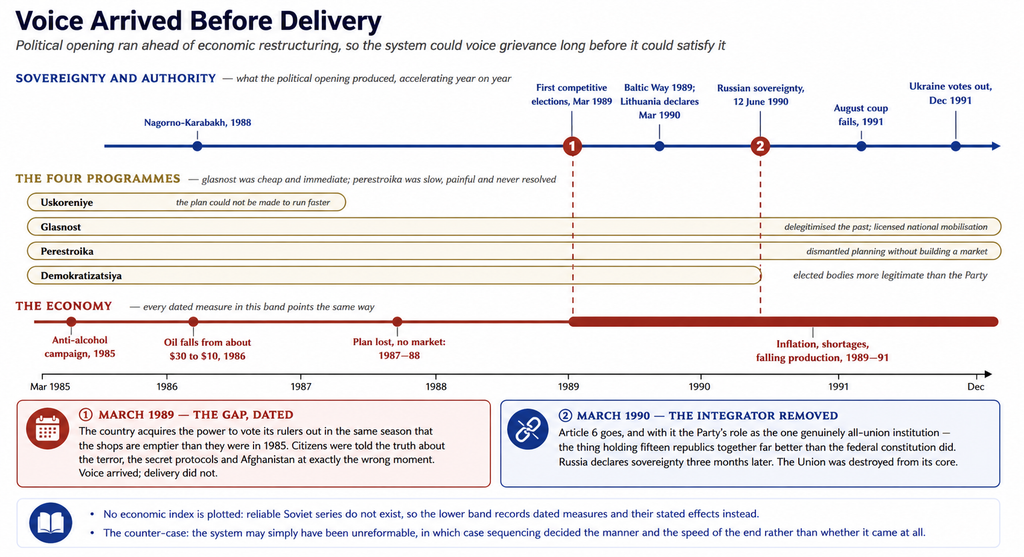
| Programme | Meaning | Introduced | What it was meant to do | What it actually did |
|---|---|---|---|---|
| Uskoreniye | “Acceleration” | 1985 | Raise growth by discipline and investment, within the plan | Failed in two years; the plan could not run faster |
| Perestroika | “Restructuring” | From 1986–87 | Enterprise autonomy, cooperatives, partial market signals | Dismantled planning without building a market |
| Glasnost | “Openness” | From 1986 | Expose corruption so reform could beat bureaucratic resistance | Delegitimised the regime’s history; licensed national mobilisation |
| Demokratizatsiya | “Democratisation” | 1988–90 | Give reform a popular base against Party conservatives | Created elected bodies more legitimate than the Party |
- The anti-alcohol campaign of May 1985 was the first measure and a warning about the rest. It cut consumption and, briefly, mortality, while removing one of the largest sources of budget revenue and driving production into illegal distilling — so it worsened the fiscal position it was meant to strengthen.
- The Chernobyl disaster of April 1986 converted glasnost from a slogan into a practice. The reflex was concealment, the concealment failed publicly, and the leadership’s own conclusion was that secrecy had become more dangerous than disclosure.
- The Law on State Enterprises of 1987, effective from 1988, gave enterprises self-financing, control over part of their output and elected managers.
- The result was neither plan nor market: enterprises raised wages and cut deliveries of cheap goods while still facing no hard budget constraint, so the state lost control of the plan without gaining competitive discipline.
- The Law on Cooperatives of 1988 legalised private enterprise in effect if not in name — the first legal private sector since the 1920s, and the first legal channel for moving state assets into private hands.
- The effect of the economic changes was catastrophic in the short run. Planning was in abeyance with no market mechanism in its place: the reforms cut the ground from under the old system without building a viable new one. Inflation, shortages and falling production were compounded by rising crime, social disarray and pervasive uncertainty.
The political opening
- The Congress of People’s Deputies elections of March 1989 were the first competitive national elections in the Soviet Union since 1917.
- A third of seats were reserved for public organisations, but the contested seats defeated senior Party officials, and the televised sessions from May 1989 gave the country a spectacle it had never seen: Andrei Sakharov challenging the leadership live, and Boris Yeltsin returning from disgrace.
- The Congress created an alternative source of legitimacy. Once officials could be voted out, Party appointment ceased to be an adequate title to rule.
- March 1990 was the decisive constitutional moment. The Congress abolished Article 6 of the Constitution, which guaranteed the Communist Party’s “leading and guiding” role, and simultaneously created an executive presidency for Gorbachev.
- Abolishing Article 6 removed the legal basis of single-party rule and with it the Party’s function as the integrating framework of the whole state — the mechanism that held fifteen republics, a planned economy and an army together far more effectively than the federal constitution did.
- The presidency was meant to give Gorbachev a base independent of a Party he could no longer control. He insisted on election by the Congress rather than by the people, unopposed — critics and supporters alike noted the irony of a leader preaching democracy while claiming to stand above it.
Did glasnost outpace perestroika?
- The central claim about Gorbachev’s reforms is one of sequencing. Political opening ran ahead of economic restructuring, so the system acquired the capacity to voice grievance before it acquired the capacity to satisfy it.
- Glasnost was cheap and immediate; perestroika was slow, contested and painful, and its first effects were negative even where it would eventually have worked.
- The result was legitimacy loss without material gain. Citizens were told the truth about the famine, the terror, the Molotov–Ribbentrop protocols and Afghanistan at exactly the moment when the shops were emptier than before.
- The counter-argument is that the system was unreformable, and that the sequencing determined the manner of the end rather than whether it came.
- Economic reform without political change requires an authoritarian apparatus willing and able to impose losses. The Soviet nomenklatura was the obstacle to reform, not its instrument, and Gorbachev opened politics precisely because he could not move the bureaucracy any other way.
- The Chinese comparison also flatters: China in 1978 was a poor agrarian economy that decollectivisation alone could release into growth, while the Soviet Union in 1985 was over-industrialised, urbanised and militarised, with no equivalent reform available.
- And the Soviet Union was a multinational empire, which China was not. Any real liberalisation in a federation of nations is a liberalisation of nationalism.
- The reasonable judgement lies between the two. Sequencing was a genuine causal factor, making collapse rather than transition the likely outcome, and making it fast.
- But an alternative sequence would have bought years, not a reprieve: the economic model had no path to the information economy, and the federal structure had no answer to self-determination once coercion was withdrawn.
The Nationalities Question: A Federation Built for Secession
The Soviet Union was not a nation-state with minorities. It was a constitutional union of national republics, and that design supplied the units, the borders, the languages, the elites and even the legal right by which it was eventually taken apart. The federal form had been intended to contain nationalism by conceding its symbols while denying its substance; when the substance became available, the symbols were already in place.
Why the federal structure was a secession machine
- The union republics were built as nations, deliberately. Between the 1920s and 1936 boundaries were drawn — in Central Asia by redrawing the former khanates of Bukhara and Khiva and the Tsarist territory of Turkestan — to give each titular nationality a defined homeland.
- Territorial delimitation consolidated group identities that had previously been divided among different political units, and so prevented from forming at all.
- Soviet modernisation then supplied everything a nation needs: literary languages created or standardised, schools, universities, publishing, film and theatre in titular languages, rising literacy, and an indigenous administrative cadre trained to run each republic.
- By the 1980s each republic possessed a national intelligentsia, bureaucracy and historiography — a state apparatus waiting for a state.
- Each republic also had a constitutional right to secede, formally meaningless for seventy years and decisive the moment the centre would not enforce its meaninglessness.
- Migration made the republics multi-ethnic at the same time. In Kazakhstan the titular nationality had fallen below 40% of the population, with Russians almost equally numerous and concentrated in the north and east; where minorities were large, national assertion produced counter-mobilisation and violence. The institutions that made secession possible made post-Soviet borders contestable.
- The Communist Party was the only genuinely all-union institution, cross-cutting every republic and disciplining every republican elite. Its erosion in 1990 removed the integrating force, transforming the politics of the centre and simultaneously threatening the structure of the Union itself.
The Baltic path: from a secret protocol to independence
- The Baltic case was unique because its legal grievance was specific. Estonia, Latvia and Lithuania had been independent states annexed in 1940 under the secret protocols of the Molotov–Ribbentrop Pact, an annexation the West never recognised.
- Soviet governments had denied the protocols existed. Glasnost made the documents discussable, and once the annexation was admitted to have followed a deal with Nazi Germany, Baltic independence became a claim about restoring legality rather than about seceding.
- The popular fronts, formed in 1988 as supporters of perestroika, became within two years the vehicles of independence, and the mobilisation was disciplined and non-violent.
- The Baltic Way of 23 August 1989 was the defining act: on the fiftieth anniversary of the Pact, roughly two million people formed a human chain of about 675 kilometres linking Vilnius, Riga and Tallinn. In December 1989 the Congress of People’s Deputies formally condemned the secret protocols.
- The sequence then moved quickly. Free elections in early 1990 produced pro-independence majorities in all three republics; Lithuania declared the restoration of independence on 11 March 1990, the first republic to do so, with Estonia and Latvia declaring transition to independence in the following weeks.
- Moscow answered with an economic blockade of Lithuania and then, in January 1991, with force in Vilnius and Riga, where troops seized the television tower and other buildings and civilians were killed.
- The crackdown failed and cost Gorbachev what remained of his reformist credit abroad and his authority at home. It demonstrated that the centre would use violence and that it would not use enough of it to succeed — the worst of both options.
The Caucasus and Central Asia
- Nagorno-Karabakh was the first nationality conflict of the perestroika era and the one that never ended. An Armenian-majority autonomous oblast inside Soviet Azerbaijan voted in February 1988 to transfer to Armenia; anti-Armenian pogroms followed at Sumgait, and the dispute escalated into war between two union republics while the Union still existed.
- Moscow’s inability to resolve it showed that the centre had lost its arbitrating function — the deeper meaning of the crisis for every republic watching.
- The conflict outlived the state that produced it: war in 1992–94, renewed war in 2020, and the Azerbaijani offensive of September 2023 that emptied the territory of its Armenian population.
- Georgia radicalised after 9 April 1989, when Soviet troops killed twenty demonstrators in Tbilisi. Independence in 1991 brought its own secessionist wars in South Ossetia and Abkhazia — the pattern in which a republic that secedes from the Union faces secession from within.
- Central Asia did not ask to leave. Independence movements were far weaker there, the leaderships were communist and remained so, and the republics had every economic reason to stay in a union that subsidised them.
- Independence arrived in Central Asia as something done to it, leaving five states with borders drawn in Moscow, economies designed as inputs to an all-union plan, and large Slavic minorities whose skills they needed.
- The consequences were severe: a transition recession with sharp falls in output and employment; language laws of 1989–90 elevating titular languages, which prompted a large exodus of Russians who had supplied a disproportionate share of skilled labour; and in Tajikistan a five-year civil war driven by regional and clan divisions.
- The leaderships then softened the nationalising measures — extending language deadlines, restoring Russian as a language of inter-ethnic communication, granting dual citizenship in some cases — because the emigration of skilled minorities was doing more damage than the nationalism was doing good.
Russia as the decisive defector
- The Union was destroyed from its core, not its edges, and this is the point most accounts underplay. The Baltic republics were a small share of population and output; the Union could have survived their departure but not Russia’s.
- The Russian republic was the anomaly in the federal design. It held about half the population and most of the territory and industry.
- Precisely because it was the Union in most people’s minds, it had been denied the trappings the others had — no separate Russian Communist Party for most of Soviet history, no apparatus of its own.
- Boris Yeltsin converted that anomaly into a weapon. Elected Chairman of the Russian Supreme Soviet in May 1990, he built the missing Russian institutions and turned them against the centre.
- The Russian declaration of sovereignty of 12 June 1990 asserted the primacy of Russian over Soviet law. Most other republics issued equivalent declarations within months — the “parade of sovereignties” — and the resulting “war of laws” left the Union government unable to legislate, tax or enforce.
- On 12 June 1991 Yeltsin was elected President of Russia by direct popular vote, the only leader in the country with a mass democratic mandate, against a Soviet President chosen by a congress.
- A union whose largest republic has defected is not a union. Once Russia — the paymaster and the source of the subsidies — decided it was better off without the centre, no arrangement of the remaining republics could hold.
The Sinatra Doctrine and the Loss of the External Empire
- The Brezhnev Doctrine had been the load-bearing assumption of the Eastern bloc: that the Soviet Union would intervene militarily to preserve socialism wherever it was threatened, as at Budapest in 1956 and Prague in 1968.
- Its function was psychological: every calculation in Eastern Europe had been made in the shadow of Soviet tanks, and that shadow, not the local security services, was what made the regimes look permanent.
- Gorbachev replaced it with the “Sinatra Doctrine”, as a Soviet spokesman labelled it — Eastern Europe could “do it their way”, and Moscow would not intervene. The reasoning was economic: the external empire was a net cost, and intervention would destroy the Western relationships domestic reform depended on.
- This was the proximate trigger of 1989. Nothing changed inside the East European states except the removal of an external guarantee, and every regime fell within months once its population understood that the guarantee was gone.
- Poland held partly free elections in June 1989; Hungary opened its Austrian border and dismantled its own party rule; East Germany lost its population through Hungary and then, on 9 November 1989, its wall; Czechoslovakia’s Velvet Revolution took six weeks; Romania ended with Ceaușescu’s execution on 25 December 1989.
- The demonstration effect ran straight back into the Soviet Union. If Moscow would not stop Poland and Hungary, the Baltic republics could ask why it would stop them, and every republic could see that the centre’s threats were no longer credible.
- The Cold War was declared over at the Malta Summit of December 1989, where Gorbachev and George H. W. Bush announced an end to hostilities. The Soviet Union still had two years to run: everything that follows happened after the Cold War had formally ended.
- The institutional shell followed within eighteen months. COMECON was dissolved on 28 June 1991 and the Warsaw Pact on 1 July 1991, removing the economic and military architecture of the Soviet position in Europe.
The Brezhnev Doctrine was never tested in 1989. It was simply withdrawn, and everything that had rested on it fell within the year.
The Endgame: From the War of Laws to 25 December 1991
The attempt to save the Union
- The referendum of 17 March 1991 was Gorbachev’s attempt to convert popular sentiment into a mandate, asking whether voters considered it necessary to preserve the USSR as “a renewed federation of equal sovereign republics” guaranteeing the rights of all nationalities.
- About 78% of those voting said yes, on a turnout near 80% — a result Gorbachev could point to and Yeltsin could ignore.
- Six republics boycotted it entirely — Lithuania, Latvia, Estonia, Georgia, Armenia and Moldova — so it measured opinion only where the Union was not seriously contested. Russia attached a second question to the same ballot, on creating a Russian presidency, which passed and gave Yeltsin his mandate.
- The Novo-Ogaryovo process was a genuine attempt at settlement: from April 1991, Gorbachev and the leaders of nine republics worked on a New Union Treaty converting the USSR into a looser confederation with a common president, foreign policy and armed forces, and far greater republican control over taxation.
- The treaty was to be signed on 20 August 1991. It was never signed.
The August coup and its consequences
- The coup of 19–21 August 1991 was launched by the men the treaty would have demoted — the State Committee on the State of Emergency of the Vice-President, Prime Minister, Defence and Interior Ministers and KGB chairman — with Gorbachev detained at Foros in Crimea.
- It failed in three days because the plotters would not order sustained violence, parts of the armed forces would not obey, and there was public resistance in Moscow and Leningrad centred on the Russian parliament.
- Yeltsin, not Gorbachev, defeated it. Standing on an armoured vehicle outside the Russian White House, he became the visible defender of legality, and the authority he gained was Russian authority exercised against Soviet institutions.
- The failure destroyed the centre far more thoroughly than success would have.
- Every all-union institution that mattered — Party, KGB, army command, Interior Ministry — was implicated, and was discredited, purged or dissolved within weeks. Communist Party activity was suspended and then banned on Russian territory by Yeltsin’s decrees and its property seized.
- Gorbachev returned to a country that had moved past him, President of a union whose army, security services, treasury and party had been taken over or abolished by the Russian republic. Ukraine declared independence on 24 August, and most of the rest followed within weeks.
- The Ukrainian referendum of 1 December 1991 ended the argument: over 90% voted for independence on a turnout above 84%, with majorities in every region including the east.
- Without Ukraine there was no Union worth preserving — the second republic by population and output, the agricultural heartland and the site of much of the strategic arsenal. Yeltsin had said Russia would not sign a treaty Ukraine refused.
Dissolution
| Date | Event | Significance |
|---|---|---|
| 12 June 1990 | Russian declaration of sovereignty | Begins the parade of sovereignties and the war of laws |
| 17 March 1991 | Union referendum, ~78% for preservation | Six republics boycott |
| 12 June 1991 | Yeltsin elected President of Russia | A mandate the Soviet President lacks |
| 19–21 August 1991 | The coup fails | Destroys Party, KGB and army command as political forces |
| 1 December 1991 | Ukrainian referendum, over 90% for independence | Removes the second pillar of any union |
| 8 December 1991 | Belovezha Accords | The USSR declared at an end; the CIS created |
| 21 December 1991 | Alma-Ata Protocol | Eight further republics accede |
| 25 December 1991 | Gorbachev resigns | Office and state abolished together |
- The Belovezha Accords of 8 December 1991 were signed at a hunting lodge in the Belovezhskaya Pushcha by Yeltsin, Leonid Kravchuk and Stanislav Shushkevich — the three Slavic republics that had founded the Union in 1922 and therefore, on their own reading, could dissolve it.
- The text declared that “the USSR as a subject of international law and a geopolitical reality ceases to exist” and established the Commonwealth of Independent States in its place. Gorbachev denounced it as illegal and had no instrument with which to act.
- The Alma-Ata Protocol of 21 December 1991 brought in eight more republics, making eleven CIS members; Georgia joined only in 1993 and the Baltic states never did.
- Gorbachev resigned on 25 December 1991 and the Supreme Soviet dissolved the state the next day. Fifteen successor states replaced one, and Russia was recognised as the continuator state, taking the Soviet seat on the Security Council, the embassies, the treaties, the debts and the nuclear arsenal.
- The CIS was a mechanism for a managed divorce rather than a successor union, giving the republics a framework for dividing assets, debts, forces and currencies without war — a substantial achievement measured against Yugoslavia, and never an effective integrating body.
- Its membership has eroded: Georgia withdrew after the 2008 war, Ukraine exited its bodies after 2014, and Turkmenistan holds only associate status.
Why the Union Fell: Six Explanations and a Weighting
The disagreement among historians and political scientists here is real and unresolved, and it maps onto the oldest argument in the discipline — whether outcomes are produced by structures or by choices.
| Explanation | Core claim | Best evidence | Where it is weak |
|---|---|---|---|
| Structural / economic | A command economy could not sustain a superpower once growth stopped | Deceleration; failure at the information frontier; oil-revenue collapse | Explains susceptibility, not timing or speed |
| Agency / Gorbachev | His choices made collapse the form the crisis took | The Andropov alternative; the Chinese counterfactual | Underrates his constraints; he could not modernise through the nomenklatura |
| External pressure | Reagan’s build-up and SDI forced the crisis | The 1980s competition; the oil collapse; the technological gap | Decline predates Reagan; Politburo records show internal drivers dominating |
| Ideological exhaustion | Nobody, the elite included, believed in the project | Late-Brezhnev cynicism; officials turning overnight into nationalists | Belief is hard to measure; regimes survive disbelief routinely |
| Nationalities | A federation with national institutions could not survive liberalisation | Baltic mobilisation; the parade of sovereignties; Russia’s defection | Central Asia did not want independence; nationalism was partly an effect |
| Inevitability vs contingency | Either the flaws doomed it, or specific events produced an avoidable end | Flaws are undeniable; so is the coup’s failure, which nobody planned | Inevitability is unfalsifiable; contingency ignores accumulated stress |
- The “natural death” reading holds that Soviet communism died of causes internal to itself — that the model’s structural flaws doomed it more surely than the contradictions Marx identified in capitalism, and that no external actor was required.
- The weighting worth defending has four ranked terms.
- First, the economic structure, necessary to every other explanation. Without stagnation there is no reform imperative, no fiscal crisis and no reason for republics to think themselves better off alone.
- Second, the nationalities structure, which determined the shape. The same stress in a unitary state produces a change of regime; in a national federation it produced fifteen states.
- Third, reform sequencing, which determined timing and speed, turning a chronic condition into an acute one within five years.
- Fourth, external pressure, real but secondary — tightening the constraint and shortening the timetable rather than creating the crisis.
- Contingency belongs in the account without dominating it. A competent coup, acceptance of the 500-day marketisation programme, a union treaty signed a fortnight earlier — each would have altered the path. None restores growth to a command economy or removes the constitutional right of fifteen nations to leave.
Structure made the collapse possible, nationality made it fifteen states rather than one revolution, and sequencing made it happen in six years.
What the Collapse Did to International Politics
The end of bipolarity and of the discipline it imposed
- The structural change was the removal of one pole, and with it the organising principle of world politics since 1945. Alignment had been the first question asked of any state or dispute; after 1991 it was often not a question at all.
- Bipolarity had been a disciplining system as well as a dangerous one: each superpower restrained its clients to avoid entanglement, and fear of escalation limited how far a local conflict could run. Conflicts frozen by patronage were unfrozen.
- The immediate aftermath was a unipolar world with the United States as the only superpower, together with an optimism about a liberal order under American leadership that did not survive the decade. What that primacy became is treated separately in this archive.
- The Warsaw Pact and COMECON disappeared while NATO survived and grew — the most consequential asymmetry of the settlement, and the origin of Russia’s grievance about it.
The Security Council unblocked, and briefly
- The Cold War had paralysed the UN Security Council, since two veto-holding members stood on opposite sides of nearly every dispute. Soviet decline removed the obstruction before the Soviet Union itself disappeared.
- The Gulf War of 1990–91 was the demonstration: Moscow voted with Washington to authorise force against Iraq, its own former client, and President Bush declared a “new world order” in which aggression would meet collective response.
- The unblocking was real and short. Resolutions and peacekeeping deployments multiplied before Somalia, Bosnia and Rwanda exposed the gap between authorising an operation and fighting one, and Kosovo and Iraq restored the great-power split.
NATO’s survival, enlargement and the assurances controversy
- An alliance formed against a threat that no longer existed did not dissolve; it enlarged. Poland, Hungary and the Czech Republic joined in 1999, seven more states in 2004, and the alliance now has 32 members after Finland and Sweden acceded in 2023 and 2024.
- The assurances controversy is a genuine dispute over what was said in 1990, and much subsequent Russian argument rests on it.
- Declassified records show Western statesmen, including Secretary of State James Baker in February 1990, telling Gorbachev that NATO’s jurisdiction would not shift eastward — Baker’s formulation was “not one inch.”
- The context was German unification, and the issue was whether NATO structures would extend into former East German territory. The dispute between Mark Kramer and Joshua Shifrinson is whether the assurances extended beyond Germany.
- Not disputed: no such commitment was written into the Two Plus Four Treaty or any binding instrument, and Gorbachev later acknowledged that enlargement beyond Germany was not raised.
- The controversy matters less as law than as narrative. Whether or not a promise was broken, a Russian elite that believes one was has behaved accordingly.
The conflicts bipolarity had suppressed
- Internal, ethnic and secessionist wars rose sharply as the states containing them lost either their patron or their coercive capacity.
- Yugoslavia disintegrated into a decade of wars from 1991 — Croatia, Bosnia, finally Kosovo — with the first mass atrocities in Europe since 1945.
- The post-Soviet space produced Nagorno-Karabakh, Abkhazia, South Ossetia, Transnistria, the Tajik civil war and two Chechen wars — the “frozen conflicts” that remain instruments of Russian leverage. Elsewhere Somalia’s state collapsed, Rwanda’s genocide unfolded without meaningful intervention, and Afghanistan, abandoned by both patrons at once, fell into civil war and then Taliban rule.
- The Cold War had suppressed rather than solved these conflicts, and Gaddis’s “long peace” among great powers had rested on a high tolerance for violence beneath it.
Two readings of what came next
| Fukuyama — the end of history | Huntington — the clash of civilisations | |
|---|---|---|
| The claim | Liberal democracy and the market are the final form of government; ideological evolution has ended | Ideological conflict gives way to conflict along cultural and civilisational fault lines |
| What the collapse proved | The last serious rival to liberalism failed on its own terms | An artificial ideological division had suppressed older and deeper identities |
| Vindicated by | The democratisation wave of the 1990s; near-universal market reform | Yugoslavia, the Caucasus, 9/11 and the wars that followed |
| Refuted by | Democratic backsliding, China’s rise, the return of great-power rivalry | Conflict within civilisations far exceeding conflict between them |
- Both were readings of the same event: the 1990s belonged to Fukuyama’s argument, the two decades after 2001 to Huntington’s.
The universalisation of the market and the rise of non-state actors
- The most durable consequence may be the disappearance of an alternative model. For seventy years a state wishing to industrialise without capitalism had a template, a patron and a source of finance; afterwards there was one prescription.
- The Washington Consensus — liberalisation, privatisation, deregulation, fiscal discipline — became the condition of access to finance rather than one option among several.
- Non-state actors gained influence: multinational corporations operating across a genuinely global market, transnational NGOs shaping humanitarian and environmental agendas, and terrorist networks such as al-Qaeda able to act globally without a state sponsor.
- The Non-Aligned Movement faced the sharpest identity problem of any institution, defined as it was by a bipolarity that had ceased to exist; its search for a new rationale is treated separately in this archive.
The Nuclear Aftermath: The Collapse’s Most Dangerous Single Consequence
- A nuclear-armed state disintegrated and roughly thirty thousand warheads sat on the territory of four new countries — the only time a nuclear arsenal has been subject to a question of state succession.
- The risks were immediate: command and control over weapons sitting in newly independent states; fissile material at hundreds of poorly guarded sites; tens of thousands of weapons scientists suddenly unpaid; and the prospect of three new nuclear-weapon states.
| Republic | Inherited | Outcome |
|---|---|---|
| Russia | The bulk of the arsenal, the command system, the production complex | Continuator state; sole recognised nuclear-weapon-state successor |
| Ukraine | ~1,900 strategic warheads, 176 ICBMs, 44 bombers — the third-largest arsenal on paper | NPT accession as a non-weapon state; last warhead transferred June 1996 |
| Kazakhstan | ~1,410 strategic warheads and the Semipalatinsk test site | Transfers completed April 1995; test site closed 1991 |
| Belarus | ~80 strategic warheads | Transfers completed by November 1996 |
- Operational control never actually passed to the republics — launch codes stayed with the Soviet and then Russian command — but ownership, custody and the political claim did, and that was enough to leave the outcome uncertain for four years.
- The Lisbon Protocol of 23 May 1992 was the legal instrument: Belarus, Kazakhstan and Ukraine joined START I as parties and undertook to transfer their weapons to Russia and accede to the NPT as non-nuclear-weapon states.
- The Budapest Memorandum of 5 December 1994 supplied the inducement — assurances by Russia, the United States and the United Kingdom to respect the three states’ independence, sovereignty and existing borders and to refrain from the threat or use of force.
- The assurances were not guarantees: no obligation to act, no enforcement, no treaty commitment — a distinction Ukrainian negotiators understood and accepted for want of an alternative.
- Crimea in 2014 and the invasion of 2022 were violations by a guarantor. The clearest case of a state giving up nuclear weapons for security assurances is now the clearest case of those assurances failing, which is a severe cost to the wider regime.
- Nunn–Lugar Cooperative Threat Reduction, legislated in 1991, was the practical response — American funding and expertise to deactivate warheads, destroy delivery systems, secure fissile material and employ weapons scientists in civilian work.
- By 2013 it recorded over 7,600 warheads deactivated, more than 900 ICBMs and 150 bombers eliminated, 33 missile submarines destroyed and civilian employment for more than 22,000 former weapons scientists.
- The loosened supply chain was exploited. The A.Q. Khan network operated through precisely the conditions the dissolution created — dual-use components moving through weakly regulated jurisdictions, unemployed expertise and disintegrating export controls — to supply centrifuge technology to Libya, Iran and North Korea.
- The architecture built to manage all this is treated in full elsewhere in this archive. What belongs here is that the dissolution came far closer to a proliferation catastrophe than the orderly outcome suggests, and that the orderly outcome was a policy achievement rather than a natural result.
The Impact on Developing Nations
For the countries of Asia, Africa and Latin America the collapse was not an abstraction about polarity. It changed the terms on which they borrowed, traded, armed themselves and bargained, and it did so within about three years.
What was lost
- The counterweight disappeared, and with it the bargaining space. A weak state’s asset in a bipolar system was the credible option of switching sides, which extracted aid, arms and forbearance from both blocs.
- Non-alignment as leverage depended on there being two things to be non-aligned between. After 1991 the threat to defect was empty and Southern demands lost their implicit sanction.
- Soviet aid, subsidised arms and barter trade ended abruptly, with no substitute at comparable terms: friendship prices, turnkey projects, scholarships and training all stopped or were repriced in hard currency.
- The collapse of COMECON trade devastated the states most integrated into it.
- Cuba’s GDP fell about 35% between 1989 and 1993 when a subsidy amounting to roughly a quarter of national income vanished, opening the “Special Period” of rationing, blackouts and hunger.
- Vietnam, Mongolia, Ethiopia and North Korea suffered comparable shocks: Mongolia lost transfers worth a large share of output, Ethiopia’s Mengistu regime fell in 1991 as Soviet support ended, and North Korean dependence on subsidised fuel and food fed into the famine of the mid-1990s.
- Conditionality became unavoidable because there was no alternative lender. Structural adjustment had existed since the early 1980s; what changed was that a state refusing it no longer had Moscow to turn to, and liberalise, privatise, devalue and cut the budget became the price of finance.
- The loss of an alternative development model was ideological as well as practical. Planned industrialisation, import substitution and state ownership had been respectable strategies with a working example behind them; after 1991 they were treated as discredited by history.
- Western freedom to intervene expanded with the removal of the Soviet veto, and the 1990s saw humanitarian, sanctions-based and military interventions that would have been unthinkable while the Council was blocked.
- The NIEO agenda died quietly, since its instruments — commodity agreements, technology-transfer obligations, a right to nationalise — depended on bloc-based leverage that had gone.
What was gained
- The proxy wars ended, and this was the largest single benefit. Once neither superpower had reason to fund a client’s war, several long conflicts became settleable within a few years.
- Namibia became independent in 1990; Angola’s Bicesse Accords followed in 1991 as Cuban and South African forces withdrew; Mozambique’s war ended with the Rome accords of 1992.
- Cambodia’s Paris Peace Agreements of October 1991 produced a UN transitional administration; Nicaragua’s 1990 election and El Salvador’s 1992 Chapultepec agreement closed two Central American proxy conflicts.
- A wave of democratisation followed across Africa and Latin America. Before 1990 only a handful of sub-Saharan states held genuinely competitive elections; by 1997 roughly three-quarters of African countries had adopted multiparty elections.
- Two mechanisms drove it: incumbents lost the superpower protection that had excused their conduct, and political conditionality was attached to aid by donors no longer needing reliable anti-communists.
- Much of it was procedural rather than substantive — elections without the civil liberties, independent institutions or alternation in power that make them meaningful.
- The South African transition was directly enabled. The National Party’s central argument, that the ANC was a Soviet-backed communist front, collapsed with its premise; Mandela was released in February 1990 and negotiation produced the 1994 election.
- Access to markets and cheap arms improved, with post-Soviet states selling surplus equipment at deep discounts and Eastern Europe opening as a market.
- Regional powers gained autonomy. Without superpower vetoes over regional affairs, India, Brazil, Nigeria, South Africa and Turkey could act in their neighbourhoods.
On balance, and for whom
- The costs came first and fell hardest on the most dependent while the benefits came later and unevenly, so any generalisation across the whole developing world is wrong.
- The clear losers were the close Soviet clients — Cuba, North Korea, Mongolia, Vietnam and Ethiopia — for whom the shock was a contraction of national income with no compensating gain.
- The clear winners were the theatres of proxy war — southern Africa, Central America, Cambodia — where the withdrawal of funding was the precondition of peace, and South Africa.
- The ambiguous majority gained peace and lost leverage: freer to choose their policies, with fewer resources and options for pursuing them.
- The developing world traded bargaining power for policy autonomy — losing the ability to extract rents from superpower competition, gaining the freedom to be governed by its own choices and the exposure of having nobody else to blame.
India and the Shock of 1991
India’s experience of the collapse was more concentrated than almost any other state’s, because the strategic loss, the trade loss and a balance-of-payments crisis all arrived in the same eighteen months.
The strategic loss
- India lost its principal patron. The Indo-Soviet Treaty of Peace, Friendship and Cooperation of 9 August 1971, renewed shortly before the state that signed it ceased to exist, had committed each party to consult in the event of an attack on the other and not to assist any aggressor against it.
- That clause underwrote India’s position in the 1971 war and, through repeated Soviet vetoes, its position on Kashmir at the Security Council for two decades. After 1991 there was no equivalent guarantee from anyone.
- Defence supply became a strategic vulnerability. With most Indian equipment of Soviet origin, the supplier’s disappearance and the dispersal of production across new republics created spares crises across all three services.
- The neighbourhood worsened at once. Pakistan’s leverage in Washington fell with the end of the Afghan war, but China’s relative position rose, and India faced both without its counterweight.
The economic transmission
- The rupee–rouble arrangement collapsed and it had carried a very large share of Indian trade. Under agreements dating from the 1950s, trade was settled in non-convertible rupees rather than hard currency, Soviet credits were repaid in goods, and Indian tea, textiles, pharmaceuticals and engineering products found a guaranteed market.
- It conserved scarce foreign exchange and gave uncompetitive Indian manufactures a buyer. Its disappearance removed both, and exports to the region fell precipitously in 1991–92; a dispute over the rouble’s rate and the valuation of Indian debt was settled only years later.
- The Gulf War of 1990–91 hit simultaneously — an oil price spike on a large net importer, the loss of remittances from Indian workers in Kuwait and Iraq, and the cost of evacuation.
- The result was the balance-of-payments crisis of 1991. Reserves fell to roughly two to three weeks of imports; India pledged 67 tonnes of gold to the Bank of England and a Swiss bank to raise emergency finance, and turned to the IMF.
- The response was the reform programme of July 1991: two devaluations within three days, the dismantling of industrial licensing, tariff reduction, and the opening of the economy to foreign investment.
- The Soviet collapse was not the sole cause of 1991 — the fiscal and external deficits were domestic in origin — but it removed the cushion that had absorbed Indian trade imbalances for thirty years, and it removed the ideological objection to liberalisation at the same time.
The diplomatic reappraisal
- Non-alignment required rethinking rather than abandonment. With one bloc gone its original content was obsolete; what survived was its purpose, strategic autonomy, which India retained and rebranded.
- The opening to the United States began then and moved slowly: exercises from the early 1990s, recovery after the 1998 sanctions, the 2005 defence framework and civil nuclear agreement, and today’s convergence over China.
- Full diplomatic relations with Israel were established in January 1992, ending a position sustainable only while Soviet alignment and Arab support were both valuable.
- The 1993 treaty replaced the 1971 one. Signed during Yeltsin’s visit to Delhi, the Treaty of Friendship and Cooperation dropped the security clause, leaving arms supply and diplomatic convergence without a quasi-alliance; the Declaration on Strategic Partnership of 2000 rebuilt the relationship on a different basis.
- Nuclear calculations changed. The loss of a great-power protector, the NPT’s indefinite extension in 1995 and pressure to accept the CTBT converged on the argument that India’s security could no longer be borrowed, feeding directly into the 1998 tests.
- Look East was the constructive response. Launched in 1991–92, it turned Indian diplomacy towards Southeast and East Asia — the region that had grown fastest under the system India was joining — and became today’s Act East policy.
Russia Since: From Shock Therapy to the Question of a Greater Russia
The transition decade and the humiliation narrative
- The 1990s were, for most Russians, a catastrophe rather than a liberation. Price liberalisation and rapid privatisation produced hyperinflation that destroyed savings, an output collapse deeper and longer than the Great Depression, wage and pension arrears, a mortality crisis and the transfer of the commanding heights to a small group of insiders.
- The 1998 default and devaluation was the low point, and the recovery that followed was driven principally by rising oil prices rather than by the reforms.
- The political consequence was decisive. A decade in which “democracy”, “market” and “the West” were the words attached to that experience made an authoritarian restoration broadly popular when it arrived.
- The relationship with Washington traced the same arc. The Charter for American–Russian Partnership and Friendship of 1992 proclaimed a strategic partnership; then came NATO’s first enlargement decisions, Western criticism over Chechnya, the 1995 NATO bombing in Bosnia and the 1999 Kosovo campaign, conducted without Security Council authorisation and over Russian objection.
- After Putin’s arrival came the American withdrawal from the ABM Treaty in 2002, the “axis of evil” framing and the Iraq war, the colour revolutions in Georgia and Ukraine, the 2004 enlargement, and the 2008 Bucharest declaration that Ukraine and Georgia “will become” NATO members.
- Putin’s speech at the Munich Security Conference in February 2007 was the public break, rejecting a unipolar world of “one centre of authority, one centre of force, one centre of decision-making.” Later came election-interference allegations, sanctions and CAATSA, whose secondary provisions have complicated Indian defence procurement.
- The revisionist turn then became military — Georgia in 2008, Crimea in 2014, Ukraine in 2022.
- As of August 2026 there is no ceasefire and no binding settlement. Russia holds roughly a fifth of Ukrainian territory, including all of Luhansk and most of Donetsk.
- A Trump–Putin meeting in Alaska in 2025 produced no agreement, a draft framework requiring Ukrainian territorial concessions and exclusion from NATO went nowhere, and a ceasefire attempt in May 2026 collapsed within days.
“The collapse of the Soviet Union was the greatest geopolitical catastrophe of the century. And for the Russian people, it was a real drama. Tens of millions of our citizens and fellow-countrymen found themselves outside the Russian Federation.” — Vladimir Putin
Reconstitution or reaction? The two readings
| “Greater Russia”: deliberate reconstitution | Defensive reaction to encirclement | |
|---|---|---|
| Core claim | Moscow is attempting to rebuild Soviet-era space as a sphere of control | Moscow is responding to the eastward advance of a hostile alliance |
| Evidence | Putin calling the collapse the century’s greatest geopolitical catastrophe; the Russkiy Mir doctrine and the duty to protect “compatriots abroad”; the essay denying Ukraine’s separate nationhood; annexation; EAEU and CSTO as integration vehicles | The 1990 assurances and their abandonment; five rounds of NATO enlargement; Bucharest 2008; missile defence; the ABM withdrawal; Kosovo as a precedent for altering borders by force |
| Reading of 2014 and 2022 | Opportunistic seizure of a weak neighbour when the cost seemed low | Pre-emption of Ukraine’s incorporation into a hostile bloc |
| Difficulty | Central Asian hedging and Armenia’s drift show a sphere Moscow cannot hold; and defensive states do not annex | Encirclement does not explain the content of Russian claims, which concern Ukrainian identity rather than NATO basing |
- The reconstitution reading is strong on intent. The compatriot-protection doctrine justifies intervention wherever Russian speakers live, the historical essays deny that Ukraine and Belarus are separate nations, and territory has actually been annexed.
- The defensive reading is strong on grievance and weak on proportionality. The enlargement sequence is real and Russian objections were stated in advance.
- But an alliance that failed to defend Georgia in 2008 or to admit Ukraine over fourteen years is a poor candidate for an imminent threat, and the response has been territorial rather than military-technical.
- The counter-evidence lies in the record of the project itself, which has not worked.
- The Eurasian Economic Union has five members and has attracted no new ones; Kazakhstan refuses to recognise the annexations and declined full BRICS membership; Central Asian states have deepened ties with China, Turkey and the EU.
- The CSTO did not act for Armenia in 2020 or 2023, and Armenia has frozen its participation, stopped funding the alliance and moved towards the European Union.
- Moldova’s pro-European party won an outright majority in September 2025 despite extensive interference; Belarus is the only genuine success, and a dependency produced by 2020’s repression rather than by the integration projects.
- The war has accelerated the loss of the sphere it was meant to secure — Finland and Sweden in NATO, Ukraine permanently estranged, and every post-Soviet capital hedging harder than before.
- The judgement worth defending is that both readings describe real things, and that reconstitution better explains the behaviour.
- The grievance is authentic and was mishandled by the West, so the defensive account explains why Russian policy hardened, and when.
- It does not explain what Russia then did. A state acting defensively secures a buffer — it does not annex territory, deny a neighbour’s nationhood or attempt regime change in a capital.
- The accurate formulation is that a genuine grievance has been used to justify an imperial project the grievance does not require — and the project is failing on its own terms, because the states it targets are moving away faster than before.
Conclusion
The Soviet Union fell because a command economy that had stopped growing was subjected to reforms that removed its coercive foundations before they delivered any result, in a federation whose nations had been given every instrument of statehood except the decision to use them. External pressure tightened the constraint and the abandonment of the Brezhnev Doctrine triggered the cascade, but the causes were internal and the decisive actor was Russia itself.
- The consequences ran far beyond the end of bipolarity: a nuclear arsenal reassembled by policy rather than by luck; a developing world that traded bargaining power for policy autonomy; an India reoriented strategically and economically within a year; and a Russia whose sense of loss is now the organising principle of European insecurity.
- Thirty-five years on the collapse is still producing events, which is the best evidence that it was a rupture in the structure of world politics rather than merely the end of a war.
Previous Year Questions
- The expansionist tendencies of the current Russian regime indicate its intentions for the realisation of a Greater Russia on the lines of the Soviet era. Comment. (2024)
- Discuss the positive and negative impacts of Soviet Union’s disintegration on developing nations. (2016)
- Discuss the collapse of the Soviet Union and its impact on international politics. (2015)
- Comment: Impact of the collapse of the Soviet Union on international politics. (2004)
- Comment: Disintegration of the Soviet Union and the threat of nuclear proliferation. (1992)
- Comment: Perestroika. (1991)
